Skip to content · ⁨الانتقال إلى المحتوى⁩

Hydroxy compounds · ⁨مركبات الهيدروكسيل⁩

A-Level Chemistry · ⁨A-Level الكيمياء⁩ · Topic 16 · ⁨الموضوع 16⁩

Video lesson for this topic · ⁨درس فيديو لهذا الموضوع⁩ Open the video page · ⁨افتح صفحة الفيديو⁩
8:20

مركبات الهيدروكسيل

اضغط معقم اليدين على يديك. يبدو بارداً، ثم يختفي. هذا إيثانول — الكحول الذي يقتل الميكروبات. الإيثانول هو كحول قصير…

English narration · English + 中文 subtitles burned in · ⁨سرد باللغة الإنجليزية · ترجمة مدمجة بالإنجليزية + الصينية⁩

16.1

Alcohols · ⁨الكحوليات⁩

Syllabus · ⁨المنهج⁩
English
  1. recall the reactions (reagents and conditions) by which alcohols can be produced: (a) electrophilic addition of steam to an alkene, $\text{H}_2\text{O(g)}$ and $\text{H}_3\text{PO}_4$ catalyst (b) reaction of alkenes with cold dilute acidified potassium manganate(VII) to form a diol (c) substitution of a halogenoalkane using $\text{NaOH(aq)}$ and heat (d) reduction of an aldehyde or ketone using $\text{NaBH}_4$ or $\text{LiAlH}_4$ (e) reduction of a carboxylic acid using $\text{LiAlH}_4$ (f) hydrolysis of an ester using dilute acid or dilute alkali and heat
  2. describe: (a) the reaction with oxygen (combustion) (b) substitution to form halogenoalkanes, e.g. by reaction with $\text{HX(g)}$; or with $\text{KCl}$ and concentrated $\text{H}_2\text{SO}_4$ or concentrated $\text{H}_3\text{PO}_4$; or with $\text{PCl}_3$ and heat; or with $\text{PCl}_5$; or with $\text{SOCl}_2$ (c) the reaction with $\text{Na(s)}$ (d) oxidation with acidified $\text{K}_2\text{Cr}_2\text{O}_7$ or acidified $\text{KMnO}_4$ to: (i) carbonyl compounds by distillation (ii) carboxylic acids by refluxing (primary alcohols give aldehydes which can be further oxidised to carboxylic acids, secondary alcohols give ketones, tertiary alcohols cannot be oxidised) (e) dehydration to an alkene, by using a heated catalyst, e.g. $\text{Al}_2\text{O}_3$ or a concentrated acid (f) formation of esters by reaction with carboxylic acids and concentrated $\text{H}_2\text{SO}_4$ as catalyst as exemplified by ethanol
  3. (a) classify alcohols as primary, secondary and tertiary alcohols, to include examples with more than one alcohol group (b) state characteristic distinguishing reactions, e.g. mild oxidation with acidified $\text{K}_2\text{Cr}_2\text{O}_7$, colour change from orange to green
  4. deduce the presence of a $\text{CH}_3\text{CH(OH)}-$ group in an alcohol, $\text{CH}_3\text{CH(OH)}-\text{R}$, from its reaction with alkaline $\text{I}_2\text{(aq)}$ to form a yellow precipitate of tri-iodomethane and an ion, $\text{RCO}_2^-$
  5. explain the acidity of alcohols compared with water
العربية
  1. استذكر التفاعلات (الكواشف والشروط) التي يمكن من خلالها إنتاج الكحولات: (أ) الإضافة الكهربية لبخار الماء إلى ألكين، $\text{H}_2\text{O(g)}$ ومحفز $\text{H}_3\text{PO}_4$ (ب) تفاعل الألكينات مع برمنغنات البوتاسيوم المخففة الباردة والمحمضة لتكوين ثنائيول (ج) استبدال هالوجينوألكان باستخدام $\text{NaOH(aq)}$ والحرارة (د) اختزال ألدهيد أو كيتون باستخدام $\text{NaBH}_4$ أو $\text{LiAlH}_4$ (هـ) اختزال حمض كربوكسيلي باستخدام $\text{LiAlH}_4$ (و) تحلل إستر باستخدام حمض مخفف أو قاعدة مخففة والحرارة
  2. صف: (أ) التفاعل مع الأكسجين (الاحتراق) (ب) الاستبدال لتكوين هالوجينوألكانات، على سبيل المثال عن طريق تفاعله مع $\text{HX(g)}$؛ أو مع $\text{KCl}$ وحمض concentré $\text{H}_2\text{SO}_4$ أو حمض concentré $\text{H}_3\text{PO}_4$؛ أو مع $\text{PCl}_3$ والحرارة؛ أو مع $\text{PCl}_5$؛ أو مع $\text{SOCl}_2$ (ج) التفاعل مع $\text{Na(s)}$ (د) الأكسدة باستخدام $\text{K}_2\text{Cr}_2\text{O}_7$ محمض أو $\text{KMnO}_4$ محمض إلى: (i) مركبات الكربونيل بالتقطير (ii) الأحماض الكربوكسيلية بالتحلل بالماء الساخن (الكحولات الأولية تعطي ألدهيدات يمكن أكسدتها أكثر إلى أحماض كربوكسيلية، الكحولات الثانوية تعطي كيتونات، الكحولات الثلاثية لا يمكن أكسدتها) (هـ) الإزالة المائية لتكوين ألكين، باستخدام محفز ساخن، على سبيل المثال $\text{Al}_2\text{O}_3$ أو حمض مركز (و) تكوين الإسترات عن طريق تفاعلها مع الأحماض الكربوكسيلية وحمض concentré $\text{H}_2\text{SO}_4$ كمحفز كمثال على ذلك الإيثانول
  3. (أ) صنف الكحولات على أنها كحولات أولية، ثانوية وثلاثية، بما في ذلك أمثلة تحتوي على أكثر من مجموعة كحول (ب) اذكر التفاعلات المميزة المميزة، على سبيل المثال الأكسدة الخفيفة باستخدام $\text{K}_2\text{Cr}_2\text{O}_7$ محمض، تغير اللون من البرتقالي إلى الأخضر
  4. استنتج وجود مجموعة $\text{CH}_3\text{CH(OH)}-$ في كحول، $\text{CH}_3\text{CH(OH)}-\text{R}$، من خلال تفاعله مع $\text{I}_2\text{(aq)}$ القلوي لتكوين راسب أصفر من ثلاثي يودوميثان وأيون، $\text{RCO}_2^-$
  5. اشرح حموضة الكحولات مقارنة بالماء

Source: Cambridge International syllabus · ⁨المصدر: منهج كامبريدج الدولي⁩

English

An alcohol 醇 has the $\text{–OH}$ (hydroxyl) functional group.

Making alcohols

Method Reagents and conditions
addition of steam to an alkene $\text{H}_2\text{O(g)}$, $\text{H}_3\text{PO}_4$ catalyst (electrophilic addition 亲电加成)
an alkene 烯烃 with cold dilute $\text{KMnO}_4$ gives a diol 二醇 (two $\text{–OH}$ groups)
substitution of a halogenoalkane 卤代烷 $\text{NaOH(aq)}$, heat
reduction 还原 of an aldehyde 醛 or ketone 酮 $\text{NaBH}_4$ or $\text{LiAlH}_4$
reduction of a carboxylic acid 羧酸 $\text{LiAlH}_4$
hydrolysis 水解 of an ester 酯 dilute acid or alkali, heat

Reactions of alcohols

  • combustion: alcohols burn in oxygen to give carbon dioxide and water.
  • substitution to a halogenoalkane, for example with $\text{HX}$, $\text{PCl}_5$, $\text{PCl}_3$ and heat, or $\text{SOCl}_2$.
  • with sodium: alcohols react with sodium metal to give hydrogen and a sodium alkoxide — like water, but more slowly.
  • oxidation 氧化 with acidified $\text{K}_2\text{Cr}_2\text{O}_7$ (or $\text{KMnO}_4$). The product depends on the class of alcohol (see below).
  • dehydration 脱水 to an alkene, using a hot $\text{Al}_2\text{O}_3$ catalyst or concentrated acid.
  • ester formation: an alcohol reacts with a carboxylic acid (with concentrated $\text{H}_2\text{SO}_4$ catalyst) to make an ester.

Three classes and how oxidation tells them apart

An alcohol is primary 伯, secondary 仲 or tertiary 叔, depending on how many carbons are joined to the carbon holding the $\text{–OH}$. Some molecules have more than one $\text{–OH}$ group.

Class Oxidation product
primary aldehyde (by distillation 蒸馏), then carboxylic acid (by reflux 回流)
secondary a ketone
tertiary not oxidised

In a quick test, acidified $\text{K}_2\text{Cr}_2\text{O}_7$ turns from orange to green with a primary or secondary alcohol, but stays orange with a tertiary alcohol.

  • distillation removes the aldehyde as it forms, before it can be oxidised further.
  • reflux keeps boiling the mixture and returning the vapour, so the alcohol is fully oxidised to the carboxylic acid.

The iodoform test

If you warm an alcohol that contains the $\text{CH}_3\text{CH(OH)}-$ group with alkaline aqueous iodine, you get a pale yellow precipitate of tri-iodomethane 三碘甲烷 ($\text{CHI}_3$) and the ion $\text{RCO}_2^-$. This is a useful test for that group.

Acidity of alcohols

The $\text{–OH}$ group makes alcohols very weakly acidic: they can lose the $\text{H}^+$ to form an $\text{RO}^-$ ion. But their acidity 酸性 is lower than that of water. This is because the alkyl group pushes electron density onto the oxygen, which makes the $\text{RO}^-$ ion less stable, so the alcohol holds onto its $\text{H}^+$ more tightly.

Worked example. Three unlabelled bottles hold butan-1-ol, butan-2-ol and 2-methylpropan-2-ol. How does warming each with acidified $\text{K}_2\text{Cr}_2\text{O}_7$ tell them apart? What matters is how many hydrogens sit on the carbon carrying the $\text{OH}$. Butan-1-ol is primary (two such hydrogens): the orange dichromate turns green, and by distilling you collect an aldehyde (butanal), or by refluxing you get the carboxylic acid (butanoic acid). Butan-2-ol is secondary (one such hydrogen): also green, but the product is a ketone (butanone), which will not oxidise further. 2-methylpropan-2-ol is tertiary (no such hydrogen): there is nothing to remove, so the dichromate stays orange. The colour only separates the tertiary from the other two - to split primary from secondary you must identify the product (an aldehyde gives a silver mirror with Tollens', a ketone does not).

العربية

تحتوي الكحولية على المجموعة الوظيفية $\text{–OH}$ (هيدروكسيل).

زجاجة معقم لليدين
الإيثانول، وهو الكحول في معقمات اليدين، يقتل الميكروبات

تحضير الكحوليات

الطريقة الكواشف والظروف
إضافة بخار الماء إلى ألكين $\text{H}_2\text{O(g)}$، $\text{H}_3\text{PO}_4$ عامل حفاز (إضافة إلكتروفيلي)
ألكين مع $\text{KMnO}_4$ مخفف وبارد يعطي ثنائي كحول (مجموعتان $\text{–OH}$)
استبدال هالوجينوألكنة $\text{NaOH(aq)}$، حرارة
اختزال ألدهيد أو كيتون $\text{NaBH}_4$ أو $\text{LiAlH}_4$
اختزال حمض كربوكسيل $\text{LiAlH}_4$
تحلل مائي إستر حمض مخفف أو قاع، حرارة
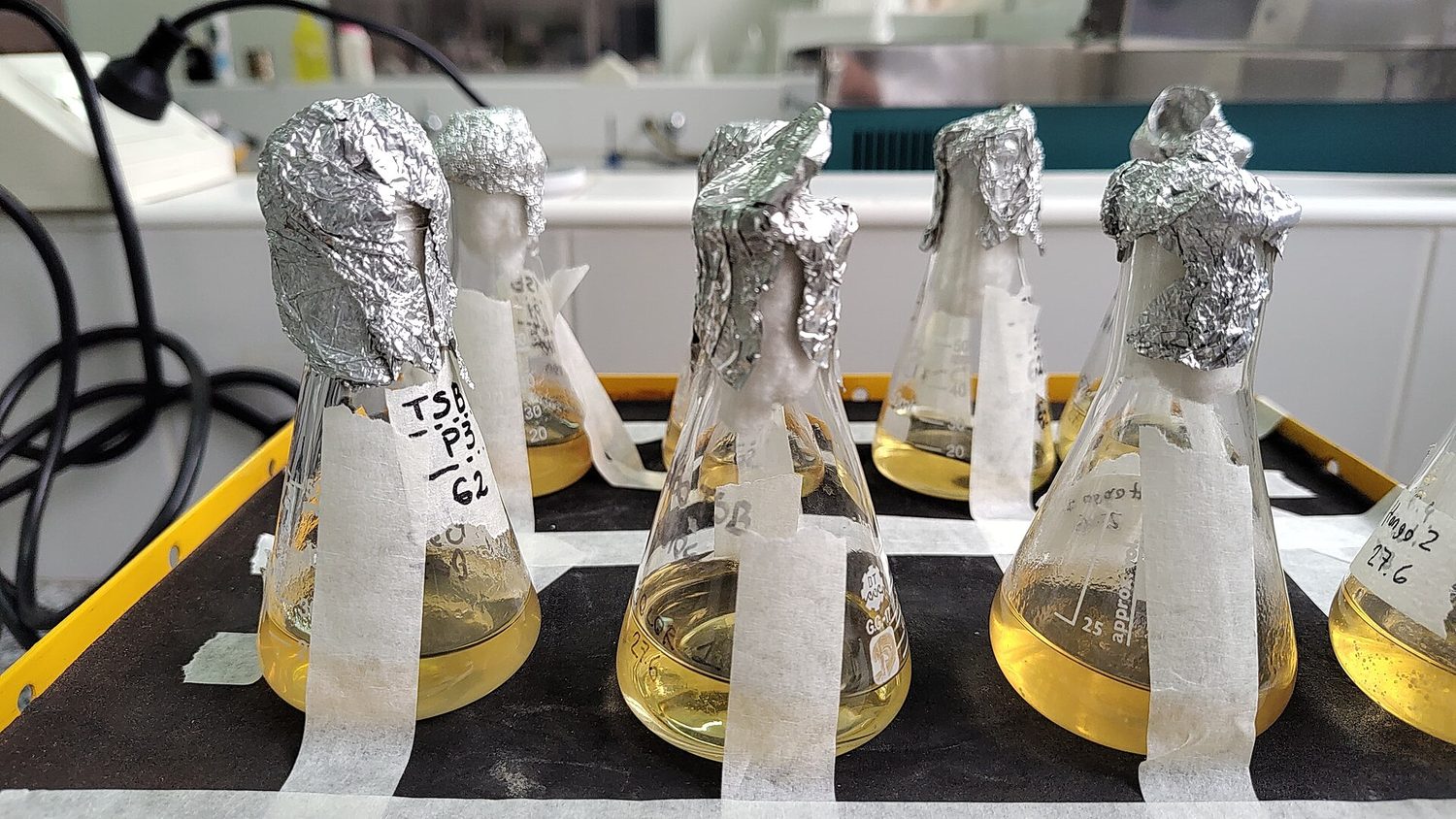
أدوار مخبرية مخروطية الشكل تحتوي على سائل معكر ومغطاة بالرقاقة، تخمر في المختبر
صناعياً، يُصنع الإيثانول أيضاً عن طريق تخمير السكر؛ ثم يتم فصله عن الماء بالتقطير التجزيئي

تفاعلات الكحوليات

  • احتراق: تحترق الكحوليات في الأكسجين لتعطي ثاني أكسيد الكربون والماء.
  • استبدال إلى هالوجينوألكنة، مثلاً مع $\text{HX}$، $\text{PCl}_5$، $\text{PCl}_3$ وحرارة، أو $\text{SOCl}_2$.
  • مع الصوديوم: تتفاعل الكحوليات مع صوديوم معدني لتعطي هيدروجين وألكوكسيد صوديوم — مثل الماء ولكن ببطء أكبر.
  • أكسدة باستخدام $\text{K}_2\text{Cr}_2\text{O}_7$ محمض (أو $\text{KMnO}_4$). يعتمد الناتج على فئة الكحول (انظر أدناه).
  • إزالة الماء للحصول على ألكين، باستخدام $\text{Al}_2\text{O}_3$ عامل حفاز ساخن أو حمض مركز.
  • تكوين إستر: يتفاعل الكحول مع حمض كربوكسيلي (مع $\text{H}_2\text{SO}_4$ عامل حفاز مركز) لإنتاج إستر.
كحول يتفاعل بأربع طرق: احتراق، إزالة ماء إلى ألكين، استرة، وأكسدة
يمكن للكحول أن يحترق، ويخضع للتجفيف، أو التستريفة، أو الأكسدة

ثلاث تصنفات وكيفية التمييز بينها عبر الأكسدة

تُصنف الكحولية أولية، ثانوية أو ثالثية، اعتماداً على عدد ذرات الكربون المرتبطة بالكربون الحامل للـ $\text{–OH}$. قد تحتوي بعض الجزيئات على أكثر من مجموعة $\text{–OH}$.

ثلاثة كربونات مركزية تحمل كل منها مجموعة OH: الأولية بها مجموعة R واحدة وهيدروجينان، والثانوية مجموعتي R وهيدروجين واحد، والثالثية ثلاث مجموعات R
يحدد التصنيف الكربون الحامل لـ –OH: مجموعة R واحدة تجعله أولياً، اثنتان ثانوياً، ثلاث ثالثياً — مما يحدد كيفية أكسدته
الفئة ناتج الأكسدة
أولية ألدهيد (عن طريق التقطير)، ثم حمض كربوكسيلي (عن طريق الارتداد)
ثانوية كيتون
ثالثية لا تُؤكسد
مخطط: كحول أولي يتأكسد إلى ألدهيد ثم حمض كربوكسيلي، وكحول ثانوي إلى كيتون، وكحول ثالثي لا يتأكسد
الأكسدة حسب التصنيف: الكحول الأولي يعطي ألدهيد ثم حمض كربوكسيلي، والثانوي يعطي كيتون، والثالثي لا يتأكسد

في اختبار سريع، يتحول $\text{K}_2\text{Cr}_2\text{O}_7$ المحمضي من برتقالي إلى أخضر مع كحول أولي أو ثانوي، ويبقى برتقالياً مع كحول ثالثي.

أنبوبا اختبار يحتويان على ثنائي كرومات برتقالي: أحدهما مع كحول أولي أو ثانوي تحول إلى الأخضر، والآخر مع كحول ثالثي لا يزال برتقالياً
يثبت ثنائي الكرومات المحمضي لوناً برتقالياً إلى أخضر مع كحول أولي أو ثانوي، ويبقى برتقالياً مع كحول ثالثي
  • التقطير يزيل الألدهيد فور تكوّنه قبل أن يتأكسد أكثر.
  • الارتداد يحافظ على غليان الخليط وإرجاع البخار، ليتم أكسدة الكحول بالكامل إلى الحمض الكربوكسيلي.
مجموعتان من الأجهزة: ارتداد بمكثف عمودي يعيد البخار إلى الشرايين، وتقطير بمكثف مائل يؤدي إلى شرايين التجميع
يقوم التقطير بإزالة الألدهيد فور تكوّنه؛ بينما يحافظ الارتداد على الغليان وإعادة البخار، ليتم الأكسدة الكاملة إلى الحمض
عمود تقطير تجزيئي في مختبر مع مقياس حرارة ومكثف ماء
تجهيز تقطير حقيقي: يتبخر البخار، يبرد في المكثف ويجمع — نفس الفكرة لفصل الإيثانول عن الخليط المخمر

اختبار اليودوفورم

إذا سخّنت كحولاً يحتوي على مجموعة $\text{CH}_3\text{CH(OH)}-$ مع يود مائي قلوي، تحصل على راسب أصفر فاتح من ثلاثي يودوميثان ($\text{CHI}_3$) والأيون $\text{RCO}_2^-$. هذا اختبار مفيد لهذه المجموعة.

حمضية الكحولات

مجموعة $\text{–OH}$ تجعل الكحولات ضعيفة الحموضة جداً: يمكنها فقدان $\text{H}^+$ لتكوين أيون $\text{RO}^-$. لكن حمضيتها أقل من حموضة الماء. وذلك لأن مجموعة الألكيل تدفع كثافة الإلكترونات نحو الأكسجين، مما يجعل أيون $\text{RO}^-$ أقل استقراراً، لذلك تمسك الكحول بـ $\text{H}^+$ بشكل أكثر تماسكاً.

مثال محلول. ثلاث زجاجات غير معلّمة تحتوي على بيوتان-1-ول، وبيوتان-2-ول، و2-ميثيلبروبان-2-ول. كيف يُمكّن تسخين كل منها مع $\text{K}_2\text{Cr}_2\text{O}_7$ المحمض تمييزها عن بعضها؟ الأمر يتعلق بعدد الهيدروجينات الملتصقة بـ الكربون الحامل لـ $\text{OH}$. بيوتان-1-ول هو أولي (يحتوي هذين الهيدروجين): يتحول الديكرومات البرتقالي إلى الأخضر، وبالتقطير يتم الحصول على ألدهيد (بيوتانال)، أو بال的回流 (reflux) يتم الحصول على حمض كربوكسيلي (بيوتانويك). بيوتان-2-ول هو ثانوي (يحتوي هيدروجين واحداً): يتحول أيضاً إلى الأخضر، ولكن المنتج هو كيتون (بيوتانون)، والذي لن يتأكسد أكثر. 2-ميثيلبروبان-2-ول هو ثالثي (لا يوجد مثل هذا الهيدروجين): لا يوجد شيء لإزالته، لذا يبقى الديكرومات برتقالياً. اللون يفصل فقط الثالثي عن الاثنين الآخرين - لفصل الأولي عن الثانوي يجب تحديد المنتج (يعطي الألدهيد مرآة فضية مع_quizens'، ولا يفعل الكيتون ذلك).

Explore · ⁨استكشف⁩

Alcohol reaction map · ⁨خريطة تفاعلات الكحول⁩

Choose what happens to alcohols under different reagents. · ⁨اختر ما يحدث للكحوليات تحت تأثير كواشف مختلفة.⁩

Explore · ⁨استكشف⁩

Alcohol oxidation test lab · ⁨مختبر اختبار أكسدة الكحول⁩

Classify alcohols by oxidation product and observation. · ⁨صنّف الكحوليات حسب ناتج الأكسدة والملاحظة.⁩

Vocabulary · ⁨مفردات⁩ Train · ⁨تدريب⁩
English العربية
alcohol/ˈælkəhɒl/ كحول
electrophilic addition/ɪˌlektrəʊˈfɪlɪk əˈdɪʃn/ إضافة إلكتروفيلية
alkene/ˈælkiːn/ ألكين
diol/dɪˈɒl/ ديول
halogenoalkane/ˈheɪləʊdʒnəʊlkeɪn/ هالوجينو ألكان
reduction/rɪˈdʌkʃn/ الاختزال
aldehyde/ˈældɪhaɪd/ ألدهيد
ketone/ˈketəʊn/ كيتون
carboxylic acid/ˌkɑːbəkˈsɪlɪk ˈæsɪd/ حمض كربوكسيلي
hydrolysis/haɪˈdrɒləsɪs/ تحلل مائي
ester/ˈestə/ إستر
oxidation/ˌɒksɪˈdeɪʃn/ أكسدة
dehydration/ˌdiːhaɪˈdreɪʃn/ إزالة الماء
primary/ˈpraɪməri/ أولي
secondary/ˈsekəndəri/ ثانوي
tertiary/ˈtɜːʃjəri/ ثالثي
distillation/dɪstɪˈleɪʃn/ التقطير
reflux/ˈriːflʌks/ التقطير العكسي
tri-iodomethane/traɪ ˈaɪədəʊmθeɪn/ ثلاثي يودو ميثان
acidity/æˈsɪdɪti/ حموضة
16.1

Exam tips · ⁨نصائح للامتحان⁩

English
  • Classify the alcohol as primary, secondary or tertiary first — it decides the oxidation product.
  • Oxidation with acidified $\text{K}_2\text{Cr}_2\text{O}_7$ (orange → green): primary → aldehyde (distil) → acid (reflux); secondary → ketone; tertiary → no reaction.
  • Distinguish the conditions for aldehyde vs acid from a primary alcohol (distillation vs reflux).
  • Name esters correctly (the acid part comes second, ending "-oate").
العربية
  • صنف الكحول كـ أولي، ثانوي أو ثالثي أولاً — فهو يحدد ناتج الأكسدة.
  • الأكسدة باستخدام $\text{K}_2\text{Cr}_2\text{O}_7$ المحمض (برتقالي → أخضر): أولي → ألدهيد (تقطير) → حمض (回流)؛ ثانوي → كيتون؛ ثالثي → لا تفاعل.
  • ميّز بين ظروف الألدهيد مقابل الحمض الناتجة من كحول أولي (التقطير مقابل回流).
  • سمِّ الإسترات بشكل صحيح (يأتي جزء الحمض في النهاية وينتهي بـ "-oate").

Interactive lessons on this topic · ⁨دروس تفاعلية حول هذا الموضوع⁩

Work through it step by step, with instant-check exercises. · ⁨ا-working عليه خطوة بخطوة، مع تمارين تحقق فوري.⁩

Past Papers · ⁨أوراق الامتحانات السابقة⁩

More topics in A-Level Chemistry · ⁨A-Level الكيمياء⁩ · ⁨المزيد من المواضيع في A-Level Chemistry · ⁨A-Level الكيمياء⁩⁩

Log in or create account · ⁨تسجيل الدخول أو إنشاء حساب⁩

IGCSE, A-Level & AP