跳到主要内容

补语

HSK 5 · 知识点 18

本主题的视频课程 打开视频页面
5:44

HSK 5 语法 18:补语

形容词 + 得 + 很 / 不得了 / 要命 / 不行。“不得了”表示程度难以置信;“要命”表示极其严重(口语);“不行”表示糟糕透顶(口语)。结构:形容词…

英文讲解与普通话例句 · 字幕与原声同步

点击任意汉字可查看拼音和释义。
English

Complements finish the meaning of a verb. Some show degree ((degree marker)得deextremely; terrible要命yào mìng, bad坏huài(completed / change)了le), some ability ((degree marker)得de(completed / change)了le/(as a resultative verb…不了bù liǎo), some a result (to live (somewhere)住zhù, to open; to drive开kāi, come out / (result: see, think up)出来chū lai, (ongoing -ing)着zhe, to / arrive / (result: get)到dào), and Verb + to come来lái + Verb + to go去qù shows an action going back and forth. Ask each time: does it say how much, whether you can, or how it ended?

18.1

一目了然

English
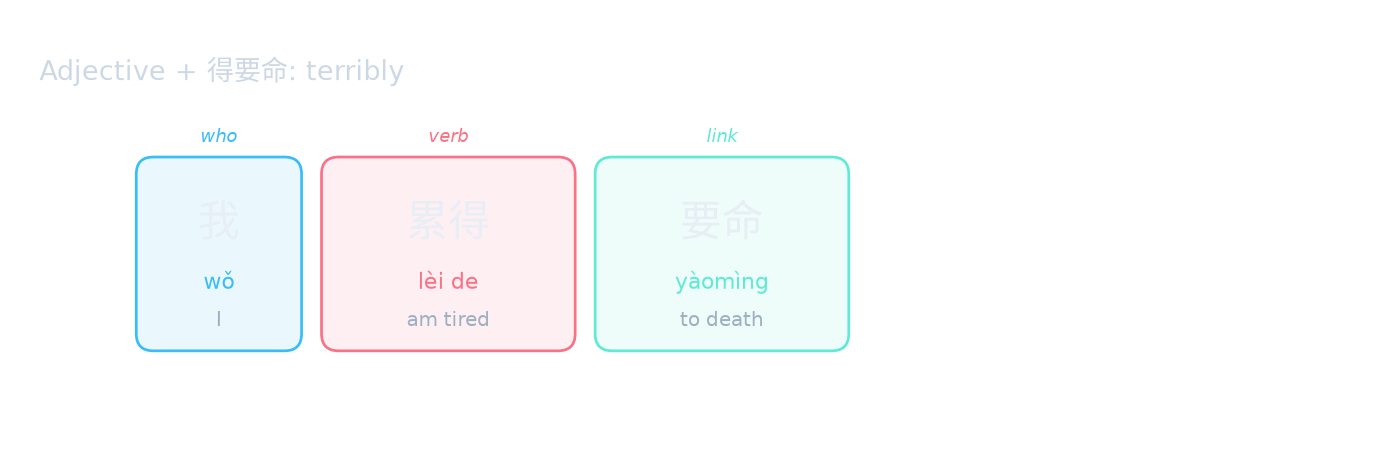
  • 1. Advanced degree complements – (degree marker)得de + degree / adjective linker很hěn / extremely; terrible要命yào mìng …: 我累wǒ lèi(degree marker)得deextremely; terrible要命yào mìng,what什么shén meall / both都dōunot want to不想bù xiǎngto do; to make做zuò(completed / change)了le。
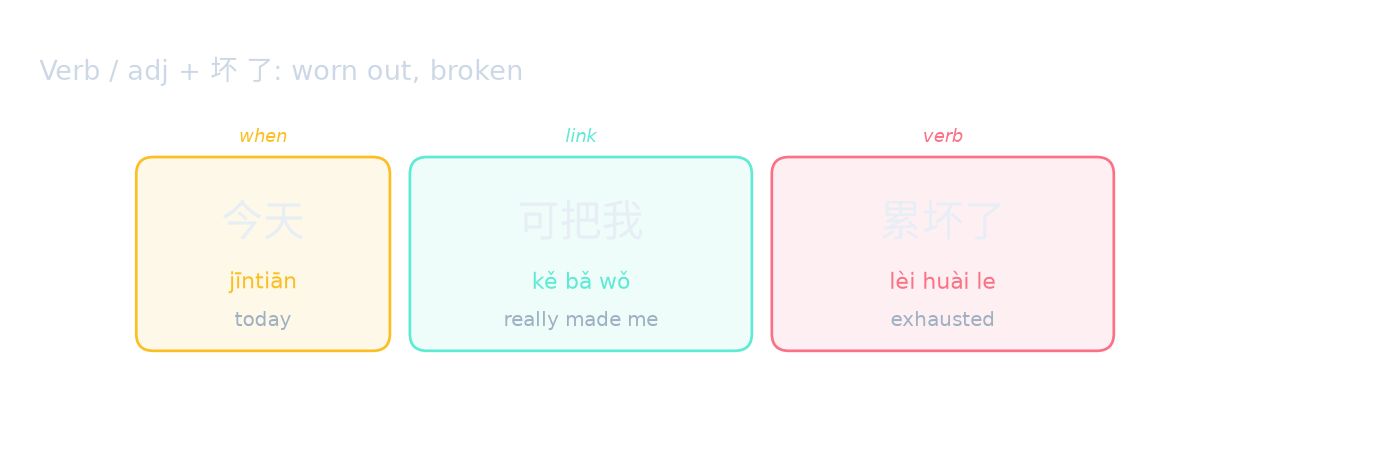
  • 2. Verb / Adj + bad坏huài(completed / change)了le – broken / to an extreme: today今天jīn tiān(prefix) can可kě(把: marks the object)把bǎI / me我wǒto become exhausted累坏lèi huài(completed / change)了le!
  • 3. Verb + (degree marker)得de(completed / change)了le / (as a resultative verb…不了bù liǎo – can / can't manage: so much这么zhè me多菜duō cài,we / us我们wǒ mento eat吃chī(as a resultative verb…不了bù liǎo。
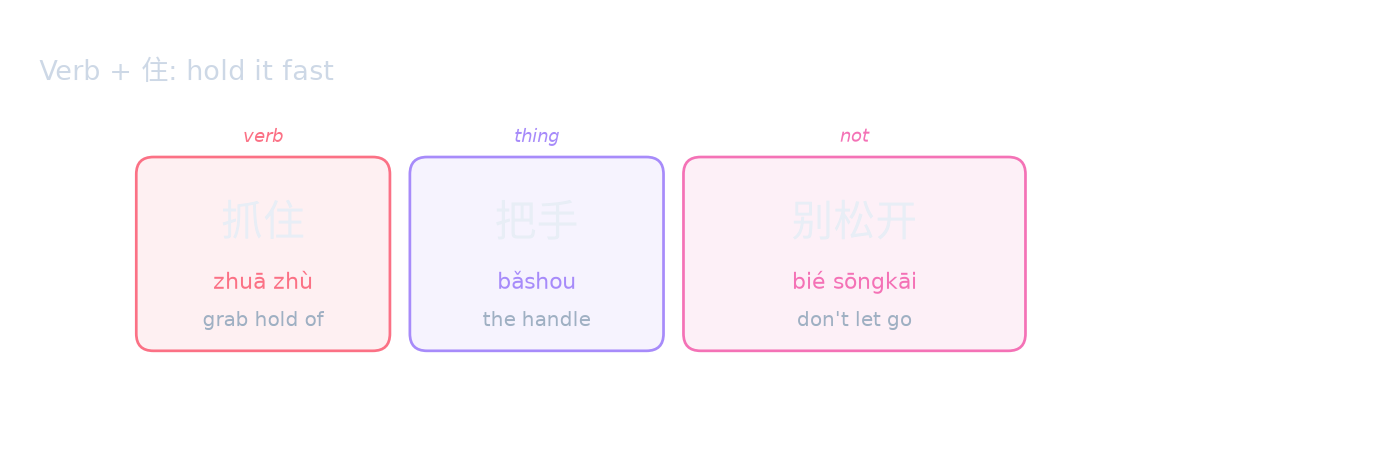
  • 4. Result complements to live (somewhere)住zhù / to open; to drive开kāi / come out / (result: see, think up)出来chū lai: to grab hold of抓住zhuā zhùhandle把手bǎ shǒu,don't别biéto release松开sōng kāi!
  • 5. Verb + (ongoing -ing)着zhe (zháo) – managed to / succeeded: I / me我wǒ两点liǎng diǎnonly then / not until才cáito fall asleep睡着shuì zháo。
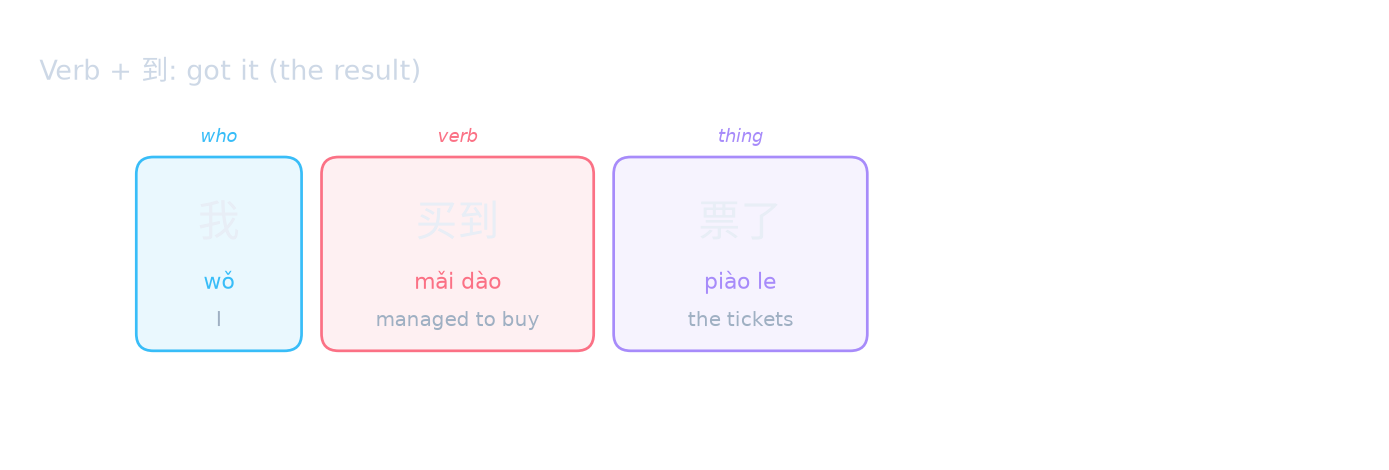
  • 6. Verb + to / arrive / (result: get)到dào – succeed in reaching: I / me我wǒto buy买mǎito / arrive / (result: get)到dàoticket票piào(completed / change)了le!
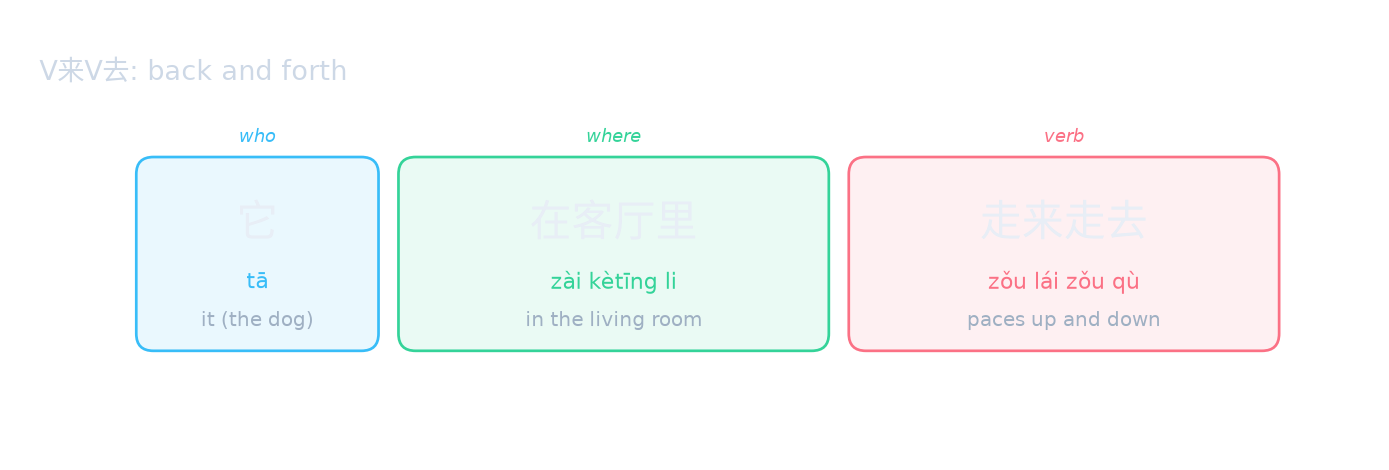
  • 7. Verb + to come来lái + Verb + to go去qù – back and forth: it它tāat / in在zàiliving room客厅kè tīnginside; in里lǐ走来走去zǒu lái zǒu qù。
18.2

1. 高级程度补语(得 + 很 / 要命 …)

English

Form: adjective / feeling + (degree marker)得de + degree / adjective linker很hěn / extremely; terrible要命yào mìng / won't do不行bù xíng / extremely / terrible不得了bù dé liǎo

  • 我累wǒ lèi(degree marker)得deextremely; terrible要命yào mìng,what什么shén meall / both都dōunot want to不想bù xiǎngto do; to make做zuò(completed / change)了le。 Wǒ lèi de yàomìng. – I'm dead tired; I don't feel like doing anything.
  • here这里zhè lǐquiet安静ān jìng(degree marker)得dedegree / adjective linker很hěn。 – It's really quiet here.
  • I / me我wǒhungry饿è(degree marker)得dewon't do不行bù xíng(completed / change)了le。 – I'm starving.
  • to hear听到tīng dàonews; message消息xiāo xī,she / her她tāhappy; glad高兴gāo xìng(degree marker)得deextremely / terrible不得了bù dé liǎo。 – She was overjoyed at the news.

How it works. These complements come after the adjective with (degree marker)得de and push it to a high degree. They are spoken and expressive.

Complement Feel Example
(degree marker)得dedegree / adjective linker很hěn emphatic, mild good好hǎo(degree marker)得dedegree / adjective linker很hěn
(degree marker)得deextremely; terrible要命yào mìng very strong, usually a complaint 疼得téng déextremely; terrible要命yào mìng
(degree marker)得dewon't do不行bù xíng can hardly bear it 困得kùn déwon't do不行bù xíng
(degree marker)得deextremely / terrible不得了bù dé liǎo extreme, good or bad happy; glad高兴gāo xìng(degree marker)得deextremely / terrible不得了bù dé liǎo

Watch out

  • Not literal: 冷得lěng déextremely; terrible要命yào mìng means "freezing", not dangerous.
  • No degree word before the adjective: wrong: 很累hěn lèi(degree marker)得deextremely; terrible要命yào mìng → tired累lèi(degree marker)得deextremely; terrible要命yào mìng.
  • In essays, use very非常fēi cháng / very十分shí fēn / especially / special特别tè bié.
Adjective + 得要命: terribly
词汇 训练
汉字 拼音 English
不得了 bù dé liǎo extremely; terrible
18.3

2. 动词 / 形容词 + 坏了(损坏或达到极端程度)

English

Form: action verb + bad坏huài ((completed / change)了le) (broken) · feeling / state + bad坏huài(completed / change)了le (terribly)

  • I / me我wǒ(modifier / structural particle)的demobile phone手机shǒu jīto drop and break摔坏shuāi huài(completed / change)了le。 Wǒ de shǒujī shuāihuài le. – I dropped my phone and broke it.
  • younger brother弟弟dì di(把: marks the object)把bǎI / me我wǒ(modifier / structural particle)的despectacles眼镜yǎn jìng弄坏了nòng huài le。 – My little brother broke my glasses.
  • today今天jīn tiān(prefix) can可kě(把: marks the object)把bǎI / me我wǒto become exhausted累坏lèi huài(completed / change)了le! – Today completely wore me out!
  • to hear听到tīng dàothis这个zhè genews; message消息xiāo xī,she / her她tāhappy; glad高兴gāo xìngbad坏huài(completed / change)了le。 – She was thrilled at the news.

How it works. After an action verb, bad坏huài is a result: the thing broke (to drop and break摔坏shuāi huài by dropping, to use / with用yòngbad坏huài by use, to ruin弄坏nòng huài by handling). After a feeling or state, bad坏huài(completed / change)了le means "extremely" and nothing breaks: 饿坏è huài(completed / change)了le, 急坏jí huài(completed / change)了le, happy; glad高兴gāo xìngbad坏huài(completed / change)了le. (completed / change)了le is usually needed in that sense.

computer电脑diàn nǎoto wear out (tools)用坏yòng huài(completed / change)了le I / me我wǒ饿坏è huài(completed / change)了le
broken (result) starving (degree)

Spoken frame. (prefix) can可kě(把: marks the object)把bǎ + person + feeling + bad坏huài(completed / change)了le: (prefix) can可kě(把: marks the object)把bǎI / me我wǒ急坏jí huài(completed / change)了le "I was worried sick".

Watch out

  • The broken-result sense often takes (把: marks the object)把bǎ with the thing damaged: (把: marks the object)把bǎspectacles眼镜yǎn jìng弄坏了nòng huài le.
Verb / adj + 坏 了: worn out, broken
18.4

3. 动词 + 得了 / 不了(能 / 不能做到)

English

Form: verb + (degree marker)得de(completed / change)了le / (as a resultative verb…不了bù liǎo (liǎo)

  • so much这么zhè me多菜duō cài,we / us我们wǒ mento eat吃chī(as a resultative verb…不了bù liǎo。 Wǒmen chī bu liǎo. – That's more food than we can eat.
  • so much这么zhè mehot热rè(modifier / structural particle)的deday天tiān,I / me我wǒcan't stand受不了shòu bù liǎo。 – I can't stand this heat.
  • tomorrow明天míng tiānI / me我wǒto be occupied with sth有事yǒu shì,to go去qù(as a resultative verb…不了bù liǎo。 – I've got something on tomorrow, so I can't go.
  • you你nǐ一个yí gèperson人rénto move搬bān(degree marker)得de(completed / change)了le(yes/no ?)吗ma? – Can you move it by yourself?

How it works. (completed / change)了le here is read liǎo "manage, finish". (degree marker)得de(completed / change)了le says something can be managed and (as a resultative verb…不了bù liǎo that it can't: too much, too hard, or blocked by circumstances. (as a resultative verb…不了bù liǎo is far more common; questions use (degree marker)得de(completed / change)了le(yes/no ?)吗ma or (degree marker)得de(completed / change)了le……(as a resultative verb…不了bù liǎo.

to eat吃chī(as a resultative verb…不了bù liǎo 吃不完chī bù wán cannot不能bù néngto eat吃chī
can't manage (too much / unable) can't finish (some will be left) mustn't / can't eat it

Watch out

  • Not le: wrong: chī bu le → chī bu liǎo.
  • (as a resultative verb…不了bù liǎo also predicts: 他来tā lái(as a resultative verb…不了bù liǎo means he won't be able to come.
Verb + 不了: can't (manage) to
18.5

4. 结果补语 住 / 开 / 出来

English

Form: verb + to live (somewhere)住zhù / to open; to drive开kāi / come out / (result: see, think up)出来chū lai (result complements)

  • to grab hold of抓住zhuā zhùhandle把手bǎ shǒu,don't别biéto release松开sōng kāi! Zhuāzhù bǎshǒu, bié sōngkāi! – Hold on to the handlebars, don't let go!
  • to remember记住jì zhùI / me我wǒ(modifier / structural particle)的de电话号码diàn huà hào mǎ。 – Remember my phone number.
  • I / me我wǒto look at; to watch; to read看kàncome out / (result: see, think up)出来chū laihe / him他tāat / in在zàito lie说谎shuō huǎng。 – I could tell he was lying.
  • he / him他tāwant / think / miss想xiǎngout / to happen出chū(completed / change)了le一个yí gègood好hǎomeans办法bàn fǎ。 – He came up with a good idea.

How it works. The complement says what result the action reached.

Complement Result Examples
to live (somewhere)住zhù fixed, held, stopped to grab hold of抓住zhuā zhù grab, to remember记住jì zhù remember, to stop / stand still站住zhàn zhù stop!
to open; to drive开kāi open, apart, away to open打开dǎ kāi open, to pull open拉开lā kāi pull open, to leave走开zǒu kāi go away
come out / (result: see, think up)出来chū lai out, produced, recognised want / think / miss想xiǎngcome out / (result: see, think up)出来chū lai think of, to look at; to watch; to read看kàncome out / (result: see, think up)出来chū lai tell, to write写xiěcome out / (result: see, think up)出来chū lai write out

Potential forms. can't remember记不住jì bú zhù can't remember · 打不开dǎ bù kāi won't open · want / think / miss想xiǎngnot不bùcome out / (result: see, think up)出来chū lai can't think of it. With an object, come out / (result: see, think up)出来chū lai can split: want / think / miss想xiǎngout / to happen出chū一个yí gèmeans办法bàn fǎto come来lái.

Watch out

  • to see看见kàn jiàn means seeing with your eyes; to look at; to watch; to read看kàncome out / (result: see, think up)出来chū lai means working something out from clues.
Verb + 住: hold it fast
18.6

5. 动词 + 着(zháo)(表示成功做到)

English

Form: verb + (ongoing -ing)着zhe (zháo) · verb + not不bù(ongoing -ing)着zhe / not / haven't没méi + verb + (ongoing -ing)着zhe

  • I / me我wǒ两点liǎng diǎnonly then / not until才cáito fall asleep睡着shuì zháo。 Wǒ liǎng diǎn cái shuìzháo. – I didn't fall asleep until two.
  • I / me我wǒ太紧张tài jǐn zhāng(completed / change)了le,睡不着shuì bù zhe。 – I'm too nervous to sleep.
  • I / me我wǒto look for; to give change找zhǎo(completed / change)了lea long time / half a day半天bàn tiānalso也yěnot / haven't没méito look for; to give change找zhǎo(ongoing -ing)着zhe。 – I looked for ages and couldn't find it.

How it works. Read zháo, (ongoing -ing)着zhe after a verb means the action reached its goal: to fall asleep睡着shuì zháo fall asleep, to look for; to give change找zhǎo(ongoing -ing)着zhe find, to buy买mǎi(ongoing -ing)着zhe manage to buy. The potential 睡不着shuì bù zhe "can't get to sleep" is very common. With to look for; to give change找zhǎo and to buy买mǎi, to / arrive / (result: get)到dào is the standard form (to find找到zhǎo dào, to buy买mǎito / arrive / (result: get)到dào); (ongoing -ing)着zhe sounds colloquial and northern.

to fall asleep睡着shuì zháo shuìzháo to fall asleep睡着shuì zháo shuìzhe to sleep睡shuìto / arrive / (result: get)到dào十点shí diǎn
fall asleep in the state of sleeping (he / him他tāto fall asleep睡着shuì zháo(and …? / softener)呢ne) sleep until ten

Watch out

  • The sentence tells you the reading: 睡不着shuì bù zhe and not / haven't没méito fall asleep睡着shuì zháo are always zháo.
  • to fall asleep睡着shuì zháo "fall asleep" has no to / arrive / (result: get)到dào version.
Verb + 着 (zháo): succeed in
18.7

6. 动词 + 到(成功达到)

English

Form: verb + to / arrive / (result: get)到dào (+ object / place / time)

  • I / me我wǒto buy买mǎito / arrive / (result: get)到dàoticket票piào(completed / change)了le! Wǒ mǎidào piào le! – I got tickets!
  • you你nǐto receive收到shōu dàoI / me我wǒ(modifier / structural particle)的demail邮件yóu jiàn(completed / change)了le(yes/no ?)吗ma? – Did you get my email?
  • he / him他tāto walk / to leave走zǒuto / arrive / (result: get)到dàodoorway门口mén kǒu。 – He walked to the door.
  • we / us我们wǒ men聊到liáo dàodegree / adjective linker很hěnlate / evening晚wǎn。 – We chatted until very late.

How it works. to / arrive / (result: get)到dào after a verb marks that the action reached its goal (a thing found, bought, received), a place or a time.

Action Result
to look for; to give change找zhǎo look for to find找到zhǎo dào find
to look at; to watch; to read看kàn look to see看到kàn dào / to see看见kàn jiàn see
to listen to听tīng listen to hear听到tīng dào / to hear听见tīng jiàn hear

Forms. Negative: 没买méi mǎito / arrive / (result: get)到dào (tried, didn't get one). Potential: to buy买mǎito get得到dé dào / 买不到mǎi bú dào.

Watch out

  • Searching isn't finding: I / me我wǒto look for; to give change找zhǎo(completed / change)了le,but可是kě shìnot / haven't没méito find找到zhǎo dào.
  • Don't negate the result with not不bù for past events: wrong: I / me我wǒnot不bùto buy买mǎito / arrive / (result: get)到dào → I / me我wǒnot / haven't没méito buy买mǎito / arrive / (result: get)到dào.
Verb + 到: got it (the result)
18.8

7. 动词 + 来 + 动词 + 去(来回)

English

Form: verb + to come来lái + same verb + to go去qù

  • it它tāat / in在zàiliving room客厅kè tīnginside; in里lǐ走来走去zǒu lái zǒu qù。 Tā zài kètīng li zǒu lái zǒu qù. – It keeps pacing back and forth in the living room.
  • child孩子hái zi(plural)们menat / in在zàicourtyard院子yuàn ziinside; in里lǐto scamper跑来跑去pǎo lái pǎo qù。 – The children are running about in the yard.
  • I / me我wǒ想来想去xiǎng lái xiǎng qù,or / still还是hái shìto decide / decision决定jué dìng不去bù qù(completed / change)了le。 – I thought it over and over and decided not to go after all.
  • they他们tā men说来说去shuō lái shuō qùor / still还是hái shìthat那nà几句话jǐ jù huà。 – They went round in circles saying the same few things.

How it works. Repeating a one-syllable verb with to come来lái and to go去qù shows movement in many directions, or doing something over and over. With thinking and talking, it suggests going round in circles before a conclusion (or / still还是hái shì / finally; last最后zuì hòu).

走来走去zǒu lái zǒu qù to make a round trip来回lái huíto walk / to leave走zǒu 一个yí gèto make a round trip来回lái huí
walk about, pace walk back and forth a round trip

Watch out

  • Use the same verb twice: wrong: 走来zǒu láito run跑pǎoto go去qù → 走来走去zǒu lái zǒu qù.
  • It describes an activity; don't add a result complement (wrong: 走来走去zǒu lái zǒu qùto finish完wán(completed / change)了le).
V来V去: back and forth
词汇 训练
汉字 拼音 English
客厅 kè tīng living room
18.9

练习

English

Cover the teaching pages before you answer. The answers are at the end.

1. Advanced degree complements ((degree marker)得de + degree / adjective linker很hěn / extremely; terrible要命yào mìng …)

1. Complete: “I'm starving.” I / me我wǒhungry饿è…………won't do不行bù xíng(completed / change)了le。

2. Which suits a formal essay?

  • A. this这个zhè gequestion / problem问题wèn tí难死nán sǐ(completed / change)了le。
  • B. this这个zhè gequestion / problem问题wèn tírare; hard to come by难得nán déwon't do不行bù xíng。
  • C. this这个zhè gequestion / problem问题wèn tívery非常fēi chángdifficult / hard难nán。
  • D. this这个zhè gequestion / problem问题wèn tírare; hard to come by难得nán déextremely; terrible要命yào mìng。

3. Match each phrase to its meaning.

  • (1) 疼得téng déextremely; terrible要命yào mìng

  • (2) quiet安静ān jìng(degree marker)得dedegree / adjective linker很hěn

  • (3) happy; glad高兴gāo xìng(degree marker)得deextremely / terrible不得了bù dé liǎo

  • A. hurts terribly

  • B. over the moon

  • C. really quiet

4. True or false? 冷得lěng déextremely; terrible要命yào mìng means it is literally dangerously cold. If false, correct it.

5. You finally reach the hostel after walking all day in the mountains. Write your answer in Chinese, then say it aloud.

2. Verb / Adj + bad坏huài(completed / change)了le (broken / to an extreme)

6. Complete: “The kids are starving.” child孩子hái zi(plural)们menhungry饿è…………(completed / change)了le。

7. In computer电脑diàn nǎoto wear out (tools)用坏yòng huài(completed / change)了le, what does bad坏huài express?

  • A. someone was angry
  • B. the computer broke from use
  • C. the computer is bad quality
  • D. extremely

8. Build: “My brother broke my glasses.”

Put in order: younger brother弟弟dì di / to ruin弄坏nòng huài / (把: marks the object)把bǎI / me我wǒ(modifier / structural particle)的despectacles眼镜yǎn jìng / (completed / change)了le。

9. True or false? In happy; glad高兴gāo xìngbad坏huài(completed / change)了le, something is broken. If false, correct it.

10. Your mum comes home after a twelve-hour shift and collapses on the sofa. Use Verb / Adj + bad坏huài(completed / change)了le. Write your answer in Chinese, then say it aloud.

3. Verb + (degree marker)得de(completed / change)了le / (as a resultative verb…不了bù liǎo (can / can't manage)

11. Complete: “I've got something on tomorrow, so I can't come.” I / me我wǒtomorrow明天míng tiānto be occupied with sth有事yǒu shì,to come来lái…………(completed / change)了le。

12. How is (completed / change)了le read in can't stand受不了shòu bù liǎo?

  • A. lài
  • B. le
  • C. lā
  • D. liǎo

13. Build: “I can't stand this heat.”

Put in order: so much这么zhè mehot热rè(modifier / structural particle)的deday天tiān / can't stand受不了shòu bù liǎo。 / , / I / me我wǒ

14. True or false? In a rule, you你nǐcannot不能bù néngto go去qù means you are not allowed; you你nǐto go去qù(as a resultative verb…不了bù liǎo means you are not able to go. If false, correct it.

15. Your host keeps adding dishes to the table, far more than two people can eat. Use Verb + (degree marker)得de(completed / change)了le / (as a resultative verb…不了bù liǎo. Write your answer in Chinese, then say it aloud.

4. Result complements to live (somewhere)住zhù / to open; to drive开kāi / come out / (result: see, think up)出来chū lai

16. Complete: “Remember: the meeting is at nine.” to record记jì…………:meeting会议huì yì九点jiǔ diǎnto start开始kāi shǐ。

17. “I can't open this bottle.” Which is correct?

  • A. this这个zhè gebottle瓶子píng ziI / me我wǒ打不开dǎ bù kāi。
  • B. this这个zhè gebottle瓶子píng ziI / me我wǒnot不bùto open打开dǎ kāi。
  • C. this这个zhè gebottle瓶子píng ziI / me我wǒcannot不能bù néng(of a sports competition or…开打kāi dǎ。
  • D. this这个zhè gebottle瓶子píng ziI / me我wǒto open打开dǎ kāinot不bù。

18. Match each verb to its meaning.

  • (1) to grab hold of抓住zhuā zhù

  • (2) to depart离开lí kāi

  • (3) want / think / miss想xiǎngcome out / (result: see, think up)出来chū lai

  • (4) to look at; to watch; to read看kàncome out / (result: see, think up)出来chū lai

  • A. tell, make out

  • B. come up with

  • C. grab hold of

  • D. leave

19. True or false? to look at; to watch; to read看kàncome out / (result: see, think up)出来chū lai and to see看见kàn jiàn mean the same. If false, correct it.

20. You are helping your little sister learn to ride a bike. Use Result complements to live (somewhere)住zhù / to open; to drive开kāi / come out / (result: see, think up)出来chū lai. Write your answer in Chinese, then say it aloud.

5. Verb + (ongoing -ing)着zhe (zháo) (managed to / succeeded)

21. Complete: “I'm too nervous; I can't get to sleep.” I / me我wǒ太紧张tài jǐn zhāng(completed / change)了le,to sleep睡shuìnot不bù…………。

22. How is (ongoing -ing)着zhe read in I / me我wǒ两点liǎng diǎnonly then / not until才cáito fall asleep睡着shuì zháo?

  • A. zhuó
  • B. zháo
  • C. zhe
  • D. zhāo

23. Build: “Did you find the keys?”

Put in order: (completed / change)了le / key钥匙yào shi / to look for; to give change找zhǎo(ongoing -ing)着zhe / (yes/no ?)吗ma?

24. True or false? to sleep睡shuìto / arrive / (result: get)到dào十点shí diǎn means “fell asleep at ten”. If false, correct it.

25. You tossed and turned for hours before you managed to sleep. Use Verb + (ongoing -ing)着zhe. Write your answer in Chinese, then say it aloud.

6. Verb + to / arrive / (result: get)到dào (succeed in reaching)

26. Complete: “I looked for it for ages but didn't find it.” I / me我wǒto look for; to give change找zhǎo(completed / change)了lea long time / half a day半天bàn tiānalso也yěnot / haven't没méito look for; to give change找zhǎo…………。

27. Which says “I can't get hold of this book anywhere”?

  • A. this这zhè本书běn shūwhere哪儿nǎrall / both都dōuto buy买mǎito / arrive / (result: get)到dàonot不bù。
  • B. this这zhè本书běn shūwhere哪儿nǎrall / both都dōunot不bùto buy买mǎito / arrive / (result: get)到dào。
  • C. this这zhè本书běn shūwhere哪儿nǎrall / both都dōunot / haven't没méito buy买mǎi。
  • D. this这zhè本书běn shūwhere哪儿nǎrall / both都dōu买不到mǎi bú dào。

28. Build: “We chatted until very late.”

Put in order: 聊到liáo dào / we / us我们wǒ men / degree / adjective linker很hěnlate / evening晚wǎn。

29. True or false? to hear听到tīng dào makes clear that the sound was actually heard. If false, correct it.

30. Concert tickets sold out in two minutes, but you clicked fast enough. Use Verb + to / arrive / (result: get)到dào. Write your answer in Chinese, then say it aloud.

7. Verb + to come来lái + Verb + to go去qù (back and forth)

31. Complete: “Birds are flying back and forth.” bird鸟儿niǎo ér飞来fēi láito fly飞fēi…………。

32. Which is correct?

  • A. he / him他tā走来走去zǒu lái zǒu qù。
  • B. he / him他tā走来zǒu láito run跑pǎoto go去qù。
  • C. he / him他tāto walk / to leave走zǒuto go去qù走来zǒu lái(completed / change)了leto finish完wán。
  • D. 他来tā láito walk / to leave走zǒuto go去qùto walk / to leave走zǒu。

33. Build: “I thought it over and over and decided not to go.”

Put in order: or / still还是hái shìto decide / decision决定jué dìng / , / 不去bù qù(completed / change)了le。 / I / me我wǒ想来想去xiǎng lái xiǎng qù

34. True or false? 一个yí gèto make a round trip来回lái huí means “a round trip”. If false, correct it.

35. Your dog can't settle before the storm and keeps pacing around the living room. Use Verb + to come来lái + Verb + to go去qù. Write your answer in Chinese, then say it aloud.

18.10

混合练习

English

These questions mix the patterns and use new situations.

36. Choose (degree marker)得de(completed / change)了le or (ongoing -ing)着zhe: so much这么zhè me多菜duō cài,I / me我wǒ一个yí gèperson人rénto eat吃chīnot不bù…………。 / I / me我wǒto look for; to give change找zhǎo(completed / change)了lea long time / half a day半天bàn tiān,finally终于zhōng yúto look for; to give change找zhǎo…………(completed / change)了le。

37. Choose to live (somewhere)住zhù or to open; to drive开kāi: 请记qǐng jì…………I / me我wǒ(modifier / structural particle)的de电话号码diàn huà hào mǎ。 / please; to invite请qǐngto stand as a goalkeeper把门bǎ ménto hit / play / make (a call)打dǎ…………。

38. Say "He walked back and forth in the room."

39. What does 饿坏è huài(completed / change)了le mean?

40. Find and fix the problem. A classmate thinks to look at; to watch; to read看kàn(as a resultative verb…不了bù liǎo and not / haven't没méito look at; to watch; to read看kànto finish完wán mean the same. What is the difference?

41. Use it yourself. Ask someone to hold the door, and say you can't eat so much food.

18.11

答案与解析

English

Mark your work, then correct each mistake in your own words.

1. Advanced degree complements ((degree marker)得de + degree / adjective linker很hěn / extremely; terrible要命yào mìng …)

1. (degree marker)得de

Adj + (degree marker)得de + won't do不行bù xíng.

2. C. this这个zhè gequestion / problem问题wèn tívery非常fēi chángdifficult / hard难nán。

The (degree marker)得de complements are colloquial; essays use very非常fēi cháng.

3. (1) A: 疼得téng déextremely; terrible要命yào mìng = hurts terribly; (2) C: quiet安静ān jìng(degree marker)得dedegree / adjective linker很hěn = really quiet; (3) B: happy; glad高兴gāo xìng(degree marker)得deextremely / terrible不得了bù dé liǎo = over the moon

All are degree complements with different flavours.

4. False.

extremely; terrible要命yào mìng is just an intensifier here.

5. Model answer: 我累wǒ lèi(degree marker)得deextremely; terrible要命yào mìng,what什么shén meall / both都dōunot want to不想bù xiǎngto do; to make做zuò(completed / change)了le。

Check your answer:

  • extremely; terrible要命yào mìng does not mean real danger: 冷得lěng déextremely; terrible要命yào mìng just means "freezing".
  • No degree / adjective linker很hěn before the adjective: tired累lèi(degree marker)得deextremely; terrible要命yào mìng, not 很累hěn lèi(degree marker)得deextremely; terrible要命yào mìng.

2. Verb / Adj + bad坏huài(completed / change)了le (broken / to an extreme)

6. bad坏huài

Feeling / state + bad坏huài(completed / change)了le = extremely.

7. B. the computer broke from use

Action verb + bad坏huài = broken by that action.

8. younger brother弟弟dì di(把: marks the object)把bǎI / me我wǒ(modifier / structural particle)的despectacles眼镜yǎn jìng弄坏了nòng huài le。

(把: marks the object)把bǎ + object + verb + bad坏huài + (completed / change)了le.

9. False.

With feelings, bad坏huài(completed / change)了le just means “extremely”.

10. Model answer: today今天jīn tiān(prefix) can可kě(把: marks the object)把bǎI / me我wǒto become exhausted累坏lèi huài(completed / change)了le!

Check your answer:

  • Action verb + bad坏huài = something is physically broken: computer电脑diàn nǎoto wear out (tools)用坏yòng huài(completed / change)了le – "The computer broke from use."
  • Feeling / state + bad坏huài(completed / change)了le = an extreme degree, nothing broken: 饿坏è huài(completed / change)了le. (completed / change)了le is usually needed.

3. Verb + (degree marker)得de(completed / change)了le / (as a resultative verb…不了bù liǎo (can / can't manage)

11. not不bù

Verb + (as a resultative verb…不了bù liǎo = can't manage.

12. D. liǎo

In potential complements (degree marker)得de(completed / change)了le / (as a resultative verb…不了bù liǎo (“can / can't manage”), (completed / change)了le is read liǎo: can't stand受不了shòu bù liǎo shòu bu liǎo “can't stand it”. The particle le is a different use.

13. so much这么zhè mehot热rè(modifier / structural particle)的deday天tiān,I / me我wǒcan't stand受不了shòu bù liǎo。

Topic, then subject + can't stand受不了shòu bù liǎo.

14. True.

cannot不能bù néng can be a rule; to go去qù(as a resultative verb…不了bù liǎo says it is impossible.

15. Model answer: so much这么zhè me多菜duō cài,we / us我们wǒ mento eat吃chī(as a resultative verb…不了bù liǎo。

Check your answer:

  • In to eat吃chī(as a resultative verb…不了bù liǎo / to go去qù(degree marker)得de(completed / change)了le, (completed / change)了le = liǎo, not the particle le.
  • Ask with both forms: you你nǐto go去qù(degree marker)得de(completed / change)了leto go去qù(as a resultative verb…不了bù liǎo? ("Can you make it?") or you你nǐto go去qù(degree marker)得de(completed / change)了le(yes/no ?)吗ma? – "Can you make it?"

4. Result complements to live (somewhere)住zhù / to open; to drive开kāi / come out / (result: see, think up)出来chū lai

16. to live (somewhere)住zhù

to remember记住jì zhù = remember (fix in memory).

17. A. this这个zhè gebottle瓶子píng ziI / me我wǒ打不开dǎ bù kāi。

Potential complement: 打不开dǎ bù kāi.

18. (1) C: to grab hold of抓住zhuā zhù = grab hold of; (2) D: to depart离开lí kāi = leave; (3) B: want / think / miss想xiǎngcome out / (result: see, think up)出来chū lai = come up with; (4) A: to look at; to watch; to read看kàncome out / (result: see, think up)出来chū lai = tell, make out

to live (somewhere)住zhù fixes, to open; to drive开kāi separates, come out / (result: see, think up)出来chū lai brings out.

19. False.

to see看见kàn jiàn = see; to look at; to watch; to read看kàncome out / (result: see, think up)出来chū lai = work out from clues.

20. Model answer: to grab hold of抓住zhuā zhùhandle把手bǎ shǒu,don't别biéto release松开sōng kāi!

Check your answer:

  • can't remember记不住jì bú zhù = can't remember; 打不开dǎ bù kāi = can't open; want / think / miss想xiǎngnot不bùcome out / (result: see, think up)出来chū lai = can't think of it.
  • come out / (result: see, think up)出来chū lai can split around an object: want / think / miss想xiǎngout / to happen出chū一个yí gèmeans办法bàn fǎto come来lái / want / think / miss想xiǎngcome out / (result: see, think up)出来chū lai一个yí gèmeans办法bàn fǎ – "Come up with a solution."

5. Verb + (ongoing -ing)着zhe (zháo) (managed to / succeeded)

21. (ongoing -ing)着zhe

睡不着shuì bù zhe = can't fall asleep.

22. B. zháo

Success in reaching the goal = zháo.

23. key钥匙yào shito look for; to give change找zhǎo(ongoing -ing)着zhe(completed / change)了le(yes/no ?)吗ma?

Verb + (ongoing -ing)着zhe (zháo) + (completed / change)了le.

24. False.

False. to / arrive / (result: get)到dào after a verb shows the end point in time: to sleep睡shuìto / arrive / (result: get)到dào十点shí diǎn means “slept until ten”. “Fell asleep at ten” is 十点shí diǎnto fall asleep睡着shuì zháo(completed / change)了le.

25. Model answer: I / me我wǒ两点liǎng diǎnonly then / not until才cáito fall asleep睡着shuì zháo。

Check your answer:

  • to fall asleep睡着shuì zháo (shuì zháo) = fall asleep (the goal reached); to fall asleep睡着shuì zháo (shuì zhe) = in a sleeping state – context and reading tell them apart.
  • For finding, to find找到zhǎo dào is the standard, more general form; to look for; to give change找zhǎo(ongoing -ing)着zhe is colloquial, mainly northern.

6. Verb + to / arrive / (result: get)到dào (succeed in reaching)

26. to / arrive / (result: get)到dào

to find找到zhǎo dào = find (the goal reached).

27. D. this这zhè本书běn shūwhere哪儿nǎrall / both都dōu买不到mǎi bú dào。

Potential complement: 买不到mǎi bú dào.

28. we / us我们wǒ men聊到liáo dàodegree / adjective linker很hěnlate / evening晚wǎn。

Verb + to / arrive / (result: get)到dào + degree / time.

29. True.

True. to listen to听tīng is the action of listening; adding the result complement to / arrive / (result: get)到dào shows the sound was actually perceived: I / me我wǒto listen to听tīng(completed / change)了le,but可是kě shìnot / haven't没méito hear听到tīng dào.

30. Model answer: I / me我wǒto buy买mǎito / arrive / (result: get)到dàoticket票piào(completed / change)了le!

Check your answer:

  • to look for; to give change找zhǎo = look for; to find找到zhǎo dào = find. I / me我wǒto look for; to give change找zhǎo(completed / change)了le,but可是kě shìnot / haven't没méito find找到zhǎo dào – "I looked but didn't find it."
  • Negate with not / haven't没méi: 没买méi mǎito / arrive / (result: get)到dào; potential: 买不到mǎi bú dào / to buy买mǎito get得到dé dào.

7. Verb + to come来lái + Verb + to go去qù (back and forth)

31. to go去qù

Vto come来láiVto go去qù.

32. A. he / him他tā走来走去zǒu lái zǒu qù。

In verb + to come来lái + verb + to go去qù the same verb repeats to show movement back and forth: he / him他tā走来走去zǒu lái zǒu qù “He paces up and down.” Mixing two verbs or adding (completed / change)了leto finish完wán breaks the pattern.

33. I / me我wǒ想来想去xiǎng lái xiǎng qù,or / still还是hái shìto decide / decision决定jué dìng不去bù qù(completed / change)了le。

想来想去xiǎng lái xiǎng qù + decision.

34. True.

True. to make a round trip来回lái huí can be a noun meaning “a round trip”: 一个yí gèto make a round trip来回lái huíwant / will / need要yào两个liǎng gèhour小时xiǎo shí. As an adverb it means “back and forth”.

35. Model answer: it它tāat / in在zàiliving room客厅kè tīnginside; in里lǐ走来走去zǒu lái zǒu qù。

Check your answer:

  • Use the same verb in both places: 走来走去zǒu lái zǒu qù, not 走来zǒu láito run跑pǎoto go去qù.
  • It describes a repeated activity, so it rarely takes a result complement: 走来走去zǒu lái zǒu qù, not 走来走去zǒu lái zǒu qùto finish完wán.

Mixed practice

36. I / me我wǒ一个yí gèperson人rénto eat吃chī(as a resultative verb…不了bù liǎo (cannot manage)。finally终于zhōng yúto look for; to give change找zhǎo(ongoing -ing)着zhe(completed / change)了le (zháo: managed to find).

37. please; to invite请qǐngto remember记住jì zhù (fix it in memory)。please; to invite请qǐngto stand as a goalkeeper把门bǎ ménto open打开dǎ kāi (open).

38. he / him他tāat / in在zàiroom房间fáng jiāninside; in里lǐ走来走去zǒu lái zǒu qù。

39. Extremely hungry. After an adjective, bad坏huài(completed / change)了le means "terribly"; after a verb it can mean broken (computer电脑diàn nǎoto wear out (tools)用坏yòng huài(completed / change)了le).

40. to look at; to watch; to read看kàn(as a resultative verb…不了bù liǎo says you cannot manage it (too much, no time, not allowed). not / haven't没méito look at; to watch; to read看kànto finish完wán reports that you did not finish it.

41. Model answer. please; to invite请qǐngto stand as a goalkeeper把门bǎ ménto pull拉lāto live (somewhere)住zhù。so much这么zhè me多菜duō cài,I / me我wǒto eat吃chī(as a resultative verb…不了bù liǎo。

Review later. Tomorrow, make one sentence each with to live (somewhere)住zhù, to open; to drive开kāi and come out / (result: see, think up)出来chū lai.

该知识点的互动课程

逐步完成,配合即时检查练习。

更多 HSK 5 知识点

登录或创建账户

IGCSE, A-Level & AP