跳到主要内容

任务十、十一 · Needs, wellbeing and leisure

HSK 1 · 知识点 7

本主题的视频课程 打开视频页面
2:41

HSK 1 · 需求、健康与休闲

身体不适与休闲意愿。“我不舒服”表示身体欠佳;“你想做什么?”询问空闲安排:中文有两个“能”字。“会”指习得技能;“能”指当下的…

英文讲解与普通话例句 · 字幕与原声同步

点击任意汉字可查看拼音和释义。
English

Say how you feel, what you need and what you can do, and answer a friend kindly. You will meet not不bùcomfortable舒服shū fú (feel unwell), want / think / miss想xiǎng (would like), and the difference between can / will会huì (a skill you have learned) and can / be able to能néng (possible in this situation).

7.1

表达需求并友善回应

English

Say how you feel and what you would like to do.

Key sentences

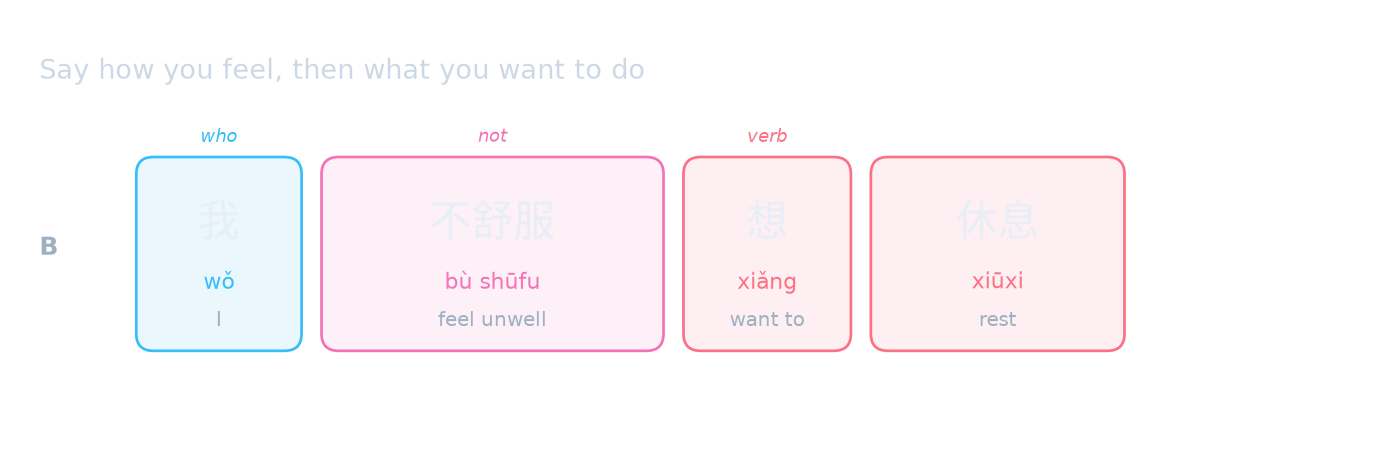
  • I / me我wǒnot不bùcomfortable舒服shū fú。 Wǒ bù shūfu. – I don't feel well.
  • I / me我wǒwant / think / miss想xiǎngto rest休息xiū xī(used after a verb) give it…一下yī xià。 Wǒ xiǎng xiūxi yíxià. – I'd like to rest for a bit.
  • you你nǐcan / will会huìto swim游泳yóu yǒng(yes/no ?)吗ma? Nǐ huì yóuyǒng ma? – Can you swim?
  • 我会wǒ huìto swim游泳yóu yǒng,but但是dàn shìtoday今天jīn tiāncannot不能bù néngto go去qù。 Wǒ huì yóuyǒng, dànshì jīntiān bù néng qù. – I can swim, but I can't go today.

How it works

can / will会huì or can / be able to能néng? Both translate as "can", but they mean different things.

can / will会huì huì can / be able to能néng néng
a skill you have learned possible or allowed in this situation
我会wǒ huìto swim游泳yóu yǒng (I know how to swim) today今天jīn tiāncan / be able to能néngto swim游泳yóu yǒng(yes/no ?)吗ma?(Can we swim today?)

Feelings and needs. not不bùcomfortable舒服shū fú (not well), tired累lèi (tired), hungry饿è (hungry) describe how you feel; want / think / miss想xiǎng + verb says what you would like to do about it.

Answering kindly. Show you understand, then suggest something: you你nǐtired累lèi(completed / change)了le?to rest休息xiū xī(used after a verb) give it…一下yī xià(suggestion)吧ba。

Say how you feel, then what you want to do

Watch out

  • 我会wǒ huìto swim游泳yóu yǒng means you have the skill, not that you are going swimming now.
  • want / think / miss想xiǎngto rest休息xiū xī is a wish; it does not mean you have already rested.

Words in context

  • not不bùcomfortable舒服shū fú bù shūfu – feel unwell. I / me我wǒnot不bùcomfortable舒服shū fú。
  • to rest休息xiū xī xiūxi – rest. I / me我wǒwant / think / miss想xiǎngto rest休息xiū xī。
  • to swim游泳yóu yǒng yóuyǒng – swim. 我会wǒ huìto swim游泳yóu yǒng。
  • can / will会huì huì – know how to. you你nǐcan / will会huìto swim游泳yóu yǒng(yes/no ?)吗ma?
  • can / be able to能néng néng – can in the situation. you你nǐtoday今天jīn tiāncan / be able to能néngto go去qù(yes/no ?)吗ma?

Reading

林安会lín ān huìto swim游泳yóu yǒng,but但是dàn shìtoday今天jīn tiānnot不bùcomfortable舒服shū fú。she / her她tātoday今天jīn tiān不去bù qùto swim游泳yóu yǒng,want / think / miss想xiǎngto be at home在家zài jiāto rest休息xiū xī。

Speaking

Ask a partner whether they can go today. In a fictional role, say you feel unwell and want to rest.

词汇 训练
汉字 拼音 English
我 wǒ I
不 bù not
想 xiǎng to want to; to think; to miss
你 nǐ you
会 huì can (a learned skill); will
吗 ma question particle
今天 jīn tiān today
去 qù to go
能 néng can (be able to)
了 le completed-action particle
她 tā she
7.2

练习

English

Cover the teaching pages before you answer. The answers are at the end.

1. Listening. A partner reads the script for this question from the answers aloud. What does the speaker want?

  • A. To rest
  • B. To learn swimming
  • C. To go to school

2. Reading. Does the text say Lin An lacks swimming skill?

  • A. It does not mention swimming
  • B. Yes
  • C. No

3. Complete “I want to rest”: I / me我wǒwant / think / miss想xiǎng…………。

4. Match each word with its meaning in this unit.

  • (1) not不bùcomfortable舒服shū fú

  • (2) to rest休息xiū xī

  • (3) to swim游泳yóu yǒng

  • (4) can / will会huì

  • (5) can / be able to能néng

  • A. feel unwell

  • B. know how to

  • C. rest

  • D. swim

  • E. can in the situation

5. Write two sentences contrasting a skill and today’s possibility. Write your answer in Chinese, then say it aloud.

6. I / me我wǒwant / think / miss想xiǎngto rest休息xiū xī。want / think / miss想xiǎng means want to and to rest休息xiū xī means rest. Which statement follows from this sentence alone?

  • A. The speaker cannot swim.
  • B. The speaker is already asleep.
  • C. The speaker wants to rest.

7. 我会wǒ huìto swim游泳yóu yǒng,but但是dàn shìswimming pool游泳池yóu yǒng chítoday今天jīn tiānnot不bùto open a door (lit. and…开门kāi mén,so / therefore所以suǒ yǐtoday今天jīn tiāncannot不能bù néngto go去qù。swimming pool游泳池yóu yǒng chí means swimming pool; today今天jīn tiānnot不bùto open a door (lit. and…开门kāi mén means it is closed today; so / therefore所以suǒ yǐ means so. First locate the reason. Why can the speaker not go today?

  • A. The speaker says that swimming is forbidden everywhere.
  • B. The pool is closed today.
  • C. The speaker has never learned to swim.

8. Read: 林安会lín ān huìto ride骑qíbicycle自行车zì xíng chē。today今天jīn tiānshe / her她tāwant / will / need要yàoto be at home在家zài jiāto wait; and so on等děngteacher老师lǎo shī,cannot不能bù néngand / with和héfriend朋友péng yǒutogether一起yì qǐto go去qù。to ride骑qíbicycle自行车zì xíng chē means ride a bicycle, to wait; and so on等děng wait and together一起yì qǐ together. Which interpretation fits?

  • A. She cannot ride a bicycle and is waiting at home for her friends.
  • B. She can ride a bicycle but cannot join today because her bicycle is broken.
  • C. She can ride a bicycle but today must wait at home for the teacher.

9. Invent a fictional person who knows how to do an activity but cannot join it today. Write the skill, a specific circumstance and a wish. A partner asks whether they can go; give a relevant reply without claiming the skill has disappeared. Read or speak the exchange, then check the meaning. Write your answer in Chinese, then say it aloud.

7.3

混合练习

English

These questions mix the patterns and use new situations.

10. Find and fix the problem. A friend says I / me我wǒwant / think / miss想xiǎng喝水hē shuǐ. A classmate reports that the friend has already had a drink. What is wrong with the report?

11. Use it yourself. Tell a friend you are tired and would like to rest. Then answer kindly when a friend says they are hungry.

7.4

答案与解析

English

Mark your work, then correct each mistake in your own words.

1. Script: 我会wǒ huìto swim游泳yóu yǒng,but但是dàn shìtoday今天jīn tiāncannot不能bù néngto go去qù。I / me我wǒwant / think / miss想xiǎngto rest休息xiū xī。

A. To rest

I / me我wǒwant / think / miss想xiǎngto rest休息xiū xī states the wish directly.

2. C. No

林安会lín ān huìto swim游泳yóu yǒng says she has the skill; today’s condition prevents the activity.

3. to rest休息xiū xī

to rest休息xiū xī names the action wanted.

4. (1) A: not不bùcomfortable舒服shū fú = feel unwell; (2) C: to rest休息xiū xī = rest; (3) D: to swim游泳yóu yǒng = swim; (4) B: can / will会huì = know how to; (5) E: can / be able to能néng = can in the situation

Use the example sentences to check each word’s meaning in context.

5. Model answer: 我会wǒ huìto swim游泳yóu yǒng。today今天jīn tiānI / me我wǒcannot不能bù néngto go去qù,want / think / miss想xiǎngto rest休息xiū xī。

Check your answer:

  • Use can / will会huì for the skill.
  • Use today今天jīn tiān to locate the situation.
  • State the wish clearly.

6. C. The speaker wants to rest.

want / think / miss想xiǎngto rest休息xiū xī expresses a wish. It supplies no evidence of sleep or swimming ability. Return to the difference between wanting an action and reporting it as happening if you chose either extra claim.

7. B. The pool is closed today.

The stated reason is the pool’s closure today. 我会wǒ huìto swim游泳yóu yǒng explicitly supplies the skill, and no universal ban is stated. A present obstacle and an absent learned skill are different claims.

8. C. She can ride a bicycle but today must wait at home for the teacher.

can / will会huìto ride骑qíbicycle自行车zì xíng chē gives the learned skill. to be at home在家zài jiāto wait; and so on等děngteacher老师lǎo shī supplies today’s commitment; cannot不能bù néngand / with和héfriend朋友péng yǒutogether一起yì qǐto go去qù says she cannot join her friends. No broken bicycle is stated, and the person she waits for is the teacher, not the friends.

9. Model answer: Possible account: 我会wǒ huìto swim游泳yóu yǒng。today今天jīn tiān我要wǒ yàoto be at home在家zài jiāto wait; and so on等děngteacher老师lǎo shī,cannot不能bù néngto go去qù。I / me我wǒwant / think / miss想xiǎngtomorrow明天míng tiānto go去qù。Partner: you你nǐtoday今天jīn tiāncan / be able to能néngto go去qù(yes/no ?)吗ma?Reply: today今天jīn tiāncannot不能bù néngto go去qù,我要wǒ yàoto be at home在家zài jiāto wait; and so on等děngteacher老师lǎo shī。The skill, today’s commitment and tomorrow’s wish are separate. Other coherent activities and circumstances are valid.

How to revise: If the reason is missing, add your invented circumstance explicitly. If your sentences contradict each other, distinguish knowing how from being able to join today. Use a fictional situation; this self-review checks meaning and organisation, not pronunciation or medical knowledge.

Check your answer:

  • State a learned skill with can / will会huì in this context.
  • Name a circumstance that explains today’s constraint.
  • State a wish without presenting it as a completed event.
  • Answer the partner’s actual question; avoid inventing a diagnosis or unstated fact.

If the reason is missing, add your invented circumstance explicitly. If your sentences contradict each other, distinguish knowing how from being able to join today. Use a fictional situation; this self-review checks meaning and organisation, not pronunciation or medical knowledge.

Scripts and models

Listening script. 我会wǒ huìto swim游泳yóu yǒng,but但是dàn shìtoday今天jīn tiāncannot不能bù néngto go去qù。I / me我wǒwant / think / miss想xiǎngto rest休息xiū xī。 – I know how to swim, but cannot go today. I want to rest.

Reading in English. Lin An knows how to swim, but feels unwell today. She does not go swimming and wants to rest at home.

Speaking model. A: you你nǐtoday今天jīn tiāncan / be able to能néngto go去qù(yes/no ?)吗ma? B: I / me我wǒnot不bùcomfortable舒服shū fú,want / think / miss想xiǎngto rest休息xiū xī。 A: good好hǎo。

Mixed practice

10. want / think / miss想xiǎng喝水hē shuǐ means she would like to drink; it does not say she has drunk. The wish has not happened yet.

11. Model answer. 我累wǒ lèi(completed / change)了le,want / think / miss想xiǎngto rest休息xiū xī(used after a verb) give it…一下yī xià。—— you你nǐhungry饿è(completed / change)了le?we / us我们wǒ mento go去qùto have a meal吃饭chī fàn(suggestion)吧ba。tired累lèi(completed / change)了le says how you feel, want / think / miss想xiǎng says what you would like, and (suggestion)吧ba makes a friendly suggestion.

Review later. Tomorrow, say one thing you would like to do and one thing you can do (can / will会huì).

该知识点的互动课程

逐步完成,配合即时检查练习。

更多 HSK 1 知识点

登录或创建账户

IGCSE, A-Level & AP