跳到主要内容

任务十二—十四 · School, study and work routines

HSK 1 · 知识点 8

本主题的视频课程 打开视频页面
2:38

HSK 1 · 学校、学习与工作日常

日常惯例、所有权与时间表。结构为“人物+时间+动词+宾语”;用“有”表示拥有;时间表应按行阅读,而非凭感觉查找。“没有”……

英文讲解与普通话例句 · 字幕与原声同步

点击任意汉字可查看拼音和释义。
English

Read a school timetable and say what a place has. to have / there is有yǒu means "have" or "there is"; its negative is always not have / haven't没有méi yǒu, never 不有bù yǒu. That leads to the two ways of saying "not": not不bù for habits, wishes and the future, and not / haven't没méi for things that did not happen.

8.1

一目了然

English
  • 1. Place + to have / there is有yǒu / not have / haven't没有méi yǒu + thing – there is / there is not: school学校xué xiàoto have / there is有yǒulibrary图书馆tú shū guǎn,not have / haven't没有méi yǒuswimming pool游泳池yóu yǒng chí。
  • 2. not不bù and not / haven't没méi – two ways to say “not”: I / me我wǒtoday今天jīn tiān不去bù qù。
8.2

1. 阅读时刻表并说明有什么

English

Find a lesson time and describe a school facility.

Key sentences

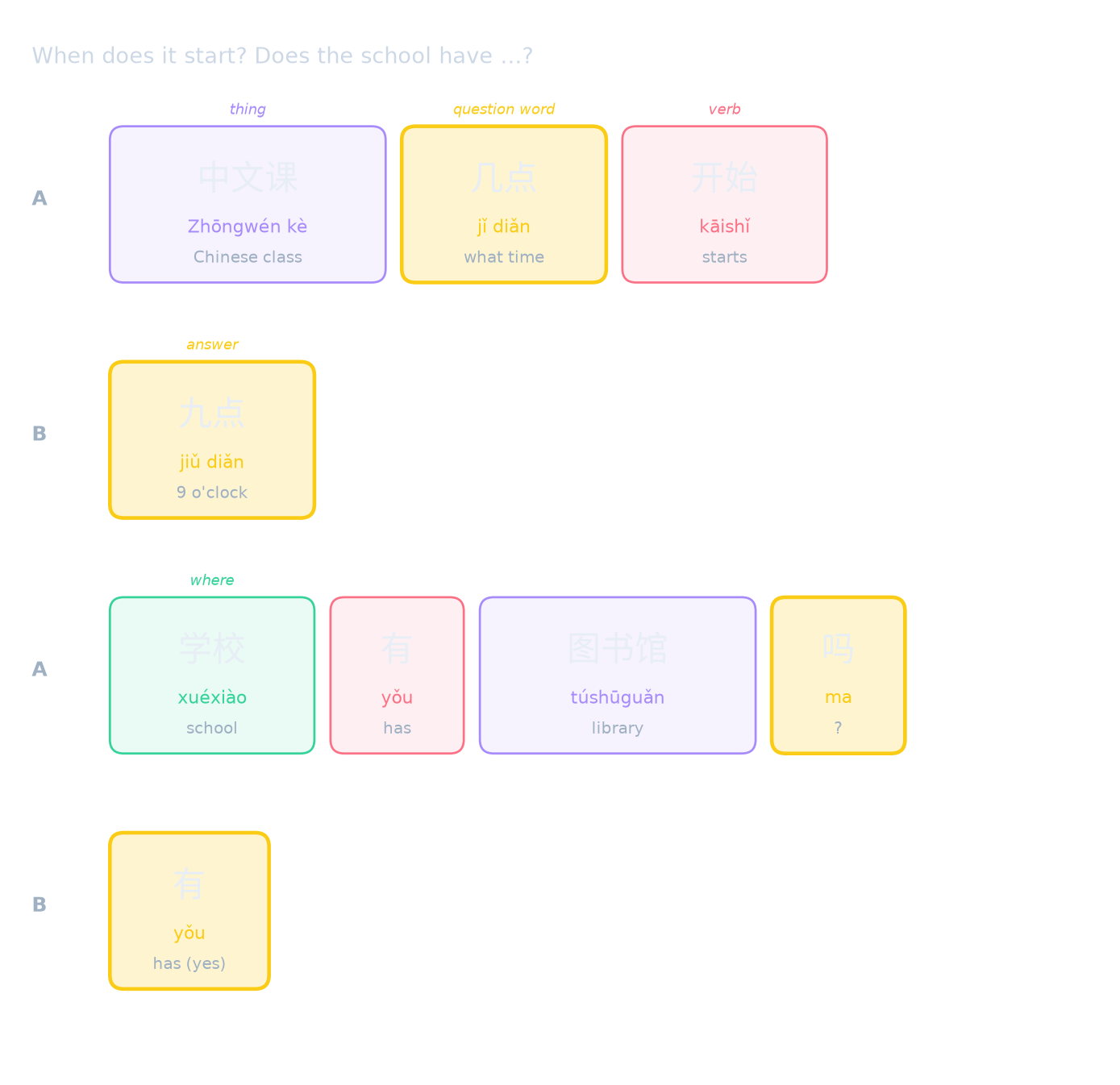
  • Chinese language中文zhōng wénlesson课kèwhat time?几点jǐ diǎnto start开始kāi shǐ? Zhōngwén kè jǐ diǎn kāishǐ? – What time does the Chinese lesson start?
  • Monday星期一xīng qī yī,Chinese language中文zhōng wénlesson课kè九点jiǔ diǎnto start开始kāi shǐ。 Xīngqīyī, Zhōngwén kè jiǔ diǎn kāishǐ. – On Monday, Chinese starts at nine.
  • school学校xué xiàoto have / there is有yǒulibrary图书馆tú shū guǎn(yes/no ?)吗ma? Xuéxiào yǒu túshūguǎn ma? – Does the school have a library?
  • to have / there is有yǒu。school学校xué xiàonot have / haven't没有méi yǒuswimming pool游泳池yóu yǒng chí。 Yǒu. Xuéxiào méiyǒu yóuyǒngchí. – Yes. The school has no swimming pool.

How it works

Place + to have / there is有yǒu + thing says what a place has, or what is there: school学校xué xiàoto have / there is有yǒulibrary图书馆tú shū guǎn (the school has a library / there is a library at the school). The negative is always not have / haven't没有méi yǒu.

Reading a timetable. Find the day first, then the subject, then the time beside it. Answer only the detail you were asked: what time?几点jǐ diǎn needs a time.

When does it start? Does the school have …?

Watch out

  • wrong: school学校xué xiào不有bù yǒuswimming pool游泳池yóu yǒng chí → school学校xué xiàonot have / haven't没有méi yǒuswimming pool游泳池yóu yǒng chí.
  • Short answers repeat the verb: to have / there is有yǒu。/ not have / haven't没有méi yǒu。

Words in context

  • Chinese language中文zhōng wénlesson课kè Zhōngwén kè – Chinese lesson. Chinese language中文zhōng wénlesson课kè九点jiǔ diǎnto start开始kāi shǐ。
  • to start开始kāi shǐ kāishǐ – begin. 九点jiǔ diǎnto start开始kāi shǐ。
  • to have / there is有yǒu yǒu – have / there is. school学校xué xiàoto have / there is有yǒulibrary图书馆tú shū guǎn。
  • not have / haven't没有méi yǒu méiyǒu – do not have / there is no. school学校xué xiàonot have / haven't没有méi yǒuswimming pool游泳池yóu yǒng chí。
  • library图书馆tú shū guǎn túshūguǎn – library. I / me我wǒto go去qùlibrary图书馆tú shū guǎn。

Reading

Monday星期一xīng qī yī,Chinese language中文zhōng wénlesson课kè九点jiǔ diǎnto start开始kāi shǐ,数学课shù xué kè十点shí diǎnto start开始kāi shǐ。school学校xué xiàoto have / there is有yǒulibrary图书馆tú shū guǎn,not have / haven't没有méi yǒuswimming pool游泳池yóu yǒng chí。

Speaking

Ask when a fictional Chinese class starts. Then ask about a library and reply with to have / there is有yǒu or not have / haven't没有méi yǒu.

词汇 训练
汉字 拼音 English
学校 xué xiào school
有 yǒu to have; there is
吗 ma question particle
我 wǒ I
去 qù to go
8.3

2. 不和没——两种表示否定的方式

English

Form: not不bù + verb / adjective · not / haven't没méi(to have / there is有yǒu) + verb · not have / haven't没有méi yǒu + noun

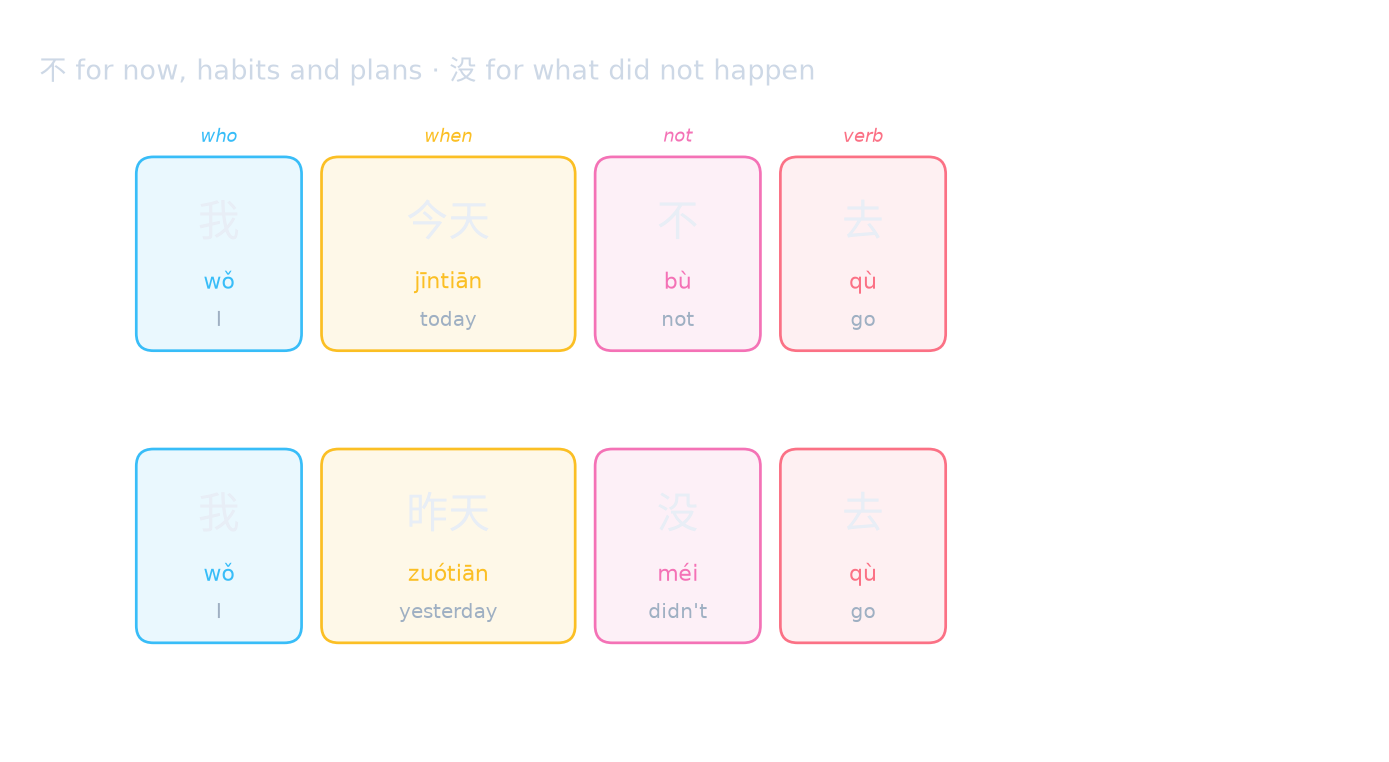
  • I / me我wǒtoday今天jīn tiān不去bù qù。 Wǒ jīntiān bú qù. – I'm not going today.
  • I / me我wǒyesterday昨天zuó tiānnot / haven't没méito go去qù。 Wǒ zuótiān méi qù. – I didn't go yesterday.
  • I / me我wǒnot have / haven't没有méi yǒumoney钱qián。 Wǒ méiyǒu qián. – I don't have any money.

How it works. Chinese has two words for "not", and they do different jobs.

not不bù bù not / haven't没méi méi
now, the future, habits and wishes an action that did not happen
I / me我wǒnot不bù喝咖啡hē kā fēi (I don't drink coffee) I / me我wǒnot / haven't没méi喝咖啡hē kā fēi (I didn't drink the coffee)
before adjectives: not不bùbusy忙máng the negative of to have / there is有yǒu: not have / haven't没有méi yǒu
before to be / is是shì: is not / no不是bú shì never before to be / is是shì

Pronunciation. not不bù becomes bú before a fourth tone: 不去bù qù bú qù, is not / no不是bú shì bú shì.

Watch out

  • The negative of to have / there is有yǒu is always not have / haven't没有méi yǒu: wrong: I / me我wǒnot不bùto have / there is有yǒu → I / me我wǒnot have / haven't没有méi yǒu.
  • to be / is是shì always takes not不bù: wrong: I / me我wǒnot / haven't没méito be / is是shìstudent学生xué shēng → I / me我wǒis not / no不是bú shìstudent学生xué shēng.
  • tomorrow明天míng tiān (tomorrow) takes not不bù: I / me我wǒtomorrow明天míng tiān不去bù qù, because it has not happened yet.
不 for now, habits and plans · 没 for what did not happen
词汇 训练
汉字 拼音 English
不 bù not
没 mò not (have); did not
今天 jīn tiān today
昨天 zuó tiān yesterday
钱 qián money
是 shì to be (am / is / are)
学生 xué sheng student
明天 míng tiān tomorrow
8.4

练习

English

Cover the teaching pages before you answer. The answers are at the end.

1. Read a timetable and say what exists

1. Listening. A partner reads the script for this question from the answers aloud. When does Chinese begin in the recording?

  • A. Monday at nine
  • B. Tuesday at nine
  • C. Tuesday at ten

2. Reading. Which facility is absent in the reading?

  • A. The swimming pool
  • B. The library
  • C. The classrooms

3. Complete “The school has no swimming pool”: school学校xué xiào…………swimming pool游泳池yóu yǒng chí。

4. Match each word with its meaning in this unit.

  • (1) Chinese language中文zhōng wénlesson课kè

  • (2) to start开始kāi shǐ

  • (3) to have / there is有yǒu

  • (4) not have / haven't没有méi yǒu

  • (5) library图书馆tú shū guǎn

  • A. have / there is

  • B. library

  • C. do not have / there is no

  • D. Chinese lesson

  • E. begin

5. Write a small timetable note and one sentence about a facility. Write your answer in Chinese, then say it aloud.

6. school学校xué xiàonot have / haven't没有méi yǒuswimming pool游泳池yóu yǒng chí。school学校xué xiào means school and swimming pool游泳池yóu yǒng chí means swimming pool. Which claim follows from not have / haven't没有méi yǒu here?

  • A. The school has no swimming pool.
  • B. The school has two pools.
  • C. The pool opens at nine.

7. Thursday星期四xīng qī sì,数学课shù xué kè八点bā diǎnto start开始kāi shǐ,Chinese language中文zhōng wénlesson课kè十点shí diǎnto start开始kāi shǐ。Thursday星期四xīng qī sì means Thursday, 数学课shù xué kè mathematics, Chinese language中文zhōng wénlesson课kè Chinese and to start开始kāi shǐ begins. First match the requested subject to its time. When does Chinese begin?

  • A. Thursday at ten
  • B. Wednesday at ten
  • C. Thursday at eight

8. Read: Friday星期五xīng qī wǔ,Chinese language中文zhōng wénlesson课kè九点jiǔ diǎnto start开始kāi shǐ。school学校xué xiàoto have / there is有yǒulibrary图书馆tú shū guǎn,not have / haven't没有méi yǒuswimming pool游泳池yóu yǒng chí。library图书馆tú shū guǎn means library and swimming pool游泳池yóu yǒng chí swimming pool. Which claim is supported?

  • A. Chinese begins at nine on Friday; the school has a library but no pool.
  • B. Chinese begins at nine on Friday; the library also opens at nine.
  • C. Chinese begins at nine on Friday; the school has a library and a pool.

9. Create a short fictional timetable for two different subjects on one weekday. Give different start times, then state one facility the school has and one it lacks. Ask a partner one timetable question and one facility question, or write both replies. Leave finishing times unknown unless you explicitly add them. Write your answer in Chinese, then say it aloud.

2. not不bù and not / haven't没méi – two ways to say “not”

10. Build: “I don’t drink coffee.”

Put in order: not不bù / coffee咖啡kā fēi。 / to drink喝hē / I / me我wǒ

11. Complete: “I don’t have money.” I / me我wǒ…………rich有钱yǒu qián。

12. He didn’t come to class yesterday. Which fits?

  • A. he / him他tāyesterday昨天zuó tiānnot不bùto come来lái。
  • B. he / him他tāyesterday昨天zuó tiān没是méi shìto come来lái。
  • C. he / him他tāyesterday昨天zuó tiānnot / haven't没méito come来lái。

13. Match each sentence to its meaning.

  • (1) he / him他tānot不bùto come来lái。

  • (2) he / him他tānot / haven't没méito come来lái。

  • (3) I / me我wǒ不吃bù chīmeat肉ròu。

  • (4) I / me我wǒnot / haven't没méito have a meal吃饭chī fàn。

  • A. He isn't coming.

  • B. I don't eat meat.

  • C. He didn't come.

  • D. I haven't eaten.

14. True or false? In is not / no不是bú shì, not不bù is pronounced bú. If false, correct it.

15. “I didn't buy it.” Which is correct?

  • A. I / me我wǒnot / haven't没méito buy买mǎi(completed / change)了le。
  • B. I / me我wǒnot不bùto buy买mǎi(completed / change)了le。
  • C. I / me我wǒnot / haven't没méito buy买mǎi。
  • D. I / me我wǒnot不bùto buy买mǎi。

16. Tell a friend one thing you never do, one thing you did not do yesterday, and one thing you do not have. Use not不bù and not / haven't没méi. Write your answer in Chinese, then say it aloud.

8.5

混合练习

English

These questions mix the patterns and use new situations.

17. Which sentence is correct?

  • A. school学校xué xiào不有bù yǒuswimming pool游泳池yóu yǒng chí。
  • B. school学校xué xiàonot have / haven't没有méi yǒuswimming pool游泳池yóu yǒng chí。
  • C. school学校xué xiào没是méi shìswimming pool游泳池yóu yǒng chí。

18. Choose not不bù or not / haven't没méi: I / me我wǒtomorrow明天míng tiān…………to go去qùschool学校xué xiào。 / I / me我wǒyesterday昨天zuó tiān…………to go去qùschool学校xué xiào。

19. Ask when the Chinese lesson starts.

20. Find and fix the problem. A notice says school学校xué xiàoto have / there is有yǒulibrary图书馆tú shū guǎn,not have / haven't没有méi yǒuswimming pool游泳池yóu yǒng chí. A classmate thinks it means a pupil owns a library. Correct the reading.

21. Use it yourself. Describe one thing your school has and one thing it does not have.

8.6

答案与解析

English

Mark your work, then correct each mistake in your own words.

1. Read a timetable and say what exists

1. Script: Tuesday星期二xīng qī èr,Chinese language中文zhōng wénlesson课kè十点shí diǎnto start开始kāi shǐ。school学校xué xiàoto have / there is有yǒuswimming pool游泳池yóu yǒng chí。

C. Tuesday at ten

Tuesday星期二xīng qī èr and 十点shí diǎn are both needed.

2. A. The swimming pool

not have / haven't没有méi yǒuswimming pool游泳池yóu yǒng chí explicitly states there is no swimming pool.

3. not have / haven't没有méi yǒu

not have / haven't没有méi yǒu is the ordinary negative of to have / there is有yǒu.

4. (1) D: Chinese language中文zhōng wénlesson课kè = Chinese lesson; (2) E: to start开始kāi shǐ = begin; (3) A: to have / there is有yǒu = have / there is; (4) C: not have / haven't没有méi yǒu = do not have / there is no; (5) B: library图书馆tú shū guǎn = library

Use the example sentences to check each word’s meaning in context.

5. Model answer: Wednesday星期三xīng qī sān,Chinese language中文zhōng wénlesson课kè十点shí diǎnto start开始kāi shǐ。school学校xué xiàoto have / there is有yǒulibrary图书馆tú shū guǎn。

Check your answer:

  • State the weekday and subject.
  • State a clock time.
  • Use to have / there is有yǒu or not have / haven't没有méi yǒu for the facility.

6. A. The school has no swimming pool.

not have / haven't没有méi yǒu negates the existence of a pool at the school. It does not supply an opening time or a positive quantity. Check the negative phrase before looking for a facility detail.

7. A. Thursday at ten

Chinese language中文zhōng wénlesson课kè is linked to 十点shí diǎn, ten, on the stated Thursday. Eight belongs to mathematics. Wednesday is not the day in this timetable. Match both the day and subject before taking a time.

8. A. Chinese begins at nine on Friday; the school has a library but no pool.

Chinese language中文zhōng wénlesson课kè九点jiǔ diǎnto start开始kāi shǐ gives the lesson’s start, not the library’s opening time. to have / there is有yǒulibrary图书馆tú shū guǎn states a library is present; not have / haven't没有méi yǒuswimming pool游泳池yóu yǒng chí states the pool is absent. Preserve both the relevant time and the negative facility statement.

9. Model answer: Possible notice: Tuesday星期二xīng qī èr,Chinese language中文zhōng wénlesson课kè八点bā diǎnto start开始kāi shǐ,数学课shù xué kè十点shí diǎnto start开始kāi shǐ。school学校xué xiàoto have / there is有yǒulibrary图书馆tú shū guǎn,not have / haven't没有méi yǒuswimming pool游泳池yóu yǒng chí。Questions and replies: Chinese language中文zhōng wénlesson课kèwhat time?几点jǐ diǎnto start开始kāi shǐ?八点bā diǎn。school学校xué xiàoto have / there is有yǒuswimming pool游泳池yóu yǒng chí(yes/no ?)吗ma?not have / haven't没有méi yǒu。Other subjects, times and facilities can work if the questions and replies match.

How to revise: If you chose the neighbouring subject’s time, pair each subject and time before answering again. If the facility answer reverses presence and absence, check to have / there is有yǒu versus not have / haven't没有méi yǒu. Make a fresh notice after correcting the specific error.

Check your answer:

  • Attach a distinct start time to each subject on the named day.
  • Use to have / there is有yǒu and not have / haven't没有méi yǒu for the two facility statements.
  • Answer the questions from your own notice rather than an earlier example.
  • Distinguish lesson start times from opening or finishing times that are not supplied.

If you chose the neighbouring subject’s time, pair each subject and time before answering again. If the facility answer reverses presence and absence, check to have / there is有yǒu versus not have / haven't没有méi yǒu. Make a fresh notice after correcting the specific error.

2. not不bù and not / haven't没méi – two ways to say “not”

10. I / me我wǒnot不bù喝咖啡hē kā fēi。

A habit or preference is negated with not不bù before the verb.

11. not / haven't没méi

to have / there is有yǒu is always negated with not / haven't没méi.

12. C. he / him他tāyesterday昨天zuó tiānnot / haven't没méito come来lái。

An action that did not happen in the past takes not / haven't没méi.

13. (1) A: he / him他tānot不bùto come来lái。 = He isn't coming.; (2) C: he / him他tānot / haven't没méito come来lái。 = He didn't come.; (3) B: I / me我wǒ不吃bù chīmeat肉ròu。 = I don't eat meat.; (4) D: I / me我wǒnot / haven't没méito have a meal吃饭chī fàn。 = I haven't eaten.

not不bù = choices, habits and plans; not / haven't没méi = it did not happen.

14. True.

True. to be / is是shì is fourth tone, so not不bù changes to bú.

15. C. I / me我wǒnot / haven't没méito buy买mǎi。

Did not happen → not / haven't没méi, and no (completed / change)了le after not / haven't没méi. (I / me我wǒnot不bùto buy买mǎi(completed / change)了le = I won't buy it after all.)

16. Model answer: I / me我wǒnot不bù喝咖啡hē kā fēi。I / me我wǒyesterday昨天zuó tiānnot / haven't没méito go去qùschool学校xué xiào。I / me我wǒnot have / haven't没有méi yǒucat猫māo。

Check your answer:

  • I used not不bù for a habit or preference.
  • I used not / haven't没méi for something that did not happen.
  • I negated to have / there is有yǒu with not / haven't没méi.
  • I said not不bù as bú before a fourth tone.

Scripts and models for section 1

Listening script. Tuesday星期二xīng qī èr,Chinese language中文zhōng wénlesson课kè十点shí diǎnto start开始kāi shǐ。school学校xué xiàoto have / there is有yǒuswimming pool游泳池yóu yǒng chí。 – On Tuesday, Chinese starts at ten. The school has a swimming pool.

Reading in English. On Monday, Chinese starts at nine and mathematics at ten. The school has a library but no swimming pool.

Speaking model. A: Chinese language中文zhōng wénlesson课kèwhat time?几点jǐ diǎnto start开始kāi shǐ? B: 九点jiǔ diǎn。 A: school学校xué xiàoto have / there is有yǒulibrary图书馆tú shū guǎn(yes/no ?)吗ma? B: to have / there is有yǒu。

Mixed practice

17. B. The negative of to have / there is有yǒu is always not have / haven't没有méi yǒu.

18. I / me我wǒtomorrow明天míng tiān不去bù qùschool学校xué xiào。I / me我wǒyesterday昨天zuó tiānnot / haven't没méito go去qùschool学校xué xiào。not不bù says no to a plan or habit; not / haven't没méi says something did not happen.

19. Chinese language中文zhōng wénlesson课kèwhat time?几点jǐ diǎnto start开始kāi shǐ?what time?几点jǐ diǎn asks for the clock time.

20. When a place comes first, to have / there is有yǒu means "there is": the school has a library. not have / haven't没有méi yǒu says it has no swimming pool. Nobody owns anything here.

21. Model answer. we / us我们wǒ menschool学校xué xiàoto have / there is有yǒudining hall食堂shí táng,not have / haven't没有méi yǒuswimming pool游泳池yóu yǒng chí。The place comes first, then to have / there is有yǒu or not have / haven't没有méi yǒu.

Review later. Tomorrow, describe your classroom with to have / there is有yǒu and not have / haven't没有méi yǒu, then say one thing you have with I / me我wǒto have / there is有yǒu.

该知识点的互动课程

逐步完成,配合即时检查练习。

更多 HSK 1 知识点

登录或创建账户

IGCSE, A-Level & AP