跳到主要内容

任务七、十五 · Meals and traditional foods

HSK 1 · 知识点 5

本主题的视频课程 打开视频页面
2:41

HSK 1 · 餐饮与传统食物

午餐中的语法。“吃”表示进食,“喝”表示饮水,“想”表示想要:再加上两个助词“在”和“了”,即可说明动作发生的时间。一顿饭涵盖三种意愿时态。“了”并非……

英文讲解与普通话例句 · 字幕与原声同步

点击任意汉字可查看拼音和释义。
English

Ordering food and drink. want / think / miss想xiǎngto eat吃chī and want / think / miss想xiǎngto drink喝hē say what you would like; at / in在zàito eat吃chī says what someone is eating right now. Then (completed / change)了le tells you that an action has happened: I / me我wǒto eat吃chī(completed / change)了le一碗yī wǎnnoodles面条miàn tiáo.

5.1

一目了然

English
  • 1. want / think / miss想xiǎng + verb – would like to …: Wang Li (a name)王力wáng lìwant / think / miss想xiǎng吃饺子chī jiǎo zi。
  • 2. (completed / change)了le – saying an action has happened: I / me我wǒto eat吃chī(completed / change)了le一碗yī wǎnnoodles面条miàn tiáo。
5.2

1. 选择食物和饮料

English

Ask what someone wants to eat and drink.

Key sentences

  • you你nǐwant / think / miss想xiǎngto eat吃chīwhat什么shén me? Nǐ xiǎng chī shénme? – What would you like to eat?
  • I / me我wǒwant / think / miss想xiǎng吃饺子chī jiǎo zi。 Wǒ xiǎng chī jiǎozi. – I'd like dumplings.
  • you你nǐto drink tea喝茶hē cháor / still还是hái shì喝水hē shuǐ? Nǐ hē chá háishi hē shuǐ? – Would you like tea or water?
  • I / me我wǒat / in在zàito have a meal吃饭chī fàn。 Wǒ zài chī fàn. – I'm eating (right now).

How it works

want / think / miss想xiǎng + verb says what you would like to do: want / think / miss想xiǎngto eat吃chī (would like to eat), want / think / miss想xiǎngto drink喝hē (would like to drink). It is softer than want / will / need要yào.

at / in在zài + verb says an action is happening now: I / me我wǒat / in在zàito have a meal吃饭chī fàn (I'm eating). Compare: I / me我wǒwant / think / miss想xiǎng吃饺子chī jiǎo zi (a wish) and I / me我wǒat / in在zài吃饺子chī jiǎo zi (happening now).

Answering a choice. or / still还是hái shì offers two options. Answer with the one you choose, not with to be / is是shì: you你nǐto drink tea喝茶hē cháor / still还是hái shì喝水hē shuǐ? – I / me我wǒto drink tea喝茶hē chá。

想 + verb: what you would like

Watch out

  • Answer to eat吃chīwhat什么shén me? with the food: I / me我wǒwant / think / miss想xiǎngto eat吃chīcooked rice米饭mǐ fàn, not just want / think / miss想xiǎng.
  • want / think / miss想xiǎng can also mean "miss" (I / me我wǒwant / think / miss想xiǎngyou你nǐ), but before to eat吃chī or to drink喝hē it always means "would like".

Words in context

  • to eat吃chī chī – eat. I / me我wǒwant / think / miss想xiǎngto have a meal吃饭chī fàn。
  • to drink喝hē hē – drink. I / me我wǒ喝水hē shuǐ。
  • dumpling饺子jiǎo zi jiǎozi – dumplings. I / me我wǒwant / think / miss想xiǎng吃饺子chī jiǎo zi。
  • water水shuǐ shuǐ – water. 我要wǒ yào一杯yī bēiwater水shuǐ。
  • want / think / miss想xiǎng xiǎng – would like to. you你nǐwant / think / miss想xiǎngto eat吃chīwhat什么shén me?

Reading

Wang Li (a name)王力wáng lìwant / think / miss想xiǎng吃饺子chī jiǎo zi。林安想lín ān xiǎngto eat吃chīcooked rice米饭mǐ fàn。两个liǎng gèperson人rénall / both都dōu喝水hē shuǐ。they他们tā mennoon中午zhōng wǔat / in在zàischool学校xué xiàoto have a meal吃饭chī fàn。

Speaking

Ask a partner what they want to eat and drink. Repeat their choices to check you understood.

词汇 训练
汉字 拼音 English
你 nǐ you
想 xiǎng to want to; to think; to miss
吃 chī to eat
什么 shén me what
我 wǒ I
在 zài at; in; to be (somewhere)
喝 hē to drink
是 shì to be (am / is / are)
米饭 mǐ fàn cooked rice
水 shuǐ water
人 rén person
都 dōu all; both
中午 zhōng wǔ noon
学校 xué xiào school
5.3

2. 了——表示动作已经发生

English

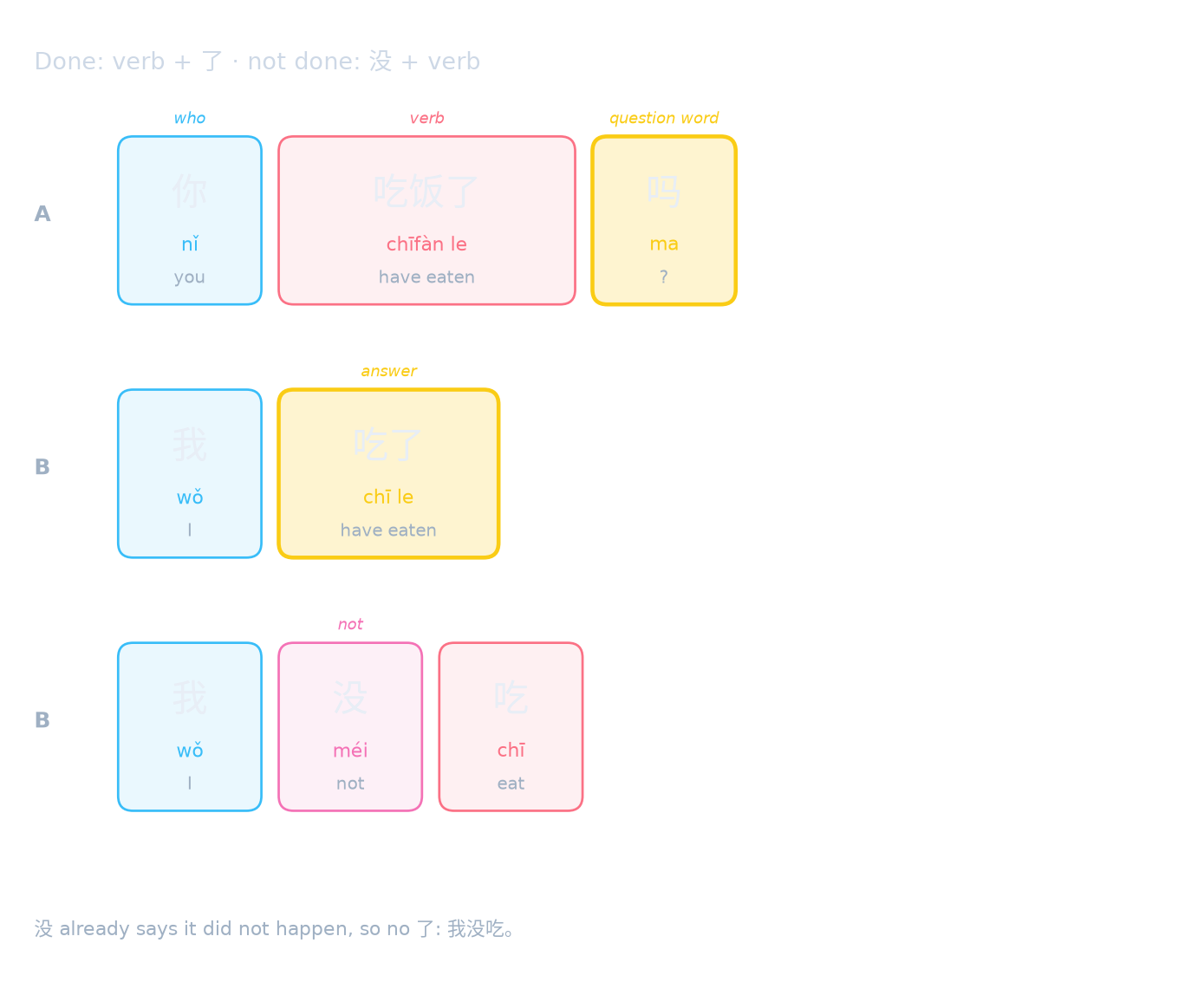
Form: verb + (completed / change)了le · not / haven't没méi + verb · ……(completed / change)了le(yes/no ?)吗ma?

  • I / me我wǒto eat吃chī(completed / change)了le一碗yī wǎnnoodles面条miàn tiáo。 Wǒ chī le yì wǎn miàntiáo. – I ate a bowl of noodles.
  • you你nǐto have a meal吃饭chī fàn(completed / change)了le(yes/no ?)吗ma? Nǐ chī fàn le ma? – Have you eaten?
  • I / me我wǒstill / also / even还háinot / haven't没méito eat吃chī。 Wǒ hái méi chī. – I haven't eaten yet.

How it works. (completed / change)了le le after a verb says that the action has happened. When you say how much, (completed / change)了le goes straight after the verb, before the amount: to buy买mǎi(completed / change)了le两个liǎng gèapple苹果píng guǒ (bought two apples).

Questions. Add (yes/no ?)吗ma: you你nǐto have a meal吃饭chī fàn(completed / change)了le(yes/no ?)吗ma? People also use this as a friendly greeting around mealtimes. The answer is to eat吃chī(completed / change)了le (yes) or not / haven't没méito eat吃chī / still / also / even还háinot / haven't没méito eat吃chī (no / not yet).

The negative. To say an action did not happen, use not / haven't没méi méi and drop (completed / change)了le: I / me我wǒnot / haven't没méito go去qù, "I didn't go" (wrong: I / me我wǒnot / haven't没méito go去qù(completed / change)了le).

(completed / change)了le is not a past tense. Habits in the past do not take it: I / me我wǒin one's childhood小时候xiǎo shí hòuevery day每天měi tiānto eat吃chīcooked rice米饭mǐ fàn (I ate rice every day as a child). (completed / change)了le is about an action being completed, not about time.

Watch out

  • wrong: I / me我wǒnot / haven't没méito eat吃chī(completed / change)了le → I / me我wǒnot / haven't没méito eat吃chī.
  • wrong: I / me我wǒevery day每天měi tiānto eat吃chī(completed / change)了lecooked rice米饭mǐ fàn → I / me我wǒevery day每天měi tiānto eat吃chīcooked rice米饭mǐ fàn.
Done: verb + 了 · not done: 没 + verb
词汇 训练
汉字 拼音 English
了 le completed-action particle
没 mò not (have); did not
吗 ma question particle
买 mǎi to buy
苹果 píng guǒ apple
去 qù to go
5.4

练习

English

Cover the teaching pages before you answer. The answers are at the end.

1. Choose food and a drink

1. Listening. A partner reads the script for this question from the answers aloud. Which drink does the speaker choose?

  • A. water水shuǐ
  • B. tea茶chá
  • C. cooked rice米饭mǐ fàn

2. Reading. What do Wang Li and Lin An both do?

  • A. Eat rice
  • B. Eat dumplings
  • C. Drink water

3. Complete “What would you like to eat?”: you你nǐwant / think / miss想xiǎngto eat吃chī…………?

4. Match each word with its meaning in this unit.

  • (1) to eat吃chī

  • (2) to drink喝hē

  • (3) dumpling饺子jiǎo zi

  • (4) water水shuǐ

  • (5) want / think / miss想xiǎng

  • A. drink

  • B. dumplings

  • C. would like to

  • D. eat

  • E. water

5. Write a lunch choice: one food and one drink. Then state the place you eat. Write your answer in Chinese, then say it aloud.

6. you你nǐwant / think / miss想xiǎngto drink喝hēwhat什么shén me?want / think / miss想xiǎngto drink喝hē means would like to drink and what什么shén me means what. Which reply supplies a drink?

  • A. tea茶chá – tea
  • B. school学校xué xiào – school
  • C. dumpling饺子jiǎo zi – dumplings

7. I / me我wǒwant / think / miss想xiǎng喝水hē shuǐ,not want to不想bù xiǎngto drink tea喝茶hē chá。water水shuǐ means water and tea茶chá means tea. First separate the wish from the rejected option. Which drink does the speaker say they want?

  • A. Tea
  • B. Water
  • C. Both tea and water

8. Read: 林安lín ānat / in在zàito eat吃chīcooked rice米饭mǐ fàn。she / her她tāwant / think / miss想xiǎng喝水hē shuǐ,not want to不想bù xiǎng喝咖啡hē kā fēi。cooked rice米饭mǐ fàn means rice, water水shuǐ water and coffee咖啡kā fēi coffee. Which account keeps action and wishes distinct?

  • A. She wants rice, is drinking water and does not want coffee.
  • B. She is eating rice, wants water and does not want coffee.
  • C. She is eating rice, is drinking water and does not want coffee.

9. Write a fictional café exchange: one person asks what food and drink the other wants. Give a choice, reject a different drink and separately say what the person is eating now. Speak both roles or work with a partner; keep current action and preference clear. Write your answer in Chinese, then say it aloud.

2. (completed / change)了le – saying an action has happened

10. Complete: “I bought two apples.” I / me我wǒto buy买mǎi…………两个liǎng gèapple苹果píng guǒ。

11. “I went to school.” Which sounds complete?

  • A. I / me我wǒto go去qù(completed / change)了leschool学校xué xiào。
  • B. I / me我wǒto go去qùschool学校xué xiào(completed / change)了le。
  • C. I / me我wǒ(completed / change)了leto go去qùschool学校xué xiào。
  • D. I / me我wǒto go去qùschool学校xué xiào。

12. Build: “Have you eaten?”

Put in order: to have a meal吃饭chī fàn / (yes/no ?)吗ma? / (completed / change)了le / you你nǐ

13. You have not eaten yet. Which reply fits?

  • A. I / me我wǒnot / haven't没méito eat吃chī(completed / change)了le。
  • B. I / me我wǒstill / also / even还háinot / haven't没méito eat吃chī。
  • C. I / me我wǒ不吃bù chī(completed / change)了le(yes/no ?)吗ma。

14. True or false? I / me我wǒevery day每天měi tiānto eat吃chī(completed / change)了lecooked rice米饭mǐ fàn is the normal way to describe a daily habit. If false, correct it.

15. A friend asks what you did this morning. Say two things you did and one thing you did not do. Use (completed / change)了le. Write your answer in Chinese, then say it aloud.

5.5

混合练习

English

These questions mix the patterns and use new situations.

16. Choose: I / me我wǒ…………吃饺子chī jiǎo zi (I would like to eat dumplings) / I / me我wǒ…………吃饺子chī jiǎo zi (I am eating dumplings now).

17. A friend asks you你nǐto eat吃chī(completed / change)了le(yes/no ?)吗ma? You have eaten. Reply.

18. Find and fix the problem. A friend asks you你nǐto drink tea喝茶hē cháor / still还是hái shìwater水shuǐ? A classmate answers to be / is是shì. Why is that not an answer?

19. Use it yourself. Ask politely for a cup of tea and say that you do not want coffee.

5.6

答案与解析

English

Mark your work, then correct each mistake in your own words.

1. Choose food and a drink

1. Script: I / me我wǒwant / think / miss想xiǎngto eat吃chīcooked rice米饭mǐ fàn,not want to不想bù xiǎng吃饺子chī jiǎo zi。I / me我wǒto drink tea喝茶hē chá。

B. tea茶chá

I / me我wǒto drink tea喝茶hē chá identifies tea as the drink.

2. C. Drink water

两个liǎng gèperson人rénall / both都dōu喝水hē shuǐ says both drink water, although they choose different foods.

3. what什么shén me

what什么shén me asks for the food.

4. (1) D: to eat吃chī = eat; (2) A: to drink喝hē = drink; (3) B: dumpling饺子jiǎo zi = dumplings; (4) E: water水shuǐ = water; (5) C: want / think / miss想xiǎng = would like to

Use the example sentences to check each word’s meaning in context.

5. Model answer: I / me我wǒwant / think / miss想xiǎng吃饺子chī jiǎo zi,喝水hē shuǐ。I / me我wǒat / in在zàischool学校xué xiàoto have a meal吃饭chī fàn。

Check your answer:

  • Name a food and a drink.
  • Use want / think / miss想xiǎng for the choice.
  • Give a place with at / in在zài.

6. A. tea茶chá – tea

Tea is a drink and answers the requested information. Dumplings are food and school is a place. A bare yes would also fail to identify what the person wants to drink.

7. B. Water

want / think / miss想xiǎng喝水hē shuǐ states the positive wish; not want to不想bù xiǎngto drink tea喝茶hē chá rejects tea. Choosing both ignores not不bù. This reports a preference, not proof that the water has already been served or drunk.

8. B. She is eating rice, wants water and does not want coffee.

at / in在zàito eat吃chīcooked rice米饭mǐ fàn marks eating in progress. want / think / miss想xiǎng喝水hē shuǐ states a wish, not proof that drinking has begun; not want to不想bù xiǎng喝咖啡hē kā fēi rejects coffee. Both incorrect options turn the water wish into current drinking, and the last also turns current eating into a wish.

9. Model answer: One possible exchange: you你nǐwant / think / miss想xiǎngto eat吃chīwhat什么shén me,to drink喝hēwhat什么shén me?I / me我wǒwant / think / miss想xiǎng吃饺子chī jiǎo zi,to drink tea喝茶hē chá,not want to不想bù xiǎng喝咖啡hē kā fēi。I / me我wǒnow现在xiàn zàiat / in在zàito eat吃chīcooked rice米饭mǐ fàn。The speaker wants dumplings and tea, declines coffee and is currently eating rice. now现在xiàn zài means now. Other coherent combinations are valid, even if current food differs from the wish.

How to revise: If your account turns a wish into current eating, check the word before to eat吃chī. If the reply leaves the choice unknown, name the requested item. Compare the meanings of your own exchange with the checklist; the model is one possibility.

Check your answer:

  • Ask for the missing food and drink information.
  • State a positive choice and a clear rejection.
  • Use at / in在zàito eat吃chī for the current action and want / think / miss想xiǎng for a wish.
  • Avoid claiming the desired item has already been served unless you state that separately.

If your account turns a wish into current eating, check the word before to eat吃chī. If the reply leaves the choice unknown, name the requested item. Compare the meanings of your own exchange with the checklist; the model is one possibility.

2. (completed / change)了le – saying an action has happened

10. (completed / change)了le

(completed / change)了le comes right after the verb when an amount follows.

11. B. I / me我wǒto go去qùschool学校xué xiào(completed / change)了le。

A short object with no amount: put (completed / change)了le at the end, I / me我wǒto go去qùschool学校xué xiào(completed / change)了le。

12. you你nǐto have a meal吃饭chī fàn(completed / change)了le(yes/no ?)吗ma?

Verb + (completed / change)了le + (yes/no ?)吗ma asks whether an action has happened.

13. B. I / me我wǒstill / also / even还háinot / haven't没méito eat吃chī。

The negative uses not / haven't没méi and drops (completed / change)了le; still / also / even还hái adds “yet”.

14. False.

False. Habits do not take (completed / change)了le – I / me我wǒevery day每天měi tiānto eat吃chīcooked rice米饭mǐ fàn.

15. Model answer: I / me我wǒto eat吃chī(completed / change)了le一个yí gèapple苹果píng guǒ,to drink喝hē(completed / change)了le一杯yī bēitea茶chá。I / me我wǒnot / haven't没méito go去qùschool学校xué xiào。

Check your answer:

  • My completed actions have (completed / change)了le right after the verb.
  • My negative uses not / haven't没méi with no (completed / change)了le.
  • I did not add (completed / change)了le to a daily habit.
  • I tried asking ……(completed / change)了le(yes/no ?)吗ma? and answering it.

Scripts and models for section 1

Listening script. I / me我wǒwant / think / miss想xiǎngto eat吃chīcooked rice米饭mǐ fàn,not want to不想bù xiǎng吃饺子chī jiǎo zi。I / me我wǒto drink tea喝茶hē chá。 – I want rice, not dumplings. I drink tea.

Reading in English. Wang Li wants dumplings. Lin An wants rice. Both drink water. They eat at school at noon.

Speaking model. A: you你nǐwant / think / miss想xiǎngto eat吃chīwhat什么shén me? B: I / me我wǒwant / think / miss想xiǎngto eat吃chīcooked rice米饭mǐ fàn。 A: to drink喝hēwhat什么shén me? B: water水shuǐ。

Mixed practice

16. I / me我wǒwant / think / miss想xiǎng吃饺子chī jiǎo zi。I / me我wǒat / in在zài吃饺子chī jiǎo zi。want / think / miss想xiǎng is a wish; at / in在zài + verb is an action happening now.

17. I / me我wǒto eat吃chī(completed / change)了le。(completed / change)了le after the verb says the action has happened.

18. The question asks you to choose, so to be / is是shì (yes) does not answer it. Say I / me我wǒto drink tea喝茶hē chá or I / me我wǒ喝水hē shuǐ.

19. Model answer. please; to invite请qǐngto / for / give给gěiI / me我wǒ一杯yī bēitea茶chá。I / me我wǒdon't不要bú yàocoffee咖啡kā fēi。trophy cup杯bēi counts cups; don't不要bú yào says what you do not want.

Review later. Tomorrow, ask a partner a or / still还是hái shì question about food and answer one yourself.

该知识点的互动课程

逐步完成,配合即时检查练习。

更多 HSK 1 知识点

登录或创建账户

IGCSE, A-Level & AP