跳到主要内容

任务二 · Dates, time and event information

HSK 1 · 知识点 2

本主题的视频课程 打开视频页面
3:07

HSK 1 · 日期、时间和活动信息

数字、日期与两个万能提问词。数字像积木一样堆叠,日期按大至小排列,而两个疑问词能破解所有时间表。“几点”用于报时……

英文讲解与普通话例句 · 字幕与原声同步

点击任意汉字可查看拼音和释义。
English

To meet someone you need a day and a time. This handout teaches the numbers you need for clock times, the days of the week, and the two questions week星期xīng qīhow many / a few几jǐ (which day?) and what time?几点jǐ diǎn (what time?). In Chinese the time comes before the action: I / me我wǒtomorrow明天míng tiān三点sān diǎnto go去qùschool学校xué xiào.

2.1

安排见面时间

English

Ask the day and time, then agree when to meet.

Key sentences

  • tomorrow明天míng tiānweek星期xīng qīhow many / a few几jǐ? Míngtiān xīngqī jǐ? – What day is it tomorrow?
  • tomorrow明天míng tiānWednesday星期三xīng qī sān。 Míngtiān xīngqīsān. – Tomorrow is Wednesday.
  • you你nǐwhat time?几点jǐ diǎnto go去qùschool学校xué xiào? Nǐ jǐ diǎn qù xuéxiào? – What time are you going to school?
  • I / me我wǒ三点sān diǎn半去bàn qù。 Wǒ sān diǎn bàn qù. – I'm going at half past three.

How it works

Numbers. Build them like a calculator: eleven十一shí yī (10 + 1 = 11), twenty二十èr shí (2 × 10 = 20), 二十三èr shí sān (2 × 10 + 3 = 23).

Days. week星期xīng qī + number: Monday星期一xīng qī yī Monday, Tuesday星期二xīng qī èr Tuesday … Saturday星期六xīng qī liù Saturday. Sunday is Sunday星期天xīng qī tiān (or Sunday星期日xīng qī rì).

Clock times. number + o'clock; a little点diǎn: 三点sān diǎn (3:00), 三点sān diǎnhalf半bàn (3:30). Add morning (before noon)上午shàng wǔ, afternoon下午xià wǔ or evening晚上wǎn shàng before the time when it is not clear: afternoon下午xià wǔ四点sì diǎn.

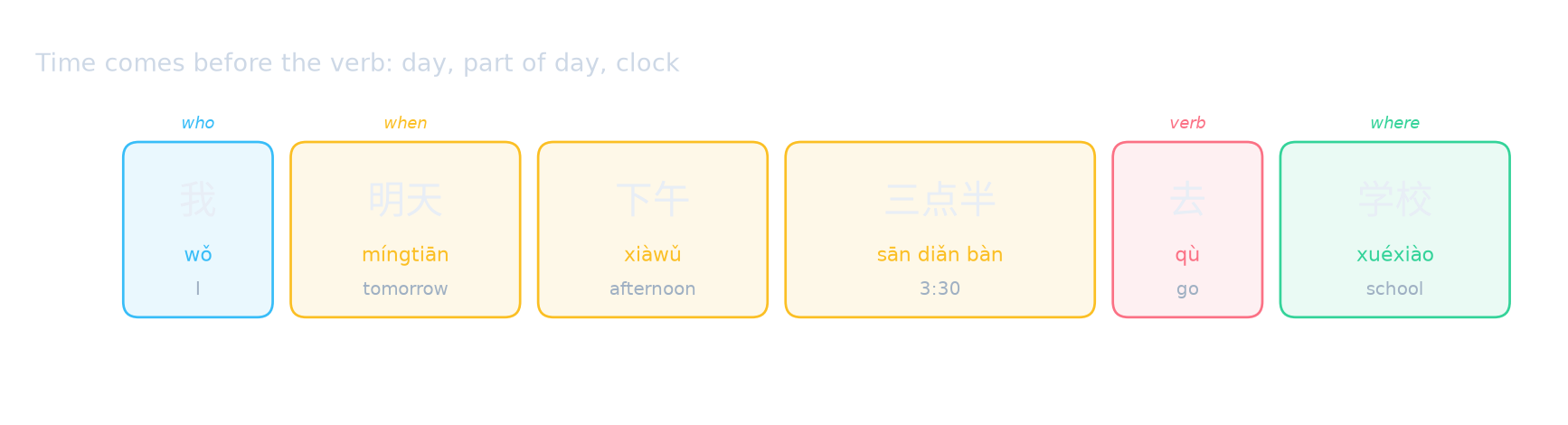
Word order. Time words go before the verb, never at the end: I / me我wǒtomorrow明天míng tiān三点sān diǎnto go去qùschool学校xué xiào. The order is: who – when – (where) – what.

Time comes before the verb: day, part of day, clock

Watch out

  • week星期xīng qīhow many / a few几jǐ asks the day; what time?几点jǐ diǎn asks the clock time. Answer the one you were asked.
  • wrong: I / me我wǒto go去qùschool学校xué xiào三点sān diǎn → I / me我wǒ三点sān diǎnto go去qùschool学校xué xiào.

Words in context

  • tomorrow明天míng tiān míngtiān – tomorrow. I / me我wǒtomorrow明天míng tiānto go去qùschool学校xué xiào。
  • Wednesday星期三xīng qī sān xīngqīsān – Wednesday. tomorrow明天míng tiānto be / is是shìWednesday星期三xīng qī sān。
  • what time?几点jǐ diǎn jǐ diǎn – what time. you你nǐwhat time?几点jǐ diǎnto go去qù?
  • half半bàn bàn – half. 三点sān diǎnhalf半bàn。
  • school学校xué xiào xuéxiào – school. I / me我wǒto go去qùschool学校xué xiào。

Reading

tomorrow明天míng tiānto be / is是shìWednesday星期三xīng qī sān。Wang Li (a name)王力wáng lì三点sān diǎnto go去qùschool学校xué xiào。林安lín ān三点sān diǎn半去bàn qùschool学校xué xiào。

Speaking

Ask a partner the day and time of a fictional meeting. They suggest Wednesday at four; confirm it.

词汇 训练
汉字 拼音 English
明天 míng tiān tomorrow
星期 xīng qī week
几 jǐ how many (small number)
你 nǐ you
去 qù to go
学校 xué xiào school
我 wǒ I
点 diǎn o'clock; a little
上午 shàng wǔ morning (before noon)
下午 xià wǔ afternoon
是 shì to be (am / is / are)
2.2

练习

English

Cover the teaching pages before you answer. The answers are at the end.

1. Listening. A partner reads the script for this question from the answers aloud. When is the meeting?

  • A. Wednesday at 4 p.m.
  • B. Thursday at 4 p.m.
  • C. Wednesday at 3:30

2. Reading. Who goes to school later?

  • A. 林安lín ān
  • B. Both at the same time
  • C. Wang Li (a name)王力wáng lì

3. Complete “What time are you going?”: you你nǐ…………to go去qù?

4. Match each word with its meaning in this unit.

  • (1) tomorrow明天míng tiān

  • (2) Wednesday星期三xīng qī sān

  • (3) what time?几点jǐ diǎn

  • (4) half半bàn

  • (5) school学校xué xiào

  • A. school

  • B. half

  • C. what time

  • D. tomorrow

  • E. Wednesday

5. Write a two-line meeting note: the weekday and time, then the place. Change at least one detail from the reading. Write your answer in Chinese, then say it aloud.

6. Someone asks week星期xīng qīhow many / a few几jǐ?week星期xīng qī means week and how many / a few几jǐ asks which number here. Which kind of reply answers this question?

  • A. 五个wǔ gèperson人rén – five people
  • B. Friday星期五xīng qī wǔ – Friday
  • C. 五点wǔ diǎn – five o’clock

7. A message says Saturday星期六xīng qī liùafternoon下午xià wǔ两点liǎng diǎn半在bàn zàipark公园gōng yuánto see / meet见jiàn – meet in the park on Saturday at 2:30 in the afternoon. First separate weekday from clock time. Which reply answers what time?几点jǐ diǎnto see / meet见jiàn – at what time shall we meet?

  • A. afternoon下午xià wǔ两点liǎng diǎnhalf半bàn – 2:30 in the afternoon
  • B. park公园gōng yuán – the park
  • C. Saturday星期六xīng qī liù – Saturday

8. Read: 林安lín ānTuesday星期二xīng qī èrmorning (before noon)上午shàng wǔ八点bā diǎnto go去qùschool学校xué xiào。Wang Li (a name)王力wáng lìTuesday星期二xīng qī èrmorning (before noon)上午shàng wǔ八点半bā diǎn bànto go去qùschool学校xué xiào。Which statement follows?

  • A. Both go at eight on Tuesday morning.
  • B. Wang Li goes half an hour after Lin An.
  • C. Lin An goes half an hour after Wang Li.

9. Write a fictional invitation giving a weekday, morning or afternoon, a clock time and a meeting place. Write a reply confirming the time and asking one different detail. Read the invitation and reply aloud or exchange them with a partner. Make your time different from the examples. Write your answer in Chinese, then say it aloud.

2.3

混合练习

English

These questions mix the patterns and use new situations.

10. Find and fix the problem. A meeting is Thursday星期四xīng qī sìafternoon下午xià wǔ三点sān diǎnhalf半bàn. Someone asks what time?几点jǐ diǎnto see / meet见jiàn? and the answer is Thursday星期四xīng qī sì. What is missing?

11. Use it yourself. Arrange to meet at school on Friday at four in the afternoon.

2.4

答案与解析

English

Mark your work, then correct each mistake in your own words.

1. Script: tomorrow明天míng tiānWednesday星期三xīng qī sān,we / us我们wǒ menafternoon下午xià wǔ四点sì diǎnat / in在zàischool学校xué xiàoto see / meet见jiàn。

A. Wednesday at 4 p.m.

四点sì diǎn is four o’clock; afternoon下午xià wǔ makes it afternoon.

2. A. 林安lín ān

三点sān diǎnhalf半bàn is later than 三点sān diǎn.

3. what time?几点jǐ diǎn

what time?几点jǐ diǎn asks for clock time.

4. (1) D: tomorrow明天míng tiān = tomorrow; (2) E: Wednesday星期三xīng qī sān = Wednesday; (3) C: what time?几点jǐ diǎn = what time; (4) B: half半bàn = half; (5) A: school学校xué xiào = school

Use the example sentences to check each word’s meaning in context.

5. Model answer: Thursday星期四xīng qī sìafternoon下午xià wǔ三点sān diǎnhalf半bàn。we / us我们wǒ menat / in在zàischool学校xué xiàoto see / meet见jiàn。

Check your answer:

  • The weekday and clock time are identifiable.
  • The place is stated.
  • The time differs from the reading.

6. B. Friday星期五xīng qī wǔ – Friday

week星期xīng qīhow many / a few几jǐ asks the weekday. 五点wǔ diǎn supplies a clock time and 五个wǔ gèperson人rén a number of people. The shared number five does not make these details interchangeable.

7. A. afternoon下午xià wǔ两点liǎng diǎnhalf半bàn – 2:30 in the afternoon

what time?几点jǐ diǎn asks clock time, so afternoon下午xià wǔ两点liǎng diǎnhalf半bàn answers it. Saturday and the park are true details but answer which day and where. Preserve afternoon下午xià wǔ instead of dropping the part of day.

8. B. Wang Li goes half an hour after Lin An.

八点半bā diǎn bàn is half an hour after 八点bā diǎn on the same stated Tuesday morning. Wang Li goes later, not Lin An. The account gives going times; it does not supply arrival times or travel duration.

9. Model answer: Possible invitation: we / us我们wǒ menMonday星期一xīng qī yīmorning (before noon)上午shàng wǔ九点jiǔ diǎnat / in在zàischool学校xué xiàoto see / meet见jiàn。Reply: morning (before noon)上午shàng wǔ九点jiǔ diǎn,to / towards / correct对duì(yes/no ?)吗ma?at / in在zàischool学校xué xiàowhere哪里nǎ lǐto see / meet见jiàn?We meet at school on Monday at nine in the morning. Nine in the morning, right? Where in the school? The reply confirms the stated time and asks for a more precise place. Other coherent invitations and questions are valid.

How to revise: If you answered a time question with a weekday, separate the two phrases and try again. Check half半bàn if you chose a half hour. Compare your own invitation with the reply; do not replace its time with the model’s time.

Check your answer:

  • Include a weekday and a clock time as separate details.
  • Specify morning or afternoon instead of relying on a guess.
  • Make the reply confirm the invitation’s actual time.
  • Ask a relevant follow-up rather than inventing an unstated detail.

If you answered a time question with a weekday, separate the two phrases and try again. Check half半bàn if you chose a half hour. Compare your own invitation with the reply; do not replace its time with the model’s time.

Scripts and models

Listening script. tomorrow明天míng tiānWednesday星期三xīng qī sān,we / us我们wǒ menafternoon下午xià wǔ四点sì diǎnat / in在zàischool学校xué xiàoto see / meet见jiàn。 – Tomorrow, Wednesday, we will meet at school at four in the afternoon.

Reading in English. Tomorrow is Wednesday. Wang Li goes to school at three. Lin An goes at half past three.

Speaking model. A: week星期xīng qīhow many / a few几jǐ?what time?几点jǐ diǎn? B: Wednesday星期三xīng qī sānafternoon下午xià wǔ四点sì diǎn。 A: good好hǎo,afternoon下午xià wǔ四点sì diǎnto see / meet见jiàn。

Mixed practice

10. Thursday星期四xīng qī sì gives the day, but what time?几点jǐ diǎn asks for the time. Answer afternoon下午xià wǔ三点sān diǎnhalf半bàn: keep afternoon下午xià wǔ so everyone knows it is 3:30 in the afternoon.

11. Model answer. we / us我们wǒ menFriday星期五xīng qī wǔafternoon下午xià wǔ四点sì diǎnat / in在zàischool学校xué xiàoto see / meet见jiàn。Day, part of the day, clock time, then place, all before the verb to see / meet见jiàn.

Review later. Tomorrow, change the day and the time, and answer week星期xīng qīhow many / a few几jǐ and what time?几点jǐ diǎn separately.

该知识点的互动课程

逐步完成,配合即时检查练习。

更多 HSK 1 知识点

登录或创建账户

IGCSE, A-Level & AP