跳到主要内容

任务八 · Travel, destinations and simple directions

HSK 1 · 知识点 6

本主题的视频课程 打开视频页面
2:29

HSK 1 · 出行、目的地与简单指路

一句话包含四个关键信息。“去”表示前往,“坐”表示乘坐,每张车票都能回答三个问题:目的地、交通方式与时间。“我明天八点坐火车去上海”即对应:日期、时刻、方式、目的地。“在”是……

英文讲解与普通话例句 · 字幕与原声同步

点击任意汉字可查看拼音和释义。
English

Say where you are going, when you leave and how you travel. Chinese puts the time first, then the action: I / me我wǒtomorrow明天míng tiān八点bā diǎnto go去qùShanghai municipality…上海shàng hǎi. 坐火车zuò huǒ chē is how you travel; to go去qùShanghai municipality…上海shàng hǎi is where to. Ask to go去qùwhere哪里nǎ lǐ for a place and how / why怎么zěn meto go去qù for a way of travelling.

6.1

说明目的地和出发时间

English

Say where you are going, when, and how.

Key sentences

  • you你nǐtomorrow明天míng tiānto go去qùwhere哪里nǎ lǐ? Nǐ míngtiān qù nǎli? – Where are you going tomorrow?
  • I / me我wǒtomorrow明天míng tiānto go去qùShanghai municipality…上海shàng hǎi。 Wǒ míngtiān qù Shànghǎi. – I'm going to Shanghai tomorrow.
  • you你nǐhow / why怎么zěn meto go去qù? Nǐ zěnme qù? – How are you getting there?
  • I / me我wǒ坐火车zuò huǒ chēto go去qù,八点bā diǎnto set off出发chū fā。 Wǒ zuò huǒchē qù, bā diǎn chūfā. – I'm taking the train; I leave at eight.

How it works

The order of a travel sentence. who – when – how – go – where:

who when how go where
I / me我wǒ tomorrow明天míng tiān八点bā diǎn 坐火车zuò huǒ chē to go去qù Shanghai municipality…上海shàng hǎi

No future ending. Chinese does not change the verb for the future. tomorrow明天míng tiān already tells you when: I / me我wǒtomorrow明天míng tiānto go去qù.

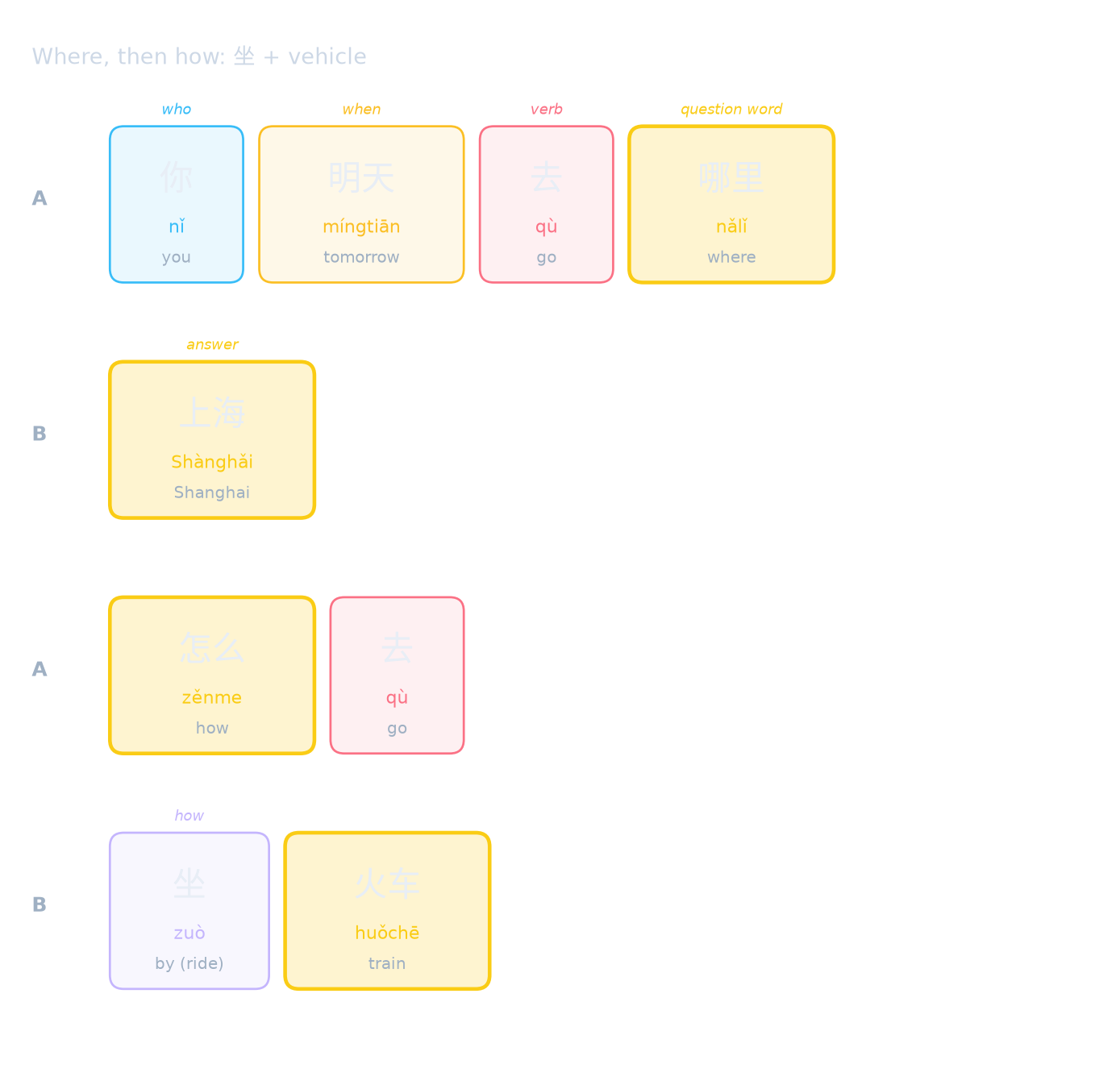
Two questions. to go去qùwhere哪里nǎ lǐ? asks for a place; how / why怎么zěn meto go去qù? asks for a way of travelling (坐火车zuò huǒ chē, to take the car, bus, train…坐车zuò chē, to walk走路zǒu lù). to sit / to take (a bus …)坐zuò literally means "sit", so it is used for vehicles you ride in.

Where, then how: 坐 + vehicle

Watch out

  • wrong: I / me我wǒto go去qùShanghai municipality…上海shàng hǎitomorrow明天míng tiān → I / me我wǒtomorrow明天míng tiānto go去qùShanghai municipality…上海shàng hǎi.
  • to go去qù is setting off; to / arrive / (result: get)到dào is arriving. 八点bā diǎnto go去qù does not say when you arrive.

Words in context

  • to go去qù qù – go. I / me我wǒto go去qùschool学校xué xiào。
  • train火车huǒ chē huǒchē – train. I / me我wǒ坐火车zuò huǒ chē。
  • to sit / to take (a bus …)坐zuò zuò – travel by / sit. I / me我wǒ坐火车zuò huǒ chēto go去qùShanghai municipality…上海shàng hǎi。
  • Shanghai municipality…上海shàng hǎi Shànghǎi – Shanghai. I / me我wǒtomorrow明天míng tiānto go去qùShanghai municipality…上海shàng hǎi。
  • 八点bā diǎn bā diǎn – eight o’clock. I / me我wǒ八点bā diǎnto go去qù。

Reading

Wang Li (a name)王力wáng lìtomorrow明天míng tiān八点bā diǎn坐火车zuò huǒ chēto go去qùShanghai municipality…上海shàng hǎi。林安lín āntomorrow明天míng tiān九点jiǔ diǎn坐车去zuò chē qùschool学校xué xiào。Wang Li (a name)王力wáng lìtoday今天jīn tiānat / in在zàischool学校xué xiào。

Speaking

Ask where a partner is going tomorrow and how. Give your own fictional departure plan.

词汇 训练
汉字 拼音 English
你 nǐ you
明天 míng tiān tomorrow
去 qù to go
我 wǒ I
怎么 zěn me how; why
坐 zuò to sit
学校 xué xiào school
今天 jīn tiān today
在 zài at; in; to be (somewhere)
6.2

练习

English

Cover the teaching pages before you answer. The answers are at the end.

1. Listening. A partner reads the script for this question from the answers aloud. What is the departure time?

  • A. Eight
  • B. Nine
  • C. Tomorrow afternoon

2. Reading. Where is Wang Li today?

  • A. Shanghai municipality…上海shàng hǎi
  • B. school学校xué xiào
  • C. On the train

3. Complete “Where are you going?”: you你nǐto go去qù…………?

4. Match each word with its meaning in this unit.

  • (1) to go去qù

  • (2) train火车huǒ chē

  • (3) to sit / to take (a bus …)坐zuò

  • (4) Shanghai municipality…上海shàng hǎi

  • (5) 八点bā diǎn

  • A. go

  • B. Shanghai

  • C. travel by / sit

  • D. eight o’clock

  • E. train

5. Write a travel plan with a time, method, and destination. Change the time from the reading. Write your answer in Chinese, then say it aloud.

6. you你nǐto go去qùwhere哪里nǎ lǐ?to go去qù means go and where哪里nǎ lǐ means where. Which reply supplies the requested kind of information?

  • A. Shanghai municipality…上海shàng hǎi – Shanghai
  • B. 八点bā diǎn – eight o’clock
  • C. 坐火车zuò huǒ chē – by train

7. The plan is 林安lín āntomorrow明天míng tiān七点qī diǎn坐车去zuò chē qùhospital医院yī yuàn – tomorrow Lin An goes to the hospital by vehicle at seven. Someone asks how / why怎么zěn meto go去qù – how will she travel? First identify whether the question requests time, method or destination.

  • A. hospital医院yī yuàn – the hospital
  • B. tomorrow明天míng tiān七点qī diǎn – seven tomorrow
  • C. to take the car, bus, train…坐车zuò chē – by vehicle

8. Read: Wang Li (a name)王力wáng lìtoday今天jīn tiānat / in在zàiBeijing北京běi jīng。tomorrow明天míng tiān十点shí diǎn坐火车zuò huǒ chēto go去qùShanghai municipality…上海shàng hǎi。Which account preserves the places and times?

  • A. He is in Shanghai today and goes to Beijing tomorrow.
  • B. He arrives in Shanghai by train at ten tomorrow.
  • C. He plans to go to Shanghai by train at ten tomorrow.

9. Make a new fictional plan: choose a destination, departure time and method. Write the plan and two different questions that a partner can answer from it. Then name one journey detail your plan does not establish. Speak the questions and replies if working with a partner. Write your answer in Chinese, then say it aloud.

6.3

混合练习

English

These questions mix the patterns and use new situations.

10. Find and fix the problem. A note says I / me我wǒtomorrow明天míng tiān三点sān diǎnto go去qùschool学校xué xiào. Does it say the person arrives at three? Explain.

11. Use it yourself. Write a message: you leave home at eight and arrive at school at half past eight.

6.4

答案与解析

English

Mark your work, then correct each mistake in your own words.

1. Script: I / me我wǒtomorrow明天míng tiān九点jiǔ diǎn坐火车zuò huǒ chēto go去qùShanghai municipality…上海shàng hǎi。

B. Nine

九点jiǔ diǎn gives nine o’clock; no afternoon is stated.

2. B. school学校xué xiào

today今天jīn tiānat / in在zàischool学校xué xiào refers to today, while the trip is tomorrow.

3. where哪里nǎ lǐ

to go去qùwhere哪里nǎ lǐ asks the destination.

4. (1) A: to go去qù = go; (2) E: train火车huǒ chē = train; (3) C: to sit / to take (a bus …)坐zuò = travel by / sit; (4) B: Shanghai municipality…上海shàng hǎi = Shanghai; (5) D: 八点bā diǎn = eight o’clock

Use the example sentences to check each word’s meaning in context.

5. Model answer: I / me我wǒtomorrow明天míng tiān十点shí diǎn坐火车zuò huǒ chēto go去qùShanghai municipality…上海shàng hǎi。

Check your answer:

  • Include a time before the action.
  • Include to sit / to take (a bus …)坐zuò plus transport.
  • Include to go去qù plus a place.

6. A. Shanghai municipality…上海shàng hǎi – Shanghai

to go去qùwhere哪里nǎ lǐ requests a destination. Eight o’clock answers when; by train answers how. Identify the question word before choosing a detail.

7. C. to take the car, bus, train…坐车zuò chē – by vehicle

how / why怎么zěn meto go去qù asks how she travels, so to take the car, bus, train…坐车zuò chē supplies the method. The other details are true within the plan but answer different questions. A true detail is not automatically a relevant reply.

8. C. He plans to go to Shanghai by train at ten tomorrow.

today今天jīn tiānat / in在zàiBeijing北京běi jīng gives today’s location; tomorrow明天míng tiān十点shí diǎn坐火车zuò huǒ chēto go去qùShanghai municipality…上海shàng hǎi gives tomorrow’s going time, method and destination. to go去qù does not supply an arrival time. The last choice reverses the cities’ roles.

9. Model answer: Possible plan: I / me我wǒtomorrow明天míng tiān七点qī diǎn坐车去zuò chē qùschool学校xué xiào。Questions: you你nǐtomorrow明天míng tiānto go去qùwhere哪里nǎ lǐ?you你nǐwhat time?几点jǐ diǎnto go去qù?Replies: school学校xué xiào。七点qī diǎn。The plan does not identify an arrival time or the specific vehicle. Other destinations, times and travel methods can work.

How to revise: Check each question against the exact phrase that answers it. If you supplied an arrival time from a departure plan, mark it as unknown and revise. Compare meanings rather than copying the model’s itinerary; self-review does not assess pronunciation.

Check your answer:

  • Include time, method and destination in the plan.
  • Use to go去qù for the destination and distinguish it from a current at / in在zài location.
  • Make both questions answerable from your own plan.
  • Identify an unstated detail without inventing it as fact.

Check each question against the exact phrase that answers it. If you supplied an arrival time from a departure plan, mark it as unknown and revise. Compare meanings rather than copying the model’s itinerary; self-review does not assess pronunciation.

Scripts and models

Listening script. I / me我wǒtomorrow明天míng tiān九点jiǔ diǎn坐火车zuò huǒ chēto go去qùShanghai municipality…上海shàng hǎi。 – Tomorrow I take a train to Shanghai at nine.

Reading in English. Tomorrow Wang Li takes a train to Shanghai at eight. Lin An goes to school by vehicle at nine. Wang Li is at school today.

Speaking model. A: you你nǐtomorrow明天míng tiānto go去qùwhere哪里nǎ lǐ? B: Shanghai municipality…上海shàng hǎi。 A: how / why怎么zěn meto go去qù? B: 坐火车zuò huǒ chē。

Mixed practice

10. No. It says the person goes to school at three tomorrow, so three is when they leave or set off. To give the arrival time, use to / arrive / (result: get)到dào: 三点sān diǎnto / arrive / (result: get)到dàoschool学校xué xiào.

11. Model answer. I / me我wǒ八点bā diǎn从家cóng jiāto set off出发chū fā,八点半bā diǎn bànto / arrive / (result: get)到dàoschool学校xué xiào。to set off出发chū fā is leaving; to / arrive / (result: get)到dào is arriving. Each time goes before its own verb.

Review later. Tomorrow, describe a different trip with a leaving time and an arrival time.

该知识点的互动课程

逐步完成,配合即时检查练习。

更多 HSK 1 知识点

登录或创建账户

IGCSE, A-Level & AP