跳到主要内容

涉及参数、向量与矩阵的函数

AP 微积分预备 · 知识点 4

本主题的视频课程 打开视频页面
8:04

含参数、向量与矩阵的函数

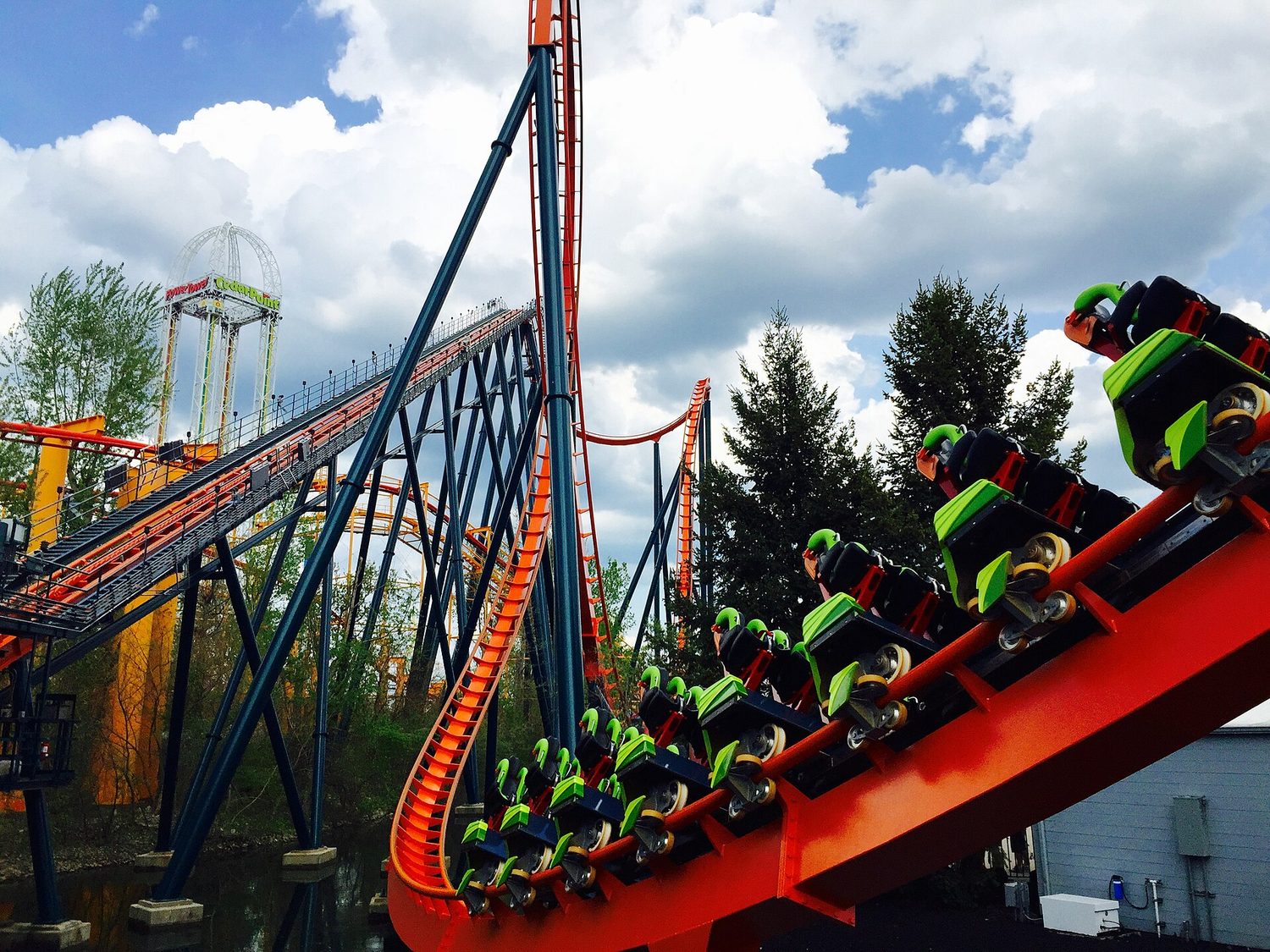
看这个过山车。在任意时刻,车厢都有两个事实:它在哪里,以及它朝哪个方向运动。单一方程无法同时容纳两者。这颗星球运行的……

英语旁白 · 英中内嵌字幕

4.1

参数方程函数

教学大纲

学习目标 4.1.A: 为以解析形式表示的参数函数构建图像或数值表。

  • 4.1.A.1 $\mathbb{R}^2$ 中的参数函数(即所有两个实数有序对的集合)由一组包含两个参数方程的集合组成,其中两个因变量 $x$ 和 $y$ 依赖于一个单一的自变量 $t$,该变量称为 参数。
  • 4.1.A.2 由于变量 $x$ 和 $y$ 依赖于自变量 $t$,因此在时刻 $t_i$ 处的坐标 $(x_i,\, y_i)$ 可以表示为 $t$ 的函数,并可表达为单个参数函数 $f(t) = (x(t),\, y(t))$;在此情况下,$x$ 和 $y$ 是两个函数的名称。
  • 4.1.A.3 可以通过在定义域内选取 $t_i$ 的多个值来计算 $x_i$ 和 $y_i$,从而生成参数函数 $f(t) = (x(t),\, y(t))$ 的数值表。
  • 4.1.A.4 可以按照 $t$ 值递增的顺序连接数值表中的若干点,从而绘制出参数函数的草图。
  • 4.1.A.5 参数函数 $f$ 的定义域通常受到限制,这会在 $f$ 的图像上产生起点和终点。

来源:College Board AP 课程与考试说明

English
A roller coaster: vectors and parametric motion describe path and velocity together

Unit 4 is part of the course but is not assessed on the AP Precalculus Exam (which covers only Units 1–3); it builds tools used in later courses.

A parametric function 参数函数 describes a curve by giving both coordinates as functions of a third variable, the parameter 参数 $t$: $\big(x(t),\,y(t)\big)$. As $t$ runs through its domain, the point traces a path – and, unlike $y=f(x)$, the path may loop or cross itself.

探索

哪种参数形式允许

在参数形式中,x和y分别依赖于参数t。对每个陈述进行排序。

词汇 训练
English 中文 拼音
parametric function/ˌpærəˈmetrɪk ˈfʌŋkʃn/ 参数函数 cān shù hán shù
parameter/pəˈræmɪtə/ 参数 cān shù
4.2

用参数方程函数为平面运动建模

教学大纲

学习目标 4.2.A: 识别与位置相关的参数平面运动函数的关键特征。

  • 4.2.A.1 由 $f(t) = (x(t),\, y(t))$ 给出的参数函数可用于对平面中的粒子运动进行建模。该函数的图像表示粒子在时间 $t$ 时的位置。
  • 4.2.A.2 通过分别确定函数 $x(t)$ 和 $y(t)$ 的最大值和最小值,可以求出粒子运动的水平极值和垂直极值。
  • 4.2.A.3 函数 $x(t)$ 的实零点对应于 $y$ 轴截距,而 $y(t)$ 的实零点对应于 $x$ 轴截距。

来源:College Board AP 课程与考试说明

English

Reading $t$ as time, a parametric function models motion in the plane. $x(t)$ and $y(t)$ give the horizontal and vertical position; the point's direction of travel is the order in which the curve is drawn as $t$ increases (mark it with arrows).

Worked example. A particle moves with $x(t)=2t-1$ and $y(t)=t^2$ for $-1\le t\le 2$. Describe its path.

Make a table first:

$t$ $-1$ $0$ $1$ $2$
$(x,y)$ $(-3,1)$ $(-1,0)$ $(1,1)$ $(3,4)$

To eliminate the parameter, solve $x=2t-1$ for $t=\tfrac{x+1}{2}$ and substitute: $y=\tfrac{(x+1)^2}{4}$. The path is the part of this parabola from $(-3,1)$ to $(3,4)$. Because $x$ increases with $t$, the particle moves left to right: down to the vertex $(-1,0)$ at $t=0$, then up.

The path x = 2t − 1, y = t² for t from −1 to 2: part of the parabola y = (x+1)²/4 from (−3, 1) down to the vertex (−1, 0) and up to (3, 4), with arrows showing the direction and the t-values marked
The same parabola could be traced in either direction; the arrows and $t$-values carry the information that $y=\tfrac{(x+1)^2}{4}$ alone loses.

Common mistake. Giving the whole parabola $y=\tfrac{(x+1)^2}{4}$ as the answer. The restriction $-1\le t\le 2$ becomes $-3\le x\le 3$, and the equation alone shows no direction.

探索

参数描绘的路径

随着参数的运行,点移动并描绘出一条平面曲线。

4.3

参数方程函数与变化率

教学大纲

学习目标 4.3.A: 识别与方向及变化率相关的平面运动参数方程函数的关键特征。

  • 4.3.A.1 随着参数的增加,可以通过独立分析 $x$ 和 $y$ 来确定质点平面运动的方向。如果 $x(t)$ 增加或减少,则运动方向分别向右或向左。如果 $y(t)$ 增加或减少,则运动方向分别向上或向下。
  • 4.3.A.2 在平面上的任意给定点,对于不同的 $t$ 值,平面运动的方向可能不同。
  • 4.3.A.3 平面上的同一条曲线可以用不同的方式参数化,并且可以使用不同的参数方程以不同的方向遍历。
  • 4.3.A.4 在定义域内的给定区间 $[t_1,\, t_2]$ 上,可以分别计算 $x(t)$ 和 $y(t)$ 的平均变化率。$y$ 的平均变化率与 $x$ 的平均变化率之比给出了曲线上对应于 $t_1$ 和 $t_2$ 的点之间的图像斜率,前提是 $x(t) \neq 0$ 的平均变化率存在(不为零)。

来源:College Board AP 课程与考试说明

English

Over an interval of $t$, the average rate of change of $x$ is $\dfrac{\Delta x}{\Delta t}$ and of $y$ is $\dfrac{\Delta y}{\Delta t}$. Their signs tell you which way the point moves (right/left, up/down); together they describe the motion's speed and direction along the path.

Worked example. Find the average rates of change for the same particle on $0\le t\le 2$ and on $-1\le t\le 0$.

$$0\le t\le 2:\quad \frac{\Delta x}{\Delta t}=\frac{3-(-1)}{2}=2,\quad \frac{\Delta y}{\Delta t}=\frac{4-0}{2}=2; \qquad -1\le t\le 0:\quad \frac{\Delta y}{\Delta t}=\frac{0-1}{1}=-1.$$

On the first interval it moves right and up on average; on the second it moves down while it moves right.

探索

首尾相接地把两个向量相加

拖动两个向量,看它们的和。向量既有方向又有大小,不像一个普通的数。

4.4

参数定义的圆与直线

教学大纲

学习目标 4.4.A: 用参数方程表示圆周运动或沿线段上的运动。

  • 4.4.A.1 一个以原点为中心、从 $(1,\, 0)$ 开始并结束于该点的单位圆完整逆时针旋转,可以用定义域为 $0 \leq t \leq 2\pi$ 的 $(x(t),\, y(t)) = (\cos t,\, \sin t)$ 来建模。
  • 4.4.A.2 对参数函数 $(x(t),\, y(t)) = (\cos t,\, \sin t)$ 进行变换,可以模拟平面内任意圆形路径。
  • 4.4.A.3 沿从点 $(x_1,\, y_1)$ 到点 $(x_2,\, y_2)$ 的线段的一条直线路径可以有多种参数化方式,其中包括使用初始位置 $(x_1,\, y_1)$ 以及 $x$ 关于 $t$ 和 $y$ 关于 $t$ 的变化率。

来源:College Board AP 课程与考试说明

English

A circle of radius $R$ centered at $(h,k)$ is $x=h+R\cos t,\ y=k+R\sin t$. A line through $(x_0,y_0)$ with direction $(a,b)$ is $x=x_0+at,\ y=y_0+bt$. Adjusting the coefficients changes the start point, speed, and direction of tracing.

Worked example. The circle with center $(3,-2)$ and radius $5$ is $x=3+5\cos t,\ y=-2+5\sin t$ for $0\le t<2\pi$. It starts at $(8,-2)$ and turns counterclockwise. Writing $y=-2-5\sin t$ instead traces the same circle clockwise.

Worked example. The segment from $(1,4)$ to $(7,1)$ has direction $(7-1,\,1-4)=(6,-3)$, so $x=1+6t,\ y=4-3t$ for $0\le t\le 1$. At $t=0$ the point is at $(1,4)$; at $t=1$ it reaches $(7,1)$.

4.5

隐函数

教学大纲

学习目标 4.5.A: 绘制包含两个变量的方程的图像。

  • 4.5.A.1 包含两个变量的方程可以隐式地描述一个或多个函数。
  • 4.5.A.2 可以通过求方程的解来绘制包含两个变量的方程的图像。
  • 4.5.A.3 求解包含两个变量的方程中的一个变量,可以定义一个函数,其图像是该方程图像的某一部分或全部。

学习目标 4.5.B: 确定隐式定义函数中两个相关量如何共同变化。

  • 4.5.B.1 对于隐式定义函数图像上彼此接近的有序数对,如果两个变量的变化量之比为正,则这两个变量同时增加或同时减少;反之,如果比值为负,则当一个变量增加时,另一个变量减小。
  • 4.5.B.2 $x$ 关于 $y$ 的变化率或 $y$ 关于 $x$ 的变化率可能为零,分别表示垂直或水平区间。

来源:College Board AP 课程与考试说明

English

An implicit 隐式 equation relates $x$ and $y$ without solving for either, such as $x^2+y^2=25$. Its graph may fail the vertical-line test (not a function), so it is often split into pieces or described parametrically.

探索

显式还是隐式?

隐式方程在不解出y的情况下关联x和y。对每一项进行分类。

词汇 训练
English 中文 拼音
implicit/ɪmˈplɪsɪt/ 隐式 yǐn shì
4.6

圆锥曲线

教学大纲

学习目标 4.6.A: 用解析法表示具有水平或垂直对称性的圆锥曲线。

  • 4.6.A.1 顶点为 $(h,\, k)$ 的抛物线,若 $a \neq 0$,当它向左或向右开口时,可解析表示为 $x - h = a(y - k)^2$;当它向上或向下开口时,可解析表示为 $y - k = a(x - h)^2$。
  • 4.6.A.2 中心在 $(h,\, k)$、水平半轴长为 $a$、垂直半轴长为 $b$ 的椭圆,可解析表示为 $\dfrac{(x - h)^2}{a^2} + \dfrac{(y - k)^2}{b^2} = 1$。圆是椭圆的特例,此时 $a = b$。
  • 4.6.A.3 中心在 $(h,\, k)$ 且具有水平和垂直对称轴的双曲线,当它向左和向右开口时,可用代数式表示为 $\dfrac{(x - h)^2}{a^2} - \dfrac{(y - k)^2}{b^2} = 1$;当它向上和向下开口时,可表示为 $\dfrac{(y - k)^2}{b^2} - \dfrac{(x - h)^2}{a^2} = 1$。其渐近线方程为 $y - k = \pm \dfrac{b}{a}(x - h)$。

来源:College Board AP 课程与考试说明

English
Conic sections: one cone, four curves

Conic sections 圆锥曲线 – circles, ellipses, parabolas, and hyperbolas – are the curves from slicing a cone, each given by a quadratic equation in $x$ and $y$. Their standard forms reveal centers, vertices, axes, and asymptotes.

Worked example. Identify $4x^2+9y^2-16x+18y-11=0$.

Complete the square in each variable:

$$4(x^2-4x)+9(y^2+2y)=11 \;\Rightarrow\; 4(x-2)^2-16+9(y+1)^2-9=11 \;\Rightarrow\; 4(x-2)^2+9(y+1)^2=36.$$

Divide by $36$: $\dfrac{(x-2)^2}{9}+\dfrac{(y+1)^2}{4}=1$. This is an ellipse 椭圆 with center $(2,-1)$, reaching $3$ units left and right (to $(-1,-1)$ and $(5,-1)$) and $2$ units up and down (to $(2,1)$ and $(2,-3)$).

Worked example. The hyperbola 双曲线 $\dfrac{x^2}{16}-\dfrac{y^2}{9}=1$ has vertices $(\pm4,0)$ and asymptotes $y=\pm\tfrac34x$. The minus sign makes it a hyperbola, and the positive $x^2$ term means it opens left and right.

Common mistake. Forgetting to subtract the constants that completing the square adds ($-16$ and $-9$ above), or dividing only one term by $36$.

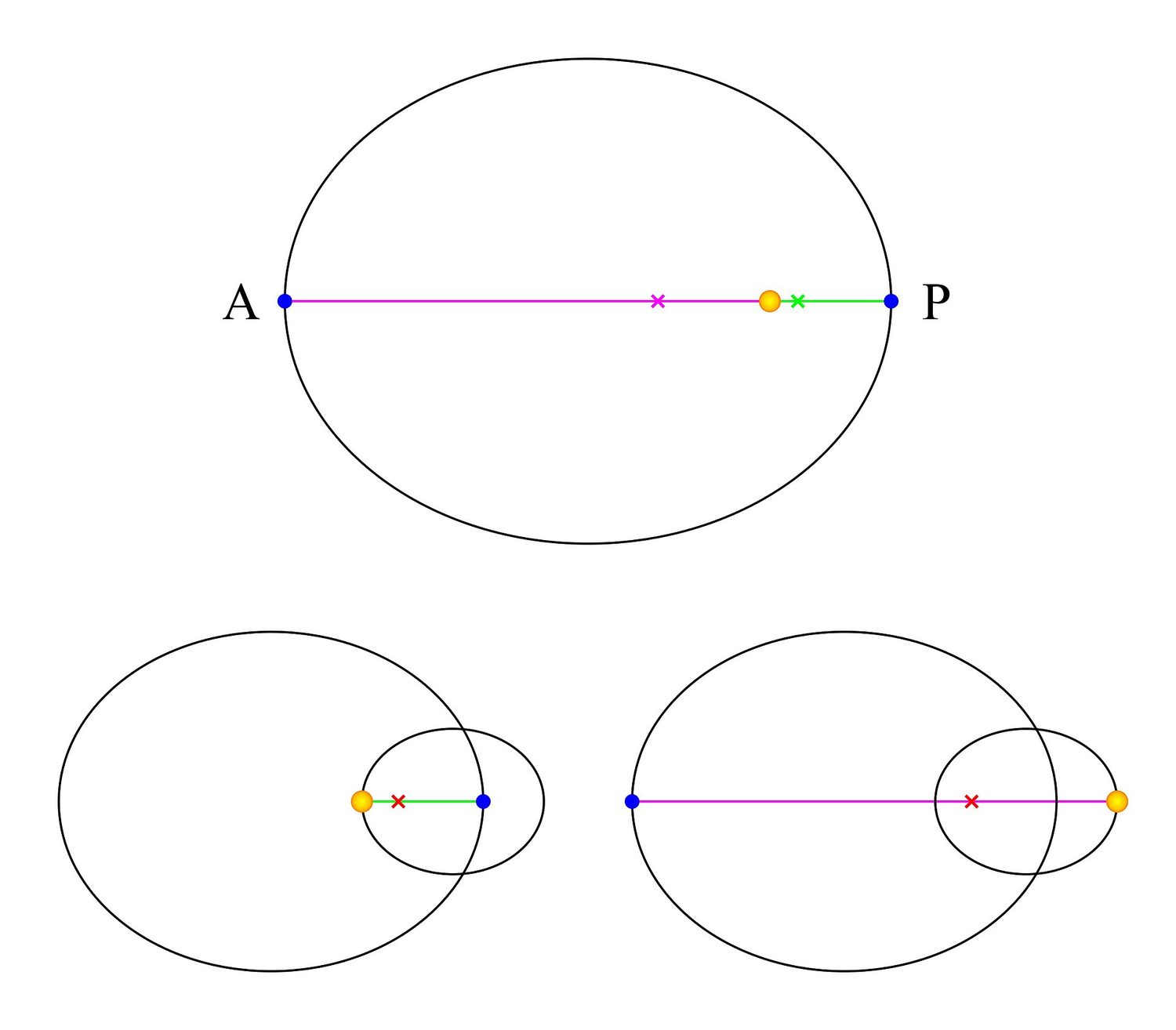
Elliptical orbits: conic sections describe closed paths with two foci — a key parametric model
探索

哪种圆锥曲线?

平方项告诉你这是哪种圆锥曲线。对每个方程进行分类。

词汇 训练
English 中文 拼音
Conic sections/ˈkɒnɪk ˈsekʃnz/ 圆锥曲线 yuán zhuī qū xiàn
ellipse/ɪˈlɪps/ 椭圆 tuǒ yuán
hyperbola/haɪˈpɜːbələ/ 双曲线 shuāng qū xiàn
4.7

隐函数的参数化

教学大纲

学习目标 4.7.A: 用参数方程表示平面上的曲线。

  • 4.7.A.1 隐函数 $(x(t),\, y(t))$ 的参数表示,当把 $x(t)$ 和 $y(t)$ 分别代入 $x$ 和 $y$ 时,对于定义域内的每一个 $t$ 值都满足相应的方程。
  • 4.7.A.2 如果 $f$ 是 $x$ 的函数,则 $y = f(x)$ 可以参数化为 $(x(t),\, y(t)) = (t, f(t))$。如果 $f$ 存在反函数,其反函数可以参数化为 $(x(t),\, y(t)) = (f(t),\, t)$,其中 $t$ 取适当的区间。

学习目标 4.7.B: 用参数方程表示圆锥曲线。

  • 4.7.B.1 抛物线可以用与任何可解出 $x$ 或 $y$ 的方程相同的方式参数化。可解出 $x$ 的方程可通过解出 $x$ 并将 $y$ 替换为 $t$ 来参数化为 $(x(t),\, y(t)) = (f(t),\, t)$。可解出 $y$ 的方程可通过解出 $y$ 并将 $x$ 替换为 $t$ 来参数化为 $(x(t),\, y(t)) = (t, f(t))$。
  • 4.7.B.2 椭圆可以使用三角函数参数化:$x(t) = h + a\cos t$ 和 $y(t) = k + b\sin t$,其中 $0 \leq t \leq 2\pi$。
  • 4.7.B.3 双曲线可以使用三角函数参数化。对于左右开口的双曲线,函数为 $x(t) = h + a\sec t$ 和 $y(t) = k + b\tan t$,其中 $0 \leq t \leq 2\pi$。对于上下开口的双曲线,函数为 $x(t) = h + a\tan t$ 和 $y(t) = k + b\sec t$,其中 $0 \leq t \leq 2\pi$。

来源:College Board AP 课程与考试说明

English

Many implicit curves can be parametrized – rewritten as $\big(x(t),y(t)\big)$ – which makes them easier to graph and to treat as motion. The circle above is the basic example; ellipses use $x=h+A\cos t,\ y=k+B\sin t$.

For the ellipse above, $x=2+3\cos t,\ y=-1+2\sin t$, $0\le t<2\pi$.

探索

把圆的方程变成运动

当角扫过时,隐式圆 x 平方加 y 平方等于 4 变成参数形式 x = 2 cos t, y = 2 sin t。

4.8

向量

教学大纲

学习目标 4.8.A: 识别向量的特征。

  • 4.8.A.1 向量是一条有向线段。当向量位于平面内时,线段的起点称为尾(tail),终点称为头(head)。线段的长度即为该向量的模(magnitude)。
  • 4.8.A.2 具有两个分量的向量 $\overrightarrow{P_1 P_2}$ 可以在 $xy$ 平面上从点 $P_1 = (x_1, y_1)$ 绘制到点 $P_2 = (x_2, y_2)$。该向量由 $a$ 和 $b$ 标识,其中 $a = x_2 - x_1$ 且 $b = y_2 - y_1$。该向量可表示为 $\langle a,\, b \rangle$。零向量 $\langle 0,\, 0 \rangle$ 是当 $P_1 = P_2$ 时的平凡情况。
  • 4.8.A.3 该向量的方向平行于从原点到坐标为 $(a,\, b)$ 的点的线段。该向量的模是分量和的平方根的平方根。
  • 4.8.A.4 对于在平面内几何表示的向量,可以使用三角学找到其分量。

学习目标 4.8.B: 确定涉及向量的和与积。

  • 4.8.B.1 常数与向量的乘积产生一个新的向量,其分量是通过将常数乘以原向量的每个分量得到的。新向量与原向量平行。
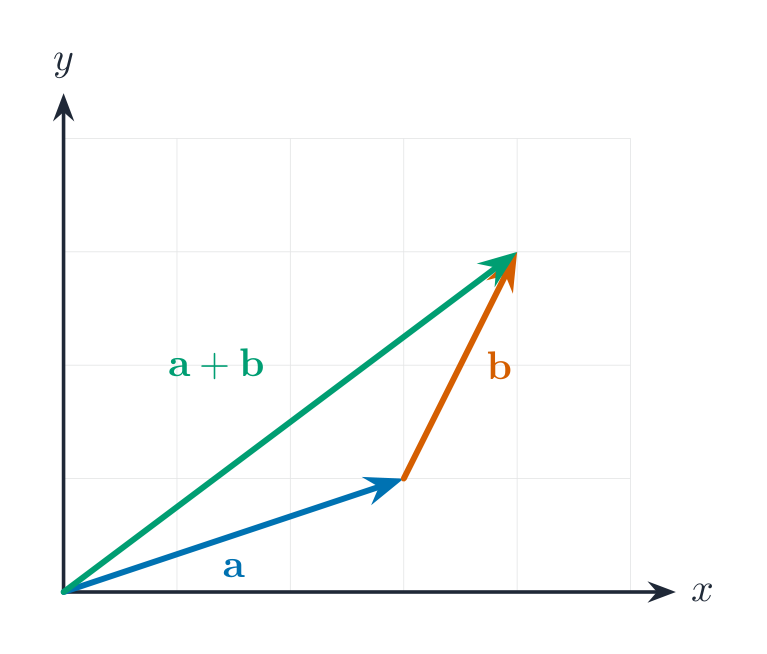
  • 4.8.B.2 $\mathbb{R}^2$ 中两个向量的和是一个新向量,其分量是通过将原向量的对应分量相加得到的。如果第二个向量的尾部位于第一个向量的头部,则新向量可以图形化地表示为一个向量,其尾部对应第一个向量的尾部,头部对应第二个向量的头部。
  • 4.8.B.3 两个向量的点积是其对应分量乘积之和。即,$\langle a_1,\, b_1 \rangle \cdot \langle a_2,\, b_2 \rangle = a_1 a_2 + b_1 b_2$。

学习目标 4.8.C: 确定给定向量的单位向量。

  • 4.8.C.1 单位向量是模为 $1$ 的向量。可以通过标量乘以给定非零向量模的倒数来找到与其同方向的单位向量。
  • 4.8.C.2 向量 $\langle a,\, b \rangle$ 可以在 $\mathbb{R}^2$ 中表示为 $a\vec{i} + b\vec{j}$,其中 $\vec{i}$ 和 $\vec{j}$ 分别是 $x$ 方向和 $y$ 方向的单位向量。即,$\vec{i} = \langle 1,\, 0 \rangle$ 且 $\vec{j} = \langle 0,\, 1 \rangle$。

学习目标 4.8.D: 确定向量之间夹角的度量以及参与向量加法的向量的模。

  • 4.8.D.1 点积在几何上等价于两个向量的模之积与它们之间夹角的余弦值的乘积。因此,如果两个非零向量的点积为零,则这两个向量互相垂直。
  • 4.8.D.2 可以使用正弦定理和余弦定理来确定由向量加法形成的三角形的边长和角度度量。

来源:College Board AP 课程与考试说明

English
Resolving a vector into components

A vector 向量 has both magnitude 大小 (length) and direction. Write it by components $\langle a,b\rangle$. Add vectors component-by-component; scale by multiplying each component; the magnitude is $\sqrt{a^2+b^2}$. Vectors model displacements, velocities, and forces.

Worked example. Let $\vec u=\langle 3,-4\rangle$ and $\vec v=\langle -1,2\rangle$. Then $\vec u+2\vec v=\langle 3-2,\,-4+4\rangle=\langle 1,0\rangle$, and $\lvert\vec u\rvert=\sqrt{9+16}=5$. The unit vector in the direction of $\vec u$ divides by its magnitude: $\tfrac15\vec u=\left\langle \tfrac35,-\tfrac45\right\rangle$.

Adding vectors by the triangle law
探索

首尾相接地把两个向量相加

向量具有大小和方向。添加两个向量时,将它们头尾相接;合向量从第一个向量的尾部指向最后一个向量的头部。拖动每个向量以查看总和。

词汇 训练
English 中文 拼音
vector/ˈvektə/ 向量 xiàng liàng
magnitude/ˈmæɡnɪtjuːd/ 大小 dà xiǎo
4.9

向量值函数

教学大纲

学习目标 4.9.A: 用向量值函数表示平面运动。

  • 4.9.A.1 在平面上运动的质点的位置,若由参数函数 $f(t) = (x(t),\, y(t))$ 给出,可以表示为 向量值函数 $p(t) = x(t)\vec{i} + y(t)\vec{j}$ 或 $p(t) = \langle x(t),\, y(t) \rangle$。位置向量在时间 $t$ 的模给出了该质点到原点的距离。
  • 4.9.A.2 向量值函数 $v(t) = \langle x(t),\, y(t) \rangle$ 可用于表示质点在平面上不同时刻 $t$ 的速度。在时间 $t$,$x(t)$ 的符号指示质点是向右还是向左运动,而 $y(t)$ 的符号则指示质点是向上还是向下运动。速度向量在时间 $t$ 的模给出了质点的速率。

来源:College Board AP 课程与考试说明

English

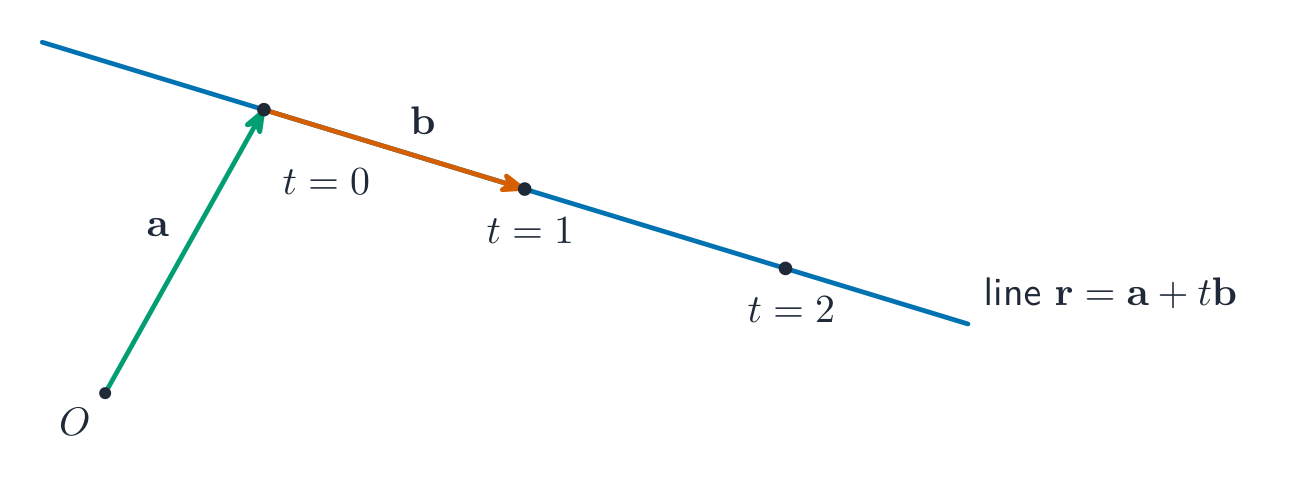
A vector-valued function 向量值函数 outputs a vector for each input, e.g. $\vec{r}(t)=\langle x(t),y(t)\rangle$ – the same information as a parametric function, packaged as a moving position vector.

A vector-valued line: start at a, then slide by t lots of the direction b
探索

向量值函数

向量值函数输出向量;将分量向量相加即可得到合向量。

词汇 训练
English 中文 拼音
vector-valued function/ˈvektə ˈvæljuːd ˈfʌŋkʃn/ 向量值函数 xiàng liàng zhí hán shù
4.10

矩阵

教学大纲

学习目标 4.10.A: 确定两个矩阵的乘积。

  • 4.10.A.1 $n \times m$ 矩阵是一个由 $n$ 行和 $m$ 列组成的数组。
  • 4.10.A.2 当第一个矩阵的列数等于第二个矩阵的行数时,这两个矩阵才能相乘。该乘积矩阵中的第 $i$ 行第 $j$ 列的元素,等于第一个矩阵的第 $i$ 行与第二个矩阵的第 $j$ 列的点积(内积)。

来源:College Board AP 课程与考试说明

English

A matrix 矩阵 is a rectangular array of numbers. Add matrices of the same size entry-by-entry; multiply a matrix by a compatible one by combining rows with columns. Matrices store and transform data compactly.

Worked example.

$$\begin{bmatrix}1 & 2\\ 0 & 1\end{bmatrix}\begin{bmatrix}3 & 0\\ 1 & 2\end{bmatrix}=\begin{bmatrix}1\cdot3+2\cdot1 & 1\cdot0+2\cdot2\\ 0\cdot3+1\cdot1 & 0\cdot0+1\cdot2\end{bmatrix}=\begin{bmatrix}5 & 4\\ 1 & 2\end{bmatrix}.$$

In the other order the product is $\begin{bmatrix}3 & 6\\ 1 & 4\end{bmatrix}$, which is different. Matrix multiplication is not commutative: order matters.

探索

矩阵变换平面

2x2矩阵移动平面的每一点;这个矩阵使其发生侧向剪切。

词汇 训练
English 中文 拼音
matrix/ˈmeɪtrɪks/ 矩阵 jǔ zhèn
4.11

矩阵的逆与行列式

教学大纲

学习目标 4.11.A: 确定 $2 \times 2$ 矩阵的逆。

  • 4.11.A.1 单位矩阵 $I$ 是一个方阵,其从左上到右下的对角线上元素为 $1$,其余位置元素均为 $0$。
  • 4.11.A.2 将方阵与其对应的单位矩阵相乘,结果仍为该原方阵。
  • 4.11.A.3 若方阵存在逆矩阵,则该方阵与其逆矩阵的乘积等于同阶的单位矩阵。
  • 4.11.A.4 $2 \times 2$ 矩阵的逆(若存在)可通过或不可通过技术工具计算得出。

学习目标 4.11.B: 应用行列式的值来判断可逆性及向量性质。

  • 4.11.B.1 矩阵 $A = \begin{bmatrix} a & b \\ c & d \end{bmatrix}$ 的行列式为 $ad - bc$。该行列式可通过或不可通过技术工具计算,记作 $\det(A)$。
  • 4.11.B.2 若一个 $2 \times 2$ 矩阵由来自 $\mathbb{R}^2$ 的两个列向量或行向量组成,则该矩阵行列式的非零绝对值即为矩阵列或行所表示向量张成的平行四边形的面积。若行列式等于 $0$,则这些向量相互平行。
  • 4.11.B.3 方阵 $A$ 存在逆矩阵当且仅当 $\det(A) \neq 0$。

来源:College Board AP 课程与考试说明

English

The determinant 行列式 of a $2\times 2$ matrix $\begin{bmatrix} a & b \\ c & d\end{bmatrix}$ is $ad-bc$. A matrix has an inverse 逆矩阵 exactly when its determinant is nonzero; the inverse undoes the matrix, and it solves matrix equations (like a reciprocal for numbers).

Worked example. For $A=\begin{bmatrix}3 & 1\\ 2 & 4\end{bmatrix}$, the determinant is $ad-bc=(3)(4)-(1)(2)=10$. Since it is nonzero, $A$ is invertible, and $A^{-1}=\dfrac{1}{10}\begin{bmatrix}4 & -1\\ -2 & 3\end{bmatrix}$ (swap the diagonal, negate the off-diagonal, divide by the determinant).

Worked example. Solve $3x+y=7,\ 2x+4y=8$ with $A^{-1}$. In matrix form $A\begin{bmatrix}x\\y\end{bmatrix}=\begin{bmatrix}7\\8\end{bmatrix}$, so

$$\begin{bmatrix}x\\y\end{bmatrix}=A^{-1}\begin{bmatrix}7\\8\end{bmatrix}=\frac{1}{10}\begin{bmatrix}4\cdot7-1\cdot8\\ -2\cdot7+3\cdot8\end{bmatrix}=\frac{1}{10}\begin{bmatrix}20\\10\end{bmatrix}=\begin{bmatrix}2\\1\end{bmatrix}.$$

Check: $3(2)+1=7$ and $2(2)+4(1)=8$.

探索

行列式是面积因子

行列式告诉你矩阵缩放面积的程度;在这里它将面积放大了四倍。

词汇 训练
English 中文 拼音
determinant/dɪˈtɜːmɪnənt/ 行列式 háng liè shì
inverse/ɪnˈvɜːs/ 逆矩阵 nì jǔ zhèn
4.12

线性变换与矩阵

教学大纲

学习目标 4.12.A: 利用 $2 \times 2$ 矩阵确定线性变换的输出向量。

  • 4.12.A.1 线性变换 是一种将输入向量映射为输出向量的函数,其输出向量的每个分量都是输入向量各分量的常数倍之和。
  • 4.12.A.2 线性变换会将零向量映射为零向量。
  • 4.12.A.3 $\mathbb{R}^2$ 中的单个向量可以表示为一个 $2 \times 1$ 矩阵。$\mathbb{R}^2$ 中的一组 $n$ 个向量可以表示为一个 $2 \times n$ 矩阵。
  • 4.12.A.4 对于从 $\mathbb{R}^2$ 到 $\mathbb{R}^2$ 的线性变换 $L$,存在唯一的 $2 \times 2$ 矩阵 $A$,使得对于 $\mathbb{R}^2$ 中的向量有 $L(\vec{v}) = A\vec{v}$。反之,对于给定的 $2 \times 2$ 矩阵 $A$,函数 $L(\vec{v}) = A\vec{v}$ 是从 $\mathbb{R}^2$ 到 $\mathbb{R}^2$ 的线性变换。
  • 4.12.A.5 将一个 $2 \times 2$ 变换矩阵 $A$ 与一个包含 $n$ 个输入向量的 $2 \times n$ 矩阵相乘,结果是一个 $2 \times n$ 矩阵,该矩阵包含了线性变换 $L(\vec{v}) = A\vec{v}$ 对应的 $n$ 个输出向量。

来源:College Board AP 课程与考试说明

English
A matrix transforms the plane

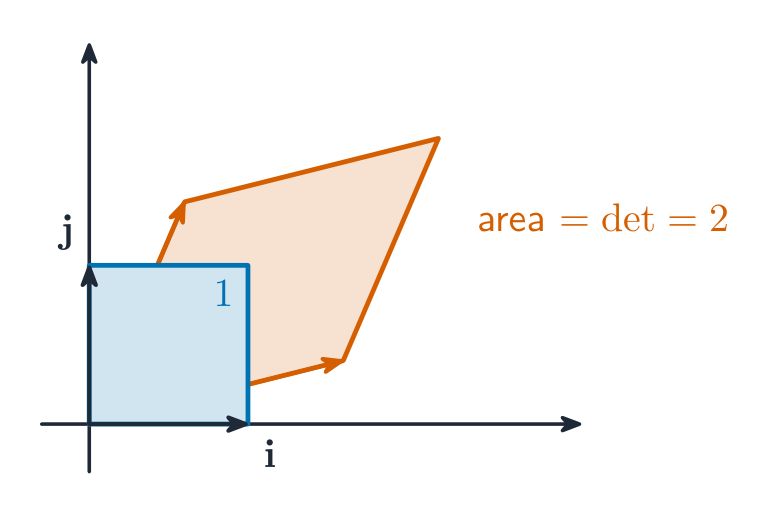
A $2\times 2$ matrix acts as a linear transformation 线性变换 of the plane – rotating, reflecting, stretching, or shearing points – by multiplying each position vector. The determinant measures how the transformation scales area (and its sign tells whether orientation flips).

Worked example. The matrix $\begin{bmatrix}2 & 0\\ 0 & 3\end{bmatrix}$ stretches the plane by $2$ horizontally and $3$ vertically, sending the vector $\begin{bmatrix}1\\1\end{bmatrix}$ to $\begin{bmatrix}2\\3\end{bmatrix}$. Its determinant $2\times3=6$ means every area is multiplied by $6$, so the unit square becomes a $2\times3$ rectangle.

Worked example. The rotation by angle $\theta$ counterclockwise about the origin is $\begin{bmatrix}\cos\theta & -\sin\theta\\ \sin\theta & \cos\theta\end{bmatrix}$. For $\theta=90^\circ$ it is $\begin{bmatrix}0 & -1\\ 1 & 0\end{bmatrix}$, which sends $\begin{bmatrix}3\\1\end{bmatrix}$ to $\begin{bmatrix}-1\\3\end{bmatrix}$. Its determinant is $0\cdot0-(-1)(1)=1$: a rotation keeps every area the same.

A 2x2 matrix maps the unit square to a parallelogram; the determinant is the area scale
探索

用矩阵变换平面

一个$2\times2$矩阵将每个点映射到新位置,从而拉伸、旋转或剪切整个网格。更改条目并观察单位正方形的变换。

词汇 训练
English 中文 拼音
linear transformation/ˈlɪnɪə trænsfɔːˈmeɪʃn/ 线性变换 xiàn xìng biàn huàn
4.13

作为函数的矩阵

教学大纲

学习目标 4.13.A: 确定线性变换与矩阵之间的关联。

  • 4.13.A.1 将 $\langle x,\, y \rangle$ 映射到 $\langle a_{11} x + a_{12} y,\, a_{21} x + a_{22} y \rangle$ 的线性变换,对应于矩阵 $\begin{bmatrix} a_{11} & a_{12} \\ a_{21} & a_{22} \end{bmatrix}$。
  • 4.13.A.2 线性变换中单位向量的映射为确定其对应的矩阵提供了重要信息。
  • 4.13.A.3 矩阵 $\begin{bmatrix} \cos\theta & -\sin\theta \\ \sin\theta & \cos\theta \end{bmatrix}$ 对应于一种线性变换,该变换将每个向量绕原点逆时针旋转角度 $\theta$。
  • 4.13.A.4 $2 \times 2$ 变换矩阵行列式的绝对值,给出了在 $\mathbb{R}^2$ 下区域经变换后的伸缩比例大小。

学习目标 4.13.B: 确定两个线性变换的组合。

  • 4.13.B.1 两个线性变换的组合仍是一个线性变换。
  • 4.13.B.2 两个线性变换组合所对应的矩阵,等于各自线性变换对应矩阵的乘积。

学习目标 4.13.C: 确定线性变换的逆。

  • 4.13.C.1 若两个线性变换的组合将任意向量映射到自身,则这两个线性变换互为逆变换。
  • 4.13.C.2 若线性变换 $L$ 由 $L(\vec{v}) = A\vec{v}$ 给出,则其逆变换由 $L^{-1}(\vec{v}) = A^{-1}\vec{v}$ 给出,其中 $A^{-1}$ 是矩阵 $A$ 的逆矩阵。

来源:College Board AP 课程与考试说明

English

Because a matrix maps input vectors to output vectors, it is a function on the plane. Composing transformations corresponds to multiplying their matrices, and the inverse matrix reverses the mapping.

探索

作为函数的矩阵

一个矩阵接收输入向量并返回输出向量——这是作用于向量的函数。

4.14

用矩阵为情境建模

教学大纲

学习目标 4.14.A: 使用矩阵构建涉及两个状态之间转换的情境模型。

  • 4.14.A.1 情境可以表明状态间转换的速率,以百分比变化表示。可以根据这些速率构建矩阵,以模拟状态在离散时间间隔内的变化。

学习目标 4.14.B: 应用矩阵模型预测 $n$ 次转换步骤的未来和过去状态。

  • 4.14.B.1 用于建模状态间转换的矩阵与相应状态向量的乘积可以预测未来状态。
  • 4.14.B.2 将用于建模状态间转换的矩阵与相应的结果状态向量进行反复相乘,可以预测稳态,即各状态之间的分布不再随下一步骤而改变的状态。
  • 4.14.B.3 用于建模状态间转换的矩阵的逆矩阵与相应状态向量的乘积可以预测过去状态。

来源:College Board AP 课程与考试说明

English

Matrices model systems that step forward in stages – for example, populations moving between states each year. Repeated multiplication by a transition matrix advances the model one step at a time, so matrix powers predict long-run behavior.

Worked example. Each year $90\%$ of a town's residents who use bus A keep using it and $10\%$ switch to bus B; $20\%$ of bus B users switch to A and $80\%$ stay. Write the model with each column holding where one group goes:

$$T=\begin{bmatrix}0.9 & 0.2\\ 0.1 & 0.8\end{bmatrix}, \qquad T\begin{bmatrix}600\\400\end{bmatrix}=\begin{bmatrix}0.9(600)+0.2(400)\\ 0.1(600)+0.8(400)\end{bmatrix}=\begin{bmatrix}620\\380\end{bmatrix}.$$

After one year, $620$ use A and $380$ use B. The numbers stop changing when the flows balance, $0.1A=0.2B$, so $A=2B$. Out of $1000$ residents, that is about $667$ on A and $333$ on B in the long run.

探索

矩阵的一个良好用途是什么?

矩阵用于模拟变换、系统和转换。对每项任务进行分类。

4.14

考试技巧

English
  • A parametric function gives $x(t)$ and $y(t)$ separately — track the direction of motion as $t$ increases.
  • A vector has magnitude and direction; add component-by-component and find magnitude with $\sqrt{a^2+b^2}$.
  • The determinant of a $2\times2$ matrix is $ad-bc$ (mind the minus sign); it scales area under the transformation.
  • A $2\times2$ matrix transforms the plane (rotate, reflect, stretch); an inverse exists only when the determinant is non-zero.
  • Note this unit is not tested on the AP Precalculus Exam (Units 1–3 only), but it underpins later courses.

该知识点的互动课程

逐步完成,配合即时检查练习。

历年真题

更多 AP 微积分预备 知识点

登录或创建账户

IGCSE, A-Level & AP