跳到主要内容

转动系统的能量与动量

AP 物理 C:力学 · 第 6 主题

训练
讲义 词汇表
6.1

转动动能

大纲
Learning ObjectiveEssential Knowledge

6.1.A
Describe the rotational kinetic energy of a rigid system in terms of the rotational inertia and angular velocity of that rigid system.

  • 6.1.A.1 The rotational kinetic energy of an object or rigid system is related to the rotational inertia and angular velocity of the rigid system and is given by the equation $K_{\text{rot}} = \dfrac{1}{2} I \omega^2$.
    • Equation: $K_{\text{rot}} = \dfrac{1}{2} I \omega^2$
    • 6.1.A.1.i The rotational inertia of an object about a fixed axis can be used to show that the rotational kinetic energy of that object is equivalent to its translational kinetic energy, which is its total kinetic energy.
    • 6.1.A.1.ii The total kinetic energy of a rigid system is the sum of its rotational kinetic energy due to its rotation about its center of mass and the translational kinetic energy due to the linear motion of its center of mass.
  • 6.1.A.2 A rigid system can have rotational kinetic energy while its center of mass is at rest due to the individual points within the rigid system having linear speed and, therefore, kinetic energy.
  • 6.1.A.3 Rotational kinetic energy is a scalar quantity.

来源:美国大学理事会 AP 课程与考试说明

一个旋转的物体有转动动能(rotational kinetic energy)

$$K_{\text{rot}}=\tfrac12 I\omega^2,$$

$\tfrac12mv^2$ 的旋转孪生,转动惯量(rotational inertia)$I$ 扮演质量的角色。一个既移动又旋转的物体携带两个项:

$$K=\tfrac12 mv_{\text{cm}}^2+\tfrac12 I\omega^2.$$

Worked example. 一个均匀圆柱($I=\tfrac12mr^2$)以速率 $v$ 滚动。它的动能是 $K=\tfrac12mv^2+\tfrac12\big(\tfrac12mr^2\big)\big(\tfrac{v}{r}\big)^2=\tfrac34mv^2$ ——它的三分之一是转动的。同样的能量核算球决定每个滚动问题。

词汇表 训练
英文 中文 拼音
rotational kinetic energy 转动动能 zhuǎn dòng dòng néng
rotational inertia 转动惯量 zhuǎn dòng guàn liàng
6.2

力矩与功

大纲
Learning ObjectiveEssential Knowledge

6.2.A
Describe the work done on a rigid system by a given torque or collection of torques.

  • 6.2.A.1 A torque can transfer energy into or out of an object or rigid system if the torque is exerted over an angular displacement.
  • 6.2.A.2 The amount of work done on a rigid system by a torque is related to the magnitude of that torque and the angular displacement through which the rigid system rotates during the interval in which that torque is exerted.
    • Equation: $W = \displaystyle\int_{\theta_1}^{\theta_2} \tau \, d\theta$
  • 6.2.A.3 Work done on a rigid system by a given torque can be found from the area under the curve of a graph of the torque as a function of angular position.

来源:美国大学理事会 AP 课程与考试说明

一个力矩(torque)作用过一个角位移(angular displacement)做功,而功率是力矩乘角速度:

$$W=\int_{\theta_1}^{\theta_2}\tau\,d\theta,\qquad P=\tau\omega.$$

这些是 $W=\int F\,dx$$P=Fv$ 的旋转形式——整个平动能量工具箱以 $F\to\tau$$x\to\theta$$v\to\omega$ 转移过来。

Worked example. 一个马达对一个飞轮施加一个恒定的 $8.0\ \text{N}\cdot\text{m}$ 力矩达 $5.0$ 整转:$W=\tau\,\Delta\theta=8.0(5.0)(2\pi)=250\ \text{J}$,若摩擦可忽略它作为转动动能出现。

探索

Balance torques on a beam

Torque is force times perpendicular distance, $\tau=Fd$. Equal torques on each side keep the beam in rotational equilibrium.

词汇表 训练
英文 中文 拼音
torque 力矩 lì jǔ
angular displacement 角位移 jiǎo wèi yí
6.3

角动量与角冲量

大纲
Learning ObjectiveEssential Knowledge

6.3.A
Describe the angular momentum of an object or rigid system.

  • 6.3.A.1 The magnitude of the angular momentum of a rigid system about a specific axis can be described with the equation $L = I\omega$.
    • Equation: $L = I\omega$
  • 6.3.A.2 The angular momentum of an object about a given point is $\vec{L} = \vec{r} \times \vec{p}$.
    • Equation: $\vec{L} = \vec{r} \times \vec{p}$
    • 6.3.A.2.i The selection of the axis about which an object is considered to rotate influences the determination of the angular momentum of that object.
    • 6.3.A.2.ii The measured angular momentum of an object traveling in a straight line depends on the distance between the reference point and the object, the mass of the object, the speed of the object, and the angle between the radial distance and the velocity of the object.

6.3.B
Describe the angular impulse delivered to an object or rigid system by a torque.

  • 6.3.B.1 Angular impulse is defined as the product of the torque exerted on an object or rigid system and the time interval during which the torque is exerted.
    • Equation: $\text{angular impulse} = \displaystyle\int \tau \, dt$
  • 6.3.B.2 Angular impulse has the same direction as the torque imparting it.
  • 6.3.B.3 The angular impulse delivered to an object or rigid system by a torque can be found from the area under the curve of a graph of the torque as a function of time.

6.3.C
Relate the change in angular momentum of an object or rigid system to the angular impulse given to that object or rigid system.

  • 6.3.C.1 The magnitude of the change in angular momentum can be described by comparing the magnitudes of the final and initial momenta of the object or rigid system.
    • Equation: $\Delta L = L - L_0$
  • 6.3.C.2 A rotational form of the impulse–momentum theorem relates the angular impulse delivered to an object or rigid system and the change in angular momentum of that object or rigid system.
    • 6.3.C.2.i The angular impulse exerted on an object or rigid system is equal to the change in angular momentum of that object or rigid system.
      • Equation: $\Delta L = \displaystyle\int_{t_1}^{t_2} \tau \, dt$
    • 6.3.C.2.ii The rotational form of the impulse–momentum theorem is a direct result of Newton's second law of motion for cases in which rotational inertia is constant.
      • Equation: $\tau_{\text{net}} = \dfrac{dL}{dt} = I\dfrac{d\omega}{dt} = I\alpha$
  • 6.3.C.3 The net torque exerted on an object or rigid system is equal to the slope of the graph of the angular momentum of an object as a function of time.
  • 6.3.C.4 The angular impulse delivered to an object or rigid system is equal to the area under the curve of a graph of the net external torque exerted on an object as a function of time.

来源:美国大学理事会 AP 课程与考试说明

一个粒子的角动量(angular momentum)是

$$\vec{L}=\vec{r}\times\vec{p},\qquad |L|=mvr\sin\theta,$$

所以即使一个沿直线移动的粒子也有绕不在那条线上的任何点的角动量($L=mv\,d$,$d$ 是垂直距离)。对于一个绕一个固定轴旋转的刚体,$L=I\omega$。旋转形式的牛顿第二定律是

$$\vec{\tau}_{\text{net}}=\frac{d\vec{L}}{dt}\quad(=I\alpha\ \text{when }I\text{ is constant}),$$

而一个合力矩随时间作用传递一个角冲量(angular impulse)$\int\tau\,dt=\Delta L$ ——旋转冲量-动量定理。

词汇表 训练
英文 中文 拼音
Angular momentum 角动量 jiǎo dòng liàng
angular impulse 角冲量 jiǎo chōng liàng
6.4

角动量守恒

大纲
Learning ObjectiveEssential Knowledge

6.4.A
Describe the behavior of a system using conservation of angular momentum.

  • 6.4.A.1 The total angular momentum of a system about a rotational axis is the sum of the angular momenta of the system's constituent parts about that rotational axis.
  • 6.4.A.2 Any change to a system's angular momentum must be due to an interaction between the system and its surroundings.
    • 6.4.A.2.i The angular impulse exerted by one object or system on a second object or system is equal and opposite to the angular impulse exerted by the second object or system on the first. This is a direct result of Newton's third law.
    • 6.4.A.2.ii A system may be selected so that the total angular momentum of that system is constant.
    • 6.4.A.2.iii The angular speed of a nonrigid system may change without the angular momentum of the system changing if the system changes shape by moving mass closer to or farther from the rotational axis.
    • 6.4.A.2.iv If the total angular momentum of a system changes, that change will be equivalent to the angular impulse exerted on the system.

6.4.B
Describe how the selection of a system determines whether the angular momentum of that system changes.

  • 6.4.B.1 Angular momentum is conserved in all interactions.
  • 6.4.B.2 If the net external torque exerted on a selected object or rigid system is zero, the total angular momentum of that system is constant.
  • 6.4.B.3 If the net external torque exerted on a selected object or rigid system is nonzero, angular momentum is transferred between the system and the environment.

来源:美国大学理事会 AP 课程与考试说明

角动量:收拢加快旋转

零合外力矩,总角动量守恒(conserved):

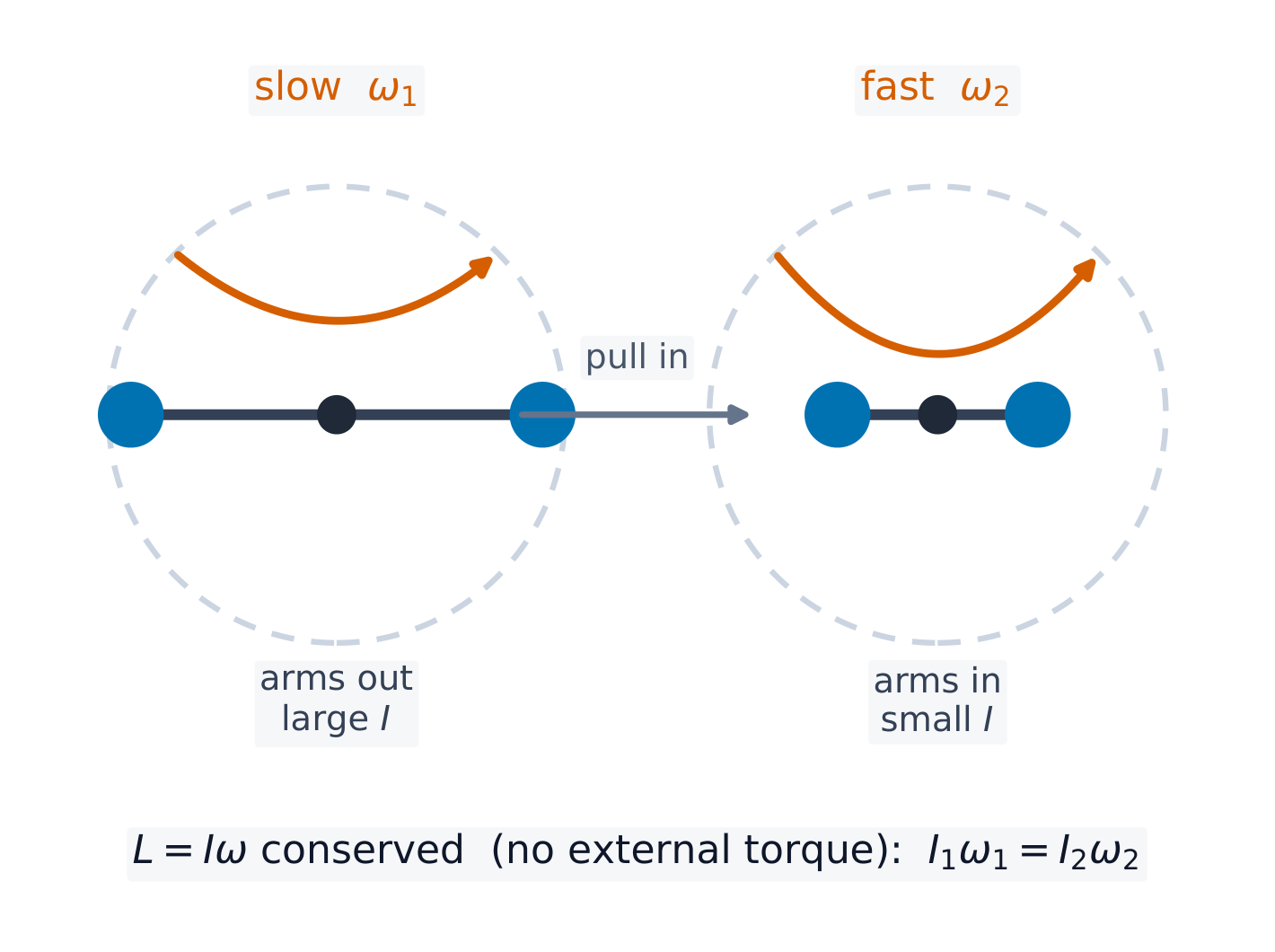
$$L_{\text{before}}=L_{\text{after}},\qquad I_1\omega_1=I_2\omega_2\ \text{(one rigid body reshaping)}.$$

$I$ 缩小,$\omega$ 增长——一个旋转的滑冰者收臂时加速。这个规则度过碰撞和形状变化,这就是使它如此有用的东西:挑选轴,使每个外力(重力、枢轴力)绕它不施加力矩。

Worked example. 一个滑冰者以 $2.0\ \text{rev/s}$$I_1=4.0\ \text{kg}\cdot\text{m}^2$ 旋转。收臂把它降到 $I_2=1.6\ \text{kg}\cdot\text{m}^2$:$\omega_2=\dfrac{4.0}{1.6}(2.0)=5.0\ \text{rev/s}$。她的动能上升——额外的能量是她的肌肉向内收臂所做的功。
向内拉质量降低 I,所以 ω 上升以守恒 L = Iω
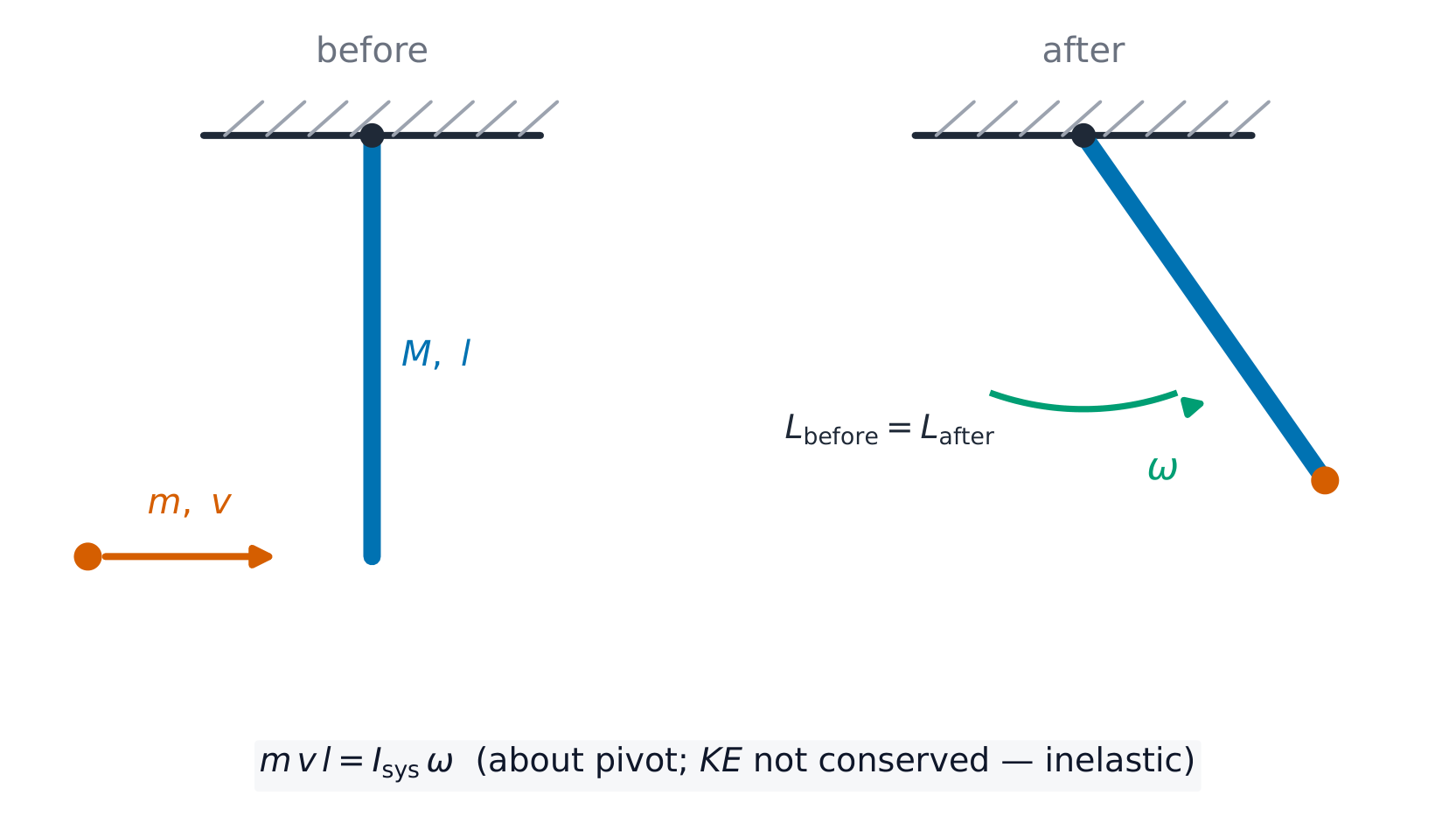
随着子弹嵌入杆,绕枢轴的角动量守恒
随着子弹嵌入杆,绕枢轴的角动量守恒

Worked example (rotational collision). 一颗 $0.020\ \text{kg}$$300\ \text{m/s}$ 的子弹撞一根从一个枢轴悬挂的均匀杆($M=1.5\ \text{kg}$、长度 $l=0.60\ \text{m}$)的尖端,并嵌入。绕枢轴,重力和枢轴力在撞击期间不施加力矩,所以 $L$ 守恒:$L=mvl=0.020(300)(0.60)=3.6\ \text{kg}\cdot\text{m}^2/\text{s}$。之后 $I=\tfrac13Ml^2+ml^2=0.18+0.0072=0.187\ \text{kg}\cdot\text{m}^2$,所以 $\omega=\dfrac{3.6}{0.187}\approx19\ \text{rad/s}$。(线性动量在这里守恒——枢轴推杆——而动能肯定不守恒:在声称它们之前检查两者。)

词汇表 训练
英文 中文 拼音
conserved 守恒 shǒu héng
6.5

滚动

大纲
Learning ObjectiveEssential Knowledge

6.5.A
Describe the kinetic energy of a system that has translational and rotational motion.

  • 6.5.A.1 The total kinetic energy of a system is the sum of the system's translational and rotational kinetic energies.
    • Equation: $K_{\text{tot}} = K_{\text{trans}} + K_{\text{rot}}$

6.5.B
Describe the motion of a system that is rolling without slipping.

  • 6.5.B.1 While rolling without slipping, the translational motion of a system's center of mass is related to the rotational motion of the system itself with the following equations:
    • Equation: $\Delta x_{\text{cm}} = r\Delta\theta$
    • Equation: $v_{\text{cm}} = r\omega$
    • Equation: $a_{\text{cm}} = r\alpha$
  • 6.5.B.2 For ideal cases, rolling without slipping implies that the frictional force does not dissipate any energy from the rolling system.

6.5.C
Describe the motion of a system that is rolling while slipping.

  • 6.5.C.1 When slipping, the motion of a system's center of mass and the system's rotational motion cannot be directly related.
  • 6.5.C.2 When a rotating system is slipping relative to another surface, the point of application of the force of kinetic friction exerted on the system moves with respect to the surface, so the force of kinetic friction will dissipate energy from the system.

Boundary statement: Rolling friction is beyond the scope of AP Physics C: Mechanics.

来源:美国大学理事会 AP 课程与考试说明

纯滚动(无滑动)

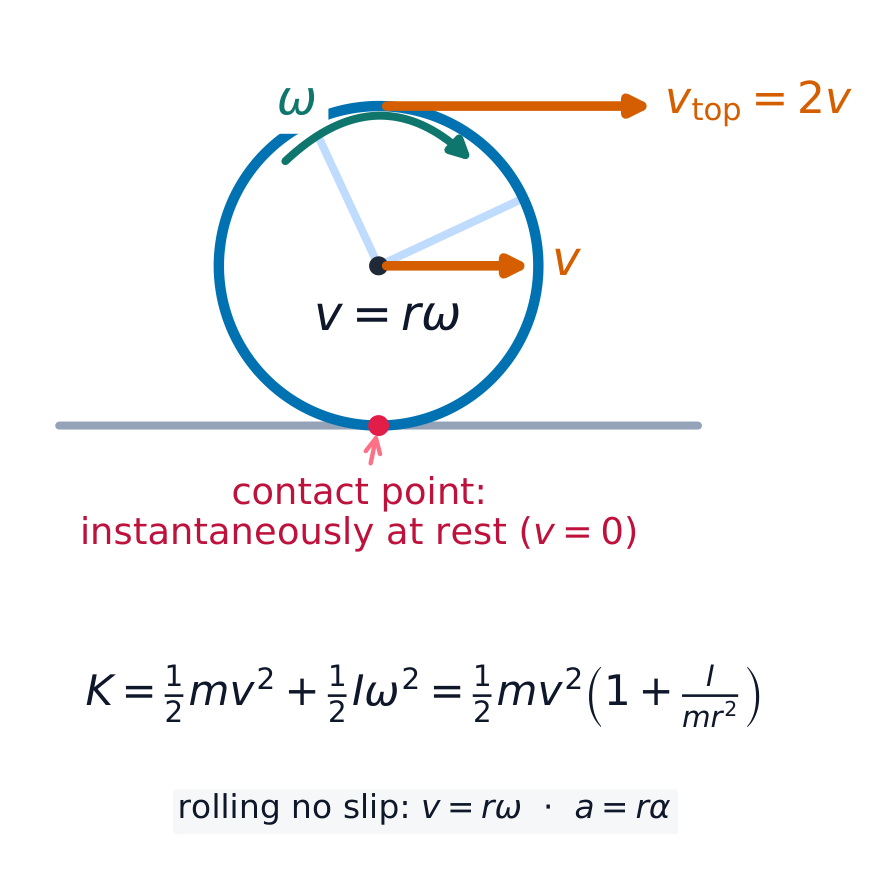
无滑滚动(rolling without slipping)把平动与旋转绑定:接触点暂时静止,所以

$$\Delta x_{\text{cm}}=r\,\Delta\theta,\qquad v_{\text{cm}}=r\omega,\qquad a_{\text{cm}}=r\alpha.$$
在无滑滚动里接触点静止,所以 v = rω

静摩擦供应保持旋转与运动匹配的力矩,但在一个不滑动的点——所以对于纯滚动,摩擦不做功,而能量守恒安全可用。(滚动摩擦超出 AP 课程。)

让形状沿一个斜面赛跑显示能量分割。以 $I=\beta mr^2$,能量守恒给出

$$a_{\text{cm}}=\frac{g\sin\theta}{1+\beta}:$$

一个($\beta=\tfrac25$)击败一个圆盘(disk)($\beta=\tfrac12$),它击败一个圆环(hoop)($\beta=1$)——质量和半径完全约去。圆环更多的能量被锁在旋转里,所以它的中心移动更慢。
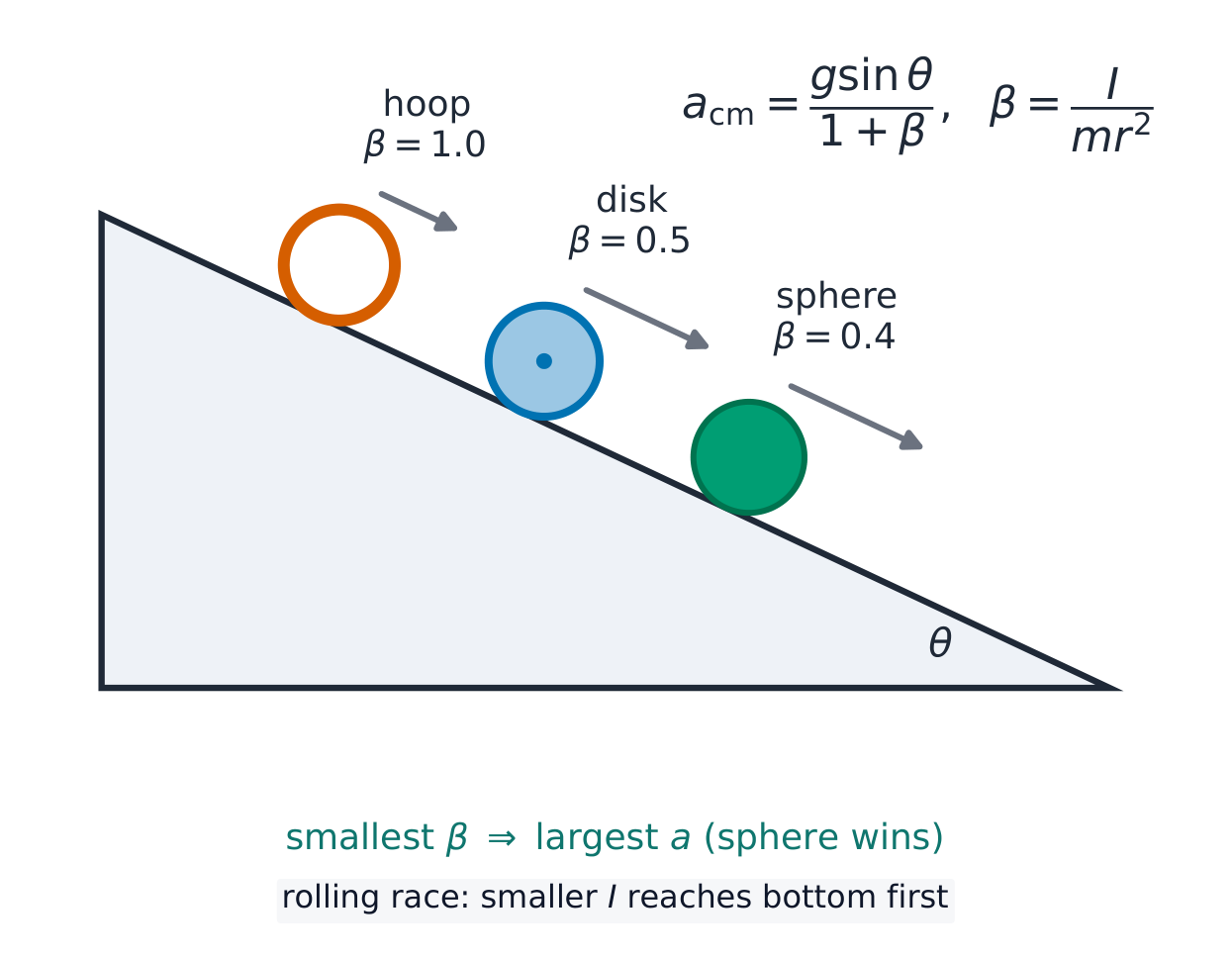
滚动赛跑:I/mr² 最小的形状最先到达底部

Worked example. 一个实心球从静止沿一个 $30^\circ$ 的斜面滚下:$a=\dfrac{g\sin30^\circ}{1+\tfrac25}=\dfrac{9.8(0.50)}{1.4}=3.5\ \text{m/s}^2$,而一个无摩擦滑块是 $4.9\ \text{m/s}^2$ ——滚动物体总是输给滑动物体的赛跑。

词汇表 训练
英文 中文 拼音
Rolling without slipping 无滑滚动 wú huá gǔn dòng
disk 圆盘 yuán pán
hoop 圆环 yuán huán
6.6

轨道卫星的运动

大纲
Learning ObjectiveEssential Knowledge

6.6.A
Describe the motions of a system consisting of two objects or systems interacting only via gravitational forces.

  • 6.6.A.1 In a system consisting only of a massive central object and an orbiting satellite with mass that is negligible in comparison to the central object's mass, the motion of the central object itself is negligible.
  • 6.6.A.2 The motion of satellites in orbits is constrained by conservation laws.
    • 6.6.A.2.i In circular orbits, the system's total mechanical energy, the system's gravitational potential energy, and the satellite's angular momentum and kinetic energy are constant.
    • 6.6.A.2.ii In elliptical orbits, the system's total mechanical energy and the satellite's angular momentum are constant, but the system's gravitational potential energy and the satellite's kinetic energy can each change.
    • 6.6.A.2.iii The gravitational potential energy of a system consisting of a satellite and a massive central object is defined to be zero when the satellite is an infinite distance from the central object.
      • Equation: $U_g = -G\dfrac{m_1 m_2}{r}$
  • 6.6.A.3 The total energy of a system consisting of a satellite orbiting a central object in a circular path can be written in terms of the gravitational potential energy of that system or the kinetic energy of the satellite.
    • Equation: $K = -\dfrac{1}{2}U$
    • Equation: $E_{total} = \dfrac{1}{2}U = -\dfrac{GMm}{2r}$
  • 6.6.A.4 The escape velocity of a satellite is the satellite's velocity such that the mechanical energy of the satellite–central-object system is equal to zero.
    • 6.6.A.4.i When the only force exerted on a satellite is gravity from a central object, a satellite that reaches escape velocity will move away from the central body until its speed reaches zero at an infinite distance from the central body.
    • 6.6.A.4.ii The escape velocity of a satellite from a central body of mass $M$ can be derived using conservation of energy laws.
      • Equation: $v_{\text{esc}} = \sqrt{\dfrac{2GM}{r}}$

来源:美国大学理事会 AP 课程与考试说明

轨道运动(开普勒第二定律)

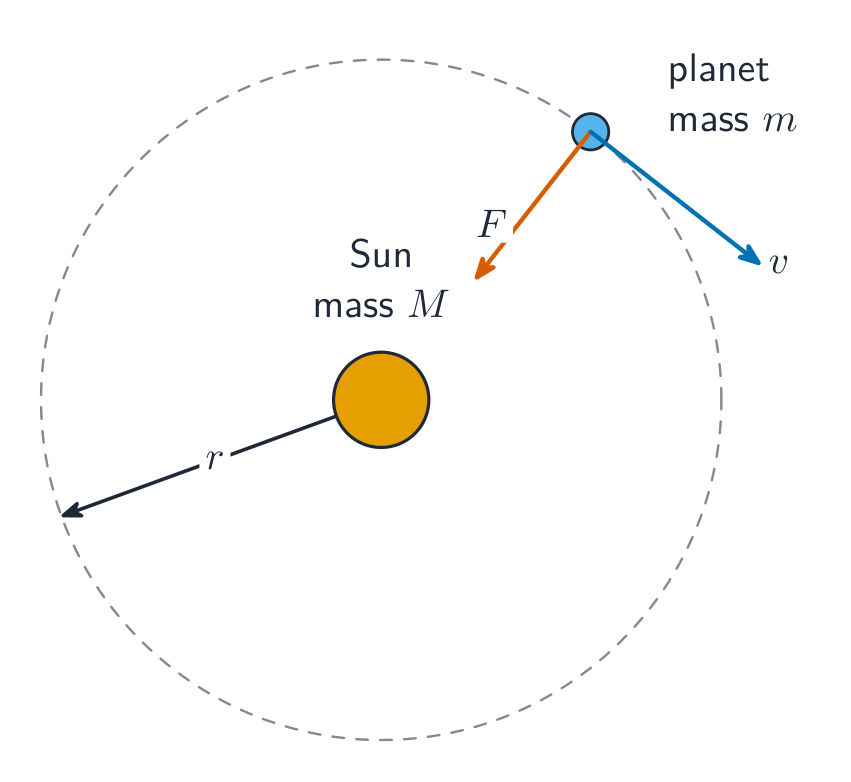
重力为一个圆形轨道里的卫星(satellite)供应向心力(centripetal force):

$$\frac{GMm}{r^2}=\frac{mv^2}{r}\quad\Rightarrow\quad v=\sqrt{\frac{GM}{r}}$$

——更大的轨道更慢。以引力势能(gravitational potential energy)$U_g=-\dfrac{GMm}{r}$,一个圆形轨道遵循 $K=-\tfrac12U$,所以总机械能(total mechanical energy)是

$$E=K+U=\frac{U}{2}=-\frac{GMm}{2r},$$

负的,因为卫星被束缚。要从半径 $r$ 逃逸,总能量必须达到零,给出逃逸速度(escape velocity)

$$v_{\text{esc}}=\sqrt{\frac{2GM}{r}}.$$
重力提供保持一个卫星在轨道里的向心力
重力提供保持一个卫星在轨道里的向心力

在一个椭圆轨道(elliptical orbit)里,$E$$L$ 固定:重力指向焦点,所以它绕它不施加力矩。守恒的 $L$ 意味着卫星在相等的时间里扫过相等的面积——开普勒第二定律(Kepler's second law)——因此在最接近时移动最快、在远点最慢。能量守恒连接两端的速率。

Worked example. 对于一个绕地球($GM=4.0\times10^{14}\ \text{m}^3/\text{s}^2$)在 $r=7.0\times10^{6}\ \text{m}$ 的卫星:轨道速率 $v=\sqrt{GM/r}=7.6\times10^{3}\ \text{m/s}$,而从那个半径逃逸需要 $v_{\text{esc}}=\sqrt{2GM/r}=1.1\times10^{4}\ \text{m/s}$ ——恰好是圆形速率的 $\sqrt2$ 倍。

Exam skill. 轨道 FRQ 是伪装的能量-和-角动量问题:在两个感兴趣的点写 $E=\tfrac12mv^2-\dfrac{GMm}{r}$$L=mvr\sin\theta$ 并解这一对——绝不假设圆的轨道公式适用于一个椭圆。

探索

Compare orbits at different radii

An orbiting satellite is in free fall, gravity supplying the centripetal force. A larger orbit means a slower speed and longer period (Kepler's third law).

词汇表 训练
英文 中文 拼音
centripetal force 向心力 xiàng xīn lì
satellite 卫星 wèi xīng
gravitational potential energy 引力势能 yǐn lì shì néng
total mechanical energy 总机械能 zǒng jī xiè néng
escape velocity 逃逸速度 táo yì sù dù
elliptical orbit 椭圆轨道 tuǒ yuán guǐ dào
Kepler's second law 开普勒第二定律 kāi pǔ lēi dì èr dìng lǜ
练习卷
6.6

考试技巧

  • 计算转动惯量 $I=\int r^2\,dm$ 并用平行轴定理 $I=I_{cm}+Md^2$ 移轴。
  • 转动动能是 $\tfrac12 I\omega^2$;一个滚动物体既有平动又有转动 KE。
  • 当合外力矩是零时守恒角动量 $L=I\omega$(一个收臂的旋转滑冰者)。
  • 对无滑滚动问题用能量守恒($v=r\omega$ 把两个运动绑定)。
  • 知道标准 $I$ 值(圆环、圆盘、杆、球)以及轴在哪里。

本主题的互动课程

逐步学习,并即时检测练习。

AP 物理 C:力学历年真题

AP 物理 C:力学的更多主题

登录或创建账号

IGCSE, A-Level & AP