| Learning Objective | Essential Knowledge |
|---|---|
9.1.A |
|
电势
AP 物理 C:电磁学 · 第 9 主题
 8:02
8:02
Electric Potential
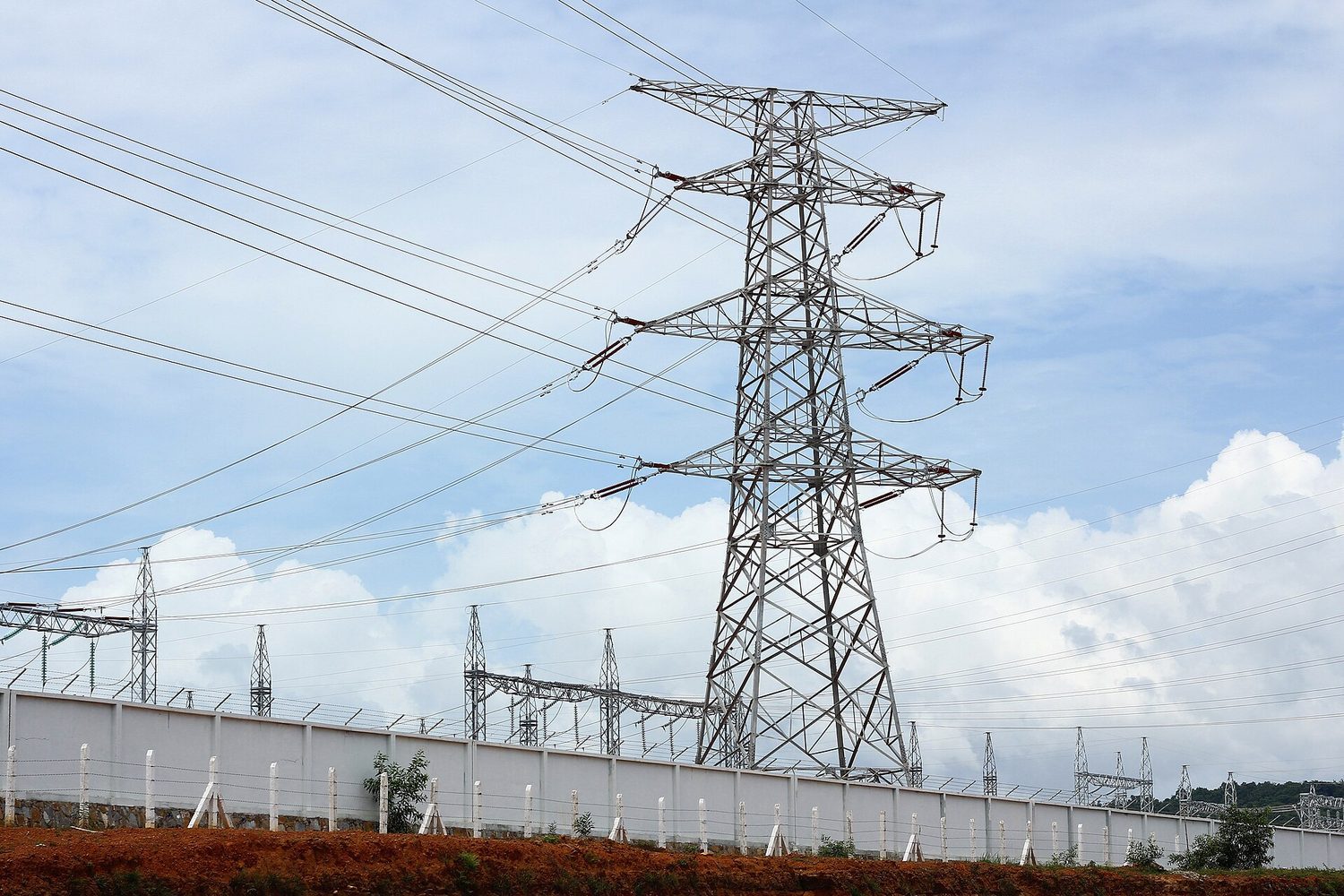
Look at these numbers. A small battery says one point five volts. A car battery says twelve. A high-voltage transmission line carries four hundred thousand. A…
英文讲解 · 内嵌中英文字幕
9.1
电势能
大纲
来源:美国大学理事会 AP 课程与考试说明
当你把两个同种电荷推到一起时,你逆着电力做功(work)。那个功被这一对储存为电势能(electric potential energy):
$$U_E=\frac{1}{4\pi\varepsilon_0}\frac{q_1 q_2}{r}=k\frac{q_1 q_2}{r}.$$
$U_E$ 被定义为一个外力必须做的功,把电荷从无限远带到相距 $r$。符号携带物理:
- 同种电荷: $U_E>0$。需要一个外部推力把它们带到一起。若释放,它们飞开,而储存的能量变成动能(kinetic energy)。
- 相反电荷: $U_E<0$。这一对被束缚。你必须供应 $|U_E|$ 的功把它们拉开到无穷。
电力是一个保守力(conservative force):它做的功只取决于起点和终点,不取决于路径,而等于 $-\Delta U_E$。
对于几个电荷的一个系统(system),把每个不同对的势能相加:
$$U_{\text{total}}=k\!\left(\frac{q_1q_2}{r_{12}}+\frac{q_1q_3}{r_{13}}+\frac{q_2q_3}{r_{23}}\right).$$
Worked example. 三个 $+2.0\ \mu\text{C}$ 电荷坐在一个边长 $0.30\ \text{m}$ 的等边三角形的角上。每一对储存 $U=\dfrac{kq^2}{r}=\dfrac{(9.0\times10^{9})(2.0\times10^{-6})^2}{0.30}=0.12\ \text{J}$。有三对,所以 $U_{\text{total}}=3\times0.12\ \text{J}=0.36\ \text{J}$。这是从无穷组装这个三角形所需的功——以及若所有三个都被释放这些电荷会共享的动能。
词汇表
训练
| 英文 | 中文 | 拼音 |
|---|---|---|
| work/wɜːk/ | 功 | gōng |
| electric potential energy/ɪˈlektrɪk pəˈtenʃl ˈenədʒi/ | 电势能 | diàn shì néng |
| kinetic energy/kɪˈnetɪk ˈenədʒi/ | 动能 | dòng néng |
| conservative force/kənˈsɜːvətɪv fɔːs/ | 保守力 | bǎo shǒu lì |
| system/ˈsɪstəm/ | 系统 | xì tǒng |
| Electric potential/ɪˈlektrɪk pəˈtenʃl/ | 电势 | diàn shì |
9.2
电势
大纲
| Learning Objective | Essential Knowledge |
|---|---|
9.2.A |
Boundary statement: AP Physics C: Electricity & Magnetism only expects students to use calculus to find the electric potential resulting from the following charge distributions and locations: an infinitely long, uniformly charged wire or cylinder at a distance from its central axis, a thin ring of charge at a location along the axis of the ring, a semicircular arc or part of a semicircular arc at its center, and a finite wire or line charge at a point collinear with the line charge or at a location along its perpendicular bisector. |
9.2.B |
|
来源:美国大学理事会 AP 课程与考试说明
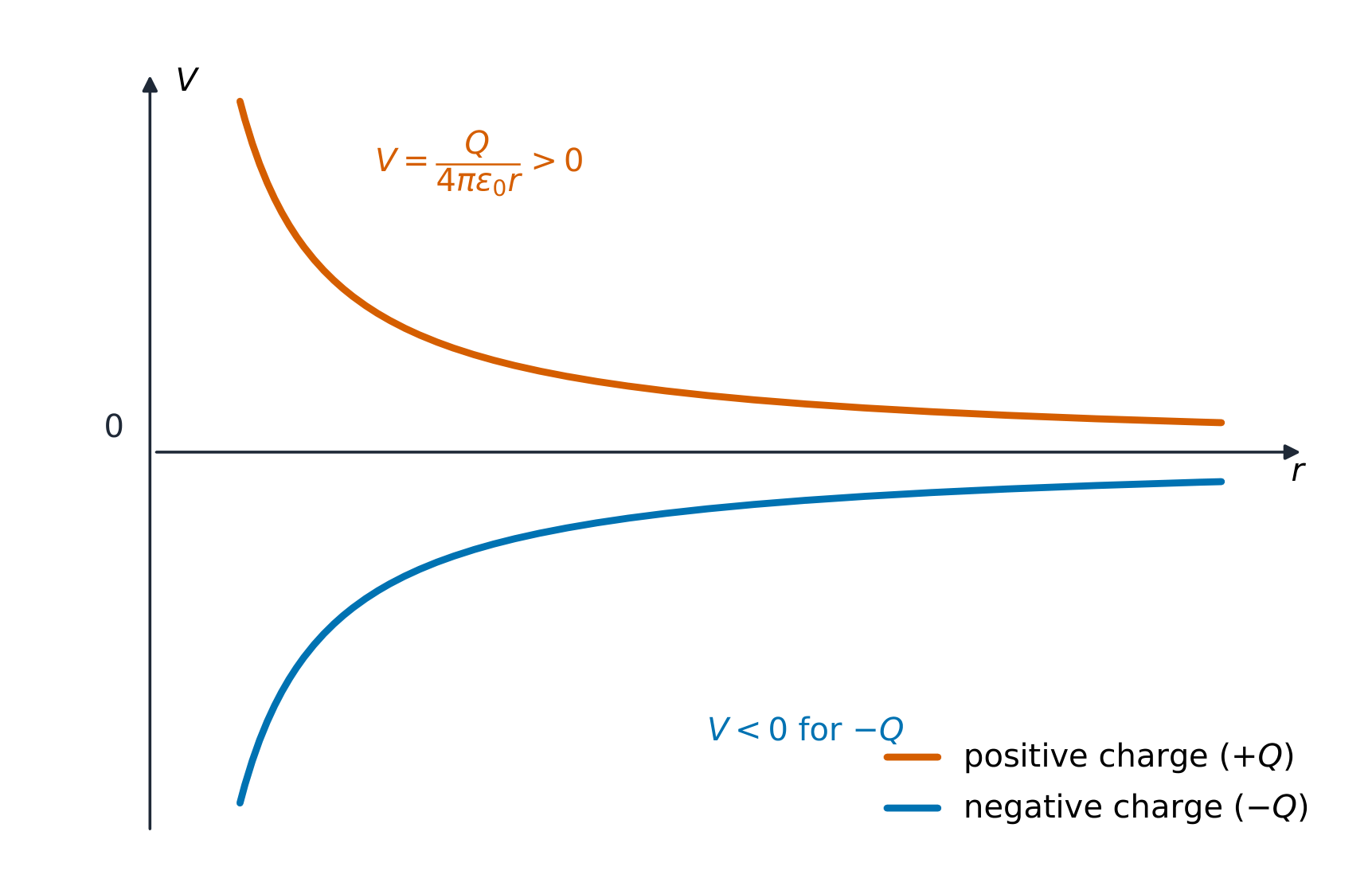
电势(electric potential)是空间里一点处每单位电荷的电势能。它以伏特测量($1\ \text{V}=1\ \text{J/C}$):
$$V=\frac{U_E}{q},\qquad V=\frac{1}{4\pi\varepsilon_0}\frac{q}{r}\ \text{(point charge)}.$$
电势是一个标量(scalar):它有一个符号但没有方向。这使 $V$ 比场 $\vec{E}$ 容易处理得多。对于几个点电荷(point charges),用标量叠加(superposition)——把电势连同它们的符号相加:
$$V=\frac{1}{4\pi\varepsilon_0}\sum_i \frac{q_i}{r_i}.$$
Worked example. 距一个 $+3.0\ \text{nC}$ 点电荷 $0.10\ \text{m}$ 的电势是 $V=\dfrac{kq}{r}=\dfrac{9.0\times10^{9}(3.0\times10^{-9})}{0.10}=270\ \text{V}$。现在加一个距同一点 $0.30\ \text{m}$ 的 $-3.0\ \text{nC}$ 电荷:它贡献 $\dfrac{9.0\times10^{9}(-3.0\times10^{-9})}{0.30}=-90\ \text{V}$,所以总量是 $270-90=180\ \text{V}$。只是一个有符号的和——没有矢量分量要分解。
Continuous charge distributions
对于一个连续电荷分布(continuous charge distribution),把它切成小片 $dq$、把每片当作一个点电荷,并积分(integrate):
$$V=\frac{1}{4\pi\varepsilon_0}\int\frac{dq}{r}.$$
这是一个标量积分,所以它通常比场积分容易得多。AP 期望你用微积分处理四个形状:一个薄环(在它轴上的一点)、一段弧(在它的中心)、一条有限的线或导线(共线,或在它的垂直平分线上),和一根无限长的导线或圆柱(距它的轴一个距离)。
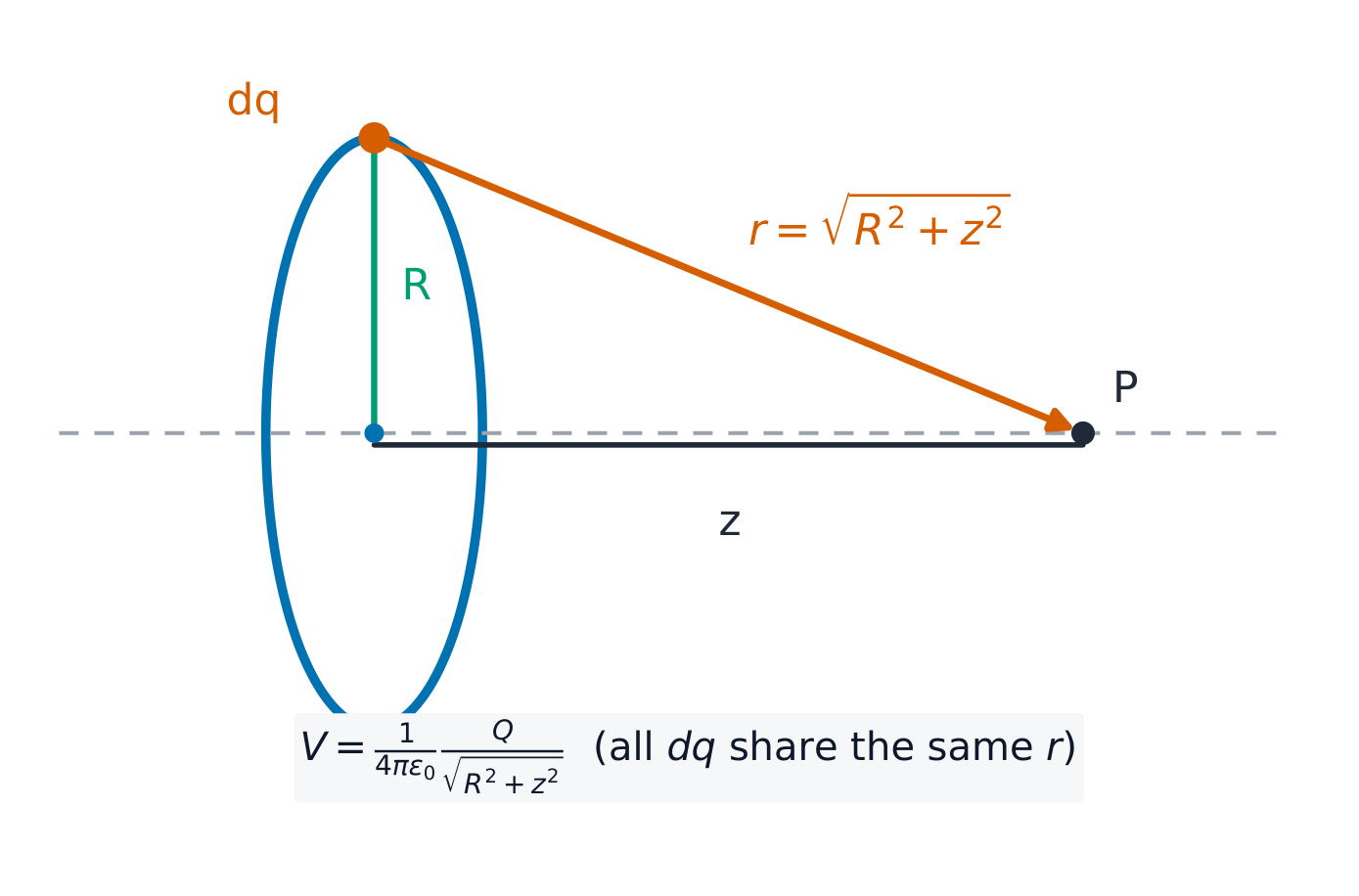
Worked example (ring of charge). 一个半径 $R$ 的薄环携带总电荷 $Q$。对于轴上距中心一个距离 $z$ 的一点 $P$,每个元素 $dq$ 距 $P$ 坐在相同的距离 $r=\sqrt{R^2+z^2}$。这个距离恒定,所以它从积分里出来:
$$V=\frac{1}{4\pi\varepsilon_0}\int\frac{dq}{\sqrt{R^2+z^2}}=\frac{1}{4\pi\varepsilon_0}\frac{Q}{\sqrt{R^2+z^2}}.$$
在一个 FRQ 上,说 $r$ 对每个元素都相同——那个陈述是评分的步骤。同样的思想给出任何弧的中心处 $V=kQ/R$,无论它的角度。
From potential to field
电势和场包含相同的信息,由每个方向的一个导数和一个路径积分联系:
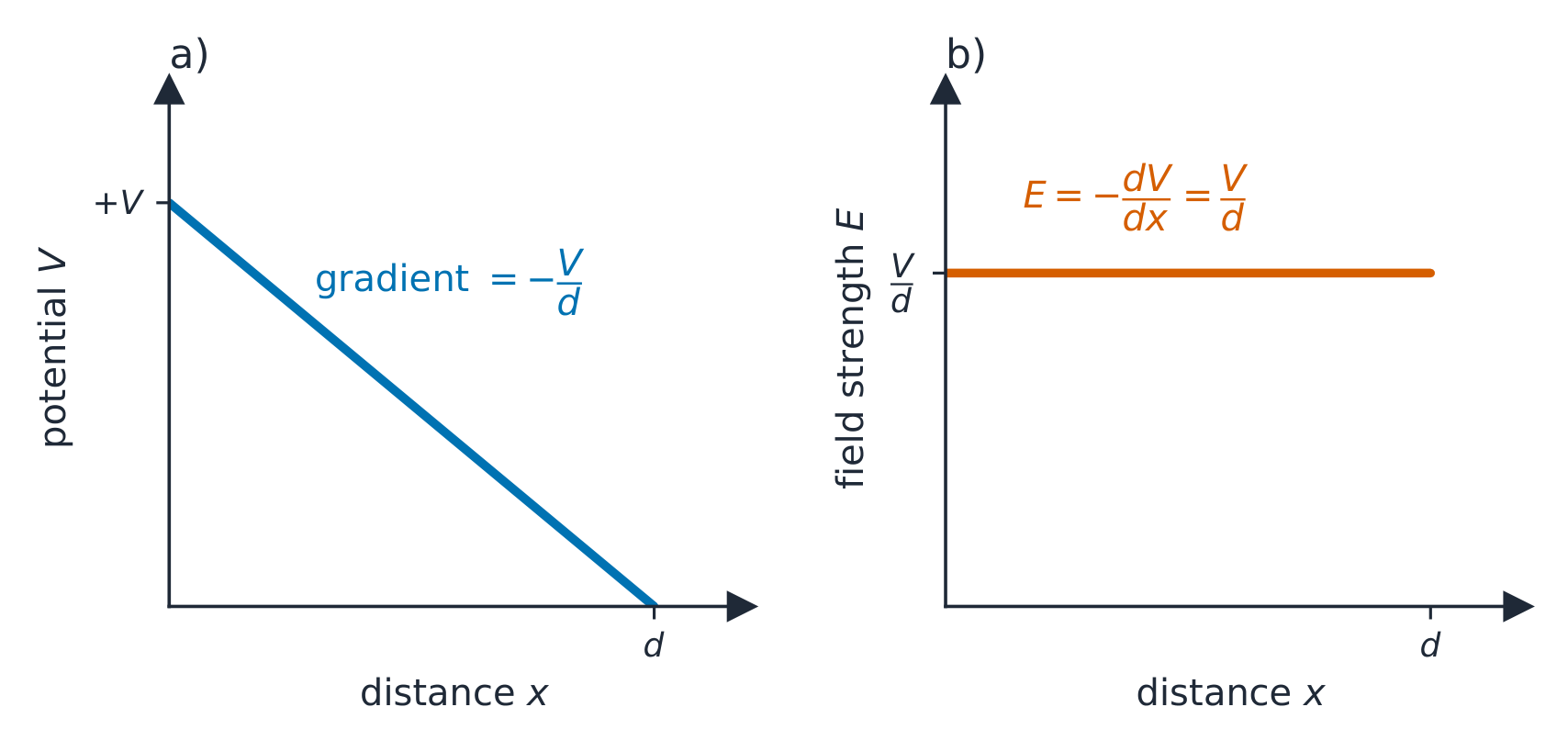
$$E_x=-\frac{dV}{dx},\qquad \Delta V=V_b-V_a=-\int_a^b \vec{E}\cdot d\vec{r}.$$
场是电势的负梯度(gradient):$\vec{E}$ 从高电势指向低电势,"下坡"。$V$ 变化快的地方,场强。
Worked example. 沿 $x$ 轴,$V(x)=3x^{2}-2x$(伏特,$x$ 以米)。那么 $E_x=-\dfrac{dV}{dx}=2-6x\ \text{V/m}$。在 $x=0.50\ \text{m}$,$E_x=-1.0\ \text{V/m}$:那里的场指向 $-x$ 方向。
两点之间的电势差(potential difference)是它们之间移动每单位电荷的势能的变化:$\Delta V=\Delta U_E/q$。一个电池化学地制造一个电势差:里面的反应把正电荷从负电荷分开并把端子保持一个固定的 $\Delta V$。
Equipotential maps
一条等势面(equipotential)线(也叫一条等值线(isoline))连接共享相同电势的点。四条规则让你能读任何图:
- 等值线在它们相交的每个地方都垂直(perpendicular)于电场线(field lines)。
- $\vec{E}$ 从高 $V$ 指向低 $V$ ——从不沿一条等值线。沿一条等值线移动一个电荷不需要功。
- 紧密间隔的等值线意味着一个强的场:$E\approx-\Delta V/\Delta x$。
- 你能从一张等值线图草绘场图,并从一张场图草绘等值线图。
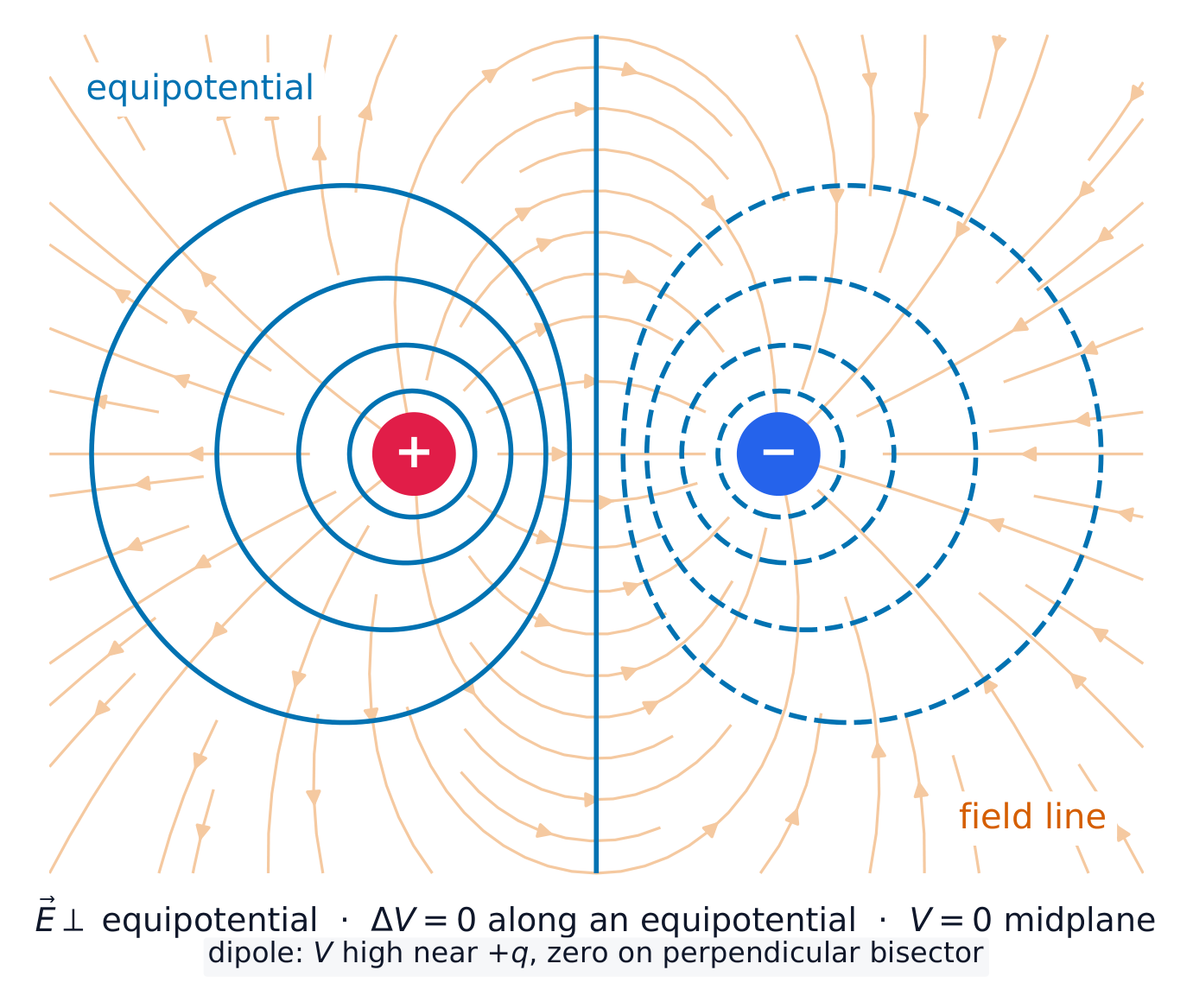
Exam skill. 给定一张每 $10\ \text{V}$、相距约 $2\ \text{cm}$ 有等值线的图,估计 $E\approx\dfrac{10}{0.02}=500\ \text{V/m}$,从较高值的线指向较低的。一个外部作用者慢慢地把一个电荷 $q$ 从 $A$ 移到 $B$ 所做的功是 $W=q(V_B-V_A)$ ——所走的路径不重要。
探索
Field lines and the potential around a charge
Electric potential is the energy per unit charge. It falls off with distance from a positive charge; the field lines point from high potential to low.
词汇表
训练
| 英文 | 中文 | 拼音 |
|---|---|---|
| scalar/ˈskeɪlə/ | 标量 | biāo liàng |
| point charges/pɔɪnt ˈtʃɑːdʒɪz/ | 点电荷 | diǎn diàn hè |
| superposition/ˌsuːpəpəˈzɪʃn/ | 叠加 | dié jiā |
| continuous charge distribution/kənˈtɪnjuːəs tʃɑːdʒ ˌdɪstrɪˈbjuːʃn/ | 连续电荷分布 | lián xù diàn hè fēn bù |
| integrate/ˈɪntɪɡreɪt/ | 积分 | jī fēn |
| gradient/ˈɡreɪdɪənt/ | 梯度 | tī dù |
| potential difference/pəˈtenʃl ˈdɪfrəns/ | 电势差 | diàn shì chā |
| equipotential/ˌiːkwɪpəˈtenʃl/ | 等势面 | děng shì miàn |
| isoline/ˈaɪsəliːn/ | 等值线 | děng zhí xiàn |
| perpendicular/ˌpɜːpənˈdɪkjʊlə/ | 垂直 | chuí zhí |
| field lines/fiːld laɪnz/ | 电场线 | diàn chǎng xiàn |
9.3
电能守恒
大纲
| Learning Objective | Essential Knowledge |
|---|---|
9.3.A |
|
来源:美国大学理事会 AP 课程与考试说明
当一个电荷 $q$ 在两个电势相差 $\Delta V$ 的点之间移动时,电荷-场系统的势能变化
$$\Delta U_E=q\,\Delta V.$$
若只有电力作用,总能量守恒,所以动能变化相反的量:
$$\Delta K=-\Delta U_E=-q\,\Delta V.$$
把两个符号一起注意:一个正电荷在它移向较低电势时加速,而一个负电荷在它移向较高电势时加速。两者都只是系统把势能换成动能。这就是粒子加速器如何给带电粒子它们的能量,而它是电路里能量分析的基础。
Worked example. 一个质子($q=1.6\times10^{-19}\ \text{C}$,$m=1.67\times10^{-27}\ \text{kg}$)从静止开始并通过一个 $500\ \text{V}$ 的电势降落加速(它移向较低电势,所以 $\Delta V=-500\ \text{V}$ 而 $\Delta K=-q\,\Delta V=+8.0\times10^{-17}\ \text{J}$)。令 $\Delta K=\tfrac12 mv^2$:
$$v=\sqrt{\frac{2(8.0\times10^{-17})}{1.67\times10^{-27}}}=3.1\times10^{5}\ \text{m/s}.$$
Exam skill. 每当场非均匀或路径弯曲时选择能量方法、不是运动学:只有端点电势重要。一个典型的 FRQ 链是 $q\,\Delta V \to \Delta K \to v$,带一行论证:"电力是保守的,所以能量守恒。"
9.3
考试技巧
- 用 $V=-\int \vec E\cdot d\vec l$ 和 $\vec E=-\nabla V$(在一维,$E_x=-\tfrac{dV}{dx}$)关联场和电势。
- 电势是一个标量——连同符号相加贡献,不需要矢量分量。
- 一对的势能是 $U=\tfrac{1}{4\pi\varepsilon_0}\tfrac{q_1 q_2}{r}$;对一个电荷的速率用能量守恒。
- 知道沿一条等势面移动不做功,它垂直于 $\vec E$。
- 选择电势的零(通常是无穷)并陈述它。
本主题的互动课程
逐步学习,并即时检测练习。