| Learning Objective | Essential Knowledge |
|---|---|
8.1.A |
|
8.1.B |
|
8.1.C |
Boundary statement: AP Physics C: Electricity & Magnetism only expects students to make calculations of the electric force between four or fewer interacting charged objects or systems. The analysis of the resulting electric force from more charges is allowed in situations of high symmetry. Note that students are expected to calculate the electric fields of charge distributions, as described in Topics 8.4 and 8.6. |
电荷、电场与高斯定律
AP 物理 C:电磁学 · 第 8 主题
 9:52
9:52
Electric Charges, Fields, and Gauss's Law
A lightning bolt hits a car. Inside, the people feel nothing at all. Why? The metal shell around them is a conductor. Charge races over its outside surface…
英文讲解 · 内嵌中英文字幕
8.1
电荷与电力
大纲
来源:美国大学理事会 AP 课程与考试说明
电荷(electric charge)有正和负;同种电荷排斥,相反的吸引。电荷量子化(quantized)——每个电荷是基本电荷(elementary charge)$e=1.6\times10^{-19}\ \text{C}$ 的一个整数倍——并遵循电荷守恒(conservation of charge):电荷从不被创造或销毁,只被移动。两个点电荷(point charges)之间的力是库仑定律(Coulomb's law):
$$\vec{F}=\frac{1}{4\pi\varepsilon_0}\frac{q_1 q_2}{r^2}\,\hat{r},$$
一个沿连接它们的线的平方反比(inverse-square)力,$\dfrac{1}{4\pi\varepsilon_0}=k=9.0\times10^{9}\ \text{N}\cdot\text{m}^2/\text{C}^2$。对于几个电荷(AP 用四个或更少,除非对称帮助),在你关心的电荷上把力矢量相加——叠加(superposition)。
电荷是物质的一个基本属性(fundamental property),而点电荷是一个忽略带电物体大小的模型。常数 $\varepsilon_0$ 是真空介电常数(permittivity of free space)—— 真空的一个材料属性。物质的介电常数不同于 $\varepsilon_0$,由材料极化的难易程度决定,这就是为什么两个电荷之间的电介质会削弱这个力。还要注意,尽管电力比重力强得多,在天文尺度上却是重力占主导,因为大的天体几乎是中性的。
Worked example. 两个 $+2.0\ \mu\text{C}$ 电荷相距 $0.30\ \text{m}$:$F=\dfrac{kq_1q_2}{r^2}=\dfrac{9.0\times10^{9}(2.0\times10^{-6})^2}{(0.30)^2}=0.40\ \text{N}$,排斥的。
Worked example (vectors). 电荷 $+3.0\ \mu\text{C}$ 和 $-3.0\ \mu\text{C}$ 坐在一个直角的两个角上,每个距角上一个 $+1.0\ \mu\text{C}$ 电荷 $0.30\ \text{m}$。每个施加 $F=\dfrac{(9.0\times10^{9})(3.0\times10^{-6})(1.0\times10^{-6})}{0.09}=0.30\ \text{N}$ ——一个推、一个拉,以直角相互。合力是 $F_{\text{net}}=\sqrt{0.30^2+0.30^2}=0.42\ \text{N}$,指向它们之间。绝不盲目地相加大小:先分量。
探索
Explore the field of a source charge
Change the charge's sign and size. Lines point away from positive and toward negative, and their $1/r^2$ crowding near the charge mirrors why Coulomb's force $F = k\,|q_1 q_2|/r^2$ weakens with distance.
词汇表
训练
| 英文 | 中文 | 拼音 |
|---|---|---|
| Electric charge/ɪˈlektrɪk tʃɑːdʒ/ | 电荷 | diàn hè |
| quantized/ˈkwɒntaɪzd/ | 量子化 | liàng zǐ huà |
| elementary charge/ˌelɪˈmentəri tʃɑːdʒ/ | 基本电荷 | jī běn diàn hè |
| conservation of charge/ˌkɒnsəˈveɪʃn ɒv tʃɑːdʒ/ | 电荷守恒 | diàn hè shǒu héng |
| point charges/pɔɪnt ˈtʃɑːdʒɪz/ | 点电荷 | diǎn diàn hè |
| Coulomb's law/ˈkuːlɒmz lɔː/ | 库仑定律 | kù lún dìng lǜ |
| inverse-square/ɪnˈvɜːs skweə/ | 平方反比 | píng fāng fǎn bǐ |
| superposition/ˌsuːpəpəˈzɪʃn/ | 叠加 | dié jiā |
| fundamental property/ˌfʌndəˈmentl ˈprɒpəti/ | 基本属性 | jī běn shǔ xìng |
| permittivity of free space/ˌpɜːmɪˈtɪvəti ɒv friː speɪs/ | 真空介电常数 | zhēn kōng jiè diàn cháng shù |
8.2
电荷与带电过程
大纲
| Learning Objective | Essential Knowledge |
|---|---|
8.2.A |
|
来源:美国大学理事会 AP 课程与考试说明
一个导体(conductor)让电荷自由移动;一个绝缘体(insulator)把它保持在原位。物体以三种方式获得净电荷:
- 摩擦起电(charging by friction):摩擦把电子从一个表面转移到另一个。
- 传导起电(charging by conduction):触碰一个带电物体共享相同符号的电荷。
- 感应起电(charging by induction):一个附近的电荷把导体的电荷推开;把远的一侧接地(ground)、先移除接地线,而导体被留下相反的符号——全都没有接触。
一个绝缘体不能传递电荷,但它能产生极化(polarization):它的分子伸展或转动,使一个面略带正电而另一个略带负电。这就是为什么一把带电的梳子捡起中性的纸屑。一个验电器(electroscope)通过它的箔片排斥显示净电荷;在任何孤立的导体上多余的电荷完全坐在外表面上。
探索
Explore charging by rubbing
Rubbing transfers electrons onto the object, leaving it negative. A charged object then attracts a neutral wall or hair (by polarization) but repels another like-charged object — the same electron transfer behind friction, conduction, and induction.
词汇表
训练
| 英文 | 中文 | 拼音 |
|---|---|---|
| conductor/kənˈdʌktə/ | 导体 | dǎo tǐ |
| insulator/ˈɪnsjuːleɪtə/ | 绝缘体 | jué yuán tǐ |
| Charging by friction/ˈtʃɑːdʒɪŋ baɪ ˈfrɪkʃn/ | 摩擦起电 | mó cā qǐ diàn |
| Charging by conduction/ˈtʃɑːdʒɪŋ baɪ kənˈdʌkʃn/ | 传导起电 | chuán dǎo qǐ diàn |
| Charging by induction/ˈtʃɑːdʒɪŋ baɪ ɪnˈdʌkʃn/ | 感应起电 | gǎn yìng qǐ diàn |
| ground/ɡraʊnd/ | 接地 | jiē dì |
| polarization/ˌpəʊləraɪˈzeɪʃn/ | 极化 | jí huà |
| electroscope/ɪˌlektrəʊˈskəʊp/ | 验电器 | yàn diàn qì |
8.3
电场
大纲
| Learning Objective | Essential Knowledge |
|---|---|
8.3.A |
|
8.3.B |
|
来源:美国大学理事会 AP 课程与考试说明
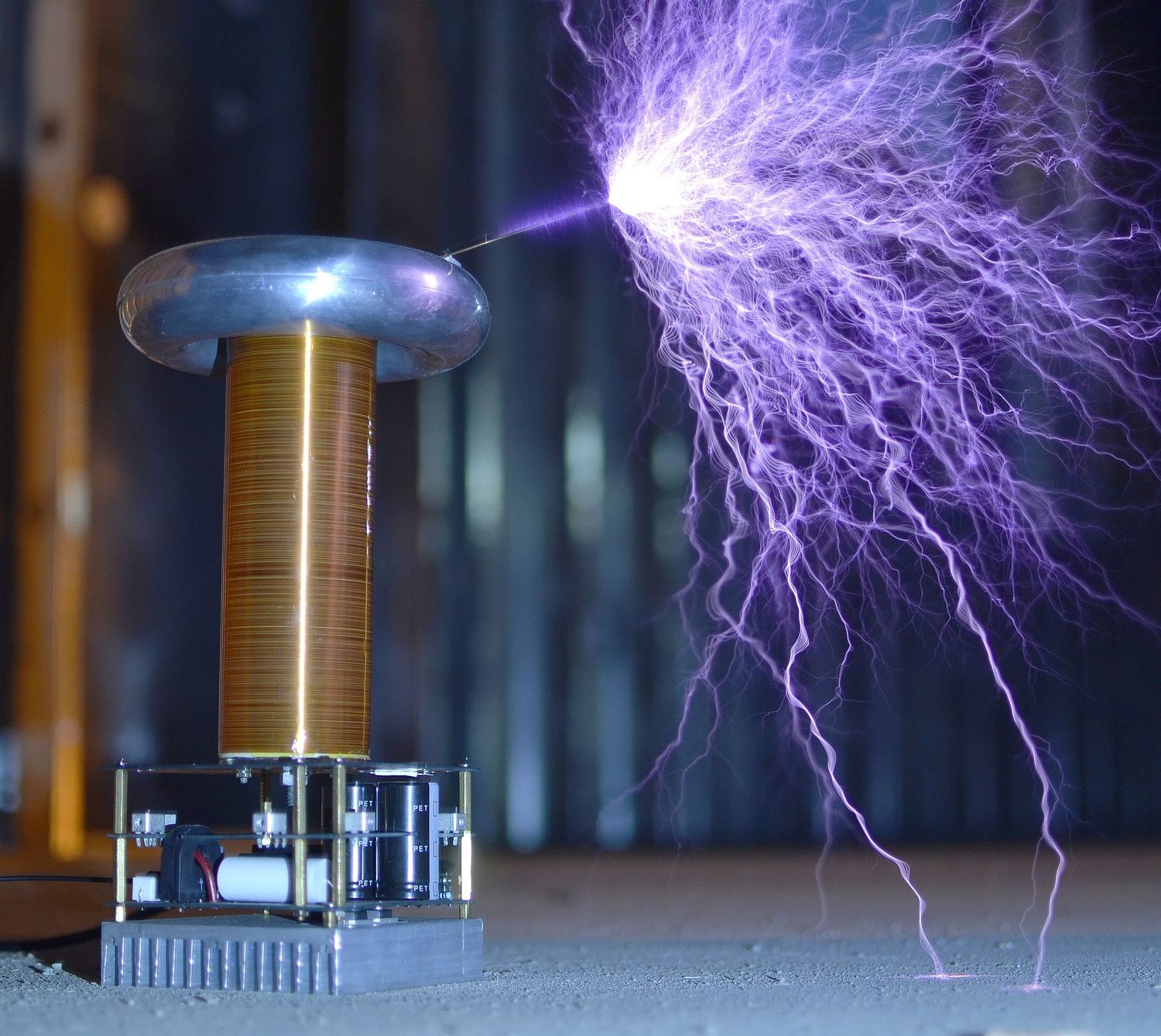
一点处的电场(electric field)是一个小的正检验电荷(test charge)在那里会感受的每单位电荷的力:
$$\vec{E}=\frac{\vec{F}}{q},\qquad \vec{E}=\frac{1}{4\pi\varepsilon_0}\frac{q}{r^2}\,\hat{r}\ \text{(point charge)}.$$
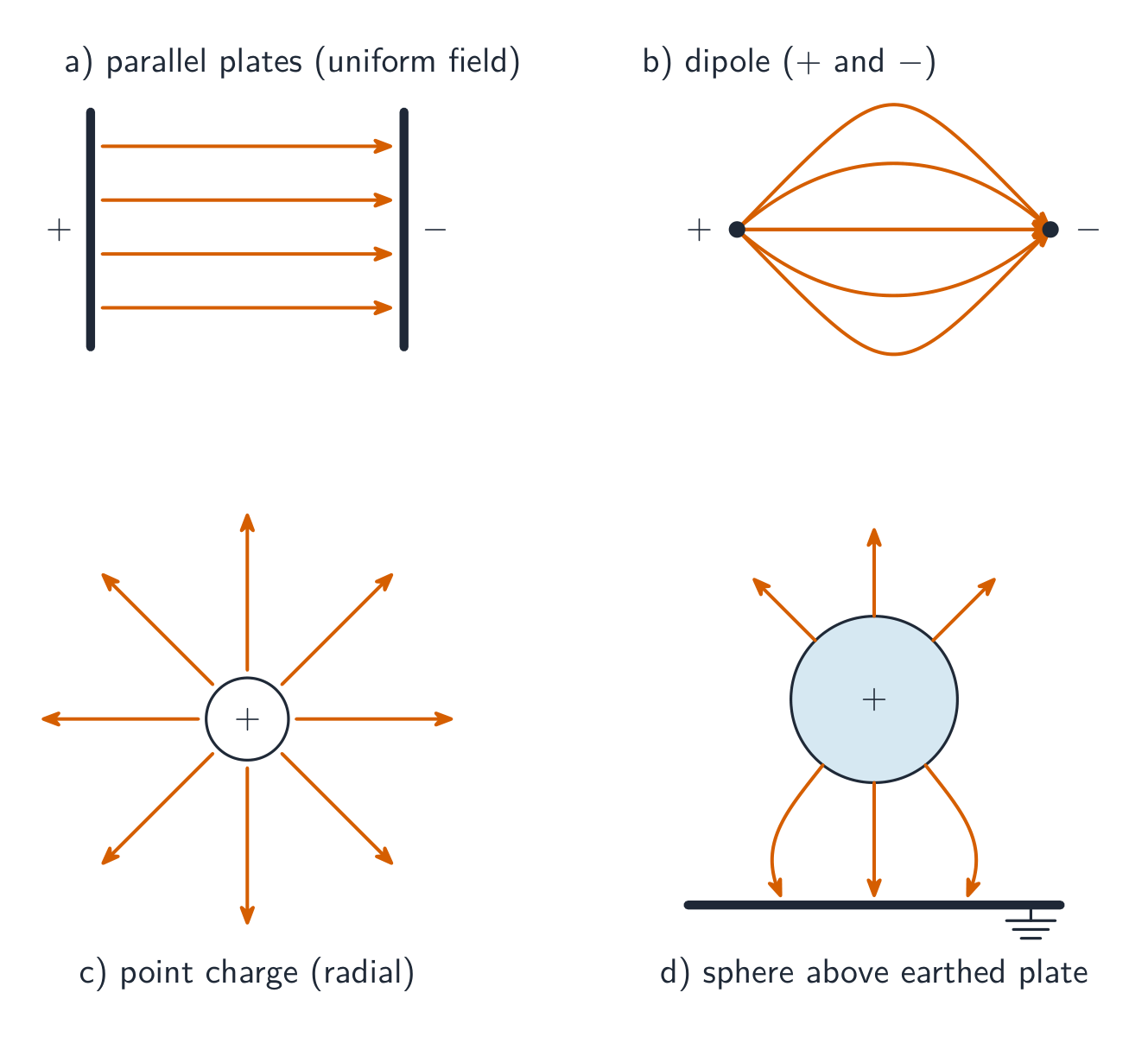
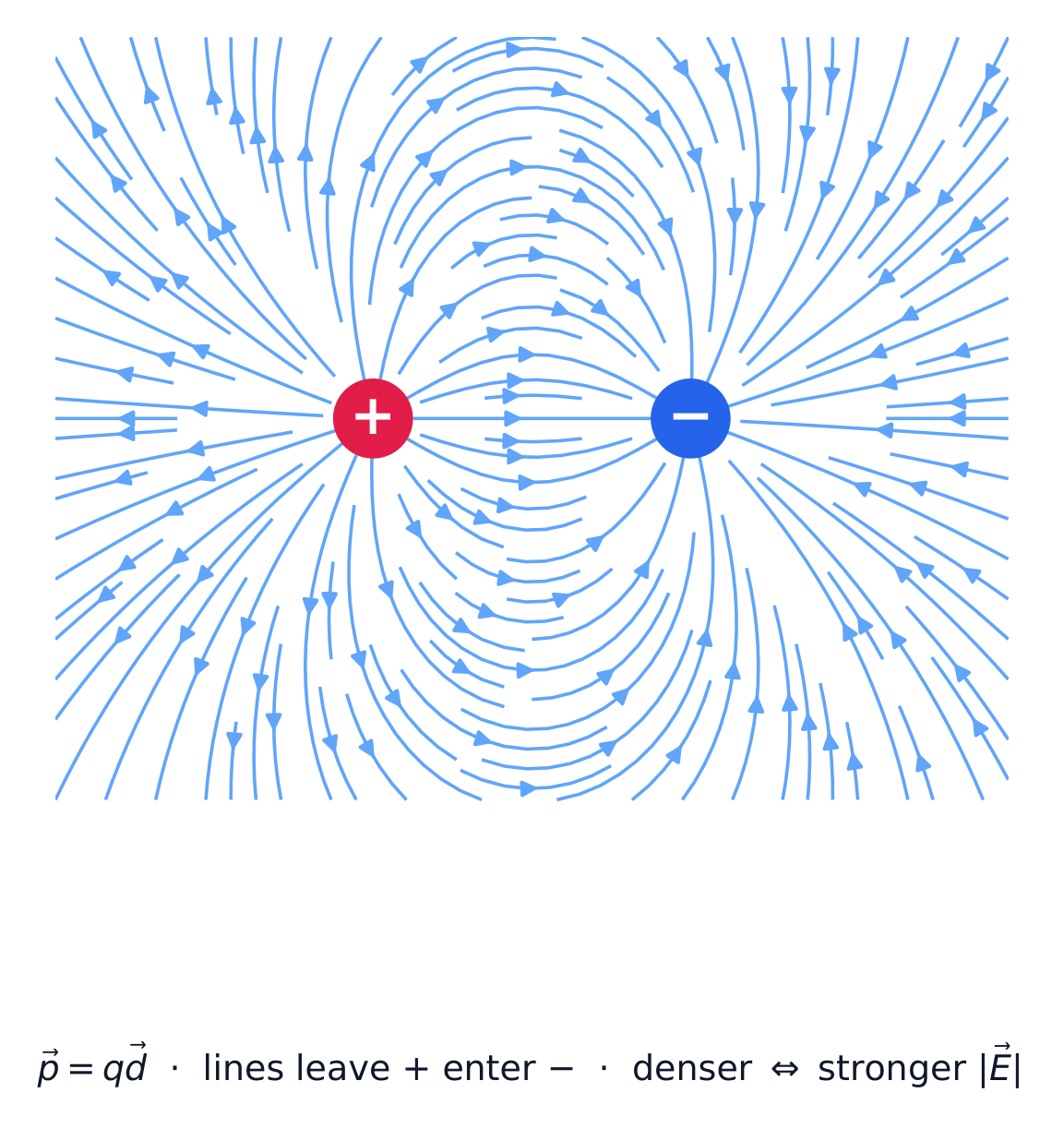
一个放在场里的电荷感受 $\vec{F}=q\vec{E}$ ——正电荷沿场、负电荷逆场。来自几个源的场作为矢量相加(又是叠加)。电场线(field lines)使场可见:它们从正电荷指向外并朝向负,它们的密度显示强度,而它们从不交叉。
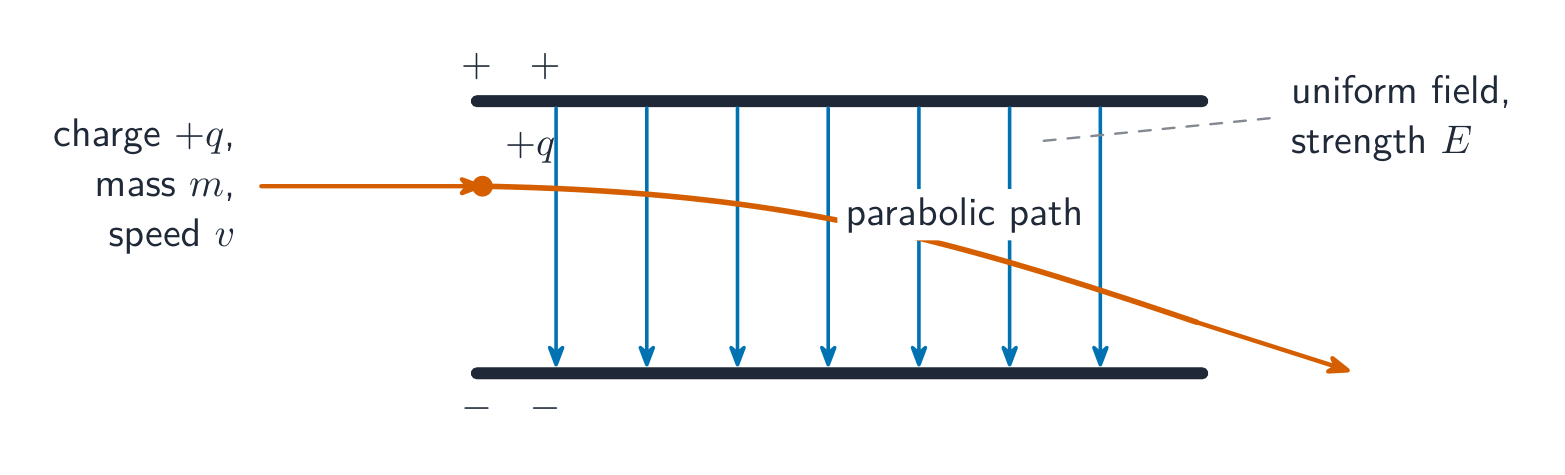
在一个均匀(uniform)场里一个电荷感受一个恒定的力,所以它均匀地加速——横向发射,它遵循一条抛物线,正如重力里的一个抛体。
探索
Explore field lines of a point charge
Set the charge positive or negative. Field lines start on positive and end on negative charge, never cross, and crowd together where $\vec{E}$ is strongest — the line density is proportional to the field magnitude.
词汇表
训练
| 英文 | 中文 | 拼音 |
|---|---|---|
| electric field/ɪˈlektrɪk fiːld/ | 电场 | diàn chǎng |
| test charge/test tʃɑːdʒ/ | 检验电荷 | jiǎn yàn diàn hè |
| Field lines/fiːld laɪnz/ | 电场线 | diàn chǎng xiàn |
| uniform/ˈjuːnɪfɔːm/ | 均匀 | jūn yún |
8.4
电荷分布的电场
大纲
| Learning Objective | Essential Knowledge |
|---|---|
8.4.A |
Boundary statement: AP Physics C: Electricity & Magnetism only expects students to use calculus to find the electric field resulting from the following charge distributions and locations: an infinitely long, uniformly charged wire or cylinder at a distance from its central axis, a thin ring of charge at a location along the axis of the ring, a semicircular arc or part of a semicircular arc at its center, and a finite wire or line charge at a point collinear with the line charge or at a location along its perpendicular bisector. |
来源:美国大学理事会 AP 课程与考试说明
对于一个连续电荷分布(continuous charge distribution),把物体切成片 $dq$ 并积分它们的点电荷场:
$$\vec{E}=\frac{1}{4\pi\varepsilon_0}\int \frac{dq}{r^2}\,\hat{r}.$$
用正确的密度写 $dq$:用线电荷密度(linear charge density)的 $\lambda\,dl$(一条线或环)、用面电荷密度(surface charge density)的 $\sigma\,dA$,或用体电荷密度(volume charge density)的 $\rho\,dV$。然后在积分之前用对称性(symmetry)抵消分量——那句话通常是一个评分的步骤。AP 的微积分情况:一条有限的线(共线点或垂直平分线)、一条无限的导线或圆柱、一个环在它的轴上,和一段弧在它的中心。
Worked example (ring, on axis). 一个半径 $R$ 的环携带电荷 $Q$。在沿轴的一点 $z$,每个元素距离 $\sqrt{R^2+z^2}$,而由对称横向分量抵消,只留下轴向部分($\cos\alpha=z/\sqrt{R^2+z^2}$):
$$E_z=\frac{1}{4\pi\varepsilon_0}\int\frac{dq}{R^2+z^2}\cdot\frac{z}{\sqrt{R^2+z^2}}=\frac{1}{4\pi\varepsilon_0}\frac{Qz}{(R^2+z^2)^{3/2}}.$$
检查极限:$E=0$ 在中心($z=0$),而在远处($z\gg R$)它变成 $kQ/z^2$ ——一个点电荷,正如它必须。
词汇表
训练
| 英文 | 中文 | 拼音 |
|---|---|---|
| continuous charge distribution/kənˈtɪnjuːəs tʃɑːdʒ ˌdɪstrɪˈbjuːʃn/ | 连续电荷分布 | lián xù diàn hè fēn bù |
| linear charge density/ˈlɪnɪə tʃɑːdʒ ˈdensɪti/ | 线电荷密度 | xiàn diàn hè mì dù |
| surface charge density/ˈsɜːfɪs tʃɑːdʒ ˈdensɪti/ | 面电荷密度 | miàn diàn hè mì dù |
| volume charge density/ˈvɒljuːm tʃɑːdʒ ˈdensɪti/ | 体电荷密度 | tǐ diàn hè mì dù |
| symmetry/ˈsɪmətri/ | 对称性 | duì chèn xìng |
8.5
电通量
大纲
| Learning Objective | Essential Knowledge |
|---|---|
8.5.A |
|
来源:美国大学理事会 AP 课程与考试说明
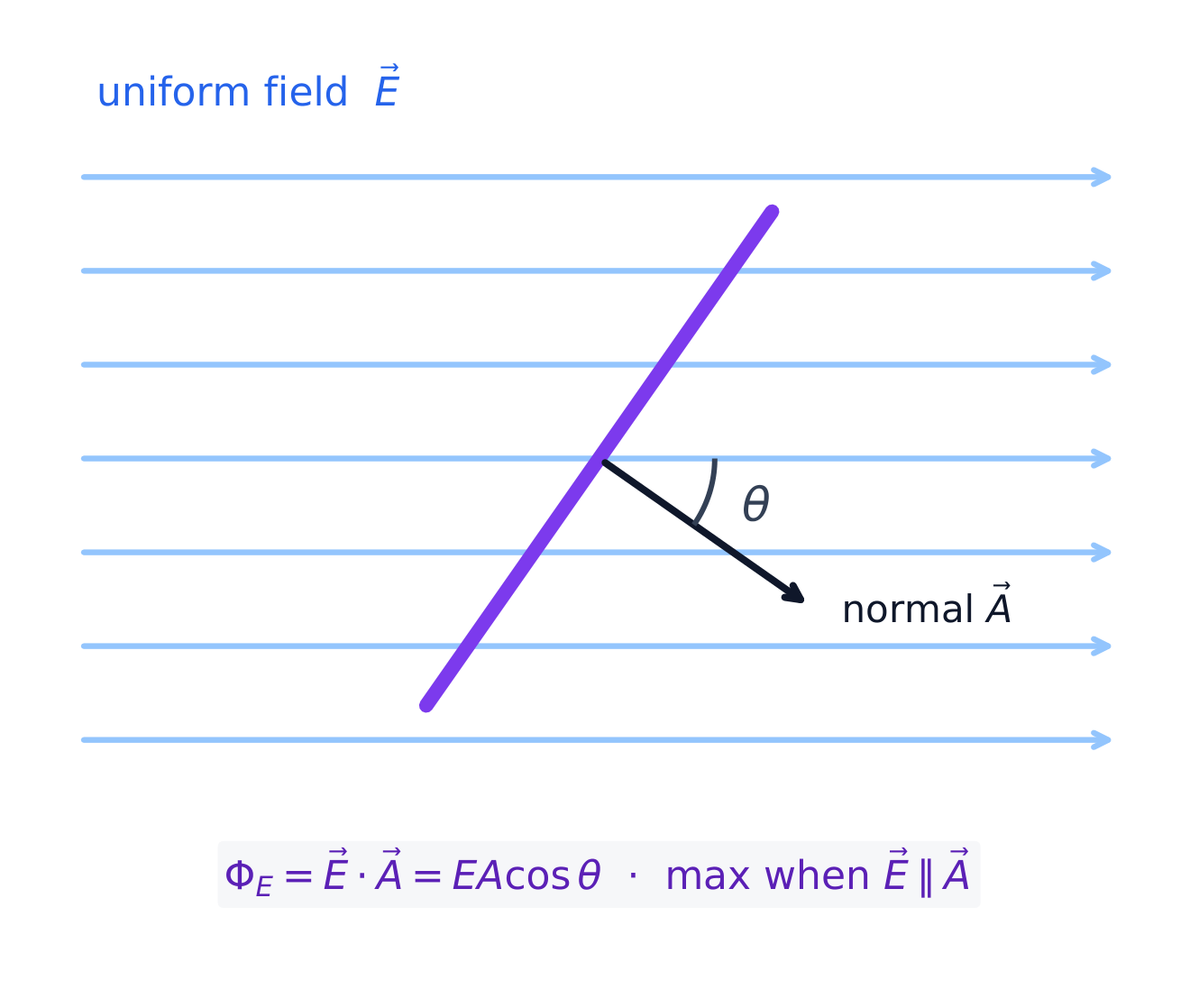
电通量(electric flux)测量多少场通过一个表面:
$$\Phi_E=\int \vec{E}\cdot d\vec{A}.$$
对于一个通过一个平坦面积的均匀场,$\Phi_E=EA\cos\theta$,其中面积矢量(area vector)垂直于表面。通量在场线离开一个闭合表面的地方为正,而在它们进入的地方为负——只有 $\vec{E}$ 的垂直分量计入。
词汇表
训练
| 英文 | 中文 | 拼音 |
|---|---|---|
| Electric flux/ɪˈlektrɪk flʌks/ | 电通量 | diàn tōng liàng |
| area vector/ˈeərɪə ˈvektə/ | 面积矢量 | miàn jī shǐ liàng |
8.6
高斯定律
大纲
| Learning Objective | Essential Knowledge |
|---|---|
8.6.A |
Boundary statement: AP Physics C: Electricity & Magnetism only expects students to quantitatively apply Gauss's law to point charges and charge distributions that have spherical, cylindrical, or planar symmetry. |
来源:美国大学理事会 AP 课程与考试说明
高斯定律(Gauss's law)——麦克斯韦方程组的第一个——把通过任何闭合表面的通量与它里面的电荷关联:
$$\oint \vec{E}\cdot d\vec{A}=\frac{Q_{\text{enc}}}{\varepsilon_0}.$$
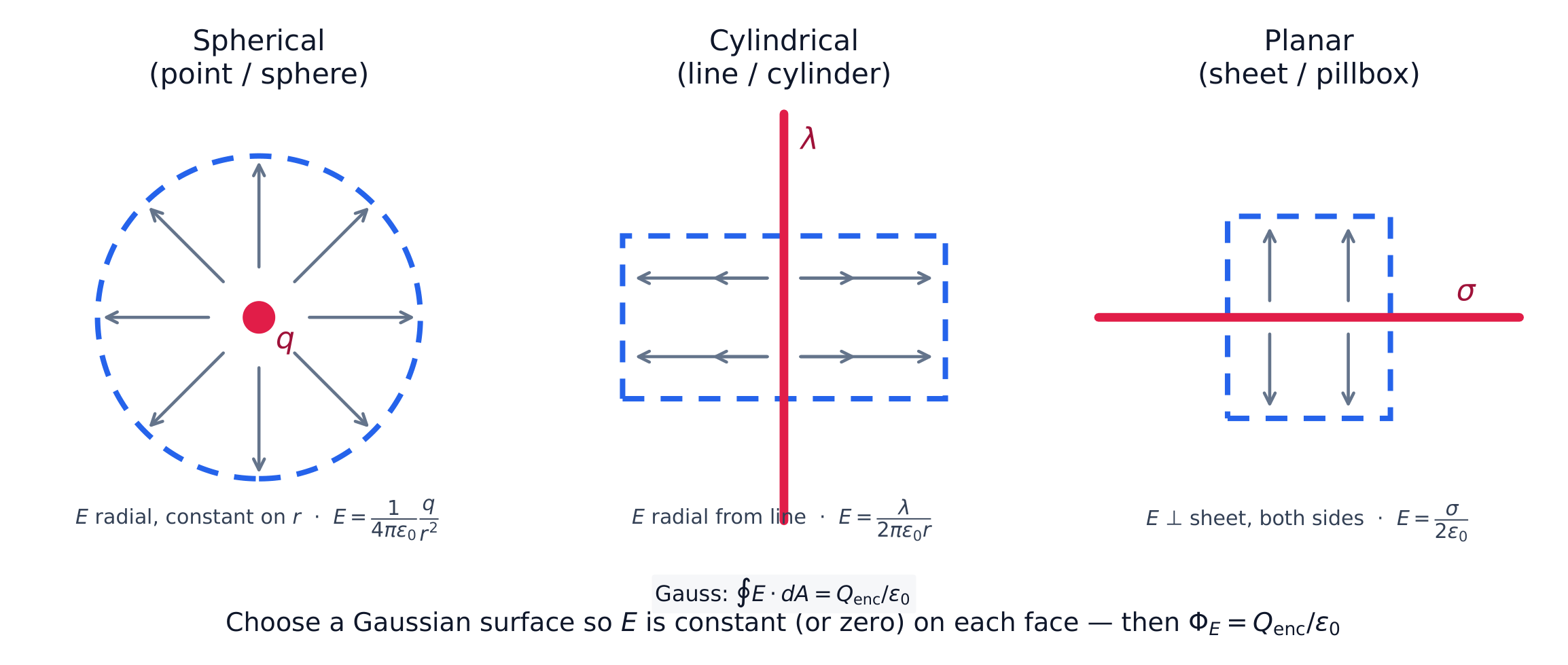
它对任何闭合表面都成立,但它只在对称让你能选择一个 $E$ 恒定且垂直(或平行,贡献零)的高斯面(Gaussian surface)时才求解 $E$。AP 考查的三种对称:球对称(spherical symmetry)(同心球)、柱对称(cylindrical symmetry)(同轴圆柱),和平面对称(planar symmetry)(一个跨立的"药盒")。
Worked example (sphere). 在一个总电荷 $Q$ 的球外部,一个半径 $r$ 的球形高斯面给出 $E(4\pi r^2)=Q/\varepsilon_0$,所以 $E=\dfrac{kQ}{r^2}$ ——与中心的一个点电荷相同。在一个半径 $R$ 的均匀带电实心球内部,表面只包围 $Q_{\text{enc}}=Q\,r^3/R^3$,所以 $E=\dfrac{kQr}{R^3}$:在中心为零,线性增长到表面。
Worked example (wire). 对于一根每长度电荷 $\lambda$ 的无限导线,取一个半径 $r$ 长度 $L$ 的同轴圆柱。两端不贡献任何东西($\vec{E}\perp d\vec{A}$),所以 $E(2\pi rL)=\dfrac{\lambda L}{\varepsilon_0}$ 而 $E=\dfrac{\lambda}{2\pi\varepsilon_0 r}$。同样的药盒方法给出一个无限薄片的场,$E=\dfrac{\sigma}{2\varepsilon_0}$,两侧均匀。
Exam skill. 一个满分的高斯定律答案有四个部分:命名表面、陈述对称论证(为什么 $E$ 在它上面恒定且垂直)、数 $Q_{\text{enc}}$,然后求解。跳过对称句子失去推理分——并记住高斯定律也解释为什么在平衡的任何导体内部 $E=0$。
词汇表
训练
| 英文 | 中文 | 拼音 |
|---|---|---|
| Gauss's law/ˈɡaʊsɪz lɔː/ | 高斯定律 | gāo sī dìng lǜ |
| Gaussian surface/ˈɡaʊʃn ˈsɜːfɪs/ | 高斯面 | gāo sī miàn |
| spherical symmetry/sˈferɪkl ˈsɪmətri/ | 球对称 | qiú duì chèn |
| cylindrical symmetry/sɪˈlɪndrɪkl ˈsɪmətri/ | 柱对称 | zhù duì chèn |
| planar symmetry/ˈpleɪnə ˈsɪmətri/ | 平面对称 | píng miàn duì chèn |
8.6
考试技巧
- 用库仑定律 $F=\tfrac{1}{4\pi\varepsilon_0}\tfrac{q_1 q_2}{r^2}$ 并把力作为矢量叠加(分量,不是大小)。
- 对一个连续电荷,在 $dq=\lambda\,dl,\ \sigma\,dA,\ \rho\,dV$ 上积分 $d\vec E$;用对称抵消分量。
- 场从正电荷指离而朝向负电荷;正确地画电场线。
- 把一个电荷上的力($\vec F=q\vec E$)与这个电荷创造的场区分开。
- 把常数 $k=\tfrac{1}{4\pi\varepsilon_0}$ 保持清楚并检查单位。
本主题的互动课程
逐步学习,并即时检测练习。