| Learning Objective | Essential Knowledge |
|---|---|
12.1.A |
|
12.1.B |
|
12.1.C |
|
磁场与电磁学
AP 物理 C:电磁学 · 第 12 主题
 12:45
12:45
Magnetic Fields and Electromagnetism
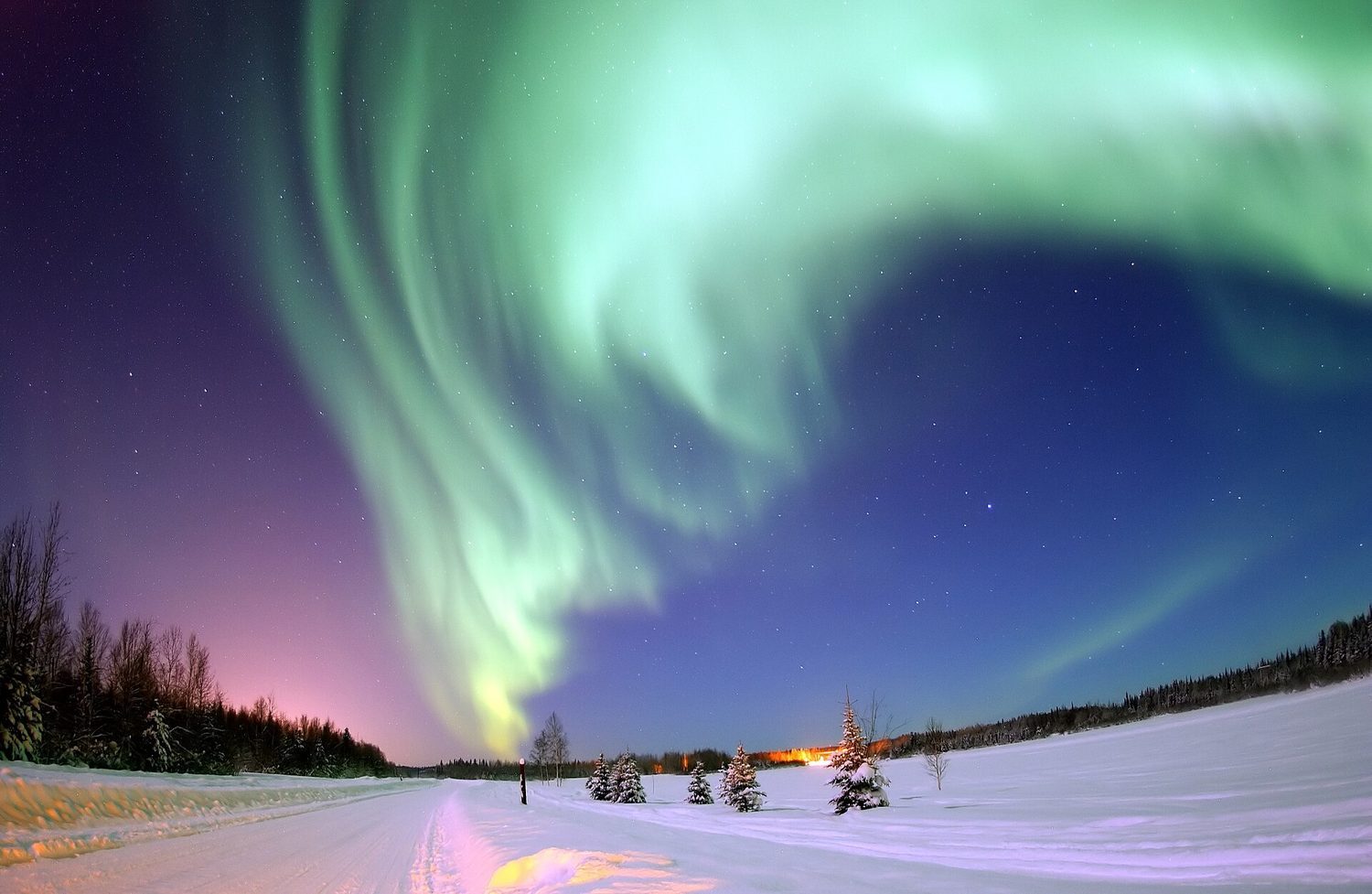
Look north on a clear winter night, far enough north, and the sky glows green. Those lights are switched on by a magnetic field. The Sun throws charged…
英文讲解 · 内嵌中英文字幕
12.1
磁场
大纲
来源:美国大学理事会 AP 课程与考试说明
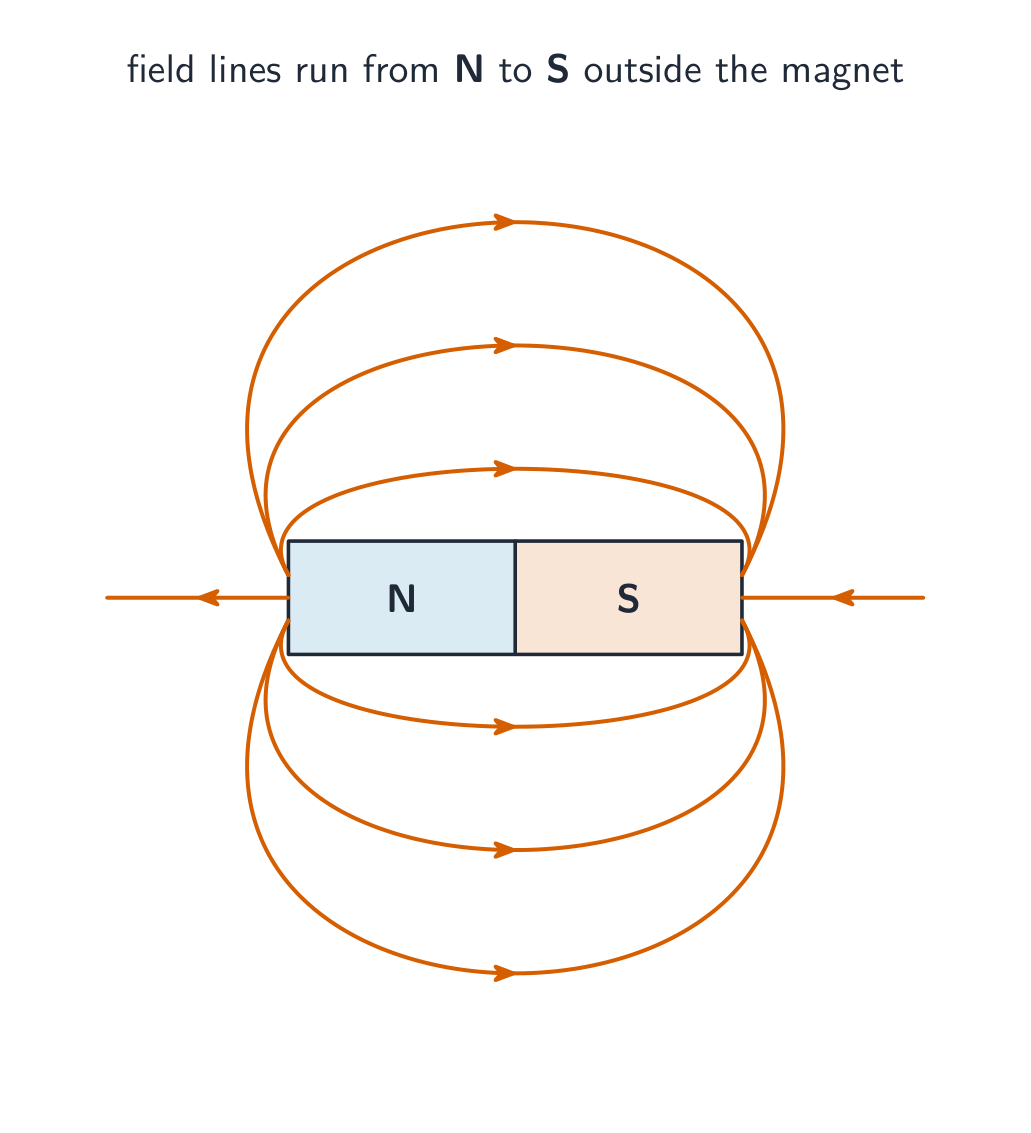
一个磁场(magnetic field)$\vec{B}$ 是一个围绕磁体、移动的电荷和电流的矢量场(vector field);它决定放在它里面的任何移动电荷上的磁力。磁感线(magnetic field lines)必须形成闭合回路:它们离开北极、返回南极,并继续穿过磁体。更密的线意味着一个更强的场。
闭合回路是磁的高斯定律的内容,麦克斯韦方程组(Maxwell's equations)的第二个:
$$\oint \vec{B}\cdot d\vec{A}=0.$$
通过任何闭合表面的净磁通量是零——离开的场线和进入的一样多。那正是孤立的磁单极子(magnetic monopoles)不存在的陈述。每个磁的源都是一个磁偶极子(magnetic dipole)(一个北-南对),由环流的电荷制造——在材料里,电子的运动。把一根条形磁体切成一半你得到两个更小的偶极子,从不得到一个孤立的极。同种极排斥、相反的极吸引,而一个自由的偶极子——一个指南针(compass)——旋转以与本地场对齐。地球自己的场大致是一个偶极子,这就是为什么一个指南针工作。偶极子场随距离减弱。
一种材料如何对一个外部场反应取决于它内部偶极子如何表现:
- 铁磁性(ferromagnetic)(铁、镍、钴):一个外部场对齐整个磁畴(magnetic domains),而在场被移除后对齐留存——一个永磁体。
- 顺磁性(paramagnetic)(铝、钛):偶极子与场弱地对齐但在它被移除时松弛。
- 抗磁性(diamagnetic)(所有材料):电子结构产生一个通常弱的、与场相反的对齐。
一种材料反应的强度是它的磁导率(magnetic permeability)。自由空间有常数值 $\mu_0$(真空磁导率);物质的磁导率不同于 $\mu_0$,甚至不恒定——它随温度、取向和场强变化。
探索
See a magnet's field lines
Magnetic field lines run from north to south outside a magnet; where they crowd together the field is strongest.
词汇表
训练
| 英文 | 中文 | 拼音 |
|---|---|---|
| magnetic field/mæɡˈnetɪk fiːld/ | 磁场 | cí chǎng |
| vector field/ˈvektə fiːld/ | 矢量场 | shǐ liàng chǎng |
| magnetic field lines/mæɡˈnetɪk fiːld laɪnz/ | 磁感线 | cí gǎn xiàn |
| Maxwell's equations/ˈmækswelz ɪˈkweɪʒnz/ | 麦克斯韦方程组 | mài kè sī wéi fāng chéng zǔ |
| magnetic monopoles/mæɡˈnetɪk ˈmɒnəʊpəʊlz/ | 磁单极子 | cí dān jí zi |
| magnetic dipole/mæɡˈnetɪk ˈdaɪpəʊl/ | 磁偶极子 | cí ǒu jí zi |
| compass/ˈkʌmpəs/ | 指南针 | zhǐ nán zhēn |
| Ferromagnetic/ˌferəməɡˈnetɪk/ | 铁磁性 | tiě cí xìng |
| magnetic domains/mæɡˈnetɪk dəˈmeɪnz/ | 磁畴 | cí chóu |
| Paramagnetic/ˌpærəməɡˈnetɪk/ | 顺磁性 | shùn cí xìng |
| Diamagnetic/ˌdaɪəməɡˈnetɪk/ | 抗磁性 | kàng cí xìng |
| magnetic permeability/mæɡˈnetɪk ˌpɜːməˈbɪlɪti/ | 磁导率 | cí dǎo lǜ |
12.2
磁性与运动电荷
大纲
| Learning Objective | Essential Knowledge |
|---|---|
12.2.A |
|
12.2.B |
|
来源:美国大学理事会 AP 课程与考试说明
一个移动的电荷做两件事:它创造一个磁场,而它在一个外部场里感受一个力。它在一点创造的场垂直于(perpendicular)它的速度和从电荷到点的位置矢量两者(又是右手定则),而在那两者垂直的地方最大——在运动的正前方或正后方为零。
一个在场 $\vec{B}$ 里移动的电荷上的力是叉积
$$\vec{F}_B=q\,\vec{v}\times\vec{B},\qquad F=qvB\sin\theta,$$
垂直于 $\vec{v}$ 和 $\vec{B}$ 两者——把你右手的手指沿 $\vec{v}$ 指、朝 $\vec{B}$ 卷曲,而拇指给出一个正电荷上的力(对负的反转它)。因为 $\vec{F}_B\perp\vec{v}$,磁力对电荷不做功:它改变方向、从不改变速率。
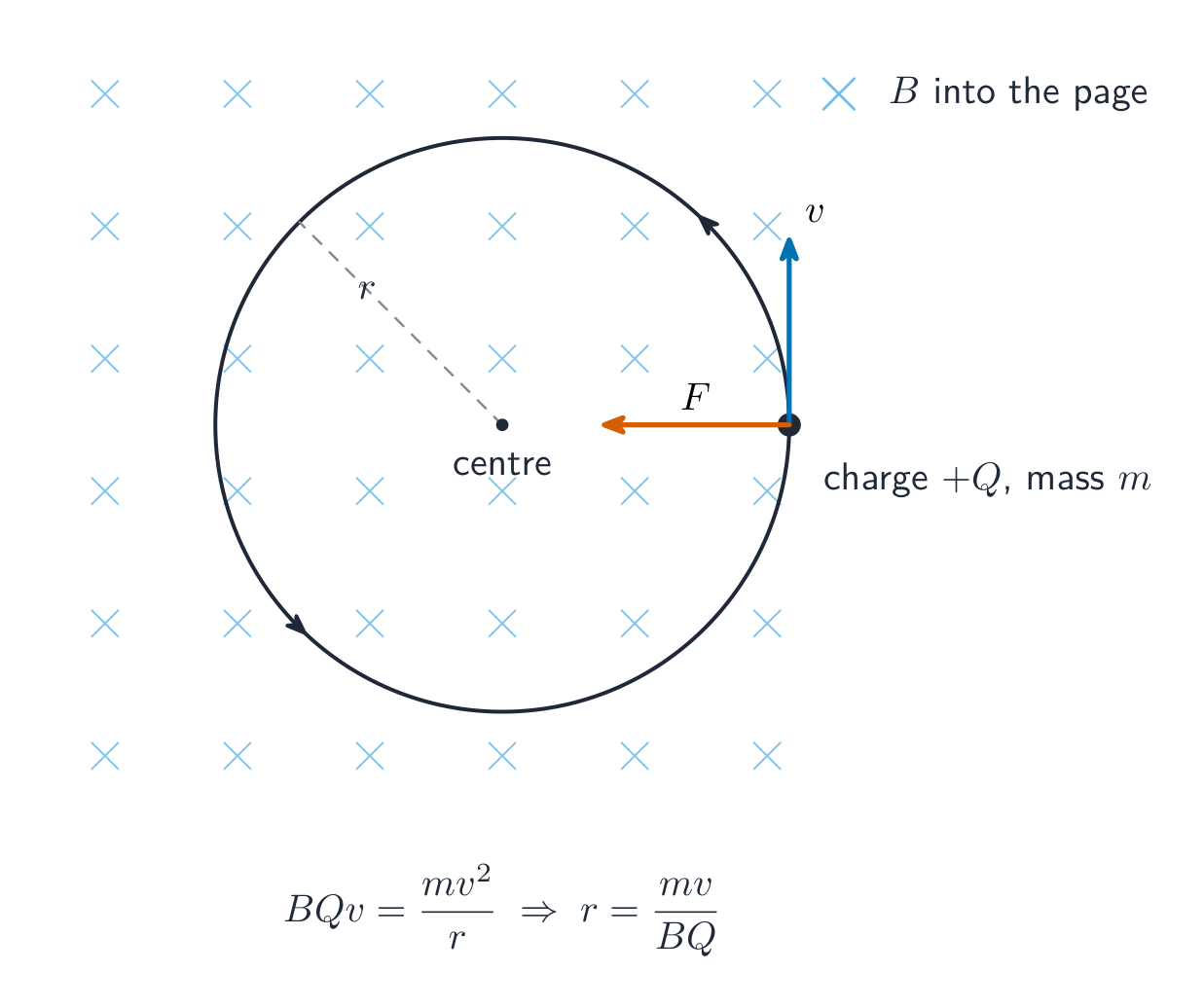
因此一个垂直于一个均匀场移动的电荷以一个圆行进,磁力供应向心力(centripetal force):
$$qvB=\frac{mv^2}{r}\quad\Rightarrow\quad r=\frac{mv}{qB},\qquad T=\frac{2\pi m}{qB}.$$
注意周期 $T$ 不取决于速率——更快的粒子在相同的时间里乘更大的圆。
Worked example. 一个质子($q=1.6\times10^{-19}\ \text{C}$,$m=1.67\times10^{-27}\ \text{kg}$)以 $2.0\times10^{5}\ \text{m/s}$、垂直于它进入一个 $0.50\ \text{T}$ 的场。磁力 $F=qvB=1.6\times10^{-14}\ \text{N}$ 把它弯曲成一个半径 $r=\dfrac{mv}{qB}=\dfrac{1.67\times10^{-27}(2.0\times10^{5})}{1.6\times10^{-19}(0.50)}=4.2\times10^{-3}\ \text{m}$ 的圆。
在一个既有电场又有磁场的区域里,这两个力独立地作用并作为矢量相加。平衡它们制造一个速度选择器(velocity selector):以 $\vec{E}$ 和 $\vec{B}$ 交叉,只有 $qE=qvB$ 即 $v=E/B$ 的电荷直接通过。霍尔效应(Hall effect)是一个导体里面相同的物理:一个带垂直于电流分量的场把移动的载流子横向推,电荷在一个面上积累,而一个可测量的电势差跨导体出现——它的符号揭示载流子是正的还是负的。
探索
Force on a moving charge
A charge moving through a magnetic field feels a force $F=qvB$ at right angles to both its velocity and the field — the basis of the motor effect. Reverse either and the force flips.
词汇表
训练
| 英文 | 中文 | 拼音 |
|---|---|---|
| perpendicular/ˌpɜːpənˈdɪkjʊlə/ | 垂直 | chuí zhí |
| centripetal force/senˈtrɪpɪtl fɔːs/ | 向心力 | xiàng xīn lì |
| velocity selector/vəˈlɒsɪti sɪˈlektə/ | 速度选择器 | sù dù xuǎn zé qì |
| Hall effect/hɔːl ɪˈfekt/ | 霍尔效应 | huò ěr xiào yìng |
12.3
载流导线的磁场与毕奥-萨伐尔定律
大纲
| Learning Objective | Essential Knowledge |
|---|---|
12.3.A |
|
12.3.B |
Boundary statement: AP Physics C: Electricity & Magnetism only expects students to perform quantitative analysis of certain cases of current-carrying conductors using the Biot-Savart law, such as at a location along the perpendicular bisector of a straight conductor, at a location along the central axis of a circular loop, or at the center of a segment of a circular loop. |
来源:美国大学理事会 AP 课程与考试说明
一个电流是移动电荷的一股流,所以它创造一个磁场。毕奥-萨伐尔定律(Biot–Savart law)加起每个电流元素的场:
$$d\vec{B}=\frac{\mu_0}{4\pi}\frac{I\,d\vec{l}\times\hat{r}}{r^2}.$$
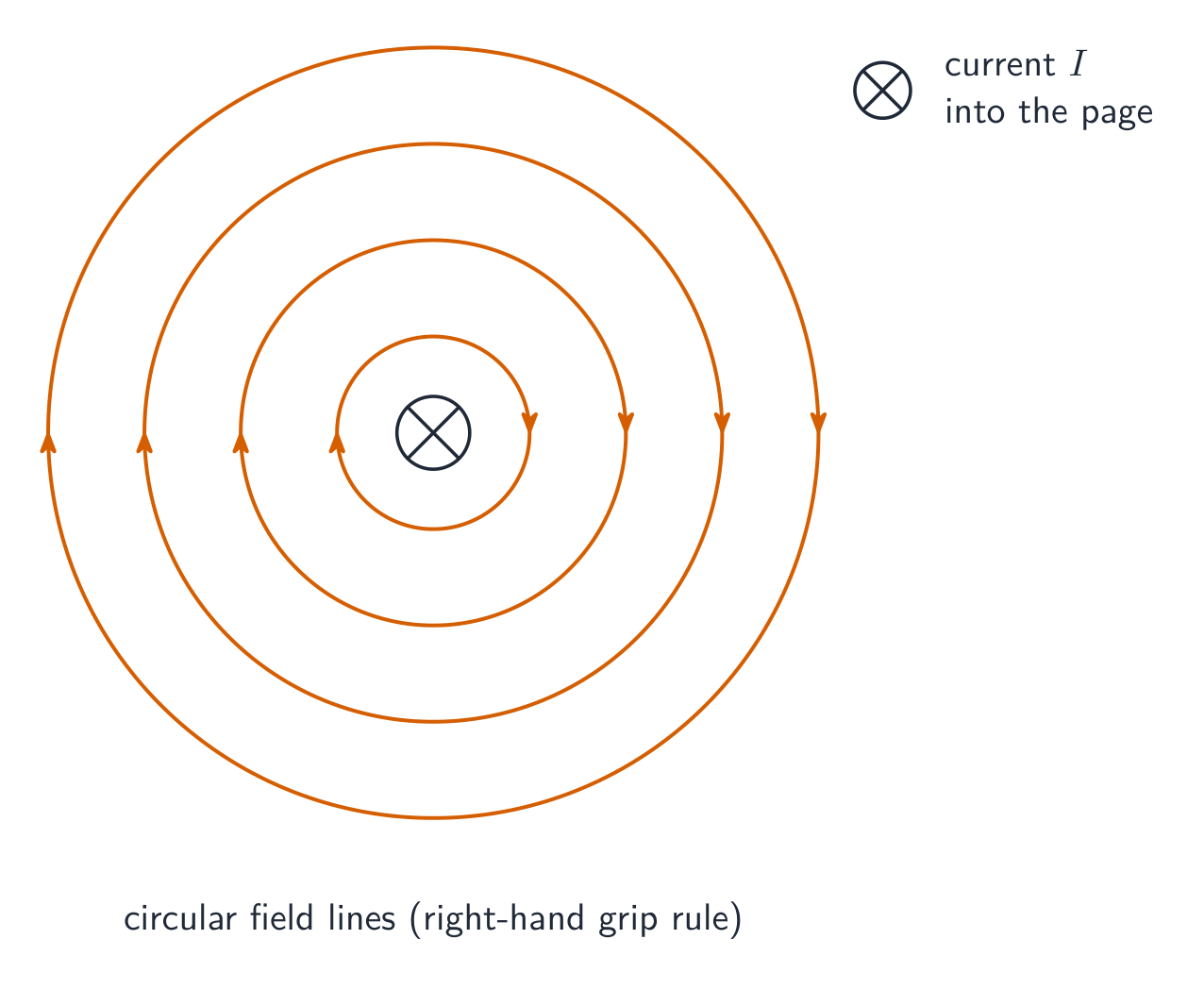
围绕任何直的段场矢量相切(tangent)于以导线为中心的同心圆(concentric circles)——没有朝向、离开或沿导线的分量。把你右手绕导线卷曲,拇指沿电流:你的手指给出场方向。
AP 期望的毕奥-萨伐尔积分:一根长直导线($B=\dfrac{\mu_0 I}{2\pi r}$,或一条有限导线的垂直平分线上的一点),和一个圆形环的中心,
$$B_{\text{centre of loop}}=\frac{\mu_0 I}{2R},$$
其中每个元素 $d\vec{l}$ 垂直于 $\hat{r}$ 并等距 $R$ ——在一个 FRQ 推导里说那个。一段是一个完整圆的分数的弧在它的中心贡献 $\mu_0 I/2R$ 的那个相同分数。
一个场也推一根载流导线,一个元素一个元素:
$$\vec{F}_B=\int I\,d\vec{l}\times\vec{B}\qquad(\vec{F}=I\vec{L}\times\vec{B}\ \text{for a straight wire in a uniform field}).$$
Worked example. 相距一个距离 $d=0.10\ \text{m}$ 的两根长平行导线各以相同方向携带 $5.0\ \text{A}$。导线 1 在导线 2 处的场是 $B=\dfrac{\mu_0 I}{2\pi d}=1.0\times10^{-5}\ \text{T}$,所以导线 2 感受 $\dfrac{F}{L}=I B=5.0\times10^{-5}\ \text{N/m}$,被拉向导线 1。相同方向的电流吸引;相反的电流排斥。
词汇表
训练
| 英文 | 中文 | 拼音 |
|---|---|---|
| Biot–Savart law/ˈbɪɒt ˈsævɑːt lɔː/ | 毕奥-萨伐尔定律 | bì ào - sà fá ěr dìng lǜ |
| tangent/ˈtændʒənt/ | 相切 | xiāng qiè |
| concentric circles/kənˈsentrɪk ˈsɜːklz/ | 同心圆 | tóng xīn yuán |
12.4
安培定律
大纲
| Learning Objective | Essential Knowledge |
|---|---|
12.4.A |
Boundary statement: AP Physics C: Electricity & Magnetism only expects quantitative application of Ampère's law limited to situations involving symmetrical magnetic fields. Long straight wires, long solenoids carrying currents, as well as conductive slabs or cylindrical conductors carrying a current density, are the types of shapes to which Ampère's law will be applied on the AP Physics C: Electricity & Magnetism Exam. Boundary statement: AP Physics C: Electricity & Magnetism does not expect students to use Maxwell's fourth equation with a changing electric field. However, students should understand that a changing electric field generates a magnetic field. |
来源:美国大学理事会 AP 课程与考试说明
对于对称的电流分布,安培定律(Ampère's law)比毕奥-萨伐尔快得多地求场:
$$\oint \vec{B}\cdot d\vec{l}=\mu_0 I_{\text{enc}}.$$
选择一个匹配对称的安培环路(Amperian loop),以便 $B$ 沿环路恒定(且平行于它)并从积分里出来。AP 把它应用于长直导线、长螺线管,和携带一个电流密度(current density)的导体(平板和圆柱);组合由叠加(superposition)处理。
Worked example. 求距一根携带 $5.0\ \text{A}$ 的长导线 $0.10\ \text{m}$ 的场。一个半径 $r$ 的圆形环路共享场的对称,所以 $B(2\pi r)=\mu_0 I$ 而
$$B=\frac{\mu_0 I}{2\pi r}=\frac{(4\pi\times10^{-7})(5.0)}{2\pi(0.10)}=1.0\times10^{-5}\ \text{T}.$$
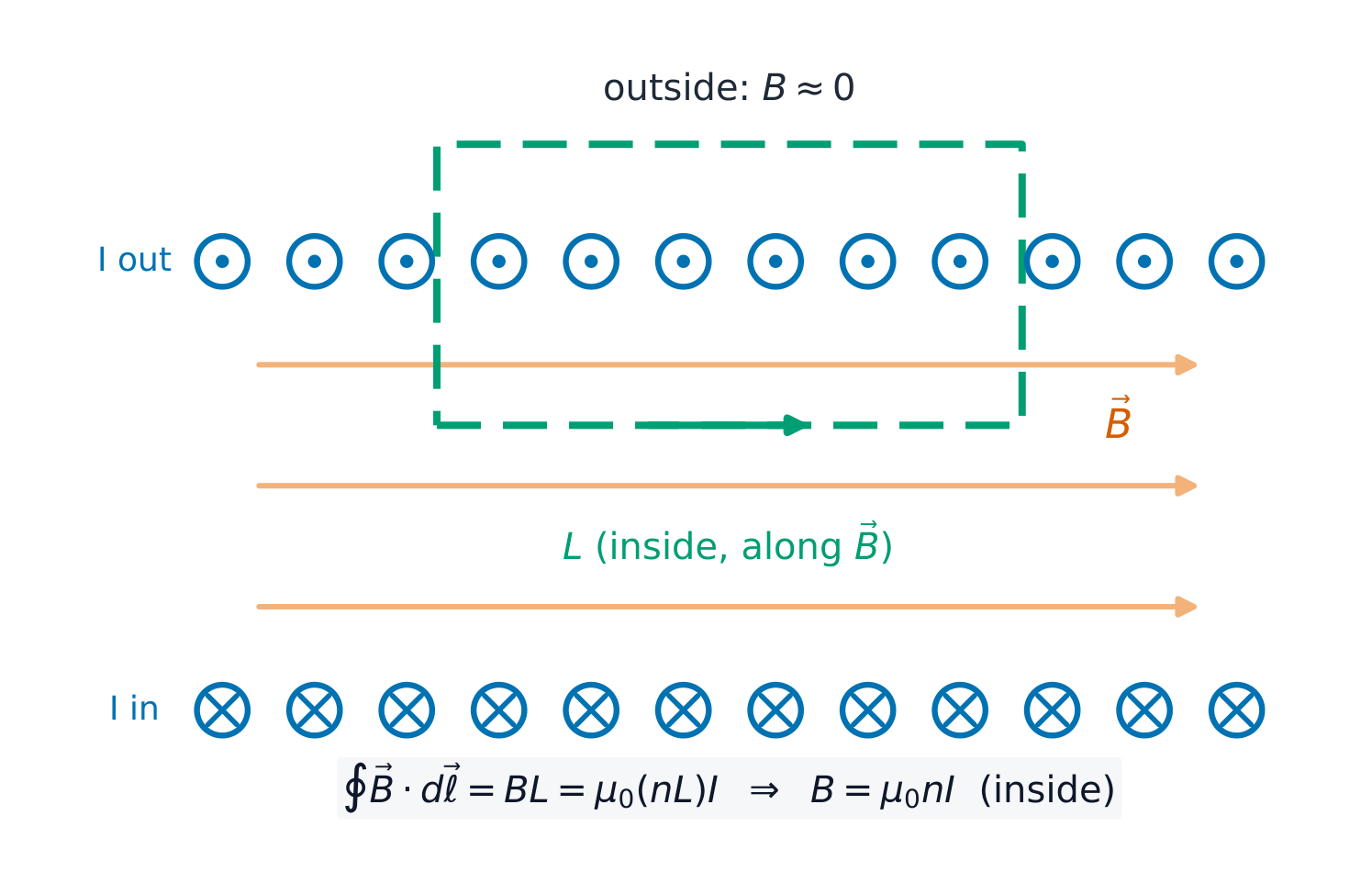
一个长螺线管(solenoid)(假设:里面均匀场、外面可忽略的场)是另一个经典。取一个矩形环路,一边长度 $L$ 在里面、平行于轴:只有那条边贡献于积分,所以 $BL=\mu_0 (nL) I$ 而
$$B_{\text{sol}}=\mu_0 n I,$$
$n$ 是每米的匝数。
Worked example (cylinder). 一个半径 $R$ 的实心圆柱导体携带电流 $I$,均匀地散布在它的横截面上。里面($r
Exam skill. 每个安培定律答案在设置里赢得它的分数:命名环路、陈述为什么 $B$ 沿它恒定且平行(对称),并在你求解之前仔细数 $I_{\text{enc}}$。麦克斯韦的第四个方程增加一个你应当定性地知道的思想:一个变化的电场也创造一个磁场——但 AP 不会要求你用那一项计算。
词汇表
训练
| 英文 | 中文 | 拼音 |
|---|---|---|
| Ampère's law/ˈæmpeəz lɔː/ | 安培定律 | ān péi dìng lǜ |
| Amperian loop/æmˈpɪərɪən luːp/ | 安培环路 | ān péi huán lù |
| current density/ˈkʌrənt ˈdensɪti/ | 电流密度 | diàn liú mì dù |
| superposition/ˌsuːpəpəˈzɪʃn/ | 叠加 | dié jiā |
| solenoid/ˈsəʊlənɔɪd/ | 螺线管 | luó xiàn guǎn |
12.4
考试技巧
- 磁力 $\vec F=q\vec v\times\vec B$ 垂直于速度——用右手定则并注意它不做功。
- 一个均匀场里的电荷以 $r=\tfrac{mv}{qB}$ 的圆移动。
- 用毕奥-萨伐尔 $d\vec B=\tfrac{\mu_0}{4\pi}\tfrac{I\,d\vec l\times\hat r}{r^2}$ 或当有对称时用安培定律 $\oint \vec B\cdot d\vec l=\mu_0 I_{enc}$ 求电流的场。
- 一根导线上的力是 $\vec F=I\vec L\times\vec B$;把叉积方向保持清楚。
- 把一个电荷上的力与电流创造的场区分开。
本主题的互动课程
逐步学习,并即时检测练习。