| Learning Objective | Essential Knowledge |
|---|---|
10.1.A |
|
导体与电容器
AP 物理 C:电磁学 · 第 10 主题
 8:28
8:28
Conductors and Capacitors
A plane is struck by lightning about once a year, and the people inside feel almost nothing. A car in a thunderstorm is one of the safest places to sit. Why?…
英文讲解 · 内嵌中英文字幕
10.1
导体的静电学
大纲
来源:美国大学理事会 AP 课程与考试说明
在一个理想的导体(conductor)里,电子自由移动。在一个上放额外的电荷,电荷互相排斥,直到几乎瞬间,它们稳定进入静电平衡(electrostatic equilibrium)。在那个状态导体有四个你必须能够陈述和使用的性质:
- 导体内部的电场是零。若它不是,自由电子仍会移动。
- 所有多余的电荷坐在表面上。(负净电荷 = 表面上的额外电子;正 = 那里的电子短缺。)
- 恰好在外面的场垂直于(perpendicular)表面,大小为 $E=\sigma/\varepsilon_0$。任何平行分量会把电荷沿表面横向推。
- 整个导体是一个等势面(equipotential surface):每个点,内部和在表面上,都处于相同的电势。
电荷密度在表面急剧弯曲的地方——在点和边缘——最大,所以外面的场在那里最强。在一个外部场里一个导体极化:电荷在它的表面上移动,以便内部保持无场而物体保持一个等势面。用一个闭合的导电壳包围一个区域完全把外部场挡在外——静电屏蔽(electrostatic shielding),法拉第笼(Faraday cage)背后的思想。
词汇表
训练
| 英文 | 中文 | 拼音 |
|---|---|---|
| conductor/kənˈdʌktə/ | 导体 | dǎo tǐ |
| electrostatic equilibrium/ɪˌlektrəʊˈstætɪk ˌiːkwɪˈlɪbrɪəm/ | 静电平衡 | jìng diàn píng héng |
| perpendicular/ˌpɜːpənˈdɪkjʊlə/ | 垂直 | chuí zhí |
| equipotential surface/ˌiːkwɪpəˈtenʃl ˈsɜːfɪs/ | 等势面 | děng shì miàn |
| electrostatic shielding/ɪˌlektrəʊˈstætɪk ˈʃiːldɪŋ/ | 静电屏蔽 | jìng diàn píng bì |
| Faraday cage/ˈfærədeɪ keɪdʒ/ | 法拉第笼 | fǎ lā dì lóng |
10.2
导体间电荷的重新分布
大纲
| Learning Objective | Essential Knowledge |
|---|---|
10.2.A |
|
来源:美国大学理事会 AP 课程与考试说明
当两个导体触碰(或被连线在一起)时,电荷在它们之间流动,直到两个表面达到相同电势——那是停止条件,不是"相等的电荷"。一个更大的球在相同的电势容纳更多电荷($V=kQ/R$),所以它取更大的份额。
Worked example. 一个携带 $+6.0\ \mu\text{C}$ 的半径 $R$ 的小球触碰一个遥远的半径 $2R$ 的球,然后它们分离。相等的电势要求 $\dfrac{kq_1}{R}=\dfrac{kq_2}{2R}$,所以 $q_2=2q_1$。以 $q_1+q_2=6.0\ \mu\text{C}$:$q_1=2.0\ \mu\text{C}$ 而 $q_2=4.0\ \mu\text{C}$。
接地(ground)是一个理想化的零电势参考,它能吸收或供应任何量的电荷。在一个外部电荷附近时给一个导体接地使导体带一个净的感应电荷(induced charge):外部场把一个符号的电荷推向地,而在移除外部电荷之前切断接地线困住其余的。
词汇表
训练
| 英文 | 中文 | 拼音 |
|---|---|---|
| ground/ɡraʊnd/ | 接地 | jiē dì |
| induced charge/ɪnˈdjuːst tʃɑːdʒ/ | 感应电荷 | gǎn yìng diàn hè |
| work/wɜːk/ | 功 | gōng |
10.3
电容器
大纲
| Learning Objective | Essential Knowledge |
|---|---|
10.3.A |
Boundary statement: While other shapes are also able to separate charges, AP Physics C: Electricity & Magnetism only expects the quantitative analysis and description of parallel-plate capacitors, concentric spherical capacitors, and coaxial cylindrical capacitors. |
来源:美国大学理事会 AP 课程与考试说明
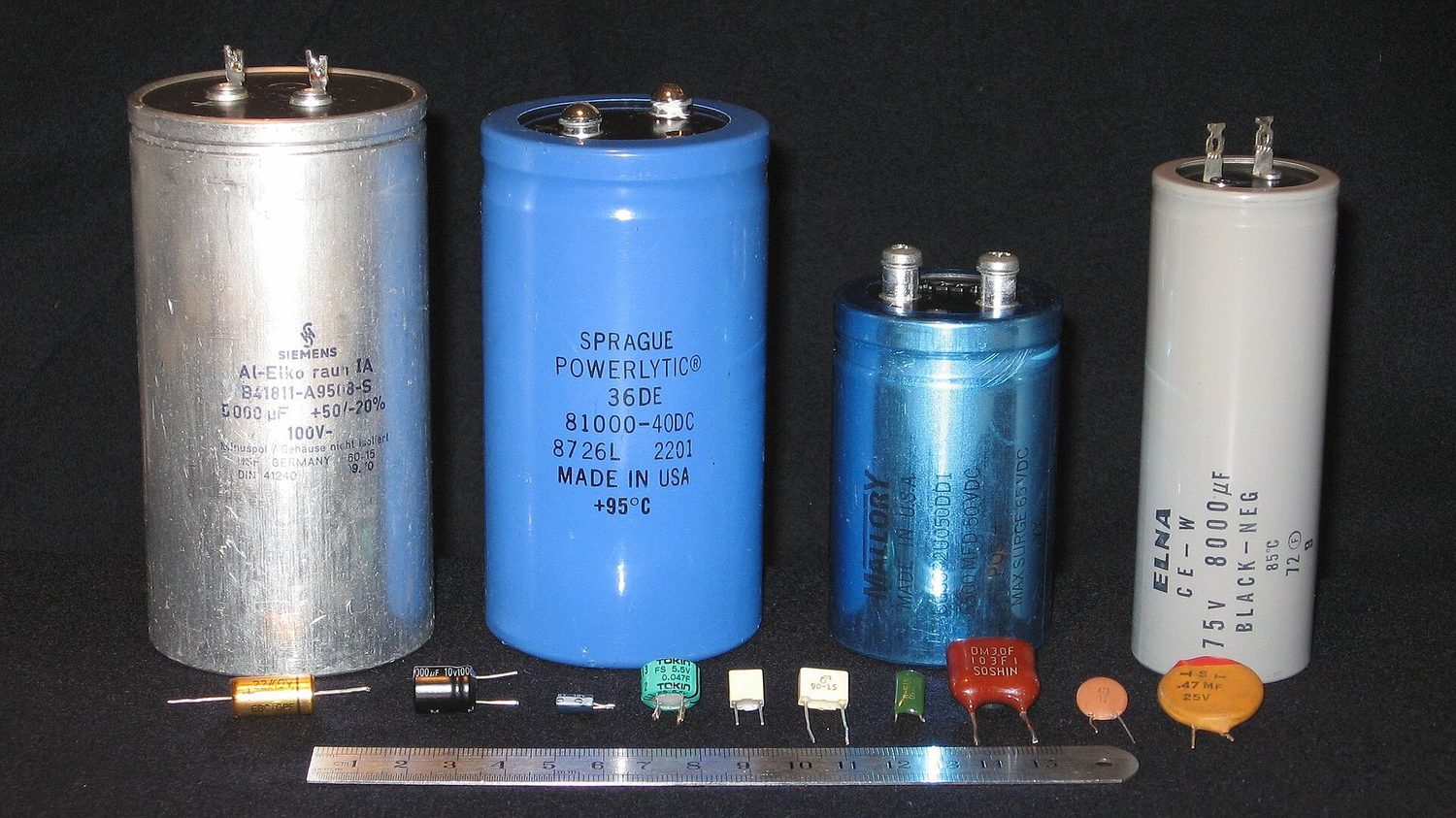
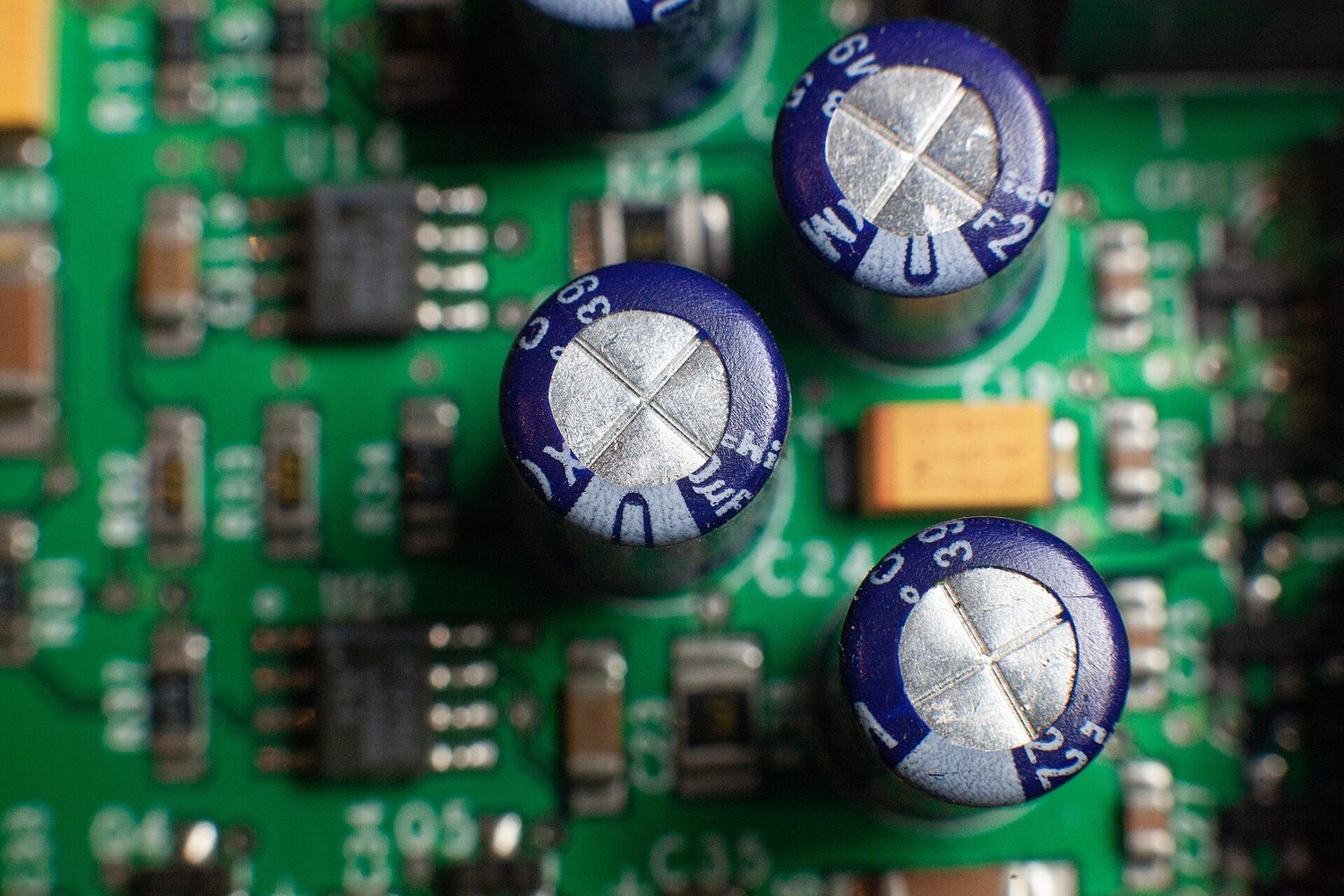
一个电容器(capacitor)在被一个间隙分开的两个导体上储存电荷:一个板上 $+Q$、另一个上 $-Q$。它的电容(capacitance)把储存的电荷与板之间的电势差关联:
$$C=\frac{Q}{\Delta V}.$$
电容只取决于几何和间隙里的材料——从不取决于 $Q$ 或 $\Delta V$ 本身。
Worked derivation (parallel plates). 对于一个板面积 $A$ 和小间隙 $d$ 的平行板电容器(parallel-plate capacitor):高斯定律加叠加(superposition)给出板之间的一个均匀(uniform)场,$E=\dfrac{\sigma}{\varepsilon_0}=\dfrac{Q}{\varepsilon_0 A}$(每个板单独贡献 $\sigma/2\varepsilon_0$;在板之间两者相加,外面它们抵消)。一个均匀场意味着 $\Delta V=Ed=\dfrac{Qd}{\varepsilon_0 A}$,所以
$$C=\frac{Q}{\Delta V}=\frac{\varepsilon_0 A}{d}.$$
这个 $E\to\Delta V\to C$ 链是一个标准的 FRQ 推导——把它作为三个步骤学,并引用每一个。同样的方法处理 AP 期望的另外两个形状:同心球($C=4\pi\varepsilon_0\dfrac{ab}{b-a}$)和一个长度 $L$ 的同轴圆柱,那里 $E=\dfrac{\lambda}{2\pi\varepsilon_0 r}$ 给出 $\Delta V=\dfrac{\lambda}{2\pi\varepsilon_0}\ln\dfrac{b}{a}$ 因而 $C=\dfrac{2\pi\varepsilon_0 L}{\ln(b/a)}$。
Worked example. 面积 $A=0.020\ \text{m}^2$ 和间隙 $d=1.0\ \text{mm}$ 的板:$C=\dfrac{8.85\times10^{-12}(0.020)}{1.0\times10^{-3}}=1.8\times10^{-10}\ \text{F}$。充电到 $100\ \text{V}$ 它容纳 $Q=CV=1.8\times10^{-8}\ \text{C}$。
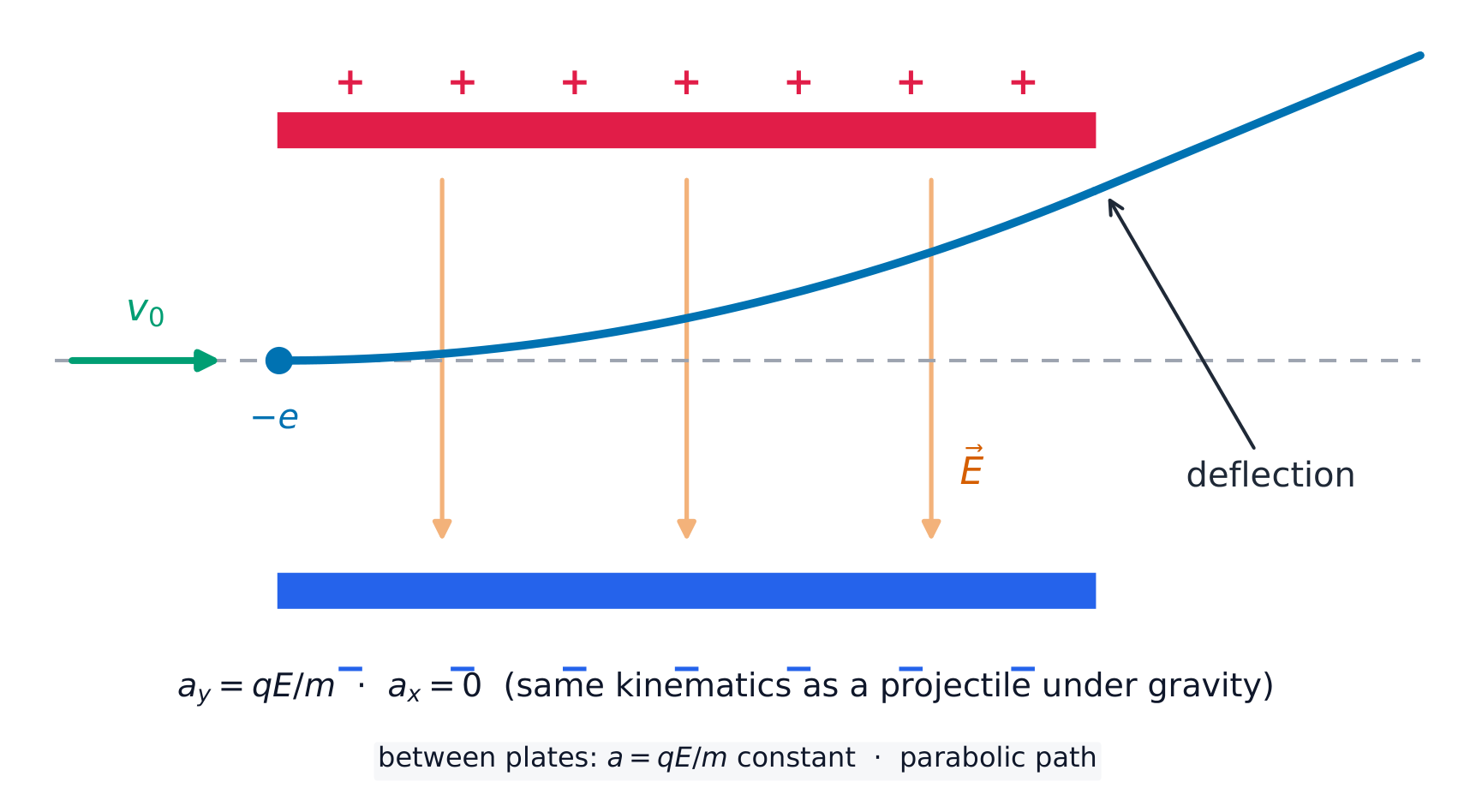
因为板之间的场是均匀的,那里的一个带电粒子感受一个恒定的力,所以它以恒定加速度移动——恰好像重力里的抛体运动(projectile motion):横向恒定速率、朝一个板均匀加速。
Worked example. 一个电子在板中间以 $v_0=2.0\times10^{7}\ \text{m/s}$、平行于它们进入。场是 $E=1.0\times10^{3}\ \text{N/C}$ 而板长 $4.0\ \text{cm}$。加速度:$a=\dfrac{eE}{m}=\dfrac{(1.6\times10^{-19})(1.0\times10^{3})}{9.11\times10^{-31}}=1.8\times10^{14}\ \text{m/s}^2$。板之间的时间:$t=\dfrac{0.040}{2.0\times10^{7}}=2.0\times10^{-9}\ \text{s}$。偏转:$y=\tfrac12at^{2}=\tfrac12(1.8\times10^{14})(2.0\times10^{-9})^{2}\approx3.5\times10^{-4}\ \text{m}$ ——约 $0.35\ \text{mm}$ 朝正板。
储存电荷需要功(work):一个外力必须逆着已经在那里的电荷的场移动每一小块电荷。总功最终成为储存的势能,
$$U_C=\tfrac12\,Q\,\Delta V=\tfrac12 C(\Delta V)^2=\frac{Q^2}{2C}.$$
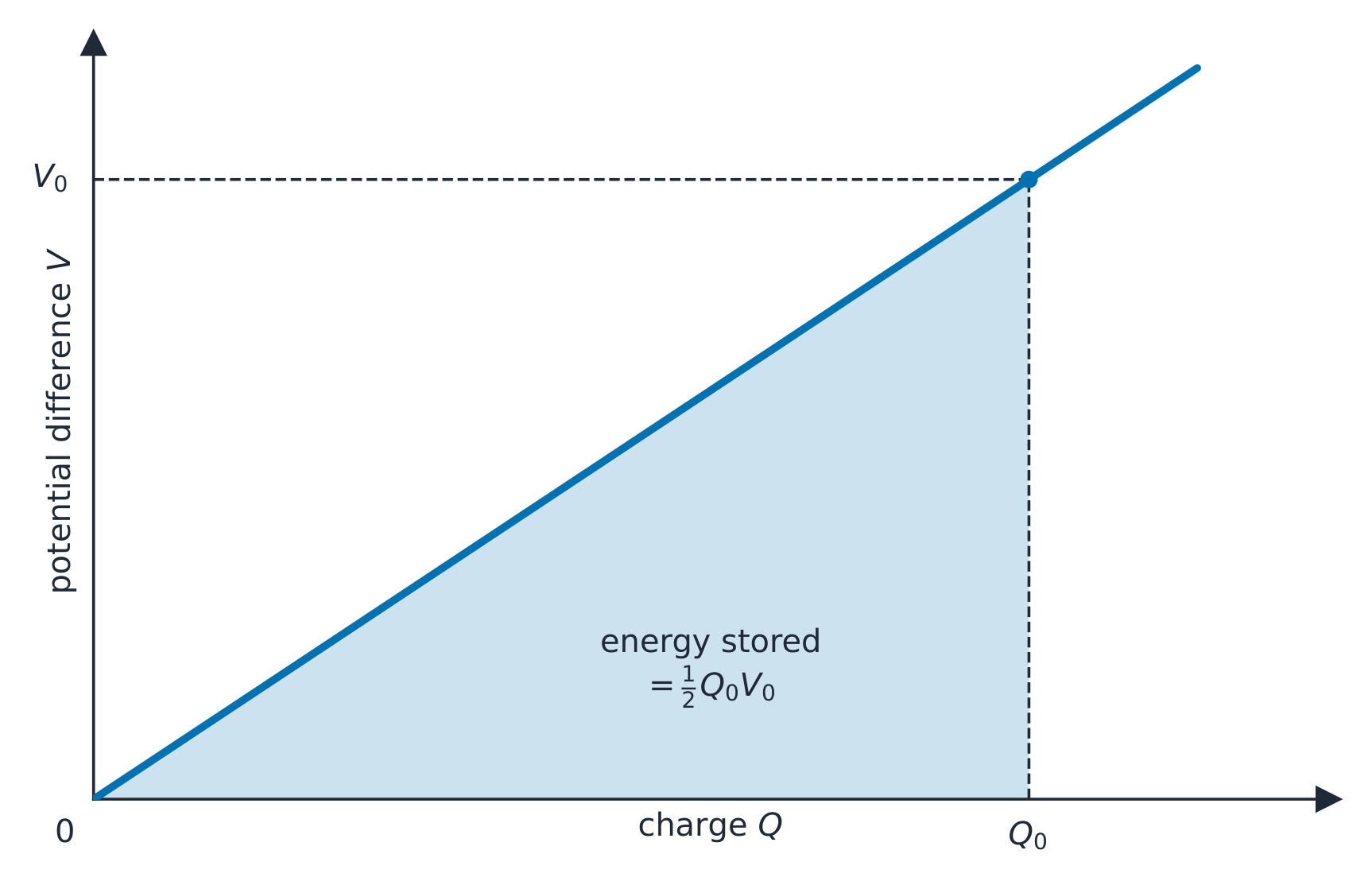
因子 $\tfrac12$ 是 $Q$–$\Delta V$ 线下三角形的面积:第一个移过的电荷几乎不花费,最后一个花费完整的 $\Delta V$。
电容器与电阻相反地组合:在并联(parallel)里电容相加($C_{\text{eq}}=C_1+C_2$,相同的 $\Delta V$,电荷相加),而在串联(series)里倒数相加($\tfrac{1}{C_{\text{eq}}}=\tfrac{1}{C_1}+\tfrac{1}{C_2}$,相同的 $Q$,电压相加)。
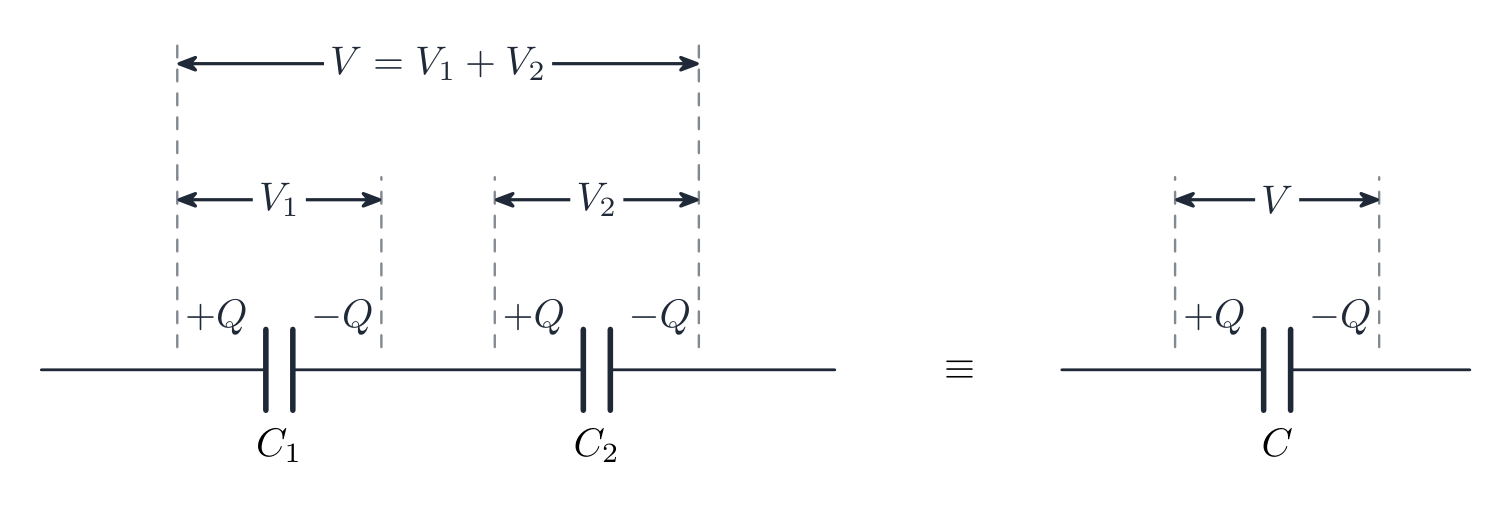
Worked example. 一个 $2\ \mu\text{F}$ 和一个 $4\ \mu\text{F}$ 电容器串联:$\tfrac{1}{C}=\tfrac12+\tfrac14$,所以 $C=\tfrac43\ \mu\text{F}$。同一对并联:$6\ \mu\text{F}$。
探索
Charge and discharge a capacitor
A capacitor stores charge on two plates, filling and emptying exponentially with time constant $\tau=RC$. Bigger $R$ or $C$ slows it down.
词汇表
训练
| 英文 | 中文 | 拼音 |
|---|---|---|
| capacitor/kəˈpæsɪtə/ | 电容器 | diàn róng qì |
| capacitance/kəˈpæsɪtəns/ | 电容 | diàn róng |
| parallel-plate capacitor/ˈpærəlel pleɪt kəˈpæsɪtə/ | 平行板电容器 | píng xíng bǎn diàn róng qì |
| superposition/ˌsuːpəpəˈzɪʃn/ | 叠加 | dié jiā |
| uniform/ˈjuːnɪfɔːm/ | 均匀 | jūn yún |
| projectile motion/prəˈdʒektaɪl ˈməʊʃn/ | 抛体运动 | pāo tǐ yùn dòng |
| parallel/ˈpærəlel/ | 并联 | bìng lián |
| series/ˈsɪəriːz/ | 串联 | chuàn lián |
10.4
电介质

大纲
| Learning Objective | Essential Knowledge |
|---|---|
10.4.A |
|
来源:美国大学理事会 AP 课程与考试说明
一个电介质(dielectric)是一个绝缘材料。它的电荷不能行进,但在一个外部场里每个分子略微伸展或转动——材料变得极化(polarized)。排列的分子创造它们自己的与施加的相反的小场,所以材料内部的净场下降:
$$E=\frac{E_0}{\kappa},\qquad \kappa=\frac{\varepsilon}{\varepsilon_0}\ \ (\kappa>1),$$
其中 $\kappa$ 是介电常数(dielectric constant),材料的介电常数与真空介电常数(permittivity of free space)之比。
用电介质填充一个电容器使它的电容成倍增加:
$$C=\kappa\,C_0\qquad\left(\text{parallel plates: } C=\frac{\kappa\varepsilon_0 A}{d}\right).$$
接下来发生什么取决于什么保持固定——一个最爱的考试陷阱:
| 电池保持连接($\Delta V$ 固定) | 电池先移除($Q$ 固定) | |
|---|---|---|
| 电荷 $Q$ | 升到 $\kappa Q_0$ | 不变 |
| 电压 $\Delta V$ | 不变 | 降到 $\Delta V_0/\kappa$ |
| 场 $E$ | 不变 | 降到 $E_0/\kappa$ |
| 能量 $U$ | 升到 $\kappa U_0$ | 降到 $U_0/\kappa$ |
Worked example. 一个 $100\ \text{pF}$ 的电容器被充电到 $12\ \text{V}$、断开,然后填充一个 $\kappa=3$ 的电介质。$Q$ 被困住,所以 $\Delta V$ 降到 $4\ \text{V}$ 而储存的能量降到三分之一——缺失的能量进入把电介质拉进去。相反重新连接到 $12\ \text{V}$ 电池,电容器会容纳三倍的电荷和三倍的能量。
Exam skill. 总是通过写下哪个量被保持固定($Q$ 或 $\Delta V$)来开始电介质问题,然后让 $C=\kappa C_0$ 通过 $Q=C\Delta V$ 和 $U=\tfrac12 C(\Delta V)^2$ 驱动其他一切。
探索
Add a dielectric
A dielectric between the plates raises the capacitance, so the capacitor holds more charge at the same voltage. Watch the charge build faster.
词汇表
训练
| 英文 | 中文 | 拼音 |
|---|---|---|
| dielectric/ˌdaɪɪˈlektrɪk/ | 电介质 | diàn jiè zhì |
| polarized/ˈpəʊləraɪzd/ | 极化 | jí huà |
| dielectric constant/ˌdaɪɪˈlektrɪk ˈkɒnstənt/ | 介电常数 | jiè diàn cháng shù |
| permittivity of free space/ˌpɜːmɪˈtɪvəti ɒv friː speɪs/ | 真空介电常数 | zhēn kōng jiè diàn cháng shù |
10.4
考试技巧
- 在静电平衡中一个导体有内部 $\vec E=0$ 而所有多余的电荷在表面上。
- 用一个匹配对称的高斯面(球、圆柱、药盒)应用高斯定律 $\oint \vec E\cdot d\vec A=\tfrac{q_{enc}}{\varepsilon_0}$。
- 整个导体是一个等势面,而表面场垂直于它。
- 对于一个电容器用 $C=\tfrac{Q}{V}$、能量 $U=\tfrac12 CV^2$,以及一个电介质如何提高 $C$。
- 挑选高斯面使 $\vec E$ 在每个部分恒定且平行(或零)。
本主题的互动课程
逐步学习,并即时检测练习。