| Learning Objective | Essential Knowledge |
|---|---|
8.1.A |
|
8.1.B |
|
8.1.C |
Boundary statement: AP Physics C: Electricity & Magnetism only expects students to make calculations of the electric force between four or fewer interacting charged objects or systems. The analysis of the resulting electric force from more charges is allowed in situations of high symmetry. Note that students are expected to calculate the electric fields of charge distributions, as described in Topics 8.4 and 8.6. |
AP 物理 C:电磁学
学习建议
AP 物理 C:电磁学是基于微积分的电磁学课程:电荷、电场与高斯定律;电势;导体与电容器;电路;磁场;电磁感应。通常在力学之后修读,并默认同等的微积分水平。
高斯定律与安培定律决定了这门课的手感。两者本质上都是选一个能让积分变简单的曲面或回路——这靠大量练习,而不是读定律本身。对称性就是全部关键。
电磁感应题最容易因正负号失分,所以请固定一套磁通方向的约定,每次都照用。
笔记从高斯定律讲到麦克斯韦方程组,逐单元展开,矢量微积分写全。资料库中有公开FRQ;电磁学最难的分数在于积分前选对对称性,所以例题从这里开始。
-
8
电荷、电场与高斯定律
8.1
电荷与电力
大纲
来源:美国大学理事会 AP 课程与考试说明
电荷(electric charge)有正和负;同种电荷排斥,相反的吸引。电荷量子化(quantized)——每个电荷是基本电荷(elementary charge)$e=1.6\times10^{-19}\ \text{C}$ 的一个整数倍——并遵循电荷守恒(conservation of charge):电荷从不被创造或销毁,只被移动。两个点电荷(point charges)之间的力是库仑定律(Coulomb's law):
$$\vec{F}=\frac{1}{4\pi\varepsilon_0}\frac{q_1 q_2}{r^2}\,\hat{r},$$一个沿连接它们的线的平方反比(inverse-square)力,$\dfrac{1}{4\pi\varepsilon_0}=k=9.0\times10^{9}\ \text{N}\cdot\text{m}^2/\text{C}^2$。对于几个电荷(AP 用四个或更少,除非对称帮助),在你关心的电荷上把力矢量相加——叠加(superposition)。
电荷是物质的一个基本属性(fundamental property),而点电荷是一个忽略带电物体大小的模型。常数 $\varepsilon_0$ 是真空介电常数(permittivity of free space)—— 真空的一个材料属性。物质的介电常数不同于 $\varepsilon_0$,由材料极化的难易程度决定,这就是为什么两个电荷之间的电介质会削弱这个力。还要注意,尽管电力比重力强得多,在天文尺度上却是重力占主导,因为大的天体几乎是中性的。
Worked example. 两个 $+2.0\ \mu\text{C}$ 电荷相距 $0.30\ \text{m}$:$F=\dfrac{kq_1q_2}{r^2}=\dfrac{9.0\times10^{9}(2.0\times10^{-6})^2}{(0.30)^2}=0.40\ \text{N}$,排斥的。
Worked example (vectors). 电荷 $+3.0\ \mu\text{C}$ 和 $-3.0\ \mu\text{C}$ 坐在一个直角的两个角上,每个距角上一个 $+1.0\ \mu\text{C}$ 电荷 $0.30\ \text{m}$。每个施加 $F=\dfrac{(9.0\times10^{9})(3.0\times10^{-6})(1.0\times10^{-6})}{0.09}=0.30\ \text{N}$ ——一个推、一个拉,以直角相互。合力是 $F_{\text{net}}=\sqrt{0.30^2+0.30^2}=0.42\ \text{N}$,指向它们之间。绝不盲目地相加大小:先分量。
探索Explore the field of a source charge
Change the charge's sign and size. Lines point away from positive and toward negative, and their $1/r^2$ crowding near the charge mirrors why Coulomb's force $F = k\,|q_1 q_2|/r^2$ weakens with distance.
词汇表 训练英文 中文 拼音 Electric charge/ɪˈlektrɪk tʃɑːdʒ/ 电荷 diàn hè quantized/ˈkwɒntaɪzd/ 量子化 liàng zǐ huà elementary charge/ˌelɪˈmentəri tʃɑːdʒ/ 基本电荷 jī běn diàn hè conservation of charge/ˌkɒnsəˈveɪʃn ɒv tʃɑːdʒ/ 电荷守恒 diàn hè shǒu héng point charges/pɔɪnt ˈtʃɑːdʒɪz/ 点电荷 diǎn diàn hè Coulomb's law/ˈkuːlɒmz lɔː/ 库仑定律 kù lún dìng lǜ inverse-square/ɪnˈvɜːs skweə/ 平方反比 píng fāng fǎn bǐ superposition/ˌsuːpəpəˈzɪʃn/ 叠加 dié jiā fundamental property/ˌfʌndəˈmentl ˈprɒpəti/ 基本属性 jī běn shǔ xìng permittivity of free space/ˌpɜːmɪˈtɪvəti ɒv friː speɪs/ 真空介电常数 zhēn kōng jiè diàn cháng shù 8.2
电荷与带电过程
大纲
Learning Objective Essential Knowledge 8.2.A
Describe the behavior of a system using conservation of charge.- 8.2.A.1 The net charge or charge distribution of a system can change in response to the presence of, or changes in, the net charge or charge distribution of other systems.
- 8.2.A.1.i The net charge of a system can change due to friction or contact between systems.
- 8.2.A.1.ii Induced charge separation occurs when the electrostatic force between two systems alters the distribution of charges within the systems, resulting in the polarization of one or both systems.
- 8.2.A.1.iii Induced charge separation can occur in neutral systems.
- 8.2.A.2 Any change to a system's net charge is due to a transfer of charge between the system and its surroundings.
- 8.2.A.2.i The charging of a system typically involves the transfer of electrons to and from the system.
- 8.2.A.2.ii The net charge of a system will be constant unless there is a transfer of charge to or from the system.
- 8.2.A.3 Grounding involves electrically connecting a charged object to a much larger and approximately neutral system (e.g., Earth).
来源:美国大学理事会 AP 课程与考试说明
一个导体(conductor)让电荷自由移动;一个绝缘体(insulator)把它保持在原位。物体以三种方式获得净电荷:
- 摩擦起电(charging by friction):摩擦把电子从一个表面转移到另一个。
- 传导起电(charging by conduction):触碰一个带电物体共享相同符号的电荷。
- 感应起电(charging by induction):一个附近的电荷把导体的电荷推开;把远的一侧接地(ground)、先移除接地线,而导体被留下相反的符号——全都没有接触。
一个绝缘体不能传递电荷,但它能产生极化(polarization):它的分子伸展或转动,使一个面略带正电而另一个略带负电。这就是为什么一把带电的梳子捡起中性的纸屑。一个验电器(electroscope)通过它的箔片排斥显示净电荷;在任何孤立的导体上多余的电荷完全坐在外表面上。
探索Explore charging by rubbing
Rubbing transfers electrons onto the object, leaving it negative. A charged object then attracts a neutral wall or hair (by polarization) but repels another like-charged object — the same electron transfer behind friction, conduction, and induction.
词汇表 训练英文 中文 拼音 conductor/kənˈdʌktə/ 导体 dǎo tǐ insulator/ˈɪnsjuːleɪtə/ 绝缘体 jué yuán tǐ Charging by friction/ˈtʃɑːdʒɪŋ baɪ ˈfrɪkʃn/ 摩擦起电 mó cā qǐ diàn Charging by conduction/ˈtʃɑːdʒɪŋ baɪ kənˈdʌkʃn/ 传导起电 chuán dǎo qǐ diàn Charging by induction/ˈtʃɑːdʒɪŋ baɪ ɪnˈdʌkʃn/ 感应起电 gǎn yìng qǐ diàn ground/ɡraʊnd/ 接地 jiē dì polarization/ˌpəʊləraɪˈzeɪʃn/ 极化 jí huà electroscope/ɪˌlektrəʊˈskəʊp/ 验电器 yàn diàn qì 8.3
电场
大纲
Learning Objective Essential Knowledge 8.3.A
Describe the electric field produced by a charged object or configuration of point charges.- 8.3.A.1 Electric fields may originate from charged objects.
- 8.3.A.2 The electric field at a given point is the ratio of the electric force exerted on a test charge at the point to the charge of the test charge.
- Relevant equation: $\vec{E} = \dfrac{\vec{F}_E}{q}$
- 8.3.A.2.i A test charge is a point charge of small enough magnitude such that its presence does not significantly affect an electric field in its vicinity.
- 8.3.A.2.ii An electric field points away from isolated positive charges and toward isolated negative charges.
- 8.3.A.2.iii The electric force exerted on a positive test charge by an electric field is in the same direction as the electric field.
- 8.3.A.3 The electric field is a vector quantity and can be represented in space using vector field maps.
- 8.3.A.3.i The net electric field at a given location is the vector sum of individual electric fields created by nearby charged objects.
- 8.3.A.3.ii Electric field maps use vectors to depict the magnitude and direction of the electric field at many locations within a given region.
- 8.3.A.3.iii Electric field line diagrams are simplified models of electric field maps and can be used to determine the relative magnitude and direction of the electric field at any position in the diagram.
8.3.B
Describe the electric field generated by charged conductors or insulators.- 8.3.B.1 While in electrostatic equilibrium, the excess charge of a conductor is distributed on the surface of the conductor, and the electric field within the conductor is zero.
- 8.3.B.1.i At the surface of a charged conductor, the electric field is perpendicular to the surface.
- 8.3.B.1.ii The electric field outside an isolated sphere with spherically symmetric charge distribution is the same as the electric field due to a point charge with the same net charge as the sphere located at the center of the sphere.
- 8.3.B.2 While in electrostatic equilibrium, the excess charge of an insulator is distributed throughout the interior of the insulator as well as at the surface, and the electric field within the insulator may have a nonzero value.
来源:美国大学理事会 AP 课程与考试说明
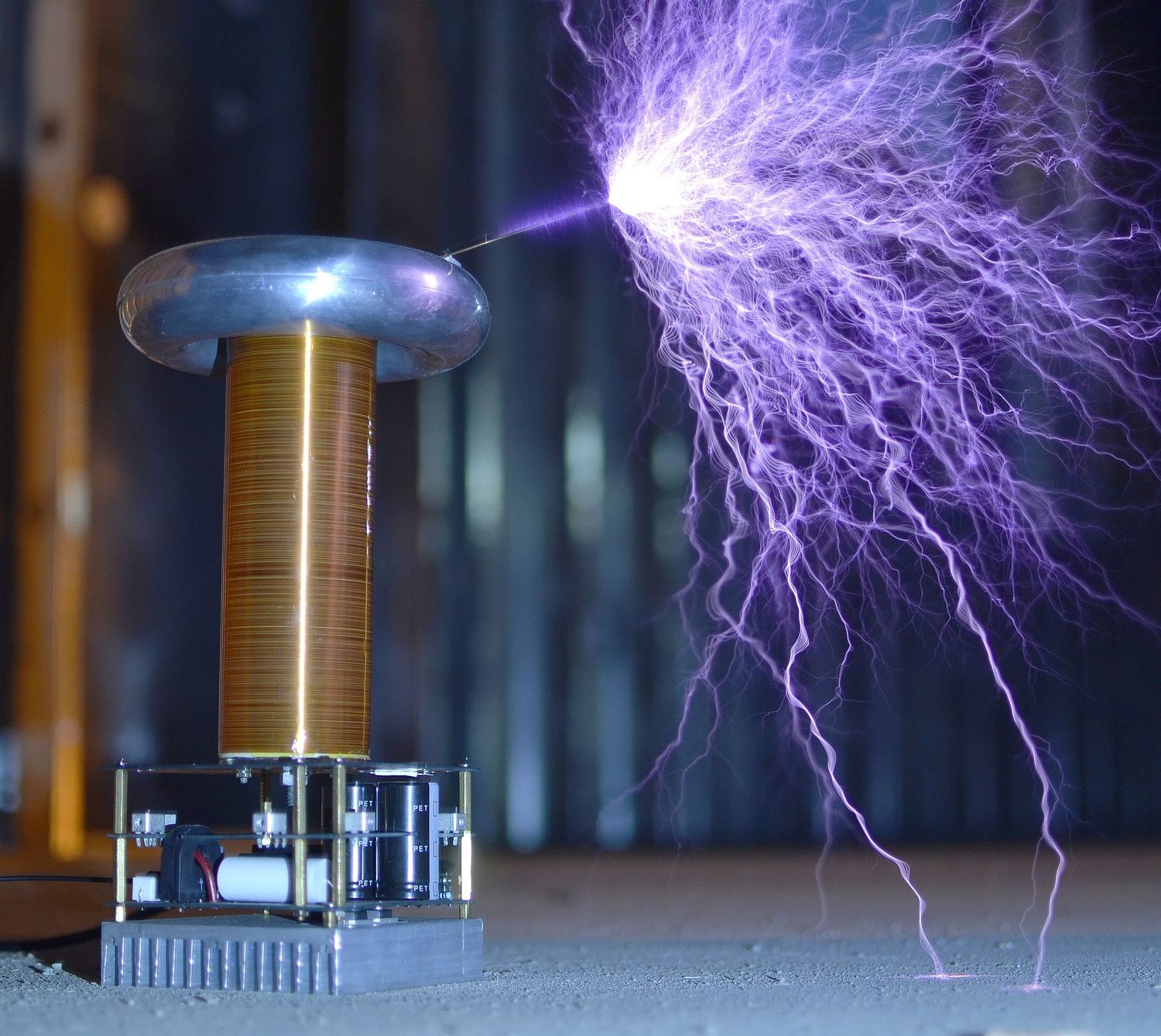
偶极子的电场 特斯拉线圈喷出火花:它把电压升得极高,使电场电离周围的空气,电荷以可见的放电形式跃过 一点处的电场(electric field)是一个小的正检验电荷(test charge)在那里会感受的每单位电荷的力:
$$\vec{E}=\frac{\vec{F}}{q},\qquad \vec{E}=\frac{1}{4\pi\varepsilon_0}\frac{q}{r^2}\,\hat{r}\ \text{(point charge)}.$$一个放在场里的电荷感受 $\vec{F}=q\vec{E}$ ——正电荷沿场、负电荷逆场。来自几个源的场作为矢量相加(又是叠加)。电场线(field lines)使场可见:它们从正电荷指向外并朝向负,它们的密度显示强度,而它们从不交叉。
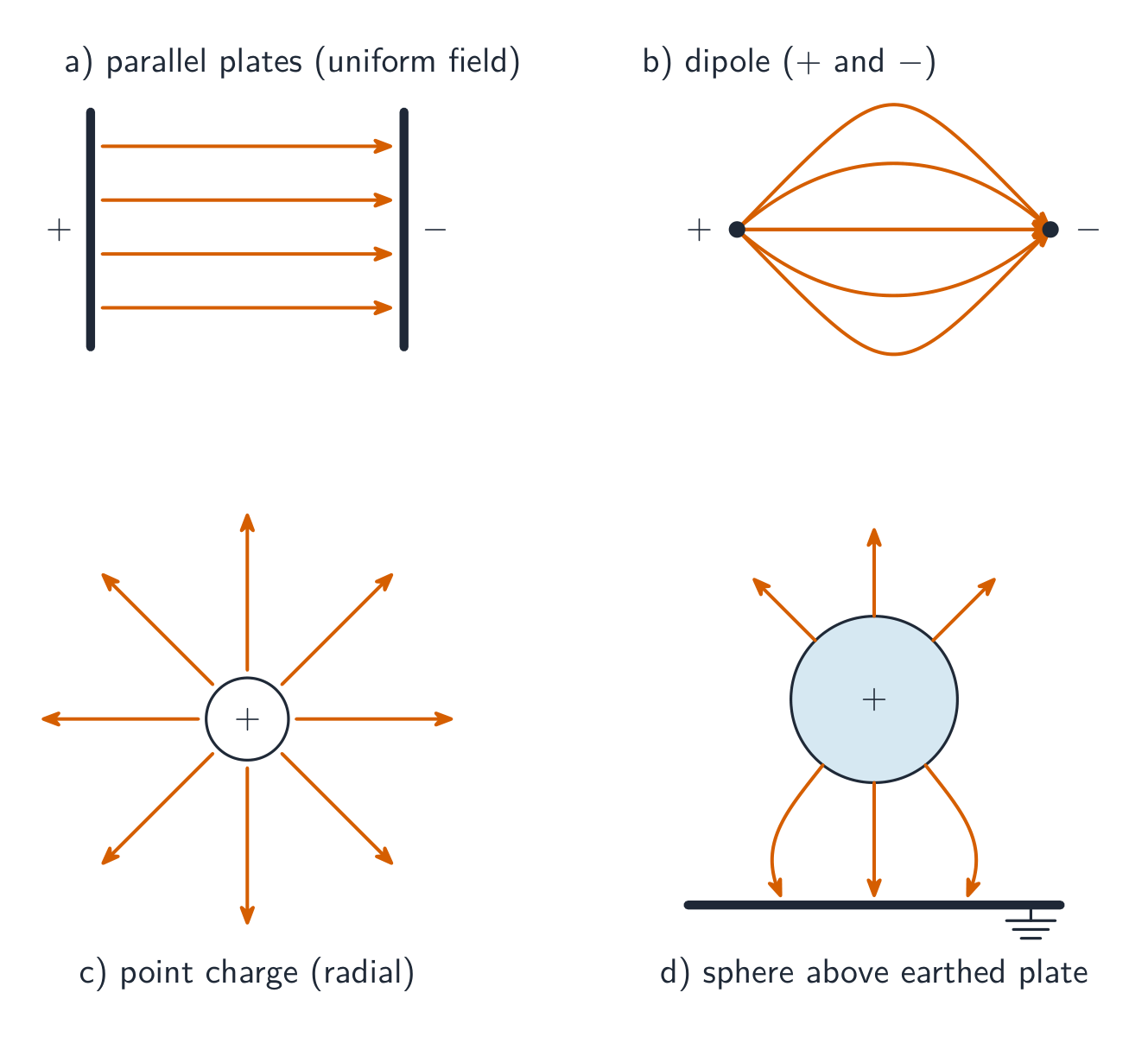
平行板、一个偶极子和一个点电荷的电场线模式 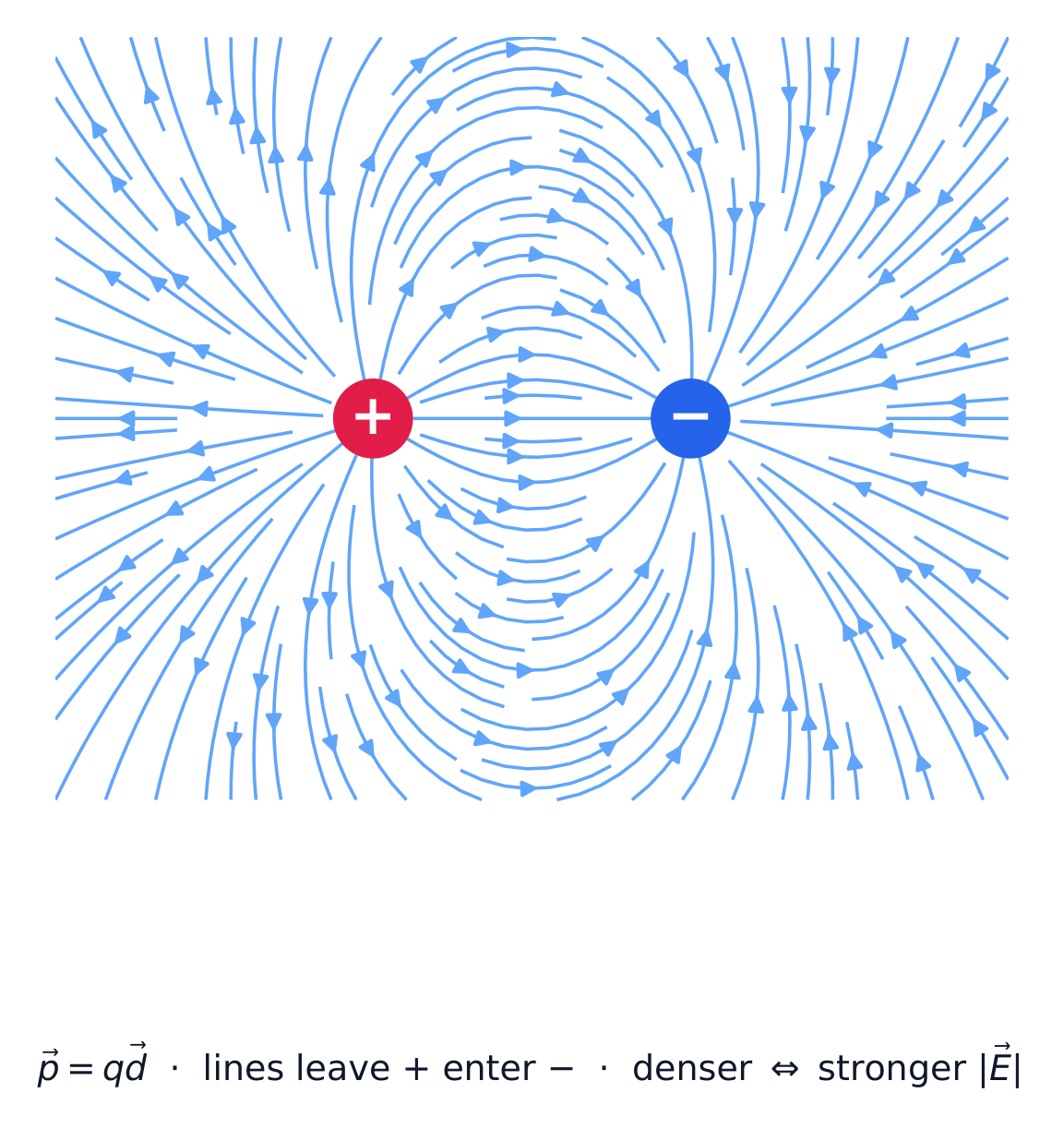
一个偶极子的电场线从正电荷指向负电荷 在一个均匀(uniform)场里一个电荷感受一个恒定的力,所以它均匀地加速——横向发射,它遵循一条抛物线,正如重力里的一个抛体。
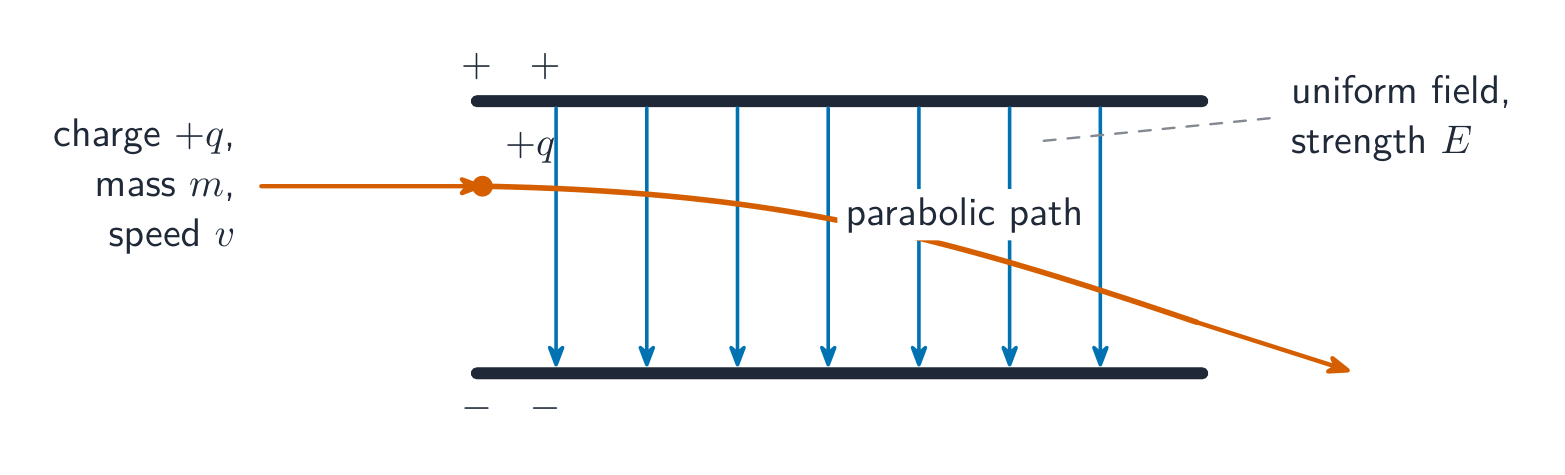
一个横穿一个均匀场的电荷遵循一条抛物线路径 探索Explore field lines of a point charge
Set the charge positive or negative. Field lines start on positive and end on negative charge, never cross, and crowd together where $\vec{E}$ is strongest — the line density is proportional to the field magnitude.
词汇表 训练英文 中文 拼音 electric field/ɪˈlektrɪk fiːld/ 电场 diàn chǎng test charge/test tʃɑːdʒ/ 检验电荷 jiǎn yàn diàn hè Field lines/fiːld laɪnz/ 电场线 diàn chǎng xiàn uniform/ˈjuːnɪfɔːm/ 均匀 jūn yún 8.4
电荷分布的电场
大纲
Learning Objective Essential Knowledge 8.4.A
Describe the electric field resulting from a given charge distribution.- 8.4.A.1 Expressions for the electric field of specified charge distributions can be found using integration and the principle of superposition.
- Relevant equation: $\vec{E} = \dfrac{1}{4\pi\varepsilon_0} \displaystyle\int \dfrac{dq}{r^2} \hat{r}$
- 8.4.A.2 Symmetry considerations of certain charge distributions can simplify analysis of the electric field resulting from those charge distributions.
Boundary statement: AP Physics C: Electricity & Magnetism only expects students to use calculus to find the electric field resulting from the following charge distributions and locations: an infinitely long, uniformly charged wire or cylinder at a distance from its central axis, a thin ring of charge at a location along the axis of the ring, a semicircular arc or part of a semicircular arc at its center, and a finite wire or line charge at a point collinear with the line charge or at a location along its perpendicular bisector.
来源:美国大学理事会 AP 课程与考试说明
对于一个连续电荷分布(continuous charge distribution),把物体切成片 $dq$ 并积分它们的点电荷场:
$$\vec{E}=\frac{1}{4\pi\varepsilon_0}\int \frac{dq}{r^2}\,\hat{r}.$$用正确的密度写 $dq$:用线电荷密度(linear charge density)的 $\lambda\,dl$(一条线或环)、用面电荷密度(surface charge density)的 $\sigma\,dA$,或用体电荷密度(volume charge density)的 $\rho\,dV$。然后在积分之前用对称性(symmetry)抵消分量——那句话通常是一个评分的步骤。AP 的微积分情况:一条有限的线(共线点或垂直平分线)、一条无限的导线或圆柱、一个环在它的轴上,和一段弧在它的中心。
Worked example (ring, on axis). 一个半径 $R$ 的环携带电荷 $Q$。在沿轴的一点 $z$,每个元素距离 $\sqrt{R^2+z^2}$,而由对称横向分量抵消,只留下轴向部分($\cos\alpha=z/\sqrt{R^2+z^2}$):
$$E_z=\frac{1}{4\pi\varepsilon_0}\int\frac{dq}{R^2+z^2}\cdot\frac{z}{\sqrt{R^2+z^2}}=\frac{1}{4\pi\varepsilon_0}\frac{Qz}{(R^2+z^2)^{3/2}}.$$检查极限:$E=0$ 在中心($z=0$),而在远处($z\gg R$)它变成 $kQ/z^2$ ——一个点电荷,正如它必须。
词汇表 训练英文 中文 拼音 continuous charge distribution/kənˈtɪnjuːəs tʃɑːdʒ ˌdɪstrɪˈbjuːʃn/ 连续电荷分布 lián xù diàn hè fēn bù linear charge density/ˈlɪnɪə tʃɑːdʒ ˈdensɪti/ 线电荷密度 xiàn diàn hè mì dù surface charge density/ˈsɜːfɪs tʃɑːdʒ ˈdensɪti/ 面电荷密度 miàn diàn hè mì dù volume charge density/ˈvɒljuːm tʃɑːdʒ ˈdensɪti/ 体电荷密度 tǐ diàn hè mì dù symmetry/ˈsɪmətri/ 对称性 duì chèn xìng 8.5
电通量
大纲
Learning Objective Essential Knowledge 8.5.A
Describe the electric flux through an arbitrary area or geometric shape.- 8.5.A.1 Flux describes the amount of a given quantity that passes through a given area.
- 8.5.A.2 For an electric field $\vec{E}$ that is constant across an area $\vec{A}$, the electric flux through the area is defined as $\Phi_E = \vec{E} \bullet \vec{A}$.
- 8.5.A.2.i The direction of the area vector is defined as perpendicular to the plane of the surface and outward from a closed surface.
- 8.5.A.2.ii The sign of flux is given by the dot product of the electric field vector and the area vector.
- 8.5.A.3 The total electric flux passing through a surface is defined by the surface integral of the electric field over the surface.
- Relevant equation: $\Phi_E = \displaystyle\int \vec{E} \cdot d\vec{A}$
来源:美国大学理事会 AP 课程与考试说明
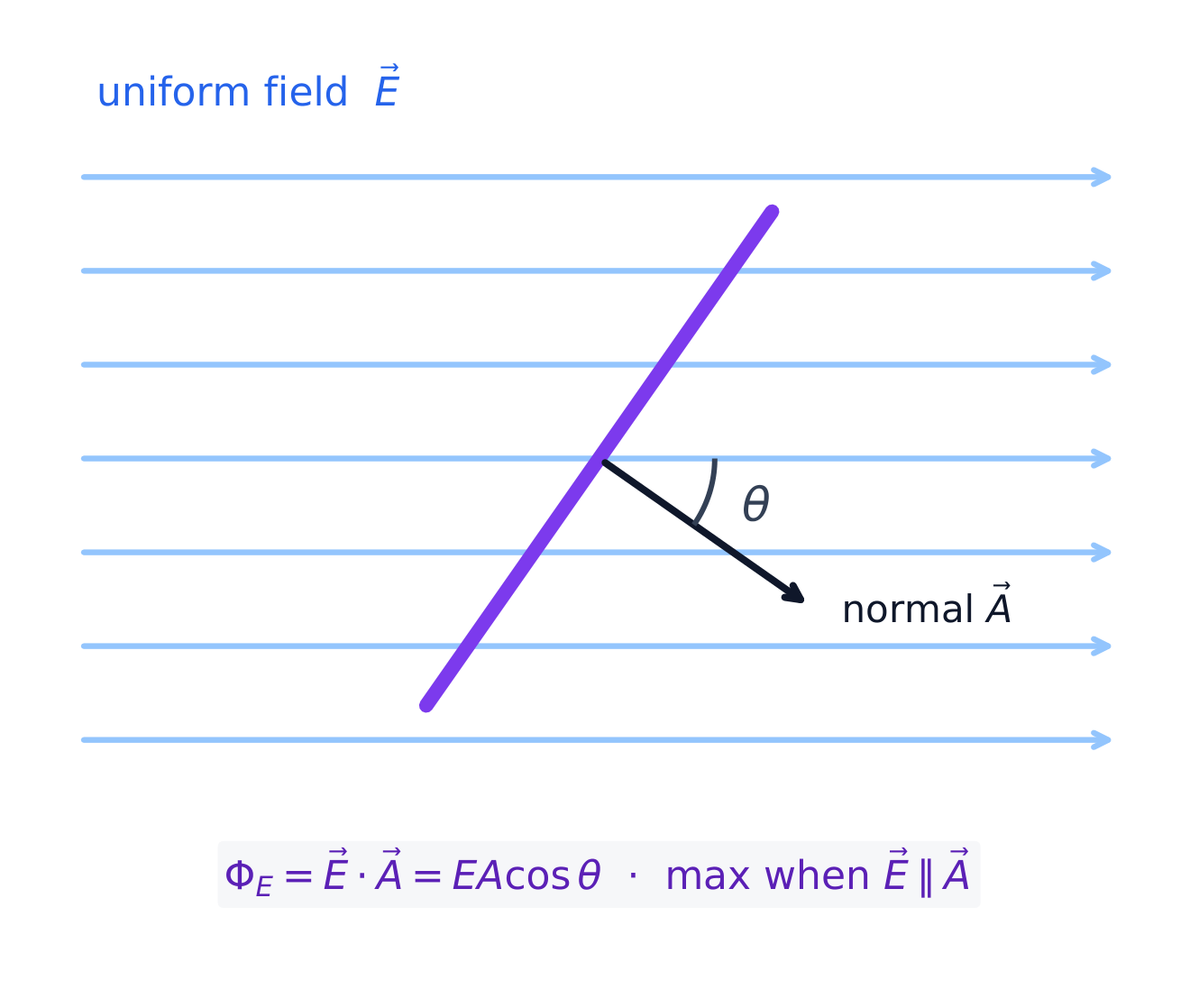
电通量与高斯定律 电通量(electric flux)测量多少场通过一个表面:
$$\Phi_E=\int \vec{E}\cdot d\vec{A}.$$对于一个通过一个平坦面积的均匀场,$\Phi_E=EA\cos\theta$,其中面积矢量(area vector)垂直于表面。通量在场线离开一个闭合表面的地方为正,而在它们进入的地方为负——只有 $\vec{E}$ 的垂直分量计入。
通过一个表面的电通量取决于场和表面法线之间的角 词汇表 训练英文 中文 拼音 Electric flux/ɪˈlektrɪk flʌks/ 电通量 diàn tōng liàng area vector/ˈeərɪə ˈvektə/ 面积矢量 miàn jī shǐ liàng 8.6
高斯定律
大纲
Learning Objective Essential Knowledge 8.6.A
Describe the properties of a charge distribution by applying Gauss's law.- 8.6.A.1 Gauss's law relates electric flux through a Gaussian surface to the charge enclosed by that surface.
- Relevant equations: $\Phi_E = \dfrac{q_{\text{enc}}}{\varepsilon_0}$ and $\displaystyle\oint \vec{E} \cdot d\vec{A} = \dfrac{q_{\text{enc}}}{\varepsilon_0}$
- 8.6.A.2 A Gaussian surface is a three-dimensional, closed surface.
- 8.6.A.3 The total electric flux through a Gaussian surface is independent of the size of the Gaussian surface if the amount of enclosed charge remains constant.
- 8.6.A.4 Gaussian surfaces are typically constructed such that the electric field generated by the enclosed charge is either perpendicular or parallel to different regions of the Gaussian surface, resulting in a simplified surface integral.
- 8.6.A.5 If a function of charge density is given for a charge distribution, the total charge can be determined by integrating the charge density over the length (one dimension), area (two dimensions), or volume (three dimensions) of the charge distribution. For example: $Q_{\text{total}} = \displaystyle\int \rho(\vec{r})\, dV$
- 8.6.A.6 Maxwell's equations are the collection of equations that fully describe electromagnetism. Gauss's law is Maxwell's first equation.
- Relevant equation: $\displaystyle\oint \vec{E} \cdot d\vec{A} = \dfrac{q_{\text{enc}}}{\varepsilon_0}$
Boundary statement: AP Physics C: Electricity & Magnetism only expects students to quantitatively apply Gauss's law to point charges and charge distributions that have spherical, cylindrical, or planar symmetry.
来源:美国大学理事会 AP 课程与考试说明
高斯定律(Gauss's law)——麦克斯韦方程组的第一个——把通过任何闭合表面的通量与它里面的电荷关联:
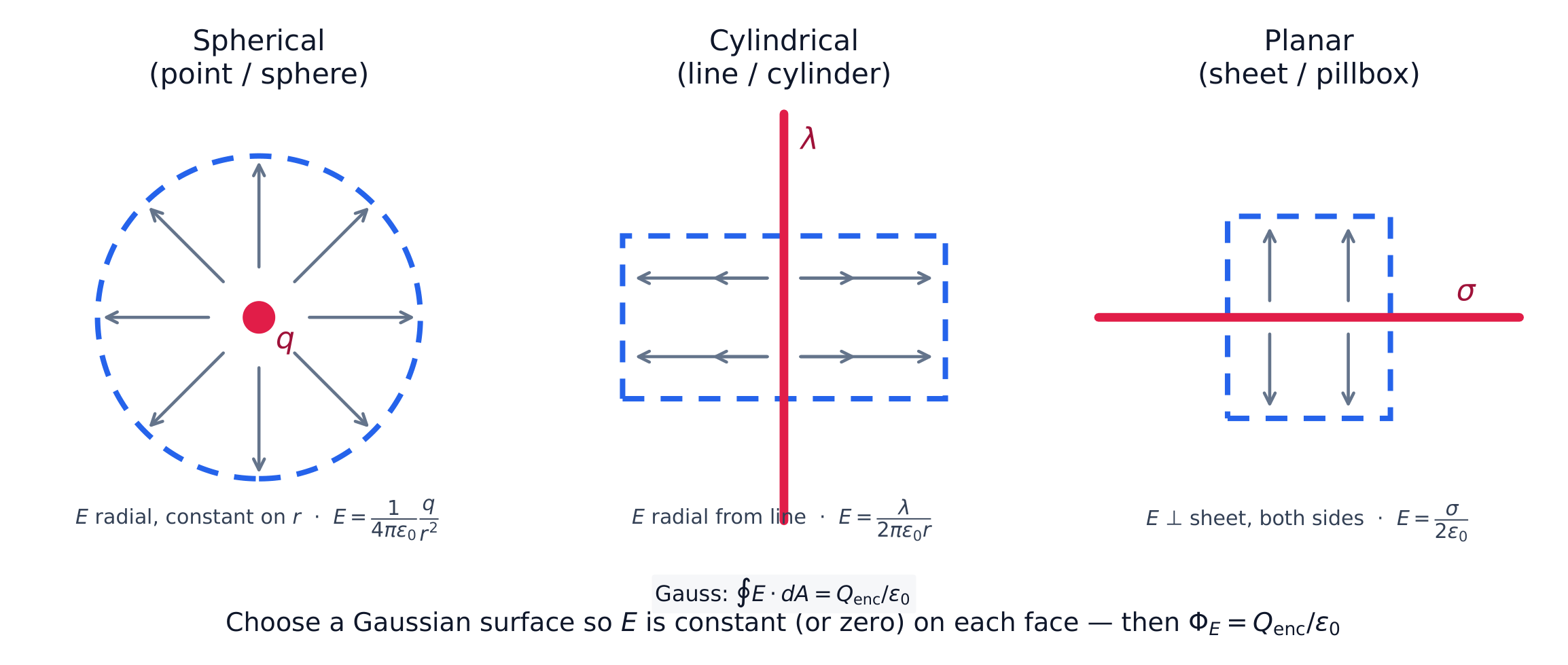
$$\oint \vec{E}\cdot d\vec{A}=\frac{Q_{\text{enc}}}{\varepsilon_0}.$$它对任何闭合表面都成立,但它只在对称让你能选择一个 $E$ 恒定且垂直(或平行,贡献零)的高斯面(Gaussian surface)时才求解 $E$。AP 考查的三种对称:球对称(spherical symmetry)(同心球)、柱对称(cylindrical symmetry)(同轴圆柱),和平面对称(planar symmetry)(一个跨立的"药盒")。
一个高斯面被选择以匹配电荷的对称 Worked example (sphere). 在一个总电荷 $Q$ 的球外部,一个半径 $r$ 的球形高斯面给出 $E(4\pi r^2)=Q/\varepsilon_0$,所以 $E=\dfrac{kQ}{r^2}$ ——与中心的一个点电荷相同。在一个半径 $R$ 的均匀带电实心球内部,表面只包围 $Q_{\text{enc}}=Q\,r^3/R^3$,所以 $E=\dfrac{kQr}{R^3}$:在中心为零,线性增长到表面。
Worked example (wire). 对于一根每长度电荷 $\lambda$ 的无限导线,取一个半径 $r$ 长度 $L$ 的同轴圆柱。两端不贡献任何东西($\vec{E}\perp d\vec{A}$),所以 $E(2\pi rL)=\dfrac{\lambda L}{\varepsilon_0}$ 而 $E=\dfrac{\lambda}{2\pi\varepsilon_0 r}$。同样的药盒方法给出一个无限薄片的场,$E=\dfrac{\sigma}{2\varepsilon_0}$,两侧均匀。
Exam skill. 一个满分的高斯定律答案有四个部分:命名表面、陈述对称论证(为什么 $E$ 在它上面恒定且垂直)、数 $Q_{\text{enc}}$,然后求解。跳过对称句子失去推理分——并记住高斯定律也解释为什么在平衡的任何导体内部 $E=0$。
词汇表 训练英文 中文 拼音 Gauss's law/ˈɡaʊsɪz lɔː/ 高斯定律 gāo sī dìng lǜ Gaussian surface/ˈɡaʊʃn ˈsɜːfɪs/ 高斯面 gāo sī miàn spherical symmetry/sˈferɪkl ˈsɪmətri/ 球对称 qiú duì chèn cylindrical symmetry/sɪˈlɪndrɪkl ˈsɪmətri/ 柱对称 zhù duì chèn planar symmetry/ˈpleɪnə ˈsɪmətri/ 平面对称 píng miàn duì chèn 8.6
考试技巧
- 用库仑定律 $F=\tfrac{1}{4\pi\varepsilon_0}\tfrac{q_1 q_2}{r^2}$ 并把力作为矢量叠加(分量,不是大小)。
- 对一个连续电荷,在 $dq=\lambda\,dl,\ \sigma\,dA,\ \rho\,dV$ 上积分 $d\vec E$;用对称抵消分量。
- 场从正电荷指离而朝向负电荷;正确地画电场线。
- 把一个电荷上的力($\vec F=q\vec E$)与这个电荷创造的场区分开。
- 把常数 $k=\tfrac{1}{4\pi\varepsilon_0}$ 保持清楚并检查单位。
- 8.2.A.1 The net charge or charge distribution of a system can change in response to the presence of, or changes in, the net charge or charge distribution of other systems.
-
9
电势
9.1
电势能
大纲
Learning Objective Essential Knowledge 9.1.A
Describe the electric potential energy of a system.- 9.1.A.1 The electric potential energy of a system of two point charges equals the amount of work required for an external force to bring the point charges to their current positions from infinitely far away.
- 9.1.A.2 The general form for the electric potential energy between two charged objects is given by the equation
- Equation: $U_E = \dfrac{1}{4\pi\varepsilon_0}\dfrac{q_1 q_2}{r} = k\dfrac{q_1 q_2}{r}$.
- 9.1.A.3 The total electric potential energy of a system can be determined by finding the sum of the electric potential energies of the individual interactions between each pair of charged objects in the system.
来源:美国大学理事会 AP 课程与考试说明
当你把两个同种电荷推到一起时,你逆着电力做功(work)。那个功被这一对储存为电势能(electric potential energy):
$$U_E=\frac{1}{4\pi\varepsilon_0}\frac{q_1 q_2}{r}=k\frac{q_1 q_2}{r}.$$$U_E$ 被定义为一个外力必须做的功,把电荷从无限远带到相距 $r$。符号携带物理:
- 同种电荷: $U_E>0$。需要一个外部推力把它们带到一起。若释放,它们飞开,而储存的能量变成动能(kinetic energy)。
- 相反电荷: $U_E<0$。这一对被束缚。你必须供应 $|U_E|$ 的功把它们拉开到无穷。
电力是一个保守力(conservative force):它做的功只取决于起点和终点,不取决于路径,而等于 $-\Delta U_E$。
对于几个电荷的一个系统(system),把每个不同对的势能相加:
$$U_{\text{total}}=k\!\left(\frac{q_1q_2}{r_{12}}+\frac{q_1q_3}{r_{13}}+\frac{q_2q_3}{r_{23}}\right).$$Worked example. 三个 $+2.0\ \mu\text{C}$ 电荷坐在一个边长 $0.30\ \text{m}$ 的等边三角形的角上。每一对储存 $U=\dfrac{kq^2}{r}=\dfrac{(9.0\times10^{9})(2.0\times10^{-6})^2}{0.30}=0.12\ \text{J}$。有三对,所以 $U_{\text{total}}=3\times0.12\ \text{J}=0.36\ \text{J}$。这是从无穷组装这个三角形所需的功——以及若所有三个都被释放这些电荷会共享的动能。
词汇表 训练英文 中文 拼音 work/wɜːk/ 功 gōng electric potential energy/ɪˈlektrɪk pəˈtenʃl ˈenədʒi/ 电势能 diàn shì néng kinetic energy/kɪˈnetɪk ˈenədʒi/ 动能 dòng néng conservative force/kənˈsɜːvətɪv fɔːs/ 保守力 bǎo shǒu lì system/ˈsɪstəm/ 系统 xì tǒng Electric potential/ɪˈlektrɪk pəˈtenʃl/ 电势 diàn shì 9.2
电势
大纲
Learning Objective Essential Knowledge 9.2.A
Describe the electric potential due to a configuration of charged objects.- 9.2.A.1 Electric potential describes the electric potential energy per unit charge at a point in space.
- 9.2.A.2 Expressions for the electric potential of charge distributions can be found using integration and the principle of superposition.
- Equation: $V = \dfrac{1}{4\pi\varepsilon_0}\displaystyle\int \dfrac{dq}{r}$
- 9.2.A.2.i The electric potential for single point charge is
- Equation: $V = \dfrac{q}{4\pi\varepsilon_0 r}$.
- 9.2.A.2.ii The electric potential due to multiple point charges can be determined by the principle of scalar superposition of the electric potential due to each of the point charges.
- Equation: $V = \dfrac{1}{4\pi\varepsilon_0}\displaystyle\sum_i \dfrac{q_i}{r_i}$
- 9.2.A.3 The electric potential difference between two points is the change in electric potential energy per unit charge when a test charge is moved between the two points.
- Equation: $\Delta V = \dfrac{\Delta U_E}{q}$
- 9.2.A.4 Electric potential difference may also result from chemical processes that cause positive and negative charges to separate, such as in a battery.
Boundary statement: AP Physics C: Electricity & Magnetism only expects students to use calculus to find the electric potential resulting from the following charge distributions and locations: an infinitely long, uniformly charged wire or cylinder at a distance from its central axis, a thin ring of charge at a location along the axis of the ring, a semicircular arc or part of a semicircular arc at its center, and a finite wire or line charge at a point collinear with the line charge or at a location along its perpendicular bisector.
9.2.B
Describe the relationship between electric potential and electric field.- 9.2.B.1 The value of an electric field component in any direction at a given location is equal to the negative of the spatial rate of change in electric potential at that location.
- Equation: $E_x = -\dfrac{dV}{dx}$
- 9.2.B.2 The change in electric potential between two points can be determined by integrating the dot product of the electric field and the displacement along the path connecting the points.
- Equation: $\Delta V = V_b - V_a = -\displaystyle\int_a^b \vec{E}\cdot d\vec{r}$
- 9.2.B.3 Electric field vector maps and equipotential lines are tools to describe the field produced by a charge or configuration of charges and can be used to predict the motion of charged objects in the field.
- 9.2.B.3.i Equipotential lines represent lines of equal electric potential. These lines are also referred to as isolines of electric potential.
- 9.2.B.3.ii Isolines are perpendicular to electric field vectors. An isoline map of electric potential can be constructed from an electric field vector map, and an electric field map may be constructed from an isoline map.
- 9.2.B.3.iii An electric field vector points in the direction of decreasing potential.
- 9.2.B.3.iv There is no component of an electric field along an isoline.
来源:美国大学理事会 AP 课程与考试说明
电势(electric potential)是空间里一点处每单位电荷的电势能。它以伏特测量($1\ \text{V}=1\ \text{J/C}$):
$$V=\frac{U_E}{q},\qquad V=\frac{1}{4\pi\varepsilon_0}\frac{q}{r}\ \text{(point charge)}.$$电势是一个标量(scalar):它有一个符号但没有方向。这使 $V$ 比场 $\vec{E}$ 容易处理得多。对于几个点电荷(point charges),用标量叠加(superposition)——把电势连同它们的符号相加:
$$V=\frac{1}{4\pi\varepsilon_0}\sum_i \frac{q_i}{r_i}.$$Worked example. 距一个 $+3.0\ \text{nC}$ 点电荷 $0.10\ \text{m}$ 的电势是 $V=\dfrac{kq}{r}=\dfrac{9.0\times10^{9}(3.0\times10^{-9})}{0.10}=270\ \text{V}$。现在加一个距同一点 $0.30\ \text{m}$ 的 $-3.0\ \text{nC}$ 电荷:它贡献 $\dfrac{9.0\times10^{9}(-3.0\times10^{-9})}{0.30}=-90\ \text{V}$,所以总量是 $270-90=180\ \text{V}$。只是一个有符号的和——没有矢量分量要分解。
Continuous charge distributions
对于一个连续电荷分布(continuous charge distribution),把它切成小片 $dq$、把每片当作一个点电荷,并积分(integrate):
$$V=\frac{1}{4\pi\varepsilon_0}\int\frac{dq}{r}.$$这是一个标量积分,所以它通常比场积分容易得多。AP 期望你用微积分处理四个形状:一个薄环(在它轴上的一点)、一段弧(在它的中心)、一条有限的线或导线(共线,或在它的垂直平分线上),和一根无限长的导线或圆柱(距它的轴一个距离)。
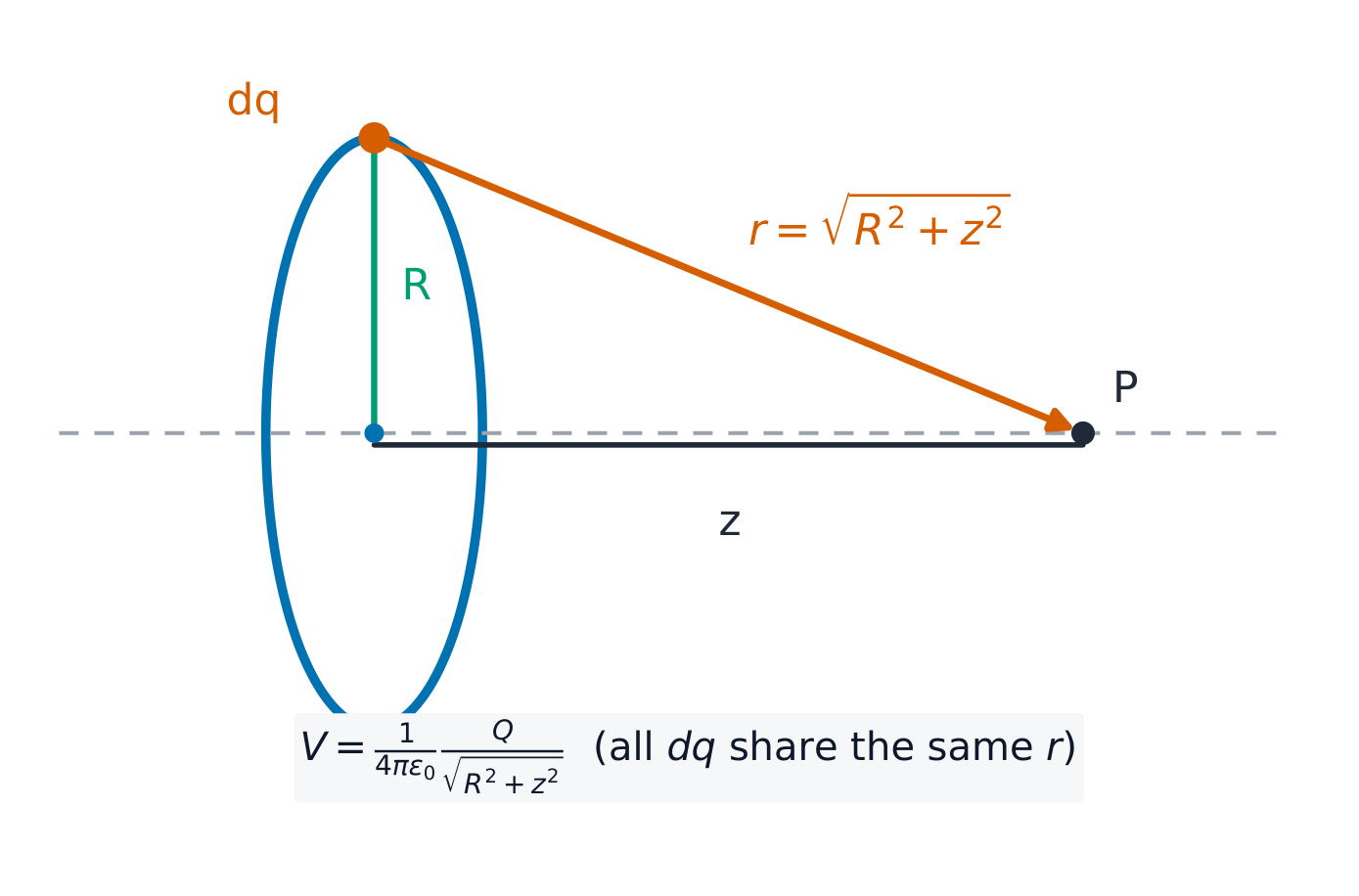
一个电荷环:每个元素 dq 距一个轴上的点相同的距离 Worked example (ring of charge). 一个半径 $R$ 的薄环携带总电荷 $Q$。对于轴上距中心一个距离 $z$ 的一点 $P$,每个元素 $dq$ 距 $P$ 坐在相同的距离 $r=\sqrt{R^2+z^2}$。这个距离恒定,所以它从积分里出来:
$$V=\frac{1}{4\pi\varepsilon_0}\int\frac{dq}{\sqrt{R^2+z^2}}=\frac{1}{4\pi\varepsilon_0}\frac{Q}{\sqrt{R^2+z^2}}.$$在一个 FRQ 上,说 $r$ 对每个元素都相同——那个陈述是评分的步骤。同样的思想给出任何弧的中心处 $V=kQ/R$,无论它的角度。
From potential to field
电势和场包含相同的信息,由每个方向的一个导数和一个路径积分联系:
$$E_x=-\frac{dV}{dx},\qquad \Delta V=V_b-V_a=-\int_a^b \vec{E}\cdot d\vec{r}.$$场是电势的负梯度(gradient):$\vec{E}$ 从高电势指向低电势,"下坡"。$V$ 变化快的地方,场强。
Worked example. 沿 $x$ 轴,$V(x)=3x^{2}-2x$(伏特,$x$ 以米)。那么 $E_x=-\dfrac{dV}{dx}=2-6x\ \text{V/m}$。在 $x=0.50\ \text{m}$,$E_x=-1.0\ \text{V/m}$:那里的场指向 $-x$ 方向。
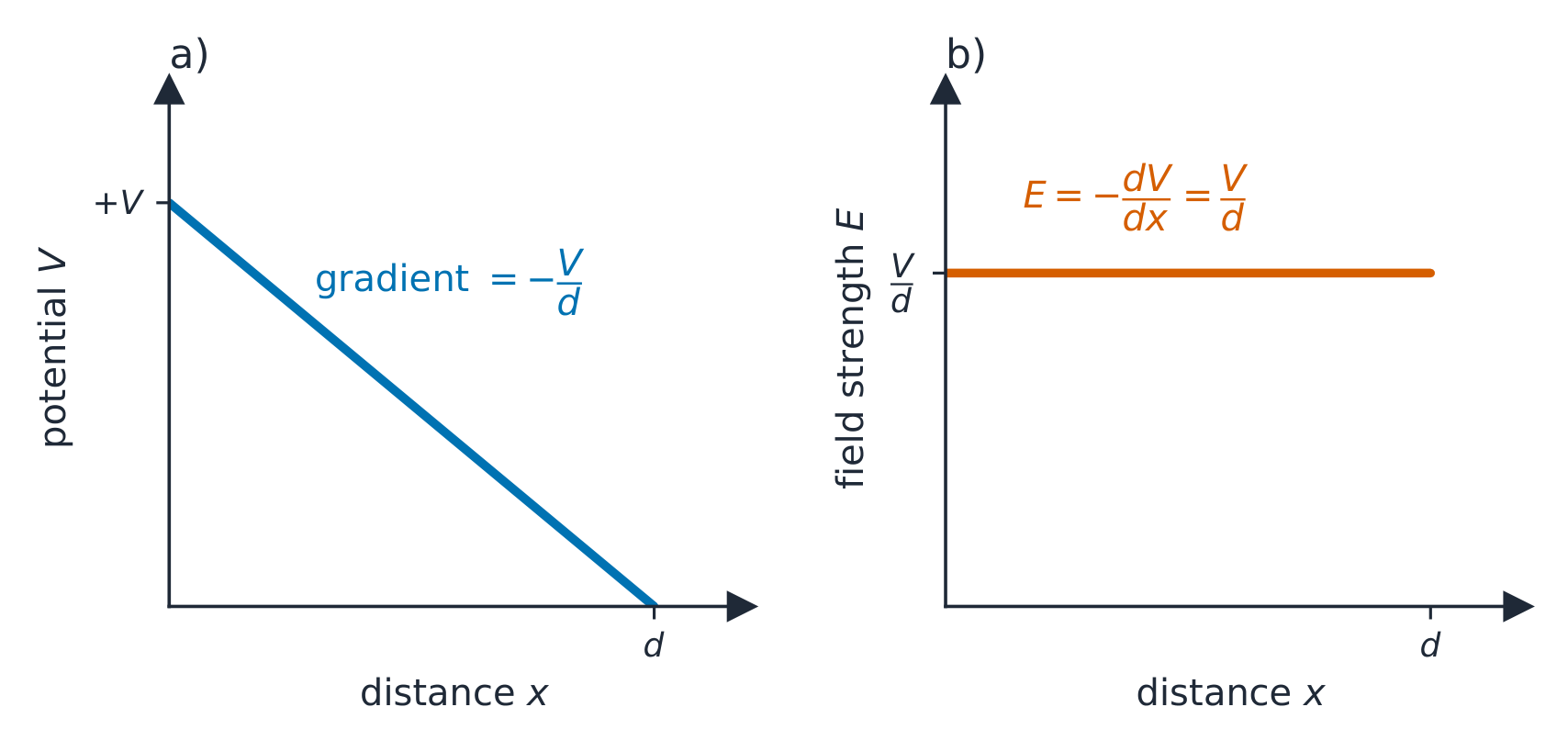
在一个均匀场里电势随距离稳定地下降 两点之间的电势差(potential difference)是它们之间移动每单位电荷的势能的变化:$\Delta V=\Delta U_E/q$。一个电池化学地制造一个电势差:里面的反应把正电荷从负电荷分开并把端子保持一个固定的 $\Delta V$。
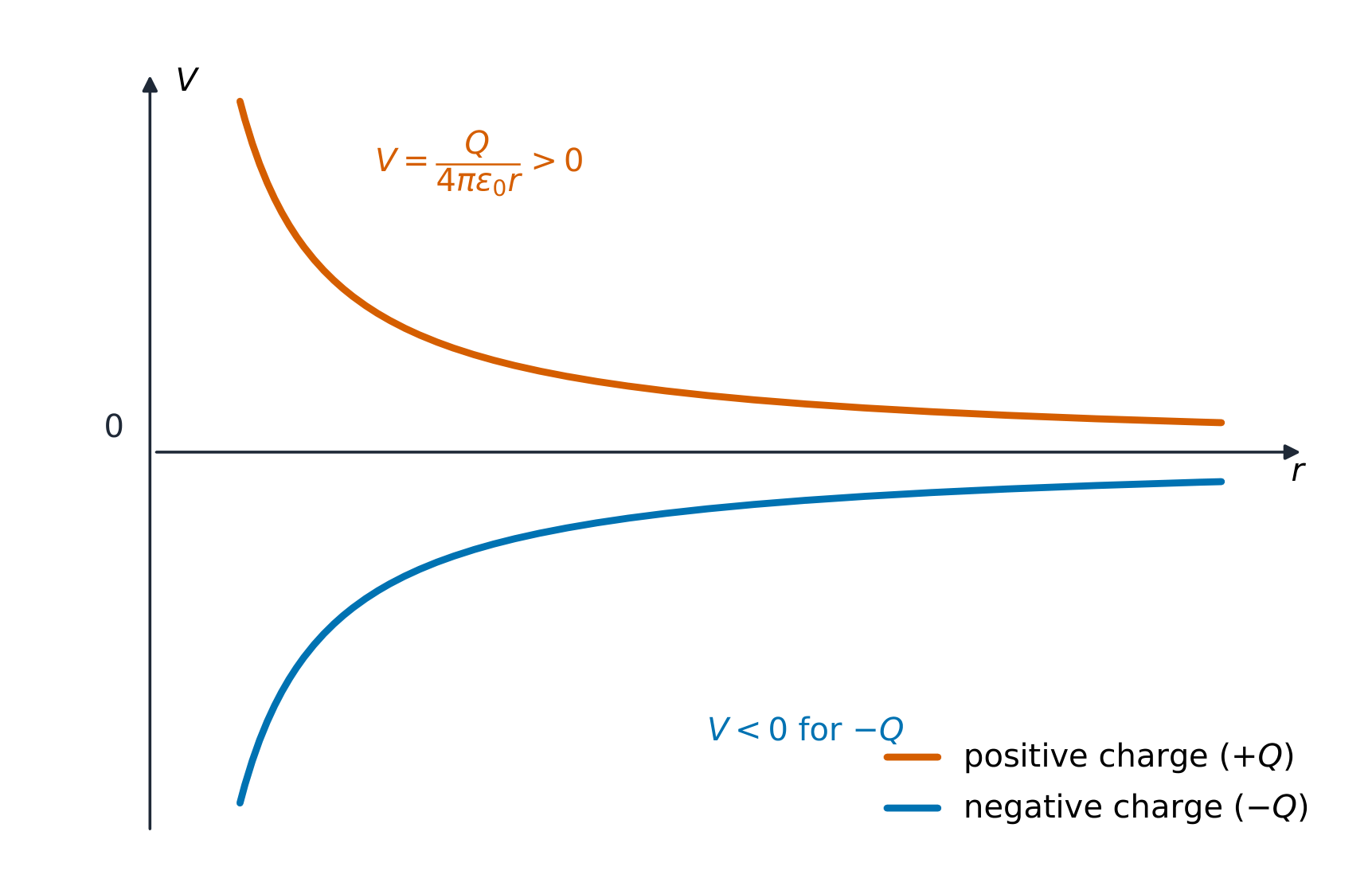
一个点电荷附近的电势随 1/r 变化 Equipotential maps
一条等势面(equipotential)线(也叫一条等值线(isoline))连接共享相同电势的点。四条规则让你能读任何图:
- 等值线在它们相交的每个地方都垂直(perpendicular)于电场线(field lines)。
- $\vec{E}$ 从高 $V$ 指向低 $V$ ——从不沿一条等值线。沿一条等值线移动一个电荷不需要功。
- 紧密间隔的等值线意味着一个强的场:$E\approx-\Delta V/\Delta x$。
- 你能从一张等值线图草绘场图,并从一张场图草绘等值线图。
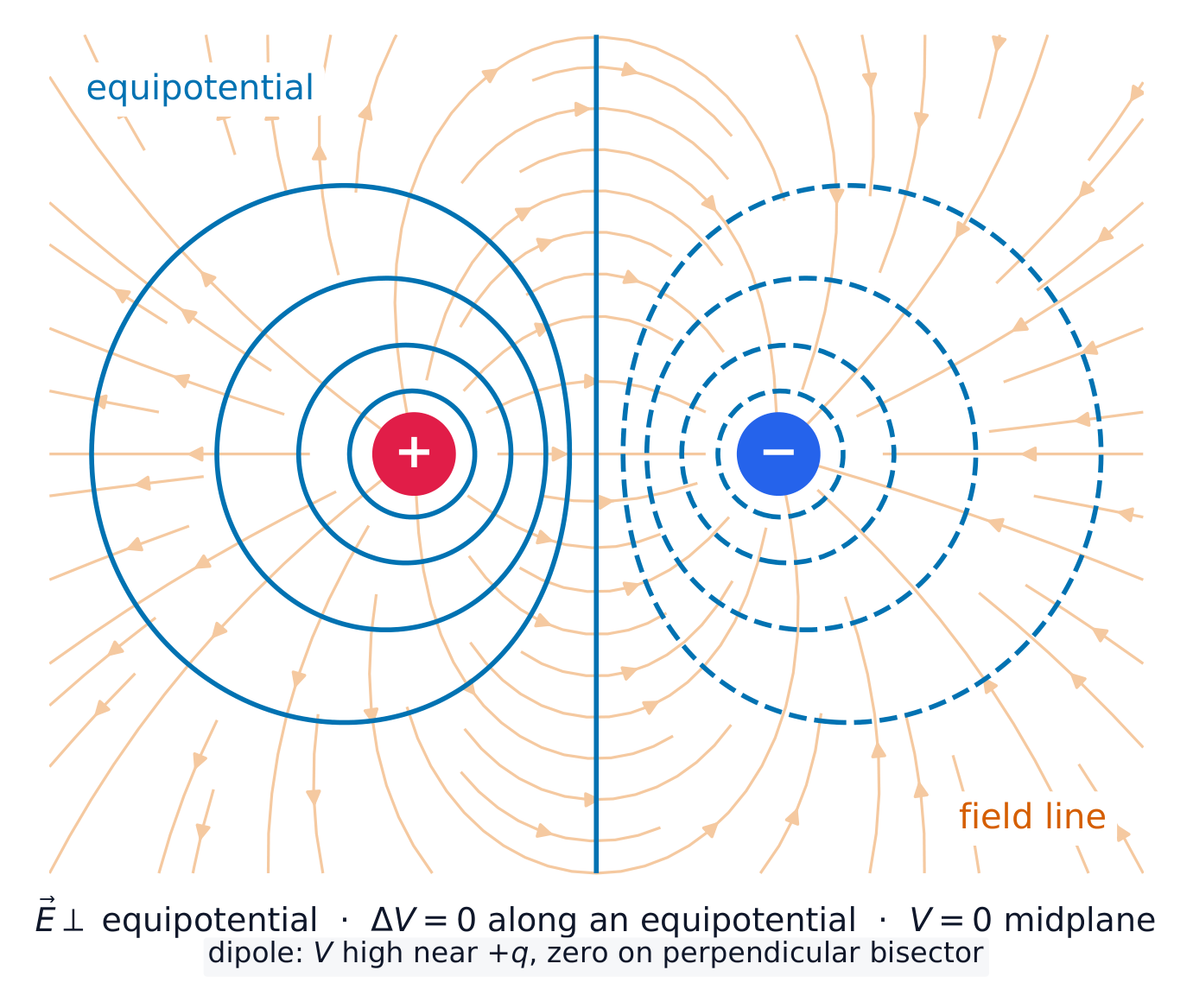
一个偶极子周围的等势线以直角穿过场线 Exam skill. 给定一张每 $10\ \text{V}$、相距约 $2\ \text{cm}$ 有等值线的图,估计 $E\approx\dfrac{10}{0.02}=500\ \text{V/m}$,从较高值的线指向较低的。一个外部作用者慢慢地把一个电荷 $q$ 从 $A$ 移到 $B$ 所做的功是 $W=q(V_B-V_A)$ ——所走的路径不重要。
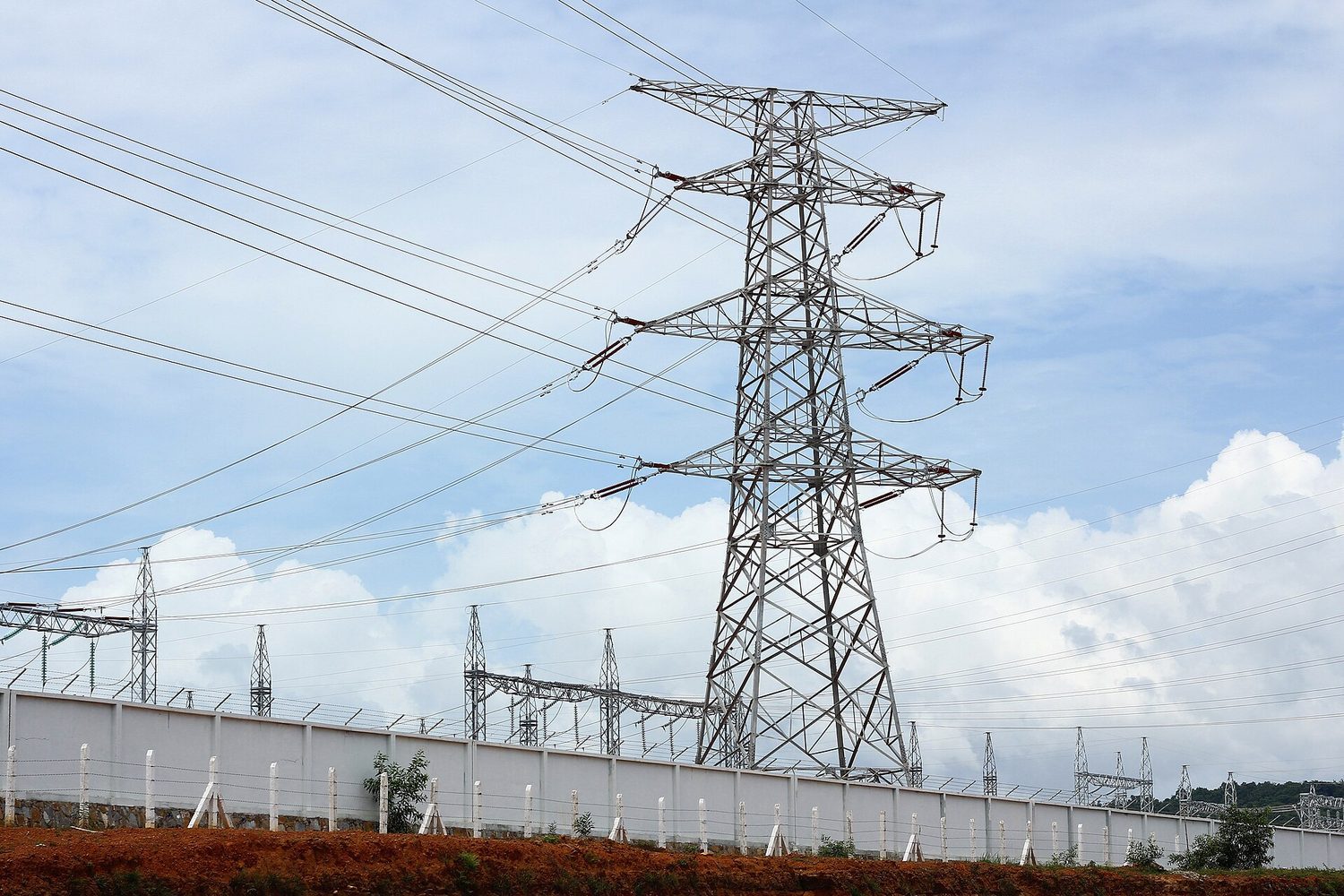
High-voltage power lines: electric potential energy is converted and transmitted as current at high voltage 探索Field lines and the potential around a charge
Electric potential is the energy per unit charge. It falls off with distance from a positive charge; the field lines point from high potential to low.
词汇表 训练英文 中文 拼音 scalar/ˈskeɪlə/ 标量 biāo liàng point charges/pɔɪnt ˈtʃɑːdʒɪz/ 点电荷 diǎn diàn hè superposition/ˌsuːpəpəˈzɪʃn/ 叠加 dié jiā continuous charge distribution/kənˈtɪnjuːəs tʃɑːdʒ ˌdɪstrɪˈbjuːʃn/ 连续电荷分布 lián xù diàn hè fēn bù integrate/ˈɪntɪɡreɪt/ 积分 jī fēn gradient/ˈɡreɪdɪənt/ 梯度 tī dù potential difference/pəˈtenʃl ˈdɪfrəns/ 电势差 diàn shì chā equipotential/ˌiːkwɪpəˈtenʃl/ 等势面 děng shì miàn isoline/ˈaɪsəliːn/ 等值线 děng zhí xiàn perpendicular/ˌpɜːpənˈdɪkjʊlə/ 垂直 chuí zhí field lines/fiːld laɪnz/ 电场线 diàn chǎng xiàn 9.3
电能守恒
大纲
Learning Objective Essential Knowledge 9.3.A
Describe changes in a system due to a difference in electric potential between two locations.- 9.3.A.1 When a charged object moves between two locations with different electric potentials, the resulting change in the electric potential energy of the object-field system is given by the following equation.
- Equation: $\Delta U_E = q\Delta V$
- 9.3.A.2 The movement of a charged object between two points with different electric potentials results in a change in kinetic energy of the object consistent with the conservation of energy.
来源:美国大学理事会 AP 课程与考试说明
当一个电荷 $q$ 在两个电势相差 $\Delta V$ 的点之间移动时,电荷-场系统的势能变化
$$\Delta U_E=q\,\Delta V.$$若只有电力作用,总能量守恒,所以动能变化相反的量:
$$\Delta K=-\Delta U_E=-q\,\Delta V.$$把两个符号一起注意:一个正电荷在它移向较低电势时加速,而一个负电荷在它移向较高电势时加速。两者都只是系统把势能换成动能。这就是粒子加速器如何给带电粒子它们的能量,而它是电路里能量分析的基础。
Worked example. 一个质子($q=1.6\times10^{-19}\ \text{C}$,$m=1.67\times10^{-27}\ \text{kg}$)从静止开始并通过一个 $500\ \text{V}$ 的电势降落加速(它移向较低电势,所以 $\Delta V=-500\ \text{V}$ 而 $\Delta K=-q\,\Delta V=+8.0\times10^{-17}\ \text{J}$)。令 $\Delta K=\tfrac12 mv^2$:
$$v=\sqrt{\frac{2(8.0\times10^{-17})}{1.67\times10^{-27}}}=3.1\times10^{5}\ \text{m/s}.$$Exam skill. 每当场非均匀或路径弯曲时选择能量方法、不是运动学:只有端点电势重要。一个典型的 FRQ 链是 $q\,\Delta V \to \Delta K \to v$,带一行论证:"电力是保守的,所以能量守恒。"
9.3
考试技巧
- 用 $V=-\int \vec E\cdot d\vec l$ 和 $\vec E=-\nabla V$(在一维,$E_x=-\tfrac{dV}{dx}$)关联场和电势。
- 电势是一个标量——连同符号相加贡献,不需要矢量分量。
- 一对的势能是 $U=\tfrac{1}{4\pi\varepsilon_0}\tfrac{q_1 q_2}{r}$;对一个电荷的速率用能量守恒。
- 知道沿一条等势面移动不做功,它垂直于 $\vec E$。
- 选择电势的零(通常是无穷)并陈述它。
-
10
导体与电容器
10.1
导体的静电学
大纲
Learning Objective Essential Knowledge 10.1.A
Describe the charge distribution within a conductor.- 10.1.A.1 An ideal conductor is a material in which electrons are able to move freely.
- 10.1.A.2 When a conductor is in electrostatic equilibrium, mutual repulsion of excess charge carriers results in those charge carriers residing entirely on the surface of the conductor.
- 10.1.A.2.i In a conductor with a negative net charge, excess electrons reside on the surface of the conductor.
- 10.1.A.2.ii In a conductor with a positive net charge, the surface becomes deficient in electrons, and can be modeled as if positive charge carriers reside on the surface of the conductor.
- 10.1.A.3 Excess charges will move to the surface of a conductor to create a state of electrostatic equilibrium within the conductor.
- 10.1.A.3.i The time interval over which charges reach electrostatic equilibrium within a conductor is so short as to be negligible.
- 10.1.A.3.ii When a conductor reaches electrostatic equilibrium, all points on the surface of the conductor have the same electric potential, and the conductor becomes an equipotential surface.
- 10.1.A.3.iii The charge density on the surface of a conductor will be greater where there are points or edges compared to planar areas.
- 10.1.A.4 All excess charges reside on the surface of a conductor, which means there is no net charge in the interior of the conductor, and the electric field is zero within the conductor.
- 10.1.A.5 The electric field is perpendicular to the outer surface of a conductor.
- 10.1.A.6 A conductor can be polarized in the presence of an external electric field. This is a consequence of the conductor remaining an equipotential surface.
- 10.1.A.7 Electrostatic shielding is the process of surrounding an area with a closed, conducting shell to create a region inside the conductor that is free from external electric fields.
来源:美国大学理事会 AP 课程与考试说明
在一个理想的导体(conductor)里,电子自由移动。在一个上放额外的电荷,电荷互相排斥,直到几乎瞬间,它们稳定进入静电平衡(electrostatic equilibrium)。在那个状态导体有四个你必须能够陈述和使用的性质:
- 导体内部的电场是零。若它不是,自由电子仍会移动。
- 所有多余的电荷坐在表面上。(负净电荷 = 表面上的额外电子;正 = 那里的电子短缺。)
- 恰好在外面的场垂直于(perpendicular)表面,大小为 $E=\sigma/\varepsilon_0$。任何平行分量会把电荷沿表面横向推。
- 整个导体是一个等势面(equipotential surface):每个点,内部和在表面上,都处于相同的电势。
电荷密度在表面急剧弯曲的地方——在点和边缘——最大,所以外面的场在那里最强。在一个外部场里一个导体极化:电荷在它的表面上移动,以便内部保持无场而物体保持一个等势面。用一个闭合的导电壳包围一个区域完全把外部场挡在外——静电屏蔽(electrostatic shielding),法拉第笼(Faraday cage)背后的思想。
词汇表 训练英文 中文 拼音 conductor/kənˈdʌktə/ 导体 dǎo tǐ electrostatic equilibrium/ɪˌlektrəʊˈstætɪk ˌiːkwɪˈlɪbrɪəm/ 静电平衡 jìng diàn píng héng perpendicular/ˌpɜːpənˈdɪkjʊlə/ 垂直 chuí zhí equipotential surface/ˌiːkwɪpəˈtenʃl ˈsɜːfɪs/ 等势面 děng shì miàn electrostatic shielding/ɪˌlektrəʊˈstætɪk ˈʃiːldɪŋ/ 静电屏蔽 jìng diàn píng bì Faraday cage/ˈfærədeɪ keɪdʒ/ 法拉第笼 fǎ lā dì lóng 10.2
导体间电荷的重新分布
大纲
Learning Objective Essential Knowledge 10.2.A
Describe the movement of charge and the resulting interactions when conductors physically contact each other.- 10.2.A.1 When conductors are in electrical contact, charges will be redistributed such that the surfaces of each conductor are at the same electric potential.
- 10.2.A.2 Ground is an idealized reference point that has zero electric potential and can absorb or provide an infinite amount of charge without changing its electric potential.
- 10.2.A.3 Charge can be induced on a conductor by grounding the conductor in the presence of an external electric field.
来源:美国大学理事会 AP 课程与考试说明
当两个导体触碰(或被连线在一起)时,电荷在它们之间流动,直到两个表面达到相同电势——那是停止条件,不是"相等的电荷"。一个更大的球在相同的电势容纳更多电荷($V=kQ/R$),所以它取更大的份额。
Worked example. 一个携带 $+6.0\ \mu\text{C}$ 的半径 $R$ 的小球触碰一个遥远的半径 $2R$ 的球,然后它们分离。相等的电势要求 $\dfrac{kq_1}{R}=\dfrac{kq_2}{2R}$,所以 $q_2=2q_1$。以 $q_1+q_2=6.0\ \mu\text{C}$:$q_1=2.0\ \mu\text{C}$ 而 $q_2=4.0\ \mu\text{C}$。
接地(ground)是一个理想化的零电势参考,它能吸收或供应任何量的电荷。在一个外部电荷附近时给一个导体接地使导体带一个净的感应电荷(induced charge):外部场把一个符号的电荷推向地,而在移除外部电荷之前切断接地线困住其余的。
词汇表 训练英文 中文 拼音 ground/ɡraʊnd/ 接地 jiē dì induced charge/ɪnˈdjuːst tʃɑːdʒ/ 感应电荷 gǎn yìng diàn hè work/wɜːk/ 功 gōng 10.3
电容器
大纲
Learning Objective Essential Knowledge 10.3.A
Describe the physical properties of a parallel-plate capacitor.- 10.3.A.1 A parallel-plate capacitor consists of two separated parallel conducting surfaces that can hold equal amounts of charge with opposite signs.
- 10.3.A.2 Capacitance relates the magnitude of the charge stored on each plate to the electric potential difference created by the separation of those charges.
- Equation: $C = \dfrac{Q}{\Delta V}$
- 10.3.A.2.i The capacitance of a capacitor depends only on the physical properties of the capacitor, such as the capacitor's shape and the material used to separate the plates.
- 10.3.A.2.ii The capacitance of a parallel-plate capacitor is proportional to the area of one of its plates and inversely proportional to the distance between its plates. The constant of proportionality is the product of the dielectric constant, $\kappa$, of the material between the plates and the electric permittivity of free space, $\varepsilon_0$.
- Equation: $C = \dfrac{\kappa \varepsilon_0 A}{d}$
- 10.3.A.3 The electric field between two charged parallel plates with uniformly distributed electric charge, such as in a parallel-plate capacitor, is constant in both magnitude and direction, except near the edges of the plates.
- 10.3.A.3.i The magnitude of the electric field between two charged parallel plates, where the plate separation is much smaller than the dimensions of the plates, can be determined by applying Gauss's law and the principle of superposition.
- Equation: $E = \dfrac{Q}{\varepsilon_0 A}$
- 10.3.A.3.ii The electric field is proportional to the surface charge density on either plate of the capacitor.
- 10.3.A.3.iii A charged particle between two oppositely charged parallel plates undergoes constant acceleration, and therefore its motion shares characteristics with the projectile motion of an object with mass in the gravitational field near Earth's surface.
- 10.3.A.3.i The magnitude of the electric field between two charged parallel plates, where the plate separation is much smaller than the dimensions of the plates, can be determined by applying Gauss's law and the principle of superposition.
- 10.3.A.4 The electric potential energy stored in a capacitor is equal to the work done by an external force to separate that amount of charge on the capacitor.
- 10.3.A.5 The electric potential energy stored in a capacitor is described by the equation $U_C = \dfrac{1}{2} Q \Delta V$.
Boundary statement: While other shapes are also able to separate charges, AP Physics C: Electricity & Magnetism only expects the quantitative analysis and description of parallel-plate capacitors, concentric spherical capacitors, and coaxial cylindrical capacitors.
来源:美国大学理事会 AP 课程与考试说明
电容器充电(RC) 一个电容器(capacitor)在被一个间隙分开的两个导体上储存电荷:一个板上 $+Q$、另一个上 $-Q$。它的电容(capacitance)把储存的电荷与板之间的电势差关联:
$$C=\frac{Q}{\Delta V}.$$电容只取决于几何和间隙里的材料——从不取决于 $Q$ 或 $\Delta V$ 本身。
Worked derivation (parallel plates). 对于一个板面积 $A$ 和小间隙 $d$ 的平行板电容器(parallel-plate capacitor):高斯定律加叠加(superposition)给出板之间的一个均匀(uniform)场,$E=\dfrac{\sigma}{\varepsilon_0}=\dfrac{Q}{\varepsilon_0 A}$(每个板单独贡献 $\sigma/2\varepsilon_0$;在板之间两者相加,外面它们抵消)。一个均匀场意味着 $\Delta V=Ed=\dfrac{Qd}{\varepsilon_0 A}$,所以
$$C=\frac{Q}{\Delta V}=\frac{\varepsilon_0 A}{d}.$$这个 $E\to\Delta V\to C$ 链是一个标准的 FRQ 推导——把它作为三个步骤学,并引用每一个。同样的方法处理 AP 期望的另外两个形状:同心球($C=4\pi\varepsilon_0\dfrac{ab}{b-a}$)和一个长度 $L$ 的同轴圆柱,那里 $E=\dfrac{\lambda}{2\pi\varepsilon_0 r}$ 给出 $\Delta V=\dfrac{\lambda}{2\pi\varepsilon_0}\ln\dfrac{b}{a}$ 因而 $C=\dfrac{2\pi\varepsilon_0 L}{\ln(b/a)}$。
Worked example. 面积 $A=0.020\ \text{m}^2$ 和间隙 $d=1.0\ \text{mm}$ 的板:$C=\dfrac{8.85\times10^{-12}(0.020)}{1.0\times10^{-3}}=1.8\times10^{-10}\ \text{F}$。充电到 $100\ \text{V}$ 它容纳 $Q=CV=1.8\times10^{-8}\ \text{C}$。
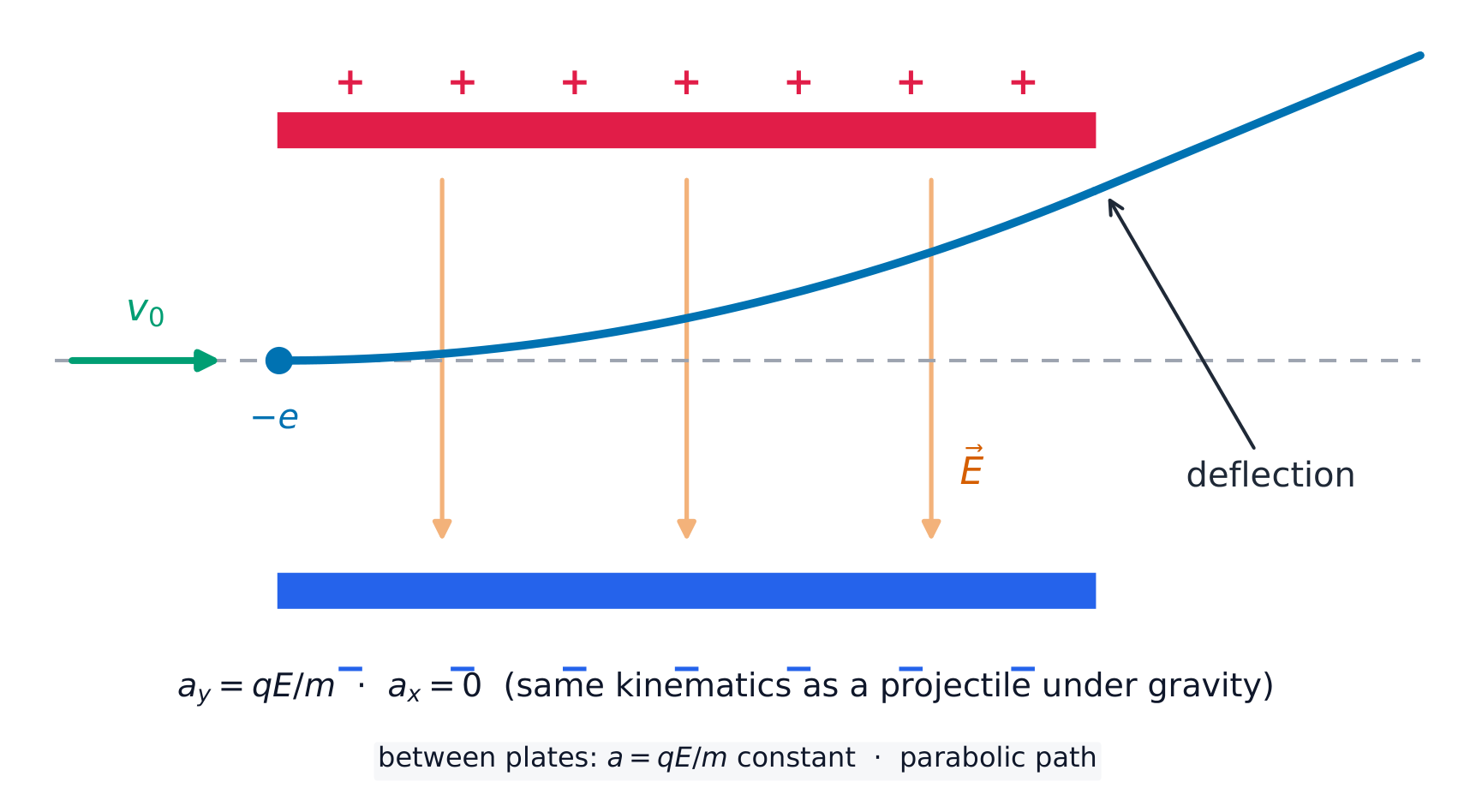
因为板之间的场是均匀的,那里的一个带电粒子感受一个恒定的力,所以它以恒定加速度移动——恰好像重力里的抛体运动(projectile motion):横向恒定速率、朝一个板均匀加速。
板之间的一个带电粒子遵循一条抛物线,像一个抛体 Worked example. 一个电子在板中间以 $v_0=2.0\times10^{7}\ \text{m/s}$、平行于它们进入。场是 $E=1.0\times10^{3}\ \text{N/C}$ 而板长 $4.0\ \text{cm}$。加速度:$a=\dfrac{eE}{m}=\dfrac{(1.6\times10^{-19})(1.0\times10^{3})}{9.11\times10^{-31}}=1.8\times10^{14}\ \text{m/s}^2$。板之间的时间:$t=\dfrac{0.040}{2.0\times10^{7}}=2.0\times10^{-9}\ \text{s}$。偏转:$y=\tfrac12at^{2}=\tfrac12(1.8\times10^{14})(2.0\times10^{-9})^{2}\approx3.5\times10^{-4}\ \text{m}$ ——约 $0.35\ \text{mm}$ 朝正板。
储存电荷需要功(work):一个外力必须逆着已经在那里的电荷的场移动每一小块电荷。总功最终成为储存的势能,
$$U_C=\tfrac12\,Q\,\Delta V=\tfrac12 C(\Delta V)^2=\frac{Q^2}{2C}.$$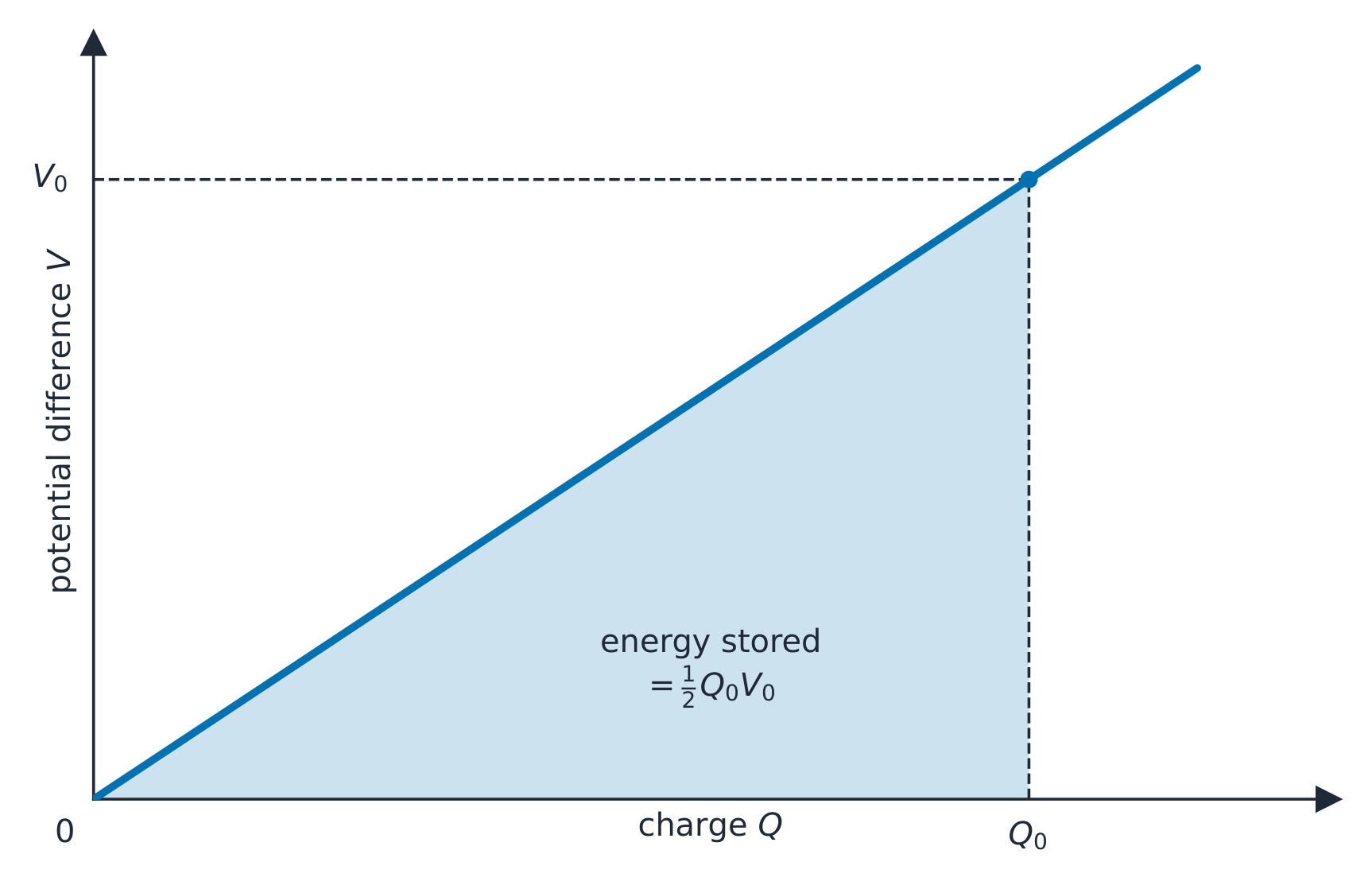
储存在一个电容器里的能量是它的电荷-电压线下的面积 因子 $\tfrac12$ 是 $Q$–$\Delta V$ 线下三角形的面积:第一个移过的电荷几乎不花费,最后一个花费完整的 $\Delta V$。
电容器与电阻相反地组合:在并联(parallel)里电容相加($C_{\text{eq}}=C_1+C_2$,相同的 $\Delta V$,电荷相加),而在串联(series)里倒数相加($\tfrac{1}{C_{\text{eq}}}=\tfrac{1}{C_1}+\tfrac{1}{C_2}$,相同的 $Q$,电压相加)。
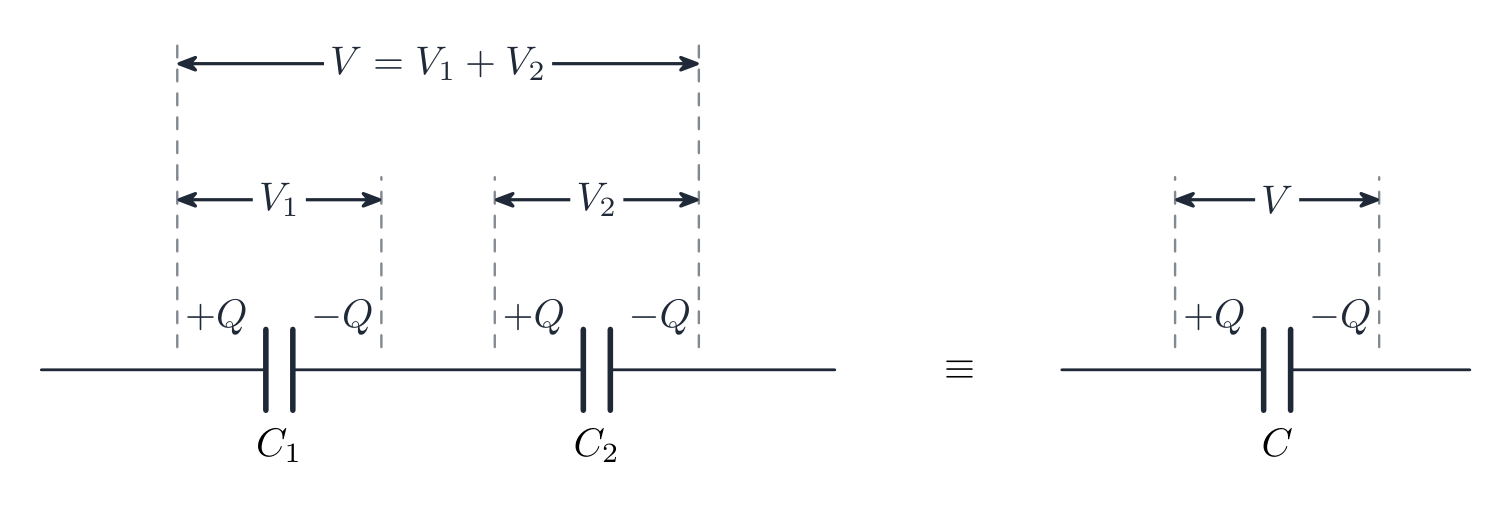
串联的电容器携带相同的电荷,而它们的电势差相加 Worked example. 一个 $2\ \mu\text{F}$ 和一个 $4\ \mu\text{F}$ 电容器串联:$\tfrac{1}{C}=\tfrac12+\tfrac14$,所以 $C=\tfrac43\ \mu\text{F}$。同一对并联:$6\ \mu\text{F}$。
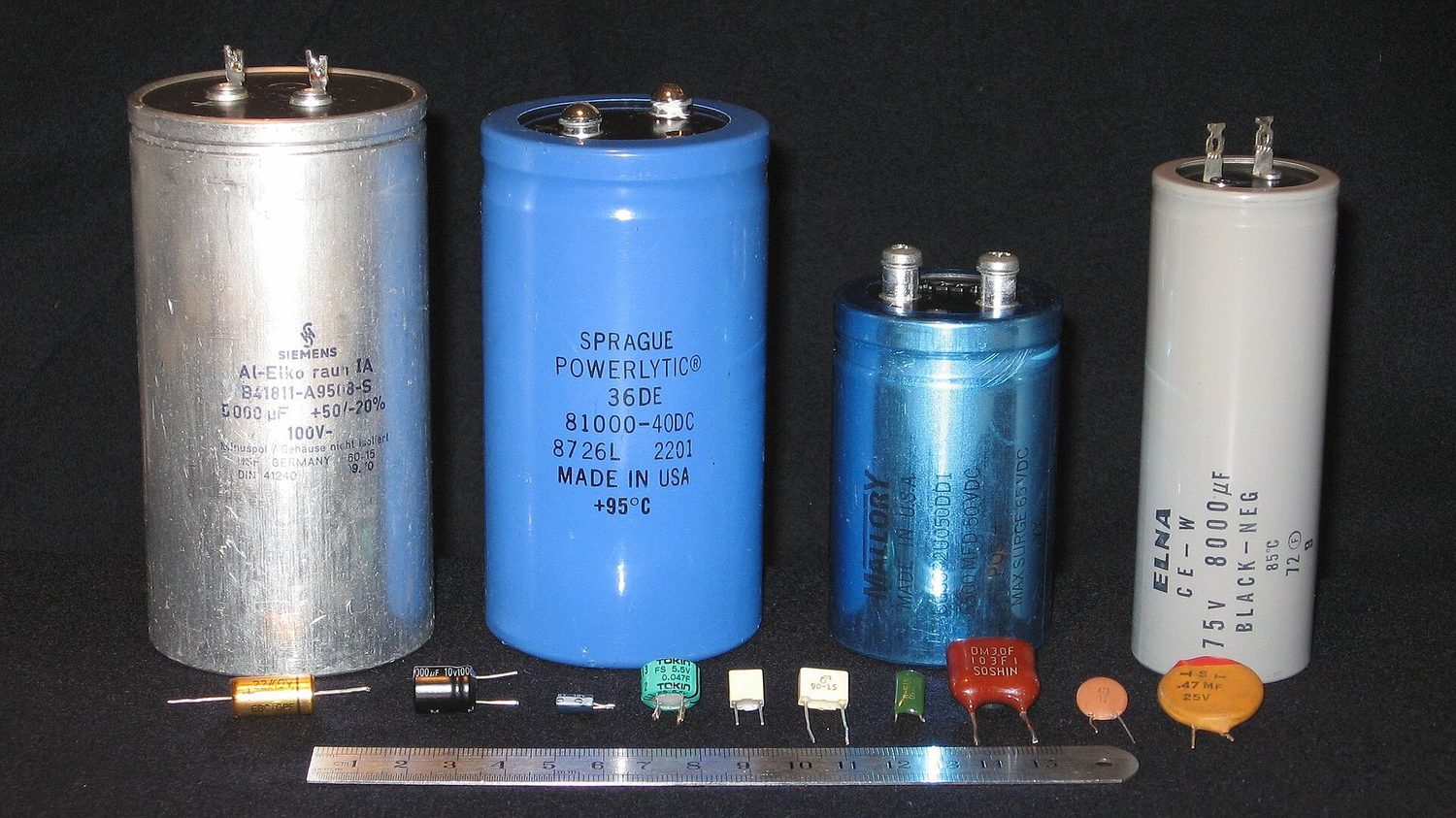
Assorted capacitors: devices that store charge and energy in an electric field between conductors 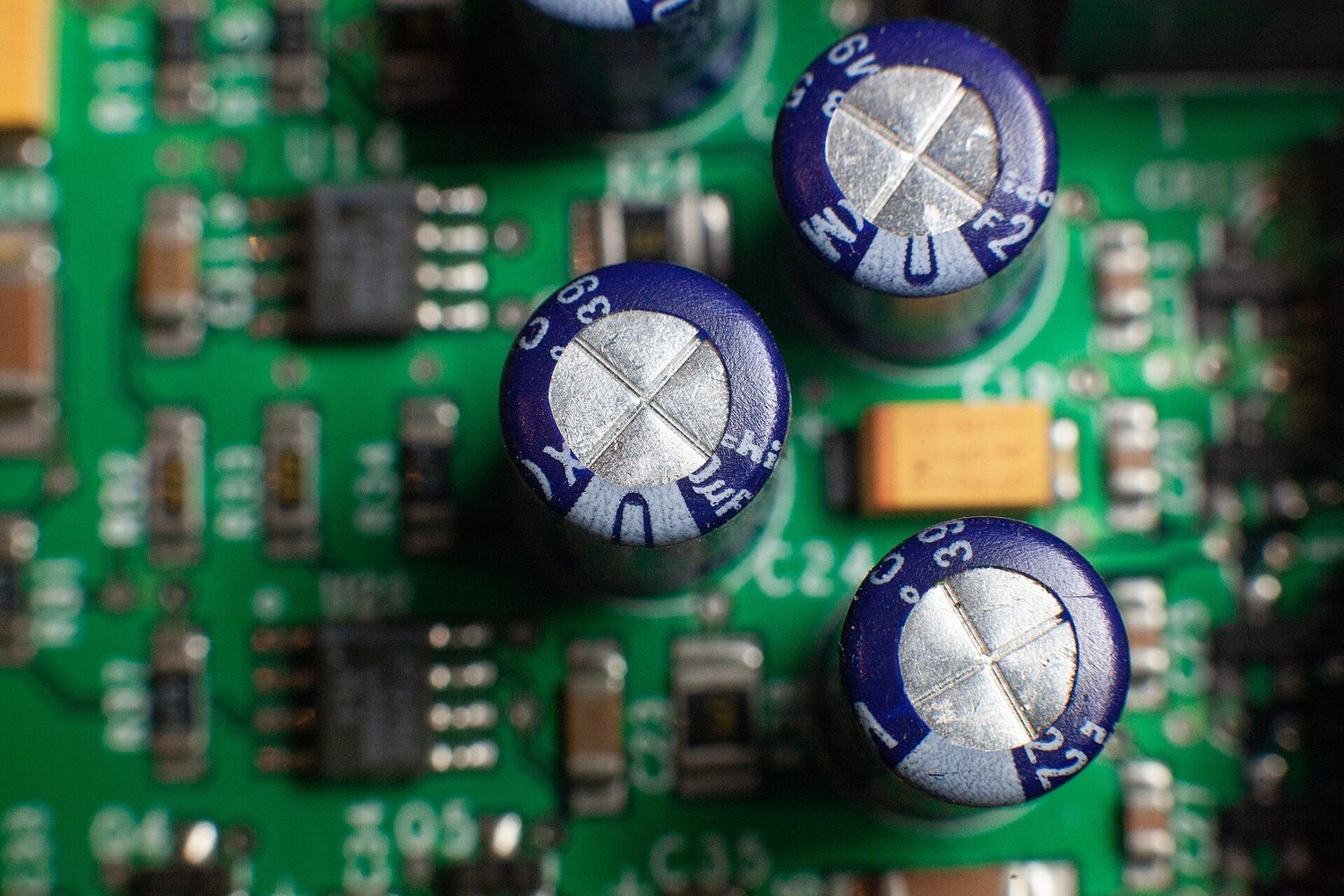
Electrolytic capacitors on a circuit board: capacitance stores energy as U = ½CV² 探索Charge and discharge a capacitor
A capacitor stores charge on two plates, filling and emptying exponentially with time constant $\tau=RC$. Bigger $R$ or $C$ slows it down.
词汇表 训练英文 中文 拼音 capacitor/kəˈpæsɪtə/ 电容器 diàn róng qì capacitance/kəˈpæsɪtəns/ 电容 diàn róng parallel-plate capacitor/ˈpærəlel pleɪt kəˈpæsɪtə/ 平行板电容器 píng xíng bǎn diàn róng qì superposition/ˌsuːpəpəˈzɪʃn/ 叠加 dié jiā uniform/ˈjuːnɪfɔːm/ 均匀 jūn yún projectile motion/prəˈdʒektaɪl ˈməʊʃn/ 抛体运动 pāo tǐ yùn dòng parallel/ˈpærəlel/ 并联 bìng lián series/ˈsɪəriːz/ 串联 chuàn lián 10.4
电介质

大纲
Learning Objective Essential Knowledge 10.4.A
Describe how a dielectric inserted between the plates of a capacitor changes the properties of the capacitor.- 10.4.A.1 In a dielectric material, electric charges are not as free to move as they are in a conductor. Instead, the material becomes polarized in the presence of an external electric field.
- 10.4.A.2 The dielectric constant of a material relates the electric permittivity of that material to the permittivity of free space.
- Equation: $\kappa = \dfrac{\varepsilon}{\varepsilon_0}$
- 10.4.A.3 The electric field created by a polarized dielectric is opposite in direction to the external field.
- 10.4.A.4 The electric field between the plates of an isolated parallel-plate capacitor decreases when a dielectric is placed between the plates.
- Equation: $\kappa = \dfrac{E_0}{E}$
- 10.4.A.5 The insertion of a dielectric into a capacitor may change the capacitance of the capacitor.
- Equation: $C = \kappa C_0$
来源:美国大学理事会 AP 课程与考试说明
一个电介质(dielectric)是一个绝缘材料。它的电荷不能行进,但在一个外部场里每个分子略微伸展或转动——材料变得极化(polarized)。排列的分子创造它们自己的与施加的相反的小场,所以材料内部的净场下降:
$$E=\frac{E_0}{\kappa},\qquad \kappa=\frac{\varepsilon}{\varepsilon_0}\ \ (\kappa>1),$$其中 $\kappa$ 是介电常数(dielectric constant),材料的介电常数与真空介电常数(permittivity of free space)之比。
一个极化的电介质创造一个反对施加场的内部场 用电介质填充一个电容器使它的电容成倍增加:
$$C=\kappa\,C_0\qquad\left(\text{parallel plates: } C=\frac{\kappa\varepsilon_0 A}{d}\right).$$接下来发生什么取决于什么保持固定——一个最爱的考试陷阱:
电池保持连接($\Delta V$ 固定) 电池先移除($Q$ 固定) 电荷 $Q$ 升到 $\kappa Q_0$ 不变 电压 $\Delta V$ 不变 降到 $\Delta V_0/\kappa$ 场 $E$ 不变 降到 $E_0/\kappa$ 能量 $U$ 升到 $\kappa U_0$ 降到 $U_0/\kappa$ Worked example. 一个 $100\ \text{pF}$ 的电容器被充电到 $12\ \text{V}$、断开,然后填充一个 $\kappa=3$ 的电介质。$Q$ 被困住,所以 $\Delta V$ 降到 $4\ \text{V}$ 而储存的能量降到三分之一——缺失的能量进入把电介质拉进去。相反重新连接到 $12\ \text{V}$ 电池,电容器会容纳三倍的电荷和三倍的能量。
Exam skill. 总是通过写下哪个量被保持固定($Q$ 或 $\Delta V$)来开始电介质问题,然后让 $C=\kappa C_0$ 通过 $Q=C\Delta V$ 和 $U=\tfrac12 C(\Delta V)^2$ 驱动其他一切。
探索Add a dielectric
A dielectric between the plates raises the capacitance, so the capacitor holds more charge at the same voltage. Watch the charge build faster.
词汇表 训练英文 中文 拼音 dielectric/ˌdaɪɪˈlektrɪk/ 电介质 diàn jiè zhì polarized/ˈpəʊləraɪzd/ 极化 jí huà dielectric constant/ˌdaɪɪˈlektrɪk ˈkɒnstənt/ 介电常数 jiè diàn cháng shù permittivity of free space/ˌpɜːmɪˈtɪvəti ɒv friː speɪs/ 真空介电常数 zhēn kōng jiè diàn cháng shù 10.4
考试技巧
- 在静电平衡中一个导体有内部 $\vec E=0$ 而所有多余的电荷在表面上。
- 用一个匹配对称的高斯面(球、圆柱、药盒)应用高斯定律 $\oint \vec E\cdot d\vec A=\tfrac{q_{enc}}{\varepsilon_0}$。
- 整个导体是一个等势面,而表面场垂直于它。
- 对于一个电容器用 $C=\tfrac{Q}{V}$、能量 $U=\tfrac12 CV^2$,以及一个电介质如何提高 $C$。
- 挑选高斯面使 $\vec E$ 在每个部分恒定且平行(或零)。
-
11
电路
11.1
电流
大纲
Learning Objective Essential Knowledge 11.1.A
Describe the movement of electric charges through a medium.- 11.1.A.1 Current is the rate at which charge passes through a cross-sectional area of a wire.
- Equation: $I = \dfrac{dq}{dt}$
- 11.1.A.1.i Current within a conductor consists of charge carriers traveling through the conductor with an average drift velocity.
- Equation: $I = nqv_d A$
- 11.1.A.1.ii Electric charge moves in a circuit in response to an electric potential difference, sometimes referred to as electromotive force, or $\mathrm{emf}$ ($\mathcal{E}$).
- 11.1.A.1.iii If the current is zero in a section of wire, the net motion of charge carriers in the wire is also zero, although individual charge carriers will not have zero speed.
- 11.1.A.2 Current density is the flow of charge per unit area.
- Equation: $I = \int \vec{J} \cdot d\vec{A}$
- 11.1.A.2.i Current density is related to the motion of the charge carriers within a conductor.
- Equation: $\vec{J} = nq\vec{v}_d$
- 11.1.A.2.ii Current density is a vector quantity.
- 11.1.A.2.iii A potential difference across a conductor creates an electric field within the conductor that is proportional to the resistivity of the conductor and the current density.
- Equation: $\vec{E} = \rho\vec{J}$
- 11.1.A.3 If a function of current density is given, the total current can be determined by integrating the current density over the area.
- Equation: $I_{\text{tot}} = \int \vec{J}(r) \cdot d\vec{A}$
- 11.1.A.4 Although current is a scalar quantity, it does have a direction. Because its direction is relative to the current carrier and not space, current does not obey the laws of vector addition and has no vector components.
- 11.1.A.4.i The direction of conventional current is chosen to be the direction in which positive charge would move.
- 11.1.A.4.ii In common circuits, the current is actually due to the movement of electrons (negative charge carriers).
来源:美国大学理事会 AP 课程与考试说明
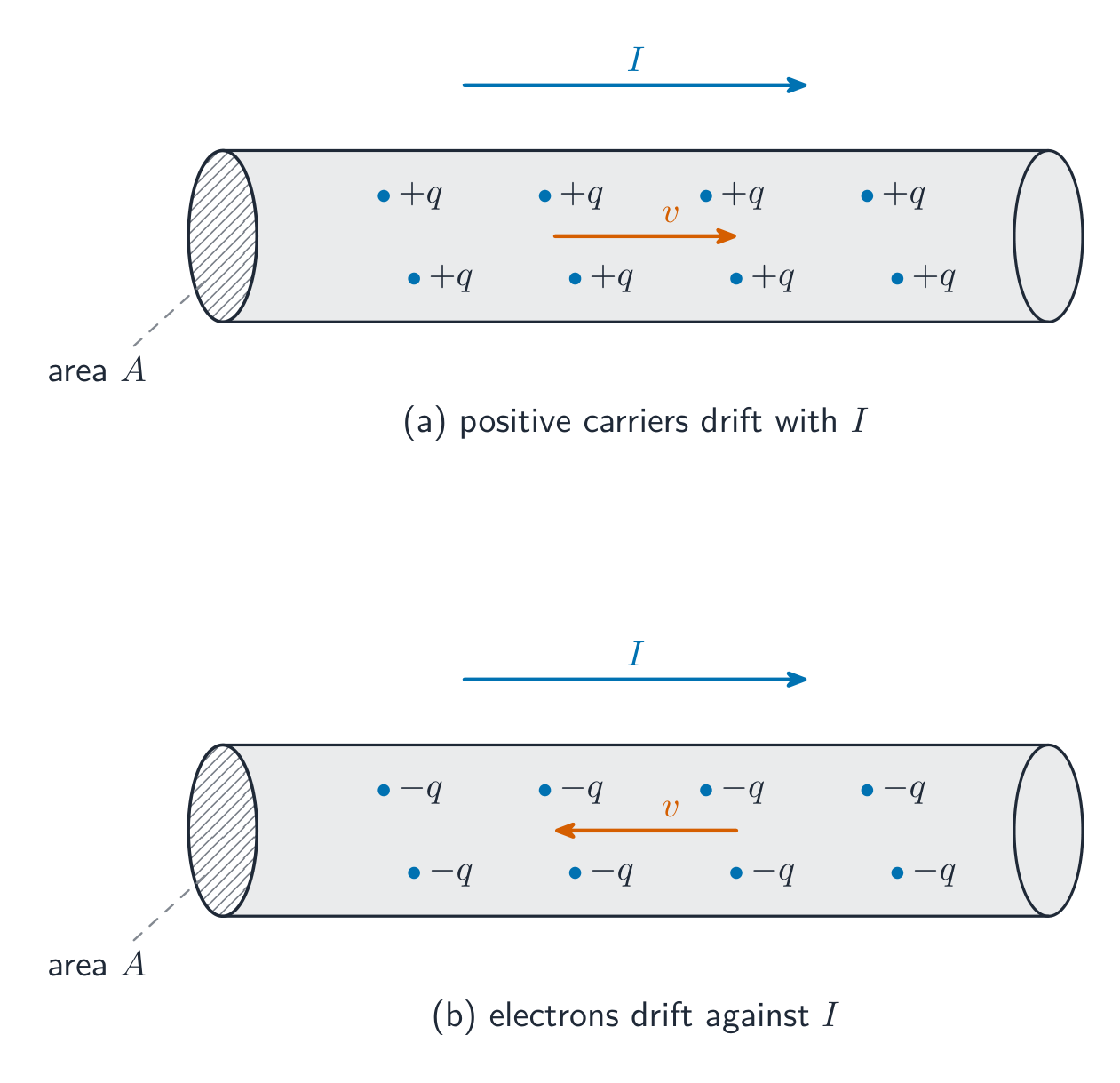
电流(electric current)是电荷通过一根导线一个横截面的速率,$I=\dfrac{dq}{dt}$,以安培(amperes)测量。常规电流指向正电荷会移动的方向。微观地,一个电流是许多载流子的一个缓慢漂移:
$$I=nqv_dA,$$$n$ 是每体积的载流子数、$q$ 是每个携带的电荷、$v_d$ 是漂移速度(drift velocity),而 $A$ 是横截面积(cross-sectional area)。
载流子缓慢地漂移过一个导体以形成一个电流 Worked example. 一根 $A=1.0\times10^{-6}\ \text{m}^2$ 和 $n=8.5\times10^{28}\ \text{m}^{-3}$ 的铜导线携带 $1.7\ \text{A}$。那么 $v_d=\dfrac{I}{nqA}=\dfrac{1.7}{(8.5\times10^{28})(1.6\times10^{-19})(1.0\times10^{-6})}\approx1.3\times10^{-4}\ \text{m/s}$ ——载流子漂移得比蜗牛还慢,即使信号以接近光速行进。
电流密度(current density)是每单位面积的电荷流,$\vec{J}=nq\vec{v}_d$,由 $\vec{E}=\rho\vec{J}$ 与驱动它的场联系。一般地 $I=\int\vec{J}\cdot d\vec{A}$;若 $J(r)$ 跨导线变化,在横截面上积分它以得到总电流。一个注意点:电流沿它的导线有一个方向,但它是一个标量(scalar)——电流不作为矢量相加,而且没有"电流的分量"。
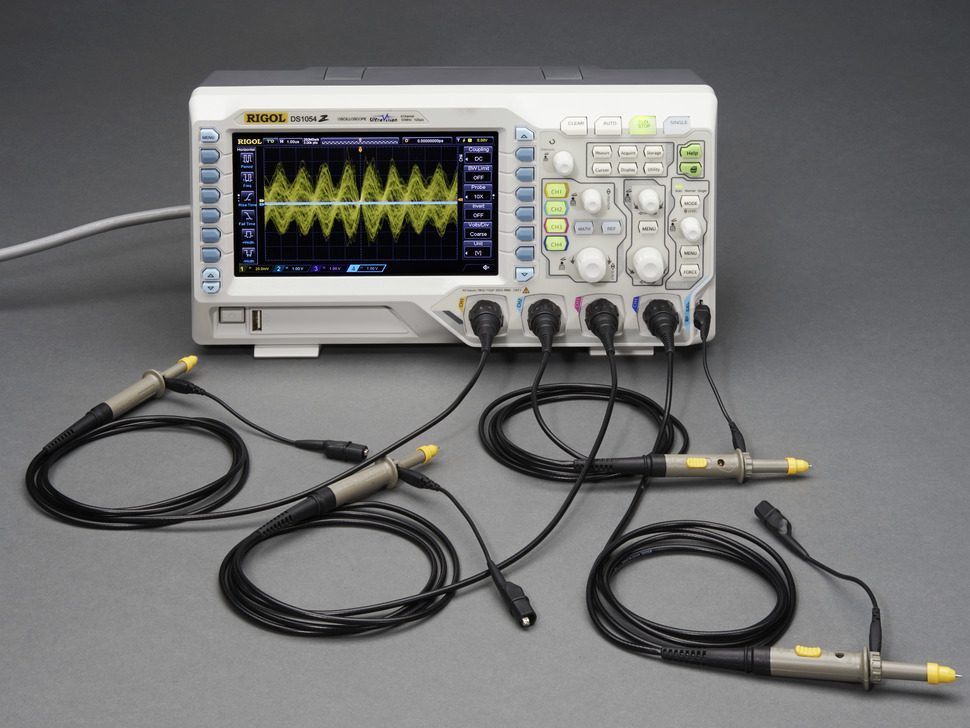
An oscilloscope: voltage against time reveals how current and charge evolve in a circuit 词汇表 训练英文 中文 拼音 Electric current/ɪˈlektrɪk ˈkʌrənt/ 电流 diàn liú amperes/ˈæmpeəz/ 安培 ān péi drift velocity/drɪft vəˈlɒsɪti/ 漂移速度 piāo yí sù dù cross-sectional area/krɒs ˈsekʃənl ˈeərɪə/ 横截面积 héng jié miàn jī Current density/ˈkʌrənt ˈdensɪti/ 电流密度 diàn liú mì dù scalar/ˈskeɪlə/ 标量 biāo liàng 11.2
电路
大纲
Learning Objective Essential Knowledge 11.2.A
Describe the behavior of a circuit.- 11.2.A.1 A circuit is composed of electrical loops, which can include wires, batteries, resistors, lightbulbs, capacitors, inductors, switches, ammeters, and voltmeters.
- 11.2.A.2 A closed electrical loop is a closed path through which charges may flow.
- 11.2.A.2.i A closed circuit is one in which charges would be able to flow.
- 11.2.A.2.ii An open circuit is one in which charges would not be able to flow.
- 11.2.A.2.iii A short circuit is one in which charges would be able to flow with no change in potential difference.
- 11.2.A.3 A single circuit element may be part of multiple electrical loops.
- 11.2.A.4 Circuit schematics are representations used to describe and analyze electric circuits.
- 11.2.A.4.i The properties of an electric circuit are dependent on the physical arrangement of its constituent elements.
- 11.2.A.4.ii Circuit elements have common symbols that are used to create schematic diagrams. Variable elements are indicated by a diagonal strikethrough arrow across the standard symbol for that element. (Symbols: Battery, Bulb, Switch, Capacitor, Resistor, Ammeter, Voltmeter, Inductor.)
Boundary statement: Unless otherwise specified, all circuit schematic diagrams will be drawn using conventional current.
来源:美国大学理事会 AP 课程与考试说明
一个电路是从导线、电池、电阻、灯泡、电容器、电感器、开关和仪表构建的一组闭合回路;电荷只能绕一条闭合路径流动。一个元件能一次属于几个回路——那就是使多回路问题有趣的东西。每个分析都以读电路图(circuit diagram)开始:追踪每个回路并辨别哪些元件共享相同的电流(串联(series))以及哪些共享相同的电势差(并联(parallel))。
探索Build series and parallel circuits
In series the same current flows through every bulb and voltage divides; in parallel each branch gets the full voltage. Switch mode to see the bulbs' brightness change.
词汇表 训练英文 中文 拼音 circuit diagram/ˈsɜːkɪt ˈdaɪəɡræm/ 电路图 diàn lù tú series/ˈsɪəriːz/ 串联 chuàn lián parallel/ˈpærəlel/ 并联 bìng lián 11.3
电阻、电阻率与欧姆定律
大纲
Learning Objective Essential Knowledge 11.3.A
Describe the resistance of an object using physical properties of that object.- 11.3.A.1 Resistance is a measure of the degree to which an object opposes the movement of electric charge.
- 11.3.A.2 The resistance of a resistor with uniform geometry is proportional to its resistivity and length and is inversely proportional to its cross-sectional area.
- Equation: $R = \dfrac{\rho\ell}{A}$
- 11.3.A.2.i Resistivity is a fundamental property of a material that depends on its atomic and molecular structure and quantifies how strongly the material opposes the motion of electric charge.
- 11.3.A.2.ii The resistivity of a conductor typically increases with temperature.
- 11.3.A.2.iii The total resistance of a resistor with uniform geometry, but that is made of a material whose resistivity varies along the length of the resistor, is given by $R = \int \dfrac{\rho(\ell)\,d\ell}{A}$.
11.3.B
Describe the electrical characteristics of elements of a circuit.- 11.3.B.1 Ohm's law relates current, resistance, and potential difference across a conductive element of a circuit.
- Equation: $I = \dfrac{\Delta V}{R}$
- 11.3.B.1.i Materials that obey Ohm's law have constant resistance for all currents and are called ohmic materials.
- 11.3.B.1.ii The resistivity of an ohmic material is constant regardless of temperature.
- 11.3.B.1.iii Resistors can also convert electrical energy to thermal energy, which may change the temperature of both the resistor and the resistor's environment.
- 11.3.B.1.iv The resistance of an ohmic circuit element can be determined from the slope of a graph of the current in the element as a function of the potential difference across the element.
来源:美国大学理事会 AP 课程与考试说明
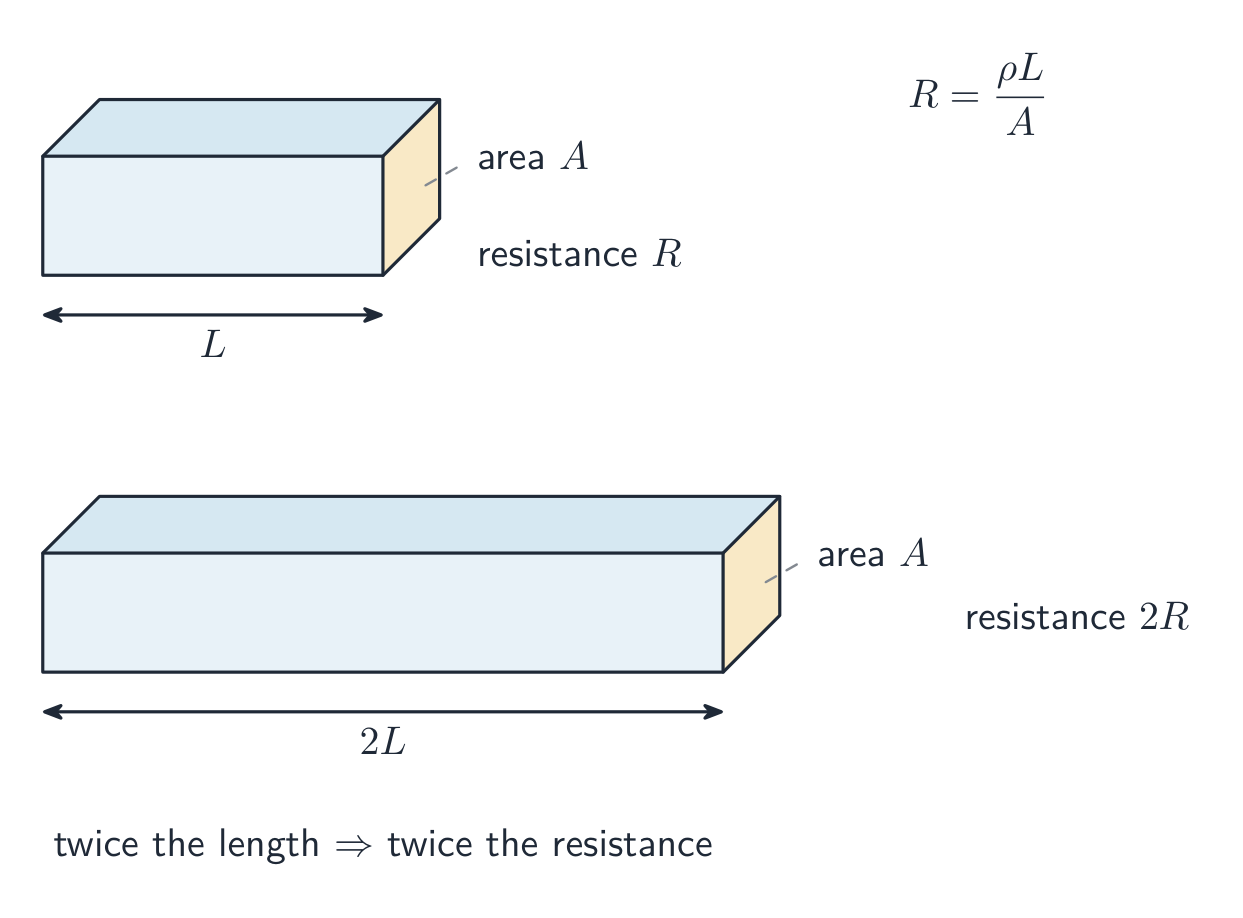
电阻(resistance)测量一个物体多强地反对电荷流。它随材料的电阻率(resistivity)和导体的长度增长,而随它的面积缩小:
$$R=\frac{\rho\,\ell}{A}.$$欧姆定律(Ohm's law)把通过一个元件的电流与跨它的电势差关联:
$$I=\frac{\Delta V}{R}.$$一个更长的导体有更多电阻;一个更宽的有更少 Worked example. 把一根导线拉伸到它长度的两倍:体积固定,所以面积减半,而 $R=\rho\ell/A$ 变成 $\rho(2\ell)/(A/2)=4R$ ——四倍的电阻。一个元件是欧姆性(ohmic)的,若 $R$ 保持恒定(在一个 $I$–$\Delta V$ 图上通过原点的一条直线);一个加热起来的灯泡灯丝不是。
探索Apply Ohm's law
Ohm's law $V=IR$: for a fixed resistance, current is proportional to voltage. Raise the resistance and the same voltage pushes less current.
词汇表 训练英文 中文 拼音 Resistance/rɪˈzɪstəns/ 电阻 diàn zǔ resistivity/ˌriːzɪˈstɪvəti/ 电阻率 diàn zǔ lǜ Ohm's law/əʊmz lɔː/ 欧姆定律 ōu mǔ dìng lǜ ohmic/ˈəʊmɪk/ 欧姆性 ōu mǔ xìng 11.4
电功率
大纲
Learning Objective Essential Knowledge 11.4.A
Describe the transfer of energy into, out of, or within an electric circuit, in terms of power.- 11.4.A.1 The rate at which energy is transferred, converted, or dissipated by a circuit element depends on the current in the element and the electric potential difference across it.
- Equation: $P = I\Delta V$
- Equation: $P = I^2 R = \dfrac{\Delta V^2}{R}$
- 11.4.A.2 The brightness of a lightbulb increases with power, so power can be used to qualitatively predict the brightness of lightbulbs in a circuit.
Boundary statement: AP Physics C: Electricity & Magnetism only expects students to analyze the transfer of mechanical and electrical energy, although students should be aware that electrical energy can also be dissipated in the form of thermal energy.
来源:美国大学理事会 AP 课程与考试说明
一个电荷 $q$ 通过一个电势差 $\Delta V$ 降落放出能量 $q\Delta V$,所以一个元件里能量转移的速率是
$$P=I\,\Delta V=I^2R=\frac{(\Delta V)^2}{R}.$$在一个电阻里全都变成热。用它的量你实际知道的形式——并用功率给灯泡亮度排名:更亮 = 更多功率,不一定更多电阻。在串联里,更大的电阻更亮($P=I^2R$,相同的 $I$);在并联里,更小的更亮($P=\Delta V^2/R$,相同的 $\Delta V$)。
探索Read an I-V characteristic
Power is $P=IV$. A resistor's I-V line is straight, but a lamp curves as it heats and its resistance rises. The area under I-V relates to the energy delivered.
11.5
复合直流电路
大纲
Learning Objective Essential Knowledge 11.5.A
Describe the equivalent resistance of multiple resistors connected in a circuit.- 11.5.A.1 Circuit elements may be connected in series and/or in parallel.
- 11.5.A.1.i A series connection is one in which any charge passing through one circuit element must proceed through all elements in that connection and has no other path available. The current in each element in series must be the same.
- 11.5.A.1.ii A parallel connection is one in which charges may pass through one of two or more paths. Across each path, the potential difference is the same.
- 11.5.A.2 A collection of resistors in a circuit may be analyzed as though it were a single resistor with an equivalent resistance $R_{\text{eq}}$.
- 11.5.A.2.i The equivalent resistance of a set of resistors in series is the sum of the individual resistances.
- Equation: $R_{\text{eq},s} = \sum_{i} R_i$
- 11.5.A.2.ii The inverse of the equivalent resistance of a set of resistors connected in parallel is equal to the sum of the inverses of the individual resistances.
- Equation: $\dfrac{1}{R_{\text{eq},p}} = \sum_{i} \dfrac{1}{R_i}$
- 11.5.A.2.iii When resistors are connected in parallel, the number of paths available to charges increases, and the equivalent resistance of the group of resistors decreases.
- 11.5.A.2.i The equivalent resistance of a set of resistors in series is the sum of the individual resistances.
11.5.B
Describe a circuit with resistive wires and a battery with internal resistance.- 11.5.B.1 Ideal batteries have negligible internal resistance. Ideal wires have negligible resistance.
- 11.5.B.1.i The resistance of wires that are good conductors may normally be neglected, because their resistance is much smaller than that of other elements of a circuit.
- 11.5.B.1.ii The resistance of wires may only be neglected if the circuit contains other elements that do have resistance.
- 11.5.B.1.iii The potential difference a battery would supply if it were ideal is the potential difference measured across the terminals when there is no current in the battery and is sometimes referred to as its $\mathrm{emf}$ ($\mathcal{E}$).
- 11.5.B.2 The internal resistance of a nonideal battery may be treated as the resistance of a resistor in series with an ideal battery and the remainder of the circuit.
- 11.5.B.3 When there is current in a nonideal battery with internal resistance $r$, the potential difference across the terminals of the battery is reduced relative to the potential difference when there is no current in the battery.
- Equation: $\Delta V_{\text{terminal}} = \mathcal{E} - Ir$
11.5.C
Describe the measurement of current and potential difference in a circuit.- 11.5.C.1 Ammeters are used to measure current at a specific point in a circuit.
- 11.5.C.1.i Ammeters must be connected in series with the element in which current is being measured.
- 11.5.C.1.ii Ideal ammeters have zero resistance so that they do not affect the current in the element that they are in series with.
- 11.5.C.2 Voltmeters are used to measure electric potential difference between two points in a circuit.
- 11.5.C.2.i Voltmeters must be connected in parallel with the element across which potential difference is being measured.
- 11.5.C.2.ii Ideal voltmeters have infinite resistance so that no charge flows through them.
- 11.5.C.3 Nonideal ammeters and voltmeters will change the properties of the circuit being measured.
Boundary statement: Unless otherwise stated, all batteries, wires, and meters are assumed to be ideal. Circuits with batteries of different potential differences connected in parallel will not be assessed.
来源:美国大学理事会 AP 课程与考试说明
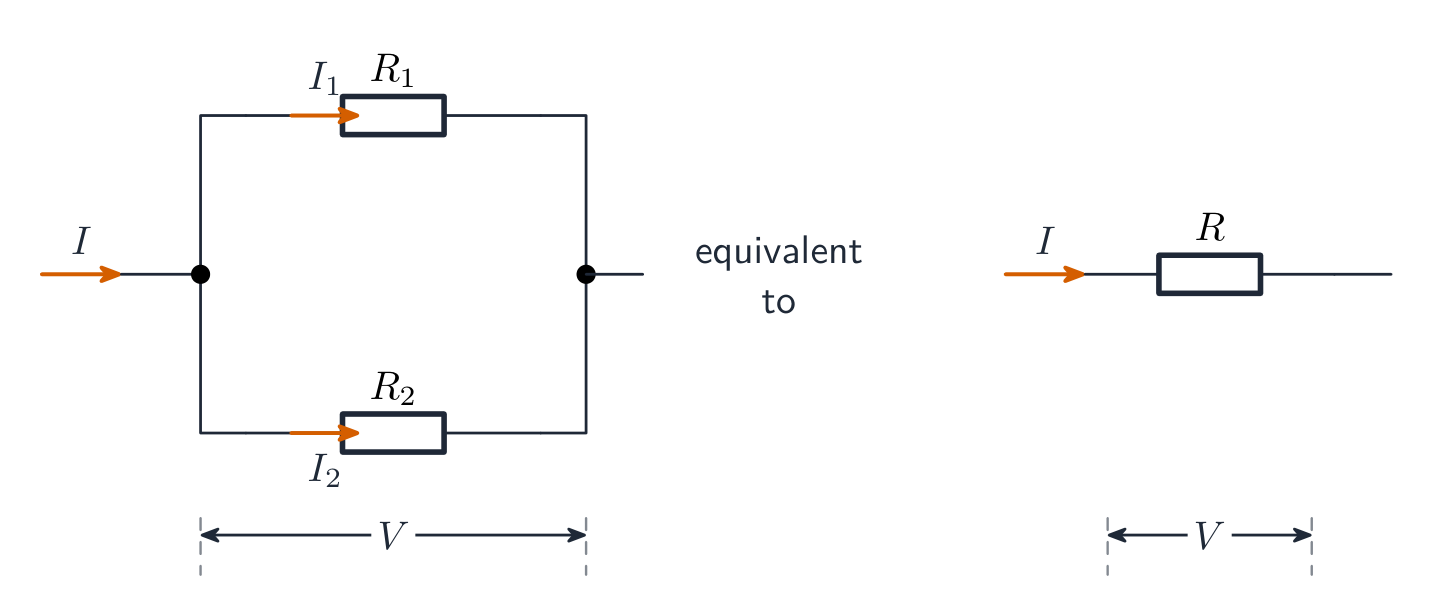
把电阻网络简化到一个等效电阻(equivalent resistance):串联电阻相加($R_{\text{eq}}=R_1+R_2+\cdots$),而并联电阻作为倒数相加($\tfrac{1}{R_{\text{eq}}}=\tfrac{1}{R_1}+\tfrac{1}{R_2}+\cdots$ ——总是小于最小的支路)。一步一步地折叠网络以求电池电流,然后向外展开以求每个元件的电流和电压。
Worked example. 一个 $12\ \text{V}$ 的电池驱动一个 $4.0\ \Omega$ 和一个 $2.0\ \Omega$ 的电阻串联:$R_{\text{eq}}=6.0\ \Omega$、$I=2.0\ \text{A}$,电压分成 $8.0\ \text{V}$ 和 $4.0\ \text{V}$,而 $4.0\ \Omega$ 的电阻耗散 $P=I^2R=16\ \text{W}$。
并联的电阻组合成一个更小的等效电阻 真实的电池不是理想的。把一个电池建模为一个 emf $\varepsilon$ 的理想电池(ideal battery)与它自己的内阻(internal resistance)$r$ 串联。当电流流动时,一些 emf 在里面被用掉,所以端电压(terminal voltage)——一个跨电池的电压表实际读的——下降:
$$\Delta V_{\text{terminal}}=\varepsilon-Ir.$$Worked example. 一个 $\varepsilon=12\ \text{V}$ 和 $r=0.50\ \Omega$ 的电池供应 $2.0\ \text{A}$:端子处于 $\Delta V=12-2.0(0.50)=11\ \text{V}$。没有电流,一个电压表读完整的 $12\ \text{V}$。
仪表:一个电流表(ammeter)串联在你想要它电流的点(理想电流表:零电阻);一个电压表(voltmeter)并联跨元件(理想电压表:无穷电阻)。非理想仪表扰乱它们测量的电路——一个真实的电流表添加串联电阻,一个真实的电压表窃取电流。
词汇表 训练英文 中文 拼音 equivalent resistance/ɪˈkwɪvələnt rɪˈzɪstəns/ 等效电阻 děng xiào diàn zǔ ideal battery/aɪˈdɪəl ˈbætəri/ 理想电池 lǐ xiǎng diàn chí internal resistance/ɪnˈtɜːnl rɪˈzɪstəns/ 内阻 nèi zǔ terminal voltage/ˈtɜːmɪnl ˈvəʊltɪdʒ/ 端电压 duān diàn yā ammeter/ˈæmiːtə/ 电流表 diàn liú biǎo voltmeter/ˈvəʊltmiːtə/ 电压表 diàn yā biǎo 11.6
基尔霍夫回路定则
大纲
Learning Objective Essential Knowledge 11.6.A
Describe a circuit or elements of a circuit by applying Kirchhoff's loop rule.- 11.6.A.1 Energy changes in simple electrical circuits may be represented in terms of charges moving through electric potential differences within circuit elements.
- Equation: $\Delta U_E = q\Delta V$
- 11.6.A.2 Kirchhoff's loop rule is a consequence of the conservation of energy.
- 11.6.A.2.i Kirchhoff's loop rule states that the sum of potential differences across all circuit elements in a single closed loop must equal zero.
- Equation: $\sum \Delta V = 0$
- 11.6.A.2.ii The values of electric potential at points in a circuit can be represented by a graph of electric potential as a function of position within a loop.
- 11.6.A.2.i Kirchhoff's loop rule states that the sum of potential differences across all circuit elements in a single closed loop must equal zero.
来源:美国大学理事会 AP 课程与考试说明
通过电势差移动的电荷交换能量($\Delta U_E=q\Delta V$),而能量必须绕任何闭合路径平衡。那是基尔霍夫回路定则(Kirchhoff's loop rule):
$$\sum\Delta V=0\ \text{around any closed loop}.$$符号纪律赢得这些问题:从 $-$ 到 $+$ 穿过一个电池是 $+\varepsilon$;顺着假设的电流穿过一个电阻是 $-IR$(逆着它,$+IR$)。每个独立回路写一个方程。
词汇表 训练英文 中文 拼音 Kirchhoff's loop rule/ˈkɜːkhɒfs luːp ruːl/ 基尔霍夫回路定则 jī ěr huò fū huí lù dìng zé 11.7
基尔霍夫节点定则
大纲
Learning Objective Essential Knowledge 11.7.A
Describe a circuit or elements of a circuit by applying Kirchhoff's junction rule.- 11.7.A.1 Kirchhoff's junction rule is a consequence of the conservation of electric charge.
- 11.7.A.2 Kirchhoff's junction rule states that the total amount of charge entering a junction per unit time must equal the total amount of charge exiting that junction per unit time.
- Equation: $\sum I_{\text{in}} = \sum I_{\text{out}}$
来源:美国大学理事会 AP 课程与考试说明
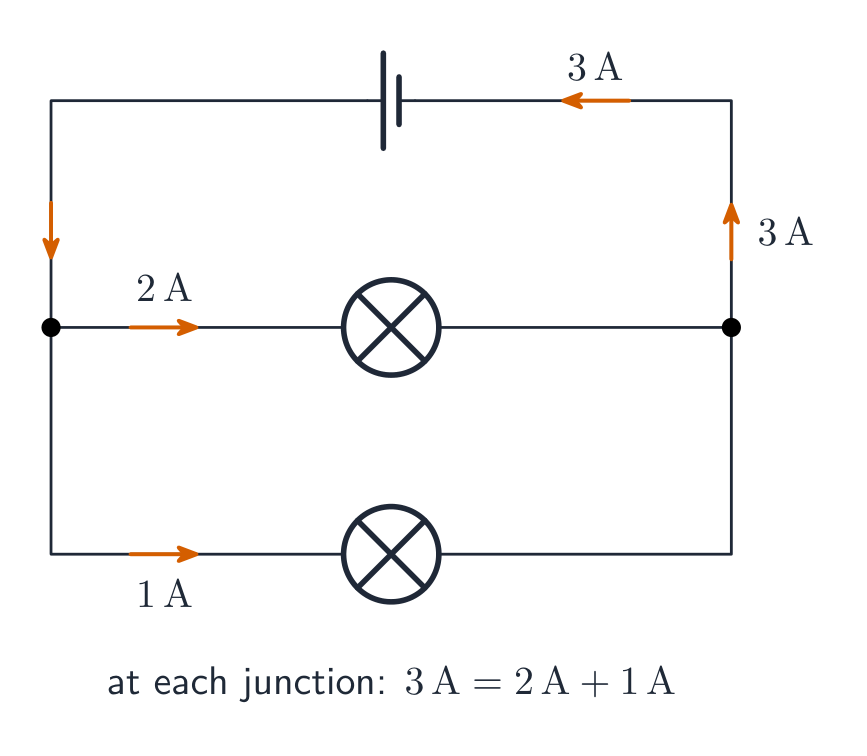
基尔霍夫节点定则(Kirchhoff's junction rule)是一个节点(junction)处的电荷守恒:
$$\sum I_{\text{in}}=\sum I_{\text{out}}.$$电流在一个节点分开:流进的等于流出的 两条规则一起求解任何多回路电路:给每个支路分配一个电流、写节点方程,然后回路方程,并求解。一个负的答案只意味着那个电流流向与你假设的方向相反。
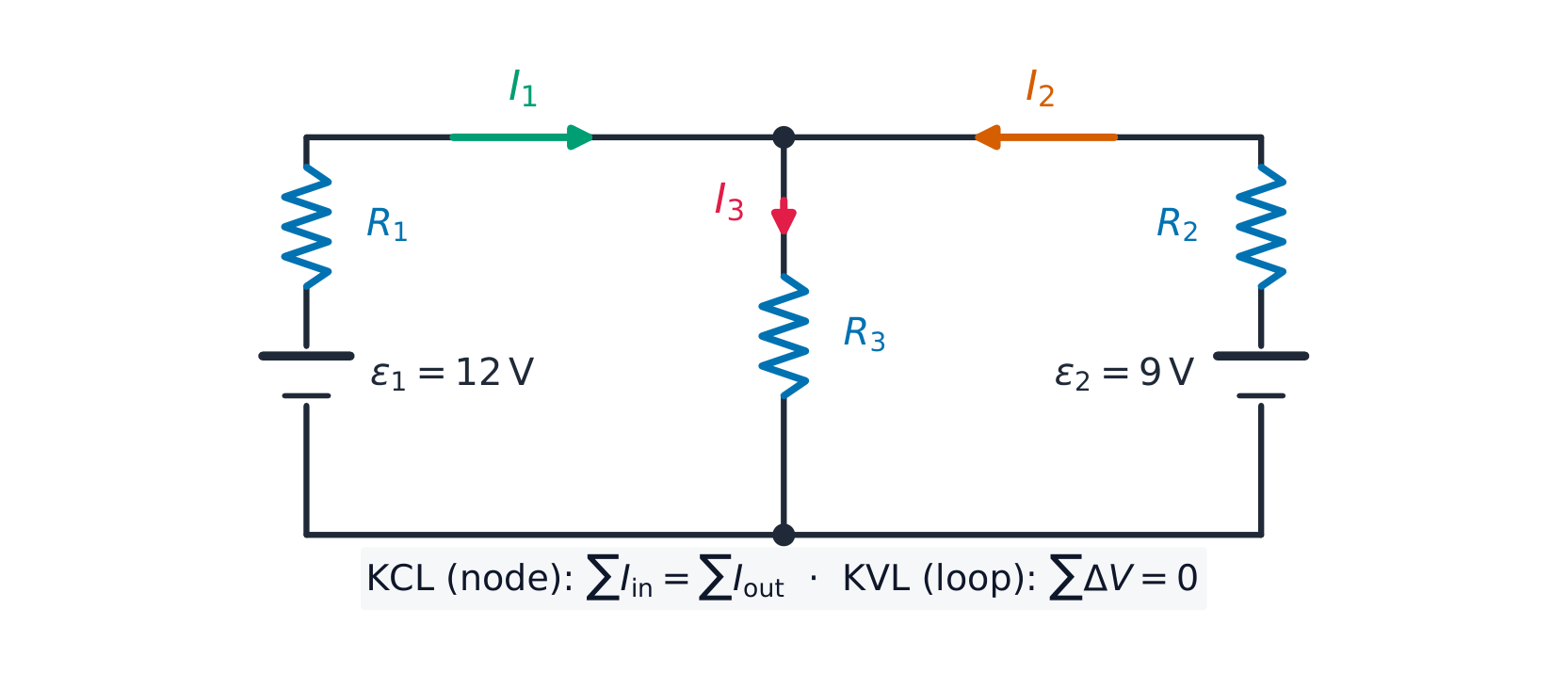
两个回路方程和一个节点方程求解这个双电池电路 Worked example. 在上面的电路里,左边 $\varepsilon_1=12\ \text{V}$ 带 $R_1=1.0\ \Omega$、右边 $\varepsilon_2=9.0\ \text{V}$ 带 $R_2=1.0\ \Omega$,和一个共享的中间电阻 $R_3=2.0\ \Omega$ 携带 $I_3=I_1+I_2$(节点定则)。两个回路方程是
$$12=I_1+2(I_1+I_2)=3I_1+2I_2,\qquad 9=I_2+2(I_1+I_2)=2I_1+3I_2.$$求解:$I_1=3.6\ \text{A}$、$I_2=0.60\ \text{A}$,所以通过中间的 $I_3=4.2\ \text{A}$。用第二个回路检查:$2(3.6)+3(0.60)=9.0$ ✓。
词汇表 训练英文 中文 拼音 Kirchhoff's junction rule/ˈkɜːkhɒfs ˈdʒʌŋkʃn ruːl/ 基尔霍夫节点定则 jī ěr huò fū jié diǎn dìng zé junction/ˈdʒʌŋkʃn/ 节点 jié diǎn 11.8
电阻-电容(RC)电路
大纲
Learning Objective Essential Knowledge 11.8.A
Describe the equivalent capacitance of multiple capacitors.- 11.8.A.1 A collection of capacitors in a circuit may be analyzed as though it was a single capacitor with an equivalent capacitance $C_{\text{eq}}$.
- 11.8.A.1.i The inverse of the equivalent capacitance of a set of capacitors connected in series is equal to the sum of the inverses of the individual capacitances.
- Equation: $\dfrac{1}{C_{\text{eq},s}} = \sum_{i} \dfrac{1}{C_i}$
- 11.8.A.1.ii The equivalent capacitance of a set of capacitors in series is less than the capacitance of the smallest capacitor.
- 11.8.A.1.iii The equivalent capacitance of a set of capacitors in parallel is the sum of the individual capacitances.
- Equation: $C_{\text{eq},p} = \sum_{i} C_i$
- 11.8.A.1.i The inverse of the equivalent capacitance of a set of capacitors connected in series is equal to the sum of the inverses of the individual capacitances.
- 11.8.A.2 As a result of conservation of charge, each of the capacitors in series must have the same magnitude of charge on each plate.
11.8.B
Describe the behavior of a circuit containing combinations of resistors and capacitors.- 11.8.B.1 The charge on a capacitor or the current in a resistor in an RC circuit can be described by a fundamental differential equation derived from Kirchhoff's loop rule.
- Equation: $\mathcal{E} = \dfrac{dq}{dt}R + \dfrac{q}{C}$
- 11.8.B.2 The time constant ($\tau$) is a significant feature of an RC circuit.
- 11.8.B.2.i The time constant of an RC circuit is a measure of how quickly the capacitor will charge or discharge and is defined as $\tau = R_{\text{eq}}C_{\text{eq}}$.
- 11.8.B.2.ii For a charging capacitor, the time constant represents the time required for the capacitor's charge to increase from zero to approximately 63 percent of its final asymptotic value.
- 11.8.B.2.iii For a discharging capacitor, the time constant represents the time required for the capacitor's charge to decrease from fully charged to approximately 37 percent of its initial value.
- 11.8.B.3 The potential difference across a capacitor and the current in the branch of the circuit containing the capacitor each change over time as the capacitor charges and discharges, but both will reach a steady state after a long time interval.
- 11.8.B.3.i Immediately after being placed in a circuit, an uncharged capacitor acts like a wire, and charge can easily flow to or from the plates of the capacitor.
- 11.8.B.3.ii As a capacitor charges, changes to the potential difference across the capacitor affect the charge on the plates of the capacitor, the current in the circuit branch in which the capacitor is located, and the electric potential energy stored in the capacitor.
- 11.8.B.3.iii The potential difference across a capacitor, the current in the circuit branch in which the capacitor is located, and the electric potential energy stored in the capacitor all change with respect to time and asymptotically approach steady state conditions.
- 11.8.B.3.iv After a long time, a charging capacitor approaches a state of being fully charged, reaching a maximum potential difference at which there is zero current in the circuit branch in which the capacitor is located.
- 11.8.B.3.v Immediately after a charged capacitor begins discharging, the amount of charge on the capacitor and the energy stored in the capacitor begin to decrease.
- 11.8.B.3.vi As a capacitor discharges, the amount of charge on the capacitor, the potential difference across the capacitor, and the current in the circuit branch in which the capacitor is located all decrease until a steady state is reached.
- 11.8.B.3.vii After either charging or discharging for times much greater than the time constant, the capacitor and the relevant circuit branch may be modeled using steady-state conditions.
来源:美国大学理事会 AP 课程与考试说明
电容放电:τ = RC 电容器充电(RC) 电容器网络像电阻一样简化但规则交换:并联电容相加($C_{\text{eq}}=C_1+C_2$),串联作为倒数相加——而串联的电容器由电荷守恒必须在每个板上携带相同的电荷。用等效电容(equivalent capacitance)分析网络,然后向回展开。
在一个 RC电路(RC circuit)里,基尔霍夫回路定则给出微分方程
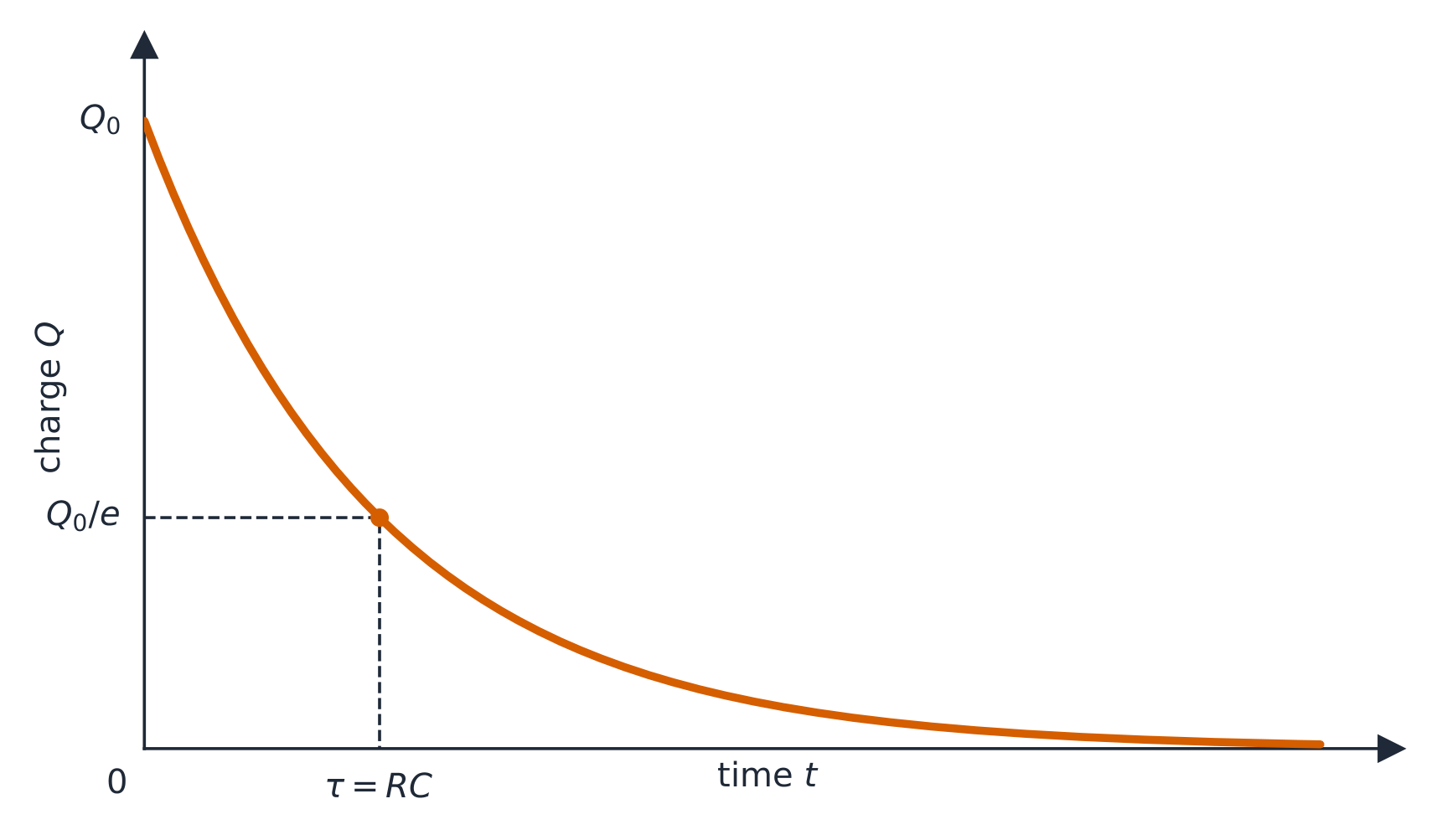
$$\varepsilon=R\frac{dq}{dt}+\frac{q}{C},$$它的解是带时间常数(time constant)$\tau=RC$ 的指数:
$$q(t)=Q\big(1-e^{-t/RC}\big)\ \text{(charging)},\qquad q(t)=Q\,e^{-t/RC}\ \text{(discharging)},\qquad i(t)=\frac{\varepsilon}{R}e^{-t/RC}.$$电流在第一个瞬间最大并衰减——它从不"等"电容器。学两个极限:在 $t=0$ 一个未充电的电容器像一根普通的导线(最大电流);很长时间后它完全充电,它的支路里没有电流流动,而它像一个断路。在任何稳态(steady state)里,用你的手指盖住电容器支路、求解电阻电路,然后从它跨的元件读电容器的电压。
一个电容器上的电荷在它放电时指数地衰减 Worked example. 以 $R=5.0\ \text{k}\Omega$、$C=200\ \mu\text{F}$,和一个 $10\ \text{V}$ 电池:$\tau=RC=1.0\ \text{s}$;初始电流 $\dfrac{\varepsilon}{R}=2.0\ \text{mA}$;一个时间常数后电荷是 $q=CV(1-e^{-1})\approx1.3\times10^{-3}\ \text{C}$,约完整电荷的 $63\%$,而电流已落到它初始值的 $37\%$。
词汇表 训练英文 中文 拼音 equivalent capacitance/ɪˈkwɪvələnt kəˈpæsɪtəns/ 等效电容 děng xiào diàn róng RC circuit/ˌɑː ˈsiː ˈsɜːkɪt/ RC电路 RC diàn lù time constant/taɪm ˈkɒnstənt/ 时间常数 shí jiān cháng shù steady state/ˈstedi steɪt/ 稳态 wěn tài 11.8
考试技巧
- 把电流与电荷流关联 $I=\tfrac{dQ}{dt}$ 并对电阻用 $J=\sigma E$、$R=\tfrac{\rho L}{A}$。
- 用一致的符号惯例应用基尔霍夫定律(节点:电荷;回路:能量)。
- 用微积分分析 RC 电路:充电/放电给出带时间常数 $\tau=RC$ 的指数。
- 组合电阻(串联相加、并联倒数)并追踪功率 $P=IV=I^2R$。
- 在 $t=0$ 一个电容器像一根导线;很长时间后($t\to\infty$)它像一个开放的支路。
- 11.1.A.1 Current is the rate at which charge passes through a cross-sectional area of a wire.
-
12
磁场与电磁学
12.1
磁场
大纲
Learning Objective Essential Knowledge 12.1.A
Describe the properties of a magnetic field.- 12.1.A.1 A magnetic field is a vector field that can be used to determine the magnetic force exerted on moving electric charges, electric currents, or magnetic materials.
- 12.1.A.1.i Magnetic fields can be produced by magnetic dipoles or combinations of dipoles, but never by monopoles.
- 12.1.A.1.ii Magnetic dipoles have north and south polarity.
- 12.1.A.2 A magnetic field is a vector quantity and can be represented using vector field maps.
- 12.1.A.3 Magnetic field lines must form closed loops, as described by Gauss's law for magnetism.
- 12.1.A.3.i Maxwell's equations are the collection of equations that fully describe electromagnetism. Gauss's law for magnetism is Maxwell's second equation.
- Equation: $\oint \vec{B} \cdot d\vec{A} = 0$
- 12.1.A.3.ii Magnetic fields in a bar magnet form closed loops, with the external magnetic field pointing away from one end (defined as the north pole) and returning to the other end (defined as the south pole).
- 12.1.A.3.i Maxwell's equations are the collection of equations that fully describe electromagnetism. Gauss's law for magnetism is Maxwell's second equation.
12.1.B
Describe the magnetic behavior of a material as a result of the configuration of magnetic dipoles in the material.- 12.1.B.1 Magnetic dipoles result from the circular or rotational motion of electric charges. In magnetic materials, this can be the motion of electrons.
- 12.1.B.1.i Permanent magnetism and induced magnetism are system properties that both result from the alignment of magnetic dipoles within a system.
- 12.1.B.1.ii No magnetic north pole is ever found in isolation from a south pole. For example, if a bar magnet is broken in half, both halves are magnetic dipoles.
- 12.1.B.1.iii Magnetic poles of the same polarity will repel; magnetic poles of opposite polarity will attract.
- 12.1.B.1.iv The magnitude of the magnetic field from a magnetic dipole decreases with increasing distance from the dipole.
- 12.1.B.2 A magnetic dipole, such as a magnetic compass, placed in a magnetic field will tend to align with the magnetic field.
- 12.1.B.3 A material's composition influences its magnetic behavior in the presence of an external magnetic field.
- 12.1.B.3.i Ferromagnetic materials such as iron, nickel, and cobalt can be permanently magnetized by an external field that causes the alignment of magnetic domains or atomic magnetic dipoles.
- 12.1.B.3.ii Paramagnetic materials such as aluminum, titanium, and magnesium interact weakly with an external magnetic field, in that the magnetic dipoles of the material do not remain aligned after the external field is removed.
- 12.1.B.3.iii All materials have the property of diamagnetism, in that their electronic structure creates a usually weak alignment of the dipole moments of the material opposite the external magnetic field.
- 12.1.B.4 Earth's magnetic field may be approximated as a magnetic dipole.
12.1.C
Describe the magnetic permeability of a material.- 12.1.C.1 Magnetic permeability is a measurement of the amount of magnetization in a material in response to an external magnetic field.
- 12.1.C.2 Free space has a constant value of magnetic permeability, known as the vacuum permeability $\mu_0$, that appears in equations representing physical relationships.
- 12.1.C.3 The permeability of matter has values different from that of free space and arises from the matter's composition and arrangement. It is not a constant for a material and varies based on many factors, including temperature, orientation, and strength of the external field.
来源:美国大学理事会 AP 课程与考试说明
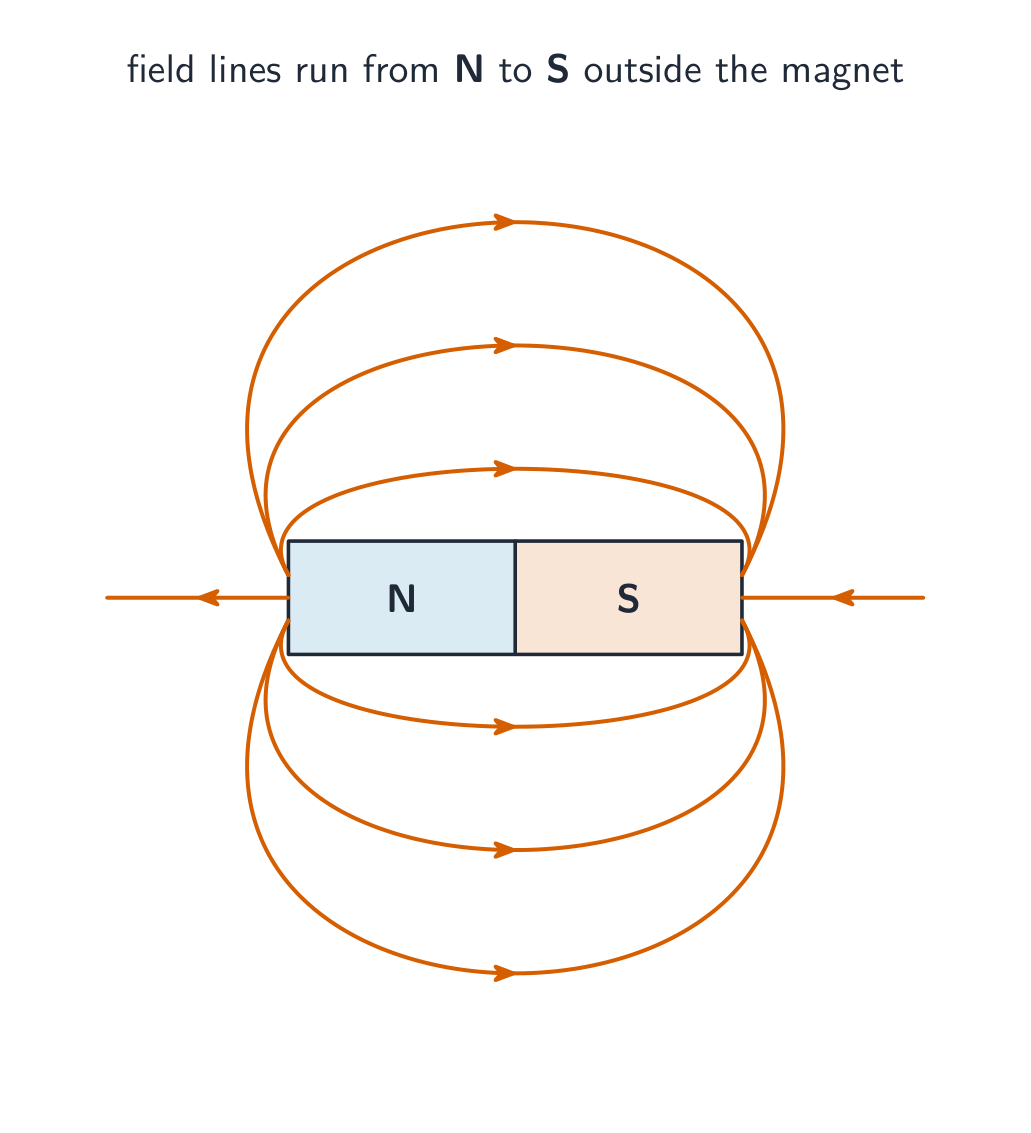
一个磁场(magnetic field)$\vec{B}$ 是一个围绕磁体、移动的电荷和电流的矢量场(vector field);它决定放在它里面的任何移动电荷上的磁力。磁感线(magnetic field lines)必须形成闭合回路:它们离开北极、返回南极,并继续穿过磁体。更密的线意味着一个更强的场。
场线在一根条形磁体外部从 N 跑向 S 闭合回路是磁的高斯定律的内容,麦克斯韦方程组(Maxwell's equations)的第二个:
$$\oint \vec{B}\cdot d\vec{A}=0.$$通过任何闭合表面的净磁通量是零——离开的场线和进入的一样多。那正是孤立的磁单极子(magnetic monopoles)不存在的陈述。每个磁的源都是一个磁偶极子(magnetic dipole)(一个北-南对),由环流的电荷制造——在材料里,电子的运动。把一根条形磁体切成一半你得到两个更小的偶极子,从不得到一个孤立的极。同种极排斥、相反的极吸引,而一个自由的偶极子——一个指南针(compass)——旋转以与本地场对齐。地球自己的场大致是一个偶极子,这就是为什么一个指南针工作。偶极子场随距离减弱。
一种材料如何对一个外部场反应取决于它内部偶极子如何表现:
- 铁磁性(ferromagnetic)(铁、镍、钴):一个外部场对齐整个磁畴(magnetic domains),而在场被移除后对齐留存——一个永磁体。
- 顺磁性(paramagnetic)(铝、钛):偶极子与场弱地对齐但在它被移除时松弛。
- 抗磁性(diamagnetic)(所有材料):电子结构产生一个通常弱的、与场相反的对齐。
一种材料反应的强度是它的磁导率(magnetic permeability)。自由空间有常数值 $\mu_0$(真空磁导率);物质的磁导率不同于 $\mu_0$,甚至不恒定——它随温度、取向和场强变化。

An aurora: charged particles from the Sun are steered by Earth's magnetic field toward the poles 探索See a magnet's field lines
Magnetic field lines run from north to south outside a magnet; where they crowd together the field is strongest.
词汇表 训练英文 中文 拼音 magnetic field/mæɡˈnetɪk fiːld/ 磁场 cí chǎng vector field/ˈvektə fiːld/ 矢量场 shǐ liàng chǎng magnetic field lines/mæɡˈnetɪk fiːld laɪnz/ 磁感线 cí gǎn xiàn Maxwell's equations/ˈmækswelz ɪˈkweɪʒnz/ 麦克斯韦方程组 mài kè sī wéi fāng chéng zǔ magnetic monopoles/mæɡˈnetɪk ˈmɒnəʊpəʊlz/ 磁单极子 cí dān jí zi magnetic dipole/mæɡˈnetɪk ˈdaɪpəʊl/ 磁偶极子 cí ǒu jí zi compass/ˈkʌmpəs/ 指南针 zhǐ nán zhēn Ferromagnetic/ˌferəməɡˈnetɪk/ 铁磁性 tiě cí xìng magnetic domains/mæɡˈnetɪk dəˈmeɪnz/ 磁畴 cí chóu Paramagnetic/ˌpærəməɡˈnetɪk/ 顺磁性 shùn cí xìng Diamagnetic/ˌdaɪəməɡˈnetɪk/ 抗磁性 kàng cí xìng magnetic permeability/mæɡˈnetɪk ˌpɜːməˈbɪlɪti/ 磁导率 cí dǎo lǜ 12.2
磁性与运动电荷
大纲
Learning Objective Essential Knowledge 12.2.A
Describe the magnetic field produced by moving charged objects.- 12.2.A.1 A single moving charged object produces a magnetic field.
- 12.2.A.1.i The magnetic field at a particular point produced by a moving charged object depends on the object's velocity and the distance between the point and the object.
- 12.2.A.1.ii At a point in space, the direction of the magnetic field produced by a moving charged object is perpendicular to both the velocity of the object and the position vector from the object to that point in space and can be determined using the right-hand rule.
- 12.2.A.1.iii The magnitude of the magnetic field is a maximum when the velocity vector and the position vector from the object to that point in space are perpendicular.
12.2.B
Describe the force exerted on moving charged objects by a magnetic field.- 12.2.B.1 A magnetic field will exert a force on a charged object moving within that field, with magnitude and direction that depend on the cross-product of the charge's velocity and the magnetic field.
- Equation: $\vec{F}_B = q\left(\vec{v} \times \vec{B}\right)$
- 12.2.B.2 In a region containing both a magnetic field and an electric field, a moving charged object will experience independent forces from each field.
- 12.2.B.3 The Hall effect describes the potential difference created in a conductor by an external magnetic field that has a component perpendicular to the direction of charges moving in the conductor.
来源:美国大学理事会 AP 课程与考试说明
磁场中的运动电荷 一个移动的电荷做两件事:它创造一个磁场,而它在一个外部场里感受一个力。它在一点创造的场垂直于(perpendicular)它的速度和从电荷到点的位置矢量两者(又是右手定则),而在那两者垂直的地方最大——在运动的正前方或正后方为零。
一个在场 $\vec{B}$ 里移动的电荷上的力是叉积
$$\vec{F}_B=q\,\vec{v}\times\vec{B},\qquad F=qvB\sin\theta,$$垂直于 $\vec{v}$ 和 $\vec{B}$ 两者——把你右手的手指沿 $\vec{v}$ 指、朝 $\vec{B}$ 卷曲,而拇指给出一个正电荷上的力(对负的反转它)。因为 $\vec{F}_B\perp\vec{v}$,磁力对电荷不做功:它改变方向、从不改变速率。
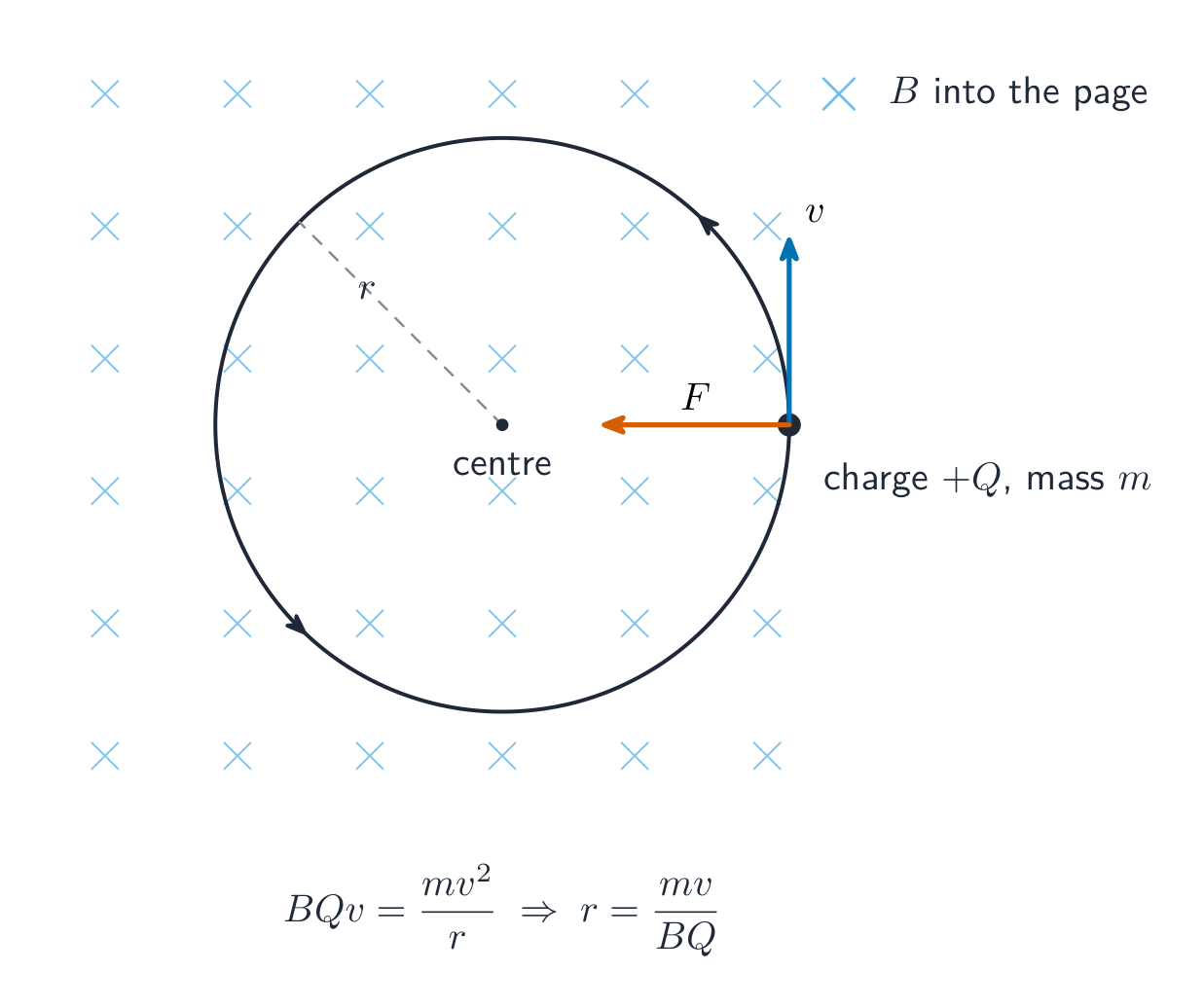
因此一个垂直于一个均匀场移动的电荷以一个圆行进,磁力供应向心力(centripetal force):
$$qvB=\frac{mv^2}{r}\quad\Rightarrow\quad r=\frac{mv}{qB},\qquad T=\frac{2\pi m}{qB}.$$注意周期 $T$ 不取决于速率——更快的粒子在相同的时间里乘更大的圆。
一个横穿一个磁场移动的带电粒子遵循一条圆形路径 Worked example. 一个质子($q=1.6\times10^{-19}\ \text{C}$,$m=1.67\times10^{-27}\ \text{kg}$)以 $2.0\times10^{5}\ \text{m/s}$、垂直于它进入一个 $0.50\ \text{T}$ 的场。磁力 $F=qvB=1.6\times10^{-14}\ \text{N}$ 把它弯曲成一个半径 $r=\dfrac{mv}{qB}=\dfrac{1.67\times10^{-27}(2.0\times10^{5})}{1.6\times10^{-19}(0.50)}=4.2\times10^{-3}\ \text{m}$ 的圆。
在一个既有电场又有磁场的区域里,这两个力独立地作用并作为矢量相加。平衡它们制造一个速度选择器(velocity selector):以 $\vec{E}$ 和 $\vec{B}$ 交叉,只有 $qE=qvB$ 即 $v=E/B$ 的电荷直接通过。霍尔效应(Hall effect)是一个导体里面相同的物理:一个带垂直于电流分量的场把移动的载流子横向推,电荷在一个面上积累,而一个可测量的电势差跨导体出现——它的符号揭示载流子是正的还是负的。
探索Force on a moving charge
A charge moving through a magnetic field feels a force $F=qvB$ at right angles to both its velocity and the field — the basis of the motor effect. Reverse either and the force flips.
词汇表 训练英文 中文 拼音 perpendicular/ˌpɜːpənˈdɪkjʊlə/ 垂直 chuí zhí centripetal force/senˈtrɪpɪtl fɔːs/ 向心力 xiàng xīn lì velocity selector/vəˈlɒsɪti sɪˈlektə/ 速度选择器 sù dù xuǎn zé qì Hall effect/hɔːl ɪˈfekt/ 霍尔效应 huò ěr xiào yìng 12.3
载流导线的磁场与毕奥-萨伐尔定律
大纲
Learning Objective Essential Knowledge 12.3.A
Describe the magnetic field produced by a current-carrying wire.- 12.3.A.1 The Biot-Savart law defines the magnitude and direction of a magnetic field created by an electrical current.
- Equation: $d\vec{B} = \dfrac{\mu_0}{4\pi} \dfrac{I(d\vec{\ell} \times \hat{r})}{r^2}$
- 12.3.A.2 The magnetic field vectors around a small segment of a current-carrying wire are tangent to concentric circles centered on that wire. The field has no component toward, away from, or parallel to the segment of the current-carrying wire.
- 12.3.A.3 The Biot-Savart law can be used to derive the magnitudes and directions of magnetic fields around segments of current-carrying wires, for example at the center of a circular loop of wire.
- Equation: $B_{\text{center of loop}} = \dfrac{\mu_0 I}{2R}$
12.3.B
Describe the force exerted on current-carrying wires by a magnetic field.- 12.3.B.1 A magnetic field will exert a force on a current-carrying wire.
- Equation: $\vec{F}_B = \int I\left(d\vec{\ell} \times \vec{B}\right)$
Boundary statement: AP Physics C: Electricity & Magnetism only expects students to perform quantitative analysis of certain cases of current-carrying conductors using the Biot-Savart law, such as at a location along the perpendicular bisector of a straight conductor, at a location along the central axis of a circular loop, or at the center of a segment of a circular loop.
来源:美国大学理事会 AP 课程与考试说明
电流周围的磁场 一个电流是移动电荷的一股流,所以它创造一个磁场。毕奥-萨伐尔定律(Biot–Savart law)加起每个电流元素的场:
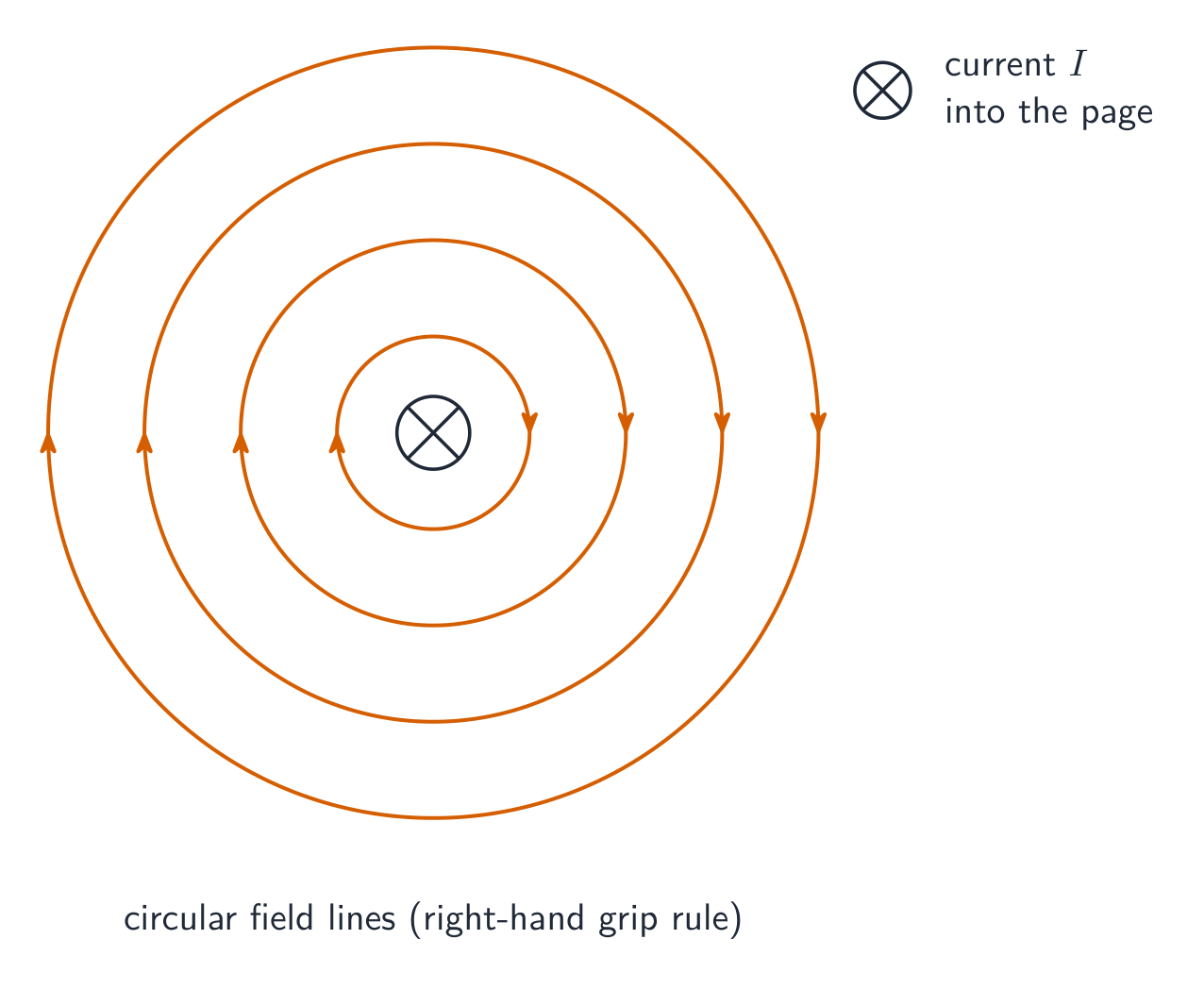
$$d\vec{B}=\frac{\mu_0}{4\pi}\frac{I\,d\vec{l}\times\hat{r}}{r^2}.$$围绕任何直的段场矢量相切(tangent)于以导线为中心的同心圆(concentric circles)——没有朝向、离开或沿导线的分量。把你右手绕导线卷曲,拇指沿电流:你的手指给出场方向。
同心的圆形场线围绕一根直的载流导线 AP 期望的毕奥-萨伐尔积分:一根长直导线($B=\dfrac{\mu_0 I}{2\pi r}$,或一条有限导线的垂直平分线上的一点),和一个圆形环的中心,
$$B_{\text{centre of loop}}=\frac{\mu_0 I}{2R},$$其中每个元素 $d\vec{l}$ 垂直于 $\hat{r}$ 并等距 $R$ ——在一个 FRQ 推导里说那个。一段是一个完整圆的分数的弧在它的中心贡献 $\mu_0 I/2R$ 的那个相同分数。
一个场也推一根载流导线,一个元素一个元素:
$$\vec{F}_B=\int I\,d\vec{l}\times\vec{B}\qquad(\vec{F}=I\vec{L}\times\vec{B}\ \text{for a straight wire in a uniform field}).$$Worked example. 相距一个距离 $d=0.10\ \text{m}$ 的两根长平行导线各以相同方向携带 $5.0\ \text{A}$。导线 1 在导线 2 处的场是 $B=\dfrac{\mu_0 I}{2\pi d}=1.0\times10^{-5}\ \text{T}$,所以导线 2 感受 $\dfrac{F}{L}=I B=5.0\times10^{-5}\ \text{N/m}$,被拉向导线 1。相同方向的电流吸引;相反的电流排斥。
词汇表 训练英文 中文 拼音 Biot–Savart law/ˈbɪɒt ˈsævɑːt lɔː/ 毕奥-萨伐尔定律 bì ào - sà fá ěr dìng lǜ tangent/ˈtændʒənt/ 相切 xiāng qiè concentric circles/kənˈsentrɪk ˈsɜːklz/ 同心圆 tóng xīn yuán 12.4
安培定律
大纲
Learning Objective Essential Knowledge 12.4.A
Use Ampère's law to describe the magnetic field created by a moving charge carrier.- 12.4.A.1 Ampère's law relates the magnitude of the magnetic field to the current enclosed by a closed imaginary path called an Amperian loop.
- Equation: $\oint \vec{B} \cdot d\vec{\ell} = \mu_0 I_{\text{enc}}$
- 12.4.A.1.i Ampère's law can be used to determine the magnetic field near a long, straight current-carrying wire.
- Equation: $B_{\text{wire}} = \dfrac{\mu_0}{2\pi} \dfrac{I}{r}$
- 12.4.A.1.ii Unless otherwise stated, all solenoids are assumed to be very long, with uniform magnetic fields inside the solenoids and negligible magnetic fields outside the solenoids.
- 12.4.A.1.iii Ampère's law can be used to determine the magnetic field inside of a long solenoid.
- Equation: $B_{\text{sol}} = \mu_0 n I$
- 12.4.A.2 An Amperian loop is a closed path around a current-carrying conductor.
- 12.4.A.3 The principle of superposition can be used to determine the net magnetic field at a point in space created by various combinations of current-carrying conductors, or conducting loops, segments, or cylinders.
- 12.4.A.4 Maxwell's equations are the collection of equations that fully describe electromagnetism. Maxwell's fourth equation is Ampère's law with Maxwell's addition; it states that magnetic fields can be generated by electric current (Ampère's law) and that a changing electric field creates a magnetic field, similar to the way a moving charge creates a magnetic field (Maxwell's addition).
- Equation: $\oint \vec{B} \cdot d\vec{\ell} = \mu_0 I + \mu_0 \varepsilon_0 \dfrac{d\Phi_E}{dt}$
Boundary statement: AP Physics C: Electricity & Magnetism only expects quantitative application of Ampère's law limited to situations involving symmetrical magnetic fields. Long straight wires, long solenoids carrying currents, as well as conductive slabs or cylindrical conductors carrying a current density, are the types of shapes to which Ampère's law will be applied on the AP Physics C: Electricity & Magnetism Exam.
Boundary statement: AP Physics C: Electricity & Magnetism does not expect students to use Maxwell's fourth equation with a changing electric field. However, students should understand that a changing electric field generates a magnetic field.
来源:美国大学理事会 AP 课程与考试说明
对于对称的电流分布,安培定律(Ampère's law)比毕奥-萨伐尔快得多地求场:
$$\oint \vec{B}\cdot d\vec{l}=\mu_0 I_{\text{enc}}.$$选择一个匹配对称的安培环路(Amperian loop),以便 $B$ 沿环路恒定(且平行于它)并从积分里出来。AP 把它应用于长直导线、长螺线管,和携带一个电流密度(current density)的导体(平板和圆柱);组合由叠加(superposition)处理。
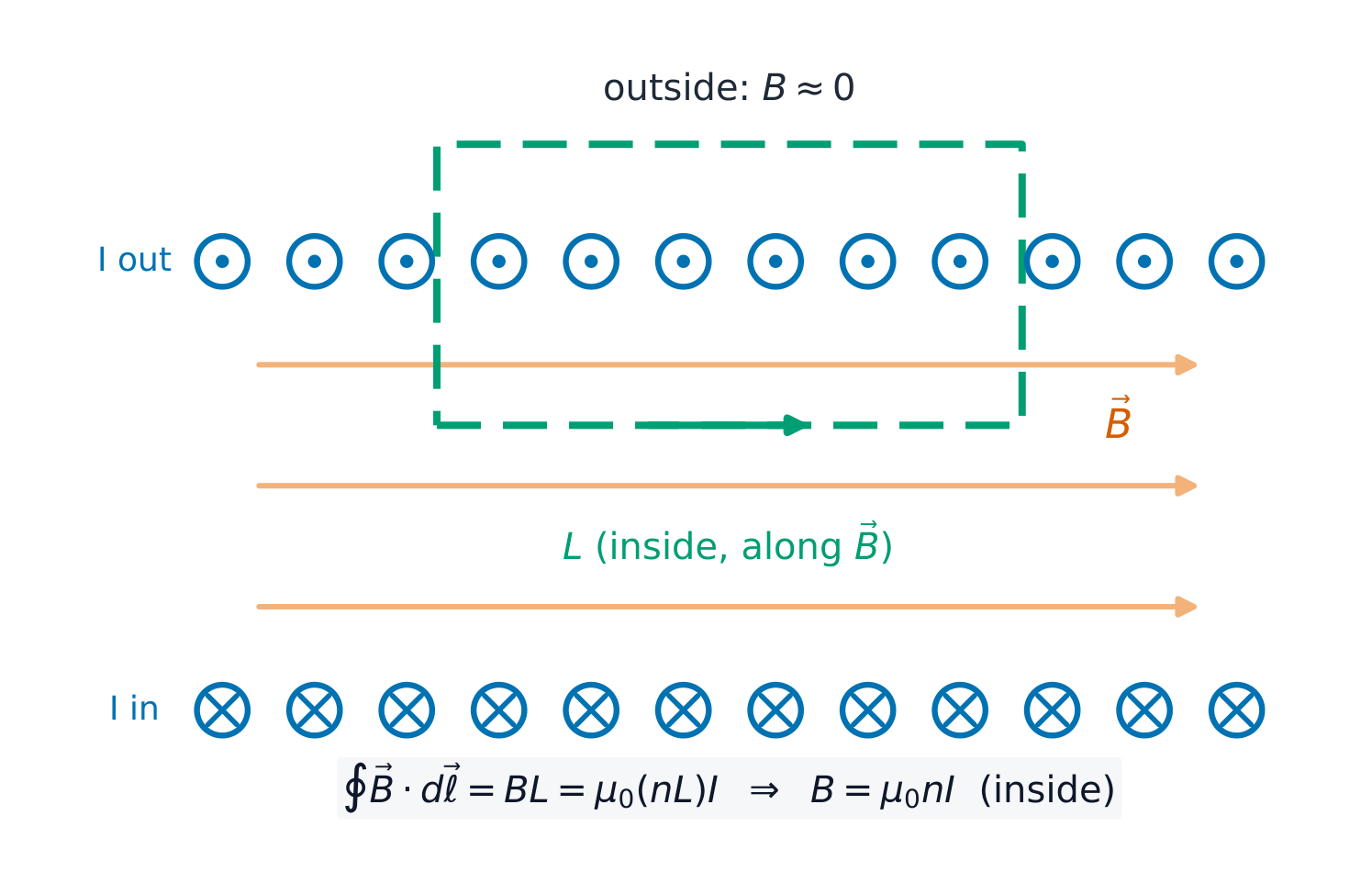
Worked example. 求距一根携带 $5.0\ \text{A}$ 的长导线 $0.10\ \text{m}$ 的场。一个半径 $r$ 的圆形环路共享场的对称,所以 $B(2\pi r)=\mu_0 I$ 而
$$B=\frac{\mu_0 I}{2\pi r}=\frac{(4\pi\times10^{-7})(5.0)}{2\pi(0.10)}=1.0\times10^{-5}\ \text{T}.$$一个长螺线管(solenoid)(假设:里面均匀场、外面可忽略的场)是另一个经典。取一个矩形环路,一边长度 $L$ 在里面、平行于轴:只有那条边贡献于积分,所以 $BL=\mu_0 (nL) I$ 而
$$B_{\text{sol}}=\mu_0 n I,$$$n$ 是每米的匝数。
一个矩形安培环路推导一个螺线管里面的均匀场 Worked example (cylinder). 一个半径 $R$ 的实心圆柱导体携带电流 $I$,均匀地散布在它的横截面上。里面($r
Exam skill. 每个安培定律答案在设置里赢得它的分数:命名环路、陈述为什么 $B$ 沿它恒定且平行(对称),并在你求解之前仔细数 $I_{\text{enc}}$。麦克斯韦的第四个方程增加一个你应当定性地知道的思想:一个变化的电场也创造一个磁场——但 AP 不会要求你用那一项计算。
词汇表 训练英文 中文 拼音 Ampère's law/ˈæmpeəz lɔː/ 安培定律 ān péi dìng lǜ Amperian loop/æmˈpɪərɪən luːp/ 安培环路 ān péi huán lù current density/ˈkʌrənt ˈdensɪti/ 电流密度 diàn liú mì dù superposition/ˌsuːpəpəˈzɪʃn/ 叠加 dié jiā solenoid/ˈsəʊlənɔɪd/ 螺线管 luó xiàn guǎn 12.4
考试技巧
- 磁力 $\vec F=q\vec v\times\vec B$ 垂直于速度——用右手定则并注意它不做功。
- 一个均匀场里的电荷以 $r=\tfrac{mv}{qB}$ 的圆移动。
- 用毕奥-萨伐尔 $d\vec B=\tfrac{\mu_0}{4\pi}\tfrac{I\,d\vec l\times\hat r}{r^2}$ 或当有对称时用安培定律 $\oint \vec B\cdot d\vec l=\mu_0 I_{enc}$ 求电流的场。
- 一根导线上的力是 $\vec F=I\vec L\times\vec B$;把叉积方向保持清楚。
- 把一个电荷上的力与电流创造的场区分开。
- 12.1.A.1 A magnetic field is a vector field that can be used to determine the magnetic force exerted on moving electric charges, electric currents, or magnetic materials.
-
13
电磁感应
13.1
磁通量
大纲
Learning Objective Essential Knowledge 13.1.A
Describe the magnetic flux through an arbitrary area or geometric shape.- 13.1.A.1 For a magnetic field $\vec{B}$ that is constant across an area $\vec{A}$, the magnetic flux through the area is defined as $\Phi_B = \vec{B} \cdot \vec{A}$ .
- 13.1.A.1.i The area vector is defined as perpendicular to the plane of the surface and outward from a closed surface.
- 13.1.A.1.ii The sign of flux is given by the dot product of the magnetic field vector and the area vector.
- 13.1.A.2 The total magnetic flux passing through a surface is defined by the surface integral of the magnetic field over the surface area.
- Equation: $\Phi_B = \displaystyle\int \vec{B} \cdot d\vec{A}$
来源:美国大学理事会 AP 课程与考试说明
磁通量(magnetic flux)测量多少磁场通过一个表面。对于一个通过一个平坦环的均匀场它是点积 $\Phi_B=\vec{B}\cdot\vec{A}=BA\cos\theta$;一般地它是面积分(surface integral)
$$\Phi_B=\int \vec{B}\cdot d\vec{A}.$$面积矢量(area vector)垂直于表面(从一个闭合的向外),而通量的符号来自点积。若 $B$ 变化、面积变化,或环转动,通量就变化——把所有三条路径记在心里,因为每一条都是一个考试问题。
词汇表 训练英文 中文 拼音 Magnetic flux/mæɡˈnetɪk flʌks/ 磁通量 cí tōng liàng surface integral/ˈsɜːfɪs ˈɪntɪɡrəl/ 面积分 miàn jī fēn area vector/ˈeərɪə ˈvektə/ 面积矢量 miàn jī shǐ liàng 13.2
电磁感应
大纲
Learning Objective Essential Knowledge 13.2.A
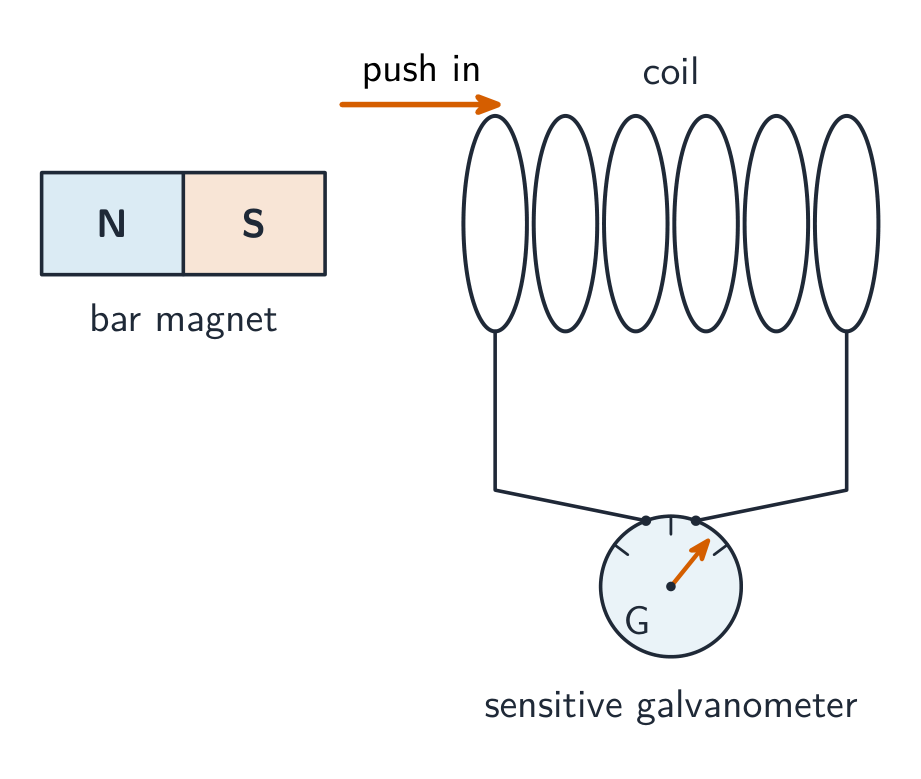
Describe the induced electric potential difference resulting from a change in magnetic flux.- 13.2.A.1 Faraday's law describes the relationship between changing magnetic flux and the resulting induced emf in a system.
- Equation: $\mathcal{E} = -\dfrac{d\Phi_B}{dt} = -\dfrac{d\left(\vec{B} \cdot \vec{A}\right)}{dt}$
- 13.2.A.1.i When the area of the surface being considered is constant, the induced emf is equal to the area multiplied by the rate of change in the component of the magnetic field perpendicular to the surface.
- 13.2.A.1.ii When the magnetic field is constant, the induced emf is equal to the magnetic field multiplied by the rate of change in area perpendicular to the magnetic field.
- 13.2.A.1.iii When an emf is induced in a long solenoid, the total induced emf is equal to the induced emf in a single loop multiplied by the number of loops in the solenoid.
- Equation: $\left|\mathcal{E}_{\text{sol}}\right| = N\left|\dfrac{d\Phi_B}{dt}\right|$
- 13.2.A.2 Lenz's law is used to determine the direction of an induced emf resulting from a changing magnetic flux.
- 13.2.A.2.i An induced emf generates a current that creates a magnetic field that opposes the change in magnetic flux.
- 13.2.A.2.ii The right-hand rule is used to determine the relationships between current, emf, and magnetic flux.
- 13.2.A.3 Maxwell's equations are the collection of equations that fully describe electromagnetism. Maxwell's third equation is Faraday's law of induction, which describes the relationship between a changing magnetic flux and an induced electric field.
- Equation: $\mathcal{E} = \oint \vec{E} \cdot d\vec{\ell} = -\dfrac{d\Phi_B}{dt}$
- 13.2.A.4 Maxwell's equations can be used to show that electric and magnetic fields obey wave equations and that electromagnetic waves travel at a constant speed in free space.
- Equation (derived): $c = \dfrac{1}{\sqrt{\varepsilon_0 \mu_0}}$
Boundary statement: AP Physics C: Electricity & Magnetism does not expect students to mathematically derive the speed of light in free space from Maxwell's equations. This relationship is included above solely as an indication of the further applications, implications, and connections to physical phenomena that students may study in more advanced physics courses.
来源:美国大学理事会 AP 课程与考试说明
电磁感应 一个变化的通量感应一个 电动势(emf)——法拉第定律(Faraday's law):
$$\varepsilon=-\frac{d\Phi_B}{dt}.$$以恒定面积,$\varepsilon=-A\,\dfrac{dB_\perp}{dt}$;以恒定场,$\varepsilon=-B\,\dfrac{dA_\perp}{dt}$。一个 $N$ 匝的线圈使单环 emf 成倍:$|\varepsilon_{\text{sol}}|=N\left|\dfrac{d\Phi_B}{dt}\right|$。
楞次定律(Lenz's law)是负号:感应电流(induced current)流动以使它自己的磁场反对造成它的通量的变化。把一个磁体推向一个环,环推回;把它拉开,环把它拉进来。用右手定则(right-hand rule)把"反对变化"变成一个电流方向。
把一个磁体移进一个线圈感应一个驱动一个电流的 emf 一根长度 $L$ 的杆以速率 $v$ 横穿一个场滑动是值得记住的特殊情况——动生电动势(motional emf)$\varepsilon=BLv$。
Worked example. 一根 $0.20\ \text{m}$ 的杆以 $3.0\ \text{m/s}$ 横穿一个 $0.50\ \text{T}$ 的场滑动:$\varepsilon=BLv=0.50(0.20)(3.0)=0.30\ \text{V}$。等价地,若一个单一环的通量在 $0.030\ \text{s}$ 里从 $0.020\ \text{Wb}$ 降到 $0.008\ \text{Wb}$,平均 emf 是 $\varepsilon=\dfrac{0.012}{0.030}=0.40\ \text{V}$。
法拉第定律也是麦克斯韦方程组(Maxwell's equations)的第三个,以一个更深的形式:一个变化的磁通量创造一个环流的电场,$\oint\vec{E}\cdot d\vec{l}=-\dfrac{d\Phi_B}{dt}$ ——那个场是把电荷绕环推的东西。麦克斯韦方程组一起预测以 $c=1/\sqrt{\varepsilon_0\mu_0}$ 行进的电磁波(electromagnetic waves)(你应当知道这个联系,但 AP 不会要求你推导它)。
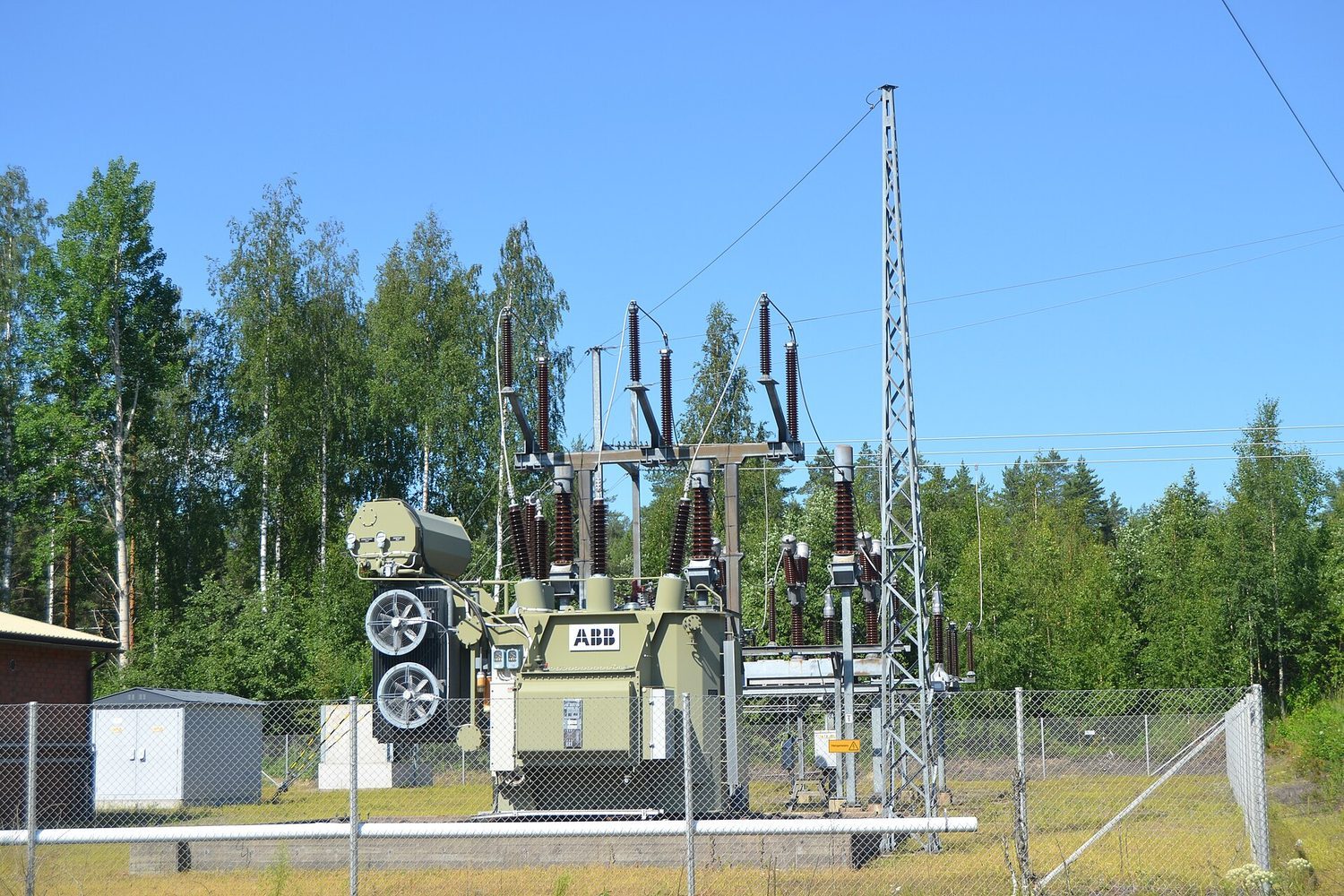
A substation transformer: changing magnetic flux in coils induces the voltages that power the grid 探索Induce a current by moving a magnet
A changing magnetic flux through a coil induces an EMF (Faraday's law); its direction opposes the change (Lenz's law). Move the magnet faster for a bigger EMF.
词汇表 训练英文 中文 拼音 emf/emf/ 电动势 diàn dòng shì Faraday's law/ˈfærədeɪz lɔː/ 法拉第定律 fǎ lā dì dìng lǜ Lenz's law/ˈlentsɪz lɔː/ 楞次定律 léng cì dìng lǜ induced current/ɪnˈdjuːst ˈkʌrənt/ 感应电流 gǎn yìng diàn liú right-hand rule/raɪt hænd ruːl/ 右手定则 yòu shǒu dìng zé motional emf/ˈməʊʃənl emf/ 动生电动势 dòng shēng diàn dòng shì Maxwell's equations/ˈmækswelz ɪˈkweɪʒnz/ 麦克斯韦方程组 mài kè sī wéi fāng chéng zǔ electromagnetic waves/ɪˌlektrəʊməɡˈnetɪk weɪvz/ 电磁波 diàn cí bō 13.3
感应电流与磁力
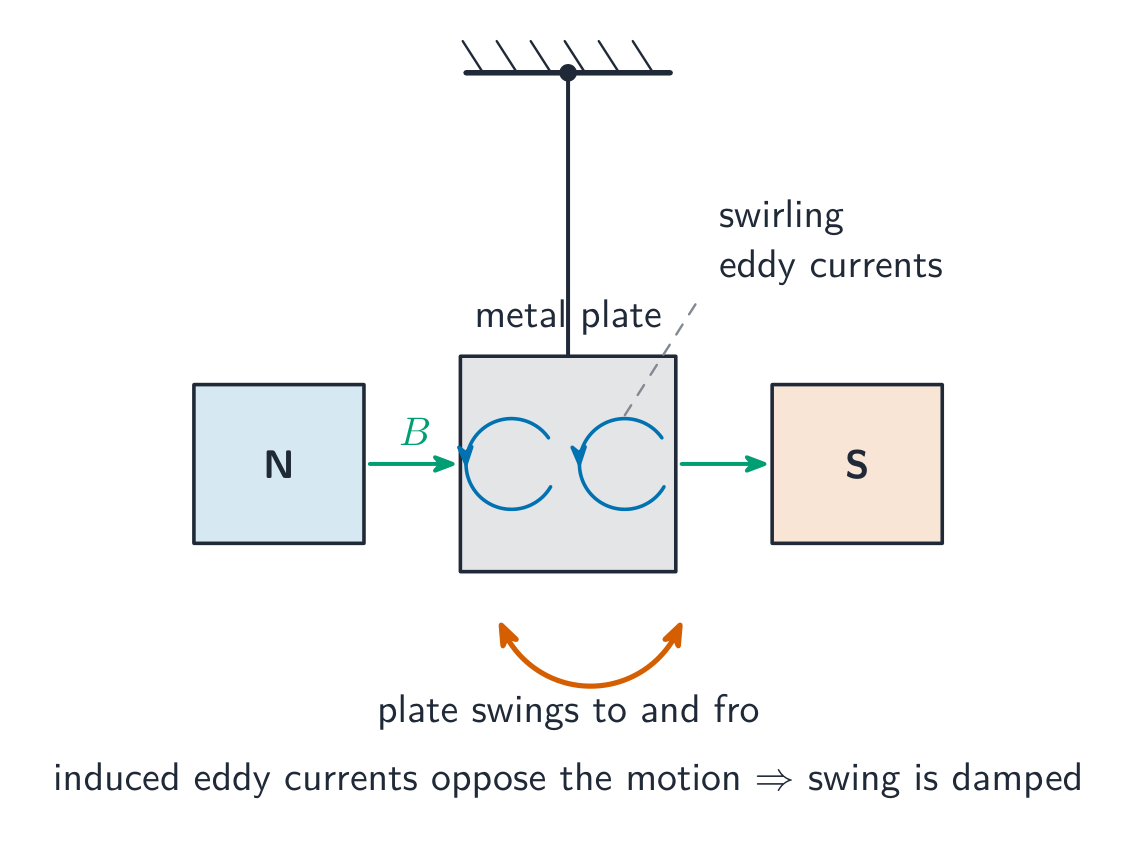
大纲
Learning Objective Essential Knowledge 13.3.A
Describe the force exerted on a conductor due to the interaction between an external magnetic field and an induced current within that conductor.- 13.3.A.1 When an induced current is created in a conductive loop, the already-present magnetic field will exert a magnetic force on the moving charge carriers within the loop.
- Equation: $\vec{F}_B = \displaystyle\int I\left(d\vec{\ell} \times \vec{B}\right)$
- 13.3.A.2 When current is induced in a conducting loop, magnetic forces are only exerted on the segments of the loop that are within the external magnetic field. These magnetic forces may cause translational or rotational acceleration.
- 13.3.A.3 The force on a conducting loop is proportional to the induced current in the loop, which depends on the rate of change of magnetic flux, the resistance of the loop, and the velocity of the loop.
- 13.3.A.4 Newton's second law can be applied to a conducting loop moving in a magnetic field as it experiences an induced emf.
来源:美国大学理事会 AP 课程与考试说明
一旦一个感应电流流动,外部场对它施加力($\vec{F}=\int I\,d\vec{l}\times\vec{B}$)——而由楞次定律那些力总是抵抗造成感应的运动。只有实际在场里面的环的段感受一个力,它能使一个环加速、旋转,或制动。这是涡电流(eddy currents)制动的起源,而你能对一个移动的环或杆像任何其他力学问题一样应用牛顿第二定律。
感应涡电流反对运动,快速地衰减一个在场里摆动的金属板 经典的设置是一根在由一个电阻连接的导电轨道上滑动的杆:

一根在轨道上滑动的杆:感应电流感受一个反对运动的力 Worked example (the full chain). 相距 $L=0.20\ \text{m}$、电阻 $R=0.60\ \Omega$ 的轨道坐在一个指入页面的 $0.50\ \text{T}$ 的场里。杆被以恒定的 $3.0\ \text{m/s}$ 推。那么:$\varepsilon=BLv=0.30\ \text{V}$;$I=\varepsilon/R=0.50\ \text{A}$;场以 $F=BIL=0.50(0.50)(0.20)=0.050\ \text{N}$ 推回杆。推力以 $P=Fv=0.15\ \text{W}$ 做功——恰好是电阻里耗散的 $P=I^2R=0.15\ \text{W}$。机械功变成电能:那是一个发电机(generator),而能量守恒。没有推力被释放,杆指数地减慢:$ma=-\dfrac{B^2L^2}{R}v$。
Exam skill. FRQ 走这个确切的链条:通量 $\to$ emf $\to$ 电流 $\to$ 力 $\to$ 牛顿第二定律。分别写每个环节并在最后用楞次定律检查方向。
词汇表 训练英文 中文 拼音 eddy currents/ˈedi ˈkʌrənts/ 涡电流 wō diàn liú generator/ˈdʒenəreɪtə/ 发电机 fā diàn jī 13.4
电感
大纲
Learning Objective Essential Knowledge 13.4.A
Describe the physical and electrical properties of an inductor.- 13.4.A.1 Inductance is the tendency of a conductor to oppose a change in electrical current.
- 13.4.A.1.i Inductance of a conductor depends on the physical properties of the conductor. Straight wires are typically modeled as having zero inductance.
- 13.4.A.1.ii An inductor, such as a solenoid, is a circuit element that has significant inductance.
- 13.4.A.1.iii The inductance of a solenoid is dependent on the total number of turns, the length of the solenoid, the cross-sectional area of the solenoid, and magnetic permeability of the solenoid's core.
- Equation: $L_{\text{sol}} = \dfrac{\mu_{\text{core}} N^2 A}{\ell}$
- 13.4.A.2 Inductors store energy in the magnetic field that is generated by current in the inductor.
- Equation: $U_L = \dfrac{1}{2} L I^2$
- 13.4.A.2.i The energy stored in the magnetic field generated by an inductor in which current is flowing can be dissipated through a resistor or used to charge a capacitor.
- 13.4.A.2.ii The transfer of energy generated in an inductor to other forms of energy obeys conservation laws.
- 13.4.A.3 By applying Faraday's law to an inductor and using the definition of inductance, induced emf can be related to inductance and the rate of change of current.
- Equation: $\mathcal{E}_i = -L\dfrac{dI}{dt}$
来源:美国大学理事会 AP 课程与考试说明
电感(inductance)是一个导体反对它自己电流变化的倾向:变化的电流改变它自己的通量,它自感一个 emf。由法拉第定律,
$$\varepsilon=-L\frac{dI}{dt}.$$一个电感器(inductor)是一个被建来有大电感的电路元件——通常是一个螺线管(solenoid),那里几何给出
$$L_{\text{sol}}=\frac{\mu_{\text{core}}N^2A}{\ell},$$$N$ 是总匝数、$A$ 是面积、$\ell$ 是长度,而 $\mu_{\text{core}}$ 是芯的磁导率(magnetic permeability)。(直导线被建模为有零电感。)一个携带电流 $I$ 的电感器在它的磁场里储存能量:
$$U_L=\tfrac{1}{2}LI^2,$$它后来能在一个电阻里耗散或移进一个电容器——能量守恒像往常一样适用。
词汇表 训练英文 中文 拼音 inductance/ɪnˈdʌktəns/ 电感 diàn gǎn inductor/ɪnˈdʌktə/ 电感器 diàn gǎn qì solenoid/ˈsəʊlənɔɪd/ 螺线管 luó xiàn guǎn magnetic permeability/mæɡˈnetɪk ˌpɜːməˈbɪlɪti/ 磁导率 cí dǎo lǜ 13.5
含电阻与电感的电路(LR 电路)
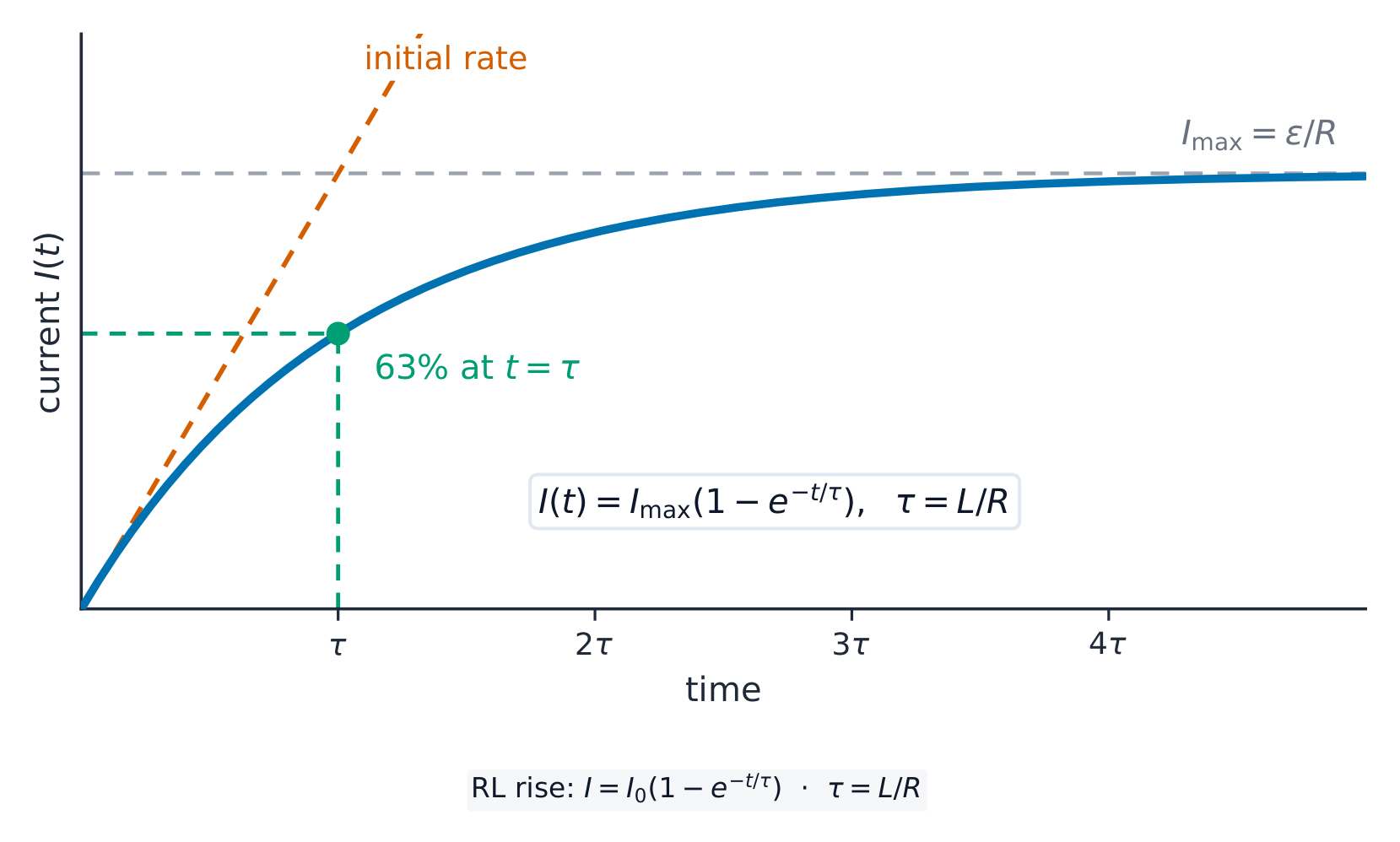
大纲
Learning Objective Essential Knowledge 13.5.A
Describe the physical and electrical properties of a circuit containing a combination of resistors and a single inductor.- 13.5.A.1 A resistor will dissipate energy that was stored in an inductor as the current changes.
- 13.5.A.2 Kirchhoff's loop rule can be applied to a series LR circuit with a battery of emf $\mathcal{E}$, resulting in a differential equation that describes the current in the loop.
- Equation (derived): $\mathcal{E} = IR + L\dfrac{dI}{dt}$
- 13.5.A.3 The time constant is a significant feature of the behavior of an LR circuit.
- 13.5.A.3.i The time constant of a circuit is a measure of how quickly an LR circuit will reach a steady state and is described with the equation $\tau = \dfrac{L}{R_{\text{eq}}}$ .
- 13.5.A.3.ii The time constant represents the time an LR circuit would take to reach a steady state if the system continued to change at the initial rate of change.
- 13.5.A.3.iii For an inductor that has zero initial current, the time constant represents the time required for the current in the inductor to reach approximately 63 percent of its final asymptotic value.
- 13.5.A.3.iv For an inductor with an initial current, the time constant represents the time required for the current in the inductor to reach approximately 37 percent of its initial value.
- 13.5.A.4 The electric properties of inductors change during the time interval in which the current in the inductor changes, but will exhibit steady state behavior after a long time interval.
- 13.5.A.4.i When a switch is initially closed or opened in a circuit containing an inductor, the induced emf will be equal in magnitude and opposite in direction to the applied potential difference across the branch containing the inductor.
- 13.5.A.4.ii The potential difference across an inductor, the current in the inductor, and the energy stored in the inductor are exponential with respect to time and have asymptotes that are determined by the initial conditions of the circuit.
- 13.5.A.4.iii After a time much greater than the time constant of the circuit, an inductor will behave as a conducting wire with zero resistance.
来源:美国大学理事会 AP 课程与考试说明
在一个 RL电路(RL circuit)里,一个电池 $\varepsilon$、电阻 $R$ 和电感器 $L$ 串联的基尔霍夫回路定则给出一个微分方程(differential equation):
$$\varepsilon=IR+L\frac{dI}{dt}\quad\Rightarrow\quad I(t)=\frac{\varepsilon}{R}\big(1-e^{-t/\tau}\big),\qquad \tau=\frac{L}{R}.$$时间常数(time constant)$\tau$ 设定节奏:一个 $\tau$ 后一个上升的电流达到约它最终值的 $63\%$(一个衰减的落到 $37\%$);它也是这个变化以初始速率会取的时间。学两个极限——它们回答大多数概念问题:
- 开关刚闭合后($t=0$):电流不能跳跃,所以电感器暂时阻挡它,自感一个与施加的电势差大小相等、方向相反的 emf。
- 很久之后($t\gg\tau$):电流稳定,$dI/dt=0$,而电感器表现为一根普通的导线——与一个电容器恰好相反。
一个 RL 电路里的电流指数地上升,在一个时间常数达到 63% Worked example. $\varepsilon=12\ \text{V}$、$R=6.0\ \Omega$、$L=3.0\ \text{H}$:最终电流 $\varepsilon/R=2.0\ \text{A}$、$\tau=L/R=0.50\ \text{s}$。在 $t=0.50\ \text{s}$ 电流是 $2.0(1-e^{-1})\approx1.3\ \text{A}$。在 $t=0$ 电感器的电势差是完整的 $12\ \text{V}$;随着 $t\to\infty$ 它落到零。电流、电感器电压和储存的能量都在时间上是指数的。
词汇表 训练英文 中文 拼音 RL circuit/ˌɑː ˈel ˈsɜːkɪt/ RL电路 RL diàn lù differential equation/ˌdɪfəˈrenʃl ɪˈkweɪʒn/ 微分方程 wēi fēn fāng chéng time constant/taɪm ˈkɒnstənt/ 时间常数 shí jiān cháng shù 13.6
含电容与电感的电路(LC 电路)
大纲
Learning Objective Essential Knowledge 13.6.A
Describe the physical and electrical properties of a circuit containing a combination of capacitors and a single inductor.- 13.6.A.1 In circuits containing only a charged capacitor and an inductor (LC circuits), the maximum current in the inductor can be determined using conservation of energy within the circuit.
- 13.6.A.2 In LC circuits, the time dependence of the charge stored in the capacitor can be modeled as simple harmonic motion.
- Equation (derived): $\dfrac{d^2 q}{dt^2} = -\dfrac{1}{LC} q$
- 13.6.A.3 The angular frequency of an oscillating LC circuit can be derived from the differential equation that describes an LC circuit.
- Equation (derived): $\omega = \dfrac{1}{\sqrt{LC}}$
来源:美国大学理事会 AP 课程与考试说明
LC 电路:能量像弹簧一样来回振荡 一个 LC电路(LC circuit)没有电阻,所以什么都不耗散能量:它振荡(oscillates),在电容器的电场和电感器的磁场之间晃动能量。回路定则给出
$$\frac{d^2q}{dt^2}=-\frac{1}{LC}\,q,$$与一个弹簧上的质量相同的方程——简谐运动(simple harmonic motion),电荷扮演位移的角色而
$$\omega=\frac{1}{\sqrt{LC}}.$$总能量 $\dfrac{q^2}{2C}+\tfrac12LI^2$ 保持恒定:在最大电荷时全在电容器里,在最大电流时全在电感器里。
Worked example. $L=2.0\ \text{H}$、$C=8.0\ \mu\text{F}$:$\omega=\dfrac{1}{\sqrt{2.0(8.0\times10^{-6})}}=250\ \text{rad/s}$,周期 $T=2\pi/\omega\approx0.025\ \text{s}$。若电容器开始充电到 $12\ \text{V}$,那么 $U=\tfrac12CV^2=5.8\times10^{-4}\ \text{J}$,而最大电流由 $\tfrac12LI_{\max}^2=U$ 得出:$I_{\max}=\sqrt{2U/L}=0.024\ \text{A}$ —— 能量守恒(conservation of energy),不需要微积分。
词汇表 训练英文 中文 拼音 LC circuit/ˌel ˈsiː ˈsɜːkɪt/ LC电路 LC diàn lù oscillates/ˈɒsɪleɪts/ 振荡 zhèn dàng simple harmonic motion/ˈsɪmpl hɑːˈmɒnɪk ˈməʊʃn/ 简谐运动 jiǎn xié yùn dòng conservation of energy/ˌkɒnsəˈveɪʃn ɒv ˈenədʒi/ 能量守恒 néng liàng shǒu héng 13.6
考试技巧
- 计算通量 $\Phi_B=\int \vec B\cdot d\vec A$ 并从法拉第定律 $\varepsilon=-\tfrac{d\Phi_B}{dt}$ 得到感应 EMF。
- 用楞次定律(负号)固定方向:感应电流反对通量的变化。
- 通量以三种方式变化——变化的 $B$、变化的面积,或变化的角度——辨别哪种并求导。
- 对于一根长度 $L$ 以速率 $v$ 移动的杆,动生 EMF 是 $BLv$。
- 一个电感器储存能量 $\tfrac12 LI^2$ 并抵抗电流的变化(RL 时间常数 $\tau=L/R$)。
- 13.1.A.1 For a magnetic field $\vec{B}$ that is constant across an area $\vec{A}$, the magnetic flux through the area is defined as $\Phi_B = \vec{B} \cdot \vec{A}$ .