- understand that an electric field is an example of a field of force and define electric field as force per unit positive charge
- recall and use $F = qE$ for the force on a charge in an electric field
- represent an electric field by means of field lines
电场
A-Level 物理 · 第 18 主题
 11:03
11:03
Electric Fields
Deep inside a storm cloud, charge is building. Negative charge gathers at the base, positive charge on the ground below. Between them, in the empty air, an…
英文讲解 · 内嵌中英文字幕
18.1
电场与电场线

大纲
来源:剑桥国际大纲
电场(electric field)是一个电荷会感受到来自其他电荷的力(force)的区域。某点的电场强度(electric field strength)$E$ 是放在那里的一个小的正检验电荷(test charge)所受的每单位正电荷的力:
$$E = \frac{F}{q}.$$
单位:$\text{N C}^{-1}$(与 $\text{V m}^{-1}$ 相同,我们将看到)。$E$ 是一个矢量(vector),指向力对一个正电荷作用的方向。一个电荷 $q$ 所受的力是
$$F = qE,$$
若 $q$ 为负则与场相反。
两分定义。 某点的电场强度是放在该点的一个小(检验)电荷所受的每单位正电荷的力。 三个词拿分:每单位电荷的力(不是"电荷受的力")、正(确定方向)、小或检验(使电荷不扰动它所测量的场)。选择题版本会给出"作用在一个小质量上的每单位电荷的力"和"每单位质量的力"作干扰项:场是用电荷定义的,决不是质量。
例题。 一个质子在电场中以 $2.00\ \text{m s}^{-2}$ 加速,没有其他力作用。求场强。($m_{\text{p}} = 1.67 \times 10^{-27}\ \text{kg}$,$e = 1.60 \times 10^{-19}\ \text{C}$。)
$qE = ma$,所以
$$E = \frac{m a}{q} = \frac{(1.67 \times 10^{-27})(2.00)}{1.60 \times 10^{-19}} = 2.09 \times 10^{-8}\ \text{V m}^{-1} = 20.9\ \text{nV m}^{-1}.$$
同样的变形反过来给出电子在 $1500\ \text{V m}^{-1}$ 场中的加速度:$a = eE/m_{\text{e}} = (1.60 \times 10^{-19})(1500)/(9.11 \times 10^{-31}) = 2.6 \times 10^{14}\ \text{m s}^{-2}$,极其巨大,因为电子的质量非常小。重力($9.81\ \text{m s}^{-2}$)与之相比可以忽略,这就是为什么关于板间电子的考题忽略重量。
场线
-
场线(field lines)指向力对一个正检验电荷作用的方向。
-
场线始于正电荷,终于负电荷(或去向无穷远)。
-
场线决不相交;场线越密表示场越强。
-
每条线都带箭头;场线与导体表面垂直相交。
场线代表什么。 被问到"说明一条电场线代表什么"时,两半都要给出:它的方向表示放在该处的一个正电荷所受力的方向,场线的疏密表示场的强弱(线越密,场越强)。一张草图正是按这些点评分的:画出箭头、场线不相交、匀强场处等间距、点电荷或球的场线呈径向。
例子:一个正点电荷(point charge)有向外指的径向线;一个负的有向内指的线;两个异号电荷(一个偶极子(dipole))有从 + 弯向 − 的线;两块平行带电板给出等间距平行线的匀强场(uniform field)。

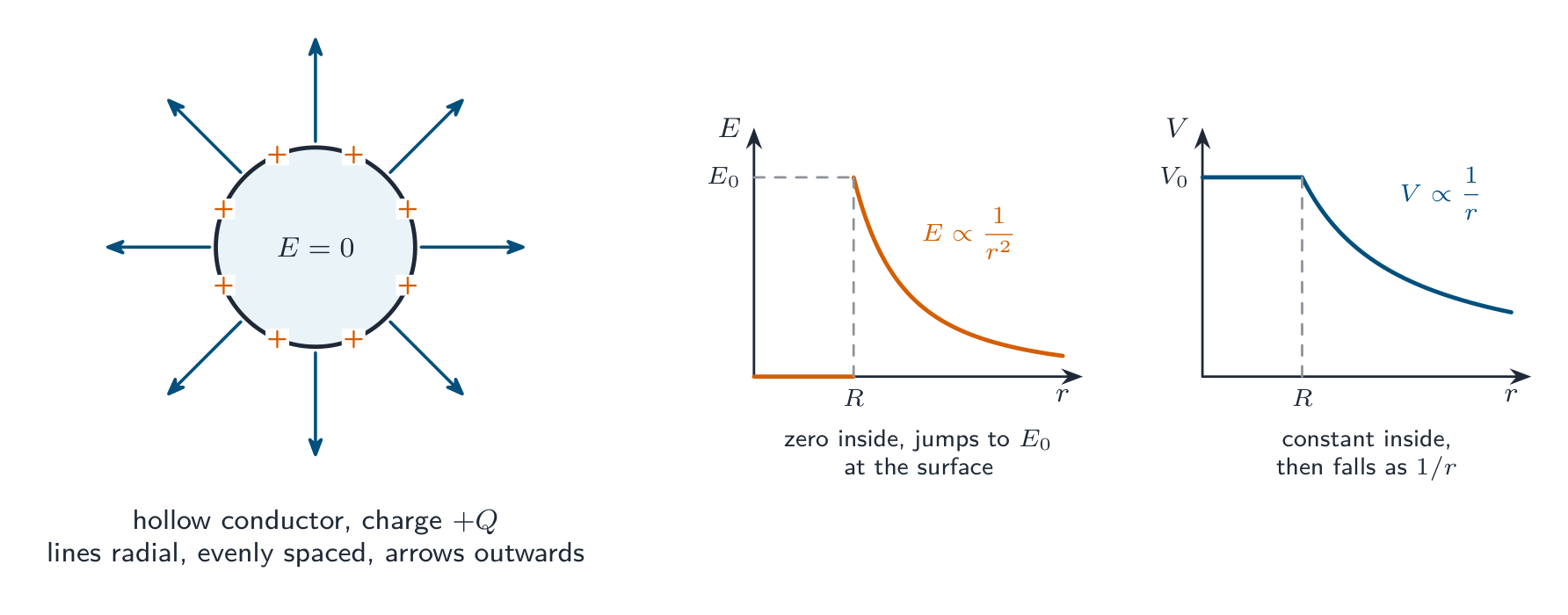
带电导体球
孤立(isolated)导体(conductor)上的电荷位于它的外表面,若球单独存在则均匀分布。球外的场线呈径向、等间距并指向外(对正电荷),正是球心处一个点电荷的图样。在空心(或实心)导体内部场为零:所有表面电荷的场在内部处处相抵,所以没有场线进入。随之而来的两张图都是考试常客。场强 $E$ 直到半径 $R$ 都为零,在表面跳到它的表面值 $E_0$,然后按 $1/r^{2}$ 下降;电势 $V$ 在内部恒定(场为零意味着电势梯度为零),然后按 $1/r$ 下降。
读图。 给定一个带电球的 $E$–$x$ 图,半径是 $E$ 从零跳起的距离,电荷可由曲线上任一点求出:$Q = 4\pi\varepsilon_{0} r^{2} E$。给定"表面处为 $E_0$",则 $2R$ 处的值是 $E_0/4$,$3R$ 处是 $E_0/9$:让曲线经过这些点,从表面线上的 $E_0$ 开始,决不从原点开始。

探索
Electric fields
E ∝ Q / r²
A charge sets up a radial field — out for +, in for −, obeying the inverse-square law.
词汇表
训练
| 英文 | 中文 | 拼音 |
|---|---|---|
| electric field/ɪˈlektrɪk fiːld/ | 电场 | diàn chǎng |
| force/fɔːs/ | 力 | lì |
| electric field strength/ɪˈlektrɪk fiːld streŋθ/ | 电场强度 | diàn chǎng qiáng dù |
| test charge/test tʃɑːdʒ/ | 检验电荷 | jiǎn yàn diàn hè |
| vector/ˈvektə/ | 矢量 | shǐ liàng |
| field lines/fiːld laɪnz/ | 场线 | chǎng xiàn |
| field line/fiːld laɪn/ | 场线 | chǎng xiàn |
| conductor/kənˈdʌktə/ | 导体 | dǎo tǐ |
| point charge/pɔɪnt tʃɑːdʒ/ | 点电荷 | diǎn diàn hè |
| dipole/ˈdaɪpəʊl/ | 偶极子 | ǒu jí zi |
| uniform field/ˈjuːnɪfɔːm fiːld/ | 匀强场 | yún qiáng chǎng |
| isolated/ˈaɪsəleɪtɪd/ | 孤立的 | gū lì de |
18.2
匀强电场

大纲
- recall and use $E = \Delta V / \Delta d$ to calculate the field strength of the uniform field between charged parallel plates
- describe the effect of a uniform electric field on the motion of charged particles
来源:剑桥国际大纲
在相距 $d$、之间有电势差(potential difference)$V$ 的两块平行板之间,场是匀强的(除边缘效应外),大小为
$$E = \frac{V}{d}.$$
它从电势较高的板指向较低的板。单位 $\text{V m}^{-1}$ 直接由此而来,并等于 $\text{N C}^{-1}$。
例题。 相距 $5.0\ \text{mm}$ 的两块平行板之间有 $200\ \text{V}$ 的电势差。求场强,以及间隙中一个电子所受的力。($e = 1.6 \times 10^{-19}\ \text{C}$。)
$$E = \frac{V}{d} = \frac{200}{5.0 \times 10^{-3}} = 4.0 \times 10^{4}\ \text{V m}^{-1}, \qquad F = qE = (1.6 \times 10^{-19})(4.0 \times 10^{4}) = 6.4 \times 10^{-15}\ \text{N}.$$
什么会改变场? 只有两件事:若增大电势差或把板移近,$E = V/d$ 就增大。与电源串联的一个电阻什么也不改变:板充电后没有电流流动,所以电阻两端没有电势差,板处于电源的全部电压。在 $+800\ \text{V}$ 和 $+1300\ \text{V}$ 的板之间,场从较高电势指向较低电势;两个正电势并不改变方向规则。
匀强场中的带电粒子
匀强场中的电荷 $q$ 感受到一个恒力 $F = qE$,所以一个恒定加速度 $a = qE/m$——就像匀强重力场中的一个质量。
- 从静止释放,它沿场加速(正电荷)或逆场加速(负电荷),获得动能(kinetic energy)。
- 垂直于场进入,它沿一条抛物线(parabolic)路径运动——像重力中的一个抛体(projectile)。这就是阴极射线管(cathode-ray tube)从前偏转它的束的方法。

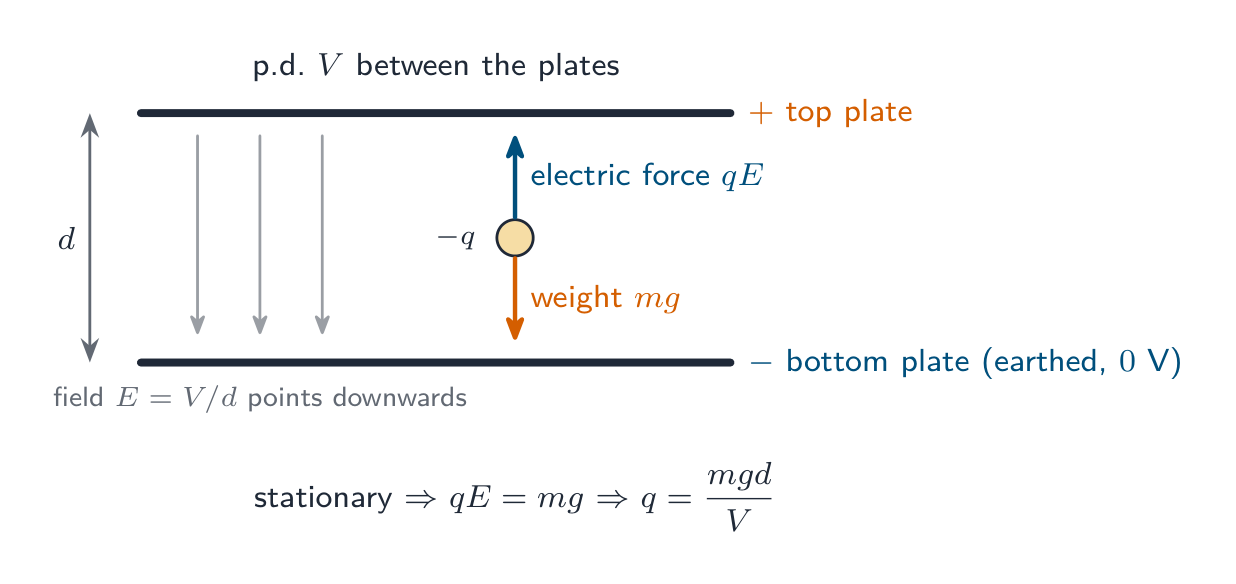
两个力,不是一个。 在水平板之间"保持静止"的带电油滴是考试最喜欢的平衡(equilibrium):作用在它上面的既有电力也有它的重量(选择题的干扰项是"只有电力"),而且二者大小相等、方向相反。对一个负油滴,电力与场方向相反,所以要托住它,顶板必须是正的。
例题。 一个质量为 $2.6 \times 10^{-15}\ \text{kg}$ 的油滴带电 $-4.8 \times 10^{-19}\ \text{C}$,在真空中相距 $2.0\ \text{cm}$ 的水平板之间保持静止。求两板间的电势差,并说明哪块板为正。
$$qE = mg \;\Rightarrow\; \frac{qV}{d} = mg \;\Rightarrow\; V = \frac{m g d}{q} = \frac{(2.6 \times 10^{-15})(9.81)(0.020)}{4.8 \times 10^{-19}} = 1.1 \times 10^{3}\ \text{V}.$$
油滴带负电,所以它受的力与场相反;要使力向上,场必须指向下,所以顶板为正。注意电荷是 $3e$,三个多余电子,这正是密立根证明电荷以 $e$ 的整数倍出现的方法。
例题。 真空中两块平行板相距 $0.041\ \text{m}$,两板间电势差为 $250\ \text{V}$。一个电子在负板处从静止释放。求 (a) 场强,(b) 电子受的力及其加速度,(c) 它到达正板所需的时间,(d) 它到达时的动能。($m_{\text{e}} = 9.11 \times 10^{-31}\ \text{kg}$。)
(a) $E = V/d = 250/0.041 = 6.1 \times 10^{3}\ \text{V m}^{-1}$。 (b) $F = eE = (1.60 \times 10^{-19})(6.1 \times 10^{3}) = 9.8 \times 10^{-16}\ \text{N}$;$a = F/m_{\text{e}} = 1.07 \times 10^{15}\ \text{m s}^{-2}$,指向正板。 (c) 从静止以恒定加速度运动,$d = \tfrac{1}{2} a t^{2}$,所以 $t = \sqrt{2d/a} = \sqrt{2 \times 0.041 / (1.07 \times 10^{15})} = 8.8 \times 10^{-9}\ \text{s}$。 (d) 能量法,不需要运动学:$E_{\text{k}} = qV = (1.60 \times 10^{-19})(250) = 4.0 \times 10^{-17}\ \text{J}$,所以 $v = \sqrt{2E_{\text{k}}/m_{\text{e}}} = 9.4 \times 10^{6}\ \text{m s}^{-1}$。(检验:$v = at = (1.07 \times 10^{15})(8.8 \times 10^{-9}) = 9.4 \times 10^{6}\ \text{m s}^{-1}$。)
例题(偏转)。 一个以 $2.0 \times 10^{7}\ \text{m s}^{-1}$ 水平运动的电子进入相距 $18\ \text{mm}$、电势差为 $400\ \text{V}$ 的两块水平板之间的场。板长 $30\ \text{mm}$。求电子离开场时的偏转(deflection)。
水平运动不受影响:在场中的时间 $t = 0.030/(2.0 \times 10^{7}) = 1.5 \times 10^{-9}\ \text{s}$。竖直方向,$a = eE/m_{\text{e}} = eV/(m_{\text{e}} d) = (1.60 \times 10^{-19})(400)/[(9.11 \times 10^{-31})(0.018)] = 3.9 \times 10^{15}\ \text{m s}^{-2}$,所以偏转 $y = \tfrac{1}{2} a t^{2} = \tfrac{1}{2}(3.9 \times 10^{15})(1.5 \times 10^{-9})^{2} = 4.4 \times 10^{-3}\ \text{m}$,小于 $9\ \text{mm}$ 的半间隙,所以电子确实离开了场。离开时的竖直速度为 $at = 5.9 \times 10^{6}\ \text{m s}^{-1}$,所以它以 $\tan\theta = 5.9/20$、即约 $16°$ 的角度离开;路径是一条抛物线,而在板之后(没有场)它沿离开时的方向做直线运动。
探索
Uniform electric field lab
Follow how a charge behaves between parallel plates.
词汇表
训练
| 英文 | 中文 | 拼音 |
|---|---|---|
| potential difference/pəˈtenʃl ˈdɪfrəns/ | 电势差 | diàn shì chā |
| kinetic energy/kɪˈnetɪk ˈenədʒi/ | 动能 | dòng néng |
| parabolic/ˌpærəˈbɒlɪk/ | 抛物线 | pāo wù xiàn |
| projectile/prəˈdʒektaɪl/ | 抛体 | pāo tǐ |
| cathode-ray tube/ˈkæθəʊd reɪ tjuːb/ | 阴极射线管 | yīn jí shè xiàn guǎn |
| equilibrium/ˌiːkwɪˈlɪbrɪəm/ | 平衡 | píng héng |
| deflection/dɪˈflekʃn/ | 偏转 | piān zhuǎn |
18.3
点电荷间的电场力

大纲
- understand that, for a point outside a spherical conductor, the charge on the sphere may be considered to be a point charge at its centre
- recall and use Coulomb’s law $F = Q_1Q_2 / (4\pi\varepsilon_0 r^2)$ for the force between two point charges in free space
来源:剑桥国际大纲
对于自由空间中相距 $r$ 的两个点电荷 $Q_{1}$ 和 $Q_{2}$,每个感受到大小为下式的力
$$F = \frac{Q_{1} Q_{2}}{4\pi\varepsilon_{0} r^{2}}.$$
这就是库仑定律(Coulomb's law)。这里 $\varepsilon_{0} = 8.85 \times 10^{-12}\ \text{F m}^{-1}$ 是真空电容率(permittivity of free space),$1/(4\pi\varepsilon_{0}) \approx 9.0 \times 10^{9}\ \text{N m}^{2}\ \text{C}^{-2}$。力沿连接电荷的连线:同号电荷相斥,异号电荷相吸。
用文字表述定律。 "表述库仑定律"要的是一句话,不是公式:两个点电荷之间的(电)力与电荷的乘积成正比,与它们间距的平方成反比。 两个比例关系都要,而且电荷必须是真空中的点电荷(或视为球心处点电荷的球)。
例题。 求相距 $4.0\ \text{cm}$ 放置的 $+2.0\ \text{nC}$ 和 $+3.0\ \text{nC}$ 点电荷之间的静电力。($1/(4\pi\varepsilon_{0}) = 9.0 \times 10^{9}\ \text{N m}^{2}\ \text{C}^{-2}$。)
$$F = \frac{Q_{1}Q_{2}}{4\pi\varepsilon_{0} r^{2}} = \frac{(9.0 \times 10^{9})(2.0 \times 10^{-9})(3.0 \times 10^{-9})}{(0.040)^{2}} \approx 3.4 \times 10^{-5}\ \text{N (repulsive).}$$
例题。 氢原子中的质子和电子可视为相距 $120\ \text{pm}$ 的点电荷。求它们之间的电力,并与它们的引力相比较。($m_{\text{p}} = 1.67 \times 10^{-27}\ \text{kg}$,$m_{\text{e}} = 9.11 \times 10^{-31}\ \text{kg}$,$G = 6.67 \times 10^{-11}\ \text{N m}^{2}\ \text{kg}^{-2}$。)
$$F_{\text{E}} = \frac{e^{2}}{4\pi\varepsilon_{0} r^{2}} = \frac{(8.99 \times 10^{9})(1.60 \times 10^{-19})^{2}}{(1.20 \times 10^{-10})^{2}} = 1.6 \times 10^{-8}\ \text{N}.$$
这是吸引力。引力:$F_{\text{G}} = G m_{\text{p}} m_{\text{e}}/r^{2} = (6.67 \times 10^{-11})(1.67 \times 10^{-27})(9.11 \times 10^{-31})/(1.20 \times 10^{-10})^{2} = 7.0 \times 10^{-48}\ \text{N}$,小了约 $10^{39}$ 倍。在原子内部,引力无关紧要。
例题。 真空中两个相同的油滴,球心相距 $3.8 \times 10^{-6}\ \text{m}$。每个带相同的电荷,它们以 $1.0 \times 10^{-15}\ \text{N}$ 的力相斥。求每个油滴的电荷,以及它所带多余电子的数目。
$$F = \frac{Q^{2}}{4\pi\varepsilon_{0} r^{2}} \;\Rightarrow\; Q = \sqrt{4\pi\varepsilon_{0} F r^{2}} = \sqrt{\frac{(1.0 \times 10^{-15})(3.8 \times 10^{-6})^{2}}{8.99 \times 10^{9}}} = 1.3 \times 10^{-18}\ \text{C},$$
即 $1.3 \times 10^{-18}/1.60 \times 10^{-19} \approx 8$ 个电子。带同号电荷的相同物体总是相斥;方向不要写成"吸引"。
例题。 一个带电球 X 固定在绝缘支架上。第二个球 Y 质量为 $2.0\ \text{g}$,用绝缘线悬挂在它旁边,达到平衡时线与竖直方向成 $12°$,球心与 X 的球心相距 $5.0\ \text{cm}$,处于同一水平高度。求 Y 所受的电力,以及若两球带等量电荷,每球的电荷。
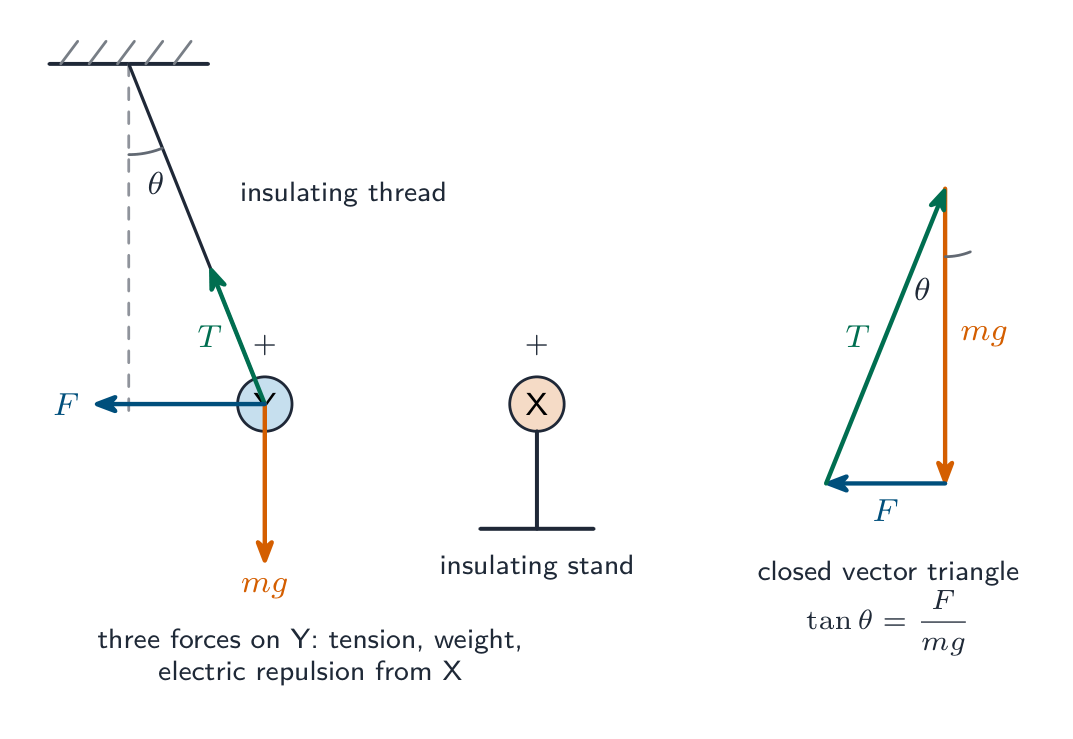
三个力作用在 Y 上:重量 $mg$(向下)、张力(tension)$T$(沿线)和电力 $F$(水平,背离 X,因为同号电荷相斥)。分解,$T\cos\theta = mg$ 和 $T\sin\theta = F$,所以
$$F = mg\tan\theta = (2.0 \times 10^{-3})(9.81)\tan 12° = 4.2 \times 10^{-3}\ \text{N}.$$
然后 $F = Q^{2}/(4\pi\varepsilon_{0} r^{2})$ 给出 $Q = \sqrt{4\pi\varepsilon_{0} F r^{2}} = \sqrt{(4.2 \times 10^{-3})(0.050)^{2}/(8.99 \times 10^{9})} = 3.4 \times 10^{-8}\ \text{C}$。三个力的闭合矢量三角形是同样好的方法;考试两种都接受,但必须画出全部三个力。
例题(氦)。 氦原子可建模为一个电荷为 $+2e$ 的核,两个电子在半径 $170\ \text{pm}$ 的直径相对的圆轨道上运动。求一个电子所受的合力(resultant force),进而求它的轨道速率。
两个力作用在该电子上:距离 $r$ 处核的吸引,以及远侧距离 $2r$ 处另一个电子的排斥:
$$F_{\text{res}} = \frac{2e^{2}}{4\pi\varepsilon_{0} r^{2}} - \frac{e^{2}}{4\pi\varepsilon_{0} (2r)^{2}} = \frac{e^{2}}{4\pi\varepsilon_{0} r^{2}}\left(2 - \tfrac{1}{4}\right) = 1.75 \times \frac{(8.99 \times 10^{9})(1.60 \times 10^{-19})^{2}}{(1.70 \times 10^{-10})^{2}} = 1.4 \times 10^{-8}\ \text{N},$$
指向核。这个合力就是向心力,$F = m_{\text{e}} v^{2}/r$,所以 $v = \sqrt{F r/m_{\text{e}}} = \sqrt{(1.4 \times 10^{-8})(1.70 \times 10^{-10})/(9.11 \times 10^{-31})} = 1.6 \times 10^{6}\ \text{m s}^{-1}$。陷阱是忘掉第二个电子,或把它放在距离 $r$ 而不是 $2r$ 处。
把球当作点电荷
一个总电荷为 $Q$ 的球形导体(conductor),在外部任何一点给出与位于其中心的点电荷 $Q$ 相同的场(从中心量 $r$)。在一个空心带电导体内部场为零,所以导体是一个等势面(equipotential)。
探索
Coulomb's law
F ∝ Qq / r²
Like charges repel, unlike attract — and the force follows 1/r².
词汇表
训练
| 英文 | 中文 | 拼音 |
|---|---|---|
| Coulomb's law/ˈkuːlɒmz lɔː/ | 库仑定律 | kù lún dìng lǜ |
| permittivity of free space/ˌpɜːmɪˈtɪvəti ɒv friː speɪs/ | 真空电容率 | zhēn kōng diàn róng lǜ |
| tension/ˈtenʃn/ | 张力 | zhāng lì |
| resultant force/rɪˈzʌltənt fɔːs/ | 合力 | hé lì |
| equipotential/ˌiːkwɪpəˈtenʃl/ | 等势面 | děng shì miàn |
18.4
点电荷的电场
大纲
- recall and use $E = Q / (4\pi\varepsilon_0 r^2)$ for the electric field strength due to a point charge in free space
来源:剑桥国际大纲
库仑定律给出两个电荷之间的力。用检验电荷去除它($E = F/q$),你就剩下源电荷 $Q$ 单独的场。距离点电荷 $Q$ 为 $r$ 处的场是
$$E = \frac{Q}{4\pi\varepsilon_{0} r^{2}}.$$
它从正 $Q$ 向外指,朝负 $Q$ 向内指,并按 $1/r^{2}$ 衰减——正如重力场(gravitational field)强度,只是重力总是吸引。对于几个电荷,把场作为矢量和(vector sum)相加。
例题。 地球可视为半径 $6.37 \times 10^{6}\ \text{m}$ 的均匀导体球,表面均匀分布着总电荷 $-4.80 \times 10^{5}\ \text{C}$。求表面处的电场强度,并与那里的重力场强度相比较。($M_{\text{E}} = 5.98 \times 10^{24}\ \text{kg}$。)
$$E = \frac{Q}{4\pi\varepsilon_{0} R^{2}} = \frac{(8.99 \times 10^{9})(4.80 \times 10^{5})}{(6.37 \times 10^{6})^{2}} = 106\ \text{V m}^{-1},$$
方向指向球心(电荷为负)。重力:$g = GM/R^{2} = 9.83\ \text{N kg}^{-1}$,所以 $E/g \approx 11$;用符号表示,$E/g = Q/(4\pi\varepsilon_{0} G M)$,这表明该比值只取决于球的电荷质量比。一个质量为 $m$、电荷为 $q$ 的带电球要在这个场中悬浮,需要 $qE = mg$:$q/m = g/E = 0.093\ \text{C kg}^{-1}$。
例题。 $+4.0\ \text{nC}$ 和 $+1.0\ \text{nC}$ 的点电荷相距 $30\ \text{cm}$。在它们连线上的何处合场为零?
在两电荷之间两个场方向相反;设到 $4.0\ \text{nC}$ 电荷的距离为 $x$。合场为零要求大小相等:
$$\frac{4.0}{x^{2}} = \frac{1.0}{(0.30 - x)^{2}} \;\Rightarrow\; \frac{0.30 - x}{x} = \frac{1}{2} \;\Rightarrow\; x = 0.20\ \text{m},$$
离较大电荷两倍远。对异号电荷,它们之间的场同向,永不相消:零点位于外侧,在较小电荷之外。
探索
Field around a point charge
Change the charge. Field lines point away from positive and toward negative, and crowd together where the field is strongest.
词汇表
训练
| 英文 | 中文 | 拼音 |
|---|---|---|
| gravitational field/ˌɡrævɪˈteɪʃənl fiːld/ | 重力场 | zhòng lì chǎng |
| vector sum/ˈvektə sʌm/ | 矢量和 | shǐ liàng hé |
18.5
电势
大纲
- define electric potential at a point as the work done per unit positive charge in bringing a small test charge from infinity to the point
- recall and use the fact that the electric field at a point is equal to the negative of potential gradient at that point
- use $V = Q / (4\pi\varepsilon_0 r)$ for the electric potential in the field due to a point charge
- understand how the concept of electric potential leads to the electric potential energy of two point charges and use $E_P = Qq / (4\pi\varepsilon_0 r)$
来源:剑桥国际大纲
某点的电势(electric potential)$V$ 是把一个小的正检验电荷从无穷远(infinity)带到那一点所做的每单位正电荷的功:
$$V = \frac{W}{q}.$$
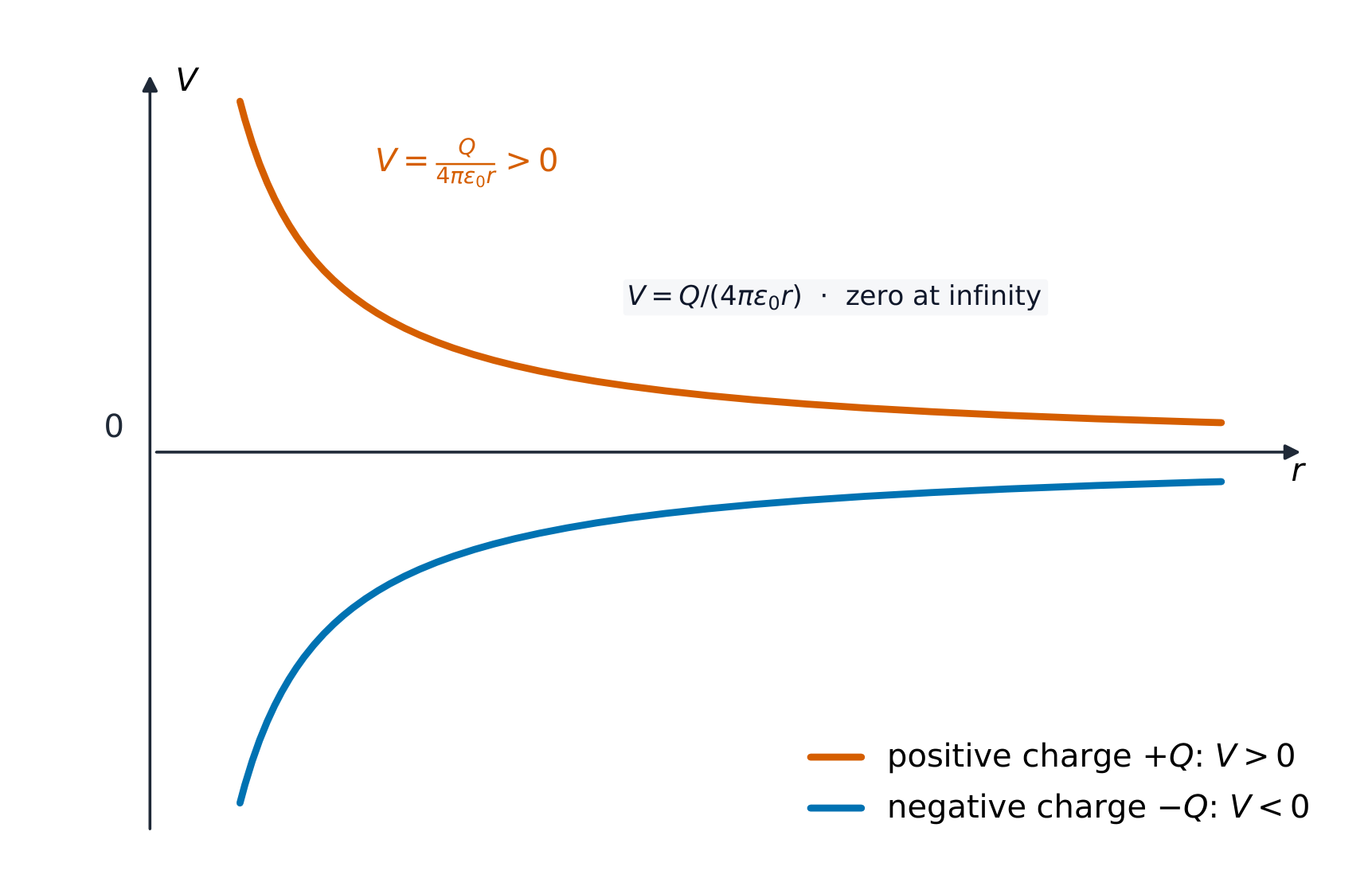
单位:$\text{V}$。电势在无穷远处为零。对于正源电荷,外部处处 $V > 0$;对于负源电荷,$V < 0$。
两分定义。 某点的电势是把一个小的检验电荷从无穷远移到该点时,每单位正电荷所做的功。 分数在于每单位(正)电荷所做的功和从无穷远到该点。正电荷的电势为正,是因为必须对一个正检验电荷做功才能逆着斥力把它推进来;在负电荷附近是场在做功,所以电势为负。"解释为什么孤立质子附近的电势为正"正是用这些话来回答。
点电荷的电势
$$V = \frac{Q}{4\pi\varepsilon_{0} r}.$$
注意这里的 $1/r$(相比场的 $1/r^{2}$)。$V$ 是一个标量(scalar);对于几个电荷,把电势相加(带符号)。
例题。 求距离一个 $+3.0\ \text{nC}$ 点电荷 $4.0\ \text{cm}$ 处的电势。($1/(4\pi\varepsilon_{0}) = 9.0 \times 10^{9}\ \text{N m}^{2}\ \text{C}^{-2}$。)
$$V = \frac{Q}{4\pi\varepsilon_{0} r} = \frac{(9.0 \times 10^{9})(3.0 \times 10^{-9})}{0.040} \approx 6.8 \times 10^{2}\ \text{V}.$$
因为电势是一个标量,几个电荷的电势就是它们的和(各带自己的符号)——没有方向要分解。
一条直线上的两个带电球
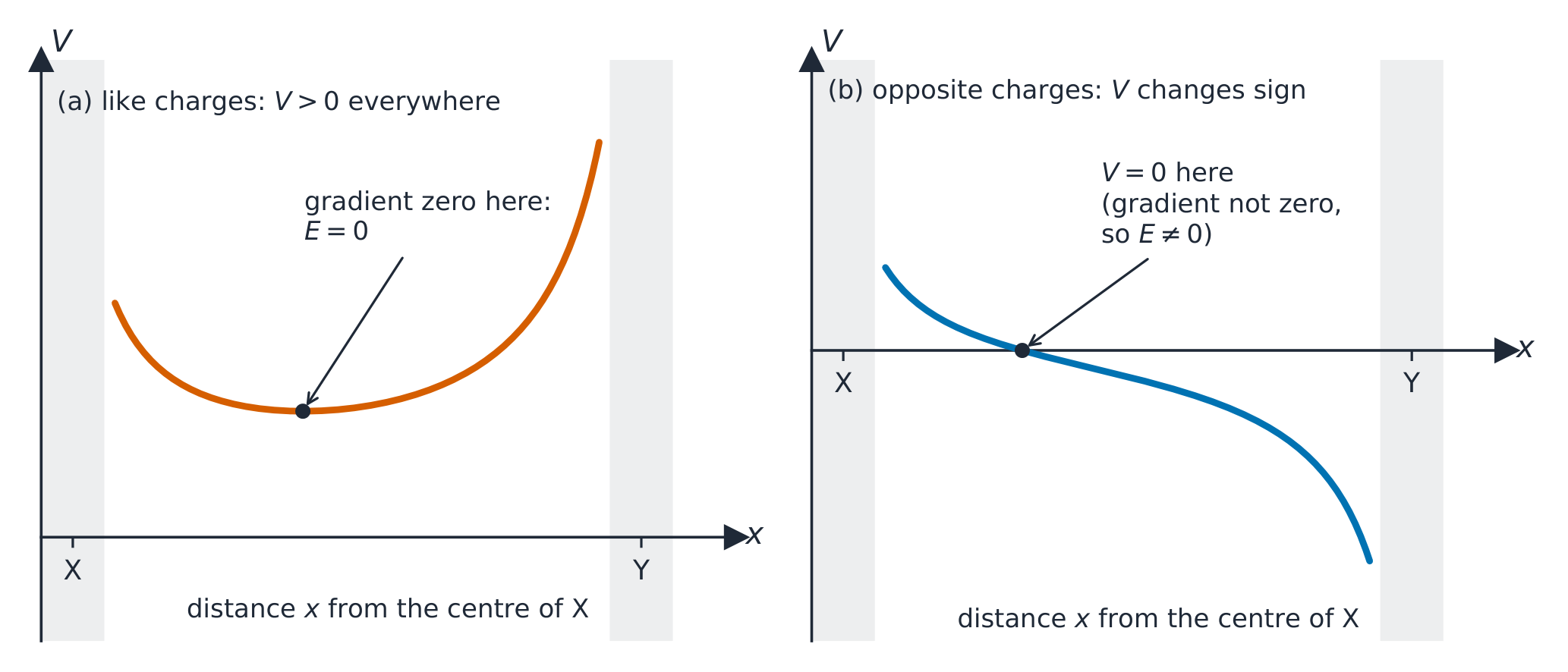
考试最喜欢的结构化题目把两个带电球 X 和 Y 相隔一段距离放置,画出沿它们球心连线的电势 $V$(或要你据此推理)。一切都来自两个事实:电势是带符号相加的标量,而场是图线的负梯度。
- 电荷的符号。 若 $V$ 沿整条线为正,两个电荷都为正;若 $V$ 变号,则电荷异号(靠近正球处为正)。
- 场在何处为零。 在曲线有极小值(梯度为零)处。对同号电荷它位于两者之间、靠近较小电荷:$Q_{\text{X}}/x^{2} = Q_{\text{Y}}/(d - x)^{2}$。对异号电荷,两者之间没有这样的点:曲线在那里过零,但它的梯度不为零,所以场不为零。
- 电荷之比。 在异号电荷之间 $V = 0$ 处,$Q_{\text{X}}/x = Q_{\text{Y}}/(d - x)$:距离直接给出比值。对同号电荷改用极小值(场条件的平方根)。
- 放在 P 点的电荷所受的力。 画一条切线(tangent)读出 P 处的梯度;然后 $E$ 是梯度的负值,$F = qE$。
例题。 真空中两个孤立带电金属球 X 和 Y 的球心相距 $1.2\ \text{m}$。它们之间连线上的电势处处为正,并在距 X 球心 $x = 0.50\ \text{m}$ 处有极小值。给出三个结论,然后求保持在 $x = 0.60\ \text{m}$ 处(该处图线梯度为 $+180\ \text{V m}^{-1}$)的一个质子所受的力。
结论:(1) 两球都带正电,因为电势处处为正;(2) 在 $x = 0.50\ \text{m}$ 处电场为零,那里梯度为零;(3) Y 上的电荷较大,因为零场点更靠近 X;实际上 $Q_{\text{Y}}/Q_{\text{X}} = (0.70/0.50)^{2} = 2.0$。在 $x = 0.60\ \text{m}$ 处:$E = -180\ \text{V m}^{-1}$(指向 X,因为 $V$ 朝 Y 上升),所以 $F = eE = (1.60 \times 10^{-19})(180) = 2.9 \times 10^{-17}\ \text{N}$,指向 X。释放后,质子朝 X 加速,随着梯度变陡其加速度增大;要让它保持静止需要一个外力。
描述运动。 "一个带正电的粒子放在 P 点并释放。描述并解释它的运动。"考官想要:方向(朝较低电势,沿 $V$ 图的下坡);力从而加速度不是恒定的(它跟随梯度,而梯度沿线变化);粒子始终加速,因为力一直沿运动方向。若 P 是零场点,粒子保持静止,处于不稳定平衡:向任一侧轻推都会让它离开。
场与电势的联系
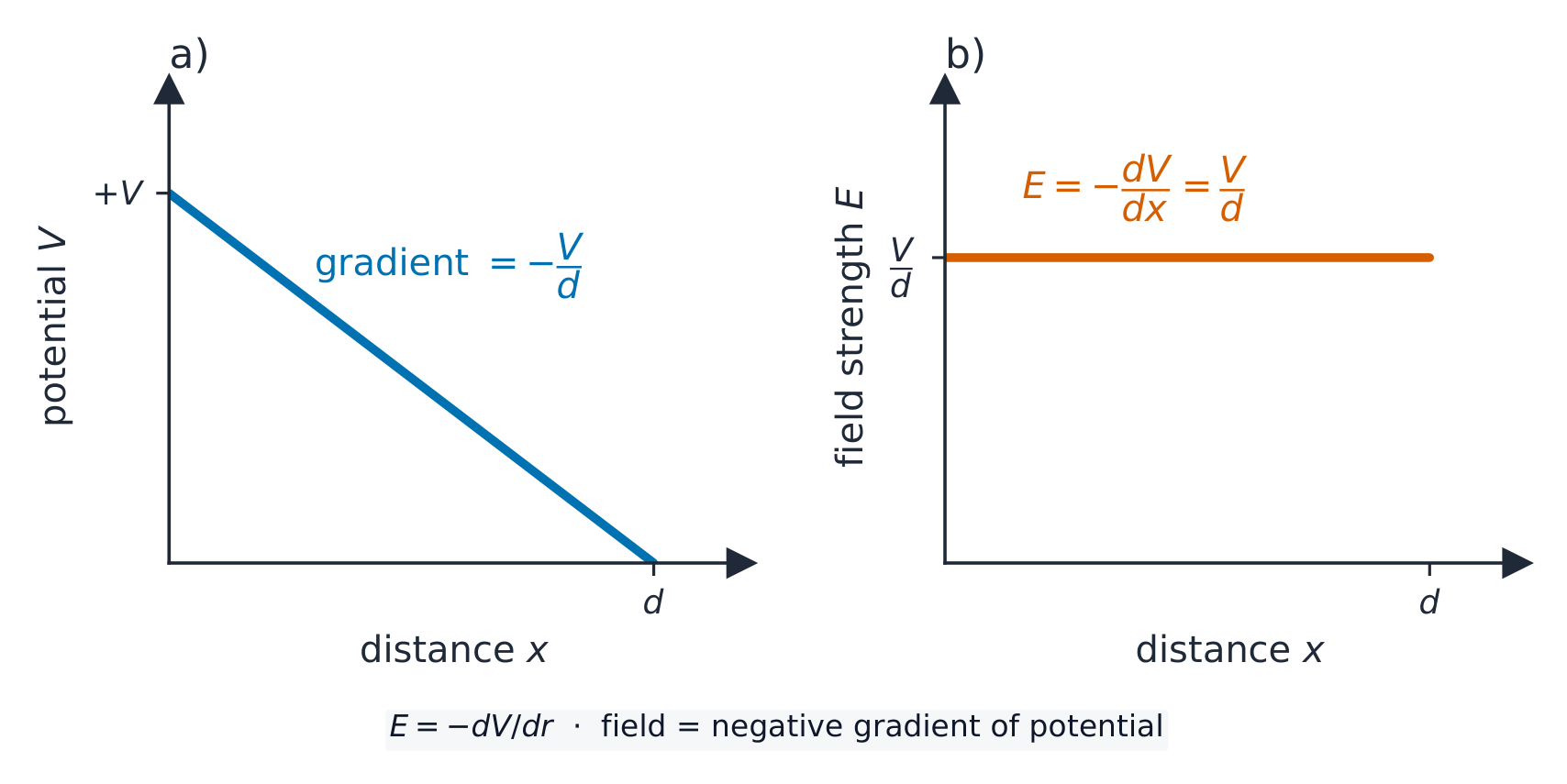
场等于电势梯度(potential gradient)的负值:
$$E = -\frac{dV}{dx}.$$
在平行板之间 $V$ 随位置均匀变化,给出与之前一样的 $E = V/d$。负号意味着场指向较低的电势。对于点电荷,$-\dfrac{dV}{dr} = \dfrac{Q}{4\pi\varepsilon_{0} r^{2}} = E$。
一句话的关系。 "说明电场与电势之间的关系":场强等于电势梯度的负值,$E = -\Delta V/\Delta x$。在 $V$–$x$ 图上,$E$ 是切线梯度的负值;在点电荷的 $V$–$r$ 图上,梯度在靠近电荷处最陡,那里场最强,而 $E$ 的符号由"场指向较低电势"确定。匀强场版本 $E = V/d$ 是同一陈述在梯度恒定时的形式。
等势面。 等势面连接电势相等的点;沿它移动电荷不做功,所以场总是与它垂直。点电荷周围的等势面是同心球面,随 $V$ 下降而越来越稀疏;平行板之间它们是平行于板的平面。导体的表面是一个等势面,这就是为什么场线与它垂直相交。
电势能
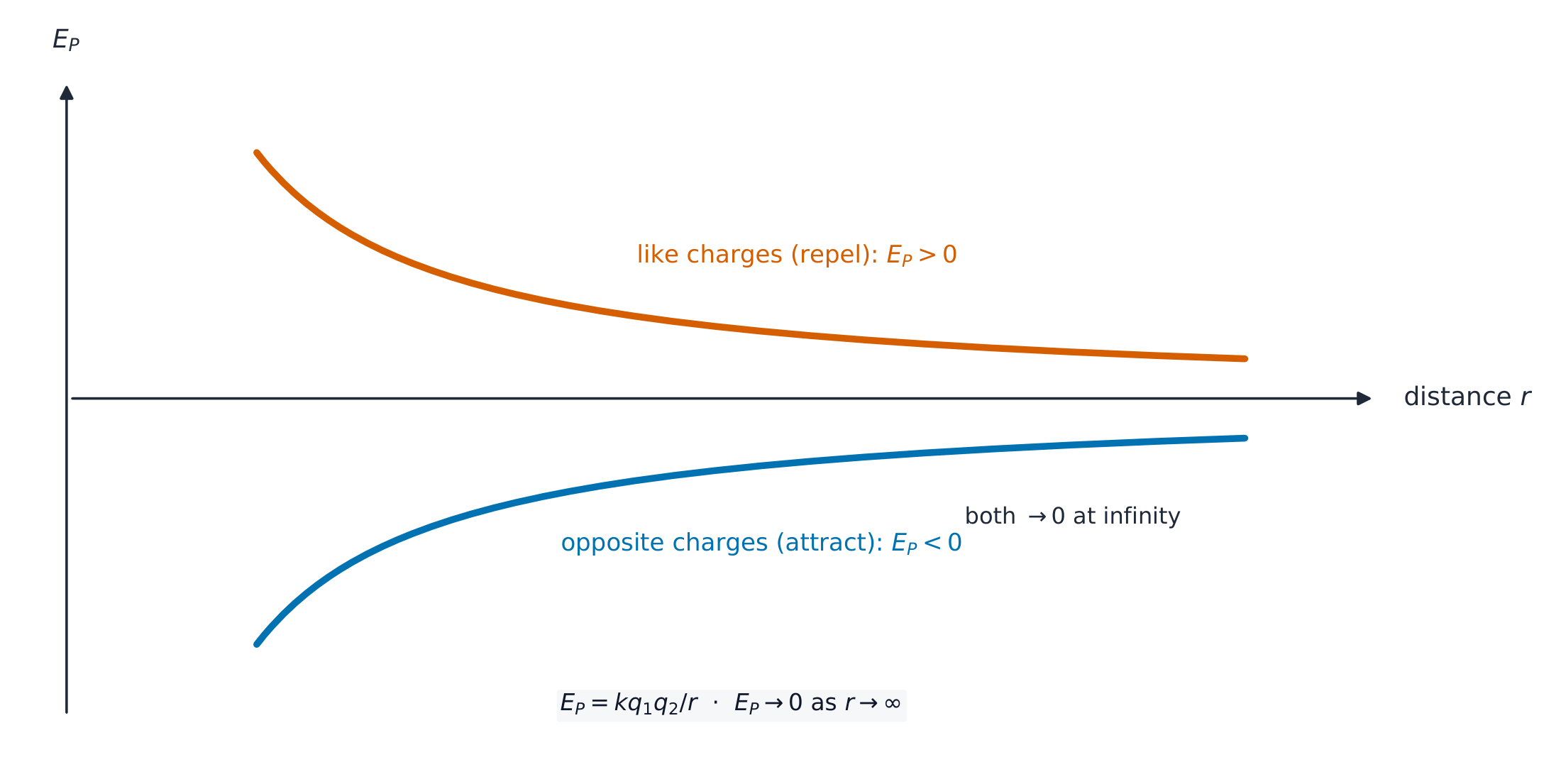
处于电势为 $V$ 的一点的电荷 $q$ 有电势能(electric potential energy)$E_{\text{P}} = qV$。对于相距 $r$ 的两个点电荷 $Q$ 和 $q$:
$$E_{\text{P}} = \frac{Qq}{4\pi\varepsilon_{0} r}.$$
- 同号电荷:$E_{\text{P}} > 0$——储存的能量,如果它们飞开会被释放。
- 异号电荷:$E_{\text{P}} < 0$——一个束缚(bound)系统;必须提供能量才能把它们分开。
两种情况下当 $r \to \infty$ 时 $E_{\text{P}} \to 0$。
例题。 氢原子中的质子和电子相距 $5.3 \times 10^{-11}\ \text{m}$。求这一对的电势能。
$$E_{\text{P}} = \frac{Qq}{4\pi\varepsilon_{0} r} = \frac{(8.99 \times 10^{9})(+1.60 \times 10^{-19})(-1.60 \times 10^{-19})}{5.3 \times 10^{-11}} = -4.3 \times 10^{-18}\ \text{J} = -27\ \text{eV}.$$
负号是答案的一部分:电荷异号,所以必须供给能量($4.3 \times 10^{-18}\ \text{J}$)才能把它们拉开到无穷远。(电子还有大小为其一半的动能,所以使原子电离(ionise)所需的能量是 $13.6\ \text{eV}$;下面的"例题模式"说明了原因。)
电荷通过电势差。 一个电荷 $q$ 通过电势差 $V$ 时,它的势能改变 $qV$,这就是为什么从静止经 $250\ \text{V}$ 加速的电子到达时具有 $250\ \text{eV}$ 的动能,无论场的形状如何。对于选择题"把 P 沿场线移动距离 $x$",所做的功是 $qEx$,若它沿力推的方向移动,其势能减小。
例题模式
一个电子(electron)在距离 $r$ 处绕一个电荷为 $+Ze$ 的原子核(nucleus)运行。库仑吸引提供向心力(centripetal force):
$$\frac{Z e^{2}}{4\pi\varepsilon_{0} r^{2}} = \frac{m_{e} v^{2}}{r}, \qquad v = \sqrt{\frac{Z e^{2}}{4\pi\varepsilon_{0} m_{e} r}}.$$
总能量是动能加势能:
$$E_{\text{total}} = \tfrac{1}{2} m_{e} v^{2} - \frac{Z e^{2}}{4\pi\varepsilon_{0} r} = -\frac{Z e^{2}}{8\pi\varepsilon_{0} r},$$
它是负的(一个束缚态)。
重力对电
这两个场理论看起来相似:
| 量 | 重力 | 电 |
|---|---|---|
| 源 | 质量 $M$(总为正) | 电荷 $Q$(可为 ±) |
| 场强 | $g = GM/r^{2}$ | $E = Q/(4\pi\varepsilon_{0} r^{2})$ |
| 对检验物体的力 | $F = mg$ | $F = qE$ |
| 势 | $\phi = -GM/r$ | $V = Q/(4\pi\varepsilon_{0} r)$ |
| 两者的势能 | $-GMm/r$ | $Qq/(4\pi\varepsilon_{0} r)$ |
| 性质 | 总是吸引 | 吸引或排斥 |
引力势(gravitational potential)中的负号反映了重力总是吸引;电势取源电荷的符号。
相似与不同(标准两分题)。 两种势都与 $1/r$ 成正比,都在无穷远处为零,都是标量;但引力势总是负的(力总是吸引的),而电势取电荷的符号,可以为正。对于场:两者都服从平方反比定律,都画成点源周围的径向线,但引力场线只会指向内(吸引),而电场线从正电荷指向外、向负电荷指向内。
探索
Electric potential
V = kQ / r
Potential ∝ 1/r around a charge — steep near it, flattening out.
词汇表
训练
| 英文 | 中文 | 拼音 |
|---|---|---|
| electron/ɪˈlektrɒn/ | 电子 | diàn zi |
| infinity/ɪnˈfɪnɪti/ | 无穷远 | wú qióng yuǎn |
| potential gradient/pəˈtenʃl ˈɡreɪdɪənt/ | 电势梯度 | diàn shì tī dù |
| nucleus/ˈnjuːklɪəs/ | 原子核 | yuán zǐ hé |
| centripetal force/senˈtrɪpɪtl fɔːs/ | 向心力 | xiàng xīn lì |
| electric potential/ɪˈlektrɪk pəˈtenʃl/ | 电势 | diàn shì |
| scalar/ˈskeɪlə/ | 标量 | biāo liàng |
| tangent/ˈtændʒənt/ | 切线 | qiè xiàn |
| negative potential gradient/ˈneɡətɪv pəˈtenʃl ˈɡreɪdɪənt/ | 电势梯度 | diàn shì tī dù |
| electric potential energy/ɪˈlektrɪk pəˈtenʃl ˈenədʒi/ | 电势能 | diàn shì néng |
| bound/baʊnd/ | 束缚 | shù fù |
| ionise/ˈaɪənaɪz/ | 电离 | diàn lí |
| gravitational potential/ˌɡrævɪˈteɪʃənl pəˈtenʃl/ | 引力势 | yǐn lì shì |
18.5
考官认可的定义
定义题按固定措辞评分。准确学会这些,只给一个答案。
| 术语 | 定义 |
|---|---|
| 电场 | 电荷在其中受到(电)力的区域 |
| 电场强度 | 放在该点的一个小(检验)电荷所受的每单位正电荷的力 |
| 电场线 | 其方向表示正电荷所受力的方向的线;线的疏密表示场的强弱 |
| 库仑定律 | 两个点电荷之间的力与电荷的乘积成正比,与它们间距的平方成反比 |
| 电势 | 把一个小的检验电荷从无穷远移到该点时,每单位正电荷所做的功 |
| 场与电势的关系 | 电场强度等于电势梯度的负值:$E = -\Delta V/\Delta x$ |
| 电势能(两个电荷的) | 把两电荷从无穷远移到它们的间距处所做的功;$Qq/(4\pi\varepsilon_{0} r)$ |
| 等势面 | 每一点电势都相同的面(或线);场与它垂直 |
| 匀强场 | 每一点强度和方向都相同的场,用平行、等间距的场线表示 |
18.5
考试技巧
- 四个公式,两个带 $r^{2}$,两个带 $r$:$F = Q_1 Q_2 / 4\pi\varepsilon_0 r^{2}$ 和 $E = Q/4\pi\varepsilon_0 r^{2}$(平方反比),$V = Q/4\pi\varepsilon_0 r$ 和 $E_{\text{P}} = Qq/4\pi\varepsilon_0 r$。写之前先确定是哪一个。
- 区分匀强场($E = V/d$,板之间)和径向场($E = Q/4\pi\varepsilon_0 r^{2}$,点电荷或球的外部);球的 $r$ 从球心量起,而不是从表面。
- 场从高电势指向低电势,且 $E$ 是电势梯度的负值:在 $V$–$x$ 图上画切线来求它。
- 场是矢量(分量相加,反向的相减);电势是标量(带符号相加)。同号电荷之间有一个零场点;异号电荷之间有一个零势点。
- 匀强场中的带电粒子:$F = qE$,$a = qE/m$,$E_{\text{k}} = qV$;沿场方向是抛体运动的竖直部分,垂直于场的运动不受影响。
- 数据表给出 $\varepsilon_0 = 8.85 \times 10^{-12}\ \text{F m}^{-1}$ 和 $1/(4\pi\varepsilon_0) = 8.99 \times 10^{9}\ \text{m F}^{-1}$;两者都可用,别把它们弄混。
常见错误
- 把场强定义为"电荷受的力"或"每单位质量的力"。它是作用在小正电荷上的每单位正电荷的力。
- 在库仑定律和场中忘记对 $r$ 平方,或在电势中对它平方($V \propto 1/r$)。
- 用直径,或从球表面量起的距离,而不是球心到球心的距离。
- 把球的 $E$ 从原点开始画。它在内部为零,在表面从 $E_0$ 起跳;$V$ 在内部恒定,不是零。
- 场线没有箭头、相交、或在匀强场中不等间距;场线在导体处不垂直。
- 丢掉异号电荷电势能的负号,或从 $V$ 的符号而不是它的梯度去判断 $E$ 的方向。
- 在氦原子中忘记第二个电子,或把它放在距离 $r$ 而不是 $2r$ 处。
- 在点电荷处用 $E = V/d$,或在板之间用 $E = Q/4\pi\varepsilon_0 r^{2}$。
- 给电子带上重量,或把质子的质量用在电子上;在板间电子的题目中重量可以忽略。
- 在"保持静止的油滴"题中漏掉重量,或把顶板的极性弄反。
本主题的互动课程
逐步学习,并即时检测练习。