这份讲义涵盖主题 1:纯数学(Pure Mathematics)1。它是本课程的代数(algebra)和微积分(calculus)核心。每个 ## 节是一个考纲子主题。
A-Level 数学
学习建议
A-Level 数学(9709)是由单元拼成的,不是作为一个整体教的:纯数 1、2、3,力学,以及概率与统计 1、2。你考哪几门取决于学校的报考组合——制定复习计划前先确认。如果走统计路线,苦练力学没有意义。
纯数是主干。其余部分都默认你能不假思索地求导、积分、处理代数。纯数的薄弱之处,往往不是在纯数卷失分,而是在力学和统计卷失分。
过程分给得很宽,但只给你真正写下来的步骤。把每一步都写出来,是这门学科回报最高的习惯。
-
1
纯数学1
讲义 双页 词汇表 双页 词汇测验 1 双页 词汇测验 2 双页 词汇测验 3 双页 词汇测验 4 双页 词汇测验 5 双页 词汇测验 6 双页 词汇测验 7 双页 词汇测验 8 双页 词汇测验 18 双页 观看视频课1.1
二次函数

大纲
Candidates should be able to: Notes and examples carry out the process of completing the square for a quadratic polynomial $ax^2 + bx + c$ and use a completed square form e.g. to locate the vertex of the graph of $y = ax^2 + bx + c$ or to sketch the graph find the discriminant of a quadratic polynomial $ax^2 + bx + c$ and use the discriminant e.g. to determine the number of real roots of the equation $ax^2 + bx + c = 0$. Knowledge of the term ‘repeated root’ is included. solve quadratic equations, and quadratic inequalities, in one unknown By factorising, completing the square and using the formula. solve by substitution a pair of simultaneous equations of which one is linear and one is quadratic e.g. $x + y + 1 = 0$ and $x^2 + y^2 = 25$, $2x + 3y = 7$ and $3x^2 = 4 + 4xy$. recognise and solve equations in $x$ which are quadratic in some function of $x$. e.g. $x^4 - 5x^2 + 4 = 0$, $6x + \sqrt{x} - 1 = 0$, $\tan^2 x = 1 + \tan x$. 来源:剑桥国际大纲
配方找出顶点 一座悬索桥:主缆挂成一条抛物线。 一个二次式(quadratic)是形如 $ax^2 + bx + c$ 的一个表达式,其中 $a \neq 0$。字母 $a$、$b$、$c$ 是系数(coefficients,固定的数)。这一节的大部分是关于解方程 $ax^2 + bx + c = 0$。
Completing the square
配方(complete the square)意味着把二次式写成
$$a(x + p)^2 + q.$$这个形式有用:它在 $(-p,\ q)$ 显示曲线的顶点(vertex,转折点),而且它给出一个解方程的快速方法。例题。 把 $9x^2 - 36x + 8$ 写成 $p(x + q)^2 + r$ 的形式。
把因子 $9$ 从前两项提出来,然后在里面配方:
$$\begin{aligned} 9x^2 - 36x + 8 &= 9\left(x^2 - 4x\right) + 8 \\ &= 9\left((x - 2)^2 - 4\right) + 8 \\ &= 9(x - 2)^2 - 36 + 8 = 9(x - 2)^2 - 28. \end{aligned}$$所以 $p = 9$,$q = -2$,$r = -28$。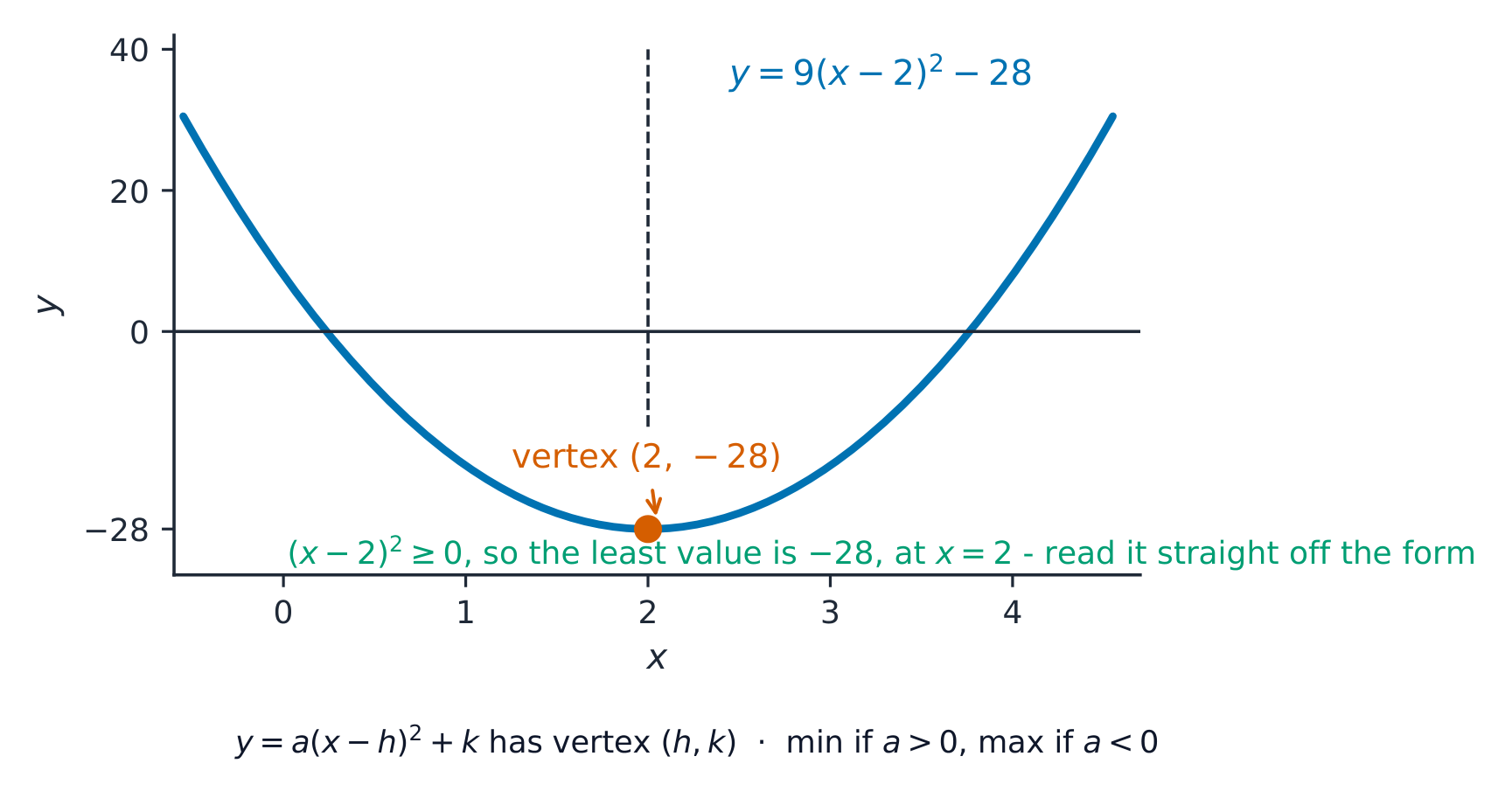
配方给你顶点:在 x 等于 2 处最小值 -28 The discriminant
$ax^2 + bx + c$ 的判别式(discriminant)是
$$\Delta = b^2 - 4ac.$$它告诉你方程 $ax^2 + bx + c = 0$ 有多少个实根(real roots,实数解):判别式 根 $b^2 - 4ac > 0$ 两个相异(distinct)实根 $b^2 - 4ac = 0$ 一个重复的实根 $b^2 - 4ac < 0$ 没有实根 
$b^2-4ac$ 的符号决定抛物线与 $x$ 轴相遇多少次。 例题。 求常数 $k$ 的值,使 $3kx^2 + (k + 8)x + 3 = 0$ 有两个相异实根。
这里 $a = 3k$,$b = k + 8$,$c = 3$。要两个相异实根你需要 $b^2 - 4ac > 0$:
$$(k + 8)^2 - 4(3k)(3) > 0 \;\Rightarrow\; k^2 + 16k + 64 - 36k > 0 \;\Rightarrow\; k^2 - 20k + 64 > 0.$$因式分解:$(k - 4)(k - 16) > 0$,所以 $k < 4$ 或 $k > 16$。你也需要 $a \neq 0$,所以 $k \neq 0$。Quadratic equations and inequalities
要解一个二次方程(quadratic equation),因式分解、配方,或用公式
$$x = \frac{-b \pm \sqrt{b^2 - 4ac}}{2a}.$$要解一个二次不等式(quadratic inequality)如 $(k - 4)(k - 16) > 0$,找到两个根,然后决定每个根的哪一侧使陈述成立。抛物线(parabola)的一个草图有帮助:曲线在根外面在 $x$ 轴之上(正),在它们之间在它之下(负)。Simultaneous equations
要解一对联立方程(simultaneous equations),其中一个是线性的、一个是二次的,用代入(substitution):把线性方程重排解出一个字母,然后把它代入二次方程。这给出一个单一的二次方程去解。
Equations that are quadratic in disguise
一些方程在 $x$ 的某个函数上是二次的。例如 $x^4 - 5x^2 + 4 = 0$ 在 $x^2$ 上是二次的:令 $u = x^2$,解 $u^2 - 5u + 4 = 0$,然后回到 $x$。你会在三角学中再次用这个思想。
探索The shape of a quadratic
y = ax² + bx + c
Drag a, b and c. Watch the vertex, the line of symmetry and the roots (where it cuts the x-axis) move as the coefficients change.
词汇表 训练英文 中文 拼音 Pure Mathematics/pjʊə ˌmæθɪˈmætɪks/ 纯数学 chún shù xué quadratic/kwɒˈdrætɪk/ 二次式 èr cì shì coefficients/ˌkəʊɪˈfɪʃənts/ 系数 xì shù complete the square/kəmˈpliːt ðə skweə/ 配方 pèi fāng vertex/ˈvɜːteks/ 顶点 dǐng diǎn discriminant/dɪˈskrɪmɪnənt/ 判别式 pàn bié shì real roots/rɪəl ruːts/ 实根 shí gēn distinct/dɪˈstɪŋkt/ 相异 xiāng yì quadratic equation/kwɒˈdrætɪk ɪˈkweɪʒn/ 二次方程 èr cì fāng chéng quadratic inequality/kwɒˈdrætɪk ɪniːˈkwɒlɪti/ 二次不等式 èr cì bù děng shì simultaneous equations/ˌsɪməlˈteɪnɪəs ɪˈkweɪʒnz/ 联立方程 lián lì fāng chéng substitution/ˌsʌbstɪˈtjuːʃn/ 代入 dài rù coefficient/ˌkəʊɪˈfɪʃənt/ 系数 xì shù parabola/pəˈræbələ/ 抛物线 pāo wù xiàn 1.2
函数
大纲
Candidates should be able to: Notes and examples understand the terms function, domain, range, one-one function, inverse function and composition of functions identify the range of a given function in simple cases, and find the composition of two given functions e.g. range of $f : x \mapsto \frac{1}{x}$ for $x \geqslant 1$ and range of $g : x \mapsto x^2 + 1$ for $x \in \mathbb{R}$. Including the condition that a composite function $gf$ can only be formed when the range of $f$ is within the domain of $g$. determine whether or not a given function is one-one, and find the inverse of a one-one function in simple cases e.g. finding the inverse of $h : x \mapsto (2x + 3)^2 - 4$ for $x < -\frac{3}{2}$. illustrate in graphical terms the relation between a one-one function and its inverse Sketches should include an indication of the mirror line $y = x$. understand and use the transformations of the graph of $y = f(x)$ given by $y = f(x) + a$, $y = f(x + a)$, $y = af(x)$, $y = f(ax)$ and simple combinations of these. Including use of the terms ‘translation’, ‘reflection’ and ‘stretch’ in describing transformations. Questions may involve algebraic or trigonometric functions, or other graphs with given features. 来源:剑桥国际大纲
变换图形:平移和伸缩 一个函数(function)是把每个输入送到恰好一个输出的一个规则。把它写作 $f(x)$。复合函数(composition of functions)$fg(x)$ 意味着先应用 $g$,然后对结果应用 $f$。
- 定义域(domain)是允许的输入 $x$ 的集合。
- 值域(range)是函数实际产生的输出的集合。
若不同的输入总是给出不同的输出,一个函数是一一对应(one-one)的。(没有输出被重复。)只有一一对应的函数才有一个反函数(inverse function)$f^{-1}$,它逆转规则。
两个函数的复合(composition)意味着一个接一个地做。$fg(x)$ 意味着"先做 $g$,然后 $f$":$fg(x) = f(g(x))$。复合函数 $fg$ 只在 $g$ 的值域位于 $f$ 的定义域内时存在。
Finding an inverse
要找 $f^{-1}$:写 $y = f(x)$,把 $x$ 变成主语,然后交换字母。
例题。 函数 $f(x) = (x + 3)^2 - 12$ 对 $x \geqslant 0$ 定义。求 $f^{-1}(x)$。
写 $y = (x + 3)^2 - 12$ 并解出 $x$:
$$(x + 3)^2 = y + 12 \;\Rightarrow\; x + 3 = \sqrt{y + 12} \;\Rightarrow\; x = \sqrt{y + 12} - 3.$$你取正平方根,因为 $x \geqslant 0$ 意味着 $x + 3 \geqslant 3 > 0$。所以$$f^{-1}(x) = \sqrt{x + 12} - 3.$$Graphs of inverses and transformations
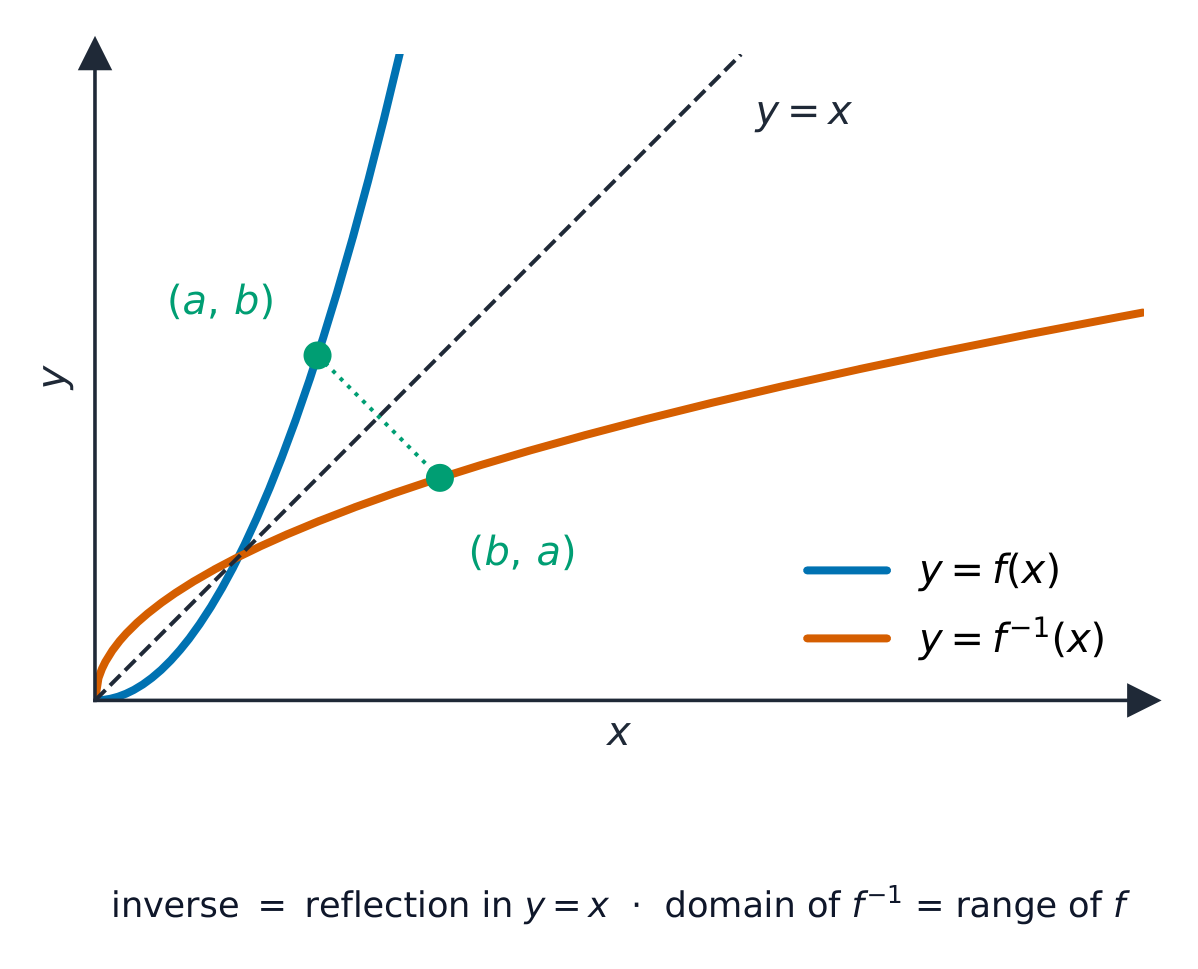
$y = f^{-1}(x)$ 的图形是 $y = f(x)$ 在直线 $y = x$ 中的反射(reflection)。
把 $y=f(x)$ 在直线 $y=x$ 中反射给出它的反函数;一个点 $(a,b)$ 变成 $(b,a)$。 你应当知道 $y = f(x)$ 的这些变换(transformations):
新方程 对图形的效果 $y = f(x) + a$ 向上平移(translation)$a$ $y = f(x + a)$ 向左平移 $a$ $y = a\,f(x)$ 在 $y$ 方向的伸缩(stretch),比例因子 $a$ $y = f(ax)$ 在 $x$ 方向的伸缩,比例因子 $\tfrac{1}{a}$ 当两个变换被组合时,顺序可能重要。完整地陈述每一个(类型、方向和量)。

加到输出或输入上滑动曲线;一个乘数伸缩它。 探索Explore a function
y = ax³ + bx² + cx + d
A function turns each input into exactly one output — drag the coefficients and watch where the curve rises and falls.
词汇表 训练英文 中文 拼音 function/ˈfʌŋkʃn/ 函数 hán shù composition of functions/ˌkɒmpəˈzɪʃn ɒv ˈfʌŋkʃnz/ 复合函数 fù hé hán shù domain/dəˈmeɪn/ 定义域 dìng yì yù range/reɪndʒ/ 值域 zhí yù one-one/wʌn wʌn/ 一一对应 yī yī duì yìng inverse function/ɪnˈvɜːs ˈfʌŋkʃn/ 反函数 fǎn hán shù composition/ˌkɒmpəˈzɪʃn/ 复合 fù hé reflection/rɪˈflekʃn/ 反射 fǎn shè transformations/trænsfɔːˈmeɪʃnz/ 变换 biàn huàn translation/trænˈsleɪʃn/ 平移 píng yí stretch/stretʃ/ 伸缩 shēn suō 1.3
坐标几何

大纲
Candidates should be able to: Notes and examples find the equation of a straight line given sufficient information e.g. given two points, or one point and the gradient. interpret and use any of the forms $y = mx + c$, $y - y_1 = m(x - x_1)$, $ax + by + c = 0$ in solving problems Including calculations of distances, gradients, midpoints, points of intersection and use of the relationship between the gradients of parallel and perpendicular lines. understand that the equation $(x - a)^2 + (y - b)^2 = r^2$ represents the circle with centre $(a, b)$ and radius $r$ Including use of the expanded form $x^2 + y^2 + 2gx + 2fy + c = 0$. use algebraic methods to solve problems involving lines and circles Including use of elementary geometrical properties of circles, e.g. tangent perpendicular to radius, angle in a semicircle, symmetry. Implicit differentiation is not included. understand the relationship between a graph and its associated algebraic equation, and use the relationship between points of intersection of graphs and solutions of equations. e.g. to determine the set of values of $k$ for which the line $y = x + k$ intersects, touches or does not meet a quadratic curve. 来源:剑桥国际大纲
坐标几何(coordinate geometry)用它们的方程研究直线和圆。
Straight lines
连接 $(x_1, y_1)$ 和 $(x_2, y_2)$ 的直线的斜率(gradient,陡度)是
$$m = \frac{y_2 - y_1}{x_2 - x_1}.$$你可以把直线方程(equation of a straight line)写成这些形式的任何一个:$$y = mx + c, \qquad y - y_1 = m(x - x_1), \qquad ax + by + c = 0.$$当两条直线的斜率相等时它们平行(parallel),当它们斜率的乘积是 $-1$ 时它们垂直(perpendicular,成直角)。Circles
圆心(centre)$(a, b)$、半径(radius)$r$ 的圆(circle)有方程
$$(x - a)^2 + (y - b)^2 = r^2.$$一个展开的形式如 $x^2 + y^2 - 6x + 10y - 27 = 0$ 是同一个圆:对 $x$ 和 $y$ 配方以找到圆心和半径。圆的一条切线(tangent)在一个点触到它,并在那个点垂直于半径。这个直角事实解决大多数圆的问题。
一条切线触到圆一次并以直角与半径相遇。 例题。 点 $P(1, 1)$ 和 $Q(7, 11)$ 是一个圆的一条直径(diameter)的端点。求圆的方程。
圆心是 $PQ$ 的中点:
$$\left(\frac{1 + 7}{2},\ \frac{1 + 11}{2}\right) = (4, 6).$$半径是 $PQ$ 长度的一半:$$r = \tfrac12\sqrt{(7 - 1)^2 + (11 - 1)^2} = \tfrac12\sqrt{36 + 100} = \tfrac12\sqrt{136} = \sqrt{34}.$$所以圆是 $(x - 4)^2 + (y - 6)^2 = 34$。探索The straight line
y = ax + b
The gradient a tilts the line; the intercept b slides it up and down.
词汇表 训练英文 中文 拼音 Coordinate geometry/kəʊˈɔːdɪnət dʒiˈɒmətri/ 坐标几何 zuò biāo jǐ hé gradient/ˈɡreɪdɪənt/ 斜率 xié lǜ equation of a straight line/ɪˈkweɪʒn əvə streɪt laɪn/ 直线方程 zhí xiàn fāng chéng parallel/ˈpærəlel/ 平行 píng xíng perpendicular/ˌpɜːpənˈdɪkjʊlə/ 垂直 chuí zhí circle/ˈsɜːkl/ 圆 yuán centre/ˈsentə/ 圆心 yuán xīn radius/ˈreɪdɪəs/ 半径 bàn jìng tangent/ˈtændʒənt/ 切线 qiè xiàn diameter/daɪˈæmɪtə/ 直径 zhí jìng 1.4
弧度制

大纲
Candidates should be able to: Notes and examples understand the definition of a radian, and use the relationship between radians and degrees use the formulae $s = r\theta$ and $A = \frac{1}{2}r^2\theta$ in solving problems concerning the arc length and sector area of a circle. Including calculation of lengths and angles in triangles and areas of triangles. 来源:剑桥国际大纲
什么是弧度? Radians
一个弧度(radian)是另一种测量角的方式。一个弧度是一个圆的中心处截出一段长度等于半径的弧(arc)的角。弧度和度(degrees)之间的联系是
$$\pi \text{ radians} = 180^\circ.$$所以要把度变成弧度,乘以 $\dfrac{\pi}{180}$;要把弧度变成度,乘以 $\dfrac{180}{\pi}$。一个弧度:弧等于半径的那个角 Arc length and sector area
对于半径 $r$、角 $\theta$ 以弧度计的一个扇形(sector):
$$\text{arc length} = s = r\theta, \qquad \text{sector area} = A = \tfrac12 r^2 \theta.$$一条弦(chord)把扇形切成一个三角形和一个弓形(segment)。弓形面积是扇形减三角形:$$\text{segment} = \tfrac12 r^2 \theta - \tfrac12 r^2 \sin\theta = \tfrac12 r^2(\theta - \sin\theta).$$
着色的弓形是扇形中弦和弧之间的部分。 例题。 一个扇形有中心 $O$,而 $O$ 处的角是 $\tfrac{2}{3}\pi$ 弧度。证明弦截出的弓形有约 $0.614 r^2$ 的面积。
$$\text{segment} = \tfrac12 r^2\left(\tfrac{2}{3}\pi - \sin\tfrac{2}{3}\pi\right) = \tfrac12 r^2(2.0944 - 0.8660) = \tfrac12 r^2(1.2284) \approx 0.614 r^2.$$探索Radians, arcs and sectors
Change the angle (in radians) and radius. See the arc length $s = r\theta$ and the sector area $\tfrac12 r^2\theta$ update.
词汇表 训练英文 中文 拼音 radian/ˈreɪdɪən/ 弧度 hú dù arc/ɑːk/ 弧 hú degrees/dɪˈɡriːz/ 度 dù sector/ˈsektə/ 扇形 shàn xíng chord/kɔːd/ 弦 xián segment/ˈseɡmənt/ 弓形 gōng xíng 1.5
三角学

大纲
Candidates should be able to: Notes and examples sketch and use graphs of the sine, cosine and tangent functions (for angles of any size, and using either degrees or radians) Including e.g. $y = 3 \sin x$, $y = 1 - \cos 2x$, $y = \tan(x + \frac{1}{4}\pi)$. use the exact values of the sine, cosine and tangent of $30^\circ$, $45^\circ$, $60^\circ$, and related angles e.g. $\cos 150^\circ = -\frac{1}{2}\sqrt{3}$, $\sin \frac{3}{4}\pi = \frac{1}{\sqrt{2}}$. use the notations $\sin^{-1} x$, $\cos^{-1} x$, $\tan^{-1} x$ to denote the principal values of the inverse trigonometric relations No specialised knowledge of these functions is required, but understanding of them as examples of inverse functions is expected. use the identities $\frac{\sin \theta}{\cos \theta} \equiv \tan \theta$ and $\sin^2 \theta + \cos^2 \theta \equiv 1$ e.g. in proving identities, simplifying expressions and solving equations. find all the solutions of simple trigonometrical equations lying in a specified interval (general forms of solution are not included). e.g. solve $3 \sin 2x + 1 = 0$ for $-\pi < x < \pi$, $3 \sin^2 \theta - 5 \cos \theta - 1 = 0$ for $0^\circ \leqslant \theta \leqslant 360^\circ$. 来源:剑桥国际大纲
一条正弦曲线的振幅、周期和中线 单位圆画出正弦曲线 一个摩天轮:轮缘上的一个点像一条正弦曲线一样上升和下降。 Graphs and exact values
你必须知道正弦(sine)、余弦(cosine)和正切函数(tangent function,写作 $\sin$、$\cos$、$\tan$)的图形的形状。正弦和余弦图形在 $-1$ 和 $1$ 之间波动,并每 $360^\circ$($2\pi$)重复。学习这些精确值:
$\theta$ $30^\circ$ $45^\circ$ $60^\circ$ $\sin\theta$ $\tfrac12$ $\tfrac{1}{\sqrt2}$ $\tfrac{\sqrt3}{2}$ $\cos\theta$ $\tfrac{\sqrt3}{2}$ $\tfrac{1}{\sqrt2}$ $\tfrac12$ $\tan\theta$ $\tfrac{1}{\sqrt3}$ $1$ $\sqrt3$ 
在一圈上 $\sin$ 和 $\cos$ 保持在 $-1$ 和 $1$ 之间;$\tan$ 在 $90^\circ$ 和 $270^\circ$ 冲走。 记号 $\sin^{-1}x$、$\cos^{-1}x$、$\tan^{-1}x$ 意味着反(inverse)角(主值(principal value))。
Identities
一个恒等式(identity)对角的每个值都为真。你必须知道的两个是
$$\tan\theta \equiv \frac{\sin\theta}{\cos\theta}, \qquad \sin^2\theta + \cos^2\theta \equiv 1.$$用它们重写一个方程,使它只含一个三角函数。Solving trigonometric equations
要解一个三角方程(trigonometric equation),先把它化简到一个函数,然后在给定的区间里找到每个解。
例题。 解 $6\sin\theta = 1 + \dfrac{2}{\sin\theta}$,对 $-180^\circ < \theta < 180^\circ$。
两边乘以 $\sin\theta$ 以消去分数。这构成一个 $\sin\theta$ 的二次式:
$$6\sin^2\theta - \sin\theta - 2 = 0 \;\Rightarrow\; (3\sin\theta - 2)(2\sin\theta + 1) = 0.$$所以 $\sin\theta = \tfrac23$ 或 $\sin\theta = -\tfrac12$。- $\sin\theta = \tfrac23$:$\theta = 41.8^\circ$ 或 $\theta = 180^\circ - 41.8^\circ = 138.2^\circ$。
- $\sin\theta = -\tfrac12$:$\theta = -30^\circ$ 或 $\theta = -150^\circ$。
四个解是 $\theta = -150^\circ,\ -30^\circ,\ 41.8^\circ,\ 138.2^\circ$。
探索Sine & cosine graphs
Drag the amplitude, period and shifts of y = a·sin(bx + c) + d and watch the curve change against the base wave.
探索Sine and cosine on the unit circle
Drag the angle round the unit circle. The height is $\sin\theta$, the across-distance is $\cos\theta$ — that's where the graphs come from.
词汇表 训练英文 中文 拼音 sine/saɪn/ 正弦 zhèng xián cosine/ˈkəʊsaɪn/ 余弦 yú xián tangent function/ˈtændʒənt ˈfʌŋkʃn/ 正切 zhèng qiē principal value/ˈprɪnsɪpl ˈvæljuː/ 主值 zhǔ zhí identity/aɪˈdentɪti/ 恒等式 héng děng shì trigonometric equation/ˌtrɪɡənəʊˈmetrɪk ɪˈkweɪʒn/ 三角方程 sān jiǎo fāng chéng 1.6
级数

大纲
Candidates should be able to: Notes and examples use the expansion of $(a + b)^n$, where $n$ is a positive integer Including the notations $\begin{pmatrix} n \\ r \end{pmatrix}$ and $n!$ Knowledge of the greatest term and properties of the coefficients are not required. recognise arithmetic and geometric progressions use the formulae for the $n$th term and for the sum of the first $n$ terms to solve problems involving arithmetic or geometric progressions Including knowledge that numbers $a$, $b$, $c$ are 'in arithmetic progression' if $2b = a + c$ (or equivalent) and are 'in geometric progression' if $b^2 = ac$ (or equivalent). Questions may involve more than one progression. use the condition for the convergence of a geometric progression, and the formula for the sum to infinity of a convergent geometric progression. 来源:剑桥国际大纲
帕斯卡三角形给出系数 无穷和填满正方形 The binomial expansion
对于一个正整数 $n$,二项展开式(binomial expansion)是
$$(a + b)^n = a^n + \binom{n}{1}a^{n-1}b + \binom{n}{2}a^{n-2}b^2 + \cdots + b^n,$$其中 $\binom{n}{r} = \dfrac{n!}{r!\,(n - r)!}$ 是一个二项式系数(binomial coefficient)。例题。 求 $(2 - px)^5$ 按 $x$ 的升幂的前三项。
$$(2 - px)^5 = 2^5 + \binom{5}{1}2^4(-px) + \binom{5}{2}2^3(-px)^2 + \cdots = 32 - 80px + 80p^2x^2 + \cdots$$Arithmetic and geometric progressions
一个数列(progression,序列)是遵循一个规则的一列项。
- 一个等差数列(arithmetic progression,AP)每步加一个固定的公差(common difference)$d$。第 $n$ 个项(term)是 $u_n = a + (n - 1)d$,而前 $n$ 项的和是 $S_n = \tfrac{n}{2}\big(2a + (n - 1)d\big)$。
- 一个等比数列(geometric progression,GP)每步乘一个固定的公比(common ratio)$r$。第 $n$ 个项是 $u_n = ar^{\,n-1}$,而 $S_n = \dfrac{a(1 - r^n)}{1 - r}$。
一个 AP 以相等的步攀升;一个 GP 的步以同样的比增长 一个 GP 是收敛的——当 $|r| < 1$ 时它收敛(converges,趋于一个极限)。那么它有一个无穷和(sum to infinity)
$$S_\infty = \frac{a}{1 - r}.$$例题。 一个 GP 的第三项是 $18$,而前三项的和是 $26$。公比是负的。求无穷和。
从 $ar^2 = 18$ 你得到 $a = \dfrac{18}{r^2}$。把这个代入 $a(1 + r + r^2) = 26$:
$$18(1 + r + r^2) = 26r^2 \;\Rightarrow\; 8r^2 - 18r - 18 = 0 \;\Rightarrow\; (4r + 3)(r - 3) = 0.$$比是负的,所以 $r = -\tfrac34$ 而 $a = \dfrac{18}{(3/4)^2} = 32$。然后$$S_\infty = \frac{32}{1 - (-\tfrac34)} = \frac{32}{\tfrac74} = \frac{128}{7}.$$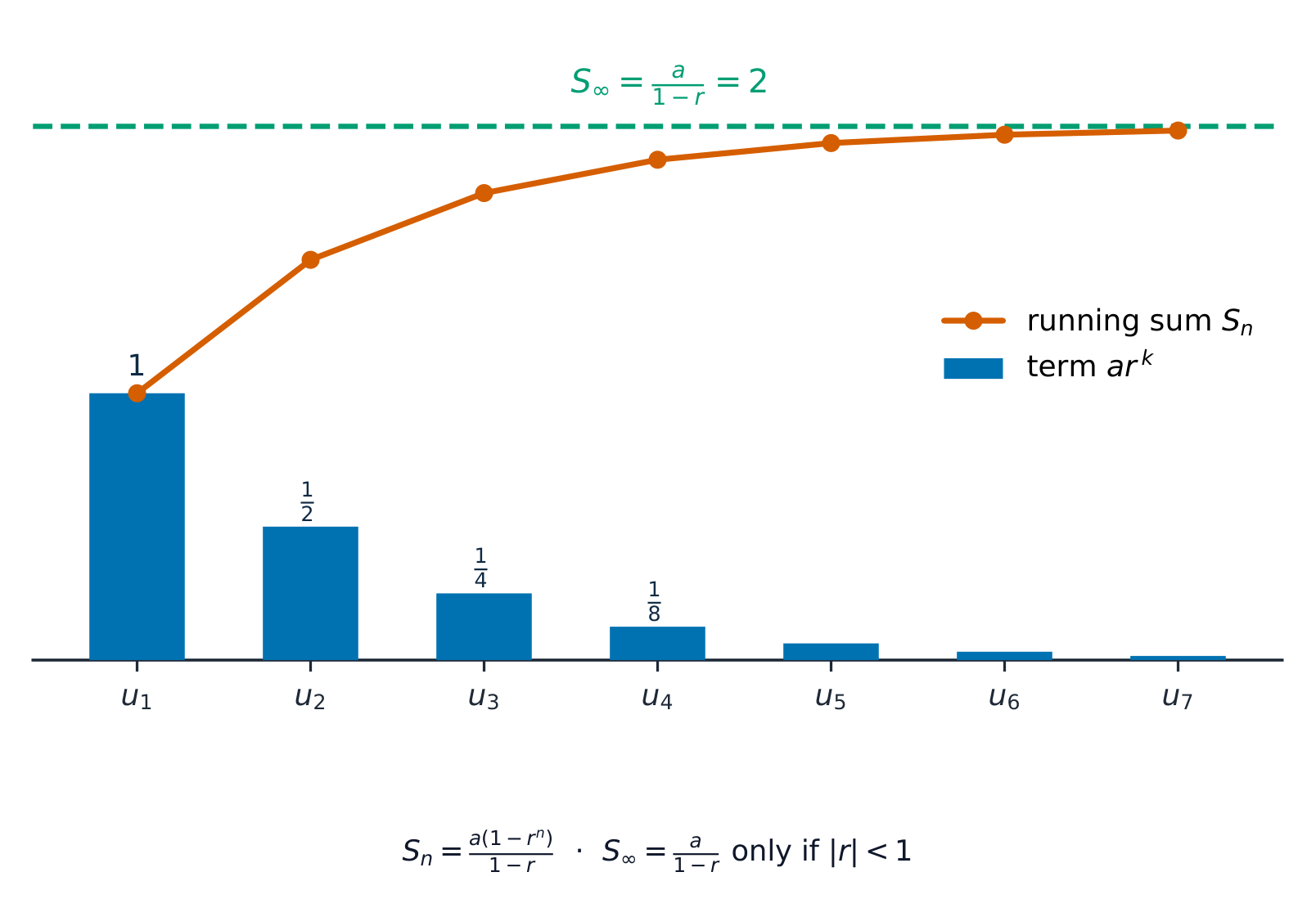
收敛等比数列:各项趋于零,部分和趋近无穷和 a/(1-r) 探索Arithmetic and geometric sequences
Switch between an arithmetic (add d) and a geometric (multiply by r) sequence and watch the terms and their sum build up.
词汇表 训练英文 中文 拼音 binomial expansion/baɪˈnəʊmɪəl ekˈspænʃn/ 二项展开式 èr xiàng zhǎn kāi shì binomial coefficient/baɪˈnəʊmɪəl ˌkəʊɪˈfɪʃənt/ 二项式系数 èr xiàng shì xì shù progression/prəˈɡreʃn/ 数列 shù liè arithmetic progression/əˈrɪθmətɪk prəˈɡreʃn/ 等差数列 děng chā shù liè common difference/ˈkɒmən ˈdɪfrəns/ 公差 gōng chāi term/tɜːm/ 项 xiàng geometric progression/ˌdʒiːəʊˈmetrɪk prəˈɡreʃn/ 等比数列 děng bǐ shù liè common ratio/ˈkɒmən ˈreɪʃɪəʊ/ 公比 gōng bǐ converges/kənˈvɜːdʒɪz/ 收敛 shōu liǎn sum to infinity/sʌm tʊ ɪnˈfɪnɪti/ 无穷和 wú qióng hé 1.7
微分
大纲
Candidates should be able to: Notes and examples understand the gradient of a curve at a point as the limit of the gradients of a suitable sequence of chords, and use the notations $f'(x)$, $f''(x)$, $\frac{\text{d}y}{\text{d}x}$, and $\frac{\text{d}^2y}{\text{d}x^2}$ for first and second derivatives Only an informal understanding of the idea of a limit is expected. e.g. includes consideration of the gradient of the chord joining the points with $x$ coordinates $2$ and $(2 + h)$ on the curve $y = x^3$. Formal use of the general method of differentiation from first principles is not required. use the derivative of $x^n$ (for any rational $n$), together with constant multiples, sums and differences of functions, and of composite functions using the chain rule e.g. find $\frac{\text{d}y}{\text{d}x}$, given $y = \sqrt{2x^3 + 5}$. apply differentiation to gradients, tangents and normals, increasing and decreasing functions and rates of change Including connected rates of change, e.g. given the rate of increase of the radius of a circle, find the rate of increase of the area for a specific value of one of the variables. locate stationary points and determine their nature, and use information about stationary points in sketching graphs. Including use of the second derivative for identifying maxima and minima; alternatives may be used in questions where no method is specified. Knowledge of points of inflexion is not included. 来源:剑桥国际大纲
从第一原理微分 微分(differentiation)找出每个点处的曲线斜率(gradient of a curve)。斜率是越来越短的弦的斜率的极限(limit),叫导数(derivative)。
The rules
把导数写作 $f'(x)$ 或 $\dfrac{dy}{dx}$。基本规则是
$$\frac{d}{dx}\left(x^n\right) = n x^{n-1} \quad \text{for any rational } n.$$逐项微分和,并对一个函数内部的一个函数用链式法则(chain rule):$$\frac{d}{dx}\,f(g(x)) = f'(g(x)) \cdot g'(x).$$再次微分给出二阶导数(second derivative)$f''(x)$ 或 $\dfrac{d^2y}{dx^2}$。Using the derivative
- 切线和法线。 曲线在一个点的斜率是那里切线(tangent)的斜率。法线(normal)垂直于切线,所以它的斜率是 $-\dfrac{1}{\text{(tangent gradient)}}$。
- 递增或递减。 函数在 $\dfrac{dy}{dx} > 0$ 处是一个增函数(increasing function),在 $\dfrac{dy}{dx} < 0$ 处是一个减函数(decreasing function)。
- 变化率。 一个导数是一个变化率(rate of change)。相连的变化率用链式法则,例如 $\dfrac{dy}{dt} = \dfrac{dy}{dx}\cdot\dfrac{dx}{dt}$。
Stationary points
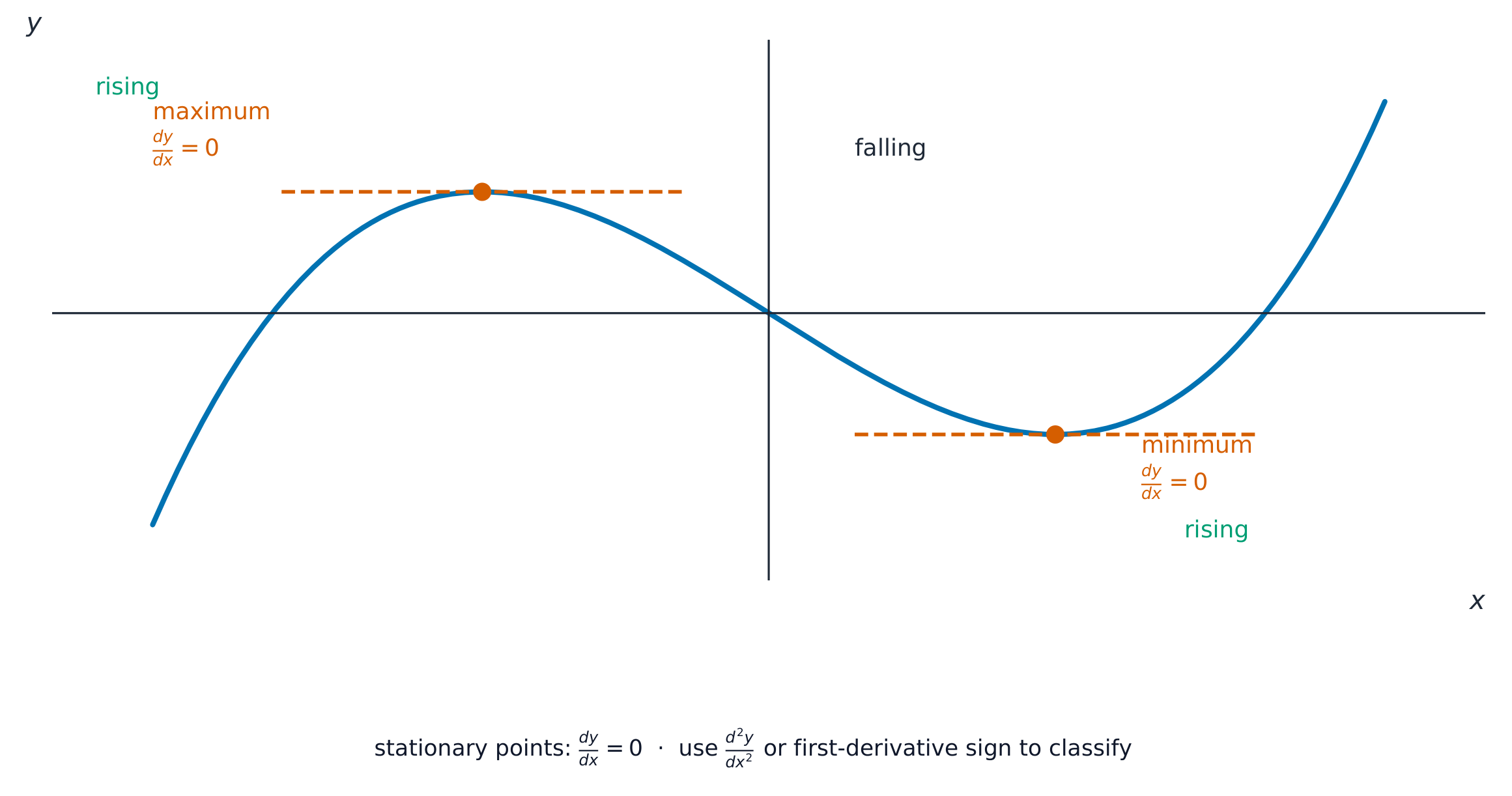
一个驻点(stationary point)是 $\dfrac{dy}{dx} = 0$ 的地方。用二阶导数测试它的性质:$f''(x) > 0$ 给出一个极小值点(minimum point),而 $f''(x) < 0$ 给出一个极大值点(maximum point)。当 $f''(x) = 0$ 时测试不确定:该点可能是一个拐点(point of inflexion),曲线在那里改变凹凸方向(弯曲的方式)——检查 $\dfrac{dy}{dx}$ 在它前后的符号来判定。
在一个极大值或一个极小值处切线是平的,所以 $\frac{dy}{dx}=0$。 例题。 曲线 $y = 4x^{1/2} - x$ 在 $x = a$ 有一个极大值点。求 $a$。
$$\frac{dy}{dx} = 2x^{-1/2} - 1 = 0 \;\Rightarrow\; \frac{2}{\sqrt{x}} = 1 \;\Rightarrow\; \sqrt{x} = 2 \;\Rightarrow\; x = 4.$$所以 $a = 4$。探索The gradient at a point
y = ax³ + bx² + cx + d
Slide the point along the curve. The tangent shows the gradient $\frac{dy}{dx}$ there — steeper where the curve bends more.
词汇表 训练英文 中文 拼音 Differentiation/ˌdɪfəˌrenʃɪˈeɪʃn/ 微分 wēi fēn gradient of a curve/ˈɡreɪdɪənt əvə kɜːv/ 曲线斜率 qū xiàn xié lǜ limit/ˈlɪmɪt/ 极限 jí xiàn derivative/dɪˈrɪvətɪv/ 导数 dǎo shù chain rule/tʃeɪn ruːl/ 链式法则 liàn shì fǎ zé second derivative/ˈsekənd dɪˈrɪvətɪv/ 二阶导数 èr jiē dǎo shù normal/ˈnɔːml/ 法线 fǎ xiàn increasing function/ɪnˈkriːsɪŋ ˈfʌŋkʃn/ 增函数 zēng hán shù decreasing function/ˈdiːkriːsɪŋ ˈfʌŋkʃn/ 减函数 jiǎn hán shù rate of change/reɪt ɒv tʃeɪndʒ/ 变化率 biàn huà lǜ stationary point/ˈsteɪʃənəri pɔɪnt/ 驻点 zhù diǎn minimum point/ˈmɪnɪməm pɔɪnt/ 极小值点 jí xiǎo zhí diǎn maximum point/ˈmæksɪməm pɔɪnt/ 极大值点 jí dà zhí diǎn point of inflexion/pɔɪnt ɒv ɪnˈflekʃn/ 拐点 guǎi diǎn 1.8
积分
大纲
Candidates should be able to: Notes and examples understand integration as the reverse process of differentiation, and integrate $(ax + b)^n$ (for any rational $n$ except $-1$), together with constant multiples, sums and differences e.g. $\int (2x^3 - 5x + 1) \text{d}x$, $\int \frac{1}{(2x + 3)^2} \text{d}x$. solve problems involving the evaluation of a constant of integration e.g. to find the equation of the curve through $(1, -2)$ for which $\frac{\text{d}y}{\text{d}x} = \sqrt{2x + 1}$. evaluate definite integrals Including simple cases of 'improper' integrals, such as $\int_{0}^{1} x^{-\frac{1}{2}} \text{d}x$ and $\int_{1}^{\infty} x^{-2} \text{d}x$. use definite integration to find: - the area of a region bounded by a curve and lines parallel to the axes, or between a curve and a line or between two curves - a volume of revolution about one of the axes. A volume of revolution may involve a region not bounded by the axis of rotation, e.g. the region between $y = 9 - x^2$ and $y = 5$ rotated about the $x$-axis. 来源:剑桥国际大纲
积分作为面积:黎曼矩形 积分(integration)是微分的逆。逆转幂法则给出
$$\int (ax + b)^n \, dx = \frac{(ax + b)^{n+1}}{a(n + 1)} + C \quad (n \neq -1).$$$+\,C$ 是积分常数(constant of integration)。若你知道曲线上一个点,代入它以找到 $C$。Definite integrals and area
一个定积分(definite integral)有限,并给出一个数:
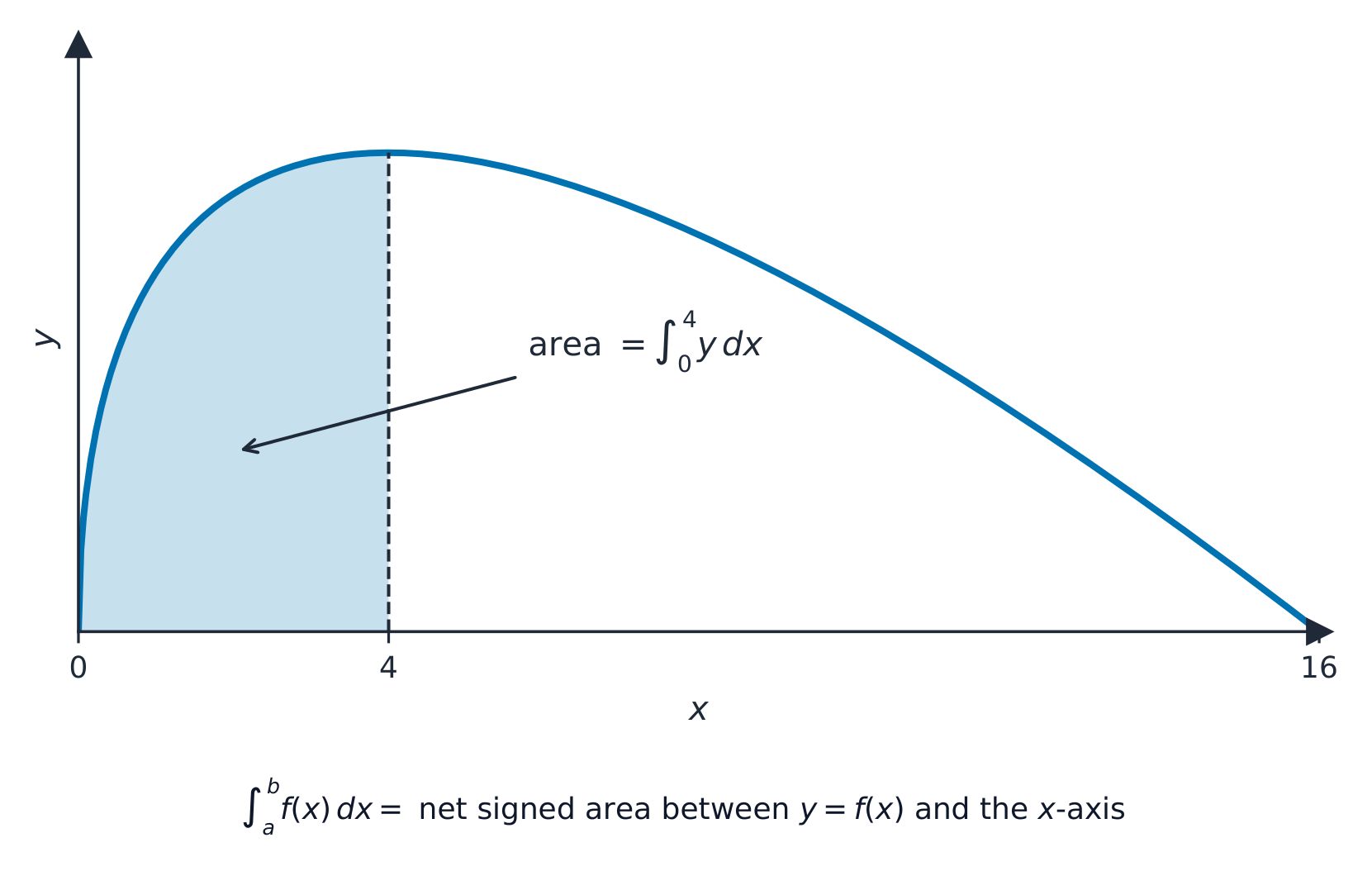
$$\int_p^q f(x)\, dx = \big[F(x)\big]_p^q = F(q) - F(p).$$一条曲线和 $x$ 轴之间从 $x = p$ 到 $x = q$ 的区域(region)的面积是 $\displaystyle\int_p^q y \, dx$。对于两条曲线之间的面积,积分(上曲线 $-$ 下曲线)。定积分 $\int_0^4 y\,dx$ 是曲线下着色的面积。 例题。 曲线 $y = 4x^{1/2} - x$ 在 $x = 16$ 再次与 $x$ 轴相遇。求曲线和 $x$ 轴之间从 $x = 0$ 到 $x = 4$ 的面积。
$$\int_0^4 \left(4x^{1/2} - x\right) dx = \left[\frac{8}{3}x^{3/2} - \frac{x^2}{2}\right]_0^4 = \frac{8}{3}(8) - \frac{16}{2} = \frac{64}{3} - 8 = \frac{40}{3}.$$一个广义积分(improper integral)有一个无穷的上下限,或一个被积函数无定义的端点;把它作为一个极限求值。例如,
$$\int_1^{\infty}x^{-2}\, dx=\lim_{b\to\infty}\left[-\frac1x\right]_1^{b}=\lim_{b\to\infty}\left(1-\frac1b\right)=1,$$而 $\displaystyle\int_0^{1}x^{-1/2}\, dx=\left[2x^{1/2}\right]_0^{1}=2$,尽管被积函数在 $x=0$ 处发散,它仍是有限的。Volume of revolution
当一个区域绕一个轴一路旋转时,它扫出一个立体。绕 $x$ 轴的旋转体体积(volume of revolution)是
$$V = \pi \int_p^q y^2 \, dx,$$而绕 $y$ 轴它是 $V = \pi \displaystyle\int x^2 \, dy$。例如,$y = \sqrt{x}$ 下从 $x = 0$ 到 $x = 4$ 的区域,绕 $x$ 轴旋转,有体积 $\pi\displaystyle\int_0^4 x\, dx = \pi\big[\tfrac{x^2}{2}\big]_0^4 = 8\pi$。
把一条曲线下的区域绕 $x$ 轴旋转扫出一个立体;每个薄片是一个面积 $\pi y^2$ 的圆盘,所以 $V = \pi\int y^2\,dx$ 探索Area under a curve
y = ax³ + bx² + cx + d
Drag the limits. The definite integral is the shaded area between the curve and the x-axis.
词汇表 训练英文 中文 拼音 Integration/ˌɪntɪˈɡreɪʃn/ 积分 jī fēn constant of integration/ˈkɒnstənt ɒv ˌɪntɪˈɡreɪʃn/ 积分常数 jī fēn cháng shù definite integral/ˈdefɪnət ˈɪntɪɡrəl/ 定积分 dìng jī fēn region/ˈriːdʒn/ 区域 qū yù improper integral/ɪmˈprɒpə ˈɪntɪɡrəl/ 广义积分 guǎng yì jī fēn volume of revolution/ˈvɒljuːm ɒv ˌrevəˈluːʃn/ 旋转体体积 xuán zhuǎn tǐ tǐ jī algebra/ˈældʒɪbrə/ 代数 dài shù calculus/ˈkælkjʊləs/ 微积分 wēi jī fēn 1.8
考试技巧
- 显示代数的每一行——跳步会失去方法分;用判别式 $b^2 - 4ac$ 来决定实根的数目。
- 对圆的度量用弧度工作(弧 $= r\theta$、扇形面积 $= \frac{1}{2}r^2\theta$),以及对三角函数的微积分。
- 对于微分,令 $\frac{dy}{dx} = 0$ 求驻点,并用二阶导数给它们分类。
- 对于积分,给一个不定积分加 $+ c$ 并用限求面积;轴以下的一个面积给出一个负积分。
-
2
纯数学2
这份讲义涵盖主题 2:纯数学(Pure Mathematics)2。它增加绝对值和多项式代数、对数(logarithms)和指数函数(exponential function)、更多的三角学,以及微分和积分的新方式。
2.1
代数
大纲
Candidates should be able to: Notes and examples understand the meaning of $|x|$, sketch the graph of $y = |ax + b|$ and use relations such as $|a| = |b| \iff a^2 = b^2$ and $|x - a| < b \iff a - b < x < a + b$ when solving equations and inequalities Graphs of $y = |f(x)|$ and $y = f(|x|)$ for non-linear functions $f$ are not included. e.g. $|3x - 2| = |2x + 7|$, $2x + 5 < |x + 1|$ divide a polynomial, of degree not exceeding 4, by a linear or quadratic polynomial, and identify the quotient and remainder (which may be zero) use the factor theorem and the remainder theorem. e.g. to find factors and remainders, solve polynomial equations or evaluate unknown coefficients. Including factors of the form $(ax + b)$ in which the coefficient of $x$ is not unity, and including calculation of remainders. 来源:剑桥国际大纲
The modulus
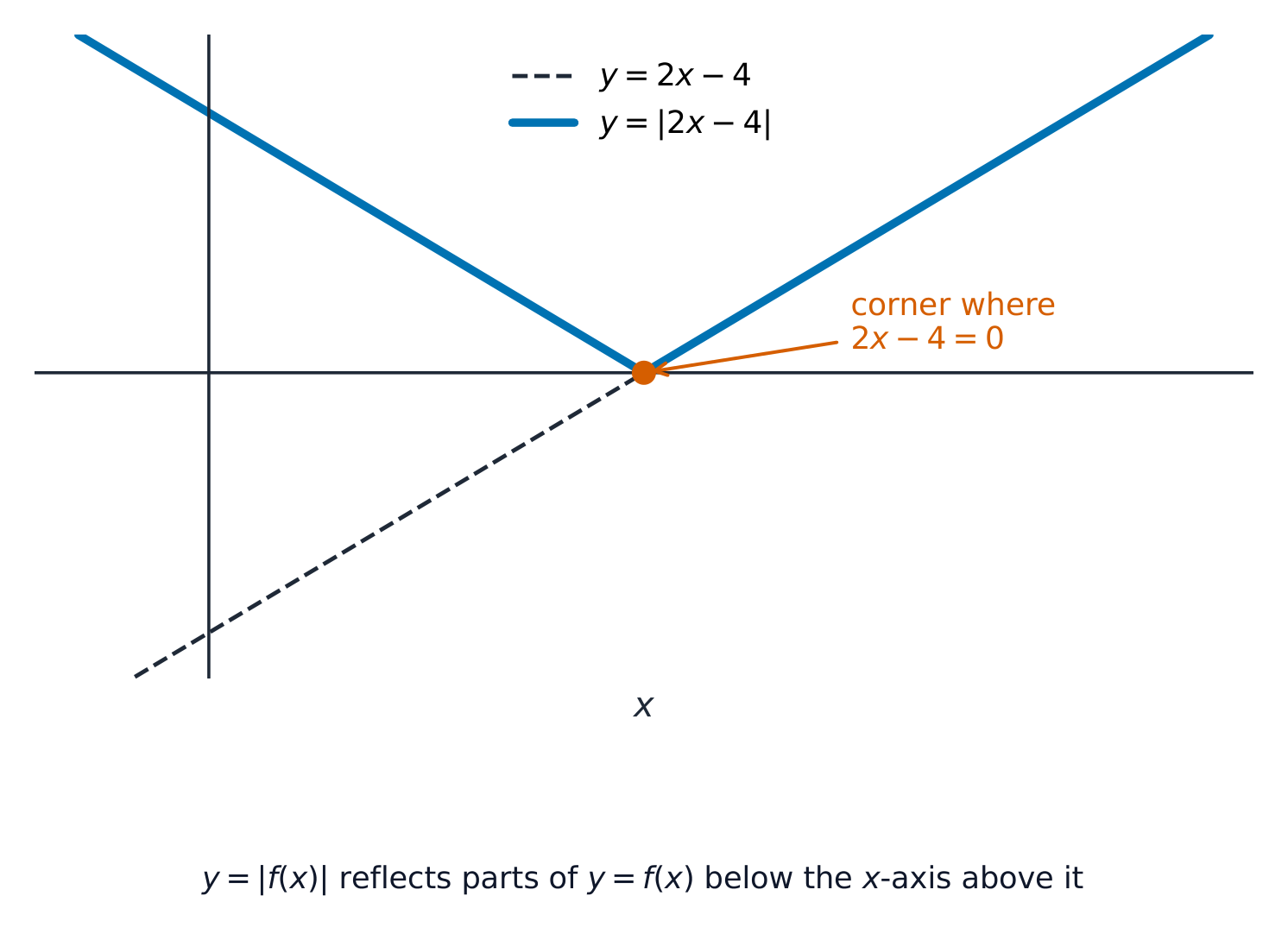
绝对值(modulus)$|x|$ 是去掉符号的一个数的大小,所以 $|x| \geqslant 0$ 总是成立。$y = |ax + b|$ 的图形是一个从 $x$ 轴弹起的"V"形。解方程和不等式的两个有用规则是
$$|a| = |b| \;\Leftrightarrow\; a^2 = b^2, \qquad |x - a| < b \;\Leftrightarrow\; a - b < x < a + b.$$取绝对值把直线在轴以下的部分向上折成一个 V。 例题。 解 $|3x + 8| < 9$。
用第二个规则,把不等式写成 $-9 < 3x + 8 < 9$:
$$-9 < 3x + 8 < 9 \;\Rightarrow\; -17 < 3x < 1 \;\Rightarrow\; -\tfrac{17}{3} < x < \tfrac13.$$Polynomial division and the factor and remainder theorems
一个多项式(polynomial)是 $x$ 的幂的一个和,如 $2x^4 + 3x^2 - 5$。它的次数(degree)是最高的幂。当你用一个多项式除另一个时,你得到一个商(quotient)和一个余数(remainder)。
- 余数定理(remainder theorem):$p(x)$ 被 $(x - a)$ 除时的余数是 $p(a)$。
- 因式定理(factor theorem):$(x - a)$ 是 $p(x)$ 的一个因式恰好当 $p(a) = 0$ 时。
例题。 多项式 $p(x) = 2x^4 + kx^3 + kx^2 + 17x + 18$ 有因式 $(x + 2)$。求 $k$。
由因式定理 $p(-2) = 0$:
$$2(16) + k(-8) + k(4) + 17(-2) + 18 = 0 \;\Rightarrow\; 16 - 4k = 0 \;\Rightarrow\; k = 4.$$探索The modulus function
y = a|x − b| + c
The modulus makes a V-shape. Move its vertex with b and c; change how steep the arms are with a.
词汇表 训练英文 中文 拼音 modulus/ˈmɒdjʊləs/ 绝对值 jué duì zhí polynomial/ˌpɒlɪˈnəʊmɪəl/ 多项式 duō xiàng shì degree/dɪˈɡriː/ 次数 cì shù quotient/ˈkwəʊʃənt/ 商 shāng remainder/rɪˈmeɪndə/ 余数 yú shù remainder theorem/rɪˈmeɪndə ˈθɪərəm/ 余数定理 yú shù dìng lǐ factor theorem/ˈfæktə ˈθɪərəm/ 因式定理 yīn shì dìng lǐ 2.2
对数函数与指数函数

大纲
Candidates should be able to: Notes and examples understand the relationship between logarithms and indices, and use the laws of logarithms (excluding change of base) understand the definition and properties of $e^x$ and $\ln x$, including their relationship as inverse functions and their graphs Including knowledge of the graph of $y = e^{kx}$ for both positive and negative values of $k$. use logarithms to solve equations and inequalities in which the unknown appears in indices e.g. $2^x < 5$, $3 \times 2^{3x-1} < 5$, $3^{x+1} = 4^{2x-1}$ use logarithms to transform a given relationship to linear form, and hence determine unknown constants by considering the gradient and/or intercept. e.g. $y = kx^n$ gives $\ln y = \ln k + n \ln x$ which is linear in $\ln x$ and $\ln y$ $y = k(a^x)$ gives $\ln y = \ln k + x \ln a$ which is linear in $x$ and $\ln y$. 来源:剑桥国际大纲
地震强度用对数的里氏震级测量。 
当资源丰富时人口能指数式地增长。 一个对数回答问题"什么幂?"。若 $a^x = y$ 则 $x = \log_a y$。对数和指数(indices,幂)是逆的思想。对数定律(laws of logarithms)是
$$\log(mn) = \log m + \log n, \qquad \log\!\frac{m}{n} = \log m - \log n, \qquad \log(m^k) = k\log m.$$指数函数 $e^x$ 和自然对数(natural logarithm)$\ln x$ 是反函数,所以 $\ln(e^x) = x$ 且 $e^{\ln x} = x$。当未知量在幂中时,取两边的对数。
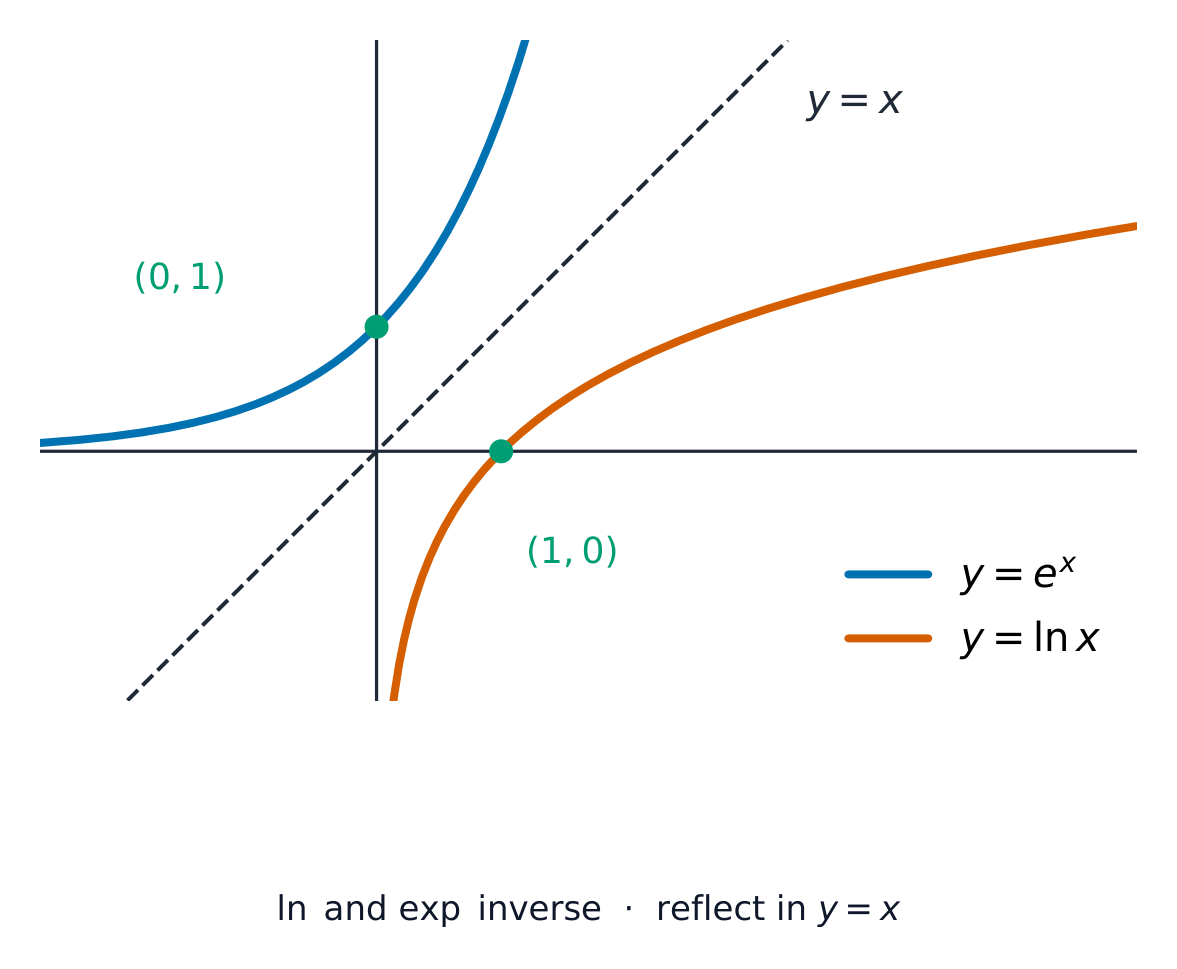
$e^x$ 和 $\ln x$ 互相抵消,所以每个是另一个在 $y=x$ 中的反射。 例题。 解 $4^x < 0.05$。
$$4^x < 0.05 \;\Rightarrow\; x\ln 4 < \ln 0.05 \;\Rightarrow\; x < \frac{\ln 0.05}{\ln 4} = -2.16 \ (\text{3 s.f.}).$$线性形式(linear form):一个像 $y = Ax^n$ 的关系若你取对数就变成一条直线:$\ln y = \ln A + n\ln x$。把 $\ln y$ 对 $\ln x$ 作图给出一条斜率 $n$、截距 $\ln A$ 的直线,所以你能找到未知的常数。
探索Exponential growth
y = a·bˣ
Change the base b: when b > 1 the curve grows, when 0 < b < 1 it decays — and it always passes through (0, a).
词汇表 训练英文 中文 拼音 Pure Mathematics/pjʊə ˌmæθɪˈmætɪks/ 纯数学 chún shù xué logarithms/ˈlɒɡərɪθəmz/ 对数 duì shù exponential function/ˌekspəˈnenʃl ˈfʌŋkʃn/ 指数函数 zhǐ shù hán shù indices/ˈɪndɪsiːz/ 指数 zhǐ shù laws of logarithms/lɔːz ɒv ˈlɒɡərɪθəmz/ 对数定律 duì shù dìng lǜ natural logarithm/ˈnætʃərəl ˈlɒɡərɪθəm/ 自然对数 zì rán duì shù linear form/ˈlɪnɪə fɔːm/ 线性形式 xiàn xìng xíng shì 2.3
三角学

大纲
Candidates should be able to: Notes and examples understand the relationship of the secant, cosecant and cotangent functions to cosine, sine and tangent, and use properties and graphs of all six trigonometric functions for angles of any magnitude use trigonometrical identities for the simplification and exact evaluation of expressions, and in the course of solving equations, and select an identity or identities appropriate to the context, showing familiarity in particular with the use of: – $\sec^2 \theta \equiv 1 + \tan^2 \theta$ and $\csc^2 \theta \equiv 1 + \cot^2 \theta$ – the expansions of $\sin(A \pm B)$, $\cos(A \pm B)$ and $\tan(A \pm B)$ – the formulae for $\sin 2A$, $\cos 2A$ and $\tan 2A$ – the expression of $a \sin \theta + b \cos \theta$ in the forms $R \sin(\theta \pm \alpha)$ and $R \cos(\theta \pm \alpha)$. e.g. simplifying $\cos(x - 30^\circ) - 3 \sin(x - 60^\circ)$. e.g. solving $\tan \theta + \cot \theta = 4$, $2 \sec^2 \theta - \tan \theta = 5$, $3 \cos \theta + 2 \sin \theta = 1$. 来源:剑桥国际大纲
有另外三个函数,每个是你知道的一个的倒数:正割(secant)$\sec\theta = \dfrac{1}{\cos\theta}$、余割(cosecant)$\csc\theta = \dfrac{1}{\sin\theta}$,和余切(cotangent)$\cot\theta = \dfrac{1}{\tan\theta}$。
$\sec\theta=1/\cos\theta$ 在任何 $\cos\theta=0$ 处上升到一条渐近线。 你必须知道这些三角恒等式(trigonometric identities)并为每个问题选择正确的那个:
$$\sec^2\theta \equiv 1 + \tan^2\theta, \qquad \csc^2\theta \equiv 1 + \cot^2\theta.$$你也用 $\sin(A \pm B)$、$\cos(A \pm B)$、$\tan(A \pm B)$ 的复合角(compound angle)公式、二倍角(double angle)公式$$\sin 2A = 2\sin A\cos A, \quad \cos 2A = 2\cos^2 A - 1, \quad \tan 2A = \frac{2\tan A}{1 - \tan^2 A},$$以及辅助角公式(R-formula)$a\sin\theta + b\cos\theta = R\sin(\theta + \alpha)$,其中 $R = \sqrt{a^2 + b^2}$ 且 $\tan\alpha = \dfrac{b}{a}$。例题。 解 $2\tan^2\theta + 3\sec\theta = 18$,对 $-180^\circ < \theta < 180^\circ$。
把 $\tan^2\theta$ 换成 $\sec^2\theta - 1$ 以得到一个函数:
$$2(\sec^2\theta - 1) + 3\sec\theta = 18 \;\Rightarrow\; 2\sec^2\theta + 3\sec\theta - 20 = 0 \;\Rightarrow\; (2\sec\theta - 5)(\sec\theta + 4) = 0.$$所以 $\sec\theta = \tfrac52$ 或 $\sec\theta = -4$,给出 $\cos\theta = \tfrac25$ 或 $\cos\theta = -\tfrac14$。解是 $\theta = \pm 66.4^\circ$ 和 $\theta = \pm 104.5^\circ$。探索The unit circle
Drag the angle to see how $\sin$, $\cos$ and $\tan$ relate — the key to solving trig equations.
词汇表 训练英文 中文 拼音 secant/ˈsiːkənt/ 正割 zhèng gē cosecant/ˈkəʊsekənt/ 余割 yú gē cotangent/ˈkəʊtændʒənt/ 余切 yú qiē trigonometric identities/ˌtrɪɡənəʊˈmetrɪk aɪˈdentɪtiz/ 三角恒等式 sān jiǎo héng děng shì compound angle/ˈkɒmpaʊnd ˈæŋɡl/ 复合角 fù hé jiǎo double angle/ˈdʌbl ˈæŋɡl/ 二倍角 èr bèi jiǎo R-formula/ɑː ˈfɔːmjʊlə/ 辅助角公式 fǔ zhù jiǎo gōng shì 2.4
微分
大纲
Candidates should be able to: Notes and examples use the derivatives of $e^x$, $\ln x$, $\sin x$, $\cos x$, $\tan x$, together with constant multiples, sums, differences and composites differentiate products and quotients e.g. $\frac{2x - 4}{3x + 2}$, $x^2 \ln x$, $x e^{1 - x^2}$. find and use the first derivative of a function which is defined parametrically or implicitly. e.g. $x = t - e^{2t}$, $y = t + e^{2t}$. e.g. $x^2 + y^2 = xy + 7$. Including use in problems involving tangents and normals. 来源:剑桥国际大纲
学习这些标准导数:
$$\frac{d}{dx}e^x = e^x, \quad \frac{d}{dx}\ln x = \frac{1}{x}, \quad \frac{d}{dx}\sin x = \cos x, \quad \frac{d}{dx}\cos x = -\sin x, \quad \frac{d}{dx}\tan x = \sec^2 x.$$对于两个函数的一个乘积或一个商,用:
- 乘积法则(product rule):$(uv)' = u'v + uv'$;
- 商法则(quotient rule):$\left(\dfrac{u}{v}\right)' = \dfrac{u'v - uv'}{v^2}$。
当一条曲线由参数方程(parametric equations)$x = x(t)$、$y = y(t)$ 给出时,斜率是 $\dfrac{dy}{dx} = \dfrac{dy/dt}{dx/dt}$。当 $y$ 被隐式(implicitly,没有变成主语)定义时,对每一项关于 $x$ 微分,对 $y$ 项用链式法则,然后解出 $\dfrac{dy}{dx}$。
例题。 给定 $y = 6x\cos(x^2 + 1)$,求 $\dfrac{dy}{dx}$。
用乘积法则,$u = 6x$、$v = \cos(x^2 + 1)$(以及对 $v$ 用链式法则):
$$\frac{dy}{dx} = 6\cos(x^2 + 1) + 6x\cdot\big(-2x\sin(x^2 + 1)\big) = 6\cos(x^2 + 1) - 12x^2\sin(x^2 + 1).$$探索Tangent and gradient
y = ax³ + bx² + cx + d
Move the point: the tangent line is the derivative at that x. Where the curve turns, the gradient is zero.
词汇表 训练英文 中文 拼音 product rule/ˈprɒdʌkt ruːl/ 乘积法则 chéng jī fǎ zé quotient rule/ˈkwəʊʃənt ruːl/ 商法则 shāng fǎ zé parametric equations/ˌpærəˈmetrɪk ɪˈkweɪʒnz/ 参数方程 cān shù fāng chéng implicitly/ɪmˈplɪsɪtli/ 隐式 yǐn shì 2.5
积分
大纲
Candidates should be able to: Notes and examples • extend the idea of ‘reverse differentiation’ to include the integration of $e^{ax + b}$, $\frac{1}{ax + b}$, $\sin(ax + b)$, $\cos(ax + b)$ and $\sec^2(ax + b)$ Knowledge of the general method of integration by substitution is not required. • use trigonometrical relationships in carrying out integration e.g. use of double-angle formulae to integrate $\sin^2 x$ or $\cos^2(2x)$. • understand and use the trapezium rule to estimate the value of a definite integral. Including use of sketch graphs in simple cases to determine whether the trapezium rule gives an over-estimate or an under-estimate. 来源:剑桥国际大纲
积分是逆微分——逆转每个新的导数;更难的积分可能需要换元积分(integration by substitution,在纯数学 3 中展开)。对于一个线性的内部函数 $(ax + b)$:
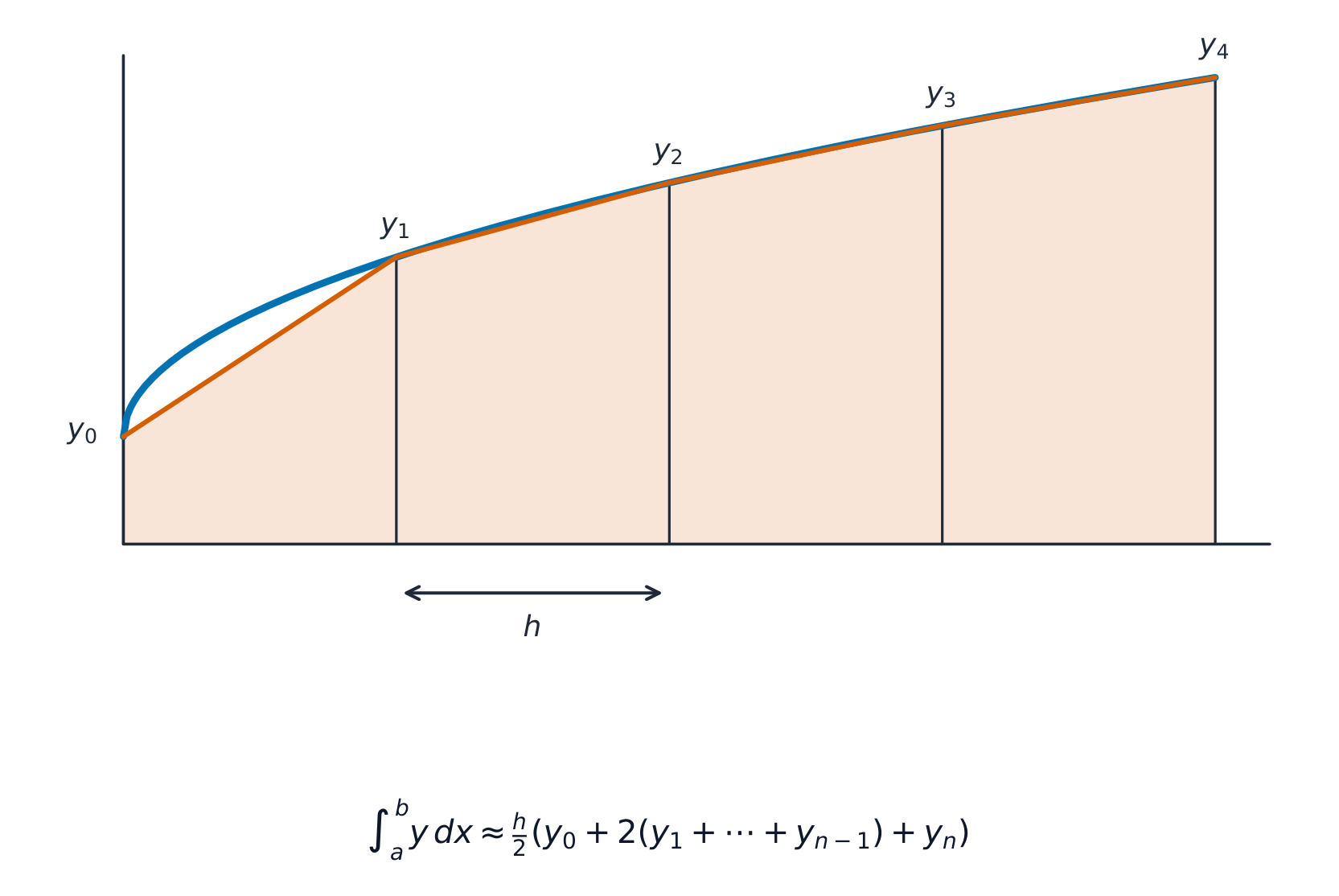
$$\int e^{ax+b}\,dx = \frac{1}{a}e^{ax+b} + C, \qquad \int \frac{1}{ax+b}\,dx = \frac{1}{a}\ln|ax + b| + C,$$$$\int \sin(ax+b)\,dx = -\frac{1}{a}\cos(ax+b) + C, \qquad \int \cos(ax+b)\,dx = \frac{1}{a}\sin(ax+b) + C, \qquad \int \sec^2(ax+b)\,dx = \frac{1}{a}\tan(ax+b) + C.$$要积分 $\sin$ 或 $\cos$ 的一个幂,先用一个恒等式去掉这个幂。当你不能精确积分时,梯形法则(trapezium rule)估计一个定积分:$$\int_a^b y\,dx \approx \tfrac{h}{2}\big[y_0 + y_n + 2(y_1 + y_2 + \cdots + y_{n-1})\big].$$每个宽 $h$ 的条是一个梯形;它们的面积加起来估计积分。 例题。 求 $\displaystyle\int 6\sin^2 x\,dx$。
用 $\sin^2 x = \tfrac12(1 - \cos 2x)$:
$$\int 6\sin^2 x\,dx = \int (3 - 3\cos 2x)\,dx = 3x - \tfrac32\sin 2x + C.$$探索The area under the curve
area = ∫ f(x) dx
The integral still measures area — drag a and b to total the strip under the curve.
词汇表 训练英文 中文 拼音 trapezium rule/trəˈpiːzɪəm ruːl/ 梯形法则 tī xíng fǎ zé integration by substitution/ˌɪntɪˈɡreɪʃn baɪ ˌsʌbstɪˈtjuːʃn/ 换元积分 huàn yuán jī fēn 2.6
方程的数值解
大纲
Candidates should be able to: Notes and examples • locate approximately a root of an equation, by means of graphical considerations and/or searching for a sign change e.g. finding a pair of consecutive integers between which a root lies. • understand the idea of, and use the notation for, a sequence of approximations which converges to a root of an equation • understand how a given simple iterative formula of the form $x_{n + 1} = \text{F}(x_n)$ relates to the equation being solved, and use a given iteration, or an iteration based on a given rearrangement of an equation, to determine a root to a prescribed degree of accuracy. Knowledge of the condition for convergence is not included, but an understanding that an iteration may fail to converge is expected. 来源:剑桥国际大纲
迭代到一个根:骑着切线 许多方程不能精确地解。两个思想帮助你找到一个根(root,一个解)。
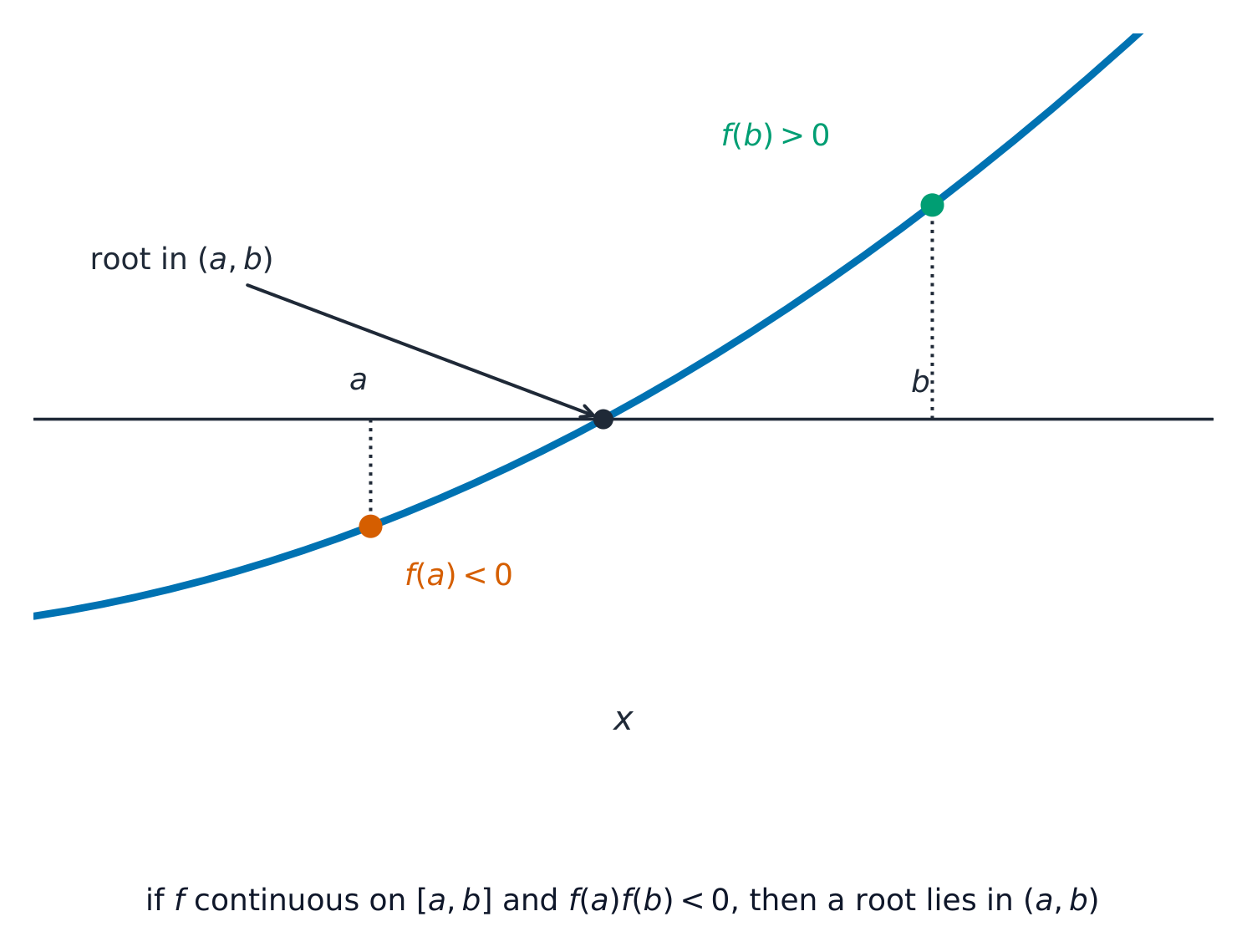
- 变号(sign change):若 $f(a)$ 和 $f(b)$ 有相反的符号(而图形在它们之间没有断裂),一个根位于 $a$ 和 $b$ 之间。
- 迭代(iteration):把方程重排成 $x = F(x)$ 的形式,然后用迭代公式(iterative formula)$x_{n+1} = F(x_n)$。从一个初始猜测 $x_0$ 开始并重复。若这些值是收敛的,它们稳定下来并收敛(converge)到一个根。继续下去直到答案稳定到所要求的精度。
$f(a)$ 和 $f(b)$ 有相反的符号,所以一个根被困在 $a$ 和 $b$ 之间。 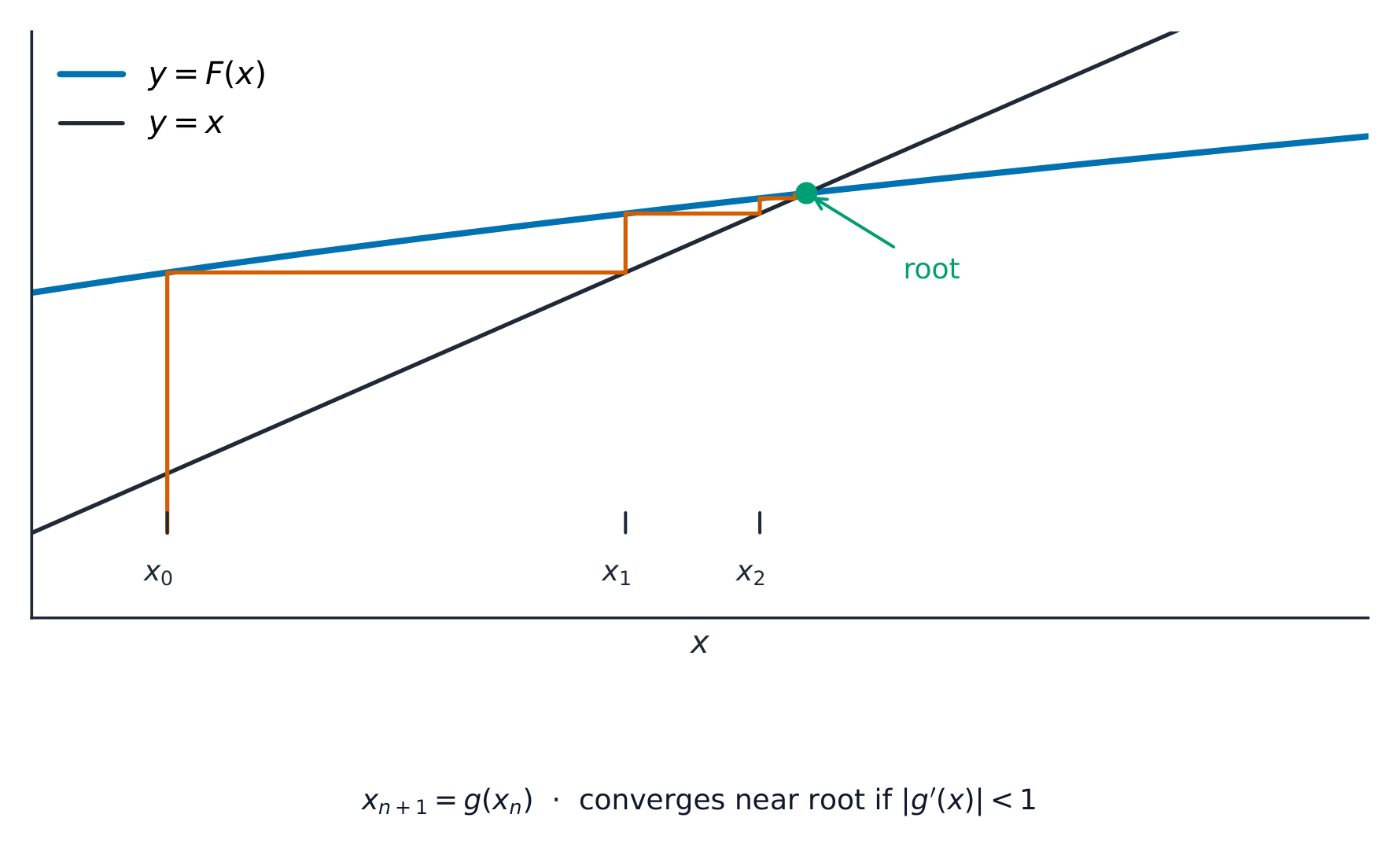
每一步上到 $y=F(x)$ 然后横过到 $y=x$;楼梯逼近根。 例题。 一个方程的一个根 $\beta$ 满足 $x = \sqrt[3]{-2x - 4.5}$,而 $-1.4 < \beta < -1.0$。用迭代 $x_{n+1} = \sqrt[3]{-2x_n - 4.5}$,$x_0 = -1.2$。
$$x_1 = \sqrt[3]{-2(-1.2) - 4.5} = \sqrt[3]{-2.1} = -1.281, \qquad x_2 = \sqrt[3]{-2(-1.281) - 4.5} = -1.247, \quad \ldots$$这些值稳定在 $-1.26$ 附近,所以 $\beta = -1.26$(3 s.f.)。探索Where is the root?
y = ax³ + bx² + cx + d
A root is where the curve crosses zero. A sign change in f(x) traps a root between two x-values.
词汇表 训练英文 中文 拼音 root/ruːt/ 根 gēn sign change/saɪn tʃeɪndʒ/ 变号 biàn hào iteration/ˌɪtəˈreɪʃn/ 迭代 dié dài iterative formula/ˈɪtərətɪv ˈfɔːmjʊlə/ 迭代公式 dié dài gōng shì converge/kənˈvɜːdʒ/ 收敛 shōu liǎn 2.6
考试技巧
- 用对数定律解方程;记住 $\ln$ 和 $e^x$ 是反函数。
- 对于数值方法,显示一个变号以定位一个根、清晰地布置迭代,并给出答案到陈述的精度。
- 学习链式、乘积和商法则并识别函数需要哪一个。
- 通过考虑正和负两种情况解绝对值方程 $|f(x)| = g(x)$,并作草图检查。
-
3
纯数学3
这份讲义涵盖主题 3:纯数学(Pure Mathematics)3。子主题 3.1–3.6 建立在纯数学 2 的代数、对数、三角学、微分、积分和数值方法之上,所以这份讲义解释纯数学 3 中新的东西,然后涵盖三个大的新领域:向量、微分方程和复数。
3.1
代数
大纲
Candidates should be able to: Notes and examples • understand the meaning of $|x|$, sketch the graph of $y = |ax + b|$ and use relations such as $|a| = |b| \iff a^2 = b^2$ and $|x - a| < b \iff a - b < x < a + b$ when solving equations and inequalities Graphs of $y = |\text{f}(x)|$ and $y = \text{f}(|x|)$ for non-linear functions $\text{f}$ are not included. e.g. $|3x - 2| = |2x + 7|$, $2x + 5 < |x + 1|$. • divide a polynomial, of degree not exceeding 4, by a linear or quadratic polynomial, and identify the quotient and remainder (which may be zero) • use the factor theorem and the remainder theorem e.g. to find factors and remainders, solve polynomial equations or evaluate unknown coefficients. Including factors of the form $(ax + b)$ in which the coefficient of $x$ is not unity, and including calculation of remainders. • recall an appropriate form for expressing rational functions in partial fractions, and carry out the decomposition, in cases where the denominator is no more complicated than – $(ax + b)(cx + d)(ex + f)$ – $(ax + b)(cx + d)^2$ – $(ax + b)(cx^2 + d)$ Excluding cases where the degree of the numerator exceeds that of the denominator • use the expansion of $(1 + x)^n$, where $n$ is a rational number and $|x| < 1$. Finding the general term in an expansion is not included. Adapting the standard series to expand e.g. $(2 - \frac{1}{2}x)^{-1}$ is included, and determining the set of values of $x$ for which the expansion is valid in such cases is also included. 来源:剑桥国际大纲
两个新工具加入纯数学 2 的代数。
Partial fractions
一个分母被因式分解的单一分数能被拆成一个更简单分数的和。这叫把它写成部分分式(partial fractions),它使一个有理函数(rational function,多项式的一个分数)容易积分或展开。把形式匹配到分母:
先检查分子的次数低于分母。如果不是("头重"),就先做多项式除法:除法给出一个商(quotient)加上一个余数(remainder)除以原来的分母,然后只拆那个剩下的真分数。
一个分母被因式分解的分数拆成一个更简单分数的和。
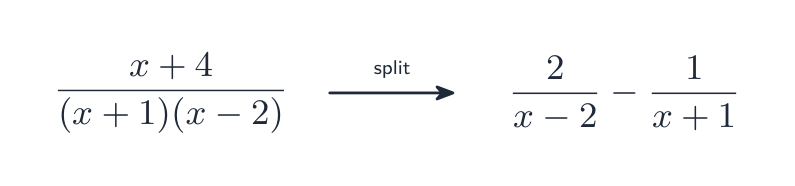
$$\frac{1}{(ax+b)(cx+d)} = \frac{A}{ax+b} + \frac{B}{cx+d}, \qquad \frac{1}{(ax+b)(cx+d)^2} = \frac{A}{ax+b} + \frac{B}{cx+d} + \frac{C}{(cx+d)^2}.$$例题。 把 $\dfrac{x+4}{(x+1)(x-2)}$ 表示成部分分式。
写 $\dfrac{x+4}{(x+1)(x-2)} = \dfrac{A}{x+1} + \dfrac{B}{x-2}$,所以 $x + 4 = A(x-2) + B(x+1)$。 令 $x = 2$:$6 = 3B$,所以 $B = 2$。令 $x = -1$:$3 = -3A$,所以 $A = -1$。因此
$$\frac{x+4}{(x+1)(x-2)} = \frac{2}{x-2} - \frac{1}{x+1}.$$The binomial expansion for a rational power
当幂是一个分数或是负的时,二项展开式(binomial expansion)也有效,只要 $|x| < 1$:
$$(1 + x)^n = 1 + nx + \frac{n(n-1)}{2!}x^2 + \frac{n(n-1)(n-2)}{3!}x^3 + \cdots$$例如对 $|x| < 1$ 有 $(1 + x)^{1/2} = 1 + \tfrac12 x - \tfrac18 x^2 + \cdots$。探索Reciprocal curves
y = a/(x − b) + c
Partial fractions split a hard fraction into simple reciprocal pieces — each with a vertical and a horizontal asymptote.
词汇表 训练英文 中文 拼音 Pure Mathematics/pjʊə ˌmæθɪˈmætɪks/ 纯数学 chún shù xué partial fractions/ˈpɑːʃl ˈfrækʃnz/ 部分分式 bù fèn fēn shì rational function/ˈræʃənl ˈfʌŋkʃn/ 有理函数 yǒu lǐ hán shù quotient/ˈkwəʊʃənt/ 商 shāng remainder/rɪˈmeɪndə/ 余数 yú shù binomial expansion/baɪˈnəʊmɪəl ekˈspænʃn/ 二项展开式 èr xiàng zhǎn kāi shì 3.2 3.3 3.6
对数函数与指数函数
大纲
Candidates should be able to: Notes and examples understand the relationship between logarithms and indices, and use the laws of logarithms (excluding change of base) understand the definition and properties of $e^x$ and $\ln x$, including their relationship as inverse functions and their graphs Including knowledge of the graph of $y = e^{kx}$ for both positive and negative values of $k$. use logarithms to solve equations and inequalities in which the unknown appears in indices e.g. $2^x < 5$, $3 \times 2^{3x-1} < 5$, $3^{x+1} = 4^{2x-1}$. use logarithms to transform a given relationship to linear form, and hence determine unknown constants by considering the gradient and/or intercept. e.g. $y = kx^n$ gives $\ln y = \ln k + n \ln x$ which is linear in $\ln x$ and $\ln y$. $y = k(a^x)$ gives $\ln y = \ln k + x \ln a$ which is linear in $x$ and $\ln y$. Candidates should be able to: Notes and examples understand the relationship of the secant, cosecant and cotangent functions to cosine, sine and tangent, and use properties and graphs of all six trigonometric functions for angles of any magnitude use trigonometrical identities for the simplification and exact evaluation of expressions, and in the course of solving equations, and select an identity or identities appropriate to the context, showing familiarity in particular with the use of: – $\sec^2 \theta \equiv 1 + \tan^2 \theta$ and $\cosec^2 \theta \equiv 1 + \cot^2 \theta$ – the expansions of $\sin(A \pm B)$, $\cos(A \pm B)$ and $\tan(A \pm B)$ – the formulae for $\sin 2A$, $\cos 2A$ and $\tan 2A$ – the expression of $a \sin \theta + b \cos \theta$ in the forms $R \sin(\theta \pm \alpha)$ and $R \cos(\theta \pm \alpha)$. e.g. simplifying $\cos(x - 30^\circ) - 3 \sin(x - 60^\circ)$. e.g. solving $\tan \theta + \cot \theta = 4$, $2 \sec^2 \theta - \tan \theta = 5$, $3 \cos \theta + 2 \sin \theta = 1$. Candidates should be able to: Notes and examples • locate approximately a root of an equation, by means of graphical considerations and/or searching for a sign change e.g. finding a pair of consecutive integers between which a root lies. • understand the idea of, and use the notation for, a sequence of approximations which converges to a root of an equation • understand how a given simple iterative formula of the form $x_{n+1} = \text{F}(x_n)$ relates to the equation being solved, and use a given iteration, or an iteration based on a given rearrangement of an equation, to determine a root to a prescribed degree of accuracy. Knowledge of the condition for convergence is not included, but an understanding that an iteration may fail to converge is expected. 来源:剑桥国际大纲
迭代到一个根:骑着切线 子主题 3.2、3.3 和 3.6 是你在纯数学 2 中遇到的同样技能:带 $e^x$ 和 $\ln x$ 的对数定律;恒等式 $\sec^2\theta \equiv 1 + \tan^2\theta$ 和 $\csc^2\theta \equiv 1 + \cot^2\theta$、复合角和二倍角公式,以及 $a\sin\theta + b\cos\theta$ 的 $R$ 形式;以及通过一个变号(sign change)和一个迭代公式(iterative formula)$x_{n+1} = F(x_n)$ 数值地解一个方程。完全像之前一样用它们。
那三个新的三角函数是熟悉的三个的倒数(reciprocals):正割(secant)$\sec\theta = \dfrac{1}{\cos\theta}$、余割(cosecant)$\csc\theta = \dfrac{1}{\sin\theta}$,和余切(cotangent)$\cot\theta = \dfrac{1}{\tan\theta} = \dfrac{\cos\theta}{\sin\theta}$。(记忆法:对上第三个字母 —— sec 配 cosine。)上面那两个毕达哥拉斯恒等式,正是把 $\sin^2\theta + \cos^2\theta \equiv 1$ 除以 $\cos^2\theta$ 或 $\sin^2\theta$ 得来的。对一个数值方法,当相继的值越来越接近时,迭代 $x_{n+1}=F(x_n)$ 就收敛(converges)到根。
探索The unit circle
(cos θ, sin θ)
The R-formula rewrites a sin θ + b cos θ as one wave — and it all lives on this circle.
词汇表 训练英文 中文 拼音 sign change/saɪn tʃeɪndʒ/ 变号 biàn hào iterative formula/ˈɪtərətɪv ˈfɔːmjʊlə/ 迭代公式 dié dài gōng shì reciprocals/rɪˈsɪprəklz/ 倒数 dào shǔ secant/ˈsiːkənt/ 正割 zhèng gē cosecant/ˈkəʊsekənt/ 余割 yú gē cotangent/ˈkəʊtændʒənt/ 余切 yú qiē converges/kənˈvɜːdʒɪz/ 收敛 shōu liǎn 3.4
微分
大纲
Candidates should be able to: Notes and examples use the derivatives of $e^x$, $\ln x$, $\sin x$, $\cos x$, $\tan x$, $\tan^{-1} x$, together with constant multiples, sums, differences and composites Derivatives of $\sin^{-1} x$ and $\cos^{-1} x$ are not required. differentiate products and quotients e.g. $\frac{2x - 4}{3x + 2}$, $x^2 \ln x$, $x e^{1-x^2}$. find and use the first derivative of a function which is defined parametrically or implicitly. e.g. $x = t - e^{2t}$, $y = t + e^{2t}$. e.g. $x^2 + y^2 = xy + 7$. Including use in problems involving tangents and normals. 来源:剑桥国际大纲
方法是纯数学 2 的那些(乘积、商和链式法则,带参数和隐式曲线)。加了一个导数——反正切(inverse tangent):
$$\frac{d}{dx}\tan^{-1} x = \frac{1}{1 + x^2}.$$例题。 微分 $y = \tan^{-1}(3x)$。
用链式法则和上面的结果:$\dfrac{dy}{dx} = \dfrac{1}{1 + (3x)^2} \times 3 = \dfrac{3}{1 + 9x^2}.$
探索The gradient at a point
gradient = dy/dx
Implicit or not, the derivative is still the slope of the tangent — slide the point to see it.
词汇表 训练英文 中文 拼音 inverse tangent/ɪnˈvɜːs ˈtændʒənt/ 反正切 fǎn zhèng qiè 3.5
积分
大纲
Candidates should be able to: Notes and examples extend the idea of 'reverse differentiation' to include the integration of $e^{ax + b}$, $\frac{1}{ax + b}$, $\sin(ax + b)$, $\cos(ax + b)$, $\sec^2(ax + b)$ and $\frac{1}{x^2 + a^2}$ Including examples such as $\frac{1}{2 + 3x^2}$. use trigonometrical relationships in carrying out integration e.g. use of double-angle formulae to integrate $\sin^2 x$ or $\cos^2(2x)$. integrate rational functions by means of decomposition into partial fractions Restricted to types of partial fractions as specified in topic 3.1 above. recognise an integrand of the form $\frac{k f'(x)}{f(x)}$, and integrate such functions e.g. integration of $\frac{x}{x^2 + 1}$, $\tan x$. recognise when an integrand can usefully be regarded as a product, and use integration by parts e.g. integration of $x \sin 2x$, $x^2 e^{-x}$, $\ln x$, $x \tan^{-1} x$. use a given substitution to simplify and evaluate either a definite or an indefinite integral. e.g. to integrate $\sin^2 2x \cos x$ using the substitution $u = \sin x$. 来源:剑桥国际大纲
纯数学 3 增加几个强大的方法。
- 一个新的标准积分:$\displaystyle\int \frac{1}{x^2 + a^2}\,dx = \frac{1}{a}\tan^{-1}\frac{x}{a} + C$。
- 部分分式:先拆一个有理函数,然后把每一片作为一个对数积分。
- 模式 $\dfrac{k\,f'(x)}{f(x)}$:这积分成 $k\ln|f(x)| + C$。例如 $\displaystyle\int \frac{2x}{x^2 + 1}\,dx = \ln(x^2 + 1) + C$。
- 分部积分(integration by parts),用于一个乘积:$\displaystyle\int u\,\frac{dv}{dx}\,dx = uv - \int v\,\frac{du}{dx}\,dx$。
- 换元积分(integration by substitution):一个给定的变量替换把一个难的积分变成一个容易的。
例题。 求 $\displaystyle\int x\cos x\,dx$。
用分部积分,$u = x$、$\dfrac{dv}{dx} = \cos x$,所以 $\dfrac{du}{dx} = 1$ 且 $v = \sin x$:
$$\int x\cos x\,dx = x\sin x - \int \sin x\,dx = x\sin x + \cos x + C.$$探索The area under the curve
area = ∫ f(x) dx
Every integration method just measures this area — drag the limits to total it.
词汇表 训练英文 中文 拼音 Integration by parts/ˌɪntɪˈɡreɪʃn baɪ pɑːts/ 分部积分 fēn bù jī fēn Integration by substitution/ˌɪntɪˈɡreɪʃn baɪ ˌsʌbstɪˈtjuːʃn/ 换元积分 huàn yuán jī fēn 3.7
向量

大纲
Candidates should be able to: Notes and examples • use standard notations for vectors, i.e. $\begin{pmatrix} x \\ y \end{pmatrix}$, $x\mathbf{i} + y\mathbf{j}$, $\begin{pmatrix} x \\ y \\ z \end{pmatrix}$, $x\mathbf{i} + y\mathbf{j} + z\mathbf{k}$, $\overrightarrow{AB}$, $\mathbf{a}$ • carry out addition and subtraction of vectors and multiplication of a vector by a scalar, and interpret these operations in geometrical terms e.g. ‘$OABC$ is a parallelogram’ is equivalent to $\overrightarrow{OB} = \overrightarrow{OA} + \overrightarrow{OC}$. The general form of the ratio theorem is not included, but understanding that the midpoint of $AB$ has position vector $\frac{1}{2}(\overrightarrow{OA} + \overrightarrow{OB})$ is expected. • calculate the magnitude of a vector, and use unit vectors, displacement vectors and position vectors In 2 or 3 dimensions. • understand the significance of all the symbols used when the equation of a straight line is expressed in the form $\mathbf{r} = \mathbf{a} + t\mathbf{b}$, and find the equation of a line, given sufficient information e.g. finding the equation of a line given the position vector of a point on the line and a direction vector, or the position vectors of two points on the line. • determine whether two lines are parallel, intersect or are skew, and find the point of intersection of two lines when it exists Calculation of the shortest distance between two skew lines is not required. Finding the equation of the common perpendicular to two skew lines is also not required. • use formulae to calculate the scalar product of two vectors, and use scalar products in problems involving lines and points. e.g. finding the angle between two lines, and finding the foot of the perpendicular from a point to a line; questions may involve 3D objects such as cuboids, tetrahedra (pyramids), etc. Knowledge of the vector product is not required. 来源:剑桥国际大纲
像风和水的力是向量——它们既有大小又有方向。 一个向量(vector)既有大小又有方向。把它写成一个列,或写成 $x\mathbf{i} + y\mathbf{j} + z\mathbf{k}$,或写成 $\overrightarrow{AB}$。
- $\mathbf{v} = x\mathbf{i} + y\mathbf{j} + z\mathbf{k}$ 的模长(magnitude,长度)是 $|\mathbf{v}| = \sqrt{x^2 + y^2 + z^2}$。
- 一个单位向量(unit vector)有模长 $1$;把一个向量除以它的模长以构成一个。
- 一个位置向量(position vector)给出一个点从原点的位置;一个位移向量(displacement vector)$\overrightarrow{AB} = \mathbf{b} - \mathbf{a}$ 从一个点到另一个。乘以一个标量(scalar,一个普通的数)伸缩一个向量。
Lines and the scalar product
通过点 $\mathbf{a}$、沿方向 $\mathbf{b}$ 的一条直线有向量方程 $\mathbf{r} = \mathbf{a} + t\mathbf{b}$。两条直线可能平行(parallel)、可能在一个点相交(intersect),或可能是异面直线(skew lines,不平行且从不相遇)。

从点 $\mathbf{a}$ 开始,然后加 $t$ 个方向 $\mathbf{b}$ 的副本以到达直线上的任何点。 $\mathbf{a}$ 和 $\mathbf{b}$ 的数量积(scalar product,点积)是
$$\mathbf{a}\cdot\mathbf{b} = a_1 b_1 + a_2 b_2 + a_3 b_3 = |\mathbf{a}|\,|\mathbf{b}|\cos\theta,$$其中 $\theta$ 是它们之间的角。所以 $\mathbf{a}\cdot\mathbf{b} = 0$ 意味着这两个向量垂直。
数量积挑出 $|\mathbf{b}|\cos\theta$,$\mathbf{b}$ 沿 $\mathbf{a}$ 到达多远。 例题。 求 $\mathbf{a} = \mathbf{i} + 2\mathbf{j} + 2\mathbf{k}$ 和 $\mathbf{b} = 2\mathbf{i} + 2\mathbf{j} + \mathbf{k}$ 之间的角。
$$\mathbf{a}\cdot\mathbf{b} = (1)(2) + (2)(2) + (2)(1) = 8, \qquad |\mathbf{a}| = |\mathbf{b}| = 3.$$所以 $\cos\theta = \dfrac{8}{3\times 3} = \dfrac{8}{9}$,给出 $\theta = 27.3^\circ$。探索Adding vectors and the dot product
Drag the two vectors. See the resultant (tip-to-tail) and the dot product, which is zero when they are perpendicular.
词汇表 训练英文 中文 拼音 vector/ˈvektə/ 向量 xiàng liàng magnitude/ˈmæɡnɪtjuːd/ 模长 mó zhǎng unit vector/ˈjuːnɪt ˈvektə/ 单位向量 dān wèi xiàng liàng position vector/pəˈzɪʃn ˈvektə/ 位置向量 wèi zhì xiàng liàng displacement vector/dɪˈspleɪsmənt ˈvektə/ 位移向量 wèi yí xiàng liàng scalar/ˈskeɪlə/ 标量 biāo liàng parallel/ˈpærəlel/ 平行 píng xíng intersect/ˌɪntəˈsekt/ 相交 xiāng jiāo skew lines/skjuː laɪnz/ 异面直线 yì miàn zhí xiàn scalar product/ˈskeɪlə ˈprɒdʌkt/ 数量积 shù liàng jī 3.8
微分方程

大纲
Candidates should be able to: Notes and examples formulate a simple statement involving a rate of change as a differential equation The introduction and evaluation of a constant of proportionality, where necessary, is included. find by integration a general form of solution for a first order differential equation in which the variables are separable Including any of the integration techniques from topic 3.5 above. use an initial condition to find a particular solution interpret the solution of a differential equation in the context of a problem being modelled by the equation. Where a differential equation is used to model a 'real-life' situation, no specialised knowledge of the context will be required. 来源:剑桥国际大纲
一个微分方程(differential equation)把一个量与它的变化率联系起来。要解一个变量可分离变量(separable)的一阶方程,把所有 $y$ 项放在一边、所有 $x$ 项放在另一边,然后积分两边。这给出通解(general solution),它含一个常数。一个初始条件(initial condition,一个已知的值)确定这个常数并给出特解(particular solution)。
例题。 解 $\dfrac{dy}{dx} = xy$,给定当 $x = 0$ 时 $y = 1$。
分离变量并积分:
$$\int \frac{1}{y}\,dy = \int x\,dx \;\Rightarrow\; \ln y = \tfrac12 x^2 + c \;\Rightarrow\; y = A e^{x^2/2}.$$用 $x = 0$ 处 $y = 1$ 给出 $A = 1$,所以 $y = e^{x^2/2}$。常数 $A$ 给出一整族曲线;条件 $x=0$ 处 $y=1$ 选出 $y=e^{x^2/2}$。 探索A slope field
Each little line shows the gradient $\frac{dy}{dx}$ there. A solution curve follows the arrows — change the starting point to see a different one.
词汇表 训练英文 中文 拼音 differential equation/ˌdɪfəˈrenʃl ɪˈkweɪʒn/ 微分方程 wēi fēn fāng chéng separable/ˈsepərəbl/ 可分离变量 kě fēn lí biàn liàng general solution/ˈdʒenərəl səˈluːʃn/ 通解 tōng jiě initial condition/ɪˈnɪʃl kənˈdɪʃn/ 初始条件 chū shǐ tiáo jiàn particular solution/pəˈtɪkjʊlə səˈluːʃn/ 特解 tè jiě 3.9
复数

大纲
Candidates should be able to: Notes and examples understand the idea of a complex number, recall the meaning of the terms real part, imaginary part, modulus, argument, conjugate, and use the fact that two complex numbers are equal if and only if both real and imaginary parts are equal Notations $\text{Re } z$, $\text{Im } z$, $|z|$, $\arg z$, $z^*$ should be known. The argument of a complex number will usually refer to an angle $\theta$ such that $-\pi < \theta \leqslant \pi$, but in some cases the interval $0 \leqslant \theta < 2\pi$ may be more convenient. Answers may use either interval unless the question specifies otherwise. carry out operations of addition, subtraction, multiplication and division of two complex numbers expressed in Cartesian form $x + \text{i}y$ For calculations involving multiplication or division, full details of the working should be shown. use the result that, for a polynomial equation with real coefficients, any non-real roots occur in conjugate pairs e.g. in solving a cubic or quartic equation where one complex root is given. represent complex numbers geometrically by means of an Argand diagram carry out operations of multiplication and division of two complex numbers expressed in polar form $r(\cos \theta + \text{i}\sin \theta) \equiv r\text{e}^{\text{i}\theta}$ Including the results $|z_1 z_2| = |z_1||z_2|$ and $\arg(z_1 z_2) = \arg(z_1) + \arg(z_2)$, and corresponding results for division. find the two square roots of a complex number e.g. the square roots of $5 + 12\text{i}$ in exact Cartesian form. Full details of the working should be shown. understand in simple terms the geometrical effects of conjugating a complex number and of adding, subtracting, multiplying and dividing two complex numbers illustrate simple equations and inequalities involving complex numbers by means of loci in an Argand diagram e.g. $|z - a| < k$, $|z - a| = |z - b|$, $\arg(z - a) = \alpha$. 来源:剑桥国际大纲
复数相乘:长度相乘,角相加 乘以 i 是一个旋转 像罗马花椰菜的自相似模式来自在复平面中迭代函数。 一个复数(complex number)有形式 $z = x + iy$,其中 $i^2 = -1$。这里 $x$ 是实部(real part)而 $y$ 是虚部(imaginary part)。这个 $x + iy$ 是直角坐标形式(Cartesian form)。两个复数相等只当它们的实部匹配且它们的虚部匹配时。
- $z = x + iy$ 的共轭(conjugate)是 $z^* = x - iy$。对一个有实系数的多项式,任何非实根成共轭对出现。
- 模(modulus)是 $|z| = \sqrt{x^2 + y^2}$(它到原点的距离),而辐角(argument)是这个点构成的角,从正实轴测量。
- 你可以把 $z$ 作为一个点画在一个阿干图(Argand diagram,复平面)上。
- 极坐标形式(polar form)是 $z = r(\cos\theta + i\sin\theta) = re^{i\theta}$,其中 $r = |z|$ 而 $\theta$ 是辐角。相乘把模相乘并把辐角相加。
- 满足一个 $z$ 上的条件的点的轨迹被画在阿干图上——例如 $|z - a| = r$ 是一个圆、$|z - a| = |z - b|$ 是一条垂直平分线,而 $\arg(z - a) = \theta$ 是一条半线。一个复数的平方根来自解 $w^2 = z$。

在阿干图上 $|z|$ 是到 $O$ 的距离,$\arg z$ 是角,而 $z^{*}$ 是在实轴中的反射。 要相除,把上和下都乘以下面的共轭。
例题。 把 $\dfrac{3 + i}{1 - i}$ 写成 $x + iy$ 的形式。
$$\frac{3 + i}{1 - i} = \frac{(3 + i)(1 + i)}{(1 - i)(1 + i)} = \frac{3 + 3i + i + i^2}{1 + 1} = \frac{2 + 4i}{2} = 1 + 2i.$$一个 $z$ 中的方程或不等式描述阿干图上的一个轨迹(locus,一条路径或区域)。例如 $|z - a| = r$ 是一个以 $a$ 为圆心、半径 $r$ 的圆。

$|z-a|=r$ 是距 $a$ 固定距离 $r$ 的点的集合——一个圆。 探索The Argand diagram
Drag the point. A complex number $a + bi$ is a point on the plane; its modulus is the distance from the origin and its argument is the angle.
词汇表 训练英文 中文 拼音 complex number/ˈkɒmpleks ˈnʌmbə/ 复数 fù shù real part/rɪəl pɑːt/ 实部 shí bù imaginary part/ɪˈmædʒɪnəri pɑːt/ 虚部 xū bù Cartesian form/kɑːˈtiːzɪən fɔːm/ 直角坐标形式 zhí jiǎo zuò biāo xíng shì conjugate/ˈkɒndʒuːɡeɪt/ 共轭 gòng è modulus/ˈmɒdjʊləs/ 模 mó argument/ˈɑːɡjuːmənt/ 辐角 fú jiǎo Argand diagram/ˈɑːɡænd ˈdaɪəɡræm/ 阿干图 ā gàn tú polar form/ˈpəʊlə fɔːm/ 极坐标形式 jí zuò biāo xíng shì locus/ˈləʊkəs/ 轨迹 guǐ jì 3.9
考试技巧
- 在积分或展开之前把一个有理函数拆成部分分式。
- 从被积函数的形式选择正确的积分技巧(换元、分部,或部分分式)。
- 用数量(点)积求向量之间的角并测试垂直性;把一条直线写成 $\mathbf{r} = \mathbf{a} + t\mathbf{b}$。
- 以被要求的形式(直角坐标或模-辐角)给出复数并在一个阿干图上显示它们。
-
4
力学
这份讲义涵盖主题 4:力学(Mechanics)。它研究力如何使物体运动。在这个主题中,取自由落体的加速度为 $g = 10\ \text{m s}^{-2}$。
4.1
力与平衡
大纲
Candidates should be able to: Notes and examples identify the forces acting in a given situation e.g. by drawing a force diagram. understand the vector nature of force, and find and use components and resultants Calculations are always required, not approximate solutions by scale drawing. use the principle that, when a particle is in equilibrium, the vector sum of the forces acting is zero, or equivalently, that the sum of the components in any direction is zero Solutions by resolving are usually expected, but equivalent methods (e.g. triangle of forces, Lami's Theorem, where suitable) are also acceptable; these other methods are not required knowledge, and will not be referred to in questions. understand that a contact force between two surfaces can be represented by two components, the normal component and the frictional component use the model of a 'smooth' contact, and understand the limitations of this model understand the concepts of limiting friction and limiting equilibrium, recall the definition of coefficient of friction, and use the relationship $F = \mu R$ or $F \leqslant \mu R$, as appropriate Terminology such as 'about to slip' may be used to mean 'in limiting equilibrium' in questions. use Newton's third law. e.g. the force exerted by a particle on the ground is equal and opposite to the force exerted by the ground on the particle. 来源:剑桥国际大纲
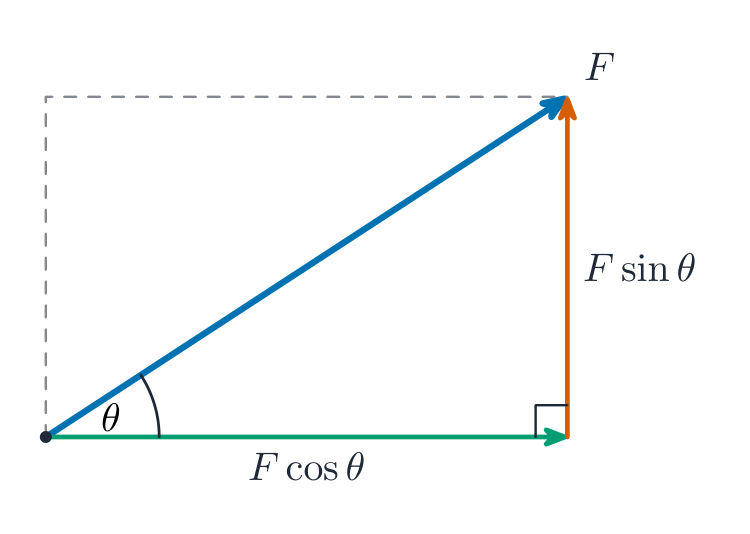
一个力(force)是一个推或一个拉。它是一个向量,所以它有大小和方向。因为它是一个向量,你可以把一个力拆成分量(components,通常是水平和竖直),而且你可以把几个力加成一个合力(resultant)。
一个角 $\theta$ 处的力有一个水平部分 $F\cos\theta$ 和一个竖直部分 $F\sin\theta$。 当力平衡时,一个质点处于平衡(equilibrium):力的向量和为零。在实践中这意味着任何方向上的分量加起来为零。

每一道力学题都是这样一幅画。三个力作用在攀岩者身上——竖直向下的重力、沿绳方向的张力,以及来自岩石的推力——因为它们相互平衡,攀岩者才静止悬着,处于平衡。把每个力分解成水平和竖直分量,就把这幅画变成了方程 Friction
当两个表面接触时,它们之间的接触力(contact force)有两部分:法向反作用力(normal reaction)$R$,与表面成直角,和摩擦力(friction)$F$,沿表面,它反对滑动。一个"光滑"表面是一个没有摩擦的模型。
摩擦只能增长到一个最大值。在那个最大值,物体处于极限平衡(limiting equilibrium),即将滑动,而摩擦是最大静摩擦力(limiting friction)。最大值由摩擦系数(coefficient of friction)$\mu$ 设定:
$$F \leqslant \mu R, \qquad \text{with } F = \mu R \text{ at the point of slipping}.$$
在一个粗糙表面上,接触力拆成法向反作用力 $R$ 和摩擦 $F$(最多 $\mu R$)。 由牛顿第三定律(Newton's third law),两个表面以相等且相反的力互相推。
例题。 一个重 $20\text{ N}$ 的方块放在一张摩擦系数 $\mu = 0.4$ 的粗糙水平桌子上。求方块滑动之前能施加的最大水平力。
桌子的法向反作用力平衡重力,所以 $R = 20\text{ N}$。当摩擦达到它的最大值 $F = \mu R = 0.4 \times 20 = 8\text{ N}$ 时,方块处于即将滑动的点。在平衡中施加的力等于摩擦,所以它能抵抗的最大力是 $8\text{ N}$。
探索Adding forces
resultant = a + b
Forces add tip-to-tail. They are in equilibrium when the resultant is zero.
词汇表 训练英文 中文 拼音 Mechanics/mɪˈkænɪks/ 力学 lì xué force/fɔːs/ 力 lì components/kəmˈpəʊnənts/ 分量 fèn liàng resultant/rɪˈzʌltənt/ 合力 hé lì equilibrium/ˌiːkwɪˈlɪbrɪəm/ 平衡 píng héng contact force/ˈkɒntækt fɔːs/ 接触力 jiē chù lì normal reaction/ˈnɔːml rɪˈækʃn/ 法向反作用力 fǎ xiàng fǎn zuò yòng lì friction/ˈfrɪkʃn/ 摩擦力 mó cā lì limiting friction/ˈlɪmɪtɪŋ ˈfrɪkʃn/ 最大静摩擦力 zuì dà jìng mó cā lì coefficient of friction/ˌkəʊɪˈfɪʃənt ɒv ˈfrɪkʃn/ 摩擦系数 mó cā xì shù Newton's third law/ˈnjuːtnz θɜːd lɔː/ 牛顿第三定律 niú dùn dì sān dìng lǜ limiting equilibrium/ˈlɪmɪtɪŋ ˌiːkwɪˈlɪbrɪəm/ 极限平衡 jí xiàn píng héng 4.2
直线运动的运动学

大纲
Candidates should be able to: Notes and examples understand the concepts of distance and speed as scalar quantities, and of displacement, velocity and acceleration as vector quantities Restricted to motion in one dimension only. The term 'deceleration' may sometimes be used in the context of decreasing speed. sketch and interpret displacement–time graphs and velocity–time graphs, and in particular appreciate that – the area under a velocity–time graph represents displacement, – the gradient of a displacement–time graph represents velocity, – the gradient of a velocity–time graph represents acceleration use differentiation and integration with respect to time to solve simple problems concerning displacement, velocity and acceleration Calculus required is restricted to techniques from the content for Paper 1: Pure Mathematics 1. use appropriate formulae for motion with constant acceleration in a straight line. Questions may involve setting up more than one equation, using information about the motion of different particles. 来源:剑桥国际大纲
距离(distance)和速率(speed)是标量(只有大小)。位移(displacement)、速度(velocity)和加速度(acceleration)是向量(大小和方向)。
在一个速度时间图(velocity-time graph)上,图形下的面积是位移,而斜率是加速度(一个负加速度是一个减速度(deceleration))。在一个位移时间图上,斜率是速度。更一般地,关于时间微分从位移到速度到加速度,而积分回去。
着色的面积给出行进的距离;线的斜率给出加速度。 对于匀加速(constant acceleration)的运动,用这些公式("suvat"方程):
$$v = u + at, \qquad s = ut + \tfrac12 at^2, \qquad v^2 = u^2 + 2as, \qquad s = \tfrac12(u + v)t.$$例题。 一辆车从静止开始并以 $2.5\ \text{m s}^{-2}$ 加速 $4\ \text{s}$。求它的速率和行进的距离。
$$v = 0 + 2.5\times 4 = 10\ \text{m s}^{-1}, \qquad s = 0 + \tfrac12(2.5)(4^2) = 20\ \text{m}.$$探索Velocity–time graph
Change the start velocity and acceleration. The gradient is the acceleration; the area under the line is the displacement.
词汇表 训练英文 中文 拼音 distance/ˈdɪstəns/ 距离 jù lí speed/spiːd/ 速率 sù lǜ displacement/dɪˈspleɪsmənt/ 位移 wèi yí velocity/vəˈlɒsɪti/ 速度 sù dù acceleration/əkˌseləˈreɪʃn/ 加速度 jiā sù dù velocity-time graph/vəˈlɒsɪti taɪm ɡræf/ 速度时间图 sù dù shí jiān tú constant acceleration/ˈkɒnstənt əkˌseləˈreɪʃn/ 匀加速 yún jiā sù deceleration/dɪˌseləˈreɪʃn/ 减速度 jiǎn sù dù 4.3
动量

大纲
Candidates should be able to: Notes and examples use the definition of linear momentum and show understanding of its vector nature For motion in one dimension only. use conservation of linear momentum to solve problems that may be modelled as the direct impact of two bodies. Including direct impact of two bodies where the bodies coalesce on impact. Knowledge of impulse and the coefficient of restitution is not required. 来源:剑桥国际大纲
一个牛顿摆演示碰撞中的动量守恒。 一个物体的动量(linear momentum)是 $\text{mass} \times \text{velocity}$。它是一个向量。在两个物体的直接碰撞中,总动量不变。这是动量守恒(conservation of linear momentum):
$$m_1 u_1 + m_2 u_2 = m_1 v_1 + m_2 v_2.$$
总动量在碰撞前和后相同。 例题。 一个质量 $2\ \text{kg}$、以 $3\ \text{m s}^{-1}$ 运动的物体撞上一个静止的质量 $1\ \text{kg}$ 的物体,它们粘在一起。求它们之后共同的速率。
$$2(3) + 1(0) = (2 + 1)v \;\Rightarrow\; v = \frac{6}{3} = 2\ \text{m s}^{-1}.$$探索A collision
Set each mass and speed and collide them. Total momentum stays the same before and after.
词汇表 训练英文 中文 拼音 momentum/məʊˈmentəm/ 动量 dòng liàng conservation of momentum/ˌkɒnsəˈveɪʃn ɒv məʊˈmentəm/ 动量守恒 dòng liàng shǒu héng mass/mæs/ 质量 zhì liàng 4.4
牛顿运动定律

大纲
Candidates should be able to: Notes and examples • apply Newton’s laws of motion to the linear motion of a particle of constant mass moving under the action of constant forces, which may include friction, tension in an inextensible string and thrust in a connecting rod If any other forces resisting motion are to be considered (e.g. air resistance) this will be indicated in the question. • use the relationship between mass and weight $W = mg$. In this component, questions are mainly numerical, and use of the approximate numerical value $10\text{ (ms}^{-2}\text{)}$ for $g$ is expected. • solve simple problems which may be modelled as the motion of a particle moving vertically or on an inclined plane with constant acceleration Including, for example, motion of a particle on a rough plane where the acceleration while moving up the plane is different from the acceleration while moving down the plane. • solve simple problems which may be modelled as the motion of connected particles. e.g. particles connected by a light inextensible string passing over a smooth pulley, or a car towing a trailer by means of either a light rope or a light rigid tow-bar. 来源:剑桥国际大纲
牛顿运动定律(Newton's laws of motion)连接力和加速度。关键的一个是:合力 $=$ 质量(mass)$\times$ 加速度,
$$F = ma.$$一个物体的重力(weight)是它上面重力的力:$W = mg$。一个问题中的力可能包括重力、摩擦、一根绳中的张力(tension)、一根杆中的推力(thrust),以及空气阻力(air resistance)。对于在一个斜面(inclined plane)上的运动,把每个力拆成沿斜坡的一部分和与它成直角的一部分,然后沿斜坡应用 $F = ma$。对于连接质点(connected particles,由一根绳连接),对每个物体、或对整个系统应用 $F = ma$。
在一个斜坡上,把力沿斜坡和与它成直角地分解。 例题。 一个质量 $12\ \text{kg}$ 的方块被一根平行于斜坡的绳沿一个粗糙的平面往上拉。平面与水平成 $20^\circ$,摩擦系数是 $0.4$,而加速度是 $2\ \text{m s}^{-2}$。求绳中的张力。
法向反作用力是 $R = mg\cos 20^\circ = 120\cos 20^\circ = 112.8\ \text{N}$,所以摩擦是 $F = \mu R = 0.4 \times 112.8 = 45.1\ \text{N}$。沿斜坡,$T - mg\sin 20^\circ - F = ma$:
$$T = ma + mg\sin 20^\circ + F = 12(2) + 120\sin 20^\circ + 45.1 = 24 + 41.0 + 45.1 = 110\ \text{N (3 s.f.)}.$$探索Resultant force
F = ma
The resultant force sets the acceleration. Balanced forces ⇒ no acceleration.
词汇表 训练英文 中文 拼音 Newton's laws of motion/ˈnjuːtnz lɔːz ɒv ˈməʊʃn/ 牛顿运动定律 niú dùn yùn dòng dìng lǜ weight/weɪt/ 重力 zhòng lì tension/ˈtenʃn/ 张力 zhāng lì inclined plane/ɪnˈklaɪnd pleɪn/ 斜面 xié miàn connected particles/kəˈnektɪd ˈpɑːtɪklz/ 连接质点 lián jiē zhì diǎn thrust/θrʌst/ 推力 tuī lì air resistance/eə rɪˈzɪstəns/ 空气阻力 kōng qì zǔ lì 4.5
能量、功与功率

大纲
Candidates should be able to: Notes and examples • understand the concept of the work done by a force, and calculate the work done by a constant force when its point of application undergoes a displacement not necessarily parallel to the force $W = Fd \cos \theta$; Use of the scalar product is not required. • understand the concepts of gravitational potential energy and kinetic energy, and use appropriate formulae • understand and use the relationship between the change in energy of a system and the work done by the external forces, and use in appropriate cases the principle of conservation of energy Including cases where the motion may not be linear (e.g. a child on a smooth curved ‘slide’), where only overall energy changes need to be considered. • use the definition of power as the rate at which a force does work, and use the relationship between power, force and velocity for a force acting in the direction of motion Including calculation of (average) power as $$\frac{\text{Work done}}{\text{Time taken}}$$$P = Fv$.• solve problems involving, for example, the instantaneous acceleration of a car moving on a hill against a resistance. 来源:剑桥国际大纲
一个过山车在它上升和下降时把势能交换成动能。 一个恒定力做的功(work done)是力和位移的数量积——力乘以沿力方向移动的距离:$W = Fd\cos\theta$,其中 $\theta$ 是力和运动之间的角。功以焦耳(J)测量。
能量以你能计算的形式出现:
- 动能(kinetic energy,运动的能量):$\text{KE} = \tfrac12 mv^2$。
- 重力势能(gravitational potential energy,高度的能量):$\text{PE} = mgh$。
外力做的功等于总能量的变化。当没有摩擦作用时,总能量保持不变——能量守恒(conservation of energy)。
功率(power)是做功的速率。对于一个沿运动方向拉的力,$P = Fv$(功率 $=$ 力 $\times$ 速度)。功率以瓦特(W)测量。
例题。 一个汽车引擎在车以 $20\ \text{m s}^{-1}$ 在一条水平的路上运动时以 $12\ \text{kW}$ 工作。求驱动力。
$$P = Fv \;\Rightarrow\; F = \frac{P}{v} = \frac{12000}{20} = 600\ \text{N}.$$探索Conservation of energy
Drop the object and watch energy change form. With no friction, GPE + KE stays constant the whole way down.
词汇表 训练英文 中文 拼音 work done/wɜːk dʌn/ 功 gōng kinetic energy/kɪˈnetɪk ˈenədʒi/ 动能 dòng néng gravitational potential energy/ˌɡrævɪˈteɪʃənl pəˈtenʃl ˈenədʒi/ 重力势能 zhòng lì shì néng conservation of energy/ˌkɒnsəˈveɪʃn ɒv ˈenədʒi/ 能量守恒 néng liàng shǒu héng power/ˈpaʊə/ 功率 gōng lǜ 4.5
考试技巧
- 画一个清晰的力图并分解成垂直的分量;对于平衡,每个方向加起来为零。
- 只对匀加速用 SUVAT 并保持一个一致的正方向。
- 沿运动方向应用 $F = ma$,在一个粗糙表面上包括摩擦($F = \mu R$)。
- 陈述你的假设(轻的不可伸长的绳、光滑的滑轮、质点)——它们常常值一分。
-
5
概率与统计1
这份讲义涵盖主题 5:概率统计(Probability & Statistics)1。它是关于描述数据、计数选择,以及算出事件的机会。
5.1
数据的表示

大纲
Candidates should be able to: Notes and examples • select a suitable way of presenting raw statistical data, and discuss advantages and/or disadvantages that particular representations may have • draw and interpret stem-and-leaf diagrams, box-and-whisker plots, histograms and cumulative frequency graphs Including back-to-back stem-and-leaf diagrams. • understand and use different measures of central tendency (mean, median, mode) and variation (range, interquartile range, standard deviation) e.g. in comparing and contrasting sets of data. • use a cumulative frequency graph e.g. to estimate medians, quartiles, percentiles, the proportion of a distribution above (or below) a given value, or between two values. • calculate and use the mean and standard deviation of a set of data (including grouped data) either from the data itself or from given totals $\Sigma x$ and $\Sigma x^2$, or coded totals $\Sigma(x - a)$ and $\Sigma(x - a)^2$, and use such totals in solving problems which may involve up to two data sets. 来源:剑桥国际大纲
选择一个适合数据的图。你应当能够画和读:
- 一个茎叶图(stem-and-leaf diagram,保留原始值并显示形状);两个数据集用一个背靠背(back-to-back)版本比较——一个共享的中央茎,一个数据集的叶向左增大而另一个向右,这样你能一眼比较它们的中位数和离散程度;
- 一个箱线图(box-and-whisker plot,显示最低值、三个四分位数和最高值);
- 一个直方图(histogram,用于分组数据,每个条的面积显示频数);
- 一个累积频数(cumulative frequency)图(累加的总数,用来估计中位数和四分位数)。
一条累积频数曲线是 S 形的;在总频数的一半处横过读中位数,在四分之一和四分之三处读四分位数 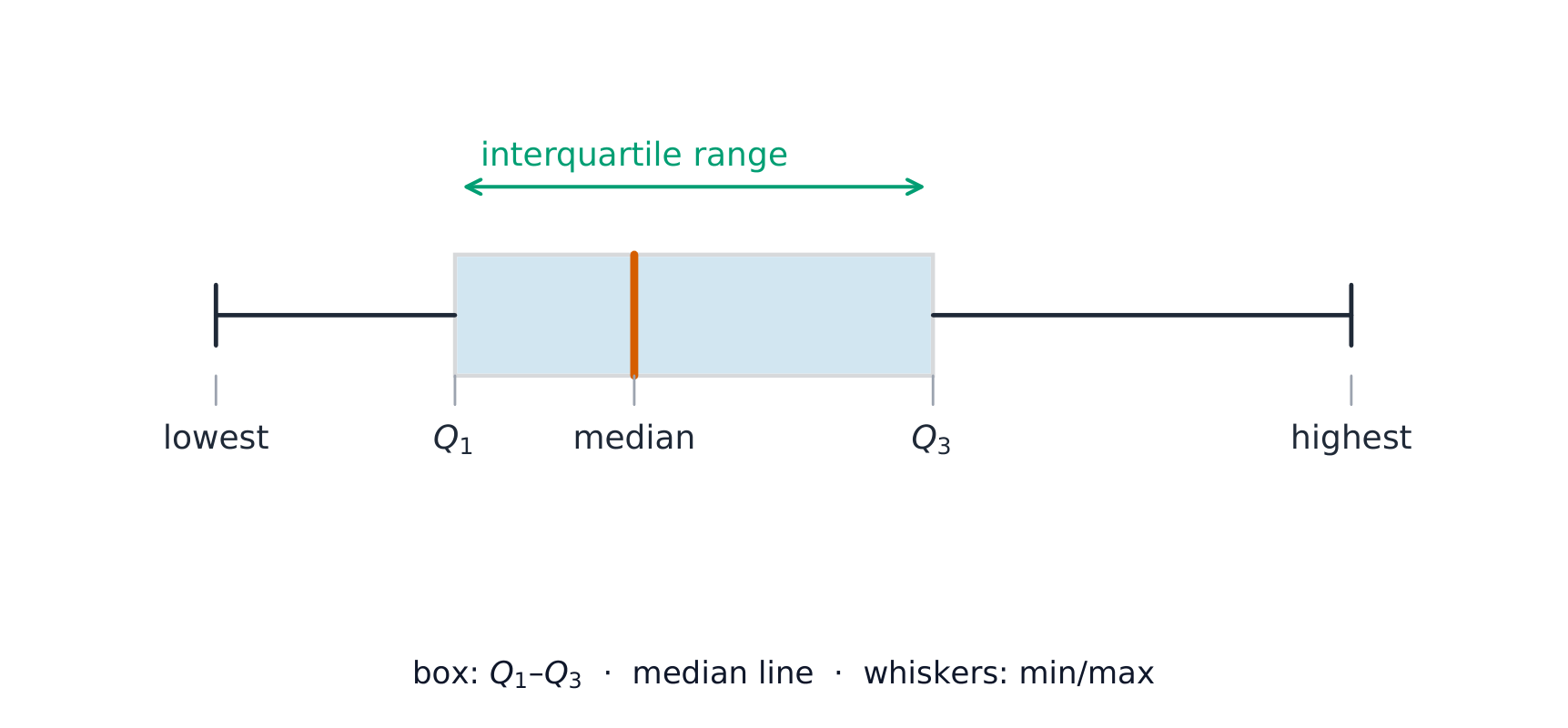
箱跨越四分位数 $Q_1$ 到 $Q_3$;须到达最低和最高值。 Averages and spread
一个集中趋势(measure of central tendency)是一个单一的"中间"值:
- 平均数(mean)$\bar{x} = \dfrac{\sum x}{n}$(平均);
- 中位数(median,数据按顺序时的中间值);
- 众数(mode,最常见的值)。
一个离散程度(variation)的量度显示数据铺开多少:
- 极差(range of data,最高 $-$ 最低);
- 四分位距(interquartile range,上四分位数 $-$ 下四分位数);
- 标准差(standard deviation)$\sigma = \sqrt{\dfrac{\sum x^2}{n} - \bar{x}^2}$。
你常常从总数 $\sum x$ 和 $\sum x^2$ 工作。标准差的平方是方差(variance)。
例题。 对于 $10$ 个值,$\sum x = 50$ 且 $\sum x^2 = 300$。求平均数和标准差。
$$\bar{x} = \frac{50}{10} = 5, \qquad \sigma = \sqrt{\frac{300}{10} - 5^2} = \sqrt{30 - 25} = \sqrt{5} = 2.24.$$编码(coding)使大数字更容易。用一个方便的假定平均数(assumed mean)$a$,把每个值换成 $t=x-a$。那么 $\bar{x}=a+\bar{t}$,而标准差不变(把每个值平移不改变数据的离散)。所以从编码后的总和 $\sum(x-a)$ 和 $\sum(x-a)^2$ 你直接得到 $\bar x$ 和 $\sigma$,而两个数据集能通过它们编码后的总和比较。
探索Spread and the bell
P(−k < Z < k)
Spread is measured in standard deviations — about 68% of data lies within 1 sd, 95% within 2.
词汇表 训练英文 中文 拼音 stem-and-leaf diagram/stem ænd liːf ˈdaɪəɡræm/ 茎叶图 jīng yè tú back-to-back/bæk tə bæk/ 背靠背 bèi kào bèi box-and-whisker plot/bɒks ænd ˈwɪskə plɒt/ 箱线图 xiāng xiàn tú histogram/ˈhɪstəɡræm/ 直方图 zhí fāng tú cumulative frequency/ˈkjuːmjʊlətɪv ˈfriːkwənsi/ 累积频数 lěi jī pín shuò measure of central tendency/ˈmeʒə ɒv ˈsentrəl ˈtendənsi/ 集中趋势 jí zhōng qū shì mean/miːn/ 平均数 píng jūn shù median/ˈmiːdiːən/ 中位数 zhōng wèi shù mode/məʊd/ 众数 zhòng shù variation/ˌveərɪˈeɪʃn/ 离散程度 lí sàn chéng dù range (of data)/reɪndʒ/ 极差 jí chà interquartile range/ˌɪntəˈkwɔːtaɪl reɪndʒ/ 四分位距 sì fēn wèi jù standard deviation/ˈstændəd ˌdiːvɪˈeɪʃn/ 标准差 biāo zhǔn chà variance/ˈveərɪəns/ 方差 fāng chà Coding/ˈkəʊdɪŋ/ 编码 biān mǎ assumed mean/əˈsjuːmd miːn/ 假定平均数 jiǎ dìng píng jūn shù central tendency/ˈsentrəl ˈtendənsi/ 集中趋势 jí zhōng qū shì 5.2
排列与组合

大纲
Candidates should be able to: Notes and examples • understand the terms permutation and combination, and solve simple problems involving selections • solve problems about arrangements of objects in a line, including those involving – repetition (e.g. the number of ways of arranging the letters of the word ‘NEEDLESS’) – restriction (e.g. the number of ways several people can stand in a line if two particular people must, or must not, stand next to each other). Questions may include cases such as people sitting in two (or more) rows. Questions about objects arranged in a circle will not be included. 来源:剑桥国际大纲
一个排列(permutation)是顺序重要的一个安排;一个组合(combination)是顺序不重要的一个选择。这些数是
$${}^nP_r = \frac{n!}{(n-r)!}, \qquad {}^nC_r = \binom{n}{r} = \frac{n!}{r!\,(n-r)!}.$$要在一条线上安排物体,当一些被重复时,除以每个重复计数的阶乘。顺序对一个排列重要,但对一个组合不重要 例题。 单词 NEEDLESS 的字母有多少个不同的安排?
有 $8$ 个字母,E 重复 $3$ 次而 S 重复 $2$ 次:
$$\frac{8!}{3!\,2!} = \frac{40320}{6 \times 2} = 3360.$$
nPr = n!/(n−r)!; nCr = nPr/r! 探索Permutation or combination lab
Choose whether order matters in a counting problem.
词汇表 训练英文 中文 拼音 permutation/ˌpɜːmjuːˈteɪʃn/ 排列 pái liè combination/ˌkɒmbɪˈneɪʃn/ 组合 zǔ hé 5.3
概率

大纲
Candidates should be able to: Notes and examples evaluate probabilities in simple cases by means of enumeration of equiprobable elementary events, or by calculation using permutations or combinations e.g. the total score when two fair dice are thrown. e.g. drawing balls at random from a bag containing balls of different colours. use addition and multiplication of probabilities, as appropriate, in simple cases Explicit use of the general formula $\text{P}(A \cup B) = \text{P}(A) + \text{P}(B) - \text{P}(A \cap B)$ is not required. understand the meaning of exclusive and independent events, including determination of whether events $A$ and $B$ are independent by comparing the values of $\text{P}(A \cap B)$ and $\text{P}(A) \times \text{P}(B)$ calculate and use conditional probabilities in simple cases. e.g. situations that can be represented by a sample space of equiprobable elementary events, or a tree diagram. The use of $\text{P}(A|B) = \frac{\text{P}(A \cap B)}{\text{P}(B)}$ may be required in simple cases. 来源:剑桥国际大纲
骰子:概率的一个熟悉的起点。 通过计数等可能的结果、或通过用排列和组合来求一个概率。用这些规则组合概率:
- 对"或"用加法:$P(A \cup B) = P(A) + P(B) - P(A \cap B)$;
- 当事件独立时对"且"用乘法:$P(A \cap B) = P(A)\,P(B)$。

两个圆的重叠是 $A\cap B$;加法规则减去它一次,所以它不被数两次。 若两个事件不能都发生,它们是互斥事件(mutually exclusive events);若一个发生不改变另一个的机会,它们是独立事件(independent events)。要测试独立性,检查是否 $P(A \cap B) = P(A)\times P(B)$。一个条件概率(conditional probability)是在 $B$ 已发生的情况下 $A$ 的机会:$P(A \mid B) = \dfrac{P(A \cap B)}{P(B)}$。
例题。 事件有 $P(A) = 0.5$、$P(B) = 0.4$ 和 $P(A \cap B) = 0.2$。$A$ 和 $B$ 独立吗?
测试:$P(A)\times P(B) = 0.5 \times 0.4 = 0.2 = P(A \cap B)$。这些值相等,所以 $A$ 和 $B$ 独立。
探索Conditional probability
Change the probabilities and read the tree. This is how P(A and B) and conditional probability fit together.
词汇表 训练英文 中文 拼音 mutually exclusive events/ˈmjuːtʃuːəli eksˈkluːsɪv ɪˈvents/ 互斥事件 hù chì shì jiàn independent events/ˌɪndɪˈpendənt ɪˈvents/ 独立事件 dú lì shì jiàn conditional probability/kənˈdɪʃənl ˌprɒbəˈbɪlɪti/ 条件概率 tiáo jiàn gài lǜ 5.4
离散随机变量
大纲
Candidates should be able to: Notes and examples draw up a probability distribution table relating to a given situation involving a discrete random variable $X$, and calculate $\text{E}(X)$ and $\text{Var}(X)$ use formulae for probabilities for the binomial and geometric distributions, and recognise practical situations where these distributions are suitable models Including the notations $\text{B}(n, p)$ and $\text{Geo}(p)$. $\text{Geo}(p)$ denotes the distribution in which $p_r = p(1 - p)^{r-1}$ for $r = 1, 2, 3, \dots$. use formulae for the expectation and variance of the binomial distribution and for the expectation of the geometric distribution. Proofs of formulae are not required. 来源:剑桥国际大纲
一个离散型随机变量(discrete random variable)$X$ 取分开的值,每个带一个概率。把它们列在一个概率分布表(probability distribution table)里;概率必须加起来为 $1$。然后期望(expectation,平均)和方差是
$$E(X) = \sum x\,P(X = x), \qquad \mathrm{Var}(X) = \sum x^2\,P(X = x) - \big(E(X)\big)^2.$$两个特殊的模型:
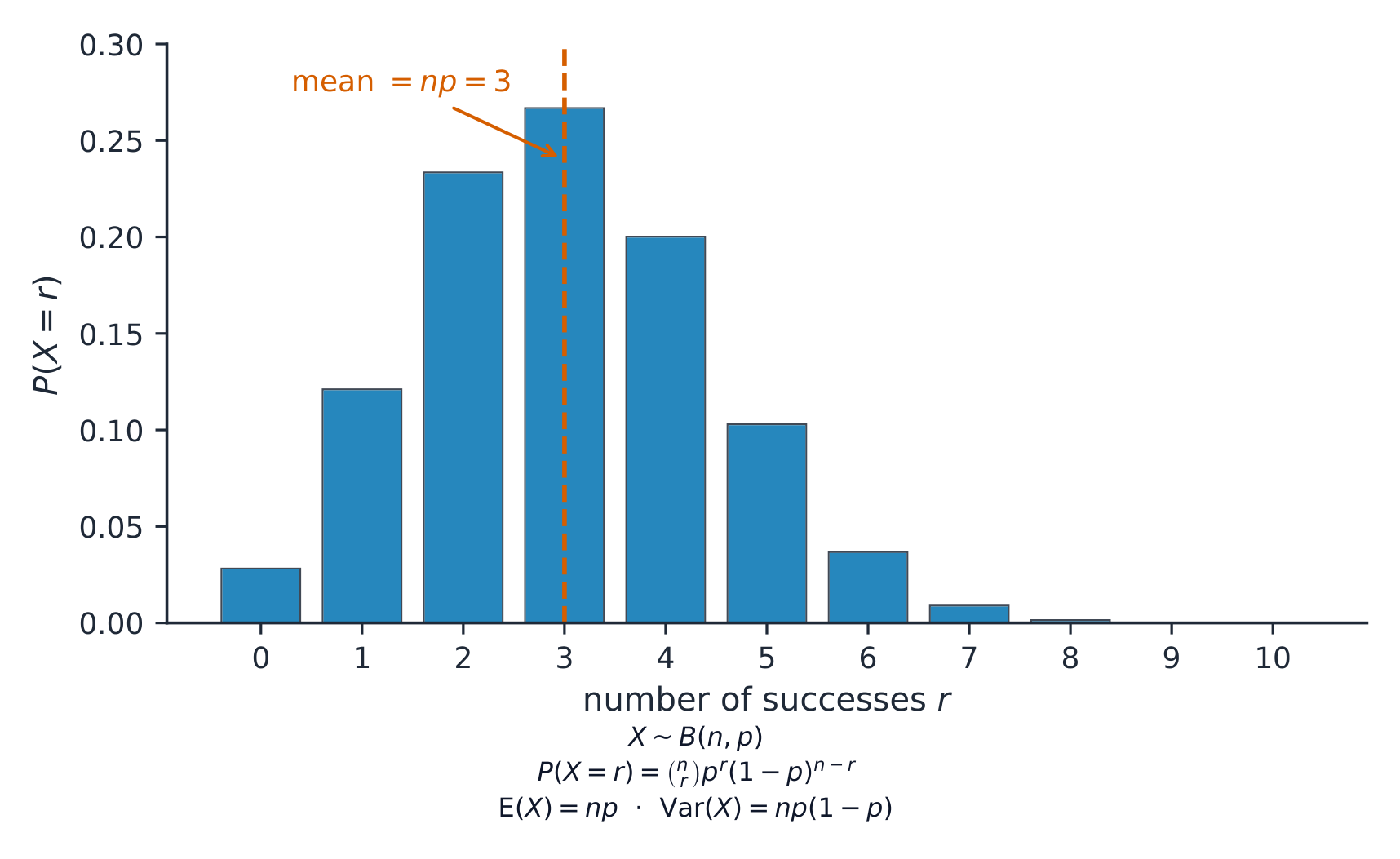
- 二项分布(binomial distribution)$X \sim B(n, p)$,用于 $n$ 个独立试验中成功的数目:$P(X = r) = \binom{n}{r}p^r(1-p)^{n-r}$,带 $E(X) = np$ 和 $\mathrm{Var}(X) = np(1-p)$;
- 几何分布(geometric distribution),用于第一次成功发生的试验:$P(X = r) = (1-p)^{r-1}p$,带 $E(X) = \dfrac{1}{p}$。
例题。 $X \sim B(10, 0.3)$。求 $P(X = 2)$ 和 $E(X)$。
$$P(X = 2) = \binom{10}{2}(0.3)^2(0.7)^8 = 45 \times 0.09 \times 0.05765 = 0.233, \qquad E(X) = 10 \times 0.3 = 3.$$分布 $B(10,0.3)$:每个条是 $P(X=r)$,聚集在平均值 $np=3$ 周围。 探索A discrete distribution
Change n and p for a binomial distribution and watch the bars — the probability of each number of successes.
词汇表 训练英文 中文 拼音 discrete random variable/dɪˈskriːt ˈrændəm ˈveərɪəbl/ 离散型随机变量 lí sàn xíng suí jī biàn liàng probability distribution table/ˌprɒbəˈbɪlɪti ˌdɪstrɪˈbjuːʃn ˈteɪbl/ 概率分布表 gài lǜ fēn bù biǎo expectation/ekspɪkˈteɪʃn/ 期望 qī wàng binomial distribution/baɪˈnəʊmɪəl ˌdɪstrɪˈbjuːʃn/ 二项分布 èr xiàng fēn bù geometric distribution/ˌdʒiːəʊˈmetrɪk ˌdɪstrɪˈbjuːʃn/ 几何分布 jǐ hé fēn bù 5.5
正态分布

大纲
Candidates should be able to: Notes and examples understand the use of a normal distribution to model a continuous random variable, and use normal distribution tables Sketches of normal curves to illustrate distributions or probabilities may be required. solve problems concerning a variable $X$, where $X \sim N(\mu, \sigma^2)$, including: – finding the value of $P(X > x_1)$, or a related probability, given the values of $x_1$, $\mu$, $\sigma$. – finding a relationship between $x_1$, $\mu$ and $\sigma$ given the value of $P(X > x_1)$ or a related probability For calculations involving standardisation, full details of the working should be shown. e.g. $Z = \frac{(X - \mu)}{\sigma}$ recall conditions under which the normal distribution can be used as an approximation to the binomial distribution, and use this approximation, with a continuity correction, in solving problems. $n$ sufficiently large to ensure that both $np > 5$ and $nq > 5$. 来源:剑桥国际大纲
68-95-99.7 规则 一个高尔顿板:球穿过钉子下落堆积成钟形的正态分布。 正态分布(normal distribution)以一个对称的钟形为一个连续型随机变量(continuous random variable)建模。写 $X \sim N(\mu, \sigma^2)$,其中 $\mu$ 是平均值而 $\sigma$ 是标准差。要用表,通过标准化(standardisation)转换到变量 $Z \sim N(0, 1)$:
$$Z = \frac{X - \mu}{\sigma}.$$然后 $P(X < x) = P\!\left(Z < \dfrac{x - \mu}{\sigma}\right)$,你从正态表 $\Phi$ 读它。

一个正态概率是钟形曲线下的一个面积;标准化把它重新缩放到 $Z\sim N(0,1)$。 当 $n$ 大时,正态分布也是二项的一个好近似(approximation)。因为你用一个连续变量替换一个离散变量,应用一个连续性校正(continuity correction,调整 $0.5$)。
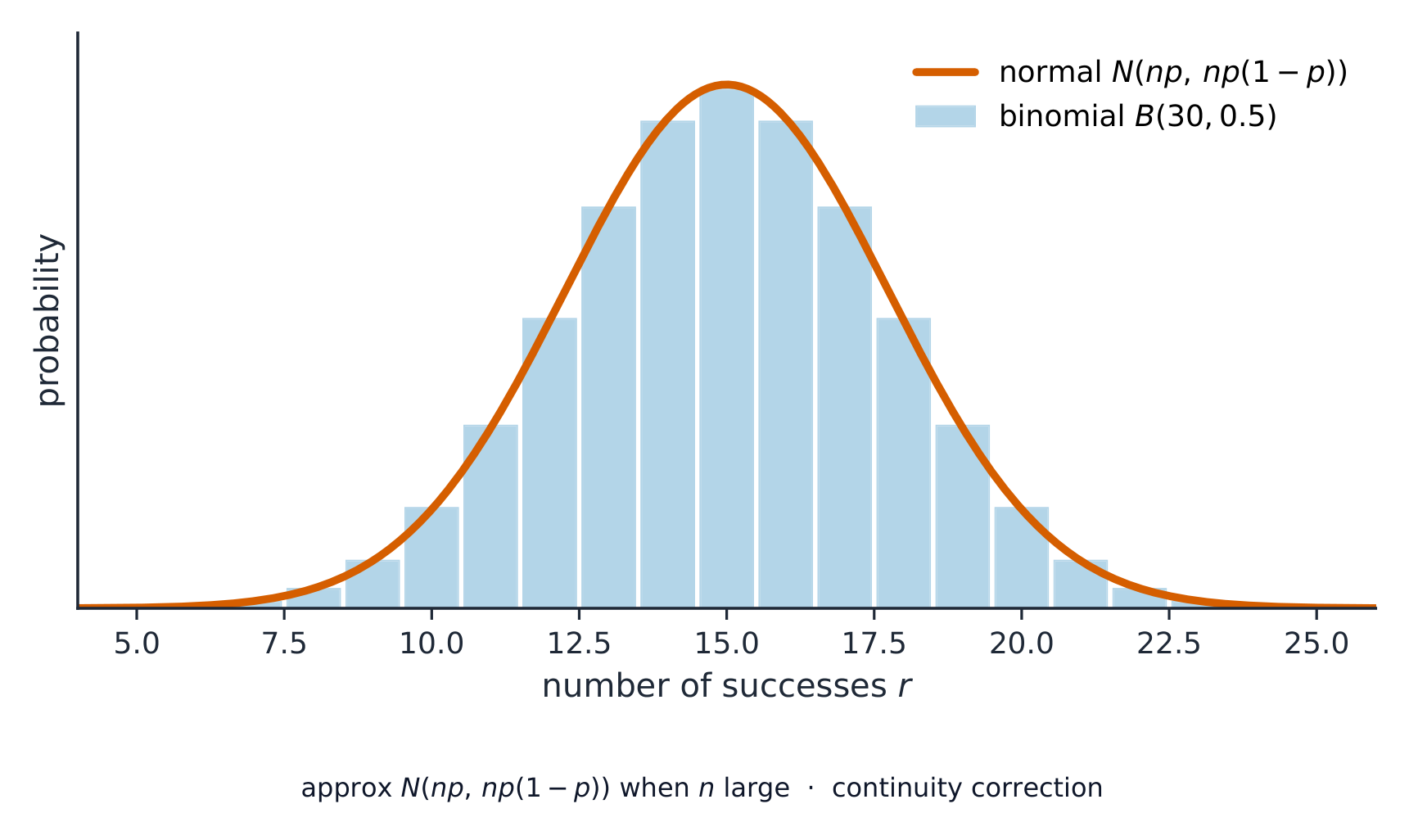
当 $n$ 大时,二项的条跟随一条同样平均值和方差的正态曲线。 例题。 米袋有质量 $X \sim N(\mu, 0.14^2)$。给定 $P(X < 1.48) = 0.22$,求 $\mu$。
从表,$P(Z < z) = 0.22$ 给出 $z = -0.772$。所以
$$\frac{1.48 - \mu}{0.14} = -0.772 \;\Rightarrow\; \mu = 1.48 + 0.772 \times 0.14 = 1.59\ \text{kg (3 s.f.)}.$$探索The normal distribution
Shade the area to find a probability. A z-value measures how many standard deviations a point is from the mean.
词汇表 训练英文 中文 拼音 normal distribution/ˈnɔːml ˌdɪstrɪˈbjuːʃn/ 正态分布 zhèng tài fēn bù continuous random variable/kənˈtɪnjuːəs ˈrændəm ˈveərɪəbl/ 连续型随机变量 lián xù xíng suí jī biàn liàng standardisation/ˌstændədaɪˈzeɪʃn/ 标准化 biāo zhǔn huà approximation/əˌprɒksɪˈmeɪʃn/ 近似 jìn sì continuity correction/kɒntɪˈnjuːɪti kəˈrekʃn/ 连续性校正 lián xù xìng jiào zhèng Probability & Statistics/ˌprɒbəˈbɪlɪti ænd stəˈtɪstɪks/ 概率统计 gài lǜ tǒng jì 5.5
考试技巧
- 决定顺序是否重要:重要时用排列($^nP_r$),不重要时用组合($^nC_r$)。
- 对于一个离散型随机变量,检查概率加起来为 $1$ 并用 $E(X) = \sum x\,P(X=x)$。
- 对于正态分布,用 $z = (x - \mu)/\sigma$ 标准化、作草图并着色,然后读表。
- 当用正态近似一个离散变量时应用一个连续性校正。
-
6
概率与统计2
这份讲义涵盖主题 6:概率统计(Probability & Statistics)2。它增加泊松模型、组合随机变量、连续分布,以及估计和检验的思想。
6.1
泊松分布

大纲
Candidates should be able to: Notes and examples • use formulae to calculate probabilities for the distribution $\text{Po}(\lambda)$ • use the fact that if $X \sim \text{Po}(\lambda)$ then the mean and variance of $X$ are each equal to $\lambda$ Proofs are not required. • understand the relevance of the Poisson distribution to the distribution of random events, and use the Poisson distribution as a model • use the Poisson distribution as an approximation to the binomial distribution where appropriate The conditions that $n$ is large and $p$ is small should be known; $n > 50$ and $np < 5$, approximately. • use the normal distribution, with continuity correction, as an approximation to the Poisson distribution where appropriate. The condition that $\lambda$ is large should be known; $\lambda > 15$, approximately. 来源:剑桥国际大纲
随机到达一个队列的人跟随一个泊松分布。 泊松分布(Poisson distribution)$X \sim \mathrm{Po}(\lambda)$ 为一个固定区间中随机事件的数目建模,当事件以一个稳定的平均速率 $\lambda$ 发生时:
$$P(X = r) = e^{-\lambda}\frac{\lambda^r}{r!}.$$对于一个泊松变量,平均值和方差都等于 $\lambda$。当 $n$ 大且 $p$ 小时,泊松分布是二项分布的一个好近似(approximation)。当 $\lambda$ 大时,正态分布(带连续性校正)近似泊松。例题。 $X \sim \mathrm{Po}(3)$。求 $P(X = 2)$。
$$P(X = 2) = e^{-3}\frac{3^2}{2!} = e^{-3}\times 4.5 = 0.224.$$
泊松分布 $\mathrm{Po}(3)$:对于一个泊松变量,平均值和方差都等于 $\lambda$。 探索The Poisson distribution
Change the mean λ. Poisson models the number of random events in a fixed interval — rare events give a skewed shape.
词汇表 训练英文 中文 拼音 Poisson distribution/ˈpɔɪsn ˌdɪstrɪˈbjuːʃn/ 泊松分布 pō sōng fēn bù approximation/əˌprɒksɪˈmeɪʃn/ 近似 jìn sì 6.2
随机变量的线性组合
大纲
Candidates should be able to: Notes and examples • use, when solving problems, the results that – $\text{E}(aX + b) = a\text{E}(X) + b$ and $\text{Var}(aX + b) = a^2\text{Var}(X)$ – $\text{E}(aX + bY) = a\text{E}(X) + b\text{E}(Y)$ – $\text{Var}(aX + bY) = a^2\text{Var}(X) + b^2\text{Var}(Y)$ for independent $X$ and $Y$ – if $X$ has a normal distribution then so does $aX + b$ – if $X$ and $Y$ have independent normal distributions then $aX + bY$ has a normal distribution – if $X$ and $Y$ have independent Poisson distributions then $X + Y$ has a Poisson distribution. Proofs of these results are not required. 来源:剑桥国际大纲
当你用一个线性规则改变一个变量时,期望(expectation,平均)和方差(variance)遵循这些规则:
$$E(aX + b) = aE(X) + b, \qquad \mathrm{Var}(aX + b) = a^2\,\mathrm{Var}(X).$$对于两个独立变量 $X$ 和 $Y$:$$E(aX + bY) = aE(X) + bE(Y), \qquad \mathrm{Var}(aX + bY) = a^2\,\mathrm{Var}(X) + b^2\,\mathrm{Var}(Y).$$两个有用的事实:若 $X$ 有一个正态分布(normal distribution)则 $aX + b$ 也有;而独立泊松变量的和又是泊松。例题。 $X$ 有平均值 $5$ 和方差 $4$。求 $E(3X - 1)$ 和 $\mathrm{Var}(3X - 1)$。
$$E(3X - 1) = 3(5) - 1 = 14, \qquad \mathrm{Var}(3X - 1) = 3^2 \times 4 = 36.$$探索Linear combination lab
E(aX + b) = aE(X) + b
Change a scaling factor and see how the expected value scales.
词汇表 训练英文 中文 拼音 expectation/ekspɪkˈteɪʃn/ 期望 qī wàng variance/ˈveərɪəns/ 方差 fāng chà normal distribution/ˈnɔːml ˌdɪstrɪˈbjuːʃn/ 正态分布 zhèng tài fēn bù 6.3
连续随机变量
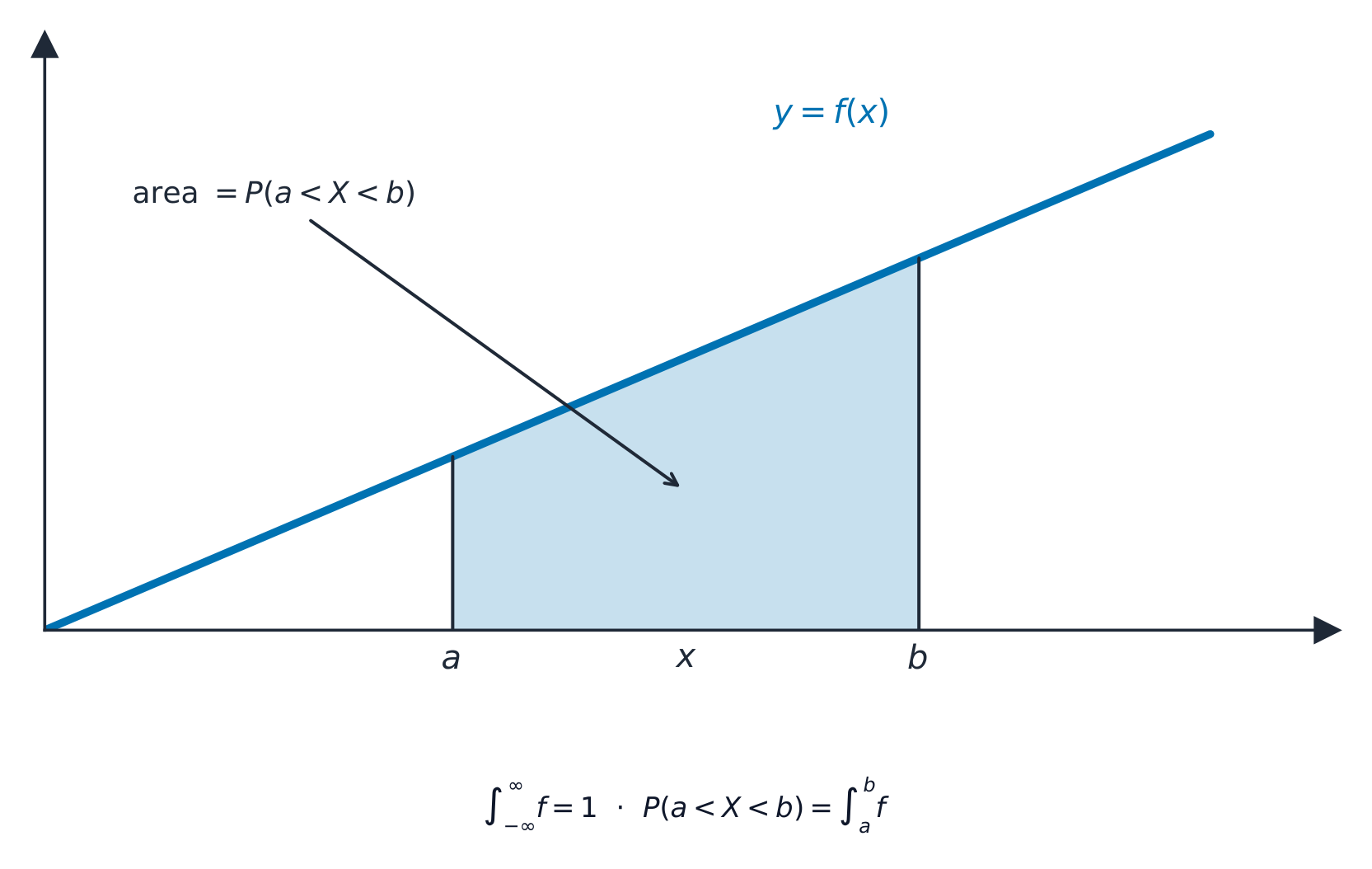
大纲
Candidates should be able to: Notes and examples • understand the concept of a continuous random variable, and recall and use properties of a probability density function For density functions defined over a single interval only; the domain may be infinite, e.g. $\frac{3}{x^4}$ for $x \geqslant 1$. • use a probability density function to solve problems involving probabilities, and to calculate the mean and variance of a distribution. Including location of the median or other percentiles of a distribution by direct consideration of an area using the density function. Explicit knowledge of the cumulative distribution function is not included. 来源:剑桥国际大纲
一个连续型随机变量(continuous random variable)能取一个范围内的任何值。它的概率来自一个概率密度函数(probability density function)$f(x)$,有两个关键的性质:
$$f(x) \geqslant 0, \qquad \int_{-\infty}^{\infty} f(x)\,dx = 1.$$一个概率是 $f$ 下的面积,而平均值通过积分求得:$$P(a < X < b) = \int_a^b f(x)\,dx, \qquad E(X) = \int_{-\infty}^{\infty} x\,f(x)\,dx.$$累积分布函数(cumulative distribution function)是 $F(x) = P(X \leqslant x) = \int_{-\infty}^{x} f(t)\,dt$;中位数(median)解 $F(m) = 0.5$,而其他百分位数(percentiles)解 $F(x) = p$。
对于一个连续变量,概率 $P(a 例题。 一个连续变量对 $0 \leqslant x \leqslant 2$ 有 $f(x) = \tfrac12 x$(其他地方为 $0$)。求 $E(X)$。
$$E(X) = \int_0^2 x\cdot\tfrac12 x\,dx = \int_0^2 \tfrac12 x^2\,dx = \left[\tfrac{x^3}{6}\right]_0^2 = \frac{8}{6} = \frac{4}{3}.$$方差(variance)用同样的思路,$\mathrm{Var}(X)=\displaystyle\int_{-\infty}^{\infty}x^2 f(x)\,dx-\big(E(X)\big)^2$。对同样的 $f(x)=\tfrac12 x$ 在 $[0,2]$ 上:$\displaystyle\int_0^2 x^2\cdot\tfrac12 x\,dx=\left[\tfrac{x^4}{8}\right]_0^2=2$,所以 $\mathrm{Var}(X)=2-\left(\tfrac43\right)^2=2-\tfrac{16}{9}=\tfrac{2}{9}$。
探索Area = probability
P(a < X < b) = ∫ f(x) dx
For a continuous variable, probability is the area under the density curve between two values.
词汇表 训练英文 中文 拼音 continuous random variable/kənˈtɪnjuːəs ˈrændəm ˈveərɪəbl/ 连续型随机变量 lián xù xíng suí jī biàn liàng probability density function/ˌprɒbəˈbɪlɪti ˈdensɪti ˈfʌŋkʃn/ 概率密度函数 gài lǜ mì dù hán shù cumulative distribution function/ˈkjuːmjʊlətɪv ˌdɪstrɪˈbjuːʃn ˈfʌŋkʃn/ 累积分布函数 lěi jī fēn bù hán shù median/ˈmiːdiːən/ 中位数 zhōng wèi shù percentiles/pəˈsentaɪlz/ 百分位数 bǎi fēn wèi shù 6.4
抽样与估计

大纲
Candidates should be able to: Notes and examples • understand the distinction between a sample and a population, and appreciate the necessity for randomness in choosing samples • explain in simple terms why a given sampling method may be unsatisfactory Including an elementary understanding of the use of random numbers in producing random samples. Knowledge of particular sampling methods, such as quota or stratified sampling, is not required. • recognise that a sample mean can be regarded as a random variable, and use the facts that $\text{E}(\overline{X}) = \mu$ and that $\text{Var}(\overline{X}) = \frac{\sigma^2}{n}$ • use the fact that $\overline{X}$ has a normal distribution if $X$ has a normal distribution • use the Central Limit Theorem where appropriate Only an informal understanding of the Central Limit Theorem (CLT) is required; for large sample sizes, the distribution of a sample mean is approximately normal. • calculate unbiased estimates of the population mean and variance from a sample, using either raw or summarised data Only a simple understanding of the term 'unbiased' is required, e.g. that although individual estimates will vary the process gives an accurate result 'on average'. • determine and interpret a confidence interval for a population mean in cases where the population is normally distributed with known variance or where a large sample is used • determine, from a large sample, an approximate confidence interval for a population proportion. 来源:剑桥国际大纲
统计研究一个样本以了解一个整个总体。 一个样本(sample)是从整个总体(population)选出的一个小群。一个随机样本需要随机性(randomness),使每个成员有一个被选中的公平机会。
有些方法不令人满意,因为它们是有偏(biased)的:只抽志愿者,或最先到达的 20 个人,会过度代表某些类型的人。一个真正随机的样本用随机数——给总体的每个成员编号,然后抽号(从一张表或一个生成器)来决定谁在样本里。
样本平均值 $\bar{X}$ 本身是一个随机变量,带
$$E(\bar{X}) = \mu, \qquad \mathrm{Var}(\bar{X}) = \frac{\sigma^2}{n}.$$由中心极限定理(Central Limit Theorem),对于一个大样本 $\bar{X}$ 近似正态,无论总体的形状如何。
无论总体的形状如何,样本平均值 $\bar{X}$ 有一个窄的、近乎正态的分布,以 $\mu$ 为中心。 从一个样本你能找到总体平均值和方差的无偏估计(unbiased estimates)。一个置信区间(confidence interval)给出一个可能包含真实平均值的范围。当总体是正态、$\sigma$ 已知(或样本大)时,一个 $95\%$ 的区间是
$$\bar{x} \pm 1.96\,\frac{\sigma}{\sqrt{n}}.$$
一个 $95\%$ 置信区间在样本平均值每一侧伸出 $1.96$ 个标准误。 你也能从一个大样本找到一个总体比例(population proportion)的置信区间。
例题。 一个 $n = 64$ 的样本有平均值 $\bar{x} = 50$,来自一个 $\sigma = 8$ 的总体。求总体平均值的一个 $95\%$ 置信区间。
$$50 \pm 1.96\times\frac{8}{\sqrt{64}} = 50 \pm 1.96 \;\Rightarrow\; (48.0,\ 52.0).$$探索The sampling distribution
X̄ ~ N(μ, σ²/n)
By the Central Limit Theorem, sample means follow a normal curve — narrower for bigger samples.
词汇表 训练英文 中文 拼音 sample/ˈsæmpl/ 样本 yàng běn population/ˌpɒpjʊˈleɪʃn/ 总体 zǒng tǐ randomness/ˈrændəmnəs/ 随机性 suí jī xìng biased/ˈbaɪəst/ 有偏 yǒu piān Central Limit Theorem/ˈsentrəl ˈlɪmɪt ˈθɪərəm/ 中心极限定理 zhōng xīn jí xiàn dìng lǐ unbiased estimates/ʌnˈbaɪəst ˈestɪməts/ 无偏估计 wú piān gū jì confidence interval/ˈkɒnfɪdəns ˈɪntəvl/ 置信区间 zhì xìn qū jiān population proportion/ˌpɒpjʊˈleɪʃn prəˈpɔːʃn/ 总体比例 zǒng tǐ bǐ lì 6.5
假设检验

大纲
Candidates should be able to: Notes and examples • understand the nature of a hypothesis test, the difference between one-tailed and two-tailed tests, and the terms null hypothesis, alternative hypothesis, significance level, rejection region (or critical region), acceptance region and test statistic Outcomes of hypothesis tests are expected to be interpreted in terms of the contexts in which questions are set. • formulate hypotheses and carry out a hypothesis test in the context of a single observation from a population which has a binomial or Poisson distribution, using – direct evaluation of probabilities – a normal approximation to the binomial or the Poisson distribution, where appropriate • formulate hypotheses and carry out a hypothesis test concerning the population mean in cases where the population is normally distributed with known variance or where a large sample is used • understand the terms Type I error and Type II error in relation to hypothesis tests • calculate the probabilities of making Type I and Type II errors in specific situations involving tests based on a normal distribution or direct evaluation of binomial or Poisson probabilities. 来源:剑桥国际大纲
一个假设检验(hypothesis test)用样本数据来判断一个断言。你设立两个陈述:原假设(null hypothesis)$H_0$(被检验的断言,通常是"没有变化")和备择假设(alternative hypothesis)$H_1$(你反而怀疑的)。若 $H_1$ 指向一个方向(例如 $\mu > 50$)测试是单尾(one-tailed),若它允许两个方向($\mu \neq 50$)则是双尾(two-tailed)。
你固定一个显著性水平(significance level,常常 $5\%$)、从数据算出一个检验统计量(test statistic),并看它是否落入拒绝域(rejection region,也叫临界域);若是你拒绝 $H_0$,否则统计量在接受域中。
一个 $5\%$ 的双尾测试只在检验统计量落入超过 $\pm1.96$ 的一个着色的尾时才拒绝 $H_0$。 两个错误可能发生:一个第一类错误(Type I error)是当 $H_0$ 实际为真时拒绝它;一个第二类错误(Type II error)是当 $H_0$ 实际为假时接受它。你能从拒绝域求它们的概率:$P(\text{第一类})=P(\text{统计量在拒绝域}\mid H_0)$——这等于显著性水平——而 $P(\text{第二类})=P(\text{统计量在接受域}\mid H_1$ 在一个给定值处为真$)$,从二项、泊松或正态分布计算。
例题。 一个总体被断言有平均值 $50$,带 $\sigma = 8$。一个 $n = 64$ 的样本给出 $\bar{x} = 52$。在 $5\%$ 水平检验平均值是否已改变。
$H_0\!: \mu = 50$ 且 $H_1\!: \mu \neq 50$(双尾)。检验统计量是
$$z = \frac{\bar{x} - \mu}{\sigma/\sqrt{n}} = \frac{52 - 50}{8/8} = 2.$$$5\%$(双尾)的临界值是 $1.96$。因为 $2 > 1.96$,你拒绝 $H_0$:有证据表明平均值已改变。例题(一个二项检验)。 一枚硬币被声称是公平的,但被怀疑正面落得太少:$H_0\!:p=0.5$,$H_1\!:p<0.5$。在 $n=30$ 次投掷里你看到 $X=9$ 个正面。在 $H_0$ 下,$X\sim B(30,0.5)$,所以单尾尾概率是
$$P(X\leqslant 9)=\sum_{k=0}^{9}\binom{30}{k}(0.5)^{30}\approx 0.021.$$因为 $0.021<0.05$,拒绝 $H_0$:硬币看来对正面有偏。(对大的 $n$,二项用一个正态近似;对稀有事件一个泊松检验同样工作。而这里,若规则是"当 $X\leqslant 9$ 时拒绝",那么 $P(\text{第一类})=P(X\leqslant 9\mid p=0.5)\approx0.021$。)探索The rejection region
reject H₀ if z < −z*
The shaded tail is the rejection region — if the test statistic lands there, reject H₀.
词汇表 训练英文 中文 拼音 hypothesis test/haɪˈpɒθəsɪs test/ 假设检验 jiǎ shè jiǎn yàn null hypothesis/nʌl haɪˈpɒθəsɪs/ 原假设 yuán jiǎ shè alternative hypothesis/ɔːlˈtɜːnətɪv haɪˈpɒθəsɪs/ 备择假设 bèi zé jiǎ shè one-tailed/wʌn teɪld/ 单尾 dān wěi two-tailed/tuː teɪld/ 双尾 shuāng wěi significance level/sɪɡˈnɪfɪkəns ˈlevl/ 显著性水平 xiǎn zhù xìng shuǐ píng test statistic/test stəˈtɪstɪk/ 检验统计量 jiǎn yàn tǒng jì liàng rejection region/rɪˈdʒekʃn ˈriːdʒn/ 拒绝域 jù jué yù Type I error/taɪp aɪ ˈerə/ 第一类错误 dì yī lèi cuò wù Type II error/taɪp ˈtuː ˈerə/ 第二类错误 dì èr lèi cuò wù Probability & Statistics/ˌprɒbəˈbɪlɪti ænd stəˈtɪstɪks/ 概率统计 gài lǜ tǒng jì 6.5
考试技巧
- 对稀有的、随机的、独立的事件用泊松分布;它的平均值等于它的方差($= \lambda$)。
- 当组合独立随机变量时,方差相加(它们从不相减)。
- 对于一个假设检验,陈述 $H_0$ 和 $H_1$、显著性水平、检验统计量,以及一个结合上下文的结论。
- 对于一个置信区间,用正确的 $z$(或 $t$)值并用文字解释它。