This handout covers Topic 1: Further Pure Mathematics 进阶纯数学 1. It adds new algebra, matrices, polar coordinates, more vectors, and proof by induction.
Tips · Mẹo
A-Level Further Mathematics (9231) nằm trên nền tảng của 9709 và giả định rằng bạn đã nắm vững nó: Further Pure 1 and 2, Further Mechanics, và Further Probability & Statistics. Môn này được học kèm theo Toán, chứ không thay thế cho Toán, và các phần thi bạn tham gia phụ thuộc vào yêu cầu đầu vào của trường.
Further Pure chứa hầu hết các công cụ mới — ma trận và biến đổi tuyến tính, số phức dưới dạng cực và hàm mũ, đường cong cực, hàm hyperbolic, phương trình vi phân, chứng minh bằng quy nạp toán học. Đây thực sự là nội dung mới, không phải các phiên bản khó hơn của những kiến thức quen thuộc.
Độ khó thực tế nằm ở thời gian, không phải ý tưởng. Phần đại số đủ dài để một sai sót ở dòng thứ hai kéo dài đến tận cuối, vì vậy hãy viết đầy đủ phương pháp và kiểm tra ở giữa bài làm.
-
1
Further Pure Mathematics 1 · Toán Nâng cao 1
Watch lesson · Xem bài học1.1
Roots of polynomial equations
Syllabus · Chương trình
EnglishCandidates should be able to: Notes and examples • recall and use the relations between the roots and coefficients of polynomial equations e.g. to evaluate symmetric functions of the roots or to solve problems involving unknown coefficients in equations; restricted to equations of degree 2, 3 or 4 only. • use a substitution to obtain an equation whose roots are related in a simple way to those of the original equation Substitutions will not be given for the easiest cases, e.g. where the new roots are reciprocals or squares or a simple linear function of the old roots. Tiếng Việtthí sinh có khả năng: Ghi chú và ví dụ • nhớ lại và sử dụng các mối quan hệ giữa gốc và hệ số của phương trình đa thức ví dụ: để đánh giá các hàm đối xứng của gốc hoặc để giải các bài toán liên quan đến hệ số chưa biết trong phương trình; chỉ giới hạn ở phương trình bậc 2, 3 hoặc 4. • sử dụng phép thế để thu được một phương trình có gốc liên hệ đơn giản với gốc của phương trình ban đầu Phép thế sẽ không được cung cấp cho các trường hợp dễ nhất, ví dụ nơi các gốc mới là nghịch đảo hoặc bình phương hoặc là hàm tuyến tính đơn giản của các gốc cũ. Source: Cambridge International syllabus · Nguồn: Chương trình Cambridge International
For a polynomial equation, the roots 根 are linked to the coefficients 系数. For $ax^2 + bx + c = 0$ with roots $\alpha, \beta$:
$$\alpha + \beta = -\frac{b}{a}, \qquad \alpha\beta = \frac{c}{a}.$$For a cubic $ax^3 + bx^2 + cx + d = 0$ with roots $\alpha, \beta, \gamma$:$$\sum\alpha = -\frac{b}{a}, \qquad \sum\alpha\beta = \frac{c}{a}, \qquad \alpha\beta\gamma = -\frac{d}{a}.$$Sums like $\sum\alpha$ and $\sum\alpha\beta$ are symmetric functions 对称函数 of the roots (unchanged if the roots are swapped). To find an equation whose roots are changed in a simple way, use a substitution 代换 (for example, put $w = \alpha + 1$).Worked example. The equation $x^2 - 5x + 6 = 0$ has roots $\alpha, \beta$. Find the equation with roots $\alpha + 1, \beta + 1$.
Here $\alpha + \beta = 5$ and $\alpha\beta = 6$. The new sum is $(\alpha + 1) + (\beta + 1) = 7$, and the new product is $(\alpha + 1)(\beta + 1) = \alpha\beta + \alpha + \beta + 1 = 6 + 5 + 1 = 12$. So the new equation is
$$x^2 - 7x + 12 = 0.$$Explore · Khám pháRoots of a polynomial · Nghiệm của đa thức
y = ax³ + bx² + cx + d
The roots are where the curve meets the x-axis — their sum and product link to the coefficients. · Nghiệm là nơi đường cong cắt trục x — tổng và tích của chúng liên hệ với các hệ số.
Vocabulary · Từ vựng Train · Luyện tậpEnglish Tiếng Việt Further Pure Mathematics/ˈfɜːðə pjʊə ˌmæθɪˈmætɪks/ Toán học thuần túy nâng cao roots/ruːts/ nghiệm coefficients/ˌkəʊɪˈfɪʃənts/ hệ số substitution/ˌsʌbstɪˈtjuːʃn/ thay thế symmetric functions/sɪˈmetrɪk ˈfʌŋkʃnz/ hàm đối xứng 1.2
Rational functions and graphs
Syllabus · Chương trình
EnglishCandidates should be able to: Notes and examples • sketch graphs of simple rational functions, including the determination of oblique asymptotes, in cases where the degree of the numerator and the denominator are at most 2 Including determination of the set of values taken by the function, e.g. by the use of a discriminant. Detailed plotting of curves will not be required, but sketches will generally be expected to show significant features, such as turning points, asymptotes and intersections with the axes. • understand and use relationships between the graphs of $y = f(x)$, $y^2 = f(x)$, $y = \frac{1}{f(x)}$, $y = |f(x)|$ and $y = f(|x|)$ Including use of such sketch graphs in the course of solving equations or inequalities. Tiếng Việtthí sinh có khả năng: Ghi chú và ví dụ • phác thảo đồ thị của các hàm hữu tỉ đơn giản, bao gồm xác định tiệm xiên, trong trường hợp mà bậc của tử số và mẫu số đều không quá 2 Bao gồm xác định tập giá trị mà hàm nhận được, ví dụ: bằng cách sử dụng biệt thức. Vẽ chi tiết đường cong sẽ không yêu cầu, nhưng các bản phác thảo nói chung sẽ được kỳ vọng thể hiện các đặc điểm đáng chú ý, chẳng hạn như điểm cực trị, tiệm cận và giao điểm với các trục tọa độ. • hiểu và sử dụng các mối quan hệ giữa đồ thị $y = f(x)$, $y^2 = f(x)$, $y = \frac{1}{f(x)}$, $y = |f(x)|$ và $y = f(|x|)$ Bao gồm sử dụng các đồ thị phác thảo này trong quá trình giải phương trình hoặc bất phương trình. Source: Cambridge International syllabus · Nguồn: Chương trình Cambridge International
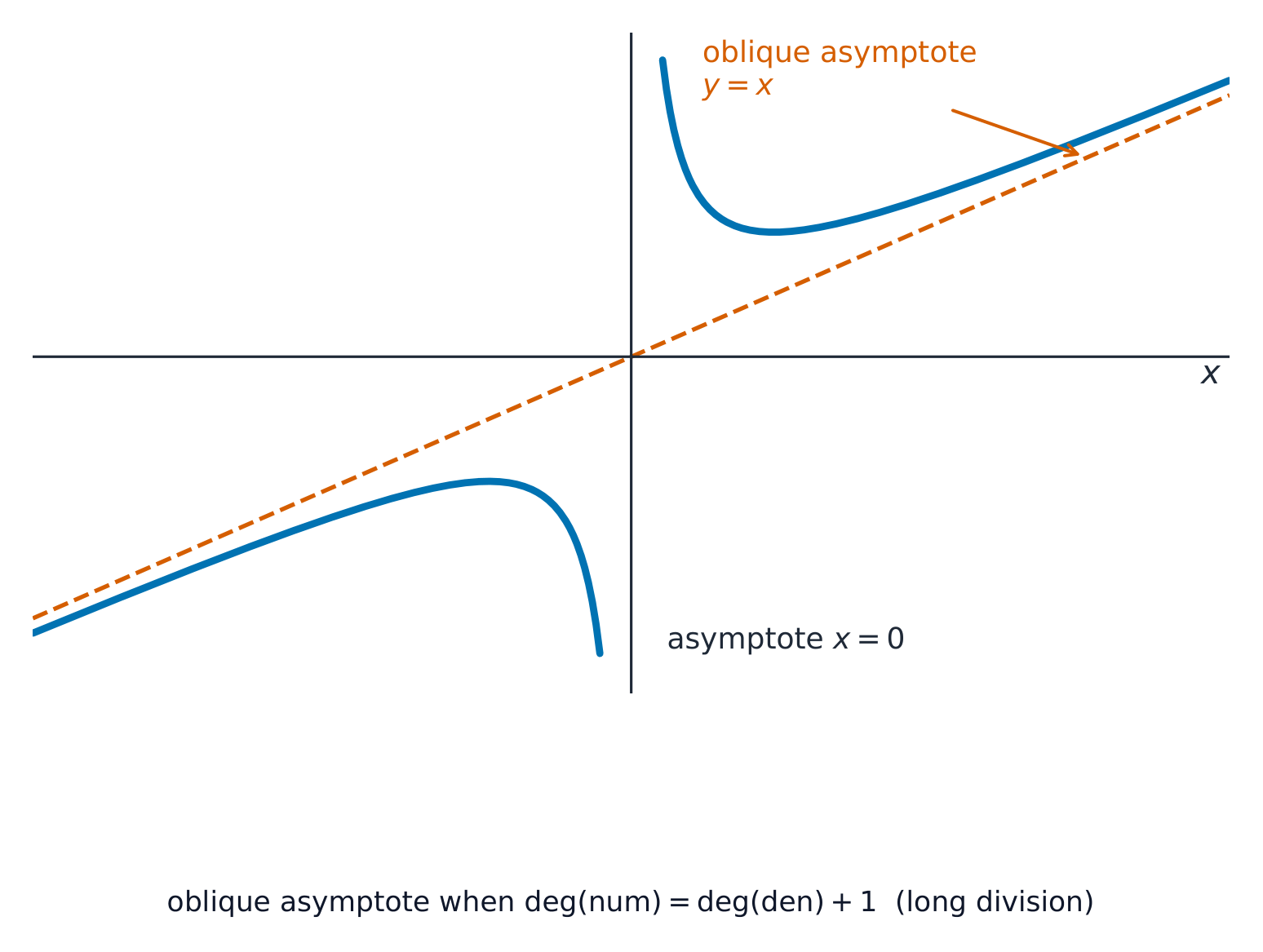
A rational function 有理函数 is a fraction of two polynomials. When the top has degree exactly one higher than the bottom, the graph has an oblique asymptote 斜渐近线 (a slanted line the curve approaches); find it by dividing out. You should also be able to relate the graph of $y = f(x)$ to those of $y^2 = f(x)$, $y = \dfrac{1}{f(x)}$, $y = |f(x)|$ and $y = f(|x|)$. Find the set of values the function can take using the discriminant 判别式, and locate its turning points 驻点.
Far from the origin the curve hugs the slant line $y=x$; near $x=0$ it runs off along the vertical asymptote. Worked example. Find the oblique asymptote of $y = \dfrac{x^2 + x + 1}{x + 1}$.
Divide out the fraction: $\dfrac{x^2 + x + 1}{x + 1} = x + \dfrac{1}{x + 1}$. As $x \to \pm\infty$ the remainder $\dfrac{1}{x+1} \to 0$, so the curve approaches the line $y = x$ — the oblique asymptote.
Explore · Khám pháRational functions · Hàm hữu tỉ
y = a/(x − b) + c
A rational function has asymptotes the curve approaches but never touches. · Một hàm hữu tỉ có tiếp tuyến mà đường cong tiến tới nhưng không bao giờ chạm vào.
Vocabulary · Từ vựng Train · Luyện tậpEnglish Tiếng Việt rational function/ˈræʃənl ˈfʌŋkʃn/ hàm hữu tỉ oblique asymptote/əˈbliːk ˈæsɪmptəʊt/ tiệm cận xiên discriminant/dɪˈskrɪmɪnənt/ delta (discriminant) turning points/ˈtɜːnɪŋ pɔɪnts/ các điểm dừng 1.3
Summation of series
Syllabus · Chương trình
EnglishCandidates should be able to: Notes and examples • use the standard results for $\sum r$, $\sum r^2$, $\sum r^3$ to find related sums • use the method of differences to obtain the sum of a finite series Use of partial fractions to express a general term in a suitable form may be required. • recognise, by direct consideration of a sum to $n$ terms, when a series is convergent, and find the sum to infinity in such cases Tiếng Việtthí sinh có khả năng: Ghi chú và ví dụ • sử dụng các kết quả chuẩn cho $\sum r$, $\sum r^2$, $\sum r^3$ để tìm các tổng liên quan • sử dụng phương pháp sai số để tìm tổng của một dãy số hữu hạn Sử dụng phân tích phân số để biểu diễn một số hạng tổng quát ở dạng phù hợp có thể cần thiết. • nhận biết, thông qua việc xét trực tiếp tổng $n$ số hạng, khi một cấp数是 hội tụ, và tìm tổng vô hạn trong các trường hợp như vậy Source: Cambridge International syllabus · Nguồn: Chương trình Cambridge International
Learn the standard results:
$$\sum_{r=1}^{n} r = \tfrac12 n(n+1), \qquad \sum_{r=1}^{n} r^2 = \tfrac16 n(n+1)(2n+1), \qquad \sum_{r=1}^{n} r^3 = \tfrac14 n^2(n+1)^2.$$The method of differences 差分法 sums a series by cancelling middle terms: if partial fractions 部分分式 write each term as $f(r) - f(r+1)$, almost everything cancels. From the sum to $n$ terms you can see whether a series is convergent 收敛 and, if so, find its sum to infinity 无穷和.Worked example. Find $\displaystyle\sum_{r=1}^{n} (2r + 1)$.
$$\sum_{r=1}^{n}(2r + 1) = 2\sum_{r=1}^{n} r + \sum_{r=1}^{n} 1 = 2\cdot\tfrac12 n(n+1) + n = n(n+1) + n = n(n+2).$$Explore · Khám pháSequences and their sums · Dãy số và tổng của chúng
Step through the terms and the running total — the idea behind a series and its sum to n terms. · Bước qua các số hạng và tổng lũy tiến — ý tưởng nền tảng về một dãy cộng và tổng của nó đến n số hạng.
Vocabulary · Từ vựng Train · Luyện tậpEnglish Tiếng Việt method of differences/ˈmeθəd ɒv ˈdɪfrənsɪz/ phương pháp sai phân convergent/kənˈvɜːdʒənt/ hội tụ sum to infinity/sʌm tʊ ɪnˈfɪnɪti/ tổng vô hạn partial fractions/ˈpɑːʃl ˈfrækʃnz/ phân tích phân thức riêng biệt 1.4
Matrices

Syllabus · Chương trình
EnglishCandidates should be able to: Notes and examples carry out operations of matrix addition, subtraction and multiplication, and recognise the terms zero matrix and identity (or unit) matrix Including non-square matrices. Matrices will have at most 3 rows and columns. recall the meaning of the terms singular and non-singular as applied to square matrices and, for $2 \times 2$ and $3 \times 3$ matrices, evaluate determinants and find inverses of non-singular matrices The notations $\det \mathbf{M}$ for the determinant of a matrix $\mathbf{M}$, and $\mathbf{I}$ for the identity matrix, will be used. understand and use the result, for non-singular matrices, $(\mathbf{AB})^{-1} = \mathbf{B}^{-1}\mathbf{A}^{-1}$ Extension to the product of more than two matrices may be required. understand the use of $2 \times 2$ matrices to represent certain geometric transformations in the $x$-$y$ plane, in particular: – understand the relationship between the transformations represented by $\mathbf{A}$ and $\mathbf{A}^{-1}$ – recognise that the matrix product $\mathbf{AB}$ represents the transformation that results from the transformation represented by $\mathbf{B}$ followed by the transformation represented by $\mathbf{A}$ – recall how the area scale factor of a transformation is related to the determinant of the corresponding matrix – find the matrix that represents a given transformation or sequence of transformations Understanding of the terms rotation, reflection, enlargement, stretch and shear for 2D transformations will be required. Other 2D transformations may be included, but no particular knowledge of them is expected. understand the meaning of invariant as applied to points and lines in the context of transformations represented by matrices, and solve simple problems involving invariant points and invariant lines. e.g. to locate the invariant points of the transformation represented by $\begin{pmatrix} 6 & 5 \\ 2 & 3 \end{pmatrix}$, or to find the invariant lines through the origin for $\begin{pmatrix} 4 & -1 \\ 2 & 1 \end{pmatrix}$, or to show that any line with gradient 1 is invariant for $\begin{pmatrix} 2 & 0 \\ 1 & 1 \end{pmatrix}$. Tiếng Việtthí sinh có khả năng: Ghi chú và ví dụ Thực hiện các phép toán cộng ma trận, trừ ma trận và nhân ma trận, và nhận biết các thuật ngữ ma trận không và ma trận đơn vị (hoặc ma trận đồng nhất) Bao gồm cả ma trận không vuông. Ma trận sẽ có tối đa 3 hàng và cột. nhớ lại ý nghĩa của các thuật ngữ đặc biệt và không đặc biệt áp dụng cho các ma trận vuông và, đối với các ma trận $2 \times 2$ và $3 \times 3$, tính định thức và tìm ma trận nghịch đảo của các ma trận không đặc biệt Các ký hiệu $\det \mathbf{M}$ cho định thức của ma trận $\mathbf{M}$, và $\mathbf{I}$ cho ma trận đơn vị, sẽ được sử dụng. hiểu và sử dụng kết quả, đối với các ma trận không đặc biệt, $(\mathbf{AB})^{-1} = \mathbf{B}^{-1}\mathbf{A}^{-1}$ Sự mở rộng cho tích của nhiều hơn hai ma trận có thể yêu cầu. hiểu cách sử dụng các ma trận $2 \times 2$ để biểu diễn các biến đổi hình học nhất định trong mặt phẳng $x$-$y$, cụ thể: – hiểu mối quan hệ giữa các biến đổi được biểu diễn bởi $\mathbf{A}$ và $\mathbf{A}^{-1}$ – nhận biết rằng tích ma trận $\mathbf{AB}$ biểu diễn biến đổi kết quả từ biến đổi được biểu diễn bởi $\mathbf{B}$ theo sau là biến đổi được biểu diễn bởi $\mathbf{A}$ – nhớ lại hệ số tỷ lệ diện tích của một biến đổi liên quan đến định thức của ma trận tương ứng như thế nào – tìm ma trận biểu diễn một biến đổi hoặc chuỗi biến đổi đã cho Hiểu biết về các thuật ngữ quay, phản xạ, phóng to, kéo giãn và trượt đối với các biến đổi 2D sẽ được yêu cầu. Các biến đổi 2D khác có thể được bao gồm, nhưng không yêu cầu kiến thức đặc biệt nào về chúng. hiểu ý nghĩa của bất biến áp dụng cho các điểm và đường thẳng trong ngữ cảnh các biến đổi được biểu diễn bằng ma trận, và giải các bài toán đơn giản liên quan đến điểm bất biến và đường thẳng bất biến. Vd. để xác định các điểm bất biến của biến đổi được biểu diễn bởi $\begin{pmatrix} 6 & 5 \\ 2 & 3 \end{pmatrix}$, hoặc để tìm các đường thẳng bất biến đi qua gốc tọa độ cho $\begin{pmatrix} 4 & -1 \\ 2 & 1 \end{pmatrix}$, hoặc để chứng minh rằng mọi đường thẳng có hệ số góc 1 đều bất biến cho $\begin{pmatrix} 2 & 0 \\ 1 & 1 \end{pmatrix}$. Source: Cambridge International syllabus · Nguồn: Chương trình Cambridge International
A matrix moves the plane A matrix 矩阵 is a rectangular block of numbers. Matrix addition adds entries in matching positions; you can also subtract and multiply matrices (multiplication is row $\times$ column). The zero matrix 零矩阵 has every entry $0$, and the identity matrix 单位矩阵 (or unit matrix) $I$ leaves any matrix unchanged under multiplication.
For a $2\times 2$ matrix $A = \begin{pmatrix} a & b \\ c & d \end{pmatrix}$, the determinant 行列式 is $\det A = ad - bc$. If $\det A \neq 0$ the matrix is non-singular (otherwise it is a singular matrix 奇异矩阵), and the inverse matrix 逆矩阵 is
$$A^{-1} = \frac{1}{ad - bc}\begin{pmatrix} d & -b \\ -c & a \end{pmatrix}.$$For a product, $(AB)^{-1} = B^{-1}A^{-1}$. A $2\times 2$ matrix can represent a geometric transformation 几何变换 of the plane — a rotation 旋转, reflection 反射, enlargement 放大, stretch 拉伸 or shear 切变: the determinant gives the area scale factor, and a product $AB$ means "do $B$, then $A$". Points or lines that do not move are called invariant points 不变点 and invariant lines 不变直线.The matrix sends the unit square to a parallelogram whose area is the determinant. Worked example. Find the inverse of $A = \begin{pmatrix} 3 & 1 \\ 2 & 4 \end{pmatrix}$.
$\det A = 3\times 4 - 1\times 2 = 10$, so
$$A^{-1} = \frac{1}{10}\begin{pmatrix} 4 & -1 \\ -2 & 3 \end{pmatrix}.$$Explore · Khám pháMatrices as transformations · Ma trận như các phép biến đổi
Change the four entries and watch the unit square map to a new shape. The determinant is the area scale factor. · Thay đổi bốn thành phần và xem hình vuông đơn vị được ánh xạ sang hình dạng mới. Định thức là hệ số tỷ lệ diện tích.
Vocabulary · Từ vựng Train · Luyện tậpEnglish Tiếng Việt matrix/ˈmeɪtrɪks/ ma trận zero matrix/ˈzɪərəʊ ˈmeɪtrɪks/ ma trận không identity matrix/aɪˈdentɪti ˈmeɪtrɪks/ ma trận đơn vị determinant/dɪˈtɜːmɪnənt/ định thức singular matrix/ˈsɪŋɡjʊlə ˈmeɪtrɪks/ ma trận suy biến inverse matrix/ɪnˈvɜːs ˈmeɪtrɪks/ ma trận nghịch đảo geometric transformation/ˌdʒiːəʊˈmetrɪk trænsfɔːˈmeɪʃn/ biến đổi hình học invariant points/ɪnˈveərɪənt pɔɪnts/ điểm bất biến invariant lines/ɪnˈveərɪənt laɪnz/ đường thẳng bất biến rotation/rəʊˈteɪʃn/ phép quay reflection/rɪˈflekʃn/ phản xạ enlargement/enˈlɑːdʒmənt/ phóng to stretch/stretʃ/ kéo dãn shear/ʃɪə/ biến dạng trượt 1.5
Polar coordinates

Syllabus · Chương trình
EnglishCandidates should be able to: Notes and examples understand the relations between Cartesian and polar coordinates, and convert equations of curves from Cartesian to polar form and vice versa The convention $r \geqslant 0$ will be used. sketch simple polar curves, for $0 \leqslant \theta < 2\pi$ or $-\pi < \theta \leqslant \pi$ or a subset of either of these intervals Detailed plotting of curves will not be required, but sketches will generally be expected to show significant features, such as symmetry, coordinates of intersections with the initial line, the form of the curve at the pole and least/greatest values of $r$. recall the formula $\frac{1}{2} \int r^2 \mathrm{d}\theta$ for the area of a sector, and use this formula in simple cases. Tiếng Việtthí sinh có khả năng: Ghi chú và ví dụ hiểu các mối quan hệ giữa tọa độ Descartes và tọa độ cực, và chuyển đổi phương trình các đường cong từ dạng Descartes sang dạng cực và ngược lại Quy ước $r \geqslant 0$ sẽ được sử dụng. vẽ sơ đồ các đường cong cực đơn giản, cho $0 \leqslant \theta < 2\pi$ hoặc $-\pi < \theta \leqslant \pi$ hoặc một tập con của một trong hai khoảng này Vẽ chi tiết các đường cong sẽ không yêu cầu, nhưng các bản vẽ sơ đồ nói chung sẽ yêu cầu hiển thị các đặc điểm đáng chú ý, chẳng hạn như đối xứng, tọa độ giao điểm với trục ban đầu, hình dạng của đường cong tại cực và giá trị nhỏ nhất/lớn nhất của $r$. nhớ lại công thức $\frac{1}{2} \int r^2 \mathrm{d}\theta$ cho diện tích của một hình quạt, và sử dụng công thức này trong các trường hợp đơn giản. Source: Cambridge International syllabus · Nguồn: Chương trình Cambridge International
Tracing a polar curve: the cardioid A spiral staircase: spirals are described naturally using polar coordinates. Polar coordinates 极坐标 give a point by its distance $r$ from the origin and its angle $\theta$. They link to Cartesian coordinates 直角坐标 by
$$x = r\cos\theta, \qquad y = r\sin\theta, \qquad r^2 = x^2 + y^2.$$
Polar coordinates $(r,\theta)$ convert to Cartesian by $x=r\cos\theta$ and $y=r\sin\theta$. You should sketch simple polar curves 极坐标曲线, and find the area of a sector with
$$\text{area} = \tfrac12\int r^2\,d\theta.$$
The cardioid $r=1+\cos\theta$, plotted straight from $r$ as a function of $\theta$. Worked example. Convert the polar equation $r = 4\cos\theta$ to Cartesian form.
Multiply both sides by $r$: $r^2 = 4r\cos\theta$, so $x^2 + y^2 = 4x$. Completing the square gives $(x - 2)^2 + y^2 = 4$, a circle of radius $2$ centred at $(2, 0)$.
Explore · Khám pháPolar curves · Đường cong cực
Pick a curve and change a. In polar form a point is set by its distance r and angle θ — that draws roses, cardioids and spirals. · Chọn một đường cong và thay đổi a. Ở dạng cực, một điểm được xác định bởi khoảng cách r và góc θ — điều này tạo ra hình hoa hồng, đường tim và đường xoắn ốc.
Vocabulary · Từ vựng Train · Luyện tậpEnglish Tiếng Việt polar coordinates/ˈpəʊlə kəʊˈɔːdɪnəts/ tọa độ cực Cartesian coordinates/kɑːˈtiːzɪən kəʊˈɔːdɪnəts/ tọa độ Descartes polar curves/ˈpəʊlə kɜːvz/ đường cực 1.6
Vectors

Syllabus · Chương trình
EnglishCandidates should be able to: Notes and examples use the equation of a plane in any of the forms $ax + by + cz = d$ or $\mathbf{r.n} = p$ or $\mathbf{r} = \mathbf{a} + \lambda\mathbf{b} + \mu\mathbf{c}$ and convert equations of planes from one form to another as necessary in solving problems recall that the vector product $\mathbf{a} \times \mathbf{b}$ of two vectors can be expressed either as $|\mathbf{a}||\mathbf{b}|\sin\theta\hat{\mathbf{n}}$, where $\hat{\mathbf{n}}$ is a unit vector, or in component form as $(a_2b_3 - a_3b_2)\mathbf{i} + (a_3b_1 - a_1b_3)\mathbf{j} + (a_1b_2 - a_2b_1)\mathbf{k}$ use equations of lines and planes, together with scalar and vector products where appropriate, to solve problems concerning distances, angles and intersections, including: – determining whether a line lies in a plane, is parallel to a plane or intersects a plane, and finding the point of intersection of a line and a plane when it exists – finding the foot of the perpendicular from a point to a plane – finding the angle between a line and a plane, and the angle between two planes – finding an equation for the line of intersection of two planes – calculating the shortest distance between two skew lines – finding an equation for the common perpendicular to two skew lines. Tiếng Việtthí sinh có khả năng: Ghi chú và ví dụ sử dụng phương trình của mặt phẳng ở bất kỳ dạng nào $ax + by + cz = d$ hoặc $\mathbf{r.n} = p$ hoặc $\mathbf{r} = \mathbf{a} + \lambda\mathbf{b} + \mu\mathbf{c}$ và chuyển đổi phương trình các mặt phẳng từ dạng này sang dạng khác khi cần thiết trong việc giải bài toán nhớ lại rằng tích vector $\mathbf{a} \times \mathbf{b}$ của hai vector có thể được biểu diễn dưới dạng $|\mathbf{a}||\mathbf{b}|\sin\theta\hat{\mathbf{n}}$, trong đó $\hat{\mathbf{n}}$ là vector đơn vị, hoặc dưới dạng thành phần là $(a_2b_3 - a_3b_2)\mathbf{i} + (a_3b_1 - a_1b_3)\mathbf{j} + (a_1b_2 - a_2b_1)\mathbf{k}$ sử dụng phương trình đường thẳng và mặt phẳng, cùng với tích vô hướng và tích vector khi phù hợp, để giải các bài toán về khoảng cách, góc và giao điểm, bao gồm: – xác định xem một đường thẳng nằm trong mặt phẳng, song song với mặt phẳng hay cắt mặt phẳng, và tìm điểm giao điểm của đường thẳng và mặt phẳng khi nó tồn tại – tìm chân đường vuông góc từ một điểm đến một mặt phẳng – tìm góc giữa một đường thẳng và một mặt phẳng, và góc giữa hai mặt phẳng – tìm phương trình cho đường giao tuyến của hai mặt phẳng – tính khoảng cách ngắn nhất giữa hai đường chéo nhau – tìm phương trình cho đường vuông góc chung của hai đường chéo nhau. Source: Cambridge International syllabus · Nguồn: Chương trình Cambridge International
Forces like wind and water are vectors — they have both size and direction. In three dimensions a plane 平面 can be written as $ax + by + cz = d$, or $\mathbf{r}\cdot\mathbf{n} = p$, or $\mathbf{r} = \mathbf{a} + \lambda\mathbf{b} + \mu\mathbf{c}$. Besides the scalar product, there is the vector product 向量积 of two vectors 向量:
$$\mathbf{a}\times\mathbf{b} = |\mathbf{a}|\,|\mathbf{b}|\sin\theta\;\hat{\mathbf{n}},$$which gives a vector at right angles to both. With scalar and vector products you can find distances, angles, and where lines and planes meet — including the shortest distance between skew lines 异面直线.
$\mathbf{a}\times\mathbf{b}$ is perpendicular to both vectors; its length equals the area of the parallelogram they span. Worked example. Find $\mathbf{a}\times\mathbf{b}$ for $\mathbf{a} = \mathbf{i} + \mathbf{j}$ and $\mathbf{b} = \mathbf{j} + \mathbf{k}$.
$$\mathbf{a}\times\mathbf{b} = \begin{vmatrix} \mathbf{i} & \mathbf{j} & \mathbf{k} \\ 1 & 1 & 0 \\ 0 & 1 & 1 \end{vmatrix} = \mathbf{i}(1) - \mathbf{j}(1) + \mathbf{k}(1) = \mathbf{i} - \mathbf{j} + \mathbf{k}.$$Explore · Khám pháVectors · Vectơ
a · b = |a||b|cos θ
The dot product is zero exactly when two vectors are perpendicular. · Tích vô hướng bằng không chính xác khi hai vectơ vuông góc.
Vocabulary · Từ vựng Train · Luyện tậpEnglish Tiếng Việt plane/pleɪn/ mặt phẳng vector product/ˈvektə ˈprɒdʌkt/ tích có hướng (vector product) vectors/ˈvektəz/ vectors skew lines/skjuː laɪnz/ đường chéo 1.7
Proof by induction

Syllabus · Chương trình
EnglishCandidates should be able to: Notes and examples use the method of mathematical induction to establish a given result e.g. $\sum_{r=1}^{n} r^4 = \frac{1}{4}n^2(n+1)^2$, $u_n = \frac{1}{2}(1 + 3^{n-1})$ for the sequence given by $u_{n+1} = 3u_n - 1$ and $u_1 = 1$, $\begin{pmatrix} 4 & -1 \\ 6 & -1 \end{pmatrix}^n = \begin{pmatrix} 3 \times 2^n - 2 & 1 - 2^n \\ 3 \times 2^{n+1} - 6 & 3 - 2^{n+1} \end{pmatrix}$, $3^{2n} + 2 \times 5^n - 3$ is divisible by 8. recognise situations where conjecture based on a limited trial followed by inductive proof is a useful strategy, and carry this out in simple cases. e.g. find the $n$th derivative of $x e^x$, find $\sum_{r=1}^{n} r \times r!$. Tiếng Việtthí sinh có khả năng: Ghi chú và ví dụ sử dụng phương pháp quy nạp toán học để thiết lập một kết quả đã cho Vd. $\sum_{r=1}^{n} r^4 = \frac{1}{4}n^2(n+1)^2$, $u_n = \frac{1}{2}(1 + 3^{n-1})$ cho dãy số cho bởi $u_{n+1} = 3u_n - 1$ và $u_1 = 1$, $\begin{pmatrix} 4 & -1 \\ 6 & -1 \end{pmatrix}^n = \begin{pmatrix} 3 \times 2^n - 2 & 1 - 2^n \\ 3 \times 2^{n+1} - 6 & 3 - 2^{n+1} \end{pmatrix}$, $3^{2n} + 2 \times 5^n - 3$ chia hết cho 8. nhận biết các tình huống mà giả thuyết dựa trên thử nghiệm hạn chế theo sau là chứng minh quy nạp là một chiến lược hữu ích, và thực hiện điều này trong các trường hợp đơn giản. Vd. tìm đạo hàm $n$ của $x e^x$, tìm $\sum_{r=1}^{n} r \times r!$. Source: Cambridge International syllabus · Nguồn: Chương trình Cambridge International
Induction: the domino proof Mathematical induction 数学归纳法 proves a result for every positive integer $n$ in two steps:
- Base case: show the result is true for $n = 1$.
- Inductive step: assume it is true for $n = k$, then prove it for $n = k + 1$.
If both steps work, the result is true for all $n$. Often you first make a conjecture 猜想 (a sensible guess) from a few cases, then confirm it by inductive proof 归纳证明.
Induction is like dominoes: the base case topples the first, and the inductive step makes each one knock over the next — so the result holds for every n Worked example. Prove that $\displaystyle\sum_{r=1}^{n} r = \tfrac12 n(n+1)$.
Base case $n = 1$: the left side is $1$ and the right side is $\tfrac12(1)(2) = 1$. True. Inductive step: assume $\displaystyle\sum_{r=1}^{k} r = \tfrac12 k(k+1)$. Then
$$\sum_{r=1}^{k+1} r = \tfrac12 k(k+1) + (k+1) = (k+1)\left(\tfrac{k}{2} + 1\right) = \tfrac12 (k+1)(k+2).$$This is the formula with $n = k + 1$, so by induction it holds for all $n$.Explore · Khám pháProof by induction route · Con đường chứng minh bằng quy nạp
See induction as a first domino plus a rule that pushes every next case. · Hãy xem quy nạp như một viên domino đầu tiên cộng với một quy tắc đẩy mọi trường hợp tiếp theo.
Vocabulary · Từ vựng Train · Luyện tậpEnglish Tiếng Việt mathematical induction/ˌmæθɪˈmætɪkl ɪnˈdʌkʃn/ quy nạp toán học conjecture/kənˈdʒektʃə/ giả thuyết inductive proof/ɪnˈdʌktɪv pruːf/ chứng minh quy nạp 1.7
Exam tips
- Use the relationships between roots and coefficients (sum, sum of pairs, product) instead of solving the polynomial.
- For proof by induction, set out the base case, assume the result for $n = k$, prove it for $n = k+1$, and write a clear closing statement.
- Sketch rational-function graphs with their asymptotes and turning points; use the method of differences for a summation.
- For matrices, know the determinant, inverse and invariant lines, and interpret each transformation geometrically.
-
2
Further Pure Mathematics 2 · Toán Nâng cao 2
Watch lesson · Xem bài họcEnglishThis handout covers Topic 2: Further Pure Mathematics 进阶纯数学 2. It adds hyperbolic functions, eigenvalues, new differentiation and integration, de Moivre's theorem, and methods for differential equations.
Tiếng ViệtTài liệu này bao gồm Chủ đề 2: Toán Thuần Nâng cao 2. Nó bổ sung các hàm hyperbolic, giá trị riêng, các phương pháp vi phân và tích phân mới, định lý de Moivre, và các phương pháp cho phương trình vi phân.
2.1
Hyperbolic functions · Hàm Hyperbolic

Syllabus · Chương trình
EnglishCandidates should be able to: Notes and examples understand the definitions of the hyperbolic functions $\sinh x$, $\cosh x$, $\tanh x$, $\text{sech } x$, $\text{cosech } x$, $\text{coth } x$ in terms of the exponential function sketch the graphs of hyperbolic functions prove and use identities involving hyperbolic functions e.g. $\cosh^2 x - \sinh^2 x \equiv 1$, $\sinh 2x \equiv 2 \sinh x \cosh x$, and similar results corresponding to the standard trigonometric identities. understand and use the definitions of the inverse hyperbolic functions and derive and use the logarithmic forms Tiếng Việtthí sinh có khả năng: Ghi chú và ví dụ hiểu các định nghĩa của các hàm hyperbolic $\sinh x$, $\cosh x$, $\tanh x$, $\text{sech } x$, $\text{cosech } x$, $\text{coth } x$ theo hàm mũ vẽ sơ đồ các đồ thị của hàm hyperbolic chứng minh và sử dụng các đẳng thức liên quan đến hàm hyperbolic Vd. $\cosh^2 x - \sinh^2 x \equiv 1$, $\sinh 2x \equiv 2 \sinh x \cosh x$, và các kết quả tương tự tương ứng với các đẳng thức lượng giác tiêu chuẩn. hiểu và sử dụng các định nghĩa của các hàm hyperbolic nghịch đảo và suy ra và sử dụng các dạng logarit Source: Cambridge International syllabus · Nguồn: Chương trình Cambridge International
Englishcosh and sinh built from exponentials The hyperbolic functions 双曲函数 are built from the exponential function:
$$\cosh x = \frac{e^x + e^{-x}}{2}, \qquad \sinh x = \frac{e^x - e^{-x}}{2}, \qquad \tanh x = \frac{\sinh x}{\cosh x}.$$They obey identities much like the trigonometric ones, the main one being $\cosh^2 x - \sinh^2 x = 1$. The three reciprocals complete the set: $\operatorname{sech} x = \dfrac{1}{\cosh x}$, $\operatorname{cosech} x = \dfrac{1}{\sinh x}$, and $\coth x = \dfrac{1}{\tanh x} = \dfrac{\cosh x}{\sinh x}$ – all built from $e^x$ too, and worth recognising in integrals and mark schemes. The inverse hyperbolic functions 反双曲函数 have a logarithmic form 对数形式, for example $\sinh^{-1} x = \ln\!\left(x + \sqrt{x^2 + 1}\right)$.
Worked example. Show that $\cosh^2 x - \sinh^2 x = 1$.
$$\cosh^2 x - \sinh^2 x = \frac{(e^x + e^{-x})^2 - (e^x - e^{-x})^2}{4} = \frac{(e^{2x} + 2 + e^{-2x}) - (e^{2x} - 2 + e^{-2x})}{4} = \frac{4}{4} = 1.$$Tiếng Việtcosh và sinh được xây dựng từ hàm mũ Dây cáp treo tự do tạo thành đường cong catenary — chính là đồ thị của hyperbolic cosine. Các hàm hyperbolic được xây dựng từ hàm mũ:
$$\cosh x = \frac{e^x + e^{-x}}{2}, \qquad \sinh x = \frac{e^x - e^{-x}}{2}, \qquad \tanh x = \frac{\sinh x}{\cosh x}.$$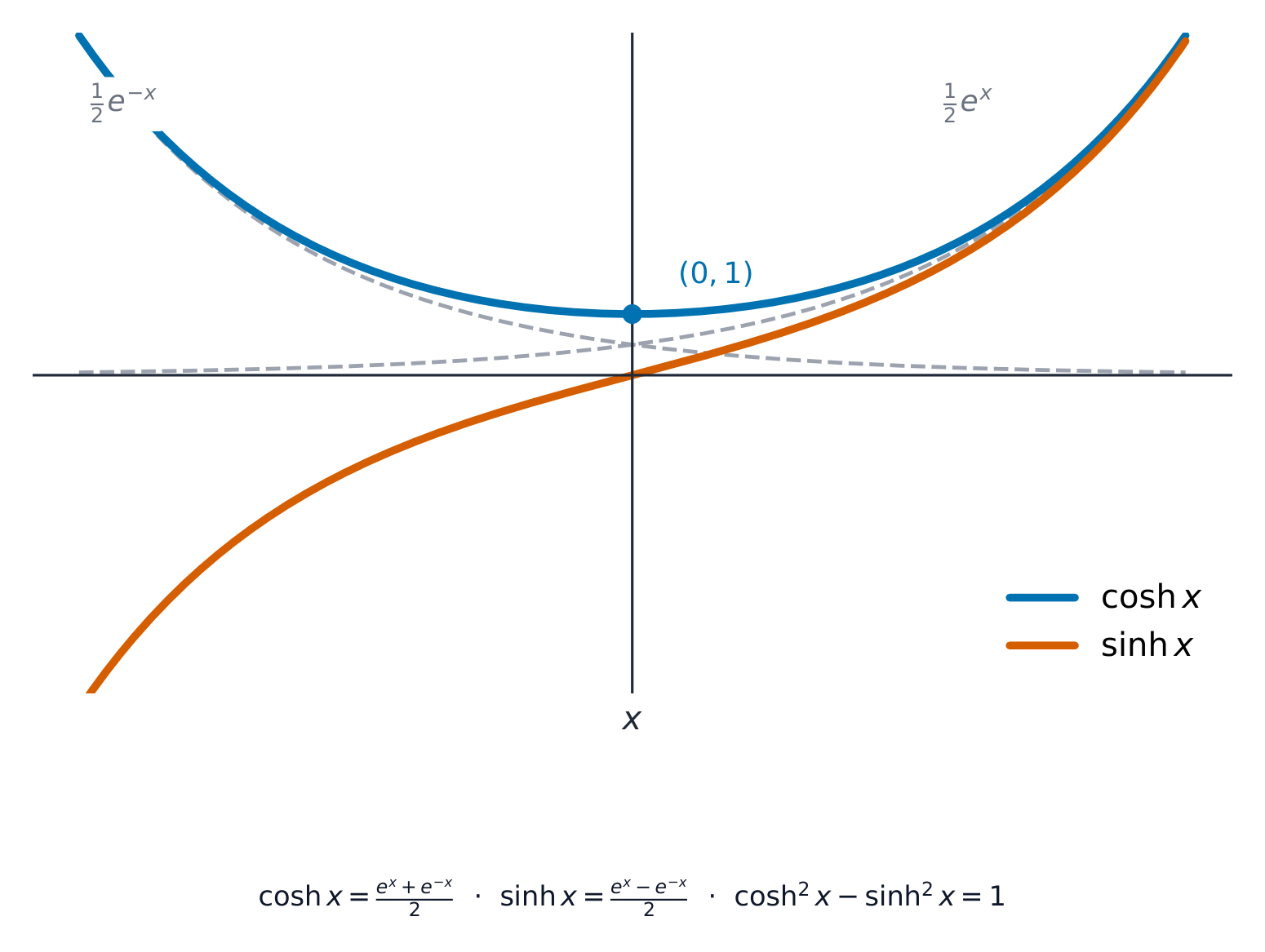
$\cosh$ là trung bình cộng của $e^x$ và $e^{-x}$; $\sinh$ là một nửa hiệu của chúng. Chúng tuân theo các đẳng thức giống như các hằng đẳng thức lượng giác, trong đó quan trọng nhất là $\cosh^2 x - \sinh^2 x = 1$. Ba hàm nghịch đảo hoàn bộ: $\operatorname{sech} x = \dfrac{1}{\cosh x}$, $\operatorname{cosech} x = \dfrac{1}{\sinh x}$, và $\coth x = \dfrac{1}{\tanh x} = \dfrac{\cosh x}{\sinh x}$ – tất cả đều được xây dựng từ $e^x$, và rất hữu ích khi nhận diện trong tích phân và đáp án điểm số. Các hàm hyperbolic ngược có dạng logarit, ví dụ $\sinh^{-1} x = \ln\!\left(x + \sqrt{x^2 + 1}\right)$.
Ví dụ minh họa. Chứng minh rằng $\cosh^2 x - \sinh^2 x = 1$.
$$\cosh^2 x - \sinh^2 x = \frac{(e^x + e^{-x})^2 - (e^x - e^{-x})^2}{4} = \frac{(e^{2x} + 2 + e^{-2x}) - (e^{2x} - 2 + e^{-2x})}{4} = \frac{4}{4} = 1.$$Explore · Khám pháHyperbolic functions · Hàm hyperbolic
y = a cosh(x)
cosh is the catenary (a hanging chain) — even, with its minimum at (0, a). · cosh là đường dây treo (dây xích treo lủng lẳng) — ngay cả khi có điểm cực tiểu tại (0, a).
2.2
Matrices · Ma trận

Syllabus · Chương trình
EnglishCandidates should be able to: Notes and examples formulate a problem involving the solution of 3 linear simultaneous equations in 3 unknowns as a problem involving the solution of a matrix equation, or vice versa understand the cases that may arise concerning the consistency or inconsistency of 3 linear simultaneous equations, relate them to the singularity or otherwise of the corresponding matrix, solve consistent systems, and interpret geometrically in terms of lines and planes e.g. three planes meeting in a common point, or in a common line, or having no common points. understand the terms 'characteristic equation', 'eigenvalue' and 'eigenvector', as applied to square matrices Including use of the definition $\mathbf{Ae} = \lambda \mathbf{e}$ to prove simple properties, e.g. that $\lambda^n$ is an eigenvalue of $\mathbf{A}^n$. find eigenvalues and eigenvectors of $2 \times 2$ and $3 \times 3$ matrices Restricted to cases where the eigenvalues are real and distinct. express a square matrix in the form $\mathbf{QDQ}^{-1}$, where $\mathbf{D}$ is a diagonal matrix of eigenvalues and $\mathbf{Q}$ is a matrix whose columns are eigenvectors, and use this expression e.g. in calculating powers of $2 \times 2$ or $3 \times 3$ matrices. use the fact that a square matrix satisfies its own characteristic equation. e.g. in finding successive powers of a matrix or finding an inverse matrix; restricted to $2 \times 2$ or $3 \times 3$ matrices only. Tiếng Việtthí sinh có khả năng: Ghi chú và ví dụ xây dựng một bài toán liên quan đến việc giải 3 phương trình tuyến tính đồng thời với 3 ẩn số dưới dạng một bài toán liên quan đến việc giải phương trình ma trận, hoặc ngược lại hiểu các trường hợp có thể xảy ra liên quan đến tính nhất quán hoặc không nhất quán của 3 phương trình tuyến tính đồng thời, liên hệ chúng với tính đặc biệt hoặc không của ma trận tương ứng, giải các hệ nhất quán, và diễn giải theo hình học dưới dạng các đường thẳng và mặt phẳng Vd. ba mặt phẳng gặp nhau tại một điểm chung, hoặc tại một đường thẳng chung, hoặc không có điểm chung nào. hiểu các thuật ngữ 'phương trình đặc trưng', 'giá trị riêng' và 'vector riêng', áp dụng cho các ma trận vuông Bao gồm việc sử dụng định nghĩa $\mathbf{Ae} = \lambda \mathbf{e}$ để chứng minh các tính chất đơn giản, ví dụ như rằng $\lambda^n$ là một giá trị riêng của $\mathbf{A}^n$. tìm giá trị riêng và véc-tơ riêng của $2 \times 2$ và $3 \times 3$ Chỉ giới hạn trong trường hợp các giá trị riêng là số thực và phân biệt. biểu diễn một ma trận vuông dưới dạng $\mathbf{QDQ}^{-1}$, trong đó $\mathbf{D}$ là ma trận chéo của các giá trị riêng và $\mathbf{Q}$ là ma trận mà các cột của nó là các vectơ riêng, và sử dụng biểu thức này Ví dụ: trong việc tính lũy thừa của $2 \times 2$ hoặc $3 \times 3$ ma trận. sử dụng việc một ma trận vuông thỏa mãn phương trình đặc trưng của chính nó. ví dụ: khi tìm lũy thừa liên tiếp của một ma trận hoặc tìm ma trận nghịch đảo; chỉ giới hạn cho $2 \times 2$ hoặc $3 \times 3$. Source: Cambridge International syllabus · Nguồn: Chương trình Cambridge International
EnglishA matrix moves the plane You can write three linear equations in three unknowns as a single matrix equation 矩阵方程 $A\mathbf{x} = \mathbf{b}$. If $A$ is non-singular there is one solution; if $A$ is singular the equations are either inconsistent (no solution) or have infinitely many.
For a square matrix $A$, the characteristic equation 特征方程 is $\det(A - \lambda I) = 0$. Its solutions are the eigenvalues 特征值 $\lambda$, and for each one the vector $\mathbf{v}$ with $A\mathbf{v} = \lambda\mathbf{v}$ is an eigenvector 特征向量. You can then write $A = QDQ^{-1}$, where $D$ is a diagonal matrix 对角矩阵 of eigenvalues and the columns of $Q$ are the eigenvectors.
Worked example. Find the eigenvalues of $A = \begin{pmatrix} 2 & 1 \\ 1 & 2 \end{pmatrix}$.
The characteristic equation is
$$\det\begin{pmatrix} 2 - \lambda & 1 \\ 1 & 2 - \lambda \end{pmatrix} = (2 - \lambda)^2 - 1 = 0 \;\Rightarrow\; 2 - \lambda = \pm 1.$$So $\lambda = 1$ or $\lambda = 3$. (The eigenvector for $\lambda = 3$ is $\begin{pmatrix} 1 \\ 1 \end{pmatrix}$ and for $\lambda = 1$ is $\begin{pmatrix} 1 \\ -1 \end{pmatrix}$.)Tiếng ViệtA matrix moves the plane Bạn có thể viết ba phương trình tuyến tính với ba ẩn dưới dạng một phương trình ma trận duy nhất $A\mathbf{x} = \mathbf{b}$. Nếu $A$ không suy biến thì có đúng một nghiệm; nếu $A$ suy biến thì hệ phương trình vô nghiệm hoặc có vô số nghiệm.
Đối với ma trận vuông $A$, phương trình đặc trưng là $\det(A - \lambda I) = 0$. Các nghiệm của nó là các giá trị riêng $\lambda$, và đối với mỗi giá trị riêng, vector $\mathbf{v}$ thỏa mãn $A\mathbf{v} = \lambda\mathbf{v}$ là một vector riêng. Sau đó bạn có thể viết $A = QDQ^{-1}$, trong đó $D$ là ma trận chéo gồm các giá trị riêng và các cột của $Q$ là các vector riêng.
Nhân một vectơ riêng với $A$ chỉ làm kéo dãn nó; một vectơ tổng quát sẽ bị quay sang một hướng mới. Ví dụ minh họa. Tìm các giá trị riêng của $A = \begin{pmatrix} 2 & 1 \\ 1 & 2 \end{pmatrix}$.
Phương trình đặc trưng là
$$\det\begin{pmatrix} 2 - \lambda & 1 \\ 1 & 2 - \lambda \end{pmatrix} = (2 - \lambda)^2 - 1 = 0 \;\Rightarrow\; 2 - \lambda = \pm 1.$$Vậy $\lambda = 1$ hoặc $\lambda = 3$. (Vector riêng tương ứng với $\lambda = 3$ là $\begin{pmatrix} 1 \\ 1 \end{pmatrix}$ và với $\lambda = 1$ là $\begin{pmatrix} 1 \\ -1 \end{pmatrix}$.)Explore · Khám pháTransformations and the determinant · Biến đổi và định thức
Change the matrix to rotate, stretch or shear the unit square; the determinant shows how area changes. · Thay đổi ma trận để quay, kéo giãn hoặc xé lệch hình vuông đơn vị; định thức cho thấy sự thay đổi của diện tích.
Vocabulary · Từ vựng Train · Luyện tậpEnglish Tiếng Việt Further Pure Mathematics/ˈfɜːðə pjʊə ˌmæθɪˈmætɪks/ Toán học thuần túy nâng cao hyperbolic functions/ˌhaɪpəˈbɒlɪk ˈfʌŋkʃnz/ hàm hyperbolic inverse hyperbolic functions/ɪnˈvɜːs ˌhaɪpəˈbɒlɪk ˈfʌŋkʃnz/ hàm hyperbolic ngược logarithmic form/ˌlɒɡəˈrɪθmɪk fɔːm/ dạng logarit matrix equation/ˈmeɪtrɪks ɪˈkweɪʒn/ phương trình ma trận characteristic equation/ˌkærɪktəˈrɪstɪk ɪˈkweɪʒn/ phương trình đặc trưng eigenvalues/ˈaɪdʒənvæljuːz/ giá trị riêng eigenvector/ˈaɪdʒənvektə/ eigenvector (vector riêng) diagonal matrix/daɪˈæɡənl ˈmeɪtrɪks/ ma trận chéo Maclaurin's series/məˈklɔːrɪnz ˈsɪəriːz/ dãy Maclaurin completing the square/kəmˈpliːtɪŋ ðə skweə/ hoàn thành bình phương reduction formula/rɪˈdʌkʃn ˈfɔːmjʊlə/ công thức hạ bậc arc length/ɑːk leŋθ/ độ dài cung surface area of revolution/ˈsɜːfɪs ˈeərɪə ɒv ˌrevəˈluːʃn/ diện tích mặt quay Riemann sum/ˈriːmən sʌm/ tổng Riemann complex number/ˈkɒmpleks ˈnʌmbə/ số phức De Moivre's theorem/də ˈmɔɪvəz ˈθɪərəm/ định lý De Moivre 2.3
Differentiation · Đạo hàm
Syllabus · Chương trình
EnglishCandidates should be able to: Notes and examples • differentiate hyperbolic functions and differentiate $\sin^{-1}x$, $\cos^{-1}x$, $\sinh^{-1}x$, $\cosh^{-1}x$ and $\tanh^{-1}x$ • obtain an expression for $\frac{\text{d}^2y}{\text{d}x^2}$ in cases where the relation between $x$ and $y$ is defined implicitly or parametrically • derive and use the first few terms of a Maclaurin's series for a function. Derivation of a general term is not included, but successive 'implicit' differentiation steps may be required, e.g. for $y = \tan x$ following an initial differentiation rearranged as $y' = 1 + y^2$. Tiếng Việtthí sinh có khả năng: Ghi chú và ví dụ • đạo hàm hàm hyperbolic và đạo hàm $\sin^{-1}x$, $\cos^{-1}x$, $\sinh^{-1}x$, $\cosh^{-1}x$ và $\tanh^{-1}x$ • tìm biểu thức cho $\frac{\text{d}^2y}{\text{d}x^2}$ trong các trường hợp mà mối quan hệ giữa $x$ và $y$ được xác định tiền ẩn hoặc tham số • rút ra và sử dụng các số hạng đầu tiên của dãy Maclaurin cho một hàm số. Việc rút ra số hạng tổng quát không bao gồm, nhưng các bước đạo hàm 'ngầm' liên tiếp có thể cần thiết, ví dụ đối với $y = \tan x$ sau khi đạo hàm ban đầu được biến đổi thành $y' = 1 + y^2$. Source: Cambridge International syllabus · Nguồn: Chương trình Cambridge International
EnglishYou can now differentiate the hyperbolic functions and the inverse functions $\sin^{-1}x$, $\tan^{-1}x$, $\sinh^{-1}x$ and so on. You can also find $\dfrac{d^2y}{dx^2}$ for curves given implicitly or parametrically.
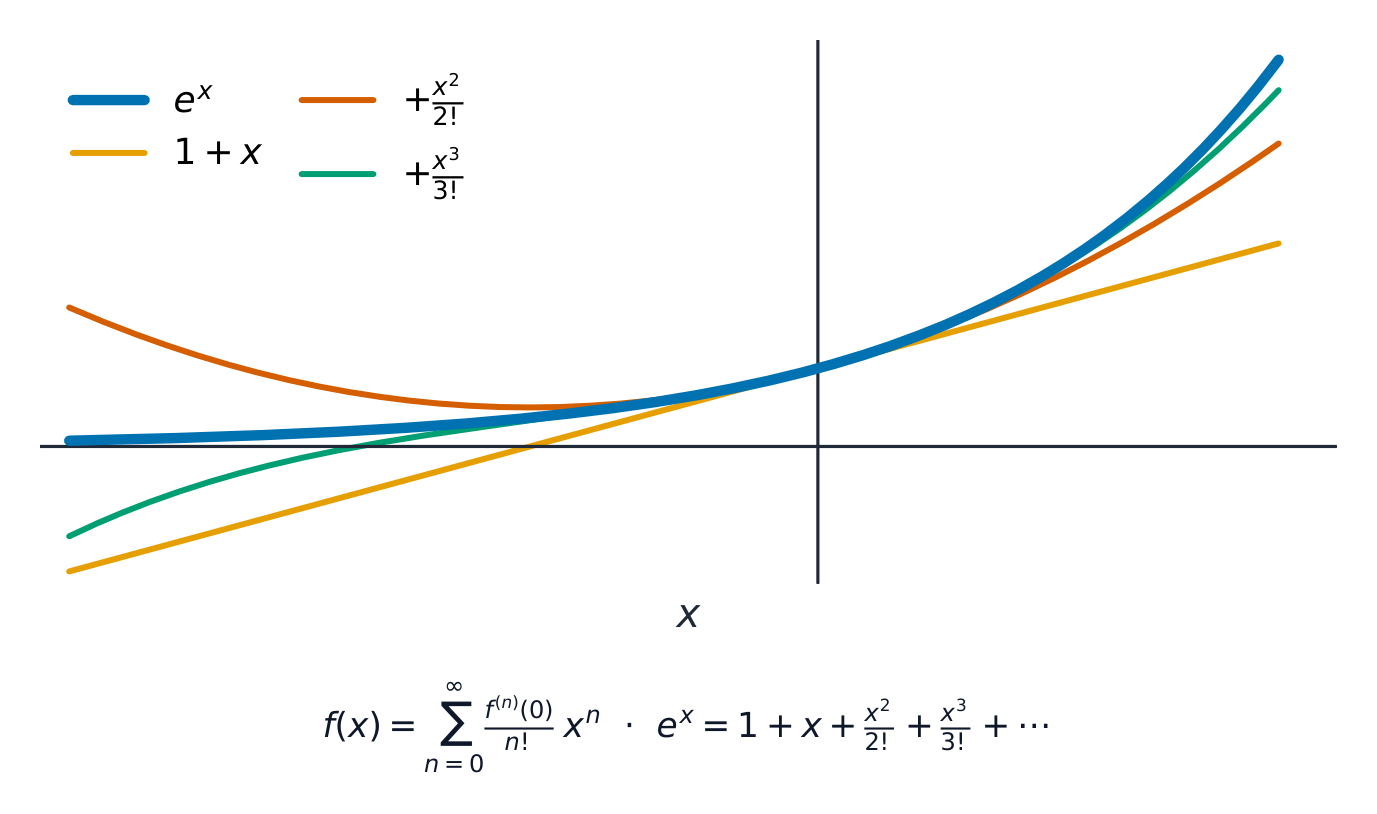
A Maclaurin's series 麦克劳林级数 writes a function as a power series:
$$f(x) = f(0) + f'(0)\,x + \frac{f''(0)}{2!}\,x^2 + \frac{f'''(0)}{3!}\,x^3 + \cdots$$For example $e^x = 1 + x + \dfrac{x^2}{2!} + \dfrac{x^3}{3!} + \cdots$Worked example. Find the Maclaurin series of $f(x) = \ln(1+x)$ up to the term in $x^3$.
$f(0) = 0$; $f'(x) = \dfrac{1}{1+x}$ so $f'(0) = 1$; $f''(x) = \dfrac{-1}{(1+x)^2}$ so $f''(0) = -1$; $f'''(x) = \dfrac{2}{(1+x)^3}$ so $f'''(0) = 2$. Substituting into the series:
$$\ln(1+x) = x - \frac{x^2}{2} + \frac{x^3}{3} - \cdots$$Tiếng ViệtBây giờ bạn có thể đạo hàm các hàm hyperbolic và các hàm ngược $\sin^{-1}x$, $\tan^{-1}x$, $\sinh^{-1}x$ và cứ thế. Bạn cũng có thể tìm $\dfrac{d^2y}{dx^2}$ cho các đường cong được cho dưới dạng ẩn hoặc tham số.
Chuỗi Maclaurin biểu diễn một hàm số dưới dạng chuỗi lũy thừa:
$$f(x) = f(0) + f'(0)\,x + \frac{f''(0)}{2!}\,x^2 + \frac{f'''(0)}{3!}\,x^3 + \cdots$$Ví dụ $e^x = 1 + x + \dfrac{x^2}{2!} + \dfrac{x^3}{3!} + \cdots$Thêm nhiều số hạng hơn giúp đa thức khớp với $e^x$ trên một khoảng rộng hơn quanh $x=0$. Ví dụ minh họa. Tìm chuỗi Maclaurin của $f(x) = \ln(1+x)$ đến số hạng chứa $x^3$.
$f(0) = 0$; $f'(x) = \dfrac{1}{1+x}$ nên $f'(0) = 1$; $f''(x) = \dfrac{-1}{(1+x)^2}$ nên $f''(0) = -1$; $f'''(x) = \dfrac{2}{(1+x)^3}$ nên $f'''(0) = 2$. Thay vào chuỗi:
$$\ln(1+x) = x - \frac{x^2}{2} + \frac{x^3}{3} - \cdots$$Explore · Khám pháThe gradient at a point · Độ dốc tại một điểm
gradient = dy/dx
The derivative is the slope of the tangent, however exotic the function. · Đạo hàm là độ dốc của tiếp tuyến, dù hàm số có phức tạp đến đâu.
2.4
Integration · Tích phân
Syllabus · Chương trình
EnglishCandidates should be able to: Notes and examples • integrate hyperbolic functions and recognise integrals of functions of the form $\frac{1}{\sqrt{a^2 - x^2}}$, $\frac{1}{\sqrt{x^2 + a^2}}$ and $\frac{1}{\sqrt{x^2 - a^2}}$, and integrate associated functions using trigonometric substitutions or hyperbolic substitutions as appropriate Including use of completing the square where necessary, e.g. to integrate $\frac{1}{\sqrt{x^2 + x}}$. • derive and use reduction formulae for the evaluation of definite integrals e.g. $\int_0^{\frac{1}{2}\pi} \sin^n x \text{ d}x$, $\int_0^1 \text{e}^{-x}(1-x)^n \text{ d}x$. In harder cases hints may be given, e.g. $\int_0^{\frac{1}{4}\pi} \sec^n x \text{ d}x$ by considering $\frac{\text{d}}{\text{d}x}(\tan x \sec^n x)$. • understand how the area under a curve may be approximated by areas of rectangles, and use rectangles to estimate or set bounds for the area under a curve or to derive inequalities or limits concerning sums Questions may involve either rectangles of unit width or rectangles whose width can tend to zero, e.g. $1 + \ln n > \sum_{r=1}^n \frac{1}{r} > \ln(n+1)$, $\sum_{r=1}^n \frac{1}{n}\left(1 + \frac{r}{n}\right)^{-1} \approx \int_0^1 (1+x)^{-1} \text{ d}x$. continued • use integration to find – arc lengths for curves with equations in Cartesian coordinates, including the use of a parameter, or in polar coordinates – surface areas of revolution about one of the axes for curves with equations in Cartesian coordinates, including the use of a parameter. Any questions involving integration may require techniques from Cambridge International A Level Mathematics (9709) applied to more difficult cases, e.g. integration by parts for $\int e^x \sin x \mathrm{d}x$, or use of the substitution $t = \tan \frac{1}{2}x$. Surface areas of revolution for curves with equations in polar coordinates will not be required. Tiếng Việtthí sinh có khả năng: Ghi chú và ví dụ • tích phân hàm hyperbolic và nhận biết các tích phân của các hàm có dạng $\frac{1}{\sqrt{a^2 - x^2}}$, $\frac{1}{\sqrt{x^2 + a^2}}$ và $\frac{1}{\sqrt{x^2 - a^2}}$, và tích phân các hàm liên kết bằng cách thay thế lượng giác hoặc thay thế hyperbolic tùy thuộc Bao gồm việc sử dụng hoàn thành bình phương nếu cần, ví dụ để tích phân $\frac{1}{\sqrt{x^2 + x}}$. • rút ra và sử dụng công thức giảm bậc để đánh giá tích phân xác định Ví dụ: $\int_0^{\frac{1}{2}\pi} \sin^n x \text{ d}x$, $\int_0^1 \text{e}^{-x}(1-x)^n \text{ d}x$. Trong các trường hợp khó hơn, gợi ý có thể được đưa ra, ví dụ: $\int_0^{\frac{1}{4}\pi} \sec^n x \text{ d}x$ bằng cách xét $\frac{\text{d}}{\text{d}x}(\tan x \sec^n x)$. • hiểu cách diện tích dưới đường cong có thể được xấp xỉ bởi diện tích của các hình chữ nhật, và sử dụng các hình chữ nhật để ước tính hoặc đặt cận cho diện tích dưới đường cong, hoặc để suy ra các bất đẳng thức hay giới hạn liên quan đến tổng Câu hỏi có thể liên quan đến các hình chữ nhật có chiều rộng đơn vị hoặc các hình chữ nhật có chiều rộng tiến tới zero, ví dụ: $1 + \ln n > \sum_{r=1}^n \frac{1}{r} > \ln(n+1)$, $\sum_{r=1}^n \frac{1}{n}\left(1 + \frac{r}{n}\right)^{-1} \approx \int_0^1 (1+x)^{-1} \text{ d}x$. tiếp theo • sử dụng tích phân để tìm – độ dài cung của các đường cong có phương trình trong tọa độ Descartes, bao gồm cả việc sử dụng tham số, hoặc trong tọa độ cực – diện tích mặt tròn xoay quanh một trong hai trục tọa độ cho các đường cong có phương trình trong tọa độ Descartes, bao gồm cả việc sử dụng tham số. Bất kỳ câu hỏi nào liên quan đến tích phân có thể yêu cầu các kỹ thuật từ Toán học Cambridge International A Level (9709) áp dụng vào các trường hợp khó hơn, ví dụ: tích phân từng phần cho $\int e^x \sin x \mathrm{d}x$, hoặc sử dụng phép thế $t = \tan \frac{1}{2}x$. Diện tích mặt tròn xoay cho các đường cong có phương trình trong tọa độ cực sẽ không được yêu cầu. Source: Cambridge International syllabus · Nguồn: Chương trình Cambridge International
EnglishLearn these standard integrals:
$$\int \frac{1}{a^2 + x^2}\,dx = \frac{1}{a}\tan^{-1}\frac{x}{a} + C, \qquad \int \frac{1}{\sqrt{a^2 - x^2}}\,dx = \sin^{-1}\frac{x}{a} + C.$$A trigonometric substitution, a hyperbolic substitution, or completing the square 配方法 in the denominator handles related forms. A reduction formula 递推公式 links an integral $I_n$ to $I_{n-1}$, so you can work down step by step. Integration also gives the arc length 弧长 of a curve and the surface area of revolution 旋转曲面面积 when a curve is turned about an axis.Worked example. Find $\displaystyle\int \frac{1}{\sqrt{4 - x^2}}\,dx$.
Here $a^2 = 4$, so $a = 2$ and
$$\int \frac{1}{\sqrt{4 - x^2}}\,dx = \sin^{-1}\frac{x}{2} + C.$$Bounding a sum by an integral. Draw rectangles of unit width under, or over, a decreasing curve such as $y=\frac1x$. Each rectangle of height $\frac1r$ is trapped between two integral strips, so summing gives
$$\ln(n+1) < \sum_{r=1}^{n}\frac1r < 1 + \ln n.$$Shrinking the rectangle width to $\frac1n\to 0$ turns such a sum into a Riemann sum 黎曼和 that equals the integral in the limit, e.g. $\displaystyle\lim_{n\to\infty}\frac1n\sum_{r=1}^{n}f\!\left(\frac{r}{n}\right)=\int_0^1 f(x)\,dx$.Tiếng ViệtHọc thuộc các tích phân cơ bản sau:
$$\int \frac{1}{a^2 + x^2}\,dx = \frac{1}{a}\tan^{-1}\frac{x}{a} + C, \qquad \int \frac{1}{\sqrt{a^2 - x^2}}\,dx = \sin^{-1}\frac{x}{a} + C.$$Phép thế lượng giác, phép thế hyperbolic, hoặc hoàn thành bình phương ở mẫu số giải quyết các dạng liên quan. Một công thức hạ bậc liên kết tích phân $I_n$ với $I_{n-1}$, giúp bạn tính toán từng bước. Tích phân còn cung cấp chiều dài cung của đường cong và diện tích mặt tròn xoay khi đường cong quay quanh một trục.Ví dụ minh họa. Tìm $\displaystyle\int \frac{1}{\sqrt{4 - x^2}}\,dx$.
Ở đây $a^2 = 4$, nên $a = 2$ và
$$\int \frac{1}{\sqrt{4 - x^2}}\,dx = \sin^{-1}\frac{x}{2} + C.$$Ước lượng tổng bằng tích phân. Vẽ các hình chữ nhật có chiều rộng đơn vị nằm dưới hoặc trên một đường cong giảm như $y=\frac1x$. Mỗi hình chữ nhật có độ cao $\frac1r$ bị kẹp giữa hai dải tích phân, nên việc cộng lại sẽ cho
$$\ln(n+1) < \sum_{r=1}^{n}\frac1r < 1 + \ln n.$$Thu nhỏ chiều rộng hình chữ nhật về $\frac1n\to 0$ biến tổng này thành tổng Riemann bằng với tích phân trong giới hạn, ví dụ $\displaystyle\lim_{n\to\infty}\frac1n\sum_{r=1}^{n}f\!\left(\frac{r}{n}\right)=\int_0^1 f(x)\,dx$.Explore · Khám pháThe area under the curve · Diện tích dưới đường cong
area = ∫ f(x) dx
Every integral measures the area under the curve — drag the limits. · Mỗi tích phân đo diện tích dưới đường cong — kéo giới hạn.
2.5
Complex numbers · Số phức

Syllabus · Chương trình
EnglishCandidates should be able to: Notes and examples • understand de Moivre’s theorem, for a positive or negative integer exponent, in terms of the geometrical effect of multiplication and division of complex numbers • prove de Moivre’s theorem for a positive integer exponent e.g. by induction. • use de Moivre’s theorem for a positive or negative rational exponent e.g. expressing $\cos 5\theta$ in terms of $\cos \theta$ or $\tan 5\theta$ in terms of $\tan \theta$. – to express trigonometrical ratios of multiple angles in terms of powers of trigonometrical ratios of the fundamental angle e.g. expressing $\sin^6 \theta$ in terms of $\cos 2\theta$, $\cos 4\theta$ and $\cos 6\theta$. – to express powers of $\sin \theta$ and $\cos \theta$ in terms of multiple angles – in the summation of series e.g. using the '$C + \mathrm{i}S$' method to sum series such as $\sum_{r=1}^{n} \binom{n}{r} \sin r\theta$. – in finding and using the $n$th roots of unity. Tiếng Việtthí sinh có khả năng: Ghi chú và ví dụ • hiểu định lý de Moivre, với số mũ nguyên dương hoặc âm, dưới góc độ hiệu ứng hình học của phép nhân và chia số phức • chứng minh định lý de Moivre cho số mũ nguyên dương ví dụ: bằng phương pháp quy nạp. • sử dụng định lý de Moivre cho số mũ nguyên有理数 ví dụ: biểu diễn $\cos 5\theta$ theo $\cos \theta$ hoặc $\tan 5\theta$ theo $\tan \theta$. – biểu diễn các tỷ số lượng giác của các góc nhiều lần theo lũy thừa của các tỷ số lượng giác của góc cơ bản Ví dụ: biểu diễn $\sin^6 \theta$ theo $\cos 2\theta$, $\cos 4\theta$ và $\cos 6\theta$. – để biểu diễn lũy thừa của $\sin \theta$ và $\cos \theta$ theo các góc bội – trong việc cộng chuỗi ví dụ: sử dụng phương pháp '$C + \mathrm{i}S$' để cộng các chuỗi như $\sum_{r=1}^{n} \binom{n}{r} \sin r\theta$. – trong việc tìm và sử dụng căn $n$ thứ căn bậc n của đơn vị. Source: Cambridge International syllabus · Nguồn: Chương trình Cambridge International
EnglishThe nth roots of unity form a polygon Multiplying complex numbers: lengths multiply, angles add Multiplying by i is a rotation A complex number 复数 in polar form is $z = r(\cos\theta + i\sin\theta)$. De Moivre's theorem 棣莫弗定理 says that for any integer $n$,
$$(\cos\theta + i\sin\theta)^n = \cos n\theta + i\sin n\theta.$$It is used to expand $\cos n\theta$ and $\sin n\theta$ in powers, to sum series, and to find the $n$ roots of unity 单位根 (the solutions of $z^n = 1$, equally spaced around the unit circle).Worked example. Use de Moivre's theorem to express $\cos 3\theta$ in terms of $\cos\theta$.
Take the real part of $(\cos\theta + i\sin\theta)^3 = \cos 3\theta + i\sin 3\theta$:
$$\cos 3\theta = \cos^3\theta - 3\cos\theta\sin^2\theta = \cos^3\theta - 3\cos\theta(1 - \cos^2\theta) = 4\cos^3\theta - 3\cos\theta.$$Tiếng ViệtCăn bậc n của đơn vị tạo thành đa giác Nhân số phức: độ dài nhân với nhau, góc cộng lại Nhân với i là phép quay Các mẫu tự tương tự như bông cải Romanesco xuất hiện từ việc lặp lại các hàm trong mặt phẳng phức. Một số phức dạng cực là $z = r(\cos\theta + i\sin\theta)$. Định lý De Moivre phát biểu rằng với mọi số nguyên $n$,
$$(\cos\theta + i\sin\theta)^n = \cos n\theta + i\sin n\theta.$$Nó được dùng để khai triển $\cos n\theta$ và $\sin n\theta$ thành lũy thừa, tính tổng chuỗi, và tìm $n$ căn bậc n của đơn vị (nghiệm của $z^n = 1$, phân bố đều trên đường tròn đơn vị).
Năm nghiệm của $z^5=1$ được phân bố đều cách nhau $72^\circ$ trên đường tròn đơn vị. Ví dụ minh họa. Sử dụng định lý De Moivre để biểu diễn $\cos 3\theta$ theo $\cos\theta$.
Lấy phần thực của $(\cos\theta + i\sin\theta)^3 = \cos 3\theta + i\sin 3\theta$:
$$\cos 3\theta = \cos^3\theta - 3\cos\theta\sin^2\theta = \cos^3\theta - 3\cos\theta(1 - \cos^2\theta) = 4\cos^3\theta - 3\cos\theta.$$Explore · Khám pháThe Argand diagram · Sơ đồ Argand
Drag the point to explore modulus and argument — the language of complex numbers in polar (modulus–argument) form. · Kéo điểm để khám phá mô-đun và argument — ngôn ngữ của số phức dưới dạng cực (mô-đun–argument).
Vocabulary · Từ vựng Train · Luyện tậpEnglish Tiếng Việt roots of unity/ruːts ɒv ˈjuːnɪti/ căn bậc n của đơn vị integrating factor/ˈɪntɪɡreɪtɪŋ ˈfæktə/ hệ số tích phân general solution/ˈdʒenərəl səˈluːʃn/ nghiệm tổng quát complementary function/ˌkɒmplɪˈmentəri ˈfʌŋkʃn/ hàm bổ sung particular integral/pəˈtɪkjʊlə ˈɪntɪɡrəl/ tích phân riêng particular solution/pəˈtɪkjʊlə səˈluːʃn/ nghiệm riêng separable variables/ˈsepərəbl ˈveərɪəblz/ biến số tách rời auxiliary equation/ɔːkˈsɪlɪəri ɪˈkweɪʒn/ phương trình phụ 2.6
Differential equations · Phương trình vi phân

Syllabus · Chương trình
EnglishCandidates should be able to: Notes and examples • find an integrating factor for a first order linear differential equation, and use an integrating factor to find the general solution e.g. $\frac{\mathrm{d}y}{\mathrm{d}x} - 2y = x^2$, $x\frac{\mathrm{d}y}{\mathrm{d}x} - y = x^4$, $\frac{\mathrm{d}y}{\mathrm{d}x} + y\coth x = \cosh x$. • recall the meaning of the terms 'complementary function' and 'particular integral' in the context of linear differential equations, and recall that the general solution is the sum of the complementary function and a particular integral find the complementary function for a first or second order linear differential equation with constant coefficients For second order equations, including the cases where the auxiliary equation has distinct real roots, a repeated real root or conjugate complex roots. recall the form of, and find, a particular integral for a first or second order linear differential equation in the cases where a polynomial or $ae^{bx}$ or $a\cos px + b\sin px$ is a suitable form, and in other simple cases find the appropriate coefficient(s) given a suitable form of particular integral e.g. evaluate $k$ given that $kx \cos 2x$ is a particular integral of $$\frac{\text{d}^2y}{\text{d}x^2} + 4y = \sin 2x$$.use a given substitution to reduce a differential equation to a first or second order linear equation with constant coefficients or to a first order equation with separable variables e.g. the substitution $x = e^t$ to reduce to linear form a differential equation with terms of the form $$ax^2\frac{\text{d}^2y}{\text{d}x^2} + bx\frac{\text{d}y}{\text{d}x} + cy$$, or the substitution $y = ux$ to reduce$$\frac{\text{d}y}{\text{d}x} = \frac{x+y}{x-y}$$to separable form.use initial conditions to find a particular solution to a differential equation, and interpret a solution in terms of a problem modelled by a differential equation. Tiếng Việtthí sinh có khả năng: Ghi chú và ví dụ • tìm hệ số nhân cho một phương trình vi phân tuyến tính bậc nhất, và sử dụng hệ số nhân để tìm nghiệm tổng quát Ví dụ: $\frac{\mathrm{d}y}{\mathrm{d}x} - 2y = x^2$, $x\frac{\mathrm{d}y}{\mathrm{d}x} - y = x^4$, $\frac{\mathrm{d}y}{\mathrm{d}x} + y\coth x = \cosh x$. • nhớ lại ý nghĩa của các thuật ngữ 'nghiệm bổ sung' và 'nguyên đặc biệt' trong bối cảnh phương trình vi phân tuyến tính, và nhớ rằng nghiệm tổng quát là tổng của nghiệm bổ sung và một nguyên đặc biệt tìm nghiệm bổ sung cho phương trình vi phân tuyến tính bậc nhất hoặc bậc hai với hệ số hằng Đối với phương trình bậc hai, bao gồm cả các trường hợp mà phương trình phụ có các nghiệm thực phân biệt, nghiệm thực lặp lại hoặc nghiệm phức liên hợp. nhớ lại dạng và tìm nguyên đặc biệt cho phương trình vi phân tuyến tính bậc nhất hoặc bậc hai trong các trường hợp mà một đa thức hoặc $ae^{bx}$ hoặc $a\cos px + b\sin px$ là dạng thích hợp, và trong các trường hợp đơn giản khác, tìm hệ số(s) phù hợp khi đã cho dạng thích hợp của nguyên đặc biệt ví dụ: đánh giá $k$ khi biết rằng $kx \cos 2x$ là một nguyên đặc biệt của $$\frac{\text{d}^2y}{\text{d}x^2} + 4y = \sin 2x$$.sử dụng một phép thế đã cho để thu gọn phương trình vi phân về dạng phương trình tuyến tính bậc nhất hoặc bậc hai với hệ số hằng, hoặc về dạng phương trình bậc nhất với các biến có thể tách rời ví dụ: phép thế $x = e^t$ để thu gọn về dạng tuyến tính một phương trình vi phân có các số hạng có dạng $$ax^2\frac{\text{d}^2y}{\text{d}x^2} + bx\frac{\text{d}y}{\text{d}x} + cy$$, hoặc phép thế $y = ux$ để thu$$\frac{\text{d}y}{\text{d}x} = \frac{x+y}{x-y}$$về dạng có thể tách rời.sử dụng điều kiện ban đầu để tìm nghiệm riêng của một phương trình vi phân, và giải thích nghiệm theo ngữ cảnh của một vấn đề được mô hình hóa bởi phương trình vi phân. Source: Cambridge International syllabus · Nguồn: Chương trình Cambridge International
EnglishFor a first order linear equation $\dfrac{dy}{dx} + P(x)\,y = Q(x)$, multiply by the integrating factor 积分因子 $\mu = e^{\int P\,dx}$. The left side then becomes $\dfrac{d}{dx}(\mu y)$, so you can integrate directly.
For a linear equation with constant coefficients, the general solution 通解 is the sum of two parts: the complementary function 余函数 (the solution of the equation with the right side set to $0$, found from the auxiliary equation) and a particular integral 特积分 (any one solution of the full equation). Initial conditions then fix the constants to give the particular solution 特解; simpler equations with separable variables 可分离变量 are integrated directly.
Worked example. Solve $\dfrac{dy}{dx} + 2y = e^x$.
The integrating factor is $\mu = e^{\int 2\,dx} = e^{2x}$. Multiplying through gives $\dfrac{d}{dx}\!\left(y\,e^{2x}\right) = e^{3x}$, so
$$y\,e^{2x} = \tfrac13 e^{3x} + C \;\Rightarrow\; y = \tfrac13 e^x + C e^{-2x}.$$Second order, constant coefficients. For $\dfrac{d^2y}{dx^2}+b\dfrac{dy}{dx}+cy=f(x)$, solve the auxiliary equation 辅助方程 $m^2+bm+c=0$. The complementary function depends on its roots:
- two distinct real roots $m_1,m_2$: $y=Ae^{m_1x}+Be^{m_2x}$;
- a repeated root $m$: $y=(A+Bx)e^{mx}$;
- complex roots $p\pm qi$: $y=e^{px}(A\cos qx+B\sin qx)$.
Then add a particular integral by trying a form matching $f(x)$ (a polynomial, $ae^{bx}$, or $a\cos px+b\sin px$); if that trial already appears in the complementary function, multiply it by $x$.
Worked example. Solve $\dfrac{d^2y}{dx^2}-4\dfrac{dy}{dx}+4y=0$. The auxiliary equation $m^2-4m+4=(m-2)^2=0$ has a repeated root $m=2$, so $y=(A+Bx)e^{2x}$.
Tiếng ViệtĐối với phương trình bậc nhất tuyến tính $\dfrac{dy}{dx} + P(x)\,y = Q(x)$, nhân với thừa số tích phân $\mu = e^{\int P\,dx}$. vế trái lúc này trở thành $\dfrac{d}{dx}(\mu y)$, nên bạn có thể tích phân trực tiếp.
Đối với phương trình tuyến tính hệ số hằng, nghiệm tổng quát là tổng của hai phần: hàm bổ sung (nghiệm của phương trình khi vế phải bằng $0$, tìm được từ phương trình phụ) và tích phân riêng (bất kỳ một nghiệm nào của phương trình đầy đủ). Điều kiện ban đầu sau đó xác định các hằng số để thu được nghiệm riêng; các phương trình đơn giản hơn có biến tách rời được tích phân trực tiếp.
Đường nghiệm chạy theo trường vectơ, luôn tiếp xúc với các đoạn nhỏ tại mọi điểm. Ví dụ minh họa. Giải $\dfrac{dy}{dx} + 2y = e^x$.
Thừa số tích phân là $\mu = e^{\int 2\,dx} = e^{2x}$. Nhân cả hai vế ta được $\dfrac{d}{dx}\!\left(y\,e^{2x}\right) = e^{3x}$, nên
$$y\,e^{2x} = \tfrac13 e^{3x} + C \;\Rightarrow\; y = \tfrac13 e^x + C e^{-2x}.$$Bậc hai, hệ số hằng. Với $\dfrac{d^2y}{dx^2}+b\dfrac{dy}{dx}+cy=f(x)$, giải phương trình phụ $m^2+bm+c=0$. Hàm bổ sung phụ thuộc vào các nghiệm của nó:
- hai nghiệm thực phân biệt $m_1,m_2$: $y=Ae^{m_1x}+Be^{m_2x}$;
- nghiệm bội $m$: $y=(A+Bx)e^{mx}$;
- nghiệm phức $p\pm qi$: $y=e^{px}(A\cos qx+B\sin qx)$.
Sau đó cộng một tích phân riêng bằng cách thử một dạng phù hợp với $f(x)$ (đa thức, $ae^{bx}$, hoặc $a\cos px+b\sin px$); nếu dạng thử này đã xuất hiện trong hàm bổ sung, nhân nó với $x$.
Ví dụ có hướng dẫn. Giải $\dfrac{d^2y}{dx^2}-4\dfrac{dy}{dx}+4y=0$. Phương trình phụ $m^2-4m+4=(m-2)^2=0$ có nghiệm bội $m=2$, nên $y=(A+Bx)e^{2x}$.
Explore · Khám pháDifferential equations · Phương trình vi phân
dy/dx = a y
The equation sets the slope everywhere; the solution follows those slopes. · Phương trình thiết lập độ dốc tại mọi nơi; nghiệm tuân theo những độ dốc đó.
2.6
Exam tips · Mẹo làm bài thi
English- Learn the hyperbolic identities and derivatives, and use the inverse hyperbolic functions in integration.
- Solve a linear differential equation as complementary function $+$ particular integral, then apply the boundary conditions.
- Use de Moivre's theorem for powers and roots of complex numbers and to derive trigonometric identities.
- Reduce an integral to a standard form by a stated substitution.
Tiếng Việt- Học các hệ thức hyperbolic và đạo hàm, và sử dụng các hàm hyperbolic ngược trong tích phân.
- Giải phương trình vi phân tuyến tính dưới dạng hàm bổ sung $+$ tích phân riêng, sau đó áp dụng điều kiện biên.
- Sử dụng định lý de Moivre cho lũy thừa và căn bậc của số phức và để suy ra các đẳng thức lượng giác.
- Rút gọn tích phân về dạng chuẩn thông qua phép thế được nêu rõ.
-
3
Further Mechanics · Cơ học Nâng cao
Watch lesson · Xem bài họcEnglishThis handout covers Topic 3: Further Mechanics 进阶力学. It extends mechanics to projectiles, rigid bodies, circular motion, elastic strings, variable forces and collisions. Take $g = 10\ \text{m s}^{-2}$.
Tiếng ViệtTài liệu này bao gồm Chủ đề 3: Cơ học nâng cao. Nó mở rộng cơ học sang vật rơi, vật rắn, chuyển động tròn, dây đàn hồi, lực biến thiên và va chạm. Take $g = 10\ \text{m s}^{-2}$.
3.1
Motion of a projectile · Chuyển động của vật rơi

Syllabus · Chương trình
EnglishCandidates should be able to: Notes and examples • model the motion of a projectile as a particle moving with constant acceleration and understand any limitations of the model Vector methods are not required • use horizontal and vertical equations of motion to solve problems on the motion of projectiles, including finding the magnitude and direction of the velocity at a given time or position, the range on a horizontal plane and the greatest height reached • derive and use the Cartesian equation of the trajectory of a projectile, including problems in which the initial speed and/or angle of projection may be unknown. Knowledge of the 'bounding parabola' for accessible points is not included. Tiếng Việtthí sinh có khả năng: Ghi chú và ví dụ • mô hình hóa chuyển động của vật ném như một chất điểm chuyển động với gia tốc không đổi và hiểu bất kỳ giới hạn nào của mô hình Phương pháp véc-tơ không yêu cầu • sử dụng phương trình chuyển động theo phương ngang và phương đứng để giải các bài toán về chuyển động của vật ném, bao gồm tìm độ lớn và hướng của vận tốc tại một thời điểm hoặc vị trí cho trước, tầm xa trên mặt phẳng nằm ngang và độ cao cực đại đạt được • suy ra và sử dụng phương trình Cartesian của quỹ đạo một vật bay, bao gồm các bài toán mà vận tốc ban đầu và/hoặc góc ném có thể chưa biết. Kiến thức về 'đường cong_parabol giới hạn' cho các điểm tiếp cận được không bao gồm. Source: Cambridge International syllabus · Nguồn: Chương trình Cambridge International
EnglishDropped vs thrown: falling together A projectile 抛射体 moves freely under gravity, so it has constant acceleration 匀加速 $g$ downwards and no horizontal acceleration. Treat the horizontal and vertical motions separately. If it is launched at speed $u$ and angle $\alpha$:
$$\text{horizontal: } x = u\cos\alpha\,\cdot t, \qquad \text{vertical: } y = u\sin\alpha\,\cdot t - \tfrac12 g t^2.$$Eliminating $t$ gives the Cartesian equation 直角坐标方程 of the trajectory 轨迹 (the path), which is a parabola. For a fixed launch speed, all the trajectories lie under a bounding parabola 包络抛物线 (the envelope of reachable points). The range on level ground is $\dfrac{u^2\sin 2\alpha}{g}$ and the greatest height is $\dfrac{u^2\sin^2\alpha}{2g}$.Worked example. A ball is thrown at $u = 20\ \text{m s}^{-1}$ at $30^\circ$ to the horizontal. Find the range and greatest height.
$$\text{range} = \frac{20^2\sin 60^\circ}{10} = 40\times 0.866 = 34.6\ \text{m}, \qquad \text{height} = \frac{20^2\sin^2 30^\circ}{2\times 10} = \frac{400\times 0.25}{20} = 5\ \text{m}.$$Tiếng ViệtDropped vs thrown: falling together Water jets follow parabolic paths — the classic projectile motion under gravity. Một vật rơi chuyển động tự do dưới tác dụng của trọng lực, vì vậy nó có gia tốc không đổi $g$ hướng xuống và không có gia tốc theo phương ngang. Xem xét riêng biệt chuyển động theo phương ngang và phương dọc. Nếu nó được phóng đi với vận tốc $u$ và góc $\alpha$:
$$\text{horizontal: } x = u\cos\alpha\,\cdot t, \qquad \text{vertical: } y = u\sin\alpha\,\cdot t - \tfrac12 g t^2.$$Loại bỏ $t$ ta thu được phương trình Cartesian của quỹ đạo (đường đi), đây là một parabol. Đối với vận tốc phóng cố định, tất cả các quỹ đạo nằm bên trong một parabol giới hạn (đường bao của các điểm có thể đạt đến). Quãng đường bay trên mặt đất bằng phẳng là $\dfrac{u^2\sin 2\alpha}{g}$ và độ cao cực đại là $\dfrac{u^2\sin^2\alpha}{2g}$.
The path is a parabola; the launch speed $u$ splits into a steady horizontal part and a vertical part slowed by gravity. Ví dụ có hướng dẫn. Một quả bóng được ném với vận tốc $u = 20\ \text{m s}^{-1}$ ở góc $30^\circ$ so với phương ngang. Tìm quãng đường bay và độ cao cực đại.
$$\text{range} = \frac{20^2\sin 60^\circ}{10} = 40\times 0.866 = 34.6\ \text{m}, \qquad \text{height} = \frac{20^2\sin^2 30^\circ}{2\times 10} = \frac{400\times 0.25}{20} = 5\ \text{m}.$$Explore · Khám pháLaunch a projectile · Phóng vật
Fire the ball, then change the angle and speed. The horizontal motion is steady while gravity pulls it down — together they trace a parabola. Find the angle for the longest range, and try the Moon. · Bắn bóng, sau đó thay đổi góc và tốc độ. Chuyển động ngang diễn ra đều trong khi trọng lực kéo xuống — kết hợp chúng tạo thành đường cong parabol. Tìm góc để tầm bay xa nhất, và thử trên Mặt Trăng.
Vocabulary · Từ vựng Train · Luyện tậpEnglish Tiếng Việt Further Mechanics/ˈfɜːðə mɪˈkænɪks/ Cơ học Nâng cao projectile/prəˈdʒektaɪl/ vật bay constant acceleration/ˈkɒnstənt əkˌseləˈreɪʃn/ gia tốc không đổi Cartesian equation/kɑːˈtiːzɪən ɪˈkweɪʒn/ phương trình Descartes trajectory/trəˈdʒektəri/ quỹ đạo 3.2
Equilibrium of a rigid body · Cân bằng của vật rắn

Syllabus · Chương trình
EnglishCandidates should be able to: Notes and examples • calculate the moment of a force about a point For questions involving coplanar forces only; understanding of the vector nature of moments is not required. • use the result that the effect of gravity on a rigid body is equivalent to a single force acting at the centre of mass of the body, and identify the position of the centre of mass of a uniform body using considerations of symmetry • use given information about the position of the centre of mass of a triangular lamina and other simple shapes Proofs of results given in the MF19 List of formulae are not required. • determine the position of the centre of mass of a composite body by considering an equivalent system of particles Simple cases only, e.g. a uniform L-shaped lamina, or a uniform cone joined at its base to a uniform hemisphere of the same radius. • use the principle that if a rigid body is in equilibrium under the action of coplanar forces then the vector sum of the forces is zero and the sum of the moments of the forces about any point is zero, and the converse of this • solve problems involving the equilibrium of a single rigid body under the action of coplanar forces, including those involving toppling or sliding. Tiếng Việtthí sinh có khả năng: Ghi chú và ví dụ • tính momen lực của một lực đối với một điểm Chỉ áp dụng cho các câu hỏi liên quan đến lực đồng phẳng; hiểu bản chất vectơ của momen lực không yêu cầu. • sử dụng kết quả rằng tác dụng của trọng lực lên một vật rắn tương đương với một lực đơn lẻ tác dụng tại trọng tâm của vật, và xác định vị trí trọng tâm của một vật đều bằng cách xem xét sự đối xứng • sử dụng thông tin đã cho về vị trí trọng tâm của một tấm mỏng hình tam giác và các hình dạng đơn giản khác Chứng minh các kết quả trong Danh sách công thức MF19 không yêu cầu. • xác định vị trí trọng tâm của một vật hợp thành bằng cách xem xét một hệ hạt tương đương Chỉ các trường hợp đơn giản, ví dụ: tấm mỏng hình L đều, hoặc một nón đều nối ở đáy với một bán cầu đều có cùng bán kính. • sử dụng nguyên lý rằng nếu một vật rắn ở trạng thái cân bằng dưới tác dụng của các lực đồng phẳng thì tổng vectơ của các lực bằng không và tổng momen của các lực đối với bất kỳ điểm nào cũng bằng không, và điều kiện ngược lại của nó • giải các bài toán liên quan đến sự cân bằng của một vật rắn duy nhất dưới tác dụng của các lực đồng phẳng, bao gồm cả những bài toán liên quan đến ngả đổ hoặc trượt. Source: Cambridge International syllabus · Nguồn: Chương trình Cambridge International
EnglishThe moment 力矩 of a force about a point is force $\times$ perpendicular distance; it measures turning effect. The weight of a body acts at its centre of mass 质心, which you can find using symmetry 对称 for a uniform flat shape (a lamina 薄片), or by treating a composite body as a set of particles.
A rigid body under coplanar forces 共面力 is in equilibrium 平衡 when two conditions both hold: the vector sum of the forces is zero, and the sum of the moments about any point is zero. A body may also be on the edge of toppling 翻倒 (turning over) or sliding 滑动 (slipping).
Worked example. A uniform beam $AB$ of length $4\ \text{m}$ and weight $100\ \text{N}$ rests on a pivot at $A$. A vertical force $F$ at $B$ keeps it horizontal. Find $F$.
Take moments about $A$ (the weight acts at the centre, $2\ \text{m}$ from $A$):
$$F\times 4 = 100\times 2 \;\Rightarrow\; F = 50\ \text{N}.$$Tiếng ViệtMomen của lực đối với một điểm là lực $\times$ nhân khoảng cách vuông góc; nó đo lường hiệu ứng quay. Trọng lực của vật tác dụng tại trọng tâm, mà bạn có thể tìm thấy bằng cách dùng tính đối xứng đối với hình phẳng đồng nhất (một tấm mỏng), hoặc bằng cách coi vật tổng hợp là tập hợp các hạt.
Một vật rắn chịu lực cùng phẳng处于 cân bằng khi cả hai điều kiện đều thỏa mãn: tổng vector của các lực bằng không, và tổng momen đối với bất kỳ điểm nào bằng không. Một vật cũng có thể ở trạng thái gần như ngả (lật) hoặc trượt (khai trượt).
Taking moments about the pivot $A$ balances the turning effects: $F\times4 = 100\times2$. Ví dụ có hướng dẫn. Một thanh đồng nhất $AB$ dài $4\ \text{m}$ và nặng $100\ \text{N}$ đặt trên bản lề tại $A$. Một lực thẳng đứng $F$ tại $B$ giữ cho nó nằm ngang. Tìm $F$.
Lấy momen đối với $A$ (trọng lực tác dụng tại trung tâm, $2\ \text{m}$ từ $A$):
$$F\times 4 = 100\times 2 \;\Rightarrow\; F = 50\ \text{N}.$$Explore · Khám pháEquilibrium of forces · Cân bằng lực
resultant = 0 · tổng hợp = 0
A body is in equilibrium when the forces add tip-to-tail back to zero. · Một vật处于 cân bằng khi các lực cộng đầu-nối-đuôi trở về không.
Vocabulary · Từ vựng Train · Luyện tậpEnglish Tiếng Việt moment/ˈməʊmənt/ thời điểm centre of mass/ˈsentə ɒv mæs/ tâm khối lượng symmetry/ˈsɪmətri/ sự đối xứng equilibrium/ˌiːkwɪˈlɪbrɪəm/ cân bằng toppling/ˈtɒplɪŋ/ ngả đổ sliding/ˈslaɪdɪŋ/ trượt angular speed/ˈæŋɡjʊlə spiːd/ vận tốc góc centripetal acceleration/senˈtrɪpɪtl əkˌseləˈreɪʃn/ gia tốc hướng tâm horizontal circle/ˌhɒrɪˈzɒntl ˈsɜːkl/ vòng tròn ngang vertical circle/ˈvɜːtɪkl ˈsɜːkl/ vòng tròn đứng Hooke's law/hʊks lɔː/ định luật Hooke modulus of elasticity/ˈmɒdjʊləs ɒv ɪlæˈstɪsɪti/ mô-đun đàn hồi elastic potential energy/ɪˈlæstɪk pəˈtenʃl ˈenədʒi/ hằng số lò xo và bình phương độ giãn differential equation/ˌdɪfəˈrenʃl ɪˈkweɪʒn/ phương trình vi phân 3.3
Circular motion · Chuyển động tròn

Syllabus · Chương trình
EnglishCandidates should be able to: Notes and examples understand the concept of angular speed for a particle moving in a circle, and use the relation $v = r\omega$ understand that the acceleration of a particle moving in a circle with constant speed is directed towards the centre of the circle, and use the formulae $r\omega^2$ and $\frac{v^2}{r}$. Proof of the acceleration formulae is not required. solve problems which can be modelled by the motion of a particle moving in a horizontal circle with constant speed solve problems which can be modelled by the motion of a particle in a vertical circle without loss of energy. Including finding a normal contact force or the tension in a string, locating points at which these are zero, and conditions for complete circular motion. Tiếng Việtthí sinh có khả năng: Ghi chú và ví dụ • hiểu khái niệm tốc độ góc của một hạt chuyển động trên đường tròn, và sử dụng hệ thức $v = r\omega$ • hiểu rằng gia tốc của một hạt chuyển động trên đường tròn với tốc độ không đổi hướng vào tâm đường tròn, và sử dụng các công thức $r\omega^2$ và $\frac{v^2}{r}$. Chứng minh các công thức gia tốc không yêu cầu. • giải các bài toán có thể mô hình hóa bằng chuyển động của một hạt chuyển động trên đường tròn nằm ngang với tốc độ không đổi • giải các bài toán có thể mô hình hóa bằng chuyển động của một hạt trên đường tròn đứng mà không mất năng lượng. Bao gồm tìm lực pháp tuyến tiếp xúc hoặc lực căng trong dây, xác định các điểm tại đó các lực này bằng không, và các điều kiện để chuyển động tròn hoàn toàn. Source: Cambridge International syllabus · Nguồn: Chương trình Cambridge International
EnglishFor a particle moving in a circle of radius $r$, the angular speed 角速度 $\omega$ links to the speed by $v = r\omega$. The acceleration points towards the centre — the centripetal acceleration 向心加速度 — with size
$$a = r\omega^2 = \frac{v^2}{r}.$$In a horizontal circle 水平圆 the speed is constant — as in a conical pendulum 圆锥摆 (a mass swung on a string). In a vertical circle 竖直圆 use energy conservation, because the speed changes with height; the normal contact force 法向接触力 or string tension provides the centripetal force.
Worked example. A particle moves in a horizontal circle of radius $2\ \text{m}$ with angular speed $3\ \text{rad s}^{-1}$. Find its speed and acceleration.
$$v = r\omega = 2\times 3 = 6\ \text{m s}^{-1}, \qquad a = r\omega^2 = 2\times 3^2 = 18\ \text{m s}^{-2}.$$Tiếng ViệtĐối với một hạt chuyển động trong vòng tròn bán kính $r$, tốc độ góc $\omega$ liên kết với vận tốc qua $v = r\omega$. Gia tốc hướng về phía tâm — gia tốc hướng tâm — có độ lớn
$$a = r\omega^2 = \frac{v^2}{r}.$$The velocity points along the tangent; the acceleration points inward to the centre. 
The hammer thrower is a moving diagram of this page. The taut wire pulls the ball toward the centre — that inward pull is the centripetal force — while the ball's velocity points along the tangent. Let go, and with no inward force left the ball flies straight off that tangent Trong vòng tròn nằm ngang, vận tốc không đổi — như trong con lắc nón (mô mass treo trên dây). Trong vòng tròn đứng, sử dụng bảo toàn năng lượng, vì vận tốc thay đổi theo độ cao; lực tiếp xúc pháp tuyến hoặc lực căng dây cung cấp gia tốc hướng tâm.
Ví dụ có hướng dẫn. Một hạt chuyển động trong vòng tròn nằm ngang bán kính $2\ \text{m}$ với tốc độ góc $3\ \text{rad s}^{-1}$. Tìm vận tốc và gia tốc của nó.
$$v = r\omega = 2\times 3 = 6\ \text{m s}^{-1}, \qquad a = r\omega^2 = 2\times 3^2 = 18\ \text{m s}^{-2}.$$Explore · Khám pháAngle in radians · Góc tính bằng radian
Circular motion is measured in radians: drag the angle θ and radius r to see the arc swept — angular speed ω turns this into v = rω. · Chuyển động tròn được đo bằng radian: kéo góc θ và bán kính r để xem cung quét qua — tốc độ góc ω biến điều này thành v = rω.
3.4
Hooke's law · Định luật Hooke
Syllabus · Chương trình
EnglishCandidates should be able to: Notes and examples use Hooke’s law as a model relating the force in an elastic string or spring to the extension or compression, and understand the term modulus of elasticity use the formula for the elastic potential energy stored in a string or spring Proof of the formula is not required. solve problems involving forces due to elastic strings or springs, including those where considerations of work and energy are needed. e.g. a particle moving horizontally or vertically or on an inclined plane while attached to one or more strings or springs, or a particle attached to an elastic string acting as a 'conical pendulum'. Tiếng Việtthí sinh có khả năng: Ghi chú và ví dụ • sử dụng Định luật Hooke như một mô hình liên hệ giữa lực trong một sợi dây đàn hồi hoặc lò xo với độ dãn hoặc độ nén, và hiểu thuật ngữ mô đun đàn hồi • sử dụng công thức cho thế năng đàn hồi tích trữ trong một sợi dây hoặc lò xo Chứng minh công thức không yêu cầu. • giải các bài toán liên quan đến lực do sợi dây đàn hồi hoặc lò xo gây ra, bao gồm cả những bài toán cần xem xét công và năng lượng. Ví dụ: một hạt chuyển động theo phương ngang, phương đứng hoặc trên mặt phẳng nghiêng khi gắn với một hoặc nhiều sợi dây/lò xo, hoặc một hạt gắn với một sợi dây đàn hồi đóng vai trò như con lắc hình nón. Source: Cambridge International syllabus · Nguồn: Chương trình Cambridge International
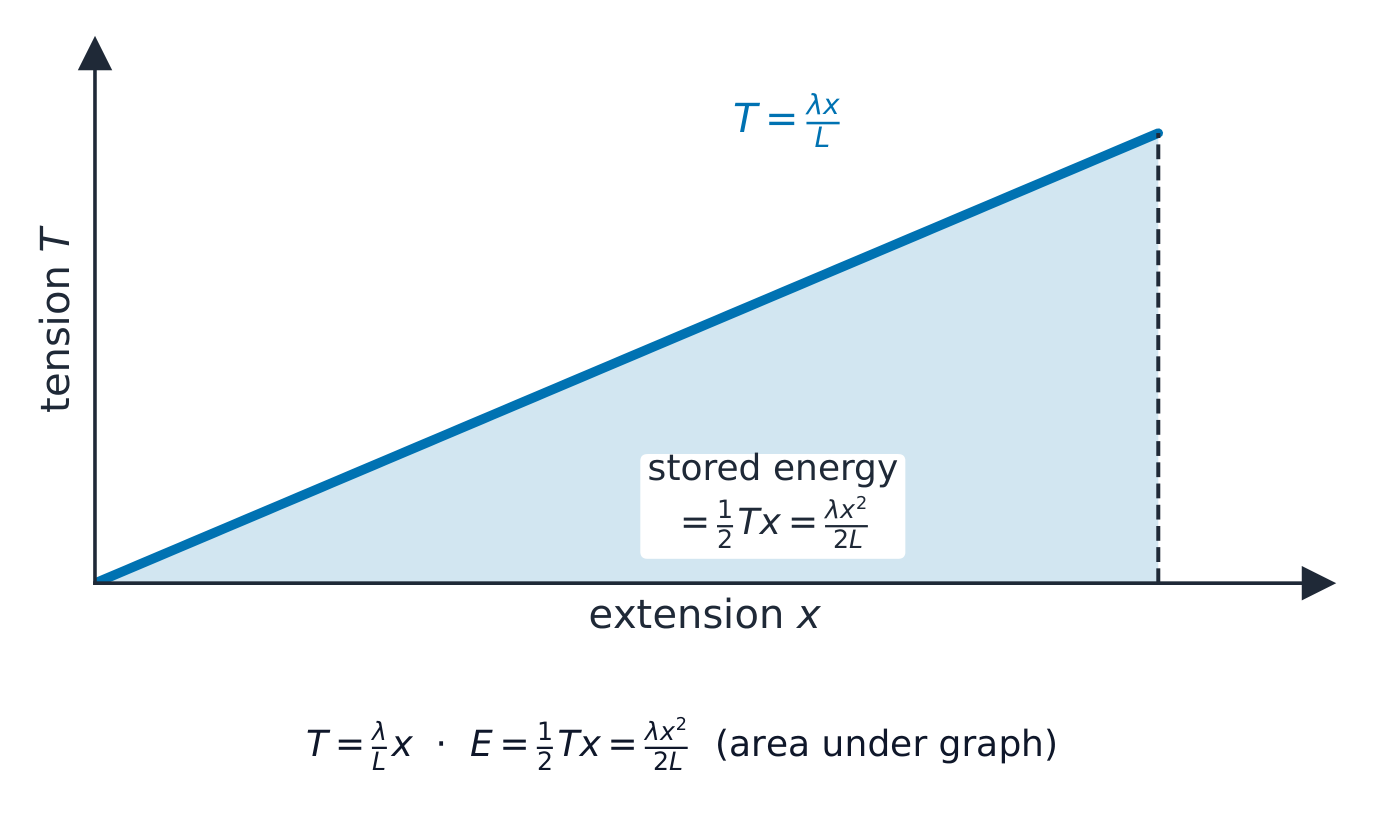
EnglishHooke's law 胡克定律 says the tension in an elastic string or spring is proportional to its extension $x$:
$$T = \frac{\lambda x}{L},$$where $L$ is the natural length and $\lambda$ is the modulus of elasticity 弹性模量. Stretching stores elastic potential energy 弹性势能:$$E = \frac{\lambda x^2}{2L}.$$Worked example. An elastic string of natural length $2\ \text{m}$ and modulus $50\ \text{N}$ is stretched by $0.5\ \text{m}$. Find the tension and the stored energy.
$$T = \frac{50\times 0.5}{2} = 12.5\ \text{N}, \qquad E = \frac{50\times 0.5^2}{2\times 2} = 3.125\ \text{J}.$$Tiếng ViệtĐịnh luật Hooke nói rằng lực căng trong một sợi dây đàn hồi hoặc lò xo tỷ lệ thuận với độ dãn $x$:
$$T = \frac{\lambda x}{L},$$trong đó $L$ là chiều dài tự nhiên và $\lambda$ là mô đun đàn hồi. Kéo dãn sẽ lưu trữ thế năng đàn hồi:$$E = \frac{\lambda x^2}{2L}.$$Tension rises in proportion to extension; the shaded triangle is the stored elastic energy. Ví dụ có hướng dẫn. Một sợi dây đàn hồi có chiều dài tự nhiên $2\ \text{m}$ và mô đun $50\ \text{N}$ bị kéo dãn thêm $0.5\ \text{m}$. Tìm lực căng và năng lượng được lưu trữ.
$$T = \frac{50\times 0.5}{2} = 12.5\ \text{N}, \qquad E = \frac{50\times 0.5^2}{2\times 2} = 3.125\ \text{J}.$$Explore · Khám pháHooke's law · định luật Hooke
F = k·x
Force is proportional to extension — the gradient is the stiffness k. · Lực tỷ lệ thuận với độ giãn — độ dốc là độ cứng k.
3.5
Linear motion under a variable force · Chuyển động thẳng dưới tác dụng của lực biến thiên

Syllabus · Chương trình
EnglishCandidates should be able to: Notes and examples solve problems which can be modelled as the linear motion of a particle under the action of a variable force, by setting up and solving an appropriate differential equation. Including use of $v \frac{\mathrm{d}v}{\mathrm{d}x}$ for acceleration, where appropriate. Calculus required is restricted to content from Pure Mathematics 3 in Cambridge International A Level Mathematics (9709). Only differential equations in which the variables are separable are included. Tiếng Việtthí sinh có khả năng: Ghi chú và ví dụ • giải các bài toán có thể mô hình hóa là chuyển động thẳng của một hạt dưới tác dụng của lực biến thiên, bằng cách thiết lập và giải một phương trình vi phân thích hợp. Bao gồm việc sử dụng $v \frac{\mathrm{d}v}{\mathrm{d}x}$ cho gia tốc, tùy thuộc vào từng trường hợp. Giải tích yêu cầu bị giới hạn ở nội dung từ Toán học thuần túy 3 trong Chương trình A Level Quốc tế Cambridge (9709). Chỉ bao gồm các phương trình vi phân mà các biến số có thể tách rời. Source: Cambridge International syllabus · Nguồn: Chương trình Cambridge International
EnglishWhen the force depends on position $x$, use acceleration in the form $a = v\dfrac{dv}{dx}$, which turns Newton's law into a differential equation 微分方程 relating $v$ and $x$.
Worked example. A particle of mass $8\ \text{kg}$ moves along a line under a variable force 变力 of size $(x^3 + 4x)\ \text{N}$ acting in the direction of motion. When $x = 0$, $v = 1$. Find $v$ in terms of $x$.
Newton's law gives $8v\dfrac{dv}{dx} = x^3 + 4x$. Separating and integrating:
$$\int 8v\,dv = \int (x^3 + 4x)\,dx \;\Rightarrow\; 4v^2 = \tfrac14 x^4 + 2x^2 + C.$$At $x = 0$, $v = 1$ gives $C = 4$, so $4v^2 = \tfrac14 x^4 + 2x^2 + 4 = 4\left(\tfrac{x^2}{4} + 1\right)^2$. Hence $v = \tfrac14 x^2 + 1$.Tiếng ViệtKhi lực phụ thuộc vào vị trí $x$, hãy sử dụng gia tốc dưới dạng $a = v\dfrac{dv}{dx}$, biến định luật Newton thành một phương trình vi phân liên hệ $v$ và $x$.
Use dv/dt when the force depends on time, v dv/dx when it depends on position Ví dụ minh họa. Một hạt có khối lượng $8\ \text{kg}$ chuyển động dọc theo một đường thẳng dưới tác dụng của lực biến thiên có độ lớn $(x^3 + 4x)\ \text{N}$ theo hướng chuyển động. Khi $x = 0$, $v = 1$. Tìm $v$ theo $x$.
Định luật Newton cho $8v\dfrac{dv}{dx} = x^3 + 4x$. Tách biến và lấy tích phân:
$$\int 8v\,dv = \int (x^3 + 4x)\,dx \;\Rightarrow\; 4v^2 = \tfrac14 x^4 + 2x^2 + C.$$Tại $x = 0$, $v = 1$ cho $C = 4$, nên $4v^2 = \tfrac14 x^4 + 2x^2 + 4 = 4\left(\tfrac{x^2}{4} + 1\right)^2$. Do đó $v = \tfrac14 x^2 + 1$.
Lực phụ thuộc vào vị trí trở thành phương trình vi phân theo v và x Explore · Khám pháWork from a variable force · Công từ lực biến đổi
W = ∫ F dx
When the force changes, the work done is the area under the force–distance graph. · Khi lực thay đổi, công thực hiện là diện tích dưới đồ thị lực–quãng đường.
Vocabulary · Từ vựng Train · Luyện tậpEnglish Tiếng Việt variable force/ˈveərɪəbl fɔːs/ lực biến thiên conservation of momentum/ˌkɒnsəˈveɪʃn ɒv məʊˈmentəm/ bảo toàn động lượng Newton's experimental law/ˈnjuːtnz ekˌsperɪˈmentl lɔː/ định luật thực nghiệm Newton coefficient of restitution/ˌkəʊɪˈfɪʃənt ɒv rɪstɪˈtjuːʃn/ hệ số phục hồi bounding parabola/ˈbaʊndɪŋ pəˈræbələ/ parabol giới hạn lamina/ˈlæmɪnə/ phiên bản coplanar forces/ˌkəʊˈpleɪnə ˈfɔːsɪz/ lực đồng phẳng conical pendulum/ˈkɒnɪkl ˈpendjʊləm/ con lắc hình nón normal contact force/ˈnɔːml ˈkɒntækt fɔːs/ lực tiếp xúc pháp tuyến oblique impact/əˈbliːk ˈɪmpækt/ va chạm xiên 3.6
Momentum · Động lượng

Syllabus · Chương trình
EnglishCandidates should be able to: Notes and examples recall Newton’s experimental law and the definition of the coefficient of restitution, the property $0 \leqslant e \leqslant 1$, and the meaning of the terms ‘perfectly elastic’ ($e = 1$) and ‘inelastic’ ($e = 0$) use conservation of linear momentum and/or Newton’s experimental law to solve problems that may be modelled as the direct or oblique impact of two smooth spheres, or the direct or oblique impact of a smooth sphere with a fixed surface. Tiếng Việtthí sinh có khả năng: Ghi chú và ví dụ • nhớ lại Định luật thực nghiệm của Newton và định nghĩa của hệ số phục hồi, tính chất $0 \leqslant e \leqslant 1$, và ý nghĩa của các thuật ngữ ‘đàn hồi hoàn toàn” ($e = 1$) và ‘không đàn hồi” ($e = 0$) • sử dụng động lượng bảo toàn và/hoặc Định luật thực nghiệm của Newton để giải các bài toán có thể mô hình hóa là va chạm trực diện hoặc va chạm xiên của hai quả cầu trơn, hoặc va chạm trực diện hoặc va chạm xiên của một quả cầu trơn với bề mặt cố định. Source: Cambridge International syllabus · Nguồn: Chương trình Cambridge International
EnglishIn a collision, total linear momentum is conserved — the conservation of linear momentum 动量守恒. The bounciness is measured by Newton's experimental law 牛顿实验定律, which defines the coefficient of restitution 恢复系数 $e$:
$$e = \frac{\text{speed of separation}}{\text{speed of approach}}, \qquad 0 \leqslant e \leqslant 1.$$Here $e = 1$ is perfectly elastic (no energy lost) and $e = 0$ is inelastic (the bodies stay together). In an oblique impact 斜碰撞, resolve the velocities along and perpendicular to the line of impact, applying restitution along it.Worked example. A sphere $A$ of mass $2\ \text{kg}$ moving at $5\ \text{m s}^{-1}$ hits a stationary sphere $B$ of mass $3\ \text{kg}$, with $e = 0.5$. Find the speeds afterwards.
Momentum: $2(5) = 2v_A + 3v_B$, so $2v_A + 3v_B = 10$. Restitution: $v_B - v_A = 0.5(5) = 2.5$. Solving together gives $v_A = 0.5\ \text{m s}^{-1}$ and $v_B = 3.0\ \text{m s}^{-1}$.
Tiếng ViệtMột quả cầu Newton minh họa định luật bảo toàn động lượng trong va chạm. Trong một va chạm, tổng động lượng tuyến tính được bảo toàn — định luật bảo toàn động lượng tuyến tính. Độ đàn hồi được đo bằng định luật thực nghiệm của Newton, định nghĩa hệ số phục hồi $e$:
$$e = \frac{\text{speed of separation}}{\text{speed of approach}}, \qquad 0 \leqslant e \leqslant 1.$$Ở đây $e = 1$ là hoàn toàn đàn hồi (không mất năng lượng) và $e = 0$ là không đàn hồi (các vật dính liền vào nhau). Trong va chạm xiên, phân giải vận tốc theo và vuông góc với trục va chạm, áp dụng hệ số phục hồi dọc theo trục đó.
Hệ số phục hồi $e$ so sánh tốc độ tách rời của các vật với tốc độ tiếp cận. Ví dụ minh họa. Một quả cầu $A$ có khối lượng $2\ \text{kg}$ chuyển động với tốc độ $5\ \text{m s}^{-1}$ va chạm với một quả cầu đứng yên $B$ có khối lượng $3\ \text{kg}$, với $e = 0.5$. Tìm tốc độ sau va chạm.
Động lượng: $2(5) = 2v_A + 3v_B$, suy ra $2v_A + 3v_B = 10$. Hệ số phục hồi: $v_B - v_A = 0.5(5) = 2.5$. Giải hệ phương trình ta thu được $v_A = 0.5\ \text{m s}^{-1}$ và $v_B = 3.0\ \text{m s}^{-1}$.
Explore · Khám pháA collision · Sự va chạm
Set each mass and speed, then collide them. Total momentum is conserved — see how the velocities come out. · Đặt khối lượng và vận tốc cho từng vật, sau đó va chạm. Tổng động lượng được bảo toàn — hãy xem vận tốc cuối cùng như thế nào.
3.6
Exam tips · Mẹo làm bài thi
English- For projectiles, resolve into horizontal (constant velocity) and vertical ($a = g$) motion, linked by the same time.
- For a rigid body in equilibrium, take moments about a point that removes an unknown force.
- For circular motion, use $F = mv^2/r = m\omega^2 r$ towards the centre; in a vertical circle check the minimum speed at the top.
- With a variable force, use $a = v\,\frac{dv}{dx}$ and integrate; elastic PE $= \frac{\lambda x^2}{2L}$.
Tiếng Việt- Đối với chuyển động nObserver, phân giải thành chuyển động ngang (vận tốc không đổi) và chuyển động dọc ($a = g$), liên kết bởi cùng một thời gian.
- Đối với vật rắn cân bằng, lập momen quanh một điểm loại bỏ một lực chưa biết.
- Đối với chuyển động tròn, sử dụng $F = mv^2/r = m\omega^2 r$ hướng vào tâm; trong vòng tròn đứng đứng kiểm tra vận tốc tối thiểu ở đỉnh.
- Với lực biến thiên, dùng $a = v\,\frac{dv}{dx}$ và lấy tích phân; thế năng đàn hồi $= \frac{\lambda x^2}{2L}$.
-
4
Further Probability & Statistics · Xác suất & Thống kê Nâng cao
Watch lesson · Xem bài họcEnglishThis handout covers Topic 4: Further Probability & Statistics 进阶概率统计. It adds continuous distributions, small-sample inference, the chi-squared and non-parametric tests, and probability generating functions.
Tiếng ViệtTài liệu này bao gồm Chủ đề 4: Xác suất & Thống kê Nâng cao. Nội dung bổ sung các phân phối liên tục, suy luận mẫu nhỏ, kiểm định chi-squared và kiểm định phi tham số, cũng như hàm sinh xác suất.
4.1
Continuous random variables · Biến ngẫu nhiên liên tục
Syllabus · Chương trình
EnglishCandidates should be able to: Notes and examples use a probability density function which may be defined piecewise use the general result $\text{E}(g(X)) = \int f(x)g(x) \, \mathrm{d}x$ where $f(x)$ is the probability density function of the continuous random variable $X$ and $g(X)$ is a function of $X$ understand and use the relationship between the probability density function (PDF) and the cumulative distribution function (CDF), and use either to evaluate probabilities or percentiles use cumulative distribution functions (CDFs) of related variables in simple cases. e.g. given the CDF of a variable $X$, find the CDF of a related variable $Y$, and hence its PDF, e.g. where $Y = X^3$. Tiếng Việtthí sinh có khả năng: Ghi chú và ví dụ • sử dụng hàm mật độ xác suất có thể được xác định theo đoạn • sử dụng kết quả tổng quát $\text{E}(g(X)) = \int f(x)g(x) \, \mathrm{d}x$ trong đó $f(x)$ là hàm mật độ xác suất của biến ngẫu nhiên liên tục $X$ và $g(X)$ là một hàm của $X$ • hiểu và sử dụng mối quan hệ giữa hàm mật độ xác suất (PDF) và hàm phân bố lũy tích (CDF), và sử dụng một trong hai để tính xác suất hoặc percentil • sử dụng hàm phân bố lũy tích (CDFs) của các biến liên quan trong các trường hợp đơn giản. Ví dụ: cho CDF của biến $X$, tìm CDF của biến liên quan $Y$, và từ đó suy ra PDF của nó, ví dụ khi $Y = X^3$. Source: Cambridge International syllabus · Nguồn: Chương trình Cambridge International
EnglishA continuous variable $X$ is described by a probability density function 概率密度函数 $f(x)$, which may be defined piecewise. The probability over a range is the area under $f$, and the mean of any function of $X$ is
$$E(g(X)) = \int g(x)\,f(x)\,dx.$$The cumulative distribution function 累积分布函数 $F(x) = P(X \leqslant x)$ is the running total: $F(x) = \displaystyle\int_{-\infty}^{x} f(t)\,dt$, and $f(x) = F'(x)$. Use $F$ to find probabilities and percentiles 百分位数 (for example, the median 中位数 solves $F(x) = 0.5$).
Worked example. A variable has $f(x) = \tfrac12 x$ for $0 \leqslant x \leqslant 2$. Find the median.
The cumulative distribution function is $F(x) = \displaystyle\int_0^x \tfrac12 t\,dt = \tfrac14 x^2$. Set $F(m) = 0.5$:
$$\tfrac14 m^2 = 0.5 \;\Rightarrow\; m^2 = 2 \;\Rightarrow\; m = \sqrt{2} = 1.41.$$The distribution of a related variable. If $Y=g(X)$, find $Y$'s distribution through its cumulative function. For $Y=X^2$: $F_Y(y)=P(X^2\leqslant y)=P(-\sqrt y\leqslant X\leqslant\sqrt y)=F_X(\sqrt y)-F_X(-\sqrt y)$, then differentiate for $f_Y=F_Y'$. When $g$ is monotonic increasing there is a shortcut, $F_Y(y)=F_X\big(g^{-1}(y)\big)$.
Worked example. With $f_X(x)=\tfrac12 x$ on $[0,2]$ (so $F_X(x)=\tfrac14 x^2$), let $Y=X^2$. For $0\leqslant y\leqslant 4$, $F_Y(y)=F_X(\sqrt y)=\tfrac14 y$, so $f_Y(y)=F_Y'(y)=\tfrac14$ – that is, $Y$ is uniform on $[0,4]$.
Tiếng ViệtMột biến liên tục $X$ được mô tả bởi hàm mật độ xác suất $f(x)$, hàm này có thể được xác định từng đoạn. Xác suất trong một khoảng giá trị là diện tích dưới $f$, và kỳ vọng của bất kỳ hàm nào của $X$ là
$$E(g(X)) = \int g(x)\,f(x)\,dx.$$Trung vị nằm tại nơi diện tích dưới $f(x)$ về phía bên trái chính xác bằng $0.5$. Hàm phân bố lũy tiến $F(x) = P(X \leqslant x)$ là tổng cộng dồn: $F(x) = \displaystyle\int_{-\infty}^{x} f(t)\,dt$, và $f(x) = F'(x)$. Sử dụng $F$ để tìm xác suất và phân vị (ví dụ, trung vị giải phương trình $F(x) = 0.5$).
Biểu đồ lũy tiến $F(x)$ tăng từ $0$ đến $1$; độ cao $0.5$ đạt được tại trung vị. Ví dụ minh họa. Một biến có $f(x) = \tfrac12 x$ cho $0 \leqslant x \leqslant 2$. Tìm trung vị.
Hàm phân bố lũy tiến là $F(x) = \displaystyle\int_0^x \tfrac12 t\,dt = \tfrac14 x^2$. Đặt $F(m) = 0.5$:
$$\tfrac14 m^2 = 0.5 \;\Rightarrow\; m^2 = 2 \;\Rightarrow\; m = \sqrt{2} = 1.41.$$Phân phối của một biến liên quan. Nếu $Y=g(X)$, tìm phân phối của $Y$ thông qua hàm lũy tiến của nó. Với $Y=X^2$: $F_Y(y)=P(X^2\leqslant y)=P(-\sqrt y\leqslant X\leqslant\sqrt y)=F_X(\sqrt y)-F_X(-\sqrt y)$, sau đó đạo hàm để tìm $f_Y=F_Y'$. Khi $g$ đồng biến thì có cách rút gọn, $F_Y(y)=F_X\big(g^{-1}(y)\big)$.
Ví dụ minh họa. Với $f_X(x)=\tfrac12 x$ trên $[0,2]$ (nên $F_X(x)=\tfrac14 x^2$), đặt $Y=X^2$. Với $0\leqslant y\leqslant 4$, $F_Y(y)=F_X(\sqrt y)=\tfrac14 y$, nên $f_Y(y)=F_Y'(y)=\tfrac14$ – tức là, $Y$ là phân phối đều trên $[0,4]$.
Explore · Khám pháContinuous random variables · Biến ngẫu nhiên liên tục
P(a < X < b) = ∫ f(x) dx
For a continuous variable, probability is the area under the density curve. · Đối với biến liên tục, xác suất chính là diện tích dưới đường cong mật độ.
Vocabulary · Từ vựng Train · Luyện tậpEnglish Tiếng Việt probability density function/ˌprɒbəˈbɪlɪti ˈdensɪti ˈfʌŋkʃn/ hàm mật độ xác suất cumulative distribution function/ˈkjuːmjʊlətɪv ˌdɪstrɪˈbjuːʃn ˈfʌŋkʃn/ hàm phân bố lũy tích percentiles/pəˈsentaɪlz/ percentiles median/ˈmiːdiːən/ trung vị hypothesis test/haɪˈpɒθəsɪs test/ kiểm định giả thuyết confidence interval/ˈkɒnfɪdəns ˈɪntəvl/ khoảng tin cậy pooled estimate/puːld ˈestɪmət/ ước lượng gộp chi-squared test/kaɪ skweəd test/ kiểm định chi-squared theoretical distribution/θɪəˈretɪkl ˌdɪstrɪˈbjuːʃn/ phân bố lý thuyết degrees of freedom/dɪˈɡriːz ɒv ˈfriːdəm/ bậc tự do goodness of fit/ˈɡʊdnəs ɒv fɪt/ tính phù hợp independence/ˌɪndɪˈpendəns/ độc lập contingency table/kənˈtɪndʒənsi ˈteɪbl/ bảng liên kết non-parametric test/nɒn ˌpærəˈmetrɪk test/ kiểm định phi tham số 4.2
Inference using normal and t-distributions · Suy luận sử dụng phân phối chuẩn và t

Syllabus · Chương trình
EnglishCandidates should be able to: Notes and examples formulate hypotheses and apply a hypothesis test concerning the population mean using a small sample drawn from a normal population of unknown variance, using a t-test calculate a pooled estimate of a population variance from two samples Calculations based on either raw or summarised data may be required. formulate hypotheses concerning the difference of population means, and apply, as appropriate: - a 2-sample t-test - a paired sample t-test - a test using a normal distribution The ability to select the test appropriate to the circumstances of a problem is expected. determine a confidence interval for a population mean, based on a small sample from a normal population with unknown variance, using a t-distribution determine a confidence interval for a difference of population means, using a t-distribution or a normal distribution, as appropriate. Tiếng Việtthí sinh có khả năng: Ghi chú và ví dụ • xây dựng giả thuyết và áp dụng kiểm định giả thuyết về trung bình tổng thể bằng mẫu nhỏ lấy từ tổng thể phân phối chuẩn có phương sai chưa biết, sử dụng kiểm định t • tính ước lượng gộp của phương sai tổng thể từ hai mẫu Các phép tính dựa trên dữ liệu thô hoặc dữ liệu tóm tắt có thể được yêu cầu. • xây dựng giả thuyết về sự chênh lệch trung bình tổng thể, và áp dụng, tùy tình huống: - kiểm định t 2 mẫu - kiểm định t mẫu ghép đôi - kiểm định sử dụng phân phối chuẩn Khả năng chọn kiểm định phù hợp với tình huống của bài toán là yêu cầu. • xác định khoảng tin cậy cho trung bình tổng thể, dựa trên mẫu nhỏ từ tổng thể phân phối chuẩn có phương sai chưa known, sử dụng phân phối t • xác định khoảng tin cậy cho sự chênh lệch trung bình tổng thể, sử dụng phân phối t hoặc phân phối chuẩn, tùy tình huống. Source: Cambridge International syllabus · Nguồn: Chương trình Cambridge International
EnglishWhen a sample is small and the population variance is unknown, base your hypothesis test 假设检验 on the $t$-distribution instead of the normal. The same idea gives a confidence interval 置信区间 for the mean:
$$\bar{x} \pm t\,\frac{s}{\sqrt{n}},$$where $t$ comes from the $t$-tables with $n - 1$ degrees of freedom. To compare two populations, use a two-sample (2-sample) or paired-sample $t$-test, after finding a pooled estimate 合并估计 of the shared variance when appropriate.Worked example. A sample of $n = 10$ has mean $\bar{x} = 50$ and standard deviation $s = 4$. Find a $95\%$ confidence interval for the mean (use $t = 2.262$ for $9$ degrees of freedom).
$$50 \pm 2.262\times\frac{4}{\sqrt{10}} = 50 \pm 2.86 \;\Rightarrow\; (47.1,\ 52.9).$$Tiếng ViệtBảng Galton: những quả bóng rơi qua các chốt tạo thành phân phối chuẩn hình chuông. Khi mẫu nhỏ và phương sai tổng thể chưa biết, hãy dựa vào kiểm định giả thuyết của phân phối $t$ thay vì phân phối chuẩn. Ý tưởng tương tự cho ra khoảng tin cậy cho trung bình:
$$\bar{x} \pm t\,\frac{s}{\sqrt{n}},$$trong đó $t$ lấy từ bảng $t$ với $n - 1$ bậc tự do. Để so sánh hai tổng thể, sử dụng kiểm định t hai mẫu (2-sample) hoặc mẫu ghép đôi $t$, sau khi tìm ước lượng gộp cho phương sai chung khi phù hợp.
Đối với mẫu nhỏ, phân phối $t$ phẳng hơn với đuôi nặng hơn, nên giá trị tới hạn của nó lớn hơn. Ví dụ minh họa. Một mẫu $n = 10$ có trung bình $\bar{x} = 50$ và độ lệch chuẩn $s = 4$. Tìm khoảng tin cậy $95\%$ cho trung bình (sử dụng $t = 2.262$ cho $9$ bậc tự do).
$$50 \pm 2.262\times\frac{4}{\sqrt{10}} = 50 \pm 2.86 \;\Rightarrow\; (47.1,\ 52.9).$$Explore · Khám pháWhy small samples need t instead of z · Tại sao mẫu nhỏ cần dùng t thay vì z
With $\sigma$ unknown you use $t$, and $t$ has heavier tails than the normal (drawn dashed behind it) — so its critical values are larger and the interval is wider. At the worked example's $9$ degrees of freedom the widget reads $t^* = 2.262$, exactly the table value used above. Sweep df up and $t$ collapses onto the normal. · Khi $\sigma$ chưa biết bạn phải dùng $t$, và $t$ có đuôi nặng hơn phân phối chuẩn (vẽ nét đứt phía sau) — nên các giá trị tới hạn của nó lớn hơn và khoảng tin cậy rộng hơn. Tại $9$ bậc tự do của ví dụ mẫu, widget hiển thị $t^* = 2.262$, đúng bằng giá trị bảng đã dùng ở trên. Kéo df lên và $t$ sẽ chồng khít lên phân phối chuẩn.
Explore · Khám pháThe normal distribution · Phân phối chuẩn
Shade a tail to find a probability — the basis of confidence intervals and hypothesis tests. · Tô bóng một đuôi để tìm xác suất — cơ sở của khoảng tin cậy và kiểm định giả thuyết.
4.3
Chi-squared tests · Kiểm định Chi-squared

Syllabus · Chương trình
EnglishCandidates should be able to: Notes and examples fit a theoretical distribution, as prescribed by a given hypothesis, to given data Questions will not involve lengthy calculations. use a $\chi^2$-test, with the appropriate number of degrees of freedom, to carry out the corresponding goodness of fit analysis Classes should be combined so that each expected frequency is at least 5. use a $\chi^2$-test, with the appropriate number of degrees of freedom, for independence in a contingency table. Yates’ correction is not required. Where appropriate, either rows or columns should be combined so that the expected frequency in each cell is at least 5. Tiếng Việtthí sinh có khả năng: Ghi chú và ví dụ điều chỉnh một phân phối lý thuyết, theo quy định của một giả thuyết cho trước, vào dữ liệu đã cho Các câu hỏi sẽ không yêu cầu tính toán phức tạp. sử dụng kiểm tra $\chi^2$, với số bậc tự do phù hợp, để thực hiện phân tích tương thích (goodness of fit) tương ứng Các lớp nên được gộp lại sao cho tần suất kỳ vọng trong mỗi lớp là ít nhất 5. sử dụng kiểm định $\chi^2$-test, với số bậc tự do thích hợp, để kiểm tra sự độc lập trong bảng tần suất. Không yêu cầu điều chỉnh Yates. Khi cần thiết, nên gộp hàng hoặc cột sao cho tần suất dự kiến trong mỗi ô là ít nhất 5. Source: Cambridge International syllabus · Nguồn: Chương trình Cambridge International
EnglishA $\chi^2$-test (chi-squared test 卡方检验) compares observed counts $O$ with expected counts $E$ from a theoretical distribution 理论分布:
$$\chi^2 = \sum \frac{(O - E)^2}{E}.$$Compare this with a table value for the right number of degrees of freedom 自由度. Two uses: a goodness of fit 拟合优度 test (does the data follow the proposed model?), and a test for independence 独立性 of two variables in a contingency table 列联表.Worked example. Four equally likely categories give observed counts $20, 30, 25, 25$ (so each expected count is $25$). Test the fit at the $5\%$ level.
$$\chi^2 = \frac{(20-25)^2 + (30-25)^2 + 0 + 0}{25} = \frac{25 + 25}{25} = 2.$$With $4 - 1 = 3$ degrees of freedom the table value is $7.815$. Since $2 < 7.815$, do not reject the model.Tiếng ViệtKiểm định $\chi^2$ (kiểm định chi-squared) so sánh số quan sát được $O$ với số mong đợi $E$ từ một phân phối lý thuyết:
$$\chi^2 = \sum \frac{(O - E)^2}{E}.$$So sánh giá trị này với giá trị bảng cho đúng số bậc tự do. Hai ứng dụng: kiểm định tương thích (dữ liệu có tuân theo mô hình đề xuất không?), và kiểm định độc lập của hai biến trong bảng đối chiếu.Kiểm định bác bỏ mô hình khi $\chi^2$ vượt quá giá trị tới hạn,落入 được vùng đuôi được tô màu $5\%$. Ví dụ minh họa. Bốn danh mục có xác suất như nhau cho số quan sát $20, 30, 25, 25$ (nên mỗi số mong đợi là $25$). Kiểm tra sự tương thích ở mức $5\%$.
$$\chi^2 = \frac{(20-25)^2 + (30-25)^2 + 0 + 0}{25} = \frac{25 + 25}{25} = 2.$$Với $4 - 1 = 3$ bậc tự do, giá trị trong bảng là $7.815$. Vì $2 < 7.815$, không bác bỏ mô hình.Explore · Khám pháThe chi-squared distribution and its 5% tail · Phân phối chi-squared và đuôi 5%
The worked example on this page gives $\chi^2 = 2$ with $3$ degrees of freedom against a table value of $7.815$ — the widget reproduces both. Drag df to see why the critical value changes with the number of categories. · Ví dụ mẫu giải trên trang này đưa ra $\chi^2 = 2$ với $3$ bậc tự do so với giá trị bảng là $7.815$ — widget tái tạo cả hai. Kéo df để thấy tại sao giá trị tới hạn thay đổi theo số lượng phân loại.
Explore · Khám pháChi-squared test route · Quy trình kiểm định Chi-squared
Follow observed and expected counts to a test decision. · Theo dõi số quan sát và số mong đợi để đưa ra quyết định kiểm định.
4.4
Non-parametric tests · Kiểm định phi tham số

Syllabus · Chương trình
EnglishCandidates should be able to: Notes and examples understand the idea of a non-parametric test and appreciate situations in which such a test might be useful e.g. when sampling from a population which cannot be assumed to be normally distributed. understand the basis of the sign test, the Wilcoxon signed-rank test and the Wilcoxon rank-sum test Including knowledge that Wilcoxon tests are valid only for symmetrical distributions. use a single-sample sign test and a single-sample Wilcoxon signed-rank test to test a hypothesis concerning a population median Including the use of normal approximations where appropriate. Questions will not involve tied ranks or observations equal to the population median value being tested. use a paired-sample sign test, a Wilcoxon matched-pairs signed-rank test and a Wilcoxon rank-sum test, as appropriate, to test for identity of populations. Including the use of normal approximations where appropriate. Questions will not involve tied ranks or zero‑difference pairs. Tiếng Việtthí sinh có khả năng: Ghi chú và ví dụ hiểu khái niệm về kiểm tra phi tham số và nhận biết các tình huống mà loại kiểm tra này có thể hữu ích Ví dụ: khi lấy mẫu từ một tổng thể không thể giả định là phân phối chuẩn. hiểu cơ sở của kiểm tra dấu, kiểm tra Wilcoxon xếp hạng có dấu và kiểm tra Wilcoxon tổng xếp hạng Bao gồm việc nắm vững rằng các kiểm tra Wilcoxon chỉ hợp lệ đối với các phân phối đối xứng. sử dụng kiểm tra dấu một mẫu và kiểm tra Wilcoxon xếp hạng có dấu một mẫu để kiểm tra giả thuyết về trung vị của tổng thể Bao gồm việc sử dụng xấp xỉ chuẩn khi phù hợp. Các câu hỏi sẽ không涉及 các hạng bằng nhau (tied ranks) hay các quan sát bằng giá trị trung vị của tổng thể đang được kiểm tra. sử dụng kiểm tra dấu cặp mẫu, kiểm tra Wilcoxon xếp hạng có dấu cặp mẫu và kiểm tra Wilcoxon tổng xếp hạng, tùy thuộc vào trường hợp, để kiểm tra sự đồng nhất của các tổng thể. Bao gồm việc sử dụng xấp xỉ chuẩn khi phù hợp. Các câu hỏi sẽ không涉及 các hạng bằng nhau hay các cặp có hiệu bằng 0. Source: Cambridge International syllabus · Nguồn: Chương trình Cambridge International
EnglishA non-parametric test 非参数检验 makes no assumption that the data is normal, so it is useful when that assumption fails. The basic ones are:
- the sign test 符号检验: count how many values fall above and below a proposed median, and test those counts with a binomial model;
- the Wilcoxon signed-rank test 威尔科克森符号秩检验 (the matched-pairs test for paired data), which also uses the sizes of the differences, not just their signs;
- the Wilcoxon rank-sum test 威尔科克森秩和检验, for comparing two separate samples.
Worked example. Test whether a median is $5$. In a sample of $10$ values (none equal to $5$), $9$ lie above $5$ and $1$ lies below. Test at the $5\%$ level (two-tailed).
Under $H_0$ (median $= 5$) the number above follows $B(10, 0.5)$. The observed result ($9$ above) is extreme, so find $P(X \geq 9) = \binom{10}{9}(0.5)^{10} + (0.5)^{10} = \dfrac{11}{1024} = 0.0107$. For a two-tailed test compare with $\tfrac{1}{2}(5\%) = 0.025$. Since $0.0107 < 0.025$, reject $H_0$: there is evidence the median is not $5$.
Tiếng ViệtMột kiểm định phi tham số không đưa ra giả thuyết rằng dữ liệu tuân theo phân phối chuẩn, do đó hữu ích khi giả thuyết đó không đúng. Các kiểm định cơ bản bao gồm:
- kiểm định dấu: đếm số giá trị nằm trên và dưới một trung vị được đề xuất, sau đó kiểm tra các phép đếm này bằng mô hình nhị thức;
- kiểm định Wilcoxon signed-rank (kiểm định cặp ghép) dành cho dữ liệu có cặp, sử dụng cả độ lớn của các hiệu số chứ không chỉ dấu của chúng;
- kiểm định Wilcoxon rank-sum, dùng để so sánh hai mẫu độc lập.
Kiểm định dấu đếm số giá trị nằm trên và dưới trung vị được đề xuất, sau đó kiểm tra các phép đếm này bằng mô hình nhị thức Ví dụ minh họa. Kiểm định xem trung vị có phải là $5$ hay không. Trong một mẫu gồm $10$ giá trị (không có giá trị nào bằng $5$), có $9$ giá trị nằm trên $5$ và $1$ giá trị nằm bên dưới. Thực hiện kiểm định ở mức ý nghĩa $5\%$ (hai phía).
Dưới giả thuyết $H_0$ (trung vị $= 5$), số giá trị nằm trên tuân theo $B(10, 0.5)$. Kết quả quan sát được ($9$ giá trị nằm trên) là cực đoan, nên cần tìm $P(X \geq 9) = \binom{10}{9}(0.5)^{10} + (0.5)^{10} = \dfrac{11}{1024} = 0.0107$. Đối với kiểm định hai phía, hãy so sánh với $\tfrac{1}{2}(5\%) = 0.025$. Vì $0.0107 < 0.025$, từ chối $H_0$: có bằng chứng cho thấy trung vị không phải là $5$.
Explore · Khám pháNon-parametric test chooser · Công cụ chọn kiểm định phi tham số
Choose the rank-based test that matches the data situation. · Chọn kiểm định dựa trên thứ hạng phù hợp với tình huống dữ liệu.
Vocabulary · Từ vựng Train · Luyện tậpEnglish Tiếng Việt sign test/saɪn test/ kiểm định dấu Wilcoxon signed-rank test/ˈwɪlkɒksn saɪnd ræŋk test/ kiểm định Wilcoxon signed-rank Wilcoxon rank-sum test/ˈwɪlkɒksn ræŋk sʌm test/ kiểm định Wilcoxon rank-sum probability generating function/ˌprɒbəˈbɪlɪti ˈdʒenəreɪtɪŋ ˈfʌŋkʃn/ hàm sinh xác suất Further Probability & Statistics/ˈfɜːðə ˌprɒbəˈbɪlɪti ænd stəˈtɪstɪks/ Xác suất & Thống kê Nâng cao 4.5
Probability generating functions · Hàm sinh xác suất

Syllabus · Chương trình
EnglishCandidates should be able to: Notes and examples understand the concept of a probability generating function (PGF) and construct and use the PGF for given distributions Including the discrete uniform, binomial, geometric and Poisson distributions. use formulae for the mean and variance of a discrete random variable in terms of its PGF, and use these formulae to calculate the mean and variance of a given probability distribution use the result that the PGF of the sum of independent random variables is the product of the PGFs of those random variables. Tiếng Việtthí sinh có khả năng: Ghi chú và ví dụ hiểu khái niệm về hàm sinh xác suất (PGF) và xây dựng cũng như sử dụng PGF cho các phân phối đã cho Bao gồm các phân phối đều rời rạc, nhị thức, hình học và Poisson. sử dụng các công thức cho kỳ vọng và phương sai của biến ngẫu nhiên rời rạc theo PGF, và áp dụng các công thức này để tính kỳ vọng và phương sai của một phân phối xác suất đã cho sử dụng kết quả rằng PGF của tổng các biến ngẫu nhiên độc lập là tích của các PGF của những biến ngẫu nhiên đó. Source: Cambridge International syllabus · Nguồn: Chương trình Cambridge International
EnglishThe probability generating function 概率母函数 of a discrete variable $X$ is
$$G(t) = E(t^X) = \sum_x P(X = x)\,t^x.$$It packs the whole distribution into one function. The mean and variance come from its derivatives at $t = 1$: $E(X) = G'(1)$ and $\mathrm{Var}(X) = G''(1) + G'(1) - \big(G'(1)\big)^2$. Also, the PGF of a sum of independent variables is the product of their PGFs.Worked example. $X$ has $P(X=0) = 0.5$, $P(X=1) = 0.3$, $P(X=2) = 0.2$. Find $E(X)$ using the PGF.
Here $G(t) = 0.5 + 0.3t + 0.2t^2$, so $G'(t) = 0.3 + 0.4t$ and
$$E(X) = G'(1) = 0.3 + 0.4 = 0.7.$$Tiếng ViệtXúc xắc: điểm bắt đầu cho xác suất và biến ngẫu nhiên rời rạc. Hàm sinh xác suất của biến rời rạc $X$ là
$$G(t) = E(t^X) = \sum_x P(X = x)\,t^x.$$Nó nén toàn bộ phân phối vào trong một hàm duy nhất. Trung bình và phương sai lấy từ đạo hàm của nó tại $t = 1$: $E(X) = G'(1)$ và $\mathrm{Var}(X) = G''(1) + G'(1) - \big(G'(1)\big)^2$. Ngoài ra, PGF của tổng các biến độc lập là tích các PGF của chúng.Ví dụ minh họa. $X$ có $P(X=0) = 0.5$, $P(X=1) = 0.3$, $P(X=2) = 0.2$. Tìm $E(X)$ bằng cách sử dụng PGF.
Ở đây $G(t) = 0.5 + 0.3t + 0.2t^2$, nên $G'(t) = 0.3 + 0.4t$ và
$$E(X) = G'(1) = 0.3 + 0.4 = 0.7.$$
PGF của xúc xắc công bằng gom các khối lượng bằng nhau tại 1 đến 6 vào G(t) Explore · Khám pháProbability generating function lab · Phòng thí nghiệm hàm sinh xác suất
G(x) = p0 + p1 x + p2 x^2 + ...
Change x and see how a PGF stores probabilities in powers of x. · Thay đổi x và xem cách một PGF lưu trữ xác suất theo lũy thừa của x.
4.5
Exam tips · Mẹo làm bài thi
English- For a continuous random variable, the pdf integrates to $1$ over its range, and $E(X) = \int x f(x)\,dx$.
- Use the $t$-distribution when the sample is small and the population variance is unknown; state the degrees of freedom.
- For a chi-squared test compute $\sum (O-E)^2/E$, compare with the critical value at the right degrees of freedom, and combine classes with $E < 5$.
- State $H_0$ and $H_1$ and give the conclusion in context for every test.
Tiếng Việt- Đối với biến ngẫu nhiên liên tục, pdf tích phân theo $1$ trên miền xác định, và $E(X) = \int x f(x)\,dx$.
- Sử dụng phân phối $t$ khi mẫu nhỏ và phương sai tổng thể chưa biết; nêu rõ bậc tự do.
- Đối với kiểm định chi-squared, tính $\sum (O-E)^2/E$, so sánh với giá trị tới hạn ở bậc tự do tương ứng, và gộp các lớp có $E < 5$.
- Nêu $H_0$ và $H_1$ và đưa ra kết luận trong ngữ cảnh cho mỗi bài kiểm định.