Skip to content · ⁨ข้ามไปยังเนื้อหา⁩
Subjects · ⁨รายวิชา⁩
  • 1 Present simple
    1.1

    عادات وحقائق (Habits & facts)

    English

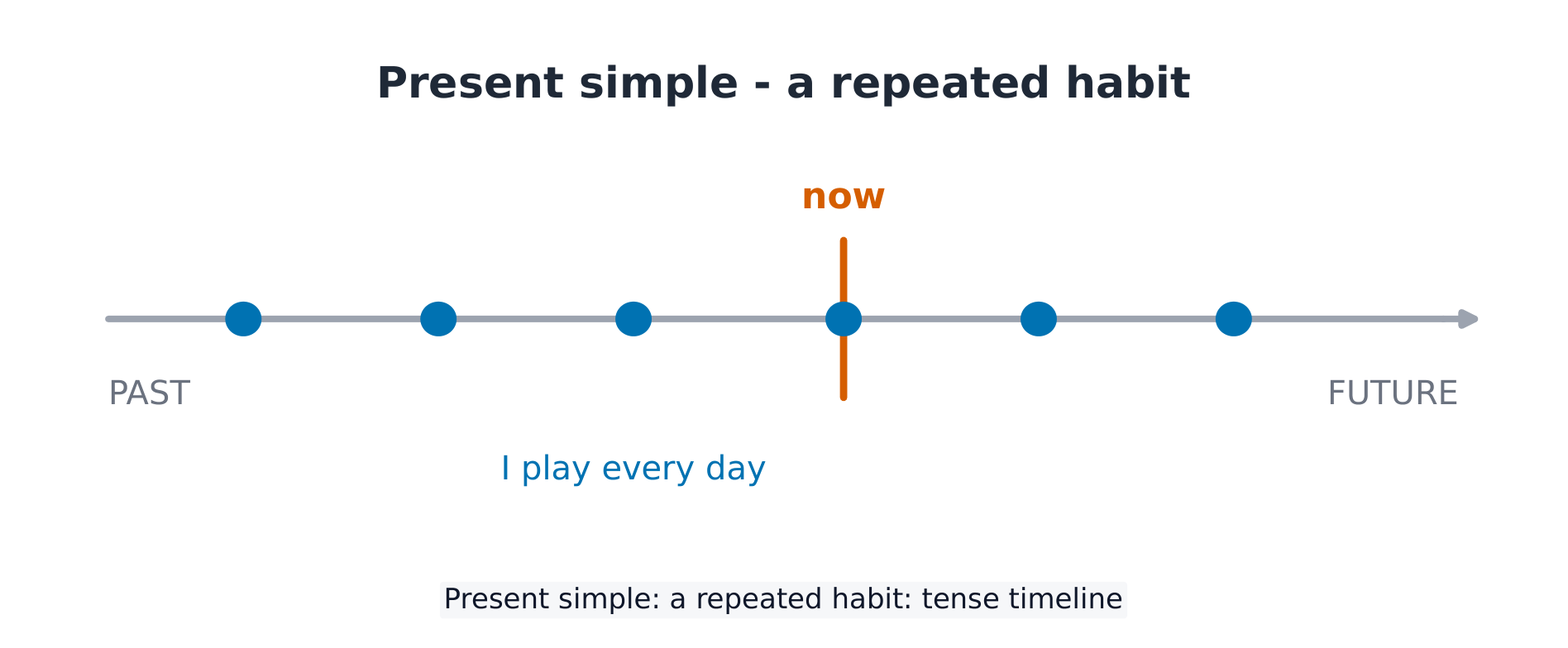
    The present simple tense is used to talk about things that happen regularly and facts that are always true: daily habits, schedules, scientific facts.

    Structure: 主语 + 动词原形

    我I 喝drink 咖啡coffee 每every 早上morning.

    I drink coffee every morning.

    我们We 住live 在in 上海Shanghai.

    We live in Shanghai.

    Scientific facts also use the present simple:

    水Water 沸腾boils 在at 一one 百hundred 度degrees.

    Water boils at one hundred degrees Celsius.

    It is often used with adverbs of frequency: always, usually, often, sometimes, never.

    她She 总是always 乘坐takes (冠词)the 公交车bus.

    She always takes the bus.

    Note

    • When talking about current habits, do not add a be verb: ~~I am drink coffee~~ ✗ → I drink coffee ✓.
    • Adverbs of frequency usually go before the main verb, but after the be verb: She is often late.
    ไทย
    一般现在时:反复的习惯

    Present Simple ใช้สำหรับพูดถึงสิ่งที่เกิดขึ้นบ่อยๆและข้อเท็จจริงที่ยังเป็นจริงเสมอ: عاداتประจำวัน, ตารางเวลา, ความรู้พื้นฐานทางวิทยาศาสตร์

    结构: 主语 + 动词原形

    我I 喝drink 咖啡coffee 每every 早上morning.

    我每天早上喝咖啡。

    我们We 住live 在in 上海Shanghai.

    我们住在上海。

    科学事实也用一般现在时:

    水Water 沸腾boils 在at 一one 百hundred 度degrees.

    水在一百度时沸腾。

    มักใช้ร่วมกับคำกริยาบอกความถี่ (adverbs of frequency): always(เสมอ), usually(โดยทั่วไป), often(บ่อยครั้ง), sometimes(บางครั้ง), never(ไม่เคย)

    她She 总是always 乘坐takes (冠词)the 公交车bus.

    她总是乘公交车。

    注意

    • เวลาพูดถึงนิสัยในปัจจุบัน, ห้ามใส่ to be: ~~I am drink coffee~~ ✗ → I drink coffee ✓
    • คำกริยาบอกความถี่มักจะอยู่ก่อนกริยาหลัก, แต่จะอยู่หลัง กริยา be: She is often late.(เธอมาสายบ่อยครั้ง)
    1.2

    Third person singular -s (Third person -s)

    English

    When the subject is he / she / it (third person singular), the verb takes -s or -es.

    Structure: He / She / It + 动词 + -s

    他He 工作works 在in 一家a 银行bank.

    He works at a bank.

    我的My 姐姐sister 喜欢likes 音乐music.

    My sister likes music.

    Spelling rules:

    • Generally add -s directly: work → works, play → plays.
    • Ends in -s / -sh / -ch / -x / -o, add -es: watch → watches, go → goes.
    • Consonant letter + -y ending, change y to i and add -es: study → studies, fly → flies.

    她She 看watches 电视TV 在at 晚上night.

    She watches TV at night.

    Note

    • Only he / she / it takes -s; I / you / we / they do not take it: ~~They likes~~ ✗ → They like ✓.
    • have is special: he / she / it uses has (not ~~haves~~).
    ไทย

    เมื่อ主语เป็น he / she / it(third person singular) กริยาต้องเพิ่ม -s หรือ -es

    结构: He / She / It + 动词 + -s

    他He 工作works 在in 一家a 银行bank.

    他在一家银行工作。

    我的My 姐姐sister 喜欢likes 音乐music.

    我姐姐喜欢音乐。

    拼写规则:

    • โดยทั่วไปเพิ่ม -s ได้เลย: work → works, play → plays
    • ลงท้ายด้วย -s / -sh / -ch / -x / -o เพิ่ม -es: watch → watches, go → goes
    • ลงท้ายด้วยพยัญชนะ + -y เปลี่ยน y เป็น i แล้วเพิ่ม -es: study → studies, fly → flies

    她She 看watches 电视TV 在at 晚上night.

    她晚上看电视。

    注意

    • มีเพียง he / she / it ที่เพิ่ม -s; I / you / we / they ไม่เพิ่ม: ~~They likes~~ ✗ → They like ✓
    • have ค่อนข้างพิเศษ: he / she / it ใช้ has(ไม่ใช่ ~~haves~~)
    1.3

    Negatives & questions (การปฏิเสธและคำถาม)

    English

    For negative and interrogative forms in the Present Simple, use the auxiliary verb do / does. Use does for he / she / it, and do for other subjects.

    Negative structure: 主语 + don't / doesn't + 动词原形

    我I 不don't 吃eat 肉meat.

    I don't eat meat.

    他He 不doesn't 喜欢like 咖啡coffee.

    He doesn't like coffee.

    Interrogative structure: Do / Does + 主语 + 动词原形 ?

    (助动词)Do 你you 说speak 英语English?

    Do you speak English?

    (助动词)Does 她she 工作work 这里here?

    Does she work here?

    Short answers: Yes, I do. / No, he doesn't.

    Note

    • After using do / does, the verb returns to its base form (no longer adds -s): ~~He doesn't likes~~ ✗ → He doesn't like ✓.
    • Don't forget the auxiliary verb: in formal contexts say Do you…?, not just ~~You speak English?~~.

    Common Errors

    • ❌ ~~She don't like it.~~ → ✓ She doesn't like it. — For third-person singular negatives, use doesn't, not don't.
    • ❌ ~~Does he has a car?~~ → ✓ Does he have a car? — When using does, even has reverts to the base form have.
    • ❌ ~~Everyone know the answer.~~ → ✓ Everyone knows the answer. — everyone / everybody / nobody are treated as singular, so add -s to the verb.
    • ❌ ~~I am usually going to school by bike.~~ → ✓ I usually go to school by bike. — Repeated habits use the Present Simple, not the continuous tense.
    ไทย

    การปฏิเสธและคำถามใน Present Simple ต้องใช้ตัวช่วย do / does. he / she / it ใช้ does,主语อื่นใช้ do

    否定结构: 主语 + don't / doesn't + 动词原形

    我I 不don't 吃eat 肉meat.

    我不吃肉。

    他He 不doesn't 喜欢like 咖啡coffee.

    他不喜欢咖啡。

    疑问结构: Do / Does + 主语 + 动词原形 ?

    (助动词)Do 你you 说speak 英语English?

    你会说英语吗?

    (助动词)Does 她she 工作work 这里here?

    她在这里工作吗?

    คำตอบสั้น: Yes, I do. / No, he doesn't.

    注意

    • หลังใช้ do / does, กริยาจะกลับสู่รูปต้นแบบ(ไม่เพิ่ม -s): ~~He doesn't likes~~ ✗ → He doesn't like ✓
    • อย่าลืมตัวช่วย: ในสถานการณ์ที่เป็นทางการต้องพูด Do you…?, ห้ามพูดแค่ ~~You speak English?~~

    ข้อผิดพลาดที่พบบ่อย

    • ~~She don't like it.~~ → ✓ She doesn't like it. — การปฏิเสธของ third person singular ใช้ doesn't ไม่ใช่ don't
    • ❌ ~~Does he has a car?~~ → ✓ Does he have a car? — หลังใช้ does, has ก็ต้องเปลี่ยนเป็นรูปต้นแบบ have
    • ❌ ~~Everyone know the answer.~~ → ✓ Everyone knows the answer. — everyone / everybody / nobody จัดเป็นเอกพจน์, กริยาเติม -s
    • ❌ ~~I am usually going to school by bike.~~ → ✓ I usually go to school by bike. — นิสัยซ้ำซ้อนใช้ Present Simple, ไม่ต้องใช้ Continuous
  • 2 Present continuous
    2.1

    Structure (be + V-ing)

    English

    The Present Continuous tense describes actions that are happening right now.

    Structure: 主语 + am / is / are + 动词-ing(I → am; he / she / it → is; you / we / they → are)

    我I 正在am 读reading 一本a 书book.

    I am reading a book.

    他们They 正在are 踢playing 足球football.

    They are playing football.

    Spelling of -ing:

    • Generally add -ing directly: read → reading.
    • End in silent -e, drop e and add -ing: make → making, write → writing.
    • Stressed closed syllable (consonant + vowel + consonant), double the final consonant: run → running, sit → sitting.

    她She 正在is 写writing 一封an 电子邮件email.

    She is writing an email.

    Note

    • Don't forget the be verb: ~~I reading~~ ✗ → I am reading ✓.
    • State verbs (like, know, want, have = possess) generally do not use the continuous tense: ~~I am knowing~~ ✗ → I know ✓.
    ไทย
    She is reading a book — an action happening right now.

    Present Continuous แสดงถึงการกระทำที่กำลังเกิดขึ้น ณ ปัจจุบัน

    โครงสร้าง: 主语 + am / is / are + 动词-ing(I → am; he / she / it → is; you / we / they → are)

    我I 正在am 读reading 一本a 书book.

    我正在读一本书。

    他们They 正在are 踢playing 足球football.

    他们正在踢足球。

    การสะกด -ing:

    • โดยทั่วไปเพิ่ม -ing ได้เลย: read → reading
    • ลงท้ายด้วย -e ที่ไม่ออกเสียง, ลบ e แล้วเพิ่ม -ing: make → making, write → writing
    • Closed syllable ที่เน้นเสียง(พยัญชนะ +元音+พยัญชนะ), เขียนซ้ำพยัญชนะสุดท้าย: run → running, sit → sitting

    她She 正在is 写writing 一封an 电子邮件email.

    她正在写一封电子邮件。

    注意

    • อย่าลืม to be: ~~I reading~~ ✗ → I am reading ✓
    • State verbs (like, know, want, have = มี) ส่วนใหญ่ไม่ใช้ Continuous: ~~I am knowing~~ ✗ → I know ✓
    2.2

    Present Continuous vs Present Simple

    English

    Both tenses relate to "now," but their meanings differ:

    • Present Simple: Habits or repeated actions.
    • Present Continuous: Actions happening at this very moment.

    他He 通常usually 步行walks 去to 上班work.

    He usually walks to work. (Habit → Present Simple)

    今天Today 他he 正在is 乘坐taking (冠词)the 公交车bus.

    He is taking the bus today. (Right now → Present Continuous)

    Time expressions help distinguish them:

    • Present Simple: every day, usually, often, always.
    • Present Continuous: now, right now, at the moment, today.

    Note

    • Temporary situations use the continuous tense: She is living with her aunt this month. (She is temporarily staying with her aunt this month.)
    • Long-term facts use the Present Simple: She lives in Beijing. (She lives in Beijing.)

    Common Errors

    • ❌ ~~They are play football now.~~ → ✓ They are playing football now. — With be, the verb must also take -ing; both elements are required.
    • ❌ ~~She is cooking every day.~~ → ✓ She cooks every day. — every day signals a habit, so use the Present Simple.
    • ❌ ~~Where is Tom? — He plays football.~~ → ✓ He is playing football. — To answer "what is he doing right now?", use the continuous tense.
    • ❌ ~~He is writeing a letter.~~ → ✓ He is writing a letter. — Verbs ending in a silent -e drop the e before adding -ing.
    ไทย

    两个时态都和“现在”有关,但意思不同:

    • 一般现在时:习惯、反复发生的事。
    • 现在进行时:此刻正在做的事。

    他He 通常usually 步行walks 去to 上班work.

    他通常步行上班。(习惯 → 一般现在时)

    今天Today 他he 正在is 乘坐taking (冠词)the 公交车bus.

    今天他在坐公交车。(此刻 → 现在进行时)

    时间词帮你判断:

    • Present Simple: every day, usually, often, always
    • Present Continuous: now, right now, at the moment, today

    注意

    • สถานการณ์ชั่วคราวใช้ Continuous: She is living with her aunt this month.(เดือนนี้เธอกำลังพักอยู่ที่บ้าน pnl ชั่วคราว)
    • ข้อเท็จจริงระยะยาวใช้ Present Simple: She lives in Beijing.(เธออาศัยอยู่ในปักกิ่ง)

    ข้อผิดพลาดที่พบบ่อย

    • ❌ ~~They are play football now.~~ → ✓ They are playing football now. —后有 to be, กริยาต้องเพิ่ม -ing, ทั้งสองอย่างขาดไม่ได้
    • ❌ ~~She is cooking every day.~~ → ✓ She cooks every day. — every day เป็นสัญญาณของนิสัย, ใช้ Present Simple
    • ❌ ~~Where is Tom? — He plays football.~~ → ✓ He is playing football. — ตอบคำถาม "กำลังทำอะไรตอนนี้" ต้องใช้ Continuous
    • ❌ ~~He is writeing a letter.~~ → ✓ He is writing a letter. — กริยาที่ลงท้ายด้วย -e ที่ไม่ออกเสียง, ลบ e แล้วเพิ่ม -ing
  • 3 Past simple
    3.1

    Regular verbs (-ed)

    English

    The Past Simple tense describes actions or states that were completed in the past. Regular verbs add -ed to the end.

    Structure: 主语 + 动词-ed(same for all persons)

    我I 看watched 一部a 电影film 昨天yesterday.

    I watched a movie yesterday.

    我们We 打played 篮球basketball 上last 周week.

    We played basketball last week.

    Spelling of -ed:

    • Generally add -ed directly: work → worked, play → played.
    • End in -e, only add -d: like → liked, live → lived.
    • Consonant + -y ending, change y to i and add -ed: study → studied, try → tried.
    • Stressed closed syllable, double the final consonant: stop → stopped, plan → planned.

    Note

    • The past tense form does not change based on person: I worked, she worked (no -s).
    • Often used with past time markers: yesterday, last week, in 2019, two days ago.
    ไทย
    一般过去时:已结束的动作

    กาลอดีตธรรมดา (past simple) แสดงถึงการกระทำหรือสถานะในอดีตที่จบลงแล้ว กริยาปกติเติม -ed ที่ท้ายคำ

    结构: 主语 + 动词-ed(所有人称都一样)

    我I 看watched 一部a 电影film 昨天yesterday.

    我昨天看了一部电影。

    我们We 打played 篮球basketball 上last 周week.

    我们上周打了篮球。

    การสะกด -ed:

    • เติม -ed โดยตรง: work → worked, play → played
    • ลงท้ายด้วย -e เติมเพียง -d: like → liked, live → lived
    • ลงท้ายด้วยพยัญชนะ + -y เปลี่ยน y เป็น i แล้วเติม -ed: study → studied, try → tried
    • พยางค์ปิดที่มีเสียงหนักแน่น写出末尾辅音双写最后一个辅音字母: stop → stopped, plan → planned

    注意

    • รูปแบบกริยาในกาลอดีตไม่เปลี่ยนตามบุคคล: I worked, she worked (ไม่มี -s)
    • มักใช้ร่วมกับคำบอกเวลาในอดีต: yesterday, last week, in 2019, two days ago
    3.2

    不规则动词

    English

    Many common verbs are irregular; their past forms must be memorized individually without adding -ed.

    我I 去went (介词)to 北京Beijing 上last 月month.

    I went to Beijing last month.

    她She 看见saw 她的her 朋友friends.

    She met her friend.

    High-frequency irregular verbs you must memorize:

    • go → went, have → had, do → did, make → made.
    • see → saw, come → came, get → got, take → took.
    • eat → ate, buy → bought, think → thought, say → said.

    我们We (吃了)had 一顿a 丰盛的big 晚餐dinner.

    We had a big dinner.

    Note these follow no pattern; practice reading and memorizing them frequently.

    ไทย

    กริยาหลายคำเป็นกริยาไม่ปกติ ต้องจำรูป过去式 แยกต่างหาก ไม่เติม -ed

    我I 去went (介词)to 北京Beijing 上last 月month.

    我上个月去了北京。

    她She 看见saw 她的her 朋友friends.

    她见到了她的朋友。

    一定要背的高频不规则动词:

    • go → went, have → had, do → did, make → made
    • see → saw, come → came, get → got, take → took
    • eat → ate, buy → bought, think → thought, say → said

    我们We (吃了)had 一顿a 丰盛的big 晚餐dinner.

    我们吃了一顿丰盛的晚餐。

    注意 这些没有规律,只能多读多记。

    3.3

    การปฏิเสธและคำถาม (did)

    English

    For negative and interrogative forms in the Past Simple, use the auxiliary did (past form). The following verb returns to its base form.

    Negative structure: 主语 + didn't + 动词原形

    我I 没有didn't 去go (介词)to 上学school.

    I didn't go to school.

    Interrogative structure: Did + 主语 + 动词原形 ?

    (助动词)Did 你you 看见see (冠词)the 电影film?

    Did you see that movie?

    Short answers: Yes, I did. / No, I didn't.

    Note

    • After using did / didn't, the verb must be in the base form: ~~I didn't went~~ ✗ → I didn't go ✓.
    • The past tense of the be verb (was / were) does not use did: Were you tired? (Were you tired?)

    Common Errors

    • ❌ ~~I go to Beijing last month.~~ → ✓ I went to Beijing last month. — Chinese verbs do not change form, but in English, once a past time marker is present, you must switch to the past tense. This is the most common error.
    • ❌ ~~She buyed a new phone.~~ → ✓ She bought a new phone. — Irregular verbs cannot simply add -ed.
    • ❌ ~~I didn't was hungry.~~ → ✓ I wasn't hungry. — For negative sentences with the verb 'be', use wasn't / weren't directly, not didn't.
    • ❌ ~~yesterday night~~ → ✓ last night — Fixed expression: 'last night' is used for last evening, not 'yesterday night' (though 'yesterday morning/afternoon' is correct).
    ไทย

    การปฏิเสธและคำถามในกาลอดีต ใช้กริยาช่วย did (รูป过去式) กริยา后面的词กลับสู่รูปเดิม

    否定结构: 主语 + didn't + 动词原形

    我I 没有didn't 去go (介词)to 上学school.

    我没去上学。

    疑问结构: Did + 主语 + 动词原形 ?

    (助动词)Did 你you 看见see (冠词)the 电影film?

    你看那部电影了吗?

    คำตอบสั้นๆ: Yes, I did. / No, I didn't.

    注意

    • เมื่อใช้ did / didn't กริยาต้องเป็นรูปเดิม: ~~I didn't went~~ ✗ → I didn't go ✓
    • กริยา be (was / were) ในกาลอดีตไม่ต้องใช้ did: Were you tired? (คุณเหนื่อยไหม?)

    ข้อผิดพลาดที่พบบ่อย

    • ❌ ~~I go to Beijing last month.~~ → ✓ I went to Beijing last month. — กริยาไทยไม่มีการผัน แต่ภาษาอังกฤษเมื่อมีคำบอกเวลาในอดีต ต้องเปลี่ยนเป็น过去式 นี่คือนิสัยที่ผิดง่ายที่สุด
    • ❌ ~~She buyed a new phone.~~ → ✓ She bought a new phone. — กริยาไม่ปกติไม่สามารถเติม -ed ได้แบบบังคับ
    • ❌ ~~I didn't was hungry.~~ → ✓ I wasn't hungry. — การปฏิเสธของกริยา be ใช้ wasn't / weren't โดยตรง ไม่ต้องใช้ didn't
    • ❌ ~~yesterday night~~ → ✓ last night — คำพูดตายตัว: เมื่อคืนคือ last night ไม่ใช่ yesterday night (แต่ yesterday morning / afternoon ถูกต้อง)
  • 4 Past continuous
    4.1

    โครงสร้าง (was / were + V-ing)

    English

    The past continuous tense describes an action in progress at a specific moment in the past.

    Structure: 主语 + was / were + 动词-ing(I / he / she / it → was; you / we / they → were)

    在At 八点eight 我I (过去进行)was 做饭cooking.

    I was cooking at eight o'clock.

    他们They (过去进行)were 看watching 电视TV.

    They were watching TV at that time.

    Note

    • Don't mix up was and were: Use was for I / he / she / it; use were for you / we / they.
    • Negative: wasn't / weren't + V-ing. Question: Was / Were + subject + V-ing?
    ไทย
    过去进行时:was / were + V-ing

    กาลอดีตต่อเนื่อง (past continuous) แสดงถึงการกระทำที่กำลังดำเนินอยู่ในช่วงเวลาหนึ่งในอดีต

    โครงสร้าง: 主语 + was / were + 动词-ing(I / he / she / it → was; you / we / they → were)

    在At 八点eight 我I (过去进行)was 做饭cooking.

    八点的时候我正在做饭。

    他们They (过去进行)were 看watching 电视TV.

    他们当时正在看电视。

    注意

    • อย่าสับสนระหว่าง was และ were: I / he / she / it ใช้ was; you / we / they ใช้ were
    • การปฏิเสธ: wasn't / weren't + V-ing การคำถาม: Was / Were + ประธาน + V-ing?
    4.2

    when กับ while

    English

    The past continuous is often used with the simple past to describe "an ongoing action interrupted by another event".

    • while + past continuous (the longer background action).
    • when + simple past (the sudden, short action).

    当...时While 我I (过去进行)was 睡觉sleeping (冠词), the 电话phone 响了rang.

    The phone rang while I was sleeping.

    她She (过去进行)was 做饭cooking 当...时when 我I 到达arrived.

    When I arrived, she was cooking.

    Compare the two tenses:

    • The ongoing background action → Past continuous (was cooking).
    • The short action that interrupts it → Simple past (arrived).

    Note

    • Two long actions happening simultaneously both use the past continuous: While I was reading, she was writing (I was reading, and she was writing).
    • 'when' can also be followed by the past continuous, but the meaning changes. Beginners should first memorize the common collocations mentioned above.

    Common Errors

    • ❌ ~~I was watch TV when he called.~~ → ✓ I was watching TV when he called. — After was / were, you must use the -ing form.
    • ❌ ~~They was playing games.~~ → ✓ They were playing games. — Use were for you / we / they.
    • ❌ ~~When I was arriving, she was cooking.~~ → ✓ When I arrived, she was cooking. — Arriving is a brief, instantaneous action, so use the simple past; only the longer background action uses the continuous form.
    • ❌ ~~I was knowing the answer.~~ → ✓ I knew the answer. — Stative verbs (know, like, want) are also generally not used in the continuous form in the past tense.
    ไทย

    过去进行时常和一般过去时一起用,描述“一件事发生时,另一件正在进行”。

    • while + กาลอดีตต่อเนื่อง(การกระทำพื้นหลังที่ยาวนาน)
    • when + กาลอดีตธรรมดา(การกระทำสั้นๆ ที่เกิดขึ้นอย่างฉับพลัน)

    当...时While 我I (过去进行)was 睡觉sleeping (冠词), the 电话phone 响了rang.

    我睡觉的时候,电话响了。

    她She (过去进行)was 做饭cooking 当...时when 我I 到达arrived.

    我到的时候她正在做饭。

    对比两个时态:

    • การกระทำพื้นหลังที่กำลังดำเนินอยู่ → กาลอดีตต่อเนื่อง (was cooking)
    • การกระทำสั้นๆ ที่ขัดจังหวะ → กาลอดีตธรรมดา (arrived)

    注意

    • การกระทำยาวสองอย่าง happening พร้อมกัน ใช้ทั้งสองอย่างกับ过去时: While I was reading, she was writing. (ฉันกำลังอ่านหนังสือ เธอเขียนอยู่)
    • after when ก็สามารถต่อด้วย过去时ได้ แต่ความหมายจะเปลี่ยนไป สำหรับผู้เริ่มต้นให้จดจำคู่ที่พบบ่อยข้างต้นก่อน

    ข้อผิดพลาดที่พบบ่อย

    • ❌ ~~I was watch TV when he called.~~ → ✓ I was watching TV when he called. — หลัง was / were ต้องเป็นรูปแบบ -ing เท่านั้น
    • ❌ ~~They was playing games.~~ → ✓ They were playing games. — you / we / they ใช้ were
    • ❌ ~~When I was arriving, she was cooking.~~ → ✓ When I arrived, she was cooking. — การมาถึงเป็นการกระทำสั้นๆ ในชั่วขณะ ใช้过去ธรรมดา; การกระทำพื้นหลังที่ยาวจึงใช้ continuous
    • ❌ ~~I was knowing the answer.~~ → ✓ I knew the answer. — กริยาแสดงสถานะ (know, like, want) ใน过去时也不能用连续体
  • 5 Present perfect
    5.1

    โครงสร้าง (have / has + 过去分词)

    English

    The present perfect tense connects the past and the present: a past action has an effect on the present now, or it refers to life experience.

    Structure: 主语 + have / has + 过去分词(he / she / it → has)

    我I (完成时)have 完成finished 我的my 作业homework.

    I have finished my homework. (So I am free now)

    她She (完成时)has 丢失lost 她的her 钥匙keys.

    She has lost her keys. (She hasn't found them yet)

    Past Participle:

    • Regular verbs = -ed: work → worked, finish → finished.
    • Irregular verbs must be memorized: go → gone, see → seen, do → done, be → been, eat → eaten.

    Note: Present perfect usually does not specify exact times. If you mention a specific past time (yesterday, in 2019), use the simple past instead.

    ไทย
    现在完成时:连接过去与现在

    กาลปัจจุบันสมบูรณ์ (present perfect) เชื่อมโยงอดีตกับปัจจุบัน: สิ่งที่เคยทำในอดีต มีผลต่อปัจจุบัน หรือเป็นประสบการณ์

    โครงสร้าง: 主语 + have / has + 过去分词(he / she / it → has)

    我I (完成时)have 完成finished 我的my 作业homework.

    我已经做完作业了。(所以现在我有空)

    她She (完成时)has 丢失lost 她的her 钥匙keys.

    她把钥匙弄丢了。(现在还没找到)

    过去分词 (past participle):

    • กริยาปกติ = -ed: work → worked, finish → finished
    • กริยาไม่ปกติต้องจำ: go → gone, see → seen, do → done, be → been, eat → eaten

    ข้อควรระวัง ในPresent Perfect มักจะไม่ระบุเวลาเฉพาะ; หากต้องการระบุเวลาในอดีตที่ชัดเจน (yesterday, in 2019) ให้ใช้过去ธรรมดา

    5.2

    ever / never / just / already / yet

    English

    These words are frequently used with the present perfect tense:

    • ever: Used in questions to mean "at any time." never: "not ever."
    • just: "just now." already: "already." yet: Used at the end of negative or interrogative sentences to mean "not yet."

    (完成时)Have 你you 曾经ever 去过been (介词)to 伦敦London?

    Have you ever been to London?

    我I (完成时)have 刚刚just 吃过eaten 午饭lunch.

    I have just had lunch.

    他He 还没hasn't 完成finished (句末"还没")yet.

    He hasn't finished yet.

    ไทย

    这几个词常和现在完成时连用:

    • ever: ในประโยคคำถามหมายถึง"เคย" never: "ไม่เคยเลย"
    • just: "เพิ่ง" already: "แล้ว" yet: ใช้ในประโยคปฏิเสธ/คำถามที่ท้ายประโยค หมายถึง"ยัง(ไม่ได้)"

    (完成时)Have 你you 曾经ever 去过been (介词)to 伦敦London?

    你去过伦敦吗?

    我I (完成时)have 刚刚just 吃过eaten 午饭lunch.

    我刚吃过午饭。

    他He 还没hasn't 完成finished (句末"还没")yet.

    他还没做完。

    5.3

    for กับ since

    English

    To say how long something has "continued," use for or since:

    • for + a period of time: for three years, for a week.
    • since + starting point: since 2020 (from the year 2020), since Monday (from Monday).

    我I (完成时)have 住lived 这里here (持续)for 五five 年years.

    I have lived here for five years. (And I still live here)

    我们We (完成时)have 认识known 彼此each other 自从since 2018年2018.

    We have known each other since 2018.

    Note: Use 'for' with duration and 'since' with a starting point; don't mix them up: ~~for 2018~~ ✗ → since 2018 ✓.

    Common Errors

    • ❌ ~~I have seen him yesterday.~~ → ✓ I saw him yesterday. — Once a specific past time is mentioned (yesterday, last week, in 2019), switch to the simple past.
    • ❌ ~~I live here for ten years.~~ → ✓ I have lived here for ten years. — "Lived here for ten years and still live here" requires the present perfect. Chinese lacks this distinction, making it easy to overlook.
    • ❌ ~~She has go home.~~ → ✓ She has gone home. — After have / has, use the past participle, not the base form.
    • ❌ ~~Have you ever went to Beijing?~~ → ✓ Have you ever been to Beijing? — Use have been to for "visited a place."
    • Distinguish gone and been: He has gone to Beijing. (He went there and hasn't returned yet) vs He has been to Beijing. (He visited there and has come back).
    ไทย

    ในการบอกว่า一件事"ดำเนินมาเท่าไหร่" ใช้ for หรือ since:

    • for + ช่วงเวลา: for three years (สามปี), for a week (หนึ่งสัปดาห์)
    • since + จุดเริ่มต้น: since 2020 (ตั้งแต่ปี 2020), since Monday (ตั้งแต่วันจันทร์)

    我I (完成时)have 住lived 这里here (持续)for 五five 年years.

    我在这里住了五年了。(现在还住着)

    我们We (完成时)have 认识known 彼此each other 自从since 2018年2018.

    我们从 2018 年就认识了。

    ข้อควรระวัง for เชื่อม"多久", since เชื่อม"从何时"; อย่าใช้ปนกัน: ~~for 2018~~ ✗ → since 2018 ✓

    ข้อผิดพลาดที่พบบ่อย

    • ❌ ~~I have seen him yesterday.~~ → ✓ I saw him yesterday. — เมื่อกล่าวถึงเวลาในอดีตที่ชัดเจน (yesterday, last week, in 2019) ให้เปลี่ยนเป็น过去ธรรมดา
    • ❌ ~~I live here for ten years.~~ → ✓ I have lived here for ten years. — "อยู่มาสิบปี ยัง住着อยู่" ต้องใช้ Present Perfect; ภาษาไทยไม่มีการแยกแยะนี้ ทำให้มักลืมได้ง่าย
    • ❌ ~~She has go home.~~ → ✓ She has gone home. — หลัง have / has คือ过去分词 ไม่ใช่รูปเดิม
    • ❌ ~~Have you ever went to Beijing?~~ → ✓ Have you ever been to Beijing? — "去过某地" ใช้ have been to
    • แยกแยะ gone กับ been: He has gone to Beijing. (ไปแล้ว คนยังไม่กลับมา) vs He has been to Beijing. (เคยไป คนกลับมาแล้ว)
  • 6 Talking about the future
    6.1

    will

    English

    will is used to talk about the future, especially spontaneous decisions, predictions, and promises.

    Structure: 主语 + will + 动词原形(Same for all persons; will not = won't)

    我I 将will 打电话call (给你)you 今晚tonight.

    I will call you tonight.

    (天气it)It 将will 下雨rain 明天tomorrow.

    It will rain tomorrow.

    Note

    • Use the base form of the verb after will: ~~will to go~~ ✗ → will go ✓.
    • Negative uses won't: I won't be late. (I will not be late.)
    ไทย
    将来:will / going to

    will ใช้พูดคุยเรื่องอนาคต โดยเฉพาะการตัดสินใจทันที, การคาดเดา และการสัญญา

    โครงสร้าง: 主语 + will + 动词原形(ทุกบุคคลเหมือนกัน; will not = won't)

    我I 将will 打电话call (给你)you 今晚tonight.

    我今晚给你打电话。

    (天气it)It 将will 下雨rain 明天tomorrow.

    明天会下雨。

    注意

    • หลัง will ใช้กริยารูปเดิม: ~~will to go~~ ✗ → will go ✓
    • การปฏิเสธใช้ won't: I won't be late. (ฉันจะไม่สาย)
    6.2

    be going to

    English

    be going to is used to talk about plans and predictions based on current evidence.

    Structure: 主语 + am / is / are + going to + 动词原形

    我们We (be)are 打算going to 拜访visit 我们的our 奶奶grandma.

    We are going to visit Grandma. (A plan already made)

    看Look (介词)at (冠词)the 云clouds (天气it)! It (be)is 将要going to 下雨rain.

    Look at those clouds! It's going to rain. (Based on current signs)

    will or going to?

    • Spontaneous decision → will: The phone is ringing. I'll get it. (Phone rings, I decide now to answer.)
    • Pre-planned intention → going to: I'm going to study tonight. (I have planned to study tonight.)
    ไทย

    be going to ใช้พูดคุยเรื่องแผนและการคาดเดาจากสถานการณ์ปัจจุบัน

    结构: 主语 + am / is / are + going to + 动词原形

    我们We (be)are 打算going to 拜访visit 我们的our 奶奶grandma.

    我们打算去看奶奶。(已有计划)

    看Look (介词)at (冠词)the 云clouds (天气it)! It (be)is 将要going to 下雨rain.

    看那些云!要下雨了。(有现状作依据)

    will หรือ going to?

    • ตัดสินใจทันที → will: The phone is ringing. I'll get it. (โทรศัพท์ดัง ฉันไปรับให้)
    • วางแผนไว้ล่วงหน้า → going to: I'm going to study tonight. (ฉันตั้งใจจะเรียนคืนนี้)
    6.3

    现在进行时表将来计划

    English

    The present continuous can also express scheduled future events (especially when there is a definite time or place).

    Structure: 主语 + am / is / are + 动词-ing + 将来时间

    我I (be)am 见面meeting 汤姆Tom 明天tomorrow.

    I am meeting Tom tomorrow. (An appointment has been set)

    我们We (be)are 飞flying 去to 东京Tokyo 在on 周五Friday.

    We are flying to Tokyo on Friday. (Tickets are booked)

    Note: This usage emphasizes that something is "already arranged," which is similar to 'be going to'; the key factor is having a definite future time.

    Common Errors

    • ❌ ~~I go to Shanghai tomorrow.~~ → ✓ I am going to Shanghai tomorrow. / I will go… — The Chinese "I go to Shanghai tomorrow" lacks a future marker; English requires adding (will / going to / present continuous).
    • ❌ ~~We will going to visit grandma.~~ → ✓ We are going to visit… / We will visit… — will and be going to are separate structures and cannot be combined.
    • ❌ ~~She will comes tomorrow.~~ → ✓ She will come tomorrow. — After will, use the base form of the verb; no -s is added for any person.
    • Exception: Timetables (trains, flights, classes) can use the simple present to express the future: The train leaves at 9. (The train leaves at nine o'clock.)
    ไทย

    现在进行时也能表示已经安排好的将来(尤其有明确时间 / 地点时)。

    结构: 主语 + am / is / are + 动词-ing + 将来时间

    我I (be)am 见面meeting 汤姆Tom 明天tomorrow.

    我明天要见汤姆。(已约好)

    我们We (be)are 飞flying 去to 东京Tokyo 在on 周五Friday.

    我们周五飞东京。(机票已订)

    ข้อควรระวัง การใช้แบบนี้จะเน้นว่า "จัดเตรียมไว้แล้ว" ซึ่งใกล้เคียงกับ be going to มาก; จุดสำคัญคือมีเวลาในอนาคตที่แน่นอน

    ข้อผิดพลาดที่พบบ่อย

    • ❌ ~~I go to Shanghai tomorrow.~~ → ✓ I am going to Shanghai tomorrow. / I will go… — คำว่า "ฉันไปเซี่ยงไฮ้พรุ่งนี้" ในภาษาจีนไม่มีคำบอกอนาคต แต่ภาษาอังกฤษต้องเพิ่ม (will / going to / present continuous)
    • ❌ ~~We will going to visit grandma.~~ → ✓ We are going to visit… / We will visit… — will และ be going to เป็นโครงสร้างคนละชุด ไม่สามารถนำมาซ้อนกันได้
    • ❌ ~~She will comes tomorrow.~~ → ✓ She will come tomorrow. — หลัง will ต้องใช้กริยาต้นฉบับ ไม่มีใคร-person ที่เติม -s
    • ข้อยกเว้น: ตารางเวลา(รถไฟ, เที่ยวบิน, บทเรียน)สามารถใช้ Present Simple บอกอนาคตได้:The train leaves at 9.(รถไฟออกเวลา ๙ โมง)*
  • 7 Comparatives and superlatives
    7.1

    เปรียบเทียบ (Comparatives)

    English

    Comparatives are used to compare two things, often used with than (compared to).

    Short adjectives + -er; long adjectives use more + adjective.

    我的My 包bag 是is 更大bigger 比than 你的yours.

    My bag is bigger than yours.

    这This 书book 是is 更more 有趣interesting 比than 那本that one.

    This book is more interesting than that one.

    Formation Rules:

    • Monosyllabic: add -er → tall → taller, fast → faster.
    • Ending in consonant + y: change y to i and add -er → happy → happier, easy → easier.
    • Two or more syllables: use more → expensive → more expensive.
    • Irregular: good → better, bad → worse, far → further.

    Note: Avoid "double comparison": ~~more bigger~~ ✗ → bigger ✓.

    ไทย
    比较级 → 最高级

    ใช้เปรียบเทียบสองสิ่ง, มักใช้คู่กับ than (กว่า/มากกว่า)

    ** adjective สั้น** + -er; adjective ยาว ใช้ more + adjective

    我的My 包bag 是is 更大bigger 比than 你的yours.

    我的包比你的大。

    这This 书book 是is 更more 有趣interesting 比than 那本that one.

    这本书比那本有趣。

    构成规则:

    • คำศัพท์หนึ่งพยางค์: เพิ่ม -er → tall → taller, fast → faster
    • ลงท้ายด้วย Accessibility consonant + y: เปลี่ยน y เป็น i แล้วเพิ่ม -er → happy → happier, easy → easier
    • สองพยางค์ขึ้นไป: ใช้ more → expensive → more expensive
    • ไม่เป็นระเบียบ: good → better, bad → worse, far → further

    ข้อควรระวัง อย่าทำ "การเปรียบเทียบซ้ำ": ~~more bigger~~ ✗ → bigger ✓

    7.2

    สูงสุด (Superlatives)

    English

    Superlatives indicate "the most …" (three or more), preceded by the.

    Short adjectives + -est; long adjectives use the most + adjective.

    他He 是is (冠词)the 最高tallest 在in (冠词)the 班级class.

    He is the tallest in the class.

    这This 是is (冠词)the 最most 贵expensive 手机phone.

    This is the most expensive phone.

    Formation Rules:

    • Monosyllabic: the + -est → fast → the fastest.
    • Long adjectives: the most → the most beautiful.
    • Irregular: good → the best, bad → the worst.

    Note: Do not forget the before superlatives: ~~he is tallest~~ → he is the tallest.

    ไทย

    ใช้บอก "ที่สุด……" (สามสิ่งขึ้นไป), นำหน้าด้วย the

    ** adjective สั้น** + -est; adjective ยาว ใช้ the most + adjective

    他He 是is (冠词)the 最高tallest 在in (冠词)the 班级class.

    他是班里最高的。

    这This 是is (冠词)the 最most 贵expensive 手机phone.

    这是最贵的手机。

    构成规则:

    • คำศัพท์หนึ่งพยางค์: the + -est → fast → the fastest
    • adjective ยาว: the most → the most beautiful
    • ไม่เป็นระเบียบ: good → the best, bad → the worst

    ข้อควรระวัง หน้า superlative อย่าลืมใส่ the: ~~he is tallest~~ → he is the tallest

    7.3

    as ... as

    English

    as + adjective + as means "as … as …".

    她She 是is 和as 高tall 一样as 她her 妈妈mother.

    She is as tall as her mother.

    Negative not as ... as means "not as … as …":

    今天Today (是)is 不not 像as 热hot 一样as 昨天yesterday.

    It is not as hot today as yesterday.

    Note: Place the base form of the adjective (not the comparative) in the middle: ~~as taller as~~ ✗ → as tall as ✓.

    Common Errors

    • ❌ ~~It is more cheap.~~ → ✓ It is cheaper. — Use -er for monosyllabic adjectives, not more.
    • ❌ ~~He is taller than me a lot.~~ → ✓ He is much taller than me. — "A lot" translates to much, which goes before the comparative.
    • ❌ ~~My bag is bigger than your.~~ → ✓ …bigger than yours. — Use yours / mine / hers (nominal possessive pronouns) after than.
    • ❌ ~~Beijing is bigger than any city in China.~~ → ✓ …than any other city in China. — Do not forget other, otherwise it implies comparing itself to itself.
    ไทย

    as + adjective + as หมายความว่า "เท่ากับ……อย่าง……"

    她She 是is 和as 高tall 一样as 她her 妈妈mother.

    她和她妈妈一样高。

    การปฏิเสธ not as ... as หมายความว่า "不如……":

    今天Today (是)is 不not 像as 热hot 一样as 昨天yesterday.

    今天没有昨天热。

    ข้อควรระวัง กลางคั่นด้วยadjective ต้นฉบับ(ไม่ใช่ comparative): ~~as taller as~~ ✗ → as tall as ✓

    ข้อผิดพลาดที่พบบ่อย

    • ❌ ~~It is more cheap.~~ → ✓ It is cheaper. — adjective หนึ่งพยางค์ใช้ -er, ไม่ต้องใช้ more
    • ❌ ~~He is taller than me a lot.~~ → ✓ He is much taller than me. — คำว่า "มาก" ของ "สูงกว่ามาก" คือ much, วางอยู่หน้า comparative ด้านหน้า
    • ❌ ~~My bag is bigger than your.~~ → ✓ …bigger than yours. — หลัง than ใช้ yours / mine / hers (Possessive pronoun)
    • ❌ ~~Beijing is bigger than any city in China.~~ → ✓ …than any other city in China. — อย่าลืม other, มิฉะนั้นจะกลายเป็น "เปรียบเทียบกับตัวเอง"
  • 8 Articles
    8.1

    a / an

    English

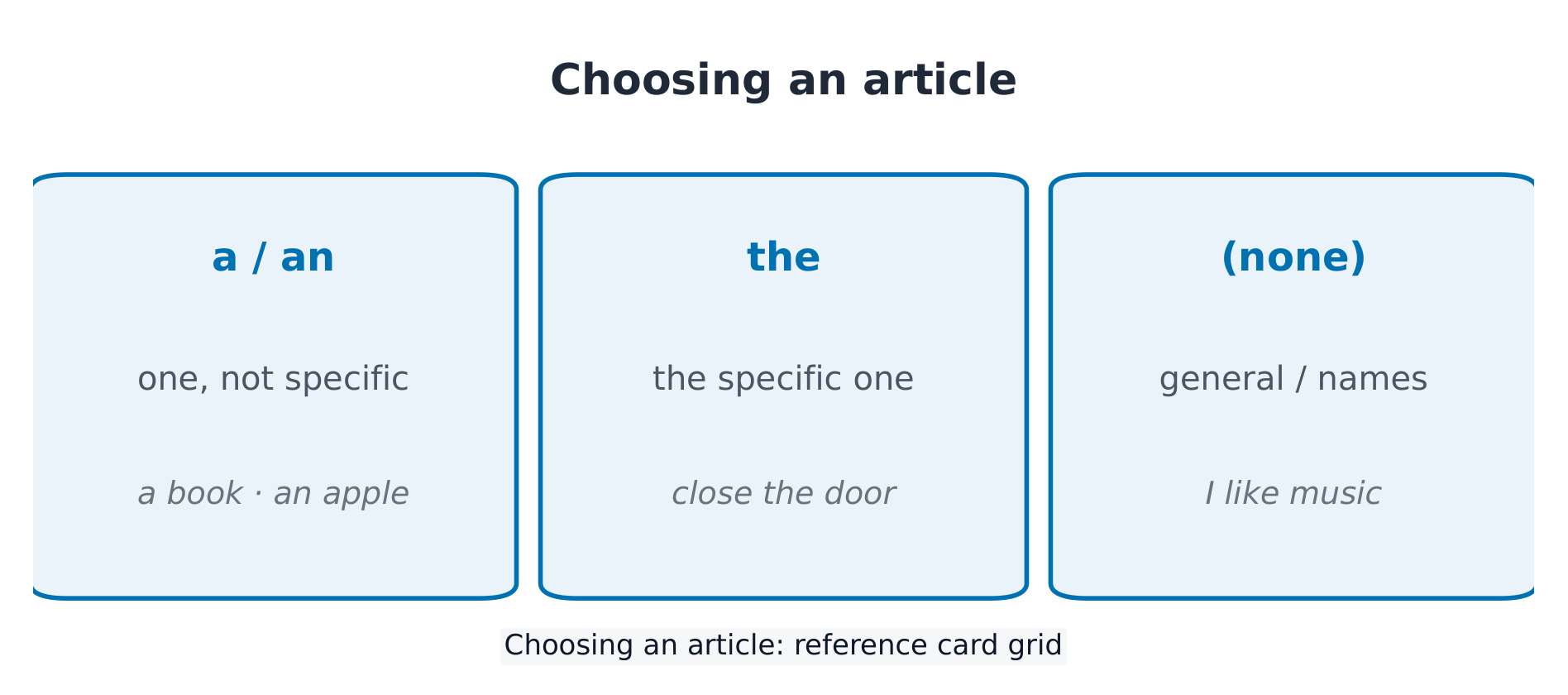
    a and an are indefinite articles, used before singular countable nouns to mean "one (non-specific)".

    • a is used before consonant sounds: a book, a car, a university (pronounced /j/ sound).
    • an is used before vowel sounds: an apple, an hour (h is silent).

    我I 有have 一个a 问题question.

    I have a question.

    她She 是is 一名an 工程师engineer.

    She is an engineer.

    Note: Look at the pronunciation, not the letter: an hour (h is silent → an), a university (pronounced /j/ → a).

    ไทย
    เลือก Article:a/an · the · Zero article

    a และ an เป็น Indefinite article, วางหน้าCountable noun แบบเอกพจน์, หมายความว่า "หนึ่ง(ไม่เฉพาะเจาะจง)"

    • a วางหน้าเสียง Accessibility consonant: a book, a car, a university (อ่านเป็น /j/)
    • an วางหน้าเสียง Vowel: an apple, an hour (h อ่านไม่ได้)

    我I 有have 一个a 问题question.

    我有一个问题。

    她She 是is 一名an 工程师engineer.

    她是一名工程师。

    ข้อควรระวัง ดูที่การออกเสียง ไม่ใช่ตัวอักษร: an hour (h อ่านไม่ได้ → an), a university (อ่านเป็น /j/ → a)

    8.2

    the

    English

    the is the definite article, indicating specificity — both speaker and listener know exactly which one.

    请Please 关close (这扇)the 门door.

    Please close (this) door.

    Common uses of the:

    • When mentioned previously or referred to again: I saw a cat. The cat was black. (I saw a cat. That cat was black.)
    • For unique things in the world: the sun, the moon.
    • Before superlatives: the best, the tallest.

    (那个)The 太阳sun 是is 非常very 明亮bright 今天today.

    The sun is very bright today.

    ไทย

    the เป็น Definite article, หมายความว่าเฉพาะเจาะจง—ผู้พูดและผู้ฟังรู้ว่าหมายถึงอะไร

    请Please 关close (这扇)the 门door.

    请关上(这扇)门。

    สถานการณ์ที่ใช้ the บ่อยๆ:

    • กล่าวถึงก่อนหน้าแล้ว, กล่าวถึงอีกครั้ง: I saw a cat. The cat was black. (ฉันเห็นแมวหนึ่งตัว, แมวนั้นสีดำ)
    • สิ่งเดียวในโลก: the sun (ดวงอาทิตย์), the moon (ดวงจันทร์)
    • หน้า Superlative: the best, the tallest

    (那个)The 太阳sun 是is 非常very 明亮bright 今天today.

    今天太阳很亮。

    8.3

    Zero article (Zero article)

    English

    Sometimes no article (zero article) is placed before a noun:

    • Plural / uncountable nouns expressing generalization: I like music. (I like music.) Cats are cute. (Cats are cute.)
    • Proper nouns: names, most countries, cities: China, Tom, Beijing.
    • Some fixed phrases: go to school / bed / work (indicating purpose, without the).

    我I 去go (介词)to 上学school 乘by 自行车bike.

    I go to school by bike.

    水Water 是is 重要important.

    Water is important.

    Note: Do not use the when plural / uncountable nouns express generalization: ~~I like the music~~ (general sense) ✗ → I like music ✓.

    Common Errors

    • ❌ ~~I want to be teacher.~~ → ✓ I want to be a teacher. — Add a / an before professions; direct translation of Chinese "to be a teacher" often omits this.
    • ❌ ~~I went to home.~~ → ✓ I went home. — home is used as an adverb here: go home, get home; do not use to or the before it.
    • ❌ ~~He plays the football.~~ → ✓ He plays football. — No the before sports; but add the for instruments: play the piano / violin.
    • Distinguish: go to school (attend school, purpose) vs go to the school (go to the school building, e.g., parents attending a meeting). Same logic applies to bed / hospital / work.
    ไทย

    有时名词前不加冠词(零冠词):

    • Plural / Uncountable nouns บอกความหมายทั่วไป: I like music. (ฉันชอบดนตรี) Cats are cute. (แมวน่ารัก)
    • Proper nouns: ชื่อคน, ประเทศส่วนใหญ่, เมือง: China, Tom, Beijing
    • สำนวนที่ติดกันบางกลุ่ม: go to school / bed / work(สื่อถึงจุดประสงค์, ไม่ใส่ the)

    我I 去go (介词)to 上学school 乘by 自行车bike.

    我骑自行车上学。

    水Water 是is 重要important.

    水很重要。

    ข้อควรระวัง เมื่อบอกความหมายทั่วไปของ Plural / Uncountable nouns ไม่ต้องใส่ the: ~~I like the music~~ (บอกความหมายทั่วไป) ✗ → I like music ✓

    ข้อผิดพลาดที่พบบ่อย

    • ❌ ~~I want to be teacher.~~ → ✓ I want to be a teacher. — หน้าอาชีพต้องใส่ a / an, การแปลตรงตัวจากภาษาจีน "เป็นครู" มักจะลื่นหายง่าย
    • ❌ ~~I went to home.~~ → ✓ I went home. — home ใช้เป็น Adverb: go home, get home, ด้านหน้าไม่ต้องใส่ to, ไม่ต้องใส่ the
    • ❌ ~~He plays the football.~~ → ✓ He plays football. — หน้ากีฬาไม่ต้องใส่ the; แต่เครื่องดนตรีต้องใส่: play the piano / violin
    • แยกแยะ: go to school(ไปโรงเรียน, วัตถุประสงค์) vs go to the school(ไปที่อาคารโรงเรียน, เช่น ผู้ปกครองเข้าประชุม) bed / hospital / work เหมือนกัน
  • 9 Countable and uncountable nouns
    9.1

    Countable vs Uncountable (Countable vs uncountable)

    English

    English nouns are divided into two categories:

    • Countable nouns: can be counted, have singular and plural forms. a book → two books.
    • Uncountable nouns: cannot be directly counted, have no plural form. water, music, money, information.

    我I 买了bought 三three 苹果apples.

    I bought three apples. (Countable)

    我I 需要need 一些some 水water.

    I need some water. (Uncountable, no ~~waters~~)

    Note

    • Uncountable nouns take a singular verb: The news is good. (The news is good.)
    • To count uncountable nouns, use measure words: a glass of water, a piece of information.
    ไทย
    Countable vs Uncountable nouns

    英语名词分两类:

    • Countable nouns (Countable): นับได้, มีเอกพจน์และพหูพจน์. a book → two books
    • Uncountable nouns (Uncountable): นับโดยตรงไม่ได้, ไม่มีพหูพจน์. water, music, money, information

    我I 买了bought 三three 苹果apples.

    我买了三个苹果。(可数)

    我I 需要need 一些some 水water.

    ฉันต้องการน้ำสักหน่อย (Uncountable, ไม่มี ~~waters~~)

    注意

    • Uncountable nouns ใช้กริยาเอกพจน์: The news is good. (ข่าวนั้นดี)
    • ถ้าอยากนับ Uncountable nouns ต้องใช้หน่วยวัด: a glass of water, a piece of information
    9.2

    some กับ any

    English

    some and any mean "some", used before plurals or uncountable nouns:

    • some: used in affirmative sentences (also used in polite requests / invitations).
    • any: used in negative sentences and interrogative sentences.

    (有)There 有are 一些some 鸡蛋eggs 在in (冠词)the 冰箱里fridge.

    There are some eggs in the fridge.

    (有)There 没有isn't 任何any 牛奶milk.

    There is no milk left.

    (助动词)Do 你you 有have 任何any 问题questions?

    Do you have any questions?

    Note: When offering drinks to others, some is commonly used to sound polite: Would you like some tea?

    ไทย
    可数名词:水果可以一个一个地数。

    some และ any หมายความว่า "บาง", วางหน้า Plural หรือ Uncountable nouns:

    • some: ใช้ในประโยคยืนยัน(ใช้ได้ในประโยคขอ/เชิญอย่างสุภาพด้วย)
    • any: ใช้ในประโยคปฏิเสธและประโยคคำถาม

    (有)There 有are 一些some 鸡蛋eggs 在in (冠词)the 冰箱里fridge.

    冰箱里有一些鸡蛋。

    (有)There 没有isn't 任何any 牛奶milk.

    ไม่มีนมแล้ว

    (助动词)Do 你you 有have 任何any 问题questions?

    你有什么问题吗?

    ข้อควรระวัง เวลาชวนดื่มเครื่องดื่ม มักใช้ some เพื่อบอกความสุภาพ: Would you like some tea? (อยากดื่มน้ำชาไหม?)

    9.3

    much / many / a lot of

    English

    Used to express "a lot":

    • many + countable plural: many books.
    • much + uncountable: much water (mostly used in negative sentences / questions).
    • a lot of + both types (most common in positive sentences).

    (有)There 有are 许多many 人people 这里here.

    There are many people here.

    我们We 没有don't 有have 多少much 时间time.

    We don't have much time left.

    她She 有has 许多a lot of 朋友friends.

    She has a lot of friends.

    Note: In positive sentences, much is rarely used; instead use a lot of: ~~I have much money~~ → I have a lot of money.

    Common Errors

    • ❌ ~~informations / advices / homeworks / furnitures~~ → ✓ information / advice / homework / furniture — These words are uncountable in English (although Chinese can say "several pieces of advice" or "pieces of furniture"). They never take a plural form.
    • ❌ ~~a bread / a paper~~ → ✓ a piece of bread / a piece of paper — Uncountable nouns require measure words to be counted.
    • ❌ ~~How much apples do you want?~~ → ✓ How many apples…? — Use many for countable plurals and much only for uncountable nouns.
    • ❌ ~~There aren't some eggs.~~ → ✓ There aren't any eggs — Replace some with any in negative sentences.
    ไทย

    表示“很多”:

    • many + Countable plural: many books
    • much + Uncountable: much water (มักใช้ในประโยคปฏิเสธ/คำถาม)
    • a lot of + ใช้ได้ทั้งสอง(ใช้บ่อยที่สุดในประโยคยืนยัน)

    (有)There 有are 许多many 人people 这里here.

    这里有很多人。

    我们We 没有don't 有have 多少much 时间time.

    我们没多少时间了。

    她She 有has 许多a lot of 朋友friends.

    她有很多朋友。

    หมายเหตุ ในประโยคบอกเล่าใช้ much น้อยกว่า และมักใช้ a lot of: ~~I have much money~~ → I have a lot of money。

    ข้อผิดพลาดที่พบบ่อย

    • ❌ ~~informations / advices / homeworks / furnitures~~ → ✓ information / advice / homework / furniture — คำเหล่านี้ในภาษาอังกฤษเป็นคำนับไม่ได้ (แม้ภาษาไทยจะพูดว่า "คำแนะนำหลายข้อ, เฟอร์นิเจอร์หลายชิ้น") แต่ไม่มีรูปพหูพจน์ตลอดไป
    • ❌ ~~a bread / a paper~~ → ✓ a piece of bread / a piece of paper — คำนับไม่ได้ต้องใช้คำวัดเพื่อนับจำนวน
    • ❌ ~~How much apples do you want?~~ → ✓ How many apples…? — คำนับได้พหูพจน์ใช้ many, นับไม่ได้จึงใช้ much
    • ❌ ~~There aren't some eggs.~~ → ✓ There aren't any eggs. — ในประโยคปฏิเสธเปลี่ยน some เป็น any
  • 10 Modal verbs
    10.1

    can กับ could (ความสามารถ, การขอ)

    English

    can expresses ability or possibility; could is the past tense of can, and is also used for more polite requests. All modal verbs are followed by the base form of the verb.

    我I 会can 游泳swim.

    I can swim.

    她She 会could 读read 在at 四岁four.

    She could read at the age of four. (Past ability)

    能Could 你you 帮help 我me 请, please?

    Could you please help me? (Polite request)

    Note

    • After a modal verb, use the base form: ~~can to swim~~ ✗ → can swim ✓.
    • Negative: cannot / can't, could not / couldn't.
    ไทย
    情态动词:能力/建议/义务

    can แสดงถึงความสามารถหรือความเป็นไปได้; could คือ过去式 ของ can และใช้สำหรับการขออย่างสุภาพขึ้น หลัง modal verb ทุกตัวตามด้วยกริยาต้นแบบ

    我I 会can 游泳swim.

    我会游泳。

    她She 会could 读read 在at 四岁four.

    เธออ่านหนังสือเป็นตั้งแต่สี่ขวบ (ความสามารถในอดีต)

    能Could 你you 帮help 我me 请, please?

    ขอความกรุณาช่วยฉันหน่อยได้ไหม? (การขออย่างสุภาพ)

    注意

    • หลัง modal verb ใช้กริยาต้นแบบ: ~~can to swim~~ ✗ → can swim ✓
    • รูปปฏิเสธ: cannot / can't, could not / couldn't
    10.2

    should (คำแนะนำ)

    English

    should expresses advice or "should".

    你You 应该should 看see 一位a 医生doctor.

    You should see a doctor.

    我们We 不应该shouldn't 浪费waste 水water.

    We shouldn't waste water.

    Note: should gives advice and is less forceful than must; it is also followed by the base form of the verb.

    ไทย

    should แสดงถึงคำแนะนำหรือ"ควร"

    你You 应该should 看see 一位a 医生doctor.

    คุณควรไปพบแพทย์

    我们We 不应该shouldn't 浪费waste 水water.

    เราไม่ควรสิ้นเปลืองน้ำ

    หมายเหตุ should ให้คำแนะนำ มีน้ำเสียงอ่อนโยนกว่า must; ตามด้วยกริยาต้นแบบ เหมือนกัน

    10.3

    must กับ have to (ความจำเป็น/ข้อบังคับ)

    English

    Both express "must":

    • must: Often indicates something the speaker considers important, or a rule.
    • have to: Often indicates an external requirement (regulation, objective necessity).

    你You 必须must 系wear (冠词)a 安全带seatbelt.

    You must wear a seatbelt.

    我I 不得不have to 起床get up 早early.

    I have to get up early.

    Note

    • mustn't = "prohibited": You mustn't smoke here. (Smoking is prohibited here.)
    • don't have to = "not necessary": You don't have to come. (You don't need to come.)
    • Note that their meanings are completely different: one means "forbidden," the other means "not necessary."

    Common Errors

    • ❌ ~~You must to wear a helmet.~~ → ✓ You must wear a helmet — All modal verbs (can / could / should / must) are followed directly by the base form and never take to.
    • ❌ ~~She musts study harder.~~ → ✓ She must study harder — Modal verbs do not take a third-person singular -s.
    • ❌ Wanting to say "you don't need to come" but saying ~~You mustn't come.~~ → ✓ You don't have to come — mustn't means "forbidden," while don't have to means "not necessary." Their meanings are exactly opposite.
    • ❌ ~~Yesterday I must work late.~~ → ✓ Yesterday I had to work late — must has no past tense; use had to for past obligations.
    ไทย

    ทั้งสองแสดงว่า "ต้อง":

    • must: มักแสดงถึงความสำคัญที่ผู้พูดรู้สึก หรือกฎระเบียบ
    • have to: มักแสดงถึงข้อกำหนดจากภายนอก (กฎหมาย, ความจำเป็น客观)

    你You 必须must 系wear (冠词)a 安全带seatbelt.

    คุณต้องคาดเข็มขัดนิรภัย

    我I 不得不have to 起床get up 早early.

    ฉันต้องตื่นแต่เช้า

    注意

    • mustn't = "ห้าม": You mustn't smoke here.(ห้ามสูบบุหรี่ที่นี่)
    • don't have to = "ไม่จำเป็นต้อง": You don't have to come.(คุณไม่ต้องมา)
    • ระวังว่าความหมายต่างกันโดยสิ้นเชิง: อย่างหนึ่งคือ "ห้าม", อีกอย่างหนึ่งคือ "ไม่จำเป็นต้อง"

    ข้อผิดพลาดที่พบบ่อย

    • ❌ ~~You must to wear a helmet.~~ → ✓ You must wear a helmet. — Modal verb ทั้งหมด (can / could / should / must) ตามด้วยกริยาต้นแบบโดยตรง ห้ามเพิ่ม to
    • ❌ ~~She musts study harder.~~ → ✓ She must study harder. — Modal verb ไม่มี -s สำหรับบุคคลที่สาม
    • ❌ ต้องการพูดว่า "คุณไม่ต้องมา" แต่พูดผิดว่า ~~You mustn't come.~~ → ✓ You don't have to come. — mustn't แปลว่า "ห้าม", don't have to ถึงจะแปลว่า "ไม่จำเป็น" ซึ่งมีความหมายตรงกันข้าม
    • ❌ ~~Yesterday I must work late.~~ → ✓ Yesterday I had to work late. — must ไม่มี过去式, ความจำเป็นในอดีตใช้ had to
  • 11 Prepositions
    11.1

    คำนำหน้าเวลา (at / in / on)

    English

    When indicating time, at / in / on each have specific uses:

    • at + specific time / point: at 7 o'clock, at night, at the weekend.
    • on + specific day / date: on Monday, on May 1st, on my birthday.
    • in + longer period: in the morning, in July, in 2020, in winter.

    (冠词)The 课class 开始starts 在at 九点nine.

    This class starts at nine o'clock.

    我们We 见面met 在on 周五Friday.

    We met on Friday.

    我的My 生日birthday 在is 在in 五月May.

    My birthday is in May.

    Note: The scope increases from small to large: at (point) → on (day) → in (month / year / period).

    ไทย
    คำนำหน้าเวลา: at / on / in

    ในการระบุเวลา at / in / on分配各有不同:

    • at + เวลาที่แน่นอน / จุดเวลา: at 7 o'clock, at night, at the weekend
    • on + วันที่เฉพาะเจาะจง / วันเดือนปี: on Monday, on May 1st, on my birthday
    • in + ช่วงเวลาที่ยาวกว่า: in the morning, in July, in 2020, in winter

    (冠词)The 课class 开始starts 在at 九点nine.

    คาบนี้เริ่มเก้าโมงเช้า

    我们We 见面met 在on 周五Friday.

    เราพบกันเมื่อวันศุกร์

    我的My 生日birthday 在is 在in 五月May.

    วันเกิดของฉันอยู่ในเดือนพฤษภาคม

    หมายเหตุ ขอบเขต从小到大: at(จุด) → on(วัน) → in(เดือน / ปี / ช่วง)

    11.2

    คำนำหน้าสถานที่ (at / in / on)

    English

    When indicating location:

    • at + a specific point / place: at the bus stop, at home, at school.
    • in + interior space: in the room, in China, in a box.
    • on + surface / line: on the table, on the wall, on the second floor.

    她She 在is (在)at 家home.

    She is at home.

    (冠词)The 书book 在is 在on (冠词)the 桌子上table.

    The book is on the table.

    (有)There 有are 鱼fish 在in (冠词)the 河里river.

    There are fish in the river.

    ไทย

    ใช้บอกสถานที่:

    • at + จุดใดจุดหนึ่ง / สถานที่: at the bus stop, at home, at school
    • in + ภายในพื้นที่: in the room, in China, in a box
    • on + พื้นผิว / บนเส้น: on the table, on the wall, on the second floor

    她She 在is (在)at 家home.

    เธอกำลังอยู่บ้าน

    (冠词)The 书book 在is 在on (冠词)the 桌子上table.

    วางหนังสือไว้บนโต๊ะ

    (有)There 有are 鱼fish 在in (冠词)the 河里river.

    มีปลาในแม่น้ำ

    11.3

    คำนำหน้าการเคลื่อนที่ (Prepositions of movement)

    English

    Indicating direction / movement:

    • to: Towards a place. into: Entering inside. out of: Coming out from inside.
    • up (upward) / down (downward) / across (cross over) / through (pass through the interior).

    我I 去go 去to 上班work 乘by 公交车bus.

    I go to work by bus.

    (冠词)The 猫cat 跳jumped 进入into (冠词)the 箱子box.

    The cat jumped into the box.

    Note: to indicates "going somewhere," so do not confuse it with at (being somewhere): go to school (go to school) vs be at school (be at school).

    Common Errors

    • ❌ ~~in Monday~~ → ✓ on Monday; ❌ ~~at July~~ → ✓ in July — Use on for specific days and in for months / years.
    • ❌ ~~in the morning of Monday~~ → ✓ on Monday morning — When referring to the morning / evening of a specific day, the preposition upgrades to on.
    • ❌ ~~I arrived to Beijing.~~ → ✓ I arrived in Beijing. / I arrived at the station — arrive does not take to; use in for large places and at for small locations.
    • ❌ ~~listen music / look the picture / wait him~~ → ✓ listen to music / look at the picture / wait for him — Although these verbs may not take prepositions in Chinese, the corresponding prepositions in English cannot be omitted.
    ไทย

    ใช้บอกทิศทาง / การเคลื่อนที่:

    • to: ไปยังทิศทาง某地。into: เข้าไปด้านใน。out of: ออกมาจากด้านใน
    • up(ขึ้น) / down(ลง) / across(ข้ามผ่าน) / through(ทะลุผ่านด้านใน)

    我I 去go 去to 上班work 乘by 公交车bus.

    ฉันไปทำงานด้วยรถเมล์

    (冠词)The 猫cat 跳jumped 进入into (冠词)the 箱子box.

    แมวกระโดดเข้าไปในกล่อง

    หมายเหตุ to表示"前往某地",อย่าสับสนกับ at(อยู่ที่某地): go to school(ไปโรงเรียน) vs be at school(อยู่โรงเรียน)

    ข้อผิดพลาดที่พบบ่อย

    • ❌ ~~in Monday~~ → ✓ on Monday; ❌ ~~at July~~ → ✓ in July — วันที่เฉพาะเจาะจงใช้ on, เดือน / ปี ใช้ in
    • ❌ ~~in the morning of Monday~~ → ✓ on Monday morning — เมื่อกล่าวถึงช่วงเช้า / เย็นของวันที่เฉพาะเจาะจง คำนำหน้าจะปรับเป็น on
    • ❌ ~~I arrived to Beijing.~~ → ✓ I arrived in Beijing. / I arrived at the station. — arrive ไม่รับ to; พื้นที่ใหญ่ใช้ in, จุดเล็กใช้ at
    • ❌ ~~listen music / look the picture / wait him~~ → ✓ listen to music / look at the picture / wait for him — กริยาเหล่านี้ในภาษาจีนไม่ใช้คำนำหน้า แต่ภาษาอังกฤษไม่สามารถละคำนำหน้าได้
  • 12 Connecting ideas
    12.1

    and / but / or / so / เพราะ

    English

    Conjunctions link two ideas together:

    • and (and): Parallel, additive. but (but): Contrast, opposite.
    • or (or): Choice. so (so): Result. because (because): Reason.

    我I (过去)was 累tired 所以, so 我I 去went (介词)to 睡觉bed.

    I was tired, so I went to bed.

    她She 留在stayed 家home 因为because (天气it)it (过去)was 下雨raining.

    She stayed at home because it was raining.

    Note: so introduces a result, while because introduces a reason; do not mix them up: Tired → so go to sleep; Slept → because tired.

    ไทย
    คำเชื่อม: เชื่อมความคิด

    คำเชื่อมใช้สำหรับเชื่อมสองความคิดเข้าด้วยกัน:

    • and(และ): เชื่อมต่อ, บวกเพิ่ม。but(แต่): เปลี่ยน主题, ตรงข้ามกัน
    • or(หรือ): เลือก.so(ดังนั้น): ผลลัพธ์。because(เพราะ): สาเหตุ

    我I (过去)was 累tired 所以, so 我I 去went (介词)to 睡觉bed.

    ฉันเหนื่อยแล้ว ดังนั้นจึงไปนอน

    她She 留在stayed 家home 因为because (天气it)it (过去)was 下雨raining.

    เธออยู่บ้าน เพราะฝนตก

    หมายเหตุ so นำเสนอผลลัพธ์, because นำเสนอสาเหตุ; อย่าใช้สลับกัน: เหนื่อย → so ไปนอน; นอนแล้ว → because เหนื่อย

    12.2

    ประโยคเงื่อนไขประเภทศูนย์และประเภทหนึ่ง

    English

    Conditional sentences express "if... then...":

    • Zero Conditional (universal facts): If + 一般现在时, 一般现在时.
    • First Conditional (future possibilities): If + 一般现在时, will + 动词原形.

    如果If 你you 加热heat 冰ice (它), it 融化melts.

    If you heat ice, it melts. (Universal fact → Zero Conditional)

    如果If (天气it)it 下雨rains 我们, we 将will 留stay 家home.

    If it rains, we will stay at home. (Future possibility → First Conditional)

    Note: In clauses introduced by if, use the present simple even when referring to the future: ~~If it will rain~~ ✗ → If it rains ✓.

    ไทย

    ประโยคเงื่อนไขใช้พูดว่า "ถ้า……แล้ว……":

    • ประโยคเงื่อนไขประเภทศูนย์ (ความจริงทั่วไป): If + 一般现在时, 一般现在时。
    • ประโยคเงื่อนไขประเภทหนึ่ง (ความเป็นไปได้ในอนาคต): If + 一般现在时, will + 动词原形。

    如果If 你you 加热heat 冰ice (它), it 融化melts.

    ถ้าคุณทำให้น้ำแข็งร้อน มันจะละลาย (ความจริงทั่วไป → ประโยคเงื่อนไขประเภทศูนย์)

    如果If (天气it)it 下雨rains 我们, we 将will 留stay 家home.

    ถ้าฝนตก เราจะอยู่บ้าน (ความเป็นไปได้ในอนาคต → ประโยคเงื่อนไขประเภทหนึ่ง)

    หมายเหตุ ในประโยคที่ if นำหน้าให้ใช้Present Simple, แม้จะพูดถึงอนาคต: ~~If it will rain~~ ✗ → If it rains ✓

    12.3

    Adverbs of frequency (คำวิเศษณ์บอกความถี่)

    English

    Adverbs of frequency indicate "how often": always (100%) > usually > often > sometimes > rarely > never (0%).

    Position Rules:

    • Place them before the main verb.
    • But place them after the be verb.

    我I 总是always 刷brush 我的my 牙teeth.

    I always brush my teeth. (Before a lexical verb)

    他He (be)is 从不never 迟到late.

    He is never late. (After a be verb)

    Note: Adverbs of frequency go before lexical verbs and after be verbs: I often read; She is often busy.

    Common Errors

    • ❌ ~~Because it was raining, so we stayed home.~~ → ✓ Because it was raining, we stayed home. / It was raining, so we stayed home. — In Chinese, "because... so..." appears as a pair, but in English, you can only keep one of because or so.
    • ❌ ~~Although he is rich, but he is not happy.~~ → ✓ Although he is rich, he is not happy. — Similarly, in the Chinese structure "although... but...", you can only choose one of although or but.
    • ❌ ~~I like apples and I like bananas and I like oranges.~~ → ✓ I like apples, bananas and oranges. — When listing multiple items, separate them with commas and use and only before the final item.
    • ❌ ~~I play sometimes football.~~ → ✓ I sometimes play football. / I play football sometimes. — An adverb cannot be placed between a verb and its object.
    ไทย

    Adverbs of frequency表示"多少次": always(100%) > usually > often > sometimes > rarely > never(0%)

    กฎ concerning ตำแหน่ง:

    • วางไว้ก่อน กริยาหลัก
    • แต่วางอยู่หลัง be verb

    我I 总是always 刷brush 我的my 牙teeth.

    ฉันแปรงฟันเสมอ (ก่อนกริยาจริง)

    他He (be)is 从不never 迟到late.

    เขาไม่เคยสายเลย (หลัง be verb)

    หมายเหตุ Adverbs of frequency วางหน้า Action Verb และหลัง be verb: I often read; She is often busy

    ข้อผิดพลาดที่พบบ่อย

    • ❌ ~~Because it was raining, so we stayed home.~~ → ✓ Because it was raining, we stayed home. / It was raining, so we stayed home. — ภาษาจีน"เพราะ……ดังนั้น……"ใช้คู่กัน แต่ภาษาอังกฤษ because และ so ใช้ได้เพียงหนึ่งตัว
    • ❌ ~~Although he is rich, but he is not happy.~~ → ✓ Although he is rich, he is not happy. — เช่นเดียวกัน, "แม้ว่า……แต่……" ในประโยค although และ but เลือกใช้ได้เพียงหนึ่งตัว
    • ❌ ~~I like apples and I like bananas and I like oranges.~~ → ✓ I like apples, bananas and oranges. — การเชื่อมหลายสิ่งใช้ comma แยก, ใช้ and เฉพาะหน้ารายการสุดท้ายเท่านั้น
    • ❌ ~~I play sometimes football.~~ → ✓ I sometimes play football. / I play football sometimes. — Adverb ไม่สามารถวางระหว่าง Action Verb กับ Object ได้

Log in or create account · ⁨เข้าสู่ระบบหรือสร้างบัญชี⁩

IGCSE, A-Level & AP