Learning Objective 5.1.A: Explain how health psychology addresses issues of physical health and wellness as they apply to behavior and mental processes.
Learning Objective 5.1.B: Explain how stress applies to behavior and mental processes.
- 5.1.B.1 Stress is a factor in heightened susceptibility to disorders and disease. Stress has been linked to physiological issues such as hypertension, headaches, and immune suppression.
- 5.1.B.2 Stressors can be viewed as motivating (eustress) or debilitating (distress). Stressors can be experienced as traumatic or as daily hassles that can build up over time. Adverse childhood experiences (ACEs) are sources of stress that can affect a person throughout the lifespan.
Learning Objective 5.1.C: Explain how reactions to stress apply to behavior and mental processes.
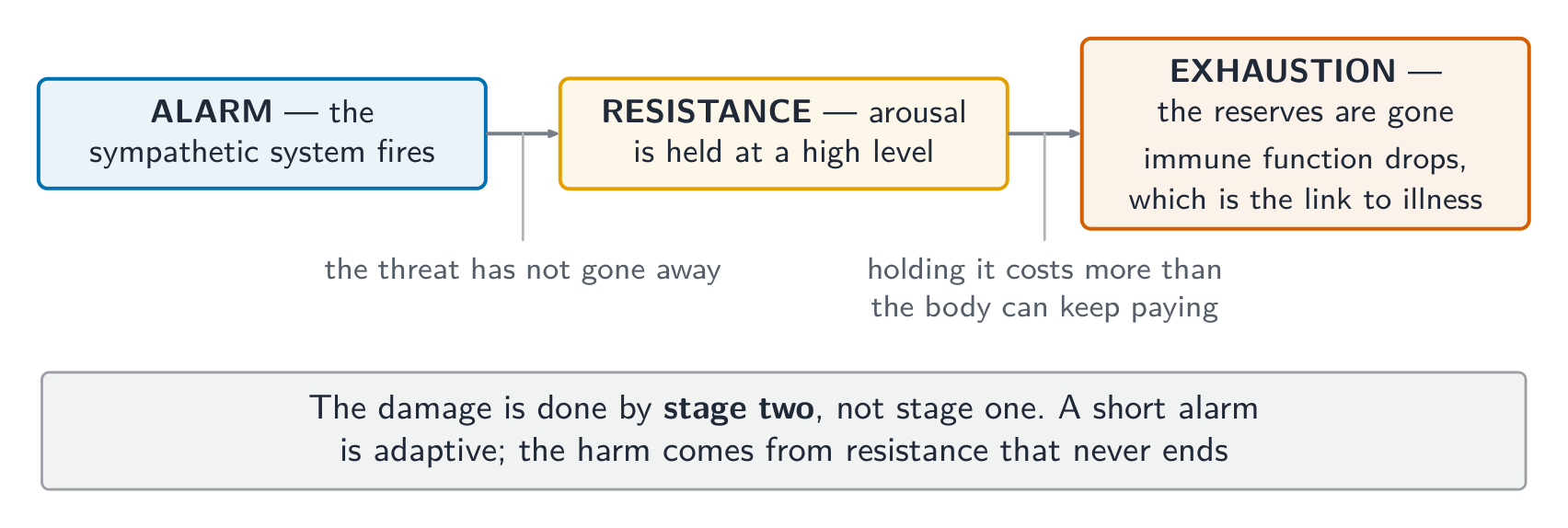
- 5.1.C.1 The general adaptation syndrome (GAS) describes the process of experiencing stress. Initially, alarm reaction occurs when the stress is encountered (via a fight-flight-freeze response). Then, a resistance phase occurs as the stress is confronted. Finally, an exhaustion phase occurs when the stress subsides, or resources are spent. The greatest susceptibility to illness occurs during the exhaustion phase.
- 5.1.C.2 The tend-and-befriend theory proposes that some people react to stress by tending to their own needs and/or the needs of others and seeking connection with others. This phenomenon seems to occur mostly in women.
Learning Objective 5.1.D: Explain how the ways that people cope with stress applies to behavior and mental processes.
- 5.1.D.1 Problem-focused coping involves seeing stress as a problem to be solved and working solutions until a solution is found.
- 5.1.D.2 Emotion-focused coping involves managing emotional reactions to stress as a means of coping. Strategies that are emotion-focused may include deep breathing, meditation, or taking medication aimed at reducing stressful emotional responses.
จุดประสงค์การเรียนรู้ 5.1.A: อธิบายว่าจิตวิทยาสุขภาพจัดการกับปัญหาสุขภาพกายและสุขภาพโดยรวมในบริบทของพฤติกรรมและกระบวนการทางจิตใจได้อย่างไร
จุดประสงค์การเรียนรู้ 5.1.B: อธิบายว่าความเครียดมีผลต่อ行为和กระบวนการทางจิตใจอย่างไร
- 5.1.B.1 ความเครียดเป็นปัจจัยที่ทำให้มีความเสี่ยงสูงต่อการเกิดโรคและความเจ็บป่วย ความเครียดมีความเกี่ยวข้องกับปัญหาทางสรีรวิทยา เช่น ความดันโลหิตสูง ปวดศีรษะ และการกดภูมิคุ้มกัน
- 5.1.B.2 ตัวกระตุ้นความเครียดสามารถมองว่าเป็นสิ่งเร้าเชิงบวก (eustress) หรือสิ่งเร้าเชิงลบ (distress) ตัวกระตุ้นความเครียดอาจถูก体验到 เป็นเหตุการณ์บาดแผลหรือปัญหาเล็กๆ น้อยๆ在日常 life ที่สะสมตามเวลา ประสบการณ์童年ที่ไม่ดี (ACEs) เป็นแหล่งที่มาของความเครียดที่มีผลต่อชีวิตตลอดช่วงอายุ
จุดประสงค์การเรียนรู้ 5.1.C: อธิบายว่าปฏิกิริยาต่อความเครียดมีผลต่อ行为和กระบวนการทางจิตใจอย่างไร
- 5.1.C.1 ซินโดรมการปรับตัวโดยทั่วไป (GAS) อธิบายกระบวนการของการ体验到ความเครียด เริ่มต้นด้วยการตอบสนองเตือนภัยเมื่อเจอความเครียด (ผ่านกลไก fight-flight-freeze) จากนั้นจะเป็นระยะต้านทานเมื่อเผชิญกับความเครียด และสุดท้ายคือระยะหมดแรงเมื่อความเครียดลดลงหรือทรัพยากรถูกใช้ไป ความเสี่ยงสูงสุดต่อการเจ็บป่วยเกิดขึ้นในช่วงหมดแรง
- 5.1.C.2 ทฤษฎีการดูแลและสร้างสัมพันธ์ (tend-and-befriend theory) เสนอว่าบางคน reacts to stress by caring for their own needs and/or the needs of others and seeking connection with others ปรากฏการณ์นี้ดูเหมือนจะเกิดขึ้นส่วนใหญ่ในผู้หญิง
จุดประสงค์การเรียนรู้ 5.1.D: อธิบายว่าวิธีการรับมือกับความเครียดมีผลต่อ行为和กระบวนการทางจิตใจอย่างไร
- 5.1.D.1 การรับมือแบบมุ่งเน้นปัญหา (Problem-focused coping) เกี่ยวกับการมองความเครียดว่าเป็นปัญหาที่ต้องแก้ และพยายามหาคำตอบจนกว่าจะพบวิธีแก้ปัญหา
- 5.1.D.2 การรับมือแบบมุ่งเน้นอารมณ์ (Emotion-focused coping) เกี่ยวกับการจัดการปฏิกิริยาทางอารมณ์จากความเครียดเพื่อใช้รับมือกับสถานการณ์ กลยุทธ์ที่มุ่งเน้นอารมณ์อาจรวมถึงการหายใจเข้าลึกๆ การทำสมาธิ หรือการใช้ยาเพื่อลดปฏิกิริยาทางอารมณ์ที่เครียด