Learning Objective 5.1.A: Describe the rotation of a system with respect to time using angular displacement, angular velocity, and angular acceleration.
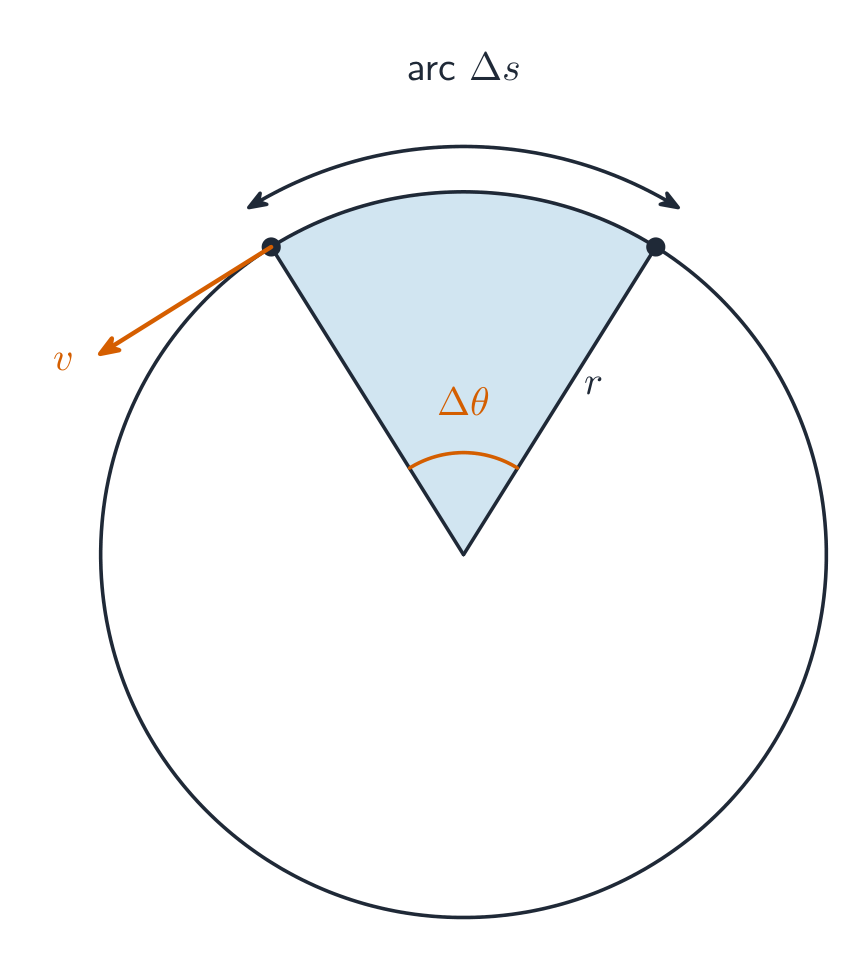
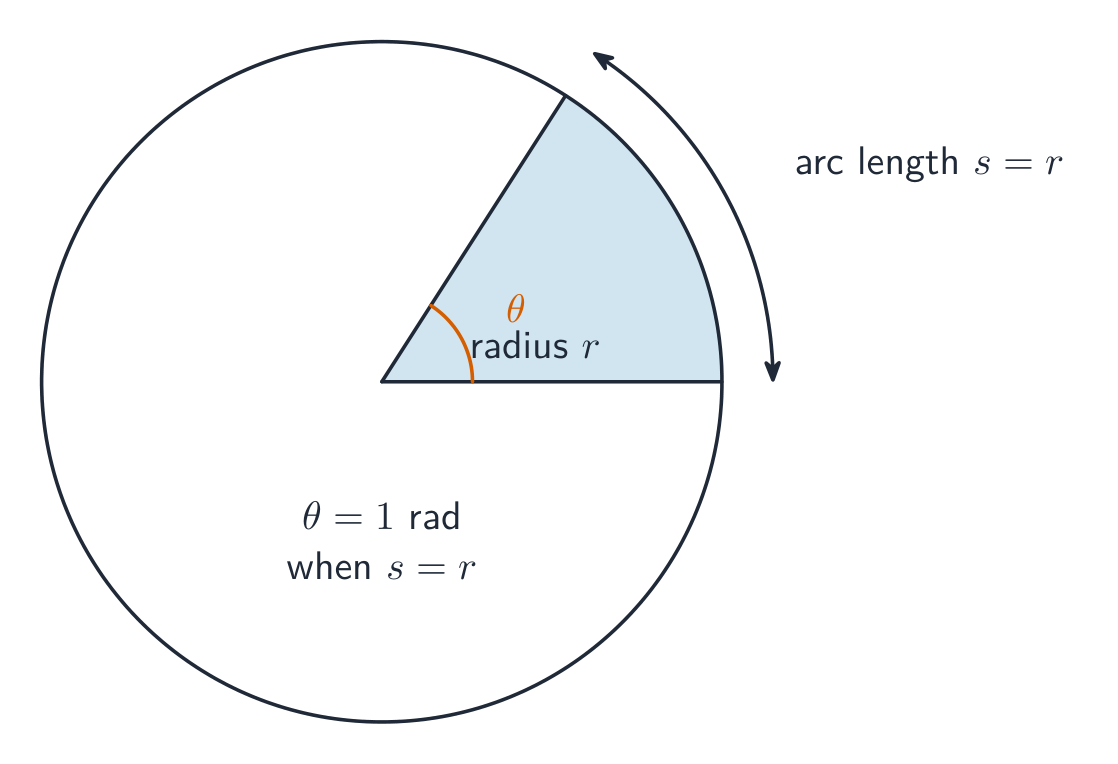
- 5.1.A.1 Angular displacement is the measurement of the angle, in radians, through which a point on a rigid system rotates about a specified axis.
- Equation: $\Delta\theta = \theta - \theta_0$
- 5.1.A.1.i A rigid system is one that holds its shape but in which different points on the system move in different directions during rotation. A rigid system cannot be modeled as an object.
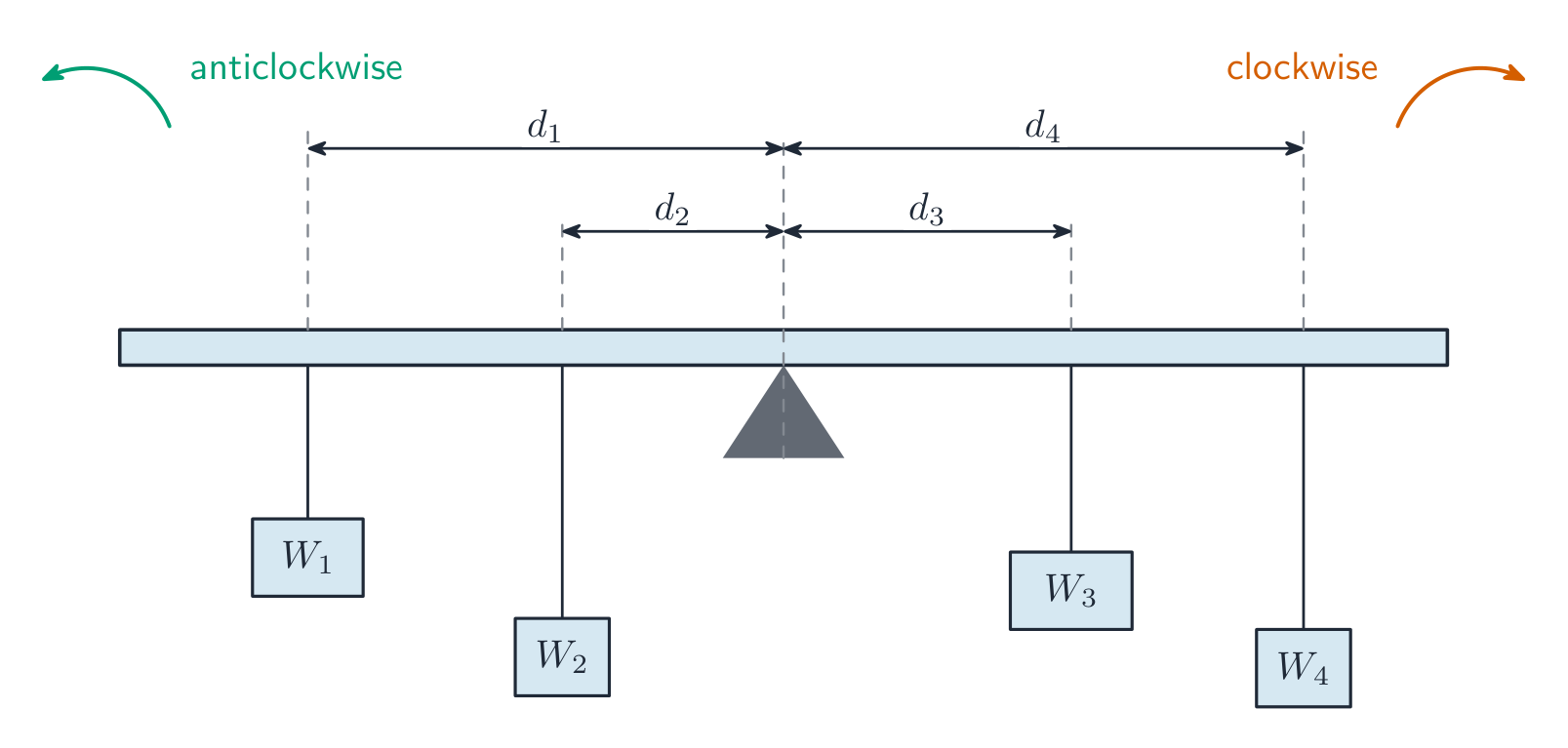
- 5.1.A.1.ii One direction of angular displacement about an axis of rotation—clockwise or counterclockwise—is typically indicated as mathematically positive, with the other direction becoming mathematically negative.
- 5.1.A.1.iii If the rotation of a system about an axis may be well described using the motion of the system's center of mass, the system may be treated as a single object. For example, the rotation of Earth about its axis may be considered negligible when considering the revolution of Earth about the center of mass of the Earth–Sun system.
- 5.1.A.2 Angular velocity is the rate at which angular position changes with respect to time.
- Equation: $\omega = \dfrac{d\theta}{dt}$
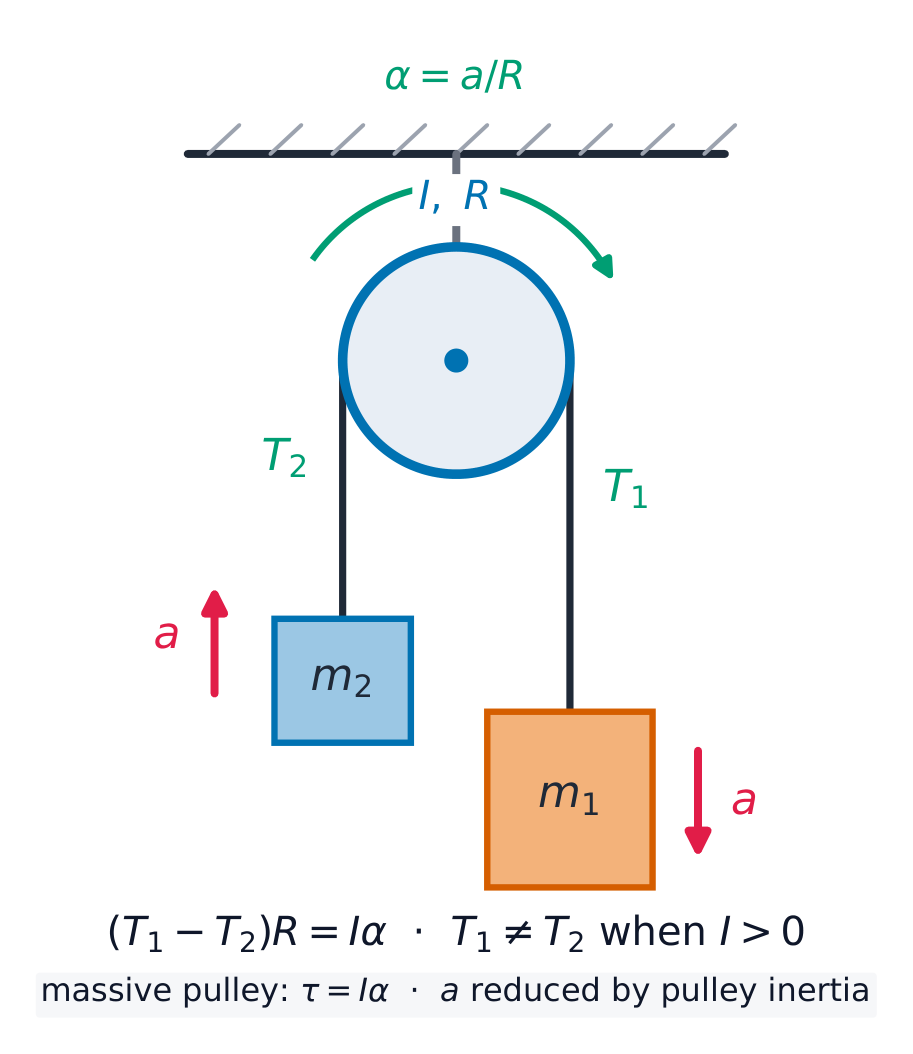
- 5.1.A.3 Angular acceleration is the rate at which angular velocity changes with respect to time.
- Equation: $\alpha = \dfrac{d\omega}{dt}$
- 5.1.A.4 Angular displacement, angular velocity, and angular acceleration around one axis are analogous to linear displacement, velocity, and acceleration in one dimension and demonstrate the same mathematical relationships.
- 5.1.A.4.i For constant angular acceleration, the mathematical relationships between angular displacement, angular velocity, and angular acceleration can be described with the following equations:
- $\omega = \omega_0 + \alpha t$
- $\theta = \theta_0 + \omega_0 t + \dfrac{1}{2}\alpha t^2$
- $\omega^2 = \omega_0^2 + 2\alpha(\theta - \theta_0)$
- 5.1.A.4.ii Graphs of angular displacement, angular velocity, and angular acceleration as functions of time can be used to find the relationships between those quantities.
- 5.1.A.4.i For constant angular acceleration, the mathematical relationships between angular displacement, angular velocity, and angular acceleration can be described with the following equations:
Boundary statement: AP Physics C: Mechanics expects students to be able to mathematically manipulate the magnitudes of angular displacement, angular velocity, and angular acceleration using vector conventions. However, the directions of said vectors will not be assessed on the exam.
Descriptions of the directions of rotational kinematics quantities for a point or rigid body are limited to clockwise and counterclockwise with respect to a given axis of rotation.
วัตถุประสงค์การเรียนรู้ 5.1.A: อธิบายการหมุนของระบบเทียบกับเวลาโดยใช้การกระจัดเชิงมุม ความเร็วเชิงมุม และความเร่งเชิงมุม
- 5.1.A.1 การกระจัดเชิงมุมคือขนาดของมุมในหน่วยเรเดียน ที่จุดหนึ่งบนระบบแข็งหมุนรอบแกนที่กำหนด
- สมการ: $\Delta\theta = \theta - \theta_0$
- 5.1.A.1.i ระบบแข็งคือระบบที่รักษารูปทรงไว้ได้แต่จุดต่างๆ บนระบบเคลื่อนที่ไปในทิศทางที่แตกต่างกันระหว่างการหมุน ระบบแข็งไม่สามารถจำลองเป็นวัตถุเดี่ยวได้
- 5.1.A.1.ii ทิศทางหนึ่งของการกระจัดเชิงมุมรอบแกนหมุน—ตามทเข็มนาฬิกาหรือทวนทเข็มนาฬิกา—มักถูกกำหนดให้เป็นค่าบวกทางคณิตศาสตร์ โดยทิศทางอีกด้านจะเป็นค่าลบทางคณิตศาสตร์
- 5.1.A.1.iii หากการหมุนของระบบรอบแกนสามารถอธิบายได้ดีด้วยการเคลื่อนที่ของศูนย์กลางมวลของระบบ ระบบสามารถพิจารณาเป็นวัตถุเดียวได้ ตัวอย่างเช่น การหมุนของโลก حولตัวเองอาจถูกละเลยเมื่อพิจารณาถึงการโคจรของโลกรอบศูนย์กลางมวลของระบบโลก-ดวงอาทิตย์
- 5.1.A.2 ความเร็วเชิงมุมคืออัตราที่ตำแหน่งเชิงมุมเปลี่ยนแปลงเทียบกับเวลา
- สมการ: $\omega = \dfrac{d\theta}{dt}$
- 5.1.A.3 ความเร่งเชิงมุมคืออัตราที่ความเร็วเชิงมุมเปลี่ยนแปลงเทียบกับเวลา
- สมการ: $\alpha = \dfrac{d\omega}{dt}$
- 5.1.A.4 การกระจัดเชิงมุม ความเร็วเชิงมุม และความเร่งเชิงมุมรอบแกนหนึ่งมีความคล้ายคลึงกับการกระจัดเชิงเส้น ความเร็ว และ ความเร่ง ในหนึ่งมิติ และแสดงความสัมพันธ์ทางคณิตศาสตร์เดียวกัน
- 5.1.A.4.i สำหรับความเร่งเชิงมุมคงที่ ความสัมพันธ์ทางคณิตศาสตร์ระหว่างการกระจัดเชิงมุม ความเร็วเชิงมุม และความเร่งเชิงมุมสามารถอธิบายได้ด้วยสมการต่อไปนี้:
- $\omega = \omega_0 + \alpha t$
- $\theta = \theta_0 + \omega_0 t + \dfrac{1}{2}\alpha t^2$
- $\omega^2 = \omega_0^2 + 2\alpha(\theta - \theta_0)$
- 5.1.A.4.ii กราฟของการกระจัดเชิงมุม ความเร็วเชิงมุม และความเร่งเชิงมุมในฐานะฟังก์ชันของเวลาสามารถใช้เพื่อหาความสัมพันธ์ระหว่างปริมาณเหล่านั้นได้
- 5.1.A.4.i สำหรับความเร่งเชิงมุมคงที่ ความสัมพันธ์ทางคณิตศาสตร์ระหว่างการกระจัดเชิงมุม ความเร็วเชิงมุม และความเร่งเชิงมุมสามารถอธิบายได้ด้วยสมการต่อไปนี้:
คำจำกัดขอบเขต: AP Physics C: Mechanics คาดหวังให้นักเรียนสามารถจัดการทางคณิตศาสตร์ด้วยขนาดของการกระจัดเชิงมุม ความเร็วเชิงมุม และความเร่งเชิงมุมโดยใช้กฎเวกเตอร์ อย่างไรก็ตาม ทิศทางของเวกเตอร์ดังกล่าวจะไม่ถูกทดสอบในการสอบ
คำอธิบายทิศทางของปริมาณจลนศาสตร์การหมุนสำหรับจุดหรือวัตถุแข็งเกร็งจำกัดอยู่แค่การหมุนตามเข็มนาฬิกาและทวนเข็มนาฬิกาเทียบกับแกนหมุนที่กำหนด