English
Learning Objective 1.1.A: Describe a scalar or vector quantity using magnitude and direction, as appropriate.
- 1.1.A.1 Scalars are quantities described by magnitude only; vectors are quantities described by both magnitude and direction.
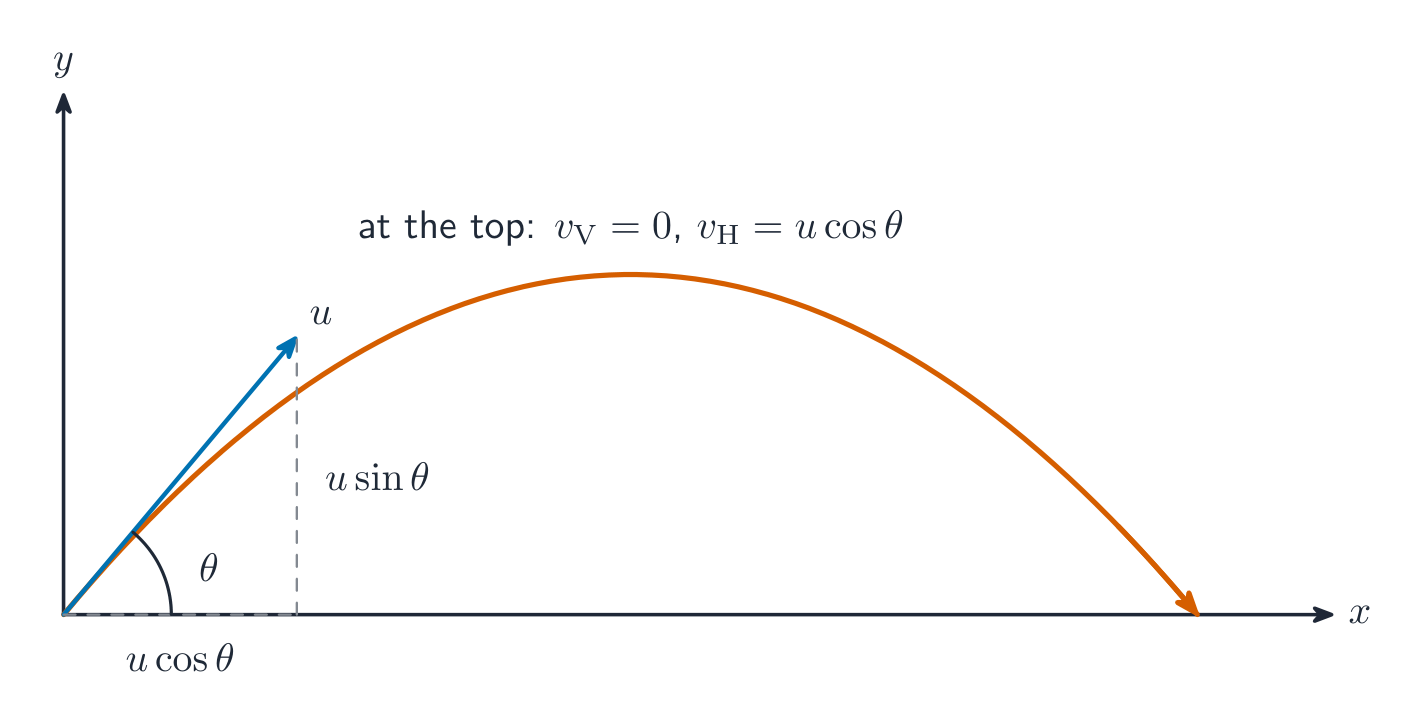
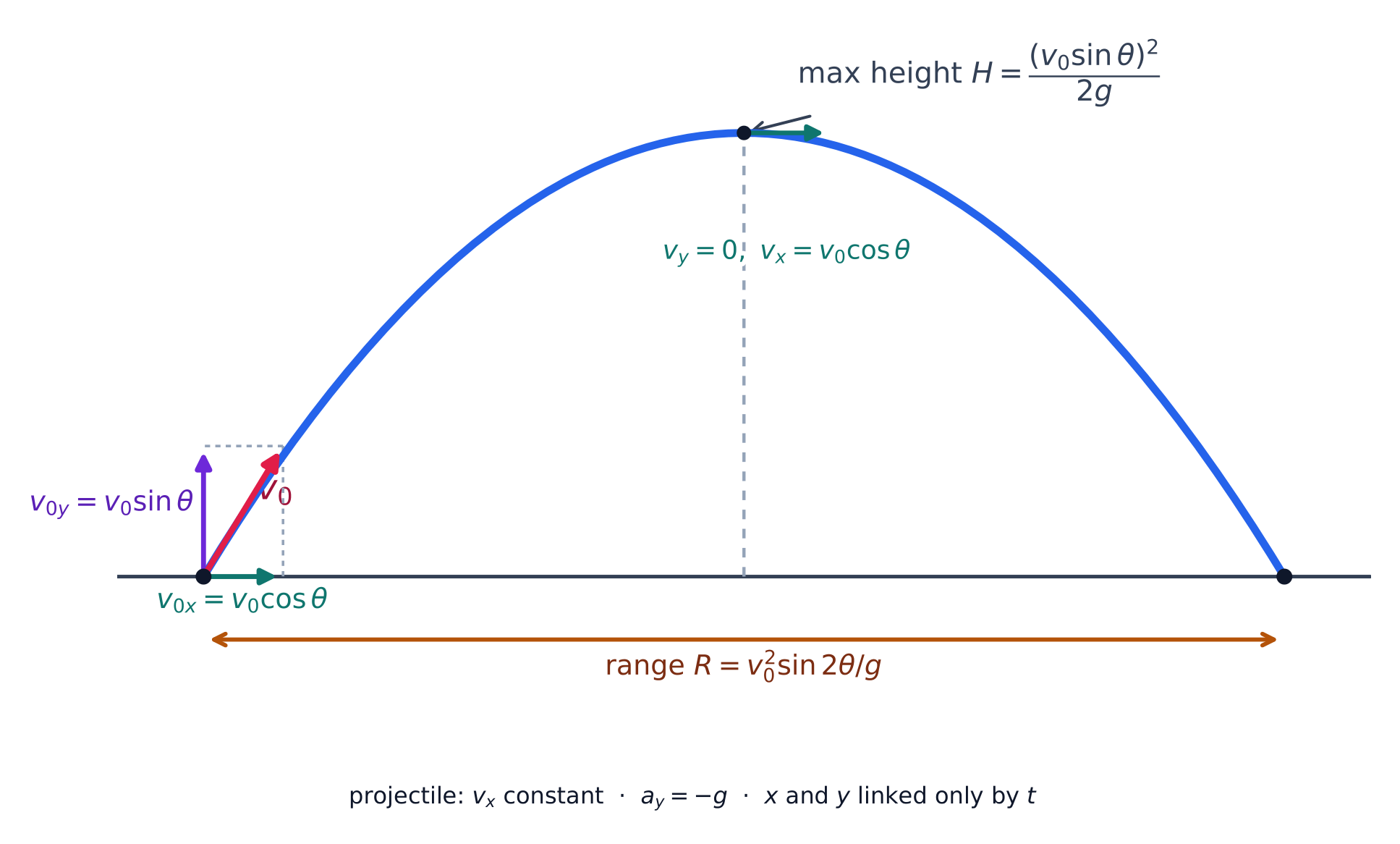
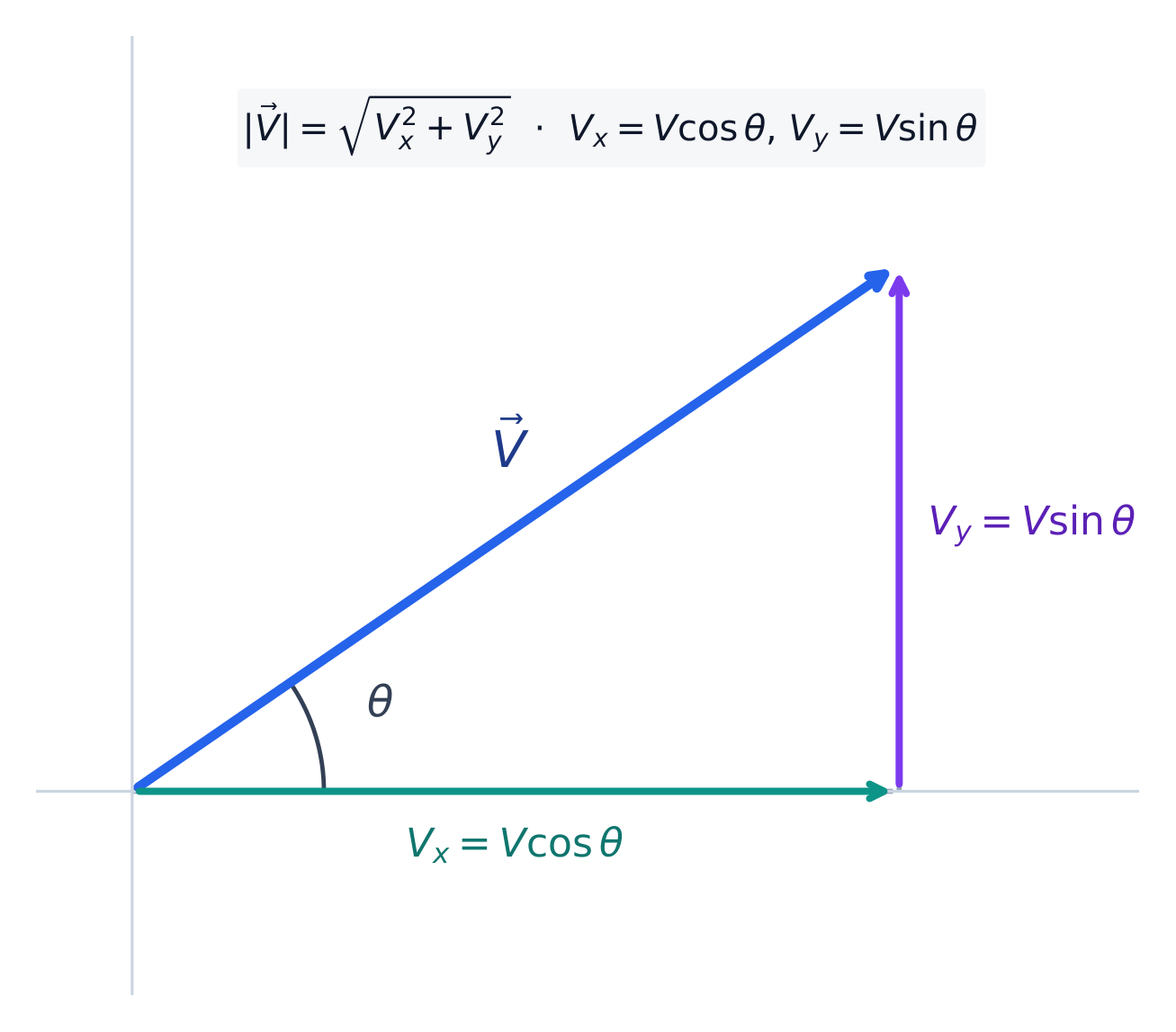
- 1.1.A.2 Vectors can be visually modeled as arrows with appropriate direction and lengths proportional to their magnitude.
- 1.1.A.3 Distance and speed are examples of scalar quantities, while position, displacement, velocity, and acceleration are examples of vector quantities.
- 1.1.A.4 Vectors can be expressed in unit vector notation or as a magnitude and a direction.
- 1.1.A.4.i Unit vector notation can be used to represent vectors as the sum of their constituent components in the $x$-, $y$-, and $z$-directions, denoted by $\hat{i}$, $\hat{j}$, and $\hat{k}$, respectively.
- Equation: $\vec{r} = \left( A\hat{i} + B\hat{j} + C\hat{k} \right)$
- 1.1.A.4.ii The position vector of a point is given by $\vec{r}$, and the unit vector in the direction of the position vector is denoted $\hat{r}$.
- 1.1.A.4.iii A resultant vector is the vector sum of the addend vectors' components.
- Equation: $\vec{C} = \vec{A} + \vec{B}$
- Equation: $\vec{C} = \left( A_x + B_x \right)\hat{i} + \left( A_y + B_y \right)\hat{j}$
- 1.1.A.4.i Unit vector notation can be used to represent vectors as the sum of their constituent components in the $x$-, $y$-, and $z$-directions, denoted by $\hat{i}$, $\hat{j}$, and $\hat{k}$, respectively.
- 1.1.A.5 In a given one-dimensional coordinate system, opposite directions are denoted by opposite signs.
ไทย
วัตถุประสงค์การเรียนรู้ 1.1.A: อธิบายปริมาณสเกลาร์หรือเวกเตอร์โดยใช้ขนาดและทิศทาง ตามความเหมาะสม
- 1.1.A.1 สเกลาร์คือปริมาณที่อธิบายได้ด้วยขนาดเพียงอย่างเดียว; เวกเตอร์คือปริมาณที่อธิบายได้ด้วยทั้งขนาดและทิศทาง
- 1.1.A.2 เวกเตอร์สามารถแสดงด้วยภาพเป็นลูกศรที่มีทิศทางที่เหมาะสมและความยาวแปรผันตรงกับขนาดของมัน
- 1.1.A.3 ระยะทางและอัตราเร็วเป็นตัวอย่างของปริมาณสเกลาร์ ในขณะที่ตำแหน่ง, การกระจัด, ความเร็ว, และความเร่งเป็นตัวอย่างของปริมาณเวกเตอร์
- 1.1.A.4 เวกเตอร์สามารถแสดงในรูปProgramming unit vector notation หรือเป็นขนาดและทิศทาง
- 1.1.A.4.i Unit vector notation สามารถใช้แทนเวกเตอร์ด้วยการบวกองค์ประกอบย่อยของเวกเตอร์ในทิศทาง $x$-, $y$-, และ $z$- ซึ่งระบุด้วย $\hat{i}$, $\hat{j}$, และ $\hat{k}$ ตามลำดับ
- สมการ: $\vec{r} = \left( A\hat{i} + B\hat{j} + C\hat{k} \right)$
- 1.1.A.4.ii Position vector ของจุดกำหนดโดย $\vec{r}$ และ unit vector ในทิศทางของ position vector ระบุด้วย $\hat{r}$
- 1.1.A.4.iii Resultant vector คือผลบวกของเวกเตอร์ขององค์ประกอบของเวกเตอร์ที่บวกกัน
- สมการ: $\vec{C} = \vec{A} + \vec{B}$
- สมการ: $\vec{C} = \left( A_x + B_x \right)\hat{i} + \left( A_y + B_y \right)\hat{j}$
- 1.1.A.4.i Unit vector notation สามารถใช้แทนเวกเตอร์ด้วยการบวกองค์ประกอบย่อยของเวกเตอร์ในทิศทาง $x$-, $y$-, และ $z$- ซึ่งระบุด้วย $\hat{i}$, $\hat{j}$, และ $\hat{k}$ ตามลำดับ
- 1.1.A.5 ในระบบพิกัดแบบหนึ่งมิติ ทิศทางตรงข้ามจะระบุด้วยเครื่องหมายตรงข้าม