Skip to content · ⁨ข้ามไปยังเนื้อหา⁩

Space, Depth, and Proportion · ⁨พื้นที่ ลึก และสัดส่วน⁩

AP Drawing · ⁨AP การวาดภาพ⁩ · Topic 3 · ⁨หัวข้อ 3⁩

Video lesson for this topic · ⁨บทเรียนวิดีโอสำหรับหัวข้อนี้⁩ Open the video page · ⁨เปิดหน้าวิดีโอ⁩
7:45

พื้นที่ ลึก และสัดส่วน

มองลงไปตามถนนนี้ ขอบทั้งสองข้างขนานกันพอดี มันไม่เคยบรรจบกัน แต่ในภาพถ่ายนี้มันรวมกันและสัมผัสกันไกลออกไป ตาของคุณอ่านความลึกจาก...

English narration · English + 中文 subtitles burned in · ⁨การบรรยายภาษาอังกฤษ · คำบรรยายภาษาอังกฤษ + 中文 ลอยตัวบนภาพ⁩

3.1

Measuring and Sighting · ⁨การวัดและการสังเกต⁩

Syllabus · ⁨หลักสูตร⁩
English

Focus: Sighting is measuring the subject with your pencil at arm's length — the observational drawing survival skill.

  • Hold the pencil at full arm's length, lock the elbow, close one eye: now it is a ruler and a protractor.
  • Pick one unit (often the head, or a cup's height) and measure everything in that unit: comparative measurement.
  • Check angles by rotating the pencil to match an edge, then carrying that angle to the paper.
  • Plumb lines (vertical checks) and level lines (horizontal checks) locate landmarks above and below each other.
  • Draw envelope shapes first: the big simple shape that contains the whole subject, then divide it.
  • Measured accuracy is visual evidence of space and proportion control in the AP rubric's drawing skills.
ไทย

จุดเน้น: การสังเกต (Sighting) คือการวัดวัตถุด้วยดินสอที่ยื่นออกด้านหน้าตัว — ทักษะพื้นฐานสำหรับการวาดภาพเชิงสังเกตการณ์

  • ยึดดินสอให้แขนเหยียดตรงล็อกข้อศอก ปิดตาข้างหนึ่ง: ตอนนี้มันคือไม้บรรทัดและโปรTRACTOR
  • เลือกหน่วยวัดหนึ่ง (มักเป็นความสูงของศีรษะหรือถ้วย) แล้ววัดทุกอย่างในหน่วยนั้น: การวัดเปรียบเทียบ
  • ตรวจสอบมุมโดยการหมุนดินสอให้ขนานกับขอบ แล้วนำมุมนั้นไปวางบนกระดาษ
  • เส้นแนวตั้ง (Plumb lines) (ตรวจสอบแนวตั้ง) และ เส้นแนวนอน (Level lines) (ตรวจสอบแนวนอน) ใช้ระบุตำแหน่งจุดสำคัญที่อยู่เหนือและใต้กัน
  • วาด รูปทรงห่อหุ้ม (Envelope shapes) ก่อน: รูปทรงใหญ่เรียบง่ายที่ครอบคลุมทั้งวัตถุ แล้วจึงแบ่งส่วน
  • ความแม่นยำจากการวัดคือหลักฐานทางสายตาของการควบคุม พื้นที่ และ สัดส่วน ตามเกณฑ์การประเมินของ AP

Source: College Board AP Course and Exam Description · ⁨แหล่งที่มา: คำอธิบายหลักสูตรและข้อสอบ College Board AP⁩

English

Sighting 目测 means measuring the subject with your pencil at arm's length — the survival skill of observational drawing.

  • Hold the pencil at full arm's length with a locked elbow and one eye closed: now it is a ruler and a protractor.
  • Pick one unit (often the head, or a cup's height) and measure everything in that unit — comparative measurement 比较测量.
  • Check angles by rotating the pencil to match an edge, then carrying that angle to the paper.
  • A plumb line 铅垂线 (an imagined vertical) shows which landmarks sit exactly above or below each other.
  • Draw the envelope 外包形 first: the big simple shape that contains the whole subject, then divide it.
ไทย

Sighting หมายถึงการวัดตัวแบบด้วยดินสอที่ยื่นแขนออกไปให้สุด — ทักษะการรอดชีวิตของการวาดแบบสังเกตการณ์

  • ยึดดินสอที่ยื่นแขนออกไปให้สุดด้วยข้อศอกล็อคและปิดตาข้างหนึ่ง: ตอนนี้มันคือไม้บรรทัดและโปรtractor
  • เลือกหน่วยวัดหนึ่ง (มักจะเป็นศีรษะ หรือความสูงของถ้วย) แล้ววัดทุกอย่างด้วยหน่วยนั้น — การวัดเปรียบเทียบ
  • ตรวจสอบมุมโดยการหมุนดินสอให้ขนานกับขอบ แล้วนำมุมนั้นไปวางบนกระดาษ
  • เส้นตั้งตรง (เส้นแนวตั้งสมมติ) แสดงให้เห็นว่าLandmarks อยู่ตรงกันแนวนอนหรือแนวตั้งกันอย่างไร
  • วาด กรอบรอบนอก ก่อน: รูปทรงใหญ่เรียบง่ายที่ครอบคลุมตัวแบบทั้งหมด แล้วจึงแบ่งย่อย
Vocabulary · ⁨คำศัพท์⁩ Train · ⁨ฝึกฝน⁩
English ไทย
sighting/ˈsaɪtɪŋ/ จุดสังเกต
comparative measurement/kəmˈpærətɪv ˈmeʒəmənt/ การวัดเปรียบเทียบ
plumb line/plʌm laɪn/ เส้นตั้งฉาก
envelope/ˈenvələʊp/ envelope
linear perspective/ˈlɪnɪə pəˈspektɪv/ linear perspective
horizon line/həˈraɪzn laɪn/ เส้นแนวนอน
vanishing point/ˈvænɪʃɪŋ pɔɪnt/ จุดหายไป
3.2

One-Point Perspective · ⁨มุมมองแบบจุดเดียว⁩

Syllabus · ⁨หลักสูตร⁩
English

Focus: Linear perspective turns the picture plane into a window: in one-point, all depth lines meet at a single vanishing point.

  • The horizon line is the viewer's eye level — everything above it we look up at, everything below we look down on.
  • Lines parallel to the picture plane stay true; lines going into the scene converge to the vanishing point.
  • Equal spaces look smaller as they recede — use the diagonal trick to divide receding space evenly.
  • One-point suits rooms, streets, and corridors seen straight-on.
  • Objects overlap and rise toward the horizon as they get further away — perspective plus overlap is depth doubled.
  • Perspective errors are easy to spot: check every depth line actually aims at the point.
ไทย

จุดเน้น: มุมมองเชิงเส้น (Linear perspective) เปลี่ยนระนาบภาพให้เป็นเหมือนหน้าต่าง: ในมุมมองจุดเดียว เส้นความลึกทั้งหมดจะบรรจบกันที่ จุด消失了 (Vanishing point) เดียว

  • เส้นขอบฟ้า (Horizon line) คือระดับสายตาของผู้ชม — ทุกอย่างเหนือเส้นนี้เราต้องเงยหน้าขึ้นดู ทุกอย่างใต้เส้นนี้เราต้องมองลง
  • เส้นขนานกับระนาบภาพจะคงรูปร่างเดิม; เส้นที่พุ่ง เข้าไป ในฉากจะรวมตัวเข้าหา จุด消失了 (Vanishing point)
  • ระยะห่างเท่ากันจะดูเล็กลงเมื่อถอยหลัง — ใช้เทคนิคเส้นทแยงมุมเพื่อแบ่งพื้นที่ที่ถอยหลังออกเท่าๆ กัน
  • มุมมองจุดเดียวเหมาะสำหรับห้อง ถนน และทางเดินที่มองเห็นตรงๆ
  • วัตถุซ้อนทับกันและยกสูงขึ้นเข้าหาเส้นขอบฟ้าเมื่ออยู่ไกลขึ้น — มุมมอง + การซ้อนทับ (Overlap) คือความลึกที่เพิ่มขึ้นสองเท่า
  • ข้อผิดพลาดด้านมุมมองเห็นได้ง่าย: ตรวจสอบให้แน่ใจว่าทุกเส้นความลึกชี้ไปที่จุด消失了จริง

Source: College Board AP Course and Exam Description · ⁨แหล่งที่มา: คำอธิบายหลักสูตรและข้อสอบ College Board AP⁩

English
One-point perspective

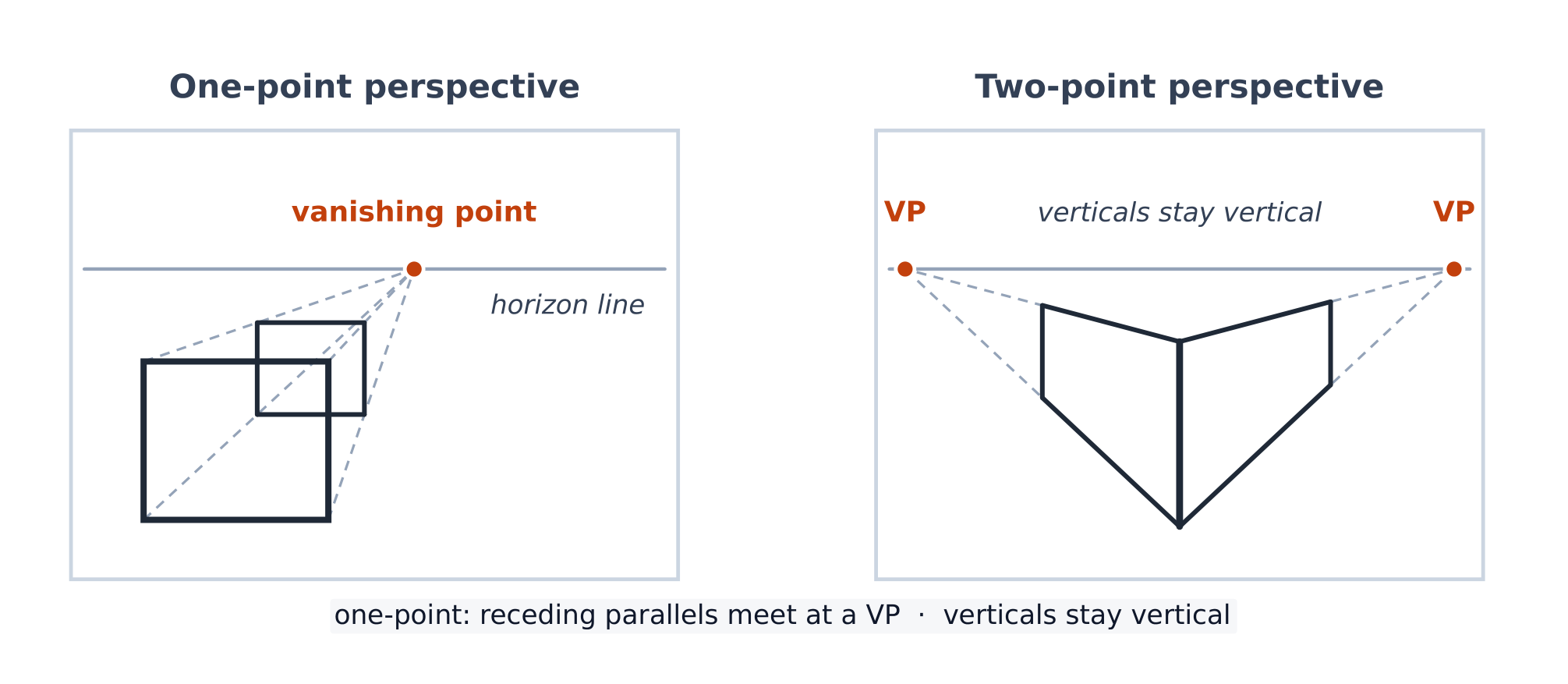
Linear perspective 线性透视 treats the picture as a window. In one-point perspective, all lines going into the depth meet at a single point.

  • The horizon line 视平线 is the viewer's eye level. We look down on everything below it and up at everything above it.
  • Lines parallel to the picture surface stay true; lines going into the scene converge to the vanishing point 灭点.
  • Equal spaces look smaller as they recede. Use diagonals to divide receding space evenly.
  • One-point perspective 一点透视 suits rooms, streets, and corridors seen straight-on.
  • Perspective plus overlap 遮挡 is depth doubled: near edges cover far edges.
ไทย

*มุมมองเชิงเส้นแบบจุดเดียว

Perspective แบบเส้นตรง มองภาพวาดเป็นหน้าต่าง ในมุมมองแบบจุดเดียว เส้นทั้งหมดที่พุ่งเข้าไปในความลึกจะ bertemuกันที่จุดเดียว

ถนนทรายยาวตรงที่ทอดตัวไปข้างหน้าสู่ขอบฟ้า ขอบถนนแคบลงจนกลายเป็นจุดเดียว *ถนนทรายตรง: ขอบทั้งสองข้างดูเหมือนจะพบกันที่จุด消失了 واحدบนขอบฟ้า พอดีกับมุมมองแบบจุดเดียวที่ภาพวาดสร้างขึ้นเพื่อแสดงความลึก

มุมมองแบบจุดเดียวและสองจุด: เส้นขอบฟ้า จุด消失了 และขอบที่ลู่เข้าหากัน *ซ้าย: จุดเดียว — เส้นความลึกพบกันที่จุด消失了หนึ่ง ขวา: สองจุด — แต่ละชุดของขอบพบจุด消失了ของตัวเอง

  • เส้นขอบฟ้า คือระดับสายตาของผู้ชม เรามองลงไปที่ทุกสิ่งด้านล่างมัน และมองขึ้นไปทุกสิ่งด้านบนมัน
  • เส้นที่ขนานกับพื้นผิวภาพจะคงความเป็นจริง; เส้นที่พุ่ง เข้าไป ในฉากจะลู่เข้าหา จุด消失了
  • ระยะห่างเท่ากันจะดูเล็กลงเมื่อถอยหลัง ใช้เส้นทแยงมุมเพื่อแบ่งพื้นที่ที่ถอยหลังอย่างสม่ำเสมอ
  • มุมมองแบบจุดเดียว เหมาะกับห้อง ถนน และทางเดินที่มองตรงๆ
  • Perspective加上 Overlap คือความลึกที่เพิ่มขึ้นสองเท่า: ขอบหน้าจะทับขอบหลัง
Vocabulary · ⁨คำศัพท์⁩ Train · ⁨ฝึกฝน⁩
English ไทย
one-point perspective/wʌn pɔɪnt pəˈspektɪv/ پرسเปกทีวหนึ่งจุด
overlap/ˌəʊvəˈlæp/ การทับซ้อน
3.3

Two-Point and Three-Point Perspective · ⁨มุมมองแบบสองจุดและสามจุด⁩

Syllabus · ⁨หลักสูตร⁩
English

Focus: Turn the subject at an angle and you need two vanishing points; look steeply up or down and you need a third.

  • In two-point, verticals stay vertical; both sets of horizontal edges converge to left and right points on the horizon.
  • Keep both vanishing points far apart (often off the paper) — close points create fisheye distortion.
  • Three-point adds a vertical vanishing point: skyscrapers from below (looking up) or street scenes from a rooftop (looking down).
  • Boxes drawn in perspective become the scaffolding for everything: buildings, books, vehicles, even heads.
  • Cast shadows and reflections follow the same perspective system as the objects that make them.
  • A perspective grid underdrawing keeps complex scenes consistent — construct lightly, render on top.
ไทย

จุดเน้น: หมุนวัตถุเป็นมุมแล้วคุณต้องใช้ จุด消失了สองจุด; มองขึ้นหรือลงชันๆ แล้วคุณต้องใช้จุด消失了ที่สาม

  • ใน มุมมองสองจุด เส้นแนวตั้งจะยังคงแนวตั้ง; ขอบแนวนอนทั้งสองชุดจะบรรจบกันที่จุดซ้ายและขวาบนเส้นขอบฟ้า
  • รักษาให้จุด消失了ทั้งสองอยู่ห่างกันมาก (มักอยู่นอกกระดาษ) — จุดที่ใกล้กันจะสร้างความบิดเบี้ยวแบบเลนส์ตาปลา
  • มุมมองสามจุด เพิ่มจุด消失了แนวตั้ง: ตึกสูงจากด้านล่าง (มองขึ้น) หรือฉากถนนจากหลังคา (มองลง)
  • กล่องที่วาดด้วย perspective จะกลายเป็นโครง支撑สำหรับทุกอย่าง: buildings, books, vehicles,甚至是 heads
  • เงาตกกระทบและสะท้อนแสงเป็นไปตามระบบมุมมองเดียวกับวัตถุที่สร้างเงาเหล่านั้น
  • โครงร่างตารางมุมมองช่วยรักษาความสอดคล้องของฉากซับซ้อน — สร้างโครงสร้างเบาๆ แล้วเติมรายละเอียดด้านบน

Source: College Board AP Course and Exam Description · ⁨แหล่งที่มา: คำอธิบายหลักสูตรและข้อสอบ College Board AP⁩

English
Two-point perspective

Turn the subject at an angle and you need two-point perspective 两点透视; look steeply up or down and you need a third point.

  • In two-point, verticals stay vertical; the two sets of horizontal edges converge to a left and a right vanishing point on the horizon.
  • Keep the two points far apart — often off the paper. Points placed too close create a fisheye distortion.
  • Three-point perspective 三点透视 adds a vertical vanishing point: a skyscraper from below, or a street from a rooftop.
  • Boxes drawn in perspective become scaffolding for everything: buildings, books, vehicles, even heads.
  • Cast shadows and reflections obey the same perspective system as the objects that make them.
ไทย
มุมมองแบบสองจุด

หมุนตัวแบบตามมุมแล้วคุณต้องใช้ ** Perspective สองจุด**; มองขึ้นหรือลงอย่างชัน你需要第三个点。

  • ในมุมมองแบบสองจุด เส้นตั้งตรงจะยังคงตั้งตรง; สองชุดของขอบแนวนอนจะลู่เข้าหาจุด消失了ทางซ้ายและขวาบนเส้นขอบฟ้า
  • รักษาให้จุด消失了ทั้งสองอยู่ห่างกัน — มักจะอยู่นอกกระดาษ การวางจุด消失了ใกล้เกินไปจะทำให้เกิดการบิดเบี้ยวแบบเลนส์ fish-eye
  • Perspective สามจุด เพิ่มจุด消失แนวตั้ง: ตึกสูงมองจากด้านล่าง หรือถนนมองจากรถยนต์บนหลังคา
  • กล่องที่วาดตาม perspective จะกลายเป็นโครงร่างสำหรับทุกอย่าง: อาคาร หนังสือ ยานพาหนะ แม้แต่ศีรษะ
  • เงาตกกระทบและการสะท้อน tuânตามระบบ perspective เดียวกันกับวัตถุที่ทำให้เกิดมัน
Vocabulary · ⁨คำศัพท์⁩ Train · ⁨ฝึกฝน⁩
English ไทย
two-point perspective/tuː pɔɪnt pəˈspektɪv/ پرسเปกทีวสองจุด
three-point perspective/θriː pɔɪnt pəˈspektɪv/ پرسเปกทีวสามจุด
foreshortening/fɔːˈʃɔːtənɪŋ/ การลดทอนระยะ
cross-sections/krɒs ˈsekʃnz/ หน้าตัด
3.4

Foreshortening · ⁨การลดทอนมิติ (Foreshortening)⁩

Syllabus · ⁨หลักสูตร⁩
English

Focus: Foreshortening is perspective applied to a single form pointing toward you — lengths compress dramatically.

  • A pointing arm may appear one-third of its true length: draw the apparent shape, not the known one.
  • Overlap is the key signal: the hand overlaps the forearm, the forearm overlaps the upper arm.
  • Think in cross-sections: imagine rings around the form (like a wireframe) to feel how it turns toward you.
  • Measure foreshortened lengths by sighting — knowledge lies, observation tells the truth.
  • Classic practice: draw a figure lying down feet-first (like Mantegna's Dead Christ).
  • Strong foreshortening is high-difficulty visual evidence — examiners recognise the skill immediately.
ไทย

จุดเน้น: มุมมองเบี่ยงเบน (Foreshortening) คือการนำมุมมองมาประยุกต์กับรูปทรงเดียวที่ชี้เข้ามาหาผู้ดู — ความยาวจะบีบอัดอย่างมาก

  • แขนที่ชี้เข้ามาอาจดูสั้นลงเหลือหนึ่งในสามของความยาวจริง: วาดรูปร่างที่ ปรากฏ ไม่ใช่รูปร่างที่คุณรู้ว่าเป็น
  • การซ้อนทับคือสัญญาณสำคัญ: มือซ้อนทับแขนส่วนล่าง, แขนส่วนล่างซ้อนทับแขนส่วนบน
  • คิดเป็นหน้าตัด: จินตนาการวงแหวนรอบรูปทรง (เหมือนโครงลวด) เพื่อรู้สึกถึงการหมุนเข้าหาผู้ดู
  • วัดความยาวที่เบี่ยงเบนด้วยการสังเกต — ความรู้อาจหลอกลวง แต่การสังเกตบอกความจริง
  • ฝึกฝนคลาสสิก: วาดตัวละครนอนคว่ำเท้าเข้าหาผู้ดู (เช่น Mantegna's Dead Christ)
  • มุมมองเบี่ยงเบนที่ชัดเจนเป็นหลักฐานทางสายตาที่มีความยากสูง — กรรมการสอบจดจำทักษะนี้ได้ทันที

Source: College Board AP Course and Exam Description · ⁨แหล่งที่มา: คำอธิบายหลักสูตรและข้อสอบ College Board AP⁩

English

Foreshortening 透视缩短 is perspective applied to a single form pointing toward you — lengths compress dramatically.

  • A pointing arm may appear one-third of its true length. Draw the apparent shape, not the length you know.
  • Overlap is the key signal: the hand overlaps the forearm, the forearm overlaps the upper arm.
  • Think in cross-sections 横截面: imagine rings around the form, like a wireframe, to feel how it turns toward you.
  • Measure foreshortened lengths by sighting — memory lies, observation tells the truth.
  • The classic practice piece: a figure lying down, drawn feet-first, like Mantegna's Dead Christ.
ไทย

การลดทอนมิติ คือ perspective ที่ใช้กับรูปทรงเดี่ยวชี้เข้ามาหาเรา — ความยาวจะบีบอัดอย่างมาก

  • แขนที่ยื่นอาจดูสั้นลงเหลือเพียงหนึ่งในสามของความยาวจริง วาด รูปร่างที่เห็น ไม่ใช่ความยาวที่คุณรู้
  • การซ้อนทับคือสัญญาณสำคัญ: มือซ้อนทับแขนส่วนล่าง, แขนส่วนล่างซ้อนทับแขนส่วนบน
  • คิดเป็น หน้าตัด: จินตนาการวงแหวนรอบรูปทรงเหมือนโครงลวด เพื่อรู้สึกถึงorientation ของมัน haciaเรา
  • วัดความยาวที่ลดทอนด้วยการมองตรง — ความจำหลอกลวง แต่การสังเกตบอกความจริง
  • งานฝึกฝนคลาสสิก: figura lying down, วาดเท้าไปหัวเหมือน Mantegna's Dead Christ
3.5

Atmospheric Perspective · ⁨Perspective ทางบรรยากาศ⁩

Syllabus · ⁨หลักสูตร⁩
English

Focus: Atmospheric (aerial) perspective creates depth without lines: distant things are lighter, cooler, softer, and less detailed.

  • Air scatters light, so contrast fades with distance — the far mountain is a pale flat shape.
  • Foreground: darkest darks, sharpest edges, most texture; background: narrow value range, soft edges.
  • Reserve full black and full white for the foreground; the distance lives in the middle greys.
  • Detail density is a depth cue by itself — render the near leaf, suggest the far tree.
  • Combine linear and atmospheric perspective for maximum depth in landscape and cityscape drawing.
  • This is the AP skill space made visible through light and shade — two rubric skills in one device.
ไทย

จุดเน้น: มุมมองบรรยากาศ (Aerial perspective) สร้างความลึกโดยไม่ใช้เส้น: วัตถุระยะไกลจะมีสีอ่อนกว่า หนาวกว่า นุ่มกว่า และมีรายละเอียดน้อยกว่า

  • อากาศกระจายแสง ทำให้ความต่างของค่าสีจางหายไปตามระยะทาง — ภูเขาไกลๆ จึงดูเป็นรูปแบนสีซีด
  • หน้าฉาก: ค่าสีดำเข้มที่สุด ขอบคมชัดที่สุด มีพื้นผิวมากที่สุด; ฉากหลัง: ช่วงค่าสีแคบ ขอบนุ่มนวล
  • Reserved สีดำสนิทและสีขาวสนิทไว้สำหรับหน้าฉาก ส่วนระยะไกลอยู่ในช่วงสีเทากลาง
  • ความหนาแน่นของรายละเอียดเป็นสัญญาณความลึกโดยตัวมันเอง — เติมรายละเอียดใบไม้ใกล้ๆ ชี้บอกต้นไม้ไกลๆ
  • ผสมผสานมุมมองเชิงเส้นและมุมมองบรรยากาศเพื่อสร้างความลึกสูงสุดในการวาดภูมิทัศน์และเมือง
  • นี่คือทักษะของ AP ที่ว่าด้วย พื้นที่ ที่ถูกทำให้เห็นผ่าน แสงและเงา — ทักษะเกณฑ์การประเมินสองประการในเครื่องมือเดียว

Source: College Board AP Course and Exam Description · ⁨แหล่งที่มา: คำอธิบายหลักสูตรและข้อสอบ College Board AP⁩

English
Atmospheric perspective

Atmospheric perspective 空气透视 creates depth without any lines: distant things become lighter, cooler, softer, and less detailed.

  • Air scatters light, so contrast fades with distance. The far mountain is a pale, flat shape.
  • Foreground: darkest darks, sharpest edges, most texture. Background: a narrow value range and soft edges.
  • Save full black and full white for the foreground; the distance lives in the middle greys.
  • Detail density is a depth cue by itself: render the near leaf, suggest the far tree.
  • Combine linear and atmospheric perspective for maximum depth in landscape drawing.
ไทย

*มุมมองเชิงบรรยากาศ

ภาพลวงตาทางบรรยากาศ สร้างความลึกโดยไม่ต้องใช้เส้น: สิ่งของที่อยู่ไกลจะดูอ่อนลง เย็นลง นุ่มลง และ รายละเอียดน้อยลง

  • อากาศกระจายแสง ทำให้ความแตกต่างของค่าสีจางหายไปเมื่อระยะทางไกลขึ้น ภูเขาที่อยู่ไกลจึงเป็นรูปทรงที่แบนและสีซีด
  • ด้านหน้า: ค่าสีเข้มที่สุด ขอบคมชัดที่สุด และมีพื้นผิวมากที่สุด ด้านหลัง: ช่วงค่าสีแคบและมีขอบนุ่มนวล
  • เก็บสีดำสนิทและสีขาวบริสุทธิ์ไว้สำหรับด้านหน้า ส่วนระยะไกลจะอยู่ในช่วงสีเทากลาง
  • ความหนาแน่นของรายละเอียดเป็นสัญญาณความลึกในตัวเอง: วาดใบไม้ใกล้ให้ชัดเจน แต่ชี้บอกรูปแบบต้นไม้ไกลๆ เพียงพอ
  • รวมภาพลวงตาเชิงเส้นและภาพลวงตาทางบรรยากาศเข้าด้วยกันเพื่อสร้างความลึกสูงสุดในการวาดทิวทัศน์
สันเขาที่ซ้อนทับกันจางหายไปเมื่อระยะทางไกลขึ้น: ภาพลวงตาทางบรรยากาศทำให้รูปทรงไกลๆ ดูเย็นลงและอ่อนลง
Explore · ⁨สำรวจ⁩

Which depth cue is at work? · ⁨นี่คือสัญญาณความลึก哪种?⁩

Drawings create depth several ways at once: linear perspective (lines converge), atmospheric perspective (distance fades and softens), overlap (near covers far), and foreshortening (forms compress toward you). · ⁨ภาพวาดสร้างความลึกหลายวิธีพร้อมกัน: linear perspective (เส้นรวมกัน), atmospheric perspective (ระยะทางจางและนุ่มลง), overlap (สิ่งใกล้บดบังสิ่งที่ไกล), และ foreshortening (รูปทรงบีบอัดเข้าหาคุณ)⁩

Vocabulary · ⁨คำศัพท์⁩ Train · ⁨ฝึกฝน⁩
English ไทย
atmospheric perspective/ˌætməsˈferɪk pəˈspektɪv/ atmospheric perspective
composition/ˌkɒmpəˈzɪʃn/ การจัดองค์ประกอบ
3.6

Composition and the Picture Plane · ⁨การจัดองค์ประกอบและระนาบภาพ⁩

Syllabus · ⁨หลักสูตร⁩
English

Focus: Composition — how everything is arranged inside the picture's edges — is a named AP drawing skill and the first thing a scorer sees.

  • The picture plane has edges: what you crop out is as expressive as what you keep in.
  • The rule of thirds places focal points on the third-lines — safer than dead centre.
  • Control the figure-ground relationship: negative space is a designed shape, not leftover paper.
  • Lead the eye with paths: lines, value contrast, and detail act as arrows toward the focal point.
  • Vary the viewpoint — eye level is neutral; a low or high viewpoint makes an ordinary subject fresh.
  • Test compositions with a viewfinder or phone camera crop before committing to the page.
ไทย

จุดเน้น: การจัดองค์ประกอบ (Composition) — วิธีการจัดวางสิ่งต่างๆ ภายในขอบเขตภาพ — เป็นทักษะวาดภาพที่ระบุชื่อใน AP และเป็นสิ่งที่ผู้ให้คะแนนมองเห็นเป็นอันดับแรก

  • ระนาบภาพ (Picture plane) มีขอบ: สิ่งที่ตัดออกไปมีพลังแสดงออกเท่ากับการ保留ไว้
  • กฎสามส่วน (Rule of thirds) วางจุดสนใจบนเส้นแบ่ง_thirds_ — ปลอดภัยกว่าการวางตรงกลางเป๊ะๆ
  • ควบคุม ความสัมพันธ์ระหว่างวัตถุและพื้นหลัง (Figure-ground relationship): พื้นที่ว่างคือรูปทรงที่ถูกออกแบบ ไม่ใช่เศษกระดาษที่เหลือ
  • นำสายตาด้วยเส้นทาง: เส้น ความต่างของค่าสี และรายละเอียดทำหน้าที่เป็นลูกศรชี้ไปยังจุดสนใจ
  • เปลี่ยนมุมมอง — ระดับสายตาเป็นกลาง; มุมมองต่ำหรือสูงจะทำให้วัตถุธรรมดาสดใหม่
  • ทดสอบการจัดองค์ประกอบด้วยกรอบมองหรือการตัดต่อกล้องมือถือก่อนเริ่มวาดจริง

Source: College Board AP Course and Exam Description · ⁨แหล่งที่มา: คำอธิบายหลักสูตรและข้อสอบ College Board AP⁩

English

Composition 构图 — the arrangement of everything inside the picture's edges — is a named AP drawing skill and the first thing a scorer sees.

  • The picture plane 画面 has edges: what you crop out is as expressive as what you keep in.
  • The rule of thirds 三分法 places focal points on the third-lines — stronger than dead centre.
  • Design the negative space 负空间: the empty shapes around the subject are shapes you drew, not leftovers.
  • The figure-ground relationship 图底关系 must stay readable: the eye should always know what is subject and what is background.
  • Lead the eye with paths — lines, value contrast, and detail act as arrows toward the focal point.
  • Test crops with a viewfinder 取景框 (or a phone camera) before committing to the page. Change the viewpoint 视点: eye level is neutral; low or high angles make ordinary subjects fresh.
ไทย

การจัดองค์ประกอบ — การจัดวางทุกสิ่งภายในขอบเขตของภาพ — เป็นทักษะการวาด AP ที่ระบุชื่อไว้ และเป็นสิ่งที่ผู้ประเมินมองเห็นเป็นอันดับแรก

  • ระนาบภาพ (Picture plane) มีขอบ: สิ่งที่ตัดออกไปมีพลังแสดงออกเท่ากับการ保留ไว้
  • กฎ三分之一的 (Rule of thirds) วางจุดสนใจบนเส้น_thirds — แข็งแกร่งกว่าการวางตรงกลาง
  • ออกแบบ พื้นที่ว่าง: รูปทรงเปล่ารอบตัวแบบคือรูปทรงที่คุณวาดขึ้น ไม่ใช่เศษเหลือทิ้ง
  • ความสัมพันธ์ระหว่างวัตถุและพื้นหลัง ต้องอ่านออกเสมอ: ตาต้องรู้เสมอว่าอะไรคือตัวแบบและอะไรคือพื้นหลัง
  • นำสายตาไปตามเส้นทาง — เส้น, ความต่างของค่าสี และรายละเอียด ทำหน้าที่เหมือนลูกศรชี้ไปยังจุดสนใจ
  • ทดสอบการตัดกรอบด้วย กรอบมองภาพ (หรือกล้องโทรศัพท์) ก่อนตัดสินใจลงมือวาดจริง เปลี่ยน มุมมอง: ระดับสายตาเป็นเรื่องปกติ; มุมต่ำหรือสูงช่วยให้ตัวแบบธรรมดาดูใหม่และน่าสนใจขึ้น
Vocabulary · ⁨คำศัพท์⁩ Train · ⁨ฝึกฝน⁩
English ไทย
picture plane/ˈpɪktʃə pleɪn/ ระนาบภาพ
rule of thirds/ruːl ɒv θɜːdz/ กฎสามส่วน
3.7

Drawing the Figure and Portrait · ⁨การวาดรูปร่างและภาพบุคคล⁩

Syllabus · ⁨หลักสูตร⁩
English

Focus: The figure combines every drawing skill at once — proportion, gesture, form, and likeness under one deadline.

  • The classic adult figure stands about 7.5 heads tall; the halfway point is near the hip, not the waist.
  • In the head, eyes sit at the halfway line of the skull — the beginner error is placing them too high.
  • Start with gesture and the big masses (ribcage, pelvis, skull); features and fingers come last.
  • Sight-size checks save likeness: compare distances between landmarks, not memorised rules alone.
  • Hands and feet earn their reputation — draw them as simple geometric mittens/wedges first, then divide.
  • Figure and portrait work is a portfolio staple: it demonstrates observation, proportion, and nerve.
ไทย

จุดเน้น: ร่างกายมนุษย์รวมทุกทักษะการวาดเข้าด้วยกันพร้อมกัน — สัดส่วน ท่าทาง รูปร่าง และความคล้ายคลึงกันภายใต้กำหนดเวลาเดียว

  • ร่างกายผู้ใหญ่คลาสสิกมีความสูงประมาณ 7.5 ศีรษะ; จุดกึ่งกลางอยู่ใกล้สะโพก ไม่ใช่เอว
  • ในศีรษะ ตาอยู่ที่ เส้นกึ่งกลาง ของกะโหลกศีรษะ — ข้อผิดพลาดของมือใหม่คือการวางตาสูงเกินไป
  • เริ่มต้นจากการวางท่าทางและมวลขนาดใหญ่ (ซี่โครง, กระดูกเชิงกราน, กะโหลกศีรษะ) ส่วนรายละเอียดและนิ้วมือให้ทำเป็นขั้นสุดท้าย
  • การตรวจสอบขนาดเท่ากับการสังเกต (Sight-size checks) ช่วยรักษาความคล้ายคลึง: เปรียบเทียบระยะห่างระหว่างจุดสำคัญ ไม่ใช่แค่กฎที่ท่องจำ
  • มือและเท้ามีชื่อเสียง因为它们... วาดเป็นถุงมือ/สามเหลี่ยมเรขาคณิตง่ายก่อน แล้วค่อยแบ่งส่วน
  • งานวาดร่างกายและภาพบุคคลเป็นเนื้อหาหลักของพอร์ตโฟลิโอ: แสดงให้เห็นถึงการสังเกต สัดส่วน และความกล้าหาญ

Source: College Board AP Course and Exam Description · ⁨แหล่งที่มา: คำอธิบายหลักสูตรและข้อสอบ College Board AP⁩

English

The human figure combines every drawing skill at once: proportion 比例, gesture, form, and likeness under one deadline.

  • The classic adult figure stands about 7.5 heads tall; the halfway point of the body is near the hip, not the waist.
  • In the head, the eyes sit at the halfway line 中线 of the skull — beginners always place them too high.
  • Start with gesture and the big masses (ribcage, pelvis, skull); features and fingers come last.
  • Check likeness with landmark distances, not memorised rules alone — every face bends the average.
  • Draw hands and feet as simple geometric mittens and wedges first, then divide them into parts.
ไทย

รูปร่างมนุษย์รวมทักษะการวาดทั้งหมดเข้าไว้ในเวลาเดียวกัน: สัดส่วน, ท่าทาง, รูปร่าง และ likeness ภายใต้กำหนดเวลาที่จำกัด

สัดส่วนของรูปร่างและศีรษะ: รูปร่างยืนสูงประมาณ 7.5 ศีรษะ; ตาอยู่ที่เส้นกึ่งกลางของกะโหลกศีรษะ
รูปร่างผู้ใหญ่คลาสสิกมีความสูงประมาณ 7.5 ศีรษะ; ภายในศีรษะ ตาจะอยู่ที่เส้นกึ่งกลาง
  • รูปร่างผู้ใหญ่คลาสสิกมีความสูงประมาณ 7.5 ศีรษะ; จุดกึ่งกลางของร่างกายอยู่ใกล้สะโพก ไม่ใช่เอว
  • ในศีรษะ ตาจะอยู่ที่ เส้นกึ่งกลาง ของกะโหลกศีรษะ — นักเรียนเริ่มต้นมักวางตำแหน่งตาสองตาไว้สูงเกินไป
  • เริ่มต้นจากการวางท่าทางและมวลขนาดใหญ่ (ซี่โครง, กระดูกเชิงกราน, กะโหลกศีรษะ) ส่วนรายละเอียดและนิ้วมือให้ทำเป็นขั้นสุดท้าย
  • ตรวจสอบความคล้ายคลึงด้วยระยะทางของLandmarks ไม่ใช่แค่กฎที่ท่องจำ — ใบหน้าแต่ละคนเบี่ยงเบนจากค่าเฉลี่ย
  • วาดมือและเท้าในรูปแบบทรงเรขาคณิตง่ายๆ resembling ถุงมือและสามเหลี่ยมก่อน แล้วจึงแบ่งส่วนประกอบ
Vocabulary · ⁨คำศัพท์⁩ Train · ⁨ฝึกฝน⁩
English ไทย
proportion/prəˈpɔːʃn/ proportion
halfway line/ˈhɑːfweɪ laɪn/ เส้นกึ่งกลาง
3.7

Exam tips · ⁨ข้อแนะนำสำหรับการสอบ⁩

English
  • Perspective errors are the easiest mistakes for a scorer to spot — check every depth line actually aims at its vanishing point before you render.
  • Include one strong observational space (an interior, a stairwell, a street) in the portfolio: it demonstrates the space skill the rubric names, unmistakably.
  • Foreshortening is high-value evidence. One convincing foreshortened limb or object tells scorers you draw what you see, not what you remember.
  • Crop like a designer. Before starting, test three viewfinder crops and pick the one with the strongest negative space — composition is judged at first glance.
  • Use atmospheric perspective in graphite too, not just paint: softening far edges with a kneaded eraser is quick and reads as skill.
ไทย
  • ข้อผิดพลาดด้านมุมมองคือจุดที่ผู้ตรวจพบได้ง่ายที่สุด — ตรวจสอบให้แน่ใจว่าเส้นความลึกทุกเส้นมุ่งตรงไปยังจุดล่องหายจริงก่อนเริ่มลงสี
  • รวมพื้นที่จากการสังเกตหนึ่งจุดที่เด่นชัด (ภายในอาคาร, บันได, ถนน) เข้าในแฟ้มผลงาน: เพื่อแสดงทักษะ พื้นที่ ที่เกณฑ์การประเมินระบุไว้อย่างชัดเจน
  • การวาดแบบทแยงมุมหรือ perspective compression เป็นหลักฐานที่มีค่าสูง การวาดแขนหรือวัตถุหนึ่งชิ้นที่ดูมีมิติสมจริง จะบอกผู้ตรวจว่าคุณวาดสิ่งที่เห็น ไม่ใช่สิ่งที่จำได้
  • ตัดกรอบภาพเหมือนนักออกแบบ ก่อนเริ่มวาด ให้ลองทดสอบการตัดกรอบภาพด้วยเฟรมมอง 3 แบบ แล้วเลือกแบบที่มีพื้นที่ว่าง (negative space) ที่โดดเด่นที่สุด — การจัดองค์ประกอบจะถูกตัดสินจาก第一眼
  • ใช้เทคนิค Perspective ทางอากาศในดินสอได้ด้วย ไม่ใช่เฉพาะสีน้ำมัน: การทำให้ขอบระยะไกลจางลงด้วยยางลบชนิดนวดได้ทั้งรวดเร็วและแสดงถึงทักษะ
Vocabulary · ⁨คำศัพท์⁩ Train · ⁨ฝึกฝน⁩
English ไทย
negative space/ˈneɡətɪv speɪs/ พื้นที่ว่าง
figure-ground relationship/ˈfɪɡə ɡraʊnd rɪˈleɪʃənʃɪp/ ความสัมพันธ์ระหว่างรูปกับพื้นหลัง
viewfinder/ˈvjuːfaɪndə/ วิউไฟน์เดอร์ (viewfinder)
viewpoint/ˈvjuːpɔɪnt/ มุมมอง

Interactive lessons on this topic · ⁨บทเรียนเชิงโต้ตอบสำหรับหัวข้อนี้⁩

Work through it step by step, with instant-check exercises. · ⁨ทำทีละขั้นตอน พร้อมแบบฝึกหัดตรวจสอบผลทันที⁩

More topics in AP Drawing · ⁨AP การวาดภาพ⁩ · ⁨หัวข้อเพิ่มเติมใน AP Drawing · ⁨AP การวาดภาพ⁩⁩

Log in or create account · ⁨เข้าสู่ระบบหรือสร้างบัญชี⁩

IGCSE, A-Level & AP