Skip to content

Present: Communication and the AP Drawing Portfolio

AP Drawing · Topic 7

Train
7.1

The AP Drawing Portfolio

Syllabus

Focus: The AP exam is a portfolio, not a written test — two sections submitted digitally in early May. (CED Big Idea 3)

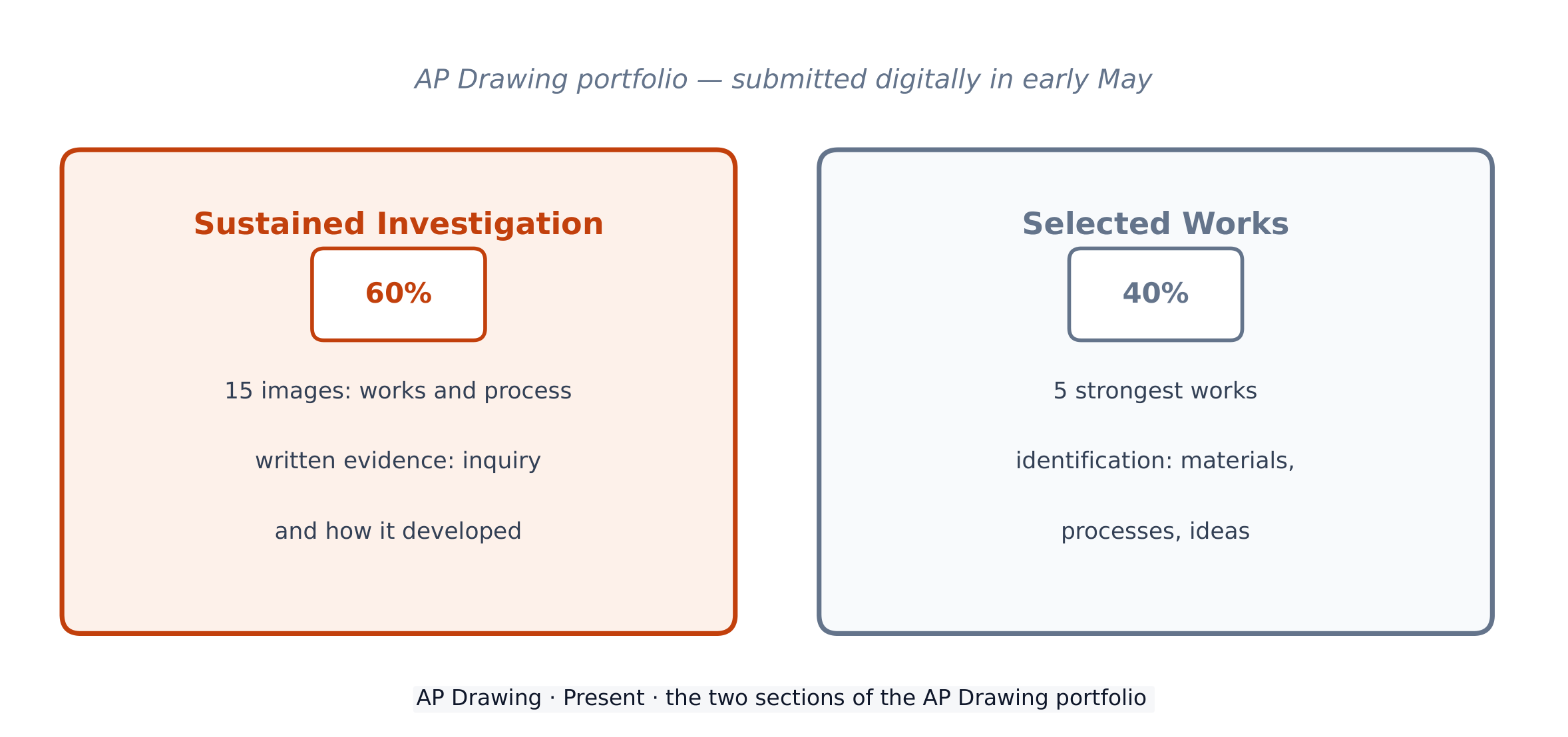
  • Sustained Investigation: 15 images of works and process, plus written evidence — 60% of the score.
  • Selected Works: 5 works demonstrating skillful synthesis of materials, processes, and ideas — 40%.
  • Selected Works may come from the investigation or outside it — choose your strongest five.
  • Everything uploads through the AP Digital Portfolio; teachers review before final submission.
  • Drawing, 2-D, and 3-D are separate portfolios; a student submits work made for the Drawing skill set.
  • Plan backwards from May: photography, writing, and selection all take real calendar time.

Source: College Board AP Course and Exam Description

The AP exam is a portfolio 作品集, not a written test — two sections submitted digitally in early May. (CED Big Idea 3)

The AP Drawing portfolio: Sustained Investigation (15 images + writing, 60%) and Selected Works (5 works, 40%) Two sections: the Sustained Investigation carries 60% of the score, the Selected Works 40%

  • Sustained Investigation: 15 images of works and process, plus written evidence — 60% of the score.
  • Selected Works 精选作品: 5 works demonstrating skilful synthesis of materials, processes, and ideas — 40%.
  • Selected Works may come from inside or outside the investigation. Choose your strongest five, wherever they came from.
  • Everything uploads through the AP Digital Portfolio 数字作品集平台; your teacher reviews before final submission.
  • Drawing, 2-D, and 3-D Art and Design are separate portfolios — submit work made for the Drawing skill set.
  • Plan backwards from May: photography, writing, and selection all take real calendar time.
Explore

Where does it belong?

The Sustained Investigation holds 15 images with written evidence (60%); the Selected Works are your five strongest pieces (40%). Some things belong in neither.

Vocabulary Train
English Chinese Pinyin
portfolio 作品集 zuò pǐn jí
Selected Works 精选作品 jīng xuǎn zuò pǐn
AP Digital Portfolio 数字作品集平台 shù zì zuò pǐn jí píng tái
7.2

Sustained Investigation: Images and Written Evidence

Syllabus

Focus: The SI section pairs 15 images with short written evidence — images show, writing states. (CED 3.A/3.B)

  • Writing has two prompts: state the inquiry, and describe how the investigation developed — 1,200 characters total.
  • Every image carries its own caption fields: materials, processes, dimensions (and citations when needed).
  • Choose images that prove the writing: question stated → tests shown → development visible.
  • Process images (journal spreads, in-progress states, detail shots) count among the 15 — use several.
  • Order the images deliberately: scorers read them as a sequence, so build a narrative arc.
  • Write plainly and concretely; name materials, processes, ideas, and skills in CED vocabulary.

Source: College Board AP Course and Exam Description

The SI section pairs 15 images with short written evidence 书面证据 — the images show, the writing states. (CED 3.A/3.B)

  • The writing answers two prompts: state the inquiry, and describe how the investigation developed — about 1,200 characters in total.
  • Every image carries caption fields: materials 材料, processes 过程, dimensions, and citations where needed.
  • Choose images that prove the writing: question stated, tests shown, development visible.
  • Process images — journal spreads, in-progress states, detail shots — count among the 15. Use several.
  • Order the images deliberately: scorers read them as a sequence, so build a narrative arc.
  • Write plainly and concretely, naming skills and components in CED vocabulary.
Vocabulary Train
English Chinese Pinyin
written evidence 书面证据 shū miàn zhèng jù
materials 材料 cái liào
processes 过程 guò chéng
7.3

Selected Works: Demonstrating Skills

Syllabus

Focus: Selected Works are your five strongest statements — each judged on written evidence, drawing skills, and synthesis. (CED 3.C)

  • Pick for range and strength: together the five should cover the drawing skills list.
  • Each work carries identification: materials, processes, ideas — 100 characters per field, make every word count.
  • Quality beats concept here: flawless craft and full value range are what a 5 looks like.
  • Strong candidates: the observational tour de force, the chiaroscuro drama, the expressive figure, the synthesis piece.
  • Details matter at scoring size — view each candidate at thumbnail scale and at full zoom before choosing.
  • Ask three viewers to rank your top eight; overlap usually finds the true five.

Source: College Board AP Course and Exam Description

The Selected Works are your five strongest statements — each judged on written evidence, drawing skills, and synthesis. (CED 3.C)

  • Pick for range and strength: together, the five should cover the whole drawing-skills list.
  • Each work carries an identification 作品信息: materials, processes, ideas — about 100 characters per field, so make every word count.
  • Quality beats concept here: flawless craft and a full value range are what a 5 looks like.
  • Strong candidates: the observational tour de force, the chiaroscuro drama, the expressive figure, the synthesis piece.
  • Details matter at scoring size. View each candidate as a small thumbnail and at full zoom before choosing.
  • Ask three viewers to rank your top eight; the overlap usually finds the true five.
Vocabulary Train
English Chinese Pinyin
identification 作品信息 zuò pǐn xìn xī
7.4

Writing About Your Work

Syllabus

Focus: The written evidence is short, factual, and load-bearing — it directs the scorer's attention. (CED 3.D/3.E)

  • State the inquiry as a question or clear statement in the first sentence.
  • Use concrete nouns and verbs: 'compressed charcoal on gessoed cardboard, lifted with erasers' beats 'mixed media'.
  • Connect writing to visible things: if you claim experimentation, the images must show it.
  • Completely unrelated writing caps the Selected Works score — relevance is a rubric rule.
  • Draft early, cut hard: character limits reward the specific and punish the vague.
  • Have someone read writing while viewing the images — wherever they ask 'where?', revise.

Source: College Board AP Course and Exam Description

The written evidence is short, factual, and load-bearing — it directs the scorer's attention. (CED 3.D/3.E)

  • State the inquiry as a question or a clear statement in the first sentence.
  • Use concrete nouns and verbs: "compressed charcoal on gessoed cardboard, lifted with erasers" beats "mixed media".
  • Connect writing to visible things: if you claim experimentation, the images must show it.
  • Writing completely unrelated to the works caps the Selected Works score — relevance is a rubric rule.
  • Draft early and cut hard: character limits reward the specific and punish the vague.
  • Have someone read the writing while viewing the images. Wherever they ask "where?", revise.
7.5

Presentation and Image Quality

Syllabus

Focus: Scorers see photographs, not originals — photography quality is portfolio quality. (CED 3.F)

  • Shoot in even, indirect daylight or two-lamp setups; avoid glare, shadows across the work, and keystone distortion.
  • Fill the frame, crop to the work's edges, and keep verticals vertical.
  • Check values on screen: a washed-out photo erases the light-and-shade skill you spent weeks building.
  • Detail shots are allowed and powerful — a close-up of mark-making proves what a full view only suggests.
  • Consistent, neutral backgrounds make a sequence read professionally.
  • Photograph work as it is finished, not all in April — fixative first, then shoot, then store flat.

Source: College Board AP Course and Exam Description

Scorers see photographs 照片, not originals — photography quality is portfolio quality. (CED 3.F)

  • Shoot in even, indirect daylight or a two-lamp setup. Avoid glare, shadows across the work, and keystone distortion 梯形畸变.
  • Fill the frame, crop to the work's edges, and keep verticals vertical.
  • Check values on screen: a washed-out photo erases the light-and-shade skill you spent weeks building.
  • A detail shot 细节图 is allowed and powerful — a close-up of mark-making proves what a full view only suggests.
  • Consistent, neutral backgrounds make a sequence read professionally.
  • Photograph each work as it is finished, not all in April: fixative first, then shoot, then store flat.
Vocabulary Train
English Chinese Pinyin
photographs 照片 zhào piān
keystone distortion 梯形畸变 tī xíng jī biàn
detail shot 细节图 xì jié tú
7.6

Understanding the Scoring Guidelines

Syllabus

Focus: Both sections are scored against published rubrics — knowing the rows lets you build to them.

  • Sustained Investigation rows: inquiry evident, evidence of practice/experimentation/revision, materials-processes-ideas, skills, and synthesis.
  • Selected Works criteria: written evidence identifies components; drawing skills; synthesis — scored 1-5 by preponderance of evidence.
  • Rubric language ladder: rudimentary → moderate → good → advanced — aim your evidence at the top descriptors.
  • Score your own mock portfolio against the rubric each term; the gaps write your to-do list.
  • Scores 1-5 arrive in July; college credit policies vary — but the rubric habits are the real prize.
  • Every rubric row asks for visual evidence — the recurring answer is: show it, then name it.

Source: College Board AP Course and Exam Description

Both sections are scored against published scoring guidelines 评分标准 — knowing the rows lets you build toward them.

The rubric ladder: rudimentary, moderate, good, advanced — aim your evidence at the top The rubric's language ladder: aim every piece of evidence at the top descriptors

  • Sustained Investigation rows: inquiry evident; practice, experimentation, and revision; materials, processes, and ideas; drawing skills; synthesis.
  • Selected Works criteria: written evidence identifies components; drawing skills; synthesis — scored 1-5 by preponderance of evidence 证据的总体倾向.
  • The rubric's language ladder runs rudimentary, moderate, good, advanced — aim your evidence at the top descriptors.
  • Score your own mock portfolio against the rubric each term; the gaps write your to-do list.
  • Scores 1-5 arrive in July, and college credit policies vary — but the rubric habits are the real prize.
  • Every rubric row asks for visual evidence. The recurring answer: show it, then name it.
Vocabulary Train
English Chinese Pinyin
scoring guidelines 评分标准 píng fēn biāo zhǔn
preponderance of evidence 证据的总体倾向 zhèng jù de zǒng tǐ qīng xiàng
7.7

Academic Integrity and Citing Sources

Syllabus

Focus: The portfolio must be your own work; borrowed images and AI tools have strict rules.

  • Working from someone else's photograph or artwork requires citation in the image's materials/processes fields.
  • Substantially copying another artist's work — even cited — cannot demonstrate your idea development.
  • Draw from life and from your own reference photos wherever possible; it also simply teaches more.
  • Generative AI may not make your work: AP policy allows it only as a documented exploration tool, never as the artwork.
  • Plagiarism cancels scores — the College Board checks, and teachers must certify originality.
  • Integrity is also artistic self-interest: your own seeing is the only unique material you have.

Source: College Board AP Course and Exam Description

The portfolio must be your own work. Borrowed images and AI tools have strict rules.

  • Working from someone else's photograph or artwork requires a citation 引用 in that image's materials/processes fields.
  • Substantially copying another artist's work — even cited — cannot demonstrate your idea development.
  • Draw from life and from your own reference photos wherever possible; it also simply teaches more.
  • Generative AI 生成式人工智能 may not make your work: AP policy allows it only as a documented exploration tool, never as the artwork.
  • Plagiarism 抄袭 cancels scores. The College Board checks, and teachers must certify originality.
  • Integrity is also artistic self-interest: your own seeing is the only truly unique material you have.
Vocabulary Train
English Chinese Pinyin
citation 引用 yǐn yòng
generative AI 生成式人工智能 shēng chéng shì rén gōng zhì néng
plagiarism 抄袭 chāo xí
7.7

Exam tips

  • Photograph like it matters, because it does — a 5-level drawing shot with glare and keystone reads as a 3. Reshoot anything you hesitate over.
  • Fill every caption field with specifics. "Willow charcoal, subtractive erasing, on toned Ingres paper" does scoring work; empty or vague fields waste free marks.
  • Check the relevance rule: if your written evidence could sit under someone else's portfolio unchanged, it is too generic — tie every sentence to your images.
  • Select the five with fresh eyes: thumbnail-size printouts on a table, three trusted viewers, overlap wins.
  • Cite every reference photo you did not take — one missing citation risks the whole portfolio; thirty seconds of typing removes the risk.

Log in or create account

IGCSE & A-Level