Skip to content
Subjects

AP Drawing

  • 1 Line and Mark-Making
    1.1

    Line Quality

    Syllabus

    Focus: Line quality is how a line looks and feels — the first drawing skill the AP rubric names is mark-making.

    • A line can be thick or thin, dark or light, smooth or rough, fast or slow.
    • Weighted line changes thickness along its length: press harder where a form turns away or carries weight.
    • Confident lines are drawn from the shoulder and elbow, not only the fingers.
    • Lost-and-found lines fade out and reappear — the viewer's eye completes the edge.
    • Line direction carries feeling: horizontal is calm, vertical is firm, diagonal is active.
    • Examiners read line quality instantly — scratchy, timid lines and one confident stroke tell different stories.

    Source: College Board AP Course and Exam Description

    Line quality 线条质感 is how a line looks and feels. The AP Drawing rubric names mark-making 笔触 first in its list of drawing skills, and line is the most basic mark.

    • A line can be thick or thin, dark or light, smooth or rough, fast or slow.
    • A weighted line 轻重线条 changes thickness along its length. Press harder where a form turns away from the light or carries weight.
    • Lost-and-found lines 虚实线条 fade out and come back. The viewer's eye completes the missing edge.
    • Confident lines come from the shoulder and elbow, not only the fingers.

    Line qualities: even, weighted, lost-and-found, and expressive lines compared The same edge drawn four ways: an even line, a weighted line, a lost-and-found line, and a fast expressive line

    Line direction carries feeling: horizontal lines feel calm, vertical lines feel firm, and diagonal lines feel active. Examiners read line quality instantly, so practise until your lines look decided, not timid.

    Vocabulary Train
    English Chinese Pinyin
    line quality 线条质感 xiàn tiáo zhì gǎn
    mark-making 笔触 bǐ chù
    weighted line 轻重线条 qīng zhòng xiàn tiáo
    lost-and-found lines 虚实线条 xū shí xiàn tiáo
    1.2

    Contour Drawing

    Syllabus

    Focus: Contour drawing follows the edges of a form slowly and carefully — it trains eye-hand coordination.

    • A contour line traces the outer edge and the inner edges (folds, creases, overlaps) of a subject.
    • In blind contour you draw without looking at the paper — pure observation practice.
    • Cross-contour lines travel across the surface of a form, like latitude lines on a globe, and describe volume.
    • Draw slowly: match the speed of your eye moving along the edge with the speed of your pencil.
    • Overlapping contours (one edge passing in front of another) create instant depth.
    • Contour studies make strong Sustained Investigation process pages — they show observation skill.

    Source: College Board AP Course and Exam Description

    A contour line 轮廓线 traces the edges of a form — the outer edge and the inner edges made by folds, creases, and overlaps. Contour drawing is slow, careful looking.

    • Match the speed of your eye moving along the edge with the speed of your pencil.
    • In blind contour 盲画轮廓 you draw without looking at the paper. It feels strange, but it trains pure observation.
    • Cross-contour lines 横截轮廓线 travel across the surface of a form, like latitude lines on a globe. They describe volume, not edges.
    • Overlapping contours create instant depth: one edge passing in front of another says "this is closer".

    Contour studies make strong process pages for the Sustained Investigation because they show real observation skill.

    Vocabulary Train
    English Chinese Pinyin
    contour line 轮廓线 lún kuò xiàn
    blind contour 盲画轮廓 máng huà lún kuò
    cross-contour lines 横截轮廓线 héng jié lún kuò xiàn
    1.3

    Gesture Drawing

    Syllabus

    Focus: Gesture drawing captures the energy, movement, and weight of a subject in seconds — before any detail.

    • A gesture drawing takes 30 seconds to 3 minutes; it looks for the action line running through the pose.
    • Draw the whole subject at once — big loose lines from the shoulder — never one polished corner.
    • Look for the line of action first: one curve that summarises the pose's movement.
    • Gesture is about what the subject is doing, not what it looks like.
    • Daily gesture pages build speed and confidence, and they photograph well as process evidence.
    • Long drawings usually start as a gesture: energy first, structure second, detail last.

    Source: College Board AP Course and Exam Description

    Gesture drawing 动态速写 captures the energy, movement, and weight of a subject in seconds — before any detail.

    • A gesture drawing takes 30 seconds to 3 minutes. Draw the whole subject at once with big, loose lines.
    • Look for the line of action 动势线 first: one curve that summarises the movement of the pose.
    • Gesture asks what the subject is doing, not what it looks like.
    • Long drawings usually start as a gesture: energy first, structure second, detail last.

    Daily gesture pages build speed and confidence, and they photograph well as evidence of practice.

    Vocabulary Train
    English Chinese Pinyin
    gesture drawing 动态速写 dòng tài sù xiě
    line of action 动势线 dòng shì xiàn
    1.4

    Hatching and Cross-Hatching

    Syllabus

    Focus: Hatching builds value with parallel lines; cross-hatching layers a second direction on top.

    • Closer, darker lines read as darker value; wider spacing reads as lighter value.
    • Cross-hatching adds layers at new angles — each layer deepens the tone step by step.
    • Curve the hatch lines around the form (cross-contour hatching) so the shading also describes volume.
    • Keep a consistent angle inside one plane; change angle when the plane changes — edges stay crisp.
    • Pen-and-ink drawing depends on hatching because ink has no grey — value comes only from line density.
    • Hatching shows control of mark-making and light and shade, two named AP drawing skills, in one technique.

    Source: College Board AP Course and Exam Description

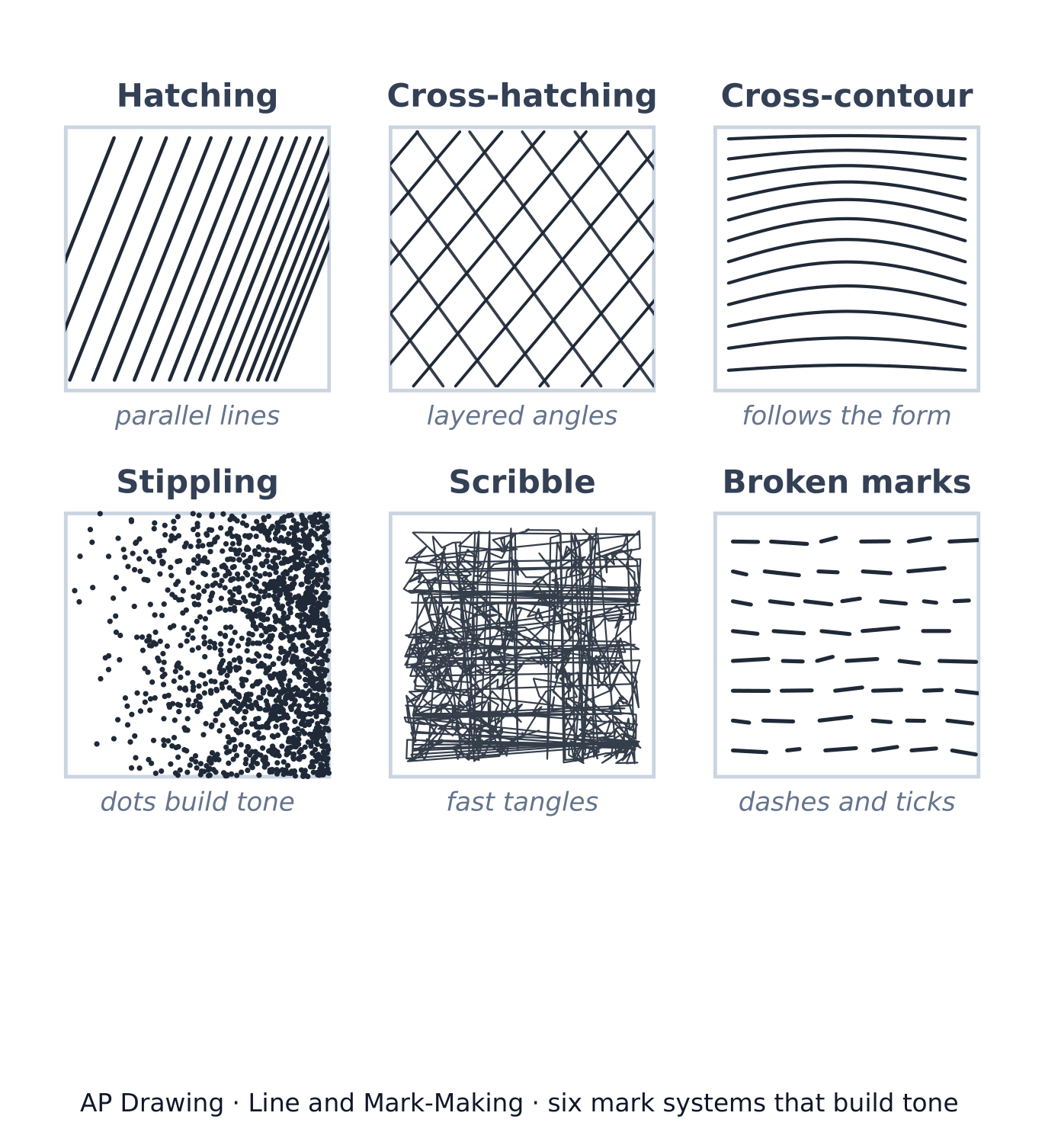
    Hatching 排线 builds tone with parallel lines. Cross-hatching 交叉排线 layers a second set of lines at a new angle on top.

    Six mark systems: hatching, cross-hatching, cross-contour hatching, stippling, scribble, and broken marks Six ways to build tone with marks; closer and denser marks read as darker value

    • Closer, darker lines read as darker value 明度; wider spacing reads as lighter value.
    • Each cross-hatched layer deepens the tone step by step — build darkness gradually.
    • Curve the lines around the form (cross-contour hatching) so the shading also describes volume.
    • Keep one angle inside one plane; change the angle when the plane changes, and edges stay crisp.
    • Pen-and-ink drawing depends on hatching, because ink has no grey: value comes only from line density.
    Explore

    Which mark system is it?

    Hatching uses parallel lines, cross-hatching layers a second angle, stippling builds tone from dots, and scribble uses fast tangles. Naming mark systems helps you choose and describe your own.

    Vocabulary Train
    English Chinese Pinyin
    hatching 排线 pái xiàn
    cross-hatching 交叉排线 jiāo chā pái xiàn
    value 明度 míng dù
    1.5

    Stippling, Scribbling, and Alternative Marks

    Syllabus

    Focus: Beyond hatching there is a whole vocabulary of marks — dots, scribbles, dashes, smears — each with its own texture and speed.

    • Stippling builds tone from dots: dense dots read dark, sparse dots read light — slow but very controllable.
    • Scribble (or scumbled) marks are fast tangles of line — lively, good for fur, foliage, and energy.
    • Dashes, ticks, and broken marks suggest texture without outlining every detail.
    • Marks can be additive (adding material) or subtractive (lifting material out with an eraser).
    • Try one subject rendered in four different mark systems — a classic experimentation page.
    • A personal mark vocabulary is part of your artistic voice — examiners look for it across the portfolio.

    Source: College Board AP Course and Exam Description

    Beyond hatching there is a whole vocabulary of marks — dots, tangles, dashes, smears — each with its own texture and speed.

    • Stippling 点画 builds tone from dots: dense dots read dark, sparse dots read light. Slow, but very controllable.
    • Scribble 乱线 marks are fast tangles of line — lively and good for fur, foliage, and energy.
    • Dashes, ticks, and broken marks suggest texture without outlining every detail.
    • Marks can be additive 加法 (putting material on) or subtractive 减法 (lifting material off with an eraser).
    • A classic experimentation page: one subject rendered in four different mark systems.
    Vocabulary Train
    English Chinese Pinyin
    stippling 点画 diǎn huà
    scribble 乱线 luàn xiàn
    additive 加法 jiā fǎ
    subtractive 减法 jiǎn fǎ
    1.6

    Texture and Surface

    Syllabus

    Focus: Surface is a named AP drawing skill: how the drawing's physical texture and the depicted texture work together.

    • Actual texture is the real surface of the work (rough paper, layered charcoal, collage); implied texture is drawn illusion.
    • Frottage (rubbing over a textured surface) transfers real texture into a drawing.
    • Paper tooth (roughness) changes every mark: the same pencil reads differently on smooth and rough paper.
    • Contrast of textures — smooth skin against rough cloth — makes both read more strongly.
    • Build texture with the logic of the material: short strokes for fur, long strokes for hair, broken marks for stone.
    • Describing texture convincingly is visual evidence of observation and material control.

    Source: College Board AP Course and Exam Description

    Surface 画面质感 is a named AP drawing skill: the physical texture of the drawing and the drawn illusion of texture work together.

    • Actual texture 实际肌理 is the real surface of the work — rough paper, layered charcoal, collage. Implied texture 视觉肌理 is drawn illusion.
    • Frottage 拓印法 (rubbing over a textured surface) transfers real texture into a drawing.
    • Paper tooth 纸纹 changes every mark: the same pencil reads differently on smooth and rough paper.
    • Contrast of textures — smooth skin against rough cloth — makes both read more strongly.
    • Build texture with the logic of the material: short strokes for fur, long strokes for hair, broken marks for stone.
    Vocabulary Train
    English Chinese Pinyin
    surface 画面质感 huà miàn zhì gǎn
    actual texture 实际肌理 shí jì jī lǐ
    implied texture 视觉肌理 shì jué jī lǐ
    frottage 拓印法 tà yìn fǎ
    tooth 纸纹 zhǐ wén
    1.7

    Expressive Mark-Making

    Syllabus

    Focus: Marks carry emotion: the same subject drawn with angry, calm, or nervous marks tells three different stories.

    • Expressive lines exaggerate speed, pressure, and direction to communicate feeling, not just describe form.
    • Käthe Kollwitz's heavy charcoal and Egon Schiele's tense contours show how marks are the meaning.
    • Choose the mark to match the idea: soft graphite for quiet subjects, aggressive ink for conflict.
    • Distortion and exaggeration are legitimate drawing decisions when they serve intent — 'accurate' is not the only goal.
    • The AP rubric rewards ideas made visual: expressive marks link technique to meaning.
    • Test the same composition in two mark styles and write one sentence on which supports your inquiry better.

    Source: College Board AP Course and Exam Description

    Marks carry emotion. The same subject drawn with angry, calm, or nervous marks tells three different stories.

    • Expressive lines 表现性线条 exaggerate speed, pressure, and direction to communicate feeling, not just to describe form.
    • Käthe Kollwitz's heavy charcoal and Egon Schiele's tense contours show how the marks themselves carry the meaning.
    • Choose the mark to match the idea: soft graphite for quiet subjects, aggressive ink for conflict.
    • Distortion 变形 and exaggeration are legitimate drawing decisions when they serve your intent — "accurate" is not the only goal.
    • A personal mark vocabulary is part of your artistic voice 个人风格. Examiners look for it across the whole portfolio.
    Vocabulary Train
    English Chinese Pinyin
    expressive lines 表现性线条 biǎo xiàn xìng xiàn tiáo
    distortion 变形 biàn xíng
    voice 个人风格 gè rén fēng gé
    1.7

    Exam tips

    • Line quality is judged at a glance — one page of confident, varied strokes tells a scorer more than an hour of timid rendering. Warm up before every serious drawing.
    • Show the systems, not just the results: a portfolio image of hatching, stippling, and cross-contour studies is direct visual evidence of the mark-making skill the rubric names.
    • Photograph marks close up. A detail shot of your best passage of marks proves a skill that a full view only suggests.
    • Blind contour and gesture pages belong in your process images — they show observation and practice, exactly what the Sustained Investigation rubric asks to see.
    • Match marks to meaning in your written evidence: one sentence like "scratchy graphite lines echo the anxiety of exam season" links technique to idea, which is what scorers reward.
  • 2 Value, Light, and Form
    2.1

    The Value Scale

    Syllabus

    Focus: Value is lightness and darkness — the backbone of drawing, because we see form as light before we see colour.

    • A value scale runs from white through greys to black; a 9-step scale is the classic exercise.
    • Most beginners draw too light and too narrow — push the darks so the full range is used.
    • High-key drawings use mostly light values (airy, soft); low-key drawings use mostly dark values (heavy, dramatic).
    • Squint at the subject: squinting removes detail and shows the big value shapes.
    • Local value (how light the object's own surface is) is separate from lighting (how much light falls on it).
    • Control of the value scale is direct visual evidence of the AP skill light and shade.

    Source: College Board AP Course and Exam Description

    Value 明度 is lightness and darkness — the backbone of drawing, because we see form as light before we see colour.

    • A value scale 明度阶 runs from white through greys to black. Drawing a smooth 9-step scale is the classic control exercise.
    • Most beginners draw too light and use too narrow a range. Push the darks so the drawing uses the full scale.
    • High-key 高调 drawings use mostly light values and feel airy; low-key 低调 drawings use mostly dark values and feel heavy or dramatic.
    • Local value 固有明度 is how light the object's own surface is; lighting is how much light falls on it. Keep the two ideas separate.
    • Squint 眯眼 at the subject: squinting removes detail and shows the big value shapes.
    Vocabulary Train
    English Chinese Pinyin
    value 明度 míng dù
    value scale 明度阶 míng dù jiē
    high-key 高调 gāo diào
    low-key 低调 dī diào
    local value 固有明度 gù yǒu míng dù
    squint 眯眼 mī yǎn
    2.2

    Light Logic: How Light Describes Form

    Syllabus

    Focus: One light source creates a predictable pattern of light and shadow — learn the pattern and any form becomes drawable.

    • The six zones: highlight, light, halftone, core shadow, reflected light, and cast shadow.
    • The core shadow is the darkest band on the form, where the surface turns fully away from the light.
    • Reflected light bounces back into the shadow side — it is always darker than any lit halftone.
    • The cast shadow is darkest and sharpest where it meets the object, softer and lighter further away.
    • Shadow edges tell the story: hard edges = sharp turn or cast shadow; soft edges = gradual turn.
    • Check the logic, not just the look: every value must be explainable by the light's direction.

    Source: College Board AP Course and Exam Description

    One light source creates a predictable pattern of light and shadow. Learn the pattern, and any form becomes drawable.

    A sphere under one light source, with the six zones of light labelled One light source, six zones: highlight, light, halftone, core shadow, reflected light, and cast shadow

    • The six zones: highlight 高光, light, halftone 中间调, core shadow 明暗交界线, reflected light 反光, and cast shadow 投影.
    • The core shadow is the darkest band on the form, where the surface turns fully away from the light.
    • Reflected light bounces back into the shadow side — but it is always darker than any lit halftone.
    • The cast shadow is darkest and sharpest where it meets the object, then softer and lighter further away.
    • Shadow edges tell the story: hard edges mean a sharp turn or a cast shadow; soft edges mean a gradual turn.
    Explore

    Which zone of light?

    One light source makes six zones. The core shadow is the darkest band on the form; reflected light stays darker than any lit halftone; the cast shadow is sharpest where it meets the object.

    Vocabulary Train
    English Chinese Pinyin
    highlight 高光 gāo guāng
    halftone 中间调 zhōng jiān diào
    core shadow 明暗交界线 míng àn jiāo jiè xiàn
    reflected light 反光 fǎn guāng
    cast shadow 投影 tóu yǐng
    2.3

    Rendering Form

    Syllabus

    Focus: Rendering means building smooth, believable volume — turning flat shapes into spheres, cylinders, and boxes.

    • Every complex subject simplifies into basic forms: sphere, cylinder, cube, cone — render those first.
    • Work dark to light or light to dark consistently; jumping around destroys the value structure.
    • Blend with intention: stumps and fingers smooth values, but preserved mark-making often reads stronger than over-blending.
    • Keep the lit side and shadow side clearly separated — form collapses when halftones creep into shadow.
    • A drawing of white objects (eggs, cups, cloth) is the classic rendering test: value comes only from light.
    • Rendered form demonstrates several AP drawing skills at once: light and shade, surface, and mark-making.

    Source: College Board AP Course and Exam Description

    Rendering 塑造 means building smooth, believable volume — turning flat shapes into spheres, cylinders, and boxes.

    • Every complex subject simplifies into basic forms 基本形体: sphere, cylinder, cube, cone. Render those first.
    • Work dark-to-light or light-to-dark consistently; jumping around destroys the value structure.
    • Blend with intention: a blending stump 擦笔 smooths values, but preserved marks often read stronger than over-blending.
    • Keep the lit side and the shadow side clearly separated. Form collapses when halftones creep into the shadow.
    • A drawing of white objects (eggs, cups, cloth) is the classic rendering test: all the value comes from light alone.
    Vocabulary Train
    English Chinese Pinyin
    rendering 塑造 sù zào
    basic forms 基本形体 jī běn xíng tǐ
    blending stump 擦笔 cā bǐ
    2.4

    Chiaroscuro and High-Contrast Drawing

    Syllabus

    Focus: Chiaroscuro ('light-dark') uses strong value contrast for drama — the language of Caravaggio and Rembrandt.

    • A single strong light against deep shadow pushes the subject forward and sets the mood.
    • Tenebrism is extreme chiaroscuro: most of the image sinks into darkness, one area blazes.
    • Reserve the strongest contrast for the focal point — contrast attracts the eye first.
    • Charcoal and ink wash suit chiaroscuro because they reach rich, deep darks quickly.
    • Working on toned paper with white and black media makes the light logic explicit.
    • High-contrast studies photograph impressively — strong candidates for Selected Works.

    Source: College Board AP Course and Exam Description

    Chiaroscuro 明暗对照法 ("light-dark") uses strong value contrast for drama — the language of Caravaggio and Rembrandt.

    • A single strong light against deep shadow pushes the subject forward and sets the mood.
    • Tenebrism 暗色调主义 is extreme chiaroscuro: most of the image sinks into darkness while one area blazes.
    • Save the strongest contrast for the focal point 视觉焦点 — contrast attracts the eye first.
    • Charcoal and ink wash suit chiaroscuro because they reach rich, deep darks quickly.
    • Working on toned paper 有色纸 with black and white media makes the light logic explicit.
    Vocabulary Train
    English Chinese Pinyin
    chiaroscuro 明暗对照法 míng àn duì zhào fǎ
    tenebrism 暗色调主义 àn sè diào zhǔ yì
    focal point 视觉焦点 shì jué jiāo diǎn
    toned paper 有色纸 yǒu sè zhǐ
    2.5

    Tonal Composition and Notan

    Syllabus

    Focus: Notan is the design of light and dark shapes — a drawing works or fails at thumbnail size before any detail.

    • Reduce the scene to 2-3 flat values (a notan study): if the pattern reads clearly, the composition is strong.
    • Thumbnail sketches (5-8 cm) let you test several value plans in minutes.
    • Group values: many small lights scattered everywhere feel noisy; connected value shapes feel designed.
    • Place the darkest dark against the lightest light at the focal point.
    • A clear value hierarchy — one dominant value, one secondary, one accent — organises the whole page.
    • Keep the thumbnails in your process journal: they are ideal Sustained Investigation evidence of planning.

    Source: College Board AP Course and Exam Description

    Notan 明暗构成 is the design of light and dark shapes. A drawing works or fails at thumbnail size, before any detail exists.

    Two notan thumbnails: a connected value pattern reads clearly, scattered values read as noise Reduce the scene to two or three values: connected value shapes read clearly; scattered spots read as noise

    • Reduce the scene to 2-3 flat values. If the pattern still reads clearly, the composition is strong.
    • Thumbnail sketches 小稿 (5-8 cm) let you test several value plans in minutes.
    • Group your values: many small lights scattered everywhere feel noisy; connected value shapes feel designed.
    • Place the darkest dark against the lightest light at the focal point.
    • A clear value hierarchy — one dominant value, one secondary, one accent — organises the whole page.
    Vocabulary Train
    English Chinese Pinyin
    notan 明暗构成 míng àn gòu chéng
    thumbnail sketches 小稿 xiǎo gǎo
    2.6

    Toned Grounds and Subtractive Drawing

    Syllabus

    Focus: Starting from a toned ground lets you draw both directions: darker with media, lighter with an eraser.

    • Cover the paper with an even charcoal or graphite tone, then lift out lights with a kneaded eraser.
    • Subtractive drawing treats the eraser as a drawing tool — pulling light out of dark.
    • Toned or grey paper gives a ready-made middle value: add darks and white highlights only.
    • The mid-tone start forces value decisions early — nothing hides behind white paper.
    • Erasers make marks too: a dragged kneaded eraser leaves soft light strokes, a hard eraser leaves crisp ones.
    • This process shows experimentation with materials and processes — exactly what the CED asks you to document.

    Source: College Board AP Course and Exam Description

    Starting from a toned ground 有色底 lets you draw in both directions: darker with media, lighter with an eraser.

    • Cover the paper with an even charcoal or graphite tone, then lift out 提白 the lights with an eraser.
    • Subtractive drawing 减法素描 treats the eraser as a drawing tool — pulling light out of dark.
    • A kneaded eraser 可塑橡皮 moulds to any shape: dab for soft lights, drag for soft strokes; a hard eraser cuts crisp lights.
    • Toned or grey paper gives a ready-made middle value: you add only the darks and the white highlights.
    • The mid-tone start forces value decisions early — nothing can hide behind white paper.
    • This process is visible experimentation 实验 with materials — exactly what the CED asks you to document.
    Vocabulary Train
    English Chinese Pinyin
    toned ground 有色底 yǒu sè dǐ
    lift out 提白 tí bái
    subtractive drawing 减法素描 jiǎn fǎ sù miáo
    kneaded eraser 可塑橡皮 kě sù xiàng pí
    experimentation 实验 shí yàn
    2.6

    Exam tips

    • Full value range is a score signal. Scorers see weak, grey-on-grey drawings constantly; a confident black-to-white range stands out immediately.
    • Get the core shadow and reflected light right — they are what separates students who understand light logic from students who copy photos.
    • Include one white-object study in your practice images: value control with no local colour to hide behind is unmistakable visual evidence of the light and shade skill.
    • Photograph dark drawings carefully. Charcoal darks crush to a black mush in bad light; recheck the value range on screen before submitting.
    • Keep your notan thumbnails and submit a page of them as a process image — planning evidence directly supports the Sustained Investigation rubric.
  • 3 Space, Depth, and Proportion
    3.1

    Measuring and Sighting

    Syllabus

    Focus: Sighting is measuring the subject with your pencil at arm's length — the observational drawing survival skill.

    • Hold the pencil at full arm's length, lock the elbow, close one eye: now it is a ruler and a protractor.
    • Pick one unit (often the head, or a cup's height) and measure everything in that unit: comparative measurement.
    • Check angles by rotating the pencil to match an edge, then carrying that angle to the paper.
    • Plumb lines (vertical checks) and level lines (horizontal checks) locate landmarks above and below each other.
    • Draw envelope shapes first: the big simple shape that contains the whole subject, then divide it.
    • Measured accuracy is visual evidence of space and proportion control in the AP rubric's drawing skills.

    Source: College Board AP Course and Exam Description

    Sighting 目测 means measuring the subject with your pencil at arm's length — the survival skill of observational drawing.

    • Hold the pencil at full arm's length with a locked elbow and one eye closed: now it is a ruler and a protractor.
    • Pick one unit (often the head, or a cup's height) and measure everything in that unit — comparative measurement 比较测量.
    • Check angles by rotating the pencil to match an edge, then carrying that angle to the paper.
    • A plumb line 铅垂线 (an imagined vertical) shows which landmarks sit exactly above or below each other.
    • Draw the envelope 外包形 first: the big simple shape that contains the whole subject, then divide it.
    Vocabulary Train
    English Chinese Pinyin
    sighting 目测 mù cè
    comparative measurement 比较测量 bǐ jiào cè liáng
    plumb line 铅垂线 qiān chuí xiàn
    envelope 外包形 wài bāo xíng
    3.2

    One-Point Perspective

    Syllabus

    Focus: Linear perspective turns the picture plane into a window: in one-point, all depth lines meet at a single vanishing point.

    • The horizon line is the viewer's eye level — everything above it we look up at, everything below we look down on.
    • Lines parallel to the picture plane stay true; lines going into the scene converge to the vanishing point.
    • Equal spaces look smaller as they recede — use the diagonal trick to divide receding space evenly.
    • One-point suits rooms, streets, and corridors seen straight-on.
    • Objects overlap and rise toward the horizon as they get further away — perspective plus overlap is depth doubled.
    • Perspective errors are easy to spot: check every depth line actually aims at the point.

    Source: College Board AP Course and Exam Description

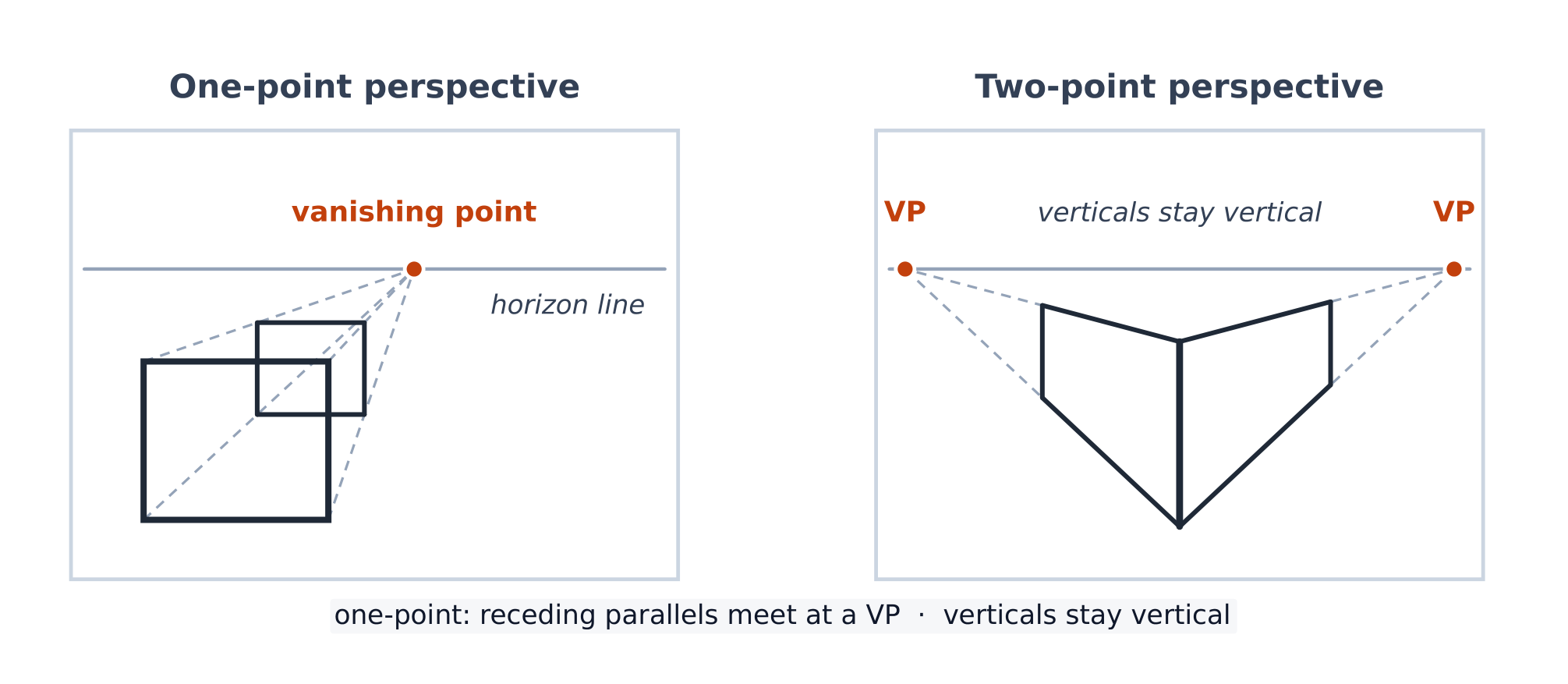
    Linear perspective 线性透视 treats the picture as a window. In one-point perspective, all lines going into the depth meet at a single point.

    One-point and two-point perspective: horizon line, vanishing points, and converging edges Left: one-point — depth lines meet at one vanishing point. Right: two-point — each set of edges meets its own point

    • The horizon line 视平线 is the viewer's eye level. We look down on everything below it and up at everything above it.
    • Lines parallel to the picture surface stay true; lines going into the scene converge to the vanishing point 灭点.
    • Equal spaces look smaller as they recede. Use diagonals to divide receding space evenly.
    • One-point perspective 一点透视 suits rooms, streets, and corridors seen straight-on.
    • Perspective plus overlap 遮挡 is depth doubled: near edges cover far edges.
    Vocabulary Train
    English Chinese Pinyin
    linear perspective 线性透视 xiàn xìng tòu shì
    horizon line 视平线 shì píng xiàn
    vanishing point 灭点 miè diǎn
    one-point perspective 一点透视 yì diǎn tòu shì
    overlap 遮挡 zhē dǎng
    3.3

    Two-Point and Three-Point Perspective

    Syllabus

    Focus: Turn the subject at an angle and you need two vanishing points; look steeply up or down and you need a third.

    • In two-point, verticals stay vertical; both sets of horizontal edges converge to left and right points on the horizon.
    • Keep both vanishing points far apart (often off the paper) — close points create fisheye distortion.
    • Three-point adds a vertical vanishing point: skyscrapers from below (looking up) or street scenes from a rooftop (looking down).
    • Boxes drawn in perspective become the scaffolding for everything: buildings, books, vehicles, even heads.
    • Cast shadows and reflections follow the same perspective system as the objects that make them.
    • A perspective grid underdrawing keeps complex scenes consistent — construct lightly, render on top.

    Source: College Board AP Course and Exam Description

    Turn the subject at an angle and you need two-point perspective 两点透视; look steeply up or down and you need a third point.

    • In two-point, verticals stay vertical; the two sets of horizontal edges converge to a left and a right vanishing point on the horizon.
    • Keep the two points far apart — often off the paper. Points placed too close create a fisheye distortion.
    • Three-point perspective 三点透视 adds a vertical vanishing point: a skyscraper from below, or a street from a rooftop.
    • Boxes drawn in perspective become scaffolding for everything: buildings, books, vehicles, even heads.
    • Cast shadows and reflections obey the same perspective system as the objects that make them.
    Vocabulary Train
    English Chinese Pinyin
    two-point perspective 两点透视 liǎng diǎn tòu shì
    three-point perspective 三点透视 sān diǎn tòu shì
    3.4

    Foreshortening

    Syllabus

    Focus: Foreshortening is perspective applied to a single form pointing toward you — lengths compress dramatically.

    • A pointing arm may appear one-third of its true length: draw the apparent shape, not the known one.
    • Overlap is the key signal: the hand overlaps the forearm, the forearm overlaps the upper arm.
    • Think in cross-sections: imagine rings around the form (like a wireframe) to feel how it turns toward you.
    • Measure foreshortened lengths by sighting — knowledge lies, observation tells the truth.
    • Classic practice: draw a figure lying down feet-first (like Mantegna's Dead Christ).
    • Strong foreshortening is high-difficulty visual evidence — examiners recognise the skill immediately.

    Source: College Board AP Course and Exam Description

    Foreshortening 透视缩短 is perspective applied to a single form pointing toward you — lengths compress dramatically.

    • A pointing arm may appear one-third of its true length. Draw the apparent shape, not the length you know.
    • Overlap is the key signal: the hand overlaps the forearm, the forearm overlaps the upper arm.
    • Think in cross-sections 横截面: imagine rings around the form, like a wireframe, to feel how it turns toward you.
    • Measure foreshortened lengths by sighting — memory lies, observation tells the truth.
    • The classic practice piece: a figure lying down, drawn feet-first, like Mantegna's Dead Christ.
    Vocabulary Train
    English Chinese Pinyin
    foreshortening 透视缩短 tòu shì suō duǎn
    cross-sections 横截面 héng jié miàn
    3.5

    Atmospheric Perspective

    Syllabus

    Focus: Atmospheric (aerial) perspective creates depth without lines: distant things are lighter, cooler, softer, and less detailed.

    • Air scatters light, so contrast fades with distance — the far mountain is a pale flat shape.
    • Foreground: darkest darks, sharpest edges, most texture; background: narrow value range, soft edges.
    • Reserve full black and full white for the foreground; the distance lives in the middle greys.
    • Detail density is a depth cue by itself — render the near leaf, suggest the far tree.
    • Combine linear and atmospheric perspective for maximum depth in landscape and cityscape drawing.
    • This is the AP skill space made visible through light and shade — two rubric skills in one device.

    Source: College Board AP Course and Exam Description

    Atmospheric perspective 空气透视 creates depth without any lines: distant things become lighter, cooler, softer, and less detailed.

    • Air scatters light, so contrast fades with distance. The far mountain is a pale, flat shape.
    • Foreground: darkest darks, sharpest edges, most texture. Background: a narrow value range and soft edges.
    • Save full black and full white for the foreground; the distance lives in the middle greys.
    • Detail density is a depth cue by itself: render the near leaf, suggest the far tree.
    • Combine linear and atmospheric perspective for maximum depth in landscape drawing.
    Explore

    Which depth cue is at work?

    Drawings create depth several ways at once: linear perspective (lines converge), atmospheric perspective (distance fades and softens), overlap (near covers far), and foreshortening (forms compress toward you).

    Vocabulary Train
    English Chinese Pinyin
    atmospheric perspective 空气透视 kōng qì tòu shì
    3.6

    Composition and the Picture Plane

    Syllabus

    Focus: Composition — how everything is arranged inside the picture's edges — is a named AP drawing skill and the first thing a scorer sees.

    • The picture plane has edges: what you crop out is as expressive as what you keep in.
    • The rule of thirds places focal points on the third-lines — safer than dead centre.
    • Control the figure-ground relationship: negative space is a designed shape, not leftover paper.
    • Lead the eye with paths: lines, value contrast, and detail act as arrows toward the focal point.
    • Vary the viewpoint — eye level is neutral; a low or high viewpoint makes an ordinary subject fresh.
    • Test compositions with a viewfinder or phone camera crop before committing to the page.

    Source: College Board AP Course and Exam Description

    Composition 构图 — the arrangement of everything inside the picture's edges — is a named AP drawing skill and the first thing a scorer sees.

    • The picture plane 画面 has edges: what you crop out is as expressive as what you keep in.
    • The rule of thirds 三分法 places focal points on the third-lines — stronger than dead centre.
    • Design the negative space 负空间: the empty shapes around the subject are shapes you drew, not leftovers.
    • The figure-ground relationship 图底关系 must stay readable: the eye should always know what is subject and what is background.
    • Lead the eye with paths — lines, value contrast, and detail act as arrows toward the focal point.
    • Test crops with a viewfinder 取景框 (or a phone camera) before committing to the page. Change the viewpoint 视点: eye level is neutral; low or high angles make ordinary subjects fresh.
    Vocabulary Train
    English Chinese Pinyin
    composition 构图 gòu tú
    picture plane 画面 huà miàn
    rule of thirds 三分法 sān fēn fǎ
    negative space 负空间 fù kōng jiān
    figure-ground relationship 图底关系 tú dǐ guān xì
    viewfinder 取景框 qǔ jǐng kuāng
    viewpoint 视点 shì diǎn
    3.7

    Drawing the Figure and Portrait

    Syllabus

    Focus: The figure combines every drawing skill at once — proportion, gesture, form, and likeness under one deadline.

    • The classic adult figure stands about 7.5 heads tall; the halfway point is near the hip, not the waist.
    • In the head, eyes sit at the halfway line of the skull — the beginner error is placing them too high.
    • Start with gesture and the big masses (ribcage, pelvis, skull); features and fingers come last.
    • Sight-size checks save likeness: compare distances between landmarks, not memorised rules alone.
    • Hands and feet earn their reputation — draw them as simple geometric mittens/wedges first, then divide.
    • Figure and portrait work is a portfolio staple: it demonstrates observation, proportion, and nerve.

    Source: College Board AP Course and Exam Description

    The human figure combines every drawing skill at once: proportion 比例, gesture, form, and likeness under one deadline.

    Figure and head proportions: a standing figure about 7.5 heads tall; eyes at the halfway line of the skull The classic adult figure is about 7.5 heads tall; in the head, the eyes sit at the halfway line

    • The classic adult figure stands about 7.5 heads tall; the halfway point of the body is near the hip, not the waist.
    • In the head, the eyes sit at the halfway line 中线 of the skull — beginners always place them too high.
    • Start with gesture and the big masses (ribcage, pelvis, skull); features and fingers come last.
    • Check likeness with landmark distances, not memorised rules alone — every face bends the average.
    • Draw hands and feet as simple geometric mittens and wedges first, then divide them into parts.
    Vocabulary Train
    English Chinese Pinyin
    proportion 比例 bǐ lì
    halfway line 中线 zhōng xiàn
    3.7

    Exam tips

    • Perspective errors are the easiest mistakes for a scorer to spot — check every depth line actually aims at its vanishing point before you render.
    • Include one strong observational space (an interior, a stairwell, a street) in the portfolio: it demonstrates the space skill the rubric names, unmistakably.
    • Foreshortening is high-value evidence. One convincing foreshortened limb or object tells scorers you draw what you see, not what you remember.
    • Crop like a designer. Before starting, test three viewfinder crops and pick the one with the strongest negative space — composition is judged at first glance.
    • Use atmospheric perspective in graphite too, not just paint: softening far edges with a kneaded eraser is quick and reads as skill.
  • 4 Drawing Media and Processes
    4.1

    Graphite

    Syllabus

    Focus: Graphite is the everyday drawing medium — precise, erasable, and capable of a full (if silvery) value range.

    • Grades run hard to soft: 9H (palest, hardest) through HB to 9B (darkest, softest).
    • Hard grades suit construction lines and fine detail; soft grades build rich darks fast.
    • Graphite gets shiny when layered heavily — deepest blacks may need charcoal or carbon pencil instead.
    • Vary the grip: writing grip for detail, overhand grip for broad, light shading from the arm.
    • Woodless graphite sticks and powder cover big areas; erasers then carve lights back out.
    • A full-value graphite still life is the classic control test — worth one polished example in any portfolio.

    Source: College Board AP Course and Exam Description

    Graphite 石墨 is the everyday drawing medium — precise, erasable, and capable of a full (if silvery) value range.

    Graphite grades from hard 2H to soft 8B, with the value each one reaches Pencil grades: hard grades stay light and precise; soft grades reach rich darks fast

    • Pencil grades 硬度等级 run hard to soft: 9H (palest, hardest) through HB to 9B (darkest, softest).
    • Hard grades suit construction lines and fine detail; soft grades build rich darks fast.
    • Heavy graphite turns shiny. For the deepest blacks, switch to charcoal or a carbon pencil 炭笔.
    • Vary the grip: the writing grip for detail, the overhand grip 横握 for broad, light shading from the arm.
    • Woodless graphite sticks and graphite powder cover big areas; erasers then carve the lights back out.
    • A full-value graphite still life is the classic control test — worth one polished example in any portfolio.
    Vocabulary Train
    English Chinese Pinyin
    graphite 石墨 shí mò
    grades 硬度等级 yìng dù děng jí
    carbon pencil 炭笔 tàn bǐ
    overhand grip 横握 héng wò
    4.2

    Charcoal and Conté

    Syllabus

    Focus: Charcoal is fast, bold, and deeply black — the medium of gesture, chiaroscuro, and large-scale drawing.

    • Vine/willow charcoal is soft and dusts off easily (great for starts); compressed charcoal is dense and permanent.
    • Charcoal loves toned and textured paper; it blends with stumps, cloth, and the side of the hand.
    • Conté crayons (sanguine, sepia, black, white) are waxier — crisper lines, classic figure-drawing look.
    • Work big: charcoal rewards shoulder-scale marks that graphite cannot make.
    • Fixative stops smudging — spray lightly in layers, and always in ventilation.
    • The trio of white conté + sanguine + black on toned paper (trois crayons) is a proven portfolio look.

    Source: College Board AP Course and Exam Description

    Charcoal 木炭 is fast, bold, and deeply black — the medium of gesture, chiaroscuro, and large-scale drawing.

    • Vine charcoal 柳条木炭 is soft and dusts off easily, perfect for starts; compressed charcoal 压缩木炭 is dense and permanent.
    • Charcoal loves toned and textured paper. Blend it with stumps, cloth, or the side of your hand.
    • Conté 炭精条 crayons (sanguine, sepia, black, white) are waxier: crisper lines and the classic figure-drawing look.
    • Work big — charcoal rewards shoulder-scale marks that graphite cannot make.
    • Fixative 定画液 stops smudging. Spray lightly, in layers, and always with ventilation.
    • White conté plus sanguine 血色红棕 and black on toned paper (the trois crayons look) is a proven portfolio classic.
    Explore

    Which medium behaves like this?

    Each drawing medium has a personality: graphite is precise and silvery, charcoal is fast and deeply black, ink commits without erasing, and pastel is almost pure pigment.

    Vocabulary Train
    English Chinese Pinyin
    charcoal 木炭 mù tàn
    vine charcoal 柳条木炭 liǔ tiáo mù tàn
    compressed charcoal 压缩木炭 yā suō mù tàn
    conté 炭精条 tàn jīng tiáo
    fixative 定画液 dìng huà yè
    sanguine 血色红棕 xuè sè hóng zōng
    4.3

    Ink: Pen, Brush, and Wash

    Syllabus

    Focus: Ink commits — no erasing — which is exactly why it builds decisiveness and mark confidence.

    • Dip pens and fineliners build value by hatching and stippling; nib pressure varies the line's weight.
    • Brush and ink swings from hairline to broad stroke in one gesture — the most expressive line tool.
    • Ink wash (diluted ink applied in layers) works like watercolour: light washes first, darks last.
    • Combine a waterproof line with wet washes, or a water-soluble line that bleeds — two different looks.
    • East Asian ink painting (shuǐmò) treats the single loaded brushstroke as the whole discipline.
    • Mistakes become decisions in ink: incorporate them or design around them — strong process-journal material.

    Source: College Board AP Course and Exam Description

    Ink 墨水 commits — there is no erasing — and that is exactly why it builds decisiveness and mark confidence.

    • Dip pens and fineliners build value by hatching and stippling; nib 笔尖 pressure varies the line's weight.
    • Brush and ink 毛笔墨线 swings from hairline to broad stroke in one gesture — the most expressive line tool.
    • Ink wash 淡彩 (diluted ink applied in layers) works like watercolour: light washes first, darks last.
    • A waterproof line under wet washes keeps its edge; a water-soluble line bleeds — two different looks, both useful.
    • East Asian ink painting 水墨画 treats the single loaded brushstroke as a whole discipline of control.
    • Mistakes become decisions in ink: incorporate them or design around them — strong material for the process journal.
    Vocabulary Train
    English Chinese Pinyin
    ink 墨水 mò shuǐ
    nib 笔尖 bǐ jiān
    brush and ink 毛笔墨线 máo bǐ mò xiàn
    ink wash 淡彩 dàn cǎi
    ink painting 水墨画 shuǐ mò huà
    4.4

    Colored Pencil and Pastel

    Syllabus

    Focus: Colour enters drawing through dry colour media — layered, optical, and fully allowed in the AP Drawing portfolio.

    • Colored pencil builds colour in transparent layers; burnishing (heavy final layer) fuses them glossy and solid.
    • Layer complements to grey a colour down instead of reaching for black — shadows stay alive.
    • Soft pastel is pure pigment: paint-like colour with drawing gestures, blended or left in strokes.
    • Oil pastel is creamy and resists smudging; it layers into sgraffito (scratch-through) effects.
    • Toned paper unifies pastel work — let the ground colour breathe between strokes.
    • Value still rules: get the values right and almost any hue choice works; get them wrong and no hue can save it.

    Source: College Board AP Course and Exam Description

    Colour enters drawing through dry colour media 干性彩色媒介 — layered, luminous, and fully allowed in the AP Drawing portfolio.

    • Colored pencil 彩色铅笔 builds colour in transparent layers; burnishing 压光 (a heavy final layer) fuses them into a glossy, solid surface.
    • Grey a colour down by layering its complement 互补色 instead of reaching for black — the shadows stay alive.
    • Soft pastel 软色粉 is almost pure pigment: paint-like colour applied with drawing gestures, blended or left in strokes.
    • Oil pastel 油画棒 is creamy and smudge-resistant; layered, it can be scratched through — sgraffito 刮画法.
    • Toned paper unifies pastel work: let the ground colour breathe between the strokes.
    • Value still rules. Get the values right and almost any hue works; get them wrong and no hue can save the drawing.
    Vocabulary Train
    English Chinese Pinyin
    dry colour media 干性彩色媒介 gàn xìng cǎi sè méi jiè
    colored pencil 彩色铅笔 cǎi sè qiān bǐ
    burnishing 压光 yā guāng
    complement 互补色 hù bǔ sè
    soft pastel 软色粉 ruǎn sè fěn
    oil pastel 油画棒 yóu huà bàng
    sgraffito 刮画法 guā huà fǎ
    4.5

    Paint and Printmaking as Drawing

    Syllabus

    Focus: The AP Drawing portfolio welcomes painting and printmaking — when mark-making and drawing skills lead the work.

    • Monochrome painting (oil, acrylic, watercolour grisaille) is drawing with a brush: value, edge, and gesture.
    • Watercolour over a drawn line keeps the drawing visible — line carries structure, wash carries light.
    • Monotype (paint on a plate, printed once) gives painterly, unrepeatable drawing marks.
    • Relief and intaglio prints (linocut, drypoint, etching) are mark-making systems: every value is built from cut or scratched lines.
    • Choose the process because it serves your inquiry — then say so in the written evidence.
    • If the work's visual language is line, tone, and mark, it belongs in Drawing; if it is colour-shape design, 2-D may fit better.

    Source: College Board AP Course and Exam Description

    The AP Drawing portfolio welcomes painting 绘画 and printmaking — when mark-making and drawing skills lead the work.

    • Monochrome painting (a grisaille 灰调单色画 in oil, acrylic, or watercolour) is drawing with a brush: value, edge, and gesture.
    • Watercolour over a drawn line keeps the drawing visible — the line carries structure, the wash carries light.
    • A monotype 独幅版画 (paint on a plate, printed once) gives painterly, unrepeatable drawing marks.
    • Relief prints 凸版画 (linocut) and intaglio 凹版画 (drypoint, etching) are mark-making systems: every value is built from cut or scratched lines.
    • Choose the process because it serves your inquiry — then say so in the written evidence.
    • If the work's visual language is line, tone, and mark, it belongs in Drawing; if it is colour-shape design, the 2-D portfolio fits better.
    Vocabulary Train
    English Chinese Pinyin
    painting 绘画 huì huà
    grisaille 灰调单色画 huī diào dān sè huà
    monotype 独幅版画 dú fú bǎn huà
    relief prints 凸版画 tū bǎn huà
    intaglio 凹版画 āo bǎn huà
    4.6

    Mixed Media and Experimental Surfaces

    Syllabus

    Focus: Combining media and preparing your own grounds turns the surface itself into a drawing decision.

    • Classic pairs: ink line over wash, charcoal over acrylic ground, pastel over watercolour, collage under drawing.
    • Resists (wax, masking fluid) protect lights; gesso grounds let wet media sit on almost any support.
    • Draw on non-white supports: kraft paper, book pages, maps, fabric — the ground becomes part of the meaning.
    • Test combinations on scraps first and glue the tests into the journal — perfect experimentation evidence.
    • Layering must stay archival enough to photograph well — heavy buildup can glare under lights.
    • The CED's synthesis of materials, processes, and ideas (CED 2.B) is exactly this: media choices that embody the idea.

    Source: College Board AP Course and Exam Description

    Combining media and preparing your own grounds turns the surface itself into a drawing decision.

    A map of drawing media: dry to wet across, line to tone down Where the media live: dry to wet, line-led to tone-led — mixed media combines corners of this map

    • Classic pairs: ink line over wash, charcoal over an acrylic ground, pastel over watercolour, collage under drawing.
    • A resist 防染法 (wax, masking fluid) protects the lights; gesso 石膏底料 lets wet media sit on almost any support.
    • Draw on non-white supports: kraft paper, old book pages, maps, fabric — the ground becomes part of the meaning.
    • Test combinations on scraps first and glue the tests into your journal — perfect experimentation evidence.
    • Keep layering stable enough to photograph well: heavy, glossy buildup can glare under lights.
    • The CED's synthesis 综合 of materials, processes, and ideas is exactly this: media choices that embody the idea.
    Vocabulary Train
    English Chinese Pinyin
    resist 防染法 fáng rǎn fǎ
    gesso 石膏底料 shí gāo dǐ liào
    synthesis 综合 zōng hé
    4.7

    Sketchbooks and Daily Practice

    Syllabus

    Focus: The sketchbook is the engine of the course: daily low-pressure drawing compounds into skill and into portfolio evidence.

    • Short daily sessions beat rare marathons — 20 focused minutes a day transforms a year.
    • Fill pages with studies: hands, cups, corners of rooms, copies of master drawings, colour tests.
    • Date pages and add one-line notes — a dated sketchbook is documentation of growth over time.
    • Master copies (Dürer, Rubens, Kollwitz, Hokusai) teach mark systems from the inside; label them as studies.
    • Photograph strong sketchbook spreads properly: process images are legitimate Sustained Investigation images.
    • Treat some pages as experiments you expect to fail — the CED rewards visible practice, experimentation, and revision.

    Source: College Board AP Course and Exam Description

    The sketchbook 速写本 is the engine of the course: daily low-pressure drawing compounds into skill — and into portfolio evidence.

    • Short daily sessions beat rare marathons. Twenty focused minutes a day transforms a year.
    • Fill pages with studies: hands, cups, corners of rooms, colour tests, and copies of master drawings.
    • Date every page and add one-line notes — a dated sketchbook is documentation of growth over time.
    • A master copy 临摹 (Dürer, Rubens, Kollwitz, Hokusai) teaches a mark system from the inside; label it clearly as a study.
    • Photograph strong sketchbook spreads properly: process images are legitimate Sustained Investigation images.
    • Treat some pages as experiments you expect to fail — the CED rewards visible practice 练习, experimentation, and revision.
    Vocabulary Train
    English Chinese Pinyin
    sketchbook 速写本 sù xiě běn
    master copy 临摹 lín mó
    practice 练习 liàn xí
    4.7

    Exam tips

    • Name materials precisely in written evidence — "compressed charcoal and white conté on toned paper" reads as expertise; "pencil and stuff" reads as guesswork.
    • Show at least two media families across the portfolio (for example graphite plus ink wash): range of material control is easy, visible evidence.
    • One ink piece is worth including — the medium's no-eraser honesty shows decisiveness that scorers recognise instantly.
    • Fix charcoal before photographing. A smudged transit mark across a finished drawing is a silly way to lose the craft impression.
    • Sketchbook spreads photograph beautifully as process images — pick spreads that show tests and notes, not just finished mini-drawings.
  • 5 Investigate: Inquiry and the Artistic Process
    5.1

    Inquiry and Asking Questions

    Syllabus

    Focus: Inquiry is the intentional process of questioning that guides exploration and discovery over time. (CED Big Idea 1)

    • A workable inquiry is open, personal, and visual — answerable through drawing, not through a paragraph.
    • 'How can line weight express my grandmother's hands aging?' beats 'I will draw hands.'
    • Strong questions generate the next drawing: each work answers a little and asks a little more.
    • Test a question by listing ten works it could produce — fewer than five means it is too narrow.
    • Questions may evolve mid-investigation; document the turn in your journal and written evidence.
    • The Sustained Investigation is scored on how clearly works relate to and develop the stated inquiry.

    Source: College Board AP Course and Exam Description

    Inquiry 探究 is the intentional process of questioning that guides exploration and discovery over time — the engine of CED Big Idea 1.

    The inquiry cycle: question, explore, make, reflect, and question again Investigation is a loop: each drawing answers a little and asks a little more

    • A workable inquiry is open, personal, and visual — answerable through drawing, not through a paragraph.
    • "How can line weight express my grandmother's hands aging?" beats "I will draw hands."
    • Strong questions generate the next drawing: each work answers a little and asks a little more.
    • Test a question by listing ten works it could produce. Fewer than five means it is too narrow.
    • Questions may evolve mid-investigation — document the turn in your journal and written evidence.
    • The Sustained Investigation 持续探究 is scored on how clearly the works relate to and develop the stated inquiry.
    Explore

    Workable inquiry, or not yet?

    A workable inquiry is open, personal, and answerable through drawing itself. Questions that are closed, borrowed, or non-visual stall an investigation.

    Vocabulary Train
    English Chinese Pinyin
    inquiry 探究 tàn jiū
    Sustained Investigation 持续探究 chí xù tàn jiū
    5.2

    Sources of Ideas and Experiences

    Syllabus

    Focus: Artists' experiences — surroundings, memory, culture, research — inform why, how, and what they draw. (CED 1.A)

    • Ideas come from direct observation, personal history, other disciplines, and other artists' work.
    • Document experiences as they happen: photos, thumbnail sketches, notes, collected objects.
    • Ordinary subjects carry authority — the kitchen table you know beats a fantasy castle you don't.
    • Research feeds drawing: anatomy pages, historical costume, botanical structure all sharpen observation.
    • Cultural sources (calligraphy, textiles, architecture) bring personal context into mark and composition choices.
    • Keep a source wall or folder; when momentum dips, the collected material restarts it.

    Source: College Board AP Course and Exam Description

    Artists' experiences 经验 — surroundings, memory, culture, research — inform why, how, and what they draw. (CED 1.A)

    • Ideas come from direct observation 观察, personal history, other school subjects, and other artists' work.
    • Document experiences as they happen: photos, thumbnail sketches, notes, collected objects.
    • Ordinary subjects carry authority: the kitchen table you know beats a fantasy castle you don't.
    • Research feeds drawing — anatomy pages, historical costume, botanical structure all sharpen observation.
    • Cultural sources (calligraphy, textiles, architecture) bring personal context into mark and composition choices.
    • Keep a source wall or folder; when momentum dips, the collected material restarts it.
    Vocabulary Train
    English Chinese Pinyin
    experiences 经验 jīng yàn
    observation 观察 guān chá
    5.3

    Materials, Processes, and Ideas

    Syllabus

    Focus: The CED's three working components: materials (substances), processes (actions), ideas (concepts) — drawings happen where they meet.

    • Every work is a decision triangle: what it is made of, how it is made, why it is made.
    • Let one corner lead: an idea can demand a material (rust drawings about decay) or a material can spark an idea.
    • Change one component at a time to see its effect — the fair-test habit works in the studio too.
    • Name all three in written evidence: scorers look for the connection explicitly.
    • Charcoal-on-torn-paper and fineliner-on-mylar are different statements, not just different looks.
    • This triad vocabulary comes straight from the CED glossary — use the exact words in your writing.

    Source: College Board AP Course and Exam Description

    The CED names three working components: materials 材料 (physical substances), processes 过程 (actions), and ideas 想法 (concepts). Drawings happen where they meet.

    • Every work is a decision triangle: what it is made of, how it is made, why it is made.
    • Let one corner lead. An idea can demand a material (rust drawings about decay), or a material can spark an idea.
    • Change one component at a time to see its effect — the fair-test habit works in the studio too.
    • Name all three in your written evidence: scorers look for the connection explicitly.
    • Charcoal on torn paper and fineliner on smooth film are different statements, not just different looks.
    • This vocabulary comes straight from the CED glossary — use the exact words in your writing.
    Vocabulary Train
    English Chinese Pinyin
    materials 材料 cái liào
    processes 过程 guò chéng
    ideas 想法 xiǎng fǎ
    5.4

    Drawing in Context

    Syllabus

    Focus: Drawings mean more when you know when, where, and why they were made — context is an investigation tool. (CED 1.C)

    • Study master drawings as working documents: Leonardo's studies, Dürer's engravings, Rembrandt's ink landscapes.
    • Every tradition has a drawing language — Chinese ink line, Persian miniature, Renaissance chiaroscuro, manga screen-tone.
    • Ask of any drawing: what was it for — study, record, plan, or finished statement?
    • Historical technique is free training: copying a hatching system teaches decisions no video can.
    • Place your own work in context: which artists share your question, and how is your answer different?
    • Contextual notes in the journal strengthen written evidence and show intellectual depth.

    Source: College Board AP Course and Exam Description

    Drawings mean more when you know when, where, and why they were made. Context 语境 is an investigation tool. (CED 1.C)

    • Study master drawings 大师素描 as working documents: Leonardo's studies, Dürer's engravings, Rembrandt's ink landscapes.
    • Every tradition has a drawing language — Chinese ink line, Persian miniature, Renaissance chiaroscuro, manga screentone.
    • Ask of any drawing: what was it for — a study, a record, a plan, or a finished statement?
    • Historical technique is free training: copying a hatching system teaches decisions no video can.
    • Place your own work in context: which artists share your question, and how is your answer different?
    • Contextual notes in the journal strengthen written evidence and show intellectual depth.
    Vocabulary Train
    English Chinese Pinyin
    context 语境 yǔ jìng
    master drawings 大师素描 dà shī sù miáo
    5.5

    Evaluating Drawings

    Syllabus

    Focus: Critique — of your own and others' work — is how an investigation steers. (CED 1.D/1.E)

    • Describe → analyse → interpret → judge: the four-step critique keeps opinions grounded in evidence.
    • Use the AP language: point to visual evidence of skills, materials, processes, and ideas.
    • Self-critique with distance: turn the drawing upside down, view it in a mirror, or photograph it small.
    • Ask one focused question per critique ('does the focal point read?') instead of 'is it good?'
    • Written reflections after critiques become drafts of your Sustained Investigation writing.
    • Revision decisions born from critique are exactly the development the rubric wants to see.

    Source: College Board AP Course and Exam Description

    Critique 评图 — of your own and others' work — is how an investigation steers. (CED 1.D/1.E)

    • Use the four-step ladder: describe, analyse, interpret, judge. It keeps opinions grounded in what is visible.
    • Speak the AP language: point to visual evidence 视觉证据 of skills, materials, processes, and ideas.
    • Create distance for self-critique: turn the drawing upside down, view it in a mirror, or photograph it small.
    • Ask one focused question per critique ("does the focal point read?") instead of "is it good?"
    • Written reflections after critiques become drafts of your Sustained Investigation writing.
    • Revision 修改 decisions born from critique are exactly the development the rubric wants to see.
    Vocabulary Train
    English Chinese Pinyin
    critique 评图 píng tú
    visual evidence 视觉证据 shì jué zhèng jù
    revision 修改 xiū gǎi
    5.6

    Documentation and the Process Journal

    Syllabus

    Focus: Investigation must be visible: the process journal captures questions, tests, failures, and turns as they happen. (CED 1.B)

    • Document with anything quick: phone photos, taped-in tests, dated notes, thumbnail storyboards.
    • Record the why at decision points — two lines today saves reconstructing your thinking in April.
    • Photograph work-in-progress stages; a before/after revision pair is gold for the portfolio.
    • Keep material tests (paper swatches, media trials) physically in the journal with outcomes noted.
    • Process images may be submitted among the 15 Sustained Investigation images — label them clearly.
    • A true journal (not a decorated diary) is the difference between claiming inquiry and showing it.

    Source: College Board AP Course and Exam Description

    Investigation must be visible. Documentation 记录 captures questions, tests, failures, and turns as they happen. (CED 1.B)

    Where drawing ideas come from: observation, memory, research, culture, other artists, other subjects Six reliable sources feed a drawing practice — collect from all of them in one journal

    • Document with anything quick: phone photos, taped-in tests, dated notes, thumbnail storyboards.
    • Record the why at decision points — two lines today saves reconstructing your thinking in April.
    • Photograph work-in-progress stages; a before/after revision pair is gold for the portfolio.
    • Keep material tests (paper swatches, media trials) physically in the process journal 创作过程日志 with outcomes noted.
    • Process images may be submitted among the 15 Sustained Investigation images — label them clearly.
    • A true journal (not a decorated diary) is the difference between claiming inquiry and showing it.
    Vocabulary Train
    English Chinese Pinyin
    documentation 记录 jì lù
    process journal 创作过程日志 chuàng zuò guò chéng rì zhì
    5.6

    Exam tips

    • Write the inquiry as one clear sentence and pin it above your desk — every scoring row of the Sustained Investigation asks how the work relates to it.
    • Scorers must SEE the investigation: tests, failed starts, and revision pairs are evidence; a folder of unrelated finished drawings is not.
    • Date everything. "Over time" is a scored idea — dated journal pages prove development without a word of explanation.
    • Use CED vocabulary in written evidence (materials, processes, ideas, experimentation, revision) — it connects your claims to the rubric instantly.
    • Photograph journal spreads as you go, not in April: process documentation shot in a rush looks like what it is.
  • 6 Make: Practice, Experimentation, and Revision
    6.1

    The Sustained Investigation

    Syllabus

    Focus: The Sustained Investigation is an inquiry-based, in-depth study of materials, processes, and ideas over time. (CED Big Idea 2)

    • It is a body of work — around 15 images — that grows from one stated question or idea.
    • Sustained means over time: works should show development, not fifteen versions of the same day.
    • Plan a rhythm: make → document → reflect → revise → make again, every one or two weeks.
    • The investigation is drawings and process: studies, tests, and revisions belong in it.
    • Depth beats breadth — one question pushed hard scores above ten unrelated good drawings.
    • Start early in the year; a rushed investigation is visible at a glance.

    Source: College Board AP Course and Exam Description

    The Sustained Investigation 持续探究 is an inquiry-based, in-depth study of materials, processes, and ideas over time — CED Big Idea 2, and 60% of your AP score.

    • It is a body of work 系列作品 — around 15 images — that grows from one stated question or idea.
    • Sustained means over time: the works should show growth, not fifteen versions of the same afternoon.
    • Plan a rhythm: make, document, reflect, revise, make again — every one or two weeks.
    • The investigation is drawings and process: studies, tests, and revisions belong inside it.
    • Depth beats breadth. One question pushed hard scores above ten unrelated good drawings.
    • Start early in the year. A rushed investigation is visible at a glance.
    Vocabulary Train
    English Chinese Pinyin
    Sustained Investigation 持续探究 chí xù tàn jiū
    body of work 系列作品 xì liè zuò pǐn
    6.2

    Practice, Experimentation, and Revision

    Syllabus

    Focus: The CED's three engines of making: practice (repeat), experimentation (test), revision (modify and reimagine). (CED 2.A)

    • Practice repeats a skill until it is reliable — the tenth ellipse, the fiftieth hand.
    • Experimentation tests without needing success: new tool, new scale, new surface, new speed.
    • Revision returns to a work and changes it on purpose — crop, rework, redraw, or respond with a new version.
    • Show all three visibly across the portfolio: scorers must see them, not trust you.
    • Keep 'failed' experiments — annotated failures are stronger evidence than unexplained successes.
    • A revision pair (first state / revised state, with a sentence on what changed) is classic AP evidence.

    Source: College Board AP Course and Exam Description

    The CED names three engines of making: practice 练习 (repeat), experimentation 实验 (test), and revision 修改 (modify and reimagine). (CED 2.A)

    Practice, experimentation, and revision drive the making of a body of work Three engines of making: repeat a skill, test something new, return and change

    • Practice repeats a skill until it is reliable — the tenth ellipse, the fiftieth hand.
    • Experimentation tests without needing success: a new tool, a new scale, a new surface, a new speed.
    • Revision returns to a work and changes it on purpose: crop it, rework it, redraw it, or answer it with a new version.
    • Show all three visibly across the portfolio — scorers must see them, not take your word.
    • Keep the failures. An annotated failed experiment is stronger evidence than an unexplained success.
    • A revision pair 修改前后对比 (first state and revised state, with one sentence on what changed) is classic AP evidence.
    Explore

    Practice, experimentation, or revision?

    Practice repeats a skill until it is reliable, experimentation tests something new without needing success, and revision returns to a work and changes it on purpose. Scorers must see all three.

    Vocabulary Train
    English Chinese Pinyin
    practice 练习 liàn xí
    experimentation 实验 shí yàn
    revision 修改 xiū gǎi
    revision pair 修改前后对比 xiū gǎi qián hòu duì bǐ
    6.3

    Synthesis of Materials, Processes, and Ideas

    Syllabus

    Focus: Synthesis means the three components fuse — the material and process choices are the idea. (CED 2.B)

    • Ask of each work: could this idea exist in any other medium? If yes, the synthesis can go deeper.
    • Burnt-edge charcoal drawings about wildfire; thread-stitched portraits about family ties — material as meaning.
    • Process can carry meaning too: obsessive stippling for time, blind contour for memory's uncertainty.
    • Synthesis is the highest row of the Sustained Investigation rubric — the 5-score discriminator.
    • It cannot be added at the end: it comes from experimenting early with materials that relate to the idea.
    • One sentence of written evidence should be able to name the link: 'I used X because the idea needed Y.'

    Source: College Board AP Course and Exam Description

    Synthesis 综合 means the three components fuse — the material and process choices are the idea. (CED 2.B)

    Materials, processes, and ideas fuse at the centre: synthesis When material, process, and idea explain each other, the rubric calls it synthesis

    • Ask of each work: could this idea exist in any other medium? If yes, the synthesis can go deeper.
    • Charcoal drawings with burnt edges about wildfire; thread-stitched portraits about family ties — material as meaning.
    • Process can carry meaning too: obsessive stippling for time passing, blind contour for the uncertainty of memory.
    • Synthesis is the top row of the scoring guidelines — the discriminator between a 4 and a 5.
    • It cannot be added at the end. It grows from experimenting early with materials that relate to the idea.
    • One sentence of written evidence should name the link: "I used X because the idea needed Y."
    Vocabulary Train
    English Chinese Pinyin
    synthesis 综合 zōng hé
    6.4

    Demonstrating Drawing Skills

    Syllabus

    Focus: The rubric's named drawing skills: mark-making, line, surface, space, light and shade, composition. (CED 2.C/2.D)

    • Audit your portfolio against the six skills — every one should appear strongly somewhere.
    • One work can carry several skills: a figure in a lit interior shows space, light and shade, and composition at once.
    • 'Good' scores need competent skills; '5' portfolios show advanced skills with visual evidence everywhere.
    • Skills must be visible in the image submitted — photograph well or the skill disappears.
    • Weak-skill areas are fixable with targeted practice blocks — see the craft topics of this course.
    • In written evidence, name skills with the CED's own words so scorers connect claim to image instantly.

    Source: College Board AP Course and Exam Description

    The rubric names the drawing skills 绘画技能: mark-making, line, surface, space, light and shade, composition. (CED 2.C/2.D)

    • Audit your portfolio against the six skills — every one should appear strongly somewhere.
    • One work can carry several: a figure in a lit interior shows space, light and shade, and composition at once.
    • "Good" portfolios show competent skills; a 5 shows advanced skills with visual evidence 视觉证据 everywhere.
    • A skill only counts if it is visible in the submitted image — photograph well or the skill disappears.
    • Weak areas are fixable with targeted practice blocks — that is what the craft topics of this course are for.
    • In written evidence, name skills with the CED's own words, so the scorer connects claim to image instantly.
    Vocabulary Train
    English Chinese Pinyin
    drawing skills 绘画技能 huì huà jì néng
    visual evidence 视觉证据 shì jué zhèng jù
    6.5

    Composition and Craft in Making

    Syllabus

    Focus: Finished works are judged as made objects: composition designed, edges considered, surface controlled.

    • Plan with thumbnails and notan before committing — composition is decided before the first real mark.
    • Craft means physical care: clean margins where intended, controlled smudging, flat unwrinkled paper.
    • Damaged or dirty work photographs badly; protect drawings with cover sheets and fixative.
    • Consider scale as a decision: intimate A5 and commanding A1 are different statements of the same idea.
    • Unresolved corners betray hurry — finish or deliberately leave raw, and let the writing own the choice.
    • Craft is not fussiness: an expressive charcoal can be perfectly crafted expression.

    Source: College Board AP Course and Exam Description

    Finished works are judged as made objects: composition designed, edges considered, surface controlled.

    • Plan with thumbnail sketches 小稿 and notan before committing — composition is decided before the first real mark.
    • Craft 工艺 means physical care: clean margins where you intend them, controlled smudging, flat unwrinkled paper.
    • Damaged or dirty work photographs badly. Protect drawings with cover sheets and fixative.
    • Treat scale 尺度 as a decision: an intimate A5 and a commanding A1 are different statements of the same idea.
    • Unresolved corners betray hurry. Finish them — or leave them raw on purpose, and let the writing own the choice.
    • Craft is not fussiness: an expressive charcoal can be perfectly crafted expression.
    Vocabulary Train
    English Chinese Pinyin
    thumbnail sketches 小稿 xiǎo gǎo
    craft 工艺 gōng yì
    scale 尺度 chǐ dù
    6.6

    Developing Ideas Over Time

    Syllabus

    Focus: Development — the furthering of an inquiry through in-depth exploration — is what 'sustained' looks like in the images.

    • Sequence matters: arrange works so the investigation's growth is readable from image 1 to image 15.
    • Development moves: change scale, change viewpoint, combine two earlier works, push one variable to its extreme.
    • Series thinking helps — variations on one motif show deliberate exploration, not repetition.
    • Mid-course turns are healthy when documented: 'the shadows became the subject' is development.
    • Compare your newest work to your first — if nothing changed (skill, idea, or ambition), push a variable.
    • Scorers explicitly look for works that show development, not fifteen isolated performances.

    Source: College Board AP Course and Exam Description

    Development 发展 — the furthering of an inquiry through in-depth exploration — is what "sustained" looks like in the images.

    • Sequence matters: arrange the works so the investigation's growth is readable from image 1 to image 15.
    • Development moves: change scale, change viewpoint, combine two earlier works, push one variable 变量 to its extreme.
    • Series thinking helps — variations on one motif 母题 show deliberate exploration, not repetition.
    • Mid-course turns are healthy when documented: "the shadows became the subject" is development.
    • Compare your newest work to your first. If nothing changed — skill, idea, or ambition — push a variable.
    • Scorers explicitly look for works that show development, not fifteen isolated performances.
    Vocabulary Train
    English Chinese Pinyin
    development 发展 fā zhǎn
    variable 变量 biàn liàng
    motif 母题 mǔ tí
    6.6

    Exam tips

    • Build the portfolio as a story: image 1 states the question, the middle images test and turn, the late images answer with authority. Scorers read the sequence.
    • Submit process images on purpose — two or three journal spreads, tests, or revision pairs among the 15 make practice, experimentation, and revision undeniable.
    • The 5-portfolios show synthesis: pick materials that mean something for your question, and say the link out loud in the written evidence.
    • Audit against the six drawing skills at mid-year, not in April — the gaps you find write your practice plan while there is still time.
    • Never pad with lookalikes. Fifteen near-identical drawings read as one idea repeated; variations must each move a variable.
  • 7 Present: Communication and the AP Drawing Portfolio
    7.1

    The AP Drawing Portfolio

    Syllabus

    Focus: The AP exam is a portfolio, not a written test — two sections submitted digitally in early May. (CED Big Idea 3)

    • Sustained Investigation: 15 images of works and process, plus written evidence — 60% of the score.
    • Selected Works: 5 works demonstrating skillful synthesis of materials, processes, and ideas — 40%.
    • Selected Works may come from the investigation or outside it — choose your strongest five.
    • Everything uploads through the AP Digital Portfolio; teachers review before final submission.
    • Drawing, 2-D, and 3-D are separate portfolios; a student submits work made for the Drawing skill set.
    • Plan backwards from May: photography, writing, and selection all take real calendar time.

    Source: College Board AP Course and Exam Description

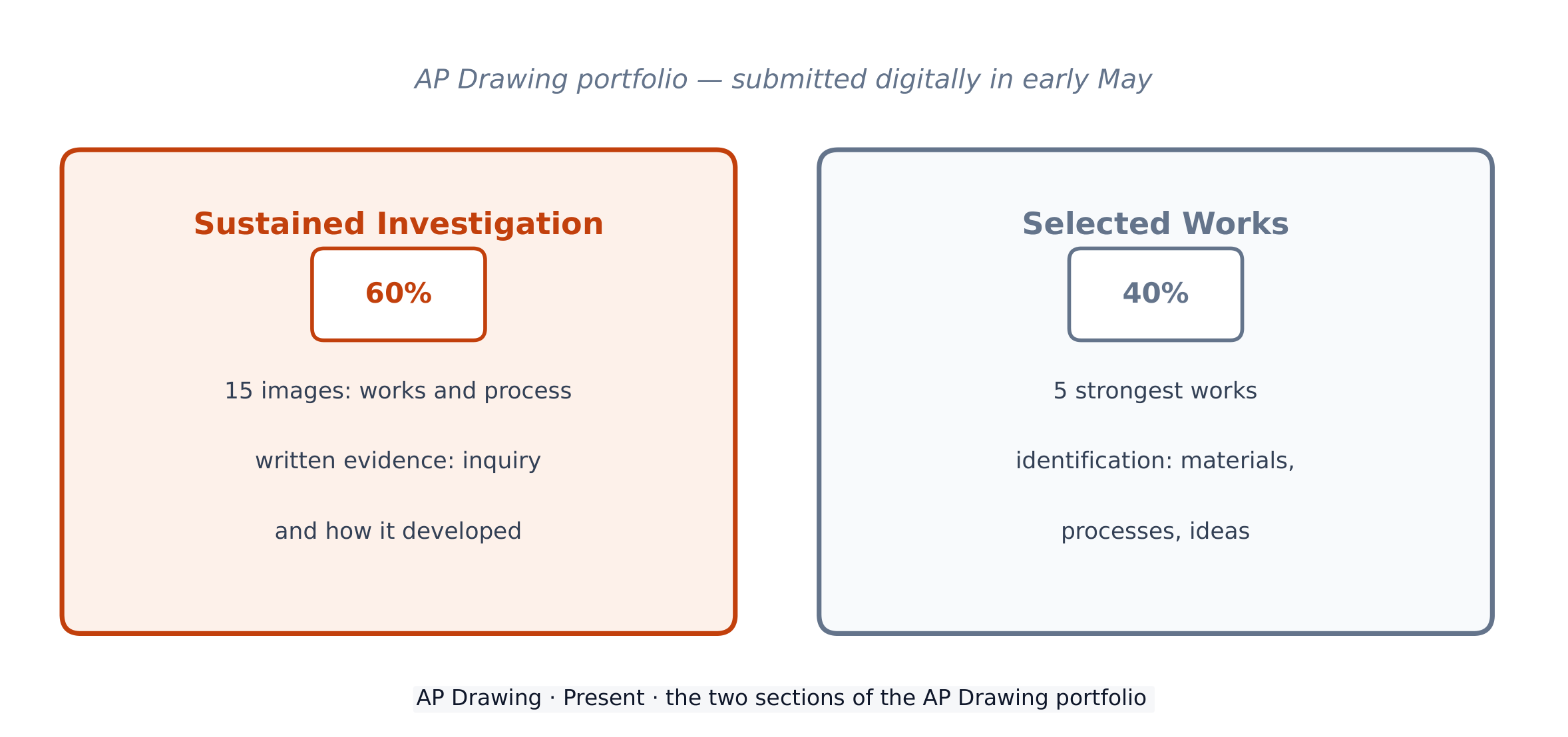
    The AP exam is a portfolio 作品集, not a written test — two sections submitted digitally in early May. (CED Big Idea 3)

    The AP Drawing portfolio: Sustained Investigation (15 images + writing, 60%) and Selected Works (5 works, 40%) Two sections: the Sustained Investigation carries 60% of the score, the Selected Works 40%

    • Sustained Investigation: 15 images of works and process, plus written evidence — 60% of the score.
    • Selected Works 精选作品: 5 works demonstrating skilful synthesis of materials, processes, and ideas — 40%.
    • Selected Works may come from inside or outside the investigation. Choose your strongest five, wherever they came from.
    • Everything uploads through the AP Digital Portfolio 数字作品集平台; your teacher reviews before final submission.
    • Drawing, 2-D, and 3-D Art and Design are separate portfolios — submit work made for the Drawing skill set.
    • Plan backwards from May: photography, writing, and selection all take real calendar time.
    Explore

    Where does it belong?

    The Sustained Investigation holds 15 images with written evidence (60%); the Selected Works are your five strongest pieces (40%). Some things belong in neither.

    Vocabulary Train
    English Chinese Pinyin
    portfolio 作品集 zuò pǐn jí
    Selected Works 精选作品 jīng xuǎn zuò pǐn
    AP Digital Portfolio 数字作品集平台 shù zì zuò pǐn jí píng tái
    7.2

    Sustained Investigation: Images and Written Evidence

    Syllabus

    Focus: The SI section pairs 15 images with short written evidence — images show, writing states. (CED 3.A/3.B)

    • Writing has two prompts: state the inquiry, and describe how the investigation developed — 1,200 characters total.
    • Every image carries its own caption fields: materials, processes, dimensions (and citations when needed).
    • Choose images that prove the writing: question stated → tests shown → development visible.
    • Process images (journal spreads, in-progress states, detail shots) count among the 15 — use several.
    • Order the images deliberately: scorers read them as a sequence, so build a narrative arc.
    • Write plainly and concretely; name materials, processes, ideas, and skills in CED vocabulary.

    Source: College Board AP Course and Exam Description

    The SI section pairs 15 images with short written evidence 书面证据 — the images show, the writing states. (CED 3.A/3.B)

    • The writing answers two prompts: state the inquiry, and describe how the investigation developed — about 1,200 characters in total.
    • Every image carries caption fields: materials 材料, processes 过程, dimensions, and citations where needed.
    • Choose images that prove the writing: question stated, tests shown, development visible.
    • Process images — journal spreads, in-progress states, detail shots — count among the 15. Use several.
    • Order the images deliberately: scorers read them as a sequence, so build a narrative arc.
    • Write plainly and concretely, naming skills and components in CED vocabulary.
    Vocabulary Train
    English Chinese Pinyin
    written evidence 书面证据 shū miàn zhèng jù
    materials 材料 cái liào
    processes 过程 guò chéng
    7.3

    Selected Works: Demonstrating Skills

    Syllabus

    Focus: Selected Works are your five strongest statements — each judged on written evidence, drawing skills, and synthesis. (CED 3.C)

    • Pick for range and strength: together the five should cover the drawing skills list.
    • Each work carries identification: materials, processes, ideas — 100 characters per field, make every word count.
    • Quality beats concept here: flawless craft and full value range are what a 5 looks like.
    • Strong candidates: the observational tour de force, the chiaroscuro drama, the expressive figure, the synthesis piece.
    • Details matter at scoring size — view each candidate at thumbnail scale and at full zoom before choosing.
    • Ask three viewers to rank your top eight; overlap usually finds the true five.

    Source: College Board AP Course and Exam Description

    The Selected Works are your five strongest statements — each judged on written evidence, drawing skills, and synthesis. (CED 3.C)

    • Pick for range and strength: together, the five should cover the whole drawing-skills list.
    • Each work carries an identification 作品信息: materials, processes, ideas — about 100 characters per field, so make every word count.
    • Quality beats concept here: flawless craft and a full value range are what a 5 looks like.
    • Strong candidates: the observational tour de force, the chiaroscuro drama, the expressive figure, the synthesis piece.
    • Details matter at scoring size. View each candidate as a small thumbnail and at full zoom before choosing.
    • Ask three viewers to rank your top eight; the overlap usually finds the true five.
    Vocabulary Train
    English Chinese Pinyin
    identification 作品信息 zuò pǐn xìn xī
    7.4

    Writing About Your Work

    Syllabus

    Focus: The written evidence is short, factual, and load-bearing — it directs the scorer's attention. (CED 3.D/3.E)

    • State the inquiry as a question or clear statement in the first sentence.
    • Use concrete nouns and verbs: 'compressed charcoal on gessoed cardboard, lifted with erasers' beats 'mixed media'.
    • Connect writing to visible things: if you claim experimentation, the images must show it.
    • Completely unrelated writing caps the Selected Works score — relevance is a rubric rule.
    • Draft early, cut hard: character limits reward the specific and punish the vague.
    • Have someone read writing while viewing the images — wherever they ask 'where?', revise.

    Source: College Board AP Course and Exam Description

    The written evidence is short, factual, and load-bearing — it directs the scorer's attention. (CED 3.D/3.E)

    • State the inquiry as a question or a clear statement in the first sentence.
    • Use concrete nouns and verbs: "compressed charcoal on gessoed cardboard, lifted with erasers" beats "mixed media".
    • Connect writing to visible things: if you claim experimentation, the images must show it.
    • Writing completely unrelated to the works caps the Selected Works score — relevance is a rubric rule.
    • Draft early and cut hard: character limits reward the specific and punish the vague.
    • Have someone read the writing while viewing the images. Wherever they ask "where?", revise.
    7.5

    Presentation and Image Quality

    Syllabus

    Focus: Scorers see photographs, not originals — photography quality is portfolio quality. (CED 3.F)

    • Shoot in even, indirect daylight or two-lamp setups; avoid glare, shadows across the work, and keystone distortion.
    • Fill the frame, crop to the work's edges, and keep verticals vertical.
    • Check values on screen: a washed-out photo erases the light-and-shade skill you spent weeks building.
    • Detail shots are allowed and powerful — a close-up of mark-making proves what a full view only suggests.
    • Consistent, neutral backgrounds make a sequence read professionally.
    • Photograph work as it is finished, not all in April — fixative first, then shoot, then store flat.

    Source: College Board AP Course and Exam Description

    Scorers see photographs 照片, not originals — photography quality is portfolio quality. (CED 3.F)

    • Shoot in even, indirect daylight or a two-lamp setup. Avoid glare, shadows across the work, and keystone distortion 梯形畸变.
    • Fill the frame, crop to the work's edges, and keep verticals vertical.
    • Check values on screen: a washed-out photo erases the light-and-shade skill you spent weeks building.
    • A detail shot 细节图 is allowed and powerful — a close-up of mark-making proves what a full view only suggests.
    • Consistent, neutral backgrounds make a sequence read professionally.
    • Photograph each work as it is finished, not all in April: fixative first, then shoot, then store flat.
    Vocabulary Train
    English Chinese Pinyin
    photographs 照片 zhào piān
    keystone distortion 梯形畸变 tī xíng jī biàn
    detail shot 细节图 xì jié tú
    7.6

    Understanding the Scoring Guidelines

    Syllabus

    Focus: Both sections are scored against published rubrics — knowing the rows lets you build to them.

    • Sustained Investigation rows: inquiry evident, evidence of practice/experimentation/revision, materials-processes-ideas, skills, and synthesis.
    • Selected Works criteria: written evidence identifies components; drawing skills; synthesis — scored 1-5 by preponderance of evidence.
    • Rubric language ladder: rudimentary → moderate → good → advanced — aim your evidence at the top descriptors.
    • Score your own mock portfolio against the rubric each term; the gaps write your to-do list.
    • Scores 1-5 arrive in July; college credit policies vary — but the rubric habits are the real prize.
    • Every rubric row asks for visual evidence — the recurring answer is: show it, then name it.

    Source: College Board AP Course and Exam Description

    Both sections are scored against published scoring guidelines 评分标准 — knowing the rows lets you build toward them.

    The rubric ladder: rudimentary, moderate, good, advanced — aim your evidence at the top The rubric's language ladder: aim every piece of evidence at the top descriptors

    • Sustained Investigation rows: inquiry evident; practice, experimentation, and revision; materials, processes, and ideas; drawing skills; synthesis.
    • Selected Works criteria: written evidence identifies components; drawing skills; synthesis — scored 1-5 by preponderance of evidence 证据的总体倾向.
    • The rubric's language ladder runs rudimentary, moderate, good, advanced — aim your evidence at the top descriptors.
    • Score your own mock portfolio against the rubric each term; the gaps write your to-do list.
    • Scores 1-5 arrive in July, and college credit policies vary — but the rubric habits are the real prize.
    • Every rubric row asks for visual evidence. The recurring answer: show it, then name it.
    Vocabulary Train
    English Chinese Pinyin
    scoring guidelines 评分标准 píng fēn biāo zhǔn
    preponderance of evidence 证据的总体倾向 zhèng jù de zǒng tǐ qīng xiàng
    7.7

    Academic Integrity and Citing Sources

    Syllabus

    Focus: The portfolio must be your own work; borrowed images and AI tools have strict rules.

    • Working from someone else's photograph or artwork requires citation in the image's materials/processes fields.
    • Substantially copying another artist's work — even cited — cannot demonstrate your idea development.
    • Draw from life and from your own reference photos wherever possible; it also simply teaches more.
    • Generative AI may not make your work: AP policy allows it only as a documented exploration tool, never as the artwork.
    • Plagiarism cancels scores — the College Board checks, and teachers must certify originality.
    • Integrity is also artistic self-interest: your own seeing is the only unique material you have.

    Source: College Board AP Course and Exam Description

    The portfolio must be your own work. Borrowed images and AI tools have strict rules.

    • Working from someone else's photograph or artwork requires a citation 引用 in that image's materials/processes fields.
    • Substantially copying another artist's work — even cited — cannot demonstrate your idea development.
    • Draw from life and from your own reference photos wherever possible; it also simply teaches more.
    • Generative AI 生成式人工智能 may not make your work: AP policy allows it only as a documented exploration tool, never as the artwork.
    • Plagiarism 抄袭 cancels scores. The College Board checks, and teachers must certify originality.
    • Integrity is also artistic self-interest: your own seeing is the only truly unique material you have.
    Vocabulary Train
    English Chinese Pinyin
    citation 引用 yǐn yòng
    generative AI 生成式人工智能 shēng chéng shì rén gōng zhì néng
    plagiarism 抄袭 chāo xí
    7.7

    Exam tips

    • Photograph like it matters, because it does — a 5-level drawing shot with glare and keystone reads as a 3. Reshoot anything you hesitate over.
    • Fill every caption field with specifics. "Willow charcoal, subtractive erasing, on toned Ingres paper" does scoring work; empty or vague fields waste free marks.
    • Check the relevance rule: if your written evidence could sit under someone else's portfolio unchanged, it is too generic — tie every sentence to your images.
    • Select the five with fresh eyes: thumbnail-size printouts on a table, three trusted viewers, overlap wins.
    • Cite every reference photo you did not take — one missing citation risks the whole portfolio; thirty seconds of typing removes the risk.

Log in or create account

IGCSE & A-Level