Skip to content

Space, Depth, and Proportion

AP Drawing · Topic 3

Train
3.1

Measuring and Sighting

Syllabus

Focus: Sighting is measuring the subject with your pencil at arm's length — the observational drawing survival skill.

  • Hold the pencil at full arm's length, lock the elbow, close one eye: now it is a ruler and a protractor.
  • Pick one unit (often the head, or a cup's height) and measure everything in that unit: comparative measurement.
  • Check angles by rotating the pencil to match an edge, then carrying that angle to the paper.
  • Plumb lines (vertical checks) and level lines (horizontal checks) locate landmarks above and below each other.
  • Draw envelope shapes first: the big simple shape that contains the whole subject, then divide it.
  • Measured accuracy is visual evidence of space and proportion control in the AP rubric's drawing skills.

Source: College Board AP Course and Exam Description

Sighting 目测 means measuring the subject with your pencil at arm's length — the survival skill of observational drawing.

  • Hold the pencil at full arm's length with a locked elbow and one eye closed: now it is a ruler and a protractor.
  • Pick one unit (often the head, or a cup's height) and measure everything in that unit — comparative measurement 比较测量.
  • Check angles by rotating the pencil to match an edge, then carrying that angle to the paper.
  • A plumb line 铅垂线 (an imagined vertical) shows which landmarks sit exactly above or below each other.
  • Draw the envelope 外包形 first: the big simple shape that contains the whole subject, then divide it.
Vocabulary Train
English Chinese Pinyin
sighting 目测 mù cè
comparative measurement 比较测量 bǐ jiào cè liáng
plumb line 铅垂线 qiān chuí xiàn
envelope 外包形 wài bāo xíng
3.2

One-Point Perspective

Syllabus

Focus: Linear perspective turns the picture plane into a window: in one-point, all depth lines meet at a single vanishing point.

  • The horizon line is the viewer's eye level — everything above it we look up at, everything below we look down on.
  • Lines parallel to the picture plane stay true; lines going into the scene converge to the vanishing point.
  • Equal spaces look smaller as they recede — use the diagonal trick to divide receding space evenly.
  • One-point suits rooms, streets, and corridors seen straight-on.
  • Objects overlap and rise toward the horizon as they get further away — perspective plus overlap is depth doubled.
  • Perspective errors are easy to spot: check every depth line actually aims at the point.

Source: College Board AP Course and Exam Description

One-point perspective

Linear perspective 线性透视 treats the picture as a window. In one-point perspective, all lines going into the depth meet at a single point.

A long, straight desert road running dead ahead to the horizon, its edges narrowing to a single point A straight desert road: its two edges appear to meet at a single vanishing point on the horizon, exactly the one-point perspective a drawing recreates to show depth

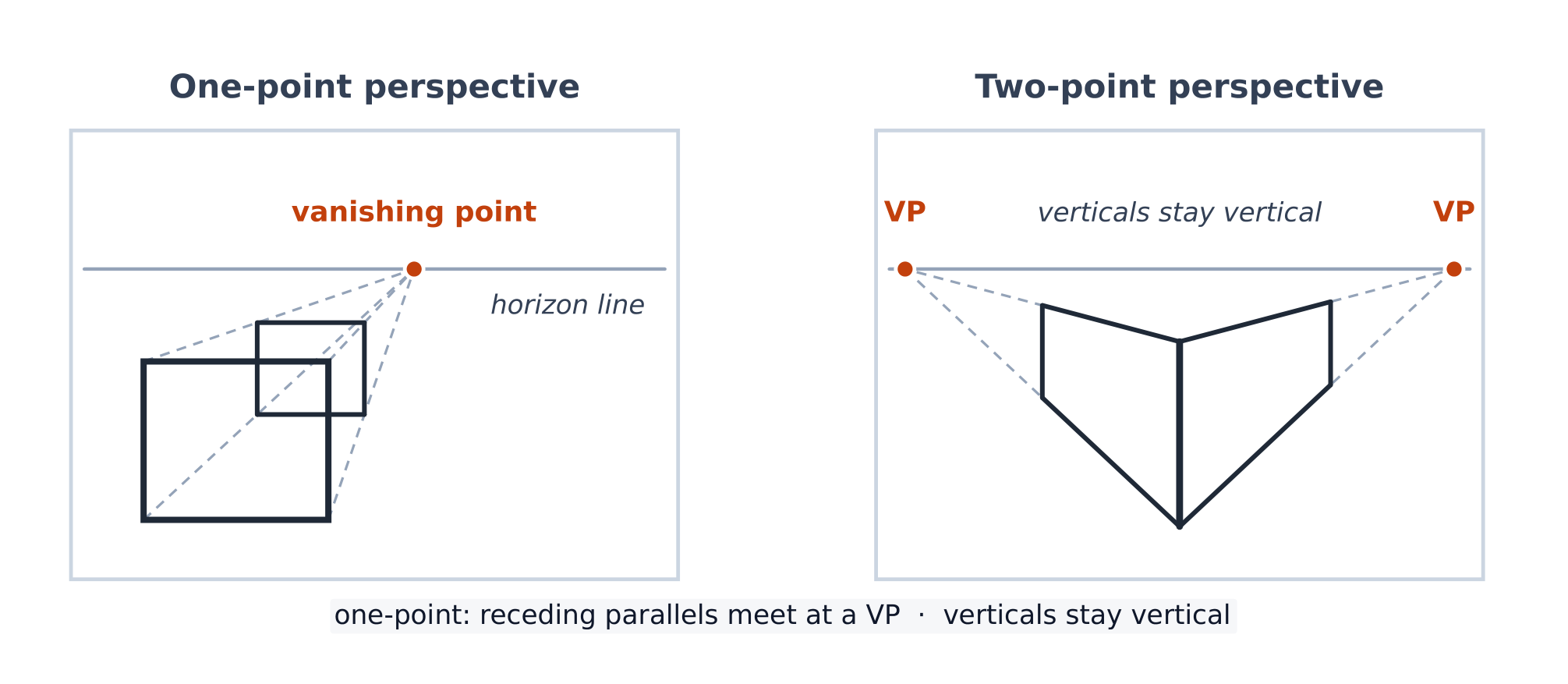
One-point and two-point perspective: horizon line, vanishing points, and converging edges Left: one-point — depth lines meet at one vanishing point. Right: two-point — each set of edges meets its own point

  • The horizon line 视平线 is the viewer's eye level. We look down on everything below it and up at everything above it.
  • Lines parallel to the picture surface stay true; lines going into the scene converge to the vanishing point 灭点.
  • Equal spaces look smaller as they recede. Use diagonals to divide receding space evenly.
  • One-point perspective 一点透视 suits rooms, streets, and corridors seen straight-on.
  • Perspective plus overlap 遮挡 is depth doubled: near edges cover far edges.
Vocabulary Train
English Chinese Pinyin
linear perspective 线性透视 xiàn xìng tòu shì
horizon line 视平线 shì píng xiàn
vanishing point 灭点 miè diǎn
one-point perspective 一点透视 yì diǎn tòu shì
overlap 遮挡 zhē dǎng
3.3

Two-Point and Three-Point Perspective

Syllabus

Focus: Turn the subject at an angle and you need two vanishing points; look steeply up or down and you need a third.

  • In two-point, verticals stay vertical; both sets of horizontal edges converge to left and right points on the horizon.
  • Keep both vanishing points far apart (often off the paper) — close points create fisheye distortion.
  • Three-point adds a vertical vanishing point: skyscrapers from below (looking up) or street scenes from a rooftop (looking down).
  • Boxes drawn in perspective become the scaffolding for everything: buildings, books, vehicles, even heads.
  • Cast shadows and reflections follow the same perspective system as the objects that make them.
  • A perspective grid underdrawing keeps complex scenes consistent — construct lightly, render on top.

Source: College Board AP Course and Exam Description

Two-point perspective

Turn the subject at an angle and you need two-point perspective 两点透视; look steeply up or down and you need a third point.

  • In two-point, verticals stay vertical; the two sets of horizontal edges converge to a left and a right vanishing point on the horizon.
  • Keep the two points far apart — often off the paper. Points placed too close create a fisheye distortion.
  • Three-point perspective 三点透视 adds a vertical vanishing point: a skyscraper from below, or a street from a rooftop.
  • Boxes drawn in perspective become scaffolding for everything: buildings, books, vehicles, even heads.
  • Cast shadows and reflections obey the same perspective system as the objects that make them.
Vocabulary Train
English Chinese Pinyin
two-point perspective 两点透视 liǎng diǎn tòu shì
three-point perspective 三点透视 sān diǎn tòu shì
3.4

Foreshortening

Syllabus

Focus: Foreshortening is perspective applied to a single form pointing toward you — lengths compress dramatically.

  • A pointing arm may appear one-third of its true length: draw the apparent shape, not the known one.
  • Overlap is the key signal: the hand overlaps the forearm, the forearm overlaps the upper arm.
  • Think in cross-sections: imagine rings around the form (like a wireframe) to feel how it turns toward you.
  • Measure foreshortened lengths by sighting — knowledge lies, observation tells the truth.
  • Classic practice: draw a figure lying down feet-first (like Mantegna's Dead Christ).
  • Strong foreshortening is high-difficulty visual evidence — examiners recognise the skill immediately.

Source: College Board AP Course and Exam Description

Foreshortening 透视缩短 is perspective applied to a single form pointing toward you — lengths compress dramatically.

  • A pointing arm may appear one-third of its true length. Draw the apparent shape, not the length you know.
  • Overlap is the key signal: the hand overlaps the forearm, the forearm overlaps the upper arm.
  • Think in cross-sections 横截面: imagine rings around the form, like a wireframe, to feel how it turns toward you.
  • Measure foreshortened lengths by sighting — memory lies, observation tells the truth.
  • The classic practice piece: a figure lying down, drawn feet-first, like Mantegna's Dead Christ.
Vocabulary Train
English Chinese Pinyin
foreshortening 透视缩短 tòu shì suō duǎn
cross-sections 横截面 héng jié miàn
3.5

Atmospheric Perspective

Syllabus

Focus: Atmospheric (aerial) perspective creates depth without lines: distant things are lighter, cooler, softer, and less detailed.

  • Air scatters light, so contrast fades with distance — the far mountain is a pale flat shape.
  • Foreground: darkest darks, sharpest edges, most texture; background: narrow value range, soft edges.
  • Reserve full black and full white for the foreground; the distance lives in the middle greys.
  • Detail density is a depth cue by itself — render the near leaf, suggest the far tree.
  • Combine linear and atmospheric perspective for maximum depth in landscape and cityscape drawing.
  • This is the AP skill space made visible through light and shade — two rubric skills in one device.

Source: College Board AP Course and Exam Description

Atmospheric perspective

Atmospheric perspective 空气透视 creates depth without any lines: distant things become lighter, cooler, softer, and less detailed.

  • Air scatters light, so contrast fades with distance. The far mountain is a pale, flat shape.
  • Foreground: darkest darks, sharpest edges, most texture. Background: a narrow value range and soft edges.
  • Save full black and full white for the foreground; the distance lives in the middle greys.
  • Detail density is a depth cue by itself: render the near leaf, suggest the far tree.
  • Combine linear and atmospheric perspective for maximum depth in landscape drawing.
Explore

Which depth cue is at work?

Drawings create depth several ways at once: linear perspective (lines converge), atmospheric perspective (distance fades and softens), overlap (near covers far), and foreshortening (forms compress toward you).

Vocabulary Train
English Chinese Pinyin
atmospheric perspective 空气透视 kōng qì tòu shì
3.6

Composition and the Picture Plane

Syllabus

Focus: Composition — how everything is arranged inside the picture's edges — is a named AP drawing skill and the first thing a scorer sees.

  • The picture plane has edges: what you crop out is as expressive as what you keep in.
  • The rule of thirds places focal points on the third-lines — safer than dead centre.
  • Control the figure-ground relationship: negative space is a designed shape, not leftover paper.
  • Lead the eye with paths: lines, value contrast, and detail act as arrows toward the focal point.
  • Vary the viewpoint — eye level is neutral; a low or high viewpoint makes an ordinary subject fresh.
  • Test compositions with a viewfinder or phone camera crop before committing to the page.

Source: College Board AP Course and Exam Description

Composition 构图 — the arrangement of everything inside the picture's edges — is a named AP drawing skill and the first thing a scorer sees.

  • The picture plane 画面 has edges: what you crop out is as expressive as what you keep in.
  • The rule of thirds 三分法 places focal points on the third-lines — stronger than dead centre.
  • Design the negative space 负空间: the empty shapes around the subject are shapes you drew, not leftovers.
  • The figure-ground relationship 图底关系 must stay readable: the eye should always know what is subject and what is background.
  • Lead the eye with paths — lines, value contrast, and detail act as arrows toward the focal point.
  • Test crops with a viewfinder 取景框 (or a phone camera) before committing to the page. Change the viewpoint 视点: eye level is neutral; low or high angles make ordinary subjects fresh.
Vocabulary Train
English Chinese Pinyin
composition 构图 gòu tú
picture plane 画面 huà miàn
rule of thirds 三分法 sān fēn fǎ
negative space 负空间 fù kōng jiān
figure-ground relationship 图底关系 tú dǐ guān xì
viewfinder 取景框 qǔ jǐng kuāng
viewpoint 视点 shì diǎn
3.7

Drawing the Figure and Portrait

Syllabus

Focus: The figure combines every drawing skill at once — proportion, gesture, form, and likeness under one deadline.

  • The classic adult figure stands about 7.5 heads tall; the halfway point is near the hip, not the waist.
  • In the head, eyes sit at the halfway line of the skull — the beginner error is placing them too high.
  • Start with gesture and the big masses (ribcage, pelvis, skull); features and fingers come last.
  • Sight-size checks save likeness: compare distances between landmarks, not memorised rules alone.
  • Hands and feet earn their reputation — draw them as simple geometric mittens/wedges first, then divide.
  • Figure and portrait work is a portfolio staple: it demonstrates observation, proportion, and nerve.

Source: College Board AP Course and Exam Description

The human figure combines every drawing skill at once: proportion 比例, gesture, form, and likeness under one deadline.

Figure and head proportions: a standing figure about 7.5 heads tall; eyes at the halfway line of the skull The classic adult figure is about 7.5 heads tall; in the head, the eyes sit at the halfway line

  • The classic adult figure stands about 7.5 heads tall; the halfway point of the body is near the hip, not the waist.
  • In the head, the eyes sit at the halfway line 中线 of the skull — beginners always place them too high.
  • Start with gesture and the big masses (ribcage, pelvis, skull); features and fingers come last.
  • Check likeness with landmark distances, not memorised rules alone — every face bends the average.
  • Draw hands and feet as simple geometric mittens and wedges first, then divide them into parts.
Vocabulary Train
English Chinese Pinyin
proportion 比例 bǐ lì
halfway line 中线 zhōng xiàn
3.7

Exam tips

  • Perspective errors are the easiest mistakes for a scorer to spot — check every depth line actually aims at its vanishing point before you render.
  • Include one strong observational space (an interior, a stairwell, a street) in the portfolio: it demonstrates the space skill the rubric names, unmistakably.
  • Foreshortening is high-value evidence. One convincing foreshortened limb or object tells scorers you draw what you see, not what you remember.
  • Crop like a designer. Before starting, test three viewfinder crops and pick the one with the strongest negative space — composition is judged at first glance.
  • Use atmospheric perspective in graphite too, not just paint: softening far edges with a kneaded eraser is quick and reads as skill.

Log in or create account

IGCSE & A-Level