Skip to content

Line and Mark-Making

AP Drawing · Topic 1

Train
1.1

Line Quality

Syllabus

Focus: Line quality is how a line looks and feels — the first drawing skill the AP rubric names is mark-making.

  • A line can be thick or thin, dark or light, smooth or rough, fast or slow.
  • Weighted line changes thickness along its length: press harder where a form turns away or carries weight.
  • Confident lines are drawn from the shoulder and elbow, not only the fingers.
  • Lost-and-found lines fade out and reappear — the viewer's eye completes the edge.
  • Line direction carries feeling: horizontal is calm, vertical is firm, diagonal is active.
  • Examiners read line quality instantly — scratchy, timid lines and one confident stroke tell different stories.

Source: College Board AP Course and Exam Description

Line quality 线条质感 is how a line looks and feels. The AP Drawing rubric names mark-making 笔触 first in its list of drawing skills, and line is the most basic mark.

  • A line can be thick or thin, dark or light, smooth or rough, fast or slow.
  • A weighted line 轻重线条 changes thickness along its length. Press harder where a form turns away from the light or carries weight.
  • Lost-and-found lines 虚实线条 fade out and come back. The viewer's eye completes the missing edge.
  • Confident lines come from the shoulder and elbow, not only the fingers.

Line qualities: even, weighted, lost-and-found, and expressive lines compared The same edge drawn four ways: an even line, a weighted line, a lost-and-found line, and a fast expressive line

Line direction carries feeling: horizontal lines feel calm, vertical lines feel firm, and diagonal lines feel active. Examiners read line quality instantly, so practise until your lines look decided, not timid.

Vocabulary Train
English Chinese Pinyin
line quality 线条质感 xiàn tiáo zhì gǎn
mark-making 笔触 bǐ chù
weighted line 轻重线条 qīng zhòng xiàn tiáo
lost-and-found lines 虚实线条 xū shí xiàn tiáo
1.2

Contour Drawing

Syllabus

Focus: Contour drawing follows the edges of a form slowly and carefully — it trains eye-hand coordination.

  • A contour line traces the outer edge and the inner edges (folds, creases, overlaps) of a subject.
  • In blind contour you draw without looking at the paper — pure observation practice.
  • Cross-contour lines travel across the surface of a form, like latitude lines on a globe, and describe volume.
  • Draw slowly: match the speed of your eye moving along the edge with the speed of your pencil.
  • Overlapping contours (one edge passing in front of another) create instant depth.
  • Contour studies make strong Sustained Investigation process pages — they show observation skill.

Source: College Board AP Course and Exam Description

A contour line 轮廓线 traces the edges of a form — the outer edge and the inner edges made by folds, creases, and overlaps. Contour drawing is slow, careful looking.

  • Match the speed of your eye moving along the edge with the speed of your pencil.
  • In blind contour 盲画轮廓 you draw without looking at the paper. It feels strange, but it trains pure observation.
  • Cross-contour lines 横截轮廓线 travel across the surface of a form, like latitude lines on a globe. They describe volume, not edges.
  • Overlapping contours create instant depth: one edge passing in front of another says "this is closer".

Contour studies make strong process pages for the Sustained Investigation because they show real observation skill.

Vocabulary Train
English Chinese Pinyin
contour line 轮廓线 lún kuò xiàn
blind contour 盲画轮廓 máng huà lún kuò
cross-contour lines 横截轮廓线 héng jié lún kuò xiàn
1.3

Gesture Drawing

Syllabus

Focus: Gesture drawing captures the energy, movement, and weight of a subject in seconds — before any detail.

  • A gesture drawing takes 30 seconds to 3 minutes; it looks for the action line running through the pose.
  • Draw the whole subject at once — big loose lines from the shoulder — never one polished corner.
  • Look for the line of action first: one curve that summarises the pose's movement.
  • Gesture is about what the subject is doing, not what it looks like.
  • Daily gesture pages build speed and confidence, and they photograph well as process evidence.
  • Long drawings usually start as a gesture: energy first, structure second, detail last.

Source: College Board AP Course and Exam Description

Gesture drawing 动态速写 captures the energy, movement, and weight of a subject in seconds — before any detail.

  • A gesture drawing takes 30 seconds to 3 minutes. Draw the whole subject at once with big, loose lines.
  • Look for the line of action 动势线 first: one curve that summarises the movement of the pose.
  • Gesture asks what the subject is doing, not what it looks like.
  • Long drawings usually start as a gesture: energy first, structure second, detail last.

Daily gesture pages build speed and confidence, and they photograph well as evidence of practice.

Vocabulary Train
English Chinese Pinyin
gesture drawing 动态速写 dòng tài sù xiě
line of action 动势线 dòng shì xiàn
1.4

Hatching and Cross-Hatching

Syllabus

Focus: Hatching builds value with parallel lines; cross-hatching layers a second direction on top.

  • Closer, darker lines read as darker value; wider spacing reads as lighter value.
  • Cross-hatching adds layers at new angles — each layer deepens the tone step by step.
  • Curve the hatch lines around the form (cross-contour hatching) so the shading also describes volume.
  • Keep a consistent angle inside one plane; change angle when the plane changes — edges stay crisp.
  • Pen-and-ink drawing depends on hatching because ink has no grey — value comes only from line density.
  • Hatching shows control of mark-making and light and shade, two named AP drawing skills, in one technique.

Source: College Board AP Course and Exam Description

Building value with marks

Hatching 排线 builds tone with parallel lines. Cross-hatching 交叉排线 layers a second set of lines at a new angle on top.

A detailed old-master drawing of a pair of hands pressed together, modelled with dense fine ink lines on blue-grey paper Dürer built these hands from fine parallel hatching and cross-hatching; where the lines sit closer and cross, the tone darkens and the flat marks turn into rounded form

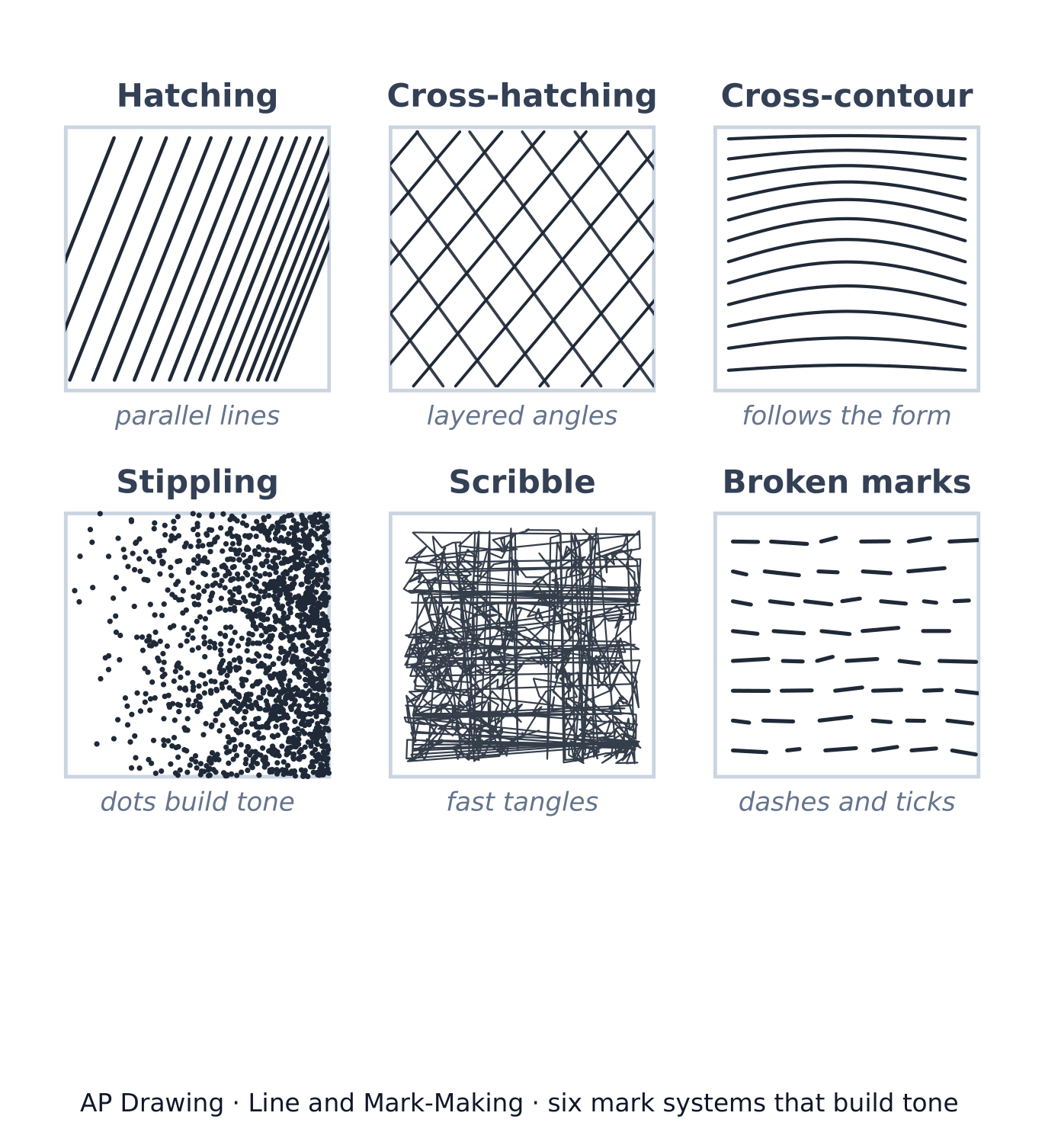
Six mark systems: hatching, cross-hatching, cross-contour hatching, stippling, scribble, and broken marks Six ways to build tone with marks; closer and denser marks read as darker value

  • Closer, darker lines read as darker value 明度; wider spacing reads as lighter value.
  • Each cross-hatched layer deepens the tone step by step — build darkness gradually.
  • Curve the lines around the form (cross-contour hatching) so the shading also describes volume.
  • Keep one angle inside one plane; change the angle when the plane changes, and edges stay crisp.
  • Pen-and-ink drawing depends on hatching, because ink has no grey: value comes only from line density.
Explore

Which mark system is it?

Hatching uses parallel lines, cross-hatching layers a second angle, stippling builds tone from dots, and scribble uses fast tangles. Naming mark systems helps you choose and describe your own.

Vocabulary Train
English Chinese Pinyin
hatching 排线 pái xiàn
cross-hatching 交叉排线 jiāo chā pái xiàn
value 明度 míng dù
1.5

Stippling, Scribbling, and Alternative Marks

Syllabus

Focus: Beyond hatching there is a whole vocabulary of marks — dots, scribbles, dashes, smears — each with its own texture and speed.

  • Stippling builds tone from dots: dense dots read dark, sparse dots read light — slow but very controllable.
  • Scribble (or scumbled) marks are fast tangles of line — lively, good for fur, foliage, and energy.
  • Dashes, ticks, and broken marks suggest texture without outlining every detail.
  • Marks can be additive (adding material) or subtractive (lifting material out with an eraser).
  • Try one subject rendered in four different mark systems — a classic experimentation page.
  • A personal mark vocabulary is part of your artistic voice — examiners look for it across the portfolio.

Source: College Board AP Course and Exam Description

Beyond hatching there is a whole vocabulary of marks — dots, tangles, dashes, smears — each with its own texture and speed.

  • Stippling 点画 builds tone from dots: dense dots read dark, sparse dots read light. Slow, but very controllable.
  • Scribble 乱线 marks are fast tangles of line — lively and good for fur, foliage, and energy.
  • Dashes, ticks, and broken marks suggest texture without outlining every detail.
  • Marks can be additive 加法 (putting material on) or subtractive 减法 (lifting material off with an eraser).
  • A classic experimentation page: one subject rendered in four different mark systems.
Vocabulary Train
English Chinese Pinyin
stippling 点画 diǎn huà
scribble 乱线 luàn xiàn
additive 加法 jiā fǎ
subtractive 减法 jiǎn fǎ
1.6

Texture and Surface

Syllabus

Focus: Surface is a named AP drawing skill: how the drawing's physical texture and the depicted texture work together.

  • Actual texture is the real surface of the work (rough paper, layered charcoal, collage); implied texture is drawn illusion.
  • Frottage (rubbing over a textured surface) transfers real texture into a drawing.
  • Paper tooth (roughness) changes every mark: the same pencil reads differently on smooth and rough paper.
  • Contrast of textures — smooth skin against rough cloth — makes both read more strongly.
  • Build texture with the logic of the material: short strokes for fur, long strokes for hair, broken marks for stone.
  • Describing texture convincingly is visual evidence of observation and material control.

Source: College Board AP Course and Exam Description

Surface 画面质感 is a named AP drawing skill: the physical texture of the drawing and the drawn illusion of texture work together.

  • Actual texture 实际肌理 is the real surface of the work — rough paper, layered charcoal, collage. Implied texture 视觉肌理 is drawn illusion.
  • Frottage 拓印法 (rubbing over a textured surface) transfers real texture into a drawing.
  • Paper tooth 纸纹 changes every mark: the same pencil reads differently on smooth and rough paper.
  • Contrast of textures — smooth skin against rough cloth — makes both read more strongly.
  • Build texture with the logic of the material: short strokes for fur, long strokes for hair, broken marks for stone.
Vocabulary Train
English Chinese Pinyin
surface 画面质感 huà miàn zhì gǎn
actual texture 实际肌理 shí jì jī lǐ
implied texture 视觉肌理 shì jué jī lǐ
frottage 拓印法 tà yìn fǎ
tooth 纸纹 zhǐ wén
1.7

Expressive Mark-Making

Syllabus

Focus: Marks carry emotion: the same subject drawn with angry, calm, or nervous marks tells three different stories.

  • Expressive lines exaggerate speed, pressure, and direction to communicate feeling, not just describe form.
  • Käthe Kollwitz's heavy charcoal and Egon Schiele's tense contours show how marks are the meaning.
  • Choose the mark to match the idea: soft graphite for quiet subjects, aggressive ink for conflict.
  • Distortion and exaggeration are legitimate drawing decisions when they serve intent — 'accurate' is not the only goal.
  • The AP rubric rewards ideas made visual: expressive marks link technique to meaning.
  • Test the same composition in two mark styles and write one sentence on which supports your inquiry better.

Source: College Board AP Course and Exam Description

Marks carry emotion. The same subject drawn with angry, calm, or nervous marks tells three different stories.

  • Expressive lines 表现性线条 exaggerate speed, pressure, and direction to communicate feeling, not just to describe form.
  • Käthe Kollwitz's heavy charcoal and Egon Schiele's tense contours show how the marks themselves carry the meaning.
  • Choose the mark to match the idea: soft graphite for quiet subjects, aggressive ink for conflict.
  • Distortion 变形 and exaggeration are legitimate drawing decisions when they serve your intent — "accurate" is not the only goal.
  • A personal mark vocabulary is part of your artistic voice 个人风格. Examiners look for it across the whole portfolio.
Vocabulary Train
English Chinese Pinyin
expressive lines 表现性线条 biǎo xiàn xìng xiàn tiáo
distortion 变形 biàn xíng
voice 个人风格 gè rén fēng gé
1.7

Exam tips

  • Line quality is judged at a glance — one page of confident, varied strokes tells a scorer more than an hour of timid rendering. Warm up before every serious drawing.
  • Show the systems, not just the results: a portfolio image of hatching, stippling, and cross-contour studies is direct visual evidence of the mark-making skill the rubric names.
  • Photograph marks close up. A detail shot of your best passage of marks proves a skill that a full view only suggests.
  • Blind contour and gesture pages belong in your process images — they show observation and practice, exactly what the Sustained Investigation rubric asks to see.
  • Match marks to meaning in your written evidence: one sentence like "scratchy graphite lines echo the anxiety of exam season" links technique to idea, which is what scorers reward.

Log in or create account

IGCSE & A-Level