Skip to content · ⁨ข้ามไปยังเนื้อหา⁩
Subjects · ⁨รายวิชา⁩

AP Drawing · ⁨AP การวาดภาพ⁩

Tips · ⁨เคล็ดลับ⁩

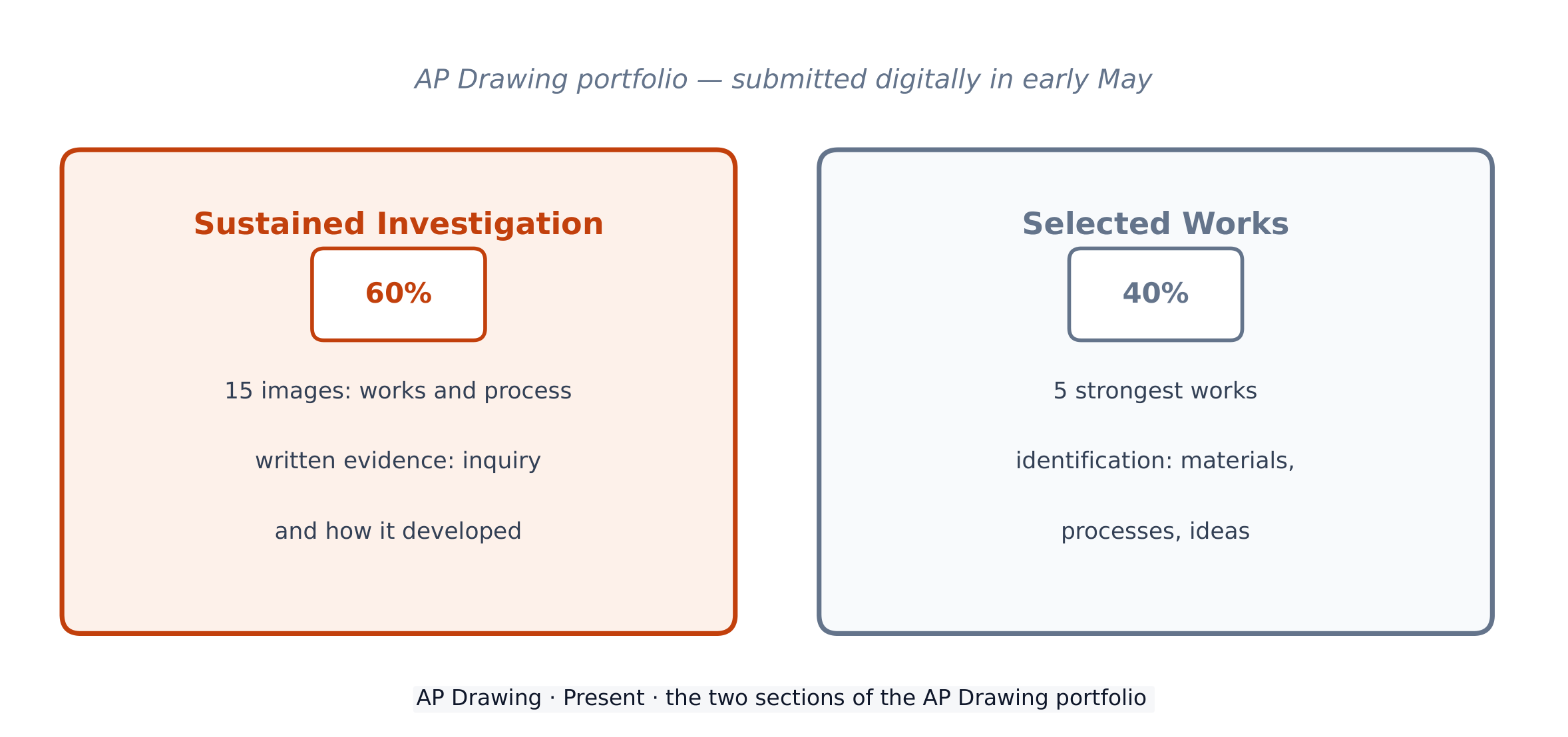
AP Drawing เป็นหลักสูตร แฟ้มสะสมผลงาน ไม่ใช่หลักสูตรข้อสอบ คุณส่ง ผลงานที่เลือกไว้ 15 ชิ้น เพื่อแสดงถึง ทักษะการวาดภาพ — การทำเครื่องหมายบนพื้นผิว, คุณภาพเส้น, การจัดองค์ประกอบ, พื้นผิวและแสง และ การสืบสวนอย่างต่อเนื่อง (Sustained Investigation) จากภาพ 15 ชิ้นพร้อม หลักฐานทางลายมือ ว่าคำถามการสืบสวนหนึ่ง是如何พัฒนาขึ้น

การวาดภาพในที่นี้กว้างกว่าแค่ดินสอบนกระดาษ การวาดภาพด้วยสี การพิมพ์ภาพ และงานดิจิทัลล้วน qualifies ได้ ตราบใดที่ การตัดสินใจเรื่องการวาดภาพ เป็นรากฐานของผลงาน

การสืบสวนอย่างต่อเนื่องให้คะแนนการพัฒนาที่มองเห็นได้ รักษาการทดลองและความล้มเหลวไว้ ถ่ายภาพและลงวันที่ทุกขั้นตอน และเขียนคำถามการสืบสวนให้เฉพาะเจาะจงพอที่จะมีหลักฐานแสดงความก้าวหน้าได้

เป็นหลักสูตรแฟ้มสะสมผลงานไม่ใช่ข้อสอบ: หมายเหตุจะครอบคลุมสิ่งที่ส่วน การสืบสวนอย่างต่อเนื่อง และ ผลงานที่เลือกไว้ ต้องการ รวมถึงวิธีการให้คะแนนส่วนคำตอบทางลายมือ ห้องสมุดจะเก็บแนวทางการให้คะแนนที่เผยแพร่แล้วแทนข้อสอบเก่า

  • 1

    Line and Mark-Making · ⁨เส้นและการสร้างเครื่องหมาย⁩

    Watch lesson · ⁨ดูบทเรียน⁩
    1.1

    Line Quality · ⁨คุณภาพเส้น⁩

    Syllabus · ⁨หลักสูตร⁩
    English

    Focus: Line quality is how a line looks and feels — the first drawing skill the AP rubric names is mark-making.

    • A line can be thick or thin, dark or light, smooth or rough, fast or slow.
    • Weighted line changes thickness along its length: press harder where a form turns away or carries weight.
    • Confident lines are drawn from the shoulder and elbow, not only the fingers.
    • Lost-and-found lines fade out and reappear — the viewer's eye completes the edge.
    • Line direction carries feeling: horizontal is calm, vertical is firm, diagonal is active.
    • Examiners read line quality instantly — scratchy, timid lines and one confident stroke tell different stories.
    ไทย

    จุดเน้น: คุณภาพเส้น (Line quality) คือลักษณะและความรู้สึกของเส้น — ทักษะการวาดชิ้นแรกที่ AP rubric ระบุคือ การสร้างเครื่องหมาย (mark-making)

    • เส้นสามารถหนาหรือบาง, มืดหรือสว่าง, เรียบหรือหยาบ, รวดเร็วหรือช้า
    • เส้นที่มีน้ำหนัก (Weighted line) เปลี่ยนความหนาตามความยาว: กดหนักขึ้นเมื่อรูปทรงหันออกหรือรับน้ำหนัก
    • เส้นที่มั่นใจจะวาดจากไหล่และศอก ไม่ใช่แค่นิ้วมือเท่านั้น
    • เส้นหายและปรากฏ (Lost-and-found lines) จางหายไปและปรากฏอีกครั้ง — ตาของผู้ชมจะเติมเต็มขอบ
    • ทิศทางของเส้นสื่อความรู้สึก: แนวนอนสงบ, แนวตั้งมั่นคง, แนวเฉียงกระตือรือร้น
    • ผู้ประเมินอ่านคุณภาพเส้นได้ทันที — เส้นที่ขรุขระ ขี้กลัว และ-strokes มั่นใจเพียง stroke เดียว บอกเรื่องราวที่แตกต่างกัน

    Source: College Board AP Course and Exam Description · ⁨แหล่งที่มา: คำอธิบายหลักสูตรและข้อสอบ College Board AP⁩

    English

    Line quality 线条质感 is how a line looks and feels. The AP Drawing rubric names mark-making 笔触 first in its list of drawing skills, and line is the most basic mark.

    • A line can be thick or thin, dark or light, smooth or rough, fast or slow.
    • A weighted line 轻重线条 changes thickness along its length. Press harder where a form turns away from the light or carries weight.
    • Lost-and-found lines 虚实线条 fade out and come back. The viewer's eye completes the missing edge.
    • Confident lines come from the shoulder and elbow, not only the fingers.

    Line direction carries feeling: horizontal lines feel calm, vertical lines feel firm, and diagonal lines feel active. Examiners read line quality instantly, so practise until your lines look decided, not timid.

    ไทย

    Line quality คือลักษณะและความรู้สึกของเส้น AP Drawing rubric ชื่อ mark-making เป็นอันดับแรกในรายการทักษะการวาดภาพ, และเส้นคือ mark ที่พื้นฐานที่สุด

    • เส้นสามารถหนาหรือบาง, มืดหรือสว่าง, เรียบหรือหยาบ, รวดเร็วหรือช้า
    • A weighted line เปลี่ยนความหนาตามความยาว กดแรงขึ้นเมื่อรูปทรงหันหนีจากแสงหรือรับน้ำหนัก
    • Lost-and-found lines จางหายไปและกลับมาตาของผู้ชมจะเติมเต็มขอบที่หายไป
    • เส้นที่มั่นใจเกิดจากไหล่และศอก ไม่ใช่แค่นิ้วมือ
    Line qualities: even, weighted, lost-and-found, and expressive lines compared
    The same edge drawn four ways: an even line, a weighted line, a lost-and-found line, and a fast expressive line

    Line direction carries feeling: horizontal lines feel calm, vertical lines feel firm, and diagonal lines feel active. Examiners read line quality instantly, so practise until your lines look decided, not timid.

    Vocabulary · ⁨คำศัพท์⁩ Train · ⁨ฝึกฝน⁩
    English ไทย
    line quality/laɪn ˈkwɒlɪti/ คุณภาพเส้น
    mark-making/mɑːk ˈmeɪkɪŋ/ การทำเครื่องหมาย (mark-making)
    weighted line/ˈweɪtɪd laɪn/ เส้นน้ำหนัก
    lost-and-found lines/lɒst ænd faʊnd laɪnz/ เส้นหายและพบ
    expressive lines/ekˈspresɪv laɪnz/ เส้นแสดงอารมณ์
    distortion/dɪˈstɔːʃn/ distortion
    voice/vɔɪs/ เสียง/เอกลักษณ์
    1.2

    Contour Drawing

    Syllabus · ⁨หลักสูตร⁩
    English

    Focus: Contour drawing follows the edges of a form slowly and carefully — it trains eye-hand coordination.

    • A contour line traces the outer edge and the inner edges (folds, creases, overlaps) of a subject.
    • In blind contour you draw without looking at the paper — pure observation practice.
    • Cross-contour lines travel across the surface of a form, like latitude lines on a globe, and describe volume.
    • Draw slowly: match the speed of your eye moving along the edge with the speed of your pencil.
    • Overlapping contours (one edge passing in front of another) create instant depth.
    • Contour studies make strong Sustained Investigation process pages — they show observation skill.
    ไทย

    จุดเน้น: Contour drawing follows edges ของรูปทรงอย่างช้าๆ และระมัดระวัง — เพื่อฝึก eye-hand coordination

    • เส้นขอบ (Contour line) วิเคราะห์ขอบภายนอกและขอบภายใน (รอยพับ รอยยับ การทับซ้อน) ของวัตถุ
    • ใน blind contour คุณวาดโดยไม่มองกระดาษ — เป็นการฝึกสังเกตการณ์บริสุทธิ์
    • Cross-contour lines เคลื่อนที่ข้ามพื้นผิวของรูปทรง เหมือนเส้นละติจูดบนโลก globe และอธิบาย volume
    • วาดช้า: จับคู่ความเร็วของตาที่เคลื่อนไปตามขอบกับความเร็วของดินสอ
    • Contours ที่ทับซ้อนกัน (ขอบหนึ่งอยู่ข้างหน้าอีกขอบหนึ่ง) สร้างความลึกทันที
    • การศึกษา Contour ทำให้เกิด Sustained Investigation pages ที่มีประสิทธิภาพสูง — แสดงทักษะการสังเกต

    Source: College Board AP Course and Exam Description · ⁨แหล่งที่มา: คำอธิบายหลักสูตรและข้อสอบ College Board AP⁩

    English

    A contour line 轮廓线 traces the edges of a form — the outer edge and the inner edges made by folds, creases, and overlaps. Contour drawing is slow, careful looking.

    • Match the speed of your eye moving along the edge with the speed of your pencil.
    • In blind contour 盲画轮廓 you draw without looking at the paper. It feels strange, but it trains pure observation.
    • Cross-contour lines 横截轮廓线 travel across the surface of a form, like latitude lines on a globe. They describe volume, not edges.
    • Overlapping contours create instant depth: one edge passing in front of another says "this is closer".

    Contour studies make strong process pages for the Sustained Investigation because they show real observation skill.

    ไทย

    A contour line เสนอขอบของรูปทรง - ขอบภายนอกและขอบภายในที่เกิดจากรอยพับ รอยย่น และการซ้อนทับ Contour drawing ช้าและมองอย่างระมัดระวัง

    • Match the speed of your eye moving along the edge with the speed of your pencil.
    • In blind contour you draw without looking at the paper. It feels strange, but it trains pure observation.
    • Cross-contour lines Travel across the surface of a form, like latitude lines on a globe. They describe volume, not edges.
    • Overlapping contours create instant depth: one edge passing in front of another says "this is closer".

    Contour studies make strong process pages for the Sustained Investigation เพราะแสดงทักษะการสังเกตที่แท้จริง

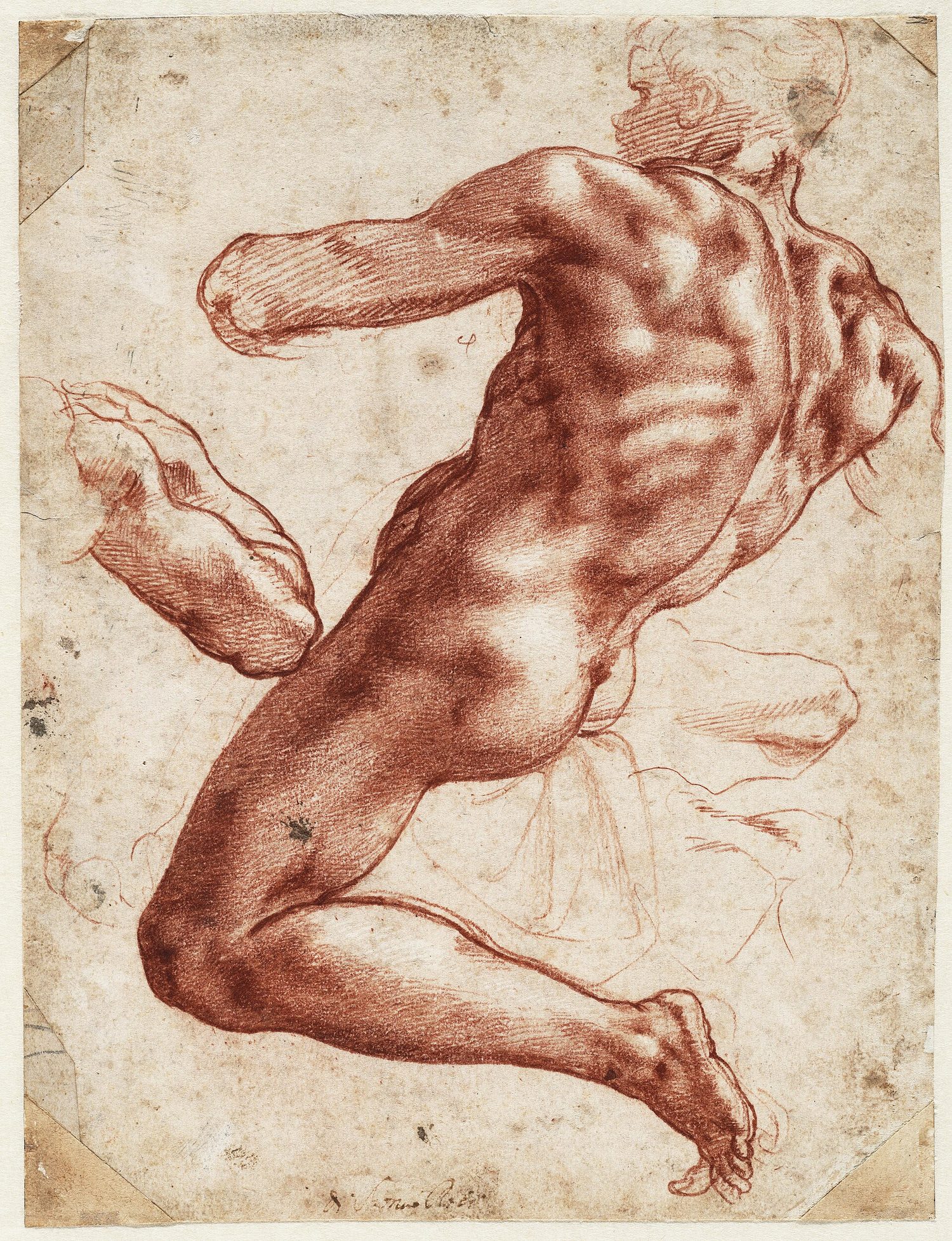
    Gesture and contour from a master study: line records form in one continuous look
    Gesture and contour from a master study: line records form in one continuous look
    Vocabulary · ⁨คำศัพท์⁩ Train · ⁨ฝึกฝน⁩
    English ไทย
    contour line/ˈkɒntʊə laɪn/ เส้นขอบ contour line
    blind contour/blaɪnd ˈkɒntʊə/ เส้นขอบตาบอด
    cross-contour lines/krɒs ˈkɒntʊə laɪnz/ เส้นข้ามพื้นผิวรูปทรง
    surface/ˈsɜːfɪs/ ผิว
    actual texture/ˈæktʃuːəl ˈtekstʃə/ actual texture
    implied texture/ɪmˈplaɪd ˈtekstʃə/ implied texture
    frottage/ˈfrɒtɪdʒ/ frottage
    1.3

    Gesture Drawing

    Syllabus · ⁨หลักสูตร⁩
    English

    Focus: Gesture drawing captures the energy, movement, and weight of a subject in seconds — before any detail.

    • A gesture drawing takes 30 seconds to 3 minutes; it looks for the action line running through the pose.
    • Draw the whole subject at once — big loose lines from the shoulder — never one polished corner.
    • Look for the line of action first: one curve that summarises the pose's movement.
    • Gesture is about what the subject is doing, not what it looks like.
    • Daily gesture pages build speed and confidence, and they photograph well as process evidence.
    • Long drawings usually start as a gesture: energy first, structure second, detail last.
    ไทย

    จุดเน้น: Gesture drawing ดึงพลังงาน การเคลื่อนไหว และน้ำหนักของวัตถุออกมาในไม่กี่วินาที — ก่อนรายละเอียดใดๆ

    • Gesture drawing ใช้เวลา 30 วินาทีถึง 3 นาที; มองหา action line ที่ไหลผ่านท่าทาง
    • วาดวัตถุทั้งชิ้นพร้อมกัน — เส้นใหญ่ๆ หลวมๆ จากไหล่ — ห้ามวาดมุมเดียวที่ขัดเงา
    • มองหา line of action ก่อน: Curve เดียวที่สรุปการเคลื่อนไหวของท่าทาง
    • Gesture เกี่ยวกับ สิ่งที่วัตถุกำลังทำ ไม่ใช่สิ่งที่มันดูเหมือน
    • หน้า gesture รายวันสร้างความเร็วและความมั่นใจ และถ่ายทำได้ดีในฐานะหลักฐานกระบวนการ
    • ภาพยาวมักเริ่มต้นด้วยการวาดท่าทาง: พลังงานก่อน โครงสร้างทีหลัง รายละเอียดสุดท้าย

    Source: College Board AP Course and Exam Description · ⁨แหล่งที่มา: คำอธิบายหลักสูตรและข้อสอบ College Board AP⁩

    English

    Gesture drawing 动态速写 captures the energy, movement, and weight of a subject in seconds — before any detail.

    • A gesture drawing takes 30 seconds to 3 minutes. Draw the whole subject at once with big, loose lines.
    • Look for the line of action 动势线 first: one curve that summarises the movement of the pose.
    • Gesture asks what the subject is doing, not what it looks like.
    • Long drawings usually start as a gesture: energy first, structure second, detail last.

    Daily gesture pages build speed and confidence, and they photograph well as evidence of practice.

    ไทย

    Gesture drawing จับพลังงาน การเคลื่อนไหว และน้ำหนักของวัตถุภายในไม่กี่วินาที - ก่อนรายละเอียดใดๆ

    • A gesture drawing ใช้เวลา 30 วินาทีถึง 3 นาที วาดวัตถุทั้งชิ้นพร้อมกันด้วยเส้นใหญ่และหลวม
    • Look for the line of action first: one curve that summarises the movement of the pose.
    • Gesture asks what the subject is doing, not what it looks like.
    • ภาพยาวมักเริ่มต้นด้วยการวาดท่าทาง: พลังงานก่อน โครงสร้างทีหลัง รายละเอียดสุดท้าย

    Daily gesture pages สร้างความเร็วและความมั่นใจ, และถ่ายทำได้ดีเป็นหลักฐานของการฝึกฝน

    Gesture captures action in a few lines before detail begins
    Gesture captures action in a few lines before detail begins
    Vocabulary · ⁨คำศัพท์⁩ Train · ⁨ฝึกฝน⁩
    English ไทย
    gesture drawing/ˈdʒestʃə ˈdrɔːɪŋ/ วาดท่าทาง
    line of action/laɪn ɒv ˈækʃn/ เส้นของการกระทำ
    1.4

    Hatching and Cross-Hatching · ⁨Hatching และ Cross-Hatching⁩

    Syllabus · ⁨หลักสูตร⁩

    Focus: Hatching builds value with parallel lines; cross-hatching layers a second direction on top.

    • Closer, darker lines read as darker value; wider spacing reads as lighter value.
    • Cross-hatching adds layers at new angles — each layer deepens the tone step by step.
    • Curve the hatch lines around the form (cross-contour hatching) so the shading also describes volume.
    • Keep a consistent angle inside one plane; change angle when the plane changes — edges stay crisp.
    • Pen-and-ink drawing depends on hatching because ink has no grey — value comes only from line density.
    • Hatching shows control of mark-making and light and shade, two named AP drawing skills, in one technique.

    Source: College Board AP Course and Exam Description · ⁨แหล่งที่มา: คำอธิบายหลักสูตรและข้อสอบ College Board AP⁩

    English
    Building value with marks

    Hatching 排线 builds tone with parallel lines. Cross-hatching 交叉排线 layers a second set of lines at a new angle on top.

    • Closer, darker lines read as darker value 明度; wider spacing reads as lighter value.
    • Each cross-hatched layer deepens the tone step by step — build darkness gradually.
    • Curve the lines around the form (cross-contour hatching) so the shading also describes volume.
    • Keep one angle inside one plane; change the angle when the plane changes, and edges stay crisp.
    • Pen-and-ink drawing depends on hatching, because ink has no grey: value comes only from line density.
    ไทย
    Building value with marks

    Hatching สร้าง tone ด้วยเส้นขนาน Cross-hatching ซ้อนชั้นเส้นชุดที่สองด้วยมุมใหม่ด้านบน

    A detailed old-master drawing of a pair of hands pressed together, modelled with dense fine ink lines on blue-grey paper
    Dürer สร้างรูปทรงมือเหล่านี้จากการขีดเส้นขนานละเอียดและการขีดไขว้; เมื่อเส้นอยู่ใกล้กันและไขว้กัน โทนสีจะเข้มขึ้น และรอยขีดที่แบนราบจะเปลี่ยนเป็นรูปทรงที่มีมิติ
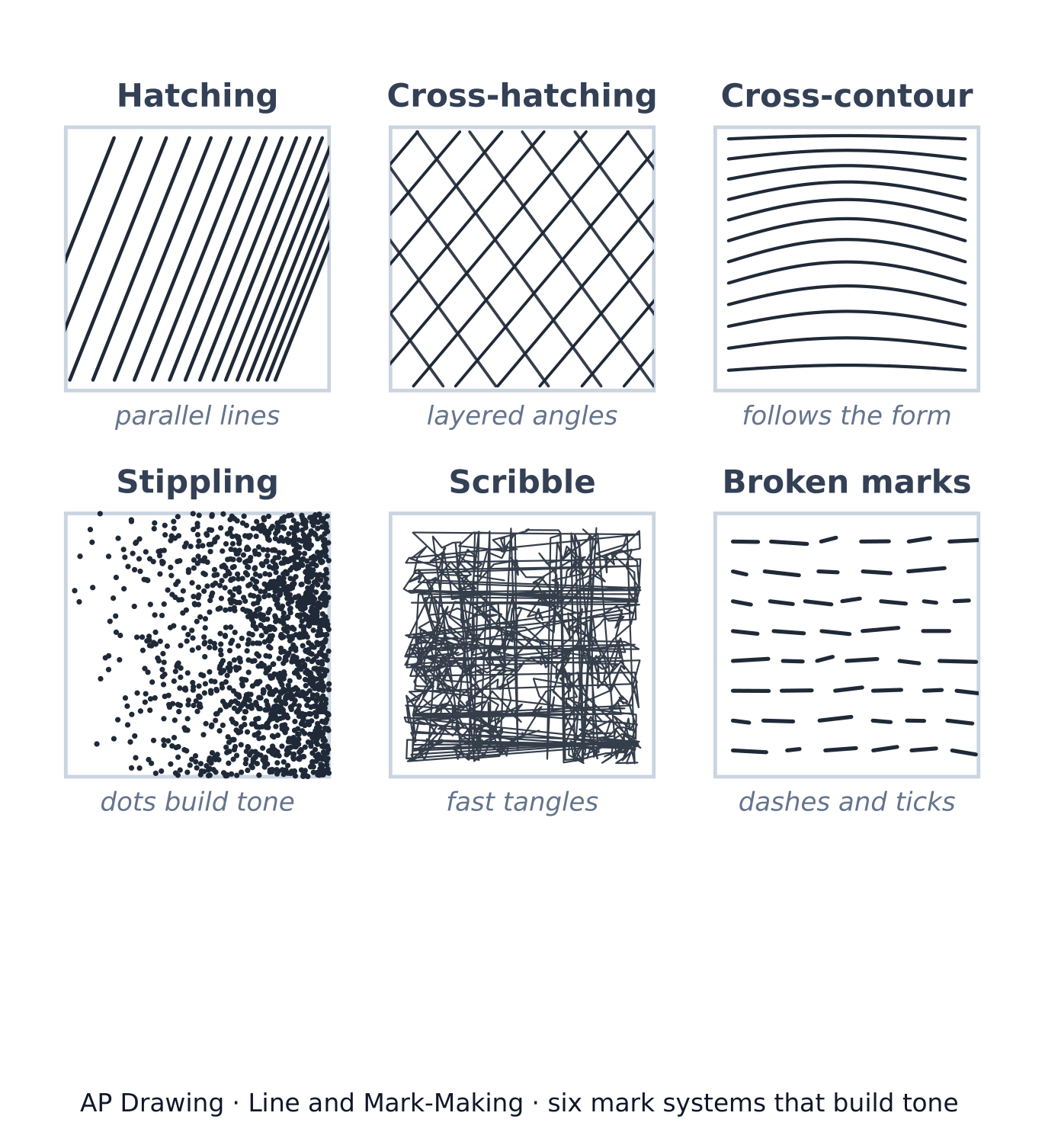
    ระบบการทำเครื่องหมาย 6 แบบ: การขีดเส้น, การขีดไขว้, การขีดตามแนวโค้ง, การขีดจุด, การขีดวน, และรอยขีดขาด
    6 วิธีในการสร้างโทนสีด้วยเครื่องหมาย: รอยขีดที่ชิด nhauและหนาแน่นกว่า จะถูกอ่านว่ามีความเข้มมากกว่า
    • เส้นที่ชิด nhauและเข้มกว่า ถูกอ่านว่ามีความเข้ม (value) มากกว่า; ระยะห่างที่กว้างกว่าจะถูกอ่านว่ามีความสว่างมากกว่า
    • แต่ละชั้นของการขีดไขว้จะทำให้โทนสีเข้มขึ้นทีละขั้น — สร้างความเข้มอย่างค่อยเป็นค่อยไป
    • ขดเส้นให้ไปตามรูปทรง (การขีดตามแนวโค้ง) เพื่อให้การแรเงาช่วยอธิบายปริมาตรด้วย
    • รักษามุมเดียวภายในระนาบหนึ่ง; เปลี่ยนมุมเมื่อระนาบเปลี่ยนไป และขอบจะยังคงคมชัด
    • การวาดด้วยปากกาหมึกdependence on การขีดเส้น เพราะหมึกไม่มีสีเทา: ความเข้มได้มาจากความหนาแน่นของเส้นเท่านั้น
    Explore · ⁨สำรวจ⁩

    Which mark system is it? · ⁨นี่คือระบบคะแนนแบบใด?⁩

    Hatching uses parallel lines, cross-hatching layers a second angle, stippling builds tone from dots, and scribble uses fast tangles. Naming mark systems helps you choose and describe your own. · ⁨Hatching ใช้เส้นขนาน, cross-hatching ซ้อนชั้นมุมที่สอง, stippling สร้างโทนจากจุด, และ scribble ใช้เส้นพัวพันเร็ว การระบุชื่อระบบเครื่องหมายช่วยให้เลือกและอธิบายงานของคุณเองได้⁩

    Vocabulary · ⁨คำศัพท์⁩ Train · ⁨ฝึกฝน⁩
    English ไทย
    hatching/ˈhætʃɪŋ/ การขีดเส้นทแยงมุม
    cross-hatching/krɒs ˈhætʃɪŋ/ การขีดเส้นไขว้
    value/ˈvæljuː/ ค่าความเข้มแสง
    stippling/ˈstɪplɪŋ/ stippling
    scribble/ˈskrɪbl/ scribble
    additive/ˈædɪtɪv/ แบบบวก
    subtractive/sʌbˈtræktɪv/ ลบ
    1.5

    Stippling, Scribbling, and Alternative Marks · ⁨การขีดจุด, การขีดวน, และเครื่องหมายทางเลือกอื่นๆ⁩

    Syllabus · ⁨หลักสูตร⁩
    English

    Focus: Beyond hatching there is a whole vocabulary of marks — dots, scribbles, dashes, smears — each with its own texture and speed.

    • Stippling builds tone from dots: dense dots read dark, sparse dots read light — slow but very controllable.
    • Scribble (or scumbled) marks are fast tangles of line — lively, good for fur, foliage, and energy.
    • Dashes, ticks, and broken marks suggest texture without outlining every detail.
    • Marks can be additive (adding material) or subtractive (lifting material out with an eraser).
    • Try one subject rendered in four different mark systems — a classic experimentation page.
    • A personal mark vocabulary is part of your artistic voice — examiners look for it across the portfolio.
    ไทย

    **เน้น:**Beyond hatching there is a whole vocabulary of marks — dots, scribbles, dashes, smears — each with its own texture and speed.

    • Stippling สร้างโทนสีจากจุด: จุดหนาอ่านเป็นสีเข้ม จุดบางอ่านเป็นสีอ่อน - ช้าแต่ควบคุมได้มาก
    • Scribble (หรือ scumbled) marks are fast tangles of line — lively, good for fur, foliage, and energy.
    • เส้นขีดเส้นจิก และเครื่องหมายแตกหักบ่งบอกถึงพื้นผิวโดยไม่ต้องวาดรายละเอียดทุกส่วน
    • Marks can be additive (adding material) or subtractive (lifting material out with an eraser).
    • Try one subject rendered in four different mark systems — a classic experimentation page.
    • A personal mark vocabulary is part of your artistic voice — examiners look for it across the portfolio.

    Source: College Board AP Course and Exam Description · ⁨แหล่งที่มา: คำอธิบายหลักสูตรและข้อสอบ College Board AP⁩

    English

    Beyond hatching there is a whole vocabulary of marks — dots, tangles, dashes, smears — each with its own texture and speed.

    • Stippling 点画 builds tone from dots: dense dots read dark, sparse dots read light. Slow, but very controllable.
    • Scribble 乱线 marks are fast tangles of line — lively and good for fur, foliage, and energy.
    • Dashes, ticks, and broken marks suggest texture without outlining every detail.
    • Marks can be additive 加法 (putting material on) or subtractive 减法 (lifting material off with an eraser).
    • A classic experimentation page: one subject rendered in four different mark systems.
    ไทย

    นอกเหนือจากการขีดเส้น ยังมีคำศัพท์ของเครื่องหมายอีกมากมาย — จุด, ลวดลายพันกัน, เส้นประ, รอยปาด — แต่ละแบบมีพื้นผิวและความเร็วของตัวเอง

    • การขีดจุด สร้างโทนสีจากจุด: จุดที่หนาแน่นถูกอ่านว่าเข้ม, จุดที่บางเบาถูกอ่านว่าสว่าง ช้าแต่ควบคุมได้ง่ายมาก
    • เครื่องหมายขีดวน เป็นลวดลายเส้นที่พันกันอย่างรวดเร็ว — มีชีวิตชีวาและเหมาะสำหรับขนสัตว์, ใบไม้, และการสื่อถึงพลังงาน
    • เส้นขีดเส้นจิก และเครื่องหมายแตกหักบ่งบอกถึงพื้นผิวโดยไม่ต้องวาดรายละเอียดทุกส่วน
    • เครื่องหมายสามารถเป็นแบบ เพิ่ม (วางวัสดุลง) หรือแบบ ลบ (ยกวัสดุออกด้วยยางลบ)
    • หน้าทดลองคลาสสิก: วัตถุหนึ่งถูก render ด้วยระบบ marks สี่แบบต่างกัน
    1.6

    Texture and Surface · ⁨พื้นผิวและลักษณะผิว⁩

    Syllabus · ⁨หลักสูตร⁩
    English

    Focus: Surface is a named AP drawing skill: how the drawing's physical texture and the depicted texture work together.

    • Actual texture is the real surface of the work (rough paper, layered charcoal, collage); implied texture is drawn illusion.
    • Frottage (rubbing over a textured surface) transfers real texture into a drawing.
    • Paper tooth (roughness) changes every mark: the same pencil reads differently on smooth and rough paper.
    • Contrast of textures — smooth skin against rough cloth — makes both read more strongly.
    • Build texture with the logic of the material: short strokes for fur, long strokes for hair, broken marks for stone.
    • Describing texture convincingly is visual evidence of observation and material control.
    ไทย

    Focus: Surface is a named AP drawing skill: how the drawing's physical texture and the depicted texture work together.

    • Actual texture is the real surface of the work (rough paper, layered charcoal, collage); implied texture is drawn illusion.
    • ฟร็อตตาژ (การถูบนพื้นผิวที่มีลวดลาย) ช่วยถ่ายโอนพื้นผิวจริงเข้าสู่ภาพวาด
    • Paper tooth (roughness) changes every mark: the same pencil reads differently on smooth and rough paper.
    • ความแตกต่างของพื้นผิว — ผิวเรียบเทียบกับผ้าหยาบ — ทำให้ทั้งสองด้านดูเด่นชัดยิ่งขึ้น
    • สร้างพื้นผิวด้วยหลักเหตุผลของวัสดุ: จังหวะสั้นสำหรับขนสัตว์, จังหวะยาวสำหรับเส้นผม, รอยขีดขาดสำหรับหิน
    • Describing texture convincingly is visual evidence of observation and material control.

    Source: College Board AP Course and Exam Description · ⁨แหล่งที่มา: คำอธิบายหลักสูตรและข้อสอบ College Board AP⁩

    English

    Surface 画面质感 is a named AP drawing skill: the physical texture of the drawing and the drawn illusion of texture work together.

    • Actual texture 实际肌理 is the real surface of the work — rough paper, layered charcoal, collage. Implied texture 视觉肌理 is drawn illusion.
    • Frottage 拓印法 (rubbing over a textured surface) transfers real texture into a drawing.
    • Paper tooth 纸纹 changes every mark: the same pencil reads differently on smooth and rough paper.
    • Contrast of textures — smooth skin against rough cloth — makes both read more strongly.
    • Build texture with the logic of the material: short strokes for fur, long strokes for hair, broken marks for stone.
    ไทย

    พื้นผิว เป็นทักษะการวาดภาพระดับ AP ที่ระบุชื่อไว้: พื้นผิวทางกายภาพของงานศิลปะและภาพลวงตาของพื้นผิวที่วาดขึ้นมาทำงานร่วมกัน

    • พื้นผิวจริง คือพื้นผิวจริงของชิ้นงาน — กระดาษหยาบ, ถ่านที่ซ้อนชั้น, คอลลาจ ภาพลวงตาของพื้นผิว คือการวาดภาพลวงตา
    • ฟร็อตตาژ (การถูบนพื้นผิวที่มีลวดลาย) ช่วยถ่ายโอนพื้นผิวจริงเข้าสู่ภาพวาด
    • Tooth ของกระดาษเปลี่ยนทุก mark:ดินสอตัวเดียวกันอ่านต่างกันบนกระดาษเรียบและหยาบ
    • ความแตกต่างของพื้นผิว — ผิวเรียบเทียบกับผ้าหยาบ — ทำให้ทั้งสองด้านดูเด่นชัดยิ่งขึ้น
    • สร้างพื้นผิวด้วยหลักเหตุผลของวัสดุ: จังหวะสั้นสำหรับขนสัตว์, จังหวะยาวสำหรับเส้นผม, รอยขีดขาดสำหรับหิน
    Vocabulary · ⁨คำศัพท์⁩ Train · ⁨ฝึกฝน⁩
    English ไทย
    tooth/tuːθ/ ความหยาบของพื้นผิว
    1.7

    Expressive Mark-Making · ⁨การทำเครื่องหมายแบบแสดงอารมณ์⁩

    Syllabus · ⁨หลักสูตร⁩
    English

    Focus: Marks carry emotion: the same subject drawn with angry, calm, or nervous marks tells three different stories.

    • Expressive lines exaggerate speed, pressure, and direction to communicate feeling, not just describe form.
    • Käthe Kollwitz's heavy charcoal and Egon Schiele's tense contours show how marks are the meaning.
    • Choose the mark to match the idea: soft graphite for quiet subjects, aggressive ink for conflict.
    • Distortion and exaggeration are legitimate drawing decisions when they serve intent — 'accurate' is not the only goal.
    • The AP rubric rewards ideas made visual: expressive marks link technique to meaning.
    • Test the same composition in two mark styles and write one sentence on which supports your inquiry better.
    ไทย

    Focus: Marks carry emotion: the same subject drawn with angry, calm, or nervous marks tells three different stories.

    • Expressive lines exaggerate speed, pressure, and direction to communicate feeling, not just describe form.
    • Käthe Kollwitz's heavy charcoal and Egon Schiele's tense contours show how marks are the meaning.
    • เลือกเส้นพู่กันให้เข้ากับแนวคิด: ดินสอนุ่มสำหรับหัวข้อที่เงียบสงบ, หมึก agresive สำหรับความขัดแย้ง
    • Distortion and exaggeration are legitimate drawing decisions when they serve intent — 'accurate' is not the only goal.
    • The AP rubric rewards ideas made visual: expressive marks link technique to meaning.
    • Test the same composition in two mark styles and write one sentence on which supports your inquiry better.

    Source: College Board AP Course and Exam Description · ⁨แหล่งที่มา: คำอธิบายหลักสูตรและข้อสอบ College Board AP⁩

    English

    Marks carry emotion. The same subject drawn with angry, calm, or nervous marks tells three different stories.

    • Expressive lines 表现性线条 exaggerate speed, pressure, and direction to communicate feeling, not just to describe form.
    • Käthe Kollwitz's heavy charcoal and Egon Schiele's tense contours show how the marks themselves carry the meaning.
    • Choose the mark to match the idea: soft graphite for quiet subjects, aggressive ink for conflict.
    • Distortion 变形 and exaggeration are legitimate drawing decisions when they serve your intent — "accurate" is not the only goal.
    • A personal mark vocabulary is part of your artistic voice 个人风格. Examiners look for it across the whole portfolio.
    ไทย

    รอยขีดข่วนบ่งบอกอารมณ์ วัตถุเดียวกันที่วาดด้วยรอยขีดข่วนที่โกรธ สงบ หรือหวาดหวั่น บอกเรื่องราวที่แตกต่างกันสามเรื่อง

    • เส้นที่แสดงอารมณ์ มุมมองความเร็ว, แรงกด, และทิศทางเกินจริงเพื่อสื่อสารความรู้สึก ไม่ใช่แค่เพื่ออธิบายรูปทรง
    • เถาถ่านหนักๆ ของ Käthe Kollwitz และเส้นขอบที่ตึงเครียดของ Egon Schiele แสดงให้เห็นว่าตัวเครื่องหมายเองก็พกพาความหมายไปด้วย
    • เลือกเส้นพู่กันให้เข้ากับแนวคิด: ดินสอนุ่มสำหรับหัวข้อที่เงียบสงบ, หมึก agresive สำหรับความขัดแย้ง
    • การบิดเบี้ยว และการมุมมองเกินจริงเป็นการตัดสินใจในการวาดภาพที่ยอมรับได้เมื่อมันสนับสนุนเจตนารมณ์ของคุณ — "ความแม่นยำ" ไม่ใช่เป้าหมายเดียว
    • คำศัพท์เครื่องหมายส่วนตัวเป็นส่วนหนึ่งของ เสียง ทางศิลปะของคุณ ผู้ประเมินมองหาสิ่งนี้ตลอดพอร์ตโฟลิโอทั้งหมด
    1.7

    Exam tips · ⁨ข้อแนะนำสำหรับการสอบ⁩

    English
    • Line quality is judged at a glance — one page of confident, varied strokes tells a scorer more than an hour of timid rendering. Warm up before every serious drawing.
    • Show the systems, not just the results: a portfolio image of hatching, stippling, and cross-contour studies is direct visual evidence of the mark-making skill the rubric names.
    • Photograph marks close up. A detail shot of your best passage of marks proves a skill that a full view only suggests.
    • Blind contour and gesture pages belong in your process images — they show observation and practice, exactly what the Sustained Investigation rubric asks to see.
    • Match marks to meaning in your written evidence: one sentence like "scratchy graphite lines echo the anxiety of exam season" links technique to idea, which is what scorers reward.
    ไทย
    • คุณภาพของเส้นถูกตัดสินในทันที — หน้ากระดาษที่เต็มไปด้วยจังหวะมั่นใจหลากหลาย บอกรายละเอียดผู้ประเมินมากกว่าการวาดที่ขี้อายเป็นเวลาหนึ่งชั่วโมงอุ่นเครื่องก่อนการวาดครั้งสำคัญทุกครั้ง
    • แสดงระบบ ไม่ใช่เพียงผลลัพธ์: ภาพพอร์ตโฟลิโอที่แสดงการขีดเส้น, การขีดจุด, และการศึกษาตามแนวโค้ง เป็นหลักฐานทางสายตาโดยตรงของทักษะ การทำเครื่องหมาย ที่เกณฑ์การประเมินระบุ
    • ถ่ายรูปเครื่องหมายแบบระยะใกล้ ภาพรายละเอียดของช่วงเครื่องหมายที่ดีที่สุดของคุณพิสูจน์ทักษะที่ภาพรวมทั้งหมดอาจเพียงบอกลางๆ
    • หน้าเส้นขอบแบบ Blind contour และหน้าท่าทาง ควรอยู่ในภาพกระบวนการ — มันแสดงถึงการสังเกตและการฝึกฝน ซึ่งตรงกับสิ่งที่เกณฑ์ Sustained Investigation ต้องการเห็น
    • จับคู่เครื่องหมายกับความหมายในเอกสารเขียนของคุณ: ประโยคเดียวเช่น "เส้นกราไฟท์ที่ขรุขระสะท้อนถึงความกังวลของฤดูกาลสอบ" เชื่อมโยงเทคนิคเข้ากับแนวคิด ซึ่งเป็นสิ่งที่ผู้ประเมินให้คะแนน
  • 2

    Value, Light, and Form · ⁨ค่า แสง และรูปร่าง⁩

    Watch lesson · ⁨ดูบทเรียน⁩
    2.1

    The Value Scale · ⁨สเกลค่าความเข้ม⁩

    Syllabus · ⁨หลักสูตร⁩
    English

    Focus: Value is lightness and darkness — the backbone of drawing, because we see form as light before we see colour.

    • A value scale runs from white through greys to black; a 9-step scale is the classic exercise.
    • Most beginners draw too light and too narrow — push the darks so the full range is used.
    • High-key drawings use mostly light values (airy, soft); low-key drawings use mostly dark values (heavy, dramatic).
    • Squint at the subject: squinting removes detail and shows the big value shapes.
    • Local value (how light the object's own surface is) is separate from lighting (how much light falls on it).
    • Control of the value scale is direct visual evidence of the AP skill light and shade.
    ไทย

    จุดเน้น: ค่าสี (Value) คือความสว่างและความมืด - ซึ่งเป็นกระดูกสันหลังของการวาดภาพ เพราะเรารู้จักรูปร่างจากความสว่างก่อนจะเห็นสี

    • สเกลค่าสี ไล่จากขาวผ่านเทาไปจนถึงดำ; สเกล 9-ขั้น เป็นแบบฝึกหัดคลาสสิก
    • ผู้เริ่มต้นส่วนใหญ่วาดสีอ่อนเกินไปและช่วงสีแคบ - ควรกดโทนเข้มเพื่อให้ใช้ช่วงสีเต็มรูปแบบ
    • ภาพ High-key ใช้ค่าสีอ่อนเป็นหลัก (เบาตา, นุ่มนวล); ภาพ Low-key ใช้ค่าสีเข้มเป็นหลัก (หนักแน่น, มีดราม่า)
    • พยายามจ้องที่วัตถุโดยเบลอสายตาเล็กน้อย: การเบลอจะช่วยตัดรายละเอียดออกและเผยให้เห็นรูปทรงค่าสีใหญ่ๆ
    • ค่าสีท้องถิ่น (ความสว่างพื้นผิวของตัววัตถุเอง) แยกต่างหากจากการจัดแสง (ปริมาณแสงที่ส่องกระทบ)
    • การควบคุมสเกลค่าสีคือหลักฐานทางตรงของทักษะ แสงและเงา ตามเกณฑ์ AP

    Source: College Board AP Course and Exam Description · ⁨แหล่งที่มา: คำอธิบายหลักสูตรและข้อสอบ College Board AP⁩

    English
    The value scale

    Value 明度 is lightness and darkness — the backbone of drawing, because we see form as light before we see colour.

    • A value scale 明度阶 runs from white through greys to black. Drawing a smooth 9-step scale is the classic control exercise.
    • Most beginners draw too light and use too narrow a range. Push the darks so the drawing uses the full scale.
    • High-key 高调 drawings use mostly light values and feel airy; low-key 低调 drawings use mostly dark values and feel heavy or dramatic.
    • Local value 固有明度 is how light the object's own surface is; lighting is how much light falls on it. Keep the two ideas separate.
    • Squint 眯眼 at the subject: squinting removes detail and shows the big value shapes.
    ไทย
    The value scale

    ค่าความเข้ม คือความสว่างและความมืด — โครงกระดูกแห่งการวาดภาพ เพราะเราเห็นรูปทรงด้วยความสว่างก่อนเห็นสี

    • สเกลค่าความเข้ม RUNNING จากสีขาวผ่านสีเทาไปจนถึงสีดำ การวาดสเกลที่เรียบเนียน 9 ขั้น เป็นการฝึกควบคุมที่เป็นคลาสสิก
    • นักเริ่มต้นส่วนใหญ่วาดอ่อนเกินไปและใช้ช่วงสีแคบเกินไป ดันโทนสีเข้มให้ภาพวาดใช้สเกลเต็มรูปแบบ
    • ภาพวาด High-key ใช้ค่าความสว่างเป็นหลักและรู้สึกเบาสบาย; ภาพวาด Low-key ใช้ค่าความเข้มเป็นหลักและรู้สึกหนักหรือมีดราม่า
    • ค่าความเข้มท้องถิ่น คือความสว่างของพื้นผิววัตถุ本身的; แสงส่องคือปริมาณแสงที่ตกกระทบ Keep这两概念แยกออกจากกัน
    • จ้องมึน ที่วัตถุ: การจ้องมึนเอา รายละเอียดออกและแสดงรูปร่างความเข้มขนาดใหญ่
    Vocabulary · ⁨คำศัพท์⁩ Train · ⁨ฝึกฝน⁩
    English ไทย
    value/ˈvæljuː/ ค่าความเข้มแสง
    value scale/ˈvæljuː skeɪl/ มาตราส่วนค่าความเข้มของสี
    high-key/haɪ kiː/ high-key
    low-key/ləʊ kiː/ low-key
    local value/ˈləʊkl ˈvæljuː/ ค่าท้องถิ่น
    squint/skwɪnt/ หรี่ตา
    highlight/ˈhaɪlaɪt/ highlight
    halftone/ˈhɑːftəʊn/ halftone
    core shadow/kɔː ˈʃædəʊ/ core shadow
    reflected light/rɪˈflektɪd laɪt/ แสงสะท้อน (Reflected light)
    cast shadow/kæst ˈʃædəʊ/ เงาตกกระทบ
    rendering/ˈrendərɪŋ/ การเรนเดอร์
    basic forms/ˈbeɪsɪk fɔːmz/ รูปทรงพื้นฐาน
    blending stump/ˈblendɪŋ stʌmp/ แท่งผสม
    2.2

    Light Logic: How Light Describes Form · ⁨ตรรกะของแสง: แสงอธิบายรูปทรงได้อย่างไร⁩

    Syllabus · ⁨หลักสูตร⁩
    English

    Focus: One light source creates a predictable pattern of light and shadow — learn the pattern and any form becomes drawable.

    • The six zones: highlight, light, halftone, core shadow, reflected light, and cast shadow.
    • The core shadow is the darkest band on the form, where the surface turns fully away from the light.
    • Reflected light bounces back into the shadow side — it is always darker than any lit halftone.
    • The cast shadow is darkest and sharpest where it meets the object, softer and lighter further away.
    • Shadow edges tell the story: hard edges = sharp turn or cast shadow; soft edges = gradual turn.
    • Check the logic, not just the look: every value must be explainable by the light's direction.
    ไทย

    จุดเน้น: แหล่งกำเนิดแสงเดียวสร้าง ลวดลายแสงและเงา ที่คาดการณ์ได้ - จักจำลวดลายนี้แล้วรูปทรงใดก็วาดได้

    • 6 โซน: จุดสว่าง, แสง, กลางสี, เงาหลัก, แสงสะท้อน, และ เงาตกกระทบ
    • เงาหลัก (Core shadow) คือแถบสีเข้มที่สุดบนรูปทรง ซึ่งเกิดเมื่อพื้นผิวหันหนีจากแหล่งกำเนิดแสงอย่างสมบูรณ์
    • แสงสะท้อน (Reflected light) ขยายกลับเข้าไปในด้านเงา - มันจะมืดกว่าโทนสีกลางที่ถูกแสง任何其他ส่วนเสมอ
    • เงาตกกระทบ (Cast shadow) จะเข้มและคมชัดที่สุดบริเวณที่ติดกับวัตถุ และนุ่มลงพร้อมสว่างขึ้นเมื่อห่างออกไป
    • ขอบเงบอกเรื่องราว: ขอบแข็ง = การเปลี่ยนมุมเฉียบพลันหรือเงาตกกระทบ; ขอบนุ่ม = การเปลี่ยนมุมค่อยเป็นค่อยไป
    • ตรวจสอบตรรกะไม่ใช่แค่ลักษณะภายนอก: ค่าสีทุกจุดต้องอธิบายได้ด้วยทิศทางของแสง

    Source: College Board AP Course and Exam Description · ⁨แหล่งที่มา: คำอธิบายหลักสูตรและข้อสอบ College Board AP⁩

    English
    Light logic: how light describes form

    One light source creates a predictable pattern of light and shadow. Learn the pattern, and any form becomes drawable.

    • The six zones: highlight 高光, light, halftone 中间调, core shadow 明暗交界线, reflected light 反光, and cast shadow 投影.
    • The core shadow is the darkest band on the form, where the surface turns fully away from the light.
    • Reflected light bounces back into the shadow side — but it is always darker than any lit halftone.
    • The cast shadow is darkest and sharpest where it meets the object, then softer and lighter further away.
    • Shadow edges tell the story: hard edges mean a sharp turn or a cast shadow; soft edges mean a gradual turn.
    ไทย
    Light logic: วิธีที่แสงอธิบายรูปทรง

    แหล่งกำเนิดแสงหนึ่งจุดสร้างรูปแบบแสงและเงาที่คาดเดาได้ เรียนรู้รูปแบบนี้ และรูปทรงใดๆ ก็วาดได้

    ทรงกลมภายใต้แหล่งกำเนิดแสงเดียว พร้อมป้ายกำกับ 6 โซนของแสง
    แหล่งกำเนิดแสงเดียว, 6 โซน: จุดสว่าง, แสง, กลางสี, เงาหลัก, แสงสะท้อน, และเงาตกกระทบ
    • 6 โซน: จุดสว่าง, แสง, กลางสี, เงาหลัก, แสงสะท้อน, และ เงาตกกระทบ
    • เงาหลักคือแถบที่มืดที่สุดบนรูปทรง ที่ซึ่งพื้นผิวหันหนีจากแสงอย่างสมบูรณ์
    • แสงสะท้อนสะท้อนกลับเข้าไปในฝั่งเงา — แต่มันจะมืดกว่ากลางสีที่ถูกแสง的任何ส่วนเสมอ
    • เงาตกกระทบจะเข้มและคมชัดที่สุดเมื่อสัมผัสกับวัตถุ แล้วจึงนุ่มลงและสว่างขึ้นเมื่อห่างออกไป
    • ขอบเงาบอกเรื่องราว: ขอบแข็งหมายถึงการเปลี่ยนมุมที่เฉียบคมหรือเงาตกกระทบ; ขอบนุ่มหมายถึงการเปลี่ยนมุมที่ค่อยเป็นค่อยไป
    Explore · ⁨สำรวจ⁩

    Which zone of light? · ⁨นี่คือโซนแสง哪种?⁩

    One light source makes six zones. The core shadow is the darkest band on the form; reflected light stays darker than any lit halftone; the cast shadow is sharpest where it meets the object. · ⁨แหล่งกำเนิดแสงหนึ่งสร้างหกโซน core shadow เป็นแถบมืดที่สุดบนรูปทรง; reflected light ยังคงมืดกว่าhalftone ที่สว่างใดๆ; cast shadow คมชัดที่สุดเมื่อสัมผัสกับวัตถุ⁩

    2.3

    Rendering Form · ⁨การแรเงารูปทรง⁩

    Syllabus · ⁨หลักสูตร⁩
    English

    Focus: Rendering means building smooth, believable volume — turning flat shapes into spheres, cylinders, and boxes.

    • Every complex subject simplifies into basic forms: sphere, cylinder, cube, cone — render those first.
    • Work dark to light or light to dark consistently; jumping around destroys the value structure.
    • Blend with intention: stumps and fingers smooth values, but preserved mark-making often reads stronger than over-blending.
    • Keep the lit side and shadow side clearly separated — form collapses when halftones creep into shadow.
    • A drawing of white objects (eggs, cups, cloth) is the classic rendering test: value comes only from light.
    • Rendered form demonstrates several AP drawing skills at once: light and shade, surface, and mark-making.
    ไทย

    จุดเน้น: การแรเงา (Rendering) หมายถึงการสร้างปริมาตรที่เรียบเนียนและสมจริง - การเปลี่ยนรูปแบนให้เป็นทรงกลม ทรงกระบอก และกล่อง

    • วัตถุซับซ้อนทุกชนิดลดรูปทรงลงเหลือ รูปทรงพื้นฐาน: ทรงกลม ทรงกระบอก ลูกบาศก์กร มุมฉาก - ให้แรเงารูปทรงเหล่านี้ก่อน
    • ทำงานจากเข้มไปอ่อน หรืออ่อนไปเข้มอย่างต่อเนื่อง; การกระโดดไปมาจะทำลายโครงสร้างค่าสี
    • ผสมอย่างมีเจตนา: การปาดด้วยนิ้วหรือสٹัมป์จะทำให้ค่าความเข้มเรียบเนียนขึ้น แต่ลายเส้นที่คงไว้มักดูแข็งแรงกว่าการผสมจนเกินพอดี
    • แยกด้านสว่างและด้านเงาให้อย่างชัดเจน — รูปทรงจะแบนราบเมื่อโทนสีกลางแทรกซึมเข้าไปในบริเวณเงา
    • ภาพวาดวัตถุสีขาว (เช่น ไข่ ถ้วย ผ้า) เป็นการทดสอบการให้ค่าสีแบบคลาสสิก: ค่าสีเกิดจากแสงเพียงอย่างเดียว
    • การวาดรูปทรงแสดงทักษะการวาดภาพ AP หลายประการพร้อมกัน: แสงและเงา ผิวสัมผัส และเทคนิคการสร้างลายเส้น

    Source: College Board AP Course and Exam Description · ⁨แหล่งที่มา: คำอธิบายหลักสูตรและข้อสอบ College Board AP⁩

    English

    Rendering 塑造 means building smooth, believable volume — turning flat shapes into spheres, cylinders, and boxes.

    • Every complex subject simplifies into basic forms 基本形体: sphere, cylinder, cube, cone. Render those first.
    • Work dark-to-light or light-to-dark consistently; jumping around destroys the value structure.
    • Blend with intention: a blending stump 擦笔 smooths values, but preserved marks often read stronger than over-blending.
    • Keep the lit side and the shadow side clearly separated. Form collapses when halftones creep into the shadow.
    • A drawing of white objects (eggs, cups, cloth) is the classic rendering test: all the value comes from light alone.
    ไทย

    การแรเงา หมายถึงการสร้างปริมาตรที่เรียบเนียนและน่าเชื่อถือ — เปลี่ยนรูปทรงแบนให้เป็นทรงกลม, ทรงกระบอก, และกล่อง

    • วัตถุที่ซับซ้อนทุกชนิดลดทอนลงเป็น รูปทรงพื้นฐาน: ทรงกลม, ทรงกระบอก, ลูกบาศก์, กรวย แรเงารูปทรงเหล่านั้นก่อน
    • ทำงานจากเข้มไปอ่อน หรืออ่อนไปเข้ม อย่างสม่ำเสมอ; การกระโดดไปมาจะทำให้โครงสร้างค่าความเข้ม-อ่อนพังทลาย
    • ผสมสีด้วยเจตนา: แท่งผสม ช่วยทำให้ค่าความเข้มเรียบเนียน แต่เครื่องหมายที่คงไว้มักดูเด่นชัดกว่าการผสมจนเกินไป
    • รักษาฝั่งที่ถูกแสงและฝั่งที่มีเงาให้แยกออกจากกันอย่างชัดเจน รูปทรงจะยุบตัวเมื่อกลางสีเลื้อยเข้าไปในฝั่งเงา
    • ภาพวาดวัตถุสีขาว (เช่น ไข่ ถ้วย ผ้า) เป็นการทดสอบการให้ค่าสีแบบคลาสสิก: ค่าสีทั้งหมดเกิดจากแสงเพียงอย่างเดียว
    2.4

    Chiaroscuro and High-Contrast Drawing · ⁨Chiaroscuro และภาพวาดความเปรียบต่างสูง⁩

    Syllabus · ⁨หลักสูตร⁩
    English

    Focus: Chiaroscuro ('light-dark') uses strong value contrast for drama — the language of Caravaggio and Rembrandt.

    • A single strong light against deep shadow pushes the subject forward and sets the mood.
    • Tenebrism is extreme chiaroscuro: most of the image sinks into darkness, one area blazes.
    • Reserve the strongest contrast for the focal point — contrast attracts the eye first.
    • Charcoal and ink wash suit chiaroscuro because they reach rich, deep darks quickly.
    • Working on toned paper with white and black media makes the light logic explicit.
    • High-contrast studies photograph impressively — strong candidates for Selected Works.
    ไทย

    เน้น: ** Chiaroscuro** ('แสง-มืด') ใช้ความแตกต่างของค่าสีที่ชัดเจนเพื่อสร้างความน่าตื่นเต้น — เป็นภาษาของ Caravaggio และ Rembrandt

    • แสงสว่างแรงเดียวตัดกับเงาเข้ม จะดันตัวแบบออกมาด้านหน้าและกำหนดอารมณ์ของภาพ
    • Tenebrism คือ chiaroscuro แบบสุดขั้ว: ส่วนใหญ่ของภาพจมอยู่ในความมืด มีเพียงพื้นที่เดียวที่สว่างไสว
    • เก็บความแตกต่างที่รุนแรงที่สุดไว้สำหรับ จุดสนใจ — ความต่างดึงดูดสายตาได้ก่อน
    • ถ่านและหมึกน้ำเหมาะสำหรับการวาด chiaroscuro เพราะสามารถสร้างสีเข้มที่ลึกซึ้งและสมบูรณ์ได้อย่างรวดเร็ว
    • การทำงานบน กระดาษสีโทน ด้วยวัสดุสีขาวและดำ ทำให้ตรรกะของแสงสว่างปรากฏชัดเจนยิ่งขึ้น
    • High-contrast studies photograph impressively — strong candidates for Selected Works.

    Source: College Board AP Course and Exam Description · ⁨แหล่งที่มา: คำอธิบายหลักสูตรและข้อสอบ College Board AP⁩

    English

    Chiaroscuro 明暗对照法 ("light-dark") uses strong value contrast for drama — the language of Caravaggio and Rembrandt.

    • A single strong light against deep shadow pushes the subject forward and sets the mood.
    • Tenebrism 暗色调主义 is extreme chiaroscuro: most of the image sinks into darkness while one area blazes.
    • Save the strongest contrast for the focal point 视觉焦点 — contrast attracts the eye first.
    • Charcoal and ink wash suit chiaroscuro because they reach rich, deep darks quickly.
    • Working on toned paper 有色纸 with black and white media makes the light logic explicit.
    ไทย

    Chiaroscuro (“แสง-มืด”) ใช้ความเปรียบต่างของค่าสีอย่างชัดเจนเพื่อสร้างความตึงเครียด — เป็นภาษาของ Caravaggio และ Rembrandt

    ภาพวาดพอร์ตเทรตที่นุ่มนวลและมีความเงามืดของผู้ชายนั่งอยู่ สร้างด้วยเฉดสีเทาเรียบเนียนโดยไม่มีการขีดเส้นขอบแข็ง
    ภาพวาดพอร์ตเทรตด้วยดินสอสีคอนเต้ของ Seurat สร้างด้วยโทนสีอ่อนๆ เพียงอย่างเดียว โดยแทบไม่มีการขีดเส้นขอบ กระดาษหยาบจะจับสีดินสอเพื่อสร้างเฉดสีเทาที่นุ่มนวล
    • แสงสว่างแรงเดียวตัดกับเงาเข้ม จะดันตัวแบบออกมาด้านหน้าและกำหนดอารมณ์ของภาพ
    • Tenebrism คือ chiaroscuro แบบสุดขั้ว: ส่วนใหญ่ของภาพจมอยู่ในความมืด ในขณะที่มีเพียงจุดเดียวที่ส่องสว่างจ้า
    • เก็บความเปรียบต่างที่รุนแรงที่สุดไว้สำหรับ จุดสนใจ — ความเปรียบต่างดึงดูดสายตาคนดูเป็นอันดับแรก
    • ถ่านและหมึกน้ำเหมาะสำหรับการวาด chiaroscuro เพราะสามารถสร้างสีเข้มที่ลึกซึ้งและสมบูรณ์ได้อย่างรวดเร็ว
    • การทำงานบน กระดาษที่มีโทนสี พร้อมใช้สีย้อมดำและขาว ทำให้ตรรกะของแสงสว่างชัดเจนขึ้น
    Vocabulary · ⁨คำศัพท์⁩ Train · ⁨ฝึกฝน⁩
    English ไทย
    chiaroscuro/ˌtʃaɪərəˈskjʊərəʊ/ คิอารอสคูโร (Chiaroscuro)
    tenebrism/ˈtenɪbrɪzəm/ tenebrism
    focal point/ˈfəʊkl pɔɪnt/ จุดโฟกัส
    toned paper/təʊnd ˈpeɪpə/ กระดาษโทนสี
    2.5

    Tonal Composition and Notan · ⁨การจัดองค์ประกอบด้วยโทนสีและ Notan⁩

    Syllabus · ⁨หลักสูตร⁩
    English

    Focus: Notan is the design of light and dark shapes — a drawing works or fails at thumbnail size before any detail.

    • Reduce the scene to 2-3 flat values (a notan study): if the pattern reads clearly, the composition is strong.
    • Thumbnail sketches (5-8 cm) let you test several value plans in minutes.
    • Group values: many small lights scattered everywhere feel noisy; connected value shapes feel designed.
    • Place the darkest dark against the lightest light at the focal point.
    • A clear value hierarchy — one dominant value, one secondary, one accent — organises the whole page.
    • Keep the thumbnails in your process journal: they are ideal Sustained Investigation evidence of planning.
    ไทย

    เน้น: Notan คือการจัดวางรูปทรงสว่างและมืด — ภาพวาดจะสำเร็จหรือล้มเหลวในระดับขนาดย่อก่อนที่จะมีรายละเอียดใดๆ

    • ลดฉากลงเหลือ 2-3 ค่าสีแบน (การฝึก Notan): หากลวดลายอ่านออกชัดเจน แสดงว่าองค์ประกอบภาพมีความแข็งแกร่ง
    • ภาพสเก็ตช์ขนาดเล็ก (5-8 ซม.) ช่วยให้คุณทดสอบแผนค่าสีหลายแบบได้ในเวลาไม่กี่นาที
    • จัดกลุ่มค่าสี: แสงเล็กๆ กระจายอยู่ทั่วไปอาจดูรบกวนสายตา; รูปทรงค่าสีที่เชื่อมต่อกันดูมีการออกแบบมาอย่างดี
    • วางความเข้มที่สุดไว้ตรงกับความอ่อนที่สุดที่จุดสนใจ
    • หlistener hierarchy ของค่าสีที่ชัดเจน — ค่าสีหลักหนึ่ง, ค่าสีรองหนึ่ง และค่าสีเสริมหนึ่ง — จะจัดระเบียบทั้งหน้ากระดาษ
    • เก็บภาพย่อไว้ในสมุดบันทึกกระบวนการของคุณ:它们是理想的持续探究证据,证明你的规划能力。

    Source: College Board AP Course and Exam Description · ⁨แหล่งที่มา: คำอธิบายหลักสูตรและข้อสอบ College Board AP⁩

    English

    Notan 明暗构成 is the design of light and dark shapes. A drawing works or fails at thumbnail size, before any detail exists.

    • Reduce the scene to 2-3 flat values. If the pattern still reads clearly, the composition is strong.
    • Thumbnail sketches 小稿 (5-8 cm) let you test several value plans in minutes.
    • Group your values: many small lights scattered everywhere feel noisy; connected value shapes feel designed.
    • Place the darkest dark against the lightest light at the focal point.
    • A clear value hierarchy — one dominant value, one secondary, one accent — organises the whole page.
    ไทย

    Notan คือการจัดวางรูปทรงระหว่างแสงและเงา ภาพวาดจะสำเร็จหรือล้มเหลวตั้งแต่ขนาดสเก็ตช์เล็ก ก่อนที่จะมีรายละเอียดใดๆ เข้ามาเกี่ยวข้อง

    สองภาพสเก็ตช์ Notan: รูปแบบค่าสีที่เชื่อมต่อกันอ่านออกชัดเจน ส่วนค่าสีที่กระจายตัวอ่านได้ว่าเป็นเสียงรบกวน *ลดฉากหลังเหลือเพียงสองหรือสามค่าสี: รูปทรงค่าสีที่เชื่อมต่อกันอ่านออกชัดเจน ส่วนจุดที่กระจายตัวอ่านได้ว่าเป็นเสียงรบกวน

    • ลดฉากหลังเหลือเพียง 2-3 ค่าสีแบน หากยังอ่านรูปแบบได้ชัดเจน แสดงว่าองค์ประกอบแข็งแรง
    • ภาพสเก็ตช์ขนาดเล็ก (5-8 ซม.) ช่วยให้คุณทดสอบแผนค่าสีหลายแบบได้ในเวลาไม่กี่นาที
    • จัดกลุ่มค่าสีของคุณ: แสงเล็กๆ จำนวนมากที่กระจายไปทั่วทุกที่ดูเป็นเสียงรบกวน; รูปทรงค่าสีที่เชื่อมต่อกันดูเป็นการออกแบบ
    • วางความเข้มที่สุดไว้ตรงกับความอ่อนที่สุดที่จุดสนใจ
    • หlistener hierarchy ของค่าสีที่ชัดเจน — ค่าสีหลักหนึ่ง, ค่าสีรองหนึ่ง และค่าสีเสริมหนึ่ง — จะจัดระเบียบทั้งหน้ากระดาษ
    Vocabulary · ⁨คำศัพท์⁩ Train · ⁨ฝึกฝน⁩
    English ไทย
    notan/ˈnəʊtn/ notan
    thumbnail sketches/ˈθʌmneɪl ˈsketʃɪz/ ภาพร่างขนาดย่อ
    toned ground/təʊnd ɡraʊnd/ พื้นโทนสี
    lift out/lɪft aʊt/ การยกออก
    2.6

    Toned Grounds and Subtractive Drawing · ⁨พื้นผิวโทนสีและการวาดแบบลบ⁩

    Syllabus · ⁨หลักสูตร⁩
    English

    Focus: Starting from a toned ground lets you draw both directions: darker with media, lighter with an eraser.

    • Cover the paper with an even charcoal or graphite tone, then lift out lights with a kneaded eraser.
    • Subtractive drawing treats the eraser as a drawing tool — pulling light out of dark.
    • Toned or grey paper gives a ready-made middle value: add darks and white highlights only.
    • The mid-tone start forces value decisions early — nothing hides behind white paper.
    • Erasers make marks too: a dragged kneaded eraser leaves soft light strokes, a hard eraser leaves crisp ones.
    • This process shows experimentation with materials and processes — exactly what the CED asks you to document.
    ไทย

    เน้น: การเริ่มต้นจากพื้นหลังที่มีสีช่วยให้คุณวาดได้ทั้งสองทาง: ทำให้มืดด้วยวัสดุ และทำให้สว่างด้วยยางลบ

    • ปกคลุมกระดาษด้วยโทนถ่านหรือกราไฟต์ให้สม่ำเสมอ แล้ว ดึงค่าสว่าง ออกด้วยยางลบแบบคลึงมือ
    • Subtractive drawing ใช้ยางลบเป็นเครื่องมือวาดภาพ — ดึงแสงออกมาจากความมืด
    • กระดาษสีโทนหรือสีเทาให้ค่าสีกลางที่พร้อมใช้: เพียงเติมส่วนมืดและไฮไลท์สีขาวเท่านั้น
    • การเริ่มต้นที่โทนกลางบังคับให้ตัดสินใจค่าความเข้ม-อ่อนตั้งแต่ต้น — ไม่มีอะไรซ่อนอยู่หลังกระดาษขาว
    • ยางลบก็ทิ้งรอยได้: ยางลบแบบนวดที่ลากไปจะทิ้งเส้นบางๆ อ่อนๆ, ยางลบแข็งจะทิ้งเส้นคมชัด
    • กระบวนการนี้แสดงถึง การทดลองกับวัสดุและกระบวนการ — ซึ่งตรงกับสิ่งที่ CED要求ให้คุณบันทึกไว้

    Source: College Board AP Course and Exam Description · ⁨แหล่งที่มา: คำอธิบายหลักสูตรและข้อสอบ College Board AP⁩

    English

    Starting from a toned ground 有色底 lets you draw in both directions: darker with media, lighter with an eraser.

    • Cover the paper with an even charcoal or graphite tone, then lift out 提白 the lights with an eraser.
    • Subtractive drawing 减法素描 treats the eraser as a drawing tool — pulling light out of dark.
    • A kneaded eraser 可塑橡皮 moulds to any shape: dab for soft lights, drag for soft strokes; a hard eraser cuts crisp lights.
    • Toned or grey paper gives a ready-made middle value: you add only the darks and the white highlights.
    • The mid-tone start forces value decisions early — nothing can hide behind white paper.
    • This process is visible experimentation 实验 with materials — exactly what the CED asks you to document.
    ไทย

    เริ่มต้นจาก พื้นผิวโทนสี ช่วยให้วาดได้ทั้งสองทิศทาง: ทำให้ออกสีดำด้วยสีย้อม และทำให้สว่างขึ้นด้วยการลบ

    • คลุมกระดาษด้วยโทนถ่านหรือกราไฟท์สม่ำเสมอ แล้ว ลบเอาแสง ออกด้วยยางลบ
    • Subtractive drawing ใช้ยางลบเป็นเครื่องมือวาดภาพ — ดึงแสงออกมาจากความมืด
    • ยางลบชนิดม้วน สามารถปรับรูปทรงได้ตามต้องการ: จิ้มเบาๆ เพื่อสร้างแสงนุ่มๆ ลากเพื่อสร้างเส้นนุ่มๆ; ยางลบแข็งจะตัดแสงให้คมชัด
    • กระดาษโทนสีหรือสีเทาให้ค่ากลางที่พร้อมใช้งาน: คุณเพิ่มเฉพาะสีเข้มและจุดสะท้อนแสงสีขาวเท่านั้น
    • การเริ่มต้นด้วยโทนกลางบังคับให้ตัดสินใจเรื่องค่าสีแต่เนิ่นๆ — ไม่มีอะไรซ่อนอยู่ใต้กระดาษสีขาวได้อีกต่อไป
    • กระบวนการนี้คือ การทดลอง กับวัสดุที่มองเห็นได้ — ซึ่งตรงกับสิ่งที่ CED要求ให้คุณบันทึก
    Vocabulary · ⁨คำศัพท์⁩ Train · ⁨ฝึกฝน⁩
    English ไทย
    subtractive drawing/sʌbˈtræktɪv ˈdrɔːɪŋ/ การวาดแบบลบ
    kneaded eraser/ˈniːdɪd ɪˈreɪzə/ ยางลบแบบนวด
    experimentation/ekˌsperɪmənˈteɪʃn/ การทดลอง
    2.6

    Exam tips · ⁨ข้อแนะนำสำหรับการสอบ⁩

    English
    • Full value range is a score signal. Scorers see weak, grey-on-grey drawings constantly; a confident black-to-white range stands out immediately.
    • Get the core shadow and reflected light right — they are what separates students who understand light logic from students who copy photos.
    • Include one white-object study in your practice images: value control with no local colour to hide behind is unmistakable visual evidence of the light and shade skill.
    • Photograph dark drawings carefully. Charcoal darks crush to a black mush in bad light; recheck the value range on screen before submitting.
    • Keep your notan thumbnails and submit a page of them as a process image — planning evidence directly supports the Sustained Investigation rubric.
    ไทย
    • ช่วงค่าสีเต็มเป็นสัญญาณคะแนน ผู้ประเมินเห็นภาพวาดสีเทาบนสีเทาที่อ่อนแอตลอดเวลา; ช่วงสีดำถึงสีขาวที่มั่นใจจะโดดเด่นทันที
    • จัดวางเงาหลักและแสงสะท้อนให้ถูกต้อง — นี่คือสิ่งที่แยกนักศึกษาที่เข้าใจตรรกะแสงออกจากนักศึกษาที่แค่วาดตามภาพ
    • รวมภาพฝึกฝนวัตถุสีขาวไว้ในภาพฝึกของคุณ: การควบคุมค่าสีโดยไม่มีสีพื้นเดิมมาพรางตา เป็นหลักฐานทางวิสัยทัศน์ที่ชัดเจนว่า ทักษะแสงและเงา ของคุณดีจริง
    • ถ่ายภาพภาพวาดสีเข้มอย่างระมัดระวัง สีดำของถ่านจะยุบตัวเป็นสีดำทึบในแสงที่ไม่ดี; ตรวจสอบช่วงค่าสีบนหน้าจออีกครั้งก่อนส่งงาน
    • เก็บภาพสเก็ตช์ Notan ไว้และส่งหน้ารวมภาพเหล่านั้น ในฐานะภาพกระบวนการ — หลักการวางแผนสนับสนุนrubric การสืบเสาะหาความรู้อย่างต่อเนื่องโดยตรง
  • 3

    Space, Depth, and Proportion · ⁨พื้นที่ ลึก และสัดส่วน⁩

    Watch lesson · ⁨ดูบทเรียน⁩
    3.1

    Measuring and Sighting · ⁨การวัดและการสังเกต⁩

    Syllabus · ⁨หลักสูตร⁩
    English

    Focus: Sighting is measuring the subject with your pencil at arm's length — the observational drawing survival skill.

    • Hold the pencil at full arm's length, lock the elbow, close one eye: now it is a ruler and a protractor.
    • Pick one unit (often the head, or a cup's height) and measure everything in that unit: comparative measurement.
    • Check angles by rotating the pencil to match an edge, then carrying that angle to the paper.
    • Plumb lines (vertical checks) and level lines (horizontal checks) locate landmarks above and below each other.
    • Draw envelope shapes first: the big simple shape that contains the whole subject, then divide it.
    • Measured accuracy is visual evidence of space and proportion control in the AP rubric's drawing skills.
    ไทย

    จุดเน้น: การสังเกต (Sighting) คือการวัดวัตถุด้วยดินสอที่ยื่นออกด้านหน้าตัว — ทักษะพื้นฐานสำหรับการวาดภาพเชิงสังเกตการณ์

    • ยึดดินสอให้แขนเหยียดตรงล็อกข้อศอก ปิดตาข้างหนึ่ง: ตอนนี้มันคือไม้บรรทัดและโปรTRACTOR
    • เลือกหน่วยวัดหนึ่ง (มักเป็นความสูงของศีรษะหรือถ้วย) แล้ววัดทุกอย่างในหน่วยนั้น: การวัดเปรียบเทียบ
    • ตรวจสอบมุมโดยการหมุนดินสอให้ขนานกับขอบ แล้วนำมุมนั้นไปวางบนกระดาษ
    • เส้นแนวตั้ง (Plumb lines) (ตรวจสอบแนวตั้ง) และ เส้นแนวนอน (Level lines) (ตรวจสอบแนวนอน) ใช้ระบุตำแหน่งจุดสำคัญที่อยู่เหนือและใต้กัน
    • วาด รูปทรงห่อหุ้ม (Envelope shapes) ก่อน: รูปทรงใหญ่เรียบง่ายที่ครอบคลุมทั้งวัตถุ แล้วจึงแบ่งส่วน
    • ความแม่นยำจากการวัดคือหลักฐานทางสายตาของการควบคุม พื้นที่ และ สัดส่วน ตามเกณฑ์การประเมินของ AP

    Source: College Board AP Course and Exam Description · ⁨แหล่งที่มา: คำอธิบายหลักสูตรและข้อสอบ College Board AP⁩

    English

    Sighting 目测 means measuring the subject with your pencil at arm's length — the survival skill of observational drawing.

    • Hold the pencil at full arm's length with a locked elbow and one eye closed: now it is a ruler and a protractor.
    • Pick one unit (often the head, or a cup's height) and measure everything in that unit — comparative measurement 比较测量.
    • Check angles by rotating the pencil to match an edge, then carrying that angle to the paper.
    • A plumb line 铅垂线 (an imagined vertical) shows which landmarks sit exactly above or below each other.
    • Draw the envelope 外包形 first: the big simple shape that contains the whole subject, then divide it.
    ไทย

    Sighting หมายถึงการวัดตัวแบบด้วยดินสอที่ยื่นแขนออกไปให้สุด — ทักษะการรอดชีวิตของการวาดแบบสังเกตการณ์

    • ยึดดินสอที่ยื่นแขนออกไปให้สุดด้วยข้อศอกล็อคและปิดตาข้างหนึ่ง: ตอนนี้มันคือไม้บรรทัดและโปรtractor
    • เลือกหน่วยวัดหนึ่ง (มักจะเป็นศีรษะ หรือความสูงของถ้วย) แล้ววัดทุกอย่างด้วยหน่วยนั้น — การวัดเปรียบเทียบ
    • ตรวจสอบมุมโดยการหมุนดินสอให้ขนานกับขอบ แล้วนำมุมนั้นไปวางบนกระดาษ
    • เส้นตั้งตรง (เส้นแนวตั้งสมมติ) แสดงให้เห็นว่าLandmarks อยู่ตรงกันแนวนอนหรือแนวตั้งกันอย่างไร
    • วาด กรอบรอบนอก ก่อน: รูปทรงใหญ่เรียบง่ายที่ครอบคลุมตัวแบบทั้งหมด แล้วจึงแบ่งย่อย
    Vocabulary · ⁨คำศัพท์⁩ Train · ⁨ฝึกฝน⁩
    English ไทย
    sighting/ˈsaɪtɪŋ/ จุดสังเกต
    comparative measurement/kəmˈpærətɪv ˈmeʒəmənt/ การวัดเปรียบเทียบ
    plumb line/plʌm laɪn/ เส้นตั้งฉาก
    envelope/ˈenvələʊp/ envelope
    linear perspective/ˈlɪnɪə pəˈspektɪv/ linear perspective
    horizon line/həˈraɪzn laɪn/ เส้นแนวนอน
    vanishing point/ˈvænɪʃɪŋ pɔɪnt/ จุดหายไป
    3.2

    One-Point Perspective · ⁨มุมมองแบบจุดเดียว⁩

    Syllabus · ⁨หลักสูตร⁩
    English

    Focus: Linear perspective turns the picture plane into a window: in one-point, all depth lines meet at a single vanishing point.

    • The horizon line is the viewer's eye level — everything above it we look up at, everything below we look down on.
    • Lines parallel to the picture plane stay true; lines going into the scene converge to the vanishing point.
    • Equal spaces look smaller as they recede — use the diagonal trick to divide receding space evenly.
    • One-point suits rooms, streets, and corridors seen straight-on.
    • Objects overlap and rise toward the horizon as they get further away — perspective plus overlap is depth doubled.
    • Perspective errors are easy to spot: check every depth line actually aims at the point.
    ไทย

    จุดเน้น: มุมมองเชิงเส้น (Linear perspective) เปลี่ยนระนาบภาพให้เป็นเหมือนหน้าต่าง: ในมุมมองจุดเดียว เส้นความลึกทั้งหมดจะบรรจบกันที่ จุด消失了 (Vanishing point) เดียว

    • เส้นขอบฟ้า (Horizon line) คือระดับสายตาของผู้ชม — ทุกอย่างเหนือเส้นนี้เราต้องเงยหน้าขึ้นดู ทุกอย่างใต้เส้นนี้เราต้องมองลง
    • เส้นขนานกับระนาบภาพจะคงรูปร่างเดิม; เส้นที่พุ่ง เข้าไป ในฉากจะรวมตัวเข้าหา จุด消失了 (Vanishing point)
    • ระยะห่างเท่ากันจะดูเล็กลงเมื่อถอยหลัง — ใช้เทคนิคเส้นทแยงมุมเพื่อแบ่งพื้นที่ที่ถอยหลังออกเท่าๆ กัน
    • มุมมองจุดเดียวเหมาะสำหรับห้อง ถนน และทางเดินที่มองเห็นตรงๆ
    • วัตถุซ้อนทับกันและยกสูงขึ้นเข้าหาเส้นขอบฟ้าเมื่ออยู่ไกลขึ้น — มุมมอง + การซ้อนทับ (Overlap) คือความลึกที่เพิ่มขึ้นสองเท่า
    • ข้อผิดพลาดด้านมุมมองเห็นได้ง่าย: ตรวจสอบให้แน่ใจว่าทุกเส้นความลึกชี้ไปที่จุด消失了จริง

    Source: College Board AP Course and Exam Description · ⁨แหล่งที่มา: คำอธิบายหลักสูตรและข้อสอบ College Board AP⁩

    English
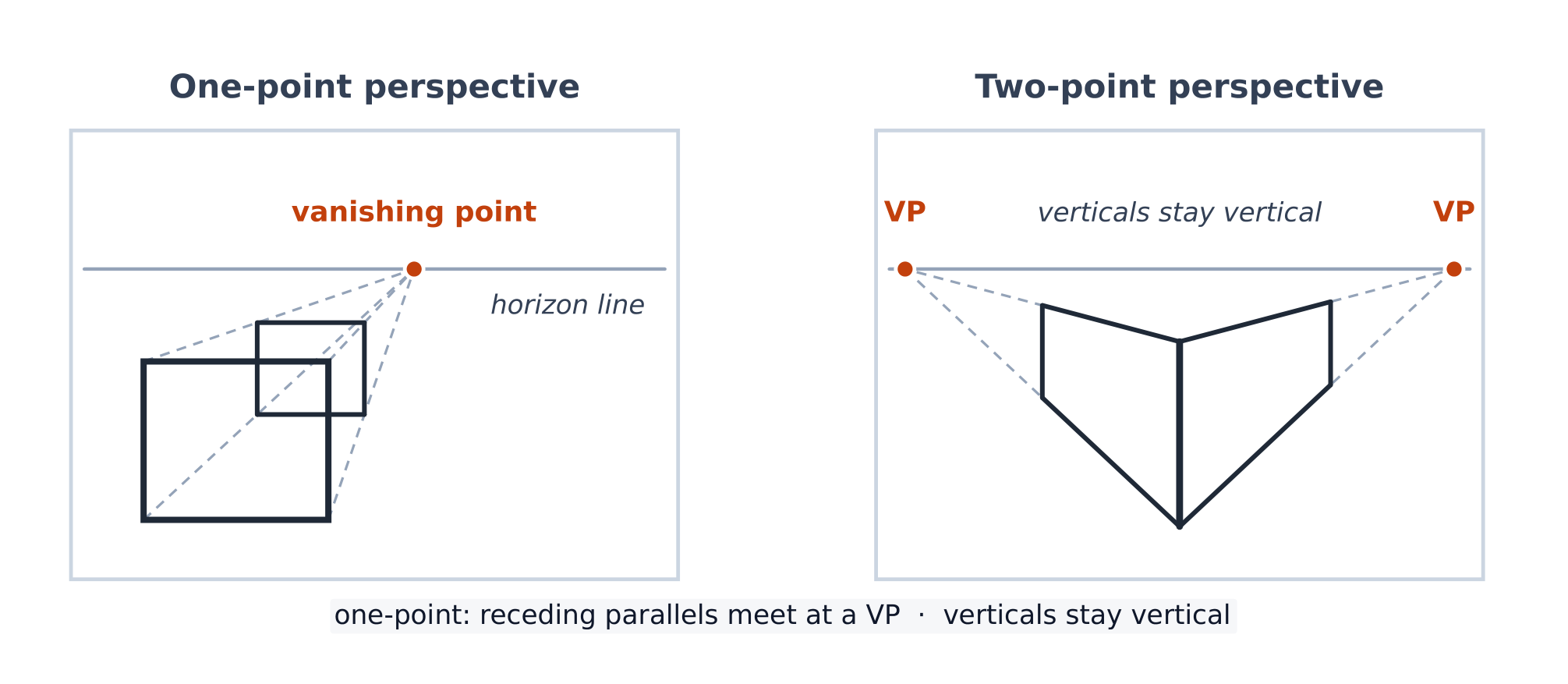
    One-point perspective

    Linear perspective 线性透视 treats the picture as a window. In one-point perspective, all lines going into the depth meet at a single point.

    • The horizon line 视平线 is the viewer's eye level. We look down on everything below it and up at everything above it.
    • Lines parallel to the picture surface stay true; lines going into the scene converge to the vanishing point 灭点.
    • Equal spaces look smaller as they recede. Use diagonals to divide receding space evenly.
    • One-point perspective 一点透视 suits rooms, streets, and corridors seen straight-on.
    • Perspective plus overlap 遮挡 is depth doubled: near edges cover far edges.
    ไทย

    *มุมมองเชิงเส้นแบบจุดเดียว

    Perspective แบบเส้นตรง มองภาพวาดเป็นหน้าต่าง ในมุมมองแบบจุดเดียว เส้นทั้งหมดที่พุ่งเข้าไปในความลึกจะ bertemuกันที่จุดเดียว

    ถนนทรายยาวตรงที่ทอดตัวไปข้างหน้าสู่ขอบฟ้า ขอบถนนแคบลงจนกลายเป็นจุดเดียว *ถนนทรายตรง: ขอบทั้งสองข้างดูเหมือนจะพบกันที่จุด消失了 واحدบนขอบฟ้า พอดีกับมุมมองแบบจุดเดียวที่ภาพวาดสร้างขึ้นเพื่อแสดงความลึก

    มุมมองแบบจุดเดียวและสองจุด: เส้นขอบฟ้า จุด消失了 และขอบที่ลู่เข้าหากัน *ซ้าย: จุดเดียว — เส้นความลึกพบกันที่จุด消失了หนึ่ง ขวา: สองจุด — แต่ละชุดของขอบพบจุด消失了ของตัวเอง

    • เส้นขอบฟ้า คือระดับสายตาของผู้ชม เรามองลงไปที่ทุกสิ่งด้านล่างมัน และมองขึ้นไปทุกสิ่งด้านบนมัน
    • เส้นที่ขนานกับพื้นผิวภาพจะคงความเป็นจริง; เส้นที่พุ่ง เข้าไป ในฉากจะลู่เข้าหา จุด消失了
    • ระยะห่างเท่ากันจะดูเล็กลงเมื่อถอยหลัง ใช้เส้นทแยงมุมเพื่อแบ่งพื้นที่ที่ถอยหลังอย่างสม่ำเสมอ
    • มุมมองแบบจุดเดียว เหมาะกับห้อง ถนน และทางเดินที่มองตรงๆ
    • Perspective加上 Overlap คือความลึกที่เพิ่มขึ้นสองเท่า: ขอบหน้าจะทับขอบหลัง
    Vocabulary · ⁨คำศัพท์⁩ Train · ⁨ฝึกฝน⁩
    English ไทย
    one-point perspective/wʌn pɔɪnt pəˈspektɪv/ پرسเปกทีวหนึ่งจุด
    overlap/ˌəʊvəˈlæp/ การทับซ้อน
    3.3

    Two-Point and Three-Point Perspective · ⁨มุมมองแบบสองจุดและสามจุด⁩

    Syllabus · ⁨หลักสูตร⁩
    English

    Focus: Turn the subject at an angle and you need two vanishing points; look steeply up or down and you need a third.

    • In two-point, verticals stay vertical; both sets of horizontal edges converge to left and right points on the horizon.
    • Keep both vanishing points far apart (often off the paper) — close points create fisheye distortion.
    • Three-point adds a vertical vanishing point: skyscrapers from below (looking up) or street scenes from a rooftop (looking down).
    • Boxes drawn in perspective become the scaffolding for everything: buildings, books, vehicles, even heads.
    • Cast shadows and reflections follow the same perspective system as the objects that make them.
    • A perspective grid underdrawing keeps complex scenes consistent — construct lightly, render on top.
    ไทย

    จุดเน้น: หมุนวัตถุเป็นมุมแล้วคุณต้องใช้ จุด消失了สองจุด; มองขึ้นหรือลงชันๆ แล้วคุณต้องใช้จุด消失了ที่สาม

    • ใน มุมมองสองจุด เส้นแนวตั้งจะยังคงแนวตั้ง; ขอบแนวนอนทั้งสองชุดจะบรรจบกันที่จุดซ้ายและขวาบนเส้นขอบฟ้า
    • รักษาให้จุด消失了ทั้งสองอยู่ห่างกันมาก (มักอยู่นอกกระดาษ) — จุดที่ใกล้กันจะสร้างความบิดเบี้ยวแบบเลนส์ตาปลา
    • มุมมองสามจุด เพิ่มจุด消失了แนวตั้ง: ตึกสูงจากด้านล่าง (มองขึ้น) หรือฉากถนนจากหลังคา (มองลง)
    • กล่องที่วาดด้วย perspective จะกลายเป็นโครง支撑สำหรับทุกอย่าง: buildings, books, vehicles,甚至是 heads
    • เงาตกกระทบและสะท้อนแสงเป็นไปตามระบบมุมมองเดียวกับวัตถุที่สร้างเงาเหล่านั้น
    • โครงร่างตารางมุมมองช่วยรักษาความสอดคล้องของฉากซับซ้อน — สร้างโครงสร้างเบาๆ แล้วเติมรายละเอียดด้านบน

    Source: College Board AP Course and Exam Description · ⁨แหล่งที่มา: คำอธิบายหลักสูตรและข้อสอบ College Board AP⁩

    English
    Two-point perspective

    Turn the subject at an angle and you need two-point perspective 两点透视; look steeply up or down and you need a third point.

    • In two-point, verticals stay vertical; the two sets of horizontal edges converge to a left and a right vanishing point on the horizon.
    • Keep the two points far apart — often off the paper. Points placed too close create a fisheye distortion.
    • Three-point perspective 三点透视 adds a vertical vanishing point: a skyscraper from below, or a street from a rooftop.
    • Boxes drawn in perspective become scaffolding for everything: buildings, books, vehicles, even heads.
    • Cast shadows and reflections obey the same perspective system as the objects that make them.
    ไทย
    มุมมองแบบสองจุด

    หมุนตัวแบบตามมุมแล้วคุณต้องใช้ ** Perspective สองจุด**; มองขึ้นหรือลงอย่างชัน你需要第三个点。

    • ในมุมมองแบบสองจุด เส้นตั้งตรงจะยังคงตั้งตรง; สองชุดของขอบแนวนอนจะลู่เข้าหาจุด消失了ทางซ้ายและขวาบนเส้นขอบฟ้า
    • รักษาให้จุด消失了ทั้งสองอยู่ห่างกัน — มักจะอยู่นอกกระดาษ การวางจุด消失了ใกล้เกินไปจะทำให้เกิดการบิดเบี้ยวแบบเลนส์ fish-eye
    • Perspective สามจุด เพิ่มจุด消失แนวตั้ง: ตึกสูงมองจากด้านล่าง หรือถนนมองจากรถยนต์บนหลังคา
    • กล่องที่วาดตาม perspective จะกลายเป็นโครงร่างสำหรับทุกอย่าง: อาคาร หนังสือ ยานพาหนะ แม้แต่ศีรษะ
    • เงาตกกระทบและการสะท้อน tuânตามระบบ perspective เดียวกันกับวัตถุที่ทำให้เกิดมัน
    Vocabulary · ⁨คำศัพท์⁩ Train · ⁨ฝึกฝน⁩
    English ไทย
    two-point perspective/tuː pɔɪnt pəˈspektɪv/ پرسเปกทีวสองจุด
    three-point perspective/θriː pɔɪnt pəˈspektɪv/ پرسเปกทีวสามจุด
    foreshortening/fɔːˈʃɔːtənɪŋ/ การลดทอนระยะ
    cross-sections/krɒs ˈsekʃnz/ หน้าตัด
    3.4

    Foreshortening · ⁨การลดทอนมิติ (Foreshortening)⁩

    Syllabus · ⁨หลักสูตร⁩
    English

    Focus: Foreshortening is perspective applied to a single form pointing toward you — lengths compress dramatically.

    • A pointing arm may appear one-third of its true length: draw the apparent shape, not the known one.
    • Overlap is the key signal: the hand overlaps the forearm, the forearm overlaps the upper arm.
    • Think in cross-sections: imagine rings around the form (like a wireframe) to feel how it turns toward you.
    • Measure foreshortened lengths by sighting — knowledge lies, observation tells the truth.
    • Classic practice: draw a figure lying down feet-first (like Mantegna's Dead Christ).
    • Strong foreshortening is high-difficulty visual evidence — examiners recognise the skill immediately.
    ไทย

    จุดเน้น: มุมมองเบี่ยงเบน (Foreshortening) คือการนำมุมมองมาประยุกต์กับรูปทรงเดียวที่ชี้เข้ามาหาผู้ดู — ความยาวจะบีบอัดอย่างมาก

    • แขนที่ชี้เข้ามาอาจดูสั้นลงเหลือหนึ่งในสามของความยาวจริง: วาดรูปร่างที่ ปรากฏ ไม่ใช่รูปร่างที่คุณรู้ว่าเป็น
    • การซ้อนทับคือสัญญาณสำคัญ: มือซ้อนทับแขนส่วนล่าง, แขนส่วนล่างซ้อนทับแขนส่วนบน
    • คิดเป็นหน้าตัด: จินตนาการวงแหวนรอบรูปทรง (เหมือนโครงลวด) เพื่อรู้สึกถึงการหมุนเข้าหาผู้ดู
    • วัดความยาวที่เบี่ยงเบนด้วยการสังเกต — ความรู้อาจหลอกลวง แต่การสังเกตบอกความจริง
    • ฝึกฝนคลาสสิก: วาดตัวละครนอนคว่ำเท้าเข้าหาผู้ดู (เช่น Mantegna's Dead Christ)
    • มุมมองเบี่ยงเบนที่ชัดเจนเป็นหลักฐานทางสายตาที่มีความยากสูง — กรรมการสอบจดจำทักษะนี้ได้ทันที

    Source: College Board AP Course and Exam Description · ⁨แหล่งที่มา: คำอธิบายหลักสูตรและข้อสอบ College Board AP⁩

    English

    Foreshortening 透视缩短 is perspective applied to a single form pointing toward you — lengths compress dramatically.

    • A pointing arm may appear one-third of its true length. Draw the apparent shape, not the length you know.
    • Overlap is the key signal: the hand overlaps the forearm, the forearm overlaps the upper arm.
    • Think in cross-sections 横截面: imagine rings around the form, like a wireframe, to feel how it turns toward you.
    • Measure foreshortened lengths by sighting — memory lies, observation tells the truth.
    • The classic practice piece: a figure lying down, drawn feet-first, like Mantegna's Dead Christ.
    ไทย

    การลดทอนมิติ คือ perspective ที่ใช้กับรูปทรงเดี่ยวชี้เข้ามาหาเรา — ความยาวจะบีบอัดอย่างมาก

    • แขนที่ยื่นอาจดูสั้นลงเหลือเพียงหนึ่งในสามของความยาวจริง วาด รูปร่างที่เห็น ไม่ใช่ความยาวที่คุณรู้
    • การซ้อนทับคือสัญญาณสำคัญ: มือซ้อนทับแขนส่วนล่าง, แขนส่วนล่างซ้อนทับแขนส่วนบน
    • คิดเป็น หน้าตัด: จินตนาการวงแหวนรอบรูปทรงเหมือนโครงลวด เพื่อรู้สึกถึงorientation ของมัน haciaเรา
    • วัดความยาวที่ลดทอนด้วยการมองตรง — ความจำหลอกลวง แต่การสังเกตบอกความจริง
    • งานฝึกฝนคลาสสิก: figura lying down, วาดเท้าไปหัวเหมือน Mantegna's Dead Christ
    3.5

    Atmospheric Perspective · ⁨Perspective ทางบรรยากาศ⁩

    Syllabus · ⁨หลักสูตร⁩
    English

    Focus: Atmospheric (aerial) perspective creates depth without lines: distant things are lighter, cooler, softer, and less detailed.

    • Air scatters light, so contrast fades with distance — the far mountain is a pale flat shape.
    • Foreground: darkest darks, sharpest edges, most texture; background: narrow value range, soft edges.
    • Reserve full black and full white for the foreground; the distance lives in the middle greys.
    • Detail density is a depth cue by itself — render the near leaf, suggest the far tree.
    • Combine linear and atmospheric perspective for maximum depth in landscape and cityscape drawing.
    • This is the AP skill space made visible through light and shade — two rubric skills in one device.
    ไทย

    จุดเน้น: มุมมองบรรยากาศ (Aerial perspective) สร้างความลึกโดยไม่ใช้เส้น: วัตถุระยะไกลจะมีสีอ่อนกว่า หนาวกว่า นุ่มกว่า และมีรายละเอียดน้อยกว่า

    • อากาศกระจายแสง ทำให้ความต่างของค่าสีจางหายไปตามระยะทาง — ภูเขาไกลๆ จึงดูเป็นรูปแบนสีซีด
    • หน้าฉาก: ค่าสีดำเข้มที่สุด ขอบคมชัดที่สุด มีพื้นผิวมากที่สุด; ฉากหลัง: ช่วงค่าสีแคบ ขอบนุ่มนวล
    • Reserved สีดำสนิทและสีขาวสนิทไว้สำหรับหน้าฉาก ส่วนระยะไกลอยู่ในช่วงสีเทากลาง
    • ความหนาแน่นของรายละเอียดเป็นสัญญาณความลึกโดยตัวมันเอง — เติมรายละเอียดใบไม้ใกล้ๆ ชี้บอกต้นไม้ไกลๆ
    • ผสมผสานมุมมองเชิงเส้นและมุมมองบรรยากาศเพื่อสร้างความลึกสูงสุดในการวาดภูมิทัศน์และเมือง
    • นี่คือทักษะของ AP ที่ว่าด้วย พื้นที่ ที่ถูกทำให้เห็นผ่าน แสงและเงา — ทักษะเกณฑ์การประเมินสองประการในเครื่องมือเดียว

    Source: College Board AP Course and Exam Description · ⁨แหล่งที่มา: คำอธิบายหลักสูตรและข้อสอบ College Board AP⁩

    English
    Atmospheric perspective

    Atmospheric perspective 空气透视 creates depth without any lines: distant things become lighter, cooler, softer, and less detailed.

    • Air scatters light, so contrast fades with distance. The far mountain is a pale, flat shape.
    • Foreground: darkest darks, sharpest edges, most texture. Background: a narrow value range and soft edges.
    • Save full black and full white for the foreground; the distance lives in the middle greys.
    • Detail density is a depth cue by itself: render the near leaf, suggest the far tree.
    • Combine linear and atmospheric perspective for maximum depth in landscape drawing.
    ไทย

    *มุมมองเชิงบรรยากาศ

    ภาพลวงตาทางบรรยากาศ สร้างความลึกโดยไม่ต้องใช้เส้น: สิ่งของที่อยู่ไกลจะดูอ่อนลง เย็นลง นุ่มลง และ รายละเอียดน้อยลง

    • อากาศกระจายแสง ทำให้ความแตกต่างของค่าสีจางหายไปเมื่อระยะทางไกลขึ้น ภูเขาที่อยู่ไกลจึงเป็นรูปทรงที่แบนและสีซีด
    • ด้านหน้า: ค่าสีเข้มที่สุด ขอบคมชัดที่สุด และมีพื้นผิวมากที่สุด ด้านหลัง: ช่วงค่าสีแคบและมีขอบนุ่มนวล
    • เก็บสีดำสนิทและสีขาวบริสุทธิ์ไว้สำหรับด้านหน้า ส่วนระยะไกลจะอยู่ในช่วงสีเทากลาง
    • ความหนาแน่นของรายละเอียดเป็นสัญญาณความลึกในตัวเอง: วาดใบไม้ใกล้ให้ชัดเจน แต่ชี้บอกรูปแบบต้นไม้ไกลๆ เพียงพอ
    • รวมภาพลวงตาเชิงเส้นและภาพลวงตาทางบรรยากาศเข้าด้วยกันเพื่อสร้างความลึกสูงสุดในการวาดทิวทัศน์
    สันเขาที่ซ้อนทับกันจางหายไปเมื่อระยะทางไกลขึ้น: ภาพลวงตาทางบรรยากาศทำให้รูปทรงไกลๆ ดูเย็นลงและอ่อนลง
    สันเขาที่ซ้อนทับกันจางหายไปเมื่อระยะทางไกลขึ้น: ภาพลวงตาทางบรรยากาศทำให้รูปทรงไกลๆ ดูเย็นลงและอ่อนลง
    Explore · ⁨สำรวจ⁩

    Which depth cue is at work? · ⁨นี่คือสัญญาณความลึก哪种?⁩

    Drawings create depth several ways at once: linear perspective (lines converge), atmospheric perspective (distance fades and softens), overlap (near covers far), and foreshortening (forms compress toward you). · ⁨ภาพวาดสร้างความลึกหลายวิธีพร้อมกัน: linear perspective (เส้นรวมกัน), atmospheric perspective (ระยะทางจางและนุ่มลง), overlap (สิ่งใกล้บดบังสิ่งที่ไกล), และ foreshortening (รูปทรงบีบอัดเข้าหาคุณ)⁩

    Vocabulary · ⁨คำศัพท์⁩ Train · ⁨ฝึกฝน⁩
    English ไทย
    atmospheric perspective/ˌætməsˈferɪk pəˈspektɪv/ atmospheric perspective
    composition/ˌkɒmpəˈzɪʃn/ การจัดองค์ประกอบ
    3.6

    Composition and the Picture Plane · ⁨การจัดองค์ประกอบและระนาบภาพ⁩

    Syllabus · ⁨หลักสูตร⁩
    English

    Focus: Composition — how everything is arranged inside the picture's edges — is a named AP drawing skill and the first thing a scorer sees.

    • The picture plane has edges: what you crop out is as expressive as what you keep in.
    • The rule of thirds places focal points on the third-lines — safer than dead centre.
    • Control the figure-ground relationship: negative space is a designed shape, not leftover paper.
    • Lead the eye with paths: lines, value contrast, and detail act as arrows toward the focal point.
    • Vary the viewpoint — eye level is neutral; a low or high viewpoint makes an ordinary subject fresh.
    • Test compositions with a viewfinder or phone camera crop before committing to the page.
    ไทย

    จุดเน้น: การจัดองค์ประกอบ (Composition) — วิธีการจัดวางสิ่งต่างๆ ภายในขอบเขตภาพ — เป็นทักษะวาดภาพที่ระบุชื่อใน AP และเป็นสิ่งที่ผู้ให้คะแนนมองเห็นเป็นอันดับแรก

    • ระนาบภาพ (Picture plane) มีขอบ: สิ่งที่ตัดออกไปมีพลังแสดงออกเท่ากับการ保留ไว้
    • กฎสามส่วน (Rule of thirds) วางจุดสนใจบนเส้นแบ่ง_thirds_ — ปลอดภัยกว่าการวางตรงกลางเป๊ะๆ
    • ควบคุม ความสัมพันธ์ระหว่างวัตถุและพื้นหลัง (Figure-ground relationship): พื้นที่ว่างคือรูปทรงที่ถูกออกแบบ ไม่ใช่เศษกระดาษที่เหลือ
    • นำสายตาด้วยเส้นทาง: เส้น ความต่างของค่าสี และรายละเอียดทำหน้าที่เป็นลูกศรชี้ไปยังจุดสนใจ
    • เปลี่ยนมุมมอง — ระดับสายตาเป็นกลาง; มุมมองต่ำหรือสูงจะทำให้วัตถุธรรมดาสดใหม่
    • ทดสอบการจัดองค์ประกอบด้วยกรอบมองหรือการตัดต่อกล้องมือถือก่อนเริ่มวาดจริง

    Source: College Board AP Course and Exam Description · ⁨แหล่งที่มา: คำอธิบายหลักสูตรและข้อสอบ College Board AP⁩

    English

    Composition 构图 — the arrangement of everything inside the picture's edges — is a named AP drawing skill and the first thing a scorer sees.

    • The picture plane 画面 has edges: what you crop out is as expressive as what you keep in.
    • The rule of thirds 三分法 places focal points on the third-lines — stronger than dead centre.
    • Design the negative space 负空间: the empty shapes around the subject are shapes you drew, not leftovers.
    • The figure-ground relationship 图底关系 must stay readable: the eye should always know what is subject and what is background.
    • Lead the eye with paths — lines, value contrast, and detail act as arrows toward the focal point.
    • Test crops with a viewfinder 取景框 (or a phone camera) before committing to the page. Change the viewpoint 视点: eye level is neutral; low or high angles make ordinary subjects fresh.
    ไทย

    การจัดองค์ประกอบ — การจัดวางทุกสิ่งภายในขอบเขตของภาพ — เป็นทักษะการวาด AP ที่ระบุชื่อไว้ และเป็นสิ่งที่ผู้ประเมินมองเห็นเป็นอันดับแรก

    • ระนาบภาพ (Picture plane) มีขอบ: สิ่งที่ตัดออกไปมีพลังแสดงออกเท่ากับการ保留ไว้
    • กฎ三分之一的 (Rule of thirds) วางจุดสนใจบนเส้น_thirds — แข็งแกร่งกว่าการวางตรงกลาง
    • ออกแบบ พื้นที่ว่าง: รูปทรงเปล่ารอบตัวแบบคือรูปทรงที่คุณวาดขึ้น ไม่ใช่เศษเหลือทิ้ง
    • ความสัมพันธ์ระหว่างวัตถุและพื้นหลัง ต้องอ่านออกเสมอ: ตาต้องรู้เสมอว่าอะไรคือตัวแบบและอะไรคือพื้นหลัง
    • นำสายตาไปตามเส้นทาง — เส้น, ความต่างของค่าสี และรายละเอียด ทำหน้าที่เหมือนลูกศรชี้ไปยังจุดสนใจ
    • ทดสอบการตัดกรอบด้วย กรอบมองภาพ (หรือกล้องโทรศัพท์) ก่อนตัดสินใจลงมือวาดจริง เปลี่ยน มุมมอง: ระดับสายตาเป็นเรื่องปกติ; มุมต่ำหรือสูงช่วยให้ตัวแบบธรรมดาดูใหม่และน่าสนใจขึ้น
    Vocabulary · ⁨คำศัพท์⁩ Train · ⁨ฝึกฝน⁩
    English ไทย
    picture plane/ˈpɪktʃə pleɪn/ ระนาบภาพ
    rule of thirds/ruːl ɒv θɜːdz/ กฎสามส่วน
    3.7

    Drawing the Figure and Portrait · ⁨การวาดรูปร่างและภาพบุคคล⁩

    Syllabus · ⁨หลักสูตร⁩
    English

    Focus: The figure combines every drawing skill at once — proportion, gesture, form, and likeness under one deadline.

    • The classic adult figure stands about 7.5 heads tall; the halfway point is near the hip, not the waist.
    • In the head, eyes sit at the halfway line of the skull — the beginner error is placing them too high.
    • Start with gesture and the big masses (ribcage, pelvis, skull); features and fingers come last.
    • Sight-size checks save likeness: compare distances between landmarks, not memorised rules alone.
    • Hands and feet earn their reputation — draw them as simple geometric mittens/wedges first, then divide.
    • Figure and portrait work is a portfolio staple: it demonstrates observation, proportion, and nerve.
    ไทย

    จุดเน้น: ร่างกายมนุษย์รวมทุกทักษะการวาดเข้าด้วยกันพร้อมกัน — สัดส่วน ท่าทาง รูปร่าง และความคล้ายคลึงกันภายใต้กำหนดเวลาเดียว

    • ร่างกายผู้ใหญ่คลาสสิกมีความสูงประมาณ 7.5 ศีรษะ; จุดกึ่งกลางอยู่ใกล้สะโพก ไม่ใช่เอว
    • ในศีรษะ ตาอยู่ที่ เส้นกึ่งกลาง ของกะโหลกศีรษะ — ข้อผิดพลาดของมือใหม่คือการวางตาสูงเกินไป
    • เริ่มต้นจากการวางท่าทางและมวลขนาดใหญ่ (ซี่โครง, กระดูกเชิงกราน, กะโหลกศีรษะ) ส่วนรายละเอียดและนิ้วมือให้ทำเป็นขั้นสุดท้าย
    • การตรวจสอบขนาดเท่ากับการสังเกต (Sight-size checks) ช่วยรักษาความคล้ายคลึง: เปรียบเทียบระยะห่างระหว่างจุดสำคัญ ไม่ใช่แค่กฎที่ท่องจำ
    • มือและเท้ามีชื่อเสียง因为它们... วาดเป็นถุงมือ/สามเหลี่ยมเรขาคณิตง่ายก่อน แล้วค่อยแบ่งส่วน
    • งานวาดร่างกายและภาพบุคคลเป็นเนื้อหาหลักของพอร์ตโฟลิโอ: แสดงให้เห็นถึงการสังเกต สัดส่วน และความกล้าหาญ

    Source: College Board AP Course and Exam Description · ⁨แหล่งที่มา: คำอธิบายหลักสูตรและข้อสอบ College Board AP⁩

    English

    The human figure combines every drawing skill at once: proportion 比例, gesture, form, and likeness under one deadline.

    • The classic adult figure stands about 7.5 heads tall; the halfway point of the body is near the hip, not the waist.
    • In the head, the eyes sit at the halfway line 中线 of the skull — beginners always place them too high.
    • Start with gesture and the big masses (ribcage, pelvis, skull); features and fingers come last.
    • Check likeness with landmark distances, not memorised rules alone — every face bends the average.
    • Draw hands and feet as simple geometric mittens and wedges first, then divide them into parts.
    ไทย

    รูปร่างมนุษย์รวมทักษะการวาดทั้งหมดเข้าไว้ในเวลาเดียวกัน: สัดส่วน, ท่าทาง, รูปร่าง และ likeness ภายใต้กำหนดเวลาที่จำกัด

    สัดส่วนของรูปร่างและศีรษะ: รูปร่างยืนสูงประมาณ 7.5 ศีรษะ; ตาอยู่ที่เส้นกึ่งกลางของกะโหลกศีรษะ
    รูปร่างผู้ใหญ่คลาสสิกมีความสูงประมาณ 7.5 ศีรษะ; ภายในศีรษะ ตาจะอยู่ที่เส้นกึ่งกลาง
    • รูปร่างผู้ใหญ่คลาสสิกมีความสูงประมาณ 7.5 ศีรษะ; จุดกึ่งกลางของร่างกายอยู่ใกล้สะโพก ไม่ใช่เอว
    • ในศีรษะ ตาจะอยู่ที่ เส้นกึ่งกลาง ของกะโหลกศีรษะ — นักเรียนเริ่มต้นมักวางตำแหน่งตาสองตาไว้สูงเกินไป
    • เริ่มต้นจากการวางท่าทางและมวลขนาดใหญ่ (ซี่โครง, กระดูกเชิงกราน, กะโหลกศีรษะ) ส่วนรายละเอียดและนิ้วมือให้ทำเป็นขั้นสุดท้าย
    • ตรวจสอบความคล้ายคลึงด้วยระยะทางของLandmarks ไม่ใช่แค่กฎที่ท่องจำ — ใบหน้าแต่ละคนเบี่ยงเบนจากค่าเฉลี่ย
    • วาดมือและเท้าในรูปแบบทรงเรขาคณิตง่ายๆ resembling ถุงมือและสามเหลี่ยมก่อน แล้วจึงแบ่งส่วนประกอบ
    Vocabulary · ⁨คำศัพท์⁩ Train · ⁨ฝึกฝน⁩
    English ไทย
    proportion/prəˈpɔːʃn/ proportion
    halfway line/ˈhɑːfweɪ laɪn/ เส้นกึ่งกลาง
    3.7

    Exam tips · ⁨ข้อแนะนำสำหรับการสอบ⁩

    English
    • Perspective errors are the easiest mistakes for a scorer to spot — check every depth line actually aims at its vanishing point before you render.
    • Include one strong observational space (an interior, a stairwell, a street) in the portfolio: it demonstrates the space skill the rubric names, unmistakably.
    • Foreshortening is high-value evidence. One convincing foreshortened limb or object tells scorers you draw what you see, not what you remember.
    • Crop like a designer. Before starting, test three viewfinder crops and pick the one with the strongest negative space — composition is judged at first glance.
    • Use atmospheric perspective in graphite too, not just paint: softening far edges with a kneaded eraser is quick and reads as skill.
    ไทย
    • ข้อผิดพลาดด้านมุมมองคือจุดที่ผู้ตรวจพบได้ง่ายที่สุด — ตรวจสอบให้แน่ใจว่าเส้นความลึกทุกเส้นมุ่งตรงไปยังจุดล่องหายจริงก่อนเริ่มลงสี
    • รวมพื้นที่จากการสังเกตหนึ่งจุดที่เด่นชัด (ภายในอาคาร, บันได, ถนน) เข้าในแฟ้มผลงาน: เพื่อแสดงทักษะ พื้นที่ ที่เกณฑ์การประเมินระบุไว้อย่างชัดเจน
    • การวาดแบบทแยงมุมหรือ perspective compression เป็นหลักฐานที่มีค่าสูง การวาดแขนหรือวัตถุหนึ่งชิ้นที่ดูมีมิติสมจริง จะบอกผู้ตรวจว่าคุณวาดสิ่งที่เห็น ไม่ใช่สิ่งที่จำได้
    • ตัดกรอบภาพเหมือนนักออกแบบ ก่อนเริ่มวาด ให้ลองทดสอบการตัดกรอบภาพด้วยเฟรมมอง 3 แบบ แล้วเลือกแบบที่มีพื้นที่ว่าง (negative space) ที่โดดเด่นที่สุด — การจัดองค์ประกอบจะถูกตัดสินจาก第一眼
    • ใช้เทคนิค Perspective ทางอากาศในดินสอได้ด้วย ไม่ใช่เฉพาะสีน้ำมัน: การทำให้ขอบระยะไกลจางลงด้วยยางลบชนิดนวดได้ทั้งรวดเร็วและแสดงถึงทักษะ
    Vocabulary · ⁨คำศัพท์⁩ Train · ⁨ฝึกฝน⁩
    English ไทย
    negative space/ˈneɡətɪv speɪs/ พื้นที่ว่าง
    figure-ground relationship/ˈfɪɡə ɡraʊnd rɪˈleɪʃənʃɪp/ ความสัมพันธ์ระหว่างรูปกับพื้นหลัง
    viewfinder/ˈvjuːfaɪndə/ วิউไฟน์เดอร์ (viewfinder)
    viewpoint/ˈvjuːpɔɪnt/ มุมมอง
  • 4

    Drawing Media and Processes · ⁨สื่อและกระบวนการวาดภาพ⁩

    Watch lesson · ⁨ดูบทเรียน⁩
    4.1

    Graphite · ⁨ดินสอ⁩

    Syllabus · ⁨หลักสูตร⁩
    English

    Focus: Graphite is the everyday drawing medium — precise, erasable, and capable of a full (if silvery) value range.

    • Grades run hard to soft: 9H (palest, hardest) through HB to 9B (darkest, softest).
    • Hard grades suit construction lines and fine detail; soft grades build rich darks fast.
    • Graphite gets shiny when layered heavily — deepest blacks may need charcoal or carbon pencil instead.
    • Vary the grip: writing grip for detail, overhand grip for broad, light shading from the arm.
    • Woodless graphite sticks and powder cover big areas; erasers then carve lights back out.
    • A full-value graphite still life is the classic control test — worth one polished example in any portfolio.
    ไทย

    จุดเน้น: ดินสอ (Graphite) เป็นสื่อวาดภาพในชีวิตประจำวัน — คัดเขียนได้แม่นยำ ลบได้ และมีช่วงค่าสีเต็มรูปแบบ (แม้จะเป็นสีเงิน)

    • ระดับความแข็งไปจนถึงความนิ่ม: 9H (อ่อนที่สุด แข็งที่สุด) ผ่าน HB ไปยัง 9B (เข้มที่สุด นุ่มที่สุด)
    • เกรดแข็งเหมาะสำหรับเส้นโครงสร้างและรายละเอียดเล็ก ๆ; เกรดยอมช่วยสร้างโทนเข้มได้รวดเร็ว
    • เกรไฟต์จะมีความเงางามเมื่อวางชั้นหนา — สีดำลึกที่สุดอาจต้องใช้ถ่านหรือดินสอถ่านแทน
    • เปลี่ยนการจับ: การจับแบบเขียนเพื่อรายละเอียด, การจับแบบคว่ำมือสำหรับการแรดเงาที่กว้างและเบาจากแขน
    • ก้านเกรไฟต์ไร้ไม้ก้านและผงครอบคลุมพื้นที่ใหญ่; ยางลบจึงใช้แกะแสงกลับออกมาได้
    • ภาพนิ่งวาดด้วยดินสอที่มีโทนสีครบถ้วนเป็นการทดสอบการควบคุมพื้นฐาน — ควรมีตัวอย่างที่เรียบหรูอย่างน้อยหนึ่งชิ้นในแฟ้มผลงาน

    Source: College Board AP Course and Exam Description · ⁨แหล่งที่มา: คำอธิบายหลักสูตรและข้อสอบ College Board AP⁩

    English

    Graphite 石墨 is the everyday drawing medium — precise, erasable, and capable of a full (if silvery) value range.

    • Pencil grades 硬度等级 run hard to soft: 9H (palest, hardest) through HB to 9B (darkest, softest).
    • Hard grades suit construction lines and fine detail; soft grades build rich darks fast.
    • Heavy graphite turns shiny. For the deepest blacks, switch to charcoal or a carbon pencil 炭笔.
    • Vary the grip: the writing grip for detail, the overhand grip 横握 for broad, light shading from the arm.
    • Woodless graphite sticks and graphite powder cover big areas; erasers then carve the lights back out.
    • A full-value graphite still life is the classic control test — worth one polished example in any portfolio.
    ไทย

    ดินสอ เป็นสื่อวาดภาพในชีวิตประจำวัน — มีความละเอียด ยบได้ และมีช่วงโทนสีเต็มรูปแบบ (แม้จะเป็นสีเงิน)

    ระดับความแข็งของดินสอตั้งแต่ 2H ไปจนถึง 8B พร้อมระดับโทนสีของแต่ละเกรด
    ระดับดินสอ: เกรดแข็งจะคงโทนสว่างและมีความแม่นยำ; เกรดยอมจะสร้างโทนเข้มได้รวดเร็ว
    • ระดับความแข็งของดินสอเรียงจากแข็งไปอ่อน: 9H (สว่างที่สุด, แข็งที่สุด) ผ่าน HB ไปจนถึง 9B (เข้มที่สุด, อ่อนที่สุด).
    • เกรดแข็งเหมาะสำหรับเส้นโครงสร้างและรายละเอียดเล็ก ๆ; เกรดยอมช่วยสร้างโทนเข้มได้รวดเร็ว
    • การกดดินสอแรงเกินไปจะทำให้พื้นผิวเงา反光 For the deepest blacks, switch to charcoal or a carbon pencil.
    • เปลี่ยนการจับดินสอ: จับแบบเขียนเพื่อรายละเอียด, จับแบบคว่ำมือ สำหรับการแรเงากว้างๆ จากแขน
    • แท่งดินสอไร้ไม้และผงดินสอครอบคลุมพื้นที่กว้าง; จากนั้นใช้ยางลบแกะแสงสว่างกลับออกมา
    • ภาพนิ่งวาดด้วยดินสอที่มีโทนสีครบถ้วนเป็นการทดสอบการควบคุมพื้นฐาน — ควรมีตัวอย่างที่เรียบหรูอย่างน้อยหนึ่งชิ้นในแฟ้มผลงาน

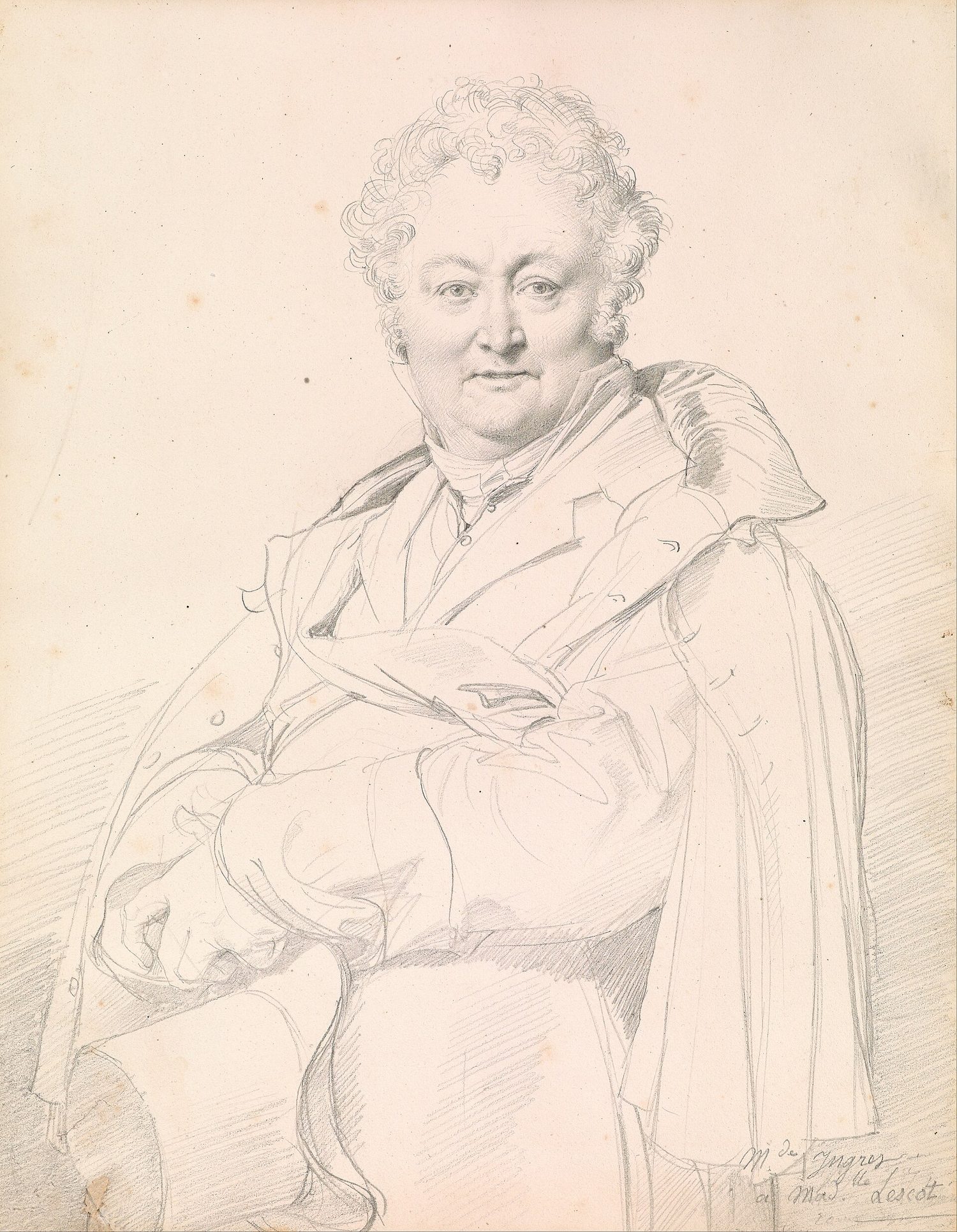
    ภาพพอร์เทรตดินสอของ Ingres: เส้น grd.แข็งที่แม่นยำและ tone ที่ควบคุมได้ดีอธิบายรูปทรงได้อย่างชัดเจน *ภาพพอร์เทรตดินสอของ Ingres: เส้น grd.แข็งที่แม่นยำและ tone ที่ควบคุมได้ดีอธิบายรูปทรงได้อย่างชัดเจน

    Vocabulary · ⁨คำศัพท์⁩ Train · ⁨ฝึกฝน⁩
    English ไทย
    graphite/ˈɡræfaɪt/ กราไฟต์
    grades/ɡreɪdz/ ระดับเกรด
    carbon pencil/ˈkɑːbən ˈpensl/ ดินสอคาร์บอน
    overhand grip/ˌəʊvəˈhænd ɡrɪp/ การจับแบบมือบน
    charcoal/ˈtʃɑːkəʊl/ ถ่านดำ
    vine charcoal/vaɪn ˈtʃɑːkəʊl/ ถ่านเถาวัลย์
    compressed charcoal/kəmˈprest ˈtʃɑːkəʊl/ ถ่านอัดแข็ง
    4.2

    Charcoal and Conté · ⁨ถ่านและคอนเต้⁩

    Syllabus · ⁨หลักสูตร⁩
    English

    Focus: Charcoal is fast, bold, and deeply black — the medium of gesture, chiaroscuro, and large-scale drawing.

    • Vine/willow charcoal is soft and dusts off easily (great for starts); compressed charcoal is dense and permanent.
    • Charcoal loves toned and textured paper; it blends with stumps, cloth, and the side of the hand.
    • Conté crayons (sanguine, sepia, black, white) are waxier — crisper lines, classic figure-drawing look.
    • Work big: charcoal rewards shoulder-scale marks that graphite cannot make.
    • Fixative stops smudging — spray lightly in layers, and always in ventilation.
    • The trio of white conté + sanguine + black on toned paper (trois crayons) is a proven portfolio look.
    ไทย

    จุดเน้น: ถ่าน เป็นสื่อที่รวดเร็ว, โดดเด่น และสีดำเข้ม — เป็นสื่อของการเคลื่อนไหว, Chiaroscuro และการวาดภาพขนาดใหญ่

    • ถ่านเถาวัลย์/willow มีความนุ่มและหลุดร่อนง่าย (เหมาะสำหรับการเริ่มต้น); ถ่านอัดแน่น มีความหนาแน่นและไม่จางหาย
    • ถ่านชอบกระดาษที่มีโทนสีและมีพื้นผิว; สามารถผสมผสานด้วยท่อนรวม, ผ้า และด้านข้างของมือ
    • ดินสอสี คอนเต้ (สีแดงเลือดหมู, สีซีเปีย, สีดำ, สีขาว) มีความมันวาวกว่า — ให้เส้นที่คมชัดขึ้น, มีลักษณะคลาสสิกของการวาดรูปคน
    • ทำงานในขนาดใหญ่: ถ่านให้รางวัลกับรอยขีดข่วนระดับไหล่ซึ่งเกรไฟต์ไม่สามารถทำได้
    • สเปรย์กันเลอะ ป้องกันการเลอะเทอะ — สเปรย์บางๆ เป็นชั้นๆ และต้องทำในพื้นที่ระบายอากาศเสมอ
    • Trio ของคอนเต้สีขาว + สีแดงเลือดหมู + สีดำ บนกระดาษโทนสี (trois crayons) เป็นสไตล์พอร์ตโฟลิโอที่ได้รับการพิสูจน์แล้ว

    Source: College Board AP Course and Exam Description · ⁨แหล่งที่มา: คำอธิบายหลักสูตรและข้อสอบ College Board AP⁩

    English

    Charcoal 木炭 is fast, bold, and deeply black — the medium of gesture, chiaroscuro, and large-scale drawing.

    • Vine charcoal 柳条木炭 is soft and dusts off easily, perfect for starts; compressed charcoal 压缩木炭 is dense and permanent.
    • Charcoal loves toned and textured paper. Blend it with stumps, cloth, or the side of your hand.
    • Conté 炭精条 crayons (sanguine, sepia, black, white) are waxier: crisper lines and the classic figure-drawing look.
    • Work big — charcoal rewards shoulder-scale marks that graphite cannot make.
    • Fixative 定画液 stops smudging. Spray lightly, in layers, and always with ventilation.
    • White conté plus sanguine 血色红棕 and black on toned paper (the trois crayons look) is a proven portfolio classic.
    ไทย

    ถ่านไม้ มีลักษณะเป็นเส้นที่รวดเร็ว มุ่งมั่น และดำสนิท — เป็นสื่อสำหรับการวาดภาพแบบอวงกิริยา, การ光影 (chiaroscuro) และการวาดภาพขนาดใหญ่

    • ถ่านไม้เถา มีความนุ่มและหลุดร่อนง่าย เหมาะสำหรับการเริ่มต้น; ถ่านอัดแน่น มีความหนาแน่นและคงทนถาวร
    • ถ่านชอบกระดาษที่มีสีพื้นหลังและพื้นผิวหยาบ ระบายสีผสมด้วยตะเกียงพู่กัน, ผ้าหรือด้านข้างของมือคุณ
    • Conté สีชอล์ก (sanguine, sepia, ดำ, ขาว) มีเนื้อขี้ผึ้งมากกว่า: ให้เส้นที่คมชัดและลุคการวาดรูปทรงคลาสสิก
    • วาดงานขนาดใหญ่ — เถาถ์ให้ผลลัพธ์ที่ดีกับการใช้แรงจากไหล่ ซึ่งดินสอไม่สามารถทำได้
    • Fixative ช่วยป้องกันรอยเปื้อน พ่นบางๆ เป็นชั้นๆ และต้องทำในพื้นที่ที่มีอากาศถ่ายเทดีเสมอ
    • การใช้ White conté คู่กับ sanguine และดำบนกระดาษสีพื้น (สไตล์ trois crayons) เป็นผลงานคลาสสิกในแฟ้มสะสมผลงานที่ยืนยันแล้ว
    ภาพวาดสเก็ตช์Still-lifeด้วยถ่าน: สื่อบนพื้นผิวแบบนุ่มสร้างรูปร่างของค่าความสว่าง-มืดก่อนลงรายละเอียด
    ภาพวาดสเก็ตช์Still-lifeด้วยถ่าน: สื่อบนพื้นผิวแบบนุ่มสร้างรูปร่างของค่าความสว่าง-มืดก่อนลงรายละเอียด
    Explore · ⁨สำรวจ⁩

    Which medium behaves like this? · ⁨สื่อ哪种 behaves like this?⁩

    Each drawing medium has a personality: graphite is precise and silvery, charcoal is fast and deeply black, ink commits without erasing, and pastel is almost pure pigment. · ⁨สื่อวาดแต่ละชนิดมีบุคลิก: graphite แม่นยำและสีเงิน, charcoal เร็วและดำสนิท, ink มั่นใจโดยไม่ลบออก, และ pastel เป็นสี近乎纯色素⁩

    Vocabulary · ⁨คำศัพท์⁩ Train · ⁨ฝึกฝน⁩
    English ไทย
    conté/kɒnˈteɪ/ คอนเต้ (conté)
    fixative/ˈfɪksətɪv/ สเปรย์กันเลอะ
    sanguine/ˈsæŋɡwɪn/ ซางวีน (sanguine)
    4.3

    Ink: Pen, Brush, and Wash · ⁨หมึก: ปากกาแปรง และน้ำหมึกเจือจาง⁩

    Syllabus · ⁨หลักสูตร⁩
    English

    Focus: Ink commits — no erasing — which is exactly why it builds decisiveness and mark confidence.

    • Dip pens and fineliners build value by hatching and stippling; nib pressure varies the line's weight.
    • Brush and ink swings from hairline to broad stroke in one gesture — the most expressive line tool.
    • Ink wash (diluted ink applied in layers) works like watercolour: light washes first, darks last.
    • Combine a waterproof line with wet washes, or a water-soluble line that bleeds — two different looks.
    • East Asian ink painting (shuǐmò) treats the single loaded brushstroke as the whole discipline.
    • Mistakes become decisions in ink: incorporate them or design around them — strong process-journal material.
    ไทย

    จุดเน้น: หมึก คือการตัดสินใจที่ไม่สามารถลบได้ — นั่นคือเหตุผลที่มันสร้างความเด็ดขาดและความมั่นใจในการสร้างรอยขีดข่วน

    • ปากกาจุ่มและไฟน์ไลเนอร์สร้างค่าความสว่าง-มืดผ่าน การขีดเส้นและจุด; ความกดหัวปากกาทำให้ความหนาของเส้นเปลี่ยนแปลงได้
    • แปรงและหมึก สามารถเปลี่ยนจากเส้นบางเฉียบไปเป็นจังหวะกว้างได้ในครั้งเดียว — เป็นเครื่องมือสร้างเส้นที่แสดงออกได้ดีที่สุด
    • Ink wash (น้ำหมึกเจือจางพ่นเป็นชั้นๆ) ทำงานเหมือนสีน้ำ: เริ่มจากชั้นสีอ่อนก่อน แล้วค่อยใส่สีเข้ม在最后
    • ผสมผสานเส้นกันน้ำกับการแรดน้ำ, หรือเส้นละลายน้ำที่ซึม — สร้างสองสไตล์ที่แตกต่างกัน
    • การวาดภาพหมึกเอเชียตะวันออก (shuǐmò)看作是หนึ่งรอยพู่กันที่จุ่มหมึกมาทั้งกระบวนการ
    • ความผิดพลาดกลายเป็นการตัดสินใจในหมึก: นำไปใช้หรือออกแบบรอบๆ มัน — วัสดุบันทึกกระบวนการที่แข็งแกร่ง

    Source: College Board AP Course and Exam Description · ⁨แหล่งที่มา: คำอธิบายหลักสูตรและข้อสอบ College Board AP⁩

    English

    Ink 墨水 commits — there is no erasing — and that is exactly why it builds decisiveness and mark confidence.

    • Dip pens and fineliners build value by hatching and stippling; nib 笔尖 pressure varies the line's weight.
    • Brush and ink 毛笔墨线 swings from hairline to broad stroke in one gesture — the most expressive line tool.
    • Ink wash 淡彩 (diluted ink applied in layers) works like watercolour: light washes first, darks last.
    • A waterproof line under wet washes keeps its edge; a water-soluble line bleeds — two different looks, both useful.
    • East Asian ink painting 水墨画 treats the single loaded brushstroke as a whole discipline of control.
    • Mistakes become decisions in ink: incorporate them or design around them — strong material for the process journal.
    ไทย

    หมึก คือการตัดสินใจที่ไม่สามารถลบได้ — และนั่นคือเหตุผลที่ทำให้มันสร้างความมั่นใจและการวางมือที่เด็ดขาด

    • ปากกาหัวจุ่มและFineliner สร้างค่าความสว่าง-มืดด้วยการขีดเขียนแบบHatchingและStippling; ความกดของ Nib เปลี่ยนน้ำหนักเส้น
    • แปรงและหมึก สามารถเปลี่ยนจากเส้นบางเฉียบไปเป็นจังหวะกว้างได้ในครั้งเดียว — เป็นเครื่องมือสร้างเส้นที่แสดงออกได้ดีที่สุด
    • Ink wash (น้ำหมึกเจือจางพ่นเป็นชั้นๆ) ทำงานเหมือนสีน้ำ: เริ่มจากชั้นสีอ่อนก่อน แล้วค่อยใส่สีเข้ม在最后
    • เส้นกันน้ำใต้ชั้นน้ำหมึกจะคงขอบไว้; เส้นละลายน้ำจะซึม扩散 — เป็นสองลุคที่แตกต่างกันแต่มีประโยชน์ทั้งคู่
    • ภาพวาดหมึกตะวันออก จัดการกับจังหวะแปรงหนึ่งจังหวะที่จุ่มหมึกไว้เต็ม认为是ทั้งระบบของการควบคุม
    • ความผิดพลาดกลายเป็นส่วนหนึ่งของงานในหมึก: นำมันมาผสมผสานหรือออกแบบรอบๆ มัน — วัสดุอันแข็งแกร่งสำหรับสมุดบันทึกกระบวนการ
    Rembrandt ปากกาหมึกน้ำตาลพร้อมน้ำหมึกเจือจาง: เส้นที่ตัดสินใจชัดเจนและชั้นโทนสีโดยไม่ใช้ยางลบ
    Rembrandt ปากกาหมึกน้ำตาลพร้อมน้ำหมึกเจือจาง: เส้นที่ตัดสินใจชัดเจนและชั้นโทนสีโดยไม่ใช้ยางลบ
    Vocabulary · ⁨คำศัพท์⁩ Train · ⁨ฝึกฝน⁩
    English ไทย
    ink/ɪŋk/ หมึก
    nib/nɪb/ ปลายปากกา (nib)
    brush and ink/brʌʃ ænd ɪŋk/ แปรงและหมึก
    ink wash/ɪŋk wɒʃ/ หมึกน้ำจาง
    ink painting/ɪŋk ˈpeɪntɪŋ/ ภาพวาดหมึก
    dry colour media/draɪ ˈkʌlə ˈmiːdiːə/ สื่อสีแห้ง
    colored pencil/ˈkʌləd ˈpensl/ ดินสอสี
    4.4

    Colored Pencil and Pastel · ⁨ดินสอสี และ_pa_stel⁩

    Syllabus · ⁨หลักสูตร⁩
    English

    Focus: Colour enters drawing through dry colour media — layered, optical, and fully allowed in the AP Drawing portfolio.

    • Colored pencil builds colour in transparent layers; burnishing (heavy final layer) fuses them glossy and solid.
    • Layer complements to grey a colour down instead of reaching for black — shadows stay alive.
    • Soft pastel is pure pigment: paint-like colour with drawing gestures, blended or left in strokes.
    • Oil pastel is creamy and resists smudging; it layers into sgraffito (scratch-through) effects.
    • Toned paper unifies pastel work — let the ground colour breathe between strokes.
    • Value still rules: get the values right and almost any hue choice works; get them wrong and no hue can save it.
    ไทย

    จุดเน้น: สีเข้าสู่งานวาดผ่าน สีย้อมแห้ง — การวางชั้น, การมองเห็นทางสายตา และยอมรับได้อย่างเต็มที่ในพอร์ตโฟลิโอ AP Drawing

    • ดินสอสี สร้างสีด้วยการวางชั้นโปร่งแสง; การบดขัด (ชั้นสุดท้ายหนัก) ทำให้รวมกันเป็นมันวาวและทึบสี
    • วางชั้นสีตรงข้ามเพื่อลดความสดของสีลงแทนการใช้สีดำ — ท้องฟ้าจะยังคงมีชีวิตชีวา
    • พาสเทลอ่อน เป็นสีบริสุทธิ์: สีเหมือนสี paint พร้อมท่าทางการวาด, ผสมผสานหรือทิ้งไว้เป็นรอยขีดข่วน
    • Oil pastel มีความครีมและป้องกันการเลอะเทอะ;它可以วางซ้อนกันเป็นลายกราฟฟิตो (sgraffito) แบบขูดผ่าน
    • กระดาษโทนสีช่วยให้งานพาสเทลเป็นหนึ่งเดียว — ปล่อยให้สีพื้นหายใจระหว่างรอยขีดข่วน
    • ค่าความสว่าง-มืดยังควบคุมอยู่: ได้ค่าที่ถูกต้องแล้วเลือกสีไหนก็ได้; ได้ค่าผิดแล้วสีใดก็ช่วยไม่ได้

    Source: College Board AP Course and Exam Description · ⁨แหล่งที่มา: คำอธิบายหลักสูตรและข้อสอบ College Board AP⁩

    English

    Colour enters drawing through dry colour media 干性彩色媒介 — layered, luminous, and fully allowed in the AP Drawing portfolio.

    • Colored pencil 彩色铅笔 builds colour in transparent layers; burnishing 压光 (a heavy final layer) fuses them into a glossy, solid surface.
    • Grey a colour down by layering its complement 互补色 instead of reaching for black — the shadows stay alive.
    • Soft pastel 软色粉 is almost pure pigment: paint-like colour applied with drawing gestures, blended or left in strokes.
    • Oil pastel 油画棒 is creamy and smudge-resistant; layered, it can be scratched through — sgraffito 刮画法.
    • Toned paper unifies pastel work: let the ground colour breathe between the strokes.
    • Value still rules. Get the values right and almost any hue works; get them wrong and no hue can save the drawing.
    ไทย

    สีเข้าสู่งานวาดผ่าน สื่อบนพื้นผิวแห้ง — การซ้อนชั้น แสงสว่าง และได้รับอนุญาตเต็มที่ในแฟ้ม AP Drawing

    • ดินสอสี สร้างสีด้วยการซ้อนชั้นโปร่งแสง; Burnishing (ชั้นสุดท้ายหนักแน่น) ผสมผสานพวกมันให้เป็นพื้นผิวมันวาวและทึบแสง
    • ลดความสดของสี bằng cáchซ้อน Complement ของสีนั้นแทนการใช้สีดำ — ท้องฟ้าจะยังคงมีชีวิตชีวา
    • Soft pastel เป็น.extent几乎純度: สีแบบสีทาที่นำไปใช้ด้วยจังหวะการวาด ลายเส้นหรือผสมกัน
    • Oil pastel มีเนื้อครีมและกันการเปื้อนง่าย; เมื่อซ้อนชั้นสามารถขีดข่วนผ่าน上去ได้ — technique Sgraffito
    • กระดาษสีพื้นรวมงานpa_stelเข้าด้วยกัน: ปล่อยให้สีพื้นหายใจอยู่ระหว่างจังหวะแปรง
    • ค่าความสว่าง-มืดยังคงเป็นกฎสำคัญ ได้ค่าที่ถูกต้องและสีใดก็ใช้ได้; ได้ค่าผิดและไม่มีสีใดช่วยงานวาดได้
    Degas pa_stel: สื่อบนพื้นผิวสีอ่อนสร้างแสงและรูปทรงด้วยจังหวะการวาด
    Degas pa_stel: สื่อบนพื้นผิวสีอ่อนสร้างแสงและรูปทรงด้วยจังหวะการวาด
    Vocabulary · ⁨คำศัพท์⁩ Train · ⁨ฝึกฝน⁩
    English ไทย
    burnishing/ˈbɜːnɪʃɪŋ/ burnishing
    complement/ˈkɒmplɪmənt/ คอมพลีเมนต์
    soft pastel/sɒft ˈpæstl/ พาสเทลนุ่ม
    oil pastel/ɔɪl ˈpæstl/ พาสเทลน้ำมัน
    sgraffito/ˈesɡræfiːtəʊ/ sgraffito
    4.5

    Paint and Printmaking as Drawing · ⁨สีและงานพิมพ์ในฐานะงานวาด⁩

    Syllabus · ⁨หลักสูตร⁩
    English

    Focus: The AP Drawing portfolio welcomes painting and printmaking — when mark-making and drawing skills lead the work.

    • Monochrome painting (oil, acrylic, watercolour grisaille) is drawing with a brush: value, edge, and gesture.
    • Watercolour over a drawn line keeps the drawing visible — line carries structure, wash carries light.
    • Monotype (paint on a plate, printed once) gives painterly, unrepeatable drawing marks.
    • Relief and intaglio prints (linocut, drypoint, etching) are mark-making systems: every value is built from cut or scratched lines.
    • Choose the process because it serves your inquiry — then say so in the written evidence.
    • If the work's visual language is line, tone, and mark, it belongs in Drawing; if it is colour-shape design, 2-D may fit better.
    ไทย

    จุดเน้น: พอร์ตโฟลิโอ AP Drawing ยอมรับ การวาดภาพและการพิมพ์ — เมื่อการสร้างรอยขีดข่วนและทักษะการวาดนำทางงาน

    • การวาดภาพโมโนโครม (oil, acrylic, watercolour grisaille) คือการวาดภาพด้วยพู่กัน: ค่าความสว่าง-มืด, ขอบ และท่าทาง
    • น้ำสีบนเส้นที่วาดไว้รักษาการมองเห็นของภาพ — เส้นนำโครงสร้าง, แรดน้ำนำแสง
    • Monotype (สีบนแผ่น, พิมพ์ครั้งเดียว) ให้รอยขีดข่วนแบบวาดภาพที่ดูเป็น painterly และไม่ซ้ำกัน
    • Relief และ intaglio prints (linocut, drypoint, etching) เป็นระบบการสร้างรอยขีดข่วน: ทุกค่าความสว่าง-มืดสร้างขึ้นจากเส้นตัดหรือขูด
    • เลือกกระบวนการเพราะมันสนับสนุนคำถามของคุณ — จากนั้นบอก它在Evidence เขียน
    • หากภาษาภาพของงานคือเส้น, โทนสี และรอยขีดข่วน มันอยู่ในหมวด Drawing; หากเป็นการออกแบบรูปทรงสี, 2-D อาจเหมาะกับกว่า

    Source: College Board AP Course and Exam Description · ⁨แหล่งที่มา: คำอธิบายหลักสูตรและข้อสอบ College Board AP⁩

    English

    The AP Drawing portfolio welcomes painting 绘画 and printmaking — when mark-making and drawing skills lead the work.

    • Monochrome painting (a grisaille 灰调单色画 in oil, acrylic, or watercolour) is drawing with a brush: value, edge, and gesture.
    • Watercolour over a drawn line keeps the drawing visible — the line carries structure, the wash carries light.
    • A monotype 独幅版画 (paint on a plate, printed once) gives painterly, unrepeatable drawing marks.
    • Relief prints 凸版画 (linocut) and intaglio 凹版画 (drypoint, etching) are mark-making systems: every value is built from cut or scratched lines.
    • Choose the process because it serves your inquiry — then say so in the written evidence.
    • If the work's visual language is line, tone, and mark, it belongs in Drawing; if it is colour-shape design, the 2-D portfolio fits better.
    ไทย

    แฟ้ม AP Drawing ยอมรับ Painting และPrintmaking — เมื่อทักษะการสร้างลายเส้นและการวาดนำทางงาน

    • ภาพวาดMonochrome (Grisaille ในน้ำมัน, อะคริลิก, หรือสีน้ำ) คือการวาดด้วยแปรง: ค่าความสว่าง-มืด, ขอบ, และจังหวะ
    • สีน้ำทับเส้นที่วาดไว้ทำให้เห็นเส้นเดิม — เส้นนำโครงสร้าง, น้ำหมึกเจือจางนำแสง
    • Monotype (สีบนแผ่น, พิมพ์ครั้งเดียว) ให้ลายเส้นแบบPainterly ที่ไม่ซ้ำกัน
    • Relief prints (Linocut) และ Intaglio (Drypoint, Etching) เป็นระบบการสร้างลายเส้น: ค่าความสว่าง-มืดทุกค่าสร้างจากเส้นตัดหรือขีดข่วน
    • เลือกกระบวนการเพราะมันสนับสนุนคำถามของคุณ — จากนั้นบอก它在Evidence เขียน
    • หากภาษาภาพของงานคือเส้น, โทนสี, และลายเส้น มันอยู่ในหมวดDrawing; ถ้าเป็นการออกแบบรูปร่างสี แฟ้ม2-D จะเหมาะสมกว่า
    Rembrandt Etching: Printmaking as drawing — every value built from scratched lines
    Rembrandt Etching: Printmaking as drawing — every value built from scratched lines
    Vocabulary · ⁨คำศัพท์⁩ Train · ⁨ฝึกฝน⁩
    English ไทย
    painting/ˈpeɪntɪŋ/ จิตรกรรม
    grisaille/ˈɡrɪseɪl/ grisaille
    monotype/ˈmɒnəʊtaɪp/ พิมพ์โมโนไทป์
    relief prints/rɪˈliːf prɪnts/ พิมพ์ลายนูน
    intaglio/ɪnˈtæɡlɪəʊ/ อินตaglio (การแกะสลักแบบฝัง)
    4.6

    Mixed Media and Experimental Surfaces · ⁨Mixed Media และพื้นผิวทดลอง⁩

    Syllabus · ⁨หลักสูตร⁩
    English

    Focus: Combining media and preparing your own grounds turns the surface itself into a drawing decision.

    • Classic pairs: ink line over wash, charcoal over acrylic ground, pastel over watercolour, collage under drawing.
    • Resists (wax, masking fluid) protect lights; gesso grounds let wet media sit on almost any support.
    • Draw on non-white supports: kraft paper, book pages, maps, fabric — the ground becomes part of the meaning.
    • Test combinations on scraps first and glue the tests into the journal — perfect experimentation evidence.
    • Layering must stay archival enough to photograph well — heavy buildup can glare under lights.
    • The CED's synthesis of materials, processes, and ideas (CED 2.B) is exactly this: media choices that embody the idea.
    ไทย

    จุดเน้น: การผสมผสานสื่อและการเตรียม พื้นผิว ของตัวเองทำให้พื้นผิวเองเป็นการตัดสินใจในการวาดภาพ

    • คู่คลาสสิก: เส้นหมึกบนแรดน้ำ, ถ่านบนพื้นผิว acryl, พาสเทลบนน้ำสี, คอลลาจใต้การวาดภาพ
    • Resists (ขี้ผึ้ง, masking fluid) ปกป้องส่วนแสง; gesso เป็นพื้นผิวที่ช่วยให้สีย้อมเปียกตั้งอยู่บนรองรับได้เกือบทุกชนิด
    • วาดบนรองรับที่ไม่ใช่สีขาว: กระดาษคราฟท์, หน้าหนังสือ, แผนที่, ผ้า — พื้นผิวกลายเป็นส่วนหนึ่งของความหมาย
    • ทดสอบการผสมผสานบนเศษกระดาษก่อนและแปะการทดสอบลงในสมุดบันทึก — หลักฐานการทดลองที่สมบูรณ์แบบ
    • การวางชั้นต้องคงสภาพพอที่จะถ่ายรูปได้ดี — การสะสมชั้นหนาเกินไปอาจสะท้อนแสงภายใต้โคมไฟ
    • Synthesis of materials, processes, and ideas ของ CED (CED 2.B) คือสิ่งนี้พอดี: การเลือกสื่อที่แสดงออกถึงแนวคิด

    Source: College Board AP Course and Exam Description · ⁨แหล่งที่มา: คำอธิบายหลักสูตรและข้อสอบ College Board AP⁩

    English

    Combining media and preparing your own grounds turns the surface itself into a drawing decision.

    • Classic pairs: ink line over wash, charcoal over an acrylic ground, pastel over watercolour, collage under drawing.
    • A resist 防染法 (wax, masking fluid) protects the lights; gesso 石膏底料 lets wet media sit on almost any support.
    • Draw on non-white supports: kraft paper, old book pages, maps, fabric — the ground becomes part of the meaning.
    • Test combinations on scraps first and glue the tests into your journal — perfect experimentation evidence.
    • Keep layering stable enough to photograph well: heavy, glossy buildup can glare under lights.
    • The CED's synthesis 综合 of materials, processes, and ideas is exactly this: media choices that embody the idea.
    ไทย

    การรวมสื่อและการเตรียมพื้นผิวของคุณเองทำให้ตัวพื้นผิวกลายเป็นการตัดสินใจในการวาด

    แผนที่สื่อบนพื้นผิววาด: จากแห้งไปเปียกตามแนวนอน, จากเส้นไปโทนสีตามแนวตั้ง
    ที่ที่สื่อนั้นอาศัย: จากแห้งไปเปียก, นำโดยเส้นไปจนนำโดยโทนสี — Mixed media รวมมุมต่างๆ ของแผนที่นี้
    • คู่คลาสสิก: เส้นหมึกเหนือชั้นน้ำหมึกเจือจาง, เตาถ์เหนือพื้นอะคริลิก, pa_stel เหนือสีน้ำ, Collage ใต้งานวาด
    • Resist (ขี้ผึ้ง, masking fluid) ป้องกันพื้นที่สว่าง; Gesso ทำให้สื่อบนพื้นผิวเปียกนั่งอยู่บนSupport hampirทุกชนิด
    • วาดบนSupportที่ไม่ใช่สีขาว: กระดาษคราฟต์, หน้าหนังสือเก่า, แผนที่, ผ้า — พื้นหลังเป็นส่วนหนึ่งของความหมาย
    • ทดสอบการผสมผสานบนเศษวัสดุก่อนและติดการทดสอบลงในสมุดบันทึก — หลักฐานการทดลองที่สมบูรณ์แบบ
    • รักษาการซ้อนชั้นให้มั่นคงพอที่จะถ่ายรูปได้ดี: การสะสมชั้นที่หนาและมันวาวอาจสะท้อนแสงใต้ไฟ
    • Synthesis ของ CED Regarding materials, processes, and ideas คือสิ่งนี้พอดี: การเลือกสื่อที่สะท้อนแนวคิด
    Vocabulary · ⁨คำศัพท์⁩ Train · ⁨ฝึกฝน⁩
    English ไทย
    resist/rɪˈzɪst/ resist
    gesso/ˈdʒesəʊ/ สีรองพื้น (เจสโซ)
    synthesis/ˈsɪnθəsɪs/ synthesis
    sketchbook/ˈsketʃbʊk/ สมุดสเก็ตช์
    4.7

    Sketchbooks and Daily Practice · ⁨สมุดสเก็ตช์ และการฝึกฝนประจำวัน⁩

    Syllabus · ⁨หลักสูตร⁩
    English

    Focus: The sketchbook is the engine of the course: daily low-pressure drawing compounds into skill and into portfolio evidence.

    • Short daily sessions beat rare marathons — 20 focused minutes a day transforms a year.
    • Fill pages with studies: hands, cups, corners of rooms, copies of master drawings, colour tests.
    • Date pages and add one-line notes — a dated sketchbook is documentation of growth over time.
    • Master copies (Dürer, Rubens, Kollwitz, Hokusai) teach mark systems from the inside; label them as studies.
    • Photograph strong sketchbook spreads properly: process images are legitimate Sustained Investigation images.
    • Treat some pages as experiments you expect to fail — the CED rewards visible practice, experimentation, and revision.
    ไทย

    จุดเน้น: สมุดจดบันทึก คือเครื่องยนต์ของรายวิชา: การวาดภาพด้วยความกดดันต่ำทุกวันสะสมเป็นทักษะและเป็นหลักฐานในพอร์ตโฟลิโอ

    • ช่วงเวลาสั้นๆ ทุกวันดีกว่าการฝึกหนักเป็นครั้งคราว — 20 นาทีที่โฟกัสทุกวันเปลี่ยนผลในระยะหนึ่งปี
    • เติมหน้ากระดาษด้วยการฝึกฝน: มือ, ถ้วย, มุมห้อง, การคัดลอกภาพวาดของศิลปิน, การทดสอบสี
    • กำหนดวันที่หน้าและเพิ่มหมายเหตุบรรทัดเดียว — สมุดจดบันทึกที่มีวันที่ คือ การ documenting การเติบโตตามเวลา
    • การคัดลอกภาพ (Dürer, Rubens, Kollwitz, Hokusai) สอนระบบรอยขีดข่วนจากภายใน; ติดป้ายชื่อว่าเป็นการฝึกฝน
    • ถ่ายภาพ spread สมุดสเก็ตช์ที่แข็งแรงอย่างถูกต้อง: Images กระบวนการเป็น Sustained Investigation images ที่ถูกต้อง
    • จัดหน้าบางส่วนเป็นการทดลองที่คุณคาดหวังว่าจะล้มเหลว — CED ให้รางวัลกับการ ฝึกฝน, การทดลอง และการแก้ไข ที่เห็นได้ชัด

    Source: College Board AP Course and Exam Description · ⁨แหล่งที่มา: คำอธิบายหลักสูตรและข้อสอบ College Board AP⁩

    English

    The sketchbook 速写本 is the engine of the course: daily low-pressure drawing compounds into skill — and into portfolio evidence.

    • Short daily sessions beat rare marathons. Twenty focused minutes a day transforms a year.
    • Fill pages with studies: hands, cups, corners of rooms, colour tests, and copies of master drawings.
    • Date every page and add one-line notes — a dated sketchbook is documentation of growth over time.
    • A master copy 临摹 (Dürer, Rubens, Kollwitz, Hokusai) teaches a mark system from the inside; label it clearly as a study.
    • Photograph strong sketchbook spreads properly: process images are legitimate Sustained Investigation images.
    • Treat some pages as experiments you expect to fail — the CED rewards visible practice 练习, experimentation, and revision.
    ไทย

    สมุดสเก็ตช์ คือเครื่องยนต์ของรายวิชา: การวาดที่ไม่มีความกดดันทุกวันสะสมเป็นทักษะ — และเป็นหลักฐานในแฟ้ม

    • ช่วงเวลาสั้นๆ ทุกวันดีกว่าการวิ่งมาราธอนหายาก 20 นาทีที่โฟกัสทุกวันเปลี่ยนปีหนึ่ง
    • เติมหน้าสมุดด้วยการศึกษา: มือ, ถ้วย, มุมห้อง, ทดสอบสี, และคัดลอกงานวาดของนักวาดเอก
    • ตั้งวันที่ทุกหน้าและเพิ่มหมายเหตุบรรทัดเดียว — สมุดสเก็ตช์ที่มีวันที่ คือ การ documenting การเติบโตตามเวลา
    • Master copy (Dürer, Rubens, Kollwitz, Hokusai) สอนระบบลายเส้นจากภายใน; ติดป้ายชื่อ它为Studyอย่างชัดเจน
    • ถ่ายภาพ spread สมุดสเก็ตช์ที่แข็งแรงอย่างถูกต้อง: Images กระบวนการเป็น Sustained Investigation images ที่ถูกต้อง
    • จัดหน้าสมุดบางอย่างเป็นการทดลองที่คุณคาดหวังว่าจะล้มเหลว — CED ให้คะแนน Practice ที่มองเห็นได้, การทดลอง, และการแก้ไข
    Vocabulary · ⁨คำศัพท์⁩ Train · ⁨ฝึกฝน⁩
    English ไทย
    master copy/ˈmæstə ˈkɒpɪ/ งานคัดลอกแบบต้นฉบับ
    practice/ˈpræktɪs/ การฝึกฝน
    4.7

    Exam tips · ⁨ข้อแนะนำสำหรับการสอบ⁩

    English
    • Name materials precisely in written evidence — "compressed charcoal and white conté on toned paper" reads as expertise; "pencil and stuff" reads as guesswork.
    • Show at least two media families across the portfolio (for example graphite plus ink wash): range of material control is easy, visible evidence.
    • One ink piece is worth including — the medium's no-eraser honesty shows decisiveness that scorers recognise instantly.
    • Fix charcoal before photographing. A smudged transit mark across a finished drawing is a silly way to lose the craft impression.
    • Sketchbook spreads photograph beautifully as process images — pick spreads that show tests and notes, not just finished mini-drawings.
    ไทย
    • ระบุชื่อวัสดุให้ชัดเจนในหลักฐานเขียน — “ถ่านอัดและคอนเต้ขาวบนกระดาษสี” ดูมีความเชี่ยวชาญ; “ดินสอและอะไรสักอย่าง” ดูเป็นการเดา
    • แสดงครอบครัววัสดุอย่างน้อยสองกลุ่ม ในแฟ้มผลงาน (เช่น เกรไฟท์บวกหมึกน้ำ): การควบคุมวัสดุที่หลากหลายเป็นหลักฐานที่เห็นได้ชัด
    • ควรมีชิ้นงานหมึกอย่างน้อยหนึ่งชิ้น — ความจริงใจของสื่อที่ไม่สามารถลบได้ แสดงถึงความเด็ดขาดที่ผู้ประเมินจดจำได้ทันที
    • เคลือบถ่านก่อนถ่ายรูป — รอยเลอะข้ามภาพวาดที่เสร็จสมบูรณ์เป็นวิธีที่ไร้สาระในการสูญเสียภาพลักษณ์ทางฝีมือ
    • หน้าสมุดสเก็ตช์ถ่ายเป็นภาพกระบวนการได้ดี — เลือกหน้าที่แสดงการทดสอบและบันทึก ไม่ใช่แค่ภาพวาดขนาดเล็กที่เสร็จแล้ว
  • 5

    Investigate: Inquiry and the Artistic Process · ⁨สืบสวน: การสำรวจและกระบวนการทางศิลปะ⁩

    Watch lesson · ⁨ดูบทเรียน⁩
    5.1

    Inquiry and Asking Questions · ⁨การตั้งคำถามและการสอบถาม⁩

    Syllabus · ⁨หลักสูตร⁩
    English

    Focus: Inquiry is the intentional process of questioning that guides exploration and discovery over time. (CED Big Idea 1)

    • A workable inquiry is open, personal, and visual — answerable through drawing, not through a paragraph.
    • 'How can line weight express my grandmother's hands aging?' beats 'I will draw hands.'
    • Strong questions generate the next drawing: each work answers a little and asks a little more.
    • Test a question by listing ten works it could produce — fewer than five means it is too narrow.
    • Questions may evolve mid-investigation; document the turn in your journal and written evidence.
    • The Sustained Investigation is scored on how clearly works relate to and develop the stated inquiry.
    ไทย

    จุดเน้น: Inquiry คือกระบวนการตั้งคำถามอย่างมีเจตนาที่นำไปสู่การสำรวจและการค้นพบตามเวลา (CED Big Idea 1)

    • การสืบเสาะที่มีประสิทธิภาพต้องเปิดกว้าง เชื่อมโยงกับตนเอง และมีลักษณะทางภาพ — ตอบได้ ผ่านภาพวาด ไม่ใช่ผ่านย่อหน้า
    • 'เส้นความหนาบางจะแสดงการแก่ของมือปู่ย่าตายายของฉันได้อย่างไร?' ดีกว่า 'ฉันจะวาดมือ'
    • คำถามที่ทรงพลังจะสร้างภาพวาดถัดไป: ผลงานแต่ละชิ้นตอบคำถามเล็กน้อยและตั้งคำถามเพิ่มเติมเล็กน้อย
    • ทดสอบคำถามโดยรายการWorks 10 ชิ้นที่คำถามนั้นอาจผลิตได้ — น้อยกว่าห้าแสดงว่าแคบเกินไป
    • คำถามอาจเปลี่ยนไปกลางการสืบเสาะ; บันทึกการเปลี่ยนนั้นในสมุดบันทึกและหลักฐานเขียน
    • การสืบเสาะที่ยั่งยืนถูกประเมินตามความชัดเจนที่งาน เกี่ยวข้องกับและพัฒนา การสืบเสาะที่กำหนดไว้

    Source: College Board AP Course and Exam Description · ⁨แหล่งที่มา: คำอธิบายหลักสูตรและข้อสอบ College Board AP⁩

    English

    Inquiry 探究 is the intentional process of questioning that guides exploration and discovery over time — the engine of CED Big Idea 1.

    • A workable inquiry is open, personal, and visual — answerable through drawing, not through a paragraph.
    • "How can line weight express my grandmother's hands aging?" beats "I will draw hands."
    • Strong questions generate the next drawing: each work answers a little and asks a little more.
    • Test a question by listing ten works it could produce. Fewer than five means it is too narrow.
    • Questions may evolve mid-investigation — document the turn in your journal and written evidence.
    • The Sustained Investigation 持续探究 is scored on how clearly the works relate to and develop the stated inquiry.
    ไทย

    การสืบเสาะ เป็นกระบวนการตั้งคำถามโดยเจตนาที่นำการสำรวจและการค้นพบไปตามเวลา — เป็นเครื่องยนต์ของแนวคิดหลัก CED 1

    วงจรการสืบเสาะ: ตั้งคำถาม สำรวจ สร้าง สะท้อน และตั้งคำถามอีกครั้ง
    การสืบเสาะเป็นวงวน: ภาพวาดแต่ละชิ้นตอบคำถามเล็กน้อยและตั้งคำถามเพิ่มเติมเล็กน้อย
    • การสืบเสาะที่มีประสิทธิภาพต้องเปิดกว้าง เชื่อมโยงกับตนเอง และมีลักษณะทางภาพ — ตอบได้ ผ่านภาพวาด ไม่ใช่ผ่านย่อหน้า
    • "น้ำหนักเส้นสามารถสื่อถึงมือของยายที่แก่ตัวได้อย่างไร?" ดีกว่า "ฉันจะวาดมือ"
    • คำถามที่ทรงพลังจะสร้างภาพวาดถัดไป: ผลงานแต่ละชิ้นตอบคำถามเล็กน้อยและตั้งคำถามเพิ่มเติมเล็กน้อย
    • ทดสอบคำถามโดยการระดมรายการผลงานสิบชิ้นที่คำถามนั้นอาจเกิดขึ้น หากน้อยกว่าห้าชิ้นแสดงว่าแคบเกินไป
    • คำถามอาจเปลี่ยนแปลงระหว่างการสืบเสาะ — บันทึกจุดเปลี่ยนในสมุดบันทึกและหลักฐานเขียนของคุณ
    • การสืบเสาะต่อเนื่อง ได้รับการประเมินตามความชัดเจนที่ผลงานเชื่อมโยงและพัฒนาแนวคิดการสืบเสาะที่ระบุไว้
    Explore · ⁨สำรวจ⁩

    Workable inquiry, or not yet? · ⁨การสืบเสาะที่ใช้งานได้จริง หรือยังไม่?⁩

    A workable inquiry is open, personal, and answerable through drawing itself. Questions that are closed, borrowed, or non-visual stall an investigation. · ⁨inquiry ที่ทำได้จริงมีความเปิดกว้าง เป็นส่วนตัว และตอบได้ผ่านการวาดเองคำถามที่ปิด,借用,或非visual ทำให้การสืบสวนหยุดชะงัก⁩

    Vocabulary · ⁨คำศัพท์⁩ Train · ⁨ฝึกฝน⁩
    English ไทย
    inquiry/ɪnˈkwaɪəri/ การสืบเสาะ
    5.2

    Sources of Ideas and Experiences · ⁨แหล่งที่มาของแนวคิดและประสบการณ์⁩

    Syllabus · ⁨หลักสูตร⁩
    English

    Focus: Artists' experiences — surroundings, memory, culture, research — inform why, how, and what they draw. (CED 1.A)

    • Ideas come from direct observation, personal history, other disciplines, and other artists' work.
    • Document experiences as they happen: photos, thumbnail sketches, notes, collected objects.
    • Ordinary subjects carry authority — the kitchen table you know beats a fantasy castle you don't.
    • Research feeds drawing: anatomy pages, historical costume, botanical structure all sharpen observation.
    • Cultural sources (calligraphy, textiles, architecture) bring personal context into mark and composition choices.
    • Keep a source wall or folder; when momentum dips, the collected material restarts it.
    ไทย

    จุดเน้น: ประสบการณ์ ของศิลปิน — สภาพแวดล้อม, ความทรงจำ, วัฒนธรรม, การวิจัย — บอกว่าทำไม, อย่างไร และอะไรที่พวกเขาวาด (CED 1.A)

    • ไอเดียมาจากสิ่งที่เห็นโดยตรง, ประวัติส่วนตัว, สาขาอื่น และผลงานของศิลปินคนอื่น
    • บันทึกประสบการณ์ขณะเกิด: ภาพถ่าย สเก็ตช์ขนาดจิ๋ว บันทึก วัตถุที่เก็บรวบรวม
    • วัตถุธรรมดาถืออำนาจ — โต๊ะครัวที่คุณรู้จักดีกว่าปราสาทแฟนตาซีที่คุณไม่รู้จัก
    • การวาดภาพเป็นแหล่งข้อมูลสำหรับการวิจัย: หน้าสัณฐานวิทยา, เครื่องแต่งกายทางประวัติศาสตร์, โครงสร้างพืชศาสตร์ ช่วยพัฒนาการสังเกต
    • แหล่ง的文化 (ลายเส้นพู่กัน, ผ้าทอ, สถาปัตยกรรม) นำบริบทส่วนบุคคลเข้าสู่การเลือกเส้นและองค์ประกอบ
    • เก็บผนังแหล่งข้อมูลหรือโฟลเดอร์ไว้ เมื่อแรงจูงใจลดลง วัสดุที่เก็บรวบรวมจะช่วยเริ่มต้นใหม่

    Source: College Board AP Course and Exam Description · ⁨แหล่งที่มา: คำอธิบายหลักสูตรและข้อสอบ College Board AP⁩

    English

    Artists' experiences 经验 — surroundings, memory, culture, research — inform why, how, and what they draw. (CED 1.A)

    • Ideas come from direct observation 观察, personal history, other school subjects, and other artists' work.
    • Document experiences as they happen: photos, thumbnail sketches, notes, collected objects.
    • Ordinary subjects carry authority: the kitchen table you know beats a fantasy castle you don't.
    • Research feeds drawing — anatomy pages, historical costume, botanical structure all sharpen observation.
    • Cultural sources (calligraphy, textiles, architecture) bring personal context into mark and composition choices.
    • Keep a source wall or folder; when momentum dips, the collected material restarts it.
    ไทย

    ประสบการณ์ ของศิลปิน — สภาพแวดล้อม ความทรงจำ วัฒนธรรม การวิจัย — อธิบายว่าทำไม อย่างไร และสิ่งที่พวกเขาวาด (CED 1.A)

    • ไอเดียมาจาก การสังเกตโดยตรง ประวัติส่วนบุคคล วิชาอื่น ๆ และผลงานของศิลปินคนอื่น
    • บันทึกประสบการณ์ขณะเกิด: ภาพถ่าย สเก็ตช์ขนาดจิ๋ว บันทึก วัตถุที่เก็บรวบรวม
    • ธีมธรรมดาๆ มีความน่าเชื่อถือ: โต๊ะอาหารที่คุณคุ้นเคย mengalahkanปราสาทแฟนตาซีที่คุณไม่รู้จัก
    • การวิจัยช่วยเสริมภาพวาด — หน้ากายวิภาคชุดเครื่องแต่งกายประวัติศาสตร์โครงสร้างพืช ช่วยเพิ่มการสังเกตให้คมชัดขึ้น
    • แหล่ง的文化 (ลายเส้นพู่กัน, ผ้าทอ, สถาปัตยกรรม) นำบริบทส่วนบุคคลเข้าสู่การเลือกเส้นและองค์ประกอบ
    • เก็บผนังแหล่งข้อมูลหรือโฟลเดอร์ไว้ เมื่อแรงจูงใจลดลง วัสดุที่เก็บรวบรวมจะช่วยเริ่มต้นใหม่
    5.3

    Materials, Processes, and Ideas · ⁨วัสดุ กระบวนการ และแนวคิด⁩

    Syllabus · ⁨หลักสูตร⁩
    English

    Focus: The CED's three working components: materials (substances), processes (actions), ideas (concepts) — drawings happen where they meet.

    • Every work is a decision triangle: what it is made of, how it is made, why it is made.
    • Let one corner lead: an idea can demand a material (rust drawings about decay) or a material can spark an idea.
    • Change one component at a time to see its effect — the fair-test habit works in the studio too.
    • Name all three in written evidence: scorers look for the connection explicitly.
    • Charcoal-on-torn-paper and fineliner-on-mylar are different statements, not just different looks.
    • This triad vocabulary comes straight from the CED glossary — use the exact words in your writing.
    ไทย

    จุดเน้น: ส่วนประกอบทั้งสามของ CED ได้แก่ วัสดุ (สาร), กระบวนการ (การกระทำ), แนวคิด (แนวคิด) — การวาดภาพเกิดขึ้นเมื่อส่วนเหล่านี้พบกัน

    • ทุกชิ้นงานคือสามเหลี่ยมของการตัดสินใจ: สิ่งใด ที่ทำ, 如何做, ทำไม จึงทำ
    • ให้หนึ่งมุมนำทาง: แนวคิดอาจกำหนดให้ต้องใช้วัสดุ (เช่น การวาดสนิมเกี่ยวกับการเน่าเปื่อย) หรือวัสดุอาจกระตุ้นให้เกิดแนวคิด
    • เปลี่ยนส่วนประกอบเพียงอย่างเดียวเพื่อดูผลกระทบ — عاداتการทดลองที่เป็นธรรมใช้ได้ในสตูดิโอเช่นกัน
    • ระบุทั้งสามอย่างในหลักฐานเชิงเขียน: ผู้ประเมินมองหาความเชื่อมโยงนี้โดยตรง
    • การวาดด้วยถ่านบนกระดาษฉีกและการใช้ไฟนไลเนอร์บนไมลาร์เป็น คำกล่าว ที่แตกต่างกัน ไม่ใช่เพียงรูปลักษณ์ที่ต่างกัน
    • คำศัพท์สามส่วนนี้มาจากพจนานุกรมของ CED โดยตรง — ใช้คำที่ถูกต้องเป๊ะๆ ในการเขียน

    Source: College Board AP Course and Exam Description · ⁨แหล่งที่มา: คำอธิบายหลักสูตรและข้อสอบ College Board AP⁩

    English

    The CED names three working components: materials 材料 (physical substances), processes 过程 (actions), and ideas 想法 (concepts). Drawings happen where they meet.

    • Every work is a decision triangle: what it is made of, how it is made, why it is made.
    • Let one corner lead. An idea can demand a material (rust drawings about decay), or a material can spark an idea.
    • Change one component at a time to see its effect — the fair-test habit works in the studio too.
    • Name all three in your written evidence: scorers look for the connection explicitly.
    • Charcoal on torn paper and fineliner on smooth film are different statements, not just different looks.
    • This vocabulary comes straight from the CED glossary — use the exact words in your writing.
    ไทย

    CED ระบุส่วนประกอบการทำงานสามส่วน: วัสดุ (สารทางกายภาพ), กระบวนการ (การกระทำ), และ แนวคิด (แนวคิด) ภาพวาดเกิดขึ้นเมื่อส่วนเหล่านี้บรรจบกัน

    • ทุกชิ้นงานคือสามเหลี่ยมของการตัดสินใจ: สิ่งใด ที่ทำ, 如何做, ทำไม จึงทำ
    • ให้มุมหนึ่งนำทาง ไอเดียอาจต้องการวัสดุ (ภาพวาดสนิมเกี่ยวกับความเสื่อม), หรือวัสดุอาจจุดประกายไอเดีย
    • เปลี่ยนส่วนประกอบเพียงอย่างเดียวเพื่อดูผลกระทบ — عاداتการทดลองที่เป็นธรรมใช้ได้ในสตูดิโอเช่นกัน
    • ระบุทั้งสามส่วนในหลักฐานเขียนของคุณ: ผู้ประเมินมองหาความเชื่อมโยงนี้โดยชัดเจน
    • ถ่านบนกระดาษฉีกและไฟเนลไลน์บนฟิล์มเรียบเป็น ข้อความ ต่างกัน ไม่ใช่แค่รูปลักษณ์ต่างกัน
    • คำศัพท์นี้มาจากคำศัพท์ใน CED โดยตรง — ใช้คำที่แน่นอนในการเขียนของคุณ
    5.4

    Drawing in Context · ⁨ภาพวาดในบริบท⁩

    Syllabus · ⁨หลักสูตร⁩
    English

    Focus: Drawings mean more when you know when, where, and why they were made — context is an investigation tool. (CED 1.C)

    • Study master drawings as working documents: Leonardo's studies, Dürer's engravings, Rembrandt's ink landscapes.
    • Every tradition has a drawing language — Chinese ink line, Persian miniature, Renaissance chiaroscuro, manga screen-tone.
    • Ask of any drawing: what was it for — study, record, plan, or finished statement?
    • Historical technique is free training: copying a hatching system teaches decisions no video can.
    • Place your own work in context: which artists share your question, and how is your answer different?
    • Contextual notes in the journal strengthen written evidence and show intellectual depth.
    ไทย

    จุดเน้น: การวาดภาพจะมีความหมายมากขึ้นเมื่อคุณรู้ เมื่อไหร่, ที่ไหน, และทำไม จึงถูกสร้างขึ้น — บริบทคือเครื่องมือในการสืบสวน (CED 1.C)

    • ศึกษาภาพวาดของศิลปินชั้นนำในฐานะเอกสารปฏิบัติงาน: การศึกษาของเลโอนาร์โด, งานแกะสลักของดูเรอร์, ภูมิทัศน์หมึกของเรมบรอนต์
    • ทุกประเพณีมีภาษาการวาดภาพของตัวเอง — เส้นหมึกจีน, มินิเอเชอร์เปอร์เซีย, ไชโรสคูโรรอสมัยrenaissance, สครีนโทนมังงะ
    • ตั้งคำถามกับภาพวาดใดๆ ว่า: มันถูกสร้างมาเพื่ออะไร — เพื่อการศึกษา, บันทึก, แผนงาน, หรือคำกล่าวที่สมบูรณ์?
    • เทคนิคในอดีตเป็นการฝึกฟรี: การคัดລอกระบบ Hatch teaches decisions no video can.
    • วางผลงานของคุณในบริบท: ศิลปินคนใดแบ่งปันคำถามของคุณ, และคำตอบของคุณแตกต่างอย่างไร?
    • หมายเหตุเชิงบริบทในสมุดบันทึกเสริมหลักฐานเขียนและแสดงความลึกซึ้งทางปัญญา

    Source: College Board AP Course and Exam Description · ⁨แหล่งที่มา: คำอธิบายหลักสูตรและข้อสอบ College Board AP⁩

    English

    Drawings mean more when you know when, where, and why they were made. Context 语境 is an investigation tool. (CED 1.C)

    • Study master drawings 大师素描 as working documents: Leonardo's studies, Dürer's engravings, Rembrandt's ink landscapes.
    • Every tradition has a drawing language — Chinese ink line, Persian miniature, Renaissance chiaroscuro, manga screentone.
    • Ask of any drawing: what was it for — a study, a record, a plan, or a finished statement?
    • Historical technique is free training: copying a hatching system teaches decisions no video can.
    • Place your own work in context: which artists share your question, and how is your answer different?
    • Contextual notes in the journal strengthen written evidence and show intellectual depth.
    ไทย

    ภาพวาดมีความหมายมากขึ้นเมื่อคุณรู้ว่าเมื่อไหร่ ที่ไหน และทำไมจึงทำ บริบท เป็นเครื่องมือสืบเสาะ (CED 1.C)

    • ศึกษา ภาพวาดมาสเตอร์ ในฐานะเอกสารทำงาน: งานศึกษาของเลโอนาร์โด, เกรฟวอร์ของดูเรอร์, ภูมิทัศน์หมึกของเรนบรอนต์
    • ทุกประเพณีมีภาษาภาพวาดของตัวเอง — เส้นหมึกจีน, มินิเอเชอร์เปอร์เซีย, ไคลโรสคูโรยุคrenaissance, สกรีนโทนมังงะ
    • ถามภาพวาดใดๆ ว่ามันถูกใช้ เพื่อ อะไร — เพื่อการศึกษา, บันทึก, แผน, หรือข้อความที่เสร็จสิ้น?
    • เทคนิคในอดีตเป็นการฝึกฟรี: การคัดລอกระบบ Hatch teaches decisions no video can.
    • วางผลงานของคุณในบริบท: ศิลปินคนใดแบ่งปันคำถามของคุณ, และคำตอบของคุณแตกต่างอย่างไร?
    • หมายเหตุเชิงบริบทในสมุดบันทึกเสริมหลักฐานเขียนและแสดงความลึกซึ้งทางปัญญา
    ดูเรอร์ Melencolia I: เกรฟวอร์ประวัติศาสตร์เป็นแบบอย่างการสร้างเส้นและบริบท
    ดูเรอร์ Melencolia I: เกรฟวอร์ประวัติศาสตร์เป็นแบบอย่างการสร้างเส้นและบริบท
    5.5

    Evaluating Drawings · ⁨การประเมินภาพวาด⁩

    Syllabus · ⁨หลักสูตร⁩
    English

    Focus: Critique — of your own and others' work — is how an investigation steers. (CED 1.D/1.E)

    • Describe → analyse → interpret → judge: the four-step critique keeps opinions grounded in evidence.
    • Use the AP language: point to visual evidence of skills, materials, processes, and ideas.
    • Self-critique with distance: turn the drawing upside down, view it in a mirror, or photograph it small.
    • Ask one focused question per critique ('does the focal point read?') instead of 'is it good?'
    • Written reflections after critiques become drafts of your Sustained Investigation writing.
    • Revision decisions born from critique are exactly the development the rubric wants to see.
    ไทย

    จุดเน้น: การ วิจารณ์ — ทั้งผลงานของตนเองและของผู้อื่น — เป็นวิธีที่การสืบสวนนำทาง (CED 1.D/1.E)

    • อธิบาย → วิเคราะห์ → ตีความ → ตัดสิน: การวิจารณ์สี่ขั้นนี้ทำให้ความคิดเห็นมีรากฐานจากหลักฐาน
    • ใช้ภาษา AP: ชี้ไปที่ หลักฐานทางสายตา ของทักษะ, วัสดุ, กระบวนการ, และแนวคิด
    • วิจารณ์ตนเองด้วยความห่างเหิน: กลับหัวภาพวาด, มองผ่านกระจก, หรือถ่ายภาพขนาดเล็ก
    • ตั้งคำถามที่เจาะจงหนึ่งข้อต่อครั้ง (เช่น 'จุดโฟกัสอ่านได้ไหม?') แทนที่จะถามว่า 'มันดีไหม?'
    • การสะท้อนคิดเป็นข้อเขียนหลังการวิจารณ์จะกลายเป็นร่างแรกของการเขียนสืบสวนต่อเนื่องของคุณ
    • การตัดสินใจแก้ไขที่เกิดจากการวิจารณ์ คือการพัฒนาที่เกณฑ์การให้คะแนนต้องการเห็น

    Source: College Board AP Course and Exam Description · ⁨แหล่งที่มา: คำอธิบายหลักสูตรและข้อสอบ College Board AP⁩

    English

    Critique 评图 — of your own and others' work — is how an investigation steers. (CED 1.D/1.E)

    • Use the four-step ladder: describe, analyse, interpret, judge. It keeps opinions grounded in what is visible.
    • Speak the AP language: point to visual evidence 视觉证据 of skills, materials, processes, and ideas.
    • Create distance for self-critique: turn the drawing upside down, view it in a mirror, or photograph it small.
    • Ask one focused question per critique ("does the focal point read?") instead of "is it good?"
    • Written reflections after critiques become drafts of your Sustained Investigation writing.
    • Revision 修改 decisions born from critique are exactly the development the rubric wants to see.
    ไทย

    การวิจารณ์ — ทั้งของผลงานตัวเองและผู้อื่น — คือวิธีการที่การสืบเสาะนำทาง (CED 1.D/1.E)

    • ใช้บันไดสี่ขั้น: อธิบาย วิเคราะห์ ตีความ ประเมิน มันทำให้ความคิดเห็น anchored กับสิ่งที่มองเห็นได้
    • ใช้ภาษา AP: ชี้ไปที่ หลักฐานทางภาพ ของทักษะ วัสดุ กระบวนการ และแนวคิด
    • สร้างระยะห่างสำหรับการวิจารณ์ตนเอง: พลิกภาพวาดคว่ำลง มองในกระจก หรือถ่ายรูปขนาดเล็ก
    • ถามคำถามที่เจาะจงหนึ่งข้อต่อการวิจารณ์ (“จุดสนใจอ่านได้ไหม?”) แทนที่จะถาม “มันดีไหม?”
    • Written reflections after critiques become drafts of your Sustained Investigation writing.
    • การตัดสินใจ ปรับปรุง ที่เกิดจากการวิจารณ์คือการพัฒนาที่ RUBRIC ต้องการเห็น
    ภาพวาดพอร์ตเทรตของอินเกรส: การวิจารณ์ระบุหลักฐานทางภาพที่มองเห็นได้ของเส้นและโทนสี
    ภาพวาดพอร์ตเทรตของอินเกรส: การวิจารณ์ระบุหลักฐานทางภาพที่มองเห็นได้ของเส้นและโทนสี
    Vocabulary · ⁨คำศัพท์⁩ Train · ⁨ฝึกฝน⁩
    English ไทย
    Sustained Investigation/səˈsteɪnd ɪnˌvestɪˈɡeɪʃn/ การสืบเสาะอย่างต่อเนื่อง
    experiences/ekˈspɪərɪənsɪz/ ประสบการณ์
    observation/ɒbzəˈveɪʃn/ observation
    materials/məˈtɪərɪəlz/ วัสดุ
    processes/ˈprəʊsesɪz/ กระบวนการ
    ideas/aɪˈdɪəz/ แนวคิด
    context/ˈkɒntekst/ บริบท
    master drawings/ˈmæstə ˈdrɔːɪŋz/ แบบร่างต้นฉบับ
    critique/krɪˈtiːk/ การวิจารณ์
    visual evidence/ˈvɪʒuːəl ˈevɪdəns/ หลักฐานทางสายตา
    revision/rɪˈvɪʒn/ การแก้ไข
    documentation/ˌdɒkjuːmənˈteɪʃn/ การบันทึก
    process journal/ˈprəʊses ˈdʒɜːnl/ สมุดบันทึกกระบวนการ
    5.6

    Documentation and the Process Journal · ⁨การบันทึกและสมุดบันทึกกระบวนการ⁩

    Syllabus · ⁨หลักสูตร⁩
    English

    Focus: Investigation must be visible: the process journal captures questions, tests, failures, and turns as they happen. (CED 1.B)

    • Document with anything quick: phone photos, taped-in tests, dated notes, thumbnail storyboards.
    • Record the why at decision points — two lines today saves reconstructing your thinking in April.
    • Photograph work-in-progress stages; a before/after revision pair is gold for the portfolio.
    • Keep material tests (paper swatches, media trials) physically in the journal with outcomes noted.
    • Process images may be submitted among the 15 Sustained Investigation images — label them clearly.
    • A true journal (not a decorated diary) is the difference between claiming inquiry and showing it.
    ไทย

    จุดเน้น: การสืบสวนต้อง มองเห็นได้: สมุดบันทึกกระบวนการบันทึกคำถาม, การทดสอบ, ความล้มเหลว, และการเปลี่ยนแปลงที่เกิดขึ้น (CED 1.B)

    • บันทึกด้วยสิ่งที่ทำได้รวดเร็ว: ภาพถ่ายมือถือ, การทดสอบติด_sample, บันทึกมีวันที่, storyboard ขนาดจิ๋ว
    • บันทึก ทำไม ที่จุดตัดสินใจ — บรรทัดสองบรรทัดวันนี้ช่วยประหยัดการ reconstruct ความคิดของคุณในเดือนเมษายน
    • ถ่ายภาพขั้นตอนที่กำลังทำอยู่; คู่ก่อน/หลังปรับปรุงเป็นทองคำสำหรับแฟ้มผลงาน
    • เก็บการทดสอบวัสดุ (ตัวอย่างกระดาษ, ทดลองสื่อ) ไว้ในสมุดบันทึกอย่างชัดเจน พร้อมบันทึกผลลัพธ์
    • ภาพกระบวนการอาจส่ง вместеกับ 15 ภาพการสืบเสาะต่อเนื่อง — ติดป้ายชื่อให้ชัดเจน
    • jurnal yang sejati (bukan diari yang dihias) adalah perbedaan antara mengklaim adanya penyelidikan dan menunjukkan hal itu.

    Source: College Board AP Course and Exam Description · ⁨แหล่งที่มา: คำอธิบายหลักสูตรและข้อสอบ College Board AP⁩

    English

    Investigation must be visible. Documentation 记录 captures questions, tests, failures, and turns as they happen. (CED 1.B)

    • Document with anything quick: phone photos, taped-in tests, dated notes, thumbnail storyboards.
    • Record the why at decision points — two lines today saves reconstructing your thinking in April.
    • Photograph work-in-progress stages; a before/after revision pair is gold for the portfolio.
    • Keep material tests (paper swatches, media trials) physically in the process journal 创作过程日志 with outcomes noted.
    • Process images may be submitted among the 15 Sustained Investigation images — label them clearly.
    • A true journal (not a decorated diary) is the difference between claiming inquiry and showing it.
    ไทย

    การสืบเสาะต้องมองเห็นได้ การบันทึกข้อมูล จับคำถาม การทดสอบ ความล้มเหลว และการเปลี่ยนแปลงที่เกิดขึ้น (CED 1.B)

    แหล่งที่มาของไอเดียภาพวาด: การสังเกต ความทรงจำ การวิจัย วัฒนธรรม ศิลปินอื่น วิชาอื่น *แหล่งข้อมูลหกแห่งที่เชื่อถือได้สนับสนุนการฝึกฝนภาพวาด — เก็บรวบรวมจากทั้งหมดในสมุดบันทึกเดียว

    • บันทึกด้วยสิ่งที่ทำได้รวดเร็ว: ภาพถ่ายมือถือ, การทดสอบติด_sample, บันทึกมีวันที่, storyboard ขนาดจิ๋ว
    • บันทึก ทำไม ที่จุดตัดสินใจ — บรรทัดสองบรรทัดวันนี้ช่วยประหยัดการ reconstruct ความคิดของคุณในเดือนเมษายน
    • ถ่ายภาพขั้นตอนที่กำลังทำอยู่; คู่ก่อน/หลังปรับปรุงเป็นทองคำสำหรับแฟ้มผลงาน
    • เก็บการทดสอบวัสดุ (ตัวอย่างกระดาษ, การทดลองสื่อ) ไว้ใน สมุดบันทึกกระบวนการ พร้อมบันทึกผลลัพธ์
    • ภาพกระบวนการอาจส่ง вместеกับ 15 ภาพการสืบเสาะต่อเนื่อง — ติดป้ายชื่อให้ชัดเจน
    • jurnal yang sejati (bukan diari yang dihias) adalah perbedaan antara mengklaim adanya penyelidikan dan menunjukkan hal itu.
    Halaman buku sketsa seorang seniman: jurnal proses mencatat penyelidikan, sumber, dan eksperimen kecil
    Halaman buku sketsa seorang seniman: jurnal proses mencatat penyelidikan, sumber, dan eksperimen kecil
    5.6

    Exam tips · ⁨ข้อแนะนำสำหรับการสอบ⁩

    English
    • Write the inquiry as one clear sentence and pin it above your desk — every scoring row of the Sustained Investigation asks how the work relates to it.
    • Scorers must SEE the investigation: tests, failed starts, and revision pairs are evidence; a folder of unrelated finished drawings is not.
    • Date everything. "Over time" is a scored idea — dated journal pages prove development without a word of explanation.
    • Use CED vocabulary in written evidence (materials, processes, ideas, experimentation, revision) — it connects your claims to the rubric instantly.
    • Photograph journal spreads as you go, not in April: process documentation shot in a rush looks like what it is.
    ไทย
    • Tulis penyelidikan sebagai satu kalimat jelas dan tempelkan di atas meja Anda — setiap baris penilaian dalam Penyelidikan Berkelanjutan menanyakan bagaimana karya tersebut berkaitan dengannya.
    • Penilai harus MELIHAT penyelidikan: uji coba, awal yang gagal, dan pasangan revisi adalah bukti; folder berisi gambar-gambar selesai yang tidak terkait bukanlah bukti.
    • Berilah tanggal pada semuanya. "Seiring berjalannya waktu" adalah ide yang dinilai — halaman jurnal yang bertanggal membuktikan perkembangan tanpa perlu kata-kata penjelasan.
    • Gunakan kosakata CED dalam bukti tertulis (bahan, proses, ide, eksperimentasi, revisi) — ini menghubungkan klaim Anda dengan rubrik secara instan.
    • Fotografi spread jurnal saat dilakukan, bukan di bulan April: dokumentasi proses yang difoto dengan terburu-buru terlihat seperti apa adanya.
  • 6

    Make: Practice, Experimentation, and Revision · ⁨สร้าง: การฝึกปฏิบัติ การทดลอง และการทบทวน⁩

    Watch lesson · ⁨ดูบทเรียน⁩
    6.1

    The Sustained Investigation · ⁨การสืบสวนต่อเนื่อง⁩

    Syllabus · ⁨หลักสูตร⁩
    English

    Focus: The Sustained Investigation is an inquiry-based, in-depth study of materials, processes, and ideas over time. (CED Big Idea 2)

    • It is a body of work — around 15 images — that grows from one stated question or idea.
    • Sustained means over time: works should show development, not fifteen versions of the same day.
    • Plan a rhythm: make → document → reflect → revise → make again, every one or two weeks.
    • The investigation is drawings and process: studies, tests, and revisions belong in it.
    • Depth beats breadth — one question pushed hard scores above ten unrelated good drawings.
    • Start early in the year; a rushed investigation is visible at a glance.
    ไทย

    จุดเน้น: การสืบสวนอย่างต่อเนื่อง คือการศึกษาเชิงลึกแบบตั้งคำถามเกี่ยวกับ วัสดุ, กระบวนการ, และแนวคิดตลอดระยะเวลาหนึ่ง (CED Big Idea 2)

    • มันเป็น ชุดผลงาน — ประมาณ 15 ภาพ — ที่เติบโตจากคำถามหรือแนวคิดที่ระบุไว้
    • ต่อเนื่องหมายถึง ตามเวลา: ผลงานควรแสดงถึงการพัฒนา ไม่ใช่แค่ 15 เวอร์ชันของวันเดียวกัน
    • วางจังหวะการทำงาน: สร้าง → จัดทำเอกสาร → สะท้อนคิด → แก้ไข → สร้างใหม่, ทุกหนึ่งหรือสองสัปดาห์
    • การสืบสวนคือการวาดภาพ และ กระบวนการ: การศึกษา, การทดสอบ, และการแก้ไขเป็นส่วนหนึ่งของมัน
    • ความลึกสำคัญกว่าความกว้าง — คำถามเดียวที่ถูก-push อย่างหนัก ได้คะแนนสูงกว่าภาพวาดที่ดี但不相连的สิบภาพ
    • เริ่มตั้งแต่ต้นปี; การสืบสวนที่เร่งรีบจะมองเห็นได้ทันที

    Source: College Board AP Course and Exam Description · ⁨แหล่งที่มา: คำอธิบายหลักสูตรและข้อสอบ College Board AP⁩

    English

    The Sustained Investigation 持续探究 is an inquiry-based, in-depth study of materials, processes, and ideas over time — CED Big Idea 2, and 60% of your AP score.

    • It is a body of work 系列作品 — around 15 images — that grows from one stated question or idea.
    • Sustained means over time: the works should show growth, not fifteen versions of the same afternoon.
    • Plan a rhythm: make, document, reflect, revise, make again — every one or two weeks.
    • The investigation is drawings and process: studies, tests, and revisions belong inside it.
    • Depth beats breadth. One question pushed hard scores above ten unrelated good drawings.
    • Start early in the year. A rushed investigation is visible at a glance.
    ไทย

    Penyelidikan Berkelanjutan adalah studi mendalam berbasis penyelidikan terhadap bahan, proses, dan ide dari waktu ke waktu — Ide Besar CED 2, dan 60% dari skor AP Anda.

    • Ini adalah kumpulan karya — sekitar 15 gambar — yang berkembang dari satu pertanyaan atau ide yang dinyatakan.
    • Berkelanjutan berarti dari waktu ke waktu: karya-karya tersebut harus menunjukkan pertumbuhan, bukan lima belas versi dari satu sore yang sama.
    • Rencanakan ritme: buat, dokumentasikan, renungkan, perbaiki, buat lagi — setiap satu atau dua minggu sekali.
    • Penyelidikan ini mencakup gambar dan proses: studi, uji coba, dan revisi masuk di dalamnya.
    • Kedalaman lebih baik daripada keluasan. Satu pertanyaan yang didorong keras mendapat skor di atas sepuluh gambar bagus yang tidak terkait.
    • Mulailah sejak awal tahun. Penyelidikan yang terburu-buru terlihat sekilas saja.
    6.2

    Practice, Experimentation, and Revision · ⁨การฝึกฝน, การทดลอง และการแก้ไข⁩

    Syllabus · ⁨หลักสูตร⁩
    English

    Focus: The CED's three engines of making: practice (repeat), experimentation (test), revision (modify and reimagine). (CED 2.A)

    • Practice repeats a skill until it is reliable — the tenth ellipse, the fiftieth hand.
    • Experimentation tests without needing success: new tool, new scale, new surface, new speed.
    • Revision returns to a work and changes it on purpose — crop, rework, redraw, or respond with a new version.
    • Show all three visibly across the portfolio: scorers must see them, not trust you.
    • Keep 'failed' experiments — annotated failures are stronger evidence than unexplained successes.
    • A revision pair (first state / revised state, with a sentence on what changed) is classic AP evidence.
    ไทย

    จุดเน้น: สามเครื่องยนต์ของการสร้างสรรค์ใน CED ได้แก่ การฝึกฝน (การทำซ้ำ), การทดลอง (การทดสอบ), การแก้ไข (การปรับเปลี่ยนและจินตนาการใหม่) (CED 2.A)

    • Latihan mengulangi keterampilan hingga menjadi dapat diandalkan — elips kesepuluh, tangan kelima puluh.
    • การทดลองเป็นการทดสอบโดยไม่ต้องรอความสำเร็จ: ใช้เครื่องมือใหม่, ขนาดใหม่, พื้นผิวใหม่, ความเร็วใหม่
    • การแก้ไขคือการกลับไปหาผลงานและเปลี่ยนแปลงโดยเจตนา — ตัดกรอบ, ทำใหม่, วาดใหม่, หรือตอบสนองด้วยเวอร์ชันใหม่
    • แสดงให้เห็นทั้งสามอย่างอย่างชัดเจนในพอร์ตโฟลิโอ: ผู้ประเมินต้อง เห็น它们, ไม่ควรเชื่อใจคุณ
    • รักษาการทดลองที่ 'ล้มเหลว' — ความล้มเหลวที่มี annotations เป็นหลักฐานที่แข็งแกร่งกว่าความสำเร็จที่ไม่ได้อธิบาย
    • คู่การแก้ไข (สถานะแรก / สถานะที่แก้ไขแล้ว, พร้อมประโยคที่อธิบายการเปลี่ยนแปลง) เป็นหลักฐานคลาสสิกของ AP

    Source: College Board AP Course and Exam Description · ⁨แหล่งที่มา: คำอธิบายหลักสูตรและข้อสอบ College Board AP⁩

    English

    The CED names three engines of making: practice 练习 (repeat), experimentation 实验 (test), and revision 修改 (modify and reimagine). (CED 2.A)

    • Practice repeats a skill until it is reliable — the tenth ellipse, the fiftieth hand.
    • Experimentation tests without needing success: a new tool, a new scale, a new surface, a new speed.
    • Revision returns to a work and changes it on purpose: crop it, rework it, redraw it, or answer it with a new version.
    • Show all three visibly across the portfolio — scorers must see them, not take your word.
    • Keep the failures. An annotated failed experiment is stronger evidence than an unexplained success.
    • A revision pair 修改前后对比 (first state and revised state, with one sentence on what changed) is classic AP evidence.
    ไทย

    CED menyebutkan tiga mesin pembuat karya: latihan (ulang), eksperimentasi (uji), dan revisi (modifikasi dan bayangkan kembali). (CED 2.A)

    Latihan, eksperimentasi, dan revisi mendorong pembuatan kumpulan karya
    Tiga mesin pembuat karya: ulangi keterampilan, uji sesuatu yang baru, kembali dan ubah
    • Latihan mengulangi keterampilan hingga menjadi dapat diandalkan — elips kesepuluh, tangan kelima puluh.
    • Eksperimentasi menguji tanpa perlu keberhasilan: alat baru, skala baru, permukaan baru, kecepatan baru.
    • Revisi kembali kepada sebuah karya dan mengubahnya dengan sengaja: potong, kerjakan ulang, gambar ulang, atau jawab dengan versi baru.
    • Tunjukkan ketiganya secara visual di seluruh portofolio — penilai harus melihat mereka, bukan mengambil perkataan Anda.
    • Simpan kegagalan. Eksperimen yang gagal dengan anotasi adalah bukti yang lebih kuat daripada kesuksesan yang tidak dijelaskan.
    • Pasangan revisi (keadaan pertama dan keadaan yang direvisi, dengan satu kalimat tentang apa yang berubah) adalah bukti klasik AP.
    Studi figur Michelangelo: latihan dan revisi membangun keterampilan menggambar melalui penyelidikan berulang
    Studi figur Michelangelo: latihan dan revisi membangun keterampilan menggambar melalui penyelidikan berulang
    Explore · ⁨สำรวจ⁩

    Practice, experimentation, or revision? · ⁨ฝึกฝน การทดลอง หรือการแก้ไข?⁩

    Practice repeats a skill until it is reliable, experimentation tests something new without needing success, and revision returns to a work and changes it on purpose. Scorers must see all three. · ⁨ฝึกฝน ทำซ้ำทักษะจนมั่นใจ, การทดลอง ทดสอบสิ่งใหม่โดยไม่ต้องคาดหวังความสำเร็จ, และ การแก้ไข กลับไปทำงานเดิมและเปลี่ยนมันอย่างตั้งใจ ผู้ให้คะแนนต้องเห็นทั้งสามอย่างนี้⁩

    6.3

    Synthesis of Materials, Processes, and Ideas · ⁨การบูรณาการวัสดุ, กระบวนการ และแนวคิด⁩

    Syllabus · ⁨หลักสูตร⁩
    English

    Focus: Synthesis means the three components fuse — the material and process choices are the idea. (CED 2.B)

    • Ask of each work: could this idea exist in any other medium? If yes, the synthesis can go deeper.
    • Burnt-edge charcoal drawings about wildfire; thread-stitched portraits about family ties — material as meaning.
    • Process can carry meaning too: obsessive stippling for time, blind contour for memory's uncertainty.
    • Synthesis is the highest row of the Sustained Investigation rubric — the 5-score discriminator.
    • It cannot be added at the end: it comes from experimenting early with materials that relate to the idea.
    • One sentence of written evidence should be able to name the link: 'I used X because the idea needed Y.'
    ไทย

    จุดเน้น: การสังเคราะห์ หมายถึงส่วนประกอบทั้งสามหลอมรวมเข้าด้วยกัน — การเลือกวัสดุและกระบวนการ คือ ตัวแนวคิดเอง (CED 2.B)

    • Tanyakan pada setiap karya: apakah ide ini bisa ada di medium lain? Jika ya, sintesis bisa lebih dalam.
    • ภาพวาดถ่านขอบไหม้เกี่ยวกับไฟป่า; ปกเสื้อปักด้ายเกี่ยวกับสายสัมพันธ์ครอบครัว — วัสดุคือความหมาย
    • กระบวนการสามารถสื่อความหมายได้เช่นกัน: การลงจุดแบบหมกมุ่นเพื่อสื่อถึงเวลา, หรือการวาดเส้นขอบตาบอดเพื่อสื่อถึงความไม่แน่นอนของความทรงจำ
    • การสังเคราะห์คือแถวสูงสุดของเกณฑ์การให้คะแนนการสืบสวนต่อเนื่อง — ตัวแยกแยะคะแนน 5
    • มันไม่สามารถเพิ่มได้ในตอนท้าย: มันเกิดจากการทดลองกับวัสดุที่เกี่ยวข้องกับแนวคิดตั้งแต่ต้น
    • ประโยคเดียวในหลักฐานเชิงเขียนควรสามารถระบุความเชื่อมโยงได้: 'ฉันใช้ X เพราะแนวคิดต้องการ Y'

    Source: College Board AP Course and Exam Description · ⁨แหล่งที่มา: คำอธิบายหลักสูตรและข้อสอบ College Board AP⁩

    English

    Synthesis 综合 means the three components fuse — the material and process choices are the idea. (CED 2.B)

    • Ask of each work: could this idea exist in any other medium? If yes, the synthesis can go deeper.
    • Charcoal drawings with burnt edges about wildfire; thread-stitched portraits about family ties — material as meaning.
    • Process can carry meaning too: obsessive stippling for time passing, blind contour for the uncertainty of memory.
    • Synthesis is the top row of the scoring guidelines — the discriminator between a 4 and a 5.
    • It cannot be added at the end. It grows from experimenting early with materials that relate to the idea.
    • One sentence of written evidence should name the link: "I used X because the idea needed Y."
    ไทย

    Sintesis berarti ketiga komponen menyatu — pilihan bahan dan proses adalah idenya. (CED 2.B)

    Bahan, proses, dan ide menyatu di tengah: sintesis *Ketika bahan, proses, dan ide saling menjelaskan, rubrik menyebutnya sebagai sintesis

    • Tanyakan pada setiap karya: apakah ide ini bisa ada di medium lain? Jika ya, sintesis bisa lebih dalam.
    • Gambar arang dengan tepi hangus tentang kebakaran hutan; potret yang dijahit benang tentang ikatan keluarga — bahan sebagai makna.
    • Proses juga dapat membawa makna: stipling yang obsesif untuk berlalunya waktu, garis kontur buta untuk ketidakpastian memori.
    • Sintesis adalah baris paling atas pedoman penilaian — pembeda antara skor 4 dan 5.
    • Tidak bisa ditambahkan di akhir. Ia tumbuh dari bereksperimen sejak dini dengan bahan yang berkaitan dengan ide.
    • ประโยคเดียวในหลักฐานเขียนควระบุชื่อเชื่อมโยง: "ฉันใช้ X เพราะแนวคิดต้องการ Y"
    Still life Cézanne: bahan, proses, dan ide bersintesis dalam komposisi dan tanda
    Still life Cézanne: bahan, proses, dan ide bersintesis dalam komposisi dan tanda
    Vocabulary · ⁨คำศัพท์⁩ Train · ⁨ฝึกฝน⁩
    English ไทย
    Sustained Investigation/səˈsteɪnd ɪnˌvestɪˈɡeɪʃn/ การสืบเสาะอย่างต่อเนื่อง
    body of work/ˈbɒdi ɒv wɜːk/ ชุดงาน
    practice/ˈpræktɪs/ การฝึกฝน
    experimentation/ekˌsperɪmənˈteɪʃn/ การทดลอง
    revision/rɪˈvɪʒn/ การแก้ไข
    revision pair/rɪˈvɪʒn peə/ คู่ทบทวน
    synthesis/ˈsɪnθəsɪs/ synthesis
    drawing skills/ˈdrɔːɪŋ skɪlz/ ทักษะการวาดภาพ
    visual evidence/ˈvɪʒuːəl ˈevɪdəns/ หลักฐานทางสายตา
    thumbnail sketches/ˈθʌmneɪl ˈsketʃɪz/ ภาพร่างขนาดย่อ
    craft/kræft/ craft
    scale/skeɪl/ สเกล / ขอบเขต
    development/dɪˈveləpmənt/ การพัฒนา
    variable/ˈveərɪəbl/ ตัวแปร
    motif/məʊˈtiːf/ โม tif
    6.4

    Demonstrating Drawing Skills · ⁨Menunjukkan Keterampilan Menggambar⁩

    Syllabus · ⁨หลักสูตร⁩
    English

    Focus: The rubric's named drawing skills: mark-making, line, surface, space, light and shade, composition. (CED 2.C/2.D)

    • Audit your portfolio against the six skills — every one should appear strongly somewhere.
    • One work can carry several skills: a figure in a lit interior shows space, light and shade, and composition at once.
    • 'Good' scores need competent skills; '5' portfolios show advanced skills with visual evidence everywhere.
    • Skills must be visible in the image submitted — photograph well or the skill disappears.
    • Weak-skill areas are fixable with targeted practice blocks — see the craft topics of this course.
    • In written evidence, name skills with the CED's own words so scorers connect claim to image instantly.
    ไทย

    จุดเน้น: ทักษะการวาดภาพ ที่ระบุไว้ในเกณฑ์การให้คะแนน: การทำเครื่องหมาย, เส้น, พื้นผิว, พื้นที่, แสงและเงา, การจัดองค์ประกอบ (CED 2.C/2.D)

    • Audit portofolio Anda berdasarkan enam keterampilan — masing-masing seharusnya muncul dengan kuat di suatu tempat.
    • หนึ่งผลงานสามารถครอบคลุมหลายทักษะ: ตัวบุคคลภายในห้องที่มีแสง แสดงพื้นที่, แสงและเงา, และการจัดองค์ประกอบพร้อมกัน
    • คะแนน 'ดี' ต้องการทักษะที่ชำนาญ; พอร์ตโฟลิโอระดับ '5' แสดง ทักษะขั้นสูง พร้อมหลักฐานทางสายตาทุกจุด
    • ทักษะต้องมองเห็นได้ใน ภาพที่ส่ง: ถ่ายภาพให้ดีหรือไม่ทักษะก็หายไป
    • จุดอ่อนด้านทักษะสามารถแก้ไขได้ด้วยการฝึกฝนเฉพาะจุด — ดูหัวข้อทักษะฝีมือของรายวิชานี้
    • ในหลักฐานเชิงเขียน ระบุชื่อทักษะด้วยคำของ CED เองเพื่อให้ผู้ประเมินเชื่อมต่อกับภาพได้ทันที

    Source: College Board AP Course and Exam Description · ⁨แหล่งที่มา: คำอธิบายหลักสูตรและข้อสอบ College Board AP⁩

    English

    The rubric names the drawing skills 绘画技能: mark-making, line, surface, space, light and shade, composition. (CED 2.C/2.D)

    • Audit your portfolio against the six skills — every one should appear strongly somewhere.
    • One work can carry several: a figure in a lit interior shows space, light and shade, and composition at once.
    • "Good" portfolios show competent skills; a 5 shows advanced skills with visual evidence 视觉证据 everywhere.
    • A skill only counts if it is visible in the submitted image — photograph well or the skill disappears.
    • Weak areas are fixable with targeted practice blocks — that is what the craft topics of this course are for.
    • In written evidence, name skills with the CED's own words, so the scorer connects claim to image instantly.
    ไทย

    Rubrik menyebutkan keterampilan menggambar: pembuatan tanda, garis, permukaan, ruang, cahaya dan bayangan, komposisi. (CED 2.C/2.D)

    • Audit portofolio Anda berdasarkan enam keterampilan — masing-masing seharusnya muncul dengan kuat di suatu tempat.
    • Satu karya dapat memuat beberapa: figur di dalam ruangan yang terang menunjukkan ruang, cahaya dan bayangan, serta komposisi sekaligus.
    • Portofolio "bagus" menunjukkan keterampilan yang kompeten; skor 5 menunjukkan keterampilan tingkat lanjut dengan bukti visual di mana pun.
    • Keterampilan hanya dihitung jika terlihat dalam gambar yang diserahkan — foto dengan baik atau keterampilan akan hilang.
    • Area lemah dapat diperbaiki dengan blok latihan yang terarah — itulah fungsi topik kerajinan dalam kursus ini.
    • Dalam bukti tertulis, sebutkan keterampilan dengan kata-kata CED sendiri, agar penilai dapat menghubungkan klaim dengan gambar secara instan.
    Man Vitruvius: proporsi dan konstruksi figur sebagai keterampilan menggambar dasar
    Man Vitruvius: proporsi dan konstruksi figur sebagai keterampilan menggambar dasar
    6.5

    Composition and Craft in Making · ⁨การจัดองค์ประกอบและฝีมือในการสร้างสรรค์⁩

    Syllabus · ⁨หลักสูตร⁩
    English

    Focus: Finished works are judged as made objects: composition designed, edges considered, surface controlled.

    • Plan with thumbnails and notan before committing — composition is decided before the first real mark.
    • Craft means physical care: clean margins where intended, controlled smudging, flat unwrinkled paper.
    • Damaged or dirty work photographs badly; protect drawings with cover sheets and fixative.
    • Consider scale as a decision: intimate A5 and commanding A1 are different statements of the same idea.
    • Unresolved corners betray hurry — finish or deliberately leave raw, and let the writing own the choice.
    • Craft is not fussiness: an expressive charcoal can be perfectly crafted expression.
    ไทย

    จุดเน้น: ผลงานที่เสร็จสิ้นถูกตัดสินในฐานะ วัตถุที่ทำขึ้น: การจัดองค์ประกอบออกแบบไว้, ขอบถูกพิจารณา, พื้นผิวถูกควบคุม

    • วางแผนด้วยภาพร่างเล็กและ notan ก่อนลงมือจริง — การจัดองค์ประกอบถูกตัดสินใจก่อนรอยขีดข่วนจริงครั้งแรก
    • ฝีมือ หมายความว่าความใส่ใจทางกายภาพ: ขอบสะอาดตามที่ตั้งใจ, การเบลอที่ควบคุมได้, กระดาษเรียบไม่ยับ
    • งานที่เสียหายหรือสกปรกถ่ายออกมาไม่ดี; ปกป้องภาพวาดด้วยแผ่นปกและสารเคลือบ
    • พิจารณาขนาดเป็นการตัดสินใจ: A5 แบบใกล้ชิดและ A1 แบบโดดเด่น เป็นคำกล่าวที่แตกต่างกันของแนวคิดเดียวกัน
    • มุมที่ไม่ได้รับการแก้ไขบอกถึงความรีบร้อน — เสร็จสิ้นหรือ ทิ้ง ให้อยู่สภาพดิบอย่างจงใจ, และให้ข้อความเขียนครอบครองการเลือกนั้น
    • ช่างไม่ใช่ความประณีตเกินเหตุ: คาร์บอนสีที่แสดงอารมณ์ก็สามารถเป็น-expression ที่มีความช่างฝีมือได้

    Source: College Board AP Course and Exam Description · ⁨แหล่งที่มา: คำอธิบายหลักสูตรและข้อสอบ College Board AP⁩

    English

    Finished works are judged as made objects: composition designed, edges considered, surface controlled.

    • Plan with thumbnail sketches 小稿 and notan before committing — composition is decided before the first real mark.
    • Craft 工艺 means physical care: clean margins where you intend them, controlled smudging, flat unwrinkled paper.
    • Damaged or dirty work photographs badly. Protect drawings with cover sheets and fixative.
    • Treat scale 尺度 as a decision: an intimate A5 and a commanding A1 are different statements of the same idea.
    • Unresolved corners betray hurry. Finish them — or leave them raw on purpose, and let the writing own the choice.
    • Craft is not fussiness: an expressive charcoal can be perfectly crafted expression.
    ไทย

    Karya selesai dinilai sebagai objek yang dibuat: komposisi dirancang, tepi dipertimbangkan, permukaan dikendalikan.

    • Rencanakan dengan sketsa thumbnail dan notan sebelum berkomitmen — komposisi ditentukan sebelum tanda asli pertama.
    • Kerajinan berarti perawatan fisik: margin bersih di tempat yang Anda inginkan, pengaburan yang terkendali, kertas datar tanpa kerutan.
    • Karya yang rusak atau kotor difoto dengan buruk. Lindungi gambar dengan lembaran penutup dan fiksatif.
    • Anggap skala sebagai keputusan: A5 yang intim dan A1 yang megah adalah pernyataan berbeda dari ide yang sama.
    • Sudut yang belum terselesaikan mengkhianati terburu-buru. Selesaikan sudut-sudut itu — atau biarkan mentah secara sengaja, dan biarkan tulisan yang mengambil alih pilihan tersebut.
    • ช่างไม่ใช่ความประณีตเกินเหตุ: คาร์บอนสีที่แสดงอารมณ์ก็สามารถเป็น-expression ที่มีความช่างฝีมือได้
    6.6

    Developing Ideas Over Time · ⁨การพัฒนาแนวคิดตลอดเวลา⁩

    Syllabus · ⁨หลักสูตร⁩
    English

    Focus: Development — the furthering of an inquiry through in-depth exploration — is what 'sustained' looks like in the images.

    • Sequence matters: arrange works so the investigation's growth is readable from image 1 to image 15.
    • Development moves: change scale, change viewpoint, combine two earlier works, push one variable to its extreme.
    • Series thinking helps — variations on one motif show deliberate exploration, not repetition.
    • Mid-course turns are healthy when documented: 'the shadows became the subject' is development.
    • Compare your newest work to your first — if nothing changed (skill, idea, or ambition), push a variable.
    • Scorers explicitly look for works that show development, not fifteen isolated performances.
    ไทย

    จุดเน้น: การพัฒนา — การต่อยอดการสืบเสาะผ่านการสำรวจอย่างลึกซึ้ง — คือสิ่งที่ 'ความต่อเนื่อง' ดูเป็นอย่างไรในภาพ

    • ลำดับสำคัญ: จัดเรียงผลงานเพื่อให้การเติบโตของการสืบเสาะอ่านได้จากรูปที่ 1 ถึงรูปที่ 15
    • การพัฒนาเคลื่อนที่: เปลี่ยนขนาด, เปลี่ยนมุมมอง, รวมงานสองชิ้นก่อนหน้าเข้าด้วยกัน, ดันตัวแปรหนึ่งไปสู่ขีดสุด
    • การคิดแบบชุดงานช่วย — ความแตกต่างของลวดลายเดียวแสดงถึงการสำรวจที่มีเจตนา ไม่ใช่การทำซ้ำ
    • จุดเปลี่ยนระหว่างทางเป็นเรื่องดีเมื่อมีการบันทึก: 'เงากลายเป็น Subjects' คือการพัฒนา
    • เปรียบเทียบผลงานล่าสุดกับงานแรก — ถ้าไม่มีอะไรเปลี่ยน (ทักษะ, แนวคิด, หรือความมุ่งมั่น) ให้ดันตัวแปรหนึ่ง
    • ผู้ประเมินมองหา ผลงานที่แสดงการพัฒนา อย่างชัดเจน ไม่ใช่การแสดงเดี่ยวสิบห้าชิ้นที่แยกขาดกัน

    Source: College Board AP Course and Exam Description · ⁨แหล่งที่มา: คำอธิบายหลักสูตรและข้อสอบ College Board AP⁩

    English

    Development 发展 — the furthering of an inquiry through in-depth exploration — is what "sustained" looks like in the images.

    • Sequence matters: arrange the works so the investigation's growth is readable from image 1 to image 15.
    • Development moves: change scale, change viewpoint, combine two earlier works, push one variable 变量 to its extreme.
    • Series thinking helps — variations on one motif 母题 show deliberate exploration, not repetition.
    • Mid-course turns are healthy when documented: "the shadows became the subject" is development.
    • Compare your newest work to your first. If nothing changed — skill, idea, or ambition — push a variable.
    • Scorers explicitly look for works that show development, not fifteen isolated performances.
    ไทย

    การพัฒนา — การสืบสวนหาความรู้โดยมีการสำรวจอย่างลึกซึ้ง — คือสิ่งที่ "ความต่อเนื่อง" ดูเป็นในภาพ

    • ลำดับมีความสำคัญ: จัดเรียงผลงานให้การเติบโตของการสืบค้นอ่านได้จากภาพที่ 1 ถึงภาพที่ 15
    • การพัฒนา可以通过: เปลี่ยนขนาด, เปลี่ยนมุมมอง, รวมผลงานเก่าสองชิ้น, ดัน ตัวแปร หนึ่งไปจนถึงขีดสุด
    • การคิดแบบชุดช่วยได้ — การเปลี่ยนแปลงของ โมทีฟ เดียวกันแสดงถึงการสำรวจที่มีเจตนา ไม่ใช่การซ้ำซาก
    • จุดเปลี่ยนระหว่างทางเป็นเรื่องดีหากมีการบันทึก: "เงาได้กลายเป็น Subjects" คือ การพัฒนา
    • เปรียบเทียบผลงานล่าสุดของคุณกับงานแรก หากคุณไม่มีการเปลี่ยนแปลงอะไรเลย — ทักษะ, ความคิด หรือความมุ่งมั่น — ให้ปรับตัวแปรหนึ่งอย่างใดอย่างหนึ่ง
    • ผู้ประเมินมองหาผลงานที่แสดงความพัฒนาอย่างชัดเจน ไม่ใช่ผลงาน 15 ชิ้นที่แยกขาดจากกัน
    6.6

    Exam tips · ⁨ข้อแนะนำสำหรับการสอบ⁩

    English
    • Build the portfolio as a story: image 1 states the question, the middle images test and turn, the late images answer with authority. Scorers read the sequence.
    • Submit process images on purpose — two or three journal spreads, tests, or revision pairs among the 15 make practice, experimentation, and revision undeniable.
    • The 5-portfolios show synthesis: pick materials that mean something for your question, and say the link out loud in the written evidence.
    • Audit against the six drawing skills at mid-year, not in April — the gaps you find write your practice plan while there is still time.
    • Never pad with lookalikes. Fifteen near-identical drawings read as one idea repeated; variations must each move a variable.
    ไทย
    • สร้างแฟ้มสะสมผลงานเป็นเรื่องราว: ภาพที่ 1 บอกคำถาม, ภาพกลางทดสอบและจุดเปลี่ยน, ภาพช่วงท้ายตอบด้วยอำนาจเหนือกว่า ผู้ประเมินอ่านตามลำดับ
    • ส่งภาพกระบวนการอย่างมีจุดมุ่งหมาย — หน้าสมุดบันทึก 2-3 หน้า, การทดสอบ, หรือคู่การแก้ไข ในจำนวน 15 ภาพ จะทำให้การฝึกฝน, การทดลอง และการแก้ไขเป็นสิ่งที่ปฏิเสธไม่ได้
    • 5 แฟ้มสะสมผลงานแสดงถึงการสังเคราะห์: เลือกวัสดุที่มีความหมายต่อคำถามของคุณ และบอกความสัมพันธ์นั้นออกมาเป็นคำพูดในหลักฐานเขียน
    • ตรวจสอบagainst ทักษะวาดภาพทั้ง 6 อย่างในช่วงกลางภาคเรียน ไม่ใช่มิถุนายน — ช่องว่างที่คุณพบจะเขียนแผนการฝึกของคุณในขณะที่ยังมีเวลาเหลืออยู่
    • อย่าเติมด้วยภาพที่ดูคล้ายกัน วาดภาพ 15 ชิ้นที่เกือบเหมือนกันทั้งหมด อ่านว่ามีความคิดเดียวที่ซ้ำกัน; การเปลี่ยนแปลงแต่ละชิ้นต้องปรับตัวแปรหนึ่ง
  • 7

    Present: Communication and the AP Drawing Portfolio · ⁨นำเสนอ: การสื่อสารและพอร์ตโฟลิโอการวาดภาพ AP⁩

    Watch lesson · ⁨ดูบทเรียน⁩
    7.1

    The AP Drawing Portfolio

    Syllabus · ⁨หลักสูตร⁩
    English

    Focus: The AP exam is a portfolio, not a written test — two sections submitted digitally in early May. (CED Big Idea 3)

    • Sustained Investigation: 15 images of works and process, plus written evidence — 60% of the score.
    • Selected Works: 5 works demonstrating skillful synthesis of materials, processes, and ideas — 40%.
    • Selected Works may come from the investigation or outside it — choose your strongest five.
    • Everything uploads through the AP Digital Portfolio; teachers review before final submission.
    • Drawing, 2-D, and 3-D are separate portfolios; a student submits work made for the Drawing skill set.
    • Plan backwards from May: photography, writing, and selection all take real calendar time.
    ไทย

    จุดเน้น: การสอบ AP เป็น แฟ้มสะสมผลงาน, ไม่ใช่ข้อสอบเขียน — ส่งสองส่วนผ่านระบบดิจิทัลในช่วงต้นเดือนพฤษภาคม (CED Big Idea 3)

    • การสืบค้นอย่างต่อเนื่อง: 15 ภาพของผลงานและกระบวนการ, บวกกับหลักฐานเขียน — มีน้ำหนัก 60% ของคะแนน
    • ผลงานที่เลือก: 5 ผลงานที่แสดงความสามารถในการสังเคราะห์วัสดุ กระบวนการ และแนวคิดได้อย่างชำนาญ — ร้อยละ 40
    • ผลงานที่เลือกอาจมาจากงานสืบเสาะหรือภายนอก它也 — เลือกห้านักเรียนที่แข็งแกร่งที่สุดของคุณ
    • ทุกอย่างอัปโหลดผ่าน AP Digital Portfolio; ครูตรวจสอบก่อนส่งสุดท้าย
    • ภาพวาด, 2 มิติ, และ 3 มิติ เป็นแฟ้มแยกต่างหาก; นักเรียนส่งผลงานที่ทำสำหรับชุดทักษะภาพวาด
    • วางแผนย้อนกลับจากเดือนพฤษภาคม: การถ่ายภาพ, การเขียน และการเลือก都需要ใช้เวลาคał calendar

    Source: College Board AP Course and Exam Description · ⁨แหล่งที่มา: คำอธิบายหลักสูตรและข้อสอบ College Board AP⁩

    The AP exam is a portfolio 作品集, not a written test — two sections submitted digitally in early May. (CED Big Idea 3)

    The AP Drawing portfolio: Sustained Investigation (15 images + writing, 60%) and Selected Works (5 works, 40%)
    Two sections: the Sustained Investigation carries 60% of the score, the Selected Works 40%
    • Sustained Investigation: 15 images of works and process, plus written evidence — 60% of the score.
    • Selected Works 精选作品: 5 works demonstrating skilful synthesis of materials, processes, and ideas — 40%.
    • Selected Works may come from inside or outside the investigation. Choose your strongest five, wherever they came from.
    • Everything uploads through the AP Digital Portfolio 数字作品集平台; your teacher reviews before final submission.
    • Drawing, 2-D, and 3-D Art and Design are separate portfolios — submit work made for the Drawing skill set.
    • Plan backwards from May: photography, writing, and selection all take real calendar time.
    Explore · ⁨สำรวจ⁩

    Where does it belong? · ⁨ควรอยู่ในส่วนไหน?⁩

    The Sustained Investigation holds 15 images with written evidence (60%); the Selected Works are your five strongest pieces (40%). Some things belong in neither. · ⁨การสืบเสาะต่อเนื่อง รวบรวม 15 ภาพพร้อมหลักฐานเขียน (60%); ผลงานที่เลือก คือชิ้นที่ดีที่สุดห้าชิ้นของคุณ (40%). บางอย่างอาจไม่เข้าข่ายทั้งสองส่วน⁩

    Vocabulary · ⁨คำศัพท์⁩ Train · ⁨ฝึกฝน⁩
    English ไทย
    portfolio/pɔːtˈfəʊlɪəʊ/ พอร์ตโฟลิโอ
    Selected Works/sɪˈlektɪd wɜːks/ ผลงานที่เลือก
    AP Digital Portfolio/ˌeɪ ˈpiː ˈdɪdʒɪtl pɔːtˈfəʊlɪəʊ/ แฟ้มผลงานดิจิทัล AP
    7.2

    Sustained Investigation: Images and Written Evidence

    Syllabus · ⁨หลักสูตร⁩
    English

    Focus: The SI section pairs 15 images with short written evidence — images show, writing states. (CED 3.A/3.B)

    • Writing has two prompts: state the inquiry, and describe how the investigation developed — 1,200 characters total.
    • Every image carries its own caption fields: materials, processes, dimensions (and citations when needed).
    • Choose images that prove the writing: question stated → tests shown → development visible.
    • Process images (journal spreads, in-progress states, detail shots) count among the 15 — use several.
    • Order the images deliberately: scorers read them as a sequence, so build a narrative arc.
    • Write plainly and concretely; name materials, processes, ideas, and skills in CED vocabulary.
    ไทย

    จุดเน้น: ส่วน SI จับคู่ 15 ภาพ กับ หลักฐานเชิงข้อความสั้นๆ — ภาพแสดง, ข้อความระบุ (CED 3.A/3.B)

    • ข้อความมีสองหัวข้อ: ระบุการสืบเสาะ, และอธิบายว่างานสืบเสาะพัฒนาอย่างไร — รวม 1,200 ตัวอักษร
    • ทุกภาพมีช่องคำบรรยายของตัวเอง: วัสดุ, กระบวนการ, ขนาด (และอ้างอิงเมื่อจำเป็น)
    • เลือกภาพที่ พิสูจน์ ข้อความ: คำถามถูกตั้งขึ้น → มีการทดสอบแล้ว → เห็นการพัฒนาชัดเจน
    • ภาพกระบวนการ (หน้าสมุดบันทึก, สถานะระหว่างทำ, ภาพรายละเอียด) นับรวมใน 15 — ใช้หลายภาพ
    • เรียงภาพอย่างมีเจตนา: ผู้ประเมินอ่านตามลำดับ ดังนั้นสร้างโครงเรื่อง
    • เขียนให้ตรงไปตรงมาและเจาะจง; ระบุชื่อวัสดุ กระบวนการ แนวคิด และทักษะด้วยศัพท์ CED

    Source: College Board AP Course and Exam Description · ⁨แหล่งที่มา: คำอธิบายหลักสูตรและข้อสอบ College Board AP⁩

    The SI section pairs 15 images with short written evidence 书面证据 — the images show, the writing states. (CED 3.A/3.B)

    • The writing answers two prompts: state the inquiry, and describe how the investigation developed — about 1,200 characters in total.
    • Every image carries caption fields: materials 材料, processes 过程, dimensions, and citations where needed.
    • Choose images that prove the writing: question stated, tests shown, development visible.
    • Process images — journal spreads, in-progress states, detail shots — count among the 15. Use several.
    • Order the images deliberately: scorers read them as a sequence, so build a narrative arc.
    • Write plainly and concretely, naming skills and components in CED vocabulary.
    Sustained Investigation rewards visible inquiry: studies, process shots, and development over time
    Sustained Investigation rewards visible inquiry: studies, process shots, and development over time
    Vocabulary · ⁨คำศัพท์⁩ Train · ⁨ฝึกฝน⁩
    English ไทย
    written evidence/ˈrɪtn ˈevɪdəns/ หลักฐานการเขียน
    materials/məˈtɪərɪəlz/ วัสดุ
    processes/ˈprəʊsesɪz/ กระบวนการ
    7.3

    Selected Works: Demonstrating Skills

    Syllabus · ⁨หลักสูตร⁩
    English

    Focus: Selected Works are your five strongest statements — each judged on written evidence, drawing skills, and synthesis. (CED 3.C)

    • Pick for range and strength: together the five should cover the drawing skills list.
    • Each work carries identification: materials, processes, ideas — 100 characters per field, make every word count.
    • Quality beats concept here: flawless craft and full value range are what a 5 looks like.
    • Strong candidates: the observational tour de force, the chiaroscuro drama, the expressive figure, the synthesis piece.
    • Details matter at scoring size — view each candidate at thumbnail scale and at full zoom before choosing.
    • Ask three viewers to rank your top eight; overlap usually finds the true five.
    ไทย

    จุดเน้น: ผลงานที่เลือกคือ ข้อความที่แข็งแกร่งที่สุดห้าฉบับของคุณ — แต่ละฉบับถูกตัดสินโดยหลักฐานเชิงข้อความ ทักษะภาพวาด และการสังเคราะห์ (CED 3.C)

    • เลือกเพื่อครอบคลุม และ ความแข็งแกร่ง: ทั้งห้าควรครอบคลุมรายการทักษะภาพวาดทั้งหมด
    • แต่ละงานมีข้อมูลระบุ: วัสดุ, กระบวนการ, แนวคิด — 100 ตัวอักษรต่อช่อง, ทำให้ทุกคำมีน้ำหนัก
    • คุณภาพเหนือกว่าแนวคิดที่นี่: งานฝีมือที่สมบูรณ์แบบและช่วงโทนสีเต็มคือสิ่งที่คะแนน 5 ดูเป็น
    • ผู้เข้าแข่งขันที่แข็งแกร่ง: การ tour แบบสังเกตการณ์ที่สมบูรณ์แบบ, ความดราม่าของ chiaroscuro, ร่างกายที่แสดงออก, ชิ้นงานสังเคราะห์
    • รายละเอียดสำคัญที่ขนาดการประเมิน — ดูแต่ละผู้เข้าแข่งขันทั้งสเกล thumbnail และซูมเต็มก่อนเลือก
    • ขอให้ผู้ชมสามคนจัดอันดับแปดชิ้นที่ดีที่สุดของคุณ; ความทับซ้อนมักจะพบห้านักเรียนที่แท้จริง

    Source: College Board AP Course and Exam Description · ⁨แหล่งที่มา: คำอธิบายหลักสูตรและข้อสอบ College Board AP⁩

    The Selected Works are your five strongest statements — each judged on written evidence, drawing skills, and synthesis. (CED 3.C)

    • Pick for range and strength: together, the five should cover the whole drawing-skills list.
    • Each work carries an identification 作品信息: materials, processes, ideas — about 100 characters per field, so make every word count.
    • Quality beats concept here: flawless craft and a full value range are what a 5 looks like.
    • Strong candidates: the observational tour de force, the chiaroscuro drama, the expressive figure, the synthesis piece.
    • Details matter at scoring size. View each candidate as a small thumbnail and at full zoom before choosing.
    • Ask three viewers to rank your top eight; the overlap usually finds the true five.
    A finished drawing for Selected Works: craft, composition and skill must read clearly in the image
    A finished drawing for Selected Works: craft, composition and skill must read clearly in the image
    Vocabulary · ⁨คำศัพท์⁩ Train · ⁨ฝึกฝน⁩
    English ไทย
    identification/aɪˈdentɪfɪkeɪʃn/ การระบุตัวตน
    7.4

    Writing About Your Work

    Syllabus · ⁨หลักสูตร⁩
    English

    Focus: The written evidence is short, factual, and load-bearing — it directs the scorer's attention. (CED 3.D/3.E)

    • State the inquiry as a question or clear statement in the first sentence.
    • Use concrete nouns and verbs: 'compressed charcoal on gessoed cardboard, lifted with erasers' beats 'mixed media'.
    • Connect writing to visible things: if you claim experimentation, the images must show it.
    • Completely unrelated writing caps the Selected Works score — relevance is a rubric rule.
    • Draft early, cut hard: character limits reward the specific and punish the vague.
    • Have someone read writing while viewing the images — wherever they ask 'where?', revise.
    ไทย

    จุดเน้น: หลักฐานเชิงข้อความสั้น, เป็นจริง, และรองรับเนื้อหา — ชี้ความสนใจของผู้ประเมิน (CED 3.D/3.E)

    • ระบุคำถามหรือข้อความที่ชัดเจนในประโยคแรก
    • ใช้คำนามและกริยาที่จับต้องได้: 'ถ่านอัดแข็งบนกระดาษแข็งเคลือบ gesso, ยกด้วยยางลบ' ดีกว่า 'มิกซ์มีเดีย'
    • เชื่อมโยงข้อเขียนกับสิ่ง ที่มองเห็นได้: หากคุณอ้างถึงการทดลอง ภาพต้องแสดงมัน
    • ข้อความที่ไม่เกี่ยวข้องเลยจะปิดคะแนน Selected Works — ความเกี่ยวข้องเป็นกฎตารางประเมิน
    • ร่างเร็ว ตัดให้หนัก: ตัวเลขจำกัดตัวอักษรให้รางวัลแก่ความเฉพาะเจาะจงและลงโทษความคลุมเครือ
    • ให้ใครสักคนอ่านข้อความ ขณะ ดูภาพ — ที่ไหนที่เขาสงสัย 'อยู่ที่ไหน?', แก้ไข

    Source: College Board AP Course and Exam Description · ⁨แหล่งที่มา: คำอธิบายหลักสูตรและข้อสอบ College Board AP⁩

    The written evidence is short, factual, and load-bearing — it directs the scorer's attention. (CED 3.D/3.E)

    • State the inquiry as a question or a clear statement in the first sentence.
    • Use concrete nouns and verbs: "compressed charcoal on gessoed cardboard, lifted with erasers" beats "mixed media".
    • Connect writing to visible things: if you claim experimentation, the images must show it.
    • Writing completely unrelated to the works caps the Selected Works score — relevance is a rubric rule.
    • Draft early and cut hard: character limits reward the specific and punish the vague.
    • Have someone read the writing while viewing the images. Wherever they ask "where?", revise.
    Written evidence starts in the journal: notes next to studies become portfolio text
    Written evidence starts in the journal: notes next to studies become portfolio text
    7.5

    Presentation and Image Quality

    Syllabus · ⁨หลักสูตร⁩
    English

    Focus: Scorers see photographs, not originals — photography quality is portfolio quality. (CED 3.F)

    • Shoot in even, indirect daylight or two-lamp setups; avoid glare, shadows across the work, and keystone distortion.
    • Fill the frame, crop to the work's edges, and keep verticals vertical.
    • Check values on screen: a washed-out photo erases the light-and-shade skill you spent weeks building.
    • Detail shots are allowed and powerful — a close-up of mark-making proves what a full view only suggests.
    • Consistent, neutral backgrounds make a sequence read professionally.
    • Photograph work as it is finished, not all in April — fixative first, then shoot, then store flat.
    ไทย

    จุดเน้น: ผู้ประเมินเห็น ภาพถ่าย, ไม่ใช่ต้นฉบับ — คุณภาพการถ่ายภาพคือคุณภาพแฟ้มสะสมผลงาน (CED 3.F)

    • ถ่ายในแสงแดดอ่อนนุ่มหรือแสงสองโคม; หลีกเลี่ยงแสงสะท้อน, เงาข้ามผลงาน, และความบิดเบี้ยวจากมุมกล้อง
    • เติมกรอบภาพ ตัดตามขอบของผลงาน และรักษาแนวตั้งให้เป็นแนวตั้ง
    • ตรวจสอบค่าบนหน้าจอ: ภาพถ่ายที่จางหายจะลบทักษะแสงและ shade ที่คุณใช้เวลาสร้างนานหลายสัปดาห์
    • ภาพรายละเอียดอนุญาตและทรงพลัง — Close-up ของการทำเครื่องหมายพิสูจน์สิ่งที่มุมมองเต็มเพียงบอกลวง
    • พื้นหลังที่สม่ำเสมอและเป็นกลางทำให้ลำดับภาพดูเป็นมืออาชีพ
    • ถ่ายผลงานตอนเสร็จสมบูรณ์, ไม่ใช่ทั้งหมดในเดือนเมษายน — แอกฟิเคทีฟก่อน, ถ่าย, แล้วเก็บราบ

    Source: College Board AP Course and Exam Description · ⁨แหล่งที่มา: คำอธิบายหลักสูตรและข้อสอบ College Board AP⁩

    Scorers see photographs 照片, not originals — photography quality is portfolio quality. (CED 3.F)

    • Shoot in even, indirect daylight or a two-lamp setup. Avoid glare, shadows across the work, and keystone distortion 梯形畸变.
    • Fill the frame, crop to the work's edges, and keep verticals vertical.
    • Check values on screen: a washed-out photo erases the light-and-shade skill you spent weeks building.
    • A detail shot 细节图 is allowed and powerful — a close-up of mark-making proves what a full view only suggests.
    • Consistent, neutral backgrounds make a sequence read professionally.
    • Photograph each work as it is finished, not all in April: fixative first, then shoot, then store flat.
    A working studio: document process, process photos, and finished pieces carefully for the portfolio
    A working studio: document process, process photos, and finished pieces carefully for the portfolio
    Vocabulary · ⁨คำศัพท์⁩ Train · ⁨ฝึกฝน⁩
    English ไทย
    photographs/ˈfəʊtəɡræfz/ ภาพถ่าย
    keystone distortion/ˈkiːstəʊn dɪˈstɔːʃn/ การบิดเบี้ยวแบบคีย์สโตน
    detail shot/ˈdiːteɪl ʃɒt/ ภาพรายละเอียด
    7.6

    Understanding the Scoring Guidelines

    Syllabus · ⁨หลักสูตร⁩
    English

    Focus: Both sections are scored against published rubrics — knowing the rows lets you build to them.

    • Sustained Investigation rows: inquiry evident, evidence of practice/experimentation/revision, materials-processes-ideas, skills, and synthesis.
    • Selected Works criteria: written evidence identifies components; drawing skills; synthesis — scored 1-5 by preponderance of evidence.
    • Rubric language ladder: rudimentary → moderate → good → advanced — aim your evidence at the top descriptors.
    • Score your own mock portfolio against the rubric each term; the gaps write your to-do list.
    • Scores 1-5 arrive in July; college credit policies vary — but the rubric habits are the real prize.
    • Every rubric row asks for visual evidence — the recurring answer is: show it, then name it.
    ไทย

    จุดเน้น: ทั้งสองส่วนถูกประเมินตาม ตารางประเมิน ที่เผยแพร่ — รู้บรรทัดช่วยให้คุณสร้างไปตามนั้น

    • บรรทัด Sustained Investigation: การสืบเสาะชัดเจน, มีหลักฐานการฝึก/การทดลอง/การแก้ไข, วัสดุ-กระบวนการ-แนวคิด, ทักษะ, และการสังเคราะห์
    • เกณฑ์งานที่เลือก: หลักฐานทางเขียนระบุองค์ประกอบ; ทักษะการวาดภาพ; การสังเคราะห์ — ให้คะแนน 1-5 ตาม ความมีน้ำหนักของหลักฐาน
    • ระดับคำศัพท์เกณฑ์การประเมิน: พื้นฐาน → ปานกลาง → ดี → สูง — กำหนดเป้าหมายหลักฐานของคุณไปที่คำอธิบายระดับสูงสุด
    • ให้คะแนนแฟ้มจำลองของคุณเองตามเกณฑ์ทุกภาคเรียน; ช่องว่างจะเขียนรายการที่ต้องทำของคุณ
    • คะแนน 1-5 มาในเดือนกรกฎาคม; นโยบายหน่วยกิตมหาวิทยาลัยแตกต่างกัน — แต่นิสัยตารางประเมินคือรางวัลที่แท้จริง
    • บรรทัดตารางประเมินทุกบรรทัดต้องการ หลักฐานทางภาพ — คำตอบที่ซ้ำคือ: แสดงมันออก, แล้วตั้งชื่อมัน

    Source: College Board AP Course and Exam Description · ⁨แหล่งที่มา: คำอธิบายหลักสูตรและข้อสอบ College Board AP⁩

    Both sections are scored against published scoring guidelines 评分标准 — knowing the rows lets you build toward them.

    The rubric ladder: rudimentary, moderate, good, advanced — aim your evidence at the top
    The rubric's language ladder: aim every piece of evidence at the top descriptors
    • Sustained Investigation rows: inquiry evident; practice, experimentation, and revision; materials, processes, and ideas; drawing skills; synthesis.
    • Selected Works criteria: written evidence identifies components; drawing skills; synthesis — scored 1-5 by preponderance of evidence 证据的总体倾向.
    • The rubric's language ladder runs rudimentary, moderate, good, advanced — aim your evidence at the top descriptors.
    • Score your own mock portfolio against the rubric each term; the gaps write your to-do list.
    • Scores 1-5 arrive in July, and college credit policies vary — but the rubric habits are the real prize.
    • Every rubric row asks for visual evidence. The recurring answer: show it, then name it.
    Vocabulary · ⁨คำศัพท์⁩ Train · ⁨ฝึกฝน⁩
    English ไทย
    scoring guidelines/ˈskɔːrɪŋ ˈɡaɪdlaɪnz/ เกณฑ์การให้คะแนน
    preponderance of evidence/prɪˈpɒndərəns ɒv ˈevɪdəns/ หลักฐานที่สนับสนุนอย่างมีนัยสำคัญ
    7.7

    Academic Integrity and Citing Sources

    Syllabus · ⁨หลักสูตร⁩
    English

    Focus: The portfolio must be your own work; borrowed images and AI tools have strict rules.

    • Working from someone else's photograph or artwork requires citation in the image's materials/processes fields.
    • Substantially copying another artist's work — even cited — cannot demonstrate your idea development.
    • Draw from life and from your own reference photos wherever possible; it also simply teaches more.
    • Generative AI may not make your work: AP policy allows it only as a documented exploration tool, never as the artwork.
    • Plagiarism cancels scores — the College Board checks, and teachers must certify originality.
    • Integrity is also artistic self-interest: your own seeing is the only unique material you have.
    ไทย

    จุดเน้น: แฟ้มสะสมผลงานต้องเป็น ผลงานของคุณเอง; ภาพถ่ายยืมและเครื่องมือ AI มีกฎเข้มงวด

    • การใช้ภาพถ่ายหรือผลงานของผู้อื่นต้องใช้ การอ้างอิง ในช่องวัสดุ/กระบวนการของภาพ
    • การคัดลอกงานของศิลปินคนอื่นอย่างมีนัยสำคัญ — แม้จะมีการอ้างอิง — ไม่สามารถแสดงการพัฒนาความคิด ของคุณ ได้
    • วาดจากชีวิตจริงและจากภาพถ่ายอ้างอิงของคุณเองเท่าที่จะเป็นไปได้ เพราะมันยังสอนสิ่งใหม่ๆ ได้ด้วย
    • Generative AI ไม่สามารถสร้างผลงานของคุณ: นโยบาย AP อนุญาตให้ใช้เฉพาะเป็นเครื่องมือสำรวจที่มีเอกสารประกอบ, ไม่ใช่ตัว artworks
    • การลอกเลียนแบบยกเลิกคะแนน — College Board ตรวจสอบ, และครูต้องรับรองความเป็นเอกลักษณ์
    • จริยธรรมคือผลประโยชน์ด้านศิลปะของตนเอง: การมองเห็นของคุณเองคือวัสดุที่เป็นเอกลักษณ์เดียวที่คุณมี

    Source: College Board AP Course and Exam Description · ⁨แหล่งที่มา: คำอธิบายหลักสูตรและข้อสอบ College Board AP⁩

    The portfolio must be your own work. Borrowed images and AI tools have strict rules.

    • Working from someone else's photograph or artwork requires a citation 引用 in that image's materials/processes fields.
    • Substantially copying another artist's work — even cited — cannot demonstrate your idea development.
    • Draw from life and from your own reference photos wherever possible; it also simply teaches more.
    • Generative AI 生成式人工智能 may not make your work: AP policy allows it only as a documented exploration tool, never as the artwork.
    • Plagiarism 抄袭 cancels scores. The College Board checks, and teachers must certify originality.
    • Integrity is also artistic self-interest: your own seeing is the only truly unique material you have.
    Vocabulary · ⁨คำศัพท์⁩ Train · ⁨ฝึกฝน⁩
    English ไทย
    citation/saɪˈteɪʃn/ การอ้างอิง
    generative AI/ˈdʒenərətɪv ˌeɪ ˈaɪ/ AI แบบสร้างข้อมูล
    plagiarism/ˈpleɪdʒərɪzəm/ การฉ้อฉล
    7.7

    Exam tips

    • Photograph like it matters, because it does — a 5-level drawing shot with glare and keystone reads as a 3. Reshoot anything you hesitate over.
    • Fill every caption field with specifics. "Willow charcoal, subtractive erasing, on toned Ingres paper" does scoring work; empty or vague fields waste free marks.
    • Check the relevance rule: if your written evidence could sit under someone else's portfolio unchanged, it is too generic — tie every sentence to your images.
    • Select the five with fresh eyes: thumbnail-size printouts on a table, three trusted viewers, overlap wins.
    • Cite every reference photo you did not take — one missing citation risks the whole portfolio; thirty seconds of typing removes the risk.

Log in or create account · ⁨เข้าสู่ระบบหรือสร้างบัญชี⁩

IGCSE, A-Level & AP