- вспомнить реакции (реагенты и условия), с помощью которых можно получить альдегиды и кетоны: (a) окисление первичных спиртов с использованием кислого $\text{K}_2\text{Cr}_2\text{O}_7$ или кислого $\text{KMnO}_4$ и дистилляции для получения альдегидов; (b) окисление вторичных спиртов с использованием кислого $\text{K}_2\text{Cr}_2\text{O}_7$ или кислого $\text{KMnO}_4$ и дистилляции для получения кетонов
- опишите: (a) восстановление альдегидов и кетонов с использованием $\text{NaBH}_4$ или $\text{LiAlH}_4$ для получения спиртов (b) реакцию альдегидов и кетонов со $\text{HCN}$, $\text{KCN}$ в качестве катализатора и при нагревании для получения гидроксинитрилов, как показано на примере этаналя и пропанона
- описать механизм реакций нуклеофильного присоединения цианидоводорода с альдегидами и кетонами из раздела 17.1.2(b)
- описать использование 2,4-динитрофенилгидразина (реагент 2,4-DNPH) для обнаружения наличия карбонильных соединений
- определить природу (альдегид или кетон) неизвестного карбонильного соединения на основе результатов простых тестов (реагенты Фейлинга и Толленса; легкость окисления)
- определить наличие группы $\text{CH}_3\text{CO}-$ в альдегиде или кетоне, $\text{CH}_3\text{CO}-\text{R}$, по его реакции со щелочным $\text{I}_2(\text{aq})$ с образованием желтого осадка трииодометана и иона, $\text{RCO}_2^-$
Карбонильные соединения
A-Level Chemistry · Тема 17
 8:02
Карбонильные соединения
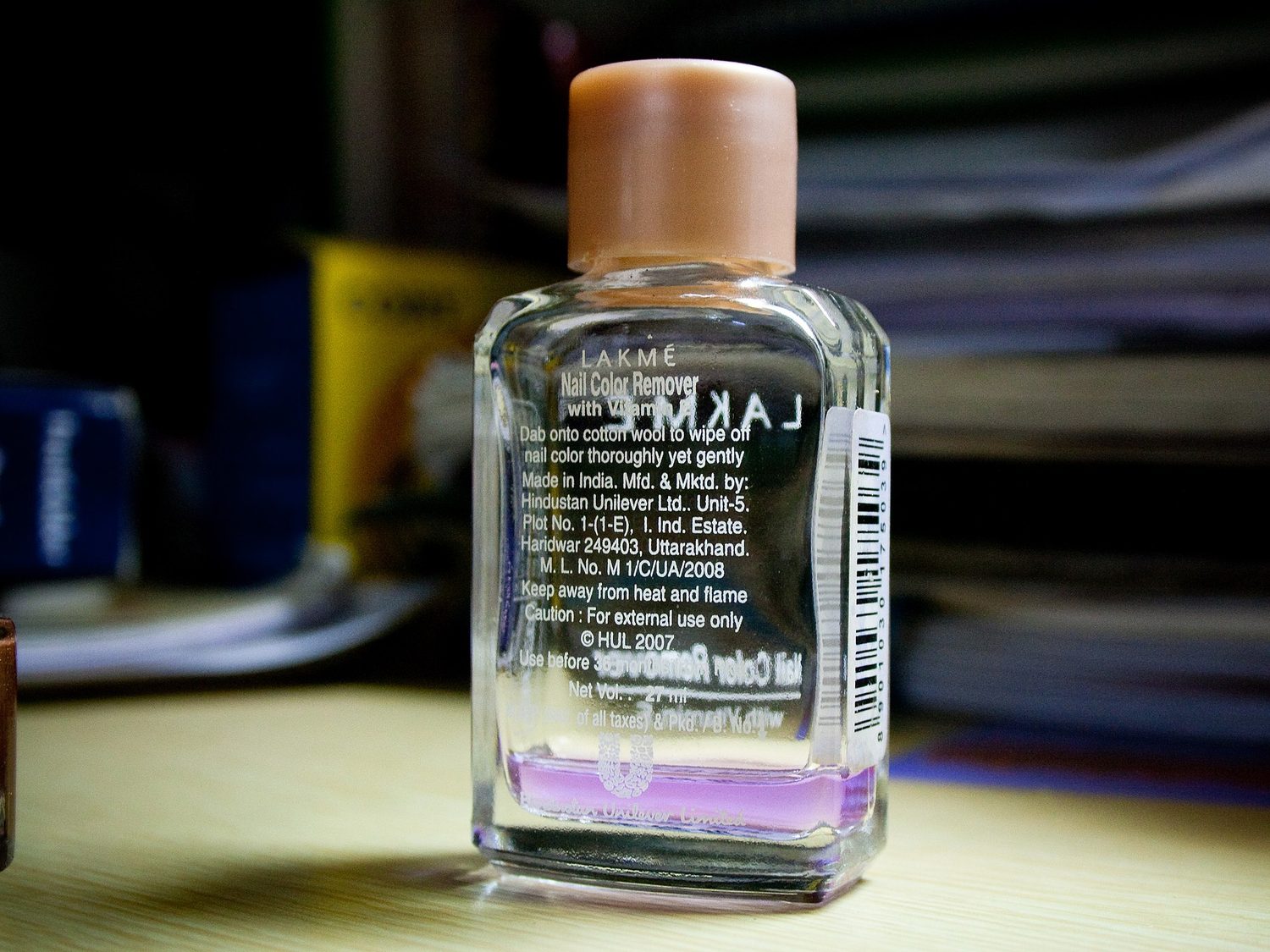
Откройте бутылку жидкости для снятия лака, и этот резкий запах — пропанон. Ваш собственный организм вырабатывает немного его каждый день. Всё это исходит из одной маленькой группы…
Озвучивание на английском · переключаемые субтитры на английском и китайском языках
17.1
Альдегиды и кетоны
Программа
Источник: Программа Cambridge International
English
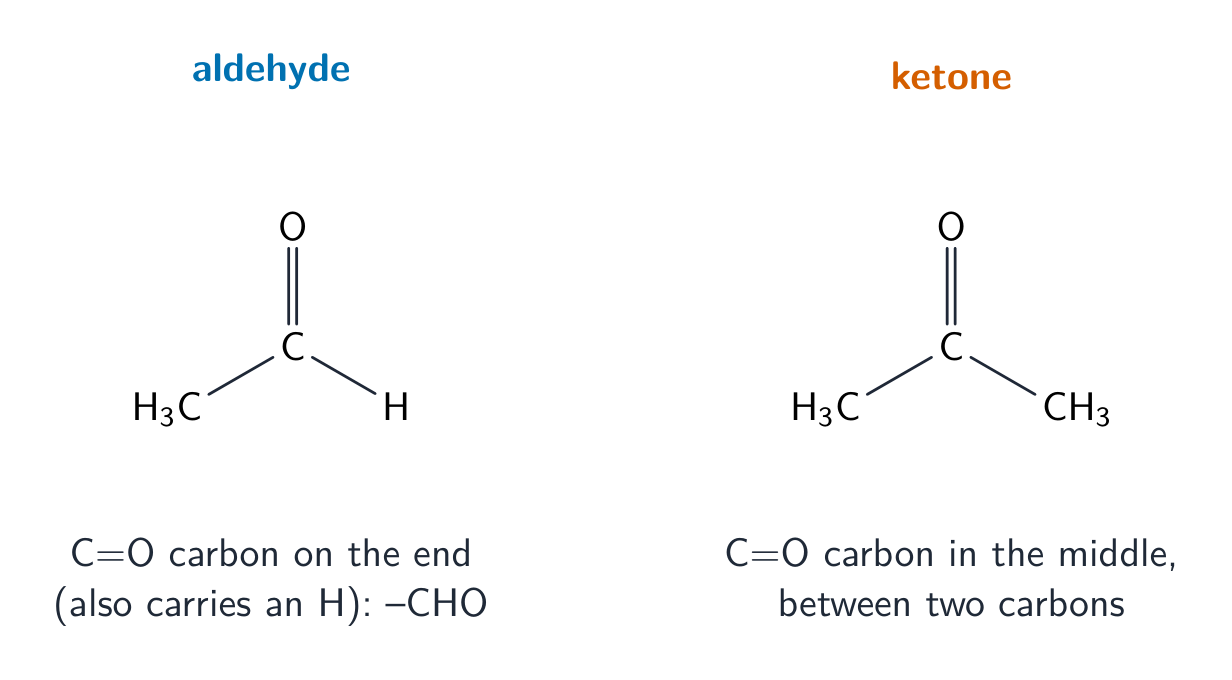
Aldehydes and ketones are carbonyl compounds 羰基化合物 — they contain the C=O carbonyl 羰基 group.
- in an aldehyde 醛 the carbonyl carbon is on the end of the chain (it also carries an H), written $\text{–CHO}$.
- in a ketone 酮 the carbonyl carbon is in the middle, between two other carbons.
Making aldehydes and ketones
Both are made by the oxidation 氧化 of an alcohol 醇 with acidified $\text{K}_2\text{Cr}_2\text{O}_7$ or $\text{KMnO}_4$:
- a primary alcohol, with distillation 蒸馏, gives an aldehyde.
- a secondary alcohol gives a ketone.
Write the oxidising agent as $[\text{O}]$ in a balanced equation:
$$\text{CH}_3\text{CH}_2\text{CH}_2\text{OH} + [\text{O}] \rightarrow \text{CH}_3\text{CH}_2\text{CHO} + \text{H}_2\text{O}$$
$$\text{CH}_3\text{CH(OH)CH}_3 + [\text{O}] \rightarrow \text{CH}_3\text{COCH}_3 + \text{H}_2\text{O}$$
Conditions and observations. Heat the alcohol with acidified potassium dichromate(VI); the solution turns from orange to green as $\text{Cr}_2\text{O}_7^{2-}$ is reduced to $\text{Cr}^{3+}$. (With acidified $\text{KMnO}_4$ the purple colour fades.) For an aldehyde, distil the product off as it forms: the aldehyde has the lowest boiling point in the mixture (it has no hydrogen bonding between its molecules), so it leaves before it can be oxidised further to a carboxylic acid. Heating under reflux 回流 instead would give the carboxylic acid. A ketone cannot be oxidised further, so it can be distilled off at the end. A tertiary alcohol is not oxidised: the dichromate stays orange.
Reactions
- reduction 还原 with $\text{NaBH}_4$ or $\text{LiAlH}_4$ turns a carbonyl compound back into an alcohol (an aldehyde gives a primary alcohol; a ketone gives a secondary alcohol).
- reaction with hydrogen cyanide 氰化氢 ($\text{HCN}$), with $\text{KCN}$ as catalyst 催化剂 and heat, adds $\text{H}$ and $\text{CN}$ across the C=O to make a hydroxynitrile 羟基腈. This adds one carbon to the chain.
Write the reducing agent as $[\text{H}]$:
$$\text{CH}_3\text{CHO} + 2[\text{H}] \rightarrow \text{CH}_3\text{CH}_2\text{OH} \qquad \text{CH}_3\text{COCH}_3 + 2[\text{H}] \rightarrow \text{CH}_3\text{CH(OH)CH}_3$$
$\text{NaBH}_4$ is used in water or methanol, at room temperature. $\text{LiAlH}_4$ is a stronger reducing agent that reacts violently with water, so it is used in dry ether. Both supply hydride ions, $\text{H}^-$, which attack the $\delta+$ carbonyl carbon. They do not reduce C=C double bonds, so in a molecule with both, only the C=O is reduced. (Hydrogen with a nickel catalyst reduces both.)
$$\text{CH}_3\text{CHO} + \text{HCN} \rightarrow \text{CH}_3\text{CH(OH)CN}$$
The mechanism: nucleophilic addition
The reaction with $\text{HCN}$ is a nucleophilic addition 亲核加成. Oxygen is more electronegative than carbon, so the C=O bond is polar and the carbonyl carbon is $\delta+$. $\text{HCN}$ is a weak acid and gives very few $\text{CN}^-$ ions, so a little $\text{KCN}$ is added to supply them. The steps are:
- a lone pair 孤对电子 on the carbon of $\text{CN}^-$ attacks the $\delta+$ carbonyl carbon.
- at the same time, one pair of the C=O double bond moves onto the oxygen, which becomes $\text{O}^-$.
- the $\text{O}^-$ uses a lone pair to take $\text{H}^+$ from an $\text{HCN}$ molecule. This makes the hydroxynitrile and gives back a $\text{CN}^-$ ion. Because $\text{CN}^-$ is used and then given back, $\text{KCN}$ acts as a catalyst.
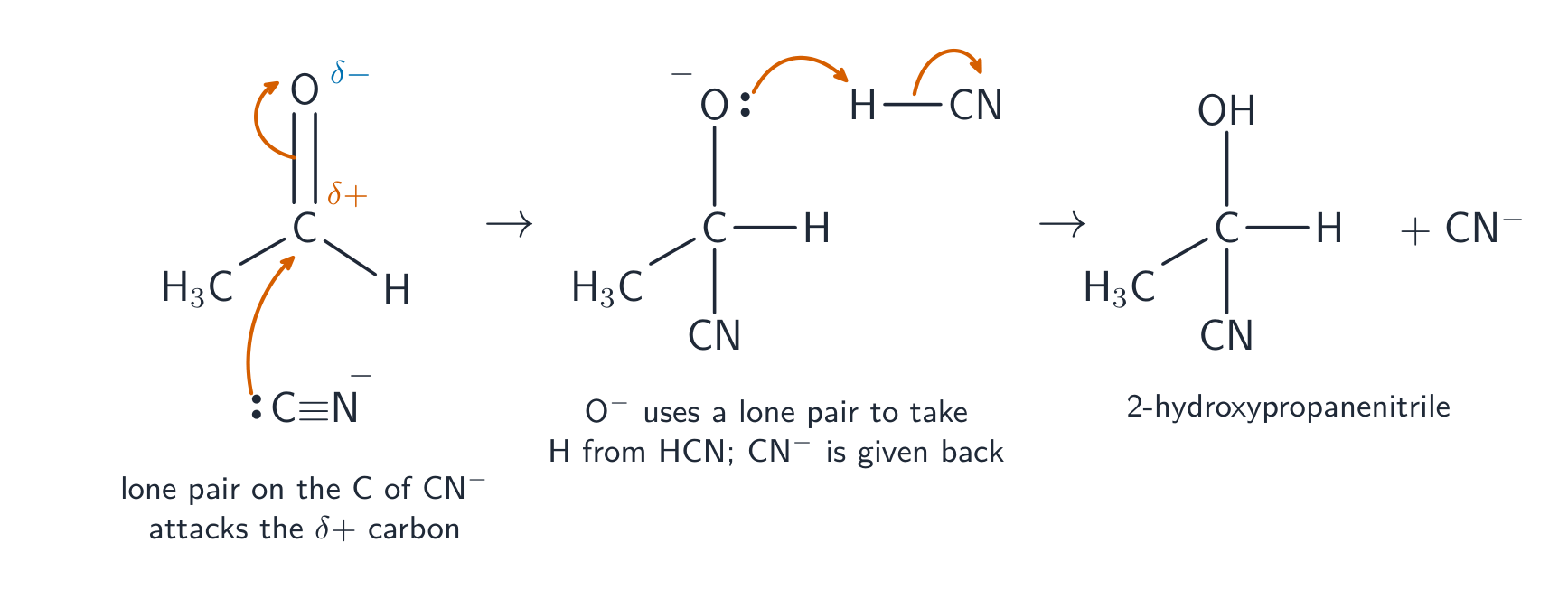
With propanone the same steps give 2-hydroxy-2-methylpropanenitrile. The product has one more carbon atom than the aldehyde or ketone, which makes this reaction useful for making longer carbon chains.
The product is a racemic mixture. The carbonyl group and the atoms joined to it are planar (trigonal planar around the carbon). So the $\text{CN}^-$ ion can attack the carbonyl carbon from above or below the plane with equal chance. With ethanal, the product 2-hydroxypropanenitrile has a chiral carbon (four different groups: H, $\text{CH}_3$, OH and CN), so the two directions of attack give the two optical isomers 旋光异构体 in equal amounts — a racemic mixture 外消旋混合物, which does not rotate plane-polarised light. With propanone the product is not chiral (the carbon carries two $\text{CH}_3$ groups), so there is only one product.
Worked example. Explain why the product of HCN with butanone shows no optical activity, even though it contains a chiral carbon. The carbon in $\text{CH}_3\text{C(OH)(CN)CH}_2\text{CH}_3$ has four different groups, so it is chiral. But the butanone molecule is planar at the C=O, so $\text{CN}^-$ attacks from either face with equal probability; equal amounts of the two enantiomers form, and their effects on plane-polarised light cancel.
Common mistakes.
- Starting the first arrow at the N of $\text{CN}^-$. The lone pair that attacks is on the carbon, which is why the new bond is C–C.
- Drawing the arrow from the oxygen to the carbon. The C=O pair moves towards the more electronegative O.
- Calling this electrophilic addition, as in alkenes. The C=O carbon is $\delta+$, so it is attacked by a nucleophile, not an electrophile.
- Leaving the product as $\text{O}^-$: the mechanism is only finished when the O gains an H.
Исследовать
Лабораторная работа с карбонильными соединениями
Отсортируйте реакции карбонильных соединений по тому, что они выявляют.
Словарь
Тренировать
| English | Русский |
|---|---|
| carbonyl compound/ˈkɑːbənaɪl ˈkɒmpaʊnd/ | карбонильное соединение |
| carbonyl/ˈkɑːbənaɪl/ | карбонильная группа |
| aldehyde/ˈældɪhaɪd/ | альдегид |
| ketone/ˈketəʊn/ | кетон |
| oxidation/ˌɒksɪˈdeɪʃn/ | окисление |
| alcohol/ˈælkəhɒl/ | спирт |
| distillation/dɪstɪˈleɪʃn/ | дистилляция |
| reflux/ˈriːflʌks/ | Heating a reaction mixture while condensing its vapour and returning the condensate to the same vessel. |
| reduction/rɪˈdʌkʃn/ | восстановление |
| hydrogen cyanide/ˈhaɪdrədʒn ˈsaɪənaɪd/ | цианистый водород |
| catalyst/ˈkætəlɪst/ | Катализатор |
| hydroxynitrile/haɪˈdrɒksɪnaɪtraɪl/ | гидроксинитрил |
| nucleophilic addition/ˌnjuːklɪəˈfɪlɪk əˈdɪʃn/ | нуклеофильное присоединение |
| lone pair/ləʊn peə/ | неделящая электронная пара |
| optical isomers/ˈɒptɪkl ˈaɪsəməz/ | optical isomers |
| racemic mixture/rəˈsiːmɪk ˈmɪkstʃə/ | racemic mixture |
17.1
Тесты на карбонильные соединения
English
Detecting any carbonyl
Add 2,4-DNPH reagent (2,4-dinitrophenylhydrazine). An orange precipitate confirms that the compound is an aldehyde or a ketone.
The reaction is a condensation 缩合: the C=O joins to the $\text{NH}_2$ of 2,4-DNPH and a molecule of water is lost, giving a 2,4-dinitrophenylhydrazone. Alcohols, carboxylic acids and esters do not react (the C=O of acids and esters is not reactive enough). To find which carbonyl compound you have, filter the orange crystals, recrystallise them to purify them, and measure their melting point. Compare it with a table of known melting points of 2,4-dinitrophenylhydrazones: each carbonyl compound gives a derivative with its own melting point.
Telling an aldehyde from a ketone
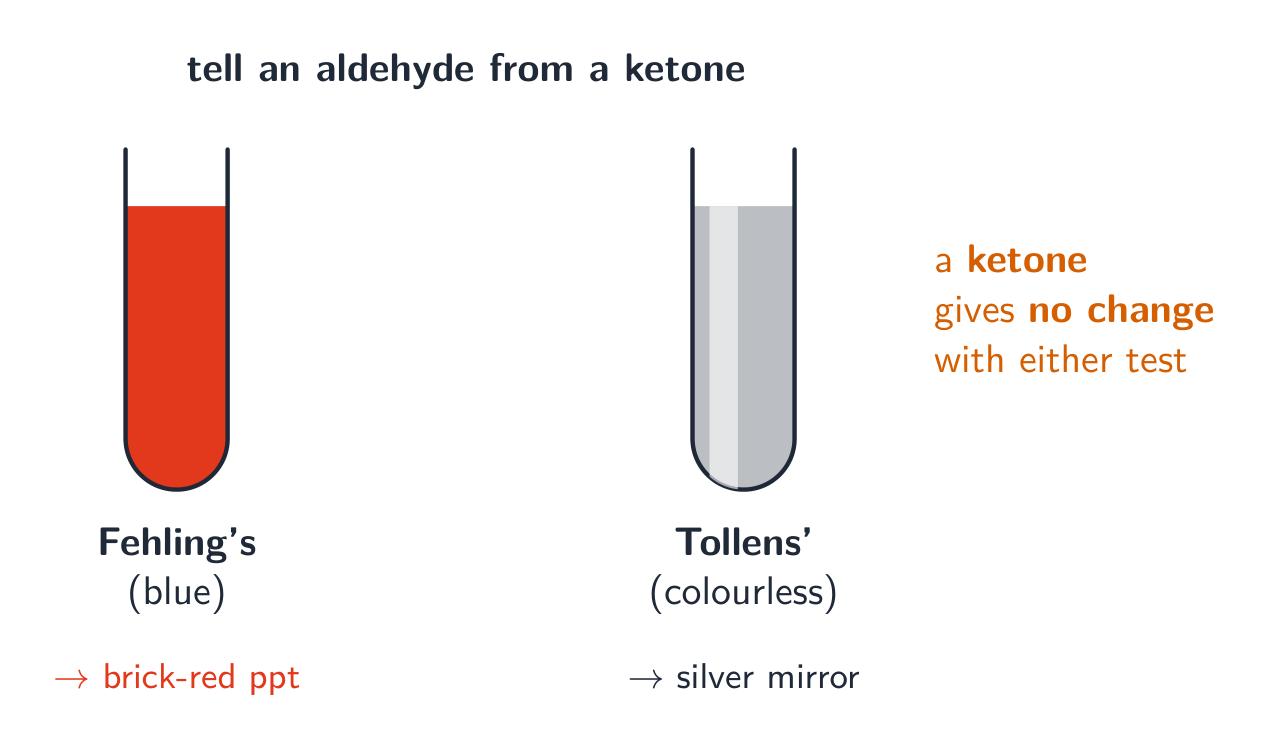
Aldehydes are easily oxidised to carboxylic acids, but ketones are not. Two tests use this difference:
| Test | Aldehyde | Ketone |
|---|---|---|
| Fehling's reagent 斐林试剂 (blue solution) | turns to a brick-red precipitate | no change |
| Tollens' reagent 托伦试剂 (colourless) | gives a silver mirror | no change |
What is happening in each test. Both reagents are mild oxidising agents; the aldehyde is oxidised to a carboxylic acid (or its anion, as the solutions are alkaline), and the reagent is reduced:
- Fehling's: warm with the aldehyde in a water bath. The blue complexed $\text{Cu}^{2+}$ ions are reduced to copper(I) oxide, $\text{Cu}_2\text{O}$, the brick-red precipitate.
- Tollens' (ammoniacal silver nitrate, $[\text{Ag(NH}_3)_2]^+$): warm with the aldehyde in a water bath. The $\text{Ag}^+$ ions are reduced to silver metal: $\text{Ag}^+ + \text{e}^- \rightarrow \text{Ag}$, which coats the glass.
- Ease of oxidation: warm with acidified $\text{K}_2\text{Cr}_2\text{O}_7$. An aldehyde turns it from orange to green; a ketone leaves it orange.
Heat these in a water bath, never with a flame: the organic compounds are flammable.
The iodoform test
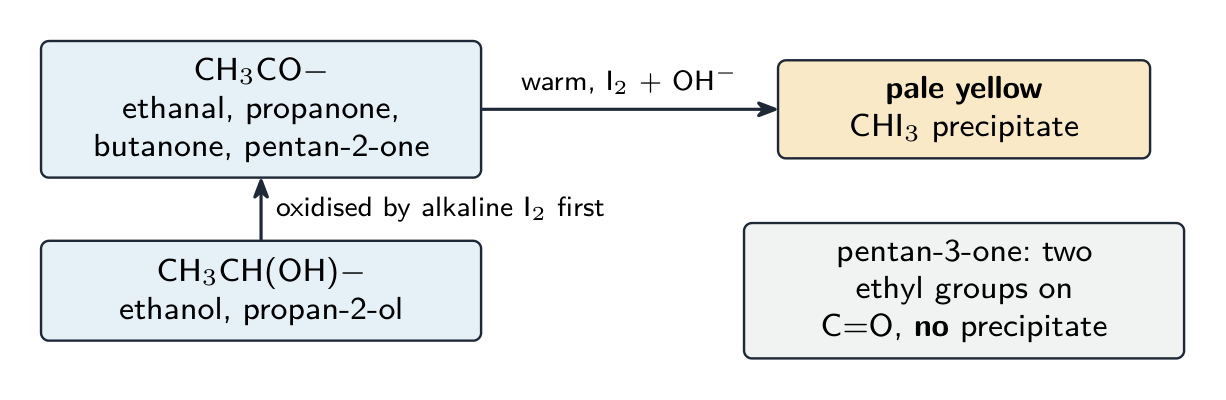
If the compound has the $\text{CH}_3\text{CO}-$ group, warming it with alkaline aqueous iodine gives a pale yellow precipitate of tri-iodomethane 三碘甲烷 ($\text{CHI}_3$) and the ion $\text{RCO}_2^-$.
$$\text{CH}_3\text{COR} + 3\text{I}_2 + 4\text{OH}^- \rightarrow \text{CHI}_3 + \text{RCO}_2^- + 3\text{I}^- + 3\text{H}_2\text{O}$$
The three H atoms of the $\text{CH}_3$ are replaced by I, then the $\text{CI}_3$ group splits off. The rest of the molecule becomes a carboxylate ion with one carbon fewer: propanone gives ethanoate, $\text{CH}_3\text{CO}_2^-$. Which carbonyls give a positive test? Ethanal (the only aldehyde), and all methyl ketones — propanone, butanone, pentan-2-one — but not pentan-3-one, whose C=O carries two ethyl groups. Alkaline iodine can also oxidise an alcohol with a $\text{CH}_3\text{CH(OH)}-$ group to a $\text{CH}_3\text{CO}-$ compound, so ethanol and propan-2-ol also give the yellow precipitate.
Worked example. A liquid gives an orange precipitate with 2,4-DNPH, gives no silver mirror with Tollens' reagent, and gives a yellow precipitate with alkaline aqueous iodine. Identify it. Take the tests one at a time, using each for exactly what it proves. The orange precipitate with 2,4-DNPH proves a carbonyl group is present - an aldehyde or a ketone, nothing else. No silver mirror with Tollens' rules out an aldehyde, so it must be a ketone. The yellow precipitate in the iodoform test proves a $\text{CH}_3\text{CO}-$ group: a methyl group joined directly to the carbonyl carbon. The simplest compound satisfying all three is propanone, $\text{CH}_3\text{COCH}_3$. Keep the roles straight: 2,4-DNPH finds any carbonyl, Tollens' separates aldehyde from ketone, and iodoform detects the methyl group beside the C=O.
Worked example (choosing between isomers). Compound X, $\text{C}_4\text{H}_8\text{O}$, gives an orange precipitate with 2,4-DNPH and a brick-red precipitate with Fehling's solution, but no yellow precipitate with alkaline aqueous iodine. Suggest two possible structures, and say how reduction could tell them apart. The carbonyl isomers of $\text{C}_4\text{H}_8\text{O}$ are butanal, 2-methylpropanal and butanone. Fehling's is positive, so X is an aldehyde, which rules out butanone. Neither aldehyde has $\text{CH}_3\text{CO}-$, consistent with the negative iodoform test. So X is butanal, $\text{CH}_3\text{CH}_2\text{CH}_2\text{CHO}$, or 2-methylpropanal, $\text{(CH}_3)_2\text{CHCHO}$. Reduction with $\text{NaBH}_4$ gives butan-1-ol or 2-methylpropan-1-ol respectively; the melting point of the 2,4-DNPH derivative also distinguishes them.
| Test | Aldehyde | Ketone | Shows |
|---|---|---|---|
| 2,4-DNPH | orange precipitate | orange precipitate | any C=O (aldehyde or ketone) |
| Fehling's, warm | blue → brick-red | stays blue | aldehyde |
| Tollens', warm | silver mirror | no change | aldehyde |
| acidified dichromate, warm | orange → green | stays orange | aldehyde |
| alkaline iodine, warm | yellow precipitate for ethanal only | yellow precipitate for methyl ketones | $\text{CH}_3\text{CO}-$ group |
Исследовать
Лаборатория по тестам на карбонильные группы
Соотнесите наблюдения с альдегидами и кетонами.
Словарь
Тренировать
| English | Русский |
|---|---|
| condensation/kɒndenˈseɪʃn/ | A chemical reaction in which molecules join and a small molecule, commonly water, is eliminated. |
| Fehling's reagent/ˈfeɪlɪŋz rɪˈeɪdʒənt/ | реагент Фелинга |
| Tollens' reagent/ˈtəʊlənz rɪˈeɪdʒənt/ | реагент Толленса |
| tri-iodomethane/traɪ ˈaɪədəʊmθeɪn/ | трииодметан |
17.1
Советы для экзамена
English
- 2,4-DNPH gives an orange precipitate with any carbonyl — it tests for $\text{C}=\text{O}$.
- Tollens' (silver mirror) and Fehling's (brick-red) are positive for aldehydes only — this is how you tell aldehydes from ketones.
- Nucleophilic addition of HCN adds one carbon (→ hydroxynitrile); show the curly arrows.
- The iodoform (tri-iodomethane) test is positive for $\text{CH}_3\text{CO}-$ groups.
- Use $[\text{O}]$ and $[\text{H}]$ in balanced oxidation and reduction equations; state “distil” for an aldehyde and “reflux” for a carboxylic acid.
- HCN addition to an aldehyde (or unsymmetrical ketone) gives a racemic mixture, because the planar C=O is attacked equally from both sides.
- $\text{NaBH}_4$ and $\text{LiAlH}_4$ reduce C=O but not C=C.
Интерактивные уроки по этой теме
Пройдите его шаг за шагом с упражнениями мгновенной проверки.