Skip to content · ⁨본문 바로가기⁩

Social Psychology and Personality · ⁨사회심리학 및 성격⁩

AP Psychology · ⁨AP 심리학⁩ · Topic 4 · ⁨주제 4⁩

Video lesson for this topic · ⁨이 주제용 영상 수업⁩ Open the video page · ⁨영상 페이지 열기⁩
10:24

사회심리학 및 성격

운전자가 당신 앞에 차를 끼우면 당신은 그들이 예의가 없다고 생각합니다. 나중에 당신이 누군가 앞에 차를 끼우면, 왜 그랬는지 정확히 압니다: 늦었기 때문이고, 다른 차로는…이었기 때문입니다.

English narration · English + 中文 subtitles burned in · ⁨영어 내레이션 · 영어 + 중국어 자막 burned-in⁩

4.1

Explaining Behaviour: Attribution · ⁨행동 설명: 귀인(Attribution)⁩

Syllabus
English

Learning Objective 4.1.A: Explain how attribution theory applies to behavior and mental processes.

  • 4.1.A.1 Attributions are how people explain behavior and mental processes of themselves and others. Dispositional attributions relate to internal qualities of others (such as intelligence or personality) while situational attributions relate to external circumstances that are experienced.
  • 4.1.A.2 People demonstrate a predictable pattern of attributions called explanatory style. Explanatory style is how people explain good and bad events in their lives and in the lives of others. Explanatory style can be optimistic or pessimistic.
  • 4.1.A.3 People are subject to biases in their attributions. Those biases include actor/ observer bias, fundamental attribution error, and self-serving bias, all of which can affect behavior and mental processes.

Learning Objective 4.1.B: Explain how locus of control (internal and external) applies to behavior and mental processes.

Learning Objective 4.1.C: Explain how person perception applies to behavior and mental processes.

  • 4.1.C.1 People’s perception of how much they like something can be influenced by the mere exposure effect. The mere exposure effect occurs when people are exposed to a stimulus repeatedly over time, which causes them to like the stimulus more.
  • 4.1.C.2 People can behave in ways that elicit behaviors from others that confirm their beliefs or perceptions about themselves or others (self-fulfilling prophecy).
  • 4.1.C.3 Social comparison is a type of person perception that occurs when people evaluate themselves based on comparisons to other members of society or social circles. Social comparison can be upward or downward. People often judge their own sense of deprivation relative to others (relative deprivation).
한국어

학습 목표 4.1.A: 귀인 이론이 행동과 정신 과정에 어떻게 적용되는지 설명하십시오.

  • 4.1.A.1 귀인(Attributions)은 사람들이 자신과 타인의 행동 및 심리적 과정을 설명하는 방식입니다. 성향적 귀인은 지능이나 성격과 같은 타인의 내부적 특성과 관련되며, 상황적 귀인은 경험하는 외부적 상황과 관련됩니다.
  • 4.1.A.2 사람들은 해설 스타일(Explanatory style)이라는 예측 가능한 패턴의 귀인을 보입니다. 해설 스타일은 사람들이 자신의 삶과 타인의 삶에서 발생하는 긍정적 및 부정적 사건을 설명하는 방법입니다. 해설 스타일은 낙관적이거나 비관적일 수 있습니다.
  • 4.1.A.3 사람들은 귀인 과정에서 편향에 노출됩니다. 이러한 편향에는 연극자/관찰자 편향(Actor/Observers bias), 기본 귀인 오류(Fundamental attribution error), 자기服务적 편향(Self-serving bias) 등이 있으며, 모두 행동과 심리적 과정에 영향을 미칠 수 있습니다.

학습 목표 4.1.B: 내재적·외재적 통제감(Locus of control)이 행동과 심리적 과정에 어떻게 적용되는지 설명하시오.

학습 목표 4.1.C: 인간 인지(Person perception)가 행동과 심리적 과정에 어떻게 적용되는지 설명하시오.

  • 4.1.C.1 사물에 대한 선호도는 단순 노출 효과(Mere exposure effect)에 의해 영향을 받을 수 있습니다. 단순 노출 효과란 시간이 지남에 따라 특정 자극에 반복적으로 노출됨으로써 그 자극에 대한 선호도가 높아지는 현상을 말합니다.
  • 4.1.C.2 사람들은 자신이나 타인에 대한 자신의 신념이나 인지를 확인시켜 주는 타인의 행동을 유발할 수 있는 방식으로 행동합니다(자신감성 예언, Self-fulfilling prophecy).
  • 4.1.C.3 사회 비교(Social comparison)는 개인이 사회 구성원이나 사회적 집단과의 비교를 통해 자신을 평가하는 인간의 인지의 일종입니다. 사회 비교는 상향 비교와 하향 비교로 나뉩니다. 사람들은 종종 타인과 비교하여 자신의 박탈감을 판단합니다(상대적 박탈감, Relative deprivation).
Source: College Board AP Course and Exam Description · ⁨출처: College Board AP Course and Exam Description⁩

English

Social psychology 社会心理学 studies how people think about, influence, and relate to others. It begins with attribution 归因 - how we explain behaviour.

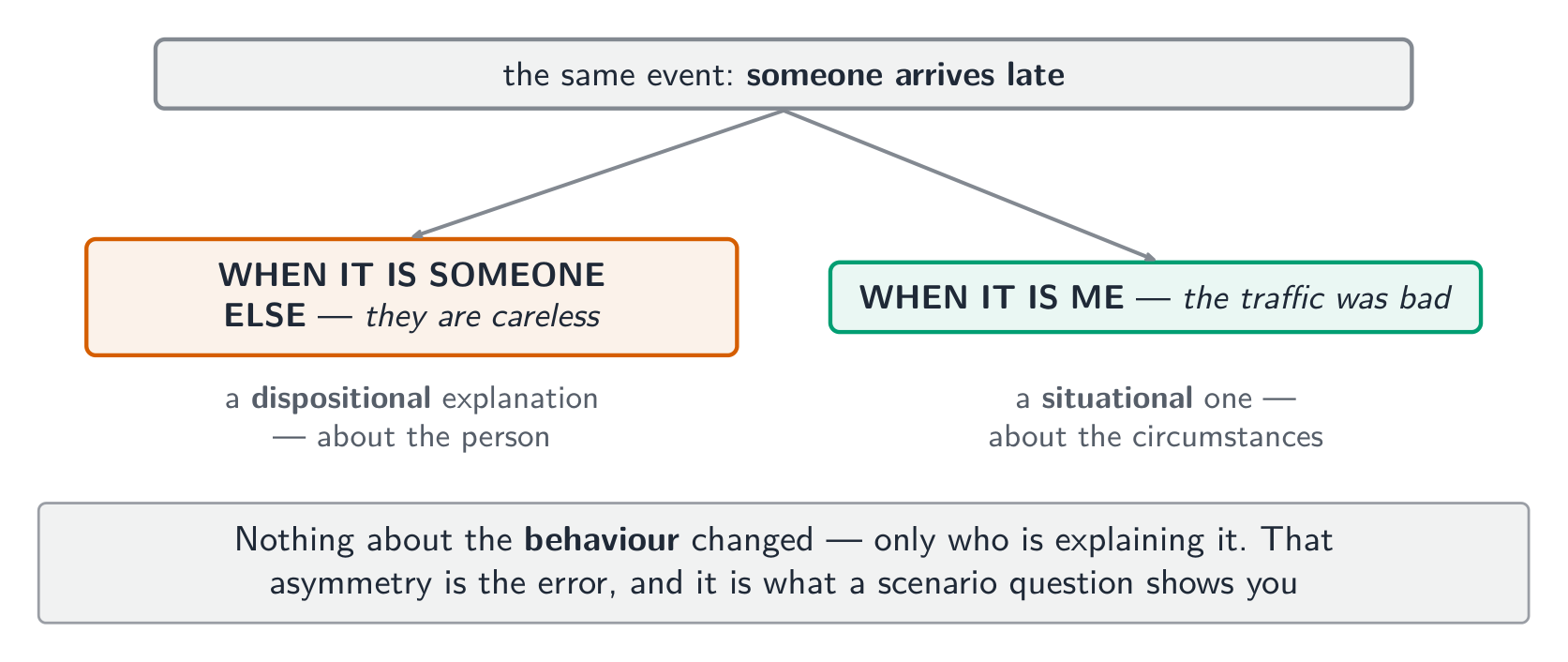
An explanation is either dispositional 内归因 (about the person's personality) or situational 外归因 (about the circumstances). People are not even-handed about which they choose:

  • The fundamental attribution error 基本归因错误 is over-using dispositional explanations for other people's behaviour.
  • The actor-observer bias 行动者-观察者偏差 is explaining your own behaviour situationally while explaining others' dispositionally.
  • The self-serving bias 自利偏差 credits success to yourself and blames failure on the situation.
  • The just-world phenomenon 公正世界现象 is the belief that people get what they deserve.

A person's explanatory style 解释风格 can be optimistic 乐观的 or pessimistic 悲观的, and this shapes how they respond to setbacks.

Person perception has its own effects. The mere exposure effect 单纯曝光效应 means repeated contact increases liking. A self-fulfilling prophecy 自我实现预言 occurs when expectations cause the behaviour that confirms them. Social comparison 社会比较 is judging yourself against others, either upward 向上比较 or downward 向下比较.

한국어

사회심리학은 사람들이 타인을 어떻게 생각하고, 영향을 미치며, 관계하는지 연구합니다. 여기에는 귀인이 포함되는데, 이는 우리가 행동을 어떻게 설명하는지에 관한 것입니다.

해석은 성격적(dipsitional) (개인의 성격에 관한 것)이거나 상황적(situational) ( circumstances에 관한 것)일 수 있습니다. 사람들은 선택할 때 공평하지 않습니다:

  • 기본적 귀인 오류(fundamental attribution error) 는 타인의 행동에 대해 성격적 해석을 과도하게 사용하는 것입니다.
  • 배우-관찰자 편향(actor-observer bias) 는 자신의 행동은 상황적으로, 타인의 행동은 성격적으로 해석하는 것입니다.
  • 자기Serve편향(self-serving bias) 는 성공을 자신에게 돌리고 실패를 상황에 돌리는 것입니다.
  • 정당한 세계 현상(just-world phenomenon) 은 사람들이 마땅히 받을 것을 받는다는 믿음입니다.

一个人的 解释风格(explanatory style) 은 乐观 또는 悲观일 수 있으며, 이는他们在逆境中的反应方式产生影响。

인식(perception)에는 자체적인 효과가 있습니다. 단순 노출 효과(mere exposure effect) 는 반복적인 접촉이 호감을 증가시킨다는 뜻입니다. 자아 성취 예언(self-fulfilling prophecy) 은 기대가 그것을 확인하는 행동을 유발할 때 발생합니다. 사회 비교(social comparison) 는 타인과 자신을 평가하는 것으로, 상향(upward) 또는 하향(downward) 일 수 있습니다.

행동에 변화는 없었음 - 오직 설명자가 바뀔 뿐
Explore · ⁨탐색하기⁩

Sort each explanation as dispositional or situational · ⁨각 설명을 성향적(dispositional)인지 상황적(situational)인지 분류하기⁩

Nothing about the behaviour changes — only who is explaining it. That asymmetry is the error. · ⁨행동 자체는 변하지 않습니다 — 오직 그것을 설명하는 사람이 바뀔 뿐입니다. 이 비대칭성이 오류입니다.⁩

Vocabulary · ⁨어휘⁩ Train · ⁨연습하기⁩
English 한국어
Social psychology/ˈsəʊʃl saɪˈkɒlədʒi/ 사회심리학
attribution/ətrɪˈbjuːʃn/ 귀인
dispositional/ˌdɪspəˈzɪʃənl/ 특성적(dispositional)
situational/ˌsɪtʃuːˈeɪʃənl/ 상황적(situational)
fundamental attribution error/ˌfʌndəˈmentl ətrɪˈbjuːʃn ˈerə/ 기본 귀인 오류
actor-observer bias/ˈæktə ɒbˈzɜːvə ˈbaɪəs/ actor-observer bias
self-serving bias/self ˈsɜːvɪŋ ˈbaɪəs/ self-serving bias
just-world phenomenon/dʒʌst wɜːld fɪˈnɒmɪnən/ 공정한 세계 현상(just-world phenomenon)
explanatory style/ekˈsplænətəri staɪl/ 해석 스타일(explanatory style)
optimistic/ˌɒptɪˈmɪstɪk/ 乐观적(optimistic)
pessimistic/ˌpesɪˈmɪstɪk/ 비관적(pessimistic)
mere exposure effect/mɪə ekˈspəʊʒə ɪˈfekt/ 단순 노출 효과
self-fulfilling prophecy/self fʊlˈfɪlɪŋ ˈprɒfəsi/ 자아 성취 예언
Social comparison/ˈsəʊʃl kəmˈpærɪsn/ 사회적 비교
upward/ˈʌpwəd/ 오른쪽으로 기울어진다
downward/ˈdaʊnwəd/ 왼쪽으로 기울어진다
4.2

Attitudes and Attitude Change · ⁨태도와 태도 변화⁩

Syllabus
English

Learning Objective 4.2.A: Explain how stereotypes and implicit attitudes contribute to the behaviors and mental processes of prejudice and discrimination.

  • 4.2.A.1 A stereotype is a generalized concept about a group. Stereotypes can help reduce cognitive load when making decisions or judgments. Stereotypes can be the cause and/or result of biased perceptions and experiences and are frequently the basis of prejudiced attitudes and discriminatory behaviors.
  • 4.2.A.2 Implicit attitudes are those that individuals hold but may be unaware of or may not acknowledge. Research has focused on how implicit attitudes reflect negative evaluations of others, as demonstrated by the just-world phenomenon, out-group homogeneity bias, in-group bias, or ethnocentrism.

Learning Objective 4.2.B: Explain how belief perseverance and cognitive dissonance apply to attitude formation and change.

  • 4.2.B.1 Belief perseverance occurs when a belief persists even if evidence suggests it is not accurate. People experiencing belief perseverance may engage in confirmation bias, thereby clinging to an attitude or belief regardless of the evidence for or against it.
  • 4.2.B.2 Cognitive dissonance refers to the mental discomfort that occurs when actions or attitudes are in conflict. People are motivated to reduce the discomfort by changing either actions or attitudes to be more in line with each other.
한국어

학습 목표 4.2.A: 고정관념(Stereotypes)과 암묵적 태도(Implicit attitudes)가 편견과 차별의 행동 및 심리적 과정에 기여하는 방식을 설명하시오.

  • 4.2.A.1 고정관념은 특정 집단에 대한 포괄적인 개념입니다. 고정관념은 의사결정이나 판단 시 인지 부하를 줄이는 데 도움이 될 수 있습니다. 고정관념은 편향된 인식과 경험의 원인이자 결과일 수 있으며, 자주 편견적인 태도와 차별적 행동의 기반이 됩니다.
  • 4.2.A.2 암묵적 태도는 개인이 가지고 있지만 의식하지 못하거나 인정하지 않을 수 있는 태도입니다. 연구는 정의의 세계 현상(Just-world phenomenon), 소수 집단 균질화 편향(Out-group homogeneity bias), 내집단 편향(In-group bias), 또는 민족 중심주의(Ethnocentrism) 등을 통해 암묵적 태도가 타인에 대한 부정적 평가를 반영함을 보여줍니다.

학습 목표 4.2.B: 신념 고착(Belief perseverance)과 인지 부조화(Cognitive dissonance)가 태도 형성과 변화에 어떻게 적용되는지 설명하시오.

  • 4.2.B.1 신념 고착이란 증거가 정확하지 않음을 시사함에도 불구하고 신념이 지속되는 현상입니다. 신념 고착을 겪는 사람들은 확인 편향(Confirmation bias)을 보이며, 신념이나 태도에 대한 증거가 있거나 없거나 관계없이 이를 고집할 수 있습니다.
  • 4.2.B.2 인지 부조화는 행동이나 태도가 서로 충돌할 때 발생하는 심리적 불편함을 의미합니다. 사람들은 불편함을 줄이기 위해 행동이나 태도를 서로 더 일치하도록 변경하려는 동기를 가집니다.

Source: College Board AP Course and Exam Description · ⁨출처: College Board AP Course and Exam Description⁩

English

A stereotype 刻板印象 is a generalised idea about a group; it reduces mental effort but can be inaccurate and harmful. Prejudice 偏见 is an attitude, and discrimination 歧视 is the behaviour. Implicit attitudes 内隐态度 are held without full awareness.

Attitudes resist change. Belief perseverance 信念固着 keeps a belief alive even after the evidence for it is discredited. Confirmation bias 确认偏差 is seeking evidence that fits what you already believe.

Cognitive dissonance 认知失调 is the discomfort felt when actions and attitudes conflict. Because the action has already happened, people often resolve it by changing the attitude - which is why doing something can change what a person believes.

한국어

고정관념(stereotype) 은 집단에 대한 일반화된 생각으로, mentale effort를 줄이지만 부정확하고 해로울 수 있습니다. 편견(prejudice) 은 태도이며, 차별(discrimination) 은 행동입니다. 암묵적 태도(implicit attitudes) 는 완전한 인식 없이 유지됩니다.

태도는 변화에 저항합니다. 신념 고착(belief perseverance) 은 증거가 부인된 후에도 신념을 유지합니다. 확인 편향(confirmation bias) 은 이미 믿고 있는 것에 맞는 증거를 찾는 것입니다.

인지 부조화(cognitive dissonance) 는 행동과 태도가 충돌할 때 느끼는 불편함입니다. 행동이 이미 발생했기 때문에, 사람들은 종종 태도를 변경하여 이를 해결합니다. 이것이 바로 무언가를 하는 것이 사람이 믿는 것을 바꿀 수 있는 이유입니다.

Vocabulary · ⁨어휘⁩ Train · ⁨연습하기⁩
English 한국어
stereotype/ˈsterɪəʊtaɪp/ 고정관념
Prejudice/ˈpredʒuːdɪs/ 편견(Prejudice)
discrimination/dɪˌskrɪmɪˈneɪʃn/ 차별
Implicit attitudes/ɪmˈplɪsɪt ˈætɪtjuːdz/ 암시적 태도
Belief perseverance/bɪˈliːf ˌpɜːsɪˈvɪərəns/ 신념 유지
Confirmation bias/kɒnfəˈmeɪʃn ˈbaɪəs/ 확증 편향(Confirmation bias)
Cognitive dissonance/ˈkɒɡnɪtɪv ˈdɪsənəns/ 인지 부조화
4.3

Social Situations · ⁨사회적 상황⁩

Syllabus
English

Learning Objective 4.3.A: Explain how the social situation affects behavior and mental processes.

  • 4.3.A.1 Social norms define expectations and roles a society may have for its members in individual and social situations.
  • 4.3.A.2 Social influence theory proposes that social pressure to behave or think in certain ways can be normative or informational.
  • 4.3.A.3 Persuasion refers to the techniques applied to convince the self or others of particular ideas, actions, or beliefs.
    • 4.3.A.3.i Persuasion can depend on the route to persuasion. The elaboration likelihood model outlines two main routes to persuasion: central and peripheral. The halo effect is an example of a peripheral route to persuasion.
    • 4.3.A.3.ii Persuasion can depend on how information is presented, as demonstrated by the foot-in-the-door and the door-in-the-face techniques.
  • 4.3.A.4 Research on conformity clarifies the conditions that strengthen the likelihood of people adhering to unspoken rules, norms, or expectations.
  • 4.3.A.5 Research on obedience clarifies the conditions that strengthen the likelihood of people complying with the directives of an authority figure.

Learning Objective 4.3.B: Explain how being in a group can affect an individual’s behavior and mental processes.

  • 4.3.B.1 Cultural phenomena such as individualism, collectivism, and multiculturalism can influence how one perceives and behaves towards oneself and others.
  • 4.3.B.2 Being a member of a group can influence how one behaves or experiences mental processes via group polarization, groupthink, diffusion of responsibility, social loafing, and deindividuation.
  • 4.3.B.3 Performing a mental or physical behavior in front of a group can lead to social facilitation.
  • 4.3.B.4 People often overestimate the levels to which others agree with them, known as the false consensus effect.
  • 4.3.B.5 Superordinate goals serve to unite disparate groups under a common goal and help reduce negative affect and stereotyping among groups. Social traps occur when individuals do not unite and act in their own self-interest to the detriment of the group.
  • 4.3.B.6 Industrial-organizational (I/O) psychologists study how people perform in the workplace. I/O psychologists study best practices in management of work, relationships among people working together or for a common company or program, and how people feel about work (burnout).

Learning Objective 4.3.C: Explain how prosocial behavior affects behavior and mental processes.

  • 4.3.C.1 Altruism refers to selfless behavior, but some researchers suggest that people act in prosocial ways due to incurring social debt. The social reciprocity norm and the social responsibility norm explain this type of behavior.
  • 4.3.C.2 The bystander effect demonstrates that situational and attentional variables predict whether someone is likely to help another person.
한국어

학습 목표 4.3.A: 사회적 상황이 행동과 심리적 과정에 미치는 영향을 설명하시오.

  • 4.3.A.1 사회 규범(Social norms)은 개인적 및 사회적 상황에서 사회가 구성원에게 기대하는 역할과 기준을 정의합니다.
  • 4.3.A.2 사회 영향 이론은 특정 방향으로 행동하거나 생각하는 데 가해지는 사회적 압력은 규범적(Normative)이거나 정보적(Informational)일 수 있다고 주장합니다.
  • 4.3.A.3 설득(Persuasion)은 특정 아이디어, 행동, 혹은 신념을 자신 또는 타인에게 설득하기 위해 적용되는 기법을 의미합니다.
    • 4.3.A.3.i 설득은 설득 경로에 따라 달라질 수 있습니다. 세밀화 확률 모델(Elaboration likelihood model)은 설득의 두 가지 주요 경로를 제시합니다: 중심 경로(Central route)와 주변 경로(Peripheral route). 후광 효과(Halo effect)는 주변 경로의 예시입니다.
    • 4.3.A.3.ii 설득은 정보 전달 방식에 따라 달라질 수 있으며, 이는 문 발음(Foot-in-the-door)과 문_face(Door-in-the-face) 기법으로 입증됩니다.
  • 4.3.A.4 순응(Conformity)에 관한 연구는 사람들이 서면되지 않은 규칙, 규범, 혹은 기대에 따를 확률을 높이는 조건을 밝혀 니다.
  • 4.3.A.5 복종(Obedience)에 관한 연구는人们在 Authority figure의 지시를 따를 확률을 높이는 조건을 밝혀 줍니다.

학습 목표 4.3.B: 집단 구성원이 개인의 행동과 심리적 과정에 미치는 영향을 설명하시오.

  • 4.3.B.1 개인주의, 집단주의, 다문화주의와 같은 문화적 현상은 자신이 스스로와 타인을如何看待 및 행동하는지에 영향을 미칠 수 있습니다.
  • 4.3.B.2 집단에 속한 것은 집단 극화(Group polarization), 집단 사고(Groupthink), 책임 분산(Diffusion of responsibility), 사회적 게으름(Social loafing), 그리고 무개체화(Deindividuation)를 통해个人行为이나 심리적 과정에 영향을 미칠 수 있습니다.
  • 4.3.B.3 집단의 앞에서 심리적 또는 신체적 행위를 수행하면 사회적 촉진(Social facilitation)이 발생할 수 있습니다.
  • 4.3.B.4 사람들은 타인들이 자신과 얼마나 동의하고 있는지 과대평가하는 경향이 있는데, 이를 허위 합의 효과(False consensus effect)라고 합니다.
  • 4.3.B.5 초월적 목표(Superordinate goals)는 disparate 한 집단들을 공통된 목표 아래로 묶어주고, 집단 간 부정적 감정과 고정관념을 줄이는 데 도움을 줍니다. 사회적 함정(Social traps)은 개인들이 단결하지 않고 집단 전체의 이익보다 자신의 이익을 위해 행동할 때 발생합니다.
  • 4.3.B.6 산업-조직(I/O) 심리학자들은 직장에서의 인간 성능을 연구합니다. I/O 심리학자들은 업무 관리의 모범 사례, 공동의 회사나 프로그램에서 함께 일하는 사람들 간의 관계, 그리고 직무에 대한 개인의 느낌(소진, Burnout) 등을 연구합니다.

학습 목표 4.3.C: 친사회적 행동이 행동과 심리적 과정에 미치는 영향을 설명하시오.

  • 4.3.C.1 이타주의는 이타적인 행동을 의미하지만, 일부 연구자들은 사람들이 사회 채무를 치러야 한다는 이유로 친사회적으로 행동한다고 주장한다. 사회적 상호작용의 규범과 사회적 책임의 규범은 이러한 유형의 행동을 설명한다.
  • 4.3.C.2 목격자 효과는 상황 및 주의 변수가 타인을 돕을 가능성이 있는지를 예측함을 보여준다.

Source: College Board AP Course and Exam Description · ⁨출처: College Board AP Course and Exam Description⁩

English

Social norms 社会规范 define the behaviour a group expects. Behaviour changes when others are present:

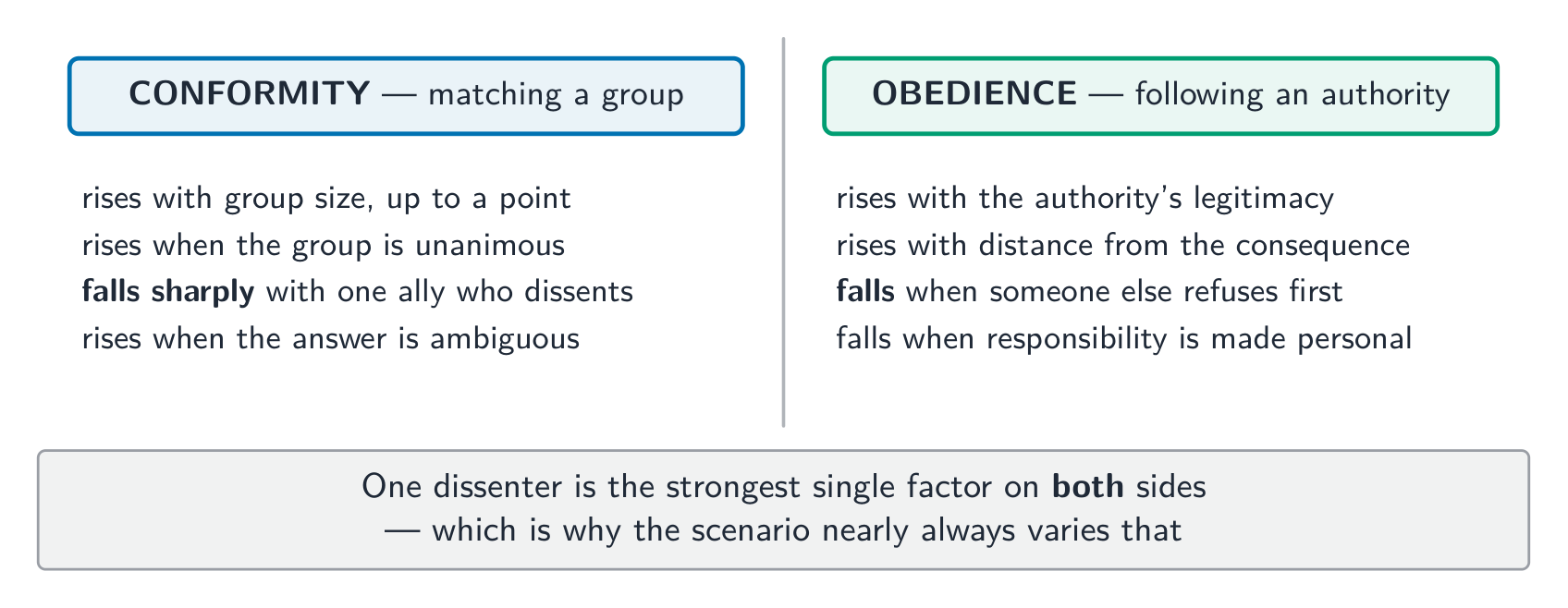
  • Conformity 从众 is adjusting behaviour to match a group. It rises with group size (up to a point), unanimity, and ambiguity, and falls when even one other person dissents.
  • Obedience 服从 is following an instruction from an authority. It rises with the authority's perceived legitimacy and closeness, and falls when the victim is close or the authority is distant.
  • Normative social influence 规范性社会影响 is conforming to be accepted; informational social influence 信息性社会影响 is conforming because you think others know better.

Persuasion 说服 has two routes in the elaboration likelihood model 精细加工可能性模型: the central route 中心路径 uses the strength of the argument, and the peripheral route 边缘路径 uses cues such as attractiveness. Sequential techniques matter too: the foot-in-the-door 登门槛效应 technique starts with a small request, while the door-in-the-face 留面子效应 technique starts with an unreasonable one.

Group settings change behaviour further. Social facilitation 社会助长 improves performance on simple or well-practised tasks when others watch, but harms performance on difficult ones. Social loafing 社会惰化 is reduced individual effort in a group. Deindividuation 去个体化 is loss of self-awareness in a crowd. Group polarization 群体极化 pushes a group's average view further in its original direction, and groupthink 群体思维 is the suppression of dissent to keep harmony.

Individualism 个人主义 and collectivism 集体主义 shape all of these, and multiculturalism 多元文化主义 describes societies holding several traditions together. The false consensus effect 虚假一致效应 is overestimating how many people agree with you. Superordinate goals 超级目标 - shared aims that need cooperation - reduce hostility between groups.

Altruism 利他行为 is selfless helping, though prosocial behavior 亲社会行为 may also bring benefit to the helper. The bystander effect 旁观者效应 shows people are less likely to help as the number of onlookers rises, because of diffusion of responsibility 责任分散.

Worked example (a real AP exam question). The 2025 Evidence-Based Question asked students to "develop and justify an argument about whether the presence of others improves performance", then to "Explain how the evidence from Part B (i) supports your claim using a psychological perspective, theory, concept, or research finding learned in AP Psychology." A full-mark answer supplies a course concept, not just a restatement of the source: "The participants performed better on the simple task when observed (Source 1). This supports my claim because social facilitation predicts that an audience improves performance on tasks that are simple or well practised, while impairing performance on difficult ones." Notice the shape: cite the source, then name the concept and state what it predicts. Re-describing the study alone does not earn the explanation point.

한국어

사회적 규범(social norms) 은 집단이 기대하는 행동을 정의합니다. 다른 사람이 있을 때 행동이 변합니다:

  • 동조(conformity) 는 집단에 맞춰 행동을 조정하는 것입니다. 집단 크기(일정 수준까지), 일치(unanimity), 모호성이 증가하면上升하고, 적어도 한 명의 다른 사람이 반대하면下降합니다.
  • 복종(obedience) 는 권위자의 지시를 따르는 것입니다. 권위자의 합법성과 근접성이 높아지면上升하고, 피해자가 가까워지거나 권위자가 멀어지면下降합니다.
  • 규범적 사회 영향(normative social influence) 은 수용받기 위해 동조하는 것이며, 정보적 사회 영향(informational social influence) 은 타인이 더 잘 안다고 여겨서 동조하는 것입니다.

설득(persuasion) 은 고려 확률 모델(elaboration likelihood model) 에서 두 가지 경로를 가집니다: 중심 경로(central route) 는 논리의 강도를 사용하며, 외곽 경로(peripheral route) 는 매력도 같은 단서를 사용합니다. 순차적 기법 또한 중요합니다: 발을 문에 넣기 기법(foot-in-the-door) 은 작은 요청으로 시작하고, 문을 얼굴에 내밀기 기법(door-in-the-face) 은 비합리적인 요청으로 시작합니다.

집단 상황은 행동을 더 변화시킨다. 사회적 촉진은 다른 사람이 지켜보는 상황에서 단순하거나 잘 연습된 과제의 성능을 향상시키지만, 어려운 과제는 오히려 저하시킨다. 사회적 게으름은 집단 내에서 개인이 줄이는 노력이다. 비개체화는 군중 속에서 자아 인식 상실을 의미한다. 집단 극화는 집단의 평균 의견이 원래 방향으로 더 치우치게 하며, 집단사유는 화합을 유지하기 위해 이견을 억압하는 현상이다.

개인주의와 집단주의는 이러한 모든 것을 형성하며, 다문화주의는 여러 전통을 함께 유지하는 사회를 설명한다. 거짓된 동조 효과는 자신과 동의하는 사람의 수를 과도하게 추정하는 것이다. 초월적 목표는 협력이 필요한 공동 목표를 말하며, 집단 간 적대를 줄여준다.

이타심은 이타적인 도움을 뜻하지만, 친사회적 행동은 도움给对方에게도 이익이 될 수 있다. 동참자 효과는 목격자의 수가 증가할수록 도움이 덜해지는 현상으로, 이는 책임 분산 때문에 발생한다.

작업 예제 (실제 AP 시험 문제). 2025 근거 기반 질문은 학생들이 "타인의 존재가 성능을 향상시키는지에 대한 논점을 개발하고 정당화"하고, "AP 심리학에서 배운 심리학적 관점, 이론, 개념 또는 연구 결과를 사용하여 B부 (i)의 증거가 주장에 어떻게 기여하는지 설명"하도록 요구했다. 만점 답안은 출처 재현뿐만 아니라 과정 개념을 제공한다: "관찰될 때 참여자들은 단순한 과제에서 더 나은 성능을 보였음(출처 1). 이는 사회적 촉진 이론이 단순하거나 잘 연습된 과제는performance을 향상시키고, 어려운 과제는Performance을 저하시킨다고 예측하므로 내 주장을 지지한다." 이 형태를 유의하라: 출처를 인용한 후 개념을 명시하고 그것이 예측하는 바를 서술하라. 연구 재기술만으로는 설명 점수를 받을 수 없다.

한 명의 이견 제시자가 양측 모두에서 가장 강력한 단일 요인임
Vocabulary · ⁨어휘⁩ Train · ⁨연습하기⁩
English 한국어
Social norms/ˈsəʊʃl nɔːmz/ 사회 규범
Conformity/kənˈfɔːmɪti/ 동조
Obedience/əʊˈbiːdɪəns/ 복종
Normative social influence/ˈnɔːmətɪv ˈsəʊʃl ˈɪnfluːəns/ 규범적 사회 영향(Normative social influence)
informational social influence/ˌɪnfəˈmeɪʃənl ˈsəʊʃl ˈɪnfluːəns/ 정보적 사회 영향(informational social influence)
Persuasion/pəˈsweɪʒn/ 설득
elaboration likelihood model/ɪˌlæbəˈreɪʃn ˈlaɪklihʊd ˈmɒdl/ 세부화 가능성 모델(elaboration likelihood model)
central route/ˈsentrəl ruːt/ 중심 경로
peripheral route/pəˈrɪfərəl ruːt/ 주변 경로
foot-in-the-door/fʊt ɪnðə dɔː/ 발 도어 인 더 도어(foot-in-the-door)
door-in-the-face/dɔː ɪnðə feɪs/ 문 인 더 페이스(door-in-the-face)
Social facilitation/ˈsəʊʃl fəˌsɪlɪˈteɪʃn/ 사회 촉진
Social loafing/ˈsəʊʃl ˈləʊfɪŋ/ 사회적 게으름(Social loafing)
Deindividuation/ˌdeɪndɪˌvɪdjuːˈeɪʃn/ 비개체화(Deindividuation)
Group polarization/ɡruːp ˌpəʊləraɪˈzeɪʃn/ 집단 극화(Group polarization)
groupthink/ˈɡruːpθɪŋk/ 그룹 사고
Individualism/ˌɪndɪˈvɪdʒuːəlɪzəm/ 개인주의
collectivism/kəˈlektɪvɪzəm/ collectivism (집단주의)
multiculturalism/ˌmʌltɪˈkʌltʃərəlɪzəm/ 다문화주의
false consensus effect/fɒls kənˈsensəs ɪˈfekt/ 거짓 동조 효과
Superordinate goals/ˌsuːpəˈrɔːdɪnət ɡəʊlz/ 초월적 목표(Superordinate goals)
Altruism/ˈɔːltruːɪzəm/ 이타주의
prosocial behavior/ˈprɒsəʊʃl bɪˈheɪvjə/ 친사회적 행동(prosocial behavior)
bystander effect/ˈbaɪstændə ɪˈfekt/ 旁观者 효과
diffusion of responsibility/dɪˈfjuːʒn ɒv rɪˌspɒnsəˈbɪlɪti/ 책임 분산(diffusion of responsibility)
4.4

Personality: Psychodynamic and Humanistic · ⁨성격: 심리역동적 및 인본주의적⁩

Syllabus
English

Learning Objective 4.4.A: Explain how the psychodynamic theory of personality defines and assesses personality.

  • 4.4.A.1 According to the psychodynamic theory of personality, unconscious processes drive personality.
    • Exclusion Statement: The stage theory of psychosexual development is out of scope for the AP Psychology Exam.
  • 4.4.A.2 Ego defense mechanisms (denial, displacement, projection, rationalization, reaction formation, regression, repression, and sublimation) serve to protect the ego unconsciously from threats.
  • 4.4.A.3 Psychodynamic personality psychologists assess personality using projective tests that are designed to probe the preconscious and unconscious mind.

Learning Objective 4.4.B: Explain how the humanistic theory of personality defines and assesses personality.

  • 4.4.B.1 According to humanistic psychology, personality focuses on unconditional regard and the self-actualizing tendency as primary motivating factors.
    • Exclusion Statement: Maslow’s hierarchy of needs is outside the scope of the AP Psychology Exam.
한국어

학습 목표 4.4.A: 정신역동적 성격 이론이 성격을 정의하고 평가하는 방법을 설명하시오.

  • 4.4.A.1 정신역동적 성격 이론에 따르면 무의식적 과정이 성격을 구동시킨다.
    • 제외 사항: 심리성발달 단계론은 AP심리학 시험 범위를 벗어난다.
  • 4.4.A.2 방어 기전(부정, 전치, 투사, 합리화, 반반응, 퇴행, 억압, 승화)은 자아를 무의식적 위협으로부터 보호하는 역할을 한다.
  • 4.4.A.3 정신역동적 성격 심리학자는 전의식과 무의식을 탐구하도록 설계된 투사 검사를 사용하여 성격을 평가한다.

학습 목표 4.4.B: 인본주의적 성격 이론이 성격을 정의하고 평가하는 방법을 설명하시오.

  • 4.4.B.1 인본주의 심리학에 따르면 성格的 무조건적 긍정적 태도와 자기실현 성향이 주요 동기로 작용한다.
    • 제외 사항: 마슬로우의 필요 계층론은 AP심리학 시험 범위를 벗어난다.

Source: College Board AP Course and Exam Description · ⁨출처: College Board AP Course and Exam Description⁩

English

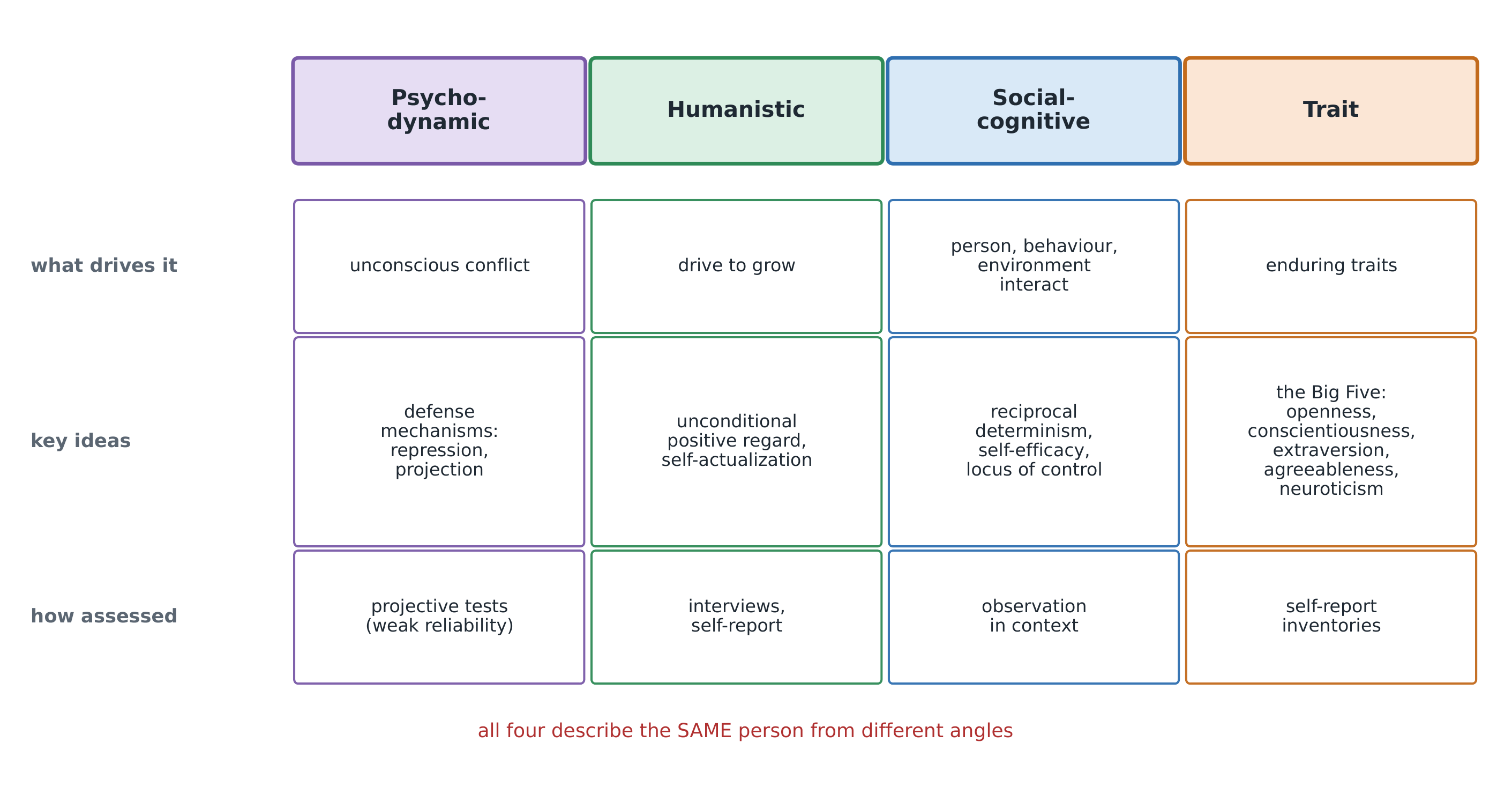
Personality 人格 is a person's characteristic pattern of thinking, feeling, and behaving. Four approaches are examinable.

The psychodynamic 精神动力学 approach holds that unconscious 无意识 processes drive personality. Ego defense mechanisms 自我防御机制 protect the person from anxiety, and the examinable set is denial 否认, displacement 转移, projection 投射, rationalization 合理化, reaction formation 反向形成, regression 退行, repression 压抑, and sublimation 升华. It assesses personality with projective tests 投射测验, which present an ambiguous stimulus; these have weak reliability and validity.

The humanistic 人本主义 approach focuses on growth. It emphasises unconditional positive regard 无条件积极关注 and self-actualization 自我实现 - becoming the fullest version of oneself.

한국어
네 가지 성격 접근법과 각각이 성격의 원동력과 평가 방법을 설명함
성격을 이해하는 네 가지 접근법: 각각 다른 원동력과 측정 방식을 가짐

성격은 개인의 고유한 사고, 감정, 행동 양식이다. examinable(시험 대상)되는 네 가지 접근법이 있다.

심리역동적 접근은 무의식 과정이 성격을 구동한다고 본다. 自我防衛機制는 불안을 보호하지만, 시험 대상인 것은 부정, 치환, 투사, 합리화, 반응 형성, 퇴행, 억압, 승화이다. 투사 검사로进行评估, 모호한 자극을 제시하며, 이들은 신뢰도와 타당도가 낮다.

인본주의적 접근은 성장을 강조한다. 무조건적 긍정적 존중과 자기 실현 - 자신의 가장 완전한 형태로 성장하는 것 - 에 초점을 맞춘다.

Vocabulary · ⁨어휘⁩ Train · ⁨연습하기⁩
English 한국어
Personality/ˌpɜːsəˈnælɪti/ 个性(Personality)
psychodynamic/ˌsaɪkəʊdaɪˈnæmɪk/ 심리동태적
unconscious/ʌnˈkɒnʃəs/ 무의식(unconscious)
Ego defense mechanisms/ˈiːɡəʊ dɪˈfens ˈmekənɪzəmz/ 에고 방어 기제
denial/dɪˈnaɪəl/ 부정
displacement/dɪˈspleɪsmənt/ 변위
projection/prəˈdʒekʃn/ 투영
rationalization/ˌræʃənəlaɪˈzeɪʃn/ 합리화(rationalization)
reaction formation/rɪˈækʃn fɔːˈmeɪʃn/ 반응 형성
regression/rɪˈɡreʃn/ 회귀분석
repression/rɪˈpreʃn/ 억압
sublimation/ˌsʌblɪˈmeɪʃn/ 승화
projective tests/prəˈdʒektɪv tests/ 투사 검사
humanistic/ˌhjuːməˈnɪstɪk/ 인본주의적
unconditional positive regard/ʌŋkənˈdɪʃənl ˈpɒzɪtɪv rɪˈɡɑːd/ 무조건적 긍정적 태도
self-actualization/self ˌæktʃuːəlaɪˈzeɪʃn/ 자기actualization(self-actualization)
social-cognitive/ˈsəʊʃl ˈkɒɡnɪtɪv/ 사회인지(social-cognitive)
reciprocal determinism/rɪˈsɪprəkl dɪˈtɜːmɪnɪzəm/ 상호 결정론
Self-efficacy/self ˈefɪkəsi/ 자기 효능감(Self-efficacy)
locus of control/ˈləʊkəs ɒv kənˈtrəʊl/ 통제원
internal/ɪnˈtɜːnl/ 내부적
external/ekˈstɜːnl/ 외부
Trait theories/treɪt ˈθɪəriz/ 特质 이론
Big Five/bɪɡ faɪv/ Big Five
openness to experience/ˈəʊpənnəs tʊ ekˈspɪərɪəns/ 경험에 대한 개방성
conscientiousness/ˌkɒnsɪˈenʃəsnəs/ 성실함
extraversion/ˌekstrəˈvɜːʃn/ 외향성
agreeableness/əˈɡriːəbəlnəs/ 친화성
neuroticism/njuːˈrɒtɪsɪzəm/ 신경증적 성향
Drive-reduction theory/draɪv rɪˈdʌkʃn ˈθɪəri/ 驱力 감소 이론
homeostasis/ˌhəʊmiːəˈstɑːsiz/ 홈오스타시스 (homeostasis)
Arousal theory/əˈraʊzl ˈθɪəri/ 흥분 이론
Yerkes-Dodson law/jɜːks ˈdɒdsn lɔː/ 예커스-도든 법칙(Yerkes-Dodson law)
Self-determination theory/self dɪˌtɜːmɪˈneɪʃn ˈθɪəri/ 자율성 이론
intrinsic motivation/ɪnˈtrɪnsɪk ˌməʊtɪˈveɪʃn/ 내재적 동기
extrinsic motivation/ekˈstrɪnsɪk ˌməʊtɪˈveɪʃn/ 외재적 동기
incentive theory/ɪnˈsentɪv ˈθɪəri/ 유인 이론(incentive theory)
Instincts/ˈɪnstɪŋkts/ 본능(Instincts)
Lewin's motivational conflicts/ˈluːɪnz ˌməʊtɪˈveɪʃənl ˈkɒnflɪkts/ 러빈의 동기 갈등(Lewin's motivational conflicts)
approach-approach/əˈprəʊtʃ əˈprəʊtʃ/ 접근-접근
approach-avoidance/əˈprəʊtʃ əˈvɔɪdəns/ 접근-회피
avoidance-avoidance/əˈvɔɪdəns əˈvɔɪdəns/ 회피-회피
Sensation-seeking theory/senˈseɪʃn ˈsiːkɪŋ ˈθɪəri/ 感觉寻求 이론
4.5

Personality: Social-Cognitive and Trait · ⁨성격: 사회인지적 및 특성론적⁩

Syllabus
English

Learning Objective 4.5.A: Explain how the social-cognitive theory of personality defines and assesses personality.

  • 4.5.A.1 According to social-cognitive theory, reciprocal determinism shapes personality. Reciprocal determinism explores self-concept (how one views themselves and in relation to others) and how self-efficacy and self-esteem both contribute to self-concept.

Learning Objective 4.5.B: Explain how trait theories of personality define and assess personality.

  • 4.5.B.1 Trait theories of personality conclude that personality involves a set of enduring characteristics that lead to typical responses to stimuli.
  • 4.5.B.2 The Big Five theory of personality proposes that traits of agreeableness, openness to experience, extraversion, conscientiousness, and emotional stability make up one’s personality. These traits are measured by specialized personality inventories that use factor analysis to organize item responses.
한국어

학습 목표 4.5.A: 사회인지적 성격 이론이 성격을 정의하고 평가하는 방법을 설명하시오.

  • 4.5.A.1 사회인지 이론에 따르면 상호 결정론이 성격을 형성한다. 상호 결정론은 자아개념(자신을 어떻게 보고 다른 사람과의 관계에서 보는지)을 탐구하며, 자기 효능감과 자존감이 모두 자아개념에 기여하는 방식을 다룬다.

학습 목표 4.5.B: 성향 이론이 성격을 정의하고 평가하는 방법을 설명하시오.

  • 4.5.B.1 성향 이론에 따르면 성격은 자극에 대한 일반적인 반응을 초래하는 일련의 지속 가능한 특성으로 구성된다.
  • 4.5.B.2 Big Five 성격 이론은 우호성, 경험에 대한 개방성, 외향성, 신중함, 정서적 안정성이 개인의 성격을 구성한다고 제안한다. 이러한 특성은 항목 응답을 요인 분석으로 조직화하는 전문 성격 검사로 측정된다.

Source: College Board AP Course and Exam Description · ⁨출처: College Board AP Course and Exam Description⁩

English

The social-cognitive 社会认知 approach explains personality through reciprocal determinism 交互决定论: the person, their behaviour, and the environment each influence the other two. Self-efficacy 自我效能感 - belief in one's own ability to succeed at a task - is central, as is locus of control 控制点, which is internal 内控 or external 外控.

Trait theories 特质理论 describe personality as enduring characteristics. The Big Five 大五人格 traits are openness to experience 开放性, conscientiousness 尽责性, extraversion 外向性, agreeableness 宜人性, and neuroticism 神经质. Traits are measured with self-report inventories, which are more reliable than projective tests.

한국어

사회인지적 접근은 상호 결정론으로 성격을 설명한다: 사람, 행동, 환경이 서로 영향을 미친다. 자아 효능감 - 어떤 과제를 성공시킬自己的能力에 대한 믿음 - 이 핵심이며, 통제원은 내재적이거나 외재적일 수 있다.

특성 이론은 성격을 지속되는 특성으로 서술합니다. 대오거론의 특성으로는 개방성, 성실함, 외향성, 조화, 신경성이 있습니다. 특성은 자기 보고 식 검사를 통해 측정되며, 이는 투사 검사보다 신뢰도가 높습니다.

4.6

Motivation · ⁨동기⁩

Syllabus
English

Learning Objective 4.6.A: Explain how theories about motivation apply to behavior and mental processes.

  • 4.6.A.1 Some theories about motivation focus on behavior and mental processes that seek to address physical needs and desires such as drive-reduction theory and arousal theory. Drive-reduction theory addresses how certain behaviors help maintain homeostasis while arousal theory addresses how people seek an optimal level of arousal when they behave (as demonstrated by the Yerkes-Dodson Law).
  • 4.6.A.2 Self-determination theory proposes that people are motivated by intrinsic (internal) or extrinsic (external) motivations. Incentive theory explores the role of rewards (an extrinsic motivation) in motivating behavior.
  • 4.6.A.3 Many non-human animals are motivated by instincts (innate, typically fixed patterns of behavior in animals in response to certain stimuli). Humans do not seem to demonstrate instinctual behavior or mental processes.
  • 4.6.A.4 Lewin’s motivational conflicts theory proposes that choices create conflicts one must resolve as the basis of motivation. The type of conflicts faced include approach-approach, approach-avoidance, and avoidance-avoidance.
  • 4.6.A.5 Sensation-seeking theory proposes that one’s level of need for varied or novel experiences is the basis of motivation. The types of sensation seeking are experience seeking, thrill or adventure seeking, disinhibition, and boredom susceptibility.

Learning Objective 4.6.B: Explain how eating and belongingness motivate behavior and mental processes.

  • 4.6.B.1 Eating is a complex motivated behavior that demonstrates how physical and mental processes interact.
    • 4.6.B.1.i Hormones, such as ghrelin and leptin (regulated by the hypothalamus via the pituitary gland), regulate feelings of hunger and satiety.
    • 4.6.B.1.ii External factors like the presence of food, time of day, or social gatherings around meals also influence the behavior of eating.
한국어

학습 목표 4.6.A: 동기 이론이 행동과 심리적 과정에 어떻게 적용되는지 설명하시오.

  • 4.6.A.1 일부 동기 이론은 생체적 필요와 욕구를 해결하려는 행동과 심리적 과정에 초점을 맞춘다. 이는 동기 감소 이론과 각성 이론이다. 동기 감소 이론은 특정 행동이 호메오스타시스 유지에 어떻게 도움이 되는지 다루며, 각성 이론은 사람이 행동할 때 최적 수준의 각성을 추구하는 방식(오크스-도드슨 법칙으로 증명됨)을 다룬다.
  • 4.6.A.2 자기결정 이론에 따르면 사람들은 내재적(내부) 또는 외재적(외부) 동기에 의해 움직인다. 보상 이론은 보상이(외재적 동기) 행동을 동기를 부여하는 데 어떤 역할을 하는지 탐구한다.
  • 4.6.A.3 많은 비인간 동물은 본능(특정 자극에 대한 동물의 일반적으로 고정된 행동 양식)에 의해 동기를 얻는다. 인간은 본능적 행동이나 심리적 과정을 나타내는 것으로 보이지 않는다.
  • 4.6.A.4 루윈의 동기 갈등 이론에 따르면 선택은 해결해야 할 갈등을 생성하며 이것이 동기의 기반이 된다. 직면하는 갈등의 유형에는 접근-접근, 접근-회피, 회피-회피가 포함된다.
  • 4.6.A.5 감각 탐색 이론에 따르면 다양한 혹은 새로운 경험에 대한 요구 수준이 동기의 기반이 된다. 감각 탐색의 유형으로는 경험 탐색, 스릴 또는 모험 탐구, 억제 해방, 지루함 민감도가 있다.

학습 목표 4.6.B: 식사와 소속감이 행동과 심리적 과정을 동기로 만드는 방법을 설명하시오.

  • 4.6.B.1 식사는 신체적 및 심리적 과정이 상호작용함을 보여주는 복잡한 동기를 가진 행동이다.
    • 4.6.B.1.i 그레린과 렙틴과 같은 호르몬(하看上脑하수체 축에 의해 조절됨)은 배고픔과 포만감을 조절한다.
    • 4.6.B.1.ii 음식의 존재, 시간대, 식사 주변 사교 모임과 같은 외부 요인 역시 식사 행동에 영향을 미친다.

Source: College Board AP Course and Exam Description · ⁨출처: College Board AP Course and Exam Description⁩

English

Several theories explain what drives behaviour:

  • Drive-reduction theory 驱力减少理论 says behaviour reduces a physical need to restore homeostasis 内稳态.
  • Arousal theory 唤醒理论 says people seek an optimal level of arousal; the Yerkes-Dodson law 耶克斯-多德森定律 states that moderate arousal gives the best performance on most tasks.
  • Self-determination theory 自我决定理论 separates intrinsic motivation 内在动机 (from within) from extrinsic motivation 外在动机 (from reward), and incentive theory 诱因理论 focuses on the pull of rewards.
  • Instincts 本能 are innate fixed patterns, seen in non-human animals rather than in human behaviour.
  • Lewin's motivational conflicts 勒温的动机冲突理论 names three: approach-approach 双趋冲突, approach-avoidance 趋避冲突, and avoidance-avoidance 双避冲突.
  • Sensation-seeking theory 感觉寻求理论 explains differences in the need for novelty.

Eating shows physical and mental processes interacting. Ghrelin and leptin, regulated by the hypothalamus, control hunger and fullness, while external factors - the sight of food, the time of day, a shared meal - change how much people eat.

한국어

여러 이론이 행동의 원인을 설명합니다:

  • 구동 감소 이론은 행동이 물리적 필요를 줄여 **안정 상태(호메오스타시스)**를 회복한다고 봅니다.
  • 각성 이론은 사람들이 최적의 각성 수준을 추구한다고 보며, 오펌스-도든 법칙에 따르면 대부분의 과업에서 적절한 수준의 각성이 가장 좋은 성능을 내게 합니다.
  • 자율성 이론은 내재적 동기(내부에서 비롯)와 외재적 동기(보상에서 비롯)를 구분하며, 유인 이론은 보상의 끌림에 초점을 맞춥니다.
  • 본능은 선천적으로 고정된 패턴으로, 인간 행동보다는 비인간 동물에게서 더 잘 관찰됩니다.
  • 루윈의 동기 간섭에는 세 가지 유형이 있습니다: 추입-추입, 추입-회피, 회피-회피.
  • 감각 탐구 이론은 신비로움에 대한 욕구의 차이를 설명합니다.

식사는 신체 및 정신 과정의 상호작용을 보여줍니다. 하체시하에서 조절되는 그hrelin과 렙틴이 배고픔과 포만감을 통제하지만, 외부 요인—음식의 시각, 시간대, 식사 동반자 등—은人们在吃的量을 변화시킵니다.

4.7

Emotion · ⁨감정⁩

Syllabus
English

Learning Objective 4.7.A: Explain how theories of emotion apply to behavior and mental processes.

  • 4.7.A.1 Emotion, or affect, is a complex psychological process that is distinguished from reasoning or knowledge. Emotions reflect internal and external factors affecting an individual. Early 20th century psychological theories of emotion parsed the distinction between the physiological and cognitive experiences of emotion. Some theories proposed that the physiological and cognitive experiences occurred in succession while others proposed that they occurred simultaneously. Other theories emphasize that the cognitive label is required to experience an emotion. The facial-feedback hypothesis suggests that the experience of emotion is influenced by facial expressions, which supports theories that propose the physiological experience of emotion precedes the cognitive appraisal, and research testing this hypothesis has produced mixed results.
    • Exclusion Statement: Specific names of theories of emotion are outside the scope of the AP Psychology Exam.
  • 4.7.A.2 The broaden-and-build theory of emotion proposes that positive emotional experiences tend to broaden awareness and encourage new actions and thoughts. Negative emotions tend to reduce awareness and narrow thinking and action.

Learning Objective 4.7.B: Explain how social norms and experiences influence the expression of emotions.

  • 4.7.B.1 Research has explored whether the expression of emotions is universally common. Some emotions that may be commonly experienced across cultures include anger, disgust, sadness, happiness, surprise, and fear. Research on the universality of emotions shows mixed results.
  • 4.7.B.2 Display rules and elicitors for emotional expression can differ among cultures. Display rules and elicitors may regulate how people from different genders, ages, or socioeconomic classes within a culture can display and interpret emotions.
한국어

학습 목표 4.7.A: 감정 이론이 행동과 심리적 과정에 어떻게 적용되는지 설명하시오.

  • 4.7.A.1 감정(또는 정서)은 추리나 지식과 구분되는 복잡한 심리적 과정이며, 개인에게 영향을 미치는 내부 및 외부 요인을 반영한다. 20세기 초기 감정 이론들은 감정의 생리적 및 인지적 경험 간의 차이를 구분했다. 일부 이론은 생리적 및 인지적 경험이 연속적으로 발생한다고 제안한 반면, 다른 이론들은 동시에 발생한다고 제안했다. 또 다른 이론들은 감정을_objects_하기 위해서는 인지적 레이블이 필요하다고 강조한다. 얼굴 피드백 가설은 감정의 경험이 얼굴 표정에 의해 영향을 받음을 시사하여, 감정의 생리적 경험이 인지적 평가보다 먼저 발생한다는 이론을 지지하며, 이 가설을 검증한 연구는mixed results를produced.
    • 배제 문구: 특정 감정 이론의 명칭은 AP 심리학 시험의 범위를 벗어납니다.
  • 4.7.A.2 확장과 구축 감정 이론(broaden-and-build theory)에 따르면 긍정적인 감정 경험은 인식의 범위를 넓히고 새로운 행동 및 사고를 촉진하는 경향이 있습니다. 반면 부정적인 감정은 인식을 축소하고 사고와 행동을 협소하게 만드는 경향이 있습니다.

학습 목표 4.7.B: 사회적 규범과 경험이 감정의 표현에 미치는 영향을 설명하시오.

  • 4.7.B.1 감정 표현이 보편적으로 존재하는지에 대한 연구가 이루어졌습니다. 일부 문화권에서 공통적으로 경험될 수 있는 감정으로는 분노, 혐오, 슬픔, 행복, 놀람, 공포 등이 있습니다. 그러나 감정 보편성에 관한 연구 결과는 일관적이지 않습니다.
  • 4.7.B.2 감정 표현의 표시 규칙(display rules)과 유발 요인은 문화에 따라 다를 수 있습니다. 이러한 표시 규칙과 유발 요인은 한 문화권 내에서도 성별, 연령, 사회경제적 계층에 따라 사람들이 감정을 어떻게 표현하고 해석하는지를 조절할 수 있습니다.

Source: College Board AP Course and Exam Description · ⁨출처: College Board AP Course and Exam Description⁩

English

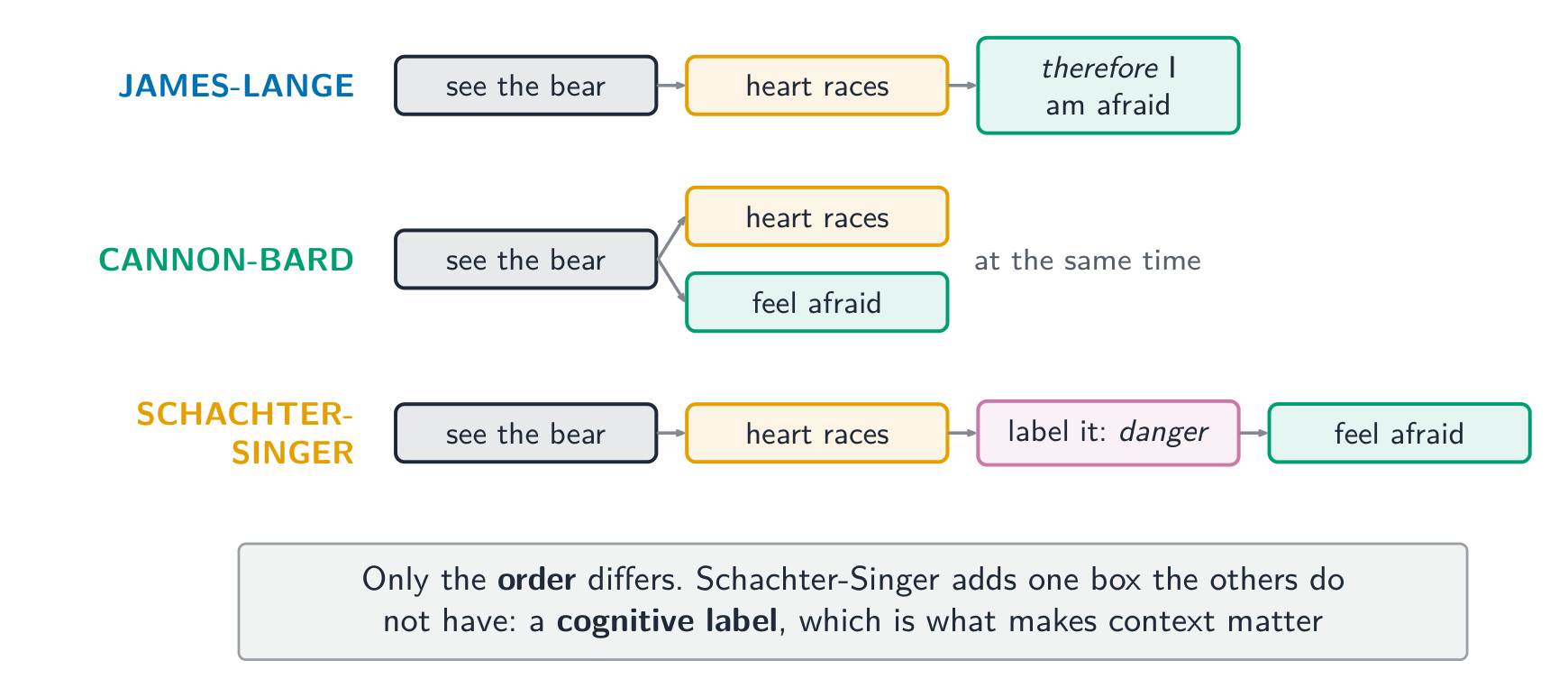
Emotion 情绪, also called affect 情感, combines physical arousal, expressive behaviour, and conscious experience. Examinable theories are the James-Lange theory 詹姆斯-兰格理论 (the body responds first, and emotion is the reading of that response), the Cannon-Bard theory 坎农-巴德理论 (arousal and emotion occur at once), and the Schachter-Singer two-factor theory 沙赫特-辛格两因素理论 (arousal plus a cognitive label 认知标签). Broaden-and-build theory 拓展-建构理论 proposes that positive emotions widen thinking and build lasting resources.

Some facial expressions are recognised across cultures, but display rules 表达规则 - a culture's norms for showing emotion - and the events that trigger emotion both vary.

한국어

감정( affect) 은 신체 각성, 표현적 행동, 의식적 경험을 결합한 것입니다. 시험에 나올 수 있는 이론으로는 제임스-랑게 이론(身体가 먼저 반응하고 감정은 그 반응을 해석하는 것), 캐논-바드 이론(각성과 감정이 동시에 발생), 슈차터-싱어 2요인 이론(각성에 인지적 레이블이 추가됨)이 있으며, 확장 및 구축 이론은 긍정적인 감정이 사고를 확장하고 장기적인 자원을 구축한다고 제안합니다.

일부 표정 문화를 넘어 인식되지만, 표현 규칙—감정을 드러내는 문화적 규범—과 감정을 유발하는 사건 모두 변할 수 있습니다.

세 가지 이론, 동일한 세 사건의 세 가지 순서
Explore · ⁨탐색하기⁩

Order the three events for each theory · ⁨각 이론에 대한 세 사건 순서 정하기⁩

The three theories are three orderings of the same three events — and only Schachter-Singer adds a cognitive label. · ⁨세 이론은 동일한 세 사건의 세 가지 순서이며, 슈라터-싱어 이론만이 인지적 레이블을 추가합니다.⁩

Vocabulary · ⁨어휘⁩ Train · ⁨연습하기⁩
English 한국어
Emotion/ɪˈməʊʃn/ 감정
affect/əˈfekt/ 영향(affect)
James-Lange theory/dʒeɪmz lændʒ ˈθɪəri/ 제임스-랑제 이론(James-Lange theory)
Cannon-Bard theory/ˈkænən bɑːd ˈθɪəri/ 캐논-바드 이론(Cannon-Bard theory)
Schachter-Singer two-factor theory/ˈʃætʃtə ˈsɪŋə tuː ˈfæktə ˈθɪəri/ 샤흐터-싱어 2요인 이론(Schachter-Singer two-factor theory)
cognitive label/ˈkɒɡnɪtɪv ˈleɪbl/ 인지 라벨
Broaden-and-build theory/ˈbrɔːdn ænd bɪld ˈθɪəri/ 확장 및 구축 이론(Broaden-and-build theory)
display rules/dɪˈspleɪ ruːlz/ 표현 규칙(display rules)
4.7

Exam tips · ⁨시험 팁⁩

English
  • Fundamental attribution error applies to explaining others. If the question is about explaining yourself, the answer is usually self-serving bias.
  • Social facilitation improves simple tasks and harms difficult ones. Say which kind of task the scenario describes.
  • Separate conformity (matching a group) from obedience (following an authority).
  • For cognitive dissonance, name the conflict and say which side changed - usually the attitude, because the behaviour already happened.
  • Learn the Big Five as a set; questions often ask you to place a described person on one named trait.
  • With emotion theories, the difference is order: body first (James-Lange), together (Cannon-Bard), or arousal plus label (two-factor).
한국어
  • 기본 attribution 오류는 타인을 설명할 때 적용됩니다. 만약 질문이 나自身을 설명하는 것이라면, 답은 보통 자기 편향입니다.
  • 사회적 증강은 단순한 과업을 향상시키고 어려운 과업은 해칩니다. 시나리오가 어떤 종류의 과업을 설명하는지 말하세요.
  • 동조 (집단에 따름)와 복종 (권위에 순응함)을 구분할 수 있어야 합니다.
  • 인지 부조화에서는 갈등을 언급하고 어느 쪽이 변경되었는지 말해야 합니다—보통 행동이 이미 일어났으므로 태도가 변경됩니다.
  • 대오거론을 한 묶음으로 기억하세요;问题是描述的一个人放在一个命名的特质上。
  • 감정 이론에서는 차이는 순서입니다: 몸이 먼저(제임스-랑게), 동시에(캐논-바드), 또는 각성에 레이블이 추가됨(2요인).

Interactive lessons on this topic · ⁨이 주제에 대한 인터랙티브 수업⁩

Work through it step by step, with instant-check exercises. · ⁨즉시 체크 기능 exercises를 통해 단계별로 진행하세요.⁩

Past Papers · ⁨과거 시험지⁩

More topics in AP Psychology · ⁨AP 심리학⁩ · ⁨AP Psychology · ⁨AP 심리학⁩ 내 추가 주제⁩

Log in or create account · ⁨로그인 또는 계정 만들기⁩

IGCSE, A-Level & AP