Skip to content · ⁨본문 바로가기⁩
Subjects · ⁨과목⁩

AP Psychology · ⁨AP 심리학⁩

Tips · ⁨팁⁩

AP Psychology covers five units: the biological bases of behaviour, cognition, development and learning, social psychology and personality, and mental and physical health. Together they move from the neuron outwards to the person, the group and the clinic.

Definitions are precise here, and the precision is examinable. Sensation is not perception; negative reinforcement is not punishment; correlation is not causation. Most lost marks come from terms used loosely rather than from material never studied.

Every unit is also a research-methods unit. You are expected to identify the design a study used, read data and graphs, and say what a result does and does not support - so the science practices are assessed alongside the content.

Apply concepts to scenarios. Questions typically describe a situation and ask which concept explains it, which is a different task from reciting the definition.

The framework marks its own boundaries. Exclusion statements say explicitly what is outside the exam's scope; they are kept in the notes below so you can see where to stop.

The notes follow the College Board framework topic by topic, with the essential knowledge behind each learning objective.

  • 1

    Biological Bases of Behavior · ⁨행위의 생물학적 기반⁩

    Watch lesson · ⁨수업 보기⁩
    1.1

    Nature and Nurture

    Syllabus
    English

    Learning Objective 1.1.A: Explain the relationship between heredity and environment in shaping behavior and mental processes.

    • 1.1.A.1 Heredity and environmental factors interact to shape behavior and mental processes.
      • 1.1.A.1.i Heredity, or “nature,” refers to genetic or predisposed characteristics that influence physical, behavioral, and mental traits and processes.
      • 1.1.A.1.ii Environmental factors, or “nurture,” refers to the external factors that one experiences, such as family interactions or education.
        • Exclusion Statement: Specific information about genetics (genotype, phenotype, DNA, chromosomes, and recessive and dominant gene expression) is beyond the scope of the AP Psychology Exam.
    • 1.1.A.2 The evolutionary perspective explores how natural selection affects the expression of behavior and mental processes to increase survival and reproductive success. Some theorists have sought to apply principles of the evolutionary perspective in ways that discriminate against others (eugenics).
    • 1.1.A.3 Research on the effects of genes on individual behavior and mental processes is often conducted using twin studies, family studies, and adoption studies.
    한국어

    학습 목표 1.1.A: 행동과 심리적 과정 형성에 있어 유전과 환경 간의 관계를 설명한다.

    • 1.1.A.1 유전과 환경 요인은 행동과 심리적 과정을 형성하기 위해 상호작용한다.
      • 1.1.A.1.i 유전, 즉 '천성'은 신체적, 행동적 및 심리적 특성과 과정에 영향을 미치는 유전적 또는 predisposed 성질을 의미한다.
      • 1.1.A.1.ii 환경 요인, 즉 '양육'은 가족 간 상호작용이나 교육과 같이 개인이 경험하는 외부 요인을 의미한다.
        • 제외 문구: 유전자(유전자형, 유전자형, DNA, 염색체, 우성 및 열성 유전자 발현)에 대한 구체적인 정보는 AP 심리학 시험 범위를 벗어난다.
    • 1.1.A.2 진화적 관점은 자연 선택이 생존과 번식 성공을 높이기 위해 행동과 심리적 과정의 발현에 어떻게 영향을 미치는지 탐구한다. 일부 이론가들은 진화적 관점의 원리를 다른 사람을 차별하는 방식(우생학)에 적용하려 시도했다.
    • 1.1.A.3 유전이 개인 행동과 심리적 과정에 미치는 영향에 대한 연구는 주로 쌍둥이 연구, 가족 연구, 입양 연구를 통해 수행된다.
    Source: College Board AP Course and Exam Description · ⁨출처: College Board AP Course and Exam Description⁩

    Psychology studies behavior 行为 (what a person does) and mental processes 心理过程 (what a person thinks and feels). Unit 1 asks where these come from in the body.

    Every trait grows from two sources working together. Heredity 遗传 is what a person inherits from their parents. Environment 环境 is everything that happens around them. Neither one acts alone.

    • Nature and nurture 先天与后天 always interact. Height is inherited, but poor nutrition lowers it.
    • The evolutionary perspective 进化论视角 explains behavior that helped ancestors survive and reproduce. Fear of snakes is easy to learn because it once kept people alive.
    • Twin and adoption studies 双生子与收养研究 separate the two sources. If identical twins raised apart are still similar, heredity matters for that trait.

    Note: the exam does not ask about genes, DNA, or chromosomes. It asks how heredity and environment together shape behavior.

    Vocabulary · ⁨어휘⁩ Train · ⁨연습하기⁩
    English 한국어
    behavior/bɪˈheɪvjə/ 동태/성격(behavior)
    mental processes/ˈmentl ˈprəʊsesɪz/ 인지 과정
    Heredity/həˈredɪti/ 유전
    Environment/enˈvaɪrənmənt/ 환경
    Nature and nurture/ˈneɪtʃə ænd ˈnɜːtʃə/ 천성 및 양육 환경
    evolutionary perspective/ɪvəˈluːʃənəri pəˈspektɪv/ 진화적 관점
    Twin and adoption studies/twɪn ænd əˈdɒpʃn ˈstʌdiz/ 쌍둥이 및 입양 연구
    Watch lesson · ⁨수업 보기⁩
    1.2

    The Nervous System

    Syllabus
    English

    Learning Objective 1.2.A: Differentiate among the subsystems of the human nervous system and their functions.

    • 1.2.A.1 The central nervous system includes the brain and the spinal cord and interacts with all processes in the body.
    • 1.2.A.2 The peripheral nervous system relays messages from the central nervous system to the rest of the body and includes the autonomic and somatic nervous systems.
      • 1.2.A.2.i The autonomic nervous system governs processes that are involuntary and includes the parasympathetic and sympathetic nervous systems.
      • 1.2.A.2.ii The somatic nervous system governs processes that are voluntary.
    한국어

    학습 목표 1.2.A: 인간 신경계의 하위 시스템과 그들의 기능을 구분한다.

    • 1.2.A.1 중추신경계는 뇌와 척수를 포함하며 신체의 모든 과정과 상호작용한다.
    • 1.2.A.2 말초신경계는 중추신경계로부터 메시지를 전달하여 신체의 나머지 부분으로 보내며, 자동신경계와 체성신경계를 포함한다.
      • 1.2.A.2.i 자동신경계는 의식이 개입하지 않는 과정을 통제하며, 교감신경계와 부교감신경계를 포함한다.
      • 1.2.A.2.ii 체성신경계는 의식이 개입하는 과정을 통제한다.

    Source: College Board AP Course and Exam Description · ⁨출처: College Board AP Course and Exam Description⁩

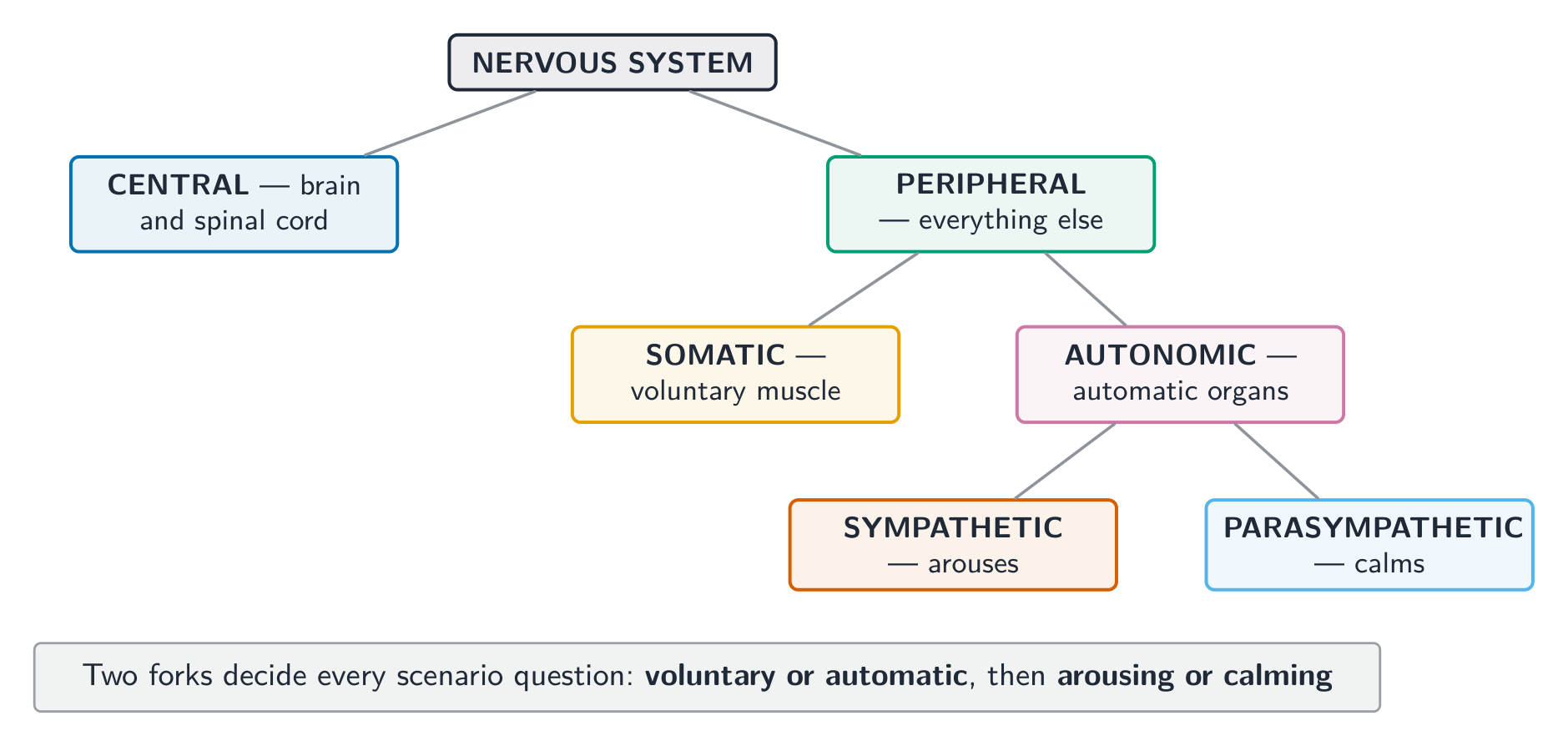
    The nervous system 神经系统 carries information around the body. It has two main parts.

    The central nervous system (CNS) 中枢神经系统 is the brain and the spinal cord 脊髓. It interacts with every process in the body.

    The peripheral nervous system (PNS) 周围神经系统 relays messages between the CNS and the rest of the body. It divides again:

    • The somatic nervous system 躯体神经系统 controls voluntary 随意的 movement, such as raising your hand.
    • The autonomic nervous system 自主神经系统 controls involuntary 不随意的 processes, such as heartbeat and digestion. It has two branches that work against each other: the sympathetic nervous system 交感神经系统 prepares the body for action (the "fight or flight" response), and the parasympathetic nervous system 副交感神经系统 calms the body down afterwards.
    Two forks decide every scenario question: voluntary or automatic, then arousing or calming
    Explore · ⁨탐색하기⁩

    Place each function on the nervous-system tree · ⁨각 함수를 신경계 계통도에 배치하기⁩

    Two forks decide every scenario question: voluntary or automatic, then arousing or calming. · ⁨모든 시나리오 질문에는 두 가지 분기점이 있습니다: 의지적(voluntary)인지 자동(automatic)인지, 그리고 각성(arousing)인지 진정(calming)인지입니다.⁩

    Vocabulary · ⁨어휘⁩ Train · ⁨연습하기⁩
    English 한국어
    nervous system/ˈnɜːvəs ˈsɪstəm/ 신경계
    central nervous system (CNS)/ˈsentrəl ˈnɜːvəs ˈsɪstəm/ 중추 신경계 (CNS)
    spinal cord/ˈspaɪnl kɔːd/ 척수
    peripheral nervous system (PNS)/pəˈrɪfərəl ˈnɜːvəs ˈsɪstəm/ 말초 신경계 (PNS)
    somatic nervous system/səˈmætɪk ˈnɜːvəs ˈsɪstəm/ 체성신경계
    voluntary/ˈvɒləntəri/ 의지적(자발적)
    autonomic nervous system/ɔːtəˈnɒmɪk ˈnɜːvəs ˈsɪstəm/ 자율 신경계
    involuntary/ɪnˈvɒləntəri/ 자발적이지 않음
    sympathetic nervous system/ˌsɪmpəˈθetɪk ˈnɜːvəs ˈsɪstəm/ 교감신경계
    parasympathetic nervous system/ˌpærəˌsɪmpəˈθetɪk ˈnɜːvəs ˈsɪstəm/ 부교감신경계
    1.3

    Neurons and How They Fire

    Syllabus
    English

    Learning Objective 1.3.A: Explain how the structures and functions of typical neurons in the central nervous system affect behavior and mental processes.

    • 1.3.A.1 Two common types of neural cells in the brain are neurons (neural cells that transmit information) and glial cells (cells that provide structure, insulation, communication, and waste transport). These types of cells form the basis of the nervous system and are the building blocks of all behavior and mental processes.
    • 1.3.A.2 In the spinal cord, the reflex arc demonstrates how neurons within the central and peripheral nervous systems work together to respond to stimuli. Three types of neurons work together in the spinal cord to create a reflex arc: sensory neurons, motor neurons, and interneurons.

    Learning Objective 1.3.B: Explain how the basic process of neural transmission is related to behavior and mental processes.

    • 1.3.B.1 The process of neural transmission most commonly occurs in an orderly, systematic way and involves the all-or-none principle, depolarization, refractory period, resting potential, reuptake, and threshold. Disruptions to this process could lead to disorders such as multiple sclerosis or myasthenia gravis.
      • Exclusion Statement: The sodium-potassium pump is outside the scope of the AP Psychology Exam.
    • 1.3.B.2 Each neurotransmitter has specific function(s) related to behavior and mental processes, which may depend on the neurotransmitter’s location in the nervous system. Neurotransmitters generally communicate either excitatory (making an action potential more likely) or inhibitory (making an action potential less likely) messages. Neurotransmitters related to behavior and mental processes for study in AP Psychology are limited to dopamine, serotonin, norepinephrine, glutamate, GABA, endorphins, substance p, and acetylcholine.
      • Exclusion Statement: The AP Psychology Exam will only address the listed neurotransmitters in EK 1.3.B.2.
    • 1.3.B.3 Outside of the nervous system, hormones perform actions similar to neurotransmitters. Hormones related to behavior and mental processes for study in AP Psychology are limited to adrenaline, leptin, ghrelin, melatonin, and oxytocin.
      • Exclusion Statement: The AP Psychology Exam will only address the listed hormones in EK 1.3.B.3.
      • Exclusion Statement: Specific information about the glands of the endocrine system (with the exception of the pituitary gland as referenced in EK 1.4.A.4) is outside the scope of the AP Psychology Exam.

    Learning Objective 1.3.C: Explain how psychoactive drugs affect behavior and mental processes.

    • 1.3.C.1 Psychoactive drugs can influence neurotransmitter function in various ways throughout the neural communication process. Some act as agonists which encourage neural firing. Some act as antagonists which discourage neural firing. Some act as reuptake inhibitors which block the reabsorption of neurotransmitters back into the cell.
    • 1.3.C.2 Psychoactive drugs have psychological and physiological effects.
      • 1.3.C.2.i Stimulants, such as caffeine and cocaine, typically cause increased neural activity.
      • 1.3.C.2.ii Depressants, such as alcohol, typically cause decreased neural activity.
      • 1.3.C.2.iii Hallucinogens, such as marijuana, typically cause distortions in perception and/or cognition.
      • 1.3.C.2.iv Opioids, such as heroin, typically act as pain relievers.
    • 1.3.C.3 Psychoactive drug use can lead to tolerance and/or addiction. Addiction can create significant withdrawal symptoms if the psychoactive drugs are no longer consumed.
    한국어

    학습 목표 1.3.A: 중추신경계의 일반적인 뉴런의 구조와 기능이 행동과 심리적 과정에 미치는 영향을 설명한다.

    • 1.3.A.1 뇌에서 가장 흔한 두 종류의 신경 세포는 뉴런(정보를 전달하는 신경 세포)과 글리아 세포(구조, 절연, 소통, 폐물 운반을 제공하는 세포)이다. 이러한 세포 유형들은 신경계의 기초를 이루며 모든 행동과 심리적 과정의 구성 요소이다.
    • 1.3.A.2 척수에서 반사 호환은 중추신경계와 말초신경계의 뉴런들이 자극에 반응하기 위해 어떻게 협력하는지를 보여준다. 세 가지 유형의 뉴런이 척수에서 협력하여 반사 호환을 형성한다: 감각 뉴런, 운동 뉴런, 및 중재 뉴런.

    학습 목표 1.3.B: 신경 전달의 기본 과정이 행동과 심리적 과정과 어떻게 관련되는지 설명한다.

    • 1.3.B.1 신경 전달 과정은 일반적으로 질서 있고 체계적으로 발생하며, 올-오어-노 principle, 탈분극, 불응기, 정지 전위, 재흡수, 임계값을 포함한다. 이 과정의 장애는 다발성 경화증이나 근무력증과 같은 질환을 초래할 수 있다.
      • 제외 문구: 나트륨-칼륨 펌프는 AP 심리학 시험 범위를 벗어난다.
    • 1.3.B.2 각 신경전달물질은 행동과 심리적 과정과 관련된 특정 기능(들)을 가지며, 이는 신경전달물질이 신경계 내 위치에 따라 달라질 수 있다. 신경전달물질은 generally 흥奋성(작동 전위 발생 가능성을 높임) 또는 억제성(작동 전위 발생 가능성을 낮춤) 메시지를 전달한다. AP 심리학에서 공부할 행동과 심리적 과정과 관련된神经전달물질은 도파민, 세로토닌, 노르에피네프린, 글루타메이트, GABA, 엔도르핀, substance p, 아세틸콜린에 한정된다.
      • 제외 문구: AP 심리학 시험은 EK 1.3.B.2에 나열된神经전달물질만 다룬다.
    • 1.3.B.3 신경계 외부에서는 호르몬이神经전달물질과 유사한 작용을 한다. AP 심리학에서 공부할 행동과 심리적 과정과 관련된 호르몬은 아드레날린, 레프틴, 그레린, 멜라토닌, 옥시토신에 한정된다.
      • 제외 문구: AP 심리학 시험은 EK 1.3.B.3에 나열된 호르몬만 다룬다.
      • 제외 문구: 내분비선(EK 1.4.A.4에서 언급된 생체하수체를 제외하고)에 대한 구체적인 정보는 AP 심리학 시험 범위를 벗어난다.

    학습 목표 1.3.C: 심리활성 물질이 행동 및 정신 과정에 미치는 영향을 설명한다.

    • 1.3.C.1 심리활성 물질은 신경 전달 과정에서 다양한 방식으로 신경전달물질 기능에 영향을 미칠 수 있다. 일부는 신경 발화를 촉진하는 작용제(agonist)로 작용하며, 일부는 신경 발화를 억제하는拮抗제(antagonist)로 작용하고, 일부는 신경전달물질의 재흡수를 차단하는 재흡수 억제제(reuptake inhibitor)로 작용한다.
    • 1.3.C.2 심리활성 물질에는 심리적 효과와 생리학적 효과가 있다.
      • 1.3.C.2.i 카페인과 코카인 같은 자극제는 일반적으로 신경 활동 증가를 유발한다.
      • 1.3.C.2.ii 알코올 같은 진정제는 일반적으로 신경 활동 감소를 유발한다.
      • 1.3.C.2.iii 마취제(hallucinogen), 예를 들어 대마초(marijuana)는 일반적으로 지각 또는 인지(또는 둘 다)의 왜곡을 유발한다.
      • 1.3.C.2.iv 오피오이드, 예를 들어 헤로인(heroin)은 일반적으로 진통제로 작용한다.
    • 1.3.C.3 심리활성 물질 사용은 내성(tolerance) 및/또는 중독(addiction)으로 이어질 수 있다. 심리활성 물질을 더 이상 섭취하지 않을 때 중독은 심각한 금단 증상을 초래할 수 있다.

    Source: College Board AP Course and Exam Description · ⁨출처: College Board AP Course and Exam Description⁩

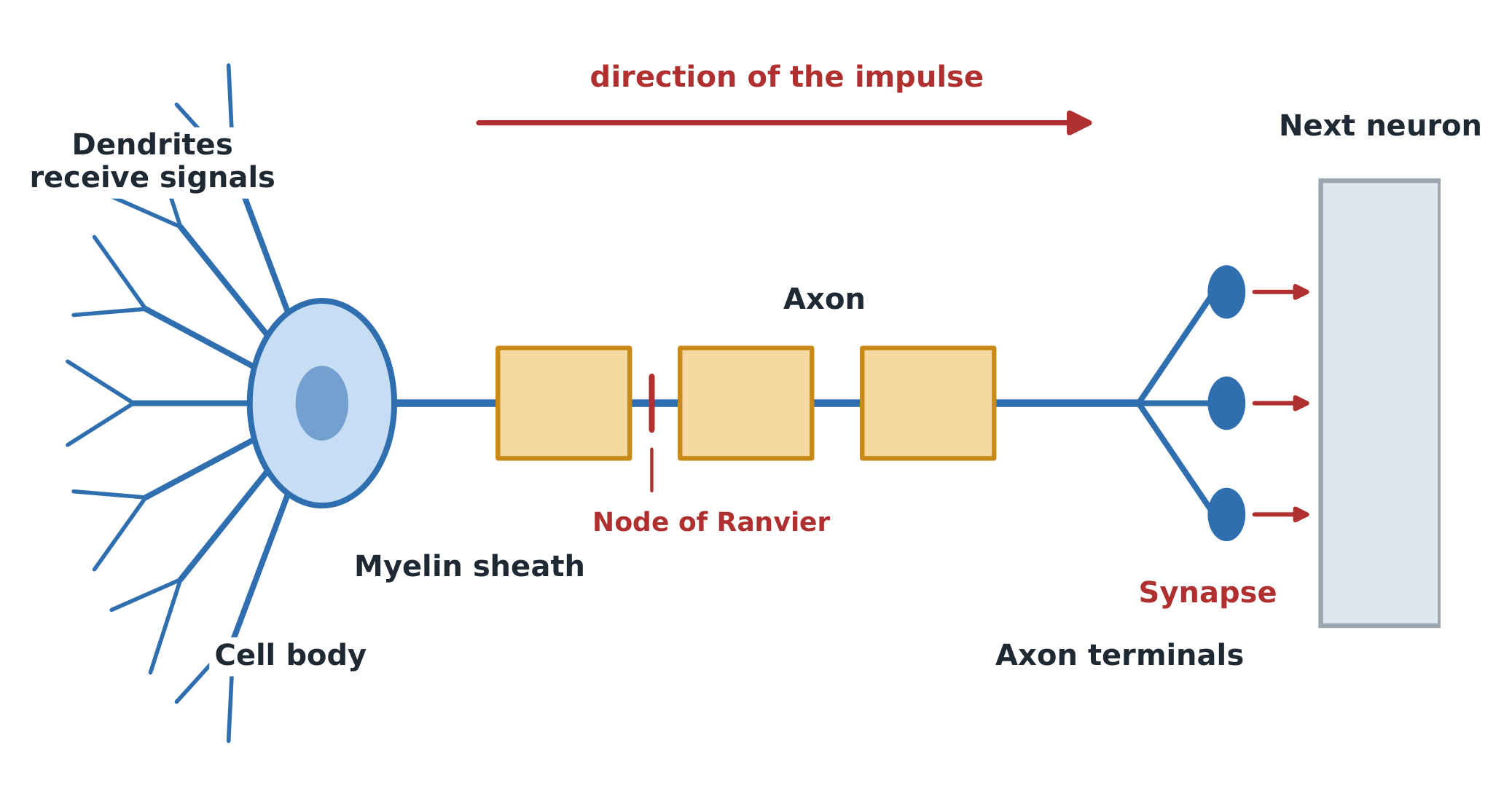
    Labelled diagram of a neuron: dendrites receive signals, the cell body integrates them, and the axon carries the impulse to the terminals
    A neuron receives at the dendrites, fires along the axon, and passes the message across the synapse

    Two kinds of cell do the work. Neurons 神经元 transmit information. Glial cells 神经胶质细胞 provide structure, insulation, communication, and waste transport. Together they are the building blocks of all behavior and mental processes.

    A neuron has dendrites 树突 that receive signals, a cell body 细胞体, and an axon 轴突 that carries the signal away. Many axons are wrapped in a myelin sheath 髓鞘, which speeds the signal up.

    Neural transmission follows a set order:

    • At rest the neuron holds a resting potential 静息电位, ready but not firing.
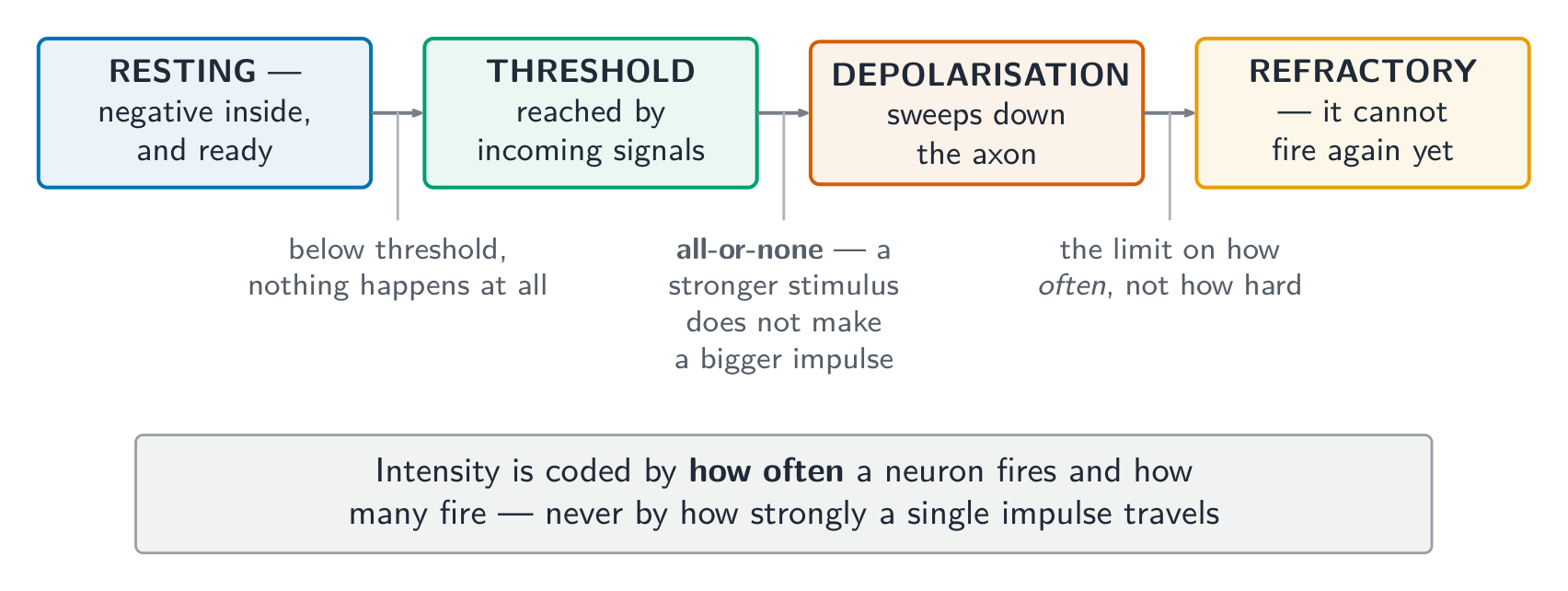
    • If incoming signals pass the threshold 阈限, the neuron depolarizes 去极化 and fires.
    • Firing follows the all-or-none principle 全或无原则: the neuron fires at full strength or not at all. A stronger stimulus makes it fire more often, not harder.
    • Straight after firing there is a refractory period 不应期 when the neuron cannot fire again.
    • At the synapse 突触, the gap between neurons, chemicals cross to the next cell. Leftover chemicals are taken back in a process called reuptake 再摄取.

    Damage to this process can cause disorders such as multiple sclerosis 多发性硬化 or myasthenia gravis 重症肌无力.

    In the spinal cord, the reflex arc 反射弧 shows the system working as a unit. Sensory neurons 感觉神经元 carry information in, interneurons 中间神经元 connect inside the cord, and motor neurons 运动神经元 carry the command out - all before the brain is involved.

    Intensity is coded by how often a neuron fires, never by how strongly one impulse travels
    Explore · ⁨탐색하기⁩

    Fire a neuron, step by step · ⁨신경세포를 단계별로 발사시키십시오⁩

    All-or-none: a stronger stimulus does not make a bigger impulse. Intensity is coded by how often, and by how many. · ⁨전 atau none(All-or-none): 더 강한 자극이 더 큰 신호를 만드는 것은 아닙니다. 강도는 발생 빈도와 관련된神经元 수로 코드됩니다.⁩

    Vocabulary · ⁨어휘⁩ Train · ⁨연습하기⁩
    English 한국어
    Neurons/ˈnjuːrɒnz/ 신경세포
    Glial cells/ˈɡlaɪəl selz/ 글리아 세포
    dendrites/ˈdendraɪts/ 가지 돌기
    cell body/sel ˈbɒdi/ 세포체
    axon/ˈæksɒn/ 축삭(신경섬유)
    myelin sheath/ˈmaɪɪlɪn ʃiːθ/ 미yel인 피막
    resting potential/ˈrestɪŋ pəˈtenʃl/ 정전 전위
    threshold/ˈθreʃəʊld/ 임계점(threshold)
    depolarizes/diːˈpəʊlɑːraɪzɪz/ 분극화
    all-or-none principle/ɔːl ɔː nɒn ˈprɪnsɪpl/ 전이나 무의 원리
    refractory period/rɪˈfræktəri ˈpɪərɪəd/ 불응기
    synapse/ˈsɪnæps/ 시냅스
    reuptake/ˈruːpteɪk/ 재흡수
    multiple sclerosis/ˈmʌltɪpl skləˈrəʊsɪs/ 다발성 경화증
    myasthenia gravis/ˌmaɪəsˈθiːnɪə ˈɡrævɪs/ 중증근無力증
    reflex arc/ˈriːfleks ɑːk/ 반사 아크
    Sensory neurons/ˈsensəri ˈnjuːrɒnz/ 감각 신경세포
    interneurons/ˌɪntəˈnjuːrɒnz/ 연결신경세포
    motor neurons/ˈməʊtə ˈnjuːrɒnz/ 운동 신경세포
    Watch lesson · ⁨수업 보기⁩
    1.3

    Neurotransmitters, Hormones, and Drugs

    Syllabus
    English

    Learning Objective 1.3.A: Explain how the structures and functions of typical neurons in the central nervous system affect behavior and mental processes.

    • 1.3.A.1 Two common types of neural cells in the brain are neurons (neural cells that transmit information) and glial cells (cells that provide structure, insulation, communication, and waste transport). These types of cells form the basis of the nervous system and are the building blocks of all behavior and mental processes.
    • 1.3.A.2 In the spinal cord, the reflex arc demonstrates how neurons within the central and peripheral nervous systems work together to respond to stimuli. Three types of neurons work together in the spinal cord to create a reflex arc: sensory neurons, motor neurons, and interneurons.

    Learning Objective 1.3.B: Explain how the basic process of neural transmission is related to behavior and mental processes.

    • 1.3.B.1 The process of neural transmission most commonly occurs in an orderly, systematic way and involves the all-or-none principle, depolarization, refractory period, resting potential, reuptake, and threshold. Disruptions to this process could lead to disorders such as multiple sclerosis or myasthenia gravis.
      • Exclusion Statement: The sodium-potassium pump is outside the scope of the AP Psychology Exam.
    • 1.3.B.2 Each neurotransmitter has specific function(s) related to behavior and mental processes, which may depend on the neurotransmitter’s location in the nervous system. Neurotransmitters generally communicate either excitatory (making an action potential more likely) or inhibitory (making an action potential less likely) messages. Neurotransmitters related to behavior and mental processes for study in AP Psychology are limited to dopamine, serotonin, norepinephrine, glutamate, GABA, endorphins, substance p, and acetylcholine.
      • Exclusion Statement: The AP Psychology Exam will only address the listed neurotransmitters in EK 1.3.B.2.
    • 1.3.B.3 Outside of the nervous system, hormones perform actions similar to neurotransmitters. Hormones related to behavior and mental processes for study in AP Psychology are limited to adrenaline, leptin, ghrelin, melatonin, and oxytocin.
      • Exclusion Statement: The AP Psychology Exam will only address the listed hormones in EK 1.3.B.3.
      • Exclusion Statement: Specific information about the glands of the endocrine system (with the exception of the pituitary gland as referenced in EK 1.4.A.4) is outside the scope of the AP Psychology Exam.

    Learning Objective 1.3.C: Explain how psychoactive drugs affect behavior and mental processes.

    • 1.3.C.1 Psychoactive drugs can influence neurotransmitter function in various ways throughout the neural communication process. Some act as agonists which encourage neural firing. Some act as antagonists which discourage neural firing. Some act as reuptake inhibitors which block the reabsorption of neurotransmitters back into the cell.
    • 1.3.C.2 Psychoactive drugs have psychological and physiological effects.
      • 1.3.C.2.i Stimulants, such as caffeine and cocaine, typically cause increased neural activity.
      • 1.3.C.2.ii Depressants, such as alcohol, typically cause decreased neural activity.
      • 1.3.C.2.iii Hallucinogens, such as marijuana, typically cause distortions in perception and/or cognition.
      • 1.3.C.2.iv Opioids, such as heroin, typically act as pain relievers.
    • 1.3.C.3 Psychoactive drug use can lead to tolerance and/or addiction. Addiction can create significant withdrawal symptoms if the psychoactive drugs are no longer consumed.
    한국어

    학습 목표 1.3.A: 중추신경계의 일반적인 뉴런의 구조와 기능이 행동과 심리적 과정에 미치는 영향을 설명한다.

    • 1.3.A.1 뇌에서 가장 흔한 두 종류의 신경 세포는 뉴런(정보를 전달하는 신경 세포)과 글리아 세포(구조, 절연, 소통, 폐물 운반을 제공하는 세포)이다. 이러한 세포 유형들은 신경계의 기초를 이루며 모든 행동과 심리적 과정의 구성 요소이다.
    • 1.3.A.2 척수에서 반사 호환은 중추신경계와 말초신경계의 뉴런들이 자극에 반응하기 위해 어떻게 협력하는지를 보여준다. 세 가지 유형의 뉴런이 척수에서 협력하여 반사 호환을 형성한다: 감각 뉴런, 운동 뉴런, 및 중재 뉴런.

    학습 목표 1.3.B: 신경 전달의 기본 과정이 행동과 심리적 과정과 어떻게 관련되는지 설명한다.

    • 1.3.B.1 신경 전달 과정은 일반적으로 질서 있고 체계적으로 발생하며, 올-오어-노 principle, 탈분극, 불응기, 정지 전위, 재흡수, 임계값을 포함한다. 이 과정의 장애는 다발성 경화증이나 근무력증과 같은 질환을 초래할 수 있다.
      • 제외 문구: 나트륨-칼륨 펌프는 AP 심리학 시험 범위를 벗어난다.
    • 1.3.B.2 각 신경전달물질은 행동과 심리적 과정과 관련된 특정 기능(들)을 가지며, 이는 신경전달물질이 신경계 내 위치에 따라 달라질 수 있다. 신경전달물질은 generally 흥奋성(작동 전위 발생 가능성을 높임) 또는 억제성(작동 전위 발생 가능성을 낮춤) 메시지를 전달한다. AP 심리학에서 공부할 행동과 심리적 과정과 관련된神经전달물질은 도파민, 세로토닌, 노르에피네프린, 글루타메이트, GABA, 엔도르핀, substance p, 아세틸콜린에 한정된다.
      • 제외 문구: AP 심리학 시험은 EK 1.3.B.2에 나열된神经전달물질만 다룬다.
    • 1.3.B.3 신경계 외부에서는 호르몬이神经전달물질과 유사한 작용을 한다. AP 심리학에서 공부할 행동과 심리적 과정과 관련된 호르몬은 아드레날린, 레프틴, 그레린, 멜라토닌, 옥시토신에 한정된다.
      • 제외 문구: AP 심리학 시험은 EK 1.3.B.3에 나열된 호르몬만 다룬다.
      • 제외 문구: 내분비선(EK 1.4.A.4에서 언급된 생체하수체를 제외하고)에 대한 구체적인 정보는 AP 심리학 시험 범위를 벗어난다.

    학습 목표 1.3.C: 심리활성 물질이 행동 및 정신 과정에 미치는 영향을 설명한다.

    • 1.3.C.1 심리활성 물질은 신경 전달 과정에서 다양한 방식으로 신경전달물질 기능에 영향을 미칠 수 있다. 일부는 신경 발화를 촉진하는 작용제(agonist)로 작용하며, 일부는 신경 발화를 억제하는拮抗제(antagonist)로 작용하고, 일부는 신경전달물질의 재흡수를 차단하는 재흡수 억제제(reuptake inhibitor)로 작용한다.
    • 1.3.C.2 심리활성 물질에는 심리적 효과와 생리학적 효과가 있다.
      • 1.3.C.2.i 카페인과 코카인 같은 자극제는 일반적으로 신경 활동 증가를 유발한다.
      • 1.3.C.2.ii 알코올 같은 진정제는 일반적으로 신경 활동 감소를 유발한다.
      • 1.3.C.2.iii 마취제(hallucinogen), 예를 들어 대마초(marijuana)는 일반적으로 지각 또는 인지(또는 둘 다)의 왜곡을 유발한다.
      • 1.3.C.2.iv 오피오이드, 예를 들어 헤로인(heroin)은 일반적으로 진통제로 작용한다.
    • 1.3.C.3 심리활성 물질 사용은 내성(tolerance) 및/또는 중독(addiction)으로 이어질 수 있다. 심리활성 물질을 더 이상 섭취하지 않을 때 중독은 심각한 금단 증상을 초래할 수 있다.

    Source: College Board AP Course and Exam Description · ⁨출처: College Board AP Course and Exam Description⁩

    Neurotransmitters 神经递质 are the chemicals that cross the synapse. Each has its own job, and the effect can depend on where in the nervous system it acts. A message is either excitatory 兴奋性的 (making firing more likely) or inhibitory 抑制性的 (making firing less likely).

    Only these are examinable: dopamine 多巴胺 (reward and movement), serotonin 血清素 (mood and sleep), norepinephrine 去甲肾上腺素 (alertness), glutamate 谷氨酸 (the main excitatory transmitter), GABA γ-氨基丁酸 (the main inhibitory transmitter), endorphins 内啡肽 (pain relief), substance P P物质 (pain signalling), and acetylcholine 乙酰胆碱 (muscle movement and memory).

    Hormones 激素 act outside the nervous system but do a similar job, travelling more slowly through the blood. Again only five are examinable: adrenaline 肾上腺素, leptin 瘦素 (reduces hunger), ghrelin 胃饥饿素 (increases hunger), melatonin 褪黑素 (sleep), and oxytocin 催产素 (bonding).

    Psychoactive drugs 精神药物 change behavior by acting on neurotransmission in three ways:

    • An agonist 激动剂 encourages neural firing.
    • An antagonist 拮抗剂 discourages it.
    • A reuptake inhibitor 再摄取抑制剂 blocks reabsorption, leaving more transmitter in the synapse.

    Drug categories: stimulants 兴奋剂 (caffeine, cocaine) increase neural activity; depressants 抑制剂 (alcohol) decrease it; hallucinogens 致幻剂 (marijuana) distort perception; opioids 阿片类药物 (heroin) relieve pain. Repeated use can lead to tolerance 耐受性, where more is needed for the same effect, and to addiction 成瘾, with withdrawal 戒断反应 symptoms when use stops.

    Vocabulary · ⁨어휘⁩ Train · ⁨연습하기⁩
    English 한국어
    Neurotransmitters/ˈnjuːrətrænsmɪtəz/ 신경전달물질
    excitatory/ekˈsɪtətəri/ 자극성
    inhibitory/ɪnˈhɪbɪtəri/ 억제성
    dopamine/ˈdɒpəmiːn/ 도파민
    serotonin/ˌserəˈtəʊnɪn/ 세로토닌
    norepinephrine/ˈnɔːpaɪnfriːn/ 노르에피네프린
    glutamate/ˈɡluːtəmeɪt/ 글루타메이트
    GABA/ˈɡɑːbə/ GABA
    endorphins/enˈdɔːfɪnz/ 엔도르핀
    substance P/ˈsʌbstəns piː/ 유질 P
    acetylcholine/ˈæsɪtɪlkəliːn/ 아세틸콜린
    Hormones/ˈhɔːməʊnz/ 호르몬
    adrenaline/əˈdrenəlɪn/ 아드레날린
    leptin/ˈleptɪn/ 레프틴
    ghrelin/ˈdʒiːhrelɪn/ 그레린
    melatonin/ˈmelətɒnɪn/ 멜라토닌
    oxytocin/ˌɒksɪˈtɒsɪn/ 옥시토신
    Psychoactive drugs/ˌsaɪkəʊˈæktɪv drʌɡz/ 정신활성 약물
    agonist/ˈæɡənɪst/ 효능제(agonist)
    antagonist/ænˈtæɡənɪst/ 악당
    reuptake inhibitor/ˈruːpteɪk ɪnˈhɪbɪtə/ 재흡수 억제제
    stimulants/ˈstɪmjʊlənts/ 자극제
    depressants/dɪˈpresənts/ 진정제(depressants)
    hallucinogens/həˈluːsɪnədʒnz/ 환각제(hallucinogens)
    opioids/ˈəʊpɪɔɪdz/ 오피오이드
    tolerance/ˈtɒlərəns/ 내성(tolerance)
    addiction/əˈdɪkʃn/ 중독
    withdrawal/wɪθˈdrɔːl/ 유출 (withdrawal)
    Watch lesson · ⁨수업 보기⁩
    1.4

    The Brain

    Syllabus
    English

    Learning Objective 1.4.A: Explain how the structures and functions of the brain apply to behavior and mental processes.

    • 1.4.A.1 The brain stem (including the medulla) generally controls basic functioning such as breathing and heart rate.
    • 1.4.A.2 The reticular activating system and the brain’s reward center generally control alertness, some voluntary movement, eye movement, and some types of learning, cognition, and emotion.
    • 1.4.A.3 The cerebellum generally controls coordination of muscle movement, balance, and some forms of procedural learning.
    • 1.4.A.4 The cerebral cortex is divided into two hemispheres and includes the limbic system (thalamus, hypothalamus, pituitary gland, hippocampus, amygdala), corpus callosum, and the lobes of the cortex.
      • 1.4.A.4.i The occipital lobes generally control visual information processing and are located in the rear of the brain.
      • 1.4.A.4.ii The temporal lobes generally control auditory and linguistic processing and are located on the sides of the brain.
      • 1.4.A.4.iii The parietal lobes generally control association areas, which process and organize information, and the somatosensory cortex, which processes touch sensitivity. These lobes are located near the back crown of the brain.
      • 1.4.A.4.iv The frontal lobes, located just behind the forehead, generally control linguistic processing, higher-order thinking, and executive functioning, especially in the prefrontal cortex. The motor cortex is located at the rear of the frontal lobes and controls most types of skeletal movement.
    • 1.4.A.5 Split brain research, achieved by severing the corpus callosum (often a treatment for severe epilepsy), reveals that the right and left hemispheres of the brain may specialize in different activities and functions.
      • 1.4.A.5.i Areas of the brain that affect language are typically located in the left hemisphere and include Broca’s area (responsible for speech production) and Wernicke’s area (responsible for speech comprehension). Damage to these parts of the brain can lead to aphasia.
      • 1.4.A.5.ii Researchers test for cortex specialization with split-brain patients by showing information in each visual field, taking advantage of the brain’s contralateral hemispheric organization.
    • 1.4.A.6 Brain plasticity is the ability of the brain to rewire itself or modify or create new connections throughout development and generally allows for the function of a damaged part of the brain to be assumed by a different part of the brain.
    • 1.4.A.7 Research on the brain is done using scans (including EEG and fMRI), case studies, and surgical procedures (such as lesioning) to promote understanding of how the different structures of the brain work and how the brain functions together as a whole.
    한국어

    학습 목표 1.4.A: 뇌의 구조와 기능이 행동 및 정신 과정에 어떻게 적용되는지 설명한다.

    • 1.4.A.1 뇌간(brain stem, 연수 포함)은 호흡과 심박수와 같은 기본 기능을 generally 조절한다.
    • 1.4.A.2 망상계 활성화 시스템(reticular activating system)과 뇌의 보상reward center는 generally 각성, 일부 자발적 운동, 눈 움직임, 그리고 일부 학습, 인지 및 감정 유형을 조절한다.
    • 1.4.A.3 소뇌(cerebellum)는 generally 근육 운동의 조율, 균형,以及一些 disgraceful learning form procedural learning을 조절한다.
    • 1.4.A.4 대뇌피질(cerebral cortex)은 두 반구로 나뉘며 변연계(limbic system: 간체(thalamus), 하시하음핵(hypothalamus), 전하엽(pituitary gland), 해마(hippocampus), 편도핵(amygdala)), 기저교차부(corpus callosum), 그리고 피질의 엽(lobes)을 포함한다.
      • 1.4.A.4.i 두개엽(occipital lobes)은 generally 시각 정보 처리를 조절하며脑后에 위치한다.
      • 1.4.A.4.ii 측두엽(temporal lobes)은 generally 청각 및 언어 처리를 조절하며脑侧에 위치한다.
      • 1.4.A.4.iii 두상엽(parietal lobes)은 generally 정보를 처리하고 조직화하는 결합영역(association areas)과 촉감 민감도를 처리하는 체성感觉皮层(somatosensory cortex)을 조절한다. 이 엽들은脑后顶冠附近에 위치한다.
      • 1.4.A.4.iv 이마엽(frontal lobes)은 generally 이마 뒤쪽에 위치하며, 언어 처리, 고차 사고, 그리고 전이마피질(prefrontal cortex)에서의 실행 기능(executive functioning)을 조절한다. 운동皮层(motor cortex)은 이마엽의脑后에 위치하며 대부분의 골격근 운동을 조절한다.
    • 1.4.A.5 기저교차부(corpus callosum)를 절단하여 달성된 분할뇌(split brain) 연구(보통重度癫痫의 치료법으로 사용됨)는 뇌의 우반구와 좌반구가 서로 다른 활동 및 기능에 특화될 수 있음을 보여준다.
      • 1.4.A.5.i 언어에 영향을 미치는脑区域은 generally 좌반구에 위치하며, Broca's area(언어 생성 담당)와 Wernicke's area(언어 이해 담당)를 포함한다. 이러한脑部分의 손상은 실어증(aphasia)으로 이어질 수 있다.
      • 1.4.A.5.ii 연구자들은 분할뇌 환자를 대상으로 각 시각장(viewing field)에서 정보를 제시함으로써,脑的交叉半球组织 contralateral hemispheric organization을 활용하여 피질 특화(counter specialization)를 테스트한다.
    • 1.4.A.6 뇌 가소성(brain plasticity)은 발달 전过程中脑自我重新布线或修改或创建新连接的能力,并允许受损脑部分的功能由脑的其他部分承担。
    • 1.4.A.7脑研究使用扫描技术(包括EEG和fMRI)、案例研究和手术程序(如损毁法lesioning)来进行,以促进对脑不同结构如何工作以及脑作为整体如何 functioning的理解。

    Source: College Board AP Course and Exam Description · ⁨출처: College Board AP Course and Exam Description⁩

    The brain is studied from the bottom up, because the lower structures handle the most basic jobs.

    • The brain stem 脑干, including the medulla 延髓, controls breathing and heart rate.
    • The reticular activating system 网状激活系统 controls alertness and arousal.
    • The cerebellum 小脑 controls coordination, balance, and some procedural learning 程序性学习.
    • The limbic system 边缘系统 sits inside the cerebral cortex and includes the thalamus 丘脑 (a relay station for the senses), the hypothalamus 下丘脑 (hunger, thirst, temperature), the pituitary gland 脑垂体, the hippocampus 海马体 (forming new memories), and the amygdala 杏仁核 (fear and emotion).

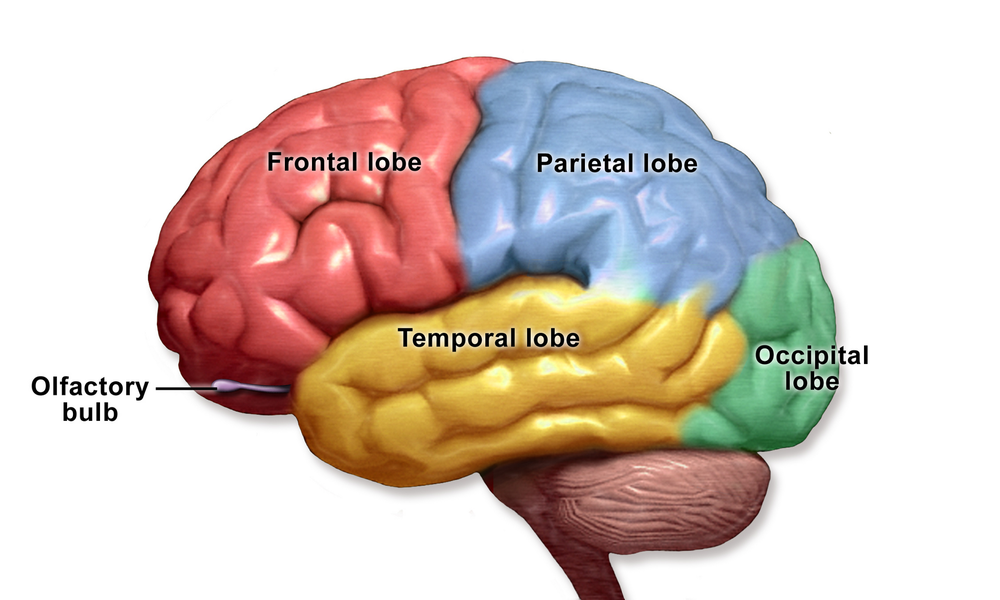
    The cerebral cortex 大脑皮层 is divided into two hemispheres 半球 and four lobes: the occipital lobes 枕叶 process vision at the rear; the temporal lobes 颞叶 process hearing and language at the sides; the parietal lobes 顶叶 hold the somatosensory cortex 体感皮层 for touch; and the frontal lobes 额叶 handle higher-order thinking and executive function 执行功能.

    Language sits mainly in the left hemisphere: Broca's area 布罗卡区 for speech production and Wernicke's area 韦尼克区 for comprehension.

    Split-brain research 裂脑研究, done on patients whose corpus callosum 胼胝体 was cut to treat severe epilepsy, shows the two hemispheres can work independently. Researchers present information to one visual field 视野 at a time, because each field is processed by the opposite hemisphere.

    Brain plasticity 大脑可塑性 is the brain's ability to rewire itself and form new connections, which supports recovery after damage. Research methods include EEG 脑电图 and fMRI 功能性磁共振成像 scans, case studies, and lesioning 损毁法.

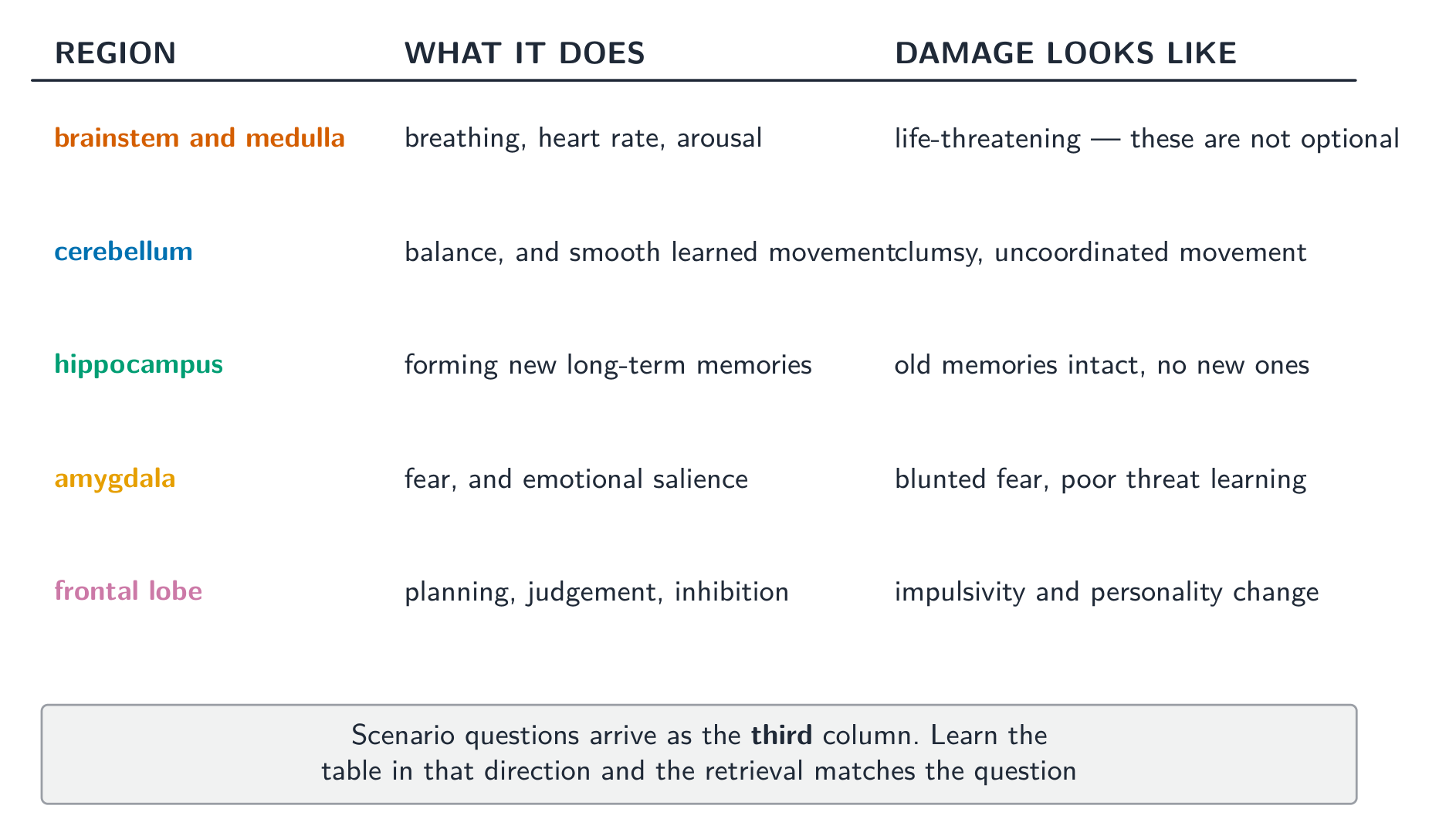
    Scenario questions arrive as the third column - learn the table in that direction
    The four lobes of the cerebral cortex
    Explore · ⁨탐색하기⁩

    Match each deficit to the region · ⁨각 결손을 해당 영역과 매칭하기⁩

    Scenario questions arrive as a deficit, so learn the table in that direction. · ⁨시나리오 질문은 결손으로 제공되므로, 표를 해당 방향으로 학습해야 합니다.⁩

    Vocabulary · ⁨어휘⁩ Train · ⁨연습하기⁩
    English 한국어
    brain stem/breɪn stem/ 뇌간
    medulla/ˈmedʌlə/ 수질(髓質)
    reticular activating system/reˈtɪkjʊlə ˈæktɪveɪtɪŋ ˈsɪstəm/ 망상 활성화 계통
    cerebellum/ˌserɪˈbeləm/ 소뇌
    procedural learning/prəˈsiːdʒərəl ˈlɜːnɪŋ/ 절차 학습
    limbic system/ˈlɪmbɪk ˈsɪstəm/ 변연계
    thalamus/ˈθælæməs/ 시상구(thalamus)
    hypothalamus/ˌhaɪpəʊˈθælæməs/ 하위 시상부(hypothalamus)
    pituitary gland/pɪˈtjuːɪtəri ɡlænd/ 하물선(뇌하엽)
    hippocampus/ˈhɪpəkæmpəs/ 해마
    amygdala/ˌæmɪɡˈdɑːlə/ 편도체(amygdala)
    cerebral cortex/ˈserɪbrəl ˈkɔːteks/ 대뇌 피질
    hemispheres/ˈhemɪsfɪəz/ 반구
    occipital lobes/ˈɒksɪpɪtl ləʊbz/ 후두엽
    temporal lobes/ˈtempərəl ləʊbz/ 측두엽
    parietal lobes/ˈpæraɪətl ləʊbz/ 두상엽
    somatosensory cortex/ˈsɒmətəʊsənsəri ˈkɔːteks/ 체감 피질
    frontal lobes/ˈfrʌntl ləʊbz/ 이마엽
    executive function/eɡˈzekjuːtɪv ˈfʌŋkʃn/ 수행 기능
    Broca's area/ˈbrəʊkəz ˈeərɪə/ 브로카 영역
    Wernicke's area/ˈwɜːnɪks ˈeərɪə/ 베르니케 영역
    Split-brain research/splɪt breɪn rɪˈsɜːtʃ/ 분리 뇌 연구
    corpus callosum/ˈkɔːpəs ˈkælɒsəm/ corpus callosum (백색선維)
    visual field/ˈvɪʒuːəl fiːld/ 시야
    Brain plasticity/breɪn plæˈstɪsɪti/ 뇌 가소성
    EEG/ˌiː iː ˈdʒiː/ EEG
    fMRI/ef ˌeˌmɑːˈraɪ/ fMRI
    lesioning/ˈliːʒənɪŋ/ 손상 연구(lesioning)
    1.5

    Consciousness and Sleep

    Syllabus
    English

    Learning Objective 1.5.A: Explain how the sleep/wake cycle affects behavior and mental processes throughout the day and night.

    • 1.5.A.1 Consciousness has varying levels of awareness of thoughts, feelings, behavior, and events in individuals’ internal and external worlds. Sleep and wakefulness are two types of consciousness.
    • 1.5.A.2 The sleep/wake cycle is a circadian rhythm, which in humans is about a 24-hour cycle. Jet lag and shift work are disruptions of the circadian rhythm.
    • 1.5.A.3 The stages of sleep are identified by their specific EEG patterns.
      • 1.5.A.3 .i NREM sleep occurs in Stages 1 through 3 and decreases in duration throughout the cycle. Hypnagogic sensations occur as one enters Initial Stage 1 sleep.
      • 1.5.A.3 .ii REM sleep is considered paradoxical because it produces waves similar to wakefulness, but the body is at its most relaxed. Dreaming typically occurs in REM sleep. The frequency of REM sleep typically increases as the cycle progresses. When deprived of REM sleep, REM rebound can occur.
    • 1.5.A.4 Theories regarding the structure and function of dreams include activation-synthesis and consolidation theory.
      • Exclusion Statement: The psychoanalytic theory of dreams is outside of the scope of the AP Psychology Exam.
    • 1.5.A.5 Memory consolidation and restoration are current theories about why sleep occurs. These theories suggest that sleep is useful for organizing and consolidating memories or restoring depleted resources used throughout a given day.
    • 1.5.A.6 Many disorders interrupt healthy sleep, and their effects on waking behavior and health vary. Sleep disruptions can affect physical and cognitive performance during wakefulness. Treating sleep disorders and following regular schedules for sleeping can improve waking performance and overall well-being. Disorders commonly studied in introductory psychology include insomnia, narcolepsy, REM sleep behavior disorder, sleep apnea, and somnambulism.
      • Exclusion Statement: The AP Psychology Exam will only address the listed disorders in EK 1.5.A.6.
    한국어

    학습 목표 1.5.A: 수면/각성 주기가 하루 종일 밤낮으로 행동 및 정신 과정에 어떻게 영향을 미치는지 설명한다.

    • 1.5.A.1 의식(consciousness)은 개인의 내외 세계에 대한 생각, 감정, 행동 및 사건에 대한 인식 수준이 다르다. 수면과 각성은 의식의 두 가지 유형이다.
    • 1.5.A.2 수면/각성 주기는 인간에게 약 24시간 주기를 가진 일주 리듬(circadian rhythm)이다. 제트ラグ(jet lag)과 교대근무(shift work)는 일주 리듬의 교란이다.
    • 1.5.A.3 수면 단계는 특정 EEG 패턴에 의해 식별된다.
      • 1.5.A.3 .i NREM 수면은 1~3단계에서 발생하며 주기 전체에서 지속 시간이 감소한다. 초기 1단계 수면으로 진입할 때 현미각(hypnagogic sensations)이 발생할 수 있다.
      • 1.5.A.3 .ii REM 수면은 깨어 있을 때와 유사한 파동을 생성하지만 몸이 가장 이완되어 있는 상태이기 때문에 역설적(paradoxical)이라고 불린다. dreaming은 일반적으로 REM 수면에서 일어난다. 수면 주기가 진행됨에 따라 REM 수면 빈도는 일반적으로 증가한다. REM 수면을剥夺하면 REM rebound이 발생할 수 있다.
    • 1.5.A.4 꿈의 구조와 기능에 대한 이론으로는 활성화-합성 이론 activation-synthesis과 통합 theory가 있다.
      • 배제 문구: 꿈의 정신분석 이론 psychoanalytic theory는 APPsychology Exam의 범위를 벗어난다.
    • 1.5.A.5 기억 통합 memory consolidation과 회복 restoration은 수면이 일어나는 이유에 대한 최신 이론들이다. 이 이론들은 수면이 기억을 조직하고 통합하거나给定 day 동안 사용된 고갈된 resources를 회복하는 데 유용하다고 제안한다.
    • 1.5.A.6 많은 장애가 건강한 수면을 방해하며, 각성 시 행동 및 건강에 미치는 영향은 다양합니다. 수면 장애는 각성 중 신체적 및 인지적 성능에 영향을 미칠 수 있습니다. 수면 장애를 치료하고 규칙적인 수면 일정을 유지하면 각성 성능과 전반적인 웰빙을 개선할 수 있습니다. 입문 심리학에서 흔히 연구되는 장애로는 불면증, 기면증, REM 수면 행동 장애, 수면 무호흡증, 수면보행증이 포함됩니다.
      • 제외 문구: AP 심리학 시험에서는 EK 1.5.A.6에 나열된 장애에만 초점을 맞춥니다.

    Source: College Board AP Course and Exam Description · ⁨출처: College Board AP Course and Exam Description⁩

    Consciousness 意识 is awareness of internal and external events, and it varies in level.

    The sleep/wake cycle is a circadian rhythm 昼夜节律 of about 24 hours. Jet lag 时差反应 and shift work disrupt it.

    Sleep stages are identified by EEG patterns. NREM sleep 非快速眼动睡眠 covers stages 1 to 3; hypnagogic sensations 入睡幻觉 occur as you fall asleep. REM sleep 快速眼动睡眠 is called paradoxical sleep 异相睡眠 because the brain looks awake while the body is most relaxed, and most dreaming happens here.

    Two examinable theories explain dreams: activation-synthesis theory 激活-综合理论 (the brain interprets random activity) and consolidation theory 巩固理论 (dreams reflect memory processing). Sleep itself is explained by memory consolidation 记忆巩固 and restoration 恢复 theories.

    Note: the psychoanalytic theory of dreams is outside the exam's scope.

    Sleep disorders disrupt waking behavior and health: insomnia 失眠, narcolepsy 发作性睡病, sleep apnea 睡眠呼吸暂停, somnambulism 梦游 (sleepwalking), and REM sleep behavior disorder 快速眼动睡眠行为障碍.

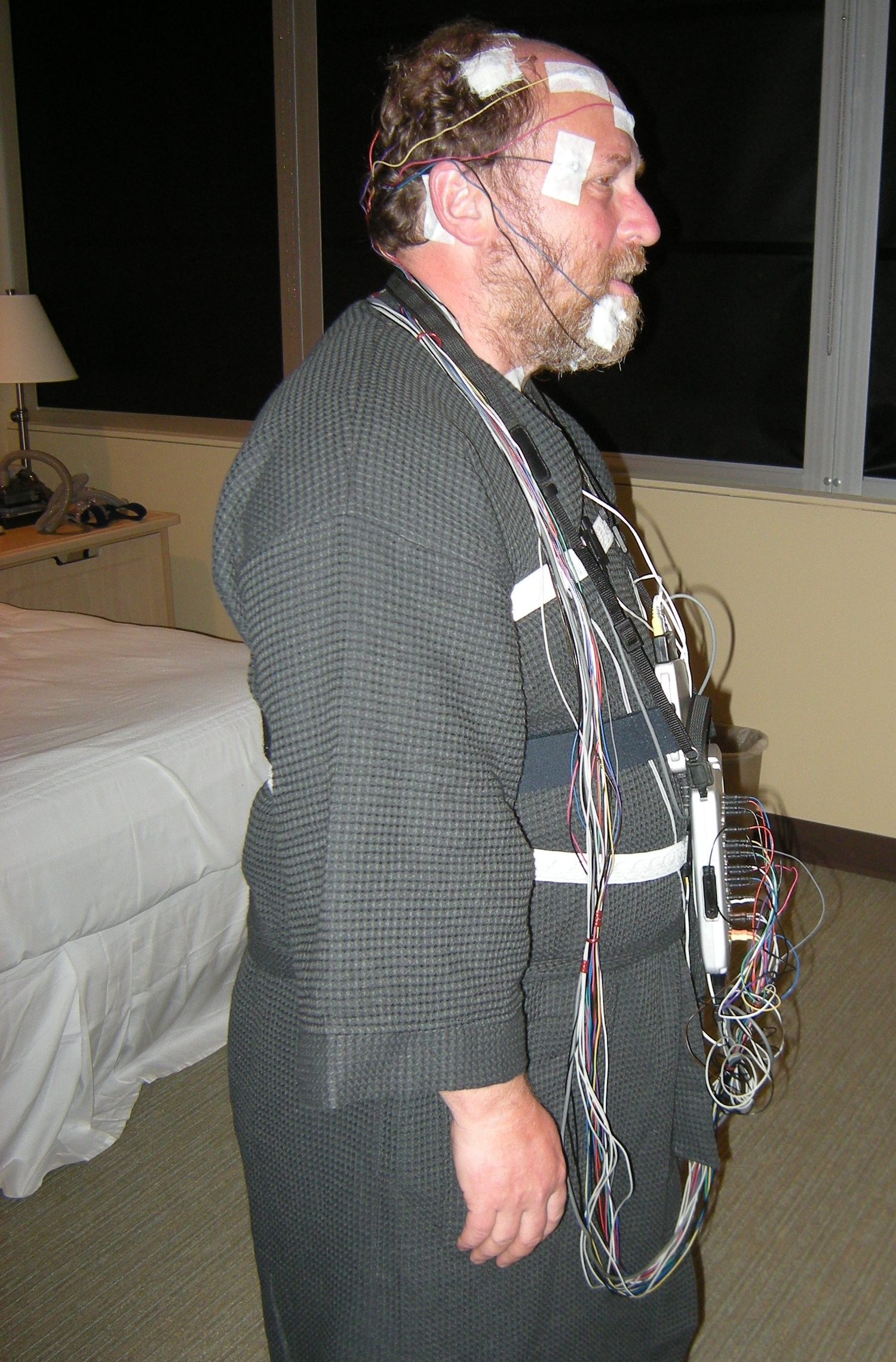
    A participant wired for polysomnography - this is what measuring sleep stages actually looks like
    Vocabulary · ⁨어휘⁩ Train · ⁨연습하기⁩
    English 한국어
    Consciousness/ˈkɒnʃəsnəs/ 의식
    circadian rhythm/sɜːˈkeɪdɪən ˈrɪðəm/ 일주 리듬
    Jet lag/dʒet læɡ/ 제트ラグ
    NREM sleep/ˌenˈrem sliːp/ 비REM 수면
    hypnagogic sensations/ˌhɪpnəˈɡɒɡɪk senˈseɪʃnz/ 수면 전 감각(hypnagogic sensations)
    REM sleep/rem sliːp/ REM 수면
    paradoxical sleep/ˌpærəˈdɒksɪkl sliːp/ 반대 수면(paradoxical sleep)
    activation-synthesis theory/ˌæktɪˈveɪʃn ˈsɪnθəsɪs ˈθɪəri/ 활성-합성 이론
    consolidation theory/kənˌsɒlɪˈdeɪʃn ˈθɪəri/ 고착화 이론
    memory consolidation/ˈmeməri kənˌsɒlɪˈdeɪʃn/ 기억 통합(memory consolidation)
    restoration/ˌrestəˈreɪʃn/ 회복(restoration)
    insomnia/ɪnˈsɒmnɪə/ 불면증
    narcolepsy/ˈnɑːkəʊlepsi/ 나르콜레프시
    sleep apnea/sliːp əpˈnɪə/ 수면 무호흡증
    somnambulism/sɒmˈnæmbjuːlɪzəm/ 수면보행증
    REM sleep behavior disorder/rem sliːp bɪˈheɪvjə dɪˈsɔːdə/ REM 수면 행동 장애
    1.6

    Sensation

    Syllabus
    English

    Learning Objective 1.6.A: Explain how the process of sensation is related to behavior and mental processes.

    • 1.6.A.1 Sensation is the process of detecting information from the environment that meets a certain threshold and transducing stimuli into neurochemical messages for processing (perception) in the brain. The absolute threshold occurs when a stimulus can be detected at least 50% of the time.
    • 1.6.A.2 Detection of change in stimuli or diminished sensitivity to stimuli can be explained by the just-noticeable difference and sensory adaptation. Weber’s law describes the degree to which stimuli need to be different for the difference to be detected.
    • 1.6.A.3 The sensory systems constantly work together in a process called sensory interaction. Synesthesia is an experience of sensation in which one system of sensation is experienced through another.

    Learning Objective 1.6.B: Explain how the structures and functions of the visual sensory system relate to behavior and mental processes.

    • 1.6.B.1 The retina is the photosensitive surface at the back of the eye. Cells in the retina capture visual information that is transduced to the brain for processing. Evidence of incomplete images captured by the retina is demonstrated by the presence of the blind spot, where the visual nerve exits the eye. The brain fills in the gaps in the incomplete retinal images to perceive a relatively complete picture of the world.
    • 1.6.B.2 Visual stimuli are focused onto the retina by the lens via a process called accommodation. When this process is altered, nearsightedness or farsightedness can result.
    • 1.6.B.3 Cells that lie in the periphery of the eye and detect shapes and movement, but not color, are called rods. These cells are mainly activated in low-light environments. These cells play a role in light and dark adaptation.
    • 1.6.B.4 Color vision is explained by both the trichromatic theory and the opponent-process theory.
      • 1.6.B.4.i Photoreceptor cells located in the fovea of the eye that process color and detail are called cones. Researchers have identified blue (detecting short wavelengths), green (detecting medium wavelengths) and red (detecting long wavelengths) cones in the retina.
      • 1.6.B.4.ii Afterimages result when certain ganglion cells in the retina are activated while others are not. The ganglion cells involved in this opponent process are red/green, blue/ yellow/ and black/white.
      • 1.6.B.4.iii Color vision deficiency involves damage or irregularities to one or more cones or ganglion cells (red/green, blue/ yellow). Color vision deficiency includes dichromatism or monochromatism.
    • 1.6.B.5 Damage to parts of the brain responsible for vision (mainly the occipital lobes) can result in disorders such as prosopagnosia (face blindness) and blindsight.

    Learning Objective 1.6.C: Explain how the structures and functions of the auditory sensory system relate to behavior and mental processes.

    • 1.6.C.1 Sound occurs through the movement of air molecules at different wavelengths (called pitch) and amplitudes (called loudness).
    • 1.6.C.2 Theories that help explain pitch perception include place theory, volley theory, and frequency theory.
    • 1.6.C.3 Sound localization describes how we identify where sounds in our environment are coming from.
    • 1.6.C.4 Hearing difficulties can result from aging and various kinds of damage to auditory structures. Types of hearing loss include conduction deafness and sensorineural deafness.

    Learning Objective 1.6.D: Explain how the structures and functions of the chemical sensory systems relate to behavior and mental processes.

    • 1.6.D.1 Structures in the nose and brain process and/ or transduce olfactory stimuli. Smell is the only sense not processed first in the thalamus of the brain. Pheromones produce chemical messages for the olfactory system.
    • 1.6.D.2 Gustation is the sense of taste, and types of tastes include sweet, sour, salty, bitter, umami, and oleogustus.
    • 1.6.D.3 Structures in the tongue, mouth, and brain process and/or transduce basic tastes. The number of taste receptors on the tongue is related to how sensitive people are to tastes, classifying them as supertasters, medium tasters, or nontasters.
    • 1.6.D.4 The chemical senses interact to create the sensation of taste. Without the sense of smell, taste sensations are either muted or not experienced.

    Learning Objective 1.6.E: Explain how the structures and functions of the touch sensory system relate to behavior and mental processes.

    • 1.6.E.1 Structures within the skin and brain process and/or transduce touch stimuli. The sensation of “hot” is produced by the activation of warm and cold receptors in the skin.

    Learning Objective 1.6.F: Explain how the structures and functions of the pain sensory system relate to behavior and mental processes.

    • 1.6.F.1 Pain is processed both in the body and in the brain. Gate control theory is one attempt to describe the complexities of pain. Phantom limb sensation occurs when people who have lost limbs report sensation or pain where the limb used to be.

    Learning Objective 1.6.G: Explain how the structures and functions that maintain balance (vestibular) and body movement (kinesthetic) relate to behavior and mental processes.

    • 1.6.G.1 The vestibular sense controls balance and is primarily detected by the semicircular canals and structures in the brain.
    • 1.6.G.2 Kinesthesis the sense of one’s body movement. Kinesthesis allows the body to move in coordinated ways without having to look at the various parts of the body as it moves.
    한국어

    학습 목표 1.6.A: 감각 과정이 행동 및 정신 과정과 어떻게 관련되는지 설명하십시오.

    • 1.6.A.1 감각은 환경으로부터 특정 임계값을 충족하는 정보를 감지하고 자극을 뇌에서 처리(지각)하기 위한 신경화학 신호로 변환하는 과정입니다. 절대 임계값은 자극이 최소 50%의 확률로 감지될 때 발생합니다.
    • 1.6.A.2 자극 변화의 탐지 또는 자극에 대한 민감도 저하를 최소미감차와 감각 적응으로 설명할 수 있습니다. 웨버 법칙은 차이가 탐지되기 위해 자극이 얼마나 달라져야 하는지를 설명합니다.
    • 1.6.A.3 감각 시스템은 상호작용(sensory interaction)이라는 과정에서 지속적으로 서로 협력하여 작동합니다. 공감각(synesthesia)은 하나의 감각 시스템이 다른 감각 시스템을 통해 경험되는 감각의 경험을 말합니다.

    학습 목표 1.6.B: 시각 감각 시스템의 구조와 기능이 행동 및 정신 과정과 어떻게 관련되는지 설명하십시오.

    • 1.6.B.1 망막은 눈 뒤쪽에 위치한 광감수 표면입니다. 망막의 세포들이 시각 정보를 포착하여 뇌로 전달되어 처리됩니다. 망막이 포착한 불완전한 이미지에 대한 증거는 시신경이 눈 밖으로 나오는 곳인 점(blind spot)이 존재함으로 입증됩니다. 뇌는 불완전한 망막 이미지 속의 빈 공간을 채워 세계에 대한 상대적으로 완전한 이미지를 지각하게 합니다.
    • 1.6.B.2 렌즈를 통한 조절(accommodation) 과정을 통해 시각 자극이 망막에 초점이 맞춰집니다. 이 과정이 변질되면 근시 또는 원시가 발생할 수 있습니다.
    • 1.6.B.3 눈의 말단에 위치하여 형태와 움직임을 감지하지만 색은 감지하지 못하는 세포를 간상체(rods)라고 합니다. 이러한 세포들은 주로 어두운 환경에서 활성화됩니다. 이들은 빛과 어둠의 적응에 역할을 합니다.
    • 1.6.B.4 색채 지각은 삼원색설(trichromatic theory)과 상보적 과정설(opponent-process theory) 모두에 의해 설명됩니다.
      • 1.6.B.4.i 눈의 오목(fovea)에 위치하여 색과 디테일을 처리하는 광수용세포를 원추체(cones)라고 합니다. 연구자들은 망막에서 파란색(단파장 감지), 녹색(중파장 감지), 빨간색(장파장 감지) 원추체를 확인했습니다.
      • 1.6.B.4.ii 잔상이 발생하면 망막의 특정 양극세포(ganglion cells)가 활성화되고 다른 세포들은 비활성화됩니다. 이 상보적 과정에 관여하는 양극세포는 적/녹, 청/황, 흑/백입니다.
      • 1.6.B.4.iii 색맹(color vision deficiency)은 하나 이상의 원추체 또는 양극세포(적/녹, 청/황)의 손상 또는 이상으로 인해 발생합니다. 색맹에는 이원색증(dichromatism) 또는 단색증(monochromatism)이 포함됩니다.
    • 1.6.B.5 시각을 담당하는 뇌 부위(주로 두정엽)의 손상은 안면실인症(prosopagnosia, 얼굴 실인증) 및 블라인드사이트(blindsight)와 같은 장애를 유발할 수 있습니다.

    학습 목표 1.6.C: 청각 감각 시스템의 구조와 기능이 행동 및 정신 과정과 어떻게 관련되는지 설명하십시오.

    • 1.6.C.1 소리는 다른 파장(음고(pitch))과 진폭(크기(loudness))을 가진 공기 분자의 운동으로 발생합니다.
    • 1.6.C.2 음고 지각을 설명하는 데 도움이 되는 이론으로는 위치설(place theory), 볼리이론(volley theory), 주파수설(frequency theory)이 있습니다.
    • 1.6.C.3 소리 위치 파악(sound localization)은 환경 내 소리의 출처를 식별하는 방법을 설명합니다.
    • 1.6.C.4 노화 및 청각 구조의 다양한 손상으로 인해 청력 문제가 발생할 수 있습니다. 청력 상실의 유형으로는 전도성 난청(conduction deafness)과 감각신경성 난청(sensorineural deafness)이 있습니다.

    학습 목표 1.6.D: 화학 감각 시스템의 구조와 기능이 행동 및 정신 과정과 어떻게 관련되는지 설명하십시오.

    • 1.6.D.1 코와 뇌의 구조는 후각 자극을 처리하고/또는 변환합니다. 후각은 대뇌 시상(thalamus)에서 먼저 처리되지 않는 유일한 감각입니다. 페로몬은 후각 시스템을 위한 화학 신호를 생성합니다.
    • 1.6.D.2 미각(gustation)은 맛의 감각이며, 맛의 종류로는 달콤함, 신맛, 짭짤함, 쓴맛, 우마미, 그리고 올레구스터스(oleogustus)가 있습니다.
    • 1.6.D.3 혀, 입, 그리고 뇌의 구조는 기본 맛을 처리하고/또는 변환합니다. 혀 위 맛 수용체의 수는 사람들이 맛에 얼마나 민감한지와 관련이 있으며, 이를 초미각자(supertasters), 중간 미각자(medium tasters), 비미각자(nontasters)로 분류합니다.
    • 1.6.D.4 화학 감각은 서로 상호작용하여 맛의 감각을 만듭니다. 후각이 없으면 미각 감각은 약해지거나 전혀 느껴지지 않습니다.

    학습 목표 1.6.E: 촉각 감각 시스템의 구조와 기능이 행동 및 정신 과정과 어떻게 관련되는지 설명하십시오.

    • 1.6.E.1 피부와 뇌 내부의 구조는 촉각 자극을 처리하고/또는 변환합니다. '뜨거움'의 감각은 피부의 온도와 냉각 수용체가 활성화됨으로써 발생합니다.

    학습 목표 1.6.F: 통증 감각 시스템의 구조와 기능이 행동 및 정신 과정과 어떻게 관련되는지 설명하십시오.

    • 1.6.F.1 통증은 신체와 뇌에서 모두 처리됩니다. 게이트 컨트롤 이론은 통증의 복잡성을 설명하려는 시도의 하나입니다. 단절된 사지의 감각이나 통증이 사라진 부위에 느껴지는 현상을 환각 사지 감각(phantom limb sensation)이라 합니다.

    학습 목표 1.6.G: 균형(vestibular)과 신체 운동(kinesthetic)을 유지하는 구조 및 기능이 행동과 정신 과정에 어떻게 관련되는지 설명하십시오.

    • 1.6.G.1 전정감각(vestibular sense)은 균형을 조절하며 주로 반원형관과 뇌 내 구조를 통해 감지됩니다.
    • 1.6.G.2 근체감(kinesthesia)은 자신의 신체 운동을 느끼는 감각입니다. 근체감은 신체가 움직일 때 각 부위를 바라보지 않고도 조화롭게 움직일 수 있게 해줍니다.

    Source: College Board AP Course and Exam Description · ⁨출처: College Board AP Course and Exam Description⁩

    Sensation 感觉 is detecting information from the environment and transducing 转导 it into neural signals the brain can use. Detection needs a certain absolute threshold 绝对阈限.

    • The just-noticeable difference 最小可觉差 is the smallest change a person can detect.
    • Sensory adaptation 感觉适应 is reduced sensitivity to an unchanging stimulus - you stop noticing a smell.
    • Sensory interaction 感觉相互作用 means the senses work together. Synesthesia 联觉 is when one sense triggers another.

    Vision. Light is focused onto the retina 视网膜 by the lens 晶状体 changing shape, a process called visual accommodation 视觉调节; when this fails the result is nearsightedness 近视 or farsightedness 远视. Rods 视杆细胞 lie in the periphery and detect shape and movement in low light. Cones 视锥细胞 sit in the fovea 中央凹 and detect colour and detail. Colour vision needs two theories: trichromatic theory 三色理论 (blue, green and red cones) and opponent-process theory 对立过程理论, which explains afterimages 后像. Damage to the occipital lobes can cause prosopagnosia 面孔失认症, or face blindness.

    Hearing. Sound is air movement; wavelength gives pitch 音高 and amplitude gives loudness 响度. Pitch perception is explained by place theory 位置理论, volley theory 齐射理论, and frequency theory 频率理论. Sound localization 声源定位 tells us where a sound comes from. Hearing loss may be conduction deafness 传导性耳聋 or sensorineural deafness 感音神经性耳聋.

    The chemical senses. Olfaction 嗅觉 is the only sense not relayed first through the thalamus. Gustation 味觉 covers sweet, sour, salty, bitter, umami 鲜味, and oleogustus 脂味. The two interact: without smell, taste is muted.

    Touch, pain, and body position. Skin receptors transduce touch; "hot" comes from warm and cold receptors firing together. Pain is processed in body and brain, and gate control theory 闸门控制理论 explains why attention changes how much it hurts; phantom limb 幻肢 sensations show the brain's role. The vestibular sense 前庭觉 controls balance through the semicircular canals 半规管, and kinesthesis 动觉 is the sense of body movement.

    Worked example (a real AP exam question). The 2025 Article Analysis Question asked students to "Identify the research method used in the study" and then to "Explain the extent to which the research findings may or may not be generalizable using specific and relevant evidence from the study." A full-mark answer to the second part names the limitation and ties it to evidence: "The findings may not generalize widely because participants were undergraduate students at one university, so the sample was not representative of the general population." Notice the shape: Explain needs a claim plus the evidence behind it. Naming the method alone answers part A, not part E.

    Vocabulary · ⁨어휘⁩ Train · ⁨연습하기⁩
    English 한국어
    Sensation/senˈseɪʃn/ 감각(sensation)
    transducing/trænsˈdjuːsɪŋ/ 변환(transducing)
    absolute threshold/ˈæbsəluːt ˈθreʃəʊld/ 절대 한계
    just-noticeable difference/dʒʌst ˈnəʊtɪsəbl ˈdɪfrəns/ 최소 감지 차이
    Sensory adaptation/ˈsensəri ˌædæpˈteɪʃn/ 감각 적응
    Sensory interaction/ˈsensəri ˌɪntəˈrækʃn/ 감각 상호작용
    Synesthesia/ˌsaɪnɪsˈθiːzɪə/ 동감각(Synesthesia)
    retina/ˈretɪnə/ 망막(retina)
    lens/lenz/ 렌즈
    visual accommodation/ˈvɪʒuːəl əˌkɒməˈdeɪʃn/ 안안 조절
    nearsightedness/ˈnɪəsaɪtɪdnəs/ 근시
    farsightedness/ˈfɑːsaɪtɪdnəs/ 원시
    Rods/rɒdz/ 막대 세포
    Cones/kəʊnz/ 원추 세포
    fovea/ˈfəʊvɪə/ 안와 중앙(fovea)
    trichromatic theory/ˌtrɪkrəʊˈmætɪk ˈθɪəri/ 삼색설
    opponent-process theory/əˈpəʊnənt ˈprəʊses ˈθɪəri/ 상반 과정 이론
    afterimages/ˈæftərɪmɪdʒɪz/ 잔상(afterimages)
    prosopagnosia/ˌprɒsəpəɡˈnəʊzɪə/ 인간 얼굴 실인식증(prosopagnosia)
    pitch/pɪtʃ/ 음고
    loudness/ˈlaʊdnəs/ 크기(음량)
    place theory/pleɪs ˈθɪəri/ 위치 이론(place theory)
    volley theory/ˈvɒli ˈθɪəri/ 볼리 이론(volley theory)
    frequency theory/ˈfriːkwənsi ˈθɪəri/ 주파수 이론
    Sound localization/saʊnd ˌləʊkəlaɪˈzeɪʃn/ 소리 위치 인식
    conduction deafness/kənˈdʌkʃn ˈdefnəs/ 전도성 난청
    sensorineural deafness/ˈsensɔːraɪnjuːrəl ˈdefnəs/ 감각신경성 난청
    Olfaction/ɒlˈfækʃn/ 후각(olfaction)
    Gustation/ɡʌˈsteɪʃn/ 미각(Gustation)
    umami/juːˈmɑːmi/ 우마미(umami)
    oleogustus/ˈəʊləɡʌstəs/ 올레고구스터스(oleogustus)
    gate control theory/ɡeɪt kənˈtrəʊl ˈθɪəri/ 게이트 통제 이론(gate control theory)
    phantom limb/ˈfæntəm lɪm/ 가상 지체(phantom limb)
    vestibular sense/veˈstɪbjʊlə sens/ 전정 감각(vestibular sense)
    semicircular canals/ˌsemɪˈsɜːkjʊlə kəˈnælz/ 반환형 관(semicircular canals)
    kinesthesis/ˈkaɪnsθəsɪs/ 근육 감각(kinesthesis)
    Watch lesson · ⁨수업 보기⁩
    1.6

    Exam tips

    • Learn only the listed neurotransmitters and hormones; the exam will not ask about others, and the endocrine glands are out of scope apart from the pituitary.
    • Keep sensation separate from perception: sensation is detecting and transducing, perception is interpreting (Unit 2).
    • The all-or-none principle means intensity is coded by how often a neuron fires, never by how strongly.
    • Match structure to job before you write: hippocampus forms memories, amygdala handles fear, cerebellum coordinates movement.
    • Sympathetic arouses, parasympathetic calms. If a question describes a racing heart, name the sympathetic branch.
    • Say what a scan can and cannot show. fMRI shows activity over time; EEG shows electrical patterns and identifies sleep stages.
  • 2

    Cognition · ⁨인지(cognition)⁩

    Watch lesson · ⁨수업 보기⁩
    2.1

    Perception · ⁨지각⁩

    Syllabus
    English

    Learning Objective 2.1.A: Explain how internal and external factors influence perception.

    • 2.1.A.1 Perception is influenced by whether one primarily relies on external sensory information (bottom-up processing) or internal prior expectations (top-down processing).
    • 2.1.A.2 Schemas and perceptual sets are internal factors that filter perceptions of the world.
    • 2.1.A.3 Contexts, experiences, and cultural experiences and expectations are external factors that filter perceptions of the world.
    • 2.1.A.4 Perceptual principles proposed by Gestalt psychology (closure, figure and ground, proximity, and similarity) help explain how humans organize their perceptual world.
    • 2.1.A.5 Attention is an interaction of sensation and perception that is affected by internal and external processes.
      • 2.1.A.5.i Some experiences of attention can be selective, such as with the cocktail party effect, where people attend to mentions of their names or specific topics in loud or distracting environments.
      • 2.1.A.5.ii Inattention can lead to a type of “blindness” to aspects of the environment. Change blindness occurs when changes to the environment are not perceived due to inattention.

    Learning Objective 2.1.B: Explain how visual perceptual processes produce correct or incorrect interpretations of stimuli.

    • 2.1.B.1 Binocular depth cues of retinal disparity (the difference between the images projecting onto the retina) and convergence (the merging of the retinal images by the brain) utilize images from each eye to provide perception of depth.
    • 2.1.B.2 Monocular depth cues (relative clarity, relative size, texture gradient, linear perspective, and interposition) give the illusion of depth on flat or two-dimensional surfaces.
      • Exclusion Statement: The AP Psychology Exam will only address the listed monocular depth cues in EK 2.1.B.2.
    • 2.1.B.3 Visual perceptual constancies maintain the perception of an object even when the images of the object in the visual field change.
    • 2.1.B.4 Apparent movement can be visually perceived even when objects are not actually moving.
    한국어

    학습 목표 2.1.A: 내부 요인과 외부 요인이 지각에 미치는 영향을 설명하십시오.

    • 2.1.A.1 지각은 주로 외부 감각 정보(하향 처리, bottom-up processing)에 의존하는지, 아니면 내부의 사전 기대(상향 처리, top-down processing)에 의존하는지에 따라 영향을 받습니다.
    • 2.1.A.2 키마(schemas)와 지각적 심상(perceptual sets)은 세상에 대한 지각을 필터링하는 내부 요인입니다.
    • 2.1.A.3 상황, 경험, 문화적 경험 및 기대는 세상에 대한 지각을 필터링하는 외부 요인입니다.
    • 2.1.A.4格式심리학(Gestalt psychology)이 제안한 지각 원리(완결성, 도형과 배경, 근접성, 유사성)는 인간이 지각 세계를 조직하는 방법을 설명하는 데 도움이 됩니다.
    • 2.1.A.5 주의(attention)는 감각과 지각의 상호작용이며, 내부 및 외부 과정에 의해 영향을 받습니다.
      • 2.1.A.5.i 주의의 일부 경험은 선택적일 수 있습니다. 예를 들어 칵테일 파티 효과(cocktail party effect)에서는 사람들이 소란스럽고 분산된 환경에서도 자신의 이름이나 특정 주제에 대한 언급에 주의를 기울입니다.
      • 2.1.A.5.ii 무주의(inattention)는 환경의 특정 aspects에 대한 ‘시각적 실명’을 초래할 수 있습니다. 변화 실명(change blindness)은 무주의로 인해 환경의 변화가 인지되지 않는 경우를 말합니다.

    학습 목표 2.1.B: 시각적 지각 과정이 자극에 대해 정확하거나 부정확한 해석을 어떻게 생성하는지 설명하십시오.

    • 2.1.B.1 망막 상차iled disparity(망막에 투영되는 이미지 간의 차이)와 수렴(convergence, 망막 이미지가 뇌에 의해 통합되는 것)라는 양안 깊이 단서(binocular depth cues)은 각 눈의 이미지를 활용하여 깊이를 인지하게 합니다.
    • 2.1.B.2 단안 깊이 단수(monocular depth cues)(相대 명료성, 상대 크기, 질감 경사, 선형 원근법, 중첩)는 평면 또는 2차원表面上에 깊이错觉을 제공합니다.
      • 제외 사항: AP 심리학 시험은 EK 2.1.B.2에 나열된 단안 깊이 단수만 다룹니다.
    • 2.1.B.3 시각적 지각 영속성(perceptual constancies)은 시각 장(Field)에서의 대상 이미지가 변하더라도 대상을 인지하는 것을 유지합니다.
    • 2.1.B.4 겉보기 운동(apparent movement)은 물체가 실제로 움직이지 않음에도 시각적으로 인지될 수 있습니다.

    Source: College Board AP Course and Exam Description · ⁨출처: College Board AP Course and Exam Description⁩

    English

    Unit 1 ended with sensation, the detection of a stimulus. Perception 知觉 is what the brain does next: it organises and interprets that information. The same signal can be perceived in more than one way.

    Two directions of processing work together:

    • Bottom-up processing 自下而上加工 starts from the raw sensory information and builds upwards.
    • Top-down processing 自上而下加工 starts from what you already expect and know.

    Internal filters shape perception. A schema 图式 is a mental framework built from past experience. A perceptual set 知觉定势 is a readiness to see something in a particular way. External filters matter too: context 情境 and cultural expectations change what people report seeing.

    Gestalt psychology 格式塔心理学 described how the brain groups parts into wholes: closure 闭合 (filling in gaps), figure and ground 图形与背景 (separating an object from its background), proximity 邻近性 (grouping things that are close), and similarity 相似性 (grouping things that look alike).

    Attention 注意 sits between sensation and perception. It is limited, so some information is lost:

    • Selective attention 选择性注意 focuses on one input. The cocktail party effect 鸡尾酒会效应 is hearing your own name across a noisy room.
    • Inattentional blindness 无意视盲 is failing to see something visible because attention was elsewhere; change blindness 变化盲视 is failing to notice that something has changed.
    한국어

    단원 1은 감각 sensation, 즉 자극의 감지로 끝났습니다. 지각 perception은脑后가 다음으로 하는 일입니다: 그것은 그 정보를 조직화하고 해석합니다. 동일한 신호가 여러 방식으로 지각될 수 있습니다.

    두 가지 처리 방향이 함께 작동합니다:

    • 하향 처리는 원시적인 감각 정보에서 시작하여 위쪽으로 구성해 나가는 과정입니다.
    • **상향식 처리(top-down processing)**는 이미 알고 있거나 예상하는 것에서 시작됩니다.

    내부 필터가 지각을 형성합니다. 스키마는 과거 경험을 바탕으로构建된 정신적 틀입니다. 지각적 설정은 특정 방식으로 무언가를 보려는 태도입니다. 외부 필터도 중요합니다: 맥락과 문화적 기대는 사람들이 보고하는 것이 달라지게 합니다.

    게슈탈트 심리학은 뇌가 부분들을 전체로 묶어 내는 방식을 설명했습니다: 완결성(빈칸 채우기), 배경과 도형(대상을 배경으로부터 분리하기), 인접성(가까운 것들 묶기), 유사성(비슷한 것들 묶기).

    주의는 감각과 지각 사이에 위치합니다. 주의의 용량은 제한되어 있어 일부 정보는 손실됩니다:

    • 선별적 주의는 하나의 입력에 집중합니다. 칵테일 파티 효과는 소란스러운 방에서 자신의 이름을 듣는 현상입니다.
    • 무관심 실명은 주의가 다른 곳에 있을 때 보이는 것을 보지 못하는 것입니다; 변화 실명은 어떤 것이 변했는지 눈치채지 못하는 것입니다.
    Vocabulary · ⁨어휘⁩ Train · ⁨연습하기⁩
    English 한국어
    Perception/pəˈsepʃn/ 지각(perception)
    Bottom-up processing/ˈbɒtəm ʌp ˈprəʊsesɪŋ/ 하향식 처리(Bottom-up processing)
    Top-down processing/tɒp daʊn ˈprəʊsesɪŋ/ 상향식 처리(Top-down processing)
    schema/ˈskiːmə/ 스키마(schema)
    perceptual set/pəˈseptʃuːəl set/ 지각적 설정(perceptual set)
    context/ˈkɒntekst/ 맥락
    Gestalt psychology/ɡəʃˈtɑːlt saɪˈkɒlədʒi/ 게슈탈트 심리학
    closure/ˈkləʊʒə/ 폐쇄(closure)
    figure and ground/ˈfɪɡə ænd ɡraʊnd/ figure and ground
    proximity/prɒkˈsɪmɪti/ 근접성
    similarity/ˌsɪmɪˈlærɪti/ 유사성
    Attention/əˈtenʃn/ 주의(Attention)
    Selective attention/sɪˈlektɪv əˈtenʃn/ 선별적 주의
    cocktail party effect/ˈkɒkteɪl ˈpɑːti ɪˈfekt/ 코크테일 파티 효과
    Inattentional blindness/ɪnəˈtenʃənl ˈblaɪndnəs/ 무주의 시각(inattentional blindness)
    change blindness/tʃeɪndʒ ˈblaɪndnəs/ 변화 시각 부재(change blindness)
    2.1

    Depth, Constancy, and Movement · ⁨깊이, 안정성, 그리고 움직임⁩

    Syllabus
    English

    Learning Objective 2.1.A: Explain how internal and external factors influence perception.

    • 2.1.A.1 Perception is influenced by whether one primarily relies on external sensory information (bottom-up processing) or internal prior expectations (top-down processing).
    • 2.1.A.2 Schemas and perceptual sets are internal factors that filter perceptions of the world.
    • 2.1.A.3 Contexts, experiences, and cultural experiences and expectations are external factors that filter perceptions of the world.
    • 2.1.A.4 Perceptual principles proposed by Gestalt psychology (closure, figure and ground, proximity, and similarity) help explain how humans organize their perceptual world.
    • 2.1.A.5 Attention is an interaction of sensation and perception that is affected by internal and external processes.
      • 2.1.A.5.i Some experiences of attention can be selective, such as with the cocktail party effect, where people attend to mentions of their names or specific topics in loud or distracting environments.
      • 2.1.A.5.ii Inattention can lead to a type of “blindness” to aspects of the environment. Change blindness occurs when changes to the environment are not perceived due to inattention.

    Learning Objective 2.1.B: Explain how visual perceptual processes produce correct or incorrect interpretations of stimuli.

    • 2.1.B.1 Binocular depth cues of retinal disparity (the difference between the images projecting onto the retina) and convergence (the merging of the retinal images by the brain) utilize images from each eye to provide perception of depth.
    • 2.1.B.2 Monocular depth cues (relative clarity, relative size, texture gradient, linear perspective, and interposition) give the illusion of depth on flat or two-dimensional surfaces.
      • Exclusion Statement: The AP Psychology Exam will only address the listed monocular depth cues in EK 2.1.B.2.
    • 2.1.B.3 Visual perceptual constancies maintain the perception of an object even when the images of the object in the visual field change.
    • 2.1.B.4 Apparent movement can be visually perceived even when objects are not actually moving.
    한국어

    학습 목표 2.1.A: 내부 요인과 외부 요인이 지각에 미치는 영향을 설명하십시오.

    • 2.1.A.1 지각은 주로 외부 감각 정보(하향 처리, bottom-up processing)에 의존하는지, 아니면 내부의 사전 기대(상향 처리, top-down processing)에 의존하는지에 따라 영향을 받습니다.
    • 2.1.A.2 키마(schemas)와 지각적 심상(perceptual sets)은 세상에 대한 지각을 필터링하는 내부 요인입니다.
    • 2.1.A.3 상황, 경험, 문화적 경험 및 기대는 세상에 대한 지각을 필터링하는 외부 요인입니다.
    • 2.1.A.4格式심리학(Gestalt psychology)이 제안한 지각 원리(완결성, 도형과 배경, 근접성, 유사성)는 인간이 지각 세계를 조직하는 방법을 설명하는 데 도움이 됩니다.
    • 2.1.A.5 주의(attention)는 감각과 지각의 상호작용이며, 내부 및 외부 과정에 의해 영향을 받습니다.
      • 2.1.A.5.i 주의의 일부 경험은 선택적일 수 있습니다. 예를 들어 칵테일 파티 효과(cocktail party effect)에서는 사람들이 소란스럽고 분산된 환경에서도 자신의 이름이나 특정 주제에 대한 언급에 주의를 기울입니다.
      • 2.1.A.5.ii 무주의(inattention)는 환경의 특정 aspects에 대한 ‘시각적 실명’을 초래할 수 있습니다. 변화 실명(change blindness)은 무주의로 인해 환경의 변화가 인지되지 않는 경우를 말합니다.

    학습 목표 2.1.B: 시각적 지각 과정이 자극에 대해 정확하거나 부정확한 해석을 어떻게 생성하는지 설명하십시오.

    • 2.1.B.1 망막 상차iled disparity(망막에 투영되는 이미지 간의 차이)와 수렴(convergence, 망막 이미지가 뇌에 의해 통합되는 것)라는 양안 깊이 단서(binocular depth cues)은 각 눈의 이미지를 활용하여 깊이를 인지하게 합니다.
    • 2.1.B.2 단안 깊이 단수(monocular depth cues)(相대 명료성, 상대 크기, 질감 경사, 선형 원근법, 중첩)는 평면 또는 2차원表面上에 깊이错觉을 제공합니다.
      • 제외 사항: AP 심리학 시험은 EK 2.1.B.2에 나열된 단안 깊이 단수만 다룹니다.
    • 2.1.B.3 시각적 지각 영속성(perceptual constancies)은 시각 장(Field)에서의 대상 이미지가 변하더라도 대상을 인지하는 것을 유지합니다.
    • 2.1.B.4 겉보기 운동(apparent movement)은 물체가 실제로 움직이지 않음에도 시각적으로 인지될 수 있습니다.

    Source: College Board AP Course and Exam Description · ⁨출처: College Board AP Course and Exam Description⁩

    English

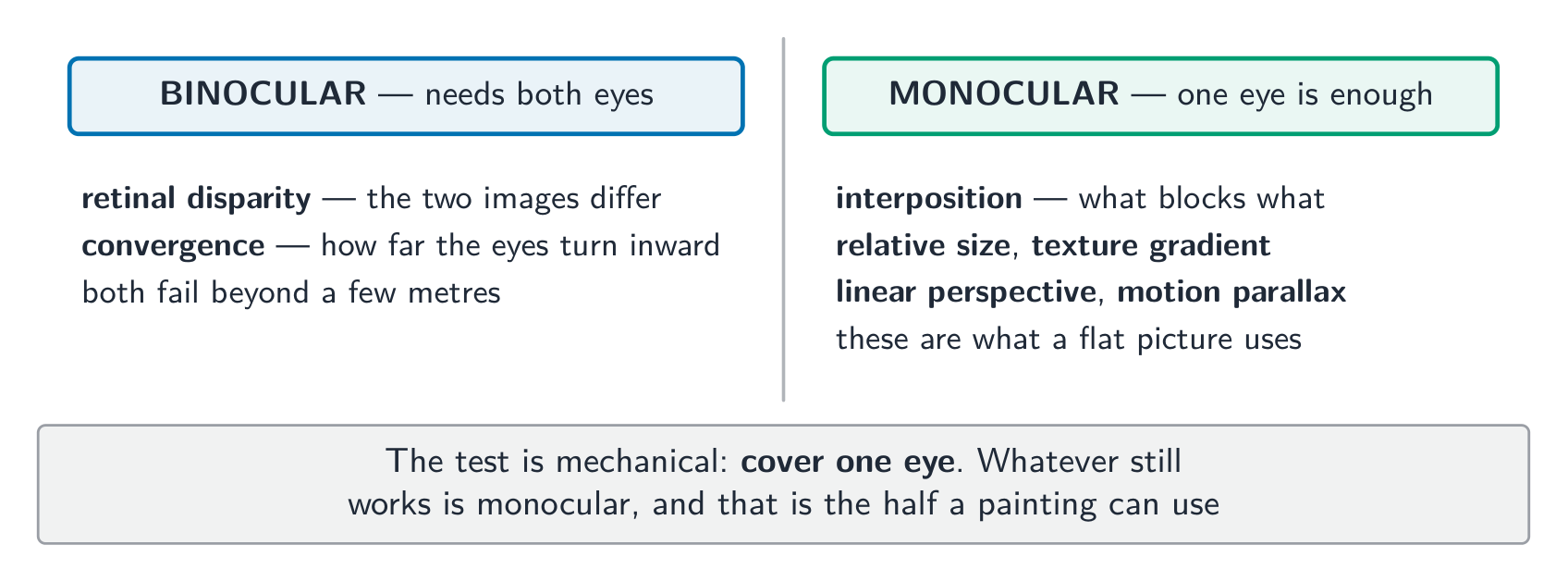
    To perceive a three-dimensional world from a flat retinal image, the brain uses depth cues 深度线索.

    Binocular cues 双眼线索 need both eyes. Retinal disparity 视网膜像差 is the small difference between the two images; the greater the difference, the closer the object. Convergence 辐辏 is the inward turn of the eyes for near objects.

    Monocular cues 单眼线索 work with one eye: relative clarity 相对清晰度, relative size 相对大小, texture gradient 纹理梯度, linear perspective 线条透视, and interposition 遮挡 (a nearer object blocks a further one).

    Perceptual constancy 知觉恒常性 keeps an object looking the same even when its retinal image changes - a door stays rectangular as it swings open. The brain can also perceive apparent movement 似动 when nothing actually moves, which is why a series of still frames looks like a film.

    한국어

    평면 망막 이미지를 통해 삼차원 세계를 지각하려면 뇌는 깊이 단서를 사용합니다.

    양안 단서는 두 눈을 모두 필요로 합니다. 망막 불일치는 두 이미지 사이의 미세한 차이로, 이 차이가 클수록 대상이 가깝습니다. 수렴은 가까운 대상을 위해 눈이 안쪽으로 돌리는 현상입니다.

    단안 단서는 한 눈으로 작동합니다: 상대적 선명도, 상대적 크기, 질감 경사, 직선 투시, 중첩(더 가까운 물체가 더 먼 물체를 가림).

    지각적 안정성은 망막 이미지가 변화해도 대상을 동일하게 보이게 유지합니다 - 문이 열릴 때에도 직사각형으로 보입니다. 뇌는 실제로 움직이는 것이 없어도 가상의 움직임을 지각할 수 있는데, 이것이 정지된 프레임들이 영화처럼 보이는 이유입니다.

    한쪽 눈을 가리면: 여전히 작동하는 것이 단안 단서입니다
    Vocabulary · ⁨어휘⁩ Train · ⁨연습하기⁩
    English 한국어
    depth cues/depθ kjuːz/ 심도 단서(depth cues)
    Binocular cues/bɪˈnɒkjʊlə kjuːz/ 양안 단서
    Retinal disparity/ˈretɪnl dɪˈspærɪti/ 망막 간격(retinal disparity)
    Convergence/kənˈvɜːdʒəns/ 수렴
    Monocular cues/mɒˈnəʊkjʊlə kjuːz/ 단안 단서
    relative clarity/ˈrelətɪv ˈklærɪti/ 상대적 선명도(relative clarity)
    relative size/ˈrelətɪv saɪz/ 상대적 크기
    texture gradient/ˈtekstʃə ˈɡreɪdɪənt/ 질감 경사
    linear perspective/ˈlɪnɪə pəˈspektɪv/ 선형 원근법
    interposition/ˌɪntəpəˈzɪʃn/ 중첩 효과
    Perceptual constancy/pəˈseptʃuːəl ˈkɒnstənsi/ 지각의 일정성(Perceptual constancy)
    apparent movement/əˈpærənt ˈmuːvmənt/ 가시 운동
    Concepts/ˈkɒnsepts/ 개념
    prototype/ˈprəʊtəʊtaɪp/ 프로토타입
    assimilation/əˌsɪmɪˈleɪʃn/ 동화(assimilation)
    accommodation/əˌkɒməˈdeɪʃn/ 조율(accommodation)
    algorithm/ˈælɡərɪθəm/ 알고리즘
    2.2

    Thinking and Problem-Solving · ⁨사고와 문제 해결⁩

    Syllabus
    English

    Learning Objective 2.2.A: Explain how psychological concepts and theories account for thinking, problem-solving, judgment, and decision-making.

    • 2.2.A.1 Concepts form the basis of thought. Prototypes are the ideal example for any given concept.
    • 2.2.A.2 People form and modify schemas, or frameworks for thinking, through assimilation (taking in new information but not changing the schema in light of it) and accommodation (taking in new information and changing the schema to incorporate the new information).
    • 2.2.A.3 Algorithms address problems by attempting all possible solutions until the correct one is found.
    • 2.2.A.4 Heuristics address problems by using mental shortcuts to make judgments. Using heuristics can lead to errors in judgment when decisions are made according to prior expectations or stereotypes (representativeness heuristic) or recalling the first or most vivid example that comes to mind (availability heuristic).
    • 2.2.A.5 Decision making can be influenced by prior experiences that were successful (mental set) or circumstances surrounding a decision (priming and framing).
    • 2.2.A.6 Cognitive processes such as gambler’s fallacy and sunk-cost fallacy can hinder people from making good decisions.
    • 2.2.A.7 Executive functions are cognitive processes that allow individuals to generate, organize, plan, and carry out goal-directed behaviors and experience critical thinking.
    • 2.2.A.8 Creativity is a way of thinking that includes generating novel ideas and engaging in divergent (versus convergent) thinking. Creative thinking is hindered by functional fixedness.
    한국어

    학습 목표 2.2.A: 심리학 개념과 이론이 사고, 문제 해결, 판단 및 의사결정을 어떻게 설명하는지 설명하십시오.

    • 2.2.A.1 개념(concepts)은 사고의 기반을 형성합니다. 프로토타입(prootypes)은 특정 개념에 대한 이상적인 예시입니다.
    • 2.2.A.2 사람들은 동화(assimilation: 새로운 정보를 받아들이되 스키마를 변경하지 않음)와 동조(accommodation: 새로운 정보를 받아들이고 스키마를 변경하여 새로운 정보를 포함함)를 통해 스키마나 사고의 틀을 형성하고 수정합니다.
    • 2.2.A.3 알고리즘(algorithms)은 올바른 해를 찾을 때까지 가능한 모든 해결책을 시도함으로써 문제를 해결합니다.
    • 2.2.A.4 휴리스틱(heuristics)은 판단을 내리기 위해 mentale shortcuts를 사용하는 방식으로 문제를 해결합니다. 휴리스틱 사용은 사전 기대나 고정관념에 따라 결정할 때(유형성 휴리스틱, representativeness heuristic) 또는 머릿속에 떠오르는 첫 번째 또는 가장 생생한 예시를 회상할 때(가용성 휴리스틱, availability heuristic) 판단 오류를 초래할 수 있습니다.
    • 2.2.A.5 의사결정은 성공적인 과거 경험(마インド셋, mental set)이나 의사결정 주변 상황(프라이밍, priming 및 프레이밍, framing)에 의해 영향을 받을 수 있습니다.
    • 2.2.A.6 도박꾼의 착각(gambler’s fallacy)과 매몰 비용의 착각(sunk-cost fallacy)과 같은 인지적 과정은人们在作出良好决策时受到阻碍。
    • 2.2.A.7 실행 기능(executive functions)은 개인이 목표 지향적 행동을 생성, 조직, 계획 및 수행하고 비판적 사고를 경험할 수 있게 하는 인지적 과정입니다.
    • 2.2.A.8 창의성(new ideas를 생성하고 수렴적thinking vs 발산적 thinking에 참여하는思维方式)은 novel한 아이디어를 생성하고 수렴적thinking(versus convergent thinking)에 참여하는思维方式입니다. 창의적 사고는 기능적 고착(functional fixedness)에 의해 저해됩니다。

    Source: College Board AP Course and Exam Description · ⁨출처: College Board AP Course and Exam Description⁩

    English

    Concepts 概念 are the basis of thought, and a prototype 原型 is the best example of a concept. People build and change schemas through assimilation 同化 (fitting new information into an existing schema) and accommodation 顺应 (changing the schema to fit new information).

    Two ways to solve a problem:

    • An algorithm 算法 tries every possible solution and is guaranteed to work, but is slow.
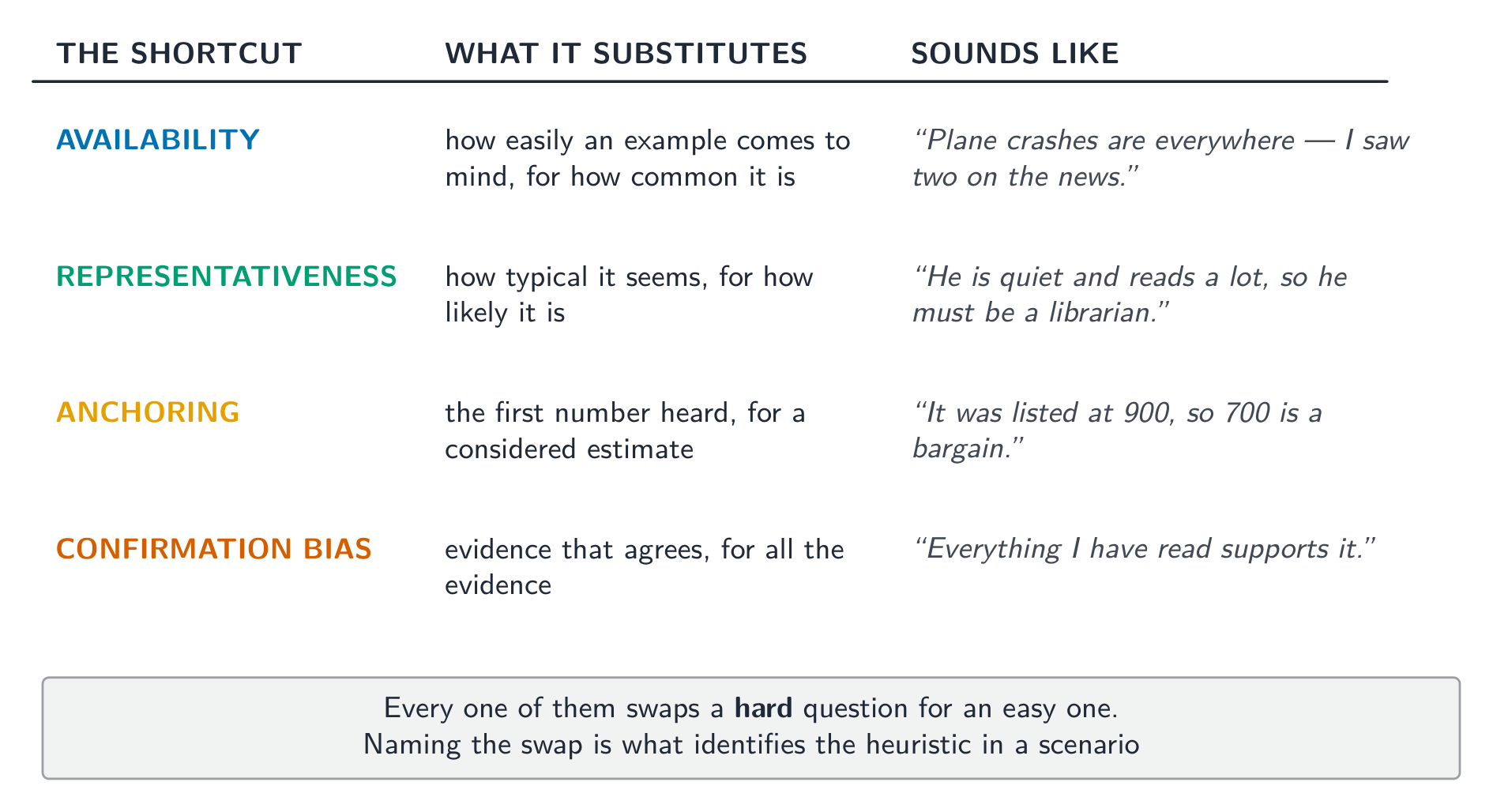
    • A heuristic 启发式 is a mental shortcut. It is fast but can lead to error - the representativeness heuristic 代表性启发式 judges by how well something matches a prototype, and the availability heuristic 可得性启发式 judges by how easily examples come to mind.

    Thinking can also get stuck. A mental set 心向 is the tendency to repeat a solution that worked before. Functional fixedness 功能固着 is seeing an object only in its usual use. The gambler's fallacy 赌徒谬误 (believing a run must end) and the sunk-cost fallacy 沉没成本谬误 (continuing because of what is already spent) both hinder good decisions.

    Executive functions 执行功能 let people generate, organise, plan, and carry out goals. Creativity 创造力 involves divergent thinking 发散思维 (generating many ideas) rather than convergent thinking 聚合思维 (narrowing to one answer).

    한국어

    개념은 사고의 기초이며, 프로토타입은 해당 개념의 가장 대표적인 예시입니다. 사람들은 동화(새로운 정보를 기존 스키마에 맞춤)와 적응(새로운 정보에 맞춰 키마를 변경)를 통해 스키마를 구축하고 변경합니다.

    문제를 해결하는 두 가지 방법:

    • 알고리즘은 모든 가능한 해를 시도하며 반드시 성공하지만 느립니다.
    • 히ュー리스틱은 정신적 shortcuts(간편한 경로)입니다. 빠르지만 오류를 유발할 수 있습니다 - 대표성 히ュー리스틱은 프로토타입과의 일치도에 따라 판단하고, 가용성 히ュー리스틱은 머릿속에 떠오르기 쉬운 예시에 따라 판단합니다.

    사고가 막힐 수도 있습니다. 정신적 고착은 이전successful한 해법을 반복하려는傾向입니다. 기능적 고정은 대상을 그 usual한 용도만으로 보는 것입니다. 도박꾼의 착각(연속 실패가 끝날 것이라는 믿음)과 沉没原価 착각(이미 쓴 비용 때문에 계속함)은 모두 좋은 의사결정을 방해합니다.

    실행 기능은 사람들이 목표를 생성, 조직, 계획, 수행하게 합니다. 창의성은 발산적 사고(다양한 아이디어 생성)가 수렴적 사고(하나의 답으로 좁히는 것)보다 포함됩니다.

    모든 간편한 경로는 어려운 문제를 쉬운 문제로 교체합니다
    Explore · ⁨탐색하기⁩

    Name the shortcut in each scenario · ⁨각 시나리오에서의 단축법(heuristic) 명명하기⁩

    Every heuristic swaps a hard question for an easy one — and naming the swap is what identifies it. · ⁨모든 단축법은 어려운 문제를 쉬운 문제로 교체합니다 — 이 교체를 명명하는 것이 단축법을 식별하는 방법입니다.⁩

    Vocabulary · ⁨어휘⁩ Train · ⁨연습하기⁩
    English 한국어
    heuristic/hjuːˈrɪstɪk/ 히어리스틱
    representativeness heuristic/ˌreprɪˈzentətɪvnəs hjuːˈrɪstɪk/ 대표성 히어리스틱(representativeness heuristic)
    availability heuristic/əˌveɪləˈbɪlɪti hjuːˈrɪstɪk/ 접근성 히어리스틱(availability heuristic)
    mental set/ˈmentl set/ 심리적 고정관념(mental set)
    Functional fixedness/ˈfʌŋkʃənl ˈfɪkstnəs/ 기능적 고착(Functional fixedness)
    gambler's fallacy/ˈɡæmbləz ˈfæləsi/ 도박인의 오류(gambler's fallacy)
    sunk-cost fallacy/sʌŋk kɒst ˈfæləsi/ 沉没成本 오류(sunk-cost fallacy)
    Executive functions/eɡˈzekjuːtɪv ˈfʌŋkʃnz/ 실행 기능(Executive functions)
    Creativity/kriːˌeɪˈtɪvɪti/ 창의성
    divergent thinking/daɪˈvɜːdʒənt ˈθɪŋkɪŋ/ 발산적 사고
    convergent thinking/kənˈvɜːdʒənt ˈθɪŋkɪŋ/ 수렴적 사고
    Explicit memory/ekˈsplɪsɪt ˈmeməri/ 명시 기억(Explicit memory)
    episodic memory/ˌepɪˈsɒdɪk ˈmeməri/ 일화 기억
    semantic memory/səˈmæntɪk ˈmeməri/ 의미 기억
    Implicit memory/ɪmˈplɪsɪt ˈmeməri/ 암묵기 기억(Implicit memory)
    procedural memory/prəˈsiːdʒərəl ˈmeməri/ 절차 기억
    Prospective memory/prəˈspektɪv ˈmeməri/ rollback 기억(Prospective memory)
    Long-term potentiation/lɒŋ tɜːm pəˌtenʃɪˈeɪʃn/ 장기 강화
    multi-store model/ˈmʌlti stɔː ˈmɒdl/ 다중 저장 모델
    sensory memory/ˈsensəri ˈmeməri/ 감각 기억(sensory memory)
    iconic/aɪˈkɒnɪk/ 이미지 기억
    echoic/eˈkəʊɪk/ 에코EIC记忆(echoic)
    short-term memory/ʃɔːt tɜːm ˈmeməri/ 단기 기억
    long-term memory/lɒŋ tɜːm ˈmeməri/ 장기 기억
    working memory model/ˈwɜːkɪŋ ˈmeməri ˈmɒdl/ 작업 기억 모델
    phonological loop/ˌfɒnəˈlɒdʒɪkl luːp/ 음운 루프(phonological loop)
    visuospatial sketchpad/ˌvɪsjuːəˈspeɪʃl ˈsketʃpæd/ 시공간 스케치패드(visuospatial sketchpad)
    central executive/ˈsentrəl eɡˈzekjuːtɪv/ 중심 집행자(central executive)
    levels of processing model/ˈlevlz ɒv ˈprəʊsesɪŋ ˈmɒdl/ 처리 수준 모델
    2.3

    Memory Systems · ⁨기억 시스템⁩

    Syllabus
    English

    Learning Objective 2.3.A: Explain how the types, structures, and processes of memory work.

    • 2.3.A.1 Memories for learned knowledge, events, and experiences are differentiated by how they are processed by, stored in, and retrieved by the brain.
      • 2.3.A.1.i Explicit memory is a type of memory that is more easily described or explained to others. Types of explicit memory include episodic and semantic.
      • 2.3.A.1.ii Implicit memory is more challenging to describe or explain to others. Procedural memory is a type of implicit memory for procedures and processes.
      • 2.3.A.1.iii Prospective memory is a type of memory related to future actions.
    • 2.3.A.2 Long-term potentiation, a process by which synaptic connections between neurons become stronger with frequent activation, is a biological process for memory.
    • 2.3.A.3 The working memory model examines how our primary memory system—working memory— engages in a dynamic interaction with several components, namely the central executive, phonological loop, and visuospatial sketchpad, to process information into long-term memory.
    • 2.3.A.4 The multi-store model proposes three interacting systems (sensory memory [including iconic and echoic memory], short-term memory, and long-term memory) that information must pass through to be remembered. This model focuses on the impact of automatic and effortful processing on memory encoding, storage, and retrieval.
    • 2.3.A.5 The levels of processing model proposes that memory is encoded on three levels from shallowest to deepest: structural, phonemic, and semantic.
    한국어

    학습 목표 2.3.A: 기억의 유형, 구조 및 작동 방식을 설명하십시오。

    • 2.3.A.1 학습된 지식, 사건 및 경험에 대한 기억은 뇌에 의해 처리, 저장 및 인출되는 방식에 따라 구분됩니다。
      • 2.3.A.1.i 명시적 기억(explicit memory)은 다른 사람에게 더 쉽게 설명하거나 설명할 수 있는 종류의 기억입니다. 명시적 기억의 유형에는 에피소드 기억과 의미 기억이 포함됩니다。
      • 2.3.A.1.ii 암묵적 기억(implicit memory)은 다른 사람에게 설명하거나 설명하기 더 어렵습니다. 절차적 기억(procedural memory)은 절차와 과정에 대한 암묵적 기억의 일종입니다。
      • 2.3.A.1.iii prospective 기억은 미래의 행동과 관련된 기억의 일종입니다。
    • 2.3.A.2 장기 강화(long-term potentiation)는 신경元之间의 시냅스 연결이 빈번한 활성화로 인해 강해지는 과정으로, 기억에 대한 생물학적 과정입니다。
    • 2.3.A.3 작업기억 모델은 주요 기억 시스템인 작업기억이 중추 집행자, 음운 루프, 시각-공간 스케치패드와 같은 여러 구성 요소와 역동적으로 상호작용하여 정보를 장기기억으로 처리하는 방식을 조사합니다.
    • 2.3.A.4 다중 저장소 모델은 정보가 기억되기 위해 거쳐야 하는 세 가지 상호작용 시스템(감각기억 [아이코닉 및 에코믹 기억 포함], 단기기억, 장기기억)을 제안합니다. 이 모델은 자동적 Processing과 노력적 Processing이 기억 인코딩, 저장, 회수에 미치는 영향을 중점적으로 다룹니다.
    • 2.3.A.5 처리 수준 모델은 기억이 가장 얕은 level부터 가장 깊은 level까지 구조적, 음운학적, 의미적 세 단계로 인코딩된다고 제안합니다.

    Source: College Board AP Course and Exam Description · ⁨출처: College Board AP Course and Exam Description⁩

    English

    Memory is divided by how information is processed.

    Explicit memory 外显记忆 can be described to others. It splits into episodic memory 情景记忆 (personal events) and semantic memory 语义记忆 (facts). Implicit memory 内隐记忆 is harder to describe, and includes procedural memory 程序性记忆 (skills such as riding a bike). Prospective memory 前瞻记忆 is remembering to do something later.

    Long-term potentiation 长时程增强 is the biological basis: synaptic connections grow stronger with repeated use.

    Three models are examinable:

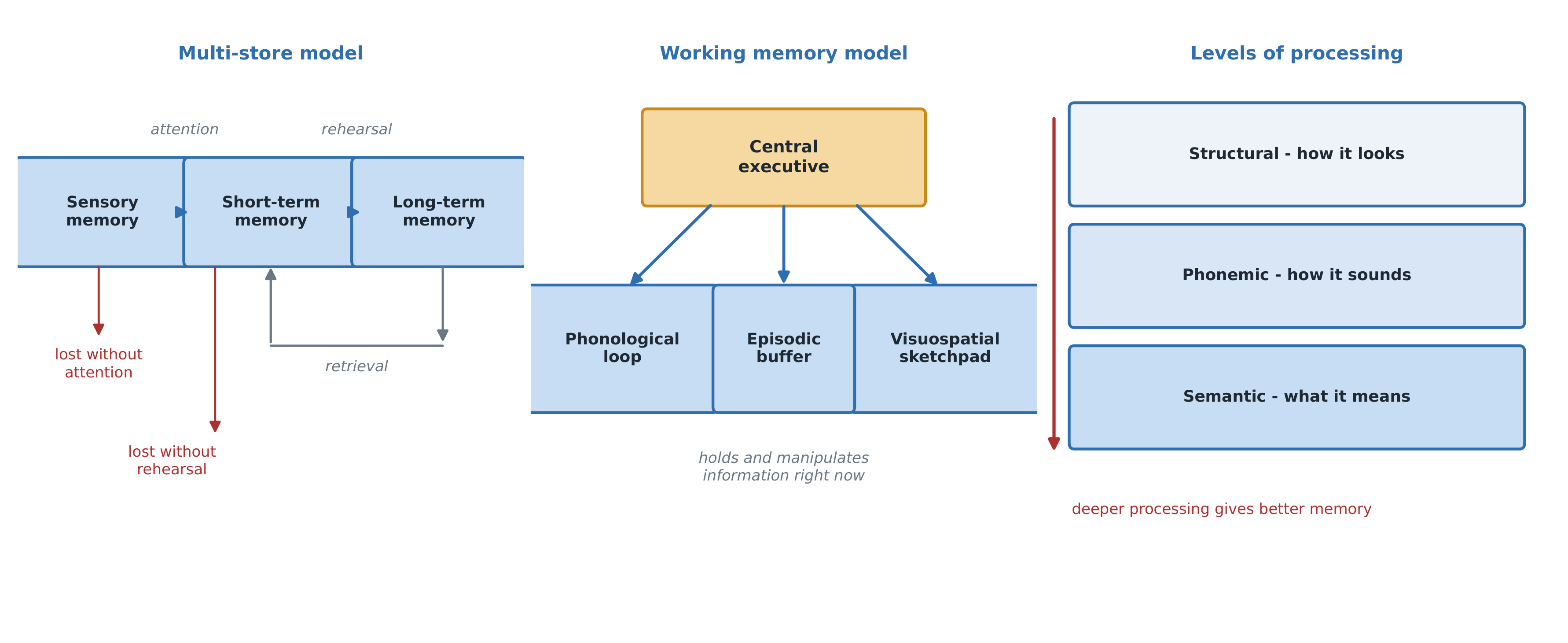
    • The multi-store model 多重存储模型 proposes sensory memory 感觉记忆 (including iconic 图像记忆 and echoic 声像记忆 stores), short-term memory 短时记忆, and long-term memory 长时记忆.
    • The working memory model 工作记忆模型 treats the middle stage as active, not a waiting room. It has a phonological loop 语音回路, a visuospatial sketchpad 视空间模板, and a central executive 中央执行系统.
    • The levels of processing model 加工水平模型 says deeper processing gives better memory: shallow processing of appearance, then sound, then deep processing of meaning.
    한국어
    세 가지 기억 모델 병렬 배치: 다중 저장소 흐름, 작업 기억의 구성 요소, 처리 깊이에 따른 척도
    시험에 나오는 세 가지 기억 모델: 정보가 저장소를 통과하고, 작업 기억에서 능동적으로 유지되며, 깊게 처리될 때 더 잘 기억됨

    기억은 정보 처리 방식에 따라 구분됩니다.

    명시적 기억은 타인에게 설명할 수 있습니다. episodic 기억(개인적 사건)과 semantic 기억(사실)으로 나뉩니다. 암시적 기억은 설명하기 어려우며, 절차적 기억(자전거 타기 같은 기술) 등을 포함합니다. 전제적 기억은 나중에 무언가를 하도록 기억하는 것입니다.

    장기 강화는 생물학적 기반입니다: 시냅스 연결이 반복 사용으로 강해집니다.

    세 가지 모델이 시험 대상입니다:

    • 다중 저장소 모델은 감각 기억(아이콘記憶 및 에코기억 저장소 포함), 단기 기억, 장기 기억을 제안합니다.
    • 작업 기억 모델은 중간 단계를 대기실이 아닌 능동적 단계로 봅니다. 음향-언어 루프, 시공간 스케치패드, 중앙 집행을 가집니다.
    • 처리 수준 모델은 깊은 처리가 더 나은 기억을 제공한다고 말합니다: 외모에 대한 얕은 처리, 소리, 그 다음 의미에 대한 깊은 처리 순서입니다.
    2.4 2.5

    Encoding and Storing · ⁨인코딩 및 저장⁩

    Syllabus
    English

    Learning Objective 2.4.A: Explain how different encoding processes work to get information into memory.

    • 2.4.A.1 Encoding involves processes and strategies to get information into memory. How information is encoded can determine how effectively information is stored and retrieved.
    • 2.4.A.2 Mnemonic devices, such as method of loci, are processes that aid in encoding information into working and long-term memory.
    • 2.4.A.3 Encoding can be improved by the process of grouping information together into meaningful chunks (“chunking”), categories, or hierarchies.
    • 2.4.A.4 The spacing effect is a process that can cause significant differences in encoding and memory consolidation depending on whether the information is encoded all at once (massed practice) or distributed over time (distributed practice).
    • 2.4.A.5 Encoding processes can be affected by the order of how the information is presented, called the serial position effect. The serial position effect predicts that information presented at the beginning of a list (primacy effect) or the end of a list (recency effect) will be more memorable than information presented in the middle of a list.
    한국어

    학습 목표 2.4.A: 다양한 인코딩 과정이 어떻게 작동하여 정보를 기억에存入하는지 설명하십시오.

    • 2.4.A.1 인코딩은 정보를 기억에存入하기 위한 과정과 전략을 포함합니다. 정보가 어떻게 인코딩되느냐가 정보의 저장 및 회수 효율성을 결정할 수 있습니다.
    • 2.4.A.2 로커스 방법(method of loci)과 같은 기법(mnemonic devices)은 정보를 작업기억과 장기기억에 인코딩하는 데 도움을 주는 과정입니다.
    • 2.4.A.3 정보를 의미 있는 덩어리(chunking), 범주 또는 계층 구조로 묶는 과정을 통해 인코딩을 개선할 수 있습니다.
    • 2.4.A.4 간격 효과(spacing effect)는 정보를 한 번에 모두 인코딩하는 경우(집중 학습)와 시간 분산하여 인코딩하는 경우(분산 학습)에 따라 인코딩과 기억 통합에 큰 차이를 초래할 수 있는 과정입니다.
    • 2.4.A.5 인코딩 과정은 정보가 제시되는 순서에 의해 영향을 받을 수 있으며 이를 일련 위치 효과(serial position effect)라고 합니다. 일련 위치 효과는 목록의 시작부분(우선 효과)이나 끝부분(후성 효과)에 제시된 정보가 목록 중간에 제시된 정보보다 더 잘 기억된다고 예측합니다.
    English

    Learning Objective 2.5.A: Explain how memory storage processes retain information in memory.

    • 2.5.A.1 Sensory memory, short-term memory, working memory, and long-term memory are processes that differ in storage duration, capacity, and content.
    • 2.5.A.2 Storage may be prolonged by rehearsing information over time (maintenance rehearsal). Rehearsing information over time in ways that promote meaning (elaborative rehearsal) helps with memory retention.
    • 2.5.A.3 Some people demonstrate highly superior autobiographical memory which may indicate that there are biological processes for superior memory storage. Autobiographical memory may also explain why memories connected to our own lives or selves are more memorable.
    • 2.5.A.4 Storage processes may be negatively affected by physical impairment and developmental limitations, such as amnesia (retrograde and anterograde), Alzheimer’s disease, and infantile amnesia.
    한국어

    학습 목표 2.5.A: 기억 저장 과정이 정보를 기억에 유지시키는 방법을 설명하십시오.

    • 2.5.A.1 감각기억, 단기기억, 작업기억, 장기기억은 저장 지속 시간, 용량, 내용 면에서 서로 다른 과정입니다.
    • 2.5.A.2 정보를 시간이 지나도 반복하여 암송하면(유지적 암송) 저장을 연장할 수 있습니다. 의미를 촉진하는 방식으로 정보를 시간이 지나도 반복하면(세부화적 암송) 기억 유지에 도움이 됩니다.
    • 2.5.A.3 일부 사람들은 매우 뛰어난 자아기억(self-memory)을 보이며, 이는 superior한 기억 저장을 위한 생물학적 과정이 존재함을 시사할 수 있습니다. 자아기억은 우리 자신의 삶이나 자신과 관련된 기억이 더 잘 기억되는 이유를 설명하기도 합니다.
    • 2.5.A.4 저장 과정은 알츠하이머병, 유아기 망실증 등 신체적 결함 및 발달적 제한(퇴행성 및 전향성 사망증 포함)에 의해 부정적인 영향을 받을 수 있습니다.

    Source: College Board AP Course and Exam Description · ⁨출처: College Board AP Course and Exam Description⁩

    English

    Encoding 编码 gets information into memory, and how you encode changes how well you remember.

    • Mnemonic devices 记忆术 such as the method of loci 位置法 aid encoding.
    • Chunking 组块 groups items into meaningful units, which raises how much short-term memory can hold.
    • The spacing effect 间隔效应 shows that spreading study over time beats massed practice 集中练习 (cramming).
    • The serial position effect 系列位置效应 means items at the start (primacy 首因效应) and end (recency 近因效应) of a list are remembered best.

    Storage differs by system. Maintenance rehearsal 保持性复述 repeats information to hold it; elaborative rehearsal 精细复述 links it to what you already know and works better.

    A few people show highly superior autobiographical memory 超常自传体记忆, which suggests biological differences. Storage can also be impaired: Alzheimer's disease 阿尔茨海默病 and infantile amnesia 婴儿期遗忘 both limit what can be stored or recovered.

    한국어

    인코딩은 정보를 기억에 넣는 과정이며, 어떻게 인코딩하느냐가 기억력을 결정합니다.

    • mnemonic 장치 such as 위치 법은 인코딩을 돕습니다.
    • 덩어리화는 항목들을 의미 있는 단위로 묶어 단기 기억이 수용할 수 있는 양을 높입니다.
    • 간격 효과는 학습을 시간 분산시키는 것이 밀집 연습(그림자 독학)보다 낫다는 것을 보여줍니다.
    • 순위 효과는 목록의 시작(우위)과 끝(종위)에 있는 항목이 가장 잘 기억됨을 의미합니다.

    저장은 시스템마다 다릅니다. 유지 재현은 정보를 반복하여 유지하는 것이며, 심화 재현은 기존 지식과 연결하여 더 잘 작동합니다.

    일부 사람들은 초강력 자아 기억을 보여주는데, 이는 생물학적 차이를 시사합니다. 저장에는 결손도 발생할 수 있습니다: 阿尔茨海默病과 유년기遗忘은 저장하거나 회수할 수 있는 범위를 제한합니다.

    2.6 2.7

    Retrieving and Forgetting · ⁨회수와 forgetting⁩

    Syllabus
    English

    Learning Objective 2.6.A: Explain how memory retrieval processes get information out of memory.

    • 2.6.A.1 The process of memory retrieval occurs through recall (remembering without cues) or recognition (which relies on retrieval cues).
    • 2.6.A.2 The process of memory retrieval can be enhanced when people are in the same environmental space (context-dependent memory), mood (mood-congruent memory), or physical state (state-dependent memory) as they were when they encoded the information to be retrieved.
    • 2.6.A.3 Successful retrieval is more likely when using retrieval practice processes, including testing effect and metacognition.
    한국어

    학습 목표 2.6.A: 기억 회수 과정이 정보를 기억에서 꺼내는 방법을 설명하십시오.

    • 2.6.A.1 기억 회수 과정은 단서 없이 기억하는 recall이나 회수 단서에 의존하는(regognition)两种方式을 통해 발생합니다.
    • 2.6.A.2人们在信息编码时所处的相同 환경(맥락 의존적 기억), 감정 상태(기분 일치적 기억), 또는 신체 상태(상태 의존적 기억)에 있을 때 기억 회수 과정이 강화될 수 있습니다.
    • 2.6.A.3 테스트 효과와 메타인지 등 회수 연습 과정을 사용할 때 성공적인 회수가 더容易发生합니다.
    English

    Learning Objective 2.7.A: Explain possible reasons why memory failure or errors may occur.

    • 2.7.A.1 The forgetting curve shows that time is a significant factor in forgetting. Forgetting occurs rapidly after initial learning and levels off over time.
    • 2.7.A.2 Many memories are difficult to retrieve due to encoding failure, interference (proactive or retroactive), or inadequate retrieval (i.e., tip-of-the-tongue phenomenon).
    • 2.7.A.3 Psychodynamic theorists believe that information or memories can be forgotten to defend the ego from distress (repression).
    • 2.7.A.4 The accuracy of memories may be affected by the misinformation effect, source amnesia, or constructive memory (via memory consolidation and imagination inflation).
    한국어

    학습 목표 2.7.A: 기억 실패나 오류가 발생할 수 있는 가능한 이유를 설명하십시오.

    • 2.7.A.1 잊힘 곡선(forgetting curve)은 시간이 잊힘에 중요한 요인임을 보여줍니다. 초기 학습 후 빠르게 잊히며 시간이 지남에 따라 안정화됩니다.
    • 2.7.A.2 많은 기억들은 인코딩 실패, 간섭(전방 간섭 또는 후방 간섭), 혹은 불충분한 회수(즉, 입두현상)로 인해 회수가 어렵습니다.
    • 2.7.A.3 심동 이론가들은 자아를 고통으로부터 보호하기 위해 정보나 기억들이 잊힐 수 있다고 믿습니다(억압).
    • 2.7.A.4 기억의 정확성은 허위 정보 효과, 출처 사망증, 혹은 기억 통합과 상상력 증대(Constructive memory)를 통한 Constructive memory에 영향을 받을 수 있습니다.

    Source: College Board AP Course and Exam Description · ⁨출처: College Board AP Course and Exam Description⁩

    English

    Retrieval takes two forms: recall 回忆 (producing information without cues) and recognition 再认 (identifying it among options). Recognition is easier, which is why a multiple-choice question feels easier than an essay.

    Retrieval improves with matching conditions. Context-dependent memory 情境依存记忆 works better in the same place; state-dependent memory 状态依存记忆 works better in the same physical state; mood-congruent memory 心境一致性记忆 recalls material matching your current mood. Practising retrieval helps too - the testing effect 测试效应 shows that testing yourself beats rereading.

    Forgetting has several causes. The forgetting curve 遗忘曲线 shows loss is fastest right after learning. Encoding failure 编码失败 means it never got in. Interference 干扰 can be proactive 前摄干扰 (old learning blocks new) or retroactive 倒摄干扰 (new blocks old). Retrieval failure 提取失败 includes the tip-of-the-tongue phenomenon 舌尖现象.

    Memory is also reconstructive 重构的, not a recording. The misinformation effect 错误信息效应 occurs when later information changes what a person remembers. Source amnesia 来源遗忘 is remembering the information but not where it came from.

    Worked example (a real AP exam question). The 2025 Article Analysis Question presented a study in which participants read a summary containing 20%, 50% or 80% misleading sentences, then answered questions about a video. Correct responses fell from 74% (low misinformation) to 63% (high). One part asked students to "Explain how at least one of the research findings supports or refutes the misinformation effect." A full-mark answer states the finding and connects it to the concept: "Participants in the high misinformation condition answered 63% correctly compared with 74% in the low condition. Because exposure to more misleading detail lowered accuracy, the finding supports the misinformation effect, in which information received after an event changes the memory of it." Notice the shape: quote the data, then name the concept the data supports. A restated definition with no number does not answer Explain.

    한국어

    회수는 두 가지 형태로 이루어집니다: 회상(단서 없이 정보 생성)과 인식(옵션 중 식별). 인식이 더 쉬우므로 서술형 문제보다 객관식 문제가 더 쉽게 느껴지는 것입니다.

    추출은 일치하는 조건에서 개선됩니다. 맥락 의존적 기억은 같은 장소에서 더 잘 작동하며, 상태 의존적 기억은 같은 신체적 상태에서 더 잘 작동하고, 기분 일관성 기억은 현재 기분에 맞는 재료를 회상합니다. 추출 연습도 도움이 됩니다. 테스팅 효과는 자기 검사가 다시 읽는 것보다 낫다는 것을 보여줍니다.

    망각에는 여러 원인이 있습니다. 망각 곡선은 학습 직후 손실이 가장 빠르다는 것을 보여줍니다. 부호화 실패는的记忆에 아예 들어가지 못했다는 의미입니다. 간섭은 전방 간섭(구로운 학습이 새로운 학습을 방해) 또는 후방 간섭(새로운 것이 구운 것을 방해)일 수 있습니다. 추출 실패에는 혀끝 현상이 포함됩니다.

    기억은 기록이 아니라 재구성되기도 합니다. 오정보 효과는 나중의 정보가 사람이 기억하는内容进行 변경할 때 발생합니다. 소스 암각은 정보는 기억하지만 그것이从哪里来的지 기억하지 못하는 것입니다.

    풀이 예시 (실제 AP 시험 문제). 2025년 기사 분석 문제는 참여자가 20%, 50% 또는 80%의 오정보 문장이 포함된 요약문을 읽고 영상에 대한 질문에 답하도록 한 연구를 제시했습니다. 정답 비율은 저오정보 조건에서 74%에서 고오정보 조건에서 63%로 감소했습니다. 일부 질문은 학생들에게 *"연구 결과 중 적어도 하나가 오정보 효과를 지지하거나 반박하는 방법을 설명하시오."*라고 물었습니다. 만점 답안은 해당 findings를 그리고 개념과 연결하여 서술해야 합니다: "고오정보 조건의 참여자는 63%의 정답률을 보였으나, 저오정보 조건에서는 74%였다. 더 많은 오정보 정보에 노출될수록 정확도가 낮아졌으므로, 이 결과는 사후에 제공된 정보가 사건에 대한 기억을 변화시키는 오정보 효과를 지지한다." 이 구조를 주의하세요: 먼저 데이터를 인용한 다음, 그 데이터가 지지하는 개념을 명시하십시오. 숫자 없이 재정의만으로는 Explain 질문에 답할 수 없습니다.

    네 가지 다른 실패, 모두 망각으로 보고됨 - 단서는 cue가 하는 역할
    Explore · ⁨탐색하기⁩

    Diagnose which stage the memory failed at · ⁨기억이 어느 단계에서 실패했는지 진단하기⁩

    Four different failures are all reported as forgetting. The tell is what happens when a cue is given. · ⁨네 가지 다른 실패가 모두 '잊어버림'으로 보고됩니다. 단서(cue)가 주어졌을 때 일어나는 일이 이를 구분하는 단서입니다.⁩

    2.8

    Intelligence and Testing · ⁨지능 및 검사⁩

    Syllabus
    English

    Learning Objective 2.8.A: Explain how modern and historical theories describe intelligence.

    • 2.8.A.1 Throughout history, consensus about how to define and measure intelligence continues to be elusive and can be subject to bias. Researchers debate whether intelligence is a general ability (called g) or is comprised of multiple abilities.

    Learning Objective 2.8.B: Explain how intelligence is measured.

    • 2.8.B.1 Early formal intelligence tests yielded an intelligence quotient (IQ), which divided mental age by chronological age. In modern times, IQ scores are often used to identify students for educational services.
      • Exclusion Statement: Labeling or describing cognitive abilities and disabilities are outside the scope of the AP Psychology Exam.
    • 2.8.B.2 All psychological assessments, including intelligence tests, should adhere to sound psychometric principles to be considered useful.
      • 2.8.B.2.i A test is said to be standardized when it is administered using consistent procedures and environments.
      • 2.8.B.2.ii A test is considered valid if it measures what it is designed to measure. Types of validity include construct and predictive.
      • 2.8.B.2.iii A test is considered reliable if it yields similar results each time it is administered. Types of reliability include test-retest and split-half.
    • 2.8.B.3 Researchers strive to develop assessments of intelligence that are socio-culturally responsive to reduce stereotype threat and potential inequity that may occur due to stereotype lift.

    Learning Objective 2.8.C: Explain how systemic issues relate to the quantitative and qualitative uses of intelligence assessments.

    • 2.8.C.1 IQ scores across much of the world have generally increased over time (Flynn Effect) due to societal factors, such as higher socioeconomic status and access to better health care and better nutrition.
    • 2.8.C.2 IQ scores tend to vary more within a group than between groups. Personal and sociocultural biases can impact the interpretation of individual IQ scores and the score’s relationship with other outcomes. Poverty, discrimination, and educational inequities can negatively influence intelligence scores of individuals and societal groups around the world.
    • 2.8.C.3 Scores from intelligence tests have been used to limit access to jobs, military ranks, educational institutions, and immigration to the US.

    Learning Objective 2.8.D: Explain how academic achievement is measured and experienced as compared to intelligence.

    • 2.8.D.1 Some academic tests attempt to measure what someone knows (achievement tests) or predict how someone will perform in the future (aptitude tests).
    • 2.8.D.2 People’s beliefs about whether intelligence is fixed from birth (fixed mindset) or malleable due to experience (growth mindset) can affect academic achievement.
    한국어

    학습 목표 2.8.A: 현대 및 역사적 이론이 지능을 어떻게 서술하는지 설명하십시오.

    • 2.8.A.1 역사 전반에 걸쳐 지능을 정의하고 측정하는 방법에 대한 합의는 여전히 모호하며 편향의 대상이 될 수 있습니다. 연구자들은 지능이 일반 능력(g)인지, 아니면 여러 능력의 조합인지 논쟁하고 있습니다.

    학습 목표 2.8.B: 지능이 어떻게 측정되는지 설명하십시오.

    • 2.8.B.1 초기 공식 지능 검사에서는 정신 나이를 연령으로 나누어 지능 지수(IQ)를 산출했습니다. 근래에는 IQ 점수가 교육 서비스를 받을 학생을 선별하는 데 자주 사용됩니다.
      • 제외声明: 인지 능력 및 장애를 라벨링하거나 기술하는 것은 AP심리학 시험의 범위를 벗납니다.
    • 2.8.B.2 지능 검사를 포함한 모든 심리 평가는 유용하다고 간주되기 위해 타당한 심리측정 원리를 준수해야 합니다.
      • 2.8.B.2.i 표준화된(test is standardized) 검사는 일관된 절차와 환경에서 시행될 때 사용된다고 합니다.
      • 2.8.B.2.ii 검증된(test is valid) 검사는 설계된 것을 측정할 때 유효하다고 여겨집니다. 검증의 유형으로는 구조 검증과 예측 검증이 있습니다.
      • 2.8.B.2.iii 테스트가 매번 유사한 결과를 산출할 때 신뢰성이 있는 것으로 간주한다. 신뢰성의 유형으로는 재-test 및 반-반이 있다.
    • 2.8.B.3 연구자들은 스테레오타입 위협(stereotype threat)을 줄이고 스테레오타입 리프트로 인해 발생할 수 있는 잠재적 불평등을 방지하기 위해 사회·문화적으로 민감하게 반응하는 지능 평가 도구를 개발하기 위해 노력한다.

    학습 목표 2.8.C: 시스템적 이슈가 지능 평가의 정량적 및 정성적 활용과 어떻게 관련되는지 설명하시오.

    • 2.8.C.1 IQ 점수는 전 세계 대부분에서 사회경제적 지위 향상, 더 나은 의료 접근성 및 영양 상태 개선과 같은 사회적 요인으로 인해 시간이 지남에 따라 일반적으로 상승해 왔다(플라인 효과).
    • 2.8.C.2 IQ 점수는 집단 간보다 집단 내에서 더 큰 변이를 보인다. 개인적 및 사회·문화적 편견은 개별 IQ 점수의 해석 및 다른 결과와의 상관관계에 영향을 미칠 수 있다. 빈곤, 차별, 교육적 불평등은 전 세계 개인의 지능 점수 및 사회 집단에 부정적인 영향을 미칠 수 있다.
    • 2.8.C.3 지능 검사 점수는 취업 기회, 군 계급, 교육 기관 입학 및 미국 이민 접근성을 제한하는 데 사용된 바 있다.

    학습 목표 2.8.D: 지능과 비교했을 때 학업 성취를 측정하고 경험하는 방식이 무엇인지 설명하시오.

    • 2.8.D.1 일부 학업 시험은某人이 알고 있는 것을 측정하려는 시도를 한다(성취도 검사), 또는某人이 미래에 어떻게 수행할지 예측하는 것을 시도한다(적성 검사).
    • 2.8.D.2 지능이 태어날 때부터 고정된 것(fixed mindset)인지, 아니면 경험에 의해 가변적인 것(growth mindset)인지에 대한 사람들의 신념은 학업 성취도에 영향을 미칠 수 있다.

    Source: College Board AP Course and Exam Description · ⁨출처: College Board AP Course and Exam Description⁩

    English

    Psychologists still disagree about how to define intelligence 智力. Spearman's g 一般智力因素 proposes one general ability; other theories propose several, including fluid intelligence 流体智力 (reasoning with novel problems, which declines with age) and crystallised intelligence 晶体智力 (accumulated knowledge, which does not).

    Early tests produced an intelligence quotient (IQ) 智商 by dividing mental age by chronological age. Modern scores are compared with a normal curve 正态曲线 of the population.

    Any psychological assessment must meet psychometric principles 心理测量学原则:

    • Standardization 标准化 - the test is given under consistent procedures and scored against a comparison group.
    • Validity 效度 - it measures what it claims to. Construct validity 构念效度 and predictive validity 预测效度 are both examinable.
    • Reliability 信度 - it gives similar results each time, checked by test-retest reliability 重测信度 and split-half reliability 分半信度.

    IQ scores have risen worldwide over generations (the Flynn effect 弗林效应), which points to societal rather than biological causes. Scores vary more within groups than between them, and stereotype threat 刻板印象威胁 can lower performance when a person fears confirming a negative stereotype about their group.

    한국어

    심리학자들은 지능을 어떻게 정의할지 여전히 의견이 다릅니다. 스피어만의 g는 하나의 일반 능력을 제안하고, 다른 이론들은 유동 지능(새로운 문제에 대한 추론, 나이와 함께 감소), 결정 지능(축적된 지식, 나이에 따라 변하지 않음) 등 여러 가지를 제안합니다.

    초기 테스트는 심리적 나이를 chronological age로 나누어 **지능 지수(IQ)**를 산출했습니다. 현대 점수는 인구의 **표준 분포(정상 곡선)**와 비교됩니다.

    모든 심리 평가는 심리측정학적 원칙을 충족해야 합니다:

    • 표준화 - 일관된 절차 하에 시행되며, 비교 집단을 기준으로 채점됩니다.
    • 타당성 -声称的内容을 측정합니다. 개념 타당성과 예측 타당성 모두 출제 가능합니다.
    • 신뢰성 - 매번 유사한 결과를给出하며, 검-재검 신뢰성 및 반면 신뢰성으로 확인됩니다.

    IQ 점수는 세대를 거쳐 전 세계적으로 상승했습니다 (플린 효과), 이는 생물학적 요인보다는 사회적 요인을 시사합니다. 점수는 집단 내에서 집단 간보다 더 많이 변동하며, 스타이오타 threats는 개인이 자신의 집단에 대한 부정적 스타이오를 입증할까 봐 걱정할 때 성능을 낮출 수 있습니다.

    2.8

    Exam tips · ⁨시험 팁⁩

    English
    • Keep sensation and perception apart: detecting is sensation, interpreting is perception.
    • Bottom-up starts with the stimulus; top-down starts with expectation. Say which the scenario shows.
    • Learn the interference pair by direction: proactive means old material acts forward onto new.
    • For encoding questions, name a specific strategy - chunking, spacing, elaborative rehearsal - not "studying harder".
    • On testing questions, separate reliability from validity. A test can be reliable and still measure the wrong thing.
    • When data are given, quote a figure before naming the concept. Findings-based parts award the link between the number and the term.
    한국어
    • 감각과 지각을 구분하세요: 감지는 감각, 해석은 지각입니다.
    • **하향 처리(bottom-up)**는 자극부터 시작하고, **상향 처리(top-down)**는 기대에서 시작합니다. 시나리오가 어떤 것을 보여주는지 말하십시오.
    • 간섭 쌍을 방향별로 배우세요: **전방 간섭(proactive)**은 구운 자료가 새로운 자료에 대해 앞으로 작용한다는 뜻입니다.
    • 부호化(encoding) 질문에는 "더 열심히 공부" 대신 chunking, spacing, elaborative rehearsal와 같은 구체적인 전략을 언급하십시오.
    • 검사 관련 질문에서는 신뢰성과 타당성을 분리하십시오. 신 뢰성이 높아도 잘못된 것을 측정할 수 있습니다.
    • 데이터가 주어지면 개념을 언급하기 전에 수치를 인용하십시오. findings 기반 부분에서는 숫자와 용어 간의 연결에 배점을 부여합니다.
    Vocabulary · ⁨어휘⁩ Train · ⁨연습하기⁩
    English 한국어
    Encoding/enˈkəʊdɪŋ/ 부호화
    Mnemonic devices/nɪˈmɒnɪk dɪˈvaɪsɪz/ 기억 장치
    method of loci/ˈmeθəd ɒv ˈləʊsaɪ/ 위치법
    Chunking/ˈtʃʌŋkɪŋ/ 덩어리 만들기
    spacing effect/ˈspeɪsɪŋ ɪˈfekt/ 간격 효과
    massed practice/mæst ˈpræktɪs/ 집중 연습(massed practice)
    serial position effect/ˈsɪərɪəl pəˈzɪʃn ɪˈfekt/ 일련 위치 효과
    primacy/ˈpraɪməsi/ 우선 효과
    recency/rɪˈsensi/ 최신 효과
    Maintenance rehearsal/ˈmeɪntənəns rɪˈhɜːsl/ 유지 반복
    elaborative rehearsal/ɪˈlæbrətɪv rɪˈhɜːsl/ 세부적 재현
    highly superior autobiographical memory/ˈhaɪli suːˈpɪərɪə ˌɔːtəʊˌbaɪəˈɡræfɪkl ˈmeməri/ 우수한 자아 biografical 기억
    Alzheimer's disease/ˈæltsaɪməz dɪˈziːz/ 알츠하이머 병
    infantile amnesia/ˈɪnfəntaɪl æmˈniːzɪə/ 유년기 기억 상실
    recall/ˈriːkɔːl/ 인출(회상)
    recognition/ˌrekəɡˈnɪʃn/ 인지
    Context-dependent memory/ˈkɒntekst dɪˈpendənt ˈmeməri/ 맥락 의존적 기억
    state-dependent memory/steɪt dɪˈpendənt ˈmeməri/ 상태 종속 기억
    mood-congruent memory/muːd ˈkɒŋɡruːənt ˈmeməri/ 기분 일치적 기억(mood-congruent memory)
    testing effect/ˈtestɪŋ ɪˈfekt/ 테스팅 효과
    forgetting curve/fəˈɡetɪŋ kɜːv/ 잊힘 곡선
    Encoding failure/enˈkəʊdɪŋ ˈfeɪlɪə/ 인코딩 실패
    Interference/ˌɪntəˈfɪərəns/ 간섭
    proactive/prəʊˈæktɪv/ 전향적
    retroactive/ˌretrəʊˈæktɪv/ 후향적
    Retrieval failure/rɪˈtriːvl ˈfeɪlɪə/ 인출 실패
    tip-of-the-tongue phenomenon/tɪp ɒvðə tʌŋ fɪˈnɒmɪnən/ 혀 끝 현상(tip-of-the-tongue phenomenon)
    reconstructive/ˌriːkənˈstrʌktɪv/ 재구성적(reconstructive)
    misinformation effect/ˌmɪsɪnfəˈmeɪʃn ɪˈfekt/ 오류 정보 효과
    Source amnesia/sɔːs æmˈniːzɪə/ 출처 기억 상실증
    intelligence/ɪnˈtelɪdʒəns/ 지능
    Spearman's g/ˈspɪəmənz dʒiː/ 스피어만의 g(spearman's g)
    fluid intelligence/ˈfluːɪd ɪnˈtelɪdʒəns/ 유동적 지능(fluid intelligence)
    crystallised intelligence/ˈkrɪstəlaɪzd ɪnˈtelɪdʒəns/ 결정된 지능
    intelligence quotient (IQ)/ɪnˈtelɪdʒəns ˈkwəʊʃənt/ 지능 지수(IQ, intelligence quotient)
    normal curve/ˈnɔːml kɜːv/ 정규 곡선(normal curve)
    psychometric principles/ˌsaɪkəʊˈmetrɪk ˈprɪnsɪplz/ 심리측정 원칙
    Standardization/ˌstændədaɪˈzeɪʃn/ 표준화(Standardization)
    Validity/væˈlɪdɪti/ 타당성
    Construct validity/ˈkɒnstrʌkt væˈlɪdɪti/ 구조 타당성(Construct validity)
    predictive validity/prɪˈdɪktɪv væˈlɪdɪti/ 예측 타당성(predictive validity)
    Reliability/rɪˌlaɪəˈbɪlɪti/ 신뢰성
    test-retest reliability/test rɪˈtest rɪˌlaɪəˈbɪlɪti/ 검-재검 신뢰(test-retest reliability)
    split-half reliability/splɪt hɑːf rɪˌlaɪəˈbɪlɪti/ 반분 신뢰(split-half reliability)
    Flynn effect/flɪn ɪˈfekt/ 플라인 효과(Flynn effect)
    stereotype threat/ˈsterɪəʊtaɪp θret/ 고정관념 위협(stereotype threat)
  • 3

    Development and Learning · ⁨발달과 학습⁩

    Watch lesson · ⁨수업 보기⁩
    3.1

    Studying Development · ⁨발달 연구⁩

    Syllabus
    English

    Learning Objective 3.1.A: Explain how enduring themes inform developmental psychology.

    • 3.1.A.1 Developmental psychology is concerned with both chronological order of development and/ or thematic issues in development across the lifespan. Thematic issues of interest to developmental psychologists include stability and change, nature and nurture, and continuous and discontinuous stages of development.

    Learning Objective 3.1.B: Describe ways cross-sectional and longitudinal research design methods used in developmental psychology inform understanding about behavior and mental processes.

    한국어

    학습 목표 3.1.A: 지속되는 주제가 발달 심리학에 어떻게 기여하는지 설명하시오.

    • 3.1.A.1 발달 심리학은 발달의 시간적 순서와/또는 일생 전반에 걸친 주제적 이슈에 모두 관여한다. 발달 심리학자가 관심 있게 여기는 주제적 이슈로는 안정성과 변화, 유전과 환경, 그리고 발달 단계의 연속성과 비연속성이 포함된다.

    학습 목표 3.1.B: 발달 심리학에서 사용되는 교차연령(cross-sectional) 및 종단(longitudinal) 연구 설계 방법이 행동 및 정신 과정에 대한 이해를 어떻게 돕는지 설명하시오.

    Source: College Board AP Course and Exam Description · ⁨출처: College Board AP Course and Exam Description⁩

    English

    Developmental psychology 发展心理学 studies how people change across the lifespan. Two questions run through the whole unit.

    • Is change continuous 连续的 (gradual and smooth) or discontinuous 不连续的 (in stages)?
    • Is a trait stable 稳定的 across life, or does it change?

    Researchers answer these with two designs. A cross-sectional study 横断研究 compares different age groups at one time - fast, but differences may come from the groups' different generations. A longitudinal study 纵向研究 follows the same people over years - slower, but it shows real change within a person.

    한국어

    발달 심리학은 사람들이 일생에 걸쳐 어떻게 변화하는지 연구합니다. 전체 단위를 관통하는 두 가지 질문이 있습니다.

    • 변화가 연속적(점진적이고 부드러운)인지 비연속적(단계적인)입니까?
    • 특성이 일생 동안 안정되는지, 아니면 변하는지?

    연구자들은 두 가지 설계로 이에 답합니다. **교차 연설(cross-sectional study)**는 한 시점에 다른 연령 집단을 비교합니다 - 빠르지만, 차이는 집단의 다른 세대에 의한 것일 수 있습니다. **종단 연구(longitudinal study)**는 수년간 동일한 사람을 추적합니다 - 느리지만, 개인 내에서의 실제 변화를 보여줍니다.

    Vocabulary · ⁨어휘⁩ Train · ⁨연습하기⁩
    English 한국어
    cross-sectional study/krɒs ˈsekʃənl ˈstʌdi/ 단면 연구
    longitudinal study/ˌlɒŋɡɪˈtjuːdɪnl ˈstʌdi/ 종단 연구
    3.2

    Physical Development · ⁨신체 발달⁩

    Syllabus
    English

    Learning Objective 3.2.A: Explain how physical development before birth applies to behavior and mental processes.

    • 3.2.A.1 Teratogens, maternal illness, genetic mutations, hormonal, and environmental factors can influence the major physical and psychological milestones that occur during prenatal development.
      • Exclusion Statement: The stages of prenatal development (zygote, embryo, and fetus) are outside the scope of the AP Psychology Exam.

    Learning Objective 3.2.B: Explain how physical development in infancy and childhood apply to behavior and mental processes.

    • 3.2.B.1 Physical development in infancy and childhood happens in generally the same order, but the timing of the development can vary. The development of fine and gross motor coordination is among the major physical and psychological milestones that define infancy and childhood. These physical skills develop as children mature, allowing children to develop critical skills needed to become more independent.
    • 3.2.B.2 Infants possess reflexes, like the rooting reflex, that indicate on-track physical and psychological milestone development.
    • 3.2.B.3 Research using the visual cliff apparatus demonstrates an early ability in infants to perceive depth and an innovative way to assess infant responses.
    • 3.2.B.4 Research suggests that critical or sensitive periods in infancy and childhood have strong developmental effects, especially for skills such as language. Some non-human animals will imprint on the first object they encounter as a means of survival.

    Learning Objective 3.2.C: Explain how physical development in adolescence applies to behavior and mental processes.

    • 3.2.C.1 The main physical and psychological milestones that occur in adolescence are the adolescent growth spurt and puberty, in which reproductive ability develops. Adolescents develop primary and secondary sex characteristics during this time, such as menarche and spermarche.

    Learning Objective 3.2.D: Explain how physical development in adulthood applies to behavior and mental processes.

    • 3.2.D.1 Adulthood spans most of the lifespan and is characterized by a general leveling off and then a varying decline in reproductive ability (i.e., menopause), mobility, flexibility, reaction time, and visual and auditory sensory acuity.
    한국어

    학습 목표 3.2.A: 출생 전 신체적 발달이 행동 및 정신 과정에 어떻게 적용되는지 설명하시오.

    • 3.2.A.1 기형 유발제(teratogens), 모체 질환, 유전자 돌연변이, 호르몬 및 환경적 요인은产前 발달 중 일어나는 주요 신체적 및 심리적 마일스톤에 영향을 미칠 수 있다.
      • *배제 문구:*产前 발달의 단계(정자란, 배아, 태아)는 AP 심리학 시험 범위를 벗어난다.

    학습 목표 3.2.B: 유아기 및 아동기의 신체적 발달이 행동 및 정신 과정에 어떻게 적용되는지 설명하시오.

    • 3.2.B.1 유아기 및 아동기의 신체적 발달은 일반적으로 같은 순서로 이루어지지만, 발달 시기는 다양할 수 있다. 세동 coordination(미세 운동 coordination)와 거동 coordination(거대 운동 coordination)의 발달은 유아기와 아동기를 정의하는 주요 신체적 및 심리적 마일스톤에 포함된다. 이러한 신체적 기술은 아이들이 성숙함에 따라 발달하여, 아이들이 더욱 독립적이 되기 위해 필요한 핵심 기술을 습득할 수 있게 한다.
    • 3.2.B.2 영유아는 근원 반사(rooting reflex)와 같은 반사를 가지고 있으며, 이는 정상적인 신체적 및 심리적 마일스톤 발달을 나타낸다.
    • 3.2.B.3 시각 절벽 apparatus를 사용한 연구는 영유아의 깊이 지각 능력에 대한 초기 능력이 있음을 보여주었으며, 영유아 반응을 평가하는 혁신적인 방법을 제시했다.
    • 3.2.B.4 연구에 따르면, 유아기 및 아동기의 kritcal 또는 sensitive periods는 언어와 같은 기술에 특히 강력한 발달적 영향을 미친다. 어떤 비인간 동물들은 생존을 위해 처음 만나는 대상에 대해 imprinting을 할 수 있다.

    학습 목표 3.2.C: 사춘기의 신체적 발달이 행동 및 정신 과정에 어떻게 적용되는지 설명하시오.

    • 3.2.C.1 사춘기에 일어나는 주요 신체적 및 심리적 마일스톤은 사춘기 성장 급증과 생식 능력이 발달하는 사춘기(puberty)이다. 사춘기에는 menarche 및 spermarche와 같은 일차 및 이차 성징이 발달한다.

    학습 목표 3.2.D: 성인기의 신체적 발달이 행동 및 정신 과정에 어떻게 적용되는지 설명하시오.

    • 3.2.D.1 성人的一生의 대부분을 차지하며, 생식 능력(menopause 등), 이동성, 유연성, 반응 속도, 시각 및 청각 감각 예리함 등에서 전반적인 평탄화 이후 감소하는 특징을 보인다.

    Source: College Board AP Course and Exam Description · ⁨출처: College Board AP Course and Exam Description⁩

    English

    Development before birth can be disrupted by teratogens 致畸物 (harmful agents such as alcohol), maternal illness, genetic mutations, and hormonal or environmental factors.

    Infant physical development follows the same general order everywhere, though the rate varies. Newborns show reflexes 反射 that indicate healthy development, such as the rooting reflex 觅食反射 (turning towards a touch on the cheek). The visual cliff 视崖 experiment shows that infants perceive depth early.

    A critical period 关键期 is a window in which a particular experience has an unusually strong effect; a sensitive period 敏感期 is a softer version of the same idea.

    Adolescence 青春期 brings the adolescent growth spurt 青春期发育突增 and puberty 青春发育期, including primary sex characteristics 第一性征 and secondary sex characteristics 第二性征. Adulthood spans most of life and is marked by a gradual levelling off, then decline - including menopause 更年期 in women.

    한국어

    태내 발달은 양육인자(teratogens) (알코올 등의 유해 물질), 모체 질환, 유전자 돌연변이, 호르몬 또는 환경 요인에 의해 방해받을 수 있습니다.

    영아 신체 발달은 어디나 동일한 일반적인 순서를 따르며, 속도는 다르지만的新生儿显示반사(reflexes), 예를 들어 기원 반사(rooting reflex) (볼에 닿았을 때 Touch towards touch). 시각 절벽(visual cliff) 실험은 영아가 초기에 깊이를 인지함을 보여줍니다.

    임계 기간(critical period) 는 특정 경험이 비寻常하게 강한 영향을 미치는 창구이며, 민감 기간(sensitive period) 은 같은 아이디어의 softer 버전입니다.

    청소년期는 청소년 성장 급증(adolescent growth spurt) 과 사춘기(puberty) 를 가져오며, 주성별 특성(primary sex characteristics) 과 이성별 특성(secondary sex characteristics) 을 포함합니다. 성인기는 대부분의 일생을 span하며, 점진적인 평형 이후 감소로 특징지어집니다 - 여성에게 폐경(menopause) 을 포함합니다.

    Vocabulary · ⁨어휘⁩ Train · ⁨연습하기⁩
    English 한국어
    teratogens/ˈterətədʒnz/ 기형 유발 물질(teratogens)
    reflexes/ˈriːfleksɪz/ 반사
    rooting reflex/ˈruːtɪŋ ˈriːfleks/ 수색 반사
    visual cliff/ˈvɪʒuːəl klɪf/ 시각 절벽
    critical period/ˈkrɪtɪkl ˈpɪərɪəd/ 임계 기
    sensitive period/ˈsensɪtɪv ˈpɪərɪəd/ 민감 기
    Adolescence/ˌædəˈlesəns/ Adolescence
    adolescent growth spurt/ˌædəˈlesənt ɡrəʊθ spɜːt/ 청소년 성장 급증
    puberty/ˈpjuːbəti/ puberty
    primary sex characteristics/ˈpraɪməri seks ˌkærɪktəˈrɪstɪks/ 일차 성징
    secondary sex characteristics/ˈsekəndəri seks ˌkærɪktəˈrɪstɪks/ 이차 성징
    menopause/ˈmenəpɔːz/ 폐경(menopause)
    Sex/seks/ Sex
    3.3

    Gender and Sexual Orientation · ⁨성별 및 성적 지향⁩

    Syllabus
    English

    Learning Objective 3.3.A: Describe how sex and gender influence socialization and other aspects of development.

    한국어

    학습 목표 3.3.A: 성(sex)과 gender가 사회화 및 기타 발달 측면에 어떻게 영향을 미치는지 설명하시오.

    Source: College Board AP Course and Exam Description · ⁨출처: College Board AP Course and Exam Description⁩

    English

    Sex 生理性别 refers to biological characteristics, while gender 社会性别 refers to the roles and expectations a society attaches to them. Gender roles 性别角色 are learned through socialization 社会化: family, school, peers, and media all teach what behaviour is expected. Sexual orientation 性取向 describes a person's enduring pattern of attraction. The exam asks how sex and gender influence socialization and development, not for any evaluation of individuals.

    한국어

    **성(sex)**은 생물학적 특성을 의미하며, **성별(gender)**은 사회가 그에 부여하는 역할과 기대를 뜻합니다. 성별 역할은 **사회화(socialization)**을 통해 습득됩니다: 가족, 학교, 동료, 매체 등이 어떤 행동이 기대되는지 가르칩니다. **성 지향性(sexual orientation)**은一个人的 enduring pattern of attraction을 설명합니다. 시험에서는 성별이 사회화와 발달에 미치는 영향을 묻는 것이지, 개인의 평가가 아닙니다.

    Vocabulary · ⁨어휘⁩ Train · ⁨연습하기⁩
    English 한국어
    gender/ˈdʒendə/ 성별(gender)
    Gender roles/ˈdʒendə rəʊlz/ 성별 역할(Gender roles)
    socialization/ˌsəʊʃəlaɪˈzeɪʃn/ socialization
    Sexual orientation/ˈsekʃuːəl ˌɔːrɪənˈteɪʃn/ 성적 지향(Sexual orientation)
    3.4

    Cognitive Development · ⁨인지적 발달⁩

    Syllabus
    English

    Learning Objective 3.4.A: Explain how theories of cognitive development apply to behavior and mental processes.

    • 3.4.A.1 According to Piaget, children develop schemas via continuous and discontinuous processes such as assimilation and accommodation.
      • 3.4.A.1.i The sensorimotor stage occurs from infancy through toddlerhood. Object permanence develops during this stage.
      • 3.4.A.1.ii The preoperational stage occurs from toddlerhood through early childhood. Children become proficient in using mental symbols and engage in pretend play. The preoperational stage is identified more by cognitive tasks children cannot perform such as conservation and reversibility, or by those they exhibit, such as animism and egocentrism. Children begin to develop a theory of mind during this stage.
      • 3.4.A.1.iii The concrete operational stage occurs from early through late childhood. Children in this stage can generally correct the cognitive errors made in the preoperational stage and understand the world in logical, realistic, and straightforward ways, but struggle to think systematically.
      • 3.4.A.1.iv The formal operational stage occurs from late childhood through adulthood. People in this stage gain the ability to think abstractly and hypothetically. Piaget proposed that not all people achieve formal operational thinking.
    • 3.4.A.2 According to Vygotsky, children are social learners who learn through interacting with and scaffolding by other people within sociocultural contexts. Ideally, learning occurs while the person is in their zone of proximal development.
    • 3.4.A.3 Adults experience changes in cognitive capabilities as they progress through the lifespan. Crystallized intelligence remains relatively stable through adulthood while fluid intelligence tends to wane as people age. Cognitive disorders that affect adults include dementia.
    한국어

    학습 목표 3.4.A: 인지 발달 이론이 행동 및 정신 과정에 어떻게 적용되는지 설명하시오.

    • 3.4.A.1 피아제(Piaget)에 따르면, 아이들은 동화(assimilation)와 조화(accommodation)와 같은 연속적 및 비연속적 과정을 통해 schemas를 발달시킨다.
      • 3.4.A.1.i 감각운동 단계(sensorimotor stage)는 유아기부터幼児期까지 이어진다. 이 단계 동안 물체 영구성(object permanence)이 발달한다.
      • 3.4.A.1.ii 전연산기(Preoperational stage)는 유아기부터 초기 아동기에 걸쳐 발생합니다. 아이들은 mentale 기호를熟练使用하게 되며 상상 놀이를 합니다. 전연산기는 보전(conervation)과 재역성(reversibility)과 같은 아이들이 수행하지 못하는 인지적 과제나, 유물론(animism)과 이기심(egocentrism)과 같이 그들이 보이는 특징으로 더 잘 식별됩니다. 아이들은 이 시기 동안 마음 이론(theory of mind)을 develop하기 시작합니다.
      • 3.4.A.1.iii 구체적 연산기(Concrete operational stage)는 초기부터 후기 아동기에 걸쳐 발생합니다. 이 시기의 아이들은 일반적으로 전연산기에서 발생한 인지적 오류를 수정할 수 있으며, 논리적이고 현실적이며 직관적인 방식으로 세상을 이해하지만, 체계적으로 생각하는 데에는 어려움을 겪습니다.
      • 3.4.A.1.iv 형식적 연산기(Formal operational stage)는 후기 아동기부터 성인기에 걸쳐 발생합니다. 이 단계의 사람들은 추상적이고 가정적 사고 능력을 얻습니다. 피아제(Piaget)는 모든 사람이 형식적 연산적 사고에 도달하지는 않는다고 제안했습니다.
    • 3.4.A.2 비고츠키(Vygotsky)에 따르면, 아이들은 사회 학습자(social learners)이며, 사회문화적 맥락 내에서 다른 사람들과의 상호작용 및 지대(scaffolding)를 통해 배웁니다. 이상적으로는 학습이 개인이 근접발달영역(zone of proximal development)에 있을 때 이루어집니다.
    • 3.4.A.3 성인은 일생(lifespan)을 진행하면서 인지 capabilities의 변화를 경험합니다. 결정지능(crystallized intelligence)은 성인기를 통틀어 상대적으로 안정된 반면, 유동지능(fluid intelligence)은 노화가 진행됨에 따라 감소하는 경향이 있습니다. 성인에게 영향을 미치는 인지 장애로는 치매(dementia)가 포함됩니다.

    Source: College Board AP Course and Exam Description · ⁨출처: College Board AP Course and Exam Description⁩

    English

    Piaget 皮亚杰 proposed that children build schemas and pass through four stages:

    • Sensorimotor stage 感知运动阶段 (infancy to toddlerhood): the child learns through senses and action, and develops object permanence 客体永久性 - knowing an object still exists when hidden.
    • Preoperational stage 前运算阶段 (toddlerhood to early childhood): the child uses symbols and pretend play but shows egocentrism 自我中心 (difficulty taking another view) and lacks conservation 守恒 (knowing quantity stays the same when shape changes).
    • Concrete operational stage 具体运算阶段 (early to late childhood): the child reasons logically about concrete things and gains conservation.
    • Formal operational stage 形式运算阶段 (late childhood onward): abstract and hypothetical reasoning becomes possible.

    Vygotsky 维果茨基 saw children as social learners. The zone of proximal development 最近发展区 is the gap between what a child can do alone and what they can do with help; scaffolding 支架 is the support that closes it.

    Adult cognition changes too, and here the fluid/crystallised split from Unit 2 returns: reasoning speed declines while accumulated knowledge does not. Dementia 痴呆 is a decline beyond normal ageing.

    한국어
    피아제의 네 단계가 계단처럼 표시되어 있으며, 각 단계에는 연령대와 이를 정의하는 성취 사항이 포함되어 있습니다
    피아제의 네 단계: 각 단계마다 아이가 새롭게 할 수 있는 것이 정의됩니다

    **피아제(Piaget)**는 아이들이 **도식(schema)**을 구성하고 네 단계를 거친다고 제안했습니다:

    • 감각-운동 단계(유아기~유년 초기): 아이는 감각과 행동을 통해 배우며, **물체 영구성(object permanence)**을 발달시킵니다 - 숨겨진 물체가 여전히 존재함을 아는 것입니다.
    • 전연산 단계(유년 초기~유년 중기): 아이는 기호와 연극 놀이를 사용하지만, 자아중심주의(egocentrism) (다른 사람의 관점을 취하는 데 어려움)를 보이며, 보존(conservation) (모양이 변해도 양이 같음을 아는 것)이 부족합니다.
    • 구체적 연산 단계(유년 중기~유년 후기): 아이는 구체적인 사물에 대해 논리적으로 추론하며 보존을 얻습니다.
    • 형식적 연산 단계(유년 후기부터): 추상적이고 가상의 추론이 가능해집니다.

    **비고츠키(Vygotsky)**는 아이들을 사회적 학습자로 보았습니다. **근접발달영역(zone of proximal development)**은 아이가 혼자 할 수 있는 것과 도움 받을 때 할 수 있는 것 사이의 간격이며, **조력(scaffolding)**은 이 간격을 메우는 지지입니다.

    성인의認知도 변화하며, 여기서 2단위에서 다룬 유동적/결정적 구분으로 돌아갑니다: 추론 속도는 감소하지만 축적된 지식은 그렇지 않습니다. **치매(dementia)**는 정상적인 노화를 초과한 감소를 말합니다.

    Vocabulary · ⁨어휘⁩ Train · ⁨연습하기⁩
    English 한국어
    Piaget/ˈpaɪəɡɪt/ 피아제
    Sensorimotor stage/ˈsensɔːrɪməʊtə steɪdʒ/ 감각 운동 단계(Sensorimotor stage)
    object permanence/ˈɒbdʒekt ˈpɜːmənəns/ 물체 영속성(object permanence)
    Preoperational stage/prɪəʊˈpreɪʃənl steɪdʒ/ 전작동 단계(Preoperational stage)
    egocentrism/ˈiːɡəʊsentrɪzəm/ 자아중심성(egocentrism)
    conservation/ˌkɒnsəˈveɪʃn/ 보존(conservation)
    Concrete operational stage/ˈkɒŋkriːt ˌɒpəˈreɪʃənl steɪdʒ/ 구체적 작동 단계(Concrete operational stage)
    Formal operational stage/ˈfɔːml ˌɒpəˈreɪʃənl steɪdʒ/ 공식적 작동 단계(Formal operational stage)
    Vygotsky/vaɪˈɡɒtski/ 비고츠키
    zone of proximal development/zəʊn ɒv ˈprɒksɪml dɪˈveləpmənt/ 최소 발현 가능 영역(zone of proximal development)
    scaffolding/ˈskæfəʊldɪŋ/ 발판(scaffolding)
    Dementia/dɪˈmenʃə/ 치매(Dementia)
    3.5

    Language Development · ⁨언어 발달⁩

    Syllabus
    English

    Learning Objective 3.5.A: Explain how key components of language and communication apply to behavior and mental processes.

    • 3.5.A.1 Language is a shared (mutually agreed upon) system of arbitrary symbols (often expressed as and combined into phonemes, morphemes, and semantics) that are rule-governed (via grammar and syntax) and generative to produce an infinity of ideas.
      • Exclusion Statement: Pragmatics of language are outside the scope of the AP Psychology Exam.

    Learning Objective 3.5.B: Explain how language develops in humans.

    • 3.5.B.1 In language development across all cultures, people use nonverbal manual gestures (e.g., pointing) to communicate and develop formal language through specific stages (cooing, babbling, one-word stage, and telegraphic speech). People learning a language often make errors such as overgeneralization of language rules as they learn.
    한국어

    학습 목표 3.5.A: 언어 및 소통의 핵심 요소들이 행동 및 정신 과정에 어떻게 적용되는지 설명하시오.

    • 3.5.A.1 언어는 임의적 기호(주로 음소(phonemes), 어휘(morphemes), 의미(semantics)로 표현되고 결합됨)의 공유된(서로 합의된) 체계로서, 문법과 구문(grammar and syntax)을 통해 규칙에 따르며 무한한 아이디어를 생성(generative)할 수 있습니다.
      • 배제 사항: 언어의 pragmatics는 AP 심리학 시험의 범위를 벗어납니다.

    학습 목표 3.5.B: 인간에서 언어가 어떻게 발달하는지 설명하시오.

    • 3.5.B.1 모든 문화권에서의 언어 발달 과정에서 사람들은 비언어적 수동 제스처(예: 손가락질)를 사용하여 소통하고, 특정 단계(울음声(cooing), 발성(babbling), 단단어 단계, 전기 문장 telegraphic speech)를 통해 공식적 언어를 발달시킵니다. 언어를 배우는 사람들은 규칙을 과잉 적용(overgeneralization)하는 등의 오류를 자주犯합니다.

    Source: College Board AP Course and Exam Description · ⁨출처: College Board AP Course and Exam Description⁩

    English

    Language 语言 is a shared system of arbitrary symbols used to communicate. Development follows a common sequence: nonverbal gestures 手势, then cooing 咕咕声, babbling 咿呀语, the one-word stage 单词阶段, and telegraphic speech 电报式语言 (two-word combinations).

    Children generalise rules before they master exceptions, which produces overgeneralization 过度规则化 - saying "goed" instead of "went". This is evidence that they are learning rules, not just copying.

    한국어

    **언어(language)**는 소통을 위해 사용되는 임의적인 기호의 공유된 체계입니다. 발달은 일반적인 순서를 따릅니다: 비언어 제스처, 울음, 아기말, 단어 단계, 그리고 전신어(telegraphic speech) (두 단어 조합).

    아이들은 예외를 숙지하기 전에 규칙을 일반화하여 **과잉 generalize(overgeneralization)**를 일으킵니다 - "went" 대신 "goed"이라고 말하는 것. 이는 그들이 단순히 따라 하는 것이 아니라 규칙을 배우고 있다는 증거입니다.

    Vocabulary · ⁨어휘⁩ Train · ⁨연습하기⁩
    English 한국어
    Language/ˈlæŋɡwɪdʒ/ 언어
    gestures/ˈdʒestʃəz/ 제스처(gestures)
    cooing/ˈkuːɪŋ/ 우우음
    babbling/ˈbæblɪŋ/ 바람직음
    one-word stage/wʌn wɜːd steɪdʒ/ 단어 단계
    telegraphic speech/ˌtelɪˈɡræfɪk spiːtʃ/ 전기문장
    overgeneralization/ˌəʊvəˌdʒenərəlaɪˈzeɪʃn/ 과잉 일반화(overgeneralization)
    Generalization/ˌdʒenərəlaɪˈzeɪʃn/ 일반화(Generalization)
    3.6

    Social and Emotional Development · ⁨사회적 및 정서적 발달⁩

    Syllabus
    English

    Learning Objective 3.6.A: Explain how social development relates to behavior and mental processes.

    • 3.6.A.1 The ecological systems theory explores how the social environment influences development. The five systems in this theory are as follows: Bullet Microsystem (groups that have direct contact with the individual) Bullet Mesosystem (the relationships between groups in the microsystem) Bullet Exosystem (indirect factors in an individual’s life) Bullet Macrosystem (cultural events that affect the individuals and others around them) Bullet Chronosystem (the individual’s current stage of life).
    • 3.6.A.2 Research has identified different parenting styles of caregivers, including authoritarian, authoritative, and permissive. Cultural differences exist in the ways these parenting styles affect outcomes in caregivers and children.
    • 3.6.A.3 Research has identified different attachment styles demonstrated by infants and children, which vary by culture. The types of attachment infants and children display include secure and insecure (avoidant, anxious, and disorganized). Temperament is related to how children attach to caregivers.
      • 3.6.A.3.i Separation anxiety occurs when children express heightened anxiety or fear when away from a caregiver or in the presence of a stranger.
      • 3.6.A.3.ii Studies with monkeys demonstrate the importance of comfort over food in attachment.
    • 3.6.A.4 Developmental psychologists study how peer relationships develop over time.
      • 3.6.A.4.i Children engage with peers via play (parallel and pretend).
      • 3.6.A.4.ii Adolescents gradually rely more on peer relationships as they age. As adolescents interact with peers, they demonstrate a type of egocentrism that is often demonstrated via the imaginary audience and the personal fable.
    • 3.6.A.5 Developmental psychologists study how adults develop socially over time.
      • 3.6.A.5.i Culture plays a role in determining when adulthood begins and when major life events occur (social clock). Some cultures allow for a time of emerging adulthood as a transition from adolescence to adulthood.
      • 3.6.A.5.ii Relationships with other adults result in adults forming families or family-like relationships that should provide mutual support and care. Childhood attachment styles can affect how adults form attachments to other adults.
    • 3.6.A.6 The stage theory of psychosocial development, which was a reconceptualization of the psychosexual theory, proposes that people must resolve psychosocial conflicts at each stage of the lifespan. The stages are as follows: Bullet Trust and mistrust Bullet Autonomy and shame and doubt Bullet Initiative and guilt Bullet Industry and inferiority Bullet Identity and role confusion Bullet Intimacy and isolation Bullet Generativity and stagnation Bullet Integrity and despair
      • Exclusion Statement: The psychosexual stage theory of development is outside of the scope of the AP Psychology Exam.
    • 3.6.A.7 The experience of adverse childhood experiences (ACEs) has effects on relationships people form throughout the lifespan. Sociocultural differences exist in what is considered an ACE and how ACEs affect outcomes people may experience.
    • 3.6.A.8 Adolescents develop a sense of identity for who they will be as an adult through the processes of achievement, diffusion, foreclosure, and moratorium. Identity development also includes processes for developing identities such as racial/ethnic identity, gender identity, sexual orientation, religious identity, occupational identity, and familial identity, often through considering possible selves.
    한국어

    학습 목표 3.6.A: 사회 발달이 행동 및 정신 과정과 어떻게 관련되는지 설명하시오.

    • 3.6.A.1 생태계 시스템 이론(ecological systems theory)은 사회 환경이 발달에 미치는 영향을 탐구합니다. 이 이론의 다섯 가지 시스템은 다음과 같습니다: 불릿 Microsystem(개인과 직접 접촉하는 집단) 불릿 Mesosystem(Microsystem 내 집단 간의 관계) 불릿 Exosystem(개인의 간접적 요인) 불릿 Macrosystem(개인 및 주변其他人에게 영향을 미치는 문화적 사건) 불릿 Chronosystem(개인의 현재 인생 단계).
    • 3.6.A.2 연구는 독단적(authoritarian), 권위적(authoritative), 방임적(permissive) 등 다양한 양육 스타일을 규명했습니다. 이러한 양육 스타일이 부모와 자녀에게 미치는 결과에 대해 문화적 차이가 존재합니다.
    • 3.6.A.3 연구는婴儿와 어린이가 보여주는 다양한 애착 스타일(attachment styles)을 규명했으며, 이는 문화에 따라 다릅니다.嬰兒와 어린이가 보이는 애착의 유형에는 안전한(seecure)과 불안정한(insecure; 회피적 avoidant, 불안적 anxious, 혼란적 disorganized)이 포함됩니다. 기질(temperament)은 아이가 부모에게 애착하는 방식과 관련이 있습니다.
      • 3.6.A.3.i 이별 불안(separation anxiety)은 아이가 부모나 보호자로부터 떨어져 있거나 낯선 사람의 앞에 있을 때 heightened 불안 또는 공포를 표현할 때 발생합니다.
      • 3.6.A.3.ii 원숭이에 대한 연구는 food보다 comfort가 애착에 더 중요함을 보여줍니다.
    • 3.6.A.4 발달 심리학자들은 동우관계(peer relationships)가 시간이 지나며 어떻게 발달하는지를 연구합니다.
      • 3.6.A.4.i 아이들은 놀이(병행적 parallel 및 상상이상 pretend)를 통해 동우와 상호작용합니다.
      • 3.6.A.4.ii 청소년은 나이가 들수록 점차 동우 관계에 더 의존하게 됩니다. 청소년이 동우와 상호작용할 때, 그들은Often imaginary audience와 personal fable를 통해 나타나는某种类型的自中心性(ego-centricism)을 보입니다.
    • 3.6.A.5 발달 심리학자들은 성인이 시간이 지나며 어떻게 사회적으로 발달하는지를 연구합니다.
      • 3.6.A.5.i 문화는 adulthood가 언제 시작되는지, 주요 life events가 언제 발생하는지(사회적 시계 social clock)를 결정하는 데 역할을 합니다. 일부 문화에서는 adolescence에서 adulthood로의 전환期为 emerging adulthood를 허용합니다.
      • 3.6.A.5.ii 다른 성인과의 관계는 성인들이 mutual support와 care를 제공해야 하는 가족 또는 가족과 유사한 관계를 형성하게 만듭니다. childhood의 애착 스타일은 성인이 다른 성인에게 애착을 형성하는 방식에 영향을 줄 수 있습니다.
    • 3.6.A.6 심리사회적发展阶段이론(pychosocial development stage theory)은 psychosexual 이론의 재해석(reconceptualization)으로서, 사람들이 일생(lifespan)의 각 단계에서 심리사회적 갈등(pychosocial conflicts)을 해결해야 한다고 제안합니다. 단계는 다음과 같습니다: 불릿 신뢰와 불신(Bullet Trust and mistrust) 불릿 자율성과 부끄러움 및 의심(Bullet Autonomy and shame and doubt) 불릿.Initiative와 죄책감(Bullet Initiative and guilt) 불릿 산업성과 열등감(Bullet Industry and inferiority) 불릿 정체성과 역할 혼란(Bullet Identity and role confusion) 불릿 친밀함과 고립(Bullet Intimacy and isolation) 불릿 생산성과 정체(Bullet Generativity and stagnation) 불릿 완전성과 절망(Bullet Integrity and despair)
      • 배제 사항: 발달의 psychosexual 단계 이론은 AP 심리학 시험의 범위를 벗어납니다.
    • 3.6.A.7 adverse childhood experiences(ACEs)의 경험은 사람들이 일생(lifespan) 동안 형성하는 관계에 영향을 미칩니다. ACE로 간주되는 것及其如何 affect outcomes에 대해 사회문화적 차이가 존재합니다.
    • 3.6.A.8 청소년은 성취, 방임, 강요 및 유예라는 과정을 통해 성인으로서의 자신의 정체성을 형성합니다. 정체성 개발에는 인종/인종적 정체성, 성별 정체성, 성적 지향, 종교적 정체성, 직업적 정체성, 가족적 정체성이 포함되며, 이 과정에서는 가능한 자기(self)를 고려하는 것이 일반적입니다.

    Source: College Board AP Course and Exam Description · ⁨출처: College Board AP Course and Exam Description⁩

    English

    Ecological systems theory 生态系统理论 describes development as nested environments, from the immediate family outwards to culture.

    Research identifies parenting styles 教养方式: authoritarian 专制型 (high demands, low warmth), authoritative 权威型 (high demands, high warmth), and permissive 放任型 (low demands, high warmth).

    Attachment 依恋 is the emotional bond between infant and caregiver, studied with the strange situation 陌生情境 procedure. Styles include secure attachment 安全型依恋 and insecure forms (avoidant 回避型, anxious 焦虑型, disorganized 混乱型). Separation anxiety 分离焦虑 is heightened distress when away from a caregiver. Studies with monkeys showed that infants prefer contact comfort 接触安慰 over food, which changed how attachment was understood.

    Peer relationships develop through parallel play 平行游戏 and pretend play 假装游戏 in childhood, and adolescents rely on peers more as they age.

    Erikson 埃里克森 proposed a stage theory of psychosocial development 心理社会发展, in which each stage poses a conflict to resolve - the adolescent stage being identity versus role confusion 同一性与角色混乱. Adverse childhood experiences (ACEs) 童年不良经历 affect later relationships and health.

    한국어

    **생태계 이론(ecological systems theory)**은 발발을 즉 immediate family에서 outward culture까지 계층화된 환경으로 묘사합니다.

    연구는 **육아 스타일(parenting styles)**을 규명했습니다: 권위적(authoritarian) (높은 요구, 낮은 따뜻함), 권위적(authoritative) (높은 요구, 높은 따뜻함), 관용적(permissive) (낮은 요구, 높은 따뜻함).

    **부착(attachment)**은 유아와 돌봄자 사이의 정서적 결속으로, 기묘 상황(startle situation) 절차를 통해 연구됩니다. 스타일로는 안전한 부유(secure attachment) 와 불안정한 형태(회피적(avoidant), 불안(anxious), 혼란적(disorganized))가 포함됩니다. 이별 불안(separation anxiety) 은 돌봄자와 떨어져 있을 때 심한 고통입니다. 원숭이에 대한 연구는 아기가 음식보다 접촉 편안함(contact comfort) 을 선호함을 보여주었으며, 이는 부착에 대한 이해를 바꾸었습니다.

    동료 관계는 아동기의 병행 놀이(parallel play) 와 연극 놀이(pretend play) 를 통해 발전하며, 청소년은 나이가 들수록 동료에게 더 의존합니다.

    **에里克손(Erikson)은 심리사회적 발달(psychosocial development) 의 단계 이론을 제안했는데, 각 단계에는 해결해야 할 갈등이 존재합니다 - 청소년 단계는 정체성 대 역할 혼란(identity versus role confusion) 입니다. ** adverse childhood experiences (ACEs) 은 후속 관계와 건강에 영향을 미칩니다.

    재회 Discriminating moment, separation is not the discriminating moment
    Vocabulary · ⁨어휘⁩ Train · ⁨연습하기⁩
    English 한국어
    Ecological systems theory/ˌekəˈlɒdʒɪkl ˈsɪstəmz ˈθɪəri/ 생태계 이론
    parenting styles/ˈpeərəntɪŋ staɪlz/ 양육 스타일
    authoritarian/ˌɔːθɔːrɪˈteərɪən/ 권위주의적
    authoritative/ɔːˈθɒrɪtətɪv/ 권위적(통제적/지속적)
    permissive/pəˈmɪsɪv/ 방임적
    Attachment/əˈtætʃmənt/ 부착(Attachment)
    strange situation/streɪndʒ ˌsɪtʃuːˈeɪʃn/ 이상 상황(strange situation)
    secure attachment/sɪˈkjʊə əˈtætʃmənt/ 안정적 애착
    avoidant/əˈvɔɪdənt/ 회피형(avoidant)
    anxious/ˈæŋʃəs/ 불안형(anxious)
    disorganized/dɪˈsɔːɡənaɪzd/ 비정형(disorganized)
    Separation anxiety/ˌsepəˈreɪʃn æŋˈzaɪəti/ 이별 불안(Separation anxiety)
    contact comfort/ˈkɒntækt ˈkʌmfət/ 접촉 편안함
    parallel play/ˈpærəlel pleɪ/ 병렬 놀이(parallel play)
    pretend play/prɪˈtend pleɪ/ 역할 연기 놀이(pretend play)
    Erikson/ˈerɪksn/ 에리克森(Erikson)
    psychosocial development/ˈsaɪkəʊsəʊʃl dɪˈveləpmənt/ 사회심리적 발달(psychosocial development)
    identity versus role confusion/aɪˈdentɪti ˈvɜːsɪz rəʊl kənˈfjuːʒn/ 정체성 대 역할 혼란(identity versus role confusion)
    Adverse childhood experiences (ACEs)/ædˈvɜːs ˈtʃaɪldhʊd ekˈspɪərɪənsɪz/ 아동期的 불이익(ACEs, adverse childhood experiences)
    behavioral perspective/bɪˈheɪvjərəl pəˈspektɪv/ 행동적 관점(behavioral perspective)
    3.7

    Classical Conditioning · ⁨고전적 조건화⁩

    Syllabus
    English

    Learning Objective 3.7.A: Explain how classical conditioning applies to behavior and mental processes.

    • 3.7.A.1 The behavioral perspective evolved from theories about learning via conditioning. Behaviorists have traditionally focused on observable behavior to the exclusion of mental processes.
    • 3.7.A.2 Classical conditioning focuses on the association of one stimulus with another stimulus to elicit a response. Learning the association (also known as acquisition) involves a series of steps that demonstrate principles of associative learning.
      • 3.7.A.2.i The unconditioned stimulus (UCS) elicits an unconditioned response (UCR). This response becomes the conditioned response (CR) when it is performed in response to the conditioned stimulus (CS).
      • 3.7.A.2.ii The order of presentation of the CS with the UCS is important to successful acquisition.
      • 3.7.A.2.iii A CR can become extinct when the CS is no longer paired with the UCS. A formerly extinct CR can be spontaneously recovered when the CS is again presented after extinction.
      • 3.7.A.2.iv Stimulus discrimination and generalization have been demonstrated in studies of classical conditioning.
      • 3.7.A.2.v A CS can be used as a UCS in higher-order conditioning.
        • Exclusion Statement: Delayed conditioning, trace conditioning, simultaneous conditioning, and backward conditioning are outside the scope of the AP Psychology Exam.
    • 3.7.A.3 Research has demonstrated that emotional responses can be classically conditioned. These findings form the basis of therapeutic interventions for many mental disorders, such as counterconditioning.
      • Exclusion Statement: The expectancy theory is outside the scope of the AP Psychology Exam.
    • 3.7.A.4 Research on taste aversions, which are acquired through classical conditioning, demonstrates one-trial conditioning and biological preparedness. One-trial learning occurs when the association is acquired through one pairing of the stimulus and response and is not strengthened by further pairings. Biological preparedness refers to how animals are biologically predisposed to learning certain stimulus-response pairings more quickly than others.
    • 3.7.A.5 Habituation occurs when organisms grow accustomed to and exhibit a diminished response to a repeated or enduring stimulus.
    한국어

    학습 목표 3.7.A: 고전 조건화가 행동과 정신 과정에 어떻게 적용되는지 설명하십시오.

    • 3.7.A.1 행동주의 관점은 조건화를 통한 학습에 대한 이론에서 발전했습니다. 행동주의자들은 전통적으로 정신 과정을 배제하고 가시적인 행동에 집중해 왔습니다.
    • 3.7.A.2 고전 조건화는 하나의 자극과 다른 자극 사이의 연관성을 통해 반응을 유도하는 데 초점을 맞춥니다. 이러한 연관을 학습하는 과정(획득也称为acquisition라고도 함)은 연상 학습의 원리를 보여주는 일련의 단계를 포함합니다.
      • 3.7.A.2.i 무조건자극(UCS)은 무조건반응(UCR)을 유도합니다. 이 반응이 조건자극(CS)에 대한 반응으로 나타날 때 조건반응(CR)이 됩니다.
      • 3.7.A.2.ii CS와 UCS의 제시 순서는 성공적인 획득에 중요합니다.
      • 3.7.A.2.iii CS가 더 이상 UCS와 쌍을 이루지 않으면 CR은 소멸될 수 있습니다. 소멸 후 다시 CS가 제시되면 Previously extinct한 CR이 자발적으로 회복될 수 있습니다.
      • 3.7.A.2.iv 자극 변별과 보편화는 고전 조건화 연구에서 입증되었습니다.
      • 3.7.A.2.v CS는 고차 조건화(higher-order conditioning)에서 UCS로 사용될 수 있습니다.
        • 배제 문구: 지연 조건화, 잔여 조건화, 동시 조건화, 역조건화는 AP 심리학 시험 범위를 벗어납니다.
    • 3.7.A.3 감정적 반응이 고전 조건화를 통해 형성될 수 있음이 입증되었습니다. 이러한 연구 결과들은 반조건화(counterconditioning)와 같은 많은 정신 장애에 대한 치료적 중재의 기반이 됩니다.
      • 배제 문구: 기대 이론(expectancy theory)은 AP 심리학 시험 범위를 벗어납니다.
    • 3.7.A.4 고전 조건화를 통해 습득된 미각 회피(taste aversions)에 대한 연구는 일회 조건화와 생물학적 준비성을 보여줍니다. 일회 학습(stimulus와 response의 한 번의 쌍으로 연관이 형성되고 추가 쌍으로 강화되지 않는 경우)이 발생합니다. 생물학적 준비성은 동물들이 특정 자극-반응 쌍을 다른 것들보다 생물학적으로 더 빠르게 학습하도록 predisposed되어 있는 정도를 의미합니다.
    • 3.7.A.5 습관화(habituation)는 유기체가 반복되거나 지속되는 자극에 익숙해져서 감소된 반응을 보이는 현상입니다.

    Source: College Board AP Course and Exam Description · ⁨출처: College Board AP Course and Exam Description⁩

    English

    The behavioral perspective 行为主义视角 explains behaviour through learning rather than thought.

    Classical conditioning 经典条件作用 associates one stimulus with another:

    • An unconditioned stimulus (UCS) 无条件刺激 naturally produces an unconditioned response (UCR) 无条件反应 - food causes salivation.
    • A neutral stimulus 中性刺激 paired with the UCS becomes a conditioned stimulus (CS) 条件刺激, producing a conditioned response (CR) 条件反应.
    • Acquisition 习得 depends on the order and timing of the pairing.
    • Extinction 消退 occurs when the CS is no longer paired with the UCS; spontaneous recovery 自发恢复 is the reappearance of an extinguished CR.
    • Generalization 泛化 is responding to similar stimuli; stimulus discrimination 刺激辨别 is responding only to the exact CS.
    • In higher-order conditioning 高级条件作用 an established CS acts as a UCS for a new one.

    Emotional responses can be conditioned, and taste aversion 味觉厌恶 shows that some associations are learned in a single trial because they aided survival. Habituation 习惯化 is a diminished response to a repeated stimulus.

    한국어

    행동주의 viewpoint는 사고보다는 학습을 통해 행동을 설명합니다.

    **고전적 조건화(classical conditioning)**는 한 자극을 다른 자극과 연결합니다:

    • 무조건 자극(unconditioned stimulus, UCS) 은 자연적으로 무조건 반응(unconditioned response, UCR) 을 유발합니다 - 음식은 침 분비를 유발합니다.
    • 중립 자극(neutral stimulus) 이 UCS와 함께 제시되면 조건 자극(conditioned stimulus, CS) 이 되어 조건 반응(conditioned response, CR) 을 유발합니다.
    • 습득(acquisition) 은 pairing의 순서와 타이밍에 의존합니다.
    • 소멸(extinction) 은 CS가 더 이상 UCS와 pairing되지 않을 때 발생합니다; 자발적 회복(spontaneous recovery) 는 소멸된 CR의 재현입니다.
    • 일반화(generalization) 는 유사한 자극에 반응하는 것; 자극 구별(stimulus discrimination) 은 오직 정확한 CS에만 반응하는 것입니다.
    • 고차 조건화(higher-order conditioning) 에서는 확립된 CS가 새로운 CS를 위한 UCS로 작용합니다.

    정서적 반응은 조건화될 수 있으며, 미량 회피(taste aversion) 는 일부 연관이 생존에 도움이 되었기 때문에 단일 시도로 학습됨을 보여줍니다. 적응(habituation) 은 반복된 자극에 대한 감소된 반응입니다.

    NS와 CS는 다른 시간의 동일한 자극입니다 - US를 먼저 식별하십시오
    Explore · ⁨탐색하기⁩

    Condition a response in three stages · ⁨반응을 세 단계로 조건화⁩

    NS and CS are the same stimulus at different times, and so are UR and CR. Identify the US first and the rest follows. · ⁨NS와 CS는 다른 시간의 동일한 자극이며, UR과 CR도 그렇습니다. US를 먼저 식별하면 나머지는 따릅니다.⁩

    Vocabulary · ⁨어휘⁩ Train · ⁨연습하기⁩
    English 한국어
    Classical conditioning/ˈklæsɪkl kənˈdɪʃənɪŋ/ 고전적 조건화
    unconditioned stimulus (UCS)/ʌŋkənˈdɪʃnd ˈstɪmjʊləs/ 비조건 자극(unconditioned stimulus, UCS)
    unconditioned response (UCR)/ʌŋkənˈdɪʃnd rɪˈspɒns/ 비조건 반응(unconditioned response, UCR)
    neutral stimulus/ˈnjuːtrəl ˈstɪmjʊləs/ 중성 자극(neutral stimulus)
    conditioned stimulus (CS)/kənˈdɪʃnd ˈstɪmjʊləs/ 조건 자극(conditioned stimulus, CS)
    conditioned response (CR)/kənˈdɪʃnd rɪˈspɒns/ 조건 반응(conditioned response, CR)
    Acquisition/əkwɪˈsɪʃn/ 획득
    Extinction/ekˈstɪŋkʃn/ 소멸
    spontaneous recovery/spɒnˈteɪnɪəs rɪˈkʌvəri/ 자발적 회복(spontaneous recovery)
    stimulus discrimination/ˈstɪmjʊləs dɪˌskrɪmɪˈneɪʃn/ 자극 구별(stimulus discrimination)
    higher-order conditioning/ˈhaɪə ˈɔːdə kənˈdɪʃənɪŋ/ 고위계 조건화(higher-order conditioning)
    taste aversion/teɪst əˈvɜːʃn/ 미각 회피(taste aversion)
    Habituation/ˌhæbɪtʃuːˈeɪʃn/ 습관화
    3.8

    Operant Conditioning · ⁨조작적 조건화⁩

    Syllabus
    English

    Learning Objective 3.8.A: Explain how operant conditioning applies to behavior and mental processes.

    • 3.8.A.1 Operant conditioning focuses on associating consequences (reinforcement and punishment) with behaviors. The Law of Effect states that behaviors with reinforcing consequences are more likely to be repeated while behaviors with punishing consequences are not as likely to be repeated.
    • 3.8.A.2 Reinforcement and punishment can be positive or negative. Reinforcers can be primary or secondary. Reinforcement discrimination and generalization have been demonstrated in studies of operant conditioning.
    • 3.8.A.3 Reinforcement can be used to shape behavior (“shaping”) gradually through rewarding successive approximations of the desired behavior. Research with animals shows that only certain behaviors can be shaped through reinforcement (known as instinctive drift).
    • 3.8.A.4 Superstitious behavior occurs when consequences reinforce unrelated behaviors. Learned helplessness occurs when organisms learn that they have no control over their experience of aversive consequences in a given situation.
    • 3.8.A.5 The schedule with which reinforcement is delivered can determine the strength of the association between the consequence and the response. The two main types of reinforcement schedules are continuous and partial. Each type of reinforcement behavior can be graphed, resulting in a distinctive pattern on the graph (e.g., fixed-interval schedule produces a scalloped graph).
      • 3.8.A.5.i Continuous reinforcement schedules deliver reinforcement for each and every correct behavior.
      • 3.8.A.5.ii The partial reinforcement schedules focus on whether reinforcement is delivered on a time-based schedule (fixed- or variable-interval) or for the number of behaviors performed (fixed- or variable-ratio).
    한국어

    학습 목표 3.8.A: 조작 조건화가 행동과 정신 과정에 어떻게 적용되는지 설명하십시오.

    • 3.8.A.1 조작 조건화는 결과(강화 및 처벌)와 행동 사이의 연관성에 초점을 맞춥니다. 효과의 법칙(Law of Effect)에 따르면 강화 결과가 따르는 행동은 반복될 가능성이 높고, 처벌 결과가 따르는 행동은 반복될 가능성이 낮습니다.
    • 3.8.A.2 강화(reinforcement)와 처벌(punishment)은 긍정적 또는 부정적일 수 있습니다. 강화제는 일차적(primary) 또는 이차적(secondary)일 수 있습니다. 강화의 차등(discrimination)과 일반ization/generalization은操作性 conditioning 연구에서 입증되었습니다.
    • 3.8.A.3 강화는 원하는 행동의 연속적인 근접값(successive approximations)에 보상을 제공하여 행동을 점진적으로 형상화(shaping)하는 데 사용할 수 있습니다. 동물 연구에 따르면 강화를 통해 형상화될 수 있는 행동은 특정 종류에만 해당하며, 이를 본능적 드리프트(instinctive drift)라고 합니다.
    • 3.8.A.4 불확실한 행(superstitious behavior)은 결과가 관련 없는 행동에 의해 강화될 때 발생합니다.习得无助感(learned helplessness)은 유기체가 특정 상황에서 불쾌한 결과에 대해 통제할 수 없다는 것을 배우는 현상입니다.
    • 3.8.A.5 강화가 전달되는 스케줄(consequence와 response 간의 연관성의 강도를 결정할 수 있습니다. 두 가지 주요类型的强化스케줄은 연속 강화와 부분 강화입니다. 각类型的强化行为类型은 그래프로 표현될 수 있으며, 이는 그래프 상 distinctive pattern(예: 고정 간격 스케줄은 조개 모양의 그래프를 생성)을 산출합니다.
      • 3.8.A.5.i 연속 강화 스케줄은 모든 올바른 행동마다 보강을 제공합니다.
      • 3.8.A.5.ii 부분 강화 스케줄은 보강이 시간 기반 스케줄(고정 간격 또는 변동 간격)에 따라 전달되는지, 아니면 수행된 행동의 수(fixed-ratio 또는 variable-ratio)에 따라 전달되는지에 초점을 맞춥니다.

    Source: College Board AP Course and Exam Description · ⁨출처: College Board AP Course and Exam Description⁩

    English

    Operant conditioning 操作性条件作用 associates a behaviour with its consequence.

    • Reinforcement 强化 increases a behaviour; punishment 惩罚 decreases it.
    • Positive 正 means something is added; negative 负 means something is removed. So negative reinforcement 负强化 increases behaviour by removing something unpleasant - it is not punishment.
    • A primary reinforcer 原级强化物 satisfies a biological need; a secondary reinforcer 次级强化物 (money) is learned.
    • Shaping 塑造 rewards successive approximations 逐步接近 of a target behaviour.

    Reinforcement schedules 强化程式 change how strong and persistent learning is. Continuous reinforcement 连续强化 rewards every response and produces fast learning but fast extinction. Partial reinforcement 部分强化 comes in four kinds - fixed-ratio 固定比率, variable-ratio 变动比率, fixed-interval 固定时距, and variable-interval 变动时距 - and variable-ratio produces the highest, most extinction-resistant rate.

    Superstitious behavior 迷信行为 arises when a consequence reinforces an unrelated action. Learned helplessness 习得性无助 develops when an organism repeatedly cannot escape an aversive event and stops trying.

    한국어

    조작적 조건화(operant conditioning) 는 행동과 그 결과를 연결합니다.

    • 강화(reinforcement) 는 행동을 증가시키고, 처벌(punishment) 은 줄여준다.
    • 긍정(positive) 은 무언가가 추가되는 것을 의미하며, 부정(negative) 은 무언가가 제거되는 것을 의미합니다. 따라서 부정 강화(negative reinforcement) 는 불쾌한 것을 제거함으로써 행동을 증가시키는데, 이는 처벌이 아닙니다.
    • 기본 강화제(primary reinforcer) 는 생물학적 필요를 충족시키고, 이차 강화제(secondary reinforcer) (예: 돈)는 학습된 것입니다.
    • 형성(shaping) 은 목표 행동의 연쇄적 근접법(successive approximations) 에 대해 보상합니다.

    **강화 스케줄(reinforcement schedules)**는 학습의 강도와 지속성을 변경합니다. 연속 강화(continuous reinforcement) 는 모든 반응에 대해 보상하여 빠른 학습과 빠른 소멸을 만듭니다. 부분 강화(partial reinforcement) 는 네 가지 유형이 있습니다 - 고정 비율(fixed-ratio), 변동 비율(variable-ratio), 고정 간격(fixed-interval), 변동 간격(variable-interval) - 변동 비율은 가장 높고 소멸에 가장 저항성이 높은 속도를 생성합니다.

    초기화적 행동은 무관한 행동이 보상에 의해 강화될 때 나타납니다. 학습된 무력감은 유기체가 불쾌한 사건에서 반복적으로 탈출하지 못해 시도를 멈추게 될 때 형성됩니다.

    부호는 제거를 의미하며, 결코 불쾌함은 아님 - 두 질문을 separately로 답하시오
    Explore · ⁨탐색하기⁩

    Place each scenario in the operant grid · ⁨각 시나리오를 조작적 조건화 격자(operant grid)에 배치하기⁩

    Negative means removal, never unpleasant. Answer two questions separately: add or remove, and does the behaviour go up or down? · ⁨음수(negative)는 제거를 의미하며, 불쾌함을 의미하지 않습니다. 두 가지 질문에 separately로 답하세요: 추가/제거, 그리고 행동이 증가/감소하는가?⁩

    Vocabulary · ⁨어휘⁩ Train · ⁨연습하기⁩
    English 한국어
    Developmental psychology/dɪˈveləpmentl saɪˈkɒlədʒi/ 발달 심리학
    continuous/kənˈtɪnjuːəs/ 연속적
    discontinuous/dɪskənˈtɪnjuːəs/ 불연속적
    stable/ˈsteɪbl/ 안정적인
    Operant conditioning/ˈɒpərənt kənˈdɪʃənɪŋ/ 조작적 조건화
    Reinforcement/ˌriːɪnˈfɔːsmənt/ 강화학습
    punishment/ˈpʌnɪʃmənt/ 징계
    Positive/ˈpɒzɪtɪv/ 긍정적
    negative/ˈneɡətɪv/ 음수
    negative reinforcement/ˈneɡətɪv ˌriːɪnˈfɔːsmənt/ 음성 강화
    primary reinforcer/ˈpraɪməri ˌriːɪnˈfɔːsə/ 일차 강화인
    secondary reinforcer/ˈsekəndəri ˌriːɪnˈfɔːsə/ 이차 강화인
    Shaping/ˈʃeɪpɪŋ/ 형성
    successive approximations/səkˈsesɪv əˌprɒksɪˈmeɪʃnz/ 연속 근접화
    Reinforcement schedules/ˌriːɪnˈfɔːsmənt ˈʃedjuːlz/ 강화 일지(Reinforcement schedules)
    Continuous reinforcement/kənˈtɪnjuːəs ˌriːɪnˈfɔːsmənt/ 지속적 보강
    Partial reinforcement/ˈpɑːʃl ˌriːɪnˈfɔːsmənt/ 부분 강화(Partial reinforcement)
    fixed-ratio/fɪkst ˈreɪʃɪəʊ/ 고정 비율(fixed-ratio)
    variable-ratio/ˈveərɪəbl ˈreɪʃɪəʊ/ 변동 비율(variable-ratio)
    fixed-interval/fɪkst ˈɪntəvl/ 고정 간격(fixed-interval)
    variable-interval/ˈveərɪəbl ˈɪntəvl/ 변동 간격(variable-interval)
    Superstitious behavior/ˌsuːpəˈstɪʃəs bɪˈheɪvjə/ 미신적 행동(Superstitious behavior)
    Learned helplessness/lɜːnd ˈhelpləsnəs/ 习得性 무력감
    Social learning theory/ˈsəʊʃl ˈlɜːnɪŋ ˈθɪəri/ 사회 학습 이론
    observation/ɒbzəˈveɪʃn/ 관찰
    modeling/ˈmɒdəlɪŋ/ 모델링(modeling)
    Insight learning/ˈɪnsaɪt ˈlɜːnɪŋ/ 통찰 학습
    Latent learning/ˈleɪtənt ˈlɜːnɪŋ/ 잠재 학습
    cognitive map/ˈkɒɡnɪtɪv mæp/ 인지 지도(cognitive map)
    3.9

    Observational and Cognitive Learning · ⁨관찰 및 인지 학습⁩

    Syllabus
    English

    Learning Objective 3.9.A: Explain how social learning applies to behavior and mental processes.

    • 3.9.A.1 Social learning theory proposes that learning can occur by observation and does not have to involve personal experience with a consequence (vicarious conditioning). Learning can occur by copying the behavior of models. The more similar a model is, the more likely the behavior is to be learned.

    Learning Objective 3.9.B: Explain how cognitive factors in learning apply to behavior and mental processes.

    • 3.9.B.1 Insight learning occurs when the solution to a problem occurs without any association, consequence, or model being present.
    • 3.9.B.2 Latent learning occurs when information is learned without reinforcement but is not immediately evident. Latent learning is often demonstrated by cognitive maps.
    한국어

    학습 목표 3.9.A: 사회 학습이 행동과 정신 과정에 어떻게 적용되는지 설명하십시오.

    • 3.9.A.1 사회 학습 이론은 관찰을 통해 학습이可能发生且 consequence에 대한 개인적 경험(대안 조건화, vicarious conditioning)을 필요하지 않다고 주장합니다. 학습은 모델(model)의 행동을 모방함으로써 발생할 수 있습니다. 모델이 더 유사할수록 행동이 학습될 가능성이 높아집니다.

    학습 목표 3.9.B: 학습에 있어 인지적 요인이 행동과 정신 과정에 어떻게 적용되는지 설명하십시오.

    • 3.9.B.1 통찰 학습(insight learning)은 문제의 해결책이 어떤 연관성, 결과, 또는 모델이 존재하지 않은 상태에서 발생할 때 일어납니다.
    • 3.9.B.2 잠복 학습(latent learning)은 보강 없이 정보学习되지만 즉시 명확하게 드러나지 않을 때 발생합니다. 잠복 학습은 종종 인지 지도(cognitive maps)를 통해 입증됩니다.

    Source: College Board AP Course and Exam Description · ⁨출처: College Board AP Course and Exam Description⁩

    English

    Not all learning needs direct experience. Social learning theory 社会学习理论 shows that behaviour can be learned by observation 观察 and modeling 榜样示范 - the basis of the Bobo doll findings on imitated aggression.

    Insight learning 顿悟学习 is a sudden solution with no gradual conditioning. Latent learning 潜伏学习 is learning that occurs without reinforcement and stays hidden until there is a reason to show it, demonstrated by rats forming a cognitive map 认知地图 of a maze.

    Worked example (a real AP exam question). The 2024 exam described Gavin, a preschooler at a science museum: he grabbed a large glass marble and tried to bounce it, he was briefly separated from his parents, and the next day he told his grandmother about a picture he had drawn. Students had to "Explain how Jean Piaget's concept of assimilation could relate to Gavin's experience with the glass marble" and "Explain how egocentrism could relate to how Gavin interacted with his grandmother in the car". A full-mark answer defines the term and ties it to the specific detail: "Gavin already had a schema for balls, which bounce. He assimilated the marble into that schema by treating it as a ball and trying to bounce it." Notice the shape: the definition alone earns nothing, and so does retelling the story. The mark is for the join between them.

    한국어

    모든 학습이 직접적인 경험을 필요하지는 않습니다. 사회 학습 이론은 관찰과 모델링을 통해 행동이 학습될 수 있음을 보여줍니다. 이는 Bobo 인형 실험에서 관찰된 모방 공격성의 기초가 됩니다.

    통찰 학습은 점진적인 조건화 없이 갑자기 해결책이 도래하는 것입니다. 잠재 학습은 보上没有 없이 일어나지만 이를 보여줄 이유가 생길 때까지 숨어 있다가 나타나는 학습으로, 쥐가 미로의 인지 지도를 형성함으로써 입증되었습니다.

    풀이 예시 (실제 AP 시험 문제). 2024년 시험에서는 과학 박물관의 유치원생 가빈(Gavin)에 대해 서술했습니다: 그는 큰 유리 구슬을 잡아 튀기려 했고, 잠시 부모와 분리되었으며, 다음 날 조카에게 자신이 그린 그림에 대해 이야기했습니다. 학생들은 *"장 피에제의 동화(assimilation) 개념이 가빈의 유리 구슬 경험과 어떻게 관련되는지 설명"*하고 *"자아 중심성(egocentrism)이 차에서 가빈이 할머니와 상호작용한 방식과 어떻게 관련되는지 설명"*해야 했습니다. 만점 답안은 용어를 정의하고 구체적인 사실에 연결합니다: "가빈은 이미 튀는 공에 대한 스키마를 가지고 있었습니다. 그는 이 구슬을 공으로 간주하여 튀기려 함으로써 그 스키마에 동화시켰다." 양식을 주목하십시오: 정의만으로는 점수를 얻을 수 없으며, 이야기를 재술하는 것 역시 점수를 얻을 수 없습니다. 점은 두 가지 사이의 연결 부분에 있습니다.

    3.9

    Exam tips · ⁨시험 팁⁩

    English
    • Negative reinforcement increases behaviour. If you can say what was removed, and the behaviour went up, it is not punishment.
    • Match a Piaget stage to its achievement - object permanence, conservation, abstract reasoning - rather than to an age.
    • Classical conditioning links two stimuli and produces an involuntary response; operant conditioning links behaviour to consequence.
    • Variable-ratio schedules resist extinction best. Use it whenever a question describes gambling-like persistence.
    • Keep critical period for the narrow window and sensitive period for the softer one.
    • On scenario questions, name the term and then point at the detail in the scenario that proves it. The detail is what earns the mark.
    한국어
    • 부양강화(negative reinforcement) 는 행동을 증가시킵니다. 어떤 것이 제거되었는지 말하고 행동이 증가했다면 그것은 처벌이 아닙니다.
    • 나이에 맞추기보다 물체 영구성(object permanence), 보존(conervation), 추상적 추론 등 피에제 단계별 성취를 매칭하십시오.
    • 고전적 조건화(classical conditioning) 는 두 자극을 연결하여 자발적이지 않은 반응을 생성합니다; 조작적 조건화(operant conditioning) 는 행동과 결과를 연결합니다.
    • 변동 비율 변형(variable-ratio schedules) 은 소멸 extinction에 가장 잘 저항합니다. 질문이 도박과 같은 지속성을 묘사할 때마다 사용하십시오.
    • 비교적 좁은 시기인 민감 기(critical period) 와 더 완만한 시기인 민감 기(sensitive period) 를 구분하여 기억하십시오.
    • 시나리오 질문에 대해 용어를 명시한 후, 시나리오 내에서 그것이 증명되는 구체적인 사실을 지목하십시오. 그 구체적 사실이 점수를 얻는 근거입니다.
  • 4

    Social Psychology and Personality · ⁨사회심리학 및 성격⁩

    Watch lesson · ⁨수업 보기⁩
    4.1

    Explaining Behaviour: Attribution · ⁨행동 설명: 귀인(Attribution)⁩

    Syllabus
    English

    Learning Objective 4.1.A: Explain how attribution theory applies to behavior and mental processes.

    • 4.1.A.1 Attributions are how people explain behavior and mental processes of themselves and others. Dispositional attributions relate to internal qualities of others (such as intelligence or personality) while situational attributions relate to external circumstances that are experienced.
    • 4.1.A.2 People demonstrate a predictable pattern of attributions called explanatory style. Explanatory style is how people explain good and bad events in their lives and in the lives of others. Explanatory style can be optimistic or pessimistic.
    • 4.1.A.3 People are subject to biases in their attributions. Those biases include actor/ observer bias, fundamental attribution error, and self-serving bias, all of which can affect behavior and mental processes.

    Learning Objective 4.1.B: Explain how locus of control (internal and external) applies to behavior and mental processes.

    Learning Objective 4.1.C: Explain how person perception applies to behavior and mental processes.

    • 4.1.C.1 People’s perception of how much they like something can be influenced by the mere exposure effect. The mere exposure effect occurs when people are exposed to a stimulus repeatedly over time, which causes them to like the stimulus more.
    • 4.1.C.2 People can behave in ways that elicit behaviors from others that confirm their beliefs or perceptions about themselves or others (self-fulfilling prophecy).
    • 4.1.C.3 Social comparison is a type of person perception that occurs when people evaluate themselves based on comparisons to other members of society or social circles. Social comparison can be upward or downward. People often judge their own sense of deprivation relative to others (relative deprivation).
    한국어

    학습 목표 4.1.A: 귀인 이론이 행동과 정신 과정에 어떻게 적용되는지 설명하십시오.

    • 4.1.A.1 귀인(Attributions)은 사람들이 자신과 타인의 행동 및 심리적 과정을 설명하는 방식입니다. 성향적 귀인은 지능이나 성격과 같은 타인의 내부적 특성과 관련되며, 상황적 귀인은 경험하는 외부적 상황과 관련됩니다.
    • 4.1.A.2 사람들은 해설 스타일(Explanatory style)이라는 예측 가능한 패턴의 귀인을 보입니다. 해설 스타일은 사람들이 자신의 삶과 타인의 삶에서 발생하는 긍정적 및 부정적 사건을 설명하는 방법입니다. 해설 스타일은 낙관적이거나 비관적일 수 있습니다.
    • 4.1.A.3 사람들은 귀인 과정에서 편향에 노출됩니다. 이러한 편향에는 연극자/관찰자 편향(Actor/Observers bias), 기본 귀인 오류(Fundamental attribution error), 자기服务적 편향(Self-serving bias) 등이 있으며, 모두 행동과 심리적 과정에 영향을 미칠 수 있습니다.

    학습 목표 4.1.B: 내재적·외재적 통제감(Locus of control)이 행동과 심리적 과정에 어떻게 적용되는지 설명하시오.

    학습 목표 4.1.C: 인간 인지(Person perception)가 행동과 심리적 과정에 어떻게 적용되는지 설명하시오.

    • 4.1.C.1 사물에 대한 선호도는 단순 노출 효과(Mere exposure effect)에 의해 영향을 받을 수 있습니다. 단순 노출 효과란 시간이 지남에 따라 특정 자극에 반복적으로 노출됨으로써 그 자극에 대한 선호도가 높아지는 현상을 말합니다.
    • 4.1.C.2 사람들은 자신이나 타인에 대한 자신의 신념이나 인지를 확인시켜 주는 타인의 행동을 유발할 수 있는 방식으로 행동합니다(자신감성 예언, Self-fulfilling prophecy).
    • 4.1.C.3 사회 비교(Social comparison)는 개인이 사회 구성원이나 사회적 집단과의 비교를 통해 자신을 평가하는 인간의 인지의 일종입니다. 사회 비교는 상향 비교와 하향 비교로 나뉩니다. 사람들은 종종 타인과 비교하여 자신의 박탈감을 판단합니다(상대적 박탈감, Relative deprivation).

    Source: College Board AP Course and Exam Description · ⁨출처: College Board AP Course and Exam Description⁩

    English

    Social psychology 社会心理学 studies how people think about, influence, and relate to others. It begins with attribution 归因 - how we explain behaviour.

    An explanation is either dispositional 内归因 (about the person's personality) or situational 外归因 (about the circumstances). People are not even-handed about which they choose:

    • The fundamental attribution error 基本归因错误 is over-using dispositional explanations for other people's behaviour.
    • The actor-observer bias 行动者-观察者偏差 is explaining your own behaviour situationally while explaining others' dispositionally.
    • The self-serving bias 自利偏差 credits success to yourself and blames failure on the situation.
    • The just-world phenomenon 公正世界现象 is the belief that people get what they deserve.

    A person's explanatory style 解释风格 can be optimistic 乐观的 or pessimistic 悲观的, and this shapes how they respond to setbacks.

    Person perception has its own effects. The mere exposure effect 单纯曝光效应 means repeated contact increases liking. A self-fulfilling prophecy 自我实现预言 occurs when expectations cause the behaviour that confirms them. Social comparison 社会比较 is judging yourself against others, either upward 向上比较 or downward 向下比较.

    한국어

    사회심리학은 사람들이 타인을 어떻게 생각하고, 영향을 미치며, 관계하는지 연구합니다. 여기에는 귀인이 포함되는데, 이는 우리가 행동을 어떻게 설명하는지에 관한 것입니다.

    해석은 성격적(dipsitional) (개인의 성격에 관한 것)이거나 상황적(situational) ( circumstances에 관한 것)일 수 있습니다. 사람들은 선택할 때 공평하지 않습니다:

    • 기본적 귀인 오류(fundamental attribution error) 는 타인의 행동에 대해 성격적 해석을 과도하게 사용하는 것입니다.
    • 배우-관찰자 편향(actor-observer bias) 는 자신의 행동은 상황적으로, 타인의 행동은 성격적으로 해석하는 것입니다.
    • 자기Serve편향(self-serving bias) 는 성공을 자신에게 돌리고 실패를 상황에 돌리는 것입니다.
    • 정당한 세계 현상(just-world phenomenon) 은 사람들이 마땅히 받을 것을 받는다는 믿음입니다.

    一个人的 解释风格(explanatory style) 은 乐观 또는 悲观일 수 있으며, 이는他们在逆境中的反应方式产生影响。

    인식(perception)에는 자체적인 효과가 있습니다. 단순 노출 효과(mere exposure effect) 는 반복적인 접촉이 호감을 증가시킨다는 뜻입니다. 자아 성취 예언(self-fulfilling prophecy) 은 기대가 그것을 확인하는 행동을 유발할 때 발생합니다. 사회 비교(social comparison) 는 타인과 자신을 평가하는 것으로, 상향(upward) 또는 하향(downward) 일 수 있습니다.

    행동에 변화는 없었음 - 오직 설명자가 바뀔 뿐
    Explore · ⁨탐색하기⁩

    Sort each explanation as dispositional or situational · ⁨각 설명을 성향적(dispositional)인지 상황적(situational)인지 분류하기⁩

    Nothing about the behaviour changes — only who is explaining it. That asymmetry is the error. · ⁨행동 자체는 변하지 않습니다 — 오직 그것을 설명하는 사람이 바뀔 뿐입니다. 이 비대칭성이 오류입니다.⁩

    Vocabulary · ⁨어휘⁩ Train · ⁨연습하기⁩
    English 한국어
    Social psychology/ˈsəʊʃl saɪˈkɒlədʒi/ 사회심리학
    attribution/ətrɪˈbjuːʃn/ 귀인
    dispositional/ˌdɪspəˈzɪʃənl/ 특성적(dispositional)
    situational/ˌsɪtʃuːˈeɪʃənl/ 상황적(situational)
    fundamental attribution error/ˌfʌndəˈmentl ətrɪˈbjuːʃn ˈerə/ 기본 귀인 오류
    actor-observer bias/ˈæktə ɒbˈzɜːvə ˈbaɪəs/ actor-observer bias
    self-serving bias/self ˈsɜːvɪŋ ˈbaɪəs/ self-serving bias
    just-world phenomenon/dʒʌst wɜːld fɪˈnɒmɪnən/ 공정한 세계 현상(just-world phenomenon)
    explanatory style/ekˈsplænətəri staɪl/ 해석 스타일(explanatory style)
    optimistic/ˌɒptɪˈmɪstɪk/ 乐观적(optimistic)
    pessimistic/ˌpesɪˈmɪstɪk/ 비관적(pessimistic)
    mere exposure effect/mɪə ekˈspəʊʒə ɪˈfekt/ 단순 노출 효과
    self-fulfilling prophecy/self fʊlˈfɪlɪŋ ˈprɒfəsi/ 자아 성취 예언
    Social comparison/ˈsəʊʃl kəmˈpærɪsn/ 사회적 비교
    upward/ˈʌpwəd/ 오른쪽으로 기울어진다
    downward/ˈdaʊnwəd/ 왼쪽으로 기울어진다
    4.2

    Attitudes and Attitude Change · ⁨태도와 태도 변화⁩

    Syllabus
    English

    Learning Objective 4.2.A: Explain how stereotypes and implicit attitudes contribute to the behaviors and mental processes of prejudice and discrimination.

    • 4.2.A.1 A stereotype is a generalized concept about a group. Stereotypes can help reduce cognitive load when making decisions or judgments. Stereotypes can be the cause and/or result of biased perceptions and experiences and are frequently the basis of prejudiced attitudes and discriminatory behaviors.
    • 4.2.A.2 Implicit attitudes are those that individuals hold but may be unaware of or may not acknowledge. Research has focused on how implicit attitudes reflect negative evaluations of others, as demonstrated by the just-world phenomenon, out-group homogeneity bias, in-group bias, or ethnocentrism.

    Learning Objective 4.2.B: Explain how belief perseverance and cognitive dissonance apply to attitude formation and change.

    • 4.2.B.1 Belief perseverance occurs when a belief persists even if evidence suggests it is not accurate. People experiencing belief perseverance may engage in confirmation bias, thereby clinging to an attitude or belief regardless of the evidence for or against it.
    • 4.2.B.2 Cognitive dissonance refers to the mental discomfort that occurs when actions or attitudes are in conflict. People are motivated to reduce the discomfort by changing either actions or attitudes to be more in line with each other.
    한국어

    학습 목표 4.2.A: 고정관념(Stereotypes)과 암묵적 태도(Implicit attitudes)가 편견과 차별의 행동 및 심리적 과정에 기여하는 방식을 설명하시오.

    • 4.2.A.1 고정관념은 특정 집단에 대한 포괄적인 개념입니다. 고정관념은 의사결정이나 판단 시 인지 부하를 줄이는 데 도움이 될 수 있습니다. 고정관념은 편향된 인식과 경험의 원인이자 결과일 수 있으며, 자주 편견적인 태도와 차별적 행동의 기반이 됩니다.
    • 4.2.A.2 암묵적 태도는 개인이 가지고 있지만 의식하지 못하거나 인정하지 않을 수 있는 태도입니다. 연구는 정의의 세계 현상(Just-world phenomenon), 소수 집단 균질화 편향(Out-group homogeneity bias), 내집단 편향(In-group bias), 또는 민족 중심주의(Ethnocentrism) 등을 통해 암묵적 태도가 타인에 대한 부정적 평가를 반영함을 보여줍니다.

    학습 목표 4.2.B: 신념 고착(Belief perseverance)과 인지 부조화(Cognitive dissonance)가 태도 형성과 변화에 어떻게 적용되는지 설명하시오.

    • 4.2.B.1 신념 고착이란 증거가 정확하지 않음을 시사함에도 불구하고 신념이 지속되는 현상입니다. 신념 고착을 겪는 사람들은 확인 편향(Confirmation bias)을 보이며, 신념이나 태도에 대한 증거가 있거나 없거나 관계없이 이를 고집할 수 있습니다.
    • 4.2.B.2 인지 부조화는 행동이나 태도가 서로 충돌할 때 발생하는 심리적 불편함을 의미합니다. 사람들은 불편함을 줄이기 위해 행동이나 태도를 서로 더 일치하도록 변경하려는 동기를 가집니다.

    Source: College Board AP Course and Exam Description · ⁨출처: College Board AP Course and Exam Description⁩

    English

    A stereotype 刻板印象 is a generalised idea about a group; it reduces mental effort but can be inaccurate and harmful. Prejudice 偏见 is an attitude, and discrimination 歧视 is the behaviour. Implicit attitudes 内隐态度 are held without full awareness.

    Attitudes resist change. Belief perseverance 信念固着 keeps a belief alive even after the evidence for it is discredited. Confirmation bias 确认偏差 is seeking evidence that fits what you already believe.

    Cognitive dissonance 认知失调 is the discomfort felt when actions and attitudes conflict. Because the action has already happened, people often resolve it by changing the attitude - which is why doing something can change what a person believes.

    한국어

    고정관념(stereotype) 은 집단에 대한 일반화된 생각으로, mentale effort를 줄이지만 부정확하고 해로울 수 있습니다. 편견(prejudice) 은 태도이며, 차별(discrimination) 은 행동입니다. 암묵적 태도(implicit attitudes) 는 완전한 인식 없이 유지됩니다.

    태도는 변화에 저항합니다. 신념 고착(belief perseverance) 은 증거가 부인된 후에도 신념을 유지합니다. 확인 편향(confirmation bias) 은 이미 믿고 있는 것에 맞는 증거를 찾는 것입니다.

    인지 부조화(cognitive dissonance) 는 행동과 태도가 충돌할 때 느끼는 불편함입니다. 행동이 이미 발생했기 때문에, 사람들은 종종 태도를 변경하여 이를 해결합니다. 이것이 바로 무언가를 하는 것이 사람이 믿는 것을 바꿀 수 있는 이유입니다.

    Vocabulary · ⁨어휘⁩ Train · ⁨연습하기⁩
    English 한국어
    stereotype/ˈsterɪəʊtaɪp/ 고정관념
    Prejudice/ˈpredʒuːdɪs/ 편견(Prejudice)
    discrimination/dɪˌskrɪmɪˈneɪʃn/ 차별
    Implicit attitudes/ɪmˈplɪsɪt ˈætɪtjuːdz/ 암시적 태도
    Belief perseverance/bɪˈliːf ˌpɜːsɪˈvɪərəns/ 신념 유지
    Confirmation bias/kɒnfəˈmeɪʃn ˈbaɪəs/ 확증 편향(Confirmation bias)
    Cognitive dissonance/ˈkɒɡnɪtɪv ˈdɪsənəns/ 인지 부조화
    4.3

    Social Situations · ⁨사회적 상황⁩

    Syllabus
    English

    Learning Objective 4.3.A: Explain how the social situation affects behavior and mental processes.

    • 4.3.A.1 Social norms define expectations and roles a society may have for its members in individual and social situations.
    • 4.3.A.2 Social influence theory proposes that social pressure to behave or think in certain ways can be normative or informational.
    • 4.3.A.3 Persuasion refers to the techniques applied to convince the self or others of particular ideas, actions, or beliefs.
      • 4.3.A.3.i Persuasion can depend on the route to persuasion. The elaboration likelihood model outlines two main routes to persuasion: central and peripheral. The halo effect is an example of a peripheral route to persuasion.
      • 4.3.A.3.ii Persuasion can depend on how information is presented, as demonstrated by the foot-in-the-door and the door-in-the-face techniques.
    • 4.3.A.4 Research on conformity clarifies the conditions that strengthen the likelihood of people adhering to unspoken rules, norms, or expectations.
    • 4.3.A.5 Research on obedience clarifies the conditions that strengthen the likelihood of people complying with the directives of an authority figure.

    Learning Objective 4.3.B: Explain how being in a group can affect an individual’s behavior and mental processes.

    • 4.3.B.1 Cultural phenomena such as individualism, collectivism, and multiculturalism can influence how one perceives and behaves towards oneself and others.
    • 4.3.B.2 Being a member of a group can influence how one behaves or experiences mental processes via group polarization, groupthink, diffusion of responsibility, social loafing, and deindividuation.
    • 4.3.B.3 Performing a mental or physical behavior in front of a group can lead to social facilitation.
    • 4.3.B.4 People often overestimate the levels to which others agree with them, known as the false consensus effect.
    • 4.3.B.5 Superordinate goals serve to unite disparate groups under a common goal and help reduce negative affect and stereotyping among groups. Social traps occur when individuals do not unite and act in their own self-interest to the detriment of the group.
    • 4.3.B.6 Industrial-organizational (I/O) psychologists study how people perform in the workplace. I/O psychologists study best practices in management of work, relationships among people working together or for a common company or program, and how people feel about work (burnout).

    Learning Objective 4.3.C: Explain how prosocial behavior affects behavior and mental processes.

    • 4.3.C.1 Altruism refers to selfless behavior, but some researchers suggest that people act in prosocial ways due to incurring social debt. The social reciprocity norm and the social responsibility norm explain this type of behavior.
    • 4.3.C.2 The bystander effect demonstrates that situational and attentional variables predict whether someone is likely to help another person.
    한국어

    학습 목표 4.3.A: 사회적 상황이 행동과 심리적 과정에 미치는 영향을 설명하시오.

    • 4.3.A.1 사회 규범(Social norms)은 개인적 및 사회적 상황에서 사회가 구성원에게 기대하는 역할과 기준을 정의합니다.
    • 4.3.A.2 사회 영향 이론은 특정 방향으로 행동하거나 생각하는 데 가해지는 사회적 압력은 규범적(Normative)이거나 정보적(Informational)일 수 있다고 주장합니다.
    • 4.3.A.3 설득(Persuasion)은 특정 아이디어, 행동, 혹은 신념을 자신 또는 타인에게 설득하기 위해 적용되는 기법을 의미합니다.
      • 4.3.A.3.i 설득은 설득 경로에 따라 달라질 수 있습니다. 세밀화 확률 모델(Elaboration likelihood model)은 설득의 두 가지 주요 경로를 제시합니다: 중심 경로(Central route)와 주변 경로(Peripheral route). 후광 효과(Halo effect)는 주변 경로의 예시입니다.
      • 4.3.A.3.ii 설득은 정보 전달 방식에 따라 달라질 수 있으며, 이는 문 발음(Foot-in-the-door)과 문_face(Door-in-the-face) 기법으로 입증됩니다.
    • 4.3.A.4 순응(Conformity)에 관한 연구는 사람들이 서면되지 않은 규칙, 규범, 혹은 기대에 따를 확률을 높이는 조건을 밝혀 니다.
    • 4.3.A.5 복종(Obedience)에 관한 연구는人们在 Authority figure의 지시를 따를 확률을 높이는 조건을 밝혀 줍니다.

    학습 목표 4.3.B: 집단 구성원이 개인의 행동과 심리적 과정에 미치는 영향을 설명하시오.

    • 4.3.B.1 개인주의, 집단주의, 다문화주의와 같은 문화적 현상은 자신이 스스로와 타인을如何看待 및 행동하는지에 영향을 미칠 수 있습니다.
    • 4.3.B.2 집단에 속한 것은 집단 극화(Group polarization), 집단 사고(Groupthink), 책임 분산(Diffusion of responsibility), 사회적 게으름(Social loafing), 그리고 무개체화(Deindividuation)를 통해个人行为이나 심리적 과정에 영향을 미칠 수 있습니다.
    • 4.3.B.3 집단의 앞에서 심리적 또는 신체적 행위를 수행하면 사회적 촉진(Social facilitation)이 발생할 수 있습니다.
    • 4.3.B.4 사람들은 타인들이 자신과 얼마나 동의하고 있는지 과대평가하는 경향이 있는데, 이를 허위 합의 효과(False consensus effect)라고 합니다.
    • 4.3.B.5 초월적 목표(Superordinate goals)는 disparate 한 집단들을 공통된 목표 아래로 묶어주고, 집단 간 부정적 감정과 고정관념을 줄이는 데 도움을 줍니다. 사회적 함정(Social traps)은 개인들이 단결하지 않고 집단 전체의 이익보다 자신의 이익을 위해 행동할 때 발생합니다.
    • 4.3.B.6 산업-조직(I/O) 심리학자들은 직장에서의 인간 성능을 연구합니다. I/O 심리학자들은 업무 관리의 모범 사례, 공동의 회사나 프로그램에서 함께 일하는 사람들 간의 관계, 그리고 직무에 대한 개인의 느낌(소진, Burnout) 등을 연구합니다.

    학습 목표 4.3.C: 친사회적 행동이 행동과 심리적 과정에 미치는 영향을 설명하시오.

    • 4.3.C.1 이타주의는 이타적인 행동을 의미하지만, 일부 연구자들은 사람들이 사회 채무를 치러야 한다는 이유로 친사회적으로 행동한다고 주장한다. 사회적 상호작용의 규범과 사회적 책임의 규범은 이러한 유형의 행동을 설명한다.
    • 4.3.C.2 목격자 효과는 상황 및 주의 변수가 타인을 돕을 가능성이 있는지를 예측함을 보여준다.

    Source: College Board AP Course and Exam Description · ⁨출처: College Board AP Course and Exam Description⁩

    English

    Social norms 社会规范 define the behaviour a group expects. Behaviour changes when others are present:

    • Conformity 从众 is adjusting behaviour to match a group. It rises with group size (up to a point), unanimity, and ambiguity, and falls when even one other person dissents.
    • Obedience 服从 is following an instruction from an authority. It rises with the authority's perceived legitimacy and closeness, and falls when the victim is close or the authority is distant.
    • Normative social influence 规范性社会影响 is conforming to be accepted; informational social influence 信息性社会影响 is conforming because you think others know better.

    Persuasion 说服 has two routes in the elaboration likelihood model 精细加工可能性模型: the central route 中心路径 uses the strength of the argument, and the peripheral route 边缘路径 uses cues such as attractiveness. Sequential techniques matter too: the foot-in-the-door 登门槛效应 technique starts with a small request, while the door-in-the-face 留面子效应 technique starts with an unreasonable one.

    Group settings change behaviour further. Social facilitation 社会助长 improves performance on simple or well-practised tasks when others watch, but harms performance on difficult ones. Social loafing 社会惰化 is reduced individual effort in a group. Deindividuation 去个体化 is loss of self-awareness in a crowd. Group polarization 群体极化 pushes a group's average view further in its original direction, and groupthink 群体思维 is the suppression of dissent to keep harmony.

    Individualism 个人主义 and collectivism 集体主义 shape all of these, and multiculturalism 多元文化主义 describes societies holding several traditions together. The false consensus effect 虚假一致效应 is overestimating how many people agree with you. Superordinate goals 超级目标 - shared aims that need cooperation - reduce hostility between groups.

    Altruism 利他行为 is selfless helping, though prosocial behavior 亲社会行为 may also bring benefit to the helper. The bystander effect 旁观者效应 shows people are less likely to help as the number of onlookers rises, because of diffusion of responsibility 责任分散.

    Worked example (a real AP exam question). The 2025 Evidence-Based Question asked students to "develop and justify an argument about whether the presence of others improves performance", then to "Explain how the evidence from Part B (i) supports your claim using a psychological perspective, theory, concept, or research finding learned in AP Psychology." A full-mark answer supplies a course concept, not just a restatement of the source: "The participants performed better on the simple task when observed (Source 1). This supports my claim because social facilitation predicts that an audience improves performance on tasks that are simple or well practised, while impairing performance on difficult ones." Notice the shape: cite the source, then name the concept and state what it predicts. Re-describing the study alone does not earn the explanation point.

    한국어

    사회적 규범(social norms) 은 집단이 기대하는 행동을 정의합니다. 다른 사람이 있을 때 행동이 변합니다:

    • 동조(conformity) 는 집단에 맞춰 행동을 조정하는 것입니다. 집단 크기(일정 수준까지), 일치(unanimity), 모호성이 증가하면上升하고, 적어도 한 명의 다른 사람이 반대하면下降합니다.
    • 복종(obedience) 는 권위자의 지시를 따르는 것입니다. 권위자의 합법성과 근접성이 높아지면上升하고, 피해자가 가까워지거나 권위자가 멀어지면下降합니다.
    • 규범적 사회 영향(normative social influence) 은 수용받기 위해 동조하는 것이며, 정보적 사회 영향(informational social influence) 은 타인이 더 잘 안다고 여겨서 동조하는 것입니다.

    설득(persuasion) 은 고려 확률 모델(elaboration likelihood model) 에서 두 가지 경로를 가집니다: 중심 경로(central route) 는 논리의 강도를 사용하며, 외곽 경로(peripheral route) 는 매력도 같은 단서를 사용합니다. 순차적 기법 또한 중요합니다: 발을 문에 넣기 기법(foot-in-the-door) 은 작은 요청으로 시작하고, 문을 얼굴에 내밀기 기법(door-in-the-face) 은 비합리적인 요청으로 시작합니다.

    집단 상황은 행동을 더 변화시킨다. 사회적 촉진은 다른 사람이 지켜보는 상황에서 단순하거나 잘 연습된 과제의 성능을 향상시키지만, 어려운 과제는 오히려 저하시킨다. 사회적 게으름은 집단 내에서 개인이 줄이는 노력이다. 비개체화는 군중 속에서 자아 인식 상실을 의미한다. 집단 극화는 집단의 평균 의견이 원래 방향으로 더 치우치게 하며, 집단사유는 화합을 유지하기 위해 이견을 억압하는 현상이다.

    개인주의와 집단주의는 이러한 모든 것을 형성하며, 다문화주의는 여러 전통을 함께 유지하는 사회를 설명한다. 거짓된 동조 효과는 자신과 동의하는 사람의 수를 과도하게 추정하는 것이다. 초월적 목표는 협력이 필요한 공동 목표를 말하며, 집단 간 적대를 줄여준다.

    이타심은 이타적인 도움을 뜻하지만, 친사회적 행동은 도움给对方에게도 이익이 될 수 있다. 동참자 효과는 목격자의 수가 증가할수록 도움이 덜해지는 현상으로, 이는 책임 분산 때문에 발생한다.

    작업 예제 (실제 AP 시험 문제). 2025 근거 기반 질문은 학생들이 "타인의 존재가 성능을 향상시키는지에 대한 논점을 개발하고 정당화"하고, "AP 심리학에서 배운 심리학적 관점, 이론, 개념 또는 연구 결과를 사용하여 B부 (i)의 증거가 주장에 어떻게 기여하는지 설명"하도록 요구했다. 만점 답안은 출처 재현뿐만 아니라 과정 개념을 제공한다: "관찰될 때 참여자들은 단순한 과제에서 더 나은 성능을 보였음(출처 1). 이는 사회적 촉진 이론이 단순하거나 잘 연습된 과제는performance을 향상시키고, 어려운 과제는Performance을 저하시킨다고 예측하므로 내 주장을 지지한다." 이 형태를 유의하라: 출처를 인용한 후 개념을 명시하고 그것이 예측하는 바를 서술하라. 연구 재기술만으로는 설명 점수를 받을 수 없다.

    한 명의 이견 제시자가 양측 모두에서 가장 강력한 단일 요인임
    Vocabulary · ⁨어휘⁩ Train · ⁨연습하기⁩
    English 한국어
    Social norms/ˈsəʊʃl nɔːmz/ 사회 규범
    Conformity/kənˈfɔːmɪti/ 동조
    Obedience/əʊˈbiːdɪəns/ 복종
    Normative social influence/ˈnɔːmətɪv ˈsəʊʃl ˈɪnfluːəns/ 규범적 사회 영향(Normative social influence)
    informational social influence/ˌɪnfəˈmeɪʃənl ˈsəʊʃl ˈɪnfluːəns/ 정보적 사회 영향(informational social influence)
    Persuasion/pəˈsweɪʒn/ 설득
    elaboration likelihood model/ɪˌlæbəˈreɪʃn ˈlaɪklihʊd ˈmɒdl/ 세부화 가능성 모델(elaboration likelihood model)
    central route/ˈsentrəl ruːt/ 중심 경로
    peripheral route/pəˈrɪfərəl ruːt/ 주변 경로
    foot-in-the-door/fʊt ɪnðə dɔː/ 발 도어 인 더 도어(foot-in-the-door)
    door-in-the-face/dɔː ɪnðə feɪs/ 문 인 더 페이스(door-in-the-face)
    Social facilitation/ˈsəʊʃl fəˌsɪlɪˈteɪʃn/ 사회 촉진
    Social loafing/ˈsəʊʃl ˈləʊfɪŋ/ 사회적 게으름(Social loafing)
    Deindividuation/ˌdeɪndɪˌvɪdjuːˈeɪʃn/ 비개체화(Deindividuation)
    Group polarization/ɡruːp ˌpəʊləraɪˈzeɪʃn/ 집단 극화(Group polarization)
    groupthink/ˈɡruːpθɪŋk/ 그룹 사고
    Individualism/ˌɪndɪˈvɪdʒuːəlɪzəm/ 개인주의
    collectivism/kəˈlektɪvɪzəm/ collectivism (집단주의)
    multiculturalism/ˌmʌltɪˈkʌltʃərəlɪzəm/ 다문화주의
    false consensus effect/fɒls kənˈsensəs ɪˈfekt/ 거짓 동조 효과
    Superordinate goals/ˌsuːpəˈrɔːdɪnət ɡəʊlz/ 초월적 목표(Superordinate goals)
    Altruism/ˈɔːltruːɪzəm/ 이타주의
    prosocial behavior/ˈprɒsəʊʃl bɪˈheɪvjə/ 친사회적 행동(prosocial behavior)
    bystander effect/ˈbaɪstændə ɪˈfekt/ 旁观者 효과
    diffusion of responsibility/dɪˈfjuːʒn ɒv rɪˌspɒnsəˈbɪlɪti/ 책임 분산(diffusion of responsibility)
    4.4

    Personality: Psychodynamic and Humanistic · ⁨성격: 심리역동적 및 인본주의적⁩

    Syllabus
    English

    Learning Objective 4.4.A: Explain how the psychodynamic theory of personality defines and assesses personality.

    • 4.4.A.1 According to the psychodynamic theory of personality, unconscious processes drive personality.
      • Exclusion Statement: The stage theory of psychosexual development is out of scope for the AP Psychology Exam.
    • 4.4.A.2 Ego defense mechanisms (denial, displacement, projection, rationalization, reaction formation, regression, repression, and sublimation) serve to protect the ego unconsciously from threats.
    • 4.4.A.3 Psychodynamic personality psychologists assess personality using projective tests that are designed to probe the preconscious and unconscious mind.

    Learning Objective 4.4.B: Explain how the humanistic theory of personality defines and assesses personality.

    • 4.4.B.1 According to humanistic psychology, personality focuses on unconditional regard and the self-actualizing tendency as primary motivating factors.
      • Exclusion Statement: Maslow’s hierarchy of needs is outside the scope of the AP Psychology Exam.
    한국어

    학습 목표 4.4.A: 정신역동적 성격 이론이 성격을 정의하고 평가하는 방법을 설명하시오.

    • 4.4.A.1 정신역동적 성격 이론에 따르면 무의식적 과정이 성격을 구동시킨다.
      • 제외 사항: 심리성발달 단계론은 AP심리학 시험 범위를 벗어난다.
    • 4.4.A.2 방어 기전(부정, 전치, 투사, 합리화, 반반응, 퇴행, 억압, 승화)은 자아를 무의식적 위협으로부터 보호하는 역할을 한다.
    • 4.4.A.3 정신역동적 성격 심리학자는 전의식과 무의식을 탐구하도록 설계된 투사 검사를 사용하여 성격을 평가한다.

    학습 목표 4.4.B: 인본주의적 성격 이론이 성격을 정의하고 평가하는 방법을 설명하시오.

    • 4.4.B.1 인본주의 심리학에 따르면 성格的 무조건적 긍정적 태도와 자기실현 성향이 주요 동기로 작용한다.
      • 제외 사항: 마슬로우의 필요 계층론은 AP심리학 시험 범위를 벗어난다.

    Source: College Board AP Course and Exam Description · ⁨출처: College Board AP Course and Exam Description⁩

    English

    Personality 人格 is a person's characteristic pattern of thinking, feeling, and behaving. Four approaches are examinable.

    The psychodynamic 精神动力学 approach holds that unconscious 无意识 processes drive personality. Ego defense mechanisms 自我防御机制 protect the person from anxiety, and the examinable set is denial 否认, displacement 转移, projection 投射, rationalization 合理化, reaction formation 反向形成, regression 退行, repression 压抑, and sublimation 升华. It assesses personality with projective tests 投射测验, which present an ambiguous stimulus; these have weak reliability and validity.

    The humanistic 人本主义 approach focuses on growth. It emphasises unconditional positive regard 无条件积极关注 and self-actualization 自我实现 - becoming the fullest version of oneself.

    한국어
    네 가지 성격 접근법과 각각이 성격의 원동력과 평가 방법을 설명함
    성격을 이해하는 네 가지 접근법: 각각 다른 원동력과 측정 방식을 가짐

    성격은 개인의 고유한 사고, 감정, 행동 양식이다. examinable(시험 대상)되는 네 가지 접근법이 있다.

    심리역동적 접근은 무의식 과정이 성격을 구동한다고 본다. 自我防衛機制는 불안을 보호하지만, 시험 대상인 것은 부정, 치환, 투사, 합리화, 반응 형성, 퇴행, 억압, 승화이다. 투사 검사로进行评估, 모호한 자극을 제시하며, 이들은 신뢰도와 타당도가 낮다.

    인본주의적 접근은 성장을 강조한다. 무조건적 긍정적 존중과 자기 실현 - 자신의 가장 완전한 형태로 성장하는 것 - 에 초점을 맞춘다.

    Vocabulary · ⁨어휘⁩ Train · ⁨연습하기⁩
    English 한국어
    Personality/ˌpɜːsəˈnælɪti/ 个性(Personality)
    psychodynamic/ˌsaɪkəʊdaɪˈnæmɪk/ 심리동태적
    unconscious/ʌnˈkɒnʃəs/ 무의식(unconscious)
    Ego defense mechanisms/ˈiːɡəʊ dɪˈfens ˈmekənɪzəmz/ 에고 방어 기제
    denial/dɪˈnaɪəl/ 부정
    displacement/dɪˈspleɪsmənt/ 변위
    projection/prəˈdʒekʃn/ 투영
    rationalization/ˌræʃənəlaɪˈzeɪʃn/ 합리화(rationalization)
    reaction formation/rɪˈækʃn fɔːˈmeɪʃn/ 반응 형성
    regression/rɪˈɡreʃn/ 회귀분석
    repression/rɪˈpreʃn/ 억압
    sublimation/ˌsʌblɪˈmeɪʃn/ 승화
    projective tests/prəˈdʒektɪv tests/ 투사 검사
    humanistic/ˌhjuːməˈnɪstɪk/ 인본주의적
    unconditional positive regard/ʌŋkənˈdɪʃənl ˈpɒzɪtɪv rɪˈɡɑːd/ 무조건적 긍정적 태도
    self-actualization/self ˌæktʃuːəlaɪˈzeɪʃn/ 자기actualization(self-actualization)
    social-cognitive/ˈsəʊʃl ˈkɒɡnɪtɪv/ 사회인지(social-cognitive)
    reciprocal determinism/rɪˈsɪprəkl dɪˈtɜːmɪnɪzəm/ 상호 결정론
    Self-efficacy/self ˈefɪkəsi/ 자기 효능감(Self-efficacy)
    locus of control/ˈləʊkəs ɒv kənˈtrəʊl/ 통제원
    internal/ɪnˈtɜːnl/ 내부적
    external/ekˈstɜːnl/ 외부
    Trait theories/treɪt ˈθɪəriz/ 特质 이론
    Big Five/bɪɡ faɪv/ Big Five
    openness to experience/ˈəʊpənnəs tʊ ekˈspɪərɪəns/ 경험에 대한 개방성
    conscientiousness/ˌkɒnsɪˈenʃəsnəs/ 성실함
    extraversion/ˌekstrəˈvɜːʃn/ 외향성
    agreeableness/əˈɡriːəbəlnəs/ 친화성
    neuroticism/njuːˈrɒtɪsɪzəm/ 신경증적 성향
    Drive-reduction theory/draɪv rɪˈdʌkʃn ˈθɪəri/ 驱力 감소 이론
    homeostasis/ˌhəʊmiːəˈstɑːsiz/ 홈오스타시스 (homeostasis)
    Arousal theory/əˈraʊzl ˈθɪəri/ 흥분 이론
    Yerkes-Dodson law/jɜːks ˈdɒdsn lɔː/ 예커스-도든 법칙(Yerkes-Dodson law)
    Self-determination theory/self dɪˌtɜːmɪˈneɪʃn ˈθɪəri/ 자율성 이론
    intrinsic motivation/ɪnˈtrɪnsɪk ˌməʊtɪˈveɪʃn/ 내재적 동기
    extrinsic motivation/ekˈstrɪnsɪk ˌməʊtɪˈveɪʃn/ 외재적 동기
    incentive theory/ɪnˈsentɪv ˈθɪəri/ 유인 이론(incentive theory)
    Instincts/ˈɪnstɪŋkts/ 본능(Instincts)
    Lewin's motivational conflicts/ˈluːɪnz ˌməʊtɪˈveɪʃənl ˈkɒnflɪkts/ 러빈의 동기 갈등(Lewin's motivational conflicts)
    approach-approach/əˈprəʊtʃ əˈprəʊtʃ/ 접근-접근
    approach-avoidance/əˈprəʊtʃ əˈvɔɪdəns/ 접근-회피
    avoidance-avoidance/əˈvɔɪdəns əˈvɔɪdəns/ 회피-회피
    Sensation-seeking theory/senˈseɪʃn ˈsiːkɪŋ ˈθɪəri/ 感觉寻求 이론
    4.5

    Personality: Social-Cognitive and Trait · ⁨성격: 사회인지적 및 특성론적⁩

    Syllabus
    English

    Learning Objective 4.5.A: Explain how the social-cognitive theory of personality defines and assesses personality.

    • 4.5.A.1 According to social-cognitive theory, reciprocal determinism shapes personality. Reciprocal determinism explores self-concept (how one views themselves and in relation to others) and how self-efficacy and self-esteem both contribute to self-concept.

    Learning Objective 4.5.B: Explain how trait theories of personality define and assess personality.

    • 4.5.B.1 Trait theories of personality conclude that personality involves a set of enduring characteristics that lead to typical responses to stimuli.
    • 4.5.B.2 The Big Five theory of personality proposes that traits of agreeableness, openness to experience, extraversion, conscientiousness, and emotional stability make up one’s personality. These traits are measured by specialized personality inventories that use factor analysis to organize item responses.
    한국어

    학습 목표 4.5.A: 사회인지적 성격 이론이 성격을 정의하고 평가하는 방법을 설명하시오.

    • 4.5.A.1 사회인지 이론에 따르면 상호 결정론이 성격을 형성한다. 상호 결정론은 자아개념(자신을 어떻게 보고 다른 사람과의 관계에서 보는지)을 탐구하며, 자기 효능감과 자존감이 모두 자아개념에 기여하는 방식을 다룬다.

    학습 목표 4.5.B: 성향 이론이 성격을 정의하고 평가하는 방법을 설명하시오.

    • 4.5.B.1 성향 이론에 따르면 성격은 자극에 대한 일반적인 반응을 초래하는 일련의 지속 가능한 특성으로 구성된다.
    • 4.5.B.2 Big Five 성격 이론은 우호성, 경험에 대한 개방성, 외향성, 신중함, 정서적 안정성이 개인의 성격을 구성한다고 제안한다. 이러한 특성은 항목 응답을 요인 분석으로 조직화하는 전문 성격 검사로 측정된다.

    Source: College Board AP Course and Exam Description · ⁨출처: College Board AP Course and Exam Description⁩

    English

    The social-cognitive 社会认知 approach explains personality through reciprocal determinism 交互决定论: the person, their behaviour, and the environment each influence the other two. Self-efficacy 自我效能感 - belief in one's own ability to succeed at a task - is central, as is locus of control 控制点, which is internal 内控 or external 外控.

    Trait theories 特质理论 describe personality as enduring characteristics. The Big Five 大五人格 traits are openness to experience 开放性, conscientiousness 尽责性, extraversion 外向性, agreeableness 宜人性, and neuroticism 神经质. Traits are measured with self-report inventories, which are more reliable than projective tests.

    한국어

    사회인지적 접근은 상호 결정론으로 성격을 설명한다: 사람, 행동, 환경이 서로 영향을 미친다. 자아 효능감 - 어떤 과제를 성공시킬自己的能力에 대한 믿음 - 이 핵심이며, 통제원은 내재적이거나 외재적일 수 있다.

    특성 이론은 성격을 지속되는 특성으로 서술합니다. 대오거론의 특성으로는 개방성, 성실함, 외향성, 조화, 신경성이 있습니다. 특성은 자기 보고 식 검사를 통해 측정되며, 이는 투사 검사보다 신뢰도가 높습니다.

    4.6

    Motivation · ⁨동기⁩

    Syllabus
    English

    Learning Objective 4.6.A: Explain how theories about motivation apply to behavior and mental processes.

    • 4.6.A.1 Some theories about motivation focus on behavior and mental processes that seek to address physical needs and desires such as drive-reduction theory and arousal theory. Drive-reduction theory addresses how certain behaviors help maintain homeostasis while arousal theory addresses how people seek an optimal level of arousal when they behave (as demonstrated by the Yerkes-Dodson Law).
    • 4.6.A.2 Self-determination theory proposes that people are motivated by intrinsic (internal) or extrinsic (external) motivations. Incentive theory explores the role of rewards (an extrinsic motivation) in motivating behavior.
    • 4.6.A.3 Many non-human animals are motivated by instincts (innate, typically fixed patterns of behavior in animals in response to certain stimuli). Humans do not seem to demonstrate instinctual behavior or mental processes.
    • 4.6.A.4 Lewin’s motivational conflicts theory proposes that choices create conflicts one must resolve as the basis of motivation. The type of conflicts faced include approach-approach, approach-avoidance, and avoidance-avoidance.
    • 4.6.A.5 Sensation-seeking theory proposes that one’s level of need for varied or novel experiences is the basis of motivation. The types of sensation seeking are experience seeking, thrill or adventure seeking, disinhibition, and boredom susceptibility.

    Learning Objective 4.6.B: Explain how eating and belongingness motivate behavior and mental processes.

    • 4.6.B.1 Eating is a complex motivated behavior that demonstrates how physical and mental processes interact.
      • 4.6.B.1.i Hormones, such as ghrelin and leptin (regulated by the hypothalamus via the pituitary gland), regulate feelings of hunger and satiety.
      • 4.6.B.1.ii External factors like the presence of food, time of day, or social gatherings around meals also influence the behavior of eating.
    한국어

    학습 목표 4.6.A: 동기 이론이 행동과 심리적 과정에 어떻게 적용되는지 설명하시오.

    • 4.6.A.1 일부 동기 이론은 생체적 필요와 욕구를 해결하려는 행동과 심리적 과정에 초점을 맞춘다. 이는 동기 감소 이론과 각성 이론이다. 동기 감소 이론은 특정 행동이 호메오스타시스 유지에 어떻게 도움이 되는지 다루며, 각성 이론은 사람이 행동할 때 최적 수준의 각성을 추구하는 방식(오크스-도드슨 법칙으로 증명됨)을 다룬다.
    • 4.6.A.2 자기결정 이론에 따르면 사람들은 내재적(내부) 또는 외재적(외부) 동기에 의해 움직인다. 보상 이론은 보상이(외재적 동기) 행동을 동기를 부여하는 데 어떤 역할을 하는지 탐구한다.
    • 4.6.A.3 많은 비인간 동물은 본능(특정 자극에 대한 동물의 일반적으로 고정된 행동 양식)에 의해 동기를 얻는다. 인간은 본능적 행동이나 심리적 과정을 나타내는 것으로 보이지 않는다.
    • 4.6.A.4 루윈의 동기 갈등 이론에 따르면 선택은 해결해야 할 갈등을 생성하며 이것이 동기의 기반이 된다. 직면하는 갈등의 유형에는 접근-접근, 접근-회피, 회피-회피가 포함된다.
    • 4.6.A.5 감각 탐색 이론에 따르면 다양한 혹은 새로운 경험에 대한 요구 수준이 동기의 기반이 된다. 감각 탐색의 유형으로는 경험 탐색, 스릴 또는 모험 탐구, 억제 해방, 지루함 민감도가 있다.

    학습 목표 4.6.B: 식사와 소속감이 행동과 심리적 과정을 동기로 만드는 방법을 설명하시오.

    • 4.6.B.1 식사는 신체적 및 심리적 과정이 상호작용함을 보여주는 복잡한 동기를 가진 행동이다.
      • 4.6.B.1.i 그레린과 렙틴과 같은 호르몬(하看上脑하수체 축에 의해 조절됨)은 배고픔과 포만감을 조절한다.
      • 4.6.B.1.ii 음식의 존재, 시간대, 식사 주변 사교 모임과 같은 외부 요인 역시 식사 행동에 영향을 미친다.

    Source: College Board AP Course and Exam Description · ⁨출처: College Board AP Course and Exam Description⁩

    English

    Several theories explain what drives behaviour:

    • Drive-reduction theory 驱力减少理论 says behaviour reduces a physical need to restore homeostasis 内稳态.
    • Arousal theory 唤醒理论 says people seek an optimal level of arousal; the Yerkes-Dodson law 耶克斯-多德森定律 states that moderate arousal gives the best performance on most tasks.
    • Self-determination theory 自我决定理论 separates intrinsic motivation 内在动机 (from within) from extrinsic motivation 外在动机 (from reward), and incentive theory 诱因理论 focuses on the pull of rewards.
    • Instincts 本能 are innate fixed patterns, seen in non-human animals rather than in human behaviour.
    • Lewin's motivational conflicts 勒温的动机冲突理论 names three: approach-approach 双趋冲突, approach-avoidance 趋避冲突, and avoidance-avoidance 双避冲突.
    • Sensation-seeking theory 感觉寻求理论 explains differences in the need for novelty.

    Eating shows physical and mental processes interacting. Ghrelin and leptin, regulated by the hypothalamus, control hunger and fullness, while external factors - the sight of food, the time of day, a shared meal - change how much people eat.

    한국어

    여러 이론이 행동의 원인을 설명합니다:

    • 구동 감소 이론은 행동이 물리적 필요를 줄여 **안정 상태(호메오스타시스)**를 회복한다고 봅니다.
    • 각성 이론은 사람들이 최적의 각성 수준을 추구한다고 보며, 오펌스-도든 법칙에 따르면 대부분의 과업에서 적절한 수준의 각성이 가장 좋은 성능을 내게 합니다.
    • 자율성 이론은 내재적 동기(내부에서 비롯)와 외재적 동기(보상에서 비롯)를 구분하며, 유인 이론은 보상의 끌림에 초점을 맞춥니다.
    • 본능은 선천적으로 고정된 패턴으로, 인간 행동보다는 비인간 동물에게서 더 잘 관찰됩니다.
    • 루윈의 동기 간섭에는 세 가지 유형이 있습니다: 추입-추입, 추입-회피, 회피-회피.
    • 감각 탐구 이론은 신비로움에 대한 욕구의 차이를 설명합니다.

    식사는 신체 및 정신 과정의 상호작용을 보여줍니다. 하체시하에서 조절되는 그hrelin과 렙틴이 배고픔과 포만감을 통제하지만, 외부 요인—음식의 시각, 시간대, 식사 동반자 등—은人们在吃的量을 변화시킵니다.

    4.7

    Emotion · ⁨감정⁩

    Syllabus
    English

    Learning Objective 4.7.A: Explain how theories of emotion apply to behavior and mental processes.

    • 4.7.A.1 Emotion, or affect, is a complex psychological process that is distinguished from reasoning or knowledge. Emotions reflect internal and external factors affecting an individual. Early 20th century psychological theories of emotion parsed the distinction between the physiological and cognitive experiences of emotion. Some theories proposed that the physiological and cognitive experiences occurred in succession while others proposed that they occurred simultaneously. Other theories emphasize that the cognitive label is required to experience an emotion. The facial-feedback hypothesis suggests that the experience of emotion is influenced by facial expressions, which supports theories that propose the physiological experience of emotion precedes the cognitive appraisal, and research testing this hypothesis has produced mixed results.
      • Exclusion Statement: Specific names of theories of emotion are outside the scope of the AP Psychology Exam.
    • 4.7.A.2 The broaden-and-build theory of emotion proposes that positive emotional experiences tend to broaden awareness and encourage new actions and thoughts. Negative emotions tend to reduce awareness and narrow thinking and action.

    Learning Objective 4.7.B: Explain how social norms and experiences influence the expression of emotions.

    • 4.7.B.1 Research has explored whether the expression of emotions is universally common. Some emotions that may be commonly experienced across cultures include anger, disgust, sadness, happiness, surprise, and fear. Research on the universality of emotions shows mixed results.
    • 4.7.B.2 Display rules and elicitors for emotional expression can differ among cultures. Display rules and elicitors may regulate how people from different genders, ages, or socioeconomic classes within a culture can display and interpret emotions.
    한국어

    학습 목표 4.7.A: 감정 이론이 행동과 심리적 과정에 어떻게 적용되는지 설명하시오.

    • 4.7.A.1 감정(또는 정서)은 추리나 지식과 구분되는 복잡한 심리적 과정이며, 개인에게 영향을 미치는 내부 및 외부 요인을 반영한다. 20세기 초기 감정 이론들은 감정의 생리적 및 인지적 경험 간의 차이를 구분했다. 일부 이론은 생리적 및 인지적 경험이 연속적으로 발생한다고 제안한 반면, 다른 이론들은 동시에 발생한다고 제안했다. 또 다른 이론들은 감정을_objects_하기 위해서는 인지적 레이블이 필요하다고 강조한다. 얼굴 피드백 가설은 감정의 경험이 얼굴 표정에 의해 영향을 받음을 시사하여, 감정의 생리적 경험이 인지적 평가보다 먼저 발생한다는 이론을 지지하며, 이 가설을 검증한 연구는mixed results를produced.
      • 배제 문구: 특정 감정 이론의 명칭은 AP 심리학 시험의 범위를 벗어납니다.
    • 4.7.A.2 확장과 구축 감정 이론(broaden-and-build theory)에 따르면 긍정적인 감정 경험은 인식의 범위를 넓히고 새로운 행동 및 사고를 촉진하는 경향이 있습니다. 반면 부정적인 감정은 인식을 축소하고 사고와 행동을 협소하게 만드는 경향이 있습니다.

    학습 목표 4.7.B: 사회적 규범과 경험이 감정의 표현에 미치는 영향을 설명하시오.

    • 4.7.B.1 감정 표현이 보편적으로 존재하는지에 대한 연구가 이루어졌습니다. 일부 문화권에서 공통적으로 경험될 수 있는 감정으로는 분노, 혐오, 슬픔, 행복, 놀람, 공포 등이 있습니다. 그러나 감정 보편성에 관한 연구 결과는 일관적이지 않습니다.
    • 4.7.B.2 감정 표현의 표시 규칙(display rules)과 유발 요인은 문화에 따라 다를 수 있습니다. 이러한 표시 규칙과 유발 요인은 한 문화권 내에서도 성별, 연령, 사회경제적 계층에 따라 사람들이 감정을 어떻게 표현하고 해석하는지를 조절할 수 있습니다.

    Source: College Board AP Course and Exam Description · ⁨출처: College Board AP Course and Exam Description⁩

    English

    Emotion 情绪, also called affect 情感, combines physical arousal, expressive behaviour, and conscious experience. Examinable theories are the James-Lange theory 詹姆斯-兰格理论 (the body responds first, and emotion is the reading of that response), the Cannon-Bard theory 坎农-巴德理论 (arousal and emotion occur at once), and the Schachter-Singer two-factor theory 沙赫特-辛格两因素理论 (arousal plus a cognitive label 认知标签). Broaden-and-build theory 拓展-建构理论 proposes that positive emotions widen thinking and build lasting resources.

    Some facial expressions are recognised across cultures, but display rules 表达规则 - a culture's norms for showing emotion - and the events that trigger emotion both vary.

    한국어

    감정( affect) 은 신체 각성, 표현적 행동, 의식적 경험을 결합한 것입니다. 시험에 나올 수 있는 이론으로는 제임스-랑게 이론(身体가 먼저 반응하고 감정은 그 반응을 해석하는 것), 캐논-바드 이론(각성과 감정이 동시에 발생), 슈차터-싱어 2요인 이론(각성에 인지적 레이블이 추가됨)이 있으며, 확장 및 구축 이론은 긍정적인 감정이 사고를 확장하고 장기적인 자원을 구축한다고 제안합니다.

    일부 표정 문화를 넘어 인식되지만, 표현 규칙—감정을 드러내는 문화적 규범—과 감정을 유발하는 사건 모두 변할 수 있습니다.

    세 가지 이론, 동일한 세 사건의 세 가지 순서
    Explore · ⁨탐색하기⁩

    Order the three events for each theory · ⁨각 이론에 대한 세 사건 순서 정하기⁩

    The three theories are three orderings of the same three events — and only Schachter-Singer adds a cognitive label. · ⁨세 이론은 동일한 세 사건의 세 가지 순서이며, 슈라터-싱어 이론만이 인지적 레이블을 추가합니다.⁩

    Vocabulary · ⁨어휘⁩ Train · ⁨연습하기⁩
    English 한국어
    Emotion/ɪˈməʊʃn/ 감정
    affect/əˈfekt/ 영향(affect)
    James-Lange theory/dʒeɪmz lændʒ ˈθɪəri/ 제임스-랑제 이론(James-Lange theory)
    Cannon-Bard theory/ˈkænən bɑːd ˈθɪəri/ 캐논-바드 이론(Cannon-Bard theory)
    Schachter-Singer two-factor theory/ˈʃætʃtə ˈsɪŋə tuː ˈfæktə ˈθɪəri/ 샤흐터-싱어 2요인 이론(Schachter-Singer two-factor theory)
    cognitive label/ˈkɒɡnɪtɪv ˈleɪbl/ 인지 라벨
    Broaden-and-build theory/ˈbrɔːdn ænd bɪld ˈθɪəri/ 확장 및 구축 이론(Broaden-and-build theory)
    display rules/dɪˈspleɪ ruːlz/ 표현 규칙(display rules)
    4.7

    Exam tips · ⁨시험 팁⁩

    English
    • Fundamental attribution error applies to explaining others. If the question is about explaining yourself, the answer is usually self-serving bias.
    • Social facilitation improves simple tasks and harms difficult ones. Say which kind of task the scenario describes.
    • Separate conformity (matching a group) from obedience (following an authority).
    • For cognitive dissonance, name the conflict and say which side changed - usually the attitude, because the behaviour already happened.
    • Learn the Big Five as a set; questions often ask you to place a described person on one named trait.
    • With emotion theories, the difference is order: body first (James-Lange), together (Cannon-Bard), or arousal plus label (two-factor).
    한국어
    • 기본 attribution 오류는 타인을 설명할 때 적용됩니다. 만약 질문이 나自身을 설명하는 것이라면, 답은 보통 자기 편향입니다.
    • 사회적 증강은 단순한 과업을 향상시키고 어려운 과업은 해칩니다. 시나리오가 어떤 종류의 과업을 설명하는지 말하세요.
    • 동조 (집단에 따름)와 복종 (권위에 순응함)을 구분할 수 있어야 합니다.
    • 인지 부조화에서는 갈등을 언급하고 어느 쪽이 변경되었는지 말해야 합니다—보통 행동이 이미 일어났으므로 태도가 변경됩니다.
    • 대오거론을 한 묶음으로 기억하세요;问题是描述的一个人放在一个命名的特质上。
    • 감정 이론에서는 차이는 순서입니다: 몸이 먼저(제임스-랑게), 동시에(캐논-바드), 또는 각성에 레이블이 추가됨(2요인).
  • 5

    Mental and Physical Health · ⁨정신 및 신체 건강⁩

    Watch lesson · ⁨수업 보기⁩
    5.1

    Health Psychology and Stress

    Syllabus
    English

    Learning Objective 5.1.A: Explain how health psychology addresses issues of physical health and wellness as they apply to behavior and mental processes.

    Learning Objective 5.1.B: Explain how stress applies to behavior and mental processes.

    • 5.1.B.1 Stress is a factor in heightened susceptibility to disorders and disease. Stress has been linked to physiological issues such as hypertension, headaches, and immune suppression.
    • 5.1.B.2 Stressors can be viewed as motivating (eustress) or debilitating (distress). Stressors can be experienced as traumatic or as daily hassles that can build up over time. Adverse childhood experiences (ACEs) are sources of stress that can affect a person throughout the lifespan.

    Learning Objective 5.1.C: Explain how reactions to stress apply to behavior and mental processes.

    • 5.1.C.1 The general adaptation syndrome (GAS) describes the process of experiencing stress. Initially, alarm reaction occurs when the stress is encountered (via a fight-flight-freeze response). Then, a resistance phase occurs as the stress is confronted. Finally, an exhaustion phase occurs when the stress subsides, or resources are spent. The greatest susceptibility to illness occurs during the exhaustion phase.
    • 5.1.C.2 The tend-and-befriend theory proposes that some people react to stress by tending to their own needs and/or the needs of others and seeking connection with others. This phenomenon seems to occur mostly in women.

    Learning Objective 5.1.D: Explain how the ways that people cope with stress applies to behavior and mental processes.

    • 5.1.D.1 Problem-focused coping involves seeing stress as a problem to be solved and working solutions until a solution is found.
    • 5.1.D.2 Emotion-focused coping involves managing emotional reactions to stress as a means of coping. Strategies that are emotion-focused may include deep breathing, meditation, or taking medication aimed at reducing stressful emotional responses.
    한국어

    학습 목표 5.1.A: 건강 심리학이 행동 및 정신 과정과 관련된 신체 건강 및 웰니스 문제를 어떻게 다루는지 설명하시오.

    학습 목표 5.1.B: 스트레스가 행동 및 정신 과정에 미치는 영향을 설명하시오.

    • 5.1.B.1 스트레스는 질환 및 병리에 대한 과민 susceptibilities(감수성)의 원인이 됩니다. 스트레스는 고혈압, 두통, 면역 억제와 같은 생리학적 문제와 연관되어 있습니다.
    • 5.1.B.2 스트레스 요인은 동기 부여(eustress) 또는 disabling(distress)으로 볼 수 있습니다. 스트레스 요인은 트라우마로 experienced되거나 시간이 지남에 따라 쌓일 수 있는 일상적 번거로움(hassles)으로的体验될 수 있습니다. 악성 아동 경험(ACEs)은一个人의 전 생애주기에 영향을 미칠 수 있는 스트레스의 원천입니다.

    학습 목표 5.1.C: 스트레스에 대한 반응이 행동 및 정신 과정에 미치는 영향을 설명하시오.

    • 5.1.C.1 일반 적응 증후군(GAS)은 스트레스를_objectsing하는 과정을 설명합니다. 초기에는 투쟁-도피-동결(fight-flight-freeze) 반응을 통해 스트레스를 encounters할 때 경계 반응(alarm reaction)이 발생합니다. 이후 스트레스를 직면하며 저항(phase resistance)이 발생합니다. 마지막으로 스트레스가 진정되거나 자원이 소진되면 고갈(phase exhaustion)이 발생합니다. 질병에 가장 크게 susceptible해지는 시기는 고갈 phase입니다.
    • 5.1.C.2 돌봄 및 친밀관계 형성(tend-and-befriend) 이론에 따르면, 어떤 사람들은 스트레스에 대해 자신의 필요나 타인의 필요를 돌보고 타인과 연결을 추구하는 방식으로 반응합니다. 이 현상은 주로 여성에서 observed됩니다.

    학습 목표 5.1.D: 사람들이 스트레스를 cope하는 방식이 행동 및 정신 과정에 미치는 영향을 설명하시오.

    • 5.1.D.1 문제 중심적 대처(problem-focused coping)는 스트레스를 해결해야 할 문제로 인식하고 해결책을找到할 때까지 노력하는 것입니다.
    • 5.1.D.2 감정 중심적 대처(emotion-focused coping)는 스트레스에 대한 감정적 반응을 manage하여 cope하는 것입니다. 감정 중심적 전략으로는 깊은 호흡, 명상, 또는 스트레스성 감정 반응을 줄이는 데 목적이 있는 약물 복용 등이 포함될 수 있습니다.

    Source: College Board AP Course and Exam Description · ⁨출처: College Board AP Course and Exam Description⁩

    Health psychology 健康心理学 studies how psychological factors affect physical health.

    Stress 压力 is the process by which people appraise and respond to demands. A stressor 应激源 is the demand itself. Stress raises susceptibility to illness and is linked to poorer immune functioning and to heart disease.

    Stressors are not all alike:

    • Eustress 良性压力 is motivating; distress 消极压力 is debilitating.
    • Stressors range from daily hassles 日常烦扰 to significant life changes 重大生活变化 and catastrophes 灾难性事件.

    The general adaptation syndrome (GAS) 一般适应综合征 describes the body's response in three stages: alarm 警觉期 (the sympathetic system mobilises), resistance 抵抗期 (the body copes at a high but sustainable level), and exhaustion 衰竭期 (resources run down and vulnerability to illness rises).

    Not everyone responds by fighting or fleeing. Tend-and-befriend theory 照料-结盟理论 proposes that some people respond to stress by caring for others and seeking social support.

    Coping takes two broad forms. Problem-focused coping 问题聚焦应对 treats the stressor as a problem to be solved and works on the cause; it suits situations a person can control. Emotion-focused coping 情绪聚焦应对 manages the emotional reaction instead, which suits situations that cannot be changed.

    The damage is done by stage two - a short alarm is adaptive
    Vocabulary · ⁨어휘⁩ Train · ⁨연습하기⁩
    English 한국어
    Health psychology/helθ saɪˈkɒlədʒi/ 건강 심리학
    Stress/stres/ 스트레스(Stress)
    stressor/ˈstresə/ 스트레스 요인(stressor)
    Eustress/ˈjuːstrəs/ 유스트레스
    distress/dɪˈstres/ 고통(distress)
    daily hassles/ˈdeɪli ˈhæslz/ 일상적 번거로움(daily hassles)
    significant life changes/sɪɡˈnɪfɪkənt laɪf ˈtʃeɪndʒɪz/ 중대한 인생 변화(significant life changes)
    catastrophes/kəˈtæstrəfiz/ 재난(catastrophes)
    general adaptation syndrome (GAS)/ˈdʒenərəl ˌædæpˈteɪʃn ˈsɪndrəʊm/ 일반 적응 증후군(GAS, general adaptation syndrome)
    alarm/əˈlɑːm/ 경계(alarm)
    resistance/rɪˈzɪstəns/ 저항
    exhaustion/eɡˈzɔːstʃn/ 고갈
    Tend-and-befriend theory/tend ænd bɪˈfrend ˈθɪəri/ 보호 및 친밀 이론
    Problem-focused coping/ˈprɒbləm ˈfəʊkəst ˈkəʊpɪŋ/ 문제 중심 대처
    Emotion-focused coping/ɪˈməʊʃn ˈfəʊkəst ˈkəʊpɪŋ/ 정서 중심 대처
    5.2

    Positive Psychology

    Syllabus
    English

    Learning Objective 5.2.A: Explain how positive psychology approaches the study of behavior and mental processes.

    • 5.2.A.1 Positive psychology seeks to identify factors that lead to well-being, resilience, positive emotions, and psychological health.

    Learning Objective 5.2.B: Explain how positive subjective experiences apply to behavior and mental processes.

    • 5.2.B.1 Expressing gratitude, a positive subjective experience, increases subjective well-being.
    • 5.2.B.2 People who exercise their signature strengths or virtues report higher levels of positive objective experiences such as happiness and subjective well-being. A classification of character strengths has been developed around 6 categories of virtues: wisdom, courage, humanity, justice, temperance, and transcendence.
    • 5.2.B.3 Posttraumatic growth, a positive subjective experience, may result after the experience of trauma or stress.
    한국어

    학습 목표 5.2.A: 긍정심리학이 행동 및 정신 과정 연구를 어떻게 접근하는지 설명하시오.

    • 5.2.A.1 긍정심리학은 웰-being, 회복력(resilience), 긍정적 감정 및 정신 건강으로 이어지는 요인을 identify하는 것을 목표로 합니다.

    학습 목표 5.2.B: 긍정적 주관적 경험(subjective experiences)이 행동 및 정신 과정에 미치는 영향을 설명하시오.

    • 5.2.B.1 감사来表达하는 것은 긍정적 주관적 경험이며, 이는 주관적 well-being를 증가시킵니다.
    • 5.2.B.2 자신의 서명 강점(signature strengths)이나 덕(virtues)을 활용하는 사람들은 행복과 같은 긍정적 객관적 경험과 주관적 well-being 수준이 높다고 보고합니다. 성격 강점의 분류는 지혜, 용기, 인간성, 정의, 절제, 초월이라는 6가지类别의 덕을 중심으로 개발되었습니다.
    • 5.2.B.3 트라우마 또는 스트레스를_objectsed 후 positive subjective experience로서 트라우마 성장(posttraumatic growth)이 발생할 수 있습니다.

    Source: College Board AP Course and Exam Description · ⁨출처: College Board AP Course and Exam Description⁩

    Positive psychology 积极心理学 studies what makes life go well rather than what goes wrong. It looks for the factors behind well-being 幸福感 and resilience 心理韧性.

    Three findings are examinable:

    • Expressing gratitude 感恩 raises subjective well-being 主观幸福感.
    • People who use their signature strengths 标志性优势 report higher objective well-being.
    • Posttraumatic growth 创伤后成长 is positive psychological change that can follow a struggle with trauma.
    Vocabulary · ⁨어휘⁩ Train · ⁨연습하기⁩
    English 한국어
    Positive psychology/ˈpɒzɪtɪv saɪˈkɒlədʒi/ 긍정 심리학
    well-being/wel ˈbiːɪŋ/ 행복감(well-being)
    resilience/rɪˈsɪlɪəns/ 회복력(resilience)
    gratitude/ˈɡrætɪtjuːd/ 감사
    subjective well-being/sʌbˈdʒektɪv wel ˈbiːɪŋ/ 주관적 복지
    signature strengths/ˈsɪɡnɪtʃə streŋθs/ 서명 강점
    Posttraumatic growth/ˌpəʊstrəˈmætɪk ɡrəʊθ/ 외상 후 성장
    5.3

    Explaining and Classifying Disorders

    Syllabus
    English

    Learning Objective 5.3.A: Describe the approaches used to define behaviors and mental processes as psychological disorders.

    • 5.3.A.1 Level of dysfunction, perception of distress, and deviation from the social norm are all factors used to identify psychological disorders.
    • 5.3.A.2 Diagnosing or classifying psychological disorders has positive and negative consequences depending on the nature of the disorder, the individual being diagnosed, and the presence of cultural/societal norms, stigma, racism, sexism, ageism, and discrimination.
    • 5.3.A.3 Diagnosing psychological disorders requires specialized training and the use of evidence-based diagnostic tools. The American Psychiatric Association developed the Diagnostic and Statistical Manual (DSM) of Mental Disorders to classify mental disorders. The World Health Organization developed the International Classification of Mental Disorders (ICD) to classify mental disorders. These classification systems are updated regularly to be responsive to new research and practice advances.

    Learning Objective 5.3.B: Explain how psychological perspectives define psychological disorders.

    • 5.3.B.1 Most psychologists employ an eclectic approach (using more than one psychological perspective) when diagnosing and treating clients.
    • 5.3.B.2 The behavioral perspective proposes that the causes of mental disorders focus on maladaptive learned associations between or among responses to stimuli.
    • 5.3.B.3 The psychodynamic perspective proposes that the causes of mental disorders focus on unconscious thoughts and experiences, often developed during childhood.
    • 5.3.B.4 The humanistic perspective proposes that the causes of mental disorders focus on a lack of social support and being unable to fulfill one’s potential.
    • 5.3.B.5 The cognitive perspective proposes that the causes of mental disorders focus on maladaptive thoughts, beliefs, attitudes, or emotions.
    • 5.3.B.6 The evolutionary perspective proposes that the causes of mental disorders focus on behaviors and mental processes that reduce the likelihood of survival.
    • 5.3.B.7 The sociocultural perspective proposes that the causes of mental disorders focus on maladaptive social and cultural relationships and dynamics.
    • 5.3.B.8 The biological perspective proposes that the causes of mental disorders focus on physiological or genetic issues.

    Learning Objective 5.3.C: Explain how interaction models define psychological disorders.

    • 5.3.C.1 The biopsychosocial model assumes that any psychological problem potentially involves a combination of biological, psychological, and sociocultural factors.
    • 5.3.C.2 The diathesis-stress model assumes that psychological disorders develop due to a genetic vulnerability (diathesis) in combination with stressful life experiences (stress).
    한국어

    학습 목표 5.3.A: 행동 및 정신 과정을 심리적 장애로 정의하는 데 사용되는 접근법을 기술하시오.

    • 5.3.A.1 기능 저하(dysfunction) 수준, 고통(perception of distress)에 대한 인식, 그리고 사회적 규범으로부터의 deviation은 모두 심리적 장애를 식별하는 데 사용되는 요인입니다.
    • 5.3.A.2 심리적 장애를 진단하거나 분류하는 것에는 장애의 nature, 진단받는 individual, 그리고 문화/사회적 규범, stigmatization, 인종차별, 성차별, 연령차별 및 discrimination의 유무에 따라 긍정적이고 부정적인后果가 있습니다.
    • 5.3.A.3 심리적 장애를 진단하기 위해서는 전문적인 training과 증거 기반의 diagnostic tools 사용이 필요합니다. 미국 정신의학협회(APA)는 정신 장애를 분류하기 위해 진단 및 통계/manual(DSM)을 개발했습니다. 세계보건기구(WHO)는 정신 장애를 분류하기 위해 국제분류(international classification of mental disorders, ICD)를 개발했습니다. 이 분류 체계들은 새로운 research 및 practice advances에 대응하기 위해 regularly 업데이트됩니다.

    학습 목표 5.3.B: 심리적 관점이 심리적 장애를 어떻게 정의하는지 설명하시오.

    • 5.3.B.1 대부분의 심리학자들은 client를 diagnose하고 treat할 때 복합적 접근(eclectic approach, 더 이상의 one psychological perspective를 use)을採用합니다.
    • 5.3.B.2 행동주의 관점은 정신 장애의 원인이 자극에 대한 responses 간의 maladaptive learned associations에 focus한다고 제안합니다.
    • 5.3.B.3 심리역동적 관점은 정신 장애의 원인이 무의식적 thought와 experience에 focus하며, 이는 종종 childhood during development된다고 제안합니다.
    • 5.3.B.4 인본주의 관점은 정신 장애의 원인이 사회적 지지의 부재와 자기 실현의 불가능에 있음을 제안합니다.
    • 5.3.B.5 인지적 관점은 정신 장애의 원 부적응적 사고, 신념, 태도 또는 정서에 초점을 맞춘다고 제안합니다.
    • 5.3.B.6 진화적 관점은 정신 장애의 원인이 생존 가능성을 낮추는 행동과 심리적 과정에 초점을 맞춘다고 제안합니다.
    • 5.3.B.7 사회문화적 관점은 정신 장애의 원이 부적응적인 사회 및 문화적 관계와 역학에 초점을 맞춘다고 제안합니다.
    • 5.3.B.8 생물학적 관점은 정신 장애의 원이 생리학적 또는 유전적 문제에 초점을 맞춘다고 제안합니다.

    학습 목표 5.3.C: 상호작용 모델이 정신 장애를 어떻게 정의하는지 설명하십시오.

    • 5.3.C.1 생물심리사회적 모델은 모든 심리적 문제가 생물학적, 심리적, 사회문화적 요인의 조합을 포함할 가능성이 있다고 가정합니다.
    • 5.3.C.2 기질-스트레스 모델은 정신 장애가 유전적 취약성(기질)과 스트레스 있는 삶의 경험(스트레스)의 결합으로 인해 발생한다고 가정합니다.

    Source: College Board AP Course and Exam Description · ⁨출처: College Board AP Course and Exam Description⁩

    Deciding that behaviour is disordered involves three considerations: the level of dysfunction 功能失调, the person's personal distress 个人痛苦, and deviation from social norms 偏离社会规范. Because norms differ between cultures and change over time, this judgement is not purely objective.

    Classifying a disorder has both benefits and costs. A diagnosis guides treatment and gives access to support, but a label can also carry stigma 污名 and change how a person is treated. Diagnosis requires specialised training and evidence-based criteria.

    Most psychologists take an eclectic approach 折衷取向, drawing on more than one perspective:

    • Behavioral 行为主义: disorders come from maladaptive learned associations.
    • Psychodynamic 精神动力学: from unconscious conflict.
    • Humanistic 人本主义: from a lack of acceptance and support.
    • Cognitive 认知: from maladaptive thought patterns.
    • Evolutionary 进化: from behaviours that were once adaptive.
    • Sociocultural 社会文化: from the person's social and cultural setting.
    • Biological 生物学: from physiological and genetic factors.

    Two integrating models are examinable. The biopsychosocial model 生物心理社会模型 assumes any psychological problem may combine biological, psychological, and social causes. The diathesis-stress model 素质-压力模型 proposes that a disorder appears when an underlying vulnerability meets sufficient stress - which explains why two people with the same vulnerability may have different outcomes.

    No criterion is sufficient alone, and culture enters all four
    Vocabulary · ⁨어휘⁩ Train · ⁨연습하기⁩
    English 한국어
    dysfunction/dɪsˈfʌŋkʃn/ 기능 장애(dysfunction)
    personal distress/ˈpɜːsənl dɪˈstres/ 개인적 고통(personal distress)
    deviation from social norms/ˌdiːvɪˈeɪʃn frɒm ˈsəʊʃl nɔːmz/ 사회 규범에서 벗남(deviation from social norms)
    stigma/ˈstɪɡmə/ 수두
    eclectic approach/ɪˈklektɪk əˈprəʊtʃ/ 혼합적 접근법
    Behavioral/bɪˈheɪvjərəl/ 행동적(Behavioral)
    Psychodynamic/ˌsaɪkəʊdaɪˈnæmɪk/ 심동 이론
    Humanistic/ˌhjuːməˈnɪstɪk/ 인간 중심적 이론
    Cognitive/ˈkɒɡnɪtɪv/ 인지(Cognitive)
    Evolutionary/ɪvəˈluːʃənəri/ 진화적(Evolutionary)
    Sociocultural/ˌsəʊsɪəˈkʌltʃərəl/ 사회문화적(Sociocultural)
    Biological/ˌbaɪəˈlɒdʒɪkl/ 생물학(Biological)
    biopsychosocial model/baɪˈɒsaɪkəʊsəʊʃl ˈmɒdl/ 생물심리사회 모델
    diathesis-stress model/ˈdaɪəθəsɪs stres ˈmɒdl/ 전조-스트레스 모델
    5.4

    Categories of Disorders

    Syllabus
    English

    Learning Objective 5.4.A: Describe the symptoms and possible causes of selected neurodevelopmental disorders.

    • 5.4.A.1 Neurodevelopmental disorders are a group of disorders with onset occurring during the developmental period. Symptoms of neurodevelopmental disorders focus on whether the person is exhibiting behaviors appropriate for their age or maturity range. Selected disorders in scope for AP Psychology in this category are attention-deficit/ hyperactivity disorder (ADHD) and autism spectrum disorder (ASD).
    • 5.4.A.2 Possible causes of neurodevelopmental disorders may be environmental, physiological, or genetic in nature.

    Learning Objective 5.4.B: Describe the symptoms and possible causes of selected schizophrenic spectrum disorders.

    • 5.4.B.1 Schizophrenic spectrum disorders are characterized by issues in one or more of these five areas: delusions, hallucinations, disorganized thinking or speech, disorganized motor behavior, and negative symptoms. Schizophrenia can be experienced as an acute or chronic condition.
      • 5.4.B.1.i Delusions (false beliefs) are positive symptoms and may manifest in ways such as delusions of persecution or grandeur.
      • 5.4.B.1.ii Hallucinations (false perceptions) are positive symptoms and may involve one or more of the senses.
      • 5.4.B.1.iii Disorganized thinking or speech is a positive symptom and may manifest as speaking in ways such as speaking in a word salad (stringing together words in nonsensical ways).
      • 5.4.B.1.iv Disorganized motor behavior may manifest as catatonia. Catatonia, or disordered movement, may be experienced as excitement (a positive symptom manifestation) or stupor (a negative symptom manifestation).
      • 5.4.B.1.v Negative symptoms present as the lack of a typical behavior, such as the lack of emotional expression (flat affect) or lack of movement (catatonic stupor).
    • 5.4.B.2 Possible causes of schizophrenia suggest a genetic or biological link, such as prenatal virus exposure or imbalances with certain neurotransmitters (dopamine hypothesis).

    Learning Objective 5.4.C: Describe the symptoms and possible causes of selected depressive disorders.

    • 5.4.C.1 Depressive disorders are characterized by the presence of sad, empty, or irritable mood along with physical and cognitive changes that affect a person’s ability to function. Selected disorders in scope for AP Psychology in this category are major depressive disorder and persistent depressive disorder.
    • 5.4.C.2 Possible causes of depressive disorders focus on biological, genetic, social, cultural, behavioral, or cognitive sources.

    Learning Objective 5.4.D: Describe the symptoms and possible causes of selected bipolar disorders.

    • 5.4.D.1 Bipolar disorders are characterized by periods of mania and periods of depression. Bipolar cycling involves experiencing periods of depression and mania in alternating periods that can last various amounts of time. Selected disorders in scope for AP Psychology in this category are Bipolar I disorder and Bipolar II disorder.
    • 5.4.D.2 Possible causes of bipolar disorders focus on biological, genetic, social, cultural, behavioral, or cognitive sources.

    Learning Objective 5.4.E: Describe the symptoms and possible causes of selected anxiety disorders.

    • 5.4.E.1 Anxiety disorders are characterized by excessive fear and/or anxiety with related disturbances to behavior. Selected disorders in scope for AP Psychology in this category are specific phobia, agoraphobia, panic disorder, social anxiety disorder, and generalized anxiety disorder.
      • 5.4.E.1.i Specific phobia involves fear or anxiety toward a specific object or situation, such as acrophobia (heights) or arachnophobia (spiders).
      • 5.4.E.1.ii Agoraphobia is intense fear of specific social situations, including using public transportation, being in open spaces, being in enclosed spaces (e.g., shops, theaters, etc.), standing in line or being in a crowd, or being outside of the home alone.
      • 5.4.E.1.iii Panic disorder involves the experience of panic attacks (unanticipated and overwhelming biological, cognitive, and emotional experiences of fear/anxiety). Panic disorder can manifest as a culture-bound anxiety disorder such as ataque de nervios (experienced mainly by people of e Caribbean or Iberian descent).
      • 5.4.E.1.iv Social anxiety disorder involves the intense fear of being judged or watched by others. Social anxiety disorder is distinct from but may include agoraphobia. Taijin kyofusho is a culture-bound anxiety disorder experienced mainly by Japanese people in which people fear others are judging their bodies as undesirable, offensive, or unpleasing.
      • 5.4.E.1.v Generalized anxiety disorder (GAD) involves prolonged experiences of nonspecific anxiety or fear.
    • 5.4.E.2 Possible causes of anxiety disorders focus on learned associations between and among stimuli, maladaptive thinking or emotional responses, and biological or genetic sources.

    Learning Objective 5.4.F: Describe the symptoms and possible causes of selected obsessive-compulsive disorders and related disorders.

    • 5.4.F.1 Obsessive-compulsive and related disorders are characterized by the presence of obsessions (intrusive thoughts) and compulsions (intrusive, often repetitive, behaviors intended to address obsessions). Selected disorders in scope for AP Psychology in this category are obsessive-compulsive disorder and hoarding disorder.
    • 5.4.F.2 Possible causes of obsessive-compulsive disorders involve learned associations between and among stimuli, maladaptive thinking or emotional responses, and biological or genetic sources.

    Learning Objective 5.4.G: Describe the symptoms and possible causes of selected dissociative disorders.

    • 5.4.G.1 Dissociative disorders are characterized by dissociations from consciousness, memory, identity, emotion, perception, body representation, motor control, and behavior. Selected disorders in scope for AP Psychology in this category are dissociative amnesia (with and without fugue) and dissociative identity disorder.
    • 5.4.G.2 Possible causes of dissociative disorders involve the experience of trauma or stress.

    Learning Objective 5.4.H: Describe the symptoms and possible causes of selected trauma and stressor-related disorders.

    • 5.4.H.1 Trauma and stressor-related disorders are characterized by exposure to a traumatic or stressful event with subsequent psychological distress. Symptoms of trauma and stressor-related disorders may involve hypervigilance, severe anxiety, flashbacks to traumatic or stressful experiences, insomnia, emotional detachment, and hostility. The selected disorder in scope for AP Psychology in this category is posttraumatic stress disorder.
    • 5.4.H.2 Possible causes of trauma and stressor-related disorders involve the experience of trauma or stress.

    Learning Objective 5.4.I: Describe the symptoms and possible causes of selected feeding and eating disorders.

    • 5.4.I.1 Feeding and eating disorders are characterized by altered consumption or absorption of food that impairs health or psychological functioning. Selected disorders in scope for AP Psychology in this category are anorexia nervosa and bulimia nervosa.
    • 5.4.I.2 Possible causes of feeding and eating disorders focus on biological, genetic, social, cultural, behavioral, or cognitive sources.

    Learning Objective 5.4.J: Describe the symptoms and possible causes of selected personality disorders.

    • 5.4.J.1 Personality disorders (which fall into three clusters) are characterized by enduring patterns of internal experience and behavior that is deviant from one’s culture; is pervasive and inflexible; begins in adolescence or early adulthood; is stable over time; and leads to personal distress or impairment.
      • 5.4.J.1.i Cluster A is the odd or eccentric cluster and includes paranoid, schizoid, and schizotypal personality disorders.
      • 5.4.J.1.ii Cluster B is the dramatic, emotional, or erratic cluster and includes antisocial, histrionic, narcissistic, and borderline personality disorders.
      • 5.4.J.1.iii Cluster C is the anxious or fearful cluster and includes avoidant, dependent, and obsessive-compulsive personality disorders.
    • 5.4.J.2 Possible causes of personality disorders focus on biological, genetic, social, cultural, behavioral, or cognitive sources.
    한국어

    학습 목표 5.4.A: 선택된 신경발달 장애의 증상과 가능한 원인을 서술하십시오.

    • 5.4.A.1 신경발달 장애는 발달 기간 중 발현되는 장애군입니다. 신경발달 장애의 증상은 해당 연령이나 성숙 수준에 맞는 행동을 나타내는지에 초점을 맞춥니다. 이 범위에 속하여 AP 심리학에서 다루는 선택된 장애는 주의결함 과다행동장애(ADHD)와 자폐 스펙트럼 장애(ASD)입니다.
    • 5.4.A.2 신경발달 장애의 가능한 원인은 환경적, 생리학적 또는 유전적일 수 있습니다.

    학습 목표 5.4.B: 선택된 조현병 스펙트럼 장애의 증상과 가능한 원인을 서술하십시오.

    • 5.4.B.1 조현병 스펙트럼 장애는 다음 다섯 가지 영역 중 하나 이상에서의 문제를 특징으로 합니다: 환각, 환각, 혼란스러운 사고나 언어, 혼란스러운 운동 행동, 그리고 음성 증상. 조현병은 급성 또는 만성 상태로서 경험될 수 있습니다.
      • 5.4.B.1.i 환각(거짓된 신념)은 양성 증상이며, 박해나夸大에 대한 환각等形式으로 나타날 수 있습니다.
      • 5.4.B.1.ii 환각(거짓된 지각)은 양성 증상이며, 한 개 이상의 감각을 포함할 수 있습니다.
      • 5.4.B.1.iii 혼란스러운 사고나 언어는 양성 증상으로, 단어 샐러드(의미 없는 방식으로 단어를 나열하는 것)처럼 말하는 등의 형태로 나타날 수 있습니다.
      • 5.4.B.1.iv 혼란스러운 운동 행동은 경련증으로 나타날 수 있습니다. 경련증, 즉 불규칙한 움직임은 흥분(양성 증상 manifestation) 또는 무반응 상태(음성 증상 manifestation)로 경험될 수 있습니다.
      • 5.4.B.1.v 음성 증상은 일반적인 행동의 부재로 나타납니다. 예를 들어 감정 표현의 부재(평탄한 감정)나Movement의 부재(경련성 무반응 상태)가 있습니다.
    • 5.4.B.2 조현병의 가능한 원인으로는 유전적 또는 생물학적 연관성이 제시되며, 예로 산전 바이러스 노출이나 특정 신경전달물질의 불균형(도파민 가설) 등이 있습니다.

    학습 목표 5.4.C: 선택된 우울 장애의 증상과 가능한 원인을 서술하십시오.

    • 5.4.C.1 우울 장애는 슬프고 공허하거나 화가 난 정서와 함께 개인의 기능 능력을 영향을 미치는 신체적 및 인지적 변화를 특징으로 합니다. 이 범위에 속하여 AP 심리학에서 다루는 선택된 장애는 중우울장애와 지속성 우울장애입니다.
    • 5.4.C.2 우울 장애의 가능한 원인은 생물학적, 유전적, 사회적, 문화적, 행동적 또는 인지적 요인에 초점을 맞춥니다.

    학습 목표 5.4.D: 선택된 쌍극성 장애의 증상과 가능한 원인을 서술하십시오.

    • 5.4.D.1 쌍극성 장애는 경조절기 및 우울기의 주기를 특징으로 합니다. 쌍극성 순환은 다양한 기간 동안 교차적으로 경험되는 우울기와 경조절기를 포함합니다. 이 범위에 속하여 AP 심리학에서 다루는 선택된 장애는 쌍극성 I형 장애와 쌍극성 II형 장애입니다.
    • 5.4.D.2 쌍극성 장애의 가능한 원인은 생물학적, 유전적, 사회적, 문화적, 행동적 또는 인지적 요인에 초점을 맞춥니다.

    학습 목표 5.4.E: 선택된 불안 장애의 증상과 가능한 원인을 서술하십시오.

    • 5.4.E.1 불안 장애는 과도한 공포와/또는 불안과 이에 수반되는 행동의 이상을 특징으로 합니다. 이 범위에 속하여 AP 심리학에서 다루는 선택된 장애는 특정 공포증, 공포공황증, 공황장애, 사회불안장애, 그리고 광범위한 불안장애입니다.
      • 5.4.E.1.i 특정 공포증은 특정 대상이나 상황에 대한 공포 또는 불안을 포함하며, 예로 고소공포증(높은 곳)이나 거미공포증(거미) 등이 있습니다.
      • 5.4.E.1.ii 공포공황증은 대중교통 이용, 개방된 공간에 있음, 밀폐된 공간(예: 상점, 극장 등)에 있음, 줄 서기 또는 군중 속에 있음, 혹은 집 밖에서 혼자 있음과 같은 특정 사회 상황에 대한 강한 공포를 포함합니다.
      • 5.4.E.1.iii 공황장애는 공황발작(비预期且 overwhelming한 생리적, 인지적, 정서적 공포/불안 경험)을 경험하는 것을 포함합니다. 공황장애는 '아타케 데 네르비오스'(주로 카리브 또는 이베리아계 사람들에게서 경험됨)와 같은 문화限定焦虑障碍的形式으로 나타날 수 있습니다.
      • 5.4.E.1.iv 사회공포장애는 타인의 평가나 감시에 대한 강렬한 공포를 포함합니다. 사회공포장애는 고어포비아와 구별되지만 고어포比亚를 포함할 수 있습니다. 태진교부쇼는 일본인들에게 주로 나타나는 문화 종속성 불안 장애로, 다른 사람들이 자신의 신체를 불쾌하거나 offensive하거나 기꺼이 하지 않는 것으로 평가한다고 느끼는 상태입니다.
      • 5.4.E.1.v 광범위 불안장애(GAD)는 비특이적 불안이나 공포의 장기적인 경험을 포함합니다.
    • 5.4.E.2 불안장애의 가능한 원인은 자극 간의 학습된 연동, 부적응적 사고 또는 감정 반응, 그리고 생물학적 또는 유전적 요인에 초점을 맞춥니다.

    학습 목표 5.4.F: 선택된 강박증 및 관련 장애의 증상과 가능한 원인을 설명하시오.

    • 5.4.F.1 강박증 및 관련 장애는 강박(침투적 사고)과 강박행위(강박을 해결하기 위해 의도된 침투적이자 종종 반복되는 행동)가 존재함을 특징으로 합니다. 이 범주에서 AP 심리학 범위 내로 선택된 장애는 강박증과 보물감기 장애입니다.
    • 5.4.F.2 강박증의 가능한 원인은 자극 간의 학습된 연동, 부적응적 사고 또는 감정 반응, 그리고 생물학적 또는 유전적 요인에 초점을 맞춥니다.

    학습 목표 5.4.G: 선택된 해리 장애의 증상과 가능한 원인을 설명하시오.

    • 5.4.G.1 해리 장애는 의식, 기억, 정체성, 감정, 지각, 신체 표현, 운동 조절 및 행동으로부터의 해리를 특징으로 합니다. 이 범주에서 AP 심리학 범위 내로 선택된 장애는 해리성 암기(피구 동반/비포함)와 해리성 정체성 장애입니다.
    • 5.4.G.2 해리 장애의 가능한 원인은 트라우마나 스트레스 경험에 관여합니다.

    학습 목표 5.4.H: 선택된 트라우마 및 Stressor 관련 장애의 증상과 가능한 원인을 설명하시오.

    • 5.4.H.1 트라우마 및 Stressor 관련 장애는 트라우마나 Stressful 사건에 노출되고 이후 정신적 고통이 따르는 것을 특징으로 합니다. 트라우마 및 Stressor 관련 장애의 증상은 과각성, 심한 불안, 트라우마나 Stressful 경험에 대한 플래시백, 불면증, 정서적 단절 및 적대성을 포함할 수 있습니다. 이 범주에서 AP 심리학 범위 내로 선택된 장애는 외상후 스트레스 장애입니다.
    • 5.4.H.2 트라우마 및 Stressor 관련 장애의 가능한 원인은 트라우마나 스트레스 경험에 관여합니다.

    학습 목표 5.4.I: 선택된 섭취 및 식이 장애의 증상과 가능한 원인을 설명하시오.

    • 5.4.I.1 섭취 및 식이 장애는 건강이나 심리적 기능에 손상을 입히는 음식 섭취 또는 흡수의 변형을 특징으로 합니다. 이 범주에서 AP 심리학 범위 내로 선택된 장애는 신경성 식욕부진증과 신경성 폭식증입니다.
    • 5.4.I.2 섭취 및 식이 장애의 가능한 원인은 생물학적, 유전적, 사회적, 문화적, 행동적 또는 인지적 요인에 초점을 맞춥니다.

    학습 목표 5.4.J: 선택된 성격 장애의 증상과 가능한 원인을 설명하시오.

    • 5.4.J.1 성격 장애(세 가지 클러스터로 분류됨)는 자신의 문화에서 비정상적이고, 광범위하며 유연성이 없으며, 사춘기나 성인 초기에 시작하고 시간이 지나도 안정적이며 개인적 고통이나 기능을 저하시키는 지속 가능한 내부 경험 및 행동 양식을 특징으로 합니다.
      • 5.4.J.1.i A클러스터는 이상하거나 기괴한 클러스터이며, 편견성, 조현성, 조현형 성격 장애를 포함합니다.
      • 5.4.J.1.ii B클러스터는 극단적, 감정적, 혹은 불안정한 클러스터이며, 반사회성, 희극적, 자아 중심, 경계선 성격 장애를 포함합니다.
      • 5.4.J.1.iii C클러스터는 불안하거나 두려운 클러스터이며, 회피성, 의존성, 강박형 성격 장애를 포함합니다.
    • 5.4.J.2 성격 장애의 가능한 원인은 생물학적, 유전적, 사회적, 문화적, 행동적 또는 인지적 요인에 초점을 맞춥니다.

    Source: College Board AP Course and Exam Description · ⁨출처: College Board AP Course and Exam Description⁩

    The diathesis-stress model as two overlapping inputs: an underlying vulnerability plus enough stress produces a disorder
    A vulnerability alone or stress alone may produce no disorder; the model predicts onset where both are present

    The CED names a limited set of categories, each with its own features and possible causes.

    • Neurodevelopmental disorders 神经发育障碍 begin during the developmental period, and causes may be environmental, physiological, or genetic.
    • Schizophrenic spectrum disorders 精神分裂症谱系障碍 involve positive symptoms 阳性症状 - delusions 妄想 (false beliefs), hallucinations 幻觉 (false perceptions), disorganized thinking 思维紊乱, and catatonia 紧张症 - and negative symptoms 阴性症状, the absence of typical behaviour such as flat affect 情感淡漠.
    • Depressive disorders 抑郁障碍 involve sad, empty, or irritable mood with related changes in body and thinking.
    • Bipolar disorders 双相障碍 involve periods of mania 躁狂 alternating with periods of depression.
    • Anxiety disorders 焦虑障碍 involve excessive fear or anxiety: specific phobia 特定恐惧症, agoraphobia 广场恐惧症, panic disorder 惊恐障碍 with panic attacks 惊恐发作, social anxiety disorder 社交焦虑障碍, and generalized anxiety disorder (GAD) 广泛性焦虑障碍.
    • Obsessive-compulsive and related disorders 强迫及相关障碍 involve obsessions 强迫思维 (intrusive thoughts) and compulsions 强迫行为 (repeated actions).
    • Dissociative disorders 分离障碍 involve dissociation from consciousness, memory, or identity, and are associated with trauma or stress.
    • Trauma and stressor-related disorders 创伤及应激相关障碍 follow exposure to a traumatic event; posttraumatic stress disorder (PTSD) 创伤后应激障碍 is the main example.
    • Feeding and eating disorders 进食障碍 involve altered consumption or absorption of food.
    • Personality disorders 人格障碍 are enduring patterns and fall into three clusters: Cluster A the odd or eccentric, Cluster B the dramatic or erratic, and Cluster C the anxious or fearful.

    For every category, the exam expects the same two-part shape: the defining features, and the possible causes - biological, genetic, social, cultural, behavioral, and cognitive.

    Vocabulary · ⁨어휘⁩ Train · ⁨연습하기⁩
    English 한국어
    Neurodevelopmental disorders/ˌnjuːrəʊdˈveləpmentl dɪˈsɔːdəz/ 신경발달장애
    Schizophrenic spectrum disorders/ˌskɪtsəˈfrenɪk ˈspektrəm dɪˈsɔːdəz/ 정신병 스펙트럼 장애
    positive symptoms/ˈpɒzɪtɪv ˈsɪmptəmz/ 양성 증상(positive symptoms)
    delusions/dɪˈluːʒnz/ 환각
    hallucinations/həˌluːsɪˈneɪʃnz/ 환각
    disorganized thinking/dɪˈsɔːɡənaɪzd ˈθɪŋkɪŋ/ 혼란스러운 사고(disorganized thinking)
    catatonia/ˌkætəˈtəʊnɪə/ 카타토니아(catatonia)
    negative symptoms/ˈneɡətɪv ˈsɪmptəmz/ 음성 symptom(negative symptoms)
    flat affect/flæt əˈfekt/ 평탄한 감정表现(flat affect)
    Depressive disorders/dɪˈpresɪv dɪˈsɔːdəz/ 우울 장애
    Bipolar disorders/baɪˈpəʊlə dɪˈsɔːdəz/ 이중성 장애
    mania/ˈmeɪnɪə/ 조증
    Anxiety disorders/æŋˈzaɪəti dɪˈsɔːdəz/ 불안 장애
    specific phobia/spəˈsɪfɪk ˈfəʊbɪə/ 특정 공포증(specific phobia)
    agoraphobia/ˌæɡɔːrəˈfəʊbɪə/ 공포 공황증(agoraphobia)
    panic disorder/ˈpænɪk dɪˈsɔːdə/ 공황 장애(panic disorder)
    panic attacks/ˈpænɪk əˈtæks/ 공황 발작(panic attacks)
    social anxiety disorder/ˈsəʊʃl æŋˈzaɪəti dɪˈsɔːdə/ 사회적 불안장애(social anxiety disorder)
    generalized anxiety disorder (GAD)/ˈdʒenərəlaɪzd æŋˈzaɪəti dɪˈsɔːdə/ 광범성 불안장애(GAD, generalized anxiety disorder)
    Obsessive-compulsive and related disorders/ɒbˈsesɪv kəmˈpʌlsɪv ænd rɪˈleɪtɪd dɪˈsɔːdəz/ 강박 및 관련 장애
    obsessions/ɒbˈseʃnz/ 강박
    compulsions/kəmˈpʌlʃnz/ 강박행위
    Dissociative disorders/dɪˈsəʊsɪətɪv dɪˈsɔːdəz/ 해리성 장애
    Trauma and stressor-related disorders/ˈtrɔːmə ænd ˈstresə rɪˈleɪtɪd dɪˈsɔːdəz/ Trauma 및 스트레스 요인 관련 장애
    posttraumatic stress disorder (PTSD)/ˌpəʊstrəˈmætɪk stres dɪˈsɔːdə/ 외상 후 스트레스 장애(PTSD, posttraumatic stress disorder)
    Feeding and eating disorders/ˈfiːdɪŋ ænd ˈiːtɪŋ dɪˈsɔːdəz/ 영양 및 섭취 장애
    Personality disorders/ˌpɜːsəˈnælɪti dɪˈsɔːdəz/ 성격 장애
    5.5

    Treatment

    Syllabus
    English

    Learning Objective 5.5.A: Describe research and trends in the treatment of psychological disorders.

    • 5.5.A.1 Many researchers who have conducted meta-analytic studies of psychotherapy conclude that psychotherapies are generally effective. Many psychologists use evidence-based interventions to develop treatment plans. Therapists should exhibit cultural humility and establish a therapeutic alliance with the client to deliver therapy successfully.

    Learning Objective 5.5.B: Describe research and trends in the treatment of psychological disorders.

    • 5.5.B.1 Due to the increased use and effectiveness of psychotropic medication therapy, hospitals and asylums deinstitutionalized massive numbers of people in the late 20th century. Therapists now prefer to treat in decentralized ways, often with a combination of medication and psychological therapies.

    Learning Objective 5.5.C: Describe ethical principles in the treatment of psychological disorders.

    • 5.5.C.1 Psychologists in clinical or therapeutic situations must follow certain ethical principles as established by the APA, including nonmaleficence, fidelity, integrity, and respect for people’s rights and dignity.

    Learning Objective 5.5.D: Describe techniques used with psychological therapies.

    • 5.5.D.1 Psychodynamic therapies employ free association and dream interpretation to uncover the unconscious mind.
    • 5.5.D.2 Cognitive therapies may employ cognitive restructuring or fear hierarchies to combat maladaptive thinking. Cognitive therapy proposes that people should focus on the cognitive triad—negative thoughts about oneself, the world, and the future.
    • 5.5.D.3 Applied behavior analysis involves applying principles of conditioning to address mental disorders and developmental disabilities. Exposure therapies (such as systematic desensitization), aversion therapies, and token economies all employ principles of applied behavior analysis. Biofeedback uses principles of conditioning to help clients regulate body systems (such as the sympathetic and parasympathetic nervous systems) that contribute to feelings of anxiety or depression.
    • 5.5.D.4 Cognitive-behavioral therapies, such as dialectical behavior therapy and rational-emotive behavior therapy, combine techniques from the cognitive and behavioral perspectives to treat mental and behavioral disorders.
    • 5.5.D.5 Therapy from the humanistic perspective, commonly referred to as person-centered therapy, employs active listening and unconditional positive regard.

    Learning Objective 5.5.E: Explain how group therapy is different from individual therapy.

    Learning Objective 5.5.F: Describe effective uses of hypnosis.

    • 5.5.F.1 Hypnosis has shown effectiveness in treating pain and anxiety. Research does not support the use of hypnosis to retrieve accurate memories or regress in age.

    Learning Objective 5.5.G: Describe interventions derived from the biological perspective.

    • 5.5.G.1 Psychoactive medications, such as antidepressants, antianxiety drugs, lithium, or antipsychotic medications, interact with specific neurotransmitters in the central nervous system to address possible biochemical causes of mental disorders. Psychoactive medications can have side effects such as tardive dyskinesia (a movement disorder related to the regulation of dopamine in the nervous system).
    • 5.5.G.2 Surgical or invasive interventions include psychosurgery (which may involve lesioning), TMS (transcranial magnetic stimulation), or electroconvulsive therapy. The lobotomy is a form of psychosurgery that was popular in the mid-20th century but is rarely, if ever, performed today.
    한국어

    학습 목표 5.5.A: 심리 장애의 치료에 관한 연구 및 동향을 설명하시오.

    • 5.5.A.1 심리치료에 대한 메타분석 연구를 수행한 많은 연구자들은 심리치료가 일반적으로 효과적이라고 결론짓습니다. 많은 심리학자들은 증거 기반 중재법을 사용하여 치료 계획을 수립합니다. 치료사는 성공적인 치료를 제공하기 위해 문화적 겸손을 보여주고 Klient와의 치료적 동맹을 구축해야 합니다.

    학습 목표 5.5.B: 심리 장애의 치료에 관한 연구 및 동향을 설명하시오.

    • 5.5.B.1 정신약물 요법의 사용 증가와 효과性로 인해 20세기 후반에 병원과 요양원이 대량의 사람들을 퇴원시켰습니다. 치료사들은 현재 약물을 심리치료와 병용하여 분산된 방식으로 치료를 선호합니다.

    학습 목표 5.5.C: 심리 장애의 치료에 대한 윤리적 원칙을 설명하시오.

    • 5.5.C.1 임상 또는 치료 상황에서 심리학자는 APA에 의해 설정된 일련의 윤리적 원칙을 따라야 하며, 이는 해를 끼치지 않기(nonmaleficence), 충실성(fidelity), 정직(integrity), 사람들의 권리 및 존엄성에 대한 존중을 포함합니다.

    학습 목표 5.5.D: 심리치료에 사용되는 기법을 설명하시오.

    • 5.5.D.1 심리역동적 치료는 무의식을 발견하기 위해 자유연상과 꿈 해석을 사용합니다.
    • 5.5.D.2 인지 치료는 부조적 사고에 대항하기 위해 인지 재구성이나 공포 계층을 사용할 수 있다. 인지 치료는 사람들이 자기 자신, 세상, 미래에 대한 부정적인 생각이라는 인지 삼중체(인지 트리아드)에 집중해야 한다고 주장한다.
    • 5.5.D.3 적용 행동 분석은 조건화 원리를 심리적 장애 및 발달 장애를 해결하는 데 적용하는 것이다. 노출 치료(예: 체계적 탈감작), 회피 치료, 토큰 경제 모두 적용 행동 분석의 원리를 사용한다. 생체 피드백은 불안이나 우울감을 유발할 수 있는 교감 및 비교감 신경계와 같은 신체 시스템의 조절을 돕기 위해 조건화의 원리를 활용한다.
    • 5.5.D.4 변증법적 행동 치료나 합리-정서 행동 치료와 같은 인지-행동 치료는 인지 및 행동 관점의 기법을 결합하여 정신 및 행동 장애를 치료한다.
    • 5.5.D.5 인문학적 관점의 치료로 일반적으로 '인간 중심 치료'라고 불리는疗法은 능동적 경청과 무조건적 긍정적 존중을 사용한다.

    학습 목표 5.5.E: 집단 치료가 개인 치료와 어떻게 다른지 설명하시오.

    **학습 목표 5.5.F:**催眠의 효과적인 용도를 서술하시오.

    • 5.5.F.1 Hypnosis은 통증 및 불안 치료에 효과가 있음이 입증되었다. 하지만 Hypnosis으로 정확한 기억을 회상하거나 나 regress를 하는 데에는 연구 결과가 지지되지 않는다.

    학습 목표 5.5.G: 생물학적 관점에서 파생된 중재 요인을 서술하시오.

    • 5.5.G.1 항우울제, 항불안제, 리튬, 항정신병약과 같은 psychoactive medications은 심리적 장애의 잠재적인 생화학적 원인을 해결하기 위해 중추 신경계의 특정 neurotransmitters와 상호작용한다. psychoactive medications은 tardive dyskinesia(신경계에서 dopamine 조절과 관련된 운동 장애)와 같은 부작용을 가질 수 있다.
    • 5.5.G.2 수술적 또는 침습적 중재 요인에는 psychosurgery(lesioning 포함 가능), TMS(transcranial magnetic stimulation), 또는 electroconvulsive therapy가 포함된다. lobotomy은 mid-20th century에 인기가 있었으나 오늘날 거의 혹은 전혀 수행되지 않는 psychosurgery의 한 형태이다.

    Source: College Board AP Course and Exam Description · ⁨출처: College Board AP Course and Exam Description⁩

    Meta-analyses 元分析 of psychotherapy conclude that therapy is effective. The rise of effective psychotropic medication 精神药物治疗 also changed care, reducing long hospital stays in favour of community treatment.

    Clinicians must follow ethical principles, including informed consent 知情同意, confidentiality 保密, and working within their competence.

    Therapies follow the perspectives above:

    • Psychodynamic therapies 精神动力学治疗 use free association 自由联想 and dream interpretation to uncover unconscious material.
    • Cognitive therapies 认知疗法 use cognitive restructuring 认知重构 and fear hierarchies 恐惧等级表 to change maladaptive thinking.
    • Applied behavior analysis 应用行为分析 applies conditioning principles, including systematic desensitization 系统脱敏 and token economies 代币制.
    • Cognitive-behavioral therapies 认知行为疗法, such as dialectical behavior therapy 辩证行为疗法 and rational-emotive behavior therapy 理性情绪行为疗法, combine both.
    • Person-centered therapy 以人为中心疗法, from the humanistic perspective, uses active listening 积极倾听 and unconditional positive regard.

    Hypnosis 催眠 is effective for pain and anxiety, but research does not support its use to recover memories. Medications include antidepressants 抗抑郁药, antianxiety drugs 抗焦虑药, lithium 锂盐, and antipsychotics 抗精神病药. More invasive options include psychosurgery 精神外科手术, transcranial magnetic stimulation (TMS) 经颅磁刺激, and electroconvulsive therapy (ECT) 电休克治疗.

    Worked example (a real AP exam question). The 2025 Article Analysis Question asked, as one of its six parts, to "Identify at least one ethical guideline applied by the researchers." This is an Identify part, so it wants a named guideline pointed to in the study, not an essay: "The researchers obtained informed consent from participants before the study began." Notice the shape: Identify parts are answered in one accurate sentence, and adding explanation earns nothing extra. Save the writing for the Explain parts, where a claim must be supported with evidence.

    Read the middle column and the third follows
    Explore · ⁨탐색하기⁩

    Match each therapy to what it thinks the problem is · ⁨각 치료법을 그 치료법이 생각하는 문제와 매칭하라⁩

    Each approach treats what it believes causes the disorder, so the middle column predicts the method. · ⁨각 접근법은 그 Approach가 의심하는 원인( disorder의 원인을)을 치료하므로, 중간 열은 방법을 예측한다.⁩

    Vocabulary · ⁨어휘⁩ Train · ⁨연습하기⁩
    English 한국어
    Meta-analyses/ˈmetə ˈænəlaɪzɪz/ 메타 분석(Meta-analyses)
    psychotropic medication/ˌsaɪkəʊˈtrɒpɪk ˌmedɪˈkeɪʃn/ 정신약물
    informed consent/ɪnˈfɔːmd kənˈsent/ 知情同意
    confidentiality/ˌkɒnfɪˌdenʃiˈæləti/ 비밀보장
    Psychodynamic therapies/ˌsaɪkəʊdaɪˈnæmɪk ˈθerəpiz/ 심리 역동적 치료(Psychodynamic therapies)
    free association/friː əˌsəʊsɪˈeɪʃn/ 자유 연상
    Cognitive therapies/ˈkɒɡnɪtɪv ˈθerəpiz/ 인지 치료(Cognitive therapies)
    cognitive restructuring/ˈkɒɡnɪtɪv rɪˈstrʌktʃərɪŋ/ 인지 재구성
    fear hierarchies/fɪə ˈhaɪərɑːkiz/ 공포 계층 구조
    Applied behavior analysis/əˈplaɪd bɪˈheɪvjə əˈnæləsɪs/ 응용 행동 분석(Applied behavior analysis)
    systematic desensitization/ˌsɪstəˈmætɪk diːˌsensɪtaɪˈzeɪʃn/ 체계적 탈감도화(systematic desensitization)
    token economies/ˈtəʊkən ɪˈkɒnəmiz/ 토큰 경제(token economies)
    Cognitive-behavioral therapies/ˈkɒɡnɪtɪv bɪˈheɪvjərəl ˈθerəpiz/ 인지-행동 치료(Cognitive-behavioral therapies)
    dialectical behavior therapy/daɪəˈlektɪkl bɪˈheɪvjə ˈθerəpi/ 변증법적 행동 치료(dialectical behavior therapy)
    rational-emotive behavior therapy/ˈræʃənl ɪˈməʊtɪv bɪˈheɪvjə ˈθerəpi/ 합리적-정서적 행동 치료(rational-emotive behavior therapy)
    Person-centered therapy/ˈpɜːsn ˈsentəd ˈθerəpi/ 인중심 치료(Person-centered therapy)
    active listening/ˈæktɪv ˈlɪsənɪŋ/ 적극적 경청
    Hypnosis/hɪpˈnəʊsɪs/ 가설
    antidepressants/ˌæntɪdɪˈpresənts/ 항우울제
    antianxiety drugs/ˌæntɪæŋˈzaɪəti drʌɡz/ 항불안제
    lithium/ˈlɪθɪəm/ 리튬
    antipsychotics/ˌæntɪsaɪˈkɒtɪks/ 항정신약물
    psychosurgery/ˈsaɪkəʊsɜːdʒəri/ 정신수술
    transcranial magnetic stimulation (TMS)/trænˈskreɪnɪəl mæɡˈnetɪk ˌstɪmjʊˈleɪʃn/ 두개 내 자기 자극(TMS, transcranial magnetic stimulation)
    electroconvulsive therapy (ECT)/ɪˌlektrəʊˈkɒnvəlsɪv ˈθerəpi/ 전뇌 전류 치료(ECT, electroconvulsive therapy)
    5.5

    Exam tips

    • Use the three considerations together - dysfunction, distress, deviation - when a question asks what makes behaviour disordered.
    • For diathesis-stress, name both halves. A vulnerability with no stressor, or a stressor with no vulnerability, is the point of the model.
    • Keep positive and negative symptoms straight: positive means something added (hallucinations), negative means something missing (flat affect).
    • Match therapy to perspective. Free association is psychodynamic; cognitive restructuring is cognitive; systematic desensitization is behavioral.
    • Obsessions are thoughts, compulsions are actions.
    • Read the task verb. Identify wants a name, Describe wants detail, Explain wants a reason with evidence.

Log in or create account · ⁨로그인 또는 계정 만들기⁩

IGCSE, A-Level & AP