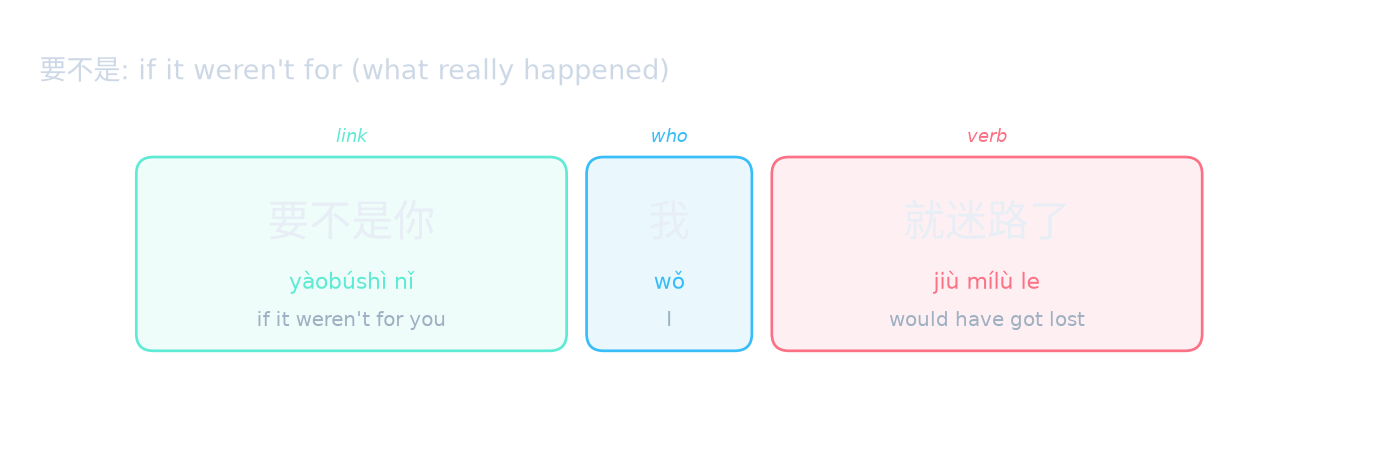
if it were not for要不是 (if it weren't for)
Form: if it were not for要不是 + person / event (if (coming after a…的话),(subject) + then / just就 + imagined result + (completed / change)了
- if it were not for要不是you你,I / me我then / just就to get lost迷路(completed / change)了。 Yàobúshì nǐ, wǒ jiù mílù le. – If it weren't for you, I'd have got lost.
- if it were not for要不是you你to remind提醒,I / me我maybe / possible可能then / just就to arrive late迟到(completed / change)了。 – Without your reminder, I might have been late.
- if it were not for要不是to rain下雨,we / us我们then / just就to go去to climb a mountain爬山(completed / change)了。 – If it weren't for the rain, we'd have gone hiking.
How it works. if it were not for要不是 yàobúshì names something that really happened (your help, the rain) and imagines the result without it. The result clause is unreal: in the first example, nobody got lost. maybe / possible可能 softens the imagined result.
| if it were not for要不是you你to remind提醒,I / me我then / just就to arrive late迟到(completed / change)了 | thanks to多亏you你to remind提醒,I / me我only then / not until才not / haven't没to arrive late迟到 |
|---|---|
| imagines the bad alternative | credits the real good result |
Watch out
- To report a real event, just state it: I / me我to get lost迷路(completed / change)了.
- if it were not for要不是 ≠ want / will / need要not不 (how about …) and ≠ otherwise要不然 (otherwise).
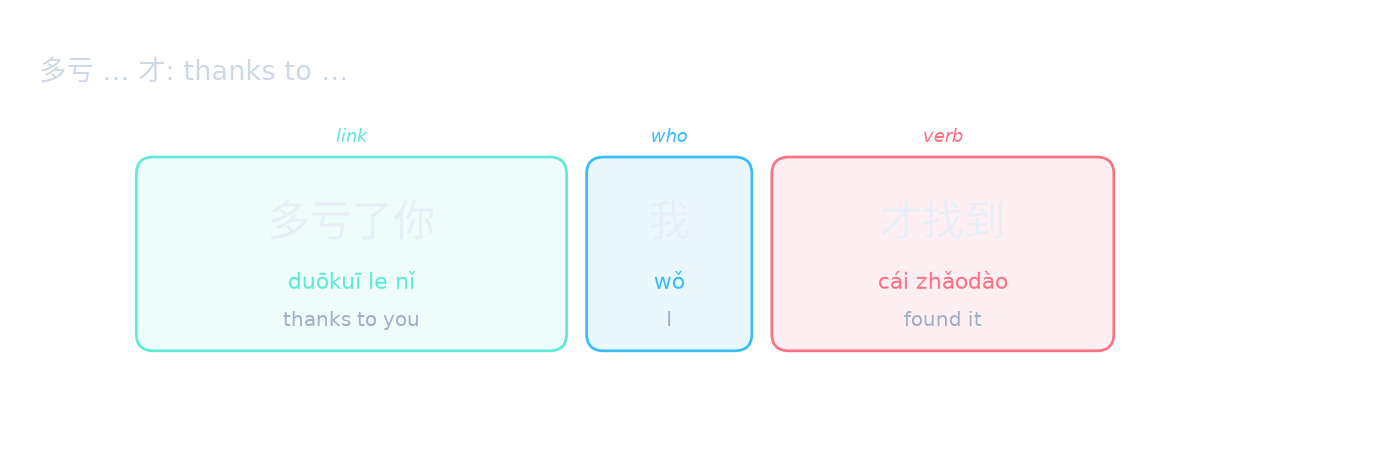
thanks to多亏 (thanks to / luckily)
Form: thanks to多亏 ((completed / change)了) + helper / event,(subject) + (only then / not until才) + good result
- thanks to多亏(completed / change)了you你,I / me我only then / not until才to find找到。 Duōkuī le nǐ, wǒ cái zhǎodào. – Thanks to you, I found it.
- thanks to多亏you你to remind提醒,I / me我only then / not until才not / haven't没to arrive late迟到。 – Thanks to your reminder, I wasn't late.
- thanks to多亏you你to remind提醒,I / me我to bring带(completed / change)了umbrella伞。 – Good thing you reminded me; I brought an umbrella.
How it works. thanks to多亏 duōkuī credits help or luck for a good result: thanks to …, luckily. only then / not until才 is common and stresses that the result depended on it; it is not required. The good result can be avoiding something bad (not / haven't没to arrive late迟到).
| thanks to多亏 | if it were not for要不是 |
|---|---|
| states the real good result | imagines the bad result without it |
Watch out
- Thanks to one helper doesn't mean nobody else helped.
- The result clause must match what happened: if the bag is still missing, I / me我only then / not until才to find找到 is wrong.
- In ordinary sincere use thanks to多亏 is thanks, not blame (an ironic tone can reverse it).
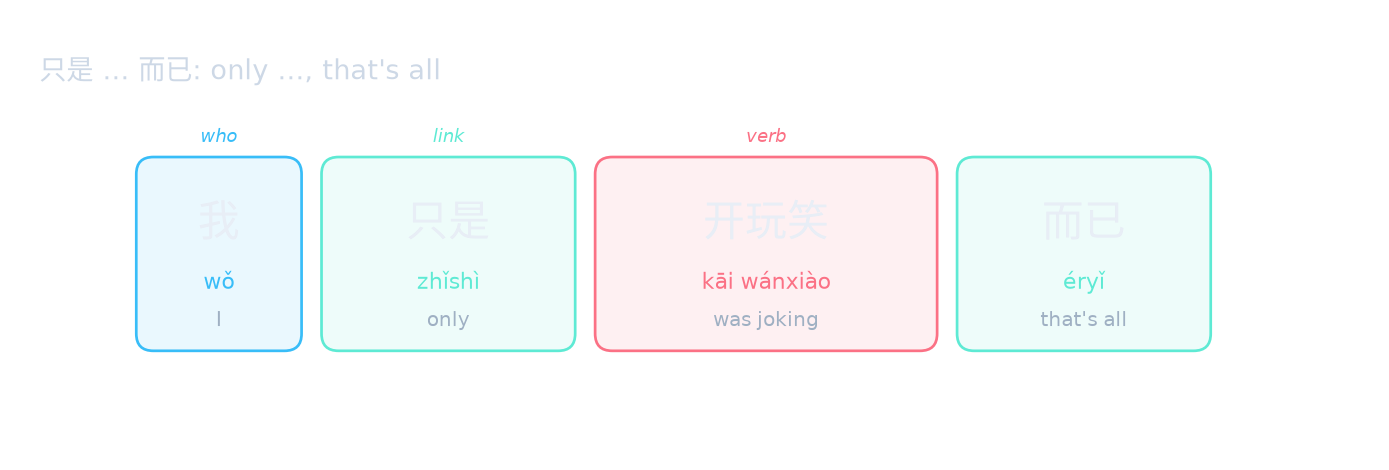
… that's all而已 (that's all / nothing more)
Form: (merely只是 / but不过 / only只) + statement + that's all而已
- I / me我merely只是to play a joke开玩笑that's all而已。 Wǒ zhǐshì kāi wánxiào éryǐ. – I was only joking, that's all.
- I / me我only只to look at; to watch; to read看(completed / change)了两页that's all而已。 – I've only read two pages.
- 两千元that's all而已。 – It's only two thousand yuan.
How it works. that's all而已 éryǐ closes a statement with "and nothing more", playing down an amount, role or intention. It often pairs with merely只是, but不过 or only只 earlier in the sentence. It is slightly formal or emphatic; a modal particle indicating…罢了 is similar.
| What is played down | Example |
|---|---|
| an intention | merely只是to play a joke开玩笑that's all而已 |
| an amount | only只to look at; to watch; to read看(completed / change)了两页that's all而已 |
| a role | merely只是to provide提供to suggest; suggestion建议that's all而已 |
Watch out
- that's all而已 shows the speaker's attitude, not the facts: 两千元 may still be a lot for you, and only只to wait; and so on等(completed / change)了四分钟 is still longer than a three-minute deadline.
- "Only joking" doesn't mean the listener wasn't hurt.
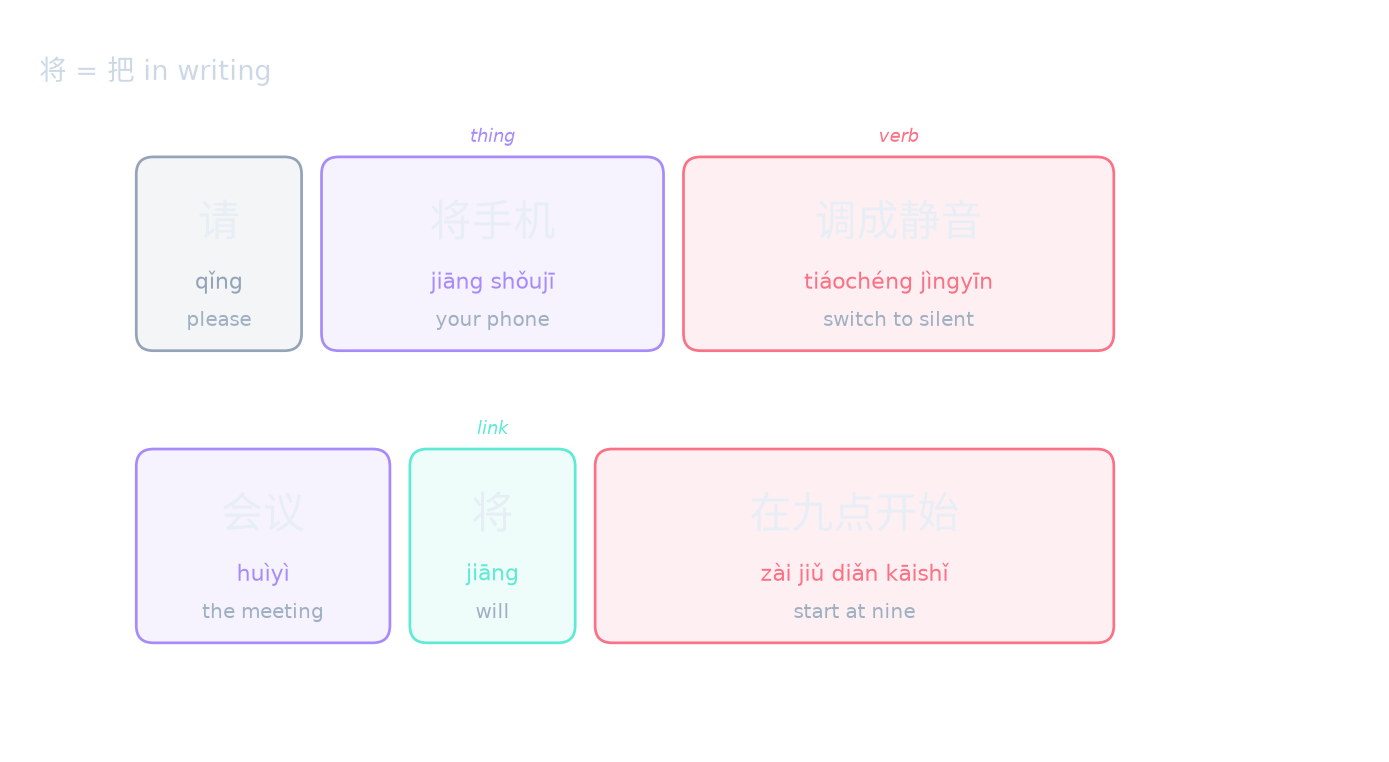
will / (formal 把)将 (a formal (把: marks the object)把)
Form: (please; to invite请) + will / (formal 把)将 + object + verb + result / place
- please; to invite请将门to close (a door)关上。 Qǐng jiāng mén guānshang. – Please close the door.
- please; to invite请will / (formal 把)将document文件放在桌上。 – Please put the documents on the table.
- please; to invite请don't不要will / (formal 把)将old (of things)旧document文件to delete删除。 – Please don't delete the old files.
How it works. will / (formal 把)将 jiāng is the written, formal form of (把: marks the object)把: it brings the object before the verb, and the verb needs a result or destination (to close (a door)关上, 放在桌上). It is typical of notices, instructions and news. The negative goes before will / (formal 把)将 (please; to invite请don't不要will / (formal 把)将……).
| please; to invite请将门to close (a door)关上 | meeting会议will / (formal 把)将at / in在tomorrow明天to hold (an event)举行 | door门(passive: by)被to close (a door)关上(completed / change)了 |
|---|---|---|
| = (把: marks the object)把: object marker | "will": future (formal) | passive report |
Watch out
- Decide will / (formal 把)将's job from what follows: an object then a verb means (把: marks the object)把-like; a verb right after will / (formal 把)将 means "will".
- An instruction is a request, not a report that it was done.
Practice without the models
Cover the teaching sections before you answer. The answers follow.
if it were not for要不是 (if it weren't for)
1. If it weren't for you, I'd have got lost. ………… you你,I / me我then / just就to get lost迷路(completed / change)了。
2. if it were not for要不是you你to remind提醒,I / me我then / just就to arrive late迟到(completed / change)了。 Was the speaker late?
- A. No
- B. We can't tell
- C. Yes
3. Which means "how about…"?
- A. don't不要
- B. otherwise要不然
- C. want / will / need要not不
- D. if it were not for要不是
4. True or false? if it were not for要不是to rain下雨,we / us我们then / just就to go去to climb a mountain爬山(completed / change)了 means it didn't rain. If false, correct it.
5. Say in Chinese: "If it weren't for the traffic, we'd be there by now."
6. If it weren't for your help, I couldn't have done it.
Put in order: I / me我 / if it were not for要不是 / you你to help帮忙, / then / just就 / to do; to make做not不to finish完(completed / change)了。
thanks to多亏 (thanks to / luckily)
7. Thanks to you, I found it. ………… (completed / change)了you你,I / me我only then / not until才to find找到。
8. Choose the best ending: thanks to多亏you你to remind提醒,……
- A. so / therefore所以I / me我to arrive late迟到(completed / change)了。
- B. I / me我then / just就to arrive late迟到(completed / change)了。
- C. I / me我only then / not until才not / haven't没to arrive late迟到。
- D. I / me我degree / adjective linker很to get angry生气。
9. How is thanks to多亏 different from if it were not for要不是?
- A. thanks to多亏 is always ironic
- B. they mean the same
- C. if it were not for要不是 is only positive
- D. thanks to多亏 states the real good result; if it were not for要不是 imagines the bad one
10. True or false? thanks to多亏you你to remind提醒,I / me我to bring带(completed / change)了umbrella伞 is wrong because it has no only then / not until才. If false, correct it.
11. Say in Chinese: "Luckily the doctor came quickly."
12. Thanks to the map, we didn't get lost.
Put in order: map地图, / only then / not until才 / thanks to多亏(completed / change)了 / we / us我们 / not / haven't没to get lost迷路。
… that's all而已 (that's all / nothing more)
13. I was only joking, that's all. I / me我merely只是to play a joke开玩笑 …………。
14. Which word often pairs with that's all而已?
- A. definitely / certain一定
- B. because因为
- C. (越…越) the more / to cross越
- D. merely只是
15. I / me我only只to wait; and so on等(completed / change)了四分钟that's all而已. The deadline was three minutes. Was the wait within it?
- A. No
- B. Yes
- C. We can't tell
16. True or false? 两千元that's all而已 proves the price is cheap for everyone. If false, correct it.
17. Say in Chinese: "I only read two pages."
18. It's just a small cold, nothing more.
Put in order: that's all而已。 / to be / is是 / small小to catch cold感冒 / but不过
will / (formal 把)将 (a formal (把: marks the object)把)
19. Please close the door. please; to invite请 ………… door门to close (a door)关上。
20. In meeting会议will / (formal 把)将at / in在tomorrow明天to hold (an event)举行, will / (formal 把)将 means…
- A. = (把: marks the object)把
- B. already
- C. will (future)
- D. passive
21. Which is the correct negative?
- A. please; to invite请will / (formal 把)将old (of things)旧document文件to delete删除don't不要。
- B. please; to invite请don't不要will / (formal 把)将old (of things)旧document文件to delete删除。
- C. please; to invite请will / (formal 把)将don't不要old (of things)旧document文件to delete删除。
- D. please; to invite请will / (formal 把)将old (of things)旧document文件don't不要to delete删除。
22. True or false? please; to invite请will / (formal 把)将document文件放在桌上 reports that the file is already on the table. If false, correct it.
23. Rewrite in everyday speech: please; to invite请will / (formal 把)将mobile phone手机to switch off关掉。
24. Please put the documents on the table.
Put in order: will / (formal 把)将 / document文件 / 桌上。 / 放在 / please; to invite请
Answers and explanations
if it were not for要不是 (if it weren't for)
1. if it were not for要不是
if it were not for要不是 + real help,then / just就 + imagined result.
2. A. No
The lateness is imagined; the reminder really happened.
3. C. want / will / need要not不
want / will / need要not不 + suggestion + (suggestion)吧.
4. False.
It did rain, so they didn't go.
5. if it were not for要不是traffic jam堵车,we / us我们already at an earlier time早就to / arrive / (result: get)到(completed / change)了。
Real obstacle, imagined result.
6. if it were not for要不是you你to help帮忙,I / me我then / just就to do; to make做not不to finish完(completed / change)了。
if it were not for要不是 + condition,subject + then / just就 + result.
thanks to多亏 (thanks to / luckily)
7. thanks to多亏
thanks to多亏 credits help for a good result.
8. C. I / me我only then / not until才not / haven't没to arrive late迟到。
thanks to多亏 needs a real good result.
9. D. thanks to多亏 states the real good result; if it were not for要不是 imagines the bad one
Compare thanks to多亏you你,I / me我only then / not until才not / haven't没to arrive late迟到 with if it were not for要不是you你,I / me我then / just就to arrive late迟到(completed / change)了.
10. False.
only then / not until才 is common but not required.
11. thanks to多亏doctor医生来得快。
thanks to多亏 + event.
12. thanks to多亏(completed / change)了map地图,we / us我们only then / not until才not / haven't没to get lost迷路。
thanks to多亏 ((completed / change)了) + helper,only then / not until才 + result.
… that's all而已 (that's all / nothing more)
13. that's all而已
that's all而已 closes a statement: nothing more.
14. D. merely只是
merely只是 / but不过 …… that's all而已.
15. A. No
that's all而已 plays it down, but four is still more than three.
16. False.
It shows the speaker's attitude, not the listener's budget.
17. I / me我only只to look at; to watch; to read看(completed / change)了两页that's all而已。
only只 …… that's all而已.
18. but不过to be / is是small小to catch cold感冒that's all而已。
but不过 …… that's all而已.
will / (formal 把)将 (a formal (把: marks the object)把)
19. will / (formal 把)将
Formal will / (formal 把)将 = (把: marks the object)把.
20. C. will (future)
A verb (phrase) follows directly: future will / (formal 把)将.
21. B. please; to invite请don't不要will / (formal 把)将old (of things)旧document文件to delete删除。
The negative goes before will / (formal 把)将.
22. False.
It is a request.
23. please; to invite请handle把手government office; mechanism机关to fall; to drop掉。
will / (formal 把)将 is the written form of (把: marks the object)把.
24. please; to invite请will / (formal 把)将document文件放在桌上。
will / (formal 把)将 + object + verb + place.