Skip to content
Subjects
  • 1 Adjectives
    • 1.1 Adjectival complement "de budeliao"
    • 1.2 Adjectival complement "de hen"
    • 1.3 Expressing "a bit too"
    • 1.4 Saying "a lot" with "youdeshi"

    Adjectives →

  • 2 Adverbs
    • 2.1 Advanced uses of "dou"
    • 2.2 Advanced uses of "hai"
    • 2.3 Advanced uses of "zong"
    • 2.4 Expressing "after all" with "bijing"
    • 2.5 Expressing "almost" using "chadian mei"
    • 2.6 Expressing "anyway" with "fanzheng"
    • 2.7 Expressing "as much as possible" with "jinliang"
    • 2.8 Expressing "each other" with "huxiang"
    • 2.9 Expressing "feel free" with "jinguan"
    • 2.10 Expressing "just" do it with "gancui"
    • 2.11 Expressing "never again" with "zai ye bu"
    • 2.12 Expressing "once" with "cengjing"
    • 2.13 Expressing "over and over again" with "zaisan"
    • 2.14 Expressing "simply" with "jianzhi"
    • 2.15 Expressing "while you're at it" with "shunbian"
    • 2.16 Expressing a last chance with "zaibu... jiu..."
    • 2.17 Expressing difficulty with "hao (bu) rongyi"
    • 2.18 Expressing wasted efforts with "bai"
    • 2.19 Repeated actions in the past with "you"
    • 2.20 The opposite of "chabuduo" is "cha hen duo"

    Adverbs →

  • 3 Auxiliary Words
    • 3.1 Listing things with "a"

    Auxiliary Words →

  • 4 Conjunctions
    • 4.1 Expressing "how about" with "yaobu"

    Conjunctions →

  • 5 Nouns
    • 5.1 Expressing "among" with "dangzhong"
    • 5.2 Expressing "each other" with "bici"
    • 5.3 Expressing "ever since" with "yilai"
    • 5.4 Expressing "when" using "dang"
    • 5.5 Name-calling with "zhege"

    Nouns →

  • 6 Particles
    • 6.1 Advanced "le" after an object
    • 6.2 Advanced "le" with complements
    • 6.3 Marking a topic with "ma"
    • 6.4 Softening the tone of questions with "ne"

    Particles →

  • 7 Prepositional Phrase

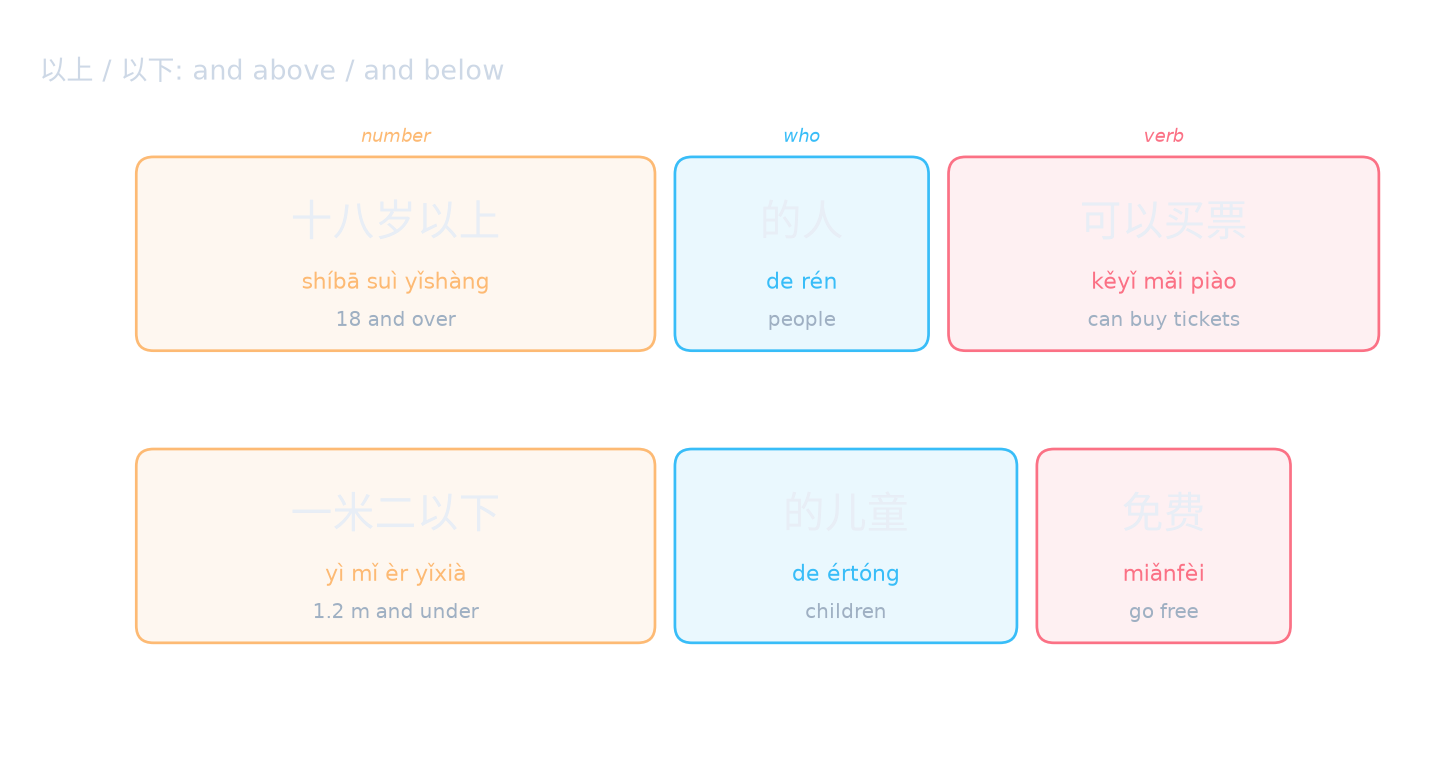
    above / the above以上yǐ shàng / that level or lower以下yǐ xià (and above / and below)

    Form: number + unit + above / the above以上yǐ shàng / that level or lower以下yǐ xià · number + unit + above / the above以上yǐ shàng / that level or lower以下yǐ xià + (modifier / structural particle)的de + noun

    • 十八岁shí bā suìabove / the above以上yǐ shàngonly then can / talent才能cái néngto look at; to watch; to read看kàn。 Shíbā suì yǐshàng cái néng kàn. – Only those 18 and over may watch.
    • thirty三十sān shíperson人rénthat level or lower以下yǐ xià,to include包括bāo kuòthirty三十sān shíperson人rén。 Sānshí rén yǐxià, bāokuò sānshí rén. – Thirty people or fewer, thirty included.
    • 三十元sān shí yuánthat level or lower以下yǐ xià(modifier / structural particle)的degift礼物lǐ wùall / both都dōucan / may可以kě yǐ。 Sānshí yuán yǐxià de lǐwù dōu kěyǐ. – Any gift of thirty yuan or less is fine.
    • 六岁liù suìthat level or lower以下yǐ xià(modifier / structural particle)的dechild儿童ér tóngfree免费miǎn fèi。 Liù suì yǐxià de értóng miǎnfèi. – Children aged six and under go free.
    • today今天jīn tiāntallest最高zuì gāoair temperature气温qì wēnat / in在zài三十五sān shí wǔdegree / extent度dùabove / the above以上yǐ shàng。 Jīntiān zuì gāo qìwēn zài sānshíwǔ dù yǐshàng. – Today's top temperature is above 35 degrees.
    • achievement成绩chéng jìeight八bāvery十分shí fēnabove / the above以上yǐ shàng(modifier / structural particle)的declassmate同学tóng xuécan / may可以kě yǐto participate参加cān jiācompetition比赛bǐ sài。 Chéngjì bāshí fēn yǐshàng de tóngxué kěyǐ cānjiā bǐsài. – Students who scored 80 or more can enter the competition.

    How it works. above / the above以上yǐ shàng yǐshàng "and above" and that level or lower以下yǐ xià yǐxià "and below" follow the number and its unit; the unit says what is counted (years old岁suì, person人rén, yuan元yuán, degree / extent度dù, minute / point / to divide分fēn). Before a noun, add (modifier / structural particle)的de: 六岁liù suìthat level or lower以下yǐ xià(modifier / structural particle)的dechild儿童ér tóng. With at / in在zài they describe a range: at / in在zài三十五sān shí wǔdegree / extent度dùabove / the above以上yǐ shàng.

    In everyday use and on most notices the number itself is included, and careful notices say so with to include包括bāo kuò (to include包括bāo kuòthirty三十sān shíperson人rén). only then can / talent才能cái néng turns the range into a condition: only people in it may do the thing, though other conditions may still apply. When the exact edge matters, Chinese also has words that clearly include or exclude it.

    Expression Thirty included?
    thirty三十sān shíperson人rénthat level or lower以下yǐ xià (to include包括bāo kuòthirty三十sān shíperson人rén) yes
    thirty三十sān shíperson人rénwithin以内yǐ nèi / most最zuìmany; much多duōthirty三十sān shíperson人rén yes
    not reach / less than不到bú dàothirty三十sān shíperson人rén no: at most 29
    to exceed超过chāo guòthirty三十sān shíperson人rén no: 31 or more

    Work it out. Limit thirty三十sān shíperson人rénthat level or lower以下yǐ xià,to include包括bāo kuòthirty三十sān shíperson人rén, with 29 inside: one more may enter; two more make 31, over the limit.

    Watch out

    • The unit comes before above / the above以上yǐ shàng / that level or lower以下yǐ xià: wrong: eighteen十八shí bāabove / the above以上yǐ shàngyears old岁suì → 十八岁shí bā suìabove / the above以上yǐ shàng.
    • above / the above以上yǐ shàng / that level or lower以下yǐ xià follow the number; they never come first: wrong: above / the above以上yǐ shàng十八岁shí bā suì → 十八岁shí bā suìabove / the above以上yǐ shàng.
    • At the end of a speech or text, above / the above以上yǐ shàng also means "the above": above / the above以上yǐ shàngto be / is是shìI / me我wǒ(modifier / structural particle)的deview; way of seeing看法kàn fǎ (that is my view, as stated above).

    In a passage

    museum博物馆bó wù guǎnto notify / notice通知tōng zhī:本馆běn guǎnevery day每天měi tiānmost最zuìmany; much多duōto receive (guests)接待jiē dài两千人liǎng qiān rén。六岁liù suìthat level or lower以下yǐ xià(modifier / structural particle)的dechild儿童ér tóngand / with和hé六十五岁liù shí wǔ suìabove / the above以上yǐ shàng(modifier / structural particle)的deold man or woman老人lǎo rén免费参观miǎn fèi cān guān。twenty二十èr shíperson人rénabove / the above以上yǐ shàng(modifier / structural particle)的deorganization团体tuán tǐplease; to invite请qǐngin advance / move earlier提前tí qián一天yī tiānbooking预约yù yuē。馆内guǎn nèitemperature温度wēn dùto keep保持bǎo chíat / in在zài二十度èr shí dùabove / the above以上yǐ shàng,please; to invite请qǐngtraveler游客yóu kèto feel relieved放心fàng xīnto look around参观cān guān。

    Read and notice. Who gets in free? How many people make a group that must book in advance?
    以上 / 以下: and above / and below

    Practice without the models

    Cover the teaching sections before you answer. The answers follow.

    1. Only those 18 and over may watch. 十八岁shí bā suì ………… only then can / talent才能cái néngto look at; to watch; to read看kàn。

    2. A room says thirty三十sān shíperson人rénthat level or lower以下yǐ xià,to include包括bāo kuòthirty三十sān shíperson人rén. 29 people are inside. How many more may enter?

    • A. 0
    • B. 2
    • C. 3
    • D. 1

    3. Which excludes thirty?

    • A. thirty三十sān shíperson人rénthat level or lower以下yǐ xià,to include包括bāo kuòthirty三十sān shíperson人rén
    • B. not reach / less than不到bú dàothirty三十sān shíperson人rén
    • C. thirty三十sān shíperson人rénwithin以内yǐ nèi
    • D. most最zuìmany; much多duōthirty三十sān shíperson人rén

    4. True or false? to exceed超过chāo guòthirty三十sān shíperson人rén includes thirty. If false, correct it.

    5. Say in Chinese: "Thirty yuan or less."

    6. Children under six get in free.

    Put in order: that level or lower以下yǐ xià(modifier / structural particle)的de / free免费miǎn fèi。 / 六岁liù suì / child儿童ér tóng

    Answers and explanations

    1. above / the above以上yǐ shàng

    Number + unit + above / the above以上yǐ shàng.

    2. D. 1

    30 is the limit and it is included.

    3. B. not reach / less than不到bú dàothirty三十sān shíperson人rén

    not reach / less than不到bú dào = fewer than.

    4. False.

    to exceed超过chāo guò means more than thirty: 31 or more.

    5. 三十元sān shí yuánthat level or lower以下yǐ xià

    Number + unit + that level or lower以下yǐ xià.

    6. 六岁liù suìthat level or lower以下yǐ xià(modifier / structural particle)的dechild儿童ér tóngfree免费miǎn fèi。

    Number + unit + that level or lower以下yǐ xià modifies the noun.

  • 8 Prepositions
    • 8.1 Expressing "ever since" with "zicong"
    • 8.2 Expressing "for" with "wei"
    • 8.3 Expressing "for…" with "eryan"
    • 8.4 Expressing "including" with "zainei"
    • 8.5 Expressing "on the basis of" with "ping"
    • 8.6 Expressing "with regards to" with "zhiyu"
    • 8.7 Expressing passive voice with "gei"
    • 8.8 Limiting scope with "jiu"
    • 8.9 Opportune timing with "chen"

    Prepositions →

  • 9 Sentence Patterns
    • 9.1 Expressing "if it were not for" with "yaobushi"
    • 9.2 Expressing "thanks to" with "duokui"
    • 9.3 Expressing "that's all" with "eryi"
    • 9.4 Using "jiang" as a formal "ba"

    Sentence Patterns →

  • 10 Verbs
    • 10.1 Challenging a verb with "shenme"
    • 10.2 Comparing specifically with "xiang"
    • 10.3 Comparisons with "biqi"
    • 10.4 Comparisons with "buru"
    • 10.5 Making "-ize" and "-ify" verbs with "hua"
    • 10.6 Making judgments with "suan"
    • 10.7 Using "nanguai" as a verb

    Verbs →

  • 11 Auxiliary verbs
    • 11.1 Expressing future with "jiang"

    Auxiliary verbs →

  • 12 Verb phrases
    • 12.1 Expressing "hard to avoid" with "nanmian"
    • 12.2 Passive verbs with "shou"

    Verb phrases →

  • 13 "But" Statements
    • 13.1 Expressing "on the contrary" with "fan'er"

    "But" Statements →

  • 14 "Even If" Statements
    • 14.1 Expressing "even if…" with "jiushi"
    • 14.2 Expressing "even if…" with "jiusuan"
    • 14.3 Expressing "even if…" with "napa"

    "Even If" Statements →

  • 15 "If" Statements
    • 15.1 Expressing "if… then…" with "jiaru"
    • 15.2 Expressing "what if" with "wanyi"
    • 15.3 Marking a topic with "de hua"

    "If" Statements →

  • 16 Adverbs with Adjectives
    • 16.1 Expressing "especially" with "gewai"

    Adverbs with Adjectives →

  • 17 Cause/Effect Statements
    • 17.1 Stating the effect before the cause

    Cause/Effect Statements →

  • 18 Complements
    • 18.1 Advanced degree complements
    • 18.2 Advanced potential complements
    • 18.3 Advanced result complements "zhu", "kai", and "chulai"
    • 18.4 Complement "-huai le"
    • 18.5 Complement "-zhao"
    • 18.6 Tricky uses of "dao"
    • 18.7 Using "lai" and "qu" when "verbing around"

    Complements →

  • 19 Conditional Statements
    • 19.1 Expressing "once...then..." with "yidan...jiu..."

    Conditional Statements →

  • 20 Sentence Patterns
    • 20.1 Advanced uses of "ba"
    • 20.2 Basic comparisons with "bu bi"
    • 20.3 Conditions with "yao" and "jiu"
    • 20.4 Expressing "can't do without" with "shaobuliao"
    • 20.5 Expressing "equal to" with "dengyu"
    • 20.6 Expressing "from" with "cong... zhong"
    • 20.7 Expressing "no" (noun) "to" (verb) with "wu... ke..."
    • 20.8 Expressing "not only..., even..." using "budan..., shenzhi lian"
    • 20.9 Expressing "related to..." with "you guan de"
    • 20.10 Expressing "so-called" with "suowei"
    • 20.11 Expressing "within" a period of time using "zai... nei"
    • 20.12 Expressing "would rather" with "ningke"
    • 20.13 Expressing indifference with "jiu"
    • 20.14 Expressing purpose with "hao"
    • 20.15 Expressing simultaneous actions with "yimian"
    • 20.16 Expressing the only two possibilities

    Sentence Patterns →

  • 21 Complex Sentence Patterns
    • 21.1 Expressing "no wonder"

    Complex Sentence Patterns →

  • 22 Either… or
    • 22.1 Providing two options with double "huozhe"

    Either… or →

  • 23 Let alone
    • 23.1 Expressing "let alone" with "bie shuo"
    • 23.2 Expressing "let alone" with "geng buyong shuo"

    Let alone →

  • 24 Comparing similar adverbs
    • 24.1 Comparing "changchang" and "jingchang"

    Comparing similar adverbs →

  • 25 Comparing similar auxiliary words
    • 25.1 Comparing "zongsuan" and “zhongyu"

    Comparing similar auxiliary words →

  • 26 Comparing similar conjunctions
    • 26.1 Comparing "gen" and "dui"

    Comparing similar conjunctions →

  • 27 Comparing similar prepositions
    • 27.1 Comparing "chao" "xiang" and "wang"
    • 27.2 Comparing "dui" and "duiyu"
    • 27.3 Comparing "duiyu" and "zhiyu"
    • 27.4 Comparing "gei" and "wei"

    Comparing similar prepositions →

  • 28 Comparing similar time words
    • 28.1 Comparing "pingshi" and "pingchang"
    • 28.2 Comparing "yihou" and "zhihou"

    Comparing similar time words →

  • 29 Comparing similar verbs
    • 29.1 Comparing "kanqilai" and "kanlai"
    • 29.2 Comparing "xiande" and "kanqilai"

    Comparing similar verbs →

Log in or create account

IGCSE, A-Level & AP