Skip to content
Subjects
  • 1 Adjectives
    • 1.1 Adjectival complement "de budeliao"
    • 1.2 Adjectival complement "de hen"
    • 1.3 Expressing "a bit too"
    • 1.4 Saying "a lot" with "youdeshi"

    Adjectives →

  • 2 Adverbs
    • 2.1 Advanced uses of "dou"
    • 2.2 Advanced uses of "hai"
    • 2.3 Advanced uses of "zong"
    • 2.4 Expressing "after all" with "bijing"
    • 2.5 Expressing "almost" using "chadian mei"
    • 2.6 Expressing "anyway" with "fanzheng"
    • 2.7 Expressing "as much as possible" with "jinliang"
    • 2.8 Expressing "each other" with "huxiang"
    • 2.9 Expressing "feel free" with "jinguan"
    • 2.10 Expressing "just" do it with "gancui"
    • 2.11 Expressing "never again" with "zai ye bu"
    • 2.12 Expressing "once" with "cengjing"
    • 2.13 Expressing "over and over again" with "zaisan"
    • 2.14 Expressing "simply" with "jianzhi"
    • 2.15 Expressing "while you're at it" with "shunbian"
    • 2.16 Expressing a last chance with "zaibu... jiu..."
    • 2.17 Expressing difficulty with "hao (bu) rongyi"
    • 2.18 Expressing wasted efforts with "bai"
    • 2.19 Repeated actions in the past with "you"
    • 2.20 The opposite of "chabuduo" is "cha hen duo"

    Adverbs →

  • 3 Auxiliary Words
    • 3.1 Listing things with "a"

    Auxiliary Words →

  • 4 Conjunctions
    • 4.1 Expressing "how about" with "yaobu"

    Conjunctions →

  • 5 Nouns
    • 5.1 Expressing "among" with "dangzhong"
    • 5.2 Expressing "each other" with "bici"
    • 5.3 Expressing "ever since" with "yilai"
    • 5.4 Expressing "when" using "dang"
    • 5.5 Name-calling with "zhege"

    Nouns →

  • 6 Particles
    • 6.1 Advanced "le" after an object
    • 6.2 Advanced "le" with complements
    • 6.3 Marking a topic with "ma"
    • 6.4 Softening the tone of questions with "ne"

    Particles →

  • 7 Prepositional Phrase
    • 7.1 Defining upper and lower limits

    Prepositional Phrase →

  • 8 Prepositions
    • 8.1 Expressing "ever since" with "zicong"
    • 8.2 Expressing "for" with "wei"
    • 8.3 Expressing "for…" with "eryan"
    • 8.4 Expressing "including" with "zainei"
    • 8.5 Expressing "on the basis of" with "ping"
    • 8.6 Expressing "with regards to" with "zhiyu"
    • 8.7 Expressing passive voice with "gei"
    • 8.8 Limiting scope with "jiu"
    • 8.9 Opportune timing with "chen"

    Prepositions →

  • 9 Sentence Patterns
    • 9.1 Expressing "if it were not for" with "yaobushi"
    • 9.2 Expressing "thanks to" with "duokui"
    • 9.3 Expressing "that's all" with "eryi"
    • 9.4 Using "jiang" as a formal "ba"

    Sentence Patterns →

  • 10 Verbs
    • 10.1 Challenging a verb with "shenme"
    • 10.2 Comparing specifically with "xiang"
    • 10.3 Comparisons with "biqi"
    • 10.4 Comparisons with "buru"
    • 10.5 Making "-ize" and "-ify" verbs with "hua"
    • 10.6 Making judgments with "suan"
    • 10.7 Using "nanguai" as a verb

    Verbs →

  • 11 Auxiliary verbs
    • 11.1 Expressing future with "jiang"

    Auxiliary verbs →

  • 12 Verb phrases
    • 12.1 Expressing "hard to avoid" with "nanmian"
    • 12.2 Passive verbs with "shou"

    Verb phrases →

  • 13 "But" Statements
    • 13.1 Expressing "on the contrary" with "fan'er"

    "But" Statements →

  • 14 "Even If" Statements
    • 14.1 Expressing "even if…" with "jiushi"
    • 14.2 Expressing "even if…" with "jiusuan"
    • 14.3 Expressing "even if…" with "napa"

    "Even If" Statements →

  • 15 "If" Statements
    • 15.1 Expressing "if… then…" with "jiaru"
    • 15.2 Expressing "what if" with "wanyi"
    • 15.3 Marking a topic with "de hua"

    "If" Statements →

  • 16 Adverbs with Adjectives
    • 16.1 Expressing "especially" with "gewai"

    Adverbs with Adjectives →

  • 17 Cause/Effect Statements
    • 17.1 Stating the effect before the cause

    Cause/Effect Statements →

  • 18 Complements
    • 18.1 Advanced degree complements
    • 18.2 Advanced potential complements
    • 18.3 Advanced result complements "zhu", "kai", and "chulai"
    • 18.4 Complement "-huai le"
    • 18.5 Complement "-zhao"
    • 18.6 Tricky uses of "dao"
    • 18.7 Using "lai" and "qu" when "verbing around"

    Complements →

  • 19 Conditional Statements
    • 19.1 Expressing "once...then..." with "yidan...jiu..."

    Conditional Statements →

  • 20 Sentence Patterns
    • 20.1 Advanced uses of "ba"
    • 20.2 Basic comparisons with "bu bi"
    • 20.3 Conditions with "yao" and "jiu"
    • 20.4 Expressing "can't do without" with "shaobuliao"
    • 20.5 Expressing "equal to" with "dengyu"
    • 20.6 Expressing "from" with "cong... zhong"
    • 20.7 Expressing "no" (noun) "to" (verb) with "wu... ke..."
    • 20.8 Expressing "not only..., even..." using "budan..., shenzhi lian"
    • 20.9 Expressing "related to..." with "you guan de"
    • 20.10 Expressing "so-called" with "suowei"
    • 20.11 Expressing "within" a period of time using "zai... nei"
    • 20.12 Expressing "would rather" with "ningke"
    • 20.13 Expressing indifference with "jiu"
    • 20.14 Expressing purpose with "hao"
    • 20.15 Expressing simultaneous actions with "yimian"
    • 20.16 Expressing the only two possibilities

    Sentence Patterns →

  • 21 Complex Sentence Patterns
    • 21.1 Expressing "no wonder"

    Complex Sentence Patterns →

  • 22 Either… or
    • 22.1 Providing two options with double "huozhe"

    Either… or →

  • 23 Let alone
    • 23.1 Expressing "let alone" with "bie shuo"
    • 23.2 Expressing "let alone" with "geng buyong shuo"

    Let alone →

  • 24 Comparing similar adverbs
    • 24.1 Comparing "changchang" and "jingchang"

    Comparing similar adverbs →

  • 25 Comparing similar auxiliary words
    • 25.1 Comparing "zongsuan" and “zhongyu"

    Comparing similar auxiliary words →

  • 26 Comparing similar conjunctions
    • 26.1 Comparing "gen" and "dui"

    Comparing similar conjunctions →

  • 27 Comparing similar prepositions
    • 27.1 Comparing "chao" "xiang" and "wang"
    • 27.2 Comparing "dui" and "duiyu"
    • 27.3 Comparing "duiyu" and "zhiyu"
    • 27.4 Comparing "gei" and "wei"

    Comparing similar prepositions →

  • 28 Comparing similar time words

    usually; normally平时píng shí vs usually / ordinary平常píng cháng (usually / ordinary)

    Form: usually; normally平时píng shí / usually / ordinary平常píng cháng + routine (usually) · degree / adjective linker很hěnusually / ordinary平常píng cháng / usually / ordinary平常píng cháng(modifier / structural particle)的de + noun (ordinary)

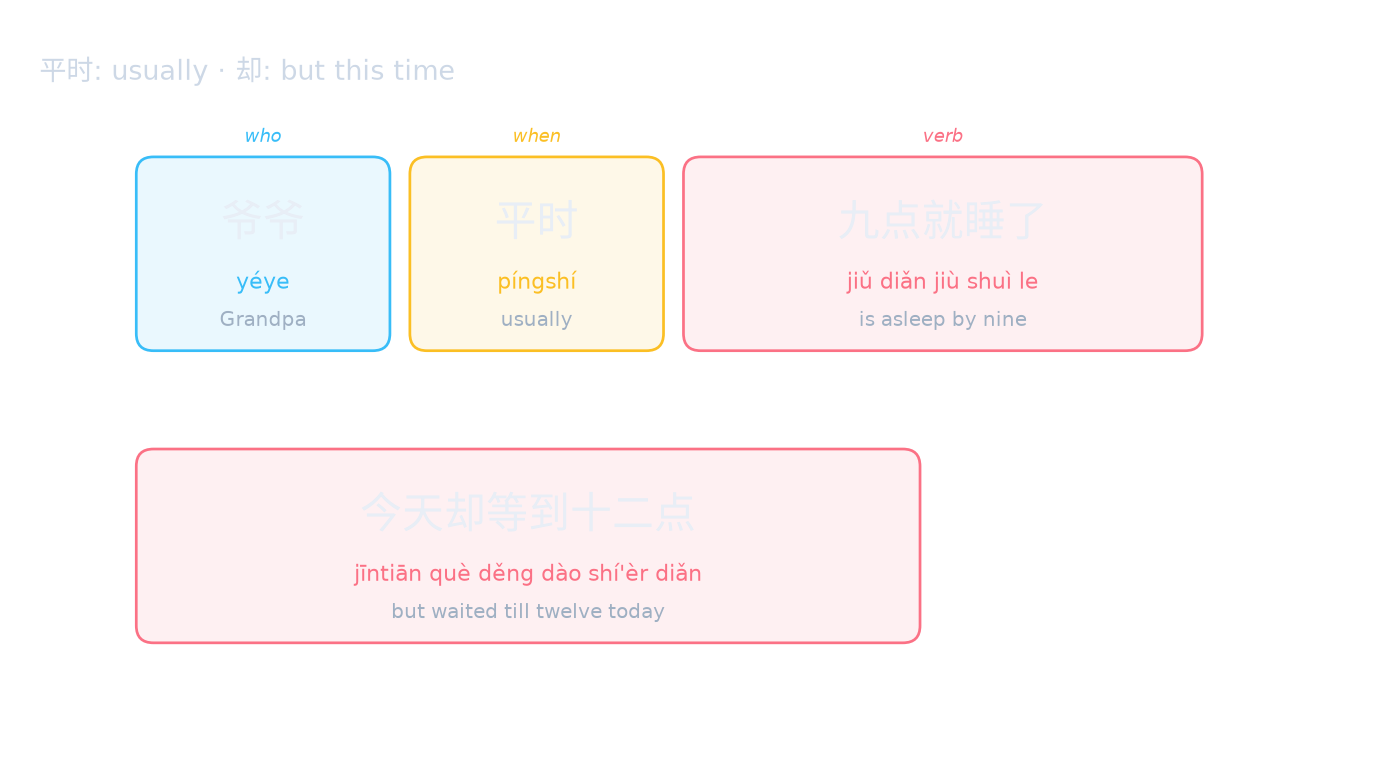
    • father's father爷爷yé yéusually; normally平时píng shí九点jiǔ diǎnthen / just就jiùto sleep睡shuì(completed / change)了le,today今天jīn tiānbut; yet却quèall along / straight一直yì zhíto wait until等到děng dào十二点shí èr diǎn。 Píngshí – Grandpa usually goes to bed at nine, but today he stayed up until midnight.
    • I / me我wǒusually / ordinary平常píng cháng七点qī diǎnto get up起床qǐ chuáng。 – I usually get up at seven.
    • this这zhèto be / is是shìdegree / adjective linker很hěnusually / ordinary平常píng cháng(modifier / structural particle)的dematter事shì。 – That's a very ordinary thing.

    How it works. Both can mean "usually, normally", and usually; normally平时píng shí sets ordinary days clearly against a special occasion (usually; normally平时píng shídegree / adjective linker很hěnbusy忙máng,weekend周末zhōu mòonly then / not until才cáito have time (to do sth)有空yǒu kòng). Only usually / ordinary平常píng cháng is also an adjective, "ordinary".

    usually; normally平时píng shí usually / ordinary平常píng cháng usually通常tōng cháng
    usually ✓ ✓ as a rule (more formal)
    ordinary (adj.) — degree / adjective linker很hěnusually / ordinary平常píng cháng —
    example with / and跟gēnusually; normally平时píng shíthe same一样yí yàng usually / ordinary平常píng cháng(modifier / structural particle)的delife; to live生活shēng huó bank银行yín hángusually通常tōng cháng九点jiǔ diǎnto open a door (lit. and…开门kāi mén

    Watch out

    • wrong: degree / adjective linker很hěnusually; normally平时píng shí → degree / adjective linker很hěnusually / ordinary平常píng cháng.
    平时: usually · 却: but this time

    after / from now on以后yǐ hòu vs after之后zhī hòu (after / afterwards)

    Form: event / time span + after / from now on以后yǐ hòu / after之后zhī hòu · after之后zhī hòu,… (afterwards) · after / from now on以后yǐ hòu,… (from now on)

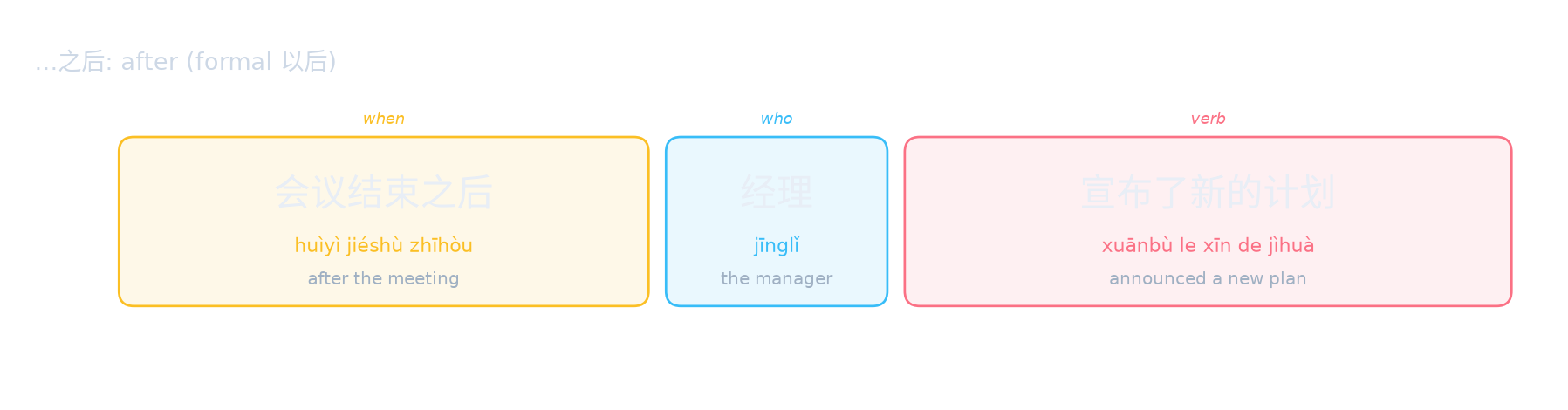
    • meeting会议huì yìto end结束jié shùafter之后zhī hòu,manager经理jīng lǐto declare; to announce宣布xuān bù(completed / change)了lenew新xīn(modifier / structural particle)的deplan计划jì huà。 Huìyì jiéshù zhīhòu … – After the meeting, the manager announced the new plan.
    • we / us我们wǒ menfirst先xiānto go去qù(completed / change)了lemuseum博物馆bó wù guǎn。after之后zhī hòu,we / us我们wǒ mento go去qùto have a meal吃饭chī fàn。 – We went to the museum first. Afterwards, we went to eat.
    • after / from now on以后yǐ hòudon't别biéto arrive late迟到chí dào(completed / change)了le。 – Don't be late from now on.
    • 三天sān tiānafter / from now on以后yǐ hòu / 三天sān tiānafter之后zhī hòu – three days later

    How it works. After an event or time span, after / from now on以后yǐ hòu and after之后zhī hòu both mean "after"; after之后zhī hòu sounds slightly more written. Standing alone at the start, they differ:

    Alone at the start Meaning
    after之后zhī hòu / later; afterwards后来hòu lái afterwards (in a past story)
    after / from now on以后yǐ hòu in the future, from now on

    Watch out

    • In a past story, don't use bare after / from now on以后yǐ hòu for "afterwards": use after之后zhī hòu or later; afterwards后来hòu lái.
    • not long (after)不久bù jiǔafter之后zhī hòu "not long after" is a fixed phrase.
    …之后: after (formal 以后)

    Practice without the models

    Cover the teaching sections before you answer. The answers follow.

    usually; normally平时píng shí vs usually / ordinary平常píng cháng (usually / ordinary)

    1. Complete: “This is a very ordinary thing.” this这zhèto be / is是shìdegree / adjective linker很hěn…………(modifier / structural particle)的dematter事shì。

    2. Which is wrong?

    • A. with / and跟gēnusually; normally平时píng shíthe same一样yí yàng。
    • B. this这zhèto be / is是shìdegree / adjective linker很hěnusually; normally平时píng shí(modifier / structural particle)的dematter事shì。
    • C. he / him他tāusually; normally平时píng shídegree / adjective linker很hěnbusy忙máng。
    • D. he / him他tāusually / ordinary平常píng chángdegree / adjective linker很hěnbusy忙máng。

    3. Build: “He's usually busy; only at weekends is he free.”

    Put in order: only then / not until才cáito have time (to do sth)有空yǒu kòng。 / he / him他tāusually; normally平时píng shídegree / adjective linker很hěnbusy忙máng / , / weekend周末zhōu mò

    4. True or false? usually通常tōng cháng is a little more formal than usually; normally平时píng shí. If false, correct it.

    5. Your grandfather normally goes to bed at nine, but tonight is New Year's Eve. Use usually; normally平时píng shí or usually / ordinary平常píng cháng. Write your answer in Chinese, then say it aloud.

    after / from now on以后yǐ hòu vs after之后zhī hòu (after / afterwards)

    6. Past story: “We went to the museum. Afterwards, we ate.” we / us我们wǒ mento go去qù(completed / change)了lemuseum博物馆bó wù guǎn。…………,we / us我们wǒ mento go去qùto have a meal吃饭chī fàn。

    7. “From now on, please don't be late.” Which fits? ____请别qǐng biéto arrive late迟到chí dào(completed / change)了le。

    • A. later; afterwards后来hòu lái
    • B. then / after然后rán hòu
    • C. after之后zhī hòu
    • D. after / from now on以后yǐ hòu

    8. Build: “Not long after, he returned home.”

    Put in order: ,he / him他tā / then / just就jiù / not long (after)不久bù jiǔafter之后zhī hòu / to return to one's home…回国huí guó(completed / change)了le。

    9. True or false? to finish class下课xià kèafter / from now on以后yǐ hòu and to finish class下课xià kèafter之后zhī hòu mean the same. If false, correct it.

    10. You are writing up what happened after a company meeting. Use after / from now on以后yǐ hòu or after之后zhī hòu. Write your answer in Chinese, then say it aloud.

    Answers and explanations

    usually; normally平时píng shí vs usually / ordinary平常píng cháng (usually / ordinary)

    1. usually / ordinary平常píng cháng

    Only usually / ordinary平常píng cháng is an adjective meaning “ordinary”.

    2. B. this这zhèto be / is是shìdegree / adjective linker很hěnusually; normally平时píng shí(modifier / structural particle)的dematter事shì。

    usually; normally平时píng shí is a time noun (“usually, ordinary times”), not an adjective, so degree / adjective linker很hěnusually; normally平时píng shí(modifier / structural particle)的dematter事shì is wrong. The adjective “ordinary” is usually / ordinary平常píng cháng: degree / adjective linker很hěnusually / ordinary平常píng cháng(modifier / structural particle)的dematter事shì.

    3. he / him他tāusually; normally平时píng shídegree / adjective linker很hěnbusy忙máng,weekend周末zhōu mòonly then / not until才cáito have time (to do sth)有空yǒu kòng。

    usually; normally平时píng shí contrasts with the weekend.

    4. True.

    True. usually通常tōng cháng (“as a rule, normally”) is slightly more formal than usually; normally平时píng shí and often states general patterns.

    5. Model answer: father's father爷爷yé yéusually; normally平时píng shí九点jiǔ diǎnthen / just就jiùto sleep睡shuì(completed / change)了le,today今天jīn tiānbut; yet却quèall along / straight一直yì zhíto wait until等到děng dào十二点shí èr diǎn。

    Check your answer:

    • "Ordinary" takes usually / ordinary平常píng cháng: degree / adjective linker很hěnusually / ordinary平常píng cháng, usually / ordinary平常píng cháng(modifier / structural particle)的delife; to live生活shēng huó ("An ordinary life"). Not degree / adjective linker很hěnusually; normally平时píng shí.
    • Both can mean "usually"; usually; normally平时píng shí contrasts more clearly with a special occasion.

    after / from now on以后yǐ hòu vs after之后zhī hòu (after / afterwards)

    6. after之后zhī hòu

    Afterwards in a past story: after之后zhī hòu.

    7. D. after / from now on以后yǐ hòu

    after / from now on以后yǐ hòu alone means “from now on, in future”: after / from now on以后yǐ hòu请别qǐng biéto arrive late迟到chí dào(completed / change)了le. after之后zhī hòu needs a reference event (to finish class下课xià kèafter之后zhī hòu), later; afterwards后来hòu lái is only for the past, and then / after然后rán hòu means “and then”.

    8. not long (after)不久bù jiǔafter之后zhī hòu,he / him他tāthen / just就jiùto return to one's home…回国huí guó(completed / change)了le。

    not long (after)不久bù jiǔafter之后zhī hòu + clause.

    9. True.

    After a clause, both mean “after”.

    10. Model answer: meeting会议huì yìto end结束jié shùafter之后zhī hòu,manager经理jīng lǐto declare; to announce宣布xuān bù(completed / change)了lenew新xīn(modifier / structural particle)的deplan计划jì huà。

    Check your answer:

    • "Afterwards" in a past story: after之后zhī hòu (or later; afterwards后来hòu lái), not a bare after / from now on以后yǐ hòu.
    • "From now on": after / from now on以后yǐ hòu, not after之后zhī hòu: after / from now on以后yǐ hòudon't别biéto arrive late迟到chí dào(completed / change)了le – "Don't be late again."
  • 29 Comparing similar verbs
    • 29.1 Comparing "kanqilai" and "kanlai"
    • 29.2 Comparing "xiande" and "kanqilai"

    Comparing similar verbs →

Log in or create account

IGCSE, A-Level & AP