facing朝 vs towards向 vs towards往 (towards)
Form: towards往 / facing朝 / towards向 + direction / person + verb · verb + towards往 / towards向 + destination
- 往前走,第二个crossing路口towards往left左variant of 拐拐。 Wǎng qián zǒu. – Go straight on and turn left at the second junction.
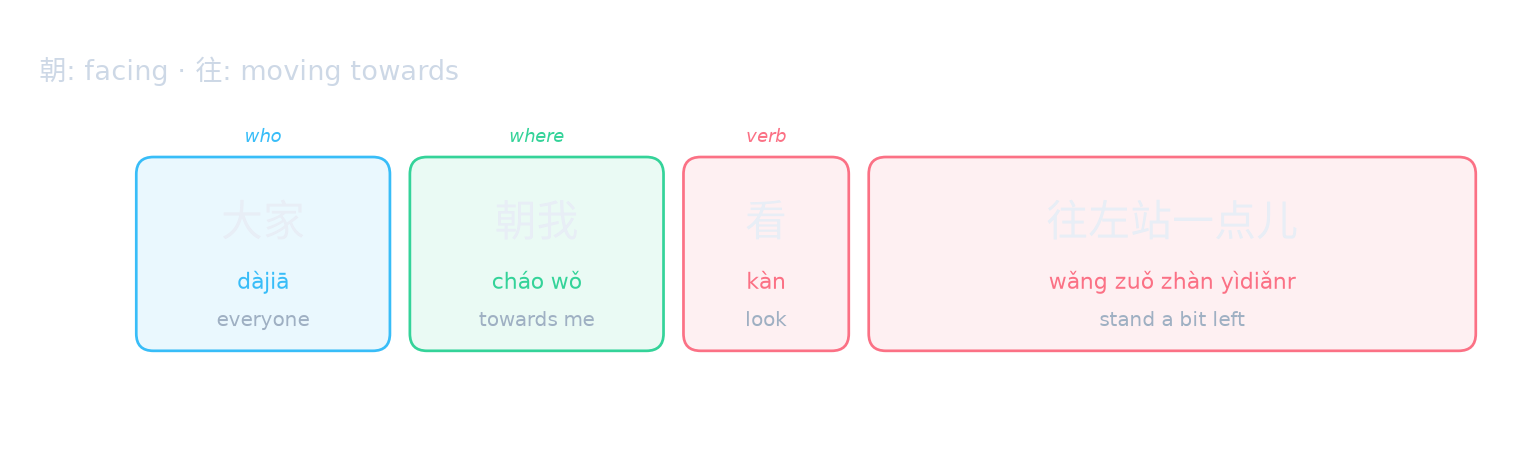
- everyone大家facing朝I / me我to look at; to watch; to read看。 – Everyone look this way, at me.
- we / us我们should应该towards向he / him他to study; to learn学习。 – We should learn from him.
- 飞往Shanghai municipality…上海(modifier / structural particle)的flight航班 – flights to Shanghai
How it works. All three mean "towards", but they differ in range.
| towards往 | facing朝 | towards向 | |
|---|---|---|---|
| movement in a direction | towards往北开 | facing forwards朝前to walk走 | 向前走 |
| facing a person / side | — | 朝南(modifier / structural particle)的room房间 · facing朝I / me我to laugh笑 | towards向he / him他to wave (one's hand)挥手 |
| abstract (learn from, apologise to) | — | — | towards向teacher老师to ask for guidance请教 · towards向you你to apologize道歉 |
| after a verb | 飞往 · (of a bus, train etc) to…开往 | — | direction走向success成功 |
Watch out
- towards往 doesn't take people: wrong: towards往he / him他to apologize道歉 → towards向he / him他to apologize道歉.
- Abstract verbs take towards向: to study; to learn学习, to ask for guidance请教, to apologize道歉, to express / indicate表示.
to / towards / correct对 vs regarding对于 (to/toward vs regarding)
Form: to / towards / correct对 + person + treatment / attitude · regarding对于 + issue,comment
- he / him他to / towards / correct对everyone大家degree / adjective linker很polite客气。 Tā duì dàjiā hěn kèqi. – He's polite to everyone.
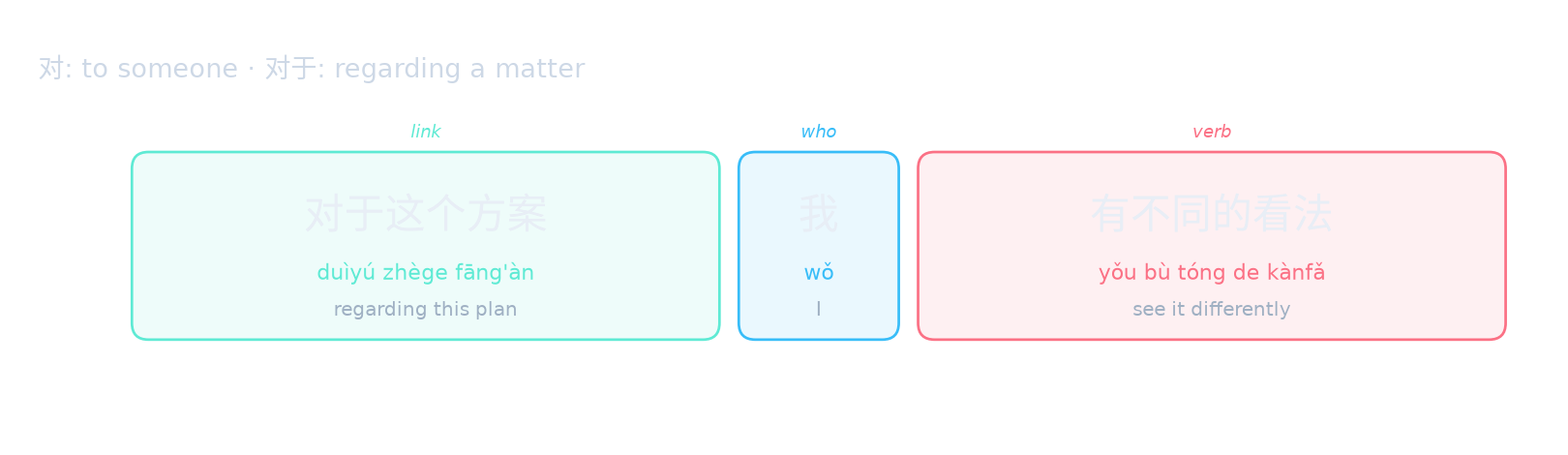
- regarding对于this这个plan方案,I / me我to have / there is有different不同(modifier / structural particle)的way of looking at a thing看法。 – As regards this proposal, I see it differently.
- to / towards / correct对((of time or place) in于)student学生来说,time时间degree / adjective linker很important重要。 – For students, time matters a great deal.
How it works. to / towards / correct对 covers both: how you treat a person (to / towards / correct对I / me我degree / adjective linker很good好) and an issue you comment on. regarding对于 duìyú is formal and only for issues and topics, often at the start of the sentence. So regarding对于 can usually become to / towards / correct对, but not the other way round.
| to / towards / correct对 | regarding对于 | |
|---|---|---|
| treatment of people | to / towards / correct对I / me我degree / adjective linker很good好 · to / towards / correct对he / him他variant of 说说 | — |
| issue / topic | to / towards / correct对this这个question问题…… | regarding对于this这个question问题…… |
| register | everyday | formal, essays |
Watch out
- wrong: he / him他regarding对于I / me我degree / adjective linker很good好 → he / him他to / towards / correct对I / me我degree / adjective linker很good好.
pertaining to关于 vs regarding对于 vs as for至于
Form: pertaining to关于 + topic · regarding对于 + issue + view · (earlier point …),as for至于 + new point
- pertaining to关于to set off出发time时间,we / us我们next week下周to decide决定。 Guānyú chūfā shíjiān … – On the departure time, we'll decide next week.
- regarding对于this这个to decide决定,I / me我degree / adjective linker很satisfied满意。 – I'm very happy with this decision.
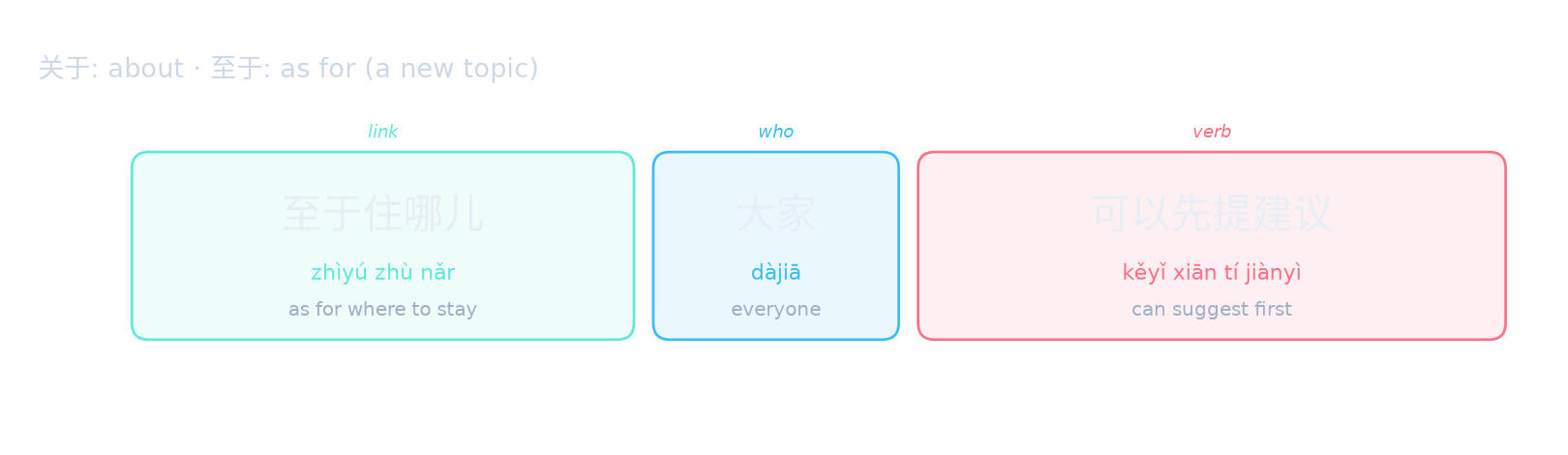
- I / me我to be in charge of负责to book tickets订票,as for至于wine shop酒店,you你to come来to choose选(suggestion)吧。 – I'll book the tickets; as for the hotel, you choose.
How it works. All three bring in a topic, for different jobs.
| Word | Job | Typical use |
|---|---|---|
| pertaining to关于 | about: content or subject | pertaining to关于environment环境(modifier / structural particle)的article文章, titles |
| regarding对于 | regarding: an attitude or judgement | regarding对于this这个question问题,I / me我to think / believe认为…… |
| as for至于 | as for: switch to a related, separate point | after another point has been made |
Watch out
- as for至于 can't open a conversation: something must come before it.
- pertaining to关于 stays before the subject: wrong: I / me我pertaining to关于这件matter事…… → pertaining to关于这件matter事,I / me我…….
to / for / give给 vs for为 (to/for vs for the sake of)
Form: to / for / give给 + recipient + verb · for为 ((completed / change)了) + person / cause + verb
- I / me我want / think / miss想to / for / give给mum; mother妈妈to buy买一份gift礼物。 Wǒ xiǎng gěi māma mǎi yí fèn lǐwù. – I want to buy Mum a present.
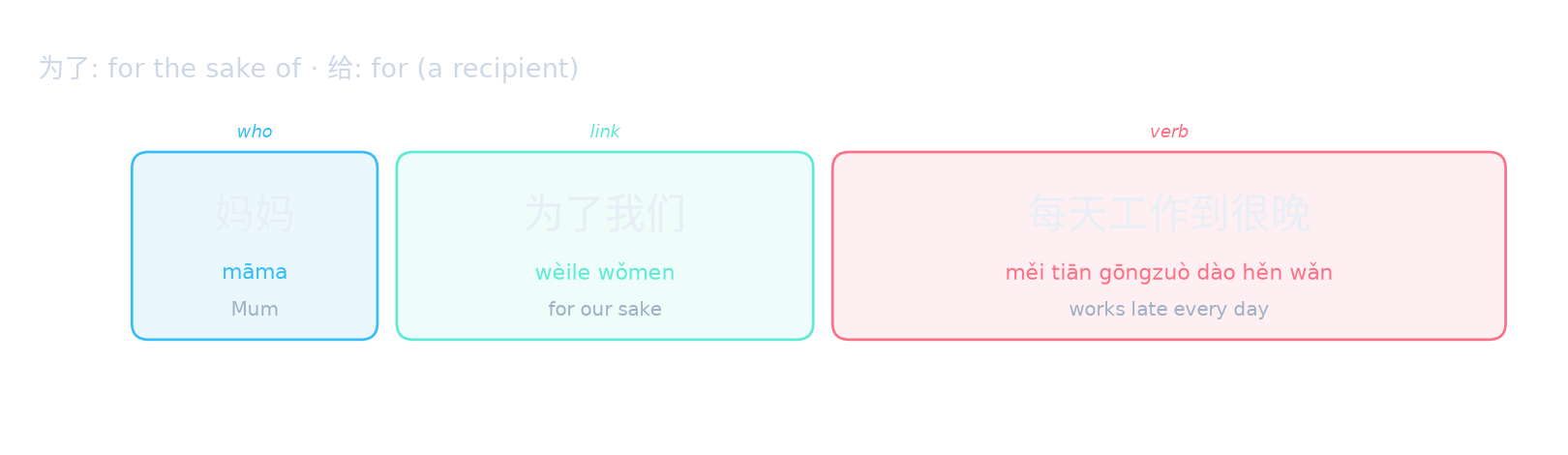
- mum; mother妈妈in order to为了we / us我们every day每天to work; job工作to / arrive到degree / adjective linker很evening晚。 – Mum works late every day for us.
- I / me我for为you你happy; glad高兴。 – I'm happy for you.
How it works. to / for / give给 marks someone who receives a thing or service (to / for / give给he / him他to write a letter写信, to / for / give给I / me我to make a telephone call打电话). for为 marks the person or cause that an effort or feeling is for or about (for为everyone大家to serve服务, for为child孩子anxious担心).
| to / for / give给 | for为 |
|---|---|
| receiver: to / for / give给you你to introduce介绍 | on behalf of, for the sake of: for为the people人民to serve服务 |
| everyday | more formal, dedicated |
Both work for some favours (to / for / give给 / for为everyone大家to prepare a meal做饭).
Watch out
- Feelings take for为: wrong: I / me我to / for / give给you你happy; glad高兴 → I / me我for为you你happy; glad高兴; wrong: to / for / give给child孩子anxious担心 → for为child孩子anxious担心.
Practice without the models
Cover the teaching sections before you answer. The answers follow.
facing朝 vs towards向 vs towards往 (towards)
1. Complete: “We should learn from her.” we / us我们should应该…………she / her她to study; to learn学习。
2. Which is wrong?
- A. towards向he / him他to apologize道歉
- B. towards往he / him他to apologize道歉
- C. 往前走
- D. 朝南(modifier / structural particle)的window窗户
3. Build: “This plane flies to Shanghai.”
Put in order: 飞往 / this这架飞机 / Shanghai municipality…上海。
4. True or false? 朝南(modifier / structural particle)的room房间 means a south-facing room. If false, correct it.
5. Your photographer friend arranges a group photo by the sea. Use facing朝 or towards向 or towards往. Write your answer in Chinese, then say it aloud.
to / towards / correct对 vs regarding对于 (to/toward vs regarding)
6. Complete: “She is very kind to me.” she / her她…………I / me我degree / adjective linker很good好。
7. Which is wrong?
- A. to / towards / correct对this这个question问题,I / me我not have / haven't没有idea意见。
- B. he / him他to / towards / correct对I / me我degree / adjective linker很polite客气。
- C. regarding对于this这个question问题,I / me我not have / haven't没有idea意见。
- D. he / him他regarding对于I / me我degree / adjective linker很polite客气。
8. Build: “Regarding this issue, opinions differ.”
Put in order: everyone大家idea意见 / , / not不one / a一。 / regarding对于this这个question问题
9. True or false? regarding对于…来说 is more formal than to / towards / correct对…来说. If false, correct it.
10. In a meeting, you describe a new colleague and give your view on a proposal. Use to / towards / correct对 or regarding对于. Write your answer in Chinese, then say it aloud.
pertaining to关于 vs regarding对于 vs as for至于
11. Complete: “I'll book the tickets; as for the hotel, you choose.” I / me我to be in charge of负责to book tickets订票,…………wine shop酒店,you你to come来to choose选(suggestion)吧。
12. A book title: “A Book about Chinese Food”. Which word fits? 《____China中国dish (of food); vegetable菜(modifier / structural particle)的book书》
- A. as for至于
- B. pertaining to关于
- C. regarding对于
- D. to / towards / correct对
13. Match each word to its job.
-
(1) pertaining to关于
-
(2) regarding对于
-
(3) as for至于
-
A. regarding (attitude or judgement)
-
B. as for (switching to another point)
-
C. about (topic or content)
14. True or false? as for至于 can open a conversation without any earlier topic. If false, correct it.
15. You are writing an email planning a school trip. Use pertaining to关于 or regarding对于 or as for至于. Write your answer in Chinese, then say it aloud.
to / for / give给 vs for为 (to/for vs for the sake of)
16. Complete: “We're all happy for you.” we / us我们all / both都…………you你happy; glad高兴。
17. “Call me tomorrow.” Which fits? tomorrow明天____I / me我to make a telephone call打电话。
- A. to / for / give给
- B. for为
- C. towards向
- D. to / towards / correct对
18. Build: “I bought Mum a bunch of flowers.”
Put in order: I / me我 / to buy买(completed / change)了 / to / for / give给mum; mother妈妈 / 一束花。
19. True or false? for为the people人民to serve服务 sounds more formal than to / for / give给the people人民to serve服务. If false, correct it.
20. Your mother works late every night to support the family. Use to / for / give给 or for为. Write your answer in Chinese, then say it aloud.
Answers and explanations
facing朝 vs towards向 vs towards往 (towards)
1. towards向
Abstract “learn from” takes towards向.
2. B. towards往he / him他to apologize道歉
towards往 shows direction of movement toward a place (往前走) and does not take a person. Apologising to someone uses towards向 or with / and跟: towards向he / him他to apologize道歉.
3. this这架飞机飞往Shanghai municipality…上海。
Verb + towards往 + destination.
4. True.
True. facing朝 means “facing towards”: 朝南(modifier / structural particle)的room房间 is a south-facing room.
5. Model answer: everyone大家facing朝I / me我to look at; to watch; to read看,towards往左站erhua variant of 一点一点儿。
Check your answer:
- towards往 does not take people: towards向he / him他to apologize道歉, not towards往he / him他to apologize道歉.
- Abstract verbs (to study; to learn学习, to ask for guidance请教, to apologize道歉, to express / indicate表示) take towards向, not facing朝 or towards往.
to / towards / correct对 vs regarding对于 (to/toward vs regarding)
6. to / towards / correct对
Treatment of people takes to / towards / correct对.
7. D. he / him他regarding对于I / me我degree / adjective linker很polite客气。
Treatment of people needs to / towards / correct对, not regarding对于.
8. regarding对于this这个question问题,everyone大家idea意见not不one / a一。
regarding对于 + issue, then the comment.
9. True.
True. regarding对于…来说 is more formal and suits essays; to / towards / correct对…来说 is the everyday form. Both mean “for, as far as … is concerned”.
10. Model answer: he / him他to / towards / correct对everyone大家degree / adjective linker很polite客气。regarding对于this这个plan方案,I / me我to have / there is有different不同(modifier / structural particle)的way of looking at a thing看法。
Check your answer:
- Wherever regarding对于 works, to / towards / correct对 usually works too: to / towards / correct对((of time or place) in于)this这个question问题….
- But treatment of people needs to / towards / correct对: to / towards / correct对I / me我degree / adjective linker很good好, to / towards / correct对he / him他variant of 说说, not regarding对于I / me我degree / adjective linker很good好 / regarding对于he / him他variant of 说说.
pertaining to关于 vs regarding对于 vs as for至于
11. as for至于
as for至于 switches to a new, related point.
12. B. pertaining to关于
Content and titles take pertaining to关于.
13. (1) C: pertaining to关于 = about (topic or content); (2) A: regarding对于 = regarding (attitude or judgement); (3) B: as for至于 = as for (switching to another point)
Each introduces a topic differently.
14. False.
It switches from a topic already mentioned.
15. Model answer: pertaining to关于to set off出发time时间,we / us我们next week下周to decide决定。as for至于to live (somewhere)住where哪儿,everyone大家can / may可以先提to propose建议。
Check your answer:
- as for至于 comes after something else has been said; it cannot open a conversation.
- pertaining to关于 cannot follow the subject: pertaining to关于这件matter事,I / me我…, not I / me我pertaining to关于这件matter事….
to / for / give给 vs for为 (to/for vs for the sake of)
16. for为
Feelings take for为.
17. A. to / for / give给
The recipient of a call takes to / for / give给.
18. I / me我to / for / give给mum; mother妈妈to buy买(completed / change)了一束花。
to / for / give给 + person + verb + object.
19. True.
for为 is the formal, dedicated “for”.
20. Model answer: mum; mother妈妈in order to为了we / us我们every day每天to work; job工作to / arrive到degree / adjective linker很evening晚,I / me我want / think / miss想to / for / give给she / her她to buy买一份gift礼物。
Check your answer:
- to / for / give给 + person = they receive something: to / for / give给he / him他to write a letter写信. for为 + person = on their behalf or about them: for为he / him他anxious担心.
- Feelings take for为, not to / for / give给: I / me我for为you你happy; glad高兴, not I / me我to / for / give给you你happy; glad高兴.