Skip to content
Subjects
  • 1 Adjectives
    • 1.1 Adjectival complement "de budeliao"
    • 1.2 Adjectival complement "de hen"
    • 1.3 Expressing "a bit too"
    • 1.4 Saying "a lot" with "youdeshi"

    Adjectives →

  • 2 Adverbs
    • 2.1 Advanced uses of "dou"
    • 2.2 Advanced uses of "hai"
    • 2.3 Advanced uses of "zong"
    • 2.4 Expressing "after all" with "bijing"
    • 2.5 Expressing "almost" using "chadian mei"
    • 2.6 Expressing "anyway" with "fanzheng"
    • 2.7 Expressing "as much as possible" with "jinliang"
    • 2.8 Expressing "each other" with "huxiang"
    • 2.9 Expressing "feel free" with "jinguan"
    • 2.10 Expressing "just" do it with "gancui"
    • 2.11 Expressing "never again" with "zai ye bu"
    • 2.12 Expressing "once" with "cengjing"
    • 2.13 Expressing "over and over again" with "zaisan"
    • 2.14 Expressing "simply" with "jianzhi"
    • 2.15 Expressing "while you're at it" with "shunbian"
    • 2.16 Expressing a last chance with "zaibu... jiu..."
    • 2.17 Expressing difficulty with "hao (bu) rongyi"
    • 2.18 Expressing wasted efforts with "bai"
    • 2.19 Repeated actions in the past with "you"
    • 2.20 The opposite of "chabuduo" is "cha hen duo"

    Adverbs →

  • 3 Auxiliary Words
    • 3.1 Listing things with "a"

    Auxiliary Words →

  • 4 Conjunctions
    • 4.1 Expressing "how about" with "yaobu"

    Conjunctions →

  • 5 Nouns
    • 5.1 Expressing "among" with "dangzhong"
    • 5.2 Expressing "each other" with "bici"
    • 5.3 Expressing "ever since" with "yilai"
    • 5.4 Expressing "when" using "dang"
    • 5.5 Name-calling with "zhege"

    Nouns →

  • 6 Particles
    • 6.1 Advanced "le" after an object
    • 6.2 Advanced "le" with complements
    • 6.3 Marking a topic with "ma"
    • 6.4 Softening the tone of questions with "ne"

    Particles →

  • 7 Prepositional Phrase
    • 7.1 Defining upper and lower limits

    Prepositional Phrase →

  • 8 Prepositions
    • 8.1 Expressing "ever since" with "zicong"
    • 8.2 Expressing "for" with "wei"
    • 8.3 Expressing "for…" with "eryan"
    • 8.4 Expressing "including" with "zainei"
    • 8.5 Expressing "on the basis of" with "ping"
    • 8.6 Expressing "with regards to" with "zhiyu"
    • 8.7 Expressing passive voice with "gei"
    • 8.8 Limiting scope with "jiu"
    • 8.9 Opportune timing with "chen"

    Prepositions →

  • 9 Sentence Patterns
    • 9.1 Expressing "if it were not for" with "yaobushi"
    • 9.2 Expressing "thanks to" with "duokui"
    • 9.3 Expressing "that's all" with "eryi"
    • 9.4 Using "jiang" as a formal "ba"

    Sentence Patterns →

  • 10 Verbs
    • 10.1 Challenging a verb with "shenme"
    • 10.2 Comparing specifically with "xiang"
    • 10.3 Comparisons with "biqi"
    • 10.4 Comparisons with "buru"
    • 10.5 Making "-ize" and "-ify" verbs with "hua"
    • 10.6 Making judgments with "suan"
    • 10.7 Using "nanguai" as a verb

    Verbs →

  • 11 Auxiliary verbs
    • 11.1 Expressing future with "jiang"

    Auxiliary verbs →

  • 12 Verb phrases
    • 12.1 Expressing "hard to avoid" with "nanmian"
    • 12.2 Passive verbs with "shou"

    Verb phrases →

  • 13 "But" Statements
    • 13.1 Expressing "on the contrary" with "fan'er"

    "But" Statements →

  • 14 "Even If" Statements
    • 14.1 Expressing "even if…" with "jiushi"
    • 14.2 Expressing "even if…" with "jiusuan"
    • 14.3 Expressing "even if…" with "napa"

    "Even If" Statements →

  • 15 "If" Statements
    • 15.1 Expressing "if… then…" with "jiaru"
    • 15.2 Expressing "what if" with "wanyi"
    • 15.3 Marking a topic with "de hua"

    "If" Statements →

  • 16 Adverbs with Adjectives
    • 16.1 Expressing "especially" with "gewai"

    Adverbs with Adjectives →

  • 17 Cause/Effect Statements

    (after a noun N and before…之所以zhī suǒ yǐ … 是因为shì yīn wèi … (effect before cause)

    Form: subject + (after a noun N and before…之所以zhī suǒ yǐ + result,是因为shì yīn wèi + cause

    • we / us我们wǒ men(after a noun N and before…之所以zhī suǒ yǐpopular受欢迎shòu huān yíng,是因为shì yīn wèiall along / straight一直yì zhíto use / with用yòngmost最zuìfresh新鲜xīn xiān(modifier / structural particle)的dematerial材料cái liào。 Wǒmen zhīsuǒyǐ shòu huānyíng, shì yīnwèi yìzhí yòng zuì xīnxiān de cáiliào. – The reason we're popular is that we've always used the freshest ingredients.
    • I / me我wǒ(after a noun N and before…之所以zhī suǒ yǐto select选择xuǎn zéthis这个zhè gemajor (subject); professional专业zhuān yè,是因为shì yīn wèiI / me我wǒto / towards / correct对duìmedicine医学yī xué很感兴趣hěn gǎn xìng qù。 Wǒ zhīsuǒyǐ xuǎnzé zhège zhuānyè, shì yīnwèi wǒ duì yīxué hěn gǎn xìngqù. – The reason I chose this major is that I'm interested in medicine.
    • he / him他tā(after a noun N and before…之所以zhī suǒ yǐto arrive late迟到chí dào,是因为shì yīn wèion the road路上lù shàngtraffic jam堵车dǔ chē。 Tā zhīsuǒyǐ chídào, shì yīnwèi lù shang dǔchē. – The reason he was late is that there was a traffic jam.
    • this这zhè本书běn shū(after a noun N and before…之所以zhī suǒ yǐto sell well畅销chàng xiāo,是因为shì yīn wèinarrative故事gù shìdegree / adjective linker很hěntrue真实zhēn shí。 Zhè běn shū zhīsuǒyǐ chàngxiāo, shì yīnwèi gùshi hěn zhēnshí. – The reason this book sells so well is that the story feels real.
    • competition比赛bǐ sài(after a noun N and before…之所以zhī suǒ yǐto cancel取消qǔ xiāo,是因为shì yīn wèiweather天气tiān qìtoo太tàipoor差chà。 Bǐsài zhīsuǒyǐ qǔxiāo, shì yīnwèi tiānqì tài chà. – The match was cancelled because the weather was too bad.
    • I / me我wǒ(after a noun N and before…之所以zhī suǒ yǐto learn学xuéChinese language汉语hàn yǔ,one / a一yī是因为shì yīn wèito like喜欢xǐ huanChina中国zhōng guóculture文化wén huà,two二èr是因为shì yīn wèiin the future将来jiāng láiwant / think / miss想xiǎngat / in在zàiChina中国zhōng guóto work; job工作gōng zuò。 Wǒ zhīsuǒyǐ xué Hànyǔ, yī shì yīnwèi xǐhuan Zhōngguó wénhuà, èr shì yīnwèi jiānglái xiǎng zài Zhōngguó gōngzuò. – I study Chinese, firstly because I like Chinese culture and secondly because I want to work in China in the future.

    How it works. In because因为yīn wèi……so / therefore所以suǒ yǐ…… the cause comes first. (after a noun N and before…之所以zhī suǒ yǐ……是因为shì yīn wèi…… turns this round: the result, which everyone already knows, comes first after (after a noun N and before…之所以zhī suǒ yǐ zhīsuǒyǐ, and the explanation follows with 是因为shì yīn wèi. The focus falls on the reason, so it answers an implied "why?".

    That makes it ideal for essays, presentations and interview answers: name the fact (I / me我wǒ(after a noun N and before…之所以zhī suǒ yǐto select选择xuǎn zéthis这个zhè gemajor (subject); professional专业zhuān yè), then give your reasons, even several of them (one / a一yī是因为shì yīn wèi……,two二èr是因为shì yīn wèi……). (after a noun N and before…之所以zhī suǒ yǐ goes after the subject.

    because因为yīn wèi A,so / therefore所以suǒ yǐ B B (after a noun N and before…之所以zhī suǒ yǐ……,是因为shì yīn wèi A
    cause → result; everyday known result → its cause; explaining, formal
    because因为yīn wèion the road路上lù shàngtraffic jam堵车dǔ chē,so / therefore所以suǒ yǐhe / him他tāto arrive late迟到chí dào(completed / change)了le。 he / him他tā(after a noun N and before…之所以zhī suǒ yǐto arrive late迟到chí dào,是因为shì yīn wèion the road路上lù shàngtraffic jam堵车dǔ chē。

    Watch out

    • The result goes after (after a noun N and before…之所以zhī suǒ yǐ, the cause after 是因为shì yīn wèi; do not swap them: wrong: (after a noun N and before…之所以zhī suǒ yǐto rain下雨xià yǔ,是因为shì yīn wèicompetition比赛bǐ sàito cancel取消qǔ xiāo(completed / change)了le → competition比赛bǐ sài(after a noun N and before…之所以zhī suǒ yǐto cancel取消qǔ xiāo,是因为shì yīn wèito rain下雨xià yǔ.
    • Keep to be / is是shì in 是因为shì yīn wèi: wrong: he / him他tā(after a noun N and before…之所以zhī suǒ yǐto arrive late迟到chí dào,because因为yīn wèitraffic jam堵车dǔ chē → he / him他tā(after a noun N and before…之所以zhī suǒ yǐto arrive late迟到chí dào,是因为shì yīn wèitraffic jam堵车dǔ chē.
    • (after a noun N and before…之所以zhī suǒ yǐ goes after the subject: wrong: (after a noun N and before…之所以zhī suǒ yǐhe / him他tāto arrive late迟到chí dào → he / him他tā(after a noun N and before…之所以zhī suǒ yǐto arrive late迟到chí dào.

    In a passage

    很多hěn duōtraveler游客yóu kèto ask问wèn,这家zhè jiāsmall小xiǎorestaurant饭馆fàn guǎnwhy?为什么wèi shén meevery day天天tiān tiānto line up排队pái duì。boss老板lǎo bǎnto speak说shuō,restaurant饭馆fàn guǎn(after a noun N and before…之所以zhī suǒ yǐpopular受欢迎shòu huān yíng,one / a一yī是因为shì yīn wèi价格便宜jià gé pián yi,two二èr是因为shì yīn wèi每道菜měi dào càiall / both都dōuto be / is是shìto appear现xiànto do; to make做zuò(modifier / structural particle)的de。he / him他tā(after a noun N and before…之所以zhī suǒ yǐto keep at; to insist坚持jiān chínot不bùto become a member of an…加盟jiā méngchain store连锁店lián suǒ diàn,是因为shì yīn wèiwant / think / miss想xiǎngto keep保持bǎo chíoneself自己zì jǐ(modifier / structural particle)的detaste; flavour味道wèi dào。

    Read and notice. What two facts does the owner explain? Give the reasons in your own words.
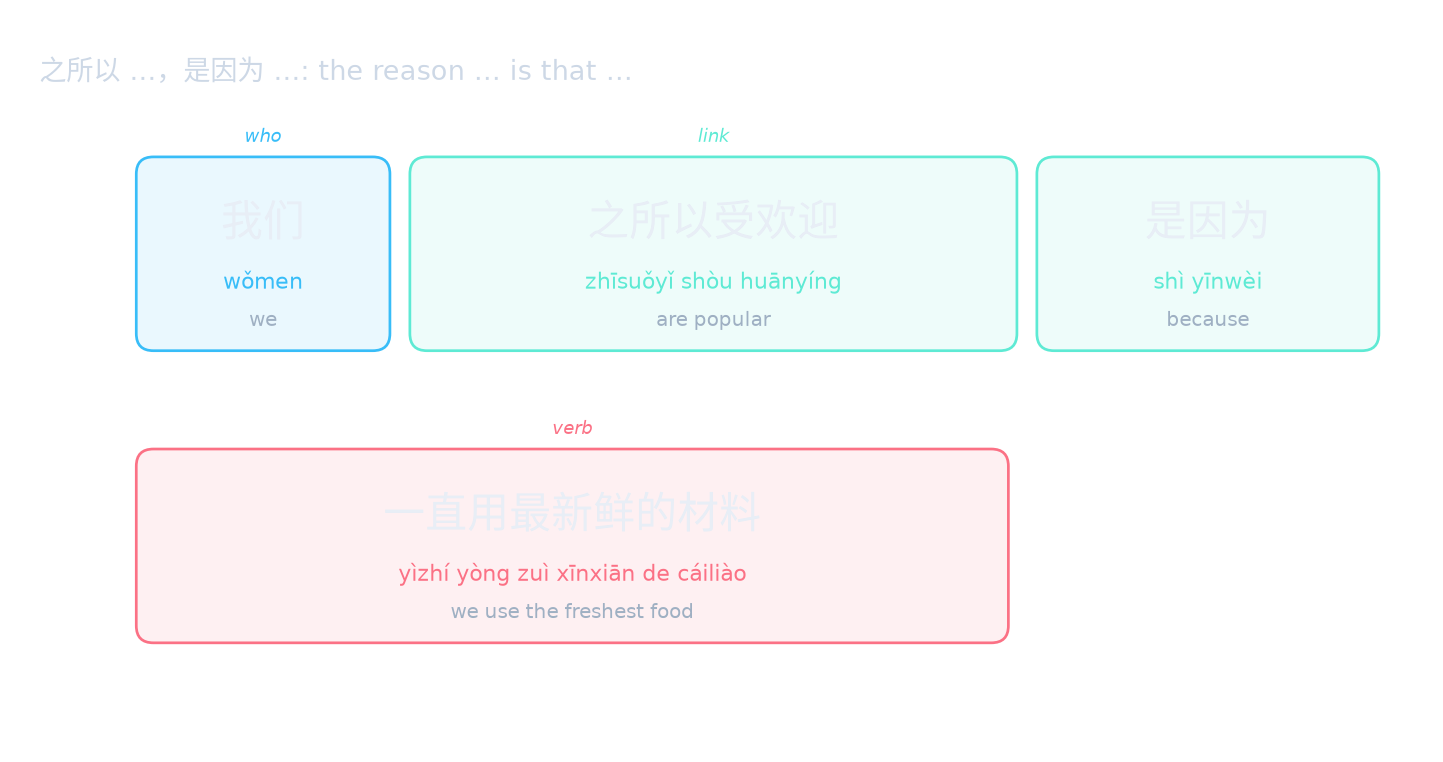
    之所以 …,是因为 …: the reason … is that …

    Practice without the models

    Cover the teaching sections before you answer. The answers follow.

    1. Complete: “The reason I'm tired is that I slept badly.” I / me我wǒ(after a noun N and before…之所以zhī suǒ yǐ很累hěn lèi,…………because因为yīn wèiyesterday evening昨晚zuó wǎn没睡méi shuìgood好hǎo。

    2. Which sentence is logically correct?

    • A. (after a noun N and before…之所以zhī suǒ yǐto rain下雨xià yǔ,是因为shì yīn wèicompetition比赛bǐ sàito cancel取消qǔ xiāo(completed / change)了le。
    • B. (after a noun N and before…之所以zhī suǒ yǐcompetition比赛bǐ sàito cancel取消qǔ xiāo,so / therefore所以suǒ yǐto rain下雨xià yǔ。
    • C. competition比赛bǐ sài(after a noun N and before…之所以zhī suǒ yǐto rain下雨xià yǔ,是因为shì yīn wèito cancel取消qǔ xiāo(completed / change)了le。
    • D. competition比赛bǐ sài(after a noun N and before…之所以zhī suǒ yǐto cancel取消qǔ xiāo,是因为shì yīn wèito rain下雨xià yǔ(completed / change)了le。

    3. Build: “I chose this major because I'm interested in medicine.”

    Put in order: I / me我wǒ(after a noun N and before…之所以zhī suǒ yǐto select选择xuǎn zéthis这个zhè gemajor (subject); professional专业zhuān yè / I / me我wǒto / towards / correct对duìmedicine医学yī xué很感兴趣hěn gǎn xìng qù。 / 是因为shì yīn wèi / ,

    4. True or false? because因为yīn wèi…so / therefore所以suǒ yǐ… puts the cause first; (after a noun N and before…之所以zhī suǒ yǐ…是因为shì yīn wèi… puts the result first. If false, correct it.

    5. A journalist asks a famous chef why her restaurant has stayed popular for thirty years. Use (after a noun N and before…之所以zhī suǒ yǐ … 是因为shì yīn wèi …. Write your answer in Chinese, then say it aloud.

    Answers and explanations

    1. to be / is是shì

    (after a noun N and before…之所以zhī suǒ yǐ…,是因为shì yīn wèi….

    2. D. competition比赛bǐ sài(after a noun N and before…之所以zhī suǒ yǐto cancel取消qǔ xiāo,是因为shì yīn wèito rain下雨xià yǔ(completed / change)了le。

    (after a noun N and before…之所以zhī suǒ yǐ + result (cancelled), 是因为shì yīn wèi + cause (rain).

    3. I / me我wǒ(after a noun N and before…之所以zhī suǒ yǐto select选择xuǎn zéthis这个zhè gemajor (subject); professional专业zhuān yè,是因为shì yīn wèiI / me我wǒto / towards / correct对duìmedicine医学yī xué很感兴趣hěn gǎn xìng qù。

    Result, then 是因为shì yīn wèi + cause.

    4. True.

    That is the key difference.

    5. Model answer: we / us我们wǒ men(after a noun N and before…之所以zhī suǒ yǐpopular受欢迎shòu huān yíng,是因为shì yīn wèiall along / straight一直yì zhíto use / with用yòngmost最zuìfresh新鲜xīn xiān(modifier / structural particle)的dematerial材料cái liào。

    Check your answer:

    • Do not reverse it: (after a noun N and before…之所以zhī suǒ yǐ introduces the result, 是因为shì yīn wèi the cause. Not (after a noun N and before…之所以zhī suǒ yǐto rain下雨xià yǔ,是因为shì yīn wèicompetition比赛bǐ sàito cancel取消qǔ xiāo(completed / change)了le.
    • The second clause usually starts with 是因为shì yīn wèi: (after a noun N and before…之所以zhī suǒ yǐ…,是因为shì yīn wèi….
  • 18 Complements
    • 18.1 Advanced degree complements
    • 18.2 Advanced potential complements
    • 18.3 Advanced result complements "zhu", "kai", and "chulai"
    • 18.4 Complement "-huai le"
    • 18.5 Complement "-zhao"
    • 18.6 Tricky uses of "dao"
    • 18.7 Using "lai" and "qu" when "verbing around"

    Complements →

  • 19 Conditional Statements
    • 19.1 Expressing "once...then..." with "yidan...jiu..."

    Conditional Statements →

  • 20 Sentence Patterns
    • 20.1 Advanced uses of "ba"
    • 20.2 Basic comparisons with "bu bi"
    • 20.3 Conditions with "yao" and "jiu"
    • 20.4 Expressing "can't do without" with "shaobuliao"
    • 20.5 Expressing "equal to" with "dengyu"
    • 20.6 Expressing "from" with "cong... zhong"
    • 20.7 Expressing "no" (noun) "to" (verb) with "wu... ke..."
    • 20.8 Expressing "not only..., even..." using "budan..., shenzhi lian"
    • 20.9 Expressing "related to..." with "you guan de"
    • 20.10 Expressing "so-called" with "suowei"
    • 20.11 Expressing "within" a period of time using "zai... nei"
    • 20.12 Expressing "would rather" with "ningke"
    • 20.13 Expressing indifference with "jiu"
    • 20.14 Expressing purpose with "hao"
    • 20.15 Expressing simultaneous actions with "yimian"
    • 20.16 Expressing the only two possibilities

    Sentence Patterns →

  • 21 Complex Sentence Patterns
    • 21.1 Expressing "no wonder"

    Complex Sentence Patterns →

  • 22 Either… or
    • 22.1 Providing two options with double "huozhe"

    Either… or →

  • 23 Let alone
    • 23.1 Expressing "let alone" with "bie shuo"
    • 23.2 Expressing "let alone" with "geng buyong shuo"

    Let alone →

  • 24 Comparing similar adverbs
    • 24.1 Comparing "changchang" and "jingchang"

    Comparing similar adverbs →

  • 25 Comparing similar auxiliary words
    • 25.1 Comparing "zongsuan" and “zhongyu"

    Comparing similar auxiliary words →

  • 26 Comparing similar conjunctions
    • 26.1 Comparing "gen" and "dui"

    Comparing similar conjunctions →

  • 27 Comparing similar prepositions
    • 27.1 Comparing "chao" "xiang" and "wang"
    • 27.2 Comparing "dui" and "duiyu"
    • 27.3 Comparing "duiyu" and "zhiyu"
    • 27.4 Comparing "gei" and "wei"

    Comparing similar prepositions →

  • 28 Comparing similar time words
    • 28.1 Comparing "pingshi" and "pingchang"
    • 28.2 Comparing "yihou" and "zhihou"

    Comparing similar time words →

  • 29 Comparing similar verbs
    • 29.1 Comparing "kanqilai" and "kanlai"
    • 29.2 Comparing "xiande" and "kanqilai"

    Comparing similar verbs →

Log in or create account

IGCSE, A-Level & AP