Skip to content
Subjects
  • 1 Adjectives
    • 1.1 Adjectival complement "de budeliao"
    • 1.2 Adjectival complement "de hen"
    • 1.3 Expressing "a bit too"
    • 1.4 Saying "a lot" with "youdeshi"

    Adjectives →

  • 2 Adverbs
    • 2.1 Advanced uses of "dou"
    • 2.2 Advanced uses of "hai"
    • 2.3 Advanced uses of "zong"
    • 2.4 Expressing "after all" with "bijing"
    • 2.5 Expressing "almost" using "chadian mei"
    • 2.6 Expressing "anyway" with "fanzheng"
    • 2.7 Expressing "as much as possible" with "jinliang"
    • 2.8 Expressing "each other" with "huxiang"
    • 2.9 Expressing "feel free" with "jinguan"
    • 2.10 Expressing "just" do it with "gancui"
    • 2.11 Expressing "never again" with "zai ye bu"
    • 2.12 Expressing "once" with "cengjing"
    • 2.13 Expressing "over and over again" with "zaisan"
    • 2.14 Expressing "simply" with "jianzhi"
    • 2.15 Expressing "while you're at it" with "shunbian"
    • 2.16 Expressing a last chance with "zaibu... jiu..."
    • 2.17 Expressing difficulty with "hao (bu) rongyi"
    • 2.18 Expressing wasted efforts with "bai"
    • 2.19 Repeated actions in the past with "you"
    • 2.20 The opposite of "chabuduo" is "cha hen duo"

    Adverbs →

  • 3 Auxiliary Words
    • 3.1 Listing things with "a"

    Auxiliary Words →

  • 4 Conjunctions
    • 4.1 Expressing "how about" with "yaobu"

    Conjunctions →

  • 5 Nouns
    • 5.1 Expressing "among" with "dangzhong"
    • 5.2 Expressing "each other" with "bici"
    • 5.3 Expressing "ever since" with "yilai"
    • 5.4 Expressing "when" using "dang"
    • 5.5 Name-calling with "zhege"

    Nouns →

  • 6 Particles
    • 6.1 Advanced "le" after an object
    • 6.2 Advanced "le" with complements
    • 6.3 Marking a topic with "ma"
    • 6.4 Softening the tone of questions with "ne"

    Particles →

  • 7 Prepositional Phrase
    • 7.1 Defining upper and lower limits

    Prepositional Phrase →

  • 8 Prepositions
    • 8.1 Expressing "ever since" with "zicong"
    • 8.2 Expressing "for" with "wei"
    • 8.3 Expressing "for…" with "eryan"
    • 8.4 Expressing "including" with "zainei"
    • 8.5 Expressing "on the basis of" with "ping"
    • 8.6 Expressing "with regards to" with "zhiyu"
    • 8.7 Expressing passive voice with "gei"
    • 8.8 Limiting scope with "jiu"
    • 8.9 Opportune timing with "chen"

    Prepositions →

  • 9 Sentence Patterns
    • 9.1 Expressing "if it were not for" with "yaobushi"
    • 9.2 Expressing "thanks to" with "duokui"
    • 9.3 Expressing "that's all" with "eryi"
    • 9.4 Using "jiang" as a formal "ba"

    Sentence Patterns →

  • 10 Verbs
    • 10.1 Challenging a verb with "shenme"
    • 10.2 Comparing specifically with "xiang"
    • 10.3 Comparisons with "biqi"
    • 10.4 Comparisons with "buru"
    • 10.5 Making "-ize" and "-ify" verbs with "hua"
    • 10.6 Making judgments with "suan"
    • 10.7 Using "nanguai" as a verb

    Verbs →

  • 11 Auxiliary verbs
    • 11.1 Expressing future with "jiang"

    Auxiliary verbs →

  • 12 Verb phrases
    • 12.1 Expressing "hard to avoid" with "nanmian"
    • 12.2 Passive verbs with "shou"

    Verb phrases →

  • 13 "But" Statements
    • 13.1 Expressing "on the contrary" with "fan'er"

    "But" Statements →

  • 14 "Even If" Statements

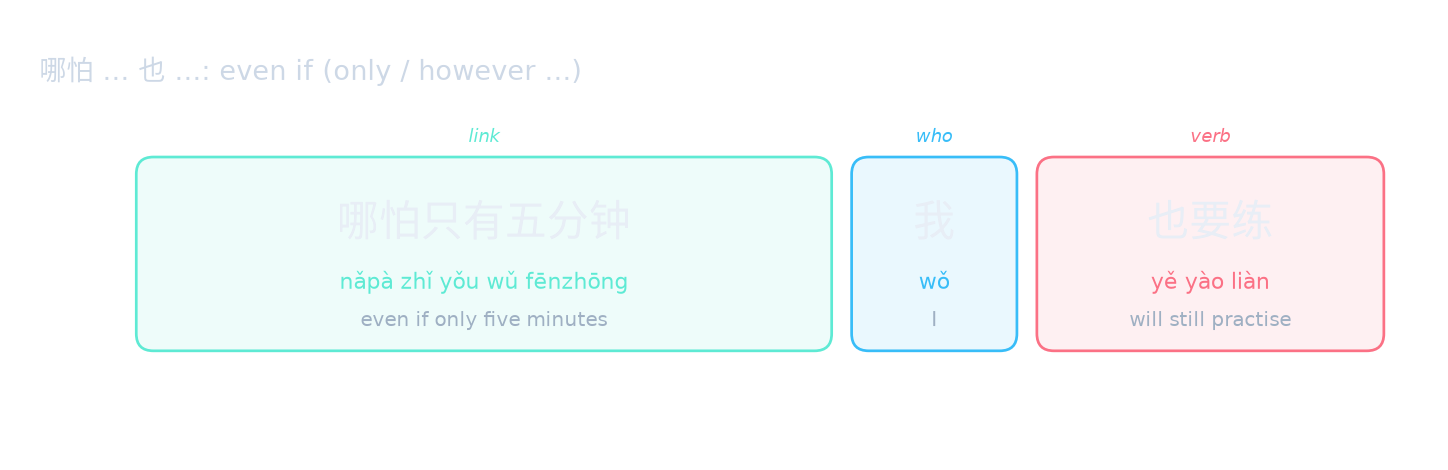
    exactly就是jiù shì … ,also也yě … (even if)

    Form: exactly就是jiù shì + possible case,subject + also也yě + decision

    • exactly就是jiù shìto rain下雨xià yǔ,I / me我wǒalso也yěto go去qù。 Jiùshì xià yǔ, wǒ yě qù. – Even if it rains, I'm going.
    • exactly就是jiù shìagain / then / (再…也) however再zàibusy忙máng,he / him他tāalso也yěevery day每天měi tiānto / for / give给gěihome家里jiā lǐto make a telephone call打电话dǎ diàn huà。 – However busy he is, he calls home every day.
    • exactly就是jiù shìyou你nǐnot不bùto speak说shuō,I / me我wǒalso也yěto know知道zhī dào。 – Even if you don't tell me, I know.

    How it works. In this spoken pattern, exactly就是jiù shì "even if" grants a case and also也yě keeps the decision anyway. It is more colloquial than even if即使jí shǐ.

    exactly就是jiù shìto rain下雨xià yǔ,I / me我wǒalso也yěto go去qù supposing假如jiǎ rúto rain下雨xià yǔ,I / me我wǒthen / just就jiùnot不bùto go去qù this这zhèexactly就是jiù shìI / me我wǒ(modifier / structural particle)的debook书shū
    even if: the plan survives if: the plan changes "exactly is" (identifies)

    Watch out

    • Read both clauses: exactly就是jiù shì alone doesn't mean "even if", and also也yě is what shows the concession.
    • The sentence states an intention; rain isn't confirmed, and the speaker hasn't arrived yet.
    就是 … 也 …: even if …, still …

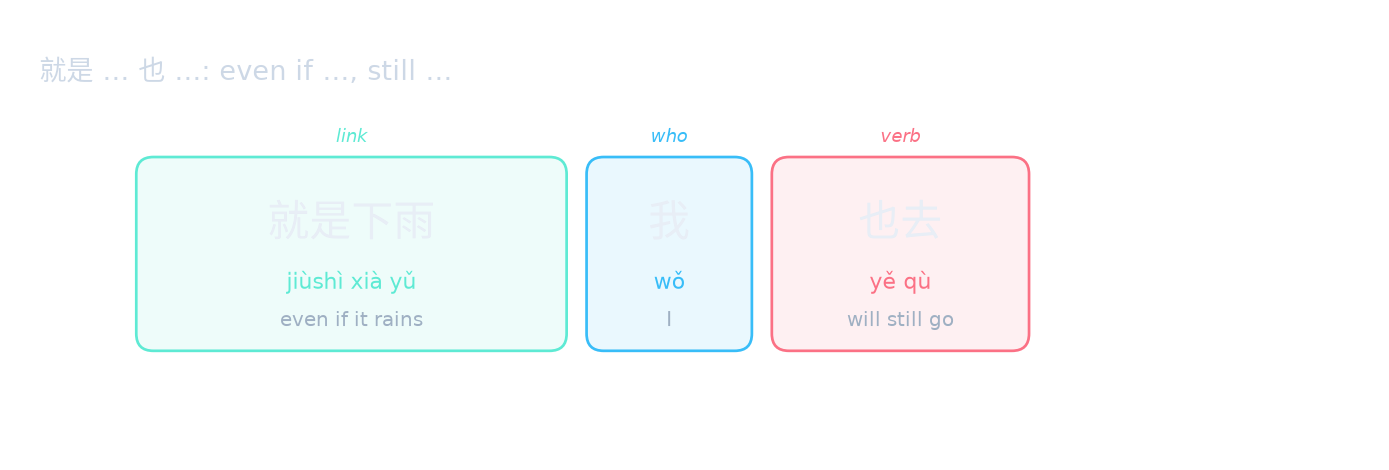
    even if / (就算了) forget it就算jiù suàn … ,also也yě … (even if)

    Form: even if / (就算了) forget it就算jiù suàn + granted case,(subject) + also也yě + conclusion

    • even if / (就算了) forget it就算jiù suànto fail; failure失败shī bài,also也yěto be worth值得zhí de。 Jiùsuàn shībài, yě zhídé. – Even if it fails, it's worth it.
    • even if / (就算了) forget it就算jiù suànthis这个zhè gemeans办法bàn fǎcheap便宜pián yi,also也yěnot不bùdefinitely / certain一定yí dìngto suit适合shì héwe / us我们wǒ men。 – Even if this method is cheap, it may not suit us.
    • even if / (就算了) forget it就算jiù suànyou你nǐnot不bùto agree同意tóng yì,I / me我wǒalso也yěwant / will / need要yào试试shì shì。 – Even if you don't agree, I'm going to try.

    How it works. even if / (就算了) forget it就算jiù suàn jiùsuàn is a spoken "even if / even granted that". It grants a point (imagined, or already known) and keeps the conclusion. The granted point can be good news as well as bad: even if / (就算了) forget it就算jiù suàncheap便宜pián yi grants the low price, then questions whether that is enough.

    Spoken Neutral / written
    exactly就是jiù shì……also也yě · even if / (就算了) forget it就算jiù suàn……also也yě even if即使jí shǐ……also也yě · even if哪怕nǎ pà……also也yě

    Watch out

    • even if / (就算了) forget it就算jiù suànto fail; failure失败shī bài doesn't say it will fail.
    • One view doesn't override other rules: also也yěto be worth值得zhí de doesn't permit breaking an agreed budget.
    就算 … 也 …: even if …, still …

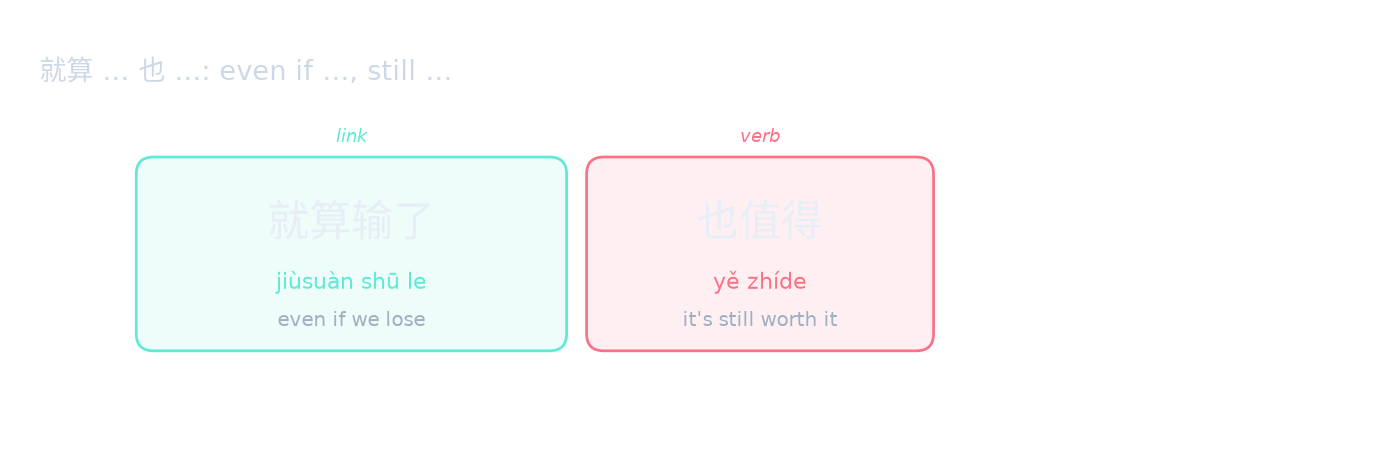
    even if哪怕nǎ pà … ,also也yě … (even if)

    Form: even if哪怕nǎ pà + extreme / minimal case,(subject) + also也yě + conclusion

    • even if哪怕nǎ pà再难zài nán,I / me我wǒalso也yě要学yào xué。 Nǎpà zài nán, wǒ yě yào xué. – However hard it is, I'm going to learn it.
    • even if哪怕nǎ pàonly (if) / only have只有zhǐ yǒu五分钟wǔ fēn zhōng,I / me我wǒalso也yěwant / will / need要yàoto practice练习liàn xí。 – Even if I only have five minutes, I'll practise.
    • even if哪怕nǎ pàonly (if) / only have只有zhǐ yǒua bit一点yì diǎnto hope希望xī wàng,we / us我们wǒ menalso也yěwant / will / need要yàoto have a try试一试shì yī shì。 – Even with only a little hope, we must give it a try.

    How it works. even if哪怕nǎ pà nǎpà pushes the case to an extreme (再难zài nán "however hard") or a minimum (only (if) / only have只有zhǐ yǒu五分钟wǔ fēn zhōng, a bit一点yì diǎnto hope希望xī wàng). The conclusion holds anyway, and it often expresses strong determination. again / then / (再…也) however再zài + adjective here means "however …", not "again".

    Follow the conclusion. also也yě doesn't make it positive: even if哪怕nǎ pàto have time (to do sth)有空yǒu kòng,I / me我wǒalso也yěnot不bùto go去qù means I won't go, even with free time.

    Case conceded Example
    extreme difficulty even if哪怕nǎ pà再难zài nán
    tiny amount even if哪怕nǎ pàonly (if) / only have只有zhǐ yǒu五分钟wǔ fēn zhōng
    a little hope even if哪怕nǎ pàonly (if) / only have只有zhǐ yǒua bit一点yì diǎnto hope希望xī wàng (not "no hope")

    Watch out

    • An intention isn't success: I / me我wǒalso也yě要学yào xué doesn't say it's been mastered.
    哪怕 … 也 …: even if (only / however …)

    Practice without the models

    Cover the teaching sections before you answer. The answers follow.

    exactly就是jiù shì … ,also也yě … (even if)

    1. Even if it rains, I'm going. exactly就是jiù shìto rain下雨xià yǔ,I / me我wǒ ………… to go去qù。

    2. Which sentence changes the plan if it rains?

    • A. even if哪怕nǎ pàto rain下雨xià yǔ,I / me我wǒalso也yěto go去qù。
    • B. exactly就是jiù shìto rain下雨xià yǔ,I / me我wǒalso也yěto go去qù。
    • C. even if / (就算了) forget it就算jiù suànto rain下雨xià yǔ,I / me我wǒalso也yěto go去qù。
    • D. supposing假如jiǎ rúto rain下雨xià yǔ,I / me我wǒthen / just就jiùnot不bùto go去qù。

    3. In this这zhèexactly就是jiù shìI / me我wǒ(modifier / structural particle)的debook书shū, exactly就是jiù shì means…

    • A. exactly is
    • B. although
    • C. even if
    • D. then

    4. True or false? exactly就是jiù shì sounds more formal than even if即使jí shǐ. If false, correct it.

    5. Say in Chinese: "However busy he is, he calls home every day."

    6. Even if you don't tell me, I know.

    Put in order: I / me我wǒ / to know知道zhī dào。 / you你nǐnot不bùto speak说shuō, / also也yě / exactly就是jiù shì

    even if / (就算了) forget it就算jiù suàn … ,also也yě … (even if)

    7. Even if it fails, it's worth it. ………… to fail; failure失败shī bài,also也yěto be worth值得zhí de。

    8. Choose the best ending: even if / (就算了) forget it就算jiù suànthis这个zhè gemeans办法bàn fǎcheap便宜pián yi,……

    • A. also也yěnot不bùdefinitely / certain一定yí dìngto suit适合shì héwe / us我们wǒ men。
    • B. because因为yīn wèicheap便宜pián yi。
    • C. then / just就jiùdegree / adjective linker很hěngood好hǎo。
    • D. so / therefore所以suǒ yǐwe / us我们wǒ mento use / with用yòng(suggestion)吧ba。

    9. Which is closest in meaning to even if / (就算了) forget it就算jiù suàn?

    • A. if如果rú guǒ
    • B. so / therefore所以suǒ yǐ
    • C. even if即使jí shǐ
    • D. because因为yīn wèi

    10. True or false? even if / (就算了) forget it就算jiù suànto fail; failure失败shī bài says the attempt will fail. If false, correct it.

    11. Say in Chinese: "Even if you don't agree, I'm going to try."

    12. Even if it's expensive, I'll buy it.

    Put in order: also也yě / I / me我wǒ / degree / adjective linker很hěnexpensive贵guì, / want / will / need要yàoto buy买mǎi。 / even if / (就算了) forget it就算jiù suàn

    even if哪怕nǎ pà … ,also也yě … (even if)

    13. However hard it is, I'm going to learn it. even if哪怕nǎ pà再难zài nán,I / me我wǒ ………… 要学yào xué。

    14. even if哪怕nǎ pàto have time (to do sth)有空yǒu kòng,I / me我wǒalso也yěnot不bùto go去qù means…

    • A. I'll go anyway
    • B. I'm not free
    • C. I won't go even if I'm free
    • D. I'll go if I'm free

    15. In even if哪怕nǎ pà再难zài nán, again / then / (再…也) however再zài means…

    • A. then
    • B. again
    • C. still
    • D. however (much more)

    16. True or false? even if哪怕nǎ pàonly (if) / only have只有zhǐ yǒu五分钟wǔ fēn zhōng concedes a tiny amount of time. If false, correct it.

    17. Say in Chinese: "Even with only a little hope, we must try."

    18. Even if I have only five minutes, I'll practise.

    Put in order: I / me我wǒ / even if哪怕nǎ pà / also也yěwant / will / need要yàoto practice练习liàn xí。 / 五分钟wǔ fēn zhōng, / only (if) / only have只有zhǐ yǒu

    Answers and explanations

    exactly就是jiù shì … ,also也yě … (even if)

    1. also也yě

    exactly就是jiù shì……also也yě: the decision survives.

    2. D. supposing假如jiǎ rúto rain下雨xià yǔ,I / me我wǒthen / just就jiùnot不bùto go去qù。

    supposing假如jiǎ rú = if; the others mean even if.

    3. A. exactly is

    Without a also也yě clause, exactly就是jiù shì often identifies.

    4. False.

    exactly就是jiù shì is colloquial; even if即使jí shǐ is more neutral and written.

    5. exactly就是jiù shìagain / then / (再…也) however再zàibusy忙máng,he / him他tāalso也yěevery day每天měi tiānto / for / give给gěihome家里jiā lǐto make a telephone call打电话dǎ diàn huà。

    exactly就是jiù shì + case,also也yě + decision.

    6. exactly就是jiù shìyou你nǐnot不bùto speak说shuō,I / me我wǒalso也yěto know知道zhī dào。

    exactly就是jiù shì + case,subject + also也yě.

    even if / (就算了) forget it就算jiù suàn … ,also也yě … (even if)

    7. even if / (就算了) forget it就算jiù suàn

    even if / (就算了) forget it就算jiù suàn grants a case.

    8. A. also也yěnot不bùdefinitely / certain一定yí dìngto suit适合shì héwe / us我们wǒ men。

    even if / (就算了) forget it就算jiù suàn grants the point, then keeps the conclusion.

    9. C. even if即使jí shǐ

    Both mean even if.

    10. False.

    It only grants the possibility.

    11. even if / (就算了) forget it就算jiù suànyou你nǐnot不bùto agree同意tóng yì,I / me我wǒalso也yěwant / will / need要yào试试shì shì。

    even if / (就算了) forget it就算jiù suàn + case,also也yě + conclusion.

    12. even if / (就算了) forget it就算jiù suàndegree / adjective linker很hěnexpensive贵guì,I / me我wǒalso也yěwant / will / need要yàoto buy买mǎi。

    even if / (就算了) forget it就算jiù suàn……also也yě…….

    even if哪怕nǎ pà … ,also也yě … (even if)

    13. also也yě

    even if哪怕nǎ pà……also也yě.

    14. C. I won't go even if I'm free

    also也yě doesn't make the conclusion positive.

    15. D. however (much more)

    even if哪怕nǎ pà + again / then / (再…也) however再zài + adj = however …

    16. True.

    even if哪怕nǎ pà can push to a minimum.

    17. even if哪怕nǎ pàonly (if) / only have只有zhǐ yǒua bit一点yì diǎnto hope希望xī wàng,we / us我们wǒ menalso也yěwant / will / need要yàoto have a try试一试shì yī shì。

    even if哪怕nǎ pà + minimal case,also也yě + conclusion.

    18. even if哪怕nǎ pàonly (if) / only have只有zhǐ yǒu五分钟wǔ fēn zhōng,I / me我wǒalso也yěwant / will / need要yàoto practice练习liàn xí。

    even if哪怕nǎ pà + case,also也yě + intention.

  • 15 "If" Statements
    • 15.1 Expressing "if… then…" with "jiaru"
    • 15.2 Expressing "what if" with "wanyi"
    • 15.3 Marking a topic with "de hua"

    "If" Statements →

  • 16 Adverbs with Adjectives
    • 16.1 Expressing "especially" with "gewai"

    Adverbs with Adjectives →

  • 17 Cause/Effect Statements
    • 17.1 Stating the effect before the cause

    Cause/Effect Statements →

  • 18 Complements
    • 18.1 Advanced degree complements
    • 18.2 Advanced potential complements
    • 18.3 Advanced result complements "zhu", "kai", and "chulai"
    • 18.4 Complement "-huai le"
    • 18.5 Complement "-zhao"
    • 18.6 Tricky uses of "dao"
    • 18.7 Using "lai" and "qu" when "verbing around"

    Complements →

  • 19 Conditional Statements
    • 19.1 Expressing "once...then..." with "yidan...jiu..."

    Conditional Statements →

  • 20 Sentence Patterns
    • 20.1 Advanced uses of "ba"
    • 20.2 Basic comparisons with "bu bi"
    • 20.3 Conditions with "yao" and "jiu"
    • 20.4 Expressing "can't do without" with "shaobuliao"
    • 20.5 Expressing "equal to" with "dengyu"
    • 20.6 Expressing "from" with "cong... zhong"
    • 20.7 Expressing "no" (noun) "to" (verb) with "wu... ke..."
    • 20.8 Expressing "not only..., even..." using "budan..., shenzhi lian"
    • 20.9 Expressing "related to..." with "you guan de"
    • 20.10 Expressing "so-called" with "suowei"
    • 20.11 Expressing "within" a period of time using "zai... nei"
    • 20.12 Expressing "would rather" with "ningke"
    • 20.13 Expressing indifference with "jiu"
    • 20.14 Expressing purpose with "hao"
    • 20.15 Expressing simultaneous actions with "yimian"
    • 20.16 Expressing the only two possibilities

    Sentence Patterns →

  • 21 Complex Sentence Patterns
    • 21.1 Expressing "no wonder"

    Complex Sentence Patterns →

  • 22 Either… or
    • 22.1 Providing two options with double "huozhe"

    Either… or →

  • 23 Let alone
    • 23.1 Expressing "let alone" with "bie shuo"
    • 23.2 Expressing "let alone" with "geng buyong shuo"

    Let alone →

  • 24 Comparing similar adverbs
    • 24.1 Comparing "changchang" and "jingchang"

    Comparing similar adverbs →

  • 25 Comparing similar auxiliary words
    • 25.1 Comparing "zongsuan" and “zhongyu"

    Comparing similar auxiliary words →

  • 26 Comparing similar conjunctions
    • 26.1 Comparing "gen" and "dui"

    Comparing similar conjunctions →

  • 27 Comparing similar prepositions
    • 27.1 Comparing "chao" "xiang" and "wang"
    • 27.2 Comparing "dui" and "duiyu"
    • 27.3 Comparing "duiyu" and "zhiyu"
    • 27.4 Comparing "gei" and "wei"

    Comparing similar prepositions →

  • 28 Comparing similar time words
    • 28.1 Comparing "pingshi" and "pingchang"
    • 28.2 Comparing "yihou" and "zhihou"

    Comparing similar time words →

  • 29 Comparing similar verbs
    • 29.1 Comparing "kanqilai" and "kanlai"
    • 29.2 Comparing "xiande" and "kanqilai"

    Comparing similar verbs →

Log in or create account

IGCSE, A-Level & AP