Skip to content
Subjects
  • 1 Adjectives
    • 1.1 Adjectival complement "de budeliao"
    • 1.2 Adjectival complement "de hen"
    • 1.3 Expressing "a bit too"
    • 1.4 Saying "a lot" with "youdeshi"

    Adjectives →

  • 2 Adverbs
    • 2.1 Advanced uses of "dou"
    • 2.2 Advanced uses of "hai"
    • 2.3 Advanced uses of "zong"
    • 2.4 Expressing "after all" with "bijing"
    • 2.5 Expressing "almost" using "chadian mei"
    • 2.6 Expressing "anyway" with "fanzheng"
    • 2.7 Expressing "as much as possible" with "jinliang"
    • 2.8 Expressing "each other" with "huxiang"
    • 2.9 Expressing "feel free" with "jinguan"
    • 2.10 Expressing "just" do it with "gancui"
    • 2.11 Expressing "never again" with "zai ye bu"
    • 2.12 Expressing "once" with "cengjing"
    • 2.13 Expressing "over and over again" with "zaisan"
    • 2.14 Expressing "simply" with "jianzhi"
    • 2.15 Expressing "while you're at it" with "shunbian"
    • 2.16 Expressing a last chance with "zaibu... jiu..."
    • 2.17 Expressing difficulty with "hao (bu) rongyi"
    • 2.18 Expressing wasted efforts with "bai"
    • 2.19 Repeated actions in the past with "you"
    • 2.20 The opposite of "chabuduo" is "cha hen duo"

    Adverbs →

  • 3 Auxiliary Words
    • 3.1 Listing things with "a"

    Auxiliary Words →

  • 4 Conjunctions
    • 4.1 Expressing "how about" with "yaobu"

    Conjunctions →

  • 5 Nouns
    • 5.1 Expressing "among" with "dangzhong"
    • 5.2 Expressing "each other" with "bici"
    • 5.3 Expressing "ever since" with "yilai"
    • 5.4 Expressing "when" using "dang"
    • 5.5 Name-calling with "zhege"

    Nouns →

  • 6 Particles
    • 6.1 Advanced "le" after an object
    • 6.2 Advanced "le" with complements
    • 6.3 Marking a topic with "ma"
    • 6.4 Softening the tone of questions with "ne"

    Particles →

  • 7 Prepositional Phrase
    • 7.1 Defining upper and lower limits

    Prepositional Phrase →

  • 8 Prepositions
    • 8.1 Expressing "ever since" with "zicong"
    • 8.2 Expressing "for" with "wei"
    • 8.3 Expressing "for…" with "eryan"
    • 8.4 Expressing "including" with "zainei"
    • 8.5 Expressing "on the basis of" with "ping"
    • 8.6 Expressing "with regards to" with "zhiyu"
    • 8.7 Expressing passive voice with "gei"
    • 8.8 Limiting scope with "jiu"
    • 8.9 Opportune timing with "chen"

    Prepositions →

  • 9 Sentence Patterns
    • 9.1 Expressing "if it were not for" with "yaobushi"
    • 9.2 Expressing "thanks to" with "duokui"
    • 9.3 Expressing "that's all" with "eryi"
    • 9.4 Using "jiang" as a formal "ba"

    Sentence Patterns →

  • 10 Verbs
    • 10.1 Challenging a verb with "shenme"
    • 10.2 Comparing specifically with "xiang"
    • 10.3 Comparisons with "biqi"
    • 10.4 Comparisons with "buru"
    • 10.5 Making "-ize" and "-ify" verbs with "hua"
    • 10.6 Making judgments with "suan"
    • 10.7 Using "nanguai" as a verb

    Verbs →

  • 11 Auxiliary verbs
    • 11.1 Expressing future with "jiang"

    Auxiliary verbs →

  • 12 Verb phrases
    • 12.1 Expressing "hard to avoid" with "nanmian"
    • 12.2 Passive verbs with "shou"

    Verb phrases →

  • 13 "But" Statements

    instead (contrary to expectation)反而fǎn ér (on the contrary / instead)

    Form: subject + instead (contrary to expectation)反而fǎn ér + predicate · (subject) not only不但bù dànnot不bù / not / haven't没méi……,instead (contrary to expectation)反而fǎn ér……

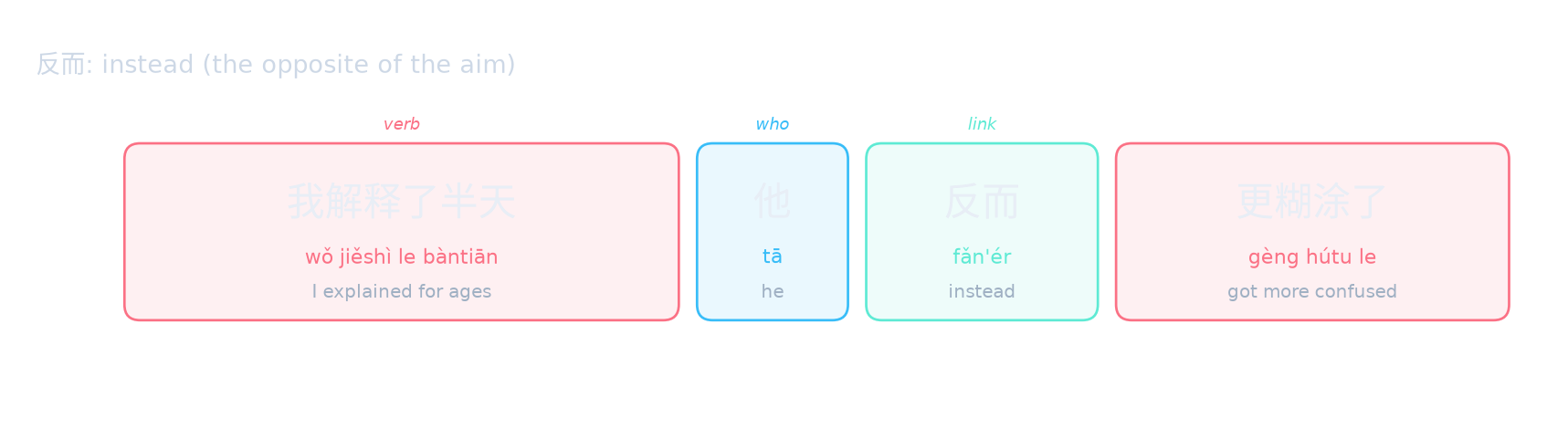
    • I / me我wǒto explain / explanation解释jiě shì(completed / change)了lea long time / half a day半天bàn tiān,he / him他tāinstead (contrary to expectation)反而fǎn érmore更gèngconfused; muddled糊涂hú tú(completed / change)了le。 Wǒ jiěshìle bàntiān, tā fǎn'ér gèng hútu le. – I explained for ages, and he only got more confused.
    • he / him他tānot only不但bù dàn没生气méi shēng qì,instead (contrary to expectation)反而fǎn érto laugh笑xiào(completed / change)了le。 Tā búdàn méi shēngqì, fǎn'ér xiào le. – Far from getting angry, he actually laughed.
    • to eat吃chī(completed / change)了lemedicine药yào,illness / ill病bìnginstead (contrary to expectation)反而fǎn ér更重gèng zhòng(completed / change)了le。 Chīle yào, bìng fǎn'ér gèng zhòng le. – After taking the medicine, the illness actually got worse.
    • rain雨yǔnot only不但bù dàn没停méi tíng,instead (contrary to expectation)反而fǎn ér越下yuè xià越大yuè dà。 Yǔ búdàn méi tíng, fǎn'ér yuè xià yuè dà. – Far from stopping, the rain got heavier and heavier.
    • I / me我wǒto think以为yǐ wéito sit / to take (a bus …)坐zuòtaxi出租车chū zū chē会快huì kuàia little一点儿yì diǎnr,didn't expect没想到méi xiǎng dàoinstead (contrary to expectation)反而fǎn ér更慢gèng màn(completed / change)了le。 Wǒ yǐwéi zuò chūzūchē huì kuài yìdiǎnr, méi xiǎngdào fǎn'ér gèng màn le. – I thought a taxi would be quicker, but it turned out even slower.
    • teacher老师lǎo shīto criticize批评pī píng(completed / change)了lehe / him他tā,he / him他tāinstead (contrary to expectation)反而fǎn érmore更gèngto work hard / effort努力nǔ lì(completed / change)了le。 Lǎoshī pīpíngle tā, tā fǎn'ér gèng nǔlì le. – The teacher criticised him, and instead of giving up he worked even harder.

    How it works. instead (contrary to expectation)反而fǎn ér fǎn'ér "instead, on the contrary" marks a result that goes against what was expected or intended. The expectation comes first, either stated (I / me我wǒto think以为yǐ wéi……) or obvious from the situation: explaining should help, medicine should cure, a taxi should be faster. Then instead (contrary to expectation)反而fǎn ér introduces the surprising opposite.

    With not only不但bù dànnot不bù / not only不但bù dànnot / haven't没méi, the first half rules out the expected reaction and the second half gives the opposite: he / him他tānot only不但bù dàn没生气méi shēng qì,instead (contrary to expectation)反而fǎn érto laugh笑xiào(completed / change)了le. more更gèng often follows instead (contrary to expectation)反而fǎn ér, because the result is "even more" of the unexpected thing.

    instead (contrary to expectation)反而fǎn ér but但是dàn shì / but; yet却què opposite; on the contrary相反xiāng fǎn
    goes against an expectation; adverb after the subject a plain contrast between two facts "on the contrary"; can start a sentence
    I / me我wǒto explain / explanation解释jiě shì(completed / change)了le,he / him他tāinstead (contrary to expectation)反而fǎn érmore更gèngconfused; muddled糊涂hú tú(completed / change)了le。 he / him他tādegree / adjective linker很hěnintelligent聪明cōng míng,but但是dàn shìnot不bùto work hard / effort努力nǔ lì。 he / him他tā没生气méi shēng qì,opposite; on the contrary相反xiāng fǎn,he / him他tādegree / adjective linker很hěnhappy; glad高兴gāo xìng。

    Watch out

    • instead (contrary to expectation)反而fǎn ér is an adverb, so it goes after the subject: wrong: instead (contrary to expectation)反而fǎn érhe / him他tāto laugh笑xiào(completed / change)了le → he / him他tāinstead (contrary to expectation)反而fǎn érto laugh笑xiào(completed / change)了le.
    • It needs an expectation to go against; a plain contrast takes but可是kě shì or but但是dàn shì: wrong: I / me我wǒdegree / adjective linker很hěntired累lèi,instead (contrary to expectation)反而fǎn érI / me我wǒto go去qùto play ball打球dǎ qiú(completed / change)了le → I / me我wǒdegree / adjective linker很hěntired累lèi,but可是kě shìor / still还是hái shìto go去qùto play ball打球dǎ qiú(completed / change)了le.
    • Pair not only不但bù dàn with not / haven't没méi / not不bù here, not with moreover而且ér qiě: wrong: he / him他tānot only不但bù dàn没生气méi shēng qì,moreover而且ér qiěto laugh笑xiào(completed / change)了le → he / him他tānot only不但bù dàn没生气méi shēng qì,instead (contrary to expectation)反而fǎn érto laugh笑xiào(completed / change)了le.

    In a passage

    in order to为了wèi leto lose weight减肥jiǎn féi,小张xiǎo zhāngevery day每天měi tiānonly只zhǐto eat吃chī一顿饭yī dùn fàn。but可是kě shì一个月yí gè yuèafter / from now on以后yǐ hòu,he / him他tānot only不但bù dàn没瘦méi shòu,instead (contrary to expectation)反而fǎn érfat胖pàng(completed / change)了letwo两liǎngkilogram公斤gōng jīn。doctor医生yī shēngto tell告诉gào sùhe / him他tā,hungry饿è(degree marker)得detoo太tàiamazing; severe厉害lì hài,evening晚上wǎn shànginstead (contrary to expectation)反而fǎn éreasy容易róng yìto eat吃chī(degree marker)得demore更gèngmany; much多duō。later; afterwards后来hòu láihe / him他tāto convert改成gǎi chéngon time按时àn shíto have a meal吃饭chī fàn、many; much多duōsports / to exercise运动yùn dòng,body weight体重tǐ zhòngonly then / not until才cáislowly慢慢màn màn降下来jiàng xià lái。

    Read and notice. What did 小张xiǎo zhāng expect, and what happened instead? Find both instead (contrary to expectation)反而fǎn ér sentences.

    反而: instead (the opposite of the aim)

    Practice without the models

    Cover the teaching sections before you answer. The answers follow.

    1. Complete: “After the rain, it got hotter instead.” down / next; to fall (rain), get off下xià(completed / change)了lerain雨yǔ,weather天气tiān qì…………more更gènghot热rè(completed / change)了le。

    2. Which sentence is correct?

    • A. he / him他tānot / haven't没méito cry哭kūinstead (contrary to expectation)反而fǎn ér,to laugh笑xiào(completed / change)了le。
    • B. he / him他tāinstead (contrary to expectation)反而fǎn érnot only不但bù dàn没哭méi kū,to laugh笑xiào(completed / change)了le。
    • C. he / him他tānot only不但bù dàn没哭méi kū,instead (contrary to expectation)反而fǎn érto laugh笑xiào(completed / change)了le。
    • D. he / him他tāto laugh笑xiào(completed / change)了leinstead (contrary to expectation)反而fǎn ér。

    3. Build: “Far from getting angry, he actually laughed.”

    Put in order: , / instead (contrary to expectation)反而fǎn ér / he / him他tānot only不但bù dàn没生气méi shēng qì / to laugh笑xiào(completed / change)了le。

    4. True or false? opposite; on the contrary相反xiāng fǎn can open a sentence followed by a comma. If false, correct it.

    5. You tried to help your little brother with maths, but he got more confused. Use instead (contrary to expectation)反而fǎn ér. Write your answer in Chinese, then say it aloud.

    Answers and explanations

    1. instead (contrary to expectation)反而fǎn ér

    instead (contrary to expectation)反而fǎn ér marks the opposite of what you'd expect.

    2. C. he / him他tānot only不但bù dàn没哭méi kū,instead (contrary to expectation)反而fǎn érto laugh笑xiào(completed / change)了le。

    not only不但bù dànnot / haven't没méi…,instead (contrary to expectation)反而fǎn ér… with instead (contrary to expectation)反而fǎn ér after the (omitted) subject.

    3. he / him他tānot only不但bù dàn没生气méi shēng qì,instead (contrary to expectation)反而fǎn érto laugh笑xiào(completed / change)了le。

    not only不但bù dànnot / haven't没méi…,instead (contrary to expectation)反而fǎn ér….

    4. True.

    True. opposite; on the contrary相反xiāng fǎn can open a sentence, followed by a comma, to mean “on the contrary”: he / him他tā没生气méi shēng qì,opposite; on the contrary相反xiāng fǎn,he / him他tādegree / adjective linker很hěnhappy; glad高兴gāo xìng.

    5. Model answer: I / me我wǒto explain / explanation解释jiě shì(completed / change)了lea long time / half a day半天bàn tiān,he / him他tāinstead (contrary to expectation)反而fǎn érmore更gèngconfused; muddled糊涂hú tú(completed / change)了le。

    Check your answer:

    • instead (contrary to expectation)反而fǎn ér is an adverb: rain雨yǔinstead (contrary to expectation)反而fǎn ér更大gèng dà(completed / change)了le is the usual order.
    • It needs an expectation to go against; for a plain contrast use but但是dàn shì / but; yet却què.
  • 14 "Even If" Statements
    • 14.1 Expressing "even if…" with "jiushi"
    • 14.2 Expressing "even if…" with "jiusuan"
    • 14.3 Expressing "even if…" with "napa"

    "Even If" Statements →

  • 15 "If" Statements
    • 15.1 Expressing "if… then…" with "jiaru"
    • 15.2 Expressing "what if" with "wanyi"
    • 15.3 Marking a topic with "de hua"

    "If" Statements →

  • 16 Adverbs with Adjectives
    • 16.1 Expressing "especially" with "gewai"

    Adverbs with Adjectives →

  • 17 Cause/Effect Statements
    • 17.1 Stating the effect before the cause

    Cause/Effect Statements →

  • 18 Complements
    • 18.1 Advanced degree complements
    • 18.2 Advanced potential complements
    • 18.3 Advanced result complements "zhu", "kai", and "chulai"
    • 18.4 Complement "-huai le"
    • 18.5 Complement "-zhao"
    • 18.6 Tricky uses of "dao"
    • 18.7 Using "lai" and "qu" when "verbing around"

    Complements →

  • 19 Conditional Statements
    • 19.1 Expressing "once...then..." with "yidan...jiu..."

    Conditional Statements →

  • 20 Sentence Patterns
    • 20.1 Advanced uses of "ba"
    • 20.2 Basic comparisons with "bu bi"
    • 20.3 Conditions with "yao" and "jiu"
    • 20.4 Expressing "can't do without" with "shaobuliao"
    • 20.5 Expressing "equal to" with "dengyu"
    • 20.6 Expressing "from" with "cong... zhong"
    • 20.7 Expressing "no" (noun) "to" (verb) with "wu... ke..."
    • 20.8 Expressing "not only..., even..." using "budan..., shenzhi lian"
    • 20.9 Expressing "related to..." with "you guan de"
    • 20.10 Expressing "so-called" with "suowei"
    • 20.11 Expressing "within" a period of time using "zai... nei"
    • 20.12 Expressing "would rather" with "ningke"
    • 20.13 Expressing indifference with "jiu"
    • 20.14 Expressing purpose with "hao"
    • 20.15 Expressing simultaneous actions with "yimian"
    • 20.16 Expressing the only two possibilities

    Sentence Patterns →

  • 21 Complex Sentence Patterns
    • 21.1 Expressing "no wonder"

    Complex Sentence Patterns →

  • 22 Either… or
    • 22.1 Providing two options with double "huozhe"

    Either… or →

  • 23 Let alone
    • 23.1 Expressing "let alone" with "bie shuo"
    • 23.2 Expressing "let alone" with "geng buyong shuo"

    Let alone →

  • 24 Comparing similar adverbs
    • 24.1 Comparing "changchang" and "jingchang"

    Comparing similar adverbs →

  • 25 Comparing similar auxiliary words
    • 25.1 Comparing "zongsuan" and “zhongyu"

    Comparing similar auxiliary words →

  • 26 Comparing similar conjunctions
    • 26.1 Comparing "gen" and "dui"

    Comparing similar conjunctions →

  • 27 Comparing similar prepositions
    • 27.1 Comparing "chao" "xiang" and "wang"
    • 27.2 Comparing "dui" and "duiyu"
    • 27.3 Comparing "duiyu" and "zhiyu"
    • 27.4 Comparing "gei" and "wei"

    Comparing similar prepositions →

  • 28 Comparing similar time words
    • 28.1 Comparing "pingshi" and "pingchang"
    • 28.2 Comparing "yihou" and "zhihou"

    Comparing similar time words →

  • 29 Comparing similar verbs
    • 29.1 Comparing "kanqilai" and "kanlai"
    • 29.2 Comparing "xiande" and "kanqilai"

    Comparing similar verbs →

Log in or create account

IGCSE, A-Level & AP