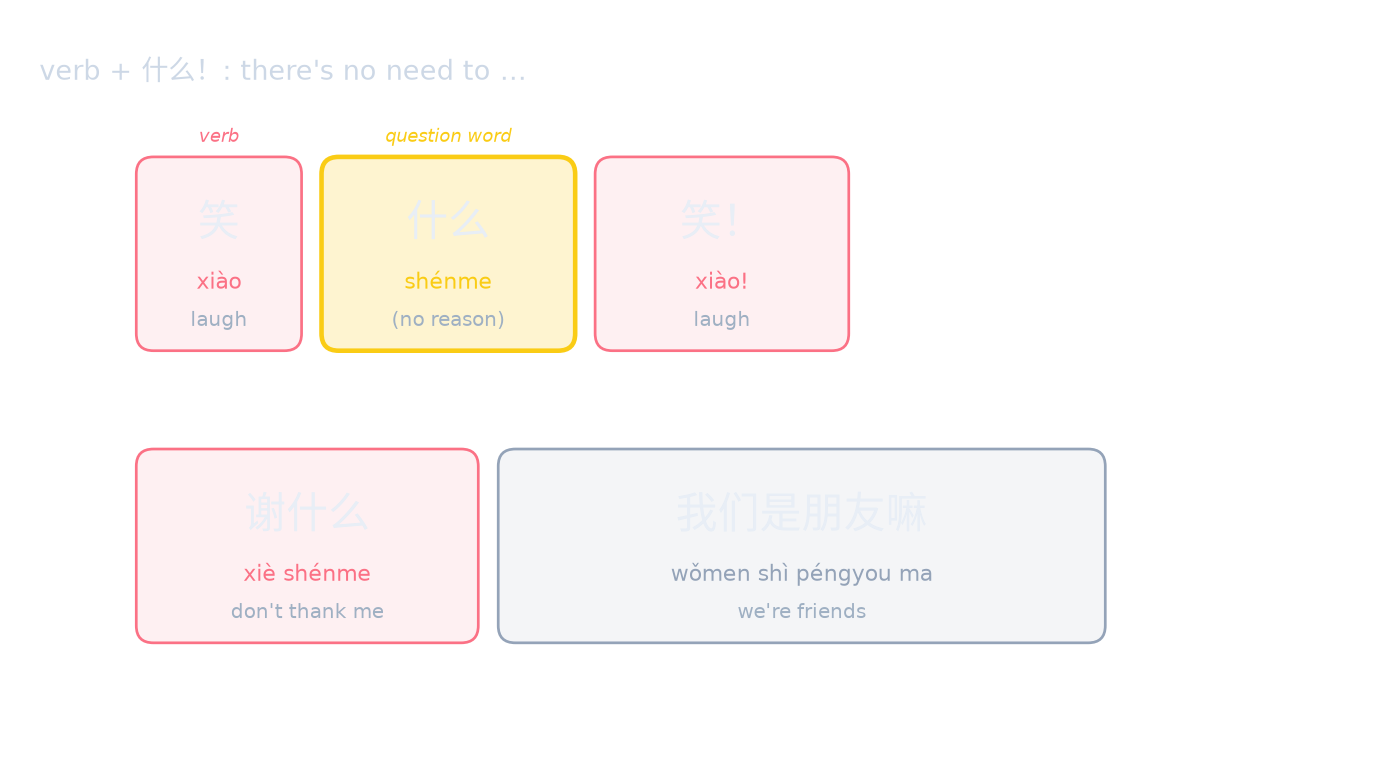
Verb + what什么 (a rebuke)
Form: verb + what什么 (+ verb)! (a rebuke) · you你 + verb/adj + what什么?
- to look at; to watch; to read看what什么to look at; to watch; to read看! Kàn shénme kàn! – What are you staring at?!
- to laugh笑what什么to laugh笑! – What's so funny?!
- you你urgent / anxious急what什么?time时间still / also / even还early早。 – What's the hurry? There's plenty of time.
How it works. In speech, verb + what什么 can object to an action instead of asking for information: stop doing that, or there's no need. The repeated form (to look at; to watch; to read看what什么to look at; to watch; to read看) is sharp and rude. you你urgent / anxious急what什么 can be gentle reassurance; tone and situation decide.
| Rebuke | Real question |
|---|---|
| to look at; to watch; to read看what什么to look at; to watch; to read看! | you你want / think / miss想to look at; to watch; to read看what什么? (what to watch) |
| to laugh笑what什么to laugh笑! | you你at / in在to laugh笑what什么? (asking why) |
Watch out
- Not every verb + what什么 is a rebuke; to ask for information, add an object or want / think / miss想 / at / in在 (you你want / think / miss想to look at; to watch; to read看what什么book书?).
- The repeated rebuke is impolite: don't use it with teachers or strangers.
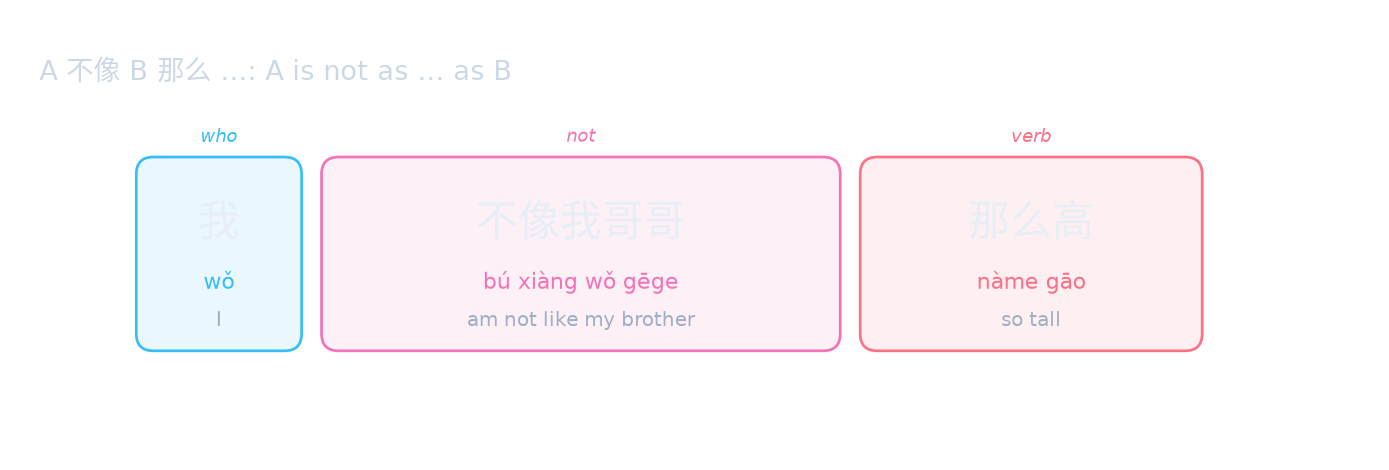
不像 … like that那么 … (not as … as)
Form: A + 不像 + B + like that那么 / so much这么 + adjective
- I / me我not不to resemble像he / him他like that那么tall; high高。 Wǒ bú xiàng tā nàme gāo. – I'm not as tall as him.
- 这杯tea茶not不to resemble像那杯like that那么hot热。 – This tea isn't as hot as that one.
- 今年冬天不像last year去年so much这么cold冷。 – This winter isn't as cold as last.
How it works. B is the standard, and A doesn't reach B's degree of the adjective. like that那么 points to something further away, so much这么 to something close or present. The pattern gives no number: 170 cm vs 180 cm makes a 10 cm gap, which comes from the measurements.
Follow the adjective. I / me我not不to resemble像he / him他like that那么tall; high高 means I'm shorter; I / me我not不to resemble像he / him他like that那么short in height矮 means I'm taller. I / me我not不to resemble像he / him他 alone says "I'm not like him", and names no quality.
| I / me我not不to resemble像he / him他like that那么tall; high高 | I / me我not have / haven't没有he / him他tall; high高 | he / him他than / compared to比I / me我tall; high高 |
|---|---|---|
| not as tall as him | not as tall as him (most common) | he's taller |
Watch out
- The comparison covers one quality only, not speed, grades or character.
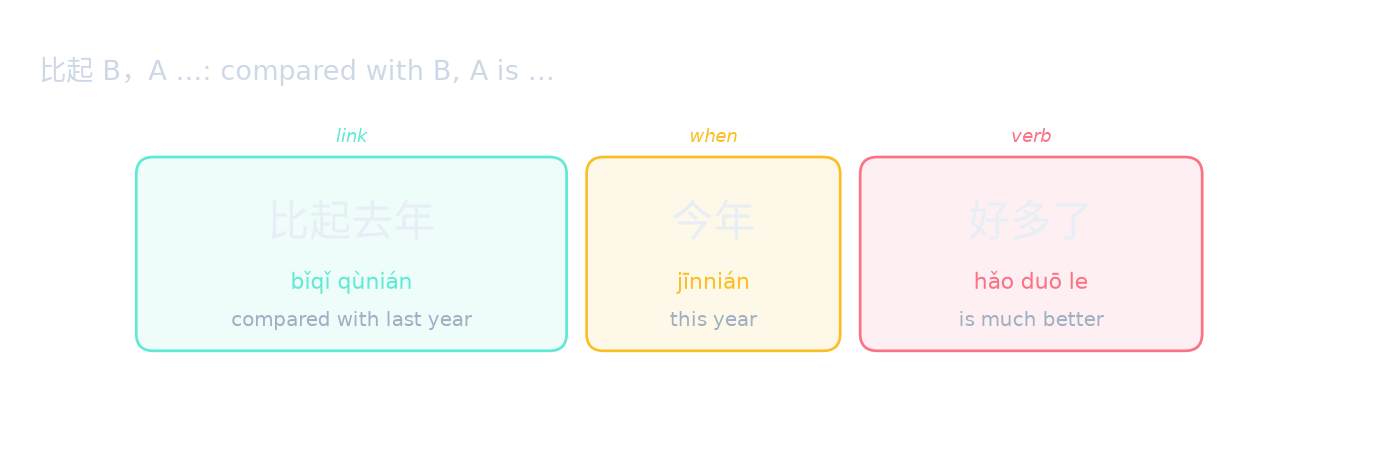
compared with比起 … to come来 (compared with)
Form: compared with比起 + B (+ to come来),A + comment
- compared with比起last year去年,this year今年many好多(completed / change)了。 Bǐqǐ qùnián, jīnnián hǎo duō le. – Compared with last year, this year is much better.
- compared with比起last year去年,this year今年to raise / improve提高(completed / change)了十五分。 – Compared with last year, this year's score rose by 15 points.
- compared with比起to drive a car开车,I / me我more更to like喜欢坐地铁。 – I'd rather take the metro than drive.
How it works. compared with比起 bǐqǐ introduces the baseline B first; the comment then evaluates A against it. to come来 is optional (compared with比起last year去年to come来). The comment sets the direction: many好多(completed / change)了, low低十五分 and more更to like喜欢 are all possible.
Numbers come from data. With 60 last year and 75 this year: compared with比起last year去年,this year今年to raise / improve提高(completed / change)了十五分; or, swapping the baseline, compared with比起this year今年,last year去年low低十五分. many好多(completed / change)了 alone gives no number.
Watch out
- compared with比起 doesn't mean "better"; read the comment.
- A preference (more更to like喜欢坐地铁) is not a claim that it's cheaper or faster.
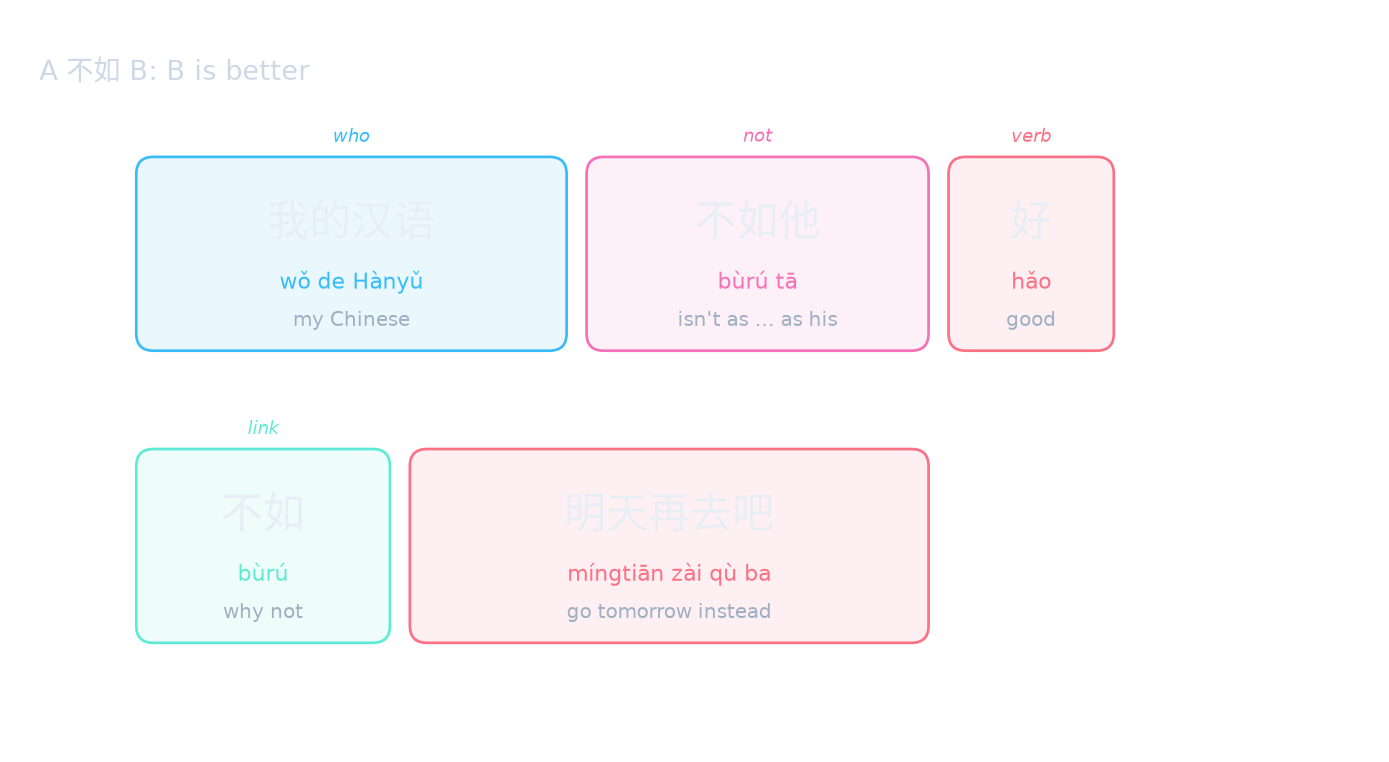
A not as good as / had better不如 B (not as good as)
Form: A + not as good as / had better不如 + B (+ adjective) · not as good as / had better不如 + action + (suggestion)吧 (might as well)
- this这个not as good as / had better不如that那个good好。 Zhège bùrú nàge hǎo. – This one isn't as good as that one.
- 这家shop店not as good as / had better不如那家店cheap便宜。 – This shop isn't as cheap as that one.
- car车太慢(completed / change)了,not as good as / had better不如to walk走路(suggestion)吧。 – The bus is so slow, we might as well walk.
- not as good as / had better不如to be at home在家to prepare a meal做饭(suggestion)吧。 – Why don't we just cook at home?
How it works. In a comparison, A falls short of B. With no adjective, the comparison means "not as good" (I / me我(modifier / structural particle)的Chinese language中文not as good as / had better不如he / him他). As a suggestion, not as good as / had better不如 + action proposes a better option than the current plan, often with (suggestion)吧.
| not as good as / had better不如to walk走路(suggestion)吧 | or / still还是to walk走路(suggestion)吧 | want / will / need要not不to walk走路(suggestion)吧 |
|---|---|---|
| might as well walk (better than this) | had better walk (after weighing) | how about walking |
Watch out
- The comparison names one quality only: cheaper isn't better service.
- A suggestion can be refused: 我太累(completed / change)了,or / still还是to wait; and so on等car车(suggestion)吧.
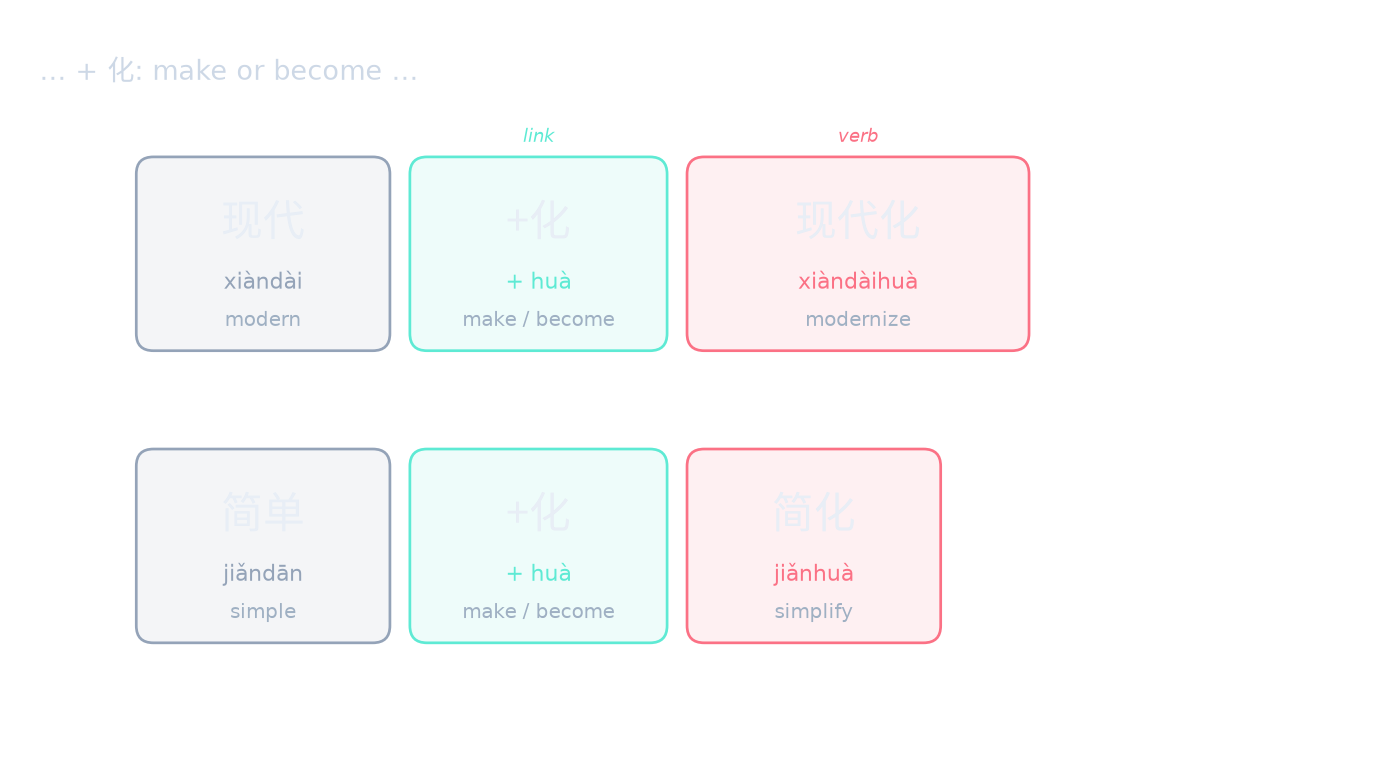
Noun / Adj + to make into化 (-ize / -ify)
Form: adjective / noun + to make into化 → "make … / become …" (-ize, -ify)
- process流程to simplify简化(completed / change)了。 Liúchéng jiǎnhuà le. – The process has been simplified.
- we / us我们want / will / need要美化环境。 – We want to make the surroundings more attractive.
- this这个city城市modernization现代化(completed / change)了。 – The city has modernised.
How it works. to make into化 huà turns a quality or noun into a change: simple简 simple → to simplify简化 simplify; beautiful美 beautiful → to make more beautiful美化 beautify; modern现代 modern → modernization现代化 modernise. The words can be verbs (to simplify简化process流程) or nouns (to achieve; to come true实现modernization现代化). Learn the established words; don't add to make into化 to any adjective (wrong: 好化, wrong: 高化).
| Word | Meaning | Common phrase |
|---|---|---|
| to simplify简化 | simplify | to simplify简化formalities手续 |
| to make more beautiful美化 | beautify | to make more beautiful美化campus校园 |
| modernization现代化 | modernise | agriculture农业modernization现代化 |
| to internationalize国际化 | internationalise | to internationalize国际化(modifier / structural particle)的school学校 |
Watch out
- A change word says what kind of change, not how much: six steps to four removes 2 steps, and the minutes saved need data.
to calculate; to count (as)算 + Adj + (modifier / structural particle)的 (counts as / considered)
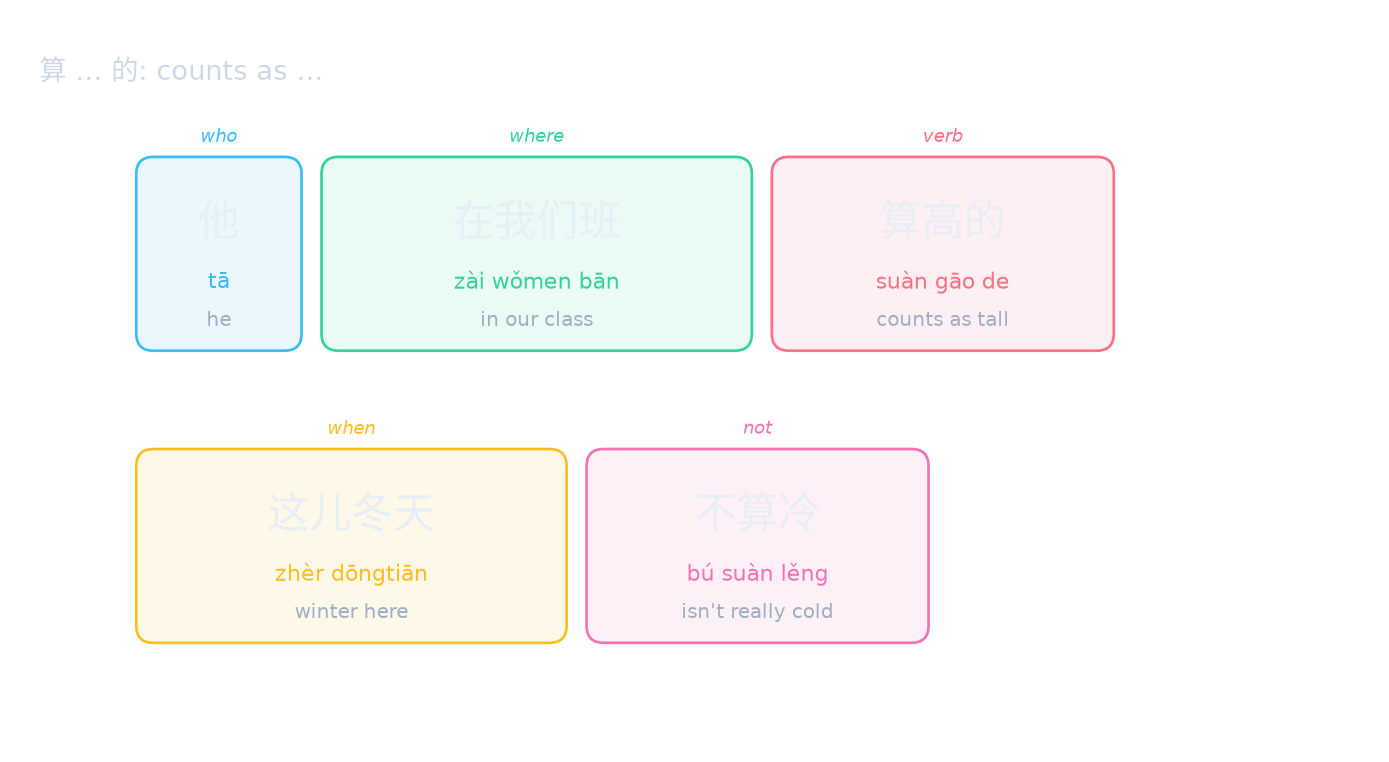
Form: subject + (at / in在 group inside; in里) + to calculate; to count (as)算 + adjective (+ (modifier / structural particle)的)
- he / him他at / in在班里to calculate; to count (as)算tall; high高(modifier / structural particle)的。 Tā zài bān li suàn gāo de. – He counts as tall in his class.
- 这算cheap便宜。 – That's considered cheap.
- today今天to calculate; to count (as)算fairly / to compare比较warm暖和(modifier / structural particle)的。 – Today is fairly warm, by comparison.
How it works. to calculate; to count (as)算 suàn places something in a category by a judgement: it "counts as" tall or cheap compared with a reference group or standard. to calculate; to count (as)算 + adjective + (modifier / structural particle)的 is the common spoken form; to calculate; to count (as)算 + adjective alone also works. considered to be算是 is similar.
A category is not first place. In a class of 168, 175 and 182 cm, both 175 and 182 can to calculate; to count (as)算tall; high高(modifier / structural particle)的; only 182 is tallest最高. In a basketball team, the same student might not count as tall; his height hasn't changed, the reference has.
| 这算cheap便宜 | to calculate; to count (as)算(used after a verb) give it…一下三加two二 |
|---|---|
| judged as cheap | calculate (to calculate; to count (as)算 = count) |
Watch out
- to calculate; to count (as)算tall; high高(modifier / structural particle)的 is not tallest最高.
no wonder难怪 (no wonder)
Form: no wonder难怪 + observation,(originally / so it turns out原来 + reason) · originally / so it turns out原来 + reason,no wonder难怪 + observation
- no wonder难怪he / him他not / haven't没to come来,originally / so it turns out原来illness / ill病(completed / change)了。 Nánguài tā méi lái, yuánlái bìng le. – No wonder he didn't come; it turns out he was ill.
- originally / so it turns out原来他考(completed / change)了第一名,no wonder难怪so much这么happy; glad高兴。 – So he came first; no wonder he's so happy.
- to snow下雪(completed / change)了,no wonder难怪so much这么cold冷。 – It's snowing; no wonder it's so cold.
How it works. no wonder难怪 nánguài "no wonder" reacts to a fact that puzzled you, now that a reason is known. The reason can come before or after, often with originally / so it turns out原来 "so, it turns out". For a past absence, use not / haven't没to come来 (not不to come来 means he won't come).
| no wonder难怪he / him他not / haven't没to come来 | he / him他why?为什么not / haven't没to come来? |
|---|---|
| it makes sense now (reason known) | asks for the reason |
Watch out
- no wonder难怪 shows the speaker is satisfied, not that the reason is proven: a guess stays a guess.
- Without any reason in view, ask a question instead.

Practice without the models
Cover the teaching sections before you answer. The answers follow.
Verb + what什么 (a rebuke)
1. Someone is staring at you rudely. Which do you snap?
- A. you你want / think / miss想to look at; to watch; to read看what什么?
- B. you你at / in在to look at; to watch; to read看what什么book书?
- C. to take a look at看看(suggestion)吧。
- D. to look at; to watch; to read看what什么to look at; to watch; to read看!
2. you你urgent / anxious急what什么?time时间still / also / even还early早。 What is the speaker doing?
- A. asking what you want
- B. asking for the time
- C. complaining about you
- D. telling you there's no need to hurry
3. Which is a real question about laughing?
- A. to laugh笑what什么!
- B. 别笑!
- C. you你at / in在to laugh笑what什么?
- D. to laugh笑what什么to laugh笑!
4. True or false? to look at; to watch; to read看what什么to look at; to watch; to read看 is fine to say to your teacher. If false, correct it.
5. Ask politely which film your friend wants to see.
6. Tell a friend gently that there's no need to worry: you你anxious担心 …………? it's not important没事(modifier / structural particle)的。
不像 … like that那么 … (not as … as)
7. I'm not as tall as him. I / me我not不to resemble像he / him他 ………… tall; high高。
8. I / me我not不to resemble像he / him他like that那么short in height矮 means…
- A. I'm shorter
- B. I'm taller
- C. we're the same
- D. I'm not like him at all
9. Which is the most common way to say "A isn't as tall as B"?
- A. Anot … than / unlike不比Btall; high高
- B. Athan / compared to比B不高
- C. Anot have / haven't没有Btall; high高
- D. A不像B
10. True or false? I / me我not不to resemble像he / him他like that那么tall; high高 tells us the height difference. If false, correct it.
11. Say in Chinese: "This winter isn't as cold as last year."
12. This tea isn't as hot as that one.
Put in order: like that那么 / 不像 / 那杯 / hot热。 / 这杯tea茶
compared with比起 … to come来 (compared with)
13. Compared with last year, this year is much better. ………… last year去年,this year今年many好多(completed / change)了。
14. Last year's score was 60, this year's 75. Which is right?
- A. compared with比起last year去年,this year今年the same一样。
- B. compared with比起last year去年,this year今年low低十五分。
- C. compared with比起last year去年,this year今年to raise / improve提高(completed / change)了十五分。
- D. compared with比起this year今年,last year去年tall; high高十五分。
15. In compared with比起to drive a car开车,I / me我more更to like喜欢坐地铁, what is the baseline?
- A. me
- B. the metro
- C. the city
- D. driving
16. True or false? compared with比起 always means "better than". If false, correct it.
17. Say in Chinese: "Compared with Beijing, Shanghai is warmer."
18. Compared with before, he is much more confident.
Put in order: many; much多(completed / change)了。 / confident自信 / compared with比起 / he / him他 / before以前,
A not as good as / had better不如 B (not as good as)
19. The bus is so slow, we might as well walk. car车太慢(completed / change)了,………… to walk走路(suggestion)吧。
20. 这家shop店not as good as / had better不如那家店cheap便宜 means…
- A. that shop is cheaper
- B. this shop is cheaper
- C. neither is cheap
- D. both are cheap
21. Which means "My Chinese isn't as good as his"?
- A. I / me我(modifier / structural particle)的Chinese language中文if / like如not不he / him他。
- B. not as good as / had better不如I / me我(modifier / structural particle)的Chinese language中文he / him他。
- C. I / me我(modifier / structural particle)的Chinese language中文not … than / unlike不比he / him他。
- D. I / me我(modifier / structural particle)的Chinese language中文not as good as / had better不如he / him他。
22. True or false? not as good as / had better不如to walk走路(suggestion)吧 means everyone has agreed to walk. If false, correct it.
23. Say in Chinese: "Why don't we just cook at home?"
24. Waiting here is not as good as going to look for him.
Put in order: at / in在here这儿to wait; and so on等 / to look for; to give change找he / him他。 / not as good as / had better不如 / to go去
Noun / Adj + to make into化 (-ize / -ify)
25. The process has been simplified. process流程 ………… (completed / change)了。
26. What does to make more beautiful美化campus校园 mean?
- A. buy a campus
- B. American campus
- C. a beautiful campus
- D. make the campus more beautiful
27. Which word is NOT a real to make into化 word?
- A. to internationalize国际化
- B. to simplify简化
- C. 好化
- D. modernization现代化
28. True or false? to simplify简化process流程 tells you how many minutes are saved. If false, correct it.
29. Say in Chinese: "This city has modernised."
30. We should simplify the procedures.
Put in order: formalities手续。 / we / us我们 / to simplify简化 / should应该
to calculate; to count (as)算 + Adj + (modifier / structural particle)的 (counts as / considered)
31. He counts as tall in his class. he / him他at / in在班里 ………… tall; high高(modifier / structural particle)的。
32. In a class of 168, 175 and 182 cm, can 175 to calculate; to count (as)算tall; high高(modifier / structural particle)的?
- A. Yes, a category isn't first place
- B. Never
- C. No, only the tallest counts
- D. Only if he is the tallest
33. In which sentence does to calculate; to count (as)算 mean "calculate"?
- A. 他算tall; high高(modifier / structural particle)的。
- B. 这算cheap便宜。
- C. today今天to calculate; to count (as)算warm暖和。
- D. you你to calculate; to count (as)算(used after a verb) give it…一下altogether一共how many / how much多少money钱。
34. True or false? 他算tall; high高(modifier / structural particle)的 means he is the tallest. If false, correct it.
35. Say in Chinese: "For Beijing, today counts as warm."
36. This price counts as cheap.
Put in order: price价格 / this这个 / to calculate; to count (as)算 / cheap便宜(modifier / structural particle)的。
no wonder难怪 (no wonder)
37. No wonder he didn't come; he was ill. ………… he / him他not / haven't没to come来,originally / so it turns out原来illness / ill病(completed / change)了。
38. Which word usually introduces the reason?
- A. although虽然
- B. originally / so it turns out原来
- C. don't tell me难道
- D. so / therefore所以
39. Choose the best ending: outside外面to snow下雪(completed / change)了,……
- A. no wonder难怪to rain下雨。
- B. no wonder难怪I / me我degree / adjective linker很hot热。
- C. no wonder难怪so much这么cold冷。
- D. no wonder难怪we / us我们(suggestion)吧。
40. True or false? no wonder难怪he / him他not / haven't没to come来 proves that he was ill. If false, correct it.
41. Say in Chinese: "So he came first; no wonder he's so happy."
42. No wonder his Chinese is so good.
Put in order: he / him他(modifier / structural particle)的Chinese language中文 / no wonder难怪 / to speak说(degree marker)得 / so much这么good好。
Answers and explanations
Verb + what什么 (a rebuke)
1. D. to look at; to watch; to read看what什么to look at; to watch; to read看!
The repeated verb + what什么 + verb is a rebuke.
2. D. telling you there's no need to hurry
Verb/adj + what什么 can mean "no need to".
3. C. you你at / in在to laugh笑what什么?
Add at / in在 or an object to ask for information.
4. False.
The repeated rebuke is rude.
5. you你want / think / miss想to look at; to watch; to read看what什么film; movie电影?
want / think / miss想 + verb + what什么 + noun asks for information.
6. what什么
you你 + verb + what什么 = no need to.
不像 … like that那么 … (not as … as)
7. like that那么
A 不像 B like that那么 + adjective.
8. B. I'm taller
Follow the adjective: not as short = taller.
9. C. Anot have / haven't没有Btall; high高
not have / haven't没有 is the everyday form.
10. False.
It gives no number.
11. 今年冬天不像last year去年so much这么cold冷。 / 今年冬天not have / haven't没有last year去年cold冷。
A 不像 B so much这么 / like that那么 + adjective.
12. 这杯tea茶not不to resemble像那杯like that那么hot热。
A + 不像 + B + like that那么 + adj.
compared with比起 … to come来 (compared with)
13. compared with比起
compared with比起 + baseline.
14. C. compared with比起last year去年,this year今年to raise / improve提高(completed / change)了十五分。
75 − 60 = 15, higher this year.
15. D. driving
The baseline follows compared with比起.
16. False.
The comment sets the direction: low低, poor差 and few; little少 are possible.
17. compared with比起Beijing北京,Shanghai municipality…上海warm暖和some一些。
compared with比起 + B, then A + comment.
18. compared with比起before以前,he / him他confident自信many; much多(completed / change)了。
Baseline first.
A not as good as / had better不如 B (not as good as)
19. not as good as / had better不如
not as good as / had better不如 + action + (suggestion)吧: a better option.
20. A. that shop is cheaper
A not as good as / had better不如 B + adj: B is more so.
21. D. I / me我(modifier / structural particle)的Chinese language中文not as good as / had better不如he / him他。
With no adjective, not as good as / had better不如 means not as good.
22. False.
It is a suggestion; it can be refused.
23. not as good as / had better不如to be at home在家to prepare a meal做饭(suggestion)吧。
not as good as / had better不如 + action + (suggestion)吧.
24. at / in在here这儿to wait; and so on等not as good as / had better不如to go去to look for; to give change找he / him他。
A not as good as / had better不如 B.
Noun / Adj + to make into化 (-ize / -ify)
25. to simplify简化
simple简 + to make into化 = simplify.
26. D. make the campus more beautiful
to make more beautiful美化 = beautify.
27. C. 好化
Learn the established words; to make into化 doesn't join every adjective.
28. False.
It names the kind of change, not the amount.
29. this这个city城市modernization现代化(completed / change)了。
modernization现代化 as a verb with (completed / change)了.
30. we / us我们should应该to simplify简化formalities手续。
to simplify简化 + object.
to calculate; to count (as)算 + Adj + (modifier / structural particle)的 (counts as / considered)
31. to calculate; to count (as)算
to calculate; to count (as)算 + adj (+ (modifier / structural particle)的): counts as.
32. A. Yes, a category isn't first place
to calculate; to count (as)算tall; high高(modifier / structural particle)的 is not tallest最高.
33. D. you你to calculate; to count (as)算(used after a verb) give it…一下altogether一共how many / how much多少money钱。
to calculate; to count (as)算(used after a verb) give it…一下 = work it out.
34. False.
It places him in the tall group.
35. at / in在Beijing北京,today今天to calculate; to count (as)算warm暖和(modifier / structural particle)的。
to calculate; to count (as)算 + adj + (modifier / structural particle)的, with a reference.
36. this这个price价格to calculate; to count (as)算cheap便宜(modifier / structural particle)的。
to calculate; to count (as)算 + adjective + (modifier / structural particle)的.
no wonder难怪 (no wonder)
37. no wonder难怪
no wonder难怪 + fact that now makes sense.
38. B. originally / so it turns out原来
originally / so it turns out原来 = so, it turns out.
39. C. no wonder难怪so much这么cold冷。
The fact must fit the reason.
40. False.
It shows the speaker accepts a reason; a guess stays a guess.
41. originally / so it turns out原来他考(completed / change)了第一名,no wonder难怪so much这么happy; glad高兴。
Reason with originally / so it turns out原来, then no wonder难怪.
42. no wonder难怪he / him他(modifier / structural particle)的Chinese language中文to speak说(degree marker)得so much这么good好。
no wonder难怪 + fact.