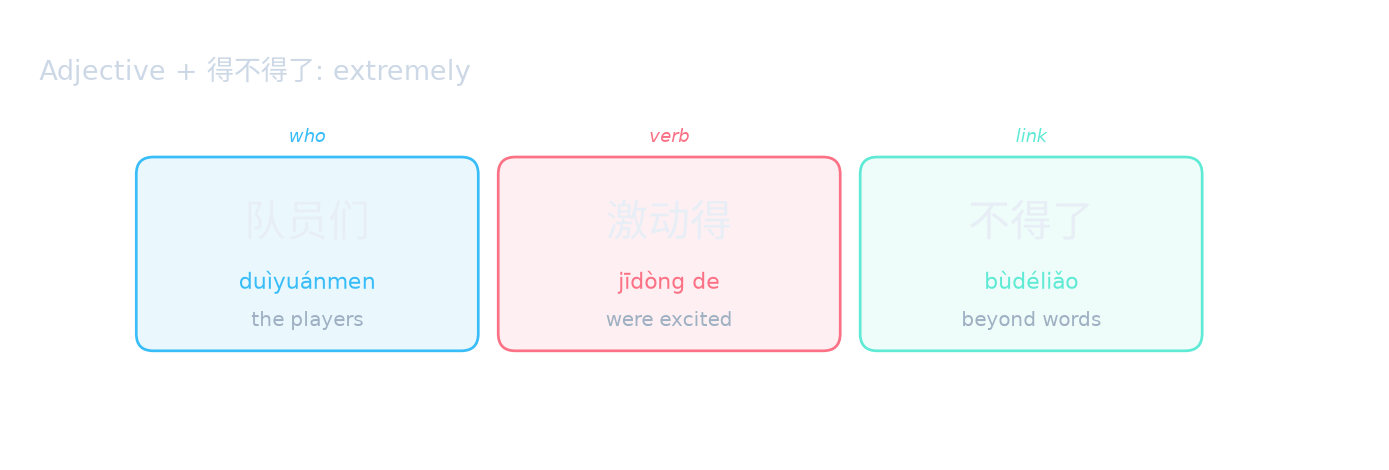
Adj + (degree marker)得desperately serious不得了 (extremely)
Form: adjective / feeling verb + (degree marker)得desperately serious不得了
- team member队员(plural)们to move emotionally激动(degree marker)得desperately serious不得了。 Duìyuánmen jīdòng de bùdéliǎo. – The players were beside themselves with excitement.
- today今天热得desperately serious不得了,I / me我erhua variant of 一点一点儿also也unexpectedly不想to go out出门。 – It's unbearably hot today; I don't want to go out at all.
- to hear (sth said)听说you你want / will / need要to come来,child孩子(plural)们happy; glad高兴(degree marker)得desperately serious不得了。 – When they heard you were coming, the children were overjoyed.
How it works. (degree marker)得 links the adjective to desperately serious不得了 bùdéliǎo ("beyond what can be borne"), which ends the clause and pushes the feeling to an extreme, good or bad.
| Expression | Meaning |
|---|---|
| tired累(degree marker)得desperately serious不得了 | exhausted |
| desperately serious不得了(completed / change)了! | Oh no, this is serious! |
| terrific了不得 | remarkable: he / him他really真terrific了不得 |
Watch out
- One degree word only: wrong: degree / adjective linker很busy忙(degree marker)得desperately serious不得了 → busy忙(degree marker)得desperately serious不得了.
- Keep (degree marker)得: wrong: tired累desperately serious不得了 → tired累(degree marker)得desperately serious不得了.
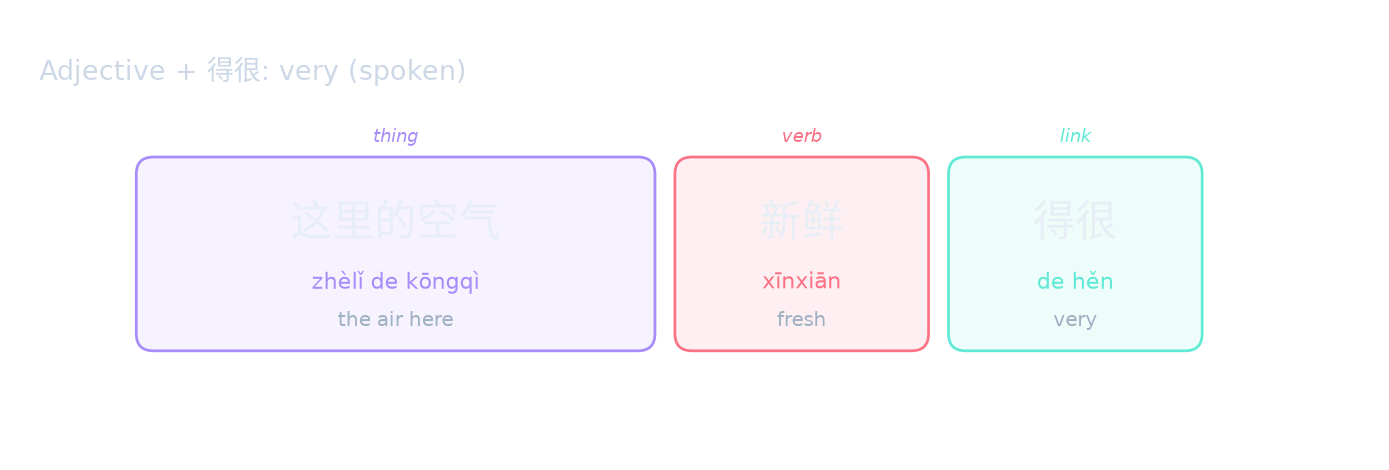
Adj + (degree marker)得degree / adjective linker很 (very)
Form: adjective / feeling verb + (degree marker)得degree / adjective linker很
- here这里(modifier / structural particle)的air空气fresh新鲜(degree marker)得degree / adjective linker很。 Zhèlǐ de kōngqì xīnxiān de hěn. – The air here is really fresh.
- he / him他(modifier / structural particle)的Chinese language中文good好(degree marker)得degree / adjective linker很,you你need not不用anxious担心。 – His Chinese is really good; don't worry.
- 这家wine shop酒店cheap便宜(degree marker)得degree / adjective linker很。 – This hotel is really cheap.
- good好(degree marker)得degree / adjective linker很,again又to arrive late迟到(completed / change)了! – Great, late again! (ironic)
How it works. (degree marker)得degree / adjective linker很 after an adjective means "very, really", livelier and more emphatic than degree / adjective linker很 in front. It ends the clause and also follows feeling verbs: he / him他to like喜欢(degree marker)得degree / adjective linker很. Said flatly, it can be ironic.
| degree / adjective linker很fresh新鲜 | fresh新鲜(degree marker)得degree / adjective linker很 | fresh新鲜(degree marker)得desperately serious不得了 |
|---|---|---|
| neutral | emphatic | strongest |
Watch out
- wrong: degree / adjective linker很fresh新鲜(degree marker)得degree / adjective linker很 → fresh新鲜(degree marker)得degree / adjective linker很; wrong: good好degree / adjective linker很 → good好(degree marker)得degree / adjective linker很.
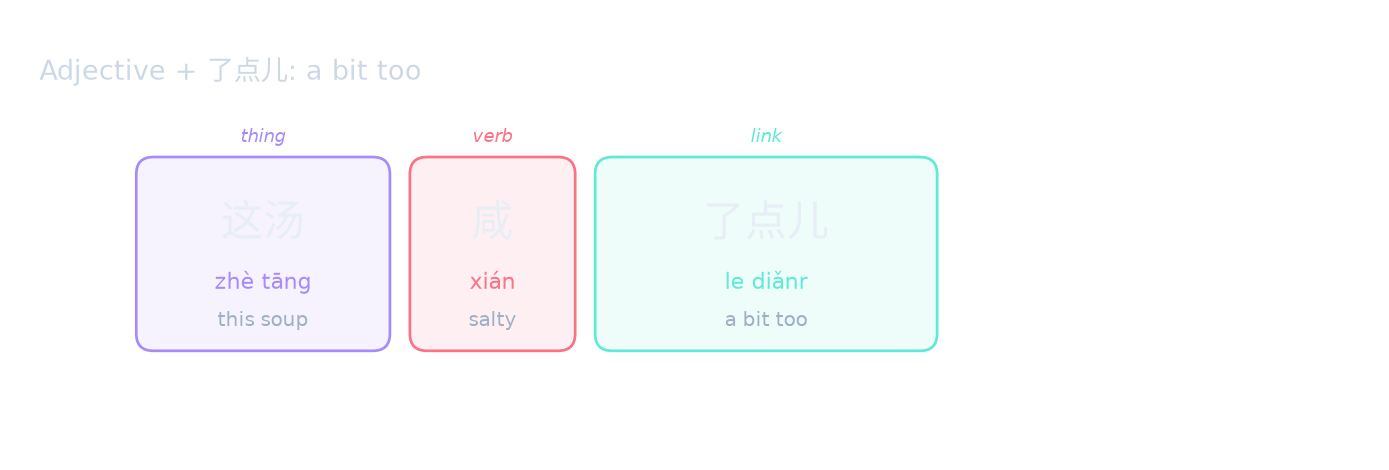
Adj + (completed / change)了 + (one / a一)erhua variant of 点点儿 (a bit too)
Form: adjective + (completed / change)了 + (one / a一)erhua variant of 点点儿 (a bit too …)
- 这汤salty咸(completed / change)了erhua variant of 点点儿。 Zhè tāng xiánle diǎnr. – This soup is a bit too salty.
- this这measure word for long thin things条trousers裤子long长(completed / change)了erhua variant of 点点儿。 – These trousers are a bit too long.
- 八点to hold a meeting开会,to / towards / correct对I / me我来说early早(completed / change)了erhua variant of 一点一点儿。 – A meeting at eight is a little early for me.
- price价格expensive贵(completed / change)了erhua variant of 点点儿,can / be able to能cheap便宜erhua variant of 一点一点儿(yes/no ?)吗? – It's a bit expensive; could you make it a little cheaper?
How it works. Adjective + (completed / change)了 + erhua variant of 点点儿 measures against the right amount: slightly past it. It is a mild, polite complaint.
| big大(completed / change)了erhua variant of 点点儿 | big大erhua variant of 一点一点儿 | slightly有点儿big大 | too太big大(completed / change)了! |
|---|---|---|---|
| a bit too big | a bit bigger (request) | a bit big (the feeling) | far too big |
Watch out
- To ask for a bigger size, say big大erhua variant of 一点一点儿(modifier / structural particle)的; big大(completed / change)了erhua variant of 点点儿 says this one is too big.
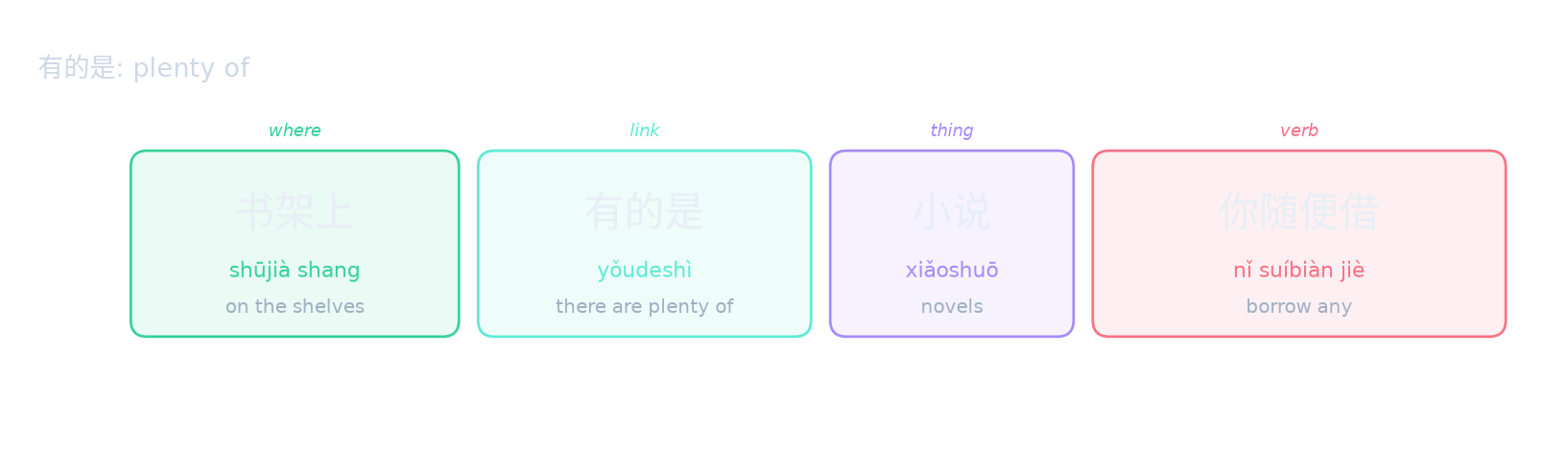
have plenty of有的是 + Noun (have plenty of)
Form: (topic,) subject + have plenty of有的是 + noun
- 书架上have plenty of有的是novel小说,you你as one wishes随便to borrow借。 Shūjià shang yǒudeshì xiǎoshuō, nǐ suíbiàn jiè. – There are plenty of novels on the shelf; borrow whatever you like.
- don't别anxious担心,ticket票have plenty of有的是。 – Don't worry, there are plenty of tickets.
- this kind of这种thing; stuff东西,supermarket超市inside; in里have plenty of有的是。 – Things like this, the supermarket has loads of.
- he / him他have plenty of有的是means办法。 – He has plenty of ways to handle it.
How it works. have plenty of有的是 yǒudeshì means "there's no shortage of". It reassures, and adds "so don't worry": to have / there is有很多time时间 is neutral; have plenty of有的是time时间 means there's no need to hurry. The topic can come first and have plenty of有的是 last.
| have plenty of有的是 + noun | to have / there is有(modifier / structural particle)的 + noun |
|---|---|
| plenty of | some |
| have plenty of有的是time时间 | to have / there is有(modifier / structural particle)的person人not不to like喜欢to eat吃spicy辣 |
Watch out
- No 很多 inside: wrong: have plenty of有的是很多money钱 → have plenty of有的是money钱.
Practice without the models
Cover the teaching sections before you answer. The answers follow.
Adj + (degree marker)得desperately serious不得了 (extremely)
1. Complete: “I'm terribly busy this week.” this这个week星期我忙…………desperately serious不得了。
2. Which sentence is correct?
- A. he / him他happy; glad高兴(degree marker)得desperately serious不得了。
- B. he / him他desperately serious不得了happy; glad高兴。
- C. he / him他happy; glad高兴desperately serious不得了(degree marker)得。
- D. he / him他degree / adjective linker很happy; glad高兴(degree marker)得desperately serious不得了。
3. Match each expression to its meaning.
-
(1) tired累(degree marker)得desperately serious不得了
-
(2) desperately serious不得了(completed / change)了!
-
(3) terrific了不得
-
A. remarkable
-
B. exhausted
-
C. oh no, this is serious!
4. Build: “When they heard you were coming, the children were overjoyed.”
Put in order: to hear (sth said)听说you你want / will / need要to come来 / desperately serious不得了。 / ,child孩子(plural)们 / happy; glad高兴(degree marker)得
5. Your school team has just won the city championship after a penalty shoot-out. Use Adj + (degree marker)得desperately serious不得了. Write your answer in Chinese, then say it aloud.
Adj + (degree marker)得degree / adjective linker很 (very)
6. Complete: “This hotel is really cheap.” 这家wine shop酒店cheap便宜…………。
7. Which sentence is correct?
- A. air空气fresh新鲜(degree marker)得degree / adjective linker很。
- B. air空气degree / adjective linker很fresh新鲜(degree marker)得degree / adjective linker很。
- C. air空气fresh新鲜degree / adjective linker很。
- D. air空气(degree marker)得degree / adjective linker很fresh新鲜。
8. Build: “His Chinese is really good.”
Put in order: (degree marker)得degree / adjective linker很。 / good好 / he / him他(modifier / structural particle)的Chinese language中文
9. True or false? (degree marker)得desperately serious不得了 is usually stronger than (degree marker)得degree / adjective linker很. If false, correct it.
10. After a week in a smoggy city, you walk in a mountain park. Use Adj + (degree marker)得degree / adjective linker很. Write your answer in Chinese, then say it aloud.
Adj + (completed / change)了 + (one / a一)erhua variant of 点点儿 (a bit too)
11. Complete: “These trousers are a bit too long.” this这measure word for long thin things条trousers裤子long长…………erhua variant of 点点儿。
12. You want a slightly bigger size. What do you ask for?
- A. too太big大(completed / change)了(modifier / structural particle)的
- B. big大(completed / change)了erhua variant of 点点儿(modifier / structural particle)的
- C. slightly有点儿big大(modifier / structural particle)的
- D. big大erhua variant of 一点一点儿(modifier / structural particle)的
13. Build: “A meeting at eight is a little early for me.”
Put in order: ,to / towards / correct对I / me我来说 / early早(completed / change)了 / erhua variant of 一点一点儿。 / 八点to hold a meeting开会
14. True or false? 太咸(completed / change)了 is a stronger complaint than 咸了erhua variant of 点点儿. If false, correct it.
15. You taste the soup your roommate made. It's good, but there's slightly too much salt. Use Adj + (completed / change)了 +. Write your answer in Chinese, then say it aloud.
have plenty of有的是 + Noun (have plenty of)
16. Reassure: “Don't worry, there are plenty of tickets.” don't别anxious担心,ticket票…………。
17. What does to have / there is有(modifier / structural particle)的person人not不to like喜欢to eat吃spicy辣 mean?
- A. Some people don't like spicy food.
- B. Plenty of people dislike spicy food.
- C. Everyone likes spicy food.
- D. Nobody likes spicy food.
18. Build: “He has plenty of ways (to solve it).”
Put in order: means办法。 / he / him他 / have plenty of有的是
19. True or false? have plenty of有的是time时间 suggests there's no need to hurry. If false, correct it.
20. A friend worries she won't find a novel to read on holiday. Use have plenty of有的是 + Noun. Write your answer in Chinese, then say it aloud.
Answers and explanations
Adj + (degree marker)得desperately serious不得了 (extremely)
1. (degree marker)得
Adj + (degree marker)得 + desperately serious不得了.
2. A. he / him他happy; glad高兴(degree marker)得desperately serious不得了。
he / him他happy; glad高兴(degree marker)得desperately serious不得了 is right: a bare adjective + (degree marker)得desperately serious不得了 already means "extremely", so degree / adjective linker很 is not added.
3. (1) B: tired累(degree marker)得desperately serious不得了 = exhausted; (2) C: desperately serious不得了(completed / change)了! = oh no, this is serious!; (3) A: terrific了不得 = remarkable
The position and order of desperately serious不得了 / terrific了不得 change the meaning.
4. to hear (sth said)听说you你want / will / need要to come来,child孩子(plural)们happy; glad高兴(degree marker)得desperately serious不得了。
Cause, then subject + Adj + (degree marker)得desperately serious不得了.
5. Model answer: team member队员(plural)们to move emotionally激动(degree marker)得desperately serious不得了。
Check your answer:
- No degree / adjective linker很 / very非常 before the adjective: busy忙(degree marker)得desperately serious不得了, not degree / adjective linker很busy忙(degree marker)得desperately serious不得了.
- Keep (degree marker)得: tired累(degree marker)得desperately serious不得了, not tired累desperately serious不得了.
Adj + (degree marker)得degree / adjective linker很 (very)
6. (degree marker)得degree / adjective linker很
Adj + (degree marker)得degree / adjective linker很.
7. A. air空气fresh新鲜(degree marker)得degree / adjective linker很。
air空气fresh新鲜(degree marker)得degree / adjective linker很 is right: a bare adjective + (degree marker)得degree / adjective linker很. A second degree / adjective linker很 is redundant, and (degree marker)得 must follow the adjective.
8. he / him他(modifier / structural particle)的Chinese language中文good好(degree marker)得degree / adjective linker很。
Subject + Adj + (degree marker)得degree / adjective linker很.
9. True.
The scale is degree / adjective linker很 → (degree marker)得degree / adjective linker很 → (degree marker)得desperately serious不得了.
10. Model answer: here这里(modifier / structural particle)的air空气fresh新鲜(degree marker)得degree / adjective linker很。
Check your answer:
- Do not add degree / adjective linker很 before as well: fresh新鲜(degree marker)得degree / adjective linker很, not degree / adjective linker很fresh新鲜(degree marker)得degree / adjective linker很.
- Keep (degree marker)得: good好(degree marker)得degree / adjective linker很, not good好degree / adjective linker很.
Adj + (completed / change)了 + (one / a一)erhua variant of 点点儿 (a bit too)
11. (completed / change)了
Adj + (completed / change)了 + erhua variant of 点点儿 = a bit too.
12. D. big大erhua variant of 一点一点儿(modifier / structural particle)的
A request for “a bit bigger” is Adj + erhua variant of 一点一点儿.
13. 八点to hold a meeting开会,to / towards / correct对I / me我来说early早(completed / change)了erhua variant of 一点一点儿。
Adj + (completed / change)了 + erhua variant of 一点一点儿.
14. True.
True. too太…(completed / change)了 is a strong complaint (“far too salty”), while adjective + (completed / change)了erhua variant of 点点儿 is mild and polite: 咸了erhua variant of 点点儿 “a little too salty”.
15. Model answer: 这汤salty咸(completed / change)了erhua variant of 点点儿。
Check your answer:
- big大(completed / change)了erhua variant of 点点儿 = a bit too big (off from what's needed). big大erhua variant of 一点一点儿 = a bit bigger (a comparison or request).
- It is mild; for a strong complaint use too太…(completed / change)了: 太咸(completed / change)了!
have plenty of有的是 + Noun (have plenty of)
16. have plenty of有的是
Topic + have plenty of有的是 = plenty.
17. A. Some people don't like spicy food.
to have / there is有(modifier / structural particle)的 + noun means “some (of them)”: to have / there is有(modifier / structural particle)的person人not不to like喜欢to eat吃spicy辣 “Some people don't like spicy food.” It says nothing about how many, so “plenty” overstates it.
18. he / him他have plenty of有的是means办法。
Subject + have plenty of有的是 + noun.
19. True.
It reassures that there is more than enough.
20. Model answer: 书架上have plenty of有的是novel小说,you你as one wishes随便to borrow借。
Check your answer:
- have plenty of有的是 = plenty; to have / there is有(modifier / structural particle)的 + noun = some: to have / there is有(modifier / structural particle)的person人to like喜欢 – "some people like it". Do not mix them up.
- No 很多 inside: have plenty of有的是money钱, not have plenty of有的是很多money钱.