This handout teaches Structure 2.3, The metallic model, for the course first assessed in 2025.
Prerequisites: electron configurations and ionization energy from Structure 1.3, and the ionic and covalent models from Structures 2.1 and 2.2. You will compare melting points from the data booklet.
8.2
The metallic bond
Why can a copper wire bend and conduct?
A copper wire carries current when it is cold and when it is red hot. You can bend it, hammer it flat or pull it into a thinner wire, and it does not shatter. A typical ionic crystal does neither as a solid: it has no freely mobile ions and often fractures under a blow. Molten salts and aqueous solutions containing mobile ions can conduct. The metallic model 金属模型 explains both properties of metals with one picture.
Cations in a sea of electrons
In the simple metallic model, outer electrons are shared throughout an extended solid rather than confined to individual atoms. Describe its positive ion cores and mobile electron density; do not imagine a collection of isolated aqueous ions. In a solid metal:
A piece of pure copper metal. The shine, and the way metals conduct and bend, all come from that giant lattice of copper ions sitting in a shared sea of delocalised electrons
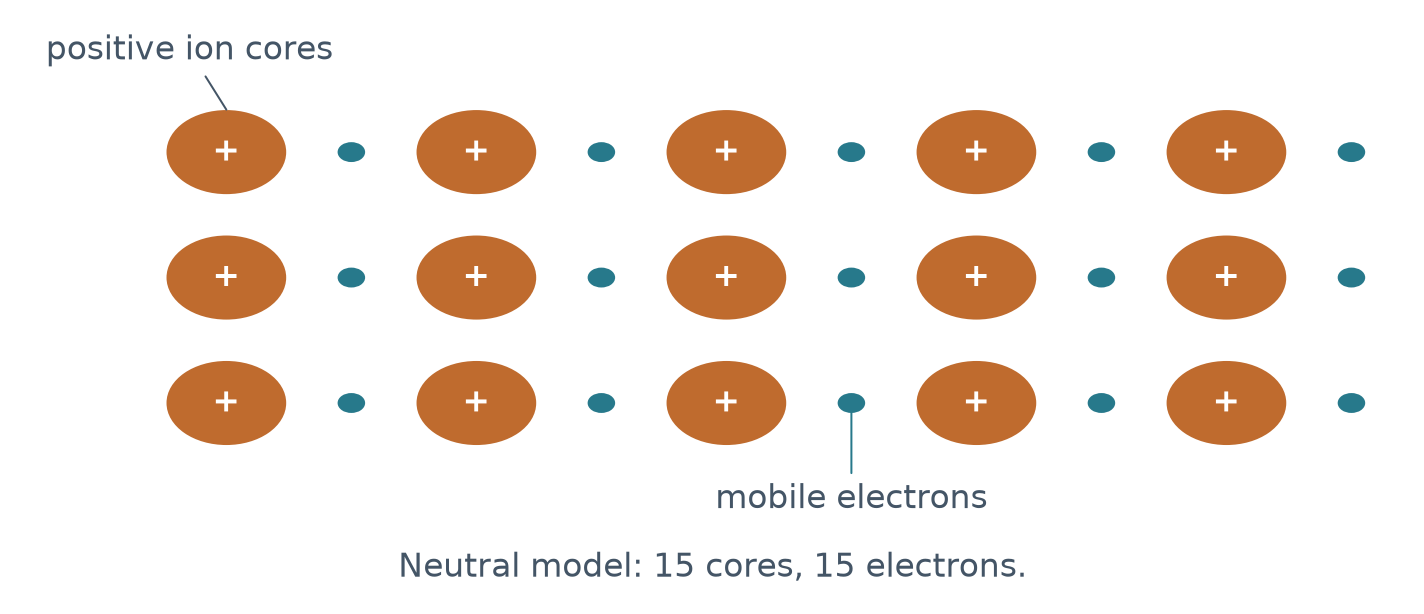
positive ion cores, described as cations 阳离子 in the model, are packed in a lattice 晶格;
the lost electrons are not attached to any one ion. They are delocalized electrons 离域电子, free to move through the whole structure, often called a "sea" of electrons.
The metallic bond 金属键 is the electrostatic attraction between a lattice of cations and the delocalized electrons.
Schematic monovalent-metal model: 15 positive cores and 15 delocalized electrons give zero net charge. Cores vibrate about lattice positions in the solid; the drawing is not to scale.
Three points a complete model explanation needs:
There are no anions in a metal. The negative charge is carried by electrons.
The attraction acts in every direction: the bonding is non-directional 无方向性的.
Each ion is attracted to many electrons, and each electron to many ions, so there are no separate bonds between pairs of atoms.
To explain any property, name the structure, the particles, the force and the mobile charge carriers.
Property
Explanation
electrical conductivity 导电性 in solid and liquid
delocalized electrons acquire a net drift under an applied potential difference; a molten metal also retains mobile electrons
thermal conductivity 导热性
delocalized electrons (and vibrating ions) pass kinetic energy quickly through the metal
malleability 延展性 and ductility 延性
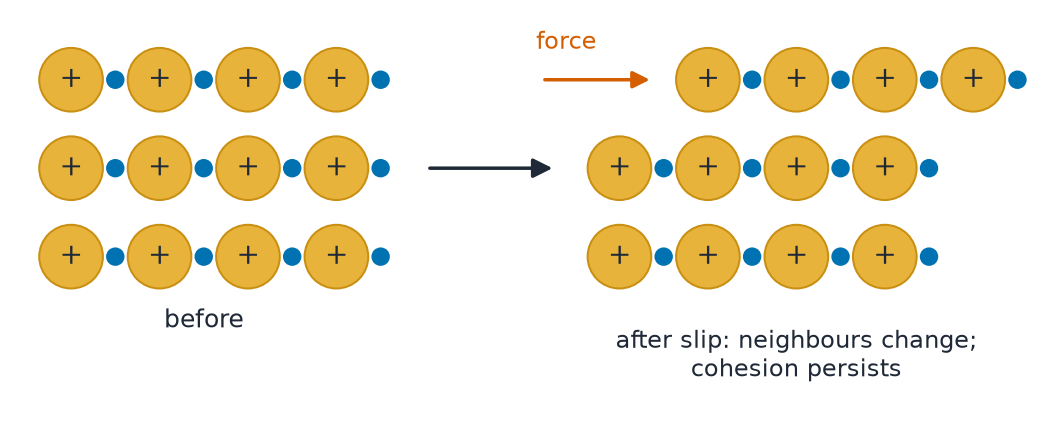
slip can rearrange the positive cores while delocalized electron density maintains cohesion; defects, temperature and microstructure affect how readily this happens
high melting and boiling points (most metals)
strong attraction between many cations and the electron sea in a giant lattice
shiny (lustre)
delocalized electrons absorb and re-emit light
Malleable means it can be hammered into shape; ductile means it can be drawn into a wire.
Schematic slip: non-directional metallic attraction can maintain cohesion as cores change neighbours. Real deformation involves defects and does not leave every local interaction identical.
From a property to a useful design
Copper combines electronic conduction with ductility, so it can be drawn into wire. A wire also needs suitable thickness, insulation and mechanical strength; conductivity alone does not establish a safe cable design. Aluminium is useful for lightweight conductors because its low density can compensate for a lower conductivity than copper in a suitable design.
Designs combine properties
A metal cooking-pan base transfers energy quickly, while a low-conductivity handle limits transfer to a hand. Strong cohesion and the processing of a metal help it retain shape in use. These are separate properties: high melting point does not by itself prove high thermal conductivity or hardness.
Metals compared with ionic compounds
Metal
Ionic compound
particles
cations and delocalized electrons
cations and anions
conducts when solid
yes, by electrons
no: ions are fixed
conducts when molten
yes, by electrons
yes, by ions
effect of a blow
layers slide, metal bends
like charges meet, crystal shatters
Notice the different charge carriers: always say electrons for a metal and ions for a molten ionic compound.
The metallic bond is stronger when the attraction between the cations and the electron sea is stronger. For simple comparisons of s- and p-block metals, two useful factors are:
Charge of the cation and number of delocalized electrons. A larger charge gives more delocalized electrons per ion and a stronger attraction.
Radius of the cation. A smaller ion lets the electrons come closer to the nucleus, so the attraction is stronger.
Stronger overall cohesion generally supports a higher melting or boiling temperature in a comparable series. The simple charge/radius model is qualitative: packing, electronic structure and the entropy change also matter, so it does not give an exact melting-point formula.
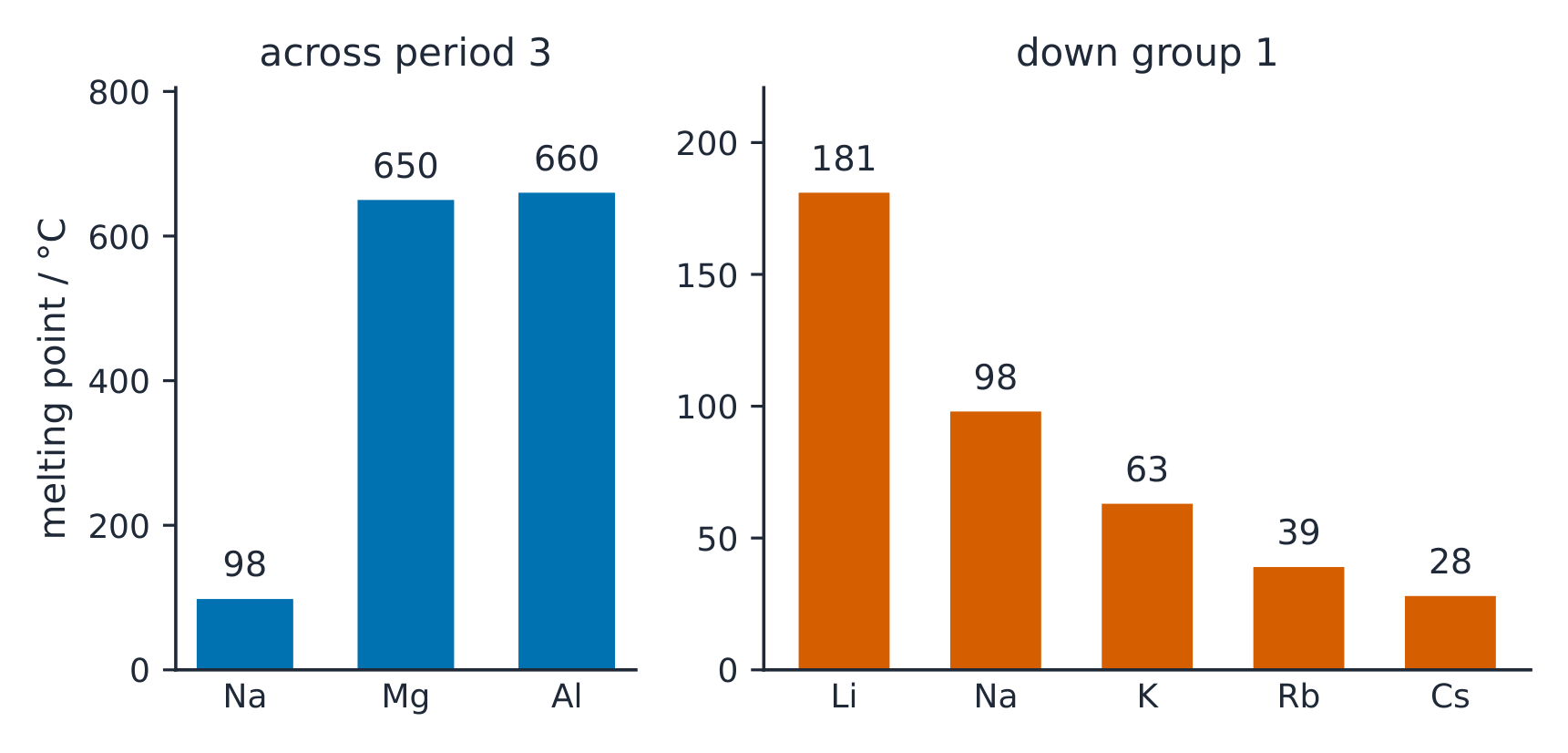
Supplied rounded melting points. The panels use different vertical scales: compare the labelled values, not bar heights across panels. Charge/electron density and size help explain these selected trends.
Across period 3: Na, Mg, Al
$\text{Na}^{+}$ gives one delocalized electron per ion, $\text{Mg}^{2+}$ two and $\text{Al}^{3+}$ three.
The simple model also compares smaller, more highly charged cores across Na, Mg and Al. Tabulated ionic radii for ions in compounds depend on coordination; they are not direct measurements of isolated Na⁺, Mg²⁺ and Al³⁺ spheres inside these elemental metals.
Both changes strengthen the attraction, so the melting point rises from $98\ ^\circ\text{C}$ to $650\ ^\circ\text{C}$ and $660\ ^\circ\text{C}$.
More delocalized electrons per ion: higher melting and boiling points
At approximately atmospheric pressure, supplied rounded boiling points show a stronger increase in this selected set: Na $883\ ^\circ\text{C}$, Mg $1090\ ^\circ\text{C}$, Al $2519\ ^\circ\text{C}$. Melting destroys long-range order while retaining strong interactions in a conducting liquid. Boiling separates the metal into vapour particles, predominantly neutral atoms for the simple model; it does not by itself produce a gas of bare cations and free electrons. Vaporization and ionization are different processes.
Down group 1: Li to Cs
Every group 1 metal gives one delocalized electron per ion. Down the group the cations get larger, so the delocalized electrons are further from each nucleus and the attraction is weaker. The melting point falls from $181\ ^\circ\text{C}$ (Li) to $28\ ^\circ\text{C}$ (Cs): this value is near a warm-room temperature. This observation is not an instruction to handle reactive caesium; use supplied data rather than a skin-contact demonstration.
Evidence and limits of a comparison
For a fair electrical comparison use approved solid samples with the same length and cross-sectional area, at controlled temperature and with clean contacts. At the same applied voltage, a larger current means lower resistance, but a thicker sample or a better contact can also increase current. Use a low-voltage instrument and avoid heating unknown metals or reactive group-1 samples. A simple bonding model identifies the charge carriers; it does not predict the exact resistance of a real wire.
A controlled resistance comparison
Worked data example. Equal-sized samples A and B at the same temperature give currents 0.30 A and 0.15 A at 1.5 V. Their resistances are $R_A=1.5/0.30=5.0\ \Omega$ and $R_B=1.5/0.15=10\ \Omega$. A has half B’s resistance in this controlled comparison. It does not follow that A has exactly twice as many delocalized electrons: carrier mobility and scattering can differ.
Worked example
Explain why magnesium has a higher melting point than sodium.
Structure: both are giant metallic lattices; melting disrupts the ordered solid while metallic interactions persist in the liquid.
Ions:$\text{Mg}^{2+}$ has a higher charge than $\text{Na}^{+}$ and is smaller.
Electrons: magnesium has two delocalized electrons per atom, sodium only one.
Conclusion: the attraction between cations and delocalized electrons is stronger in magnesium, so more energy is needed to melt it.
8.5
Practice
Define the metallic bond.
Explain why solid copper conducts electricity but solid copper(II) chloride does not.
Explain why a metal bends when hammered, but a crystal of sodium chloride shatters.
Explain why aluminium has a higher boiling point than sodium.
Explain why the melting point of the group 1 metals decreases from lithium to caesium.
Predict, with a reason, which has the higher melting point: potassium or calcium.
Explain why molten magnesium can still conduct even though its crystal lattice has lost long-range order. Does melting remove all metallic interactions?
Choose one useful metal property for each: (a) a drawn copper wire, (b) a pan base, (c) a shaped metal sheet. Explain with the model and give one additional practical constraint.
In the equal-size comparison above, A carries 0.30 A and B 0.15 A at 1.5 V. Calculate both resistances and their ratio. Why is the current ratio not a direct count of conduction electrons?
A student says boiling aluminium produces Al³⁺(g) and three electrons per atom. Correct the physical interpretation and distinguish vaporization from ionization.
The Na/Mg/Al chart uses a 0–800°C scale while a separate Li–Cs chart uses 0–200°C. May bar heights across the panels be compared directly? Explain why Mg and Al’s similar melting points do not prove identical bonding.
Worked answers.
The electrostatic attraction between a lattice of positive ions (cations) and delocalized electrons.
Copper contains delocalized electrons that can move through the lattice and carry charge. In solid copper(II) chloride the ions are held in fixed positions and there are no mobile electrons, so no charge can move.
In a metal the bonding is non-directional: layers of cations slide and the delocalized electrons move with them, so the attraction holds the new arrangement. In NaCl a shift brings ions of the same charge next to each other, they repel and the crystal splits.
$\text{Al}^{3+}$ has a higher charge and a smaller radius than $\text{Na}^{+}$, and aluminium has three delocalized electrons per atom against one. The attraction between cations and delocalized electrons is stronger, so generally more energy is needed to separate neutral vapour particles from the condensed metal. Do not describe boiling as producing gaseous Al³⁺ or Na⁺ ions.
Each ion gives one delocalized electron, but the ions get larger down the group. The delocalized electrons are further from the nucleus, the attraction is weaker, and less energy is needed to melt the metal.
Calcium: $\text{Ca}^{2+}$ has a higher charge and is smaller than $\text{K}^{+}$, and gives two delocalized electrons per atom, so its metallic bond is stronger ($842\ ^\circ\text{C}$ against $63\ ^\circ\text{C}$).
The liquid still has delocalized mobile electrons, which acquire net drift under an applied potential difference. Melting changes long-range positional order; it does not eliminate metallic cohesion or require electrons to become localized on fixed atoms.
(a) Ductility allows wire drawing and delocalized electrons carry current; choose thickness, insulation and strength for the use. (b) Mobile electrons and lattice vibrations transfer energy through the pan base; also consider chemical stability and a suitable handle. (c) Malleability permits shaping while attraction maintains cohesion; thickness and microstructure affect fracture or springback. A single property is not a complete design specification.
$R_A=1.5/0.30=5.0\ \Omega$; $R_B=1.5/0.15=10\ \Omega$; $R_A/R_B=0.50$. Carrier mobility/scattering, contact resistance and sample geometry can affect current. Only a controlled comparison supports a material-resistance inference; it still does not identify an exact carrier-number ratio.
Ordinary vaporization forms metal vapour, predominantly neutral atoms in the simple model. Producing gaseous Al³⁺ additionally requires successive ionizations and a separate energy input. Strong metallic bonding does not imply permanent isolated +3 ions remain after boiling.
No: different vertical scales give different temperatures per drawn millimetre. Read the labelled temperatures or replot on a common scale. The charge/electron-density model predicts a qualitative tendency; crystal structure, electronic contributions and entropy of melting also matter. Melting temperature is not a unique measurement of bond strength.
8.6
Exam tips
Define the metallic bond as an attraction between cations and delocalized electrons; never mention anions or "molecules".
Metals conduct by delocalized electrons in both solid and liquid states; molten ionic compounds conduct by ions.
For malleability, say that layers slide and the non-directional bonding is kept.
Compare metallic bond strength with charge (number of delocalized electrons) and ionic radius, and link it to the energy needed.