Skip to content

Structure 1.2 · The nuclear atom

IB Chemistry SL · Topic 2

Video lesson for this topic Open the video page
3:50

The nuclear atom

A salt crystal conducts when dissolved but not when solid. The ions exist in both states; their ability to move changes.

English narration · English + 中文 subtitles burned in

2.1

Scope and prerequisites

This handout teaches Structure 1.2, The nuclear atom, for the course first assessed in 2025.

Prerequisites: the particle model of matter from Structure 1.1, and positive and negative charge. Use the data booklet for relative atomic masses.

2.2

Inside the atom

What did Rutherford see?

Geiger and Marsden investigated the scattering of positively charged alpha particles by metals; Rutherford used the large deflections to develop the nuclear model in 1911. With a sufficiently thin foil most particles pass through with little deflection, but a small fraction undergo large deflections. The fraction depends on the material, foil thickness, particle energy and angle counted: it is not one universal gold-foil number. Rutherford’s original paper distinguishes gold-foil results from the often-quoted 1-in-8000 estimate for platinum.
A scanning tunnelling microscope image of flat silver islands, one atom thick, on a surface
A scanning tunnelling microscope image: islands of silver only one atom thick on a surface 250 nm across. The microscope feels the surface atom by atom
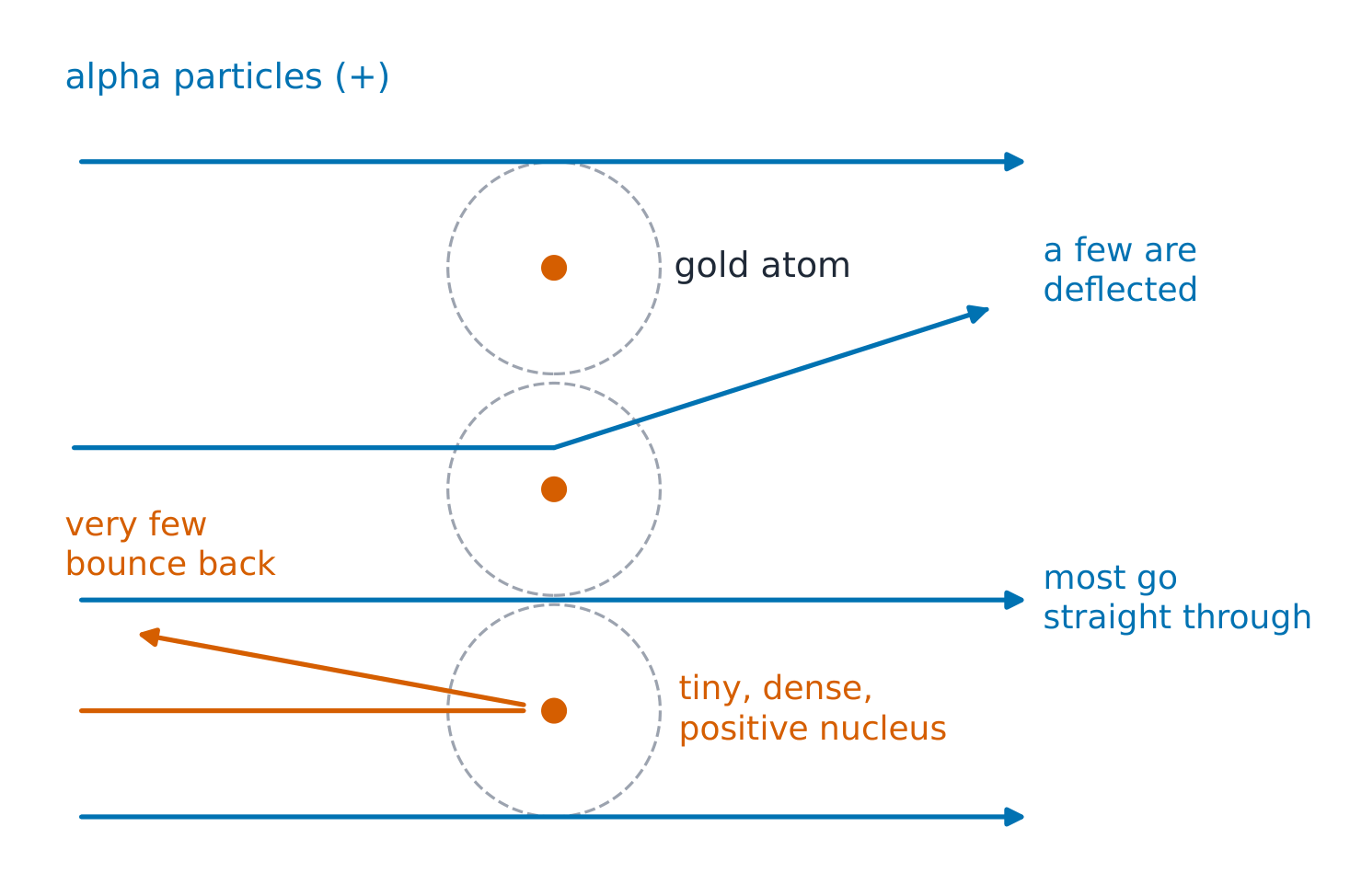
Alpha particles crossing a row of gold atoms: most pass straight through the empty space, one passing near a nucleus is deflected, and one heading at a nucleus bounces back
Most of an atom is empty space; its mass and positive charge sit in a tiny nucleus
  • Most alpha particles pass straight through, so an atom is mostly empty space.
  • A few are deflected, so there is a region of concentrated positive charge that repels them.
  • Very few bounce back, so that region, the nucleus 原子核, is tiny and holds almost all the mass.

Atomic radii are of order 10⁻¹⁰ m and nuclear radii of order 10⁻¹⁵–10⁻¹⁴ m, depending on the atom. The sizes are orders of magnitude apart. A classroom drawing enlarges the nucleus so it is visible; it cannot show both scales faithfully. Large-angle scattering supports a compact nucleus, but does not by itself establish the later neutron model or literal electron orbits.
Protons, neutrons and electrons

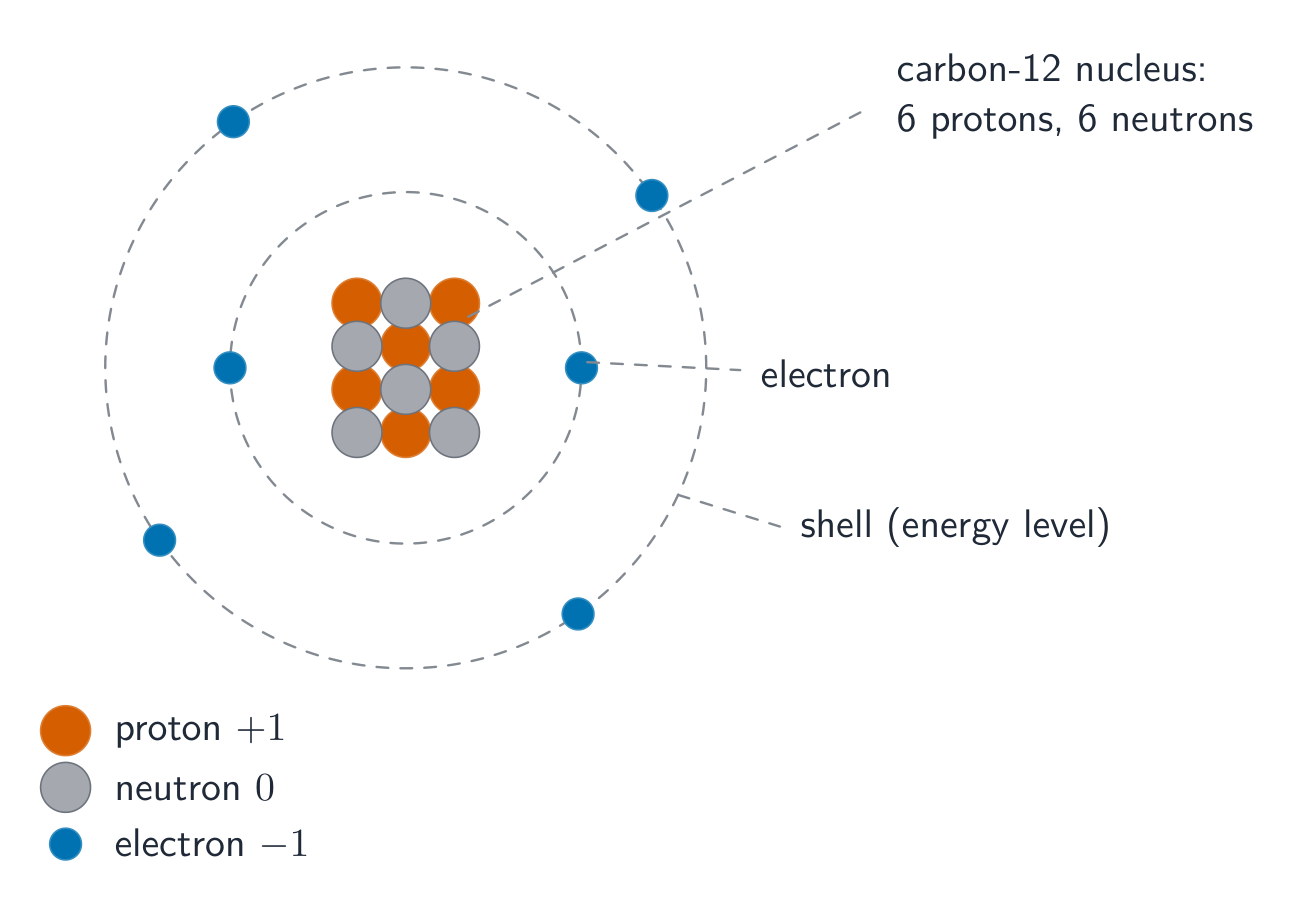
A schematic neutral carbon-12 atom: six protons, six neutrons and six electrons; shell circles represent energy levels, not measured paths
Neutral carbon-12 has six protons and six electrons. The enlarged nucleus contains six neutrons as well; circles are a simplified energy-level model, not literal trajectories.
Particle Relative mass Relative charge Where
proton 质子 1 +1 nucleus
neutron 中子 1 0 nucleus
electron 电子 1/1836 (about 0.0005) −1 outside the nucleus

Protons and neutrons together are called nucleons 核子. A neutral atom has equal numbers of protons and electrons, so it has no overall charge. Each proton/electron has equal-magnitude opposite charge; the neutron is uncharged. Hydrogen-1 is the important reminder that an atomic nucleus need not contain any neutrons.

Vocabulary Train
English
nucleus/ˈnjuːklɪəs/
proton/ˈprəʊtɒn/
neutron/ˈnjuːtrɒn/
electron/ɪˈlektrɒn/
nucleon/ˈnjuːklɪən/
2.3

Atomic number and mass number

Nuclear symbols

  • The atomic number 原子序数 $Z$ is the number of protons. It decides which element the atom is.
  • The mass number 质量数 $A$ is the number of protons plus neutrons.
  • Number of neutrons $= A - Z$.
Nuclear symbol for sodium-23: mass number 23 at top left counts protons plus neutrons; atomic number 11 at bottom left counts protons; so 11 protons, 12 neutrons and 11 electrons
Reading a nuclear symbol: A at the top, Z at the bottom, neutrons = A − Z

The nuclear symbol 核素符号 writes $A$ at the top left and $Z$ at the bottom left: $^{23}_{11}\text{Na}$ has 11 protons, $23 - 11 = 12$ neutrons and 11 electrons.

Ions

An ion 离子 has gained or lost electrons. The number of protons does not change.

Shell diagrams: a sodium atom with 11 protons and electrons 2, 8, 1 loses one electron to become Na+ with 2, 8; a sulfur atom with 16 protons and electrons 2, 8, 6 gains two electrons to become S2− with 2, 8, 8. The nucleus is unchanged
Forming an ion changes only the number of electrons; the protons, and so the element, stay the same.
Species Protons Neutrons Electrons
$^{23}_{11}\text{Na}$ 11 12 11
$^{23}_{11}\text{Na}^+$ 11 12 10
$^{32}_{16}\text{S}^{2-}$ 16 16 18
$^{27}_{13}\text{Al}^{3+}$ 13 14 10

A positive ion has fewer electrons than protons; a negative ion has more. In elementary-charge units, q = number of protons − number of electrons. Thus electrons = Z − q, with the sign retained: for q = −2, electrons = Z + 2. A species with 17 protons, 20 neutrons and 18 electrons is chlorine-37 with charge −1. Its mass number is 37, not 35 or 36.

Ion formation changes the electron count, not A or Z; changing neutron count changes the isotope, while changing proton count changes the element. Never obtain a mass number by rounding an element’s periodic-table relative atomic mass. A nuclear symbol refers to one nuclide, whereas the table value generally averages an isotopic mixture.

Vocabulary Train
English
atomic number/əˈtɒmɪk ˈnʌmbə/
mass number/mæs ˈnʌmbə/
nuclear symbol/ˈnjuːklɪə ˈsɪmbl/
ion/ˈaɪɒn/
2.4

Isotopes

Same element, different mass

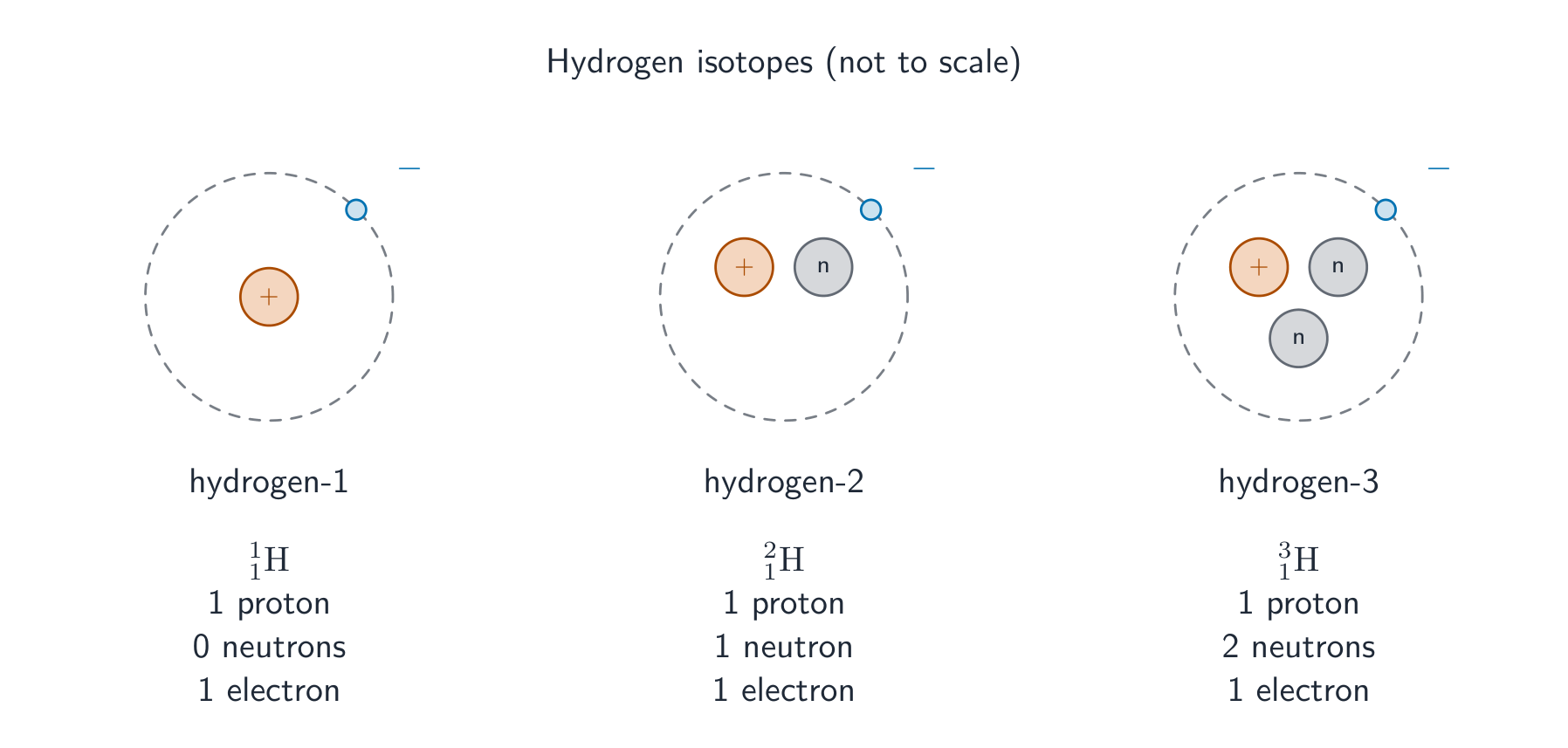
Isotopes 同位素 are atoms of the same element with different numbers of neutrons: the same $Z$, a different $A$.

The three isotopes of hydrogen: hydrogen-1 with one proton, hydrogen-2 with one proton and one neutron, hydrogen-3 with one proton and two neutrons; each has one electron
Isotopes differ only in the number of neutrons
  • Neutral isotopes of the same element have the same electron configuration, so they have very similar chemical behaviour. Isotope mass can affect reaction rates and equilibria; identical electronic structure does not make every measured chemical rate exactly identical. Compare like charge states before comparing electron counts.
  • They have different masses, so their physical properties differ slightly: density, rate of diffusion, and melting and boiling points. Heavy water, D₂O, boils at 101.4 °C.
  • Some isotopes are radioactive. Carbon-14 is used to date old wood and bone; cobalt-60 is used in radiotherapy; iodine-131 is used to treat thyroid disease.

Relative atomic mass from abundances

The relative atomic mass $A_r$ of an element is the weighted mean mass of its atoms relative to one-twelfth of the mass of a carbon-12 atom. It has no unit. Weight each isotope’s relative mass by its abundance 丰度 in the stated sample; proportions can differ between samples. Mass number is a whole-number nucleon count and is not an exact measured isotope mass.

$$A_r = \frac{\sum (\text{isotope mass} \times \text{abundance})}{100}$$

Worked example: chlorine

Use supplied approximate chlorine abundances 75.8% ³⁵Cl and 24.2% ³⁷Cl, and the stated whole-number isotope-mass approximation. These are calculation inputs, not exact masses or universal sample proportions.

$$A_r = \frac{35 \times 75.8 + 37 \times 24.2}{100} = \frac{2653 + 895.4}{100} = 35.5$$

The unrounded result is 35.484, reported 35.5 here. It lies nearer 35 because ³⁵Cl is more abundant. It does not mean an individual atom contains 35.484 nucleons or that an isotope with that mass number exists.

Worked example: finding an abundance

For a simplified two-isotope copper calculation, use masses 63 and 65 and $A_r = 63.55$. Let the abundance of ⁶³Cu be $x$%.

$$63x + 65(100 - x) = 63.55 \times 100$$
$$6500 - 2x = 6355 \quad\Rightarrow\quad x = 72.5$$

So ⁶³Cu is 72.5% and ⁶⁵Cu is 27.5%. Using the more accurate but still rounded isotope masses 62.93 and 64.93 with the same supplied mean gives 69.0% instead. These are calculation inputs, not exact isotope masses or a new measurement of natural abundance. State which mass approximation the question supplies.

Vocabulary Train
English
isotope/ˈaɪsətəʊp/
abundance/əˈbʌndəns/
2.5

Practice

  1. State the relative mass, relative charge and position of a proton, a neutron and an electron.
  2. Explain what the gold-foil experiment showed about the structure of the atom.
  3. Give the numbers of protons, neutrons and electrons in $^{40}_{20}\text{Ca}^{2+}$ and in $^{19}_{9}\text{F}^-$.
  4. A species has 26 protons, 30 neutrons and 23 electrons. Write its nuclear symbol with its charge.
  5. Explain why neutral ³⁵Cl and ³⁷Cl have very similar chemical behaviour. Why should this not imply exactly identical reaction rates?
  6. State one physical property that differs between isotopes, and explain why.
  7. Neon is 90.5% ²⁰Ne, 0.3% ²¹Ne and 9.2% ²²Ne. Calculate its $A_r$ to 2 decimal places.
  8. Gallium has isotopes ⁶⁹Ga and ⁷¹Ga, and $A_r = 69.8$. Calculate the abundance of each.
  9. A two-isotope sample has relative isotope masses 64.00 and 66.00 and mean relative atomic mass 64.60. Find both percentage abundances and check the result.
  10. A species has 17 protons, 20 neutrons and 18 electrons. Identify its element, mass number and charge. What changes if it loses one electron?
  11. Does relative atomic mass 35.5 mean each atom has 35.5 nucleons? State its unit and distinguish it from mass number.

Answers.

  1. Proton: 1, +1, nucleus. Neutron: 1, 0, nucleus. Electron: 1/1836, −1, outside the nucleus.
  2. Most alpha particles passed straight through, so the atom is mostly empty space. A few were deflected or bounced back, so the positive charge and most of the mass are in a tiny, dense nucleus.
  3. Ca²⁺: 20 protons, 20 neutrons, 18 electrons. F⁻: 9 protons, 10 neutrons, 10 electrons.
  4. $^{56}_{26}\text{Fe}^{3+}$.
  5. Neutral atoms have the same electron configuration, giving very similar bonding behaviour. Their different masses can still affect reaction rates or equilibria.
  6. For example, different masses affect diffusion rates under comparable conditions. A measured isotope effect depends on the substance, phase and conditions.
  7. $(20 \times 90.5 + 21 \times 0.3 + 22 \times 9.2)/100 = (1810 + 6.3 + 202.4)/100 = 20.19$.
  8. $69x + 71(100 - x) = 6980$, so $7100 - 2x = 6980$ and $x = 60$: ⁶⁹Ga 60%, ⁷¹Ga 40%.
  9. Let f be the fraction with mass 64.00: 64f + 66(1−f) =64.60, so f=0.700. Abundances are 70.0% and 30.0%. Check: 64×0.70 +66×0.30 =64.60, nearer the more abundant isotope.
  10. Z=17 identifies chlorine; A=17+20=37 and q=17−18=−1. Losing one electron gives neutral chlorine-37 with 17 electrons; the nucleus is unchanged.
  11. No: relative atomic mass is a weighted mean relative to the carbon-12 reference and has no unit. An individual nuclide’s mass number is an integer count of protons plus neutrons.
2.6

Exam tips

  • The atomic number is the number of protons; never say "the number of electrons", which changes in an ion.
  • In an ion, change only the electrons: add for a negative charge, subtract for a positive one.
  • Isotopes: same proton count, different neutron count. Explain similar chemistry through electron configuration; distinguish mass effects on rates.
  • Give $A_r$ to the precision the data allows, and check that it lies between the lightest and heaviest isotope, nearer the more abundant one.
Was this helpful?

More topics in IB Chemistry SL

Log in or create account

IGCSE, A-Level & AP