This handout teaches Structure 1.3, Electron configurations, for the course first assessed in 2025.
Prerequisites: protons, neutrons and electrons from Structure 1.2, the atomic number $Z$, and arithmetic with powers of ten. You will use three relations from the data booklet: $c = f\lambda$, $E = hf$ and the Avogadro constant $N_A$.
3.2
Light, energy and emission spectra
Why do atoms give out coloured light?
Put a little sodium salt in a flame and the flame turns orange-yellow. Pass a high voltage through hydrogen gas in a tube and it glows pink. Each element gives its own colours. The colours tell us how the electrons in the atom are arranged.
Flame tests: each metal ion gives its own colour because heat excites its electrons and, as they drop back down, they emit light of specific wavelengthsHydrogen emits light only at discrete, characteristic wavelengths — its line emission spectrum.
Light carries energy in packets
Light is part of the electromagnetic spectrum 电磁波谱. In vacuum it travels at the same speed $c = 3.00 \times 10^{8}\ \text{m s}^{-1}$, and its frequency $f$ and wavelength $\lambda$ are linked by
Shorter wavelength means higher frequency and more energy per photon
$$c = f\lambda$$
Light is given out and taken in as packets of energy called photons 光子. The energy of one photon depends only on its frequency:
$$E = hf$$
Here $h = 6.63 \times 10^{-34}\ \text{J s}$ is the Planck constant. So higher frequency means higher energy and shorter wavelength.
Region
Wavelength
Frequency and photon energy
infrared
longer than about 700 nm
lowest of the three
visible: red → violet
about 700 nm → 400 nm
rising
ultraviolet
shorter than about 400 nm
highest of the three
In the visible region, red light has the longest wavelength and the lowest energy; violet light has the shortest wavelength and the highest energy.
Continuous and line spectra
White light from a hot solid, such as a lamp filament, contains every visible wavelength. A prism spreads it into a continuous spectrum 连续光谱: a smooth band of colour with no gaps.
Light from excited gas atoms is different. A prism spreads it into a few sharp coloured lines on a dark background. This is a line emission spectrum 线状发射光谱. Every element has its own pattern of lines, so the spectrum works like a fingerprint for the element.
Where the lines come from
An electron in an atom can only have certain fixed energies, called energy levels 能级. When the atom absorbs energy (from a flame or an electric current), an electron moves up to a higher level. The atom is now in an excited state 激发态.
The electron then falls back to a lower level. It gives out the energy difference as one photon:
$$\Delta E = E_{\text{upper}} - E_{\text{lower}} = hf$$
Only certain gaps exist, so only certain photon energies, and therefore only certain frequencies, appear. That is why we see separate lines and not a continuous band.
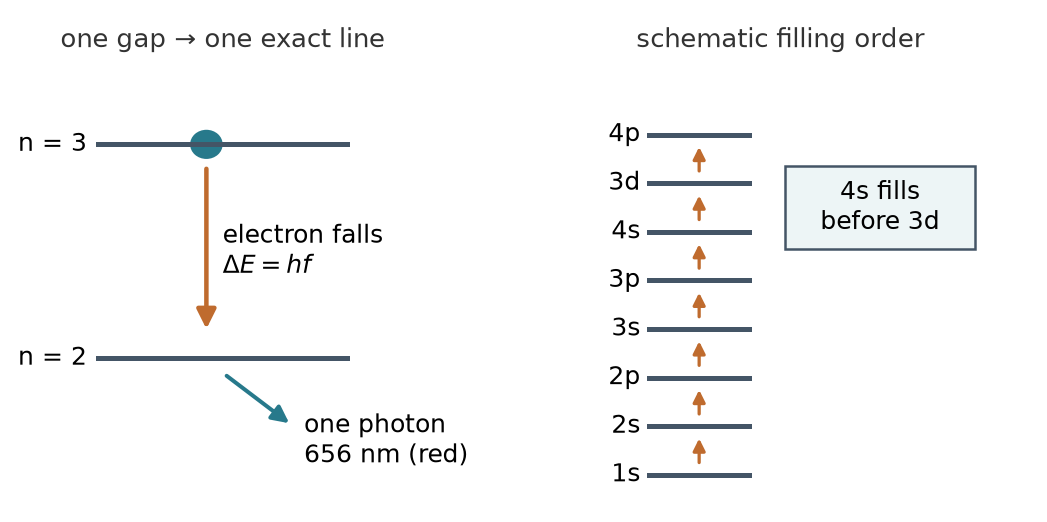
A fixed hydrogen energy gap gives a photon; the right panel is a schematic filling-order guide, not one universal measured energy scale. Chromium, copper and ion formation need the qualifications taught below.
The hydrogen spectrum is evidence for energy levels
Hydrogen has one electron, so its spectrum is the simplest. Two features matter:
The discrete energy levels of hydrogen produce a line spectrum
The lines are separate. If the electron could have any energy, hydrogen would give a continuous spectrum. The separate lines show that the energy of the electron is quantized 量子化的: it can only take fixed values.
The lines get closer together at higher frequency. The levels themselves get closer together as $n$ increases, so the lines converge 会聚. The bound-to-bound lines of that series approach its convergence limit 会聚极限. Beyond the limit there are no further bound-to-bound transitions in that same series; this is not a claim that no other series, or continuum radiation, can exist.
Which line appears depends on the level the electron falls to. Falls to $n = 1$ give the largest gaps, so those photons are ultraviolet. Falls to $n = 2$ include visible lines, such as the red 3→2 line at 656 nm, but higher members of that series extend into the near ultraviolet. Do not label the entire series visible. Falls to $n = 3$ give infrared.
Worked example. The red line of hydrogen has $\lambda = 656\ \text{nm}$. Find the energy gap it comes from.
Convert the wavelength: $\lambda = 656 \times 10^{-9}\ \text{m}$.
The main energy levels are numbered by the principal quantum number 主量子数$n = 1, 2, 3, \dots$ Level $n$ can hold at most $2n^2$ electrons. This is a capacity, not the filling sequence: 4s can be occupied before the 3d sublevel is filled.
$n$
Maximum electrons $2n^2$
Sublevels
1
2
1s
2
8
2s, 2p
3
18
3s, 3p, 3d
4
32
4s, 4p, 4d, 4f
Sublevels and orbitals
Each main level is split into sublevels 亚层 called s, p, d and f. Each sublevel is made of atomic orbitals 原子轨道. An orbital is a region around the nucleus where there is a high chance of finding an electron. One orbital holds at most two electrons.
Sublevel
Orbitals
Maximum electrons
s
1
2
p
3
6
d
5
10
f
7
14
Check: level $n = 3$ has 3s + 3p + 3d = 2 + 6 + 10 = 18 electrons, which matches $2n^2 = 18$.
Shapes of s and p orbitals
You need to recognise two shapes:
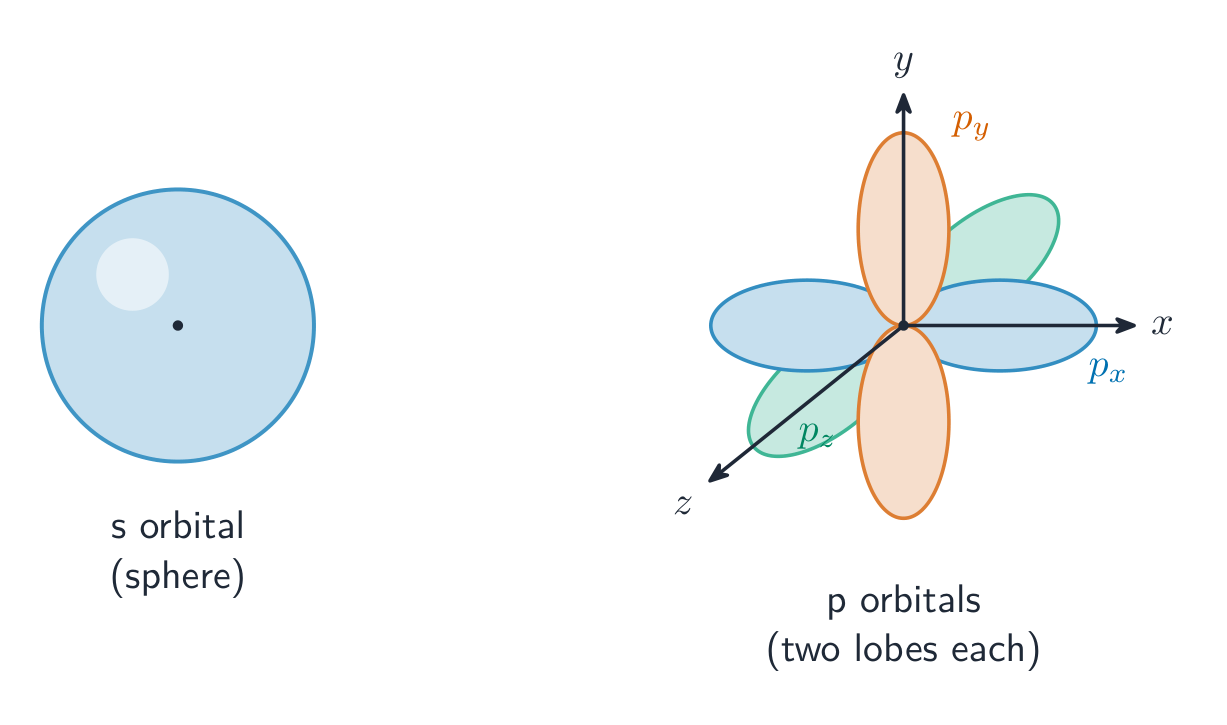
An s orbital is spherically symmetric around the nucleus. A drawn surface encloses a chosen probability region, not a hard boundary or an electron path. For the same atom, 2s extends farther on average than 1s.
A p orbital has two lobes on opposite sides of the nucleus, like a dumbbell. The three p orbitals of one level point along the $x$, $y$ and $z$ axes, at right angles to each other. They are named $p_x$, $p_y$ and $p_z$.
Schematic probability-region surfaces: spherical symmetry for s and two lobes for each p orientation. The colours distinguish orientations, not particle charges.
In an isolated atom without an external field, the three p orbitals of one sublevel have the same energy. Orbitals with equal energy are called degenerate 简并的.
principal quantum number/ˈprɪnsɪpl ˈkwɒntəm ˈnʌmbə/
sublevel/ˈsʌblevl/
atomic orbital/əˈtɒmɪk ˈɔːbɪtl/
degenerate/dɪˈdʒenəreɪt/
3.4
Writing electron configurations
Three rules for filling orbitals
Aufbau principle 构造原理: electrons go into the lowest-energy orbital available first.
Pauli exclusion principle 泡利不相容原理: an orbital holds at most two electrons, and they must have opposite spins 相反的自旋.
Hund's rule 洪特规则: in a set of degenerate orbitals, electrons go in singly with parallel spins before any orbital gets a second electron. This is the lowest-energy arrangement for the stated degenerate sublevel; Pauli and Hund are different constraints.
Aufbau, Pauli and Hund in one orbital diagram
For atoms up to $Z = 36$, the order of filling is:
A condensed configuration 简化电子排布 replaces the inner electrons with the symbol of the noble gas before the element, in square brackets:
sulfur: $[\text{Ne}]\,3\text{s}^2\,3\text{p}^4$
iron: $[\text{Ar}]\,4\text{s}^2\,3\text{d}^6$
Always check that the superscripts add up to the number of electrons.
Orbital diagrams
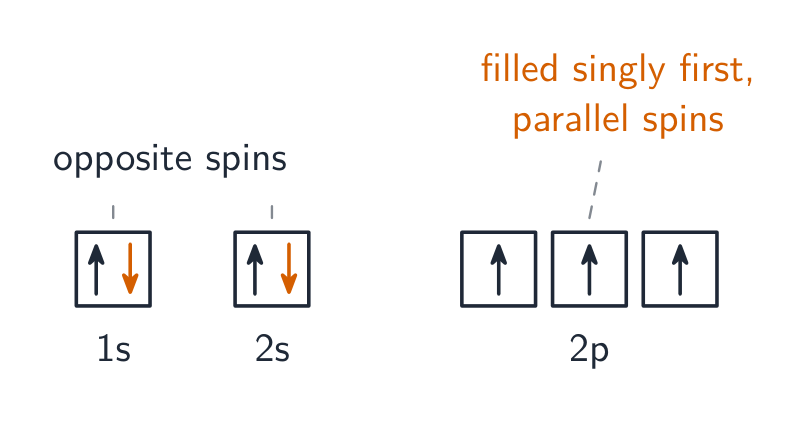
An orbital diagram 轨道表示式 draws each orbital as a box and each electron as a half-arrow. Two arrows in one box point in opposite directions (Pauli). Within a sublevel, fill every box with one arrow, all pointing the same way, before you add a second arrow to any box (Hund).
Nitrogen, $1\text{s}^2\,2\text{s}^2\,2\text{p}^3$: paired spins in 1s and 2s; the three 2p electrons sit singly with parallel spins
Nitrogen therefore has three unpaired electrons. Oxygen, $2\text{p}^4$, has one pair and two unpaired electrons in its 2p sublevel.
Worked example. Draw the orbital diagram of the 3d and 4s sublevels of iron.
Iron is $[\text{Ar}]\,4\text{s}^2\,3\text{d}^6$. The 4s box holds two opposite arrows. Six electrons go into five 3d boxes: one up-arrow in each of the five boxes, then the sixth pairs up in the first box. Iron has four unpaired electrons.
Two exceptions: chromium and copper
Two atoms in the first row of the d-block do not follow the simple order:
chromium, $Z = 24$: $[\text{Ar}]\,4\text{s}^1\,3\text{d}^5$, not $4\text{s}^2\,3\text{d}^4$
copper, $Z = 29$: $[\text{Ar}]\,4\text{s}^1\,3\text{d}^{10}$, not $4\text{s}^2\,3\text{d}^9$
These observed ground-state arrangements have lower total energy than the naive Aufbau predictions for these atoms. The notation is not a claim that every atom first forms one configuration and then visibly promotes an electron. Learn Cr and Cu as the required exceptions; do not extend a “half-full is always best” slogan to every atom or ion.
Configurations of ions
For a negative ion 阴离子, add electrons to the next available orbital. Oxide, $\text{O}^{2-}$: $1\text{s}^2\,2\text{s}^2\,2\text{p}^6$, the same as neon.
For a positive ion 阳离子 of a main-group element, remove electrons from the outermost level. $\text{Na}^{+}$: $1\text{s}^2\,2\text{s}^2\,2\text{p}^6$.
For a positive ion of a transition element 过渡元素, remove the 4s electrons first, then 3d electrons. Once 3d is occupied, 4s is no longer the lower level.
Species
Configuration
Fe
$[\text{Ar}]\,4\text{s}^2\,3\text{d}^6$
$\text{Fe}^{2+}$
$[\text{Ar}]\,3\text{d}^6$
$\text{Fe}^{3+}$
$[\text{Ar}]\,3\text{d}^5$
$\text{Cu}^{+}$
$[\text{Ar}]\,3\text{d}^{10}$
A common error is to write $\text{Fe}^{2+}$ as $[\text{Ar}]\,4\text{s}^2\,3\text{d}^4$. Remember: 4s fills first and empties first.
Use c=3.00×10⁸ m s⁻¹, h=6.63×10⁻³⁴ J s and Nₐ=6.02×10²³ mol⁻¹. All newly constructed numerical cases use supplied inputs; keep intermediate precision.
A spectral line has wavelength 589 nm. Calculate its frequency and one-photon energy.
State the maximum electron capacity of n=4 and name its sublevels. Does this determine which sublevel fills next?
Write the full configuration of chlorine and condensed configuration of Cr³⁺.
How many unpaired electrons does phosphorus have? Describe its 3s and 3p box diagram.
Explain why isolated excited hydrogen produces separate emission lines. Are all transitions ending on n=2 visible?
Compare photon energies for wavelengths 400 nm and 800 nm in vacuum. Find the energy ratio without calculating both energies.
Give the configurations and unpaired-electron counts of Fe²⁺ and Fe³⁺ in the isolated-ion model.
Give the configurations of Cu⁺ and Cu²⁺. Identify the sublevel from which each electron was removed.
A proposed ground-state nitrogen 2p diagram has a pair in one box, a single electron in the second and the third empty. Does it satisfy Pauli? Does it satisfy Hund?
How many orbitals and electrons at full capacity are in n=3? Distinguish an orbital, a sublevel and a main level.
A p orbital is drawn with two lobes in different colours. Does that show two electrons of opposite electric charge? What does degeneracy mean for isolated atomic p orbitals?
Worked answers.
f=c/λ=3.00×10⁸/(589×10⁻⁹)=5.0933786…×10¹⁴ Hz; E=hc/λ=3.3769100…×10⁻¹⁹ J. Report 5.09×10¹⁴ Hz and 3.38×10⁻¹⁹ J. Use the unrounded frequency for the second result.
2n²=32 electrons; 4s,4p,4d,4f. Capacity does not set filling order; an orbital’s energy and occupancy matter.
Cl: 1s² 2s² 2p⁶ 3s² 3p⁵ (17 electrons). Cr is [Ar]4s¹3d⁵; remove 4s first, then two 3d electrons: Cr³⁺=[Ar]3d³, with 21 electrons.
Three unpaired. The 3s box contains two opposite arrows; each of the three 3p boxes contains one parallel arrow.
Only allowed discrete energy differences produce bound-to-bound photons with E=hf. Some n=2-series lines are visible, but higher members enter the near ultraviolet; a series label does not guarantee every wavelength is visible.
E=hc/λ, so E₄₀₀/E₈₀₀=800/400=2. The shorter-wavelength photon has twice the energy, not half.
Fe²⁺=[Ar]3d⁶, four unpaired; Fe³⁺=[Ar]3d⁵, five unpaired. Remove the neutral atom’s 4s electrons first, then one 3d electron for the third positive charge. These are isolated-ion counts, not a universal prediction for every coordination complex.
Neutral Cu=[Ar]4s¹3d¹⁰. Removing 4s gives Cu⁺=[Ar]3d¹⁰; removing another electron from 3d gives Cu²⁺=[Ar]3d⁹. Electron totals are 28 and 27 respectively.
If the paired arrows have opposite spins, Pauli is satisfied. Hund is violated for the ground state: three degenerate p orbitals should first contain three singly occupied parallel arrows. A legal occupancy is not necessarily the ground state.
3s,3p,3d contain 1+3+5=9 orbitals, at most 18 electrons. An orbital holds at most two electrons; several orbitals make a sublevel; the sublevels belong to a main level.
No: lobes describe one orbital’s spatial form; colours can denote wavefunction phase in some diagrams or just identify orientations. They are not positive/negative electrons or a particle count. Degenerate orbitals have equal energy under the stated isolated-atom conditions.
3.6
Exam tips
Explain lines through allowed levels and emitted photons. A series has a stated endpoint; not all n=2-series lines are visible.
Check electron totals, Pauli, Hund and Cr/Cu exceptions; remove 4s before 3d in the ions taught here.