This handout teaches Structure 1.5, Ideal gases, for the course first assessed in 2025. All of it is SL and HL content.
Prerequisites: the amount of substance $n$ in mol and molar mass from Structure 1.4, and rearranging an equation. You will use the gas constant $R = 8.31\ \text{J K}^{-1}\ \text{mol}^{-1}$ and the molar volume $22.7\ \text{dm}^3\ \text{mol}^{-1}$ from the data booklet.
5.2
The ideal gas model
Why does a sealed can burst in a fire?
Heating a suitably confined gas can raise its pressure; whether a container fails also depends on its construction, contents and conditions. Pumping a tyre adds gas, while squeezing an air-filled syringe changes volume. These are different changes in the same model, not one rule that heating always determines pressure. They are explanatory examples, not practical instructions: never heat an improvised sealed container.
Steam rising from boiling water: gases expand to fill space and obey the ideal gas law at high T and low PAn ideal gas is a model: point particles with no forces between them. A real gas behaves least like this at high pressure and low temperature, when the particles are crowded and their real size and attractions start to matter
Five assumptions
The kinetic molecular theory 分子动理论 pictures a gas as a huge number of tiny particles in fast, random motion. An ideal gas 理想气体 is one that obeys this model exactly:
The particles move randomly in straight lines until they collide.
The volume of the particles themselves is negligible compared with the volume of the container.
There are no intermolecular forces 分子间作用力 between the particles.
All collisions are elastic 弹性的: total kinetic energy is conserved in a collision, although individual particles can exchange energy.
The average kinetic energy of the particles is proportional to the kelvin temperature.
Pressure 压强 is the force per unit area that the particles exert when they hit the walls of the container. More hits per second, or harder hits, mean a higher pressure.
Temperature must be in kelvin
The kelvin scale 开尔文温标 starts at absolute zero 绝对零度, the lowest possible temperature, which is the zero of the thermodynamic scale. The classical ideal-gas model approaches zero mean translational kinetic energy there; it does not describe all motion in real quantum systems.
The offset is exactly 273.15. The whole-kelvin course estimates below use 273 consistently; use the precision specified in a question.
Kelvin temperature is proportional to the average kinetic energy of the particles. Celsius temperature is not: $40\ ^{\circ}\text{C}$ is not twice as hot as $20\ ^{\circ}\text{C}$, but 400 K is twice 200 K and gives twice the ideal-gas mean translational kinetic energy. This does not mean every particle has the same energy or that total internal energy depends on temperature alone for every material. Every gas calculation uses kelvin.
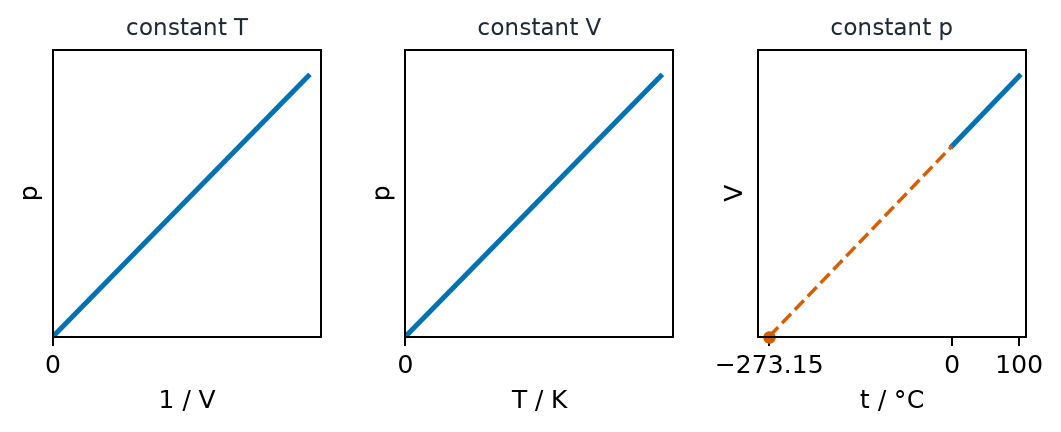
Change one quantity, hold one fixed, and watch the third. Each result has a particle explanation.
Held fixed
Relationship
Particle explanation
$T$
$p \propto \dfrac{1}{V}$, so $pV$ is constant
smaller volume → particles hit the walls more often
$V$
$p \propto T$
hotter particles move faster, hit more often and harder
$p$
$V \propto T$
faster particles push the walls out until the pressure is back to its old value
Straight lines through the origin show proportionality; the volume line meets zero at $-273.15\ ^{\circ}\text{C}$, absolute zero
A plot of p against V can be tested using a suitable inverse model; a curve is not automatically poor evidence. Plotting p against 1/V can make the proposed proportionality easier to inspect. Check the intercept, residuals and uncertainties rather than accepting any roughly straight line. The Celsius-axis intercept is an ideal-model extrapolation: a real gas may condense before approaching it, so it is not a practical route to zero gas volume.
At constant temperature $pV$ stays constant: $300 \times 20 = 100 \times 60 = 6000$
The combined gas law
The three relationships combine into one equation for a fixed amount of gas:
The worked combined-gas-law example in SI units
$$\frac{p_1 V_1}{T_1} = \frac{p_2 V_2}{T_2}$$
For course calculations, convert pressure to Pa, volume to m³ and temperature to K. Compatible units on both sides can cancel algebraically, but this does not remove the syllabus requirement to use SI pressure/volume in ideal-gas calculations. The combined form also requires a fixed amount: a leak, reaction or gas added to the sample changes that assumption.
Worked example. A gas occupies $250\ \text{cm}^3$ at $20\ ^{\circ}\text{C}$ and $100\ \text{kPa}$. It is heated to $80\ ^{\circ}\text{C}$ and the pressure rises to $150\ \text{kPa}$. Find the new volume.
Convert p₁ = 100000 Pa, p₂ = 150000 Pa and V₁ = 2.50 × 10⁻⁴ m³. Substitute: V₂ = (100000 × 2.50 × 10⁻⁴ × 353)/(150000 × 293) = 2.0079636… × 10⁻⁴ m³, or 201 cm³ to three significant figures.
Check: T increases by a factor 353/293 = 1.20478…, while p increases by 1.50. The volume factor is 0.803185…, so volume falls about 19.7 %. Quantify the competing factors rather than saying they cancel.
Explore
Gas pressure uses kelvin temperature
$\frac{p_2}{p_1}=\frac{T_2}{T_1}\frac{V_1}{V_2}$
For a fixed amount of ideal gas, pressure rises with kelvin temperature and falls as volume increases.
5.4
Molar volume and the ideal gas equation
Equal volumes, equal numbers of particles
In an ideal gas the particles have negligible volume, so at specified pressure and temperature the ideal volume depends on how many particles there are, not their chemical identity. Volume also depends on pressure and temperature; amount alone does not determine it. Avogadro's law 阿伏伽德罗定律: equal volumes of all gases at the same temperature and pressure contain the same number of particles.
So one mole of any ideal gas has the same volume at a given temperature and pressure. This is the molar volume 摩尔体积. At standard temperature and pressure (STP: $273\ \text{K}$ and $100\ \text{kPa}$):
$$V_m = 22.7\ \text{dm}^3\ \text{mol}^{-1}$$
$$n = \frac{V}{V_m}$$
For example, $0.500\ \text{mol}$ of oxygen or of carbon dioxide at STP each occupy $0.500 \times 22.7 = 11.4\ \text{dm}^3$.
Because volume is proportional to amount, the coefficients in a balanced equation for gases give their volume ratio too. In $\text{N}_2(\text{g}) + 3\text{H}_2(\text{g}) \rightarrow 2\text{NH}_3(\text{g})$, $10\ \text{cm}^3$ of nitrogen reacts with $30\ \text{cm}^3$ of hydrogen to give $20\ \text{cm}^3$ of ammonia, all compared at the same temperature and pressure, assuming the stated reaction proceeds to the specified stoichiometric extent and the substances remain gases. Real ammonia equilibrium need not give complete conversion.
N₂ + 3H₂ → 2NH₃: at the same T and p, gas volumes follow the mole ratio
The ideal gas equation
Putting amount into the combined law gives the ideal gas equation 理想气体状态方程:
$$pV = nRT$$
$R$ is the gas constant 气体常数, $8.31\ \text{J K}^{-1}\ \text{mol}^{-1}$. The units must fit $R$:
The product kPa·dm³ is dimensionally equal to a joule, but use the stated SI route Pa with m³ for this course. Mixing kPa with m³ while keeping the numerical R = 8.31 gives a factor-of-1000 error.
Worked example: finding a molar mass. A $0.320\ \text{g}$ sample of a gas occupies $180\ \text{cm}^3$ at $300\ \text{K}$ and $100\ \text{kPa}$. Find its molar mass.
Interpret: this is close to $44.0\ \text{g mol}^{-1}$, so carbon dioxide or propane could be candidates. Molar mass alone does not identify a gas uniquely; uncertainty, composition and independent evidence matter. Using unrounded n gives M = 44.32 g mol⁻¹, reported 44.3.
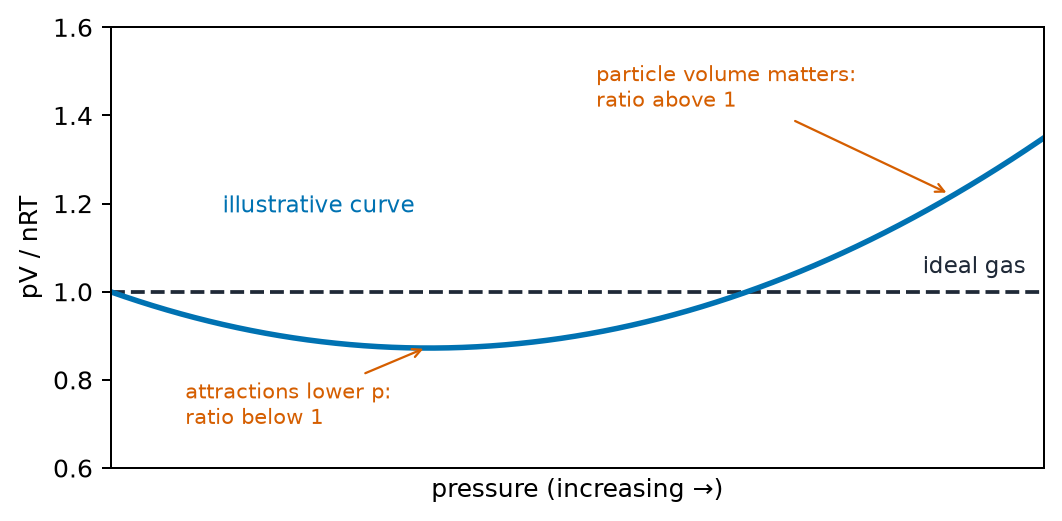
A real gas 实际气体 behaves almost ideally at high temperature and low pressure. It deviates most at low temperature and high pressure, because two assumptions stop being true.
Liquid nitrogen boils at −196 °C: cooled enough, every real gas condenses, which an ideal gas never would
High pressure. The particles are pushed close together, so their own volume is no longer negligible. Excluded-volume effects can push pV/(nRT) above 1 when they dominate. Attractions can oppose this; the net deviation depends on the gas, temperature and pressure, rather than every high-pressure state having one compulsory sign.
Low temperature. Attractions become more important relative to thermal motion and can lower pressure relative to the ideal prediction for the same amount, volume and temperature. They act at other temperatures too; the relevant issue is their relative importance. Condensation can invalidate a single-gas-phase comparison.
Stronger attractions can increase deviations under suitable comparable conditions, but particle size, temperature, pressure and phase also matter. Do not rank every possible state of two gases from an attraction label alone.
We can compare a real gas with the model by plotting $\dfrac{pV}{nRT}$ against pressure. For an ideal gas this ratio is exactly 1 at every pressure.
A curve. Below/above 1 are interpreted using the conditions and competing effects.
Absolute pressure, dry gas and density
Gas-law p is absolute pressure, referenced to vacuum. Gauge pressure is relative to ambient: p_absolute = p_gauge + p_ambient. Gauge 50 kPa at ambient 100 kPa means 150 kPa absolute. In a rigid fixed-amount ideal sample warming 300→360 K, pressure becomes 150 × 360/300 =180 kPa absolute, or 80 kPa gauge if ambient stays 100 kPa.
Use absolute pressure of the dry gas
If gas is collected over water and the relevant pressure conditions are given, subtract the supplied water-vapour partial pressure to find dry-gas pressure. With total 103 kPa and water vapour 3 kPa, dry p =100 kPa; do not invent a water-vapour value or ignore a hydrostatic pressure difference. A mixture needs the appropriate component pressure/amount interpretation.
Combining n=m/M with pV=nRT gives M=mRT/(pV) and ρ=pM/(RT). If density is kg/m³, use M in kg/mol to obtain consistent SI mass units. A fitted slope of p against 1/V at fixed n,T is nRT, with units Pa·m³ = J. It can estimate n if the model and calibration are justified.
Measuring gas behaviour in the lab
To test $p \propto T$, warm a sealed flask of air in a water bath connected to a pressure sensor. Let the gas reach the temperature of the bath before each reading, and keep within the temperature and pressure limits your teacher sets. Never heat a sealed vessel that is not designed for it.
Convert $-23\ ^{\circ}\text{C}$ and $127\ ^{\circ}\text{C}$ to kelvin.
A gas at $300\ \text{K}$ and $120\ \text{kPa}$ in a rigid container is cooled to $250\ \text{K}$. Find the new pressure.
Calculate the volume of $0.0400\ \text{mol}$ of a gas at STP, in cm$^3$.
Calculate the volume, in dm$^3$, of $0.500\ \text{mol}$ of gas at $298\ \text{K}$ and $101\ \text{kPa}$.
$1.00\ \text{g}$ of a gas occupies $0.763\ \text{dm}^3$ at $273\ \text{K}$ and $100\ \text{kPa}$. Find its molar mass and suggest the gas.
Explain, in terms of particles, why the pressure of a gas rises when it is heated at constant volume.
State two assumptions of the ideal gas model, and explain why each fails at high pressure or low temperature.
A gauge reads 50 kPa at ambient 100 kPa. In a rigid fixed-amount ideal sample, T changes 300→360 K. Find initial/final absolute pressure and final gauge pressure if ambient is unchanged.
A fixed ideal sample occupies 300 cm³ at 300 K and 100 kPa, then reaches 360 K and 150 kPa. Find the new volume using SI intermediate units, and explain its direction of change.
A p-versus-1/V line at 300 K has slope 500 Pa·m³. Using R=8.31, estimate n. Explain why an intercept or systematic residual pattern matters.
For supplied p=1.20×10⁶ Pa, V=1.00×10⁻³ m³, n=0.500 mol and T=300 K, find Z=pV/(nRT). What does its sign relative to 1 suggest, and what does it not identify by itself?
A gas density is 1.60 kg/m³ at 300 K and 100000 Pa. Derive its molar mass in kg/mol and g/mol. Explain why that does not uniquely identify the gas.
A supplied equal-level water collection has total pressure 103 kPa, water-vapour partial pressure 3 kPa, volume 200 cm³ and T=300 K. Find dry-gas amount. Name one measurement condition that must be checked.
A rigid sample changes from 200 kPa at 300 K to 204 kPa at 360 K. Assuming ideal behaviour and unchanged volume, find n₂/n₁. Does a higher final pressure alone prove the amount was unchanged?
Convert p=101000 Pa. V=0.500 × 8.31 × 298/101000 = 0.0122593069… m³ = 12.3 dm³ to three significant figures.
$n = \dfrac{0.763}{22.7} = 0.0336\ \text{mol}$; $M = \dfrac{1.00}{0.0336} = 29.8\ \text{g mol}^{-1}$, close to $30$: ethane, $\text{C}_2\text{H}_6$, or nitrogen monoxide, NO.
The particles gain kinetic energy and move faster. They hit the walls more often and with more force, so the force per unit area rises.
Particle volume is negligible: at high pressure the particles are close together and their own volume is a large share of the container. No intermolecular forces: at low temperature the particles move slowly and attractions pull them together, lowering the pressure.
Initially 50+100 = 150 kPa absolute. Final absolute 150 × 360/300 = 180 kPa. Final gauge 180−100 = 80 kPa. A gauge value cannot be substituted as though it were absolute.
V₁=3.00×10⁻⁴ m³; p₁=100000 Pa, p₂=150000 Pa. V₂=p₁V₁T₂/(p₂T₁)=2.40×10⁻⁴ m³ =240 cm³. Temperature factor 1.20 is outweighed by pressure factor 1.50, giving volume factor 0.80.
n=slope/(RT)=500/(8.31×300)=0.2005616… mol, about 0.201 mol. A nonzero intercept or residual pattern can indicate offset, changed conditions or model inadequacy; straightness alone does not prove the assumptions.
pV=1200 J; nRT=1246.5 J; Z=0.9626955…, about 0.963. Below 1 is consistent with attractions being important; it does not identify the gas or eliminate measurement uncertainty.
From M=ρRT/p, M=1.60×8.31×300/100000=0.039888 kg/mol =39.888 g/mol, reported 0.0399 kg/mol or 39.9 g/mol. Identity needs independent chemical evidence.
Dry p=(103−3)×1000 =100000 Pa; V=2.00×10⁻⁴ m³. n=pV/(RT)=0.00802246… mol, about 0.00802 mol. For example, check that liquid levels are equal and temperature is measured.
At fixed V, n₂/n₁=(p₂/p₁)(T₁/T₂)=(204/200)(300/360)=0.85. The model implies 15% less gas despite a 2% pressure rise. A leak is possible, but pressure alone does not establish its cause.
5.7
Exam tips
Use kelvin, absolute Pa and m³ with R=8.31; convert requested output units afterwards.
Check fixed amount, wet/dry gas, physical states and stated molar-volume conditions before choosing a relation.
Explain competing attraction/particle-volume effects. An extrapolation, schematic or single molar mass does not uniquely identify a gas or mechanism.