This handout teaches Structure 2.2, The covalent model, for the course first assessed in 2025.
Prerequisites: electron configurations and valence electrons from Structure 1.3, and the ionic model from Structure 2.1. You will use electronegativity values from the data booklet.
7.2
The covalent bond
Why does iodine melt so easily?
Iodine is made of $\text{I}_2$ molecules. The bond that holds the two iodine atoms together is strong: the supplied gas-phase I–I bond enthalpy is about $151\ \text{kJ mol}^{-1}$. Yet solid iodine melts at only $114\ ^\circ\text{C}$ and turns to a purple vapour with gentle heating. Under ordinary melting or gentle sublimation conditions the particles remain mainly $\text{I}_2$: intermolecular attractions are overcome while the intramolecular I–I bonds remain intact. This unit explains the difference between the strong covalent bonds 共价键 inside a molecule and the weak intermolecular forces 分子间作用力 between molecules.
Bonds inside molecules are strong; forces between them are weak, so melting leaves the molecules intact
What a covalent bond is
A covalent bond is the electrostatic attraction between a shared pair 共用电子对 of electrons and the positively charged nuclei of the two bonded atoms. The covalent model describes shared electron density between atoms and is especially useful for non-metal compounds. Sharing need not be equal: electronegativity differences can polarize a covalent bond. Bonding is a continuum, so this is not an absolute classification by element names.
In a covalent bond, atoms share pairs of electrons so each reaches a full outer shell
Most atoms in covalent molecules end with eight electrons in their outer shell. This is the octet rule 八隅体规则. Hydrogen is the exception: it is full with two.
Some small atoms have fewer than eight. In $\text{BF}_3$ boron has only six outer electrons, and in $\text{BeCl}_2$ beryllium has only four. These are incomplete octets 不完全八隅体.
Pairs of outer electrons that are not shared are lone pairs 孤对电子. They matter for shape and for hydrogen bonding.
Lewis formulas
A Lewis formula 路易斯结构式 shows every valence electron: shared pairs as lines (or dot-cross pairs) and lone pairs as pairs of dots. To draw one:
Dot-and-cross diagrams show the bonding pairs and lone pairs in a molecule
Add up the valence electrons of all the atoms. Add one for each negative charge and subtract one for each positive charge.
Put the least electronegative atom in the centre (never H) and join each outer atom with a single bond.
Complete the octets of the outer atoms with lone pairs, then put any electrons left on the central atom.
If appropriate for the species, use outer-atom lone pairs to form multiple bonds and complete the central octet. Check total electron count and allowed exceptions: do not force extra bonds into an incomplete-octet BF₃ or BeCl₂ model merely to make eight.
For $\text{CO}_2$: $4 + 2(6) = 16$ valence electrons. Two C–O single bonds and full octets on both O use all 16, but C has only four. Moving one lone pair from each O gives $\text{O}=\text{C}=\text{O}$, with two lone pairs on each O and eight electrons round C.
Single, double and triple bonds
Two atoms can share one, two or three pairs. More shared pairs pull the nuclei closer together and hold them more strongly.
Nitrogen is unreactive for two reasons: a very strong triple bond, and a symmetrical, non-polar molecule
Bond
Shared pairs
Length / pm
Bond enthalpy / kJ mol$^{-1}$
C–C
1
154
346
C=C
2
134
614
C≡C
3
120
839
For these carbon–carbon comparisons, the triple bond is the shortest and strongest. This is a comparison of bond order between the same elements, not a ranking of every triple bond above every single bond. Note that a double bond is not twice as strong as a single bond.
Coordination bonds
In a coordination bond 配位键 (a dative covalent bond) both shared electrons come from the same atom. The donor origin is electron bookkeeping; it is still a covalent bond after formation. Equivalent bonds in a symmetric species need not retain different physical properties because their drawn electron origins differ.
A coordinate (dative) bond: nitrogen's lone pair forms the fourth N–H bond, both electrons coming from N
$\text{NH}_3 + \text{H}^+ \rightarrow \text{NH}_4^{+}$: the lone pair on N bonds to the $\text{H}^+$ ion. All four N–H bonds in $\text{NH}_4^{+}$ are the same.
$\text{H}_2\text{O} + \text{H}^+ \rightarrow \text{H}_3\text{O}^{+}$, a useful hydrated-proton representation for aqueous acid solutions; actual proton hydration involves surrounding water molecules.
Carbon monoxide, $\text{C}\equiv\text{O}$: two of the three shared pairs come from both atoms, but one comes from oxygen alone.
Draw a coordination bond as an arrow from the donor atom to the acceptor atom.
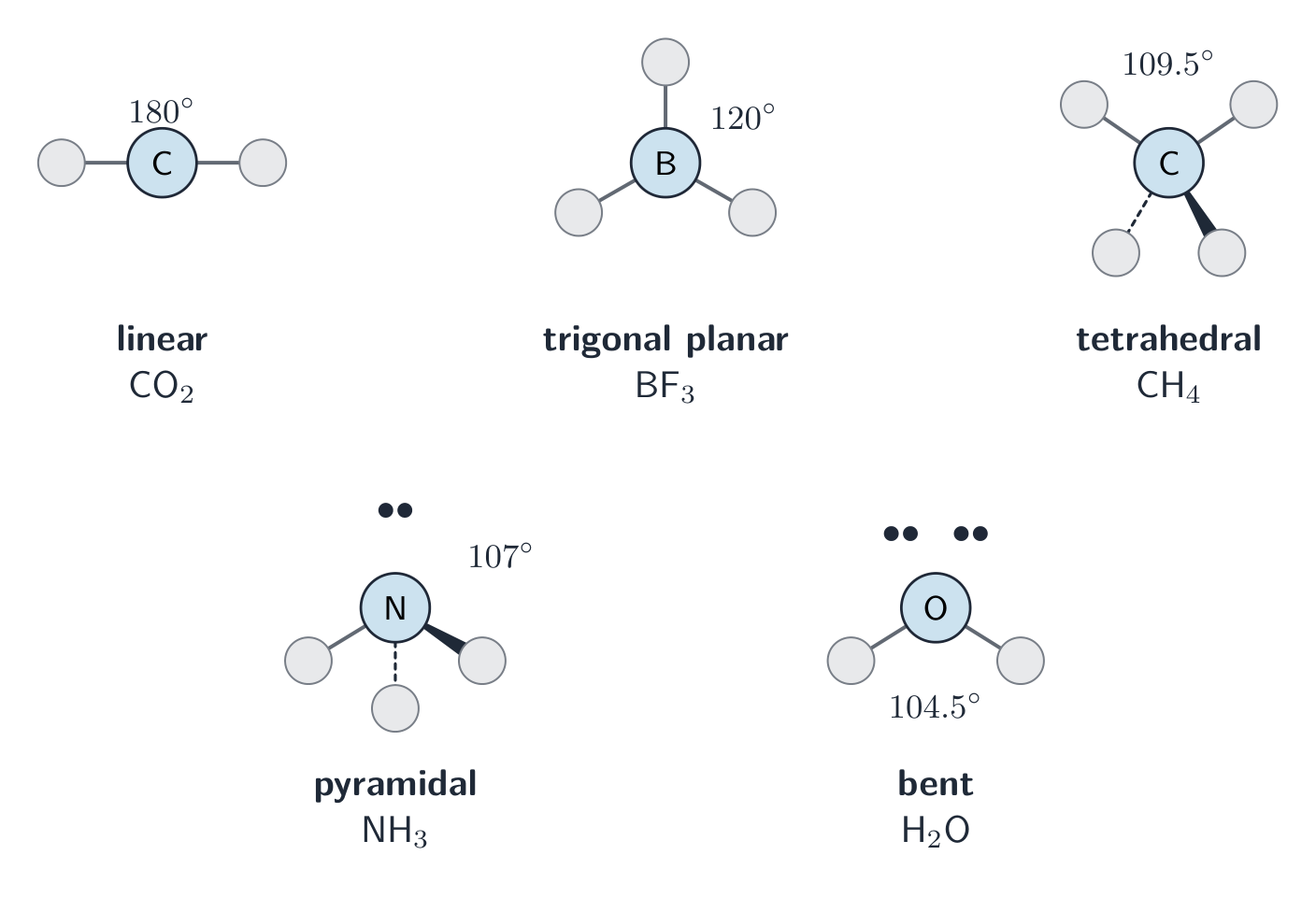
The valence shell electron pair repulsion 价层电子对互斥 (VSEPR) model predicts shape from one idea: groups of electrons round the central atom repel and spread as far apart as possible. Each group is an electron domain 电子域: a single bond, a double bond, a triple bond or a lone pair each counts as one domain.
A molecular model shows the three-dimensional shape of a covalent molecule.
Draw the Lewis formula.
Count the electron domains round the central atom: this gives the electron domain geometry.
Count how many domains are bonds: the positions of the atoms give the molecular geometry 分子几何构型 (the shape).
Lone-pair electron density is typically more concentrated around the central atom, so lone pairs exert greater repulsion than bonding domains in the simple model. Multiple bonds can also repel more strongly than single-bond domains. There is no fixed angle subtraction per lone pair: exact angles depend on the atoms and bonding. The familiar 107° and 104.5° values below belong to NH₃ and H₂O, not every pyramidal or bent molecule. NIST phosphine data give about 93.3° for PH₃.
Domains
Lone pairs
Shape
Angle
Example
2
0
linear
$180^\circ$
$\text{CO}_2$, $\text{BeCl}_2$
3
0
trigonal planar
$120^\circ$
$\text{BF}_3$, $\text{CO}_3^{2-}$
3
1
bent (V-shaped)
below $120^\circ$
$\text{SO}_2$, $\text{O}_3$
4
0
tetrahedral
$109.5^\circ$
$\text{CH}_4$, $\text{NH}_4^{+}$
4
1
trigonal pyramidal
$107^\circ$
$\text{NH}_3$
4
2
bent (V-shaped)
$104.5^\circ$
$\text{H}_2\text{O}$
Common examples with up to four electron domains. Wedges point towards you and dashed bonds away; labelled angles are specific to these examples.
Worked example: the shape of $\text{NH}_3$
Valence electrons: $5 + 3(1) = 8$, so four pairs round N.
Three are N–H bonds and one is a lone pair: four domains, so the electron domain geometry is tetrahedral.
Only three positions hold atoms, so the shape is trigonal pyramidal.
The lone pair repels more strongly than the bonds, so the angle closes from $109.5^\circ$ to $107^\circ$.
valence shell electron pair repulsion/ˈveɪləns ʃel ɪˈlektrɒn peə rɪˈpʌlʃn/
electron domain/ɪˈlektrɒn dəˈmeɪn/
molecular geometry/məˈlekjʊlə dʒiˈɒmətri/
7.4
Bond polarity and molecular polarity
Polar bonds
Electronegativity 电负性 is the ability of an atom to attract a shared pair of electrons. When the two bonded atoms have different electronegativities, the shared pair sits closer to the more electronegative atom. That atom gains a small negative charge, $\delta-$, and the other a small positive charge, $\delta+$. The bond is a polar bond 极性键 and has a bond dipole.
Check both the bonds and the shape: polar bonds can belong to a non-polar molecule.
Atom
H
C
N
O
F
Cl
Electronegativity
2.2
2.6
3.0
3.4
4.0
3.2
The larger the electronegativity difference, the more polar the bond. O–H (difference 1.2) is much more polar than C–H (difference 0.4). A large difference tends to increase ionic character, but no universal numerical cutoff proves a bonding category. Use the bonding continuum and structural evidence.
Polar molecules
A molecule is polar 极性的 when its bond dipoles do not cancel, so it has a net dipole moment 偶极矩. Whether they cancel depends on the shape.
$\text{CO}_2$ has two polar C=O bonds, but the molecule is linear: the two dipoles point in opposite directions and cancel. $\text{CO}_2$ is non-polar.
$\text{H}_2\text{O}$ has two polar O–H bonds, but the molecule is bent: the dipoles add up towards the oxygen. Water is polar.
$\text{CH}_4$ and $\text{CCl}_4$ are symmetrical tetrahedra, so they are non-polar. In $\text{CH}_3\text{Cl}$ one bond is different, the dipoles no longer cancel, and the molecule is polar.
For a symmetric arrangement of equivalent bond dipoles, the vectors cancel. Apply that vector test to the actual geometry: lone pairs do not automatically imply polarity, and an apparently irregular drawing does not establish a net dipole.
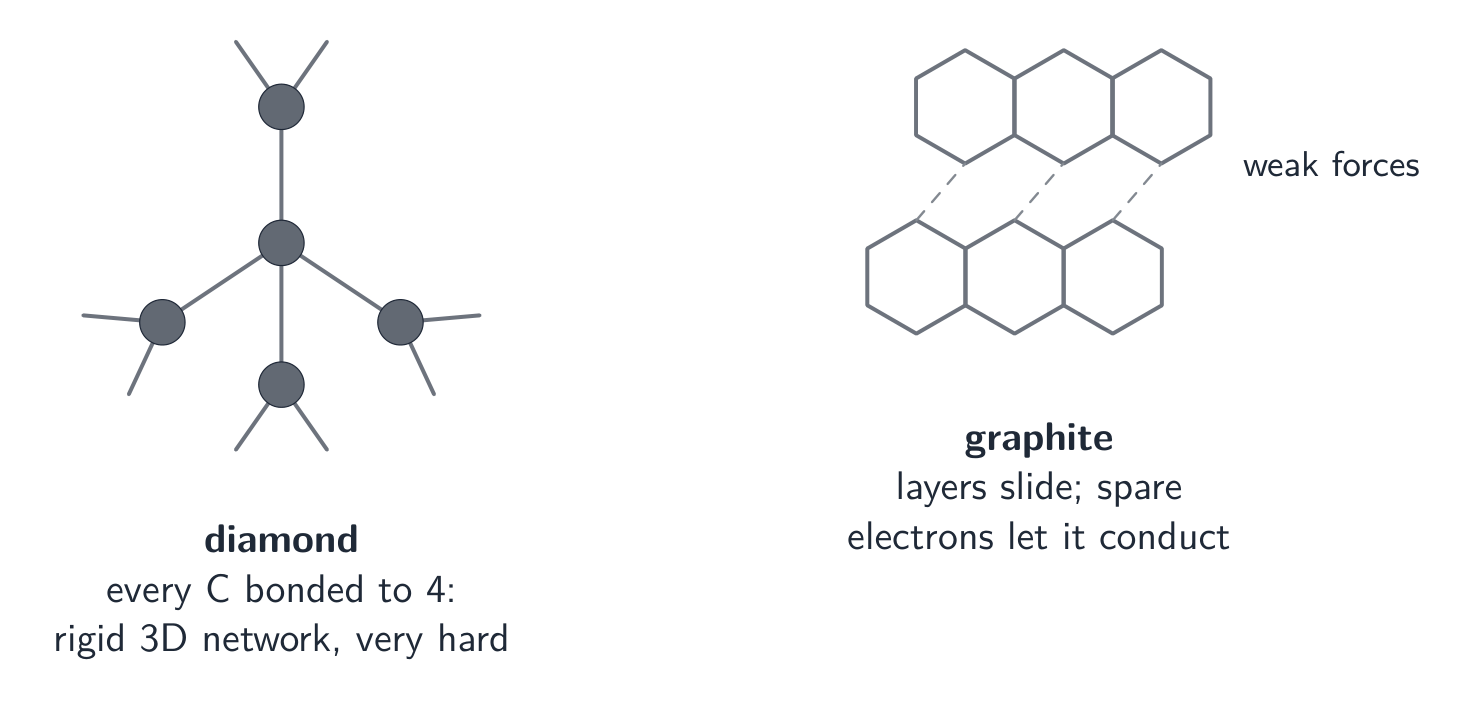
In a covalent network structure 共价网状结构 (giant covalent structure) every atom is joined to its neighbours by covalent bonds in a continuous lattice. There are no separate molecules, so melting means breaking strong covalent bonds. These extended networks generally have high melting or decomposition temperatures and low volatility. They are usually insoluble in ordinary solvents without reaction; a chemical reaction with a solvent is not simple physical dissolution.
Natural graphite: those weak forces between the layers are why the specimen flakes, and why it marks paperQuartz is a giant covalent structure of silicon and oxygen.
Carbon has several allotropes 同素异形体: different structural forms of the same element in the same state.
Allotrope
Bonding of each C
Structure
Key properties
diamond
4 C, tetrahedral
3D network
hardest natural substance; does not conduct
graphite
3 C, trigonal planar
flat hexagonal layers, weak forces between them
soft, slippery; conducts along the layers
graphene
3 C, trigonal planar
a single layer of graphite
very strong and light; conducts very well
fullerene C$_{60}$
3 C
hollow ball of 60 atoms
a molecular solid with weaker inter-cage forces than network bonds; relatively soft; poor conductor
Diamond is a rigid 3D network. In graphite one electron per carbon is free to move along each layer.
In graphite, graphene and $\text{C}_{60}$ each carbon uses three electrons in bonds. The fourth is delocalized 离域的: spread over many atoms rather than held between two. Mobile delocalized electrons explain why graphite and graphene conduct.
Silicon and silicon dioxide
Silicon has the same tetrahedral network as diamond, but the Si–Si bond is longer and weaker, so silicon melts lower ($1414\ ^\circ\text{C}$) and is a semiconductor.
Silicon dioxide 二氧化硅, $\text{SiO}_2$ (quartz, sand), is a network in which each Si bonds to four O atoms and each O bonds to two Si atoms. The ratio 1 : 2 gives the formula. Compare it with $\text{CO}_2$: carbon dioxide is a small molecule and a gas at room temperature, while silicon dioxide melts above $1600\ ^\circ\text{C}$.
Intermolecular forces act between molecules in simple molecular substances. The following types should be recognized. For comparable molar mass, dispersion < dipole–dipole < hydrogen bonding is a useful general trend, not a universal numerical ranking of every pair of molecules:
A London force: a momentary dipole in one molecule induces a dipole in its neighbour, so they attract — this acts between all molecules
London forces 伦敦色散力 (dispersion forces) act between all molecules. Electrons move, so at any instant one side of a molecule may have more electrons than the other: an instantaneous dipole. It induces a dipole in the next molecule, and the two attract. London forces grow with the number of electrons (larger molar mass) and with greater surface contact between molecules.
Dipole–induced dipole forces act between a polar molecule and a non-polar one: the permanent dipole distorts the electrons of its neighbour.
Dipole–dipole forces 取向力 act between polar molecules: the $\delta+$ end of one attracts the $\delta-$ end of the next, in addition to London forces.
Hydrogen bonding 氢键 is often the strongest of these interactions in comparisons of similar-sized molecules. It forms when H is bonded to N, O or F, and interacts attractively with a suitable lone pair on a nearby electronegative atom. Intermolecular examples commonly involve N, O or F; intramolecular hydrogen bonds can also occur when geometry permits.
These three forces together, London, dipole–induced dipole and dipole–dipole, are called van der Waals forces 范德华力.
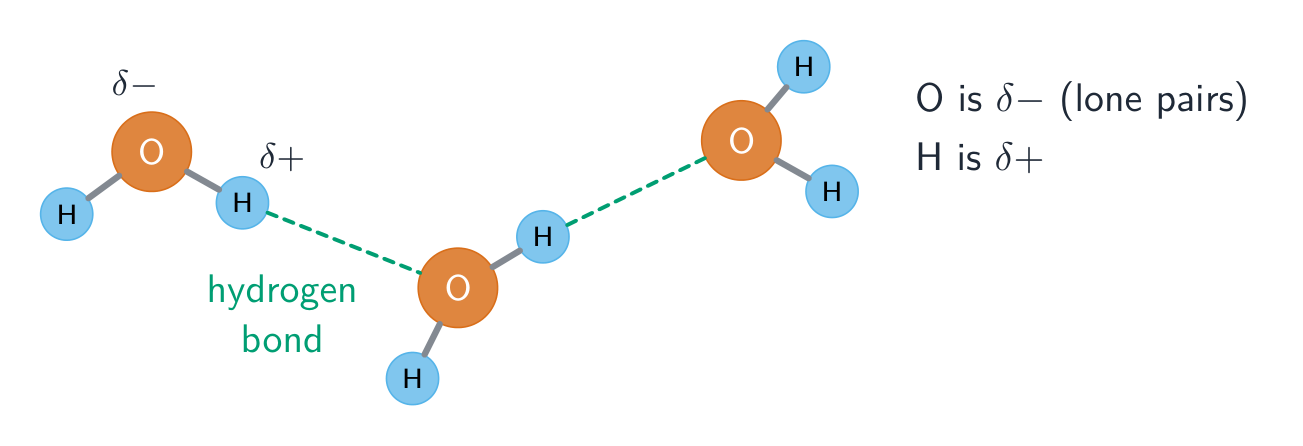
Each water molecule can form up to four hydrogen bonds: two through its H atoms and two through its lone pairs
An N–H, O–H or F–H bond is strongly polarized, giving H a partial positive charge. Its small size permits a close, directional interaction with a suitable acceptor; a hydrogen-bonded H is not a free or bare proton.
Evidence from boiling points
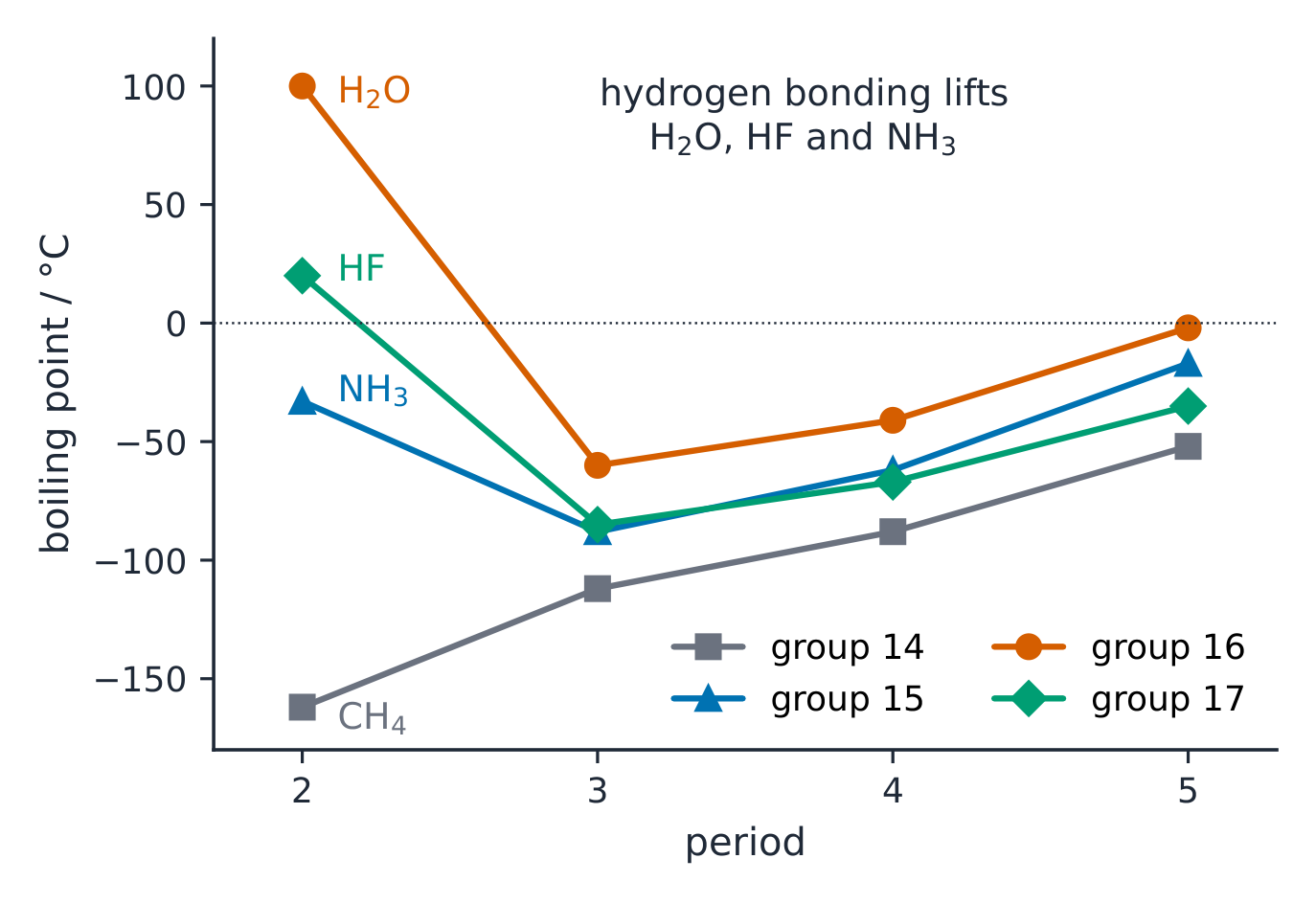
Down each group the hydrides boil higher, because the molecules have more electrons and stronger London forces. Three hydrides break the pattern.
Hydrogen bonding lifts $\text{H}_2\text{O}$, HF and $\text{NH}_3$ far above the trend. $\text{CH}_4$ has no hydrogen bonding and follows it.
At approximately atmospheric pressure water boils at 100°C. Its unusually high value relative to the heavier group-16 hydrides supports an important role for hydrogen bonding; extrapolating a trend does not measure a unique boiling point for a water with that interaction removed.
To explain a physical property, name the structure, the particles, the forces that must be overcome and any mobile charged particles.
Property
Simple molecular
Covalent network
melting and boiling point
low: only weak intermolecular forces are overcome
very high: strong covalent bonds must break
volatility 挥发性
often high
very low
conductivity
usually very low in a pure molecular liquid: few mobile charge carriers; dissolved molecules can react to form ions
varies: diamond/silica have few mobile carriers; graphite/graphene conduct; silicon is a semiconductor
solubility
depends on polarity
insoluble
Comparing boiling points: a method
Check the structure and physical conditions. Extended covalent networks generally require much more energy to disrupt than similar small-molecule solids; some decompose or sublime rather than boil.
For molecular substances, list all interactions and compare the overall pattern; similar mass helps make an interaction-type comparison meaningful.
If the strongest force is the same kind, compare London forces through the number of electrons and the shape.
Similar molar mass, different forces: each extra kind of attraction raises the boiling point. Branching lowers it.
Example: propane, $\text{C}_3\text{H}_8$ ($M = 44$), boils at $-42\ ^\circ\text{C}$; ethanal, $\text{CH}_3\text{CHO}$ ($M = 44$), at $20\ ^\circ\text{C}$; ethanol, $\text{C}_2\text{H}_5\text{OH}$ ($M = 46$), at $78\ ^\circ\text{C}$. Similar masses mean similar London forces. Ethanal adds dipole–dipole forces; ethanol adds hydrogen bonding through its O–H group.
Shape matters too: pentane (a straight chain) boils at $36\ ^\circ\text{C}$ but its branched isomer 2,2-dimethylpropane at $10\ ^\circ\text{C}$, because the compact molecules touch over a smaller surface.
Solubility: like dissolves like
Solubility reflects the overall free-energy change, including attractions disrupted and formed and entropy. “Like dissolves like” is a useful qualitative guide, not a sufficient numerical condition or a universal rule for polar substances.
Some polar and hydrogen-bonding substances dissolve well in water: ethanol and glucose form hydrogen bonds with water molecules.
Non-polar substances such as iodine or hexane dissolve in non-polar solvents but hardly in water: they cannot replace the hydrogen bonds between water molecules.
In a series such as methanol, ethanol, propanol, butanol, solubility in water falls as the non-polar hydrocarbon chain grows longer.
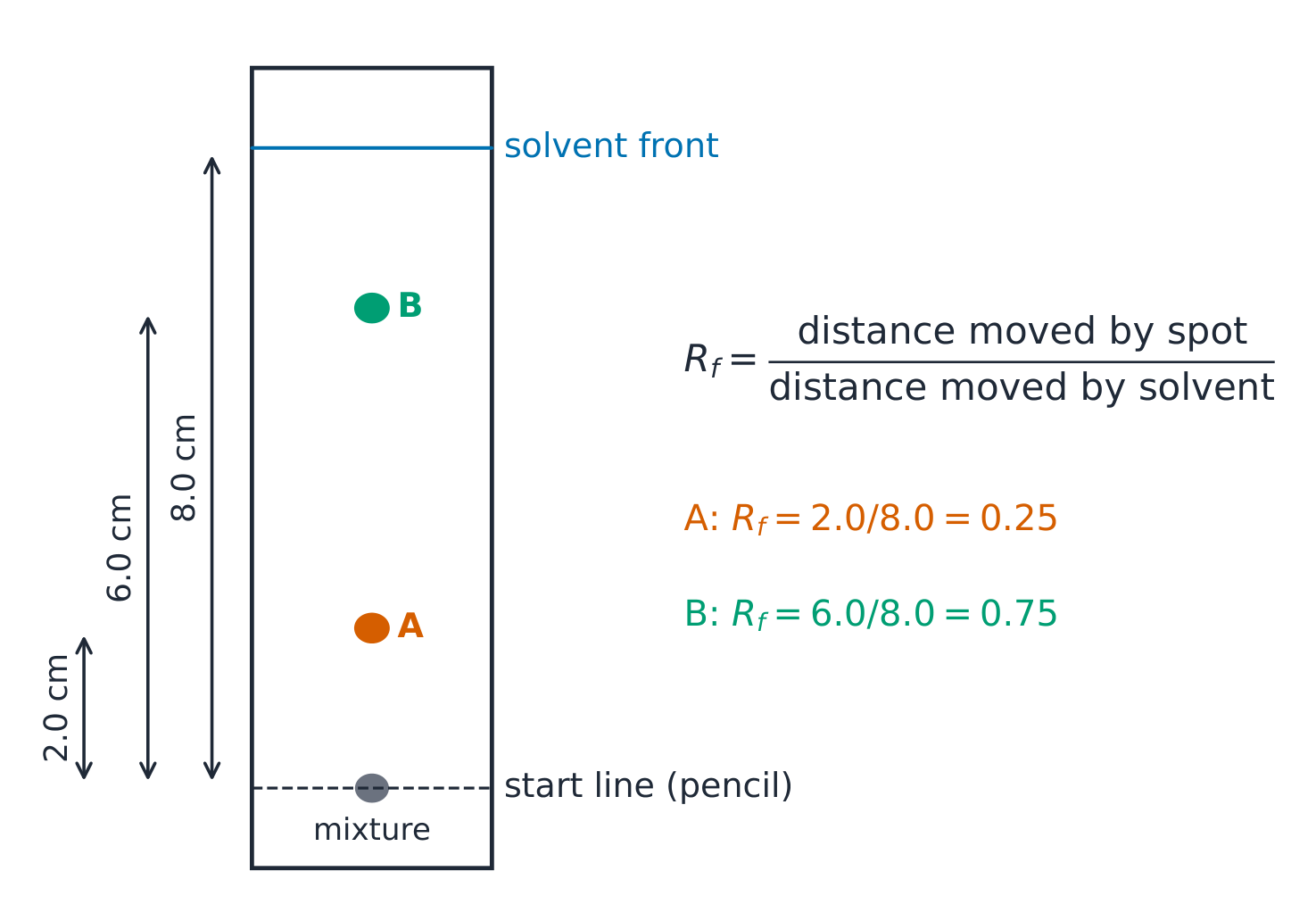
Chromatography 色谱法 separates the components of a mixture by how strongly each one is attracted to two phases:
A real TLC plate under UV light: each glowing spot is a separated component of the mixture
the stationary phase 固定相, which does not move: water held in the fibres of the paper, or a thin layer of silica on a plate in thin-layer chromatography (TLC);
the mobile phase 流动相, the solvent that moves through it.
A component that is more attracted to the mobile phase moves further. A component that is more attracted to the stationary phase stays near the start. Intermolecular attractions, solvent composition and the nature of each phase influence the result: on polar silica with a non-polar solvent, polar components move least.
Chromatogram: measure from the start line to each spot’s centre; the ratios are 2.0/8.0 and 6.0/8.0.
The retardation factor 比移值, $R_f$, is
$$R_f = \frac{\text{distance moved by the component}}{\text{distance moved by the solvent front}}$$
$R_f$ always lies between 0 and 1 and has no units. Under controlled conditions (stationary phase, solvent composition, temperature and sample loading), comparable $R_f$ values support identification against reference samples run alongside. Different substances can share a value, so a match alone is not proof of identity or purity. Draw the start line in pencil, because ink would itself separate, and keep it above the level of the solvent. Colourless spots may be located by an approved method under the laboratory protocol; direct exposure to UV and casual handling of locating reagents are inappropriate. Specific locating agents are not required syllabus knowledge.
Draw the Lewis formula of: (a) $\text{N}_2$, (b) $\text{HCN}$, (c) $\text{NH}_4^{+}$, showing the coordination bond.
State and explain which is shorter and stronger: the C–O bond in methanol or the C=O bond in methanal.
Predict the shape and bond angle of: (a) $\text{PH}_3$, (b) $\text{BCl}_3$, (c) $\text{H}_2\text{S}$, (d) $\text{CS}_2$.
Explain why $\text{CCl}_4$ is non-polar but $\text{CHCl}_3$ is polar.
Explain why diamond is hard and does not conduct electricity, but graphite is soft and conducts.
Put these in order of increasing boiling point and explain: $\text{CH}_3\text{OCH}_3$, $\text{C}_2\text{H}_5\text{OH}$, $\text{C}_3\text{H}_8$ (all have $M \approx 44$–$46$).
Explain why ethanol mixes with water but hexane does not.
In a chromatogram the solvent front is 9.0 cm from the start line. Spot X has moved 3.6 cm. Calculate its $R_f$.
A student predicts every AX₃E molecule has angle 107°. Explain why this goes beyond VSEPR and how a multiple bond can affect neighbouring angles.
An TLC sample and reference both have $R_f=0.40$ on one plate. Does this prove identity or purity? State two conditions to control.
Compare water, ammonia and methoxymethane as hydrogen-bond donors and acceptors. Can methoxymethane interact with water by hydrogen bonding?
Worked answers.
(a) $\text{N}\equiv\text{N}$ with one lone pair on each N. (b) $\text{H}-\text{C}\equiv\text{N}$ with one lone pair on N. (c) N in the centre with four N–H bonds; one is drawn as an arrow from N to H; overall charge $+1$, shown with square brackets.
The C=O bond in methanal: two shared pairs pull the nuclei closer together and attract them more strongly than one.
(a) trigonal pyramidal, less than $109.5^\circ$ (four domains, one lone pair). VSEPR predicts the pyramidal arrangement, not a universal 107°: the measured H–P–H angle in PH₃ is about 93.3°. (b) trigonal planar, $120^\circ$. (c) bent, less than $109.5^\circ$ (two lone pairs). (d) linear, $180^\circ$.
Both are tetrahedral. In $\text{CCl}_4$ the four equal C–Cl dipoles cancel by symmetry. In $\text{CHCl}_3$ the C–H bond has a much smaller dipole, so the dipoles do not cancel and there is a net dipole moment.
In diamond every C forms four strong covalent bonds in a rigid 3D network, and all outer electrons are in bonds, so there are no mobile charged particles. In graphite each C bonds to three others in layers held by weak London forces, so layers slide; the fourth electron of each C is delocalized and moves along the layers.
$\text{C}_3\text{H}_8$ ($-42\ ^\circ\text{C}$) < $\text{CH}_3\text{OCH}_3$ ($-24\ ^\circ\text{C}$) < $\text{C}_2\text{H}_5\text{OH}$ ($78\ ^\circ\text{C}$). Similar masses give similar London forces. Methoxymethane is polar and adds dipole–dipole forces. Ethanol has an O–H group and forms hydrogen bonds, the strongest intermolecular force.
Ethanol forms hydrogen bonds with water molecules through its O–H group, so the new attractions replace the ones broken. Hexane is non-polar: water–hexane interactions include dispersion and dipole-induced dipole attraction, but mixing is not sufficiently favourable to overcome the overall free-energy cost under ordinary conditions.
$R_f = 3.6 / 9.0 = 0.40$.
VSEPR supports a trigonal-pyramidal shape for the four-domain AX₃E model, but not a fixed measured angle. NH₃ and PH₃ need not share an angle. A multiple-bond domain typically occupies more angular space than a single-bond domain and can compress neighbouring single-bond angles.
No. Distinct compounds can have the same ratio; unresolved components can overlap in one spot. Run authentic references alongside and seek a second solvent system or another analytical method. Control stationary phase, solvent composition and temperature; avoid overloaded spots. A ratio is condition-dependent and dimensionless.
Water has O–H donor groups and oxygen lone-pair acceptors; ammonia has N–H donors and a nitrogen lone-pair acceptor. Methoxymethane has an oxygen acceptor but lacks an N–H/O–H/F–H donor, so it does not self-hydrogen-bond in the usual course model. It can accept a hydrogen bond from water’s O–H group.
7.10
Exam tips
Define a covalent bond as the attraction between a shared pair of electrons and the nuclei of the bonded atoms.
In VSEPR count domains, not bonds: a double bond is one domain. Then name the shape from the atoms only.
Where lone pairs are present, explain how their greater repulsion affects bond angles; do not infer a lone pair from an angle alone.
For molecular polarity, combine the actual bond dipoles with the geometry and state whether their vector sum cancels.
Melting a simple molecular substance overcomes intermolecular forces; never write that it breaks covalent bonds.
Hydrogen bonding needs H bonded directly to N, O or F; pure $\text{CH}_3\text{F}$ has no N–H, O–H or F–H donor for the usual self-hydrogen-bonding comparison.
For $R_f$, measure to the centre of the spot and from the start line, not from the bottom of the paper.