Formal patterns for reports and official writing. to borrow借……之名 and by means of以……(modifier / structural particle)的name名义 both mean "in the name of", but to borrow借……之名 suggests a false excuse; to pass; through; by means of通过……to make使…… shows how a result was achieved; to be bound to势必 says a result is bound to follow; supposing倘若 is a literary "if"; and (nominalizer)所 + verb + (modifier / structural particle)的 turns a verb into "that which …".
Sentence patterns — formal & written
HSK 6 · Topic 12
 5:13
HSK 6 Grammar 12: Formal patterns
You are writing a project report and a polite email to the people who funded the work. In speech, 如果, 所以 and 为了 are enough. Formal writing prefers tighter…
English explanations + Mandarin examples · captions follow the spoken text
12.1
At a glance
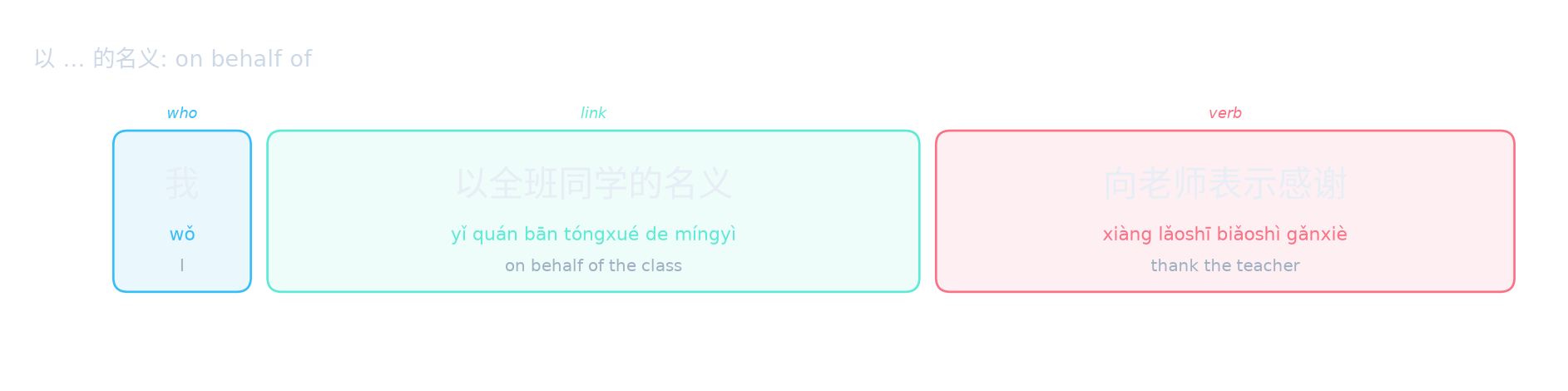
- 1. by means of以 … (modifier / structural particle)的name名义 – in the name of: 我以全班同学(modifier / structural particle)的name名义,towards向teacher老师表示感谢。
- 2. to borrow借 … 之名 – under the guise of: someone有人to borrow借charity慈善之名骗钱。
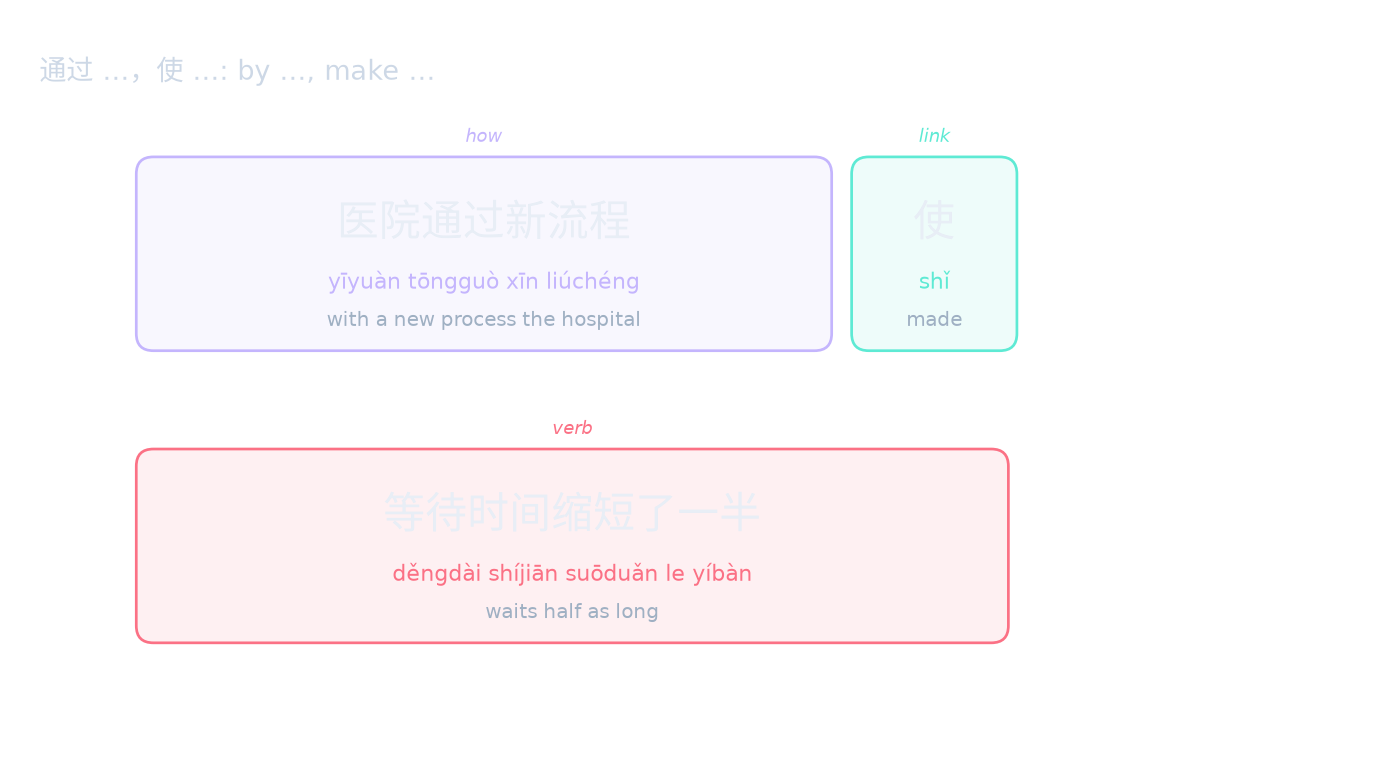
- 3. to pass; through; by means of通过 … to make使 … – by …, bring about …: hospital医院to pass; through; by means of通过new新process流程,to make使patient患者(modifier / structural particle)的等待时间to shorten缩短(completed / change)了half一半。
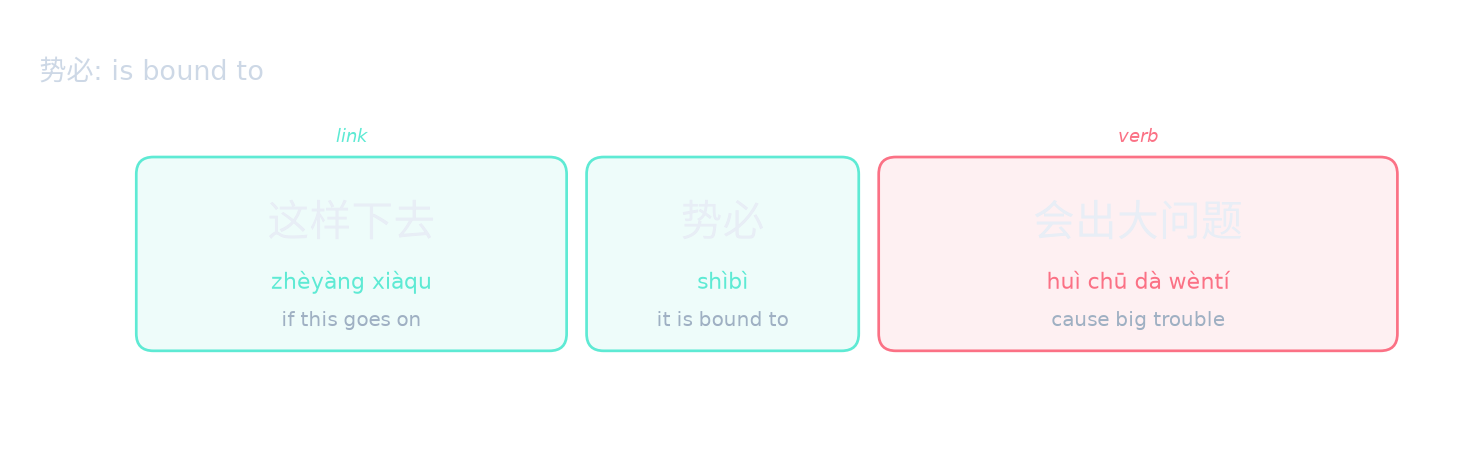
- 4. to be bound to势必 – be bound to / inevitably: this way / so这样go down / (keep on)下去,势必会出大question / problem问题。
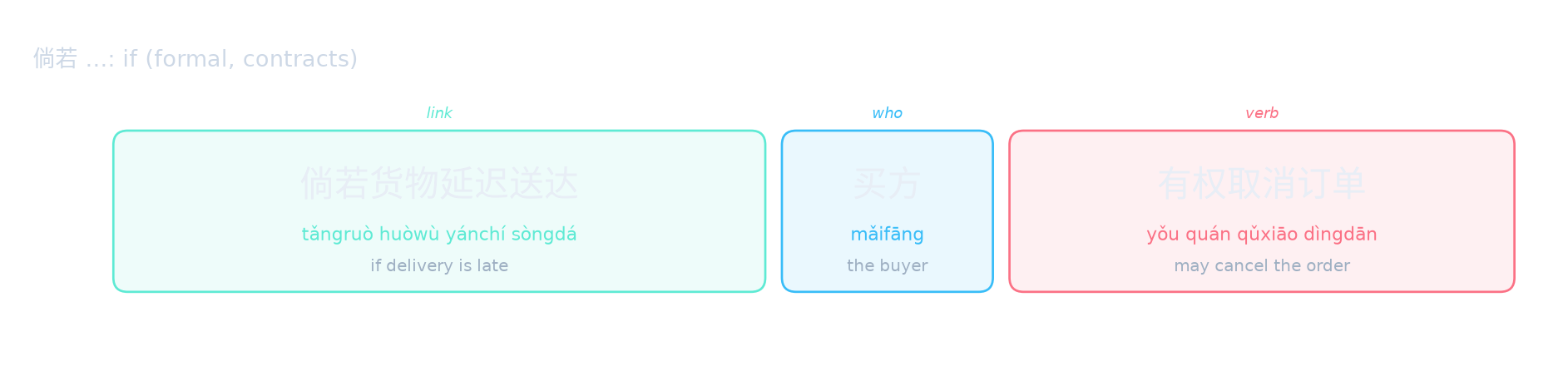
- 5. supposing倘若 – if / should – literary: supposing倘若goods货物to delay延迟to deliver送达,buyer (in contracts)买方to have the right to有权to cancel取消(purchase) order订单。
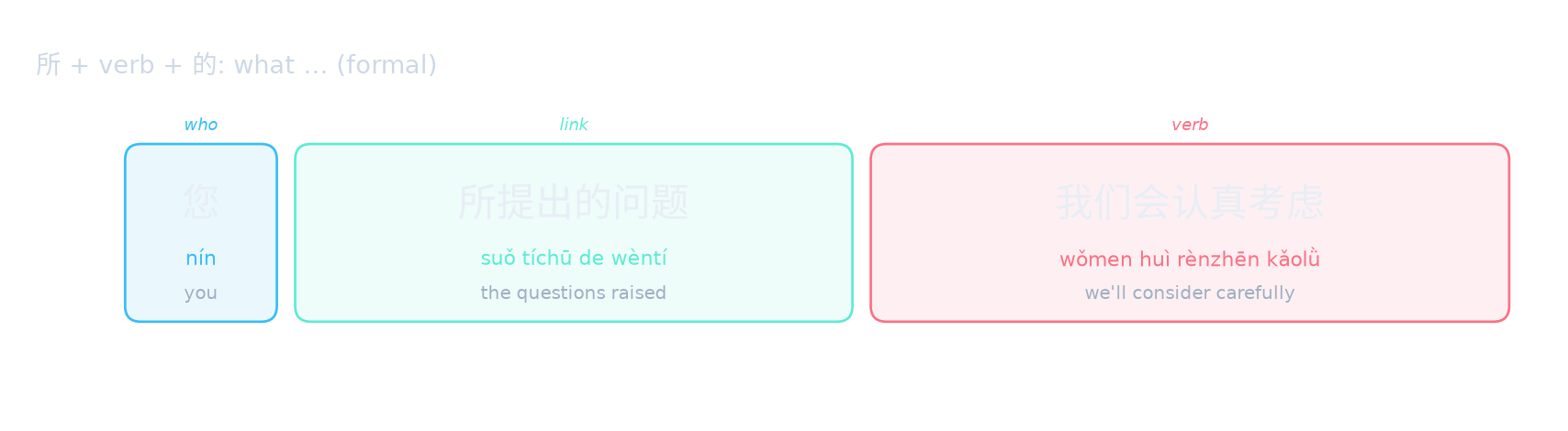
- 6. (nominalizer)所 + Verb + (modifier / structural particle)的 – that which is V-ed: you (polite)您(nominalizer)所to raise (an issue)提出(modifier / structural particle)的question / problem问题,we / us我们can / will会conscientious认真to think over考虑。
12.2
1. 以 … 的名义 (in the name of)
Form: by means of以 + person / organisation + (modifier / structural particle)的name名义 + action
- 我以全班同学(modifier / structural particle)的name名义,towards向teacher老师表示感谢。 Wǒ yǐ quán bān tóngxué de míngyì … – On behalf of the whole class, I'd like to thank our teacher.
- this这封信to be / is是by means of以school学校(modifier / structural particle)的name名义to issue (an order, decree…发出(modifier / structural particle)的。 – This letter was sent in the school's name.
- 我以friend朋友(modifier / structural particle)的name名义to advise; to urge劝you你,don't别so much这么to do; to make做。 – As your friend, I'm telling you: don't do it.
How it works. by means of以……(modifier / structural particle)的name名义 yǐ … de míngyì "in the name of" says whose name or authority an action carries. It is neutral and official, and goes before the verb phrase. The shorter by means of以company公司name名义 also occurs in documents.
| to represent; representative代表the whole class全班 | by means of以the whole class全班(modifier / structural particle)的name名义 | to borrow借……之名 |
|---|---|---|
| represent the class | in the class's name | as a cover (critical) |
12.3
2. 借 … 之名 (under the guise of)
Form: (subject) + to borrow借 + cover reason + 之名 + real (bad) purpose
- someone有人to borrow借charity慈善之名骗钱。 Yǒu rén jiè císhàn zhī míng piàn qián. – Some people swindle money under the guise of charity.
- some一些merchant商家to borrow借eco-friendly / environmental protection环保之名to raise / improve提高price价格。 – Some businesses raise prices in the name of being green.
How it works. to borrow借……之名 jiè … zhī míng "borrowing the name of …" says the stated reason is only a cover, and the real purpose follows. It is formal and critical, common in news and commentary.
| by means of以company公司(modifier / structural particle)的name名义 | to borrow借company公司之名 |
|---|---|
| on behalf of the company (neutral, official) | using the company as a cover (critical) |
Watch out
- It accuses someone of a hidden motive: use it only when you mean to criticise.

12.4
3. 通过 … 使 … (by …, bring about …)
Form: subject + to pass; through; by means of通过 + means + to make使 + someone / something + result · to pass; through; by means of通过 + means,subject + result
- hospital医院to pass; through; by means of通过new新process流程,to make使patient患者(modifier / structural particle)的等待时间to shorten缩短(completed / change)了half一半。 Yīyuàn tōngguò xīn liúchéng, shǐ … – The hospital halved patients' waiting time with a new procedure.
- company公司通过培训to make使staff员工to raise / improve提高(completed / change)了ability能力。 – The company improved its staff's skills through training.
- 通过培训,staff员工(modifier / structural particle)的ability能力to raise / improve提高(completed / change)了。 – Through training, the staff's skills improved.
How it works. to pass; through; by means of通过 gives the means and to make使 the result, and the sentence needs a subject who does it (hospital医院, company公司).
The classic defective sentence病句. wrong: to pass; through; by means of通过这次activity; to exercise活动,to make使student学生more更confident自信(completed / change)了 has no subject, because to pass; through; by means of通过 and to make使 both swallow it. There are two repairs:
| Add a subject | Drop to make使 |
|---|---|
| school学校to pass; through; by means of通过这次activity; to exercise活动,to make使student学生more更confident自信(completed / change)了 | to pass; through; by means of通过这次activity; to exercise活动,student学生more更confident自信(completed / change)了 |
Watch out
- The same trap catches to pass / process经过 / due to由于……to make使……: wrong: to pass / process经过everyone大家(modifier / structural particle)的to work hard / effort努力,to make使question / problem问题to get得到(completed / change)了to solve解决 → to pass / process经过everyone大家(modifier / structural particle)的to work hard / effort努力,question / problem问题to get得到(completed / change)了to solve解决.
Vocabulary
Train
| 汉字 | Pinyin | English |
|---|---|---|
| 患者 | huàn zhě | patient |
12.5
4. 势必 (be bound to / inevitably)
Form: (cause / situation,) + to be bound to势必 + (can / will会) + result
- this way / so这样go down / (keep on)下去,势必会出大question / problem问题。 Zhèyàng xiàqù, shìbì huì chū dà wèntí. – If this goes on, serious trouble is bound to follow.
- long term长期to stay up late or all night熬夜to be bound to势必harm损害health健康。 – Staying up late for long periods is bound to damage your health.
- 价格上涨to be bound to势必influence影响sales volume销量。 – Rising prices will inevitably affect sales.
How it works. to be bound to势必 shìbì predicts a result that follows from the momentum of the situation: the way things are going, it will happen. It is formal and analytical, and usually follows a stated cause. Speech uses definitely; to be sure肯定can / will会 / definitely / certain一定can / will会.
| maybe / possible可能 / I'm afraid (that); probably恐怕 | to be bound to势必 | inevitable必然 |
|---|---|---|
| maybe (a guess) | bound to (reasoned forecast) | necessarily; also an adjective: inevitable必然(modifier / structural particle)的result; as a result结果 |
Vocabulary
Train
| 汉字 | Pinyin | English |
|---|---|---|
| 势必 | shì bì | to be bound to |
12.6
5. 倘若 (if / should – literary)
Form: supposing倘若 + condition,(subject) + then / just就 / convenient / then便 / then / whereas则 + result
- supposing倘若goods货物to delay延迟to deliver送达,buyer (in contracts)买方to have the right to有权to cancel取消(purchase) order订单。 Tǎngruò huòwù yánchí sòngdá … – Should the goods arrive late, the buyer may cancel the order.
- supposing倘若at that time当时I / me我to listen to听(completed / change)了you你if (coming after a…的话,then / just就won't / can't不会this way / so这样(completed / change)了。 – If I'd listened to you then, it wouldn't have come to this.
How it works. supposing倘若 tǎngruò "if, should" is a literary if如果, used in contracts, essays and literature, and for regrets about the past.
| Word | Use |
|---|---|
| if要是 / if如果 | everyday "if" |
| supposing假如 / if假使 / supposing倘若 | literary "if, supposing" |
| in case; if by any chance万一 | in case (unlikely and unwelcome) |
Watch out
- then / just就 / convenient / then便 go after the result's subject: wrong: then / just就I / me我won't / can't不会 → I / me我then / just就won't / can't不会.
- In conversation, supposing倘若 sounds bookish.
Vocabulary
Train
| 汉字 | Pinyin | English |
|---|---|---|
| 倘若 | tǎng ruò | supposing |
| 假使 | jiǎ shǐ | if |
12.7
6. 所 + Verb + 的 (that which is V-ed)
Form: (subject) + (nominalizer)所 + transitive verb + (modifier / structural particle)的 (+ noun)
- you (polite)您(nominalizer)所to raise (an issue)提出(modifier / structural particle)的question / problem问题,we / us我们can / will会conscientious认真to think over考虑。 Nín suǒ tíchū de wèntí … – We will carefully consider the issues you have raised.
- we / us我们(nominalizer)所to do; to make做(modifier / structural particle)的一切都是in order to为了child孩子。 – Everything we do is for the children.
- just as正如everyone大家(nominalizer)所to see看到(modifier / structural particle)的,situation情况already已经to improve好转。 – As you can all see, things have improved.
How it works. (nominalizer)所 suǒ before a verb marks what the verb acts on: he / him他所说if (coming after a…的话 "the words he said". It adds a formal, precise tone; the meaning is the same without it (he / him他to speak说if (coming after a…的话). Set phrases keep it: as everyone knows众所周知 "as everyone knows".
Watch out
- (nominalizer)所 goes right before the verb, after the subject: wrong: (nominalizer)所he / him他to speak说(modifier / structural particle)的 → he / him他所说(modifier / structural particle)的.
- It needs a verb that takes an object (所说, (nominalizer)所to do; to make做, (nominalizer)所to see看到); verbs without an object don't work (wrong: 所去, wrong: 所来).
Vocabulary
Train
| 汉字 | Pinyin | English |
|---|---|---|
| 众所周知 | zhòng suǒ zhōu zhī | as everyone knows |
12.8
Practice
Cover the teaching pages before you answer. The answers are at the end.
1. by means of以 … (modifier / structural particle)的name名义 (in the name of)
1. Complete: “He donated in his own name.” he / him他by means of以individual / personal个人(modifier / structural particle)的…………to donate捐(completed / change)了money钱。
2. Which suggests the name is used as a cover?
- A. by means of以individual / personal个人(modifier / structural particle)的name名义to donate money捐款。
- B. by means of以company公司(modifier / structural particle)的name名义to post a letter发信。
- C. to represent; representative代表company公司to make a speech发言。
- D. to borrow借company公司之名谋私利。
3. Build: “On behalf of the whole class, I thank the teacher.”
Put in order: , / towards向teacher老师 / 我以全班同学(modifier / structural particle)的name名义 / 表示感谢。
4. True or false? to represent; representative代表 can also mean “on behalf of”. If false, correct it.
5. Your class wants to thank the teacher who is retiring, and you write the card. Use by means of以 … (modifier / structural particle)的name名义. Write your answer in Chinese, then say it aloud.
2. to borrow借 … 之名 (under the guise of)
6. Complete: “under the guise of charity” to borrow借charity慈善(of — literary)之…………
7. Which is neutral, without criticism?
- A. he / him他to borrow借to go on a business trip出差之名to go去to travel; tourism旅游。
- B. he / him他by means of以company公司(modifier / structural particle)的name名义to make a speech发言。
- C. he / him他to borrow借eco-friendly / environmental protection环保之名to appreciate (in value)涨价。
- D. he / him他to borrow借company公司之名谋私利。
8. Build: “Some businesses raise prices under the banner of environmental protection.”
Put in order: some一些merchant商家 / to raise / improve提高 / to borrow借eco-friendly / environmental protection环保之名 / price价格。
9. True or false? to borrow借…之名 implies the stated reason is a cover. If false, correct it.
10. A news report warns about fake charity callers. Use to borrow借 … 之名. Write your answer in Chinese, then say it aloud.
3. to pass; through; by means of通过 … to make使 … (by …, bring about …)
11. Which sentence is grammatically correct?
- A. to make使to pass; through; by means of通过这次lecture讲座,everyone大家to understand了解(completed / change)了eco-friendly / environmental protection环保。
- B. to pass; through; by means of通过这次lecture讲座,to make使to understand了解(completed / change)了everyone大家eco-friendly / environmental protection环保(modifier / structural particle)的importance重要性。
- C. 这次lecture讲座to make使everyone大家to understand了解(completed / change)了eco-friendly / environmental protection环保(modifier / structural particle)的importance重要性。
- D. to pass; through; by means of通过这次lecture讲座,to make使everyone大家to understand了解(completed / change)了eco-friendly / environmental protection环保(modifier / structural particle)的importance重要性。
12. Repair the error: to pass; through; by means of通过new新process流程,to make使等待时间to shorten缩短(completed / change)了。
- A. to pass; through; by means of通过new新process流程,to make使等待时间to shorten缩短(completed / change)了(yes/no ?)吗?
- B. hospital医院to pass; through; by means of通过new新process流程,to make使等待时间to shorten缩短(completed / change)了。
- C. new新process流程to pass; through; by means of通过,to make使等待时间to shorten缩短(completed / change)了。
- D. to pass; through; by means of通过new新process流程,to make使hospital医院等待时间to shorten缩短(completed / change)了。
13. Build the correct sentence: “Through training, the staff's skills improved.”
Put in order: to raise / improve提高(completed / change)了。 / , / staff员工(modifier / structural particle)的ability能力 / 通过培训
14. True or false? to pass / process经过everyone大家(modifier / structural particle)的to work hard / effort努力,to make使question / problem问题to get得到(completed / change)了to solve解决 is correct. If false, correct it.
15. Which sentence has the missing-subject error?
- A. at / in在everyone大家(modifier / structural particle)的to support支持down / next; to fall (rain), get off下,to make使this这个project; item项目顺利完成(completed / change)了。
- B. everyone大家(modifier / structural particle)的to support支持to make使this这个project; item项目顺利完成(completed / change)了。
- C. at / in在everyone大家(modifier / structural particle)的to support支持down / next; to fall (rain), get off下,this这个project; item项目顺利完成(completed / change)了。
16. Repair: due to由于weather天气(modifier / structural particle)的reason; cause原因,to make使flight航班to postpone推迟(completed / change)了。
- A. due to由于weather天气(modifier / structural particle)的reason; cause原因,flight航班to postpone推迟(completed / change)了。
- B. due to由于weather天气(modifier / structural particle)的reason; cause原因,usable使得flight航班to postpone推迟(completed / change)了。
17. True or false? 这次competition比赛to make使he / him他more更加to love (deeply)热爱basketball篮球(completed / change)了。 is correct. If false, correct it.
18. A hospital report describes how a new booking system changed patients' waiting time. Use to pass; through; by means of通过 … to make使 …. Write your answer in Chinese, then say it aloud.
4. to be bound to势必 (be bound to / inevitably)
19. Complete: “This is bound to affect sales.” this这…………influence影响sales volume销量。
20. Which sounds most natural in casual speech?
- A. this way / so这样to be bound to势必地出question / problem问题。
- B. this way / so这样definitely; to be sure肯定会出question / problem问题。
- C. this way / so这样势必会out / to happen出question / problem问题。
- D. this way / so这样inevitable必然会出question / problem问题。
21. Build: “Staying up late long-term is bound to harm your health.”
Put in order: to be bound to势必 / long term长期to stay up late or all night熬夜 / health健康。 / harm损害
22. True or false? to be bound to势必 expresses a weak guess. If false, correct it.
23. An economist comments on a factory that keeps cutting corners on safety. Use to be bound to势必. Write your answer in Chinese, then say it aloud.
5. supposing倘若 (if / should – literary)
24. Complete (contract): “Should the goods arrive late, the buyer may cancel.” …………goods货物to delay延迟to deliver送达,buyer (in contracts)买方can / may可以to cancel取消(purchase) order订单。
25. “What if it rains?” (an unlikely, unwelcome event). Which fits? ____to rain下雨what's to be done怎么办?
- A. because因为
- B. in case; if by any chance万一
- C. since既然
- D. supposing倘若
26. Build: “Had I listened to you, it wouldn't have come to this.”
Put in order: then / just就won't / can't不会 / , / supposing倘若at that time当时I / me我to listen to听(completed / change)了you你if (coming after a…的话 / this way / so这样(completed / change)了。
27. True or false? supposing倘若 sounds natural in casual conversation. If false, correct it.
28. A contract sets out what happens if a delivery is late. Use supposing倘若. Write your answer in Chinese, then say it aloud.
6. (nominalizer)所 + Verb + (modifier / structural particle)的 (that which is V-ed)
29. Complete (formal): “the words he said” he / him他…………to speak说if (coming after a…的话
30. Which order is correct?
- A. (nominalizer)所I / me我to know知道(modifier / structural particle)的
- B. I / me我to know知道(nominalizer)所(modifier / structural particle)的
- C. I / me我(nominalizer)所to know知道(modifier / structural particle)的
- D. I / me我(modifier / structural particle)的(nominalizer)所to know知道
31. Build: “Everything we do is for the children.”
Put in order: we / us我们(nominalizer)所to do; to make做(modifier / structural particle)的 / all / both都to be / is是in order to为了 / child孩子。 / everything一切
32. True or false? as everyone knows众所周知 means “as everyone knows”. If false, correct it.
33. In a formal letter you respond to a complaint point by point. Use (nominalizer)所 + Verb + (modifier / structural particle)的. Write your answer in Chinese, then say it aloud.
12.9
Mixed practice
These questions mix the patterns and use new situations.
34. Choose by means of以……(modifier / structural particle)的name名义 or to borrow借……之名: he / him他…………class (group of students)班级…………to / for / give给teacher老师to give (as a gift); to see off送(completed / change)了flower花。 / someone有人…………charity慈善…………骗钱。
35. Which sentence is correct?
- A. 通过培训,to make使staff员工to raise / improve提高(completed / change)了ability能力。
- B. 通过培训,staff员工to raise / improve提高(completed / change)了ability能力。
- C. training培训to pass; through; by means of通过,to make使staff员工ability能力to raise / improve提高。
36. Rewrite with (nominalizer)所……(modifier / structural particle)的: we / us我们to learn学(modifier / structural particle)的knowledge知识degree / adjective linker很useful有用。
37. Find and fix the problem. An editor sees 通过培训,to make使staff员工to raise / improve提高(completed / change)了ability能力. Correct it in two ways.
38. Use it yourself. Say he gave flowers to the teacher on behalf of the class, then say some people cheat under the cover of charity.
12.10
Answers and explanations
Mark your work, then correct each mistake in your own words.
1. by means of以 … (modifier / structural particle)的name名义 (in the name of)
1. name名义
by means of以 X (modifier / structural particle)的name名义.
2. D. to borrow借company公司之名谋私利。
to borrow借company公司之名谋私利 uses the company's name as a cover for personal gain, so it is critical. by means of以…(modifier / structural particle)的name名义 and to represent; representative代表 are neutral ways to say whom you speak or act for.
3. 我以全班同学(modifier / structural particle)的name名义,towards向teacher老师表示感谢。
by means of以 X (modifier / structural particle)的name名义 + verb phrase.
4. True.
True. to represent; representative代表 can mean “on behalf of”: I / me我to represent; representative代表the whole class全班to thank感谢teacher老师 “On behalf of the class, I thank the teacher.”
5. Model answer: 我以全班同学(modifier / structural particle)的name名义,towards向teacher老师表示感谢。
Check your answer:
- by means of以…(modifier / structural particle)的name名义 is neutral or official; for using a name as a cover, use to borrow借…之名.
- Both by means of以company公司(modifier / structural particle)的name名义 and the shorter by means of以company公司name名义 occur. Learn the full phrase first; the shorter form is also used in formal documents.
2. to borrow借 … 之名 (under the guise of)
6. name名
to borrow借 X 之名.
7. B. he / him他by means of以company公司(modifier / structural particle)的name名义to make a speech发言。
by means of以…(modifier / structural particle)的name名义 (“in the name of”) is neutral: he / him他by means of以company公司(modifier / structural particle)的name名义to make a speech发言 simply says whom he represents. to borrow借…之名 suggests the name is used as a cover for something else.
8. some一些merchant商家to borrow借eco-friendly / environmental protection环保之名to raise / improve提高price价格。
Subject + to borrow借 X 之名 + real purpose.
9. True.
True. to borrow借…之名 is critical: the stated reason is a pretext, as in to borrow借to go on a business trip出差之名to go去to travel; tourism旅游 “travel on the pretext of a business trip”.
10. Model answer: someone有人to borrow借charity慈善之名骗钱。
Check your answer:
- to borrow借…之名 implies the stated reason is a cover; use it only when you mean to criticise.
- For a neutral "in the name of / on behalf of", use by means of以…(modifier / structural particle)的name名义.
3. to pass; through; by means of通过 … to make使 … (by …, bring about …)
11. C. 这次lecture讲座to make使everyone大家to understand了解(completed / change)了eco-friendly / environmental protection环保(modifier / structural particle)的importance重要性。
The first has no subject. The second has one: 这次lecture讲座 is the subject of to make使.
12. B. hospital医院to pass; through; by means of通过new新process流程,to make使等待时间to shorten缩短(completed / change)了。
Add the doer (hospital医院) before to pass; through; by means of通过.
13. 通过培训,staff员工(modifier / structural particle)的ability能力to raise / improve提高(completed / change)了。
to pass; through; by means of通过…,subject + result (no to make使).
14. False.
It lacks a subject; drop to make使 or add a doer.
15. A. at / in在everyone大家(modifier / structural particle)的to support支持down / next; to fall (rain), get off下,to make使this这个project; item项目顺利完成(completed / change)了。
at / in在……down / next; to fall (rain), get off下 is only a frame, so to make使 has no subject. Drop to make使, or make everyone大家(modifier / structural particle)的to support支持 the subject.
16. A. due to由于weather天气(modifier / structural particle)的reason; cause原因,flight航班to postpone推迟(completed / change)了。
due to由于 gives a reason, not a doer; drop to make使 so flight航班 is the subject. usable使得 has the same problem.
17. True.
这次competition比赛 is the subject of to make使 – no to pass; through; by means of通过 frame, no error.
18. Model answer: hospital医院to pass; through; by means of通过new新process流程,to make使patient患者(modifier / structural particle)的等待时间to shorten缩短(completed / change)了half一半。
Check your answer:
- Subject + to pass; through; by means of通过…to make使…: company公司通过培训to make使staff员工to raise / improve提高(completed / change)了ability能力。 – "Through training, the company improved its staff's skills."
- to pass; through; by means of通过…,subject + result: 通过培训,staff员工(modifier / structural particle)的ability能力to raise / improve提高(completed / change)了。 – "Through training, the staff's skills improved."
4. to be bound to势必 (be bound to / inevitably)
19. to be bound to势必
to be bound to势必 + verb.
20. B. this way / so这样definitely; to be sure肯定会出question / problem问题。
definitely; to be sure肯定can / will会 is the spoken choice.
21. long term长期to stay up late or all night熬夜to be bound to势必harm损害health健康。
Cause + to be bound to势必 + verb.
22. False.
It is a strong, reasoned prediction.
23. Model answer: this way / so这样go down / (keep on)下去,势必会出大question / problem问题。
Check your answer:
- to be bound to势必 means the result is practically certain because of the situation; for a guess, use maybe / possible可能 / I'm afraid (that); probably恐怕.
- It is written style; in speech, definitely; to be sure肯定can / will会 / definitely / certain一定can / will会 are more natural.
5. supposing倘若 (if / should – literary)
24. supposing倘若
supposing倘若 = if (literary).
25. B. in case; if by any chance万一
in case; if by any chance万一 = in case of something unlikely and unwelcome.
26. supposing倘若at that time当时I / me我to listen to听(completed / change)了you你if (coming after a…的话,then / just就won't / can't不会this way / so这样(completed / change)了。
supposing倘若 + condition, then / just就 + result.
27. False.
It is literary; speech uses if如果 / if要是.
28. Model answer: supposing倘若goods货物to delay延迟to deliver送达,buyer (in contracts)买方to have the right to有权to cancel取消(purchase) order订单。
Check your answer:
- In conversation, if如果 / if要是 are natural; supposing倘若 sounds bookish.
- Keep then / just就 / convenient / then便 after the subject of the result: I / me我then / just就…, not then / just就I / me我….
6. (nominalizer)所 + Verb + (modifier / structural particle)的 (that which is V-ed)
29. (nominalizer)所
Subject + (nominalizer)所 + verb + (modifier / structural particle)的.
30. C. I / me我(nominalizer)所to know知道(modifier / structural particle)的
(nominalizer)所 stands before the verb in the pattern subject + (nominalizer)所 + verb + (modifier / structural particle)的: I / me我(nominalizer)所to know知道(modifier / structural particle)的 “what I know”. It never comes before the subject or after the verb.
31. we / us我们(nominalizer)所to do; to make做(modifier / structural particle)的一切都是in order to为了child孩子。
(nominalizer)所 + verb + (modifier / structural particle)的 + noun.
32. True.
True. as everyone knows众所周知 is a set phrase with (nominalizer)所 meaning “as is well known to all”.
33. Model answer: you (polite)您(nominalizer)所to raise (an issue)提出(modifier / structural particle)的question / problem问题,we / us我们can / will会conscientious认真to think over考虑。
Check your answer:
- Order: subject + (nominalizer)所 + verb + (modifier / structural particle)的: he / him他所说(modifier / structural particle)的, not (nominalizer)所he / him他to speak说(modifier / structural particle)的.
- It needs a transitive verb (one with an object): 所说, (nominalizer)所to do; to make做, (nominalizer)所to see看到; not 所去 / 所来.
Mixed practice
34. he / him他by means of以class (group of students)班级(modifier / structural particle)的name名义to / for / give给teacher老师to give (as a gift); to see off送(completed / change)了flower花 (neutral, on behalf of)。someone有人to borrow借charity慈善之名骗钱 (using it as a cover).
35. B. In A, to pass; through; by means of通过 turns training培训 into a phrase, so to make使 has no subject. training培训to make使staff员工to raise / improve提高(completed / change)了ability能力 is also correct.
36. we / us我们所学(modifier / structural particle)的knowledge知识degree / adjective linker很useful有用。(nominalizer)所 + verb + (modifier / structural particle)的 is a formal "what we learn".
37. The sentence has no subject. Drop to pass; through; by means of通过: training培训to make使staff员工to raise / improve提高(completed / change)了ability能力. Or drop to make使: 通过培训,staff员工to raise / improve提高(completed / change)了ability能力.
38. Model answer. he / him他by means of以class (group of students)班级(modifier / structural particle)的name名义to / for / give给teacher老师to give (as a gift); to see off送(completed / change)了flower花。someone有人to borrow借charity慈善之名骗钱。
Review later. Tomorrow, write one sentence with to be bound to势必 and one with (nominalizer)所……(modifier / structural particle)的.
Interactive lessons on this topic
Work through it step by step, with instant-check exercises.