Advanced sentence patterns for writing and discussion. They rearrange the sentence (advanced (把: marks the object)把, from从……middle / in中, at / in在……within / inside内), compare and define (not … than / unlike不比, to equal等于, so-called所谓), weigh choices (would rather宁可, is not / no不是……exactly就是……) and show attitude (want / will / need要 V then / just就 V, V then / just就 V, can't do without / bound to少不了). Read each pattern as a whole frame: the second half matters as much as the first.
Sentence patterns — advanced
HSK 5 · Topic 20
 9:59
HSK 5 Grammar 20: Sentence patterns — advanced
把 has four advanced frames. With 给 it adds spoken force: 他把通知给删了。 He went and deleted the notice. With 当成 or 看作 it says how you treat or see something…
English explanations + Mandarin examples · captions follow the spoken text
20.1
At a glance
Where, when and what about
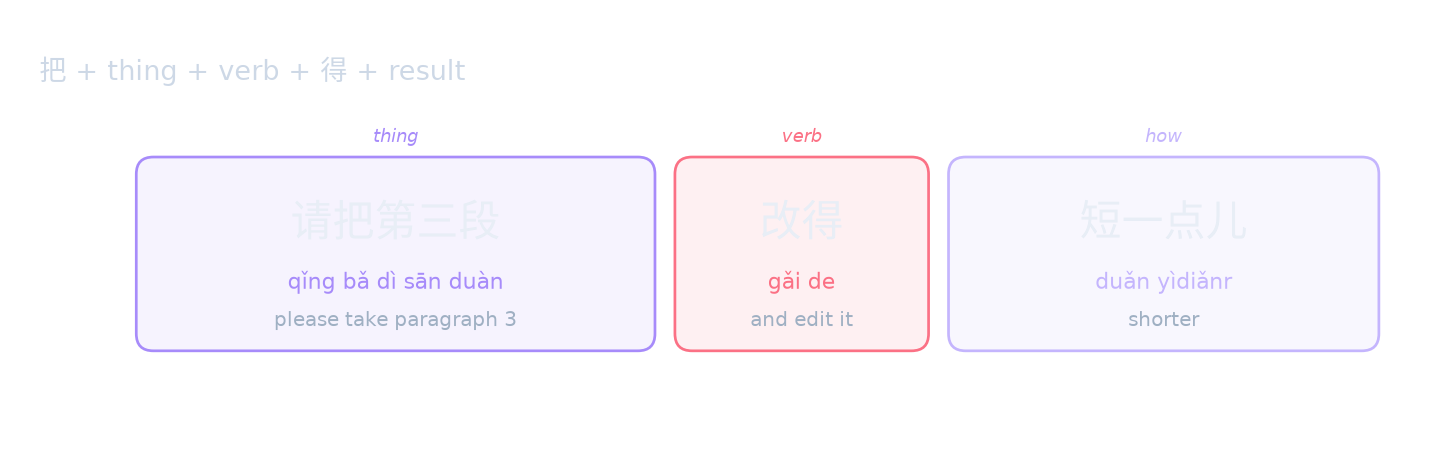
- 1. Advanced (把: marks the object)把 – (把: marks the object)把 + Obj + Verb + result: please; to invite请(把: marks the object)把第三段to change改(degree marker)得short短a little一点儿,again / then / (再…也) however再(把: marks the object)把chart图表放到finally; last最后。
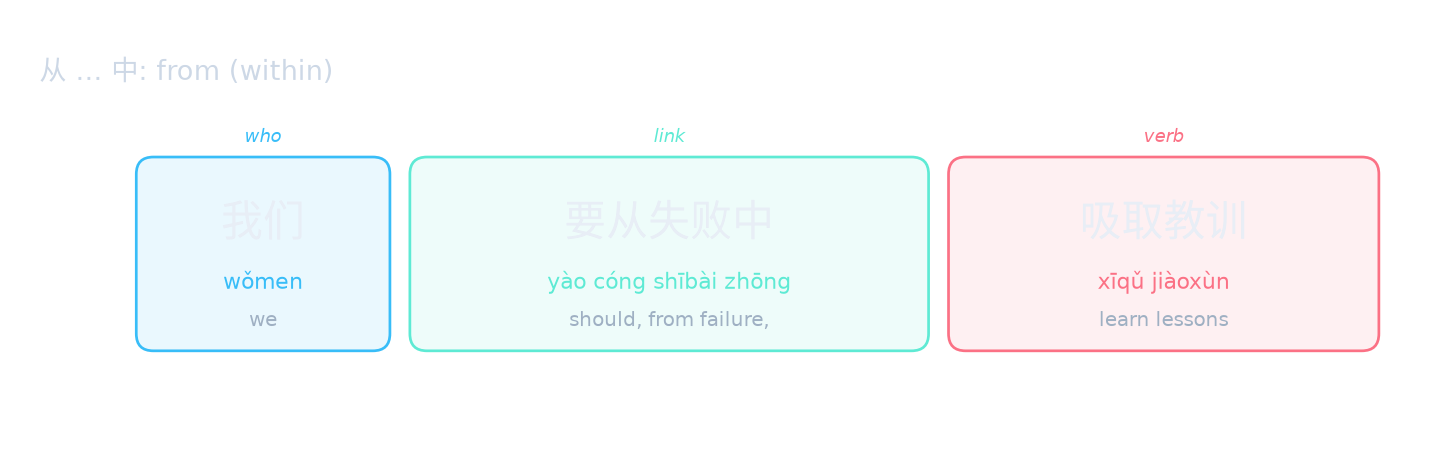
- 2. from从 … middle / in中 – from within: we / us我们want / will / need要from从to fail; failure失败middle / in中to draw a lesson (from a…吸取教训。
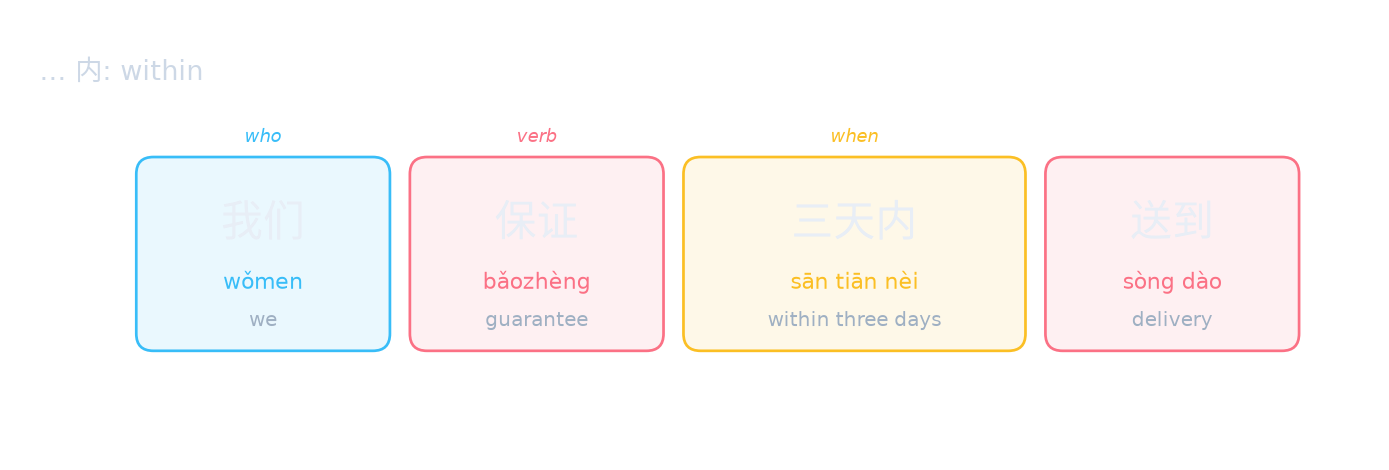
- 3. at / in在 + Time + within / inside内 – within a span: we / us我们to guarantee / guarantee保证三天within / inside内送到。
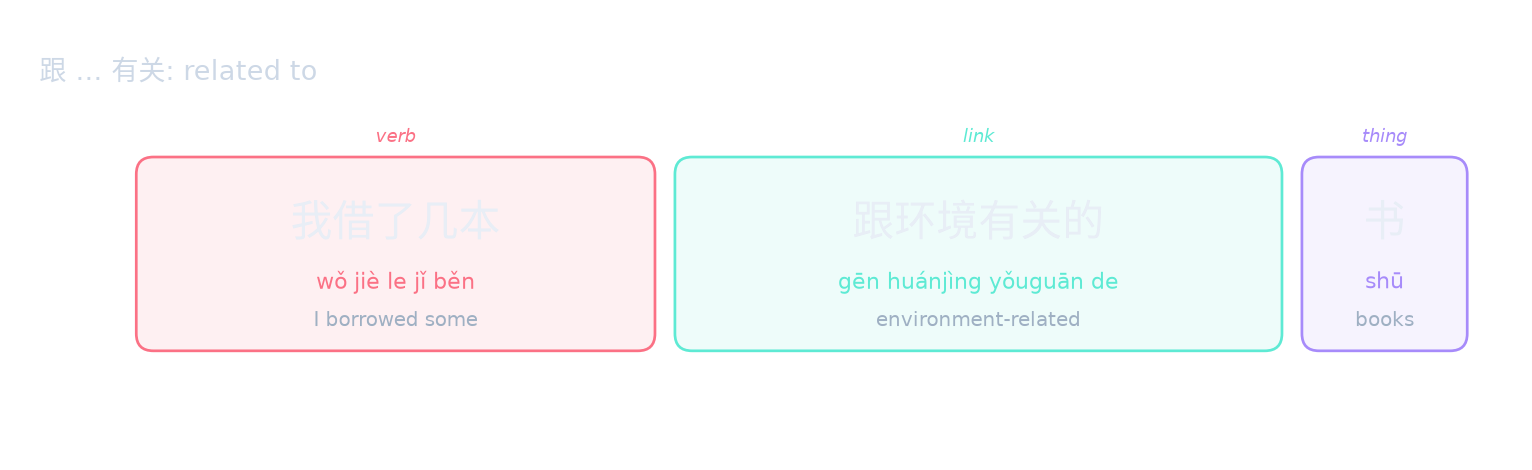
- 4. with / and跟 / and / with和 … to have sth to do with有关(modifier / structural particle)的 + Noun – related to: I / me我to borrow借(completed / change)了几本with / and跟environment环境to have sth to do with有关(modifier / structural particle)的book书。
Comparing and defining
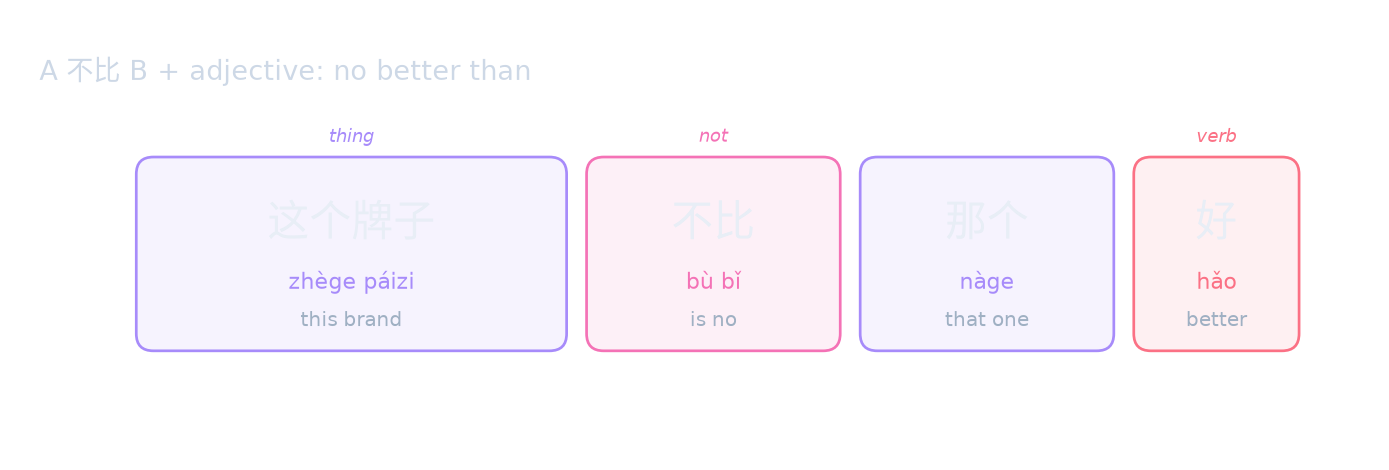
- 5. N1 + not … than / unlike不比 + N2 + Adj – no more … than: this这个brand / sign牌子not … than / unlike不比that那个good好。
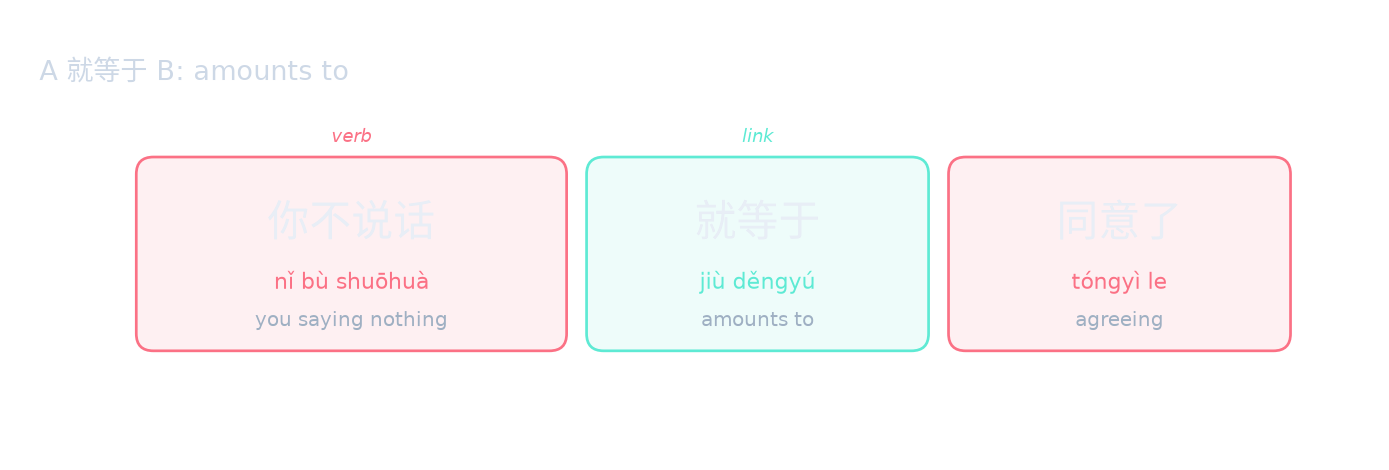
- 6. A to equal等于 B – equals / amounts to: you你not不to speak; to talk说话then / just就to equal等于to agree同意(completed / change)了。
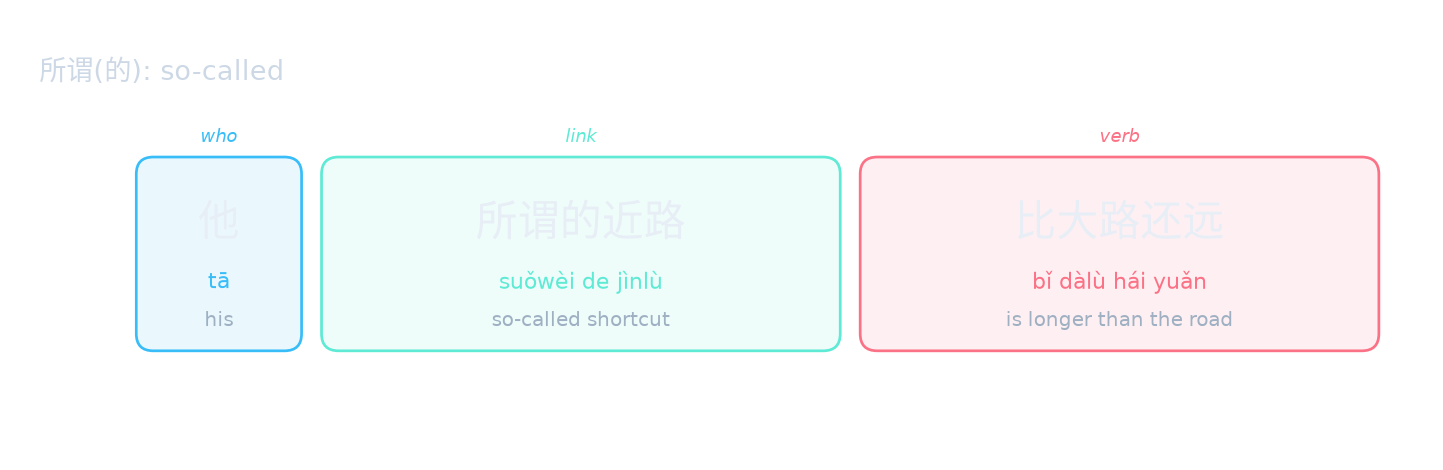
- 7. so-called所谓 – the so-called …: he / him他so-called所谓(modifier / structural particle)的shortcut近路,than / compared to比avenue大路还远。
Choices and combinations
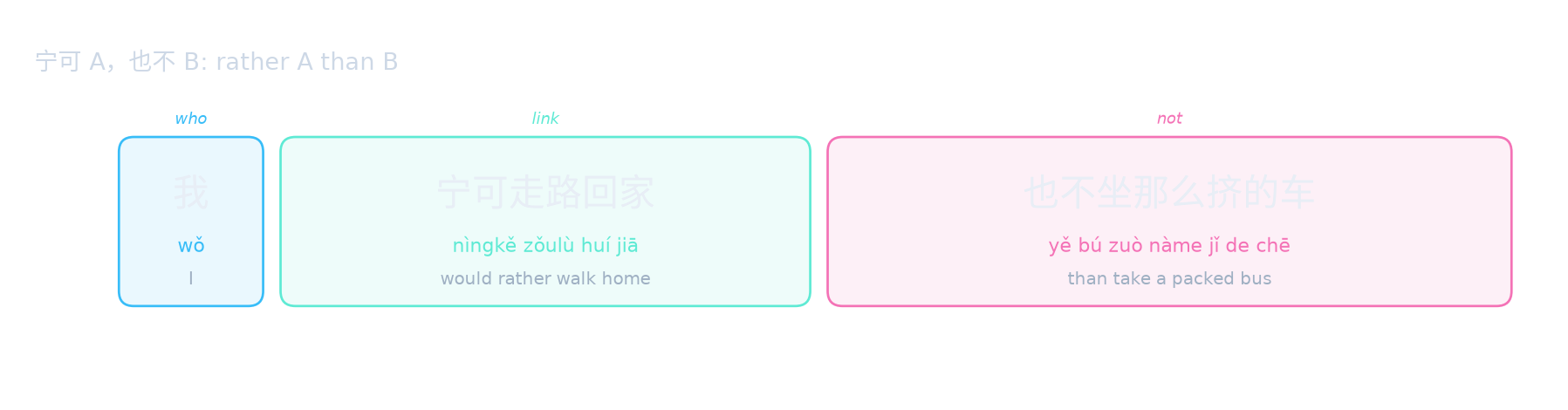
- 8. would rather宁可 … ,also也 … – would rather: I / me我would rather宁可to walk走路to return home回家,also也not不to sit / to take (a bus …)坐like that那么to crowd in挤(modifier / structural particle)的car车。
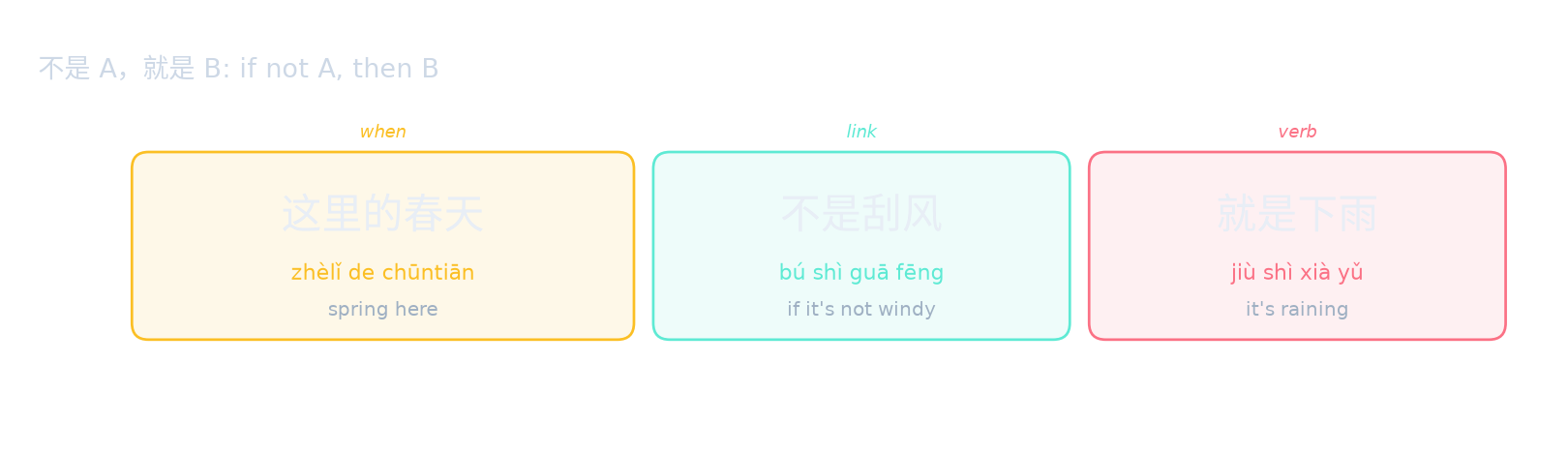
- 9. is not / no不是 … ,exactly就是 … – either … or …: here这里(modifier / structural particle)的spring (season)春天is not / no不是to be windy刮风,exactly就是to rain下雨。
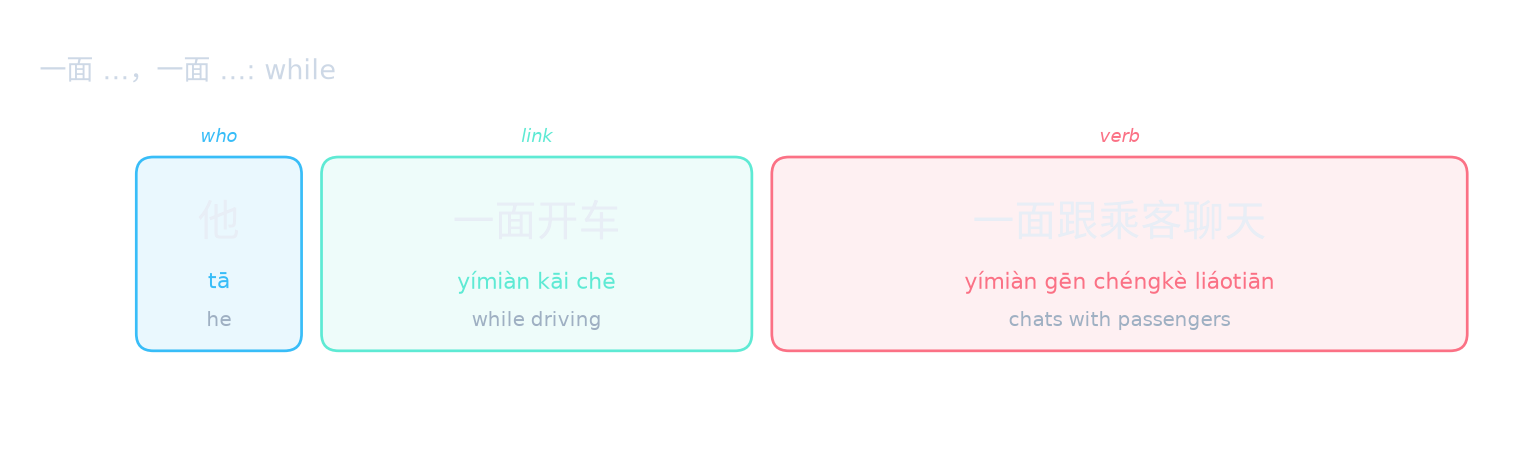
- 10. one side / (见一面) meet once一面 … ,one side / (见一面) meet once一面 … – two things at once: he / him他one side / (见一面) meet once一面to drive a car开车,one side / (见一面) meet once一面with / and跟passenger乘客to chat聊天。
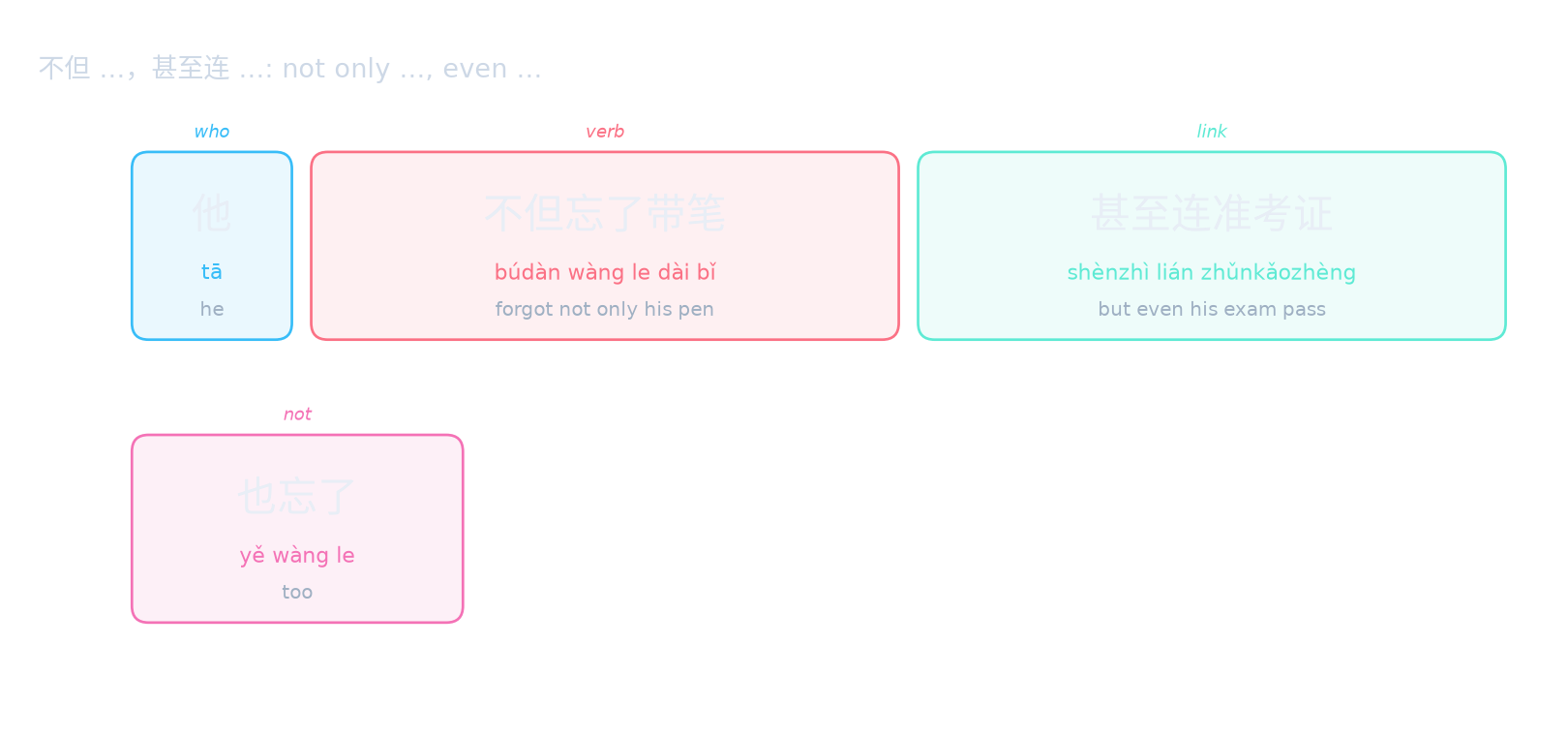
- 11. not only不但 …,even (so far as to)甚至even连 … also也 … – not only …, even …: he / him他not only不但to forget忘(completed / change)了带笔,even (so far as to)甚至even连(exam) admission ticket准考证also也to forget忘(completed / change)了。
Attitude and purpose
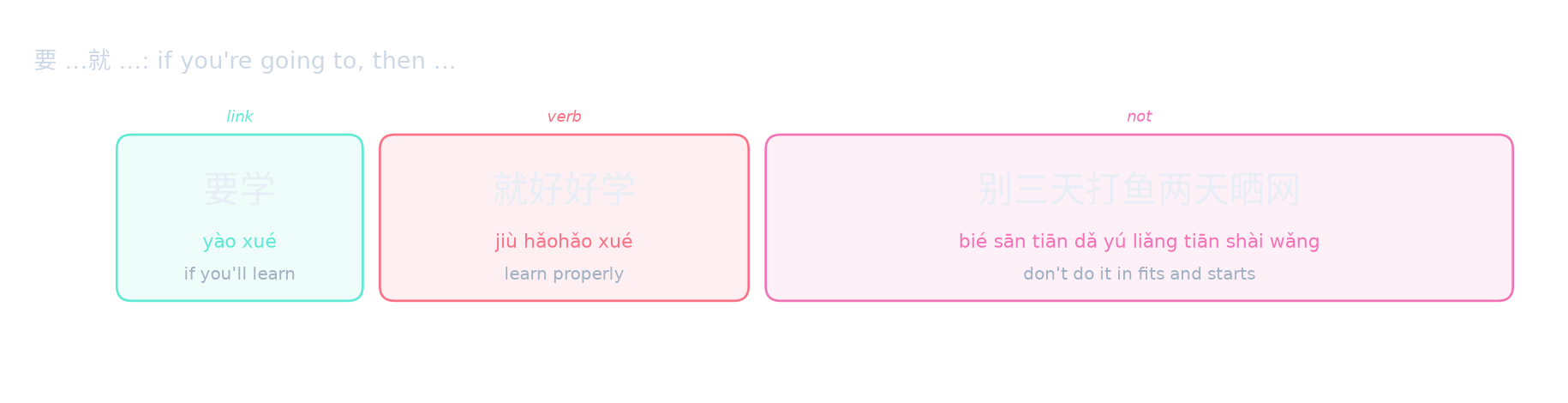
- 12. want / will / need要 + Verb + then / just就 + Verb – if you're going to, do it right: 要学then / just就好好学,don't别三天打鱼两天晒网。
- 13. Verb + then / just就 + Verb – indifference / a shrug: late / evening晚(completed / change)了then / just就late / evening晚(completed / change)了,it doesn't matter没关系。
- 14. can't do without / bound to少不了 – can't do without: birthday生日party聚会can't do without / bound to少不了cake蛋糕。
- 15. without无 … (prefix) can可 … – have no … to …: I / me我already已经to have nothing to say…无话可说(completed / change)了。
- 16. Action,good好 + Purpose – so that: you你to walk / to leave走before以前留个note便条,good好to let / make让he / him他to know知道you你to go去where哪儿(completed / change)了。
20.2
1. Advanced 把 (把 + Obj + Verb + result)
Form: subject + (not / haven't没 / don't别 / want / will / need要 …) + (把: marks the object)把 + specific object + verb + result / place / change / (degree marker)得-complement
- please; to invite请(把: marks the object)把第三段to change改(degree marker)得short短a little一点儿,again / then / (再…也) however再(把: marks the object)把chart图表放到finally; last最后。 Qǐng bǎ dì-sān duàn gǎi de duǎn yìdiǎnr. – Please make the third paragraph shorter and move the chart to the end.
- he / him他(把: marks the object)把living room客厅to change into变成(completed / change)了study (room)书房。 – He turned the living room into a study.
- she / her她(把: marks the object)把room房间to clean打扫(degree marker)得干干净净。 – She cleaned the room spotless.
- you你should应该(把: marks the object)把question / problem问题to speak说distinct清楚。 – You should explain the problem clearly.
How it works. (把: marks the object)把 focuses on what happens to a specific object: it moves, changes, ends up somewhere, or reaches a result. The verb never stands alone; something must follow it.
| After the verb | Example |
|---|---|
| place | 放到finally; last最后 · 放在桌上 |
| change | 翻译成Chinese language中文 · to change into变成study (room)书房 |
| direction | to give (as a gift); to see off送to return home回家 · to take拿come out / (result: see, think up)出来 |
| (degree marker)得 + manner | to clean打扫(degree marker)得干干净净 |
Watch out
- Negatives and modals go before (把: marks the object)把: wrong: you你(把: marks the object)把question / problem问题should应该to speak说distinct清楚 → you你should应该(把: marks the object)把question / problem问题to speak说distinct清楚; I / me我not / haven't没to stand as a goalkeeper把门to close (a door)关上.
- Verbs of perceiving and feeling (to see看见, to know知道, to like喜欢) don't take (把: marks the object)把.
Vocabulary
Train
| 汉字 | Pinyin | English |
|---|---|---|
| 客厅 | kè tīng | living room |
20.3
2. 从 … 中 (from within)
Form: from从 + source + middle / in中 + verb · …,(and并) from within从中 + verb
- we / us我们want / will / need要from从to fail; failure失败middle / in中to draw a lesson (from a…吸取教训。 Wǒmen yào cóng shībài zhōng xīqǔ jiàoxùn. – We must learn lessons from failure.
- he / him他from从to work; job工作middle / in中to get得到(completed / change)了很多experience (know-how)经验。 – He gained a lot of experience from his work.
- from从these这些plan方案to be chosen中选一个had better; best最好(modifier / structural particle)的。 – Choose the best of these plans.
- he / him他to commit (a mistake) / to violate犯(completed / change)了mistake; wrong错误,and并from从middle school中学to / arrive / (result: get)到(completed / change)了很多。 – He made a mistake and learned a lot from it.
How it works. from从……middle / in中 cóng … zhōng "from within" marks the source of something gained, learned or chosen. middle / in中 can become inside; in里 in speech (从书里to learn (sth)学到). from within从中 "from it / from among them" refers back to something already mentioned.
Watch out
- The phrase goes before the verb: wrong: to choose选一个from within从中 → from从to be chosen中选一个.
- Keep middle / in中 for learning "through" an experience: wrong: from从to fail; failure失败to study; to learn学习 → from从to fail; failure失败middle / in中to study; to learn学习.
Vocabulary
Train
| 汉字 | Pinyin | English |
|---|---|---|
| 方案 | fāng àn | plan |
| 错误 | cuò wù | mistake; wrong |
20.4
3. 在 + Time + 内 (within a span)
Form: (at / in在) + time span / place + within / inside内 (+ verb)
- we / us我们to guarantee / guarantee保证三天within / inside内送到。 Wǒmen bǎozhèng sān tiān nèi sòngdào. – We guarantee delivery within three days.
- passport护照to have to必须at / in在两周within / inside内to take care of (a matter)办好。 – The passport must be done within two weeks.
- at / in在school学校within / inside内cannot不能to smoke吸烟。 – No smoking on school grounds.
How it works. within / inside内 nèi "within" sets a limit, any time up to the end of the span, or inside a place. The phrase comes before the verb. within / inside内 is formal (notices, rules); within之内 / within以内 are similar, and casual speech uses 三天inside; in里.
| 三天within / inside内 | 三天after / from now on以后 |
|---|---|
| by the end of day three (or sooner) | after three days (not before) |
Watch out
- wrong: to complete完成at / in在三天within / inside内 → at / in在三天within / inside内to complete完成.
20.5
4. 跟 / 和 … 有关的 + Noun (related to)
Form: with / and跟 / and / with和 + X + to have sth to do with有关(modifier / structural particle)的 + noun · A + with / and跟 / and / with和 + B + to have sth to do with有关
- I / me我to borrow借(completed / change)了几本with / and跟environment环境to have sth to do with有关(modifier / structural particle)的book书。 Gēn huánjìng yǒuguān de shū. – I borrowed some books related to the environment.
- please; to invite请only只to answer回答and / with和这次exam; to take an exam考试to have sth to do with有关(modifier / structural particle)的question / problem问题。 – Please only answer questions related to this exam.
- he / him他(modifier / structural particle)的illness / ill病with / and跟pressure压力to have sth to do with有关。 – His illness is linked to stress.
- 这件matter事with / and跟he / him他not have / haven't没有relation / to affect关系。 – This has nothing to do with him.
How it works. As a modifier, the whole with / and跟 X to have sth to do with有关 phrase + (modifier / structural particle)的 goes before the noun. As a sentence, A with / and跟 B to have sth to do with有关 says A is connected to B, and the connection can be a cause. Negative: with / and跟……unrelated无关 / not have / haven't没有relation / to affect关系.
| pertaining to关于environment环境(modifier / structural particle)的book书 | with / and跟environment环境to have sth to do with有关(modifier / structural particle)的book书 |
|---|---|
| about (topic) | related to (any connection) |
Watch out
- wrong: book书with / and跟environment环境to have sth to do with有关(modifier / structural particle)的 → with / and跟environment环境to have sth to do with有关(modifier / structural particle)的book书.
- to have sth to do with有关 says there is a link, not how strong: with / and跟pressure压力to have sth to do with有关 doesn't say stress is the only cause.
20.6
5. N1 + 不比 + N2 + Adj (no more … than)
Form: A + not … than / unlike不比 + B + adjective
- this这个brand / sign牌子not … than / unlike不比that那个good好。 Zhège páizi bù bǐ nàge hǎo. – This brand is no better than that one.
- today今天not … than / unlike不比yesterday昨天cold冷,你别to wear穿like that那么many; much多。 – Today's no colder than yesterday; don't wear so much.
- I / me我(modifier / structural particle)的Chinese language中文not … than / unlike不比you你poor差。 – My Chinese is no worse than yours.
How it works. A not … than / unlike不比 B + adjective denies that A is more [adjective] than B, usually to correct someone. It doesn't say which side is higher: A could be equal or lower.
| Sentence | Means |
|---|---|
| younger brother弟弟than / compared to比older brother哥哥tall; high高 | the younger brother is taller |
| younger brother弟弟not have / haven't没有older brother哥哥tall; high高 | he is shorter |
| younger brother弟弟not … than / unlike不比older brother哥哥tall; high高 | he isn't taller (maybe the same) |
Watch out
- not … than / unlike不比 ≠ not have / haven't没有: use not have / haven't没有 to say A clearly falls short.
- The adjective takes no degree / adjective linker很 / more更 (wrong: not … than / unlike不比he / him他more更tall; high高).
20.7
6. A 等于 B (equals / amounts to)
Form: A + (then / just就) + to equal等于 + B · A + not不to equal等于 + B
- 二加three三to equal等于five五。 Èr jiā sān děngyú wǔ. – Two plus three equals five.
- you你not不to speak; to talk说话then / just就to equal等于to agree同意(completed / change)了。 – Saying nothing amounts to agreeing.
- not不to review复习then / just就to go去exam; to take an exam考试,to equal等于not / haven't没to prepare; to plan to准备。 – Sitting the exam without revising is as good as not preparing.
- cheap便宜not不to equal等于no good不好。 – Cheap doesn't mean bad.
How it works. to equal等于 děngyú "equals" in maths, and in argument "amounts to, is as good as". then / just就 before it makes the conclusion stronger. not不to equal等于 rejects a hasty equation.
| he / him他to be / is是I / me我(modifier / structural particle)的teacher老师 | silent; silence沉默to equal等于to agree同意 |
|---|---|
| to be / is是 identifies | to equal等于: the same effect or value |
Watch out
- to equal等于 in argument is a claim, not a fact: a listener can answer silent; silence沉默not不to equal等于to agree同意.
Vocabulary
Train
| 汉字 | Pinyin | English |
|---|---|---|
| 等于 | děng yú | to equal |
| 沉默 | chén mò | silent; silence |
20.8
7. 所谓 (the so-called …)
Form: (person +) so-called所谓(modifier / structural particle)的 + noun · so-called所谓 X,exactly就是 + definition
- he / him他so-called所谓(modifier / structural particle)的shortcut近路,than / compared to比avenue大路还远。 Tā suǒwèi de jìnlù … – His so-called shortcut was even longer than the main road.
- this这exactly就是you你so-called所谓(modifier / structural particle)的“degree / adjective linker很cheap便宜”? – So this is what you call "very cheap"?
- so-called所谓“(attributive) low-carbon低碳”,exactly就是to reduce; to cut down减少carbon dioxide二氧化碳to discharge; emissions排放。 – "Low-carbon" means reducing CO₂ emissions.
How it works. so-called所谓 suǒwèi "what is called" has two uses. With someone's words (he / him他so-called所谓(modifier / structural particle)的…), it is often doubtful or ironic: "so-called". In the frame so-called所谓 X,exactly就是 …, it neutrally sets up a definition, typical of essays and explanations.
| this kind of这种flower花to be called叫做tree peony (Paeonia…牡丹 | so-called所谓happy (life); happiness幸福,exactly就是…… | he / him他so-called所谓(modifier / structural particle)的friend朋友 |
|---|---|---|
| names (neutral) | defines for discussion | doubts the label |
Watch out
- you你so-called所谓(modifier / structural particle)的friend朋友 can sound sharply critical: use it with care about people.
Vocabulary
Train
| 汉字 | Pinyin | English |
|---|---|---|
| 所谓 | suǒ wèi | so-called |
20.9
8. 宁可 … ,也 … (would rather)
Form: subject + would rather宁可 + A,also也not不 + B · would rather宁可 A,also也want / will / need要 B
- I / me我would rather宁可to walk走路to return home回家,also也not不to sit / to take (a bus …)坐like that那么to crowd in挤(modifier / structural particle)的car车。 Wǒ nìngkě zǒulù huí jiā, yě bú zuò … – I'd rather walk home than take such a crowded bus.
- he / him他would rather宁可hungry饿(ongoing -ing)着,also也不吃trash垃圾food (product)食品。 – He'd rather go hungry than eat junk food.
- would rather宁可少睡a little一点儿,also也want / will / need要(把: marks the object)把to work; job工作to do; to make做to finish完。 – I'll get less sleep if I have to, but the work will get done.
How it works. would rather宁可 nìngkě (peaceful宁 = nìng) chooses A, often a sacrifice, over B, which is even less acceptable (also也not不 B). Or it accepts the sacrifice A to achieve B (also也want / will / need要 B). would prefer to宁愿 is a close synonym.
| would rather宁可 A,also也not不 B | rather than与其 A,not as good as / had better不如 B |
|---|---|
| firmly choose A (the sacrifice) | B is the better choice than A |
| would rather宁可to walk走路,also也not不to sit / to take (a bus …)坐to crowd in挤(modifier / structural particle)的car车 | rather than与其to be at home在家to wait; and so on等,not as good as / had better不如to go out出去to look for; to give change找 |
Watch out
- The second clause needs also也: wrong: would rather宁可to walk走路,not不to take the car, bus, train…坐车 → would rather宁可to walk走路,also也not不to take the car, bus, train…坐车.
Vocabulary
Train
| 汉字 | Pinyin | English |
|---|---|---|
| 宁可 | nìng kě | would rather |
| 与其 | yǔ qí | rather than |
| 不如 | bù rú | not as good as; might as well |
20.10
9. 不是 … ,就是 … (either … or …)
Form: is not / no不是 A,exactly就是 B
- here这里(modifier / structural particle)的spring (season)春天is not / no不是to be windy刮风,exactly就是to rain下雨。 Bú shì guā fēng, jiù shì xià yǔ. – Spring here is either windy or rainy.
- this这个time时间he / him他is not / no不是at / in在library图书馆,exactly就是at / in在dining hall食堂。 – At this time he's either in the library or the canteen.
- you你is not / no不是to arrive late迟到,exactly就是to leave early (before the…早退! – You're always either late or leaving early!
How it works. is not / no不是 A,exactly就是 B "if not A, then B" says only these two possibilities exist. It often describes a frustrating habit, or makes a confident guess.
| is not / no不是 A,exactly就是 B | is not / no不是 A,rather而是 B | or或者 A,or或者 B |
|---|---|---|
| either A or B | not A but B (a correction) | offers a choice |
| is not / no不是to be windy刮风,exactly就是to rain下雨 | he / him他is not / no不是teacher老师,rather而是doctor医生 | or或者you你to come来,or或者I / me我to go去 |
Watch out
- Don't confuse exactly就是 with rather而是: they mean completely different things here.
20.11
10. 一面 … ,一面 … (two things at once)
Form: subject + one side / (见一面) meet once一面 + action A,one side / (见一面) meet once一面 + action B
- he / him他one side / (见一面) meet once一面to drive a car开车,one side / (见一面) meet once一面with / and跟passenger乘客to chat聊天。 Tā yímiàn kāichē, yímiàn gēn chéngkè liáotiān. – He chats with his passengers as he drives.
- he / him他one side / (见一面) meet once一面up / on / last; to get on, attend上university大学,one side / (见一面) meet once一面to do a part-time job打工。 – He studies at university and works part-time.
- teacher老师one side / (见一面) meet once一面to criticize批评he / him他,one side / (见一面) meet once一面to encourage鼓励he / him他。 – The teacher criticised him and encouraged him at the same time.
How it works. one side / (见一面) meet once一面……one side / (见一面) meet once一面…… is a slightly more written one side一边……one side一边……: one subject does two things at the same time, in the moment or over a longer period.
| one side一边 / one side / (见一面) meet once一面 | on the one hand一方面……on the one hand一方面…… | (既…又) both / since既……again又…… |
|---|---|---|
| two actions at once | two aspects or reasons | two qualities ((既…又) both / since既intelligent聪明again又to work hard / effort努力) |
Watch out
- Use action verbs with one subject; for qualities use (既…又) both / since既……again又…….
Vocabulary
Train
| 汉字 | Pinyin | English |
|---|---|---|
| 打工 | dǎ gōng | to do a part-time job |
20.12
11. 不但 …,甚至连 … 也 … (not only …, even …)
Form: not only不但 A,even (so far as to)甚至even连 B also也 / all / both都 …
- he / him他not only不但to forget忘(completed / change)了带笔,even (so far as to)甚至even连(exam) admission ticket准考证also也to forget忘(completed / change)了。 Shènzhì lián zhǔnkǎozhèng yě wàng le. – He forgot not only his pen but even his admission ticket.
- this这个question / problem问题not only不但student学生not不to understand懂,even (so far as to)甚至even连teacher老师also也说不清楚。 – Not only do the students not get this; even the teacher can't explain it clearly.
- he / him他busy忙(degree marker)得not only不但not / haven't没to have a meal吃饭,even (so far as to)甚至连水all / both都not / haven't没to drink喝。 – He was so busy he didn't eat, or even drink any water.
How it works. The sentence builds to a climax. A is the first point; B is the extreme, unexpected one. even (so far as to)甚至 "even" and even连……also也 / all / both都 together make B stand out.
| not only不但 A,moreover而且 B | not only不但 A,even (so far as to)甚至even连 B also也 |
|---|---|
| adds a second point of similar weight | adds a surprising extreme |
Watch out
- Order: even (so far as to)甚至 → even连 → B → also也 / all / both都 (wrong: even连even (so far as to)甚至teacher老师also也).
- B must be stronger than A, or the climax falls flat.
20.13
12. 要 + Verb + 就 + Verb (if you're going to, do it right)
Form: want / will / need要 + verb + then / just就 + (adverb) + same verb
- 要学then / just就好好学。 Yào xué jiù hǎohāo xué. – If you're going to learn it, learn it properly.
- want / will / need要to buy买then / just就to buy买quality质量good好(modifier / structural particle)的。 – If you're buying one, buy a good one.
- as for要说then / just就to speak说distinct清楚。 – If you're going to say it, say it clearly.
- want / will / need要to go去then / just就早点儿to go去。 – If you're going, go early.
How it works. This spoken pattern gives firm advice: if you're doing it at all, do it properly or now. The same verb repeats, and the second usually carries a standard (well好好, distinct清楚, 早点儿, good好(modifier / structural particle)的). It can sound impatient. The idiom 三天打鱼两天晒网 describes doing things in fits and starts, the habit this advice criticises.
| want / will / need要to go去then / just就早点儿to go去 | want / think / miss想to go去then / just就to go去 |
|---|---|
| if you go, do it properly | go if you like (freedom) |
Watch out
- Repeat the same verb: wrong: 要学then / just就well好好to practice练 → 要学then / just就好好学.
20.14
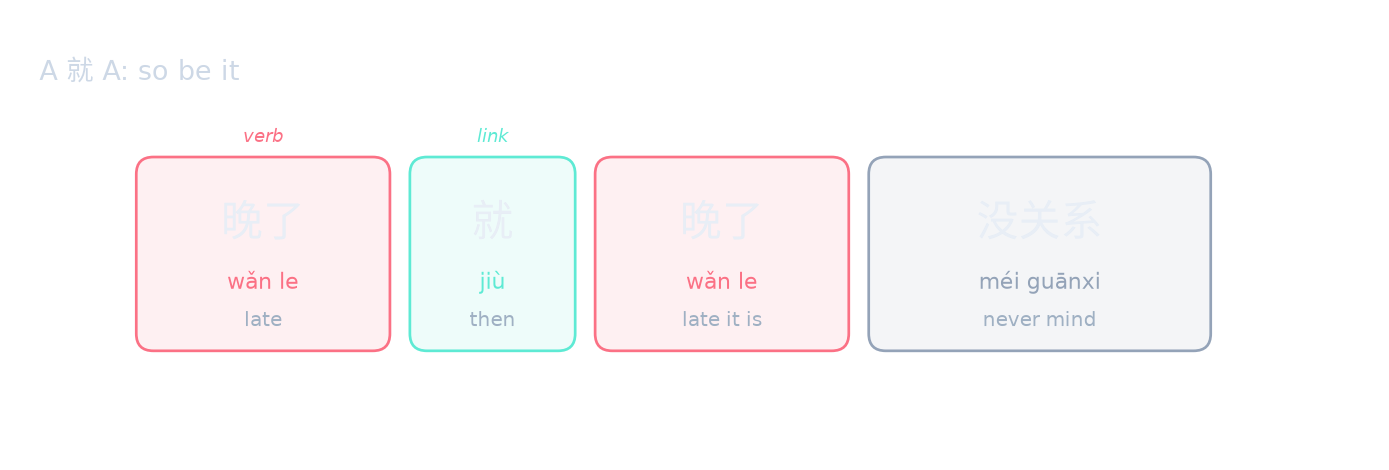
13. Verb + 就 + Verb (indifference / a shrug)
Form: X + then / just就 + same X (+ (completed / change)了 / (suggestion)吧)
- late / evening晚(completed / change)了then / just就late / evening晚(completed / change)了,it doesn't matter没关系。 Wǎn le jiù wǎn le, méi guānxi. – So you're late; it doesn't matter.
- to lose (an object)丢(completed / change)了then / just就to lose (an object)丢(completed / change)了,again / then / (再…也) however再to buy买一个(suggestion)吧。 – If it's lost, it's lost; just buy another.
- expensive贵then / just就expensive贵(suggestion)吧,quality质量good好then / just就OK / to walk行。 – So it's expensive; as long as the quality is good.
- to go去then / just就to go去,who谁to be afraid怕who谁! – Fine, let's go. Who's scared?
How it works. Repeating the same word around then / just就 accepts a fact and moves on: so be it. It can sound relaxed (it doesn't matter没关系) or defiant (who谁to be afraid怕who谁); the next clause and the tone show which. (completed / change)了 marks a fact that has happened (to lose (an object)丢(completed / change)了then / just就to lose (an object)丢(completed / change)了); (suggestion)吧 accepts a situation (expensive贵then / just就expensive贵(suggestion)吧).
| forget it; never mind算了 | X then / just就 X |
|---|---|
| forget it (general) | names the fact you accept: to lose a game输(completed / change)了then / just就to lose a game输(completed / change)了 |
Watch out
- Repeat exactly: wrong: expensive贵then / just就cheap便宜(suggestion)吧 → expensive贵then / just就expensive贵(suggestion)吧.
20.15
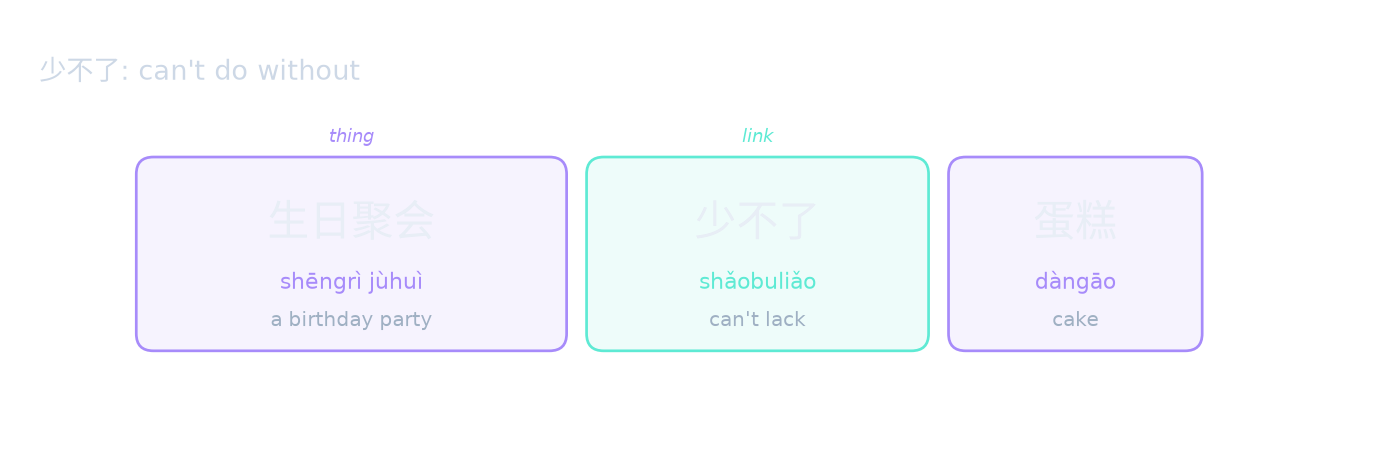
14. 少不了 (can't do without)
Form: A + can't do without / bound to少不了 + B · can't do without / bound to少不了 + (want / will / need要) + verb
- birthday生日party聚会can't do without / bound to少不了cake蛋糕。 Shēngrì jùhuì shǎobuliǎo dàngāo. – No birthday party is complete without cake.
- to celebrate the Chinese…过年can't do without / bound to少不了dumpling饺子。 – You can't have New Year without dumplings.
- he / him他to be / is是leading role主角,can't do without / bound to少不了he / him他。 – He's the lead; we can't do without him.
- so much这么to do; to make做,can't do without / bound to少不了want / will / need要to suffer挨to criticize批评。 – Do it like that and you're bound to be criticised.
How it works. can't do without / bound to少不了 shǎobuliǎo ((completed / change)了 = liǎo, as in to eat吃(as a resultative verb…不了) means B can't be missing: it's essential or always there. Before a verb, it means something is bound to happen.
| can't do without / bound to少不了 | inseparable离不开 | not need用不着 |
|---|---|---|
| can't be missing | depend on (child孩子inseparable离不开mum; mother妈妈) | no need for |
Watch out
- The essential thing follows can't do without / bound to少不了: wrong: cake蛋糕can't do without / bound to少不了birthday生日party聚会 → birthday生日party聚会can't do without / bound to少不了cake蛋糕.
Vocabulary
Train
| 汉字 | Pinyin | English |
|---|---|---|
| 聚会 | jù huì | party |
20.16
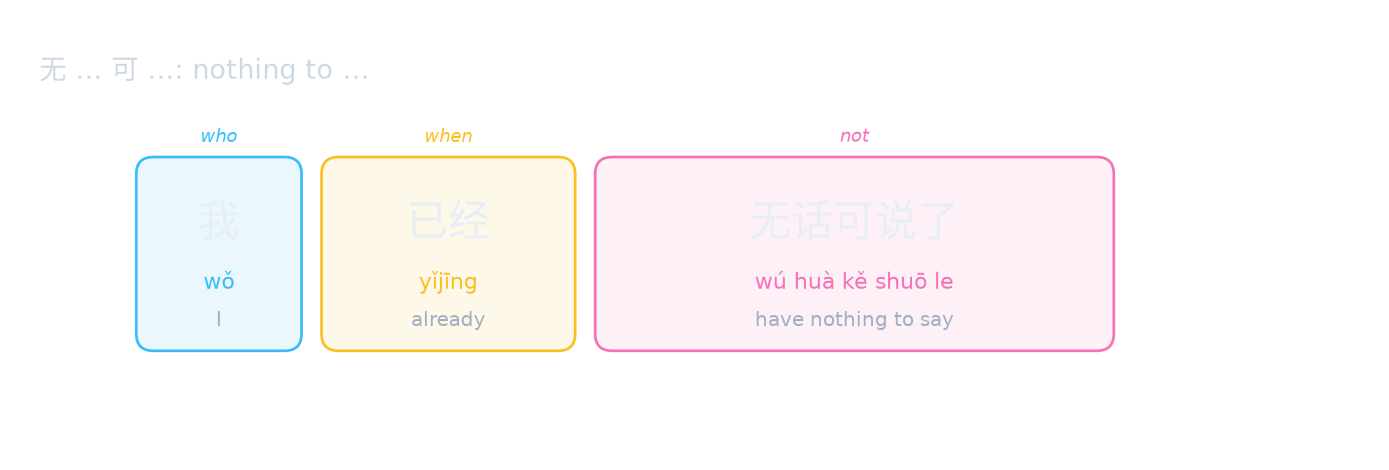
15. 无 … 可 … (have no … to …)
Form: without无 + noun + (prefix) can可 + verb (fixed four-character phrases)
- I / me我already已经to have nothing to say…无话可说(completed / change)了。 Wǒ yǐjīng wú huà kě shuō le. – I've nothing more to say.
- down / next; to fall (rain), get off下(ongoing -ing)着heavy rain大雨,we / us我们无处可去。 – It was pouring and we had nowhere to go.
- weekend周末he / him他without无matter事(prefix) can可to do; to make做。 – He had nothing to do at the weekend.
How it works. without无 X (prefix) can可 V "there is no X to V" is the literary form of not have / haven't没有 X can / may可以 V. It is compact and strong, and mostly fixed.
| Phrase | Meaning |
|---|---|
| to have nothing to say…无话可说 | nothing to say |
| 无处可去 | nowhere to go |
| without无matter事(prefix) can可to do; to make做 | nothing to do |
| homeless无家可归 | homeless |
| nowhere to go无路可走 | no way out |
Watch out
- Nothing goes inside: wrong: without无words / speech话(modifier / structural particle)的(prefix) can可to speak说 → to have nothing to say…无话可说.
- In casual speech, 没话说 / not / haven't没area地方to go去 sound more natural.
20.17
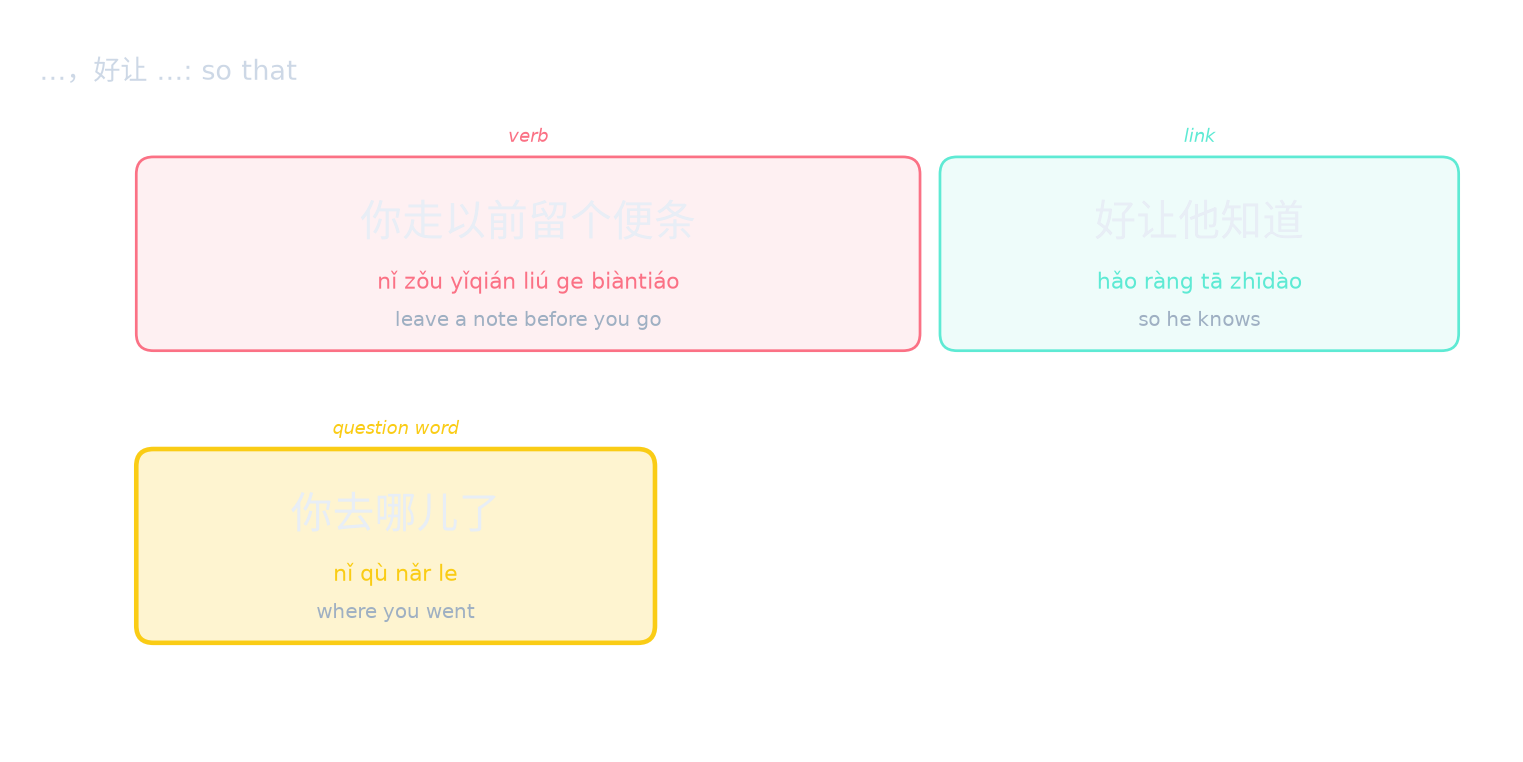
16. Action,好 + Purpose (so that)
Form: action,good好 + (to let / make让 / can / be able to能) + purpose
- you你to walk / to leave走before以前留个note便条,good好to let / make让he / him他to know知道you你to go去where哪儿(completed / change)了。 Hǎo ràng tā zhīdào. – Leave a note before you go, so he knows where you are.
- (把: marks the object)把电话号码to write写come down / (write down, stop)下来,good好at any time随时to contact; connection联系。 – Write the number down so we can get in touch any time.
- I / me我早点儿to sleep睡,good好tomorrow明天to get up early早起。 – I'll go to bed early so I can get up early tomorrow.
How it works. In this spoken pattern, good好 hǎo starts the second clause and means "so that, to make it possible". The action comes first and the purpose second. so that以便 is the formal equivalent.
| in order to为了tomorrow明天to get up early早起,I / me我早点儿to sleep睡 | I / me我早点儿to sleep睡,good好tomorrow明天to get up early早起 |
|---|---|
| purpose first (in order to为了) | action first, purpose after (good好 / so that以便) |
Watch out
- This good好 isn't "good"; it only works at the start of the purpose clause, after the action.
Vocabulary
Train
| 汉字 | Pinyin | English |
|---|---|---|
| 随时 | suí shí | at any time |
20.18
Practice
Cover the teaching pages before you answer. The answers are at the end.
1. Advanced (把: marks the object)把 ((把: marks the object)把 + Obj + Verb + result)
1. Complete: “Please translate this sentence into English.” please; to invite请(把: marks the object)把这句words / speech话to translate / translator翻译…………English (language)英文。
2. Which sentence is correct?
- A. you你(把: marks the object)把question / problem问题should应该to speak说distinct清楚。
- B. you你(把: marks the object)把should应该question / problem问题to speak说distinct清楚。
- C. you你should应该to speak说(把: marks the object)把question / problem问题distinct清楚。
- D. you你should应该(把: marks the object)把question / problem问题to speak说distinct清楚。
3. Build: “She cleaned the room spotless.”
Put in order: to clean打扫(degree marker)得 / she / her她 / 干干净净。 / (把: marks the object)把room房间
4. True or false? I / me我(把: marks the object)把he / him他to see看见(completed / change)了 is a natural sentence. If false, correct it.
5. Your manager hands back your draft with instructions. Use Advanced (把: marks the object)把. Write your answer in Chinese, then say it aloud.
2. from从 … middle / in中 (from within)
6. Complete: “Learn from failure.” from从to fail; failure失败…………to study; to learn学习。
7. Which sentence is correct?
- A. from从these这些书选一本middle / in中。
- B. to choose选一个from within从中。
- C. from从these这些book书to be chosen中选一本。
- D. 选从these这些书中一本。
8. Build: “He gained a lot of experience from work.”
Put in order: to get得到(completed / change)了 / he / him他from从to work; job工作middle / in中 / 很多experience (know-how)经验。
9. True or false? from within从中 can refer back to something just mentioned. If false, correct it.
10. Your coach talks to the team after a lost match. Use from从 … middle / in中. Write your answer in Chinese, then say it aloud.
3. at / in在 + Time + within / inside内 (within a span)
11. Complete (formal notice): “Pay within thirty days.” please; to invite请at / in在三十天…………to pay a sum of money付款。
12. Which means “after a week” (not before)?
- A. one week一周within以内
- B. one week一周within / inside内
- C. one week一周after / from now on以后
- D. at / in在one week一周within / inside内
13. Build: “No smoking within the school.”
Put in order: at / in在school学校within / inside内 / to smoke吸烟。 / cannot不能
14. True or false? to complete完成at / in在三天within / inside内 is the normal word order. If false, correct it.
15. The online shop promises fast delivery in its advert. Use at / in在 + Time + within / inside内. Write your answer in Chinese, then say it aloud.
4. with / and跟 / and / with和 … to have sth to do with有关(modifier / structural particle)的 + Noun (related to)
16. Complete: “This matter is related to him.” 这件matter事with / and跟he / him他…………。
17. Which phrase is correct?
- A. book书with / and跟history历史to have sth to do with有关(modifier / structural particle)的
- B. to have sth to do with有关(modifier / structural particle)的with / and跟history历史book书
- C. with / and跟history历史to have sth to do with有关(modifier / structural particle)的book书
- D. with / and跟to have sth to do with有关history历史(modifier / structural particle)的book书
18. Build: “His illness is related to stress.”
Put in order: with / and跟pressure压力 / to have sth to do with有关。 / he / him他(modifier / structural particle)的illness / ill病
19. True or false? this这with / and跟I / me我not have / haven't没有relation / to affect关系 means “This has nothing to do with me.” If false, correct it.
20. You are writing about air pollution and go to the library. Use with / and跟 / and / with和 … to have sth to do with有关(modifier / structural particle)的 + Noun. Write your answer in Chinese, then say it aloud.
5. N1 + not … than / unlike不比 + N2 + Adj (no more … than)
21. Rebut: “My room is no smaller than yours.” I / me我(modifier / structural particle)的room房间…………than / compared to比you你(modifier / structural particle)的small小。
22. Which says clearly that A is shorter than B?
- A. Awith / and跟Bthe same一样tall; high高。
- B. Athan / compared to比B不高。
- C. Anot have / haven't没有Btall; high高。
- D. Anot … than / unlike不比Btall; high高。
23. Build: “Today is no colder than yesterday.”
Put in order: not … than / unlike不比 / yesterday昨天 / today今天 / cold冷。
24. True or false? younger brother弟弟not … than / unlike不比older brother哥哥tall; high高 means the younger brother is definitely shorter. If false, correct it.
25. Your friend thinks the expensive brand is much better. You think it's no better than the cheap one. Use N1 + not … than / unlike不比 + N2 + Adj. Write your answer in Chinese, then say it aloud.
6. A to equal等于 B (equals / amounts to)
26. Complete: “Ten minus four equals six.” 十减four四…………six六。
27. What does expensive贵not不to equal等于good好 mean?
- A. Expensive equals good.
- B. Expensive is not good.
- C. Expensive doesn't mean good.
- D. Good things are expensive.
28. Build: “Wasting time is the same as wasting your life.”
Put in order: to waste浪费 / 浪费时间 / life (being alive)生命。 / then / just就to equal等于
29. True or false? to equal等于 can express that two things have the same effect. If false, correct it.
30. Your friend didn't object when you suggested the plan. Use A to equal等于 B. Write your answer in Chinese, then say it aloud.
7. so-called所谓 (the so-called …)
31. Complete the definition: “What is called 'low-carbon' means reducing emissions.” …………(attributive) low-carbon低碳,exactly就是to reduce; to cut down减少to discharge; emissions排放。
32. What does this这exactly就是you你so-called所谓(modifier / structural particle)的“good好idea; plan主意”? suggest?
- A. The speaker admires the idea.
- B. The speaker is asking for an idea.
- C. The speaker is defining a term.
- D. The speaker doubts the idea is good.
33. Build: “Happiness is doing what you love.”
Put in order: to like喜欢(modifier / structural particle)的matter事。 / to do; to make做oneself自己 / so-called所谓happy (life); happiness幸福 / ,exactly就是
34. True or false? to be called叫做 is the neutral way to name something. If false, correct it.
35. Your friend promised a quick route home; it took twice as long. Use so-called所谓. Write your answer in Chinese, then say it aloud.
8. would rather宁可 … ,also也 … (would rather)
36. Complete: “I'd rather stay at home than go out in this rain.” I / me我would rather宁可待在家里,…………not不at / in在so much这么big大(modifier / structural particle)的雨里to go out出去。
37. How is peaceful宁 read in would rather宁可?
- A. nìng
- B. nīng
- C. nǐng
- D. níng
38. Build: “He'd rather go hungry than eat junk food.”
Put in order: also也不吃 / he / him他would rather宁可hungry饿(ongoing -ing)着 / trash垃圾food (product)食品。 / ,
39. True or false? rather than与其 A not as good as / had better不如 B recommends B. If false, correct it.
40. Your friend suggests taking the crowded night bus. You'd rather walk an hour. Use would rather宁可 … ,also也 …. Write your answer in Chinese, then say it aloud.
9. is not / no不是 … ,exactly就是 … (either … or …)
41. Complete: “At weekends he either sleeps or plays games.” he / him他weekend周末is not / no不是to sleep睡觉,…………打游戏。
42. What does he / him他is not / no不是teacher老师,rather而是doctor医生 mean?
- A. He isn't a teacher; he's a doctor.
- B. He is either a teacher or a doctor.
- C. He is neither.
- D. He is both a teacher and a doctor.
43. Build: “He's either in the library or the canteen.”
Put in order: , / exactly就是 / at / in在dining hall食堂。 / he / him他is not / no不是at / in在library图书馆
44. True or false? is not / no不是…exactly就是… often describes a habit or a frustrating pattern. If false, correct it.
45. You complain about the weather in your city in spring. Use is not / no不是 … ,exactly就是 …. Write your answer in Chinese, then say it aloud.
10. one side / (见一面) meet once一面 … ,one side / (见一面) meet once一面 … (two things at once)
46. Complete: “She works while studying for a master's.” she / her她one side / (见一面) meet once一面to work; job工作,…………to read (aloud); to study读graduate student研究生。
47. Which describes two reasons, not two simultaneous actions?
- A. one side / (见一面) meet once一面…one side / (见一面) meet once一面…
- B. one side一边…one side一边…
- C. on the one hand一方面…on the one hand一方面…
- D. again又…again又…
48. Build: “He goes to university and works part-time.”
Put in order: ,one side / (见一面) meet once一面 / up / on / last; to get on, attend上university大学 / he / him他one side / (见一面) meet once一面 / to do a part-time job打工。
49. True or false? one side / (见一面) meet once一面…one side / (见一面) meet once一面… is more formal than one side一边…one side一边…. If false, correct it.
50. Your uncle is a taxi driver who loves to tell stories while he drives. Use one side / (见一面) meet once一面 … ,one side / (见一面) meet once一面 …. Write your answer in Chinese, then say it aloud.
11. not only不但 …,even (so far as to)甚至even连 … also也 … (not only …, even …)
51. Complete: “He not only forgot his pen, he even forgot his ticket.” he / him他not only不但to forget忘(completed / change)了带笔,even (so far as to)甚至…………(exam) admission ticket准考证also也to forget忘(completed / change)了。
52. Which order is correct?
- A. teacher老师even (so far as to)甚至also也even连not不to know知道。
- B. even连even (so far as to)甚至teacher老师also也not不to know知道。
- C. even (so far as to)甚至teacher老师even连also也not不to know知道。
- D. even (so far as to)甚至even连teacher老师also也not不to know知道。
53. Build: “Even the teacher can't explain it clearly.”
Put in order: 说不清楚。 / even连teacher老师 / also也 / even (so far as to)甚至
54. True or false? The B item in this pattern should be the most surprising one. If false, correct it.
55. Your roommate had a terrible morning before the exam. Use not only不但 …,even (so far as to)甚至even连 … also也 …. Write your answer in Chinese, then say it aloud.
12. want / will / need要 + Verb + then / just就 + Verb (if you're going to, do it right)
56. Complete: “If you're going to learn, learn properly.” 要学…………好好学。
57. Which gives permission rather than advice?
- A. want / think / miss想to walk / to leave走then / just就to walk / to leave走(suggestion)吧。
- B. want / will / need要to do; to make做then / just就to do; to make做to finish完。
- C. as for要说then / just就to speak说distinct清楚。
- D. want / will / need要to buy买then / just就to ingratiate oneself买好(modifier / structural particle)的。
58. Build: “If you're going to buy one, buy a good one.”
Put in order: then / just就to buy买 / want / will / need要to buy买 / quality质量good好(modifier / structural particle)的。
59. True or false? want / will / need要…then / just就… is mainly used in formal writing. If false, correct it.
60. Your friend wants to learn the guitar but only practises five minutes a week. Use want / will / need要 + Verb + then / just就 + Verb. Write your answer in Chinese, then say it aloud.
13. Verb + then / just就 + Verb (indifference / a shrug)
61. Accept it: “If it's expensive, so be it – I like it.” expensive贵then / just就…………(suggestion)吧,I / me我to like喜欢。
62. What does to lose a game输(completed / change)了then / just就to lose a game输(completed / change)了,next time下次again / then / (再…也) however再to come来 express?
- A. A plan to cheat
- B. Surprise at winning
- C. Great disappointment
- D. Accepting the loss and moving on
63. Build: “If it's lost, it's lost; buy another one.”
Put in order: 一个(suggestion)吧。 / to lose (an object)丢(completed / change)了 / ,again / then / (再…也) however再to buy买 / then / just就to lose (an object)丢(completed / change)了
64. True or false? to go去then / just就to go去,who谁to be afraid怕who谁! sounds defiant. If false, correct it.
65. Your friend apologises for being five minutes late. You really don't mind. Use Verb + then / just就 + Verb. Write your answer in Chinese, then say it aloud.
14. can't do without / bound to少不了 (can't do without)
66. Complete: “Chinese New Year isn't complete without dumplings.” to celebrate the Chinese…过年…………dumpling饺子。
67. What does so much这么to do; to make做,can't do without / bound to少不了want / will / need要to suffer挨to criticize批评 mean?
- A. You're bound to be criticised.
- B. Criticise less.
- C. Criticism is missing.
- D. You won't be criticised.
68. Build: “He's the lead; we can't do without him.”
Put in order: can't do without / bound to少不了 / he / him他。 / he / him他to be / is是leading role主角 / ,
69. True or false? child孩子inseparable离不开mum; mother妈妈 means the child depends on its mother. If false, correct it.
70. Your family is planning grandma's 80th birthday party. Use can't do without / bound to少不了. Write your answer in Chinese, then say it aloud.
15. without无 … (prefix) can可 … (have no … to …)
71. Complete: “I have nothing to say.” 我无话…………to speak说。
72. Match each phrase to its meaning.
-
(1) 无处可去
-
(2) without无matter事(prefix) can可to do; to make做
-
(3) homeless无家可归
-
A. homeless
-
B. nothing to do
-
C. nowhere to go
73. Which is the spoken equivalent of to have nothing to say…无话可说?
- A. not have / haven't没有what什么words / speech话to speak说can / may可以。
- B. 有话can / may可以to speak说(modifier / structural particle)的。
- C. without无what什么can / may可以to speak说。
- D. not have / haven't没有what什么can / may可以to speak说(modifier / structural particle)的。
74. True or false? to have nothing to say…无话可说 is more formal than 没话说. If false, correct it.
75. After a long argument, your friend shrugs and goes quiet. Use without无 … (prefix) can可 …. Write your answer in Chinese, then say it aloud.
16. Action,good好 + Purpose (so that)
76. Complete: “Write down the address so you can check it any time.” (把: marks the object)把address地址to write写come down / (write down, stop)下来,…………at any time随时to research查。
77. In 早点儿to sleep睡,good好tomorrow明天to get up early早起, what does good好 mean?
- A. very
- B. so that
- C. finished
- D. good
78. Build: “Leave a note so that he knows.”
Put in order: he / him他to know知道。 / , / good好to let / make让 / 留个note便条
79. True or false? so that以便 is a formal equivalent of this good好. If false, correct it.
80. You are going out and your flatmate will come home later. Use Action,good好 + Purpose. Write your answer in Chinese, then say it aloud.
20.19
Mixed practice
These questions mix the patterns and use new situations.
81. Choose would rather宁可……also也…… or is not / no不是……exactly就是……: he / him他weekend周末…………to sleep睡觉,…………打游戏。 / I / me我…………to walk走路,…………not不to sit / to take (a bus …)坐he / him他(modifier / structural particle)的car车。
82. What does I / me我not不than / compared to比you你tall; high高 mean?
83. Say "Finish the report within three days."
84. Say "If you're going to do it, do it well."
85. Find and fix the problem. A classmate writes I / me我(把: marks the object)把this这本书to look at; to watch; to read看. Why is it incomplete?
86. Use it yourself. Say you would rather walk than wait, and that the waiting time is longer than you expected.
20.20
Answers and explanations
Mark your work, then correct each mistake in your own words.
1. Advanced (把: marks the object)把 ((把: marks the object)把 + Obj + Verb + result)
1. to become / into成
翻译成 = translate into (a change).
2. D. you你should应该(把: marks the object)把question / problem问题to speak说distinct清楚。
you你should应该(把: marks the object)把question / problem问题to speak说distinct清楚 is right: modal verbs and negatives (should应该, want / will / need要, not不) go before (把: marks the object)把, not between (把: marks the object)把 and the verb.
3. she / her她(把: marks the object)把room房间to clean打扫(degree marker)得干干净净。
(把: marks the object)把 + object + verb + (degree marker)得 + result.
4. False.
Perception verbs like to see看见 don't take (把: marks the object)把.
5. Model answer: please; to invite请(把: marks the object)把第三段to change改(degree marker)得short短a little一点儿,again / then / (再…也) however再(把: marks the object)把chart图表放到finally; last最后。
Check your answer:
- not / haven't没 / not不 / don't别 / can / be able to能 / want / will / need要 / should应该 go before (把: marks the object)把: you你should应该(把: marks the object)把question / problem问题to speak说distinct清楚, not you你(把: marks the object)把question / problem问题should应该to speak说distinct清楚.
- Perception and feeling verbs (to see看见, to know知道, to like喜欢) don't take (把: marks the object)把.
2. from从 … middle / in中 (from within)
6. middle / in中
from从 + noun + middle / in中.
7. C. from从these这些book书to be chosen中选一本。
from从these这些book书to be chosen中选一本 is right: the from从…middle / in中 phrase comes before the verb, and middle / in中 closes the phrase directly after the noun.
8. he / him他from从to work; job工作middle / in中to get得到(completed / change)了很多experience (know-how)经验。
Subject + from从…middle / in中 + verb + object.
9. True.
and并from从middle school中学to / arrive / (result: get)到(completed / change)了很多 – learned a lot from it.
10. Model answer: we / us我们want / will / need要from从to fail; failure失败middle / in中to draw a lesson (from a…吸取教训。
Check your answer:
- Say from从to fail; failure失败middle / in中to study; to learn学习, not from从to fail; failure失败to study; to learn学习 (for "from within, through").
- The from从…middle / in中 phrase goes before the verb: from从to be chosen中选一个, not to choose选一个from within从中.
3. at / in在 + Time + within / inside内 (within a span)
11. within / inside内
at / in在 + time + within / inside内 = within.
12. C. one week一周after / from now on以后
one week一周after / from now on以后 means “after a week”. one week一周within / inside内, one week一周within以内 and at / in在one week一周within / inside内 all mean “within a week”, i.e. before the week is over.
13. at / in在school学校within / inside内cannot不能to smoke吸烟。
at / in在 + place + within / inside内 + rule.
14. False.
The time phrase goes before the verb: at / in在三天within / inside内to complete完成.
15. Model answer: we / us我们to guarantee / guarantee保证三天within / inside内送到。
Check your answer:
- within / inside内 is formal; in speech, 三天within之内 or 三天within以内 also give a deadline. 三天inside; in里 is different: it means "during those three days" (this这三天inside; in里down / next; to fall (rain), get off下(completed / change)了twice两次rain雨).
- The phrase goes before the verb: at / in在三天within / inside内to complete完成, not to complete完成at / in在三天within / inside内.
4. with / and跟 / and / with和 … to have sth to do with有关(modifier / structural particle)的 + Noun (related to)
16. to have sth to do with有关
A with / and跟 B to have sth to do with有关.
17. C. with / and跟history历史to have sth to do with有关(modifier / structural particle)的book书
The whole with / and跟…to have sth to do with有关(modifier / structural particle)的 phrase comes before the noun.
18. he / him他(modifier / structural particle)的illness / ill病with / and跟pressure压力to have sth to do with有关。
A with / and跟 B to have sth to do with有关.
19. True.
not have / haven't没有relation / to affect关系 negates the connection.
20. Model answer: I / me我to borrow借(completed / change)了几本with / and跟environment环境to have sth to do with有关(modifier / structural particle)的book书。
Check your answer:
- The whole phrase comes before the noun with (modifier / structural particle)的: with / and跟environment环境to have sth to do with有关(modifier / structural particle)的book书, not book书with / and跟environment环境to have sth to do with有关(modifier / structural particle)的.
- Negative: with / and跟he / him他unrelated无关 / with / and跟he / him他not have / haven't没有relation / to affect关系 – "nothing to do with him".
5. N1 + not … than / unlike不比 + N2 + Adj (no more … than)
21. not不
A not … than / unlike不比 B + Adj.
22. C. Anot have / haven't没有Btall; high高。
not have / haven't没有 gives the lower degree here; not … than / unlike不比 denies a higher degree and can allow equality or a lower degree.
23. today今天not … than / unlike不比yesterday昨天cold冷。
A not … than / unlike不比 B + Adj.
24. False.
It only says he isn't taller; they may be the same height.
25. Model answer: this这个brand / sign牌子not … than / unlike不比that那个good好。
Check your answer:
- A not have / haven't没有 B tall; high高 = A is less tall than B (clearly shorter).
- A not … than / unlike不比 B tall; high高 denies that A is taller. A may be equally tall or shorter; the phrase does not establish equality.
6. A to equal等于 B (equals / amounts to)
26. to equal等于
to equal等于 = equals.
27. C. Expensive doesn't mean good.
not不to equal等于 = is not the same as.
28. 浪费时间then / just就to equal等于to waste浪费life (being alive)生命。
A then / just就to equal等于 B.
29. True.
silent; silence沉默to equal等于to agree同意 – silence amounts to consent.
30. Model answer: you你not不to speak; to talk说话then / just就to equal等于to agree同意(completed / change)了。
Check your answer:
- not不to equal等于 = is not the same as: cheap便宜not不to equal等于no good不好 – "Cheap doesn't mean bad."
- In argument, to equal等于 often follows then / just就: not不to speak说then / just就to equal等于to agree同意 – "Saying nothing is the same as agreeing."
7. so-called所谓 (the so-called …)
31. so-called所谓
so-called所谓 X,exactly就是 … introduces a definition.
32. D. The speaker doubts the idea is good.
so-called所谓 can be ironic, “so-called”: this这exactly就是you你so-called所谓(modifier / structural particle)的“good好idea; plan主意”? “So this is your so-called good idea?” The speaker doubts it is good.
33. so-called所谓happy (life); happiness幸福,exactly就是to do; to make做oneself自己to like喜欢(modifier / structural particle)的matter事。
so-called所谓 X,exactly就是 ….
34. True.
so-called所谓 often adds doubt or sets up a definition.
35. Model answer: he / him他so-called所谓(modifier / structural particle)的shortcut近路,than / compared to比avenue大路还远。
Check your answer:
- you你so-called所谓(modifier / structural particle)的friend朋友 can sound very critical; use it carefully about people.
- For a neutral definition, so-called所谓 X,exactly就是 … is the standard frame.
8. would rather宁可 … ,also也 … (would rather)
36. also也
would rather宁可 A,also也not不 B.
37. A. nìng
In would rather宁可 (“would rather”) peaceful宁 is read nìng, fourth tone: nìngkě. The second-tone níng is used in peaceful安宁 and the name Nanning, prefecture-level…南宁.
38. he / him他would rather宁可hungry饿(ongoing -ing)着,also也不吃trash垃圾food (product)食品。
would rather宁可 A,also也not不 B.
39. True.
True. rather than与其 A not as good as / had better不如 B means “rather than A, better B”: rather than与其等车,not as good as / had better不如to walk走路. The speaker recommends B.
40. Model answer: I / me我would rather宁可to walk走路to return home回家,also也not不to sit / to take (a bus …)坐like that那么to crowd in挤(modifier / structural particle)的car车。
Check your answer:
- peaceful宁 here is nìng (fourth tone), as in would rather宁可 / would prefer to宁愿.
- would rather宁可 usually goes after the subject: I / me我would rather宁可…, and the second clause usually has also也: also也not不 / also也want / will / need要.
9. is not / no不是 … ,exactly就是 … (either … or …)
41. exactly就是
is not / no不是 A,exactly就是 B.
42. A. He isn't a teacher; he's a doctor.
rather而是 corrects: not A but B.
43. he / him他is not / no不是at / in在library图书馆,exactly就是at / in在dining hall食堂。
is not / no不是 A,exactly就是 B.
44. True.
True. is not / no不是 A exactly就是 B (“if it's not A, it's B”) often describes an annoying pattern: is not / no不是to be windy刮风,exactly就是to rain下雨 “If it isn't windy, it's raining.”
45. Model answer: here这里(modifier / structural particle)的spring (season)春天is not / no不是to be windy刮风,exactly就是to rain下雨。
Check your answer:
- is not / no不是 A,rather而是 B = not A but B (a correction): he / him他is not / no不是teacher老师,rather而是doctor医生 ("He's not a teacher but a doctor"). Different meaning!
- is not / no不是 A,exactly就是 B = either A or B (two options, one of them true).
10. one side / (见一面) meet once一面 … ,one side / (见一面) meet once一面 … (two things at once)
46. one side / (见一面) meet once一面
one side / (见一面) meet once一面 A,one side / (见一面) meet once一面 B.
47. C. on the one hand一方面…on the one hand一方面…
on the one hand一方面 gives aspects or reasons.
48. he / him他one side / (见一面) meet once一面up / on / last; to get on, attend上university大学,one side / (见一面) meet once一面to do a part-time job打工。
one side / (见一面) meet once一面 A,one side / (见一面) meet once一面 B.
49. True.
True. one side / (见一面) meet once一面…one side / (见一面) meet once一面… is more formal and written; one side一边…one side一边… is the everyday form for doing two things at once.
50. Model answer: he / him他one side / (见一面) meet once一面to drive a car开车,one side / (见一面) meet once一面with / and跟passenger乘客to chat聊天。
Check your answer:
- Both actions belong to one subject: he / him他one side / (见一面) meet once一面…one side / (见一面) meet once一面….
- Use action verbs; for two qualities use (既…又) both / since既…again又….
11. not only不但 …,even (so far as to)甚至even连 … also也 … (not only …, even …)
51. even连
even (so far as to)甚至even连 B also也….
52. D. even (so far as to)甚至even连teacher老师also也not不to know知道。
The order is even (so far as to)甚至 + even连 + B + also也/all / both都: even (so far as to)甚至even连teacher老师also也not不to know知道 “Even the teacher didn't know.” even (so far as to)甚至 comes first and even连 directly before the surprising item.
53. even (so far as to)甚至even连teacher老师also也说不清楚。
even (so far as to)甚至even连 B also也 + verb.
54. True.
True. B is the climax, the least expected case: if even the teacher didn't know, nobody would.
55. Model answer: he / him他not only不但to forget忘(completed / change)了带笔,even (so far as to)甚至even连(exam) admission ticket准考证also也to forget忘(completed / change)了。
Check your answer:
- even (so far as to)甚至 comes before even连, and also也 / all / both都 after B: even (so far as to)甚至even连he / him他also也…, not even连even (so far as to)甚至he / him他also也….
- B should be stronger than A; a weaker B makes the sentence fall flat.
12. want / will / need要 + Verb + then / just就 + Verb (if you're going to, do it right)
56. then / just就
want / will / need要 V then / just就 V.
57. A. want / think / miss想to walk / to leave走then / just就to walk / to leave走(suggestion)吧。
want / think / miss想 V then / just就 V gives permission: want / think / miss想to walk / to leave走then / just就to walk / to leave走(suggestion)吧 “Feel free to leave if you want.” want / will / need要 V then / just就 V gives firm advice: if you do it, do it properly.
58. want / will / need要to buy买then / just就to buy买quality质量good好(modifier / structural particle)的。
want / will / need要 V then / just就 V + object.
59. False.
False. want / will / need要…then / just就… is spoken and firm (want / will / need要to buy买then / just就to ingratiate oneself买好(modifier / structural particle)的 “If you're buying, buy a good one”). It is not a formal written pattern.
60. Model answer: 要学then / just就好好学,don't别三天打鱼两天晒网。
Check your answer:
- Repeat the same verb: 要学then / just就好好学 is the usual pattern.
- The tone is firm advice or impatience; it is spoken.
13. Verb + then / just就 + Verb (indifference / a shrug)
61. expensive贵
The same word repeats: expensive贵then / just就expensive贵.
62. D. Accepting the loss and moving on
X then / just就 X accepts a fact and moves on: to lose a game输(completed / change)了then / just就to lose a game输(completed / change)了,next time下次again / then / (再…也) however再to come来 “If we lost, we lost; we'll try again next time.” It is not disappointment or surprise.
63. to lose (an object)丢(completed / change)了then / just就to lose (an object)丢(completed / change)了,again / then / (再…也) however再to buy买一个(suggestion)吧。
X then / just就 X, then the next step.
64. True.
The tone can be relaxed or defiant.
65. Model answer: late / evening晚(completed / change)了then / just就late / evening晚(completed / change)了,it doesn't matter没关系。
Check your answer:
- It can sound relaxed (it doesn't matter没关系) or defiant (who谁to be afraid怕who谁); context and voice tell which.
- Repeat exactly the same word: expensive贵then / just就expensive贵(suggestion)吧, not expensive贵then / just就cheap便宜(suggestion)吧.
14. can't do without / bound to少不了 (can't do without)
66. can't do without / bound to少不了
A can't do without / bound to少不了 B = B is essential.
67. A. You're bound to be criticised.
can't do without / bound to少不了 can mean “bound to, can't avoid”: so much这么to do; to make做,can't do without / bound to少不了want / will / need要to suffer挨to criticize批评 “Do it this way and you're bound to be criticised.” Its other sense is “can't do without”.
68. he / him他to be / is是leading role主角,can't do without / bound to少不了he / him他。
can't do without / bound to少不了 + essential person.
69. True.
True. inseparable离不开 means “can't be without, depends on”: child孩子inseparable离不开mum; mother妈妈 “The child can't be without its mother.”
70. Model answer: birthday生日party聚会can't do without / bound to少不了cake蛋糕。
Check your answer:
- (completed / change)了 in can't do without / bound to少不了 is liǎo, as in to eat吃(as a resultative verb…不了.
- The opposite is 少得(completed / change)了 (rare); for "not needed", say not不to need需要 or not need用不着.
15. without无 … (prefix) can可 … (have no … to …)
71. (prefix) can可
without无 + noun + (prefix) can可 + verb.
72. (1) C: 无处可去 = nowhere to go; (2) B: without无matter事(prefix) can可to do; to make做 = nothing to do; (3) A: homeless无家可归 = homeless
without无 X (prefix) can可 V = no X to V.
73. D. not have / haven't没有what什么can / may可以to speak说(modifier / structural particle)的。
not have / haven't没有…can / may可以… is the everyday form.
74. True.
True. without无…(prefix) can可… comes from literary Chinese (to have nothing to say…无话可说, homeless无家可归), so it is more formal than everyday 没话说.
75. Model answer: I / me我already已经to have nothing to say…无话可说(completed / change)了。
Check your answer:
- In speech, say 没有话说 / not / haven't没area地方to go去; without无…(prefix) can可… is more formal.
- Keep the order without无 + noun + (prefix) can可 + verb; do not add (modifier / structural particle)的 or (completed / change)了 inside: to have nothing to say…无话可说, not without无words / speech话(modifier / structural particle)的(prefix) can可to speak说.
16. Action,good好 + Purpose (so that)
76. good好
Action,good好 + purpose.
77. B. so that
Here good好 introduces the purpose.
78. 留个note便条,good好to let / make让he / him他to know知道。
Action,good好to let / make让 + person + verb.
79. True.
Both introduce a purpose after the action.
80. Model answer: you你to walk / to leave走before以前留个note便条,good好to let / make让he / him他to know知道you你to go去where哪儿(completed / change)了。
Check your answer:
- The action comes first and good好 + purpose second; this good好 is not "good".
- It is spoken and practical; in writing, so that以便 is the formal equivalent.
Mixed practice
81. he / him他weekend周末is not / no不是to sleep睡觉,exactly就是打游戏 (one or the other)。I / me我would rather宁可to walk走路,also也not不to sit / to take (a bus …)坐he / him他(modifier / structural particle)的car车 (I would rather).
82. I am not taller than you: we are about the same, or you may be taller. It rejects a claim; it is not the same as I / me我not have / haven't没有you你tall; high高.
83. please; to invite请at / in在三天within / inside内to complete完成report; to report报告。at / in在 + time + within / inside内 = within.
84. want / will / need要to do; to make做then / just就做好。want / will / need要 V then / just就 V: if you do it at all, do it properly.
85. (把: marks the object)把 needs a result after the verb: I / me我(把: marks the object)把this这本书to look at; to watch; to read看to finish完(completed / change)了, or I / me我(把: marks the object)把this这本书to look at; to watch; to read看(completed / change)了两遍.
86. Model answer. I / me我would rather宁可to walk走路,also也not want to不想again / then / (再…也) however再to wait; and so on等(completed / change)了。to wait; and so on等(modifier / structural particle)的time时间than / compared to比I / me我want / think / miss想(modifier / structural particle)的long长many; much多(completed / change)了。
Review later. Tomorrow, make one sentence with is not / no不是……exactly就是…… about your weekend.
Interactive lessons on this topic
Work through it step by step, with instant-check exercises.
- Advanced 把 (把 + Obj + Verb + result)
- N1 + 不比 + N2 + Adj (no more … than)
- 要 + Verb + 就 + Verb (if you're going to, do it right)
- 少不了 (can't do without)
- A 等于 B (equals / amounts to)
- 从 … 中 (from within)
- 无 … 可 … (have no … to …)
- 不但 …,甚至连 … 也 … (not only …, even …)
- 跟 / 和 … 有关的 + Noun (related to)
- 所谓 (the so-called …)
- 在 + Time + 内 (within a span)
- 宁可 … ,也 … (would rather)
- Verb + 就 + Verb (indifference / a shrug)
- Action,好 + Purpose (so that)
- 一面 … ,一面 … (two things at once)
- 不是 … ,就是 … (either … or …)