Linking words for longer speech and writing. want / will / need要not不……(suggestion)吧 suggests another plan, and otherwise否则 / otherwise; or else不然 say what happens if advice is not followed. The essay connectors turn an argument (however然而), add a point (besides此外), state a result (therefore因而, thereby; thus从而) and draw a conclusion from facts (so we can see可见). They usually start the second clause or a new sentence.
Conjunctions
HSK 5 · Topic 4
 3:10
HSK 5 Grammar 4: 要不 + Suggestion + 吧
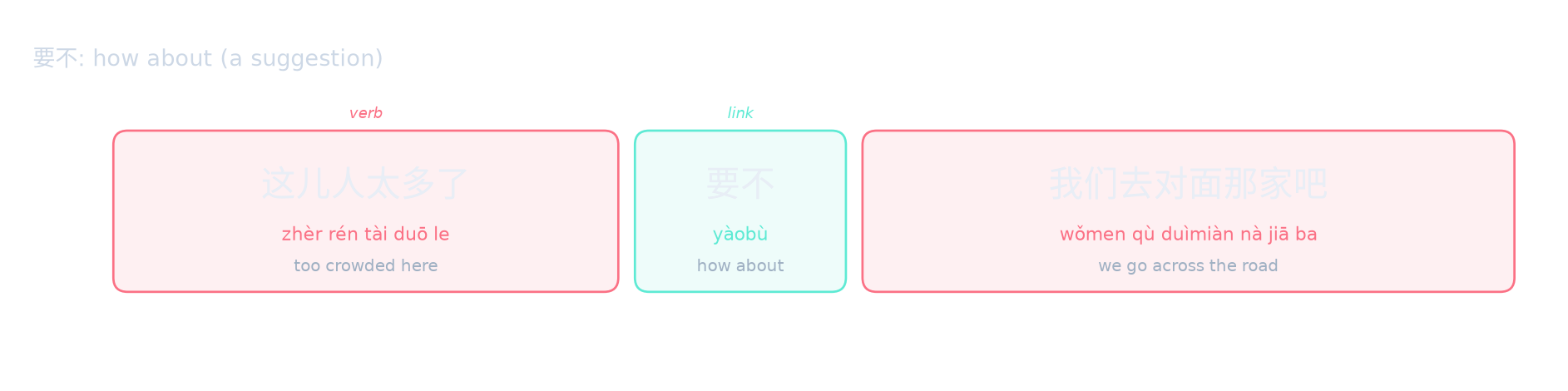
要不 puts a plan B on the table and quietly asks whether the other person agrees: how about, why don't we. 吧 at the end keeps the inviting tone: 要不我们去对面那家吧。 It…
English explanations + Mandarin examples · captions follow the spoken text
4.1
At a glance
Suggestions and warnings
- 1. want / will / need要not不 … (suggestion)吧 – how about …: here这儿人太多(completed / change)了,want / will / need要not不we / us我们to go去opposite对面that那home / family / (measure: shops)家(suggestion)吧。
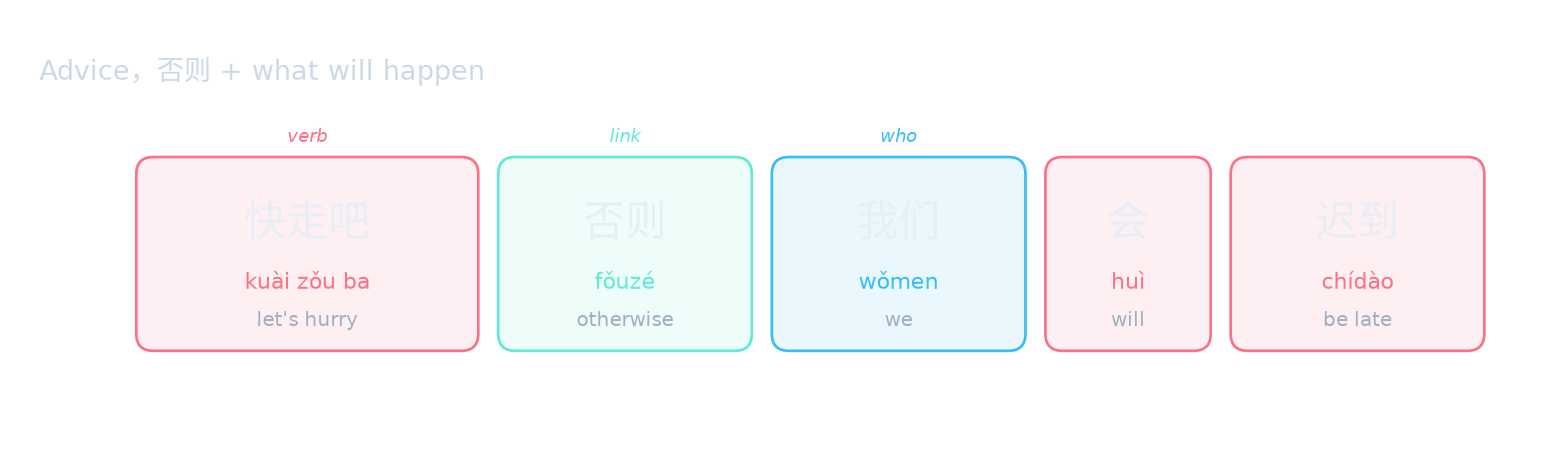
- 2. otherwise否则 / otherwise; or else不然 – otherwise: fast; soon快to walk / to leave走(suggestion)吧,otherwise否则we / us我们can / will会to arrive late迟到(modifier / structural particle)的。
Essay connectors
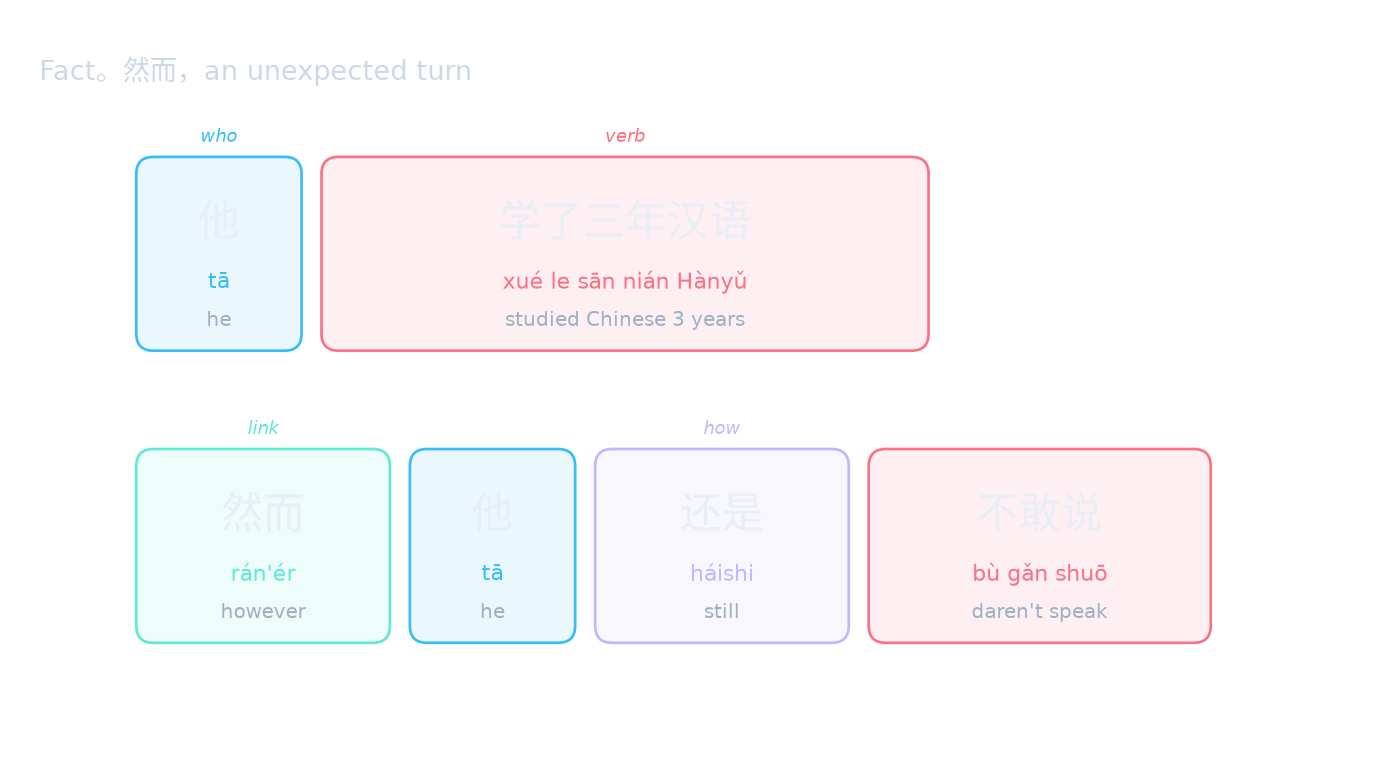
- 3. however然而 – however – formal: 他学(completed / change)了三年Chinese language汉语。
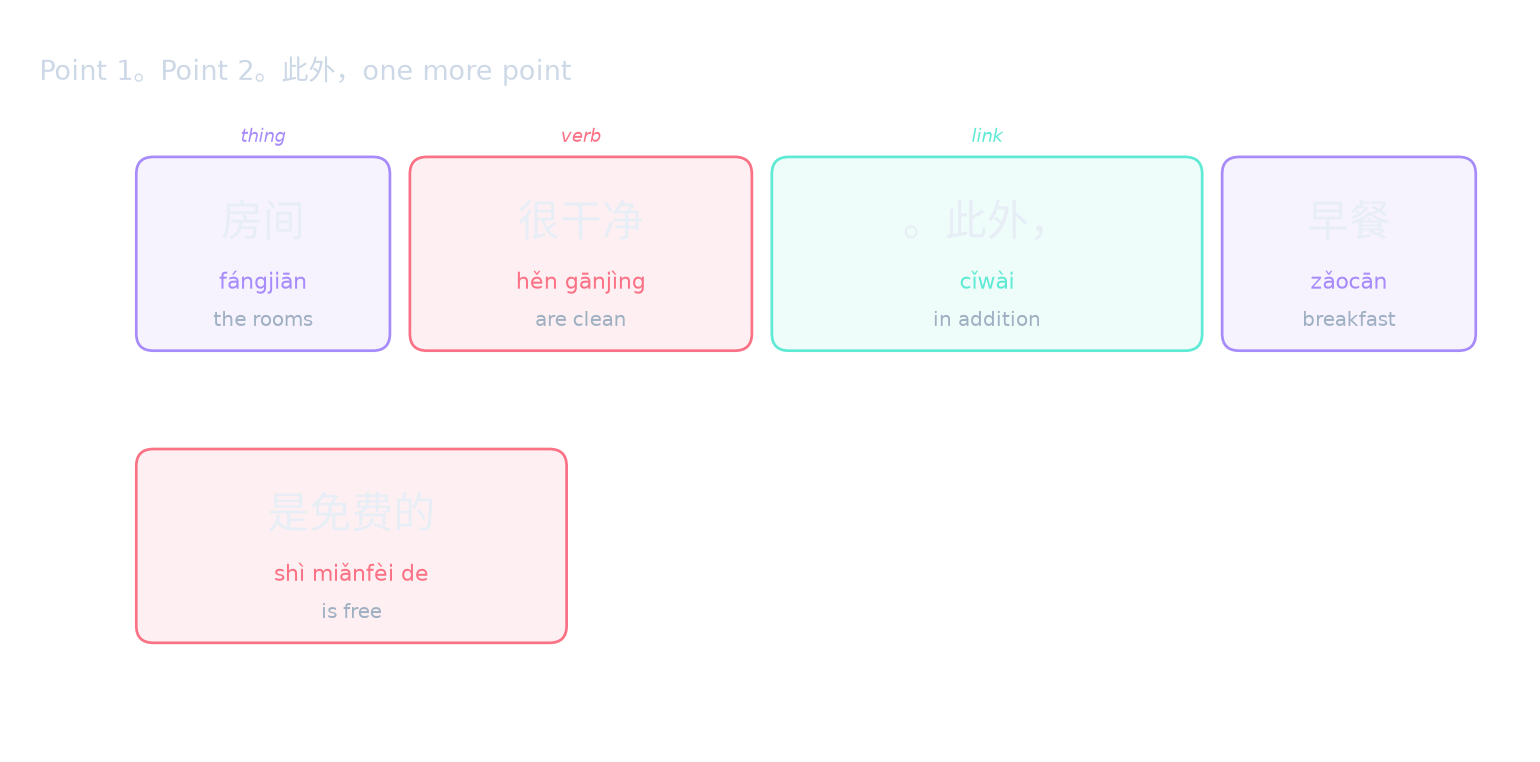
- 4. besides此外 – in addition: 这家hotel酒店away from离subway station地铁站很近,room房间also也degree / adjective linker很clean干净。
- 5. therefore因而 / thereby; thus从而 – therefore / thereby: he / him他every day每天and / with和China中国friend朋友to chat聊天,thereby; thus从而to raise / improve提高(completed / change)了colloquial speech口语level水平。
- 6. so we can see可见 – this shows / clearly: he / him他every day每天all / both都to learn (sth)学到midnight半夜,so we can see可见he / him他to have / there is有many; much多to work hard / effort努力。
4.2
1. 要不 … 吧 (how about …)
Form: (problem,) want / will / need要not不 + suggestion + (suggestion)吧
- here这儿人太多(completed / change)了,want / will / need要not不we / us我们to go去opposite对面that那home / family / (measure: shops)家(suggestion)吧。 Zhèr rén tài duō le, yàobù wǒmen qù duìmiàn nà jiā ba. – It's too crowded here; how about the place across the road?
- want / will / need要not不we / us我们to take a taxi (in town)打车(suggestion)吧。 Yàobù wǒmen dǎchē ba. – How about we take a taxi?
- maybe / possible可能to rain下雨,want / will / need要not不we / us我们(把: marks the object)把picnic野餐to change改to / arrive / (result: get)到indoor室内(suggestion)吧。 Kěnéng xià yǔ, yàobù wǒmen bǎ yěcān gǎi dào shìnèi ba. – It might rain; how about moving the picnic indoors?
- you你太累(completed / change)了,want / will / need要not不first先to rest休息(used after a verb) give it…一下(suggestion)吧。 Nǐ tài lèi le, yàobù xiān xiūxi yíxià ba. – You're exhausted; why not rest for a bit first?
- telephone电话inside; in里说不清楚,want / will / need要not不we / us我们to meet见面to talk (about)谈(suggestion)吧。 Diànhuà li shuō bu qīngchu, yàobù wǒmen jiànmiàn tán ba. – It's hard to explain on the phone; how about we talk in person?
- A:Saturday周六I / me我to be occupied with sth有事。 B:那要not不to change改to / arrive / (result: get)到Sunday周日(suggestion)吧? A: Zhōuliù wǒ yǒu shì. B: Nà yàobù gǎi dào zhōurì ba? – A: I'm busy on Saturday. B: Then how about Sunday?
How it works. want / will / need要not不 yàobù at the start of a clause offers another option, "how about …, why don't we …". It usually comes right after a reason the first plan won't work (人太多(completed / change)了, maybe / possible可能to rain下雨, I / me我to be occupied with sth有事), so the order is: problem, then want / will / need要not不 + new idea. (suggestion)吧 at the end keeps it a friendly suggestion rather than an order, and a question mark is fine too.
that那 often comes before it in a reply (那要not不……(suggestion)吧). The subject can be we / us我们, you你, or left out when it is obvious.
| Expression | Meaning | Example |
|---|---|---|
| want / will / need要not不……(suggestion)吧 | how about (a new idea) | want / will / need要not不we / us我们坐地铁(suggestion)吧? |
| or / still还是……(suggestion)吧 | had better (after weighing options) | want / think / miss想(completed / change)了want / think / miss想,or / still还是坐地铁(suggestion)吧。 |
| otherwise要不然 | otherwise | fast; soon快to walk / to leave走,otherwise要不然then / just就to arrive late迟到(completed / change)了。 |
| if it were not for要不是 | if it weren't for | if it were not for要不是you你to help帮I / me我,I / me我then / just就to finish完(completed / change)了。 |
Watch out
- Without (suggestion)吧 the suggestion can sound abrupt: wrong: want / will / need要not不we / us我们to take a taxi (in town)打车 → want / will / need要not不we / us我们to take a taxi (in town)打车(suggestion)吧.
- In fast speech want / will / need要not不 can also mean "otherwise" (fast; soon快to walk / to leave走,want / will / need要not不then / just就to arrive late迟到(completed / change)了). It is a suggestion only when a new plan follows, usually with (suggestion)吧.
- Do not confuse it with if it were not for要不是 ("if it weren't for"), which talks about the past.
In a passage
小王:cinema ticket电影票to be sold out卖完(completed / change)了,what's to be done怎么办?
小李:want / will / need要not不we / us我们看晚a little一点儿(modifier / structural particle)的那场(suggestion)吧?
小王:太晚(completed / change)了,I / me我tomorrow明天还要to go to work上班。
小李:那要not不we / us我们改天再来(suggestion)吧,today今天first先to go去to have a meal吃饭。
小王:good好idea; plan主意!
Read and notice. What problem comes before each want / will / need要not不? Which suggestion does 小王 accept?
4.3
2. 否则 / 不然 (otherwise)
Form: advice / condition,otherwise否则 / otherwise; or else不然 / otherwise要不然 + (can / will会 / then / just就) result
- fast; soon快to walk / to leave走(suggestion)吧,otherwise否则we / us我们can / will会to arrive late迟到(modifier / structural particle)的。 Kuài zǒu ba, fǒuzé wǒmen huì chídào de. – Let's hurry, otherwise we'll be late.
- to take along with one带上umbrella伞,otherwise; or else不然can / will会to get soaked淋湿(modifier / structural particle)的。 – Take an umbrella, or you'll get wet.
- fortunately幸亏you你to come来(completed / change)了,otherwise; or else不然I / me我then / just就to walk / to leave走(completed / change)了。 – Luckily you came, otherwise I'd have left.
How it works. The first clause gives advice or something that must happen. otherwise否则 ("otherwise, if not") starts the second clause and says what follows if it doesn't. otherwise否则 is formal; otherwise; or else不然 and otherwise要不然 are spoken.
| otherwise否则 | otherwise; or else不然 / otherwise要不然 | want / will / need要not不 … (suggestion)吧 |
|---|---|---|
| otherwise (formal) | otherwise (spoken) | how about … (a suggestion) |
Watch out
- wrong: if如果you你早点儿to sleep睡,otherwise否则… → you你(degree marker)得早点儿to sleep睡,otherwise否则….
- otherwise否则 comes before the subject of the second clause.
Vocabulary
Train
| 汉字 | Pinyin | English |
|---|---|---|
| 不然 | bù rán | otherwise; or else |
| 幸亏 | xìng kuī | fortunately |
4.4
3. 然而 (however – formal)
Form: statement。however然而,+ contrasting statement
- 他学(completed / change)了三年Chinese language汉语。however然而,he / him他or / still还是不敢to open one's mouth开口to speak说。 Tā xuéle sān nián Hànyǔ. Rán'ér, tā háishi bù gǎn kāikǒu shuō. – He has studied Chinese for three years. However, he still doesn't dare to speak.
- however然而,matter; thing (to do)事情and并not have / haven't没有so much这么simple简单。 – However, things were not that simple.
- although虽然everyone大家all / both都degree / adjective linker很to work hard / effort努力,however然而result; as a result结果and并not不ideal; dream理想。 – Although everyone worked hard, the result was not ideal.
How it works. however然而 turns to a contrast in formal writing. It usually starts the second sentence or a new paragraph and is followed by a comma.
| however然而 | but但是 / but可是 | then / after然后 |
|---|---|---|
| however (formal writing) | but (speech and writing) | then, next (time order) |
Watch out
- wrong: 我先to have a meal吃饭,however然而to go去school学校 → 我先to have a meal吃饭,then / after然后to go去school学校.
- In conversation, use but但是 / but可是, not however然而.
4.5
4. 此外 (in addition)
Form: point(s)。besides此外,+ one more point · apart from this除此之外,…
- 这家hotel酒店away from离subway station地铁站很近,room房间also也degree / adjective linker很clean干净。besides此外,breakfast早餐to be / is是free免费(modifier / structural particle)的。 Cǐwài, zǎocān shì miǎnfèi de. – This hotel is close to the metro and the rooms are clean. In addition, breakfast is free.
- meeting会议九点to start开始。besides此外,please; to invite请everyone大家to take along with one带上laptop笔记本电脑。 – The meeting starts at nine. Also, please bring your laptops.
- apart from this除此之外,here这里(modifier / structural particle)的service / to serve服务also也degree / adjective linker很good好。 – Besides this, the service here is good too.
How it works. besides此外 starts a new sentence and adds one more point. It is common in formal writing, notices and reports. apart from this除此之外 means the same.
| besides此外,… | besides; other另外一个question / problem问题 | …,moreover而且 … |
|---|---|---|
| in addition (new sentence, formal) | another problem (besides; other另外 before a noun) | and also (inside one sentence) |
Watch out
- wrong: besides此外一个question / problem问题 → besides; other另外一个question / problem问题.
- To join two points inside one sentence, use moreover而且.
Vocabulary
Train
| 汉字 | Pinyin | English |
|---|---|---|
| 此外 | cǐ wài | besides |
4.6
5. 因而 / 从而 (therefore / thereby)
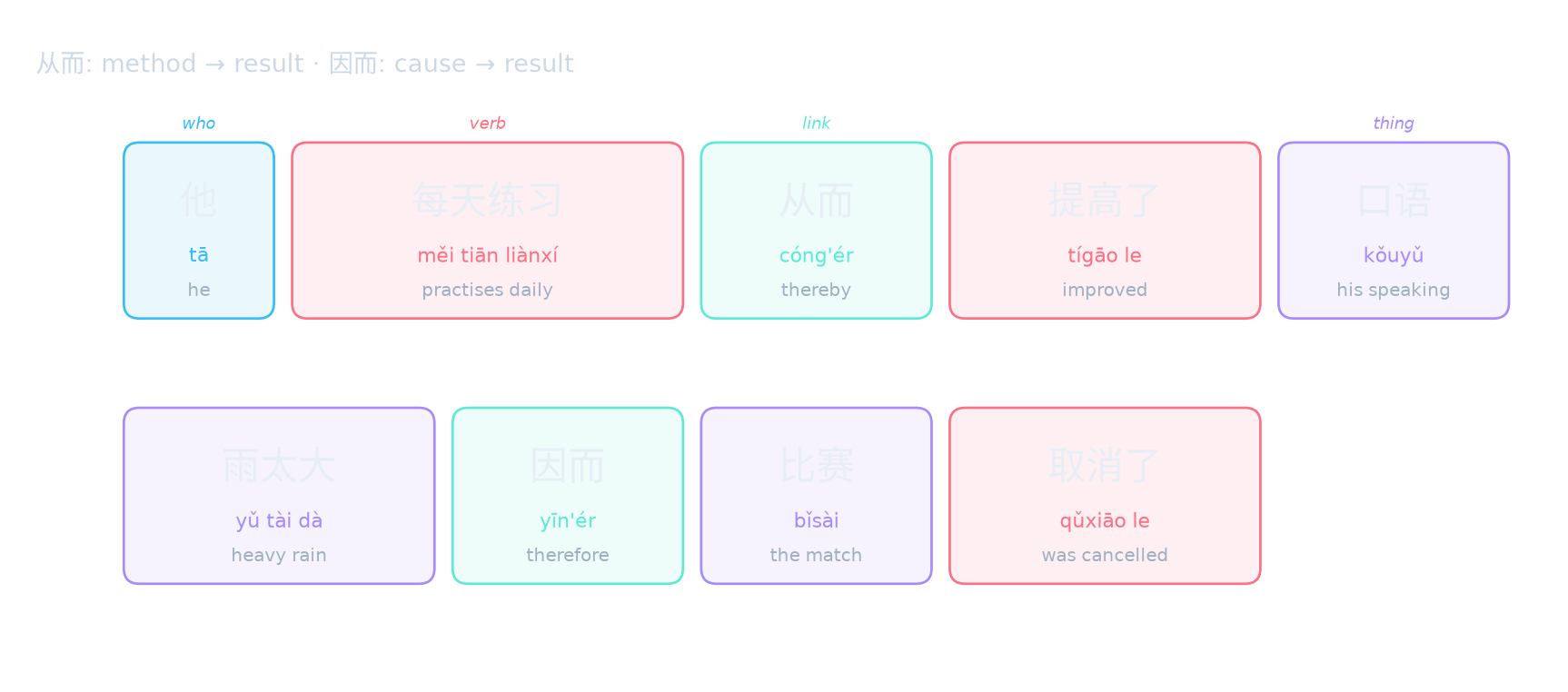
Form: action / method,thereby; thus从而 + verb · cause,therefore因而 + result
- he / him他every day每天and / with和China中国friend朋友to chat聊天,thereby; thus从而to raise / improve提高(completed / change)了colloquial speech口语level水平。 Tā měi tiān hé Zhōngguó péngyou liáotiān, cóng'ér tígāole kǒuyǔ shuǐpíng. – He chatted with Chinese friends every day, and so improved his speaking.
- we / us我们to improve (methods)改进(completed / change)了method方法,thereby; thus从而to save (resources)节约(completed / change)了time时间。 – We improved our method, and so saved time.
- 雨下(degree marker)得too太big大,therefore因而competition比赛to cancel取消(completed / change)了。 – The rain was too heavy, so the match was cancelled.
How it works. Both are formal. thereby; thus从而 says what an action achieved; the subject stays the same, so thereby; thus从而 is followed by a verb. therefore因而 is a formal so / therefore所以: a cause, then a result, which may have a new subject.
| thereby; thus从而 | therefore因而 / therefore因此 | so / therefore所以 |
|---|---|---|
| by doing this, achieved … | therefore (formal) | so (pairs with because因为) |
Watch out
- wrong: 雨太大,thereby; thus从而competition比赛to cancel取消(completed / change)了 → 雨太大,therefore因而competition比赛to cancel取消(completed / change)了 (rain is not an action someone took).
- wrong: because因为to rain下雨,thereby; thus从而… → because因为to rain下雨,so / therefore所以….
Vocabulary
Train
| 汉字 | Pinyin | English |
|---|---|---|
| 因而 | yīn ér | therefore |
| 从而 | cóng ér | thereby; thus |
| 改进 | gǎi jìn | to improve (methods) |
| 取消 | qǔ xiāo | to cancel |
4.7
6. 可见 (this shows / clearly)
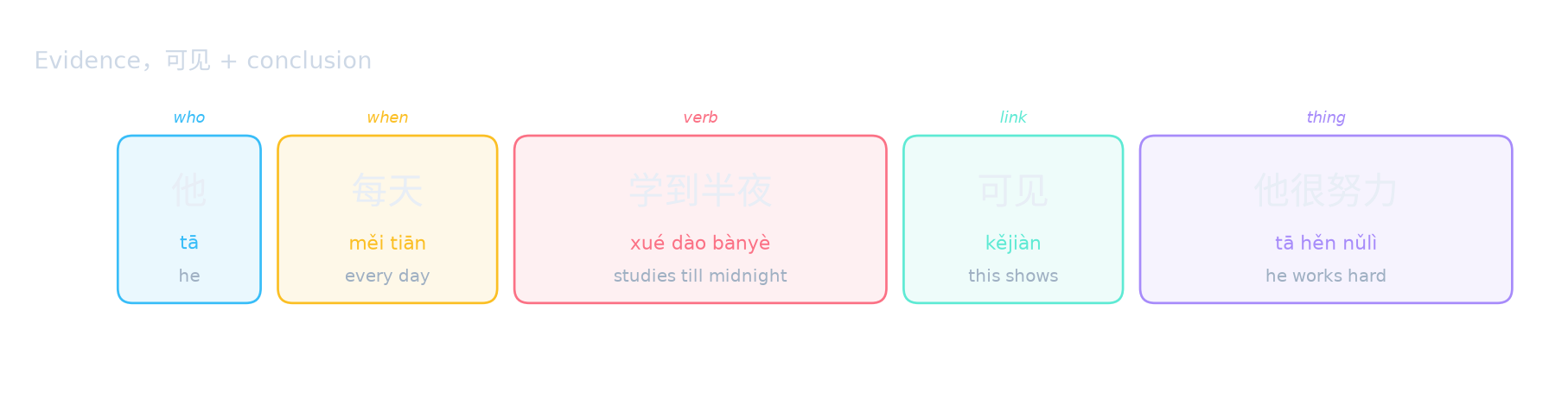
Form: evidence,so we can see可见 + conclusion · from this, it can be seen…由此可见,+ conclusion
- he / him他every day每天all / both都to learn (sth)学到midnight半夜,so we can see可见he / him他to have / there is有many; much多to work hard / effort努力。 Tā měi tiān dōu xué dào bànyè, kějiàn tā yǒu duō nǔlì. – He studies until midnight every day, which shows how hard he works.
- 这家shop店every day每天all / both都排长队,so we can see可见thing; stuff东西degree / adjective linker很tasty好吃。 – There's a long queue at this shop every day, so the food must be good.
- from this, it can be seen…由此可见,good好habit / be used to习惯to / towards / correct对to study; to learn学习very非常important重要。 – From this we can see that good habits are very important for study.
How it works. so we can see可见 draws a conclusion from facts you have just given. from this, it can be seen…由此可见 sums up the examples in an essay paragraph.
| it seems (from this)看来want / will / need要to rain下雨(completed / change)了 | he / him他three times三次all / both都not / haven't没to come来,so we can see可见he / him他not want to不想to participate参加 |
|---|---|
| it seems (a guess) | this shows (a conclusion from facts) |
Watch out
- The facts come first, then so we can see可见.
- so we can see可见 does not take an object: wrong: I / me我so we can see可见he / him他 → I / me我to see看见he / him他.
Vocabulary
Train
| 汉字 | Pinyin | English |
|---|---|---|
| 可见 | kě jiàn | so we can see |
| 看来 | kàn lai | it seems (from this) |
4.8
Practice
Cover the teaching pages before you answer. The answers are at the end.
1. want / will / need要not不 … (suggestion)吧 (how about …)
1. Suggest: “How about we take a taxi?” …………we / us我们to take a taxi (in town)打车(suggestion)吧。
2. What does if it were not for要不是you你to help帮I / me我,I / me我then / just就to finish完(completed / change)了 mean?
- A. I didn't need your help.
- B. If you hadn't helped me, I'd have been done for.
- C. Help me, or else.
- D. How about you help me?
3. Build: “It might rain; how about moving the picnic indoors?”
Put in order: we / us我们(把: marks the object)把picnic野餐 / to change改to / arrive / (result: get)到indoor室内(suggestion)吧。 / maybe / possible可能to rain下雨 / ,want / will / need要not不
4. True or false? otherwise要不然 means “otherwise”. If false, correct it.
5. You and a friend walk into a café, and every table is taken. Use want / will / need要not不 … (suggestion)吧. Write your answer in Chinese, then say it aloud.
2. otherwise否则 / otherwise; or else不然 (otherwise)
6. Complete: “Wear more clothes, otherwise you'll catch a cold.” you你(degree marker)得many; much多to wear穿a little点儿,…………can / will会to catch cold感冒(modifier / structural particle)的。
7. Which sentence is correct?
- A. you你(degree marker)得早点儿to sleep睡,otherwise否则tomorrow明天起不来。
- B. you你(degree marker)得早点儿to sleep睡,tomorrow明天otherwise否则起不来。
- C. if如果you你早点儿to sleep睡,otherwise否则tomorrow明天起不来。
8. Build: “Take an umbrella, or you'll get wet.”
Put in order: can / will会 / to take along with one带上umbrella伞, / otherwise; or else不然 / to get soaked淋湿(modifier / structural particle)的。
9. “How about taking a taxi?” Which word makes this suggestion? ____we / us我们to take a taxi (in town)打车(suggestion)吧?
- A. otherwise否则
- B. want / will / need要not不
10. True or false? otherwise; or else不然 can look back at the past, as in fortunately幸亏you你to come来(completed / change)了,otherwise; or else不然I / me我then / just就to walk / to leave走(completed / change)了. If false, correct it.
11. Your younger brother is playing games the night before an exam. Give him two pieces of advice, each with what will happen otherwise (otherwise否则 / otherwise; or else不然). Write your answer in Chinese, then say it aloud.
3. however然而 (however – formal)
12. Complete: “He has studied for three years. However, he still doesn't dare to speak.” 他学(completed / change)了三年。…………,he / him他or / still还是不敢to speak说。
13. “I'll eat first, then go to school.” Which word fits? 我先to have a meal吃饭,____to go去school学校。
- A. then / after然后
- B. moreover而且
- C. however然而
14. Build: “However, things were not that simple.”
Put in order: however然而, / and并not have / haven't没有 / so much这么simple简单。 / matter; thing (to do)事情
15. You are chatting with a friend: “This shirt is nice, but too expensive.” Which sounds most natural?
- A. 这件clothes衣服degree / adjective linker很good-looking好看,however然而太贵(completed / change)了。
- B. 这件clothes衣服degree / adjective linker很good-looking好看,but可是太贵(completed / change)了。
16. True or false? however然而 can open a new paragraph in an essay. If false, correct it.
17. Write two sentences for an essay about smartphones: first a good point, then a problem introduced with however然而. Write your answer in Chinese, then say it aloud.
4. besides此外 (in addition)
18. Complete: “The rooms are clean. In addition, breakfast is free.” room房间degree / adjective linker很clean干净。…………,breakfast早餐to be / is是free免费(modifier / structural particle)的。
19. “There is another problem.” Which is right? also / there is still还有____。
- A. besides; other另外一个question / problem问题
- B. besides此外一个question / problem问题
20. Build: “Also, please bring your laptops.”
Put in order: please; to invite请everyone大家 / besides此外, / to take along with one带上 / laptop笔记本电脑。
21. “The room is clean, and cheap too.” Which word joins the two points inside one sentence? room房间degree / adjective linker很clean干净,____degree / adjective linker很cheap便宜。
- A. besides此外
- B. moreover而且
22. True or false? apart from this除此之外 means the same as besides此外. If false, correct it.
23. Write a short notice for a class trip: give the time and place, then add one more instruction with besides此外. Write your answer in Chinese, then say it aloud.
5. therefore因而 / thereby; thus从而 (therefore / thereby)
24. Complete: “We improved our method, and so saved time.” we / us我们to improve (methods)改进(completed / change)了method方法,…………to save (resources)节约(completed / change)了time时间。
25. Choose the better word: 雨下(degree marker)得too太big大,____competition比赛to cancel取消(completed / change)了。
- A. therefore因而
- B. thereby; thus从而
26. Build: “He practised every day, and so improved his speaking.”
Put in order: he / him他every day每天to practice练习, / colloquial speech口语level水平。 / thereby; thus从而 / to raise / improve提高(completed / change)了
27. Which sentence is correct?
- A. because因为to rain下雨,therefore因而thereby; thus从而competition比赛to cancel取消(completed / change)了。
- B. because因为to rain下雨,thereby; thus从而competition比赛to cancel取消(completed / change)了。
- C. because因为to rain下雨,so / therefore所以competition比赛to cancel取消(completed / change)了。
28. True or false? therefore因而 is a formal word for so / therefore所以. If false, correct it.
29. Write two sentences for a report about your school: one change the school made and what it achieved (thereby; thus从而), and one cause and its result (therefore因而). Use therefore因而 / thereby; thus从而. Write your answer in Chinese, then say it aloud.
6. so we can see可见 (this shows / clearly)
30. Complete: “There's a long queue every day, so the food must be good.” 这家shop店every day每天all / both都排长队,…………thing; stuff东西degree / adjective linker很tasty好吃。
31. Which sentence is correct?
- A. he / him他three times三次all / both都not / haven't没to come来,so we can see可见he / him他not want to不想to participate参加。
- B. he / him他three times三次all / both都not / haven't没to come来,he / him他so we can see可见not want to不想to participate参加。
- C. so we can see可见he / him他not want to不想to participate参加,he / him他three times三次all / both都not / haven't没to come来。
32. Build: “From this we can see that good habits are very important.”
Put in order: from this, it can be seen…由此可见, / good好habit / be used to习惯 / important重要。 / very非常
33. You look out of the window at dark clouds. “It looks like rain.” Which fits?
- A. it seems (from this)看来want / will / need要to rain下雨(completed / change)了。
- B. so we can see可见want / will / need要to rain下雨(completed / change)了。
34. True or false? from this, it can be seen…由此可见 often opens the last sentence of an essay paragraph. If false, correct it.
35. Write a short essay paragraph: give two facts about a classmate who reads a lot, then conclude with from this, it can be seen…由此可见. Write your answer in Chinese, then say it aloud.
4.9
Mixed practice
These questions mix the patterns and use new situations.
36. Find and fix the problem. You say want / will / need要not不we / us我们坐地铁(suggestion)吧. A classmate translates it as "Otherwise we will definitely take the metro." Correct it.
37. Use it yourself. Suggest moving the meeting to tomorrow because many people are busy today.
4.10
Answers and explanations
Mark your work, then correct each mistake in your own words.
1. want / will / need要not不 … (suggestion)吧 (how about …)
1. want / will / need要not不
want / will / need要not不 + suggestion + (suggestion)吧.
2. B. If you hadn't helped me, I'd have been done for.
if it were not for要不是 means “if it weren't for”: it introduces a condition contrary to fact. if it were not for要不是you你to help帮I / me我,I / me我then / just就to finish完(completed / change)了 “If you hadn't helped me, I'd have been done for.”
3. maybe / possible可能to rain下雨,want / will / need要not不we / us我们(把: marks the object)把picnic野餐to change改to / arrive / (result: get)到indoor室内(suggestion)吧。
Reason, then want / will / need要not不 + suggestion.
4. True.
True. otherwise要不然 (also want / will / need要not不) means “otherwise”: fast; soon快to walk / to leave走,otherwise要不然then / just就to arrive late迟到(completed / change)了 “Hurry up, otherwise we'll be late.”
5. Model answer: here这儿人太多(completed / change)了,want / will / need要not不we / us我们to go去opposite对面that那home / family / (measure: shops)家(suggestion)吧。
Check your answer:
- if it were not for要不是 = "if it weren't for": if it were not for要不是you你to remind提醒I / me我,I / me我then / just就to forget忘(completed / change)了 – "If you hadn't reminded me, I'd have forgotten."
- otherwise要不然 = "otherwise": fast; soon快to walk / to leave走,otherwise要不然then / just就to arrive late迟到(completed / change)了 ("Hurry up, or we’ll be late"). Different from the suggestion want / will / need要not不.
2. otherwise否则 / otherwise; or else不然 (otherwise)
6. otherwise否则
Advice first, then otherwise否则 + what will happen.
7. A. you你(degree marker)得早点儿to sleep睡,otherwise否则tomorrow明天起不来。
No if如果 before otherwise否则, and otherwise否则 starts the second clause.
8. to take along with one带上umbrella伞,otherwise; or else不然can / will会to get soaked淋湿(modifier / structural particle)的。
otherwise; or else不然 + can / will会 + result.
9. B. want / will / need要not不
want / will / need要not不 … (suggestion)吧 makes a suggestion; otherwise否则 only means "otherwise".
10. True.
otherwise; or else不然 here means "if you hadn't come".
11. Model answer: 快去to review复习(suggestion)吧,otherwise否则tomorrow明天unified examination会考no good不好(modifier / structural particle)的。早点儿to sleep睡觉,otherwise; or else不然tomorrow明天起不来。
Check your answer:
- Each sentence gives advice first, then otherwise否则 / otherwise; or else不然 + result.
- I did not put if如果 before otherwise否则.
- I said it aloud before comparing with the model.
Your answer need not copy the model. A partner or teacher must hear the spoken response to comment on pronunciation.
3. however然而 (however – formal)
12. however然而
however然而 turns to a contrast in formal writing.
13. A. then / after然后
then / after然后 = then (time order). however然而 = however.
14. however然而,matter; thing (to do)事情and并not have / haven't没有so much这么simple简单。
however然而 opens the sentence, followed by a comma.
15. B. 这件clothes衣服degree / adjective linker很good-looking好看,but可是太贵(completed / change)了。
In conversation but可是 / but但是 sound natural; however然而 is for formal writing.
16. True.
however然而,… can turn the whole argument at the start of a paragraph.
17. Model answer: mobile phone手机to let / make让we / us我们(modifier / structural particle)的life; to live生活convenient方便(completed / change)了很多。however然而,很多person人每天花too太many; much多time时间to look at; to watch; to read看mobile phone手机,influence影响(completed / change)了to study; to learn学习and / with和sleep睡眠。
Check your answer:
- however然而 starts the second sentence and is followed by a comma.
- The second sentence really contrasts with the first.
- I read it aloud before comparing with the model.
Your answer need not copy the model.
4. besides此外 (in addition)
18. besides此外
besides此外 starts a new sentence with one more point.
19. A. besides; other另外一个question / problem问题
Only besides; other另外 can go before a number and noun.
20. besides此外,please; to invite请everyone大家to take along with one带上laptop笔记本电脑。
besides此外 opens the sentence, followed by a comma.
21. B. moreover而且
moreover而且 links two points in one sentence; besides此外 starts a new sentence.
22. True.
Both mean "besides this, in addition".
23. Model answer: we / us我们Saturday星期六early morning早上八点at / in在school学校doorway门口to gather集合。besides此外,please; to invite请everyone大家to take along with one带上water水and / with和umbrella雨伞。
Check your answer:
- besides此外 starts a new sentence and adds one more point.
- The notice sounds clear and formal.
- I read it aloud before comparing with the model.
Your answer need not copy the model.
5. therefore因而 / thereby; thus从而 (therefore / thereby)
24. thereby; thus从而
An action (to improve (methods)改进method方法) leads to a result, so thereby; thus从而 + verb.
25. A. therefore因而
The rain is a cause, not an action someone took, and competition比赛 is a new subject. Use therefore因而.
26. he / him他every day每天to practice练习,thereby; thus从而to raise / improve提高(completed / change)了colloquial speech口语level水平。
Method, then thereby; thus从而 + verb (no new subject).
27. C. because因为to rain下雨,so / therefore所以competition比赛to cancel取消(completed / change)了。
because因为 pairs with so / therefore所以. thereby; thus从而 needs an action first.
28. True.
therefore因而 / therefore因此 = therefore, formal.
29. Model answer: school学校to increase增加(completed / change)了体育课,thereby; thus从而to raise / improve提高(completed / change)了student学生(modifier / structural particle)的身体素质。this year今年to sign up报名(modifier / structural particle)的person人很多,therefore因而school学校again又to open; to drive开(completed / change)了两个class班。
Check your answer:
- The thereby; thus从而 sentence starts with an action and keeps the same subject.
- The therefore因而 sentence starts with a cause.
- I read it aloud before comparing with the model.
Your answer need not copy the model.
6. so we can see可见 (this shows / clearly)
30. so we can see可见
Facts first, then so we can see可见 + the conclusion.
31. A. he / him他three times三次all / both都not / haven't没to come来,so we can see可见he / him他not want to不想to participate参加。
The evidence comes first; so we can see可见 then starts the conclusion.
32. from this, it can be seen…由此可见,good好habit / be used to习惯very非常important重要。
from this, it can be seen…由此可见 opens the summing-up sentence.
33. A. it seems (from this)看来want / will / need要to rain下雨(completed / change)了。
A guess from what you see is it seems (from this)看来. so we can see可见 follows facts you have just stated.
34. True.
It sums up the examples before it.
35. Model answer: 小王every day每天all / both都to look at; to watch; to read看half of sth半个hour小时book书。he / him他(modifier / structural particle)的essay; to write an essay作文often常常to get得到teacher老师(modifier / structural particle)的to praise表扬。from this, it can be seen…由此可见,many; much多to read a book读书to / towards / correct对to write写作degree / adjective linker很to have / there is有to help帮助。
Check your answer:
- The facts come before so we can see可见 / from this, it can be seen…由此可见.
- The conclusion really follows from the facts.
- I read it aloud before comparing with the model.
Your answer need not copy the model.
Mixed practice
36. want / will / need要not不……(suggestion)吧 is a soft suggestion: "How about taking the metro instead?" Nothing has been decided.
37. Model answer. today今天很多person人没空,want / will / need要not不we / us我们tomorrow明天again / then / (再…也) however再to hold a meeting开会(suggestion)吧?
Review later. Tomorrow, make two want / will / need要not不……(suggestion)吧 suggestions when a plan does not work.
Interactive lessons on this topic
Work through it step by step, with instant-check exercises.