Thinking, problem solving and intelligence
Scope and prerequisites
Supported GRE topic 19 (TH.1). Use the overview measurement lesson VI when interpreting research evidence. Existing official questions are traced in bank_review_form.yaml; original tasks below are not ETS items.
Concepts and method
availability heuristic 可得性启发式: Estimating frequency or likelihood by how easily examples come to mind. representativeness heuristic 代表性启发式: Judging probability by similarity to a prototype, neglecting base rates.
Concepts group instances; natural concepts have fuzzy boundaries organised around prototypes, so a robin is a "better" bird than a penguin and is verified faster. Schemas are organised knowledge structures about domains; scripts are schemas for event sequences (the restaurant script). Schemas guide encoding and also distort recall toward the expected.
An algorithm guarantees a solution by exhaustive rule; heuristics trade certainty for speed. Availability estimates frequency by ease of recall, so vivid events are overestimated. Representativeness judges by similarity to a prototype and neglects base rates. Anchoring drags estimates toward an initial number. Framing changes choices between logically equivalent descriptions, and confirmation bias seeks only supporting evidence.
Problem solving fails in characteristic ways: functional fixedness (objects only in usual roles), mental set (old solutions to new problems), and missing insight restructuring. Means-end analysis reduces the difference to the goal; working backward suits problems with a clear goal state.
Intelligence theories differ on structure: Spearman's general factor g, Cattell's fluid versus crystallised abilities, Gardner's multiple intelligences, Sternberg's triarchic analysis. Test interpretation follows the psychometrics of earlier units: scores are reliable for prediction within their validation samples, but a score measures performance on the test, not a fixed essence.
An algorithm follows steps that guarantee a solution for its specified problem class when correctly applied. A heuristic is an efficient shortcut that may fail. Representativeness judges similarity and can neglect base rates; availability uses ease of recall and can confuse memorable with frequent. Mental set and functional fixedness constrain which solutions are considered. Intelligence tests measure performances under particular conditions and require validity and fairness evidence for their use.
Worked reasoning
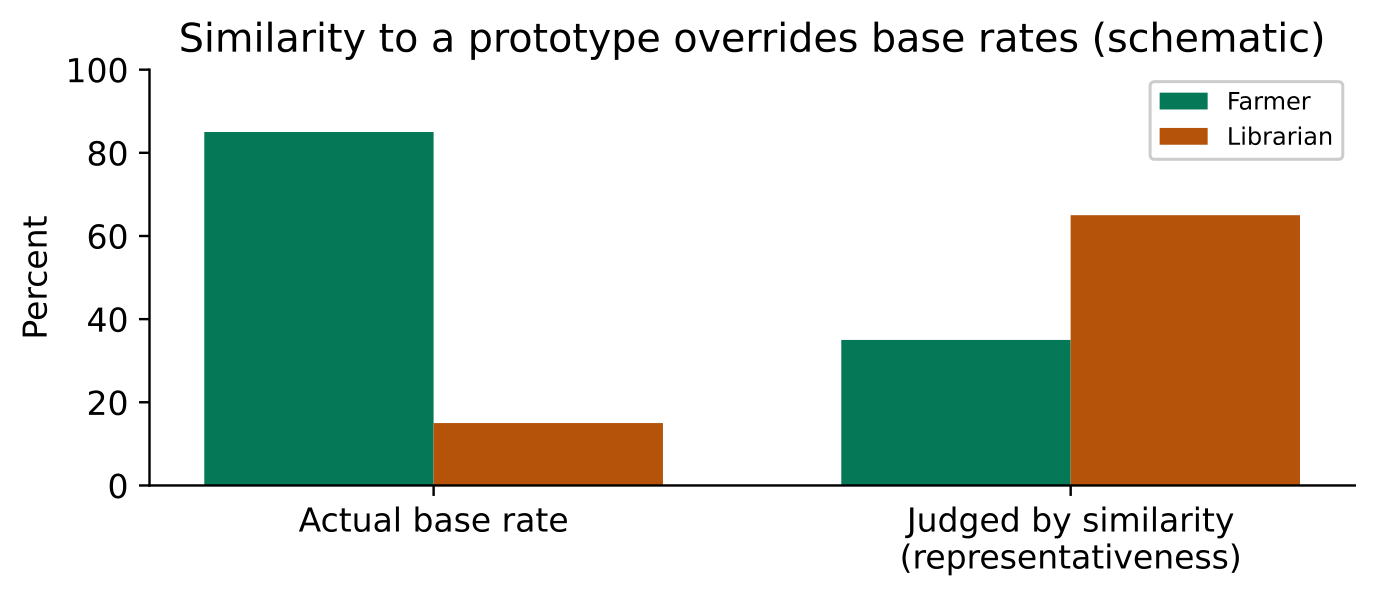
Estimating plane crashes as commoner than car deaths after news coverage is the availability heuristic. Judging a quiet bookish stranger more likely a librarian than a farmer, despite far more farmers, is representativeness neglecting base rates. Using a candle only as a candle, not as part of a shelf, is functional fixedness.
A description fits a rare occupation. A pupil chooses it without checking how many people have each occupation. Identify the reasoning risk.
Representativeness can override base-rate information: similarity to a stereotype does not by itself determine probability. Combine relevant likelihood information with prior frequencies if available. A vivid description supplies neither a population count nor proof of group traits.
Independent transfer
A method works on nine puzzles and fails on a tenth with different constraints. Explain how to decide whether the method is an algorithm or heuristic and propose a response.
Attempt independently, then use the matching skill sheet solution.
Review and source limits
Avoid this error: Calling a heuristic an error in itself; heuristics are efficient defaults whose costs are predictable. Do not equate a test score with a fixed measure of worth or potential. Teaching scope comes from teaching.yaml and the source/key/crop review in bank_review_form.yaml. Detailed current diagnostic criteria require an authenticated manual; neither historical ETS practice nor this educational reference certifies them.