Cognition, language and learning
Scope and prerequisites
Supported GRE topic 2 (II). Read LR.1, ME.1, LG.1, TH.1 and ME.2 for the detailed cognitive mechanisms. Existing official questions are traced in bank_review_form.yaml; original tasks below are not ETS items.
Concepts and method
negative reinforcement 负强化: Removing an aversive condition to increase behaviour. morpheme 语素: A smallest meaningful language unit.
Classical conditioning associates stimuli; operant conditioning changes behaviour through consequences.
Negative reinforcement removes an unpleasant condition and increases behaviour. It is not punishment.
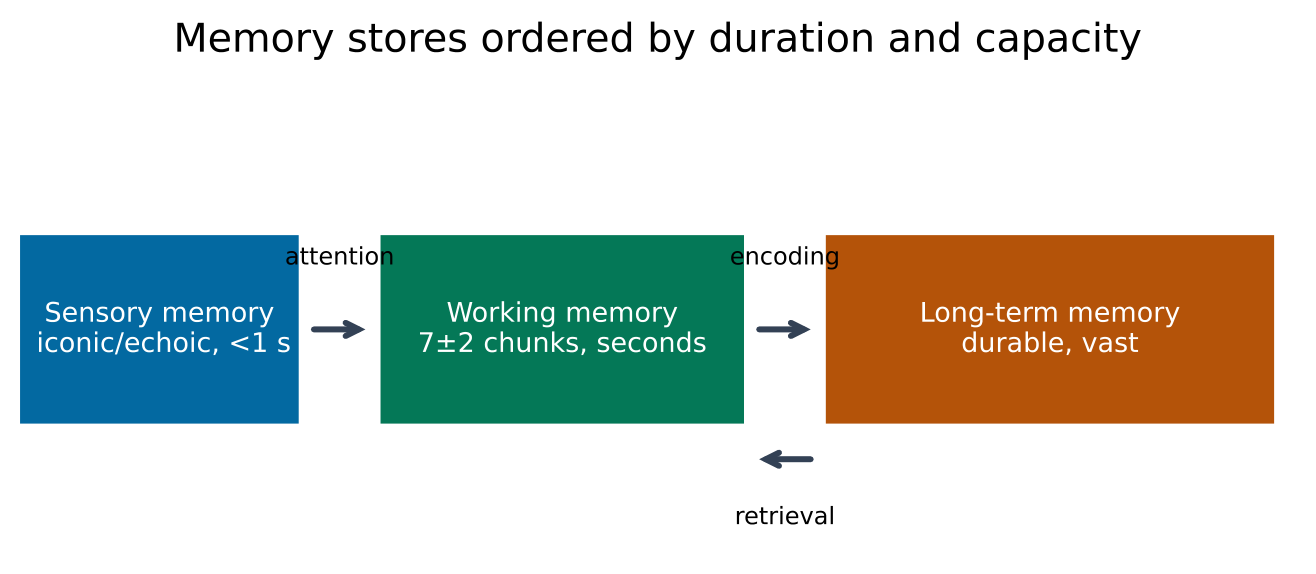
Working memory supports current processing. Long-term memory includes explicit and implicit forms.
Language uses phonemes for sound contrasts and morphemes for meaning units. Problem solving can be limited by fixation or biased heuristics.
Identify what changes before naming a learning process. In classical conditioning, a cue predicts another event and evokes a response. In operant conditioning, a consequence follows an action and changes its future frequency. Memory tasks differ in their retrieval cues: recognizing an answer supplies information that free recall does not. A language task may require sound contrasts, meaningful word parts or sentence structure; identify the level rather than using language as one undivided ability. See LR.1, ME.1, LG.1, TH.1 and ME.2 for detailed teaching.
Worked reasoning
A seat-belt alarm stops when the belt is fastened. Removing the alarm makes fastening more likely: negative reinforcement. If an added fine reduces unsafe driving, that is positive punishment. Positive and negative mean adding and removing, not good and bad.
A child hears a tune before lunch and later salivates to it. Separately, a child earns a token after reading and reads more often. Explain the different processes.
The tune predicts food; salivation to the cue fits classical conditioning. Reading produces a token and subsequently increases; adding that consequence fits positive reinforcement. A pleasant event is not automatically reinforcement: the evidence must include a change in the target action.
Independent transfer
Students remember a definition when shown its first letter but fail to recall it unaided. One claims the memory never existed. Evaluate and propose a comparison.
Attempt independently, then use the matching skill sheet solution.
Review and source limits
Avoid this error: Recognition performance cannot be treated as identical to unaided recall performance. Teaching scope comes from teaching.yaml and the source/key/crop review in bank_review_form.yaml. Detailed current diagnostic criteria require an authenticated manual; neither historical ETS practice nor this educational reference certifies them.