Cognition, language and learning
Introduced| English | Meaning |
|---|---|
| extinction/ekˈstɪŋkʃn/ | A reduction in conditioned responding after repeated CS presentations without the US. |
| negative reinforcement/ˈneɡətɪv ˌriːɪnˈfɔːsmənt/ | An increase in a behaviour because it removes an aversive event. |
| morpheme/ˈmɔːfiːm/ | The smallest unit that carries meaning or a grammatical function. |
Recognised, but not recalled
- A student selects the right psychology term from four options but cannot produce it on a blank page. The two tests provide different retrieval support; a familiar-looking answer can also be wrong.
- This overview connects learning, memory, language and problem solving. For each example, identify what changed, what was measured and what the evidence allows you to conclude.
Classical conditioning
- In a simplified Pavlov-style example, food is an unconditioned stimulus (US) producing salivation, the unconditioned response (UR). A bell is initially neutral with respect to salivation; it may still make the dog turn its head.
- After predictive bell–food pairings, the bell becomes a conditioned stimulus (CS), and salivation to it is a conditioned response (CR). The response label depends on what elicits it: salivation to food is UR, to the learned cue is CR.
Before bell–food conditioning, the bell does not elicit salivation. Relative to that response it is a
Difficulty 1/5 · 100 coins + a small bonus on first completion today
It is neutral with respect to salivation, even if it produces another response such as orienting. Neutral does not mean unable to elicit any response.
Extinction and stimulus control
- Extinction 消退 is a reduction in conditioned responding after repeated CS presentations without the US. It need not erase the earlier learning: responding can return after a rest (spontaneous recovery) or a context change (renewal).
- Generalisation means responding to stimuli similar to the CS. Discrimination means responding differently to them, for example after one tone predicts food and another does not. Similarity alone does not guarantee an identical response.
Presenting the CS repeatedly without the US produces ____ of the conditioned response.
Difficulty 1/5 · 100 coins + a small bonus on first completion today
Extinction reduces the conditioned response through CS-without-US experience. Recovery later shows why reduced responding need not mean erasure.
After extinction, salivation to the bell returns following a rest, without new bell–food pairings. This is
Difficulty 1/5 · 100 coins + a small bonus on first completion today
The time delay distinguishes spontaneous recovery. Renewal instead concerns a changed context; neither requires new acquisition pairings.
Operant conditioning
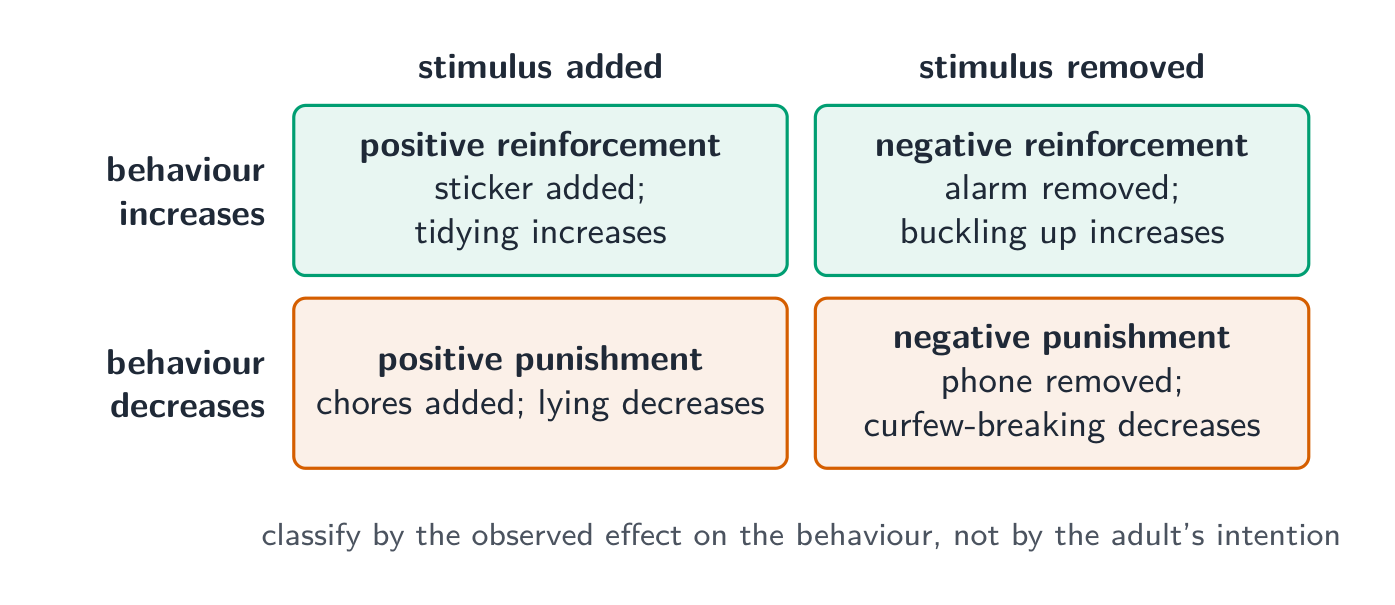
- Operant learning concerns behaviour and its consequences. Reinforcement increases the future behaviour; punishment decreases it. Positive means something is added, and negative means something is removed.
- Negative reinforcement 负强化 is an increase in a behaviour because it removes an aversive event. Classify the observed effect on a specified behaviour, not whether an adult intended to reward or punish; a simple before–after description alone does not establish causation.
Which operant procedure?
Classify an observed effect using addition or removal and future behaviour change.
Negative reinforcement removes something unpleasant and increases the behaviour.
Difficulty 1/5 · 100 coins + a small bonus on first completion today
True: removal of an aversive event reinforces the action only if it increases that action in the future. Negative means removal, not punishment.
Work through the consequence
- Write three parts: behaviour → consequence → later change in that behaviour. Buckling up → alarm stops → buckling becomes more likely is negative reinforcement. Taking a phone away → less curfew-breaking is negative punishment.
- A teacher adds a reprimand after calling out, but calling out then increases. Calling it punishment because it was meant to discourage is incorrect; the pattern is consistent with positive reinforcement, perhaps through attention.
Extra chores follow missed homework. Without information about later homework completion or missed homework, the consequence has been added, but its reinforcing or punishing effect is unknown. If missed homework falls because of the chores, this is positive punishment of missed homework.
A reprimand is added after calling out, and calling out increases because of that attention. Classify the effect on calling out.
Difficulty 1/5 · 100 coins + a small bonus on first completion today
The consequence is added and the specified behaviour increases. Intended discouragement does not make it punishment.
A parent takes away game time after unfinished chores. No later behaviour is reported. Explain what can and cannot be classified.
Game time was removed, so the change is negative. Punishment would require a decrease in unfinished chores because of that consequence. The intention and removal alone do not establish that effect.
Memory functions and capacity
- Sensory traces briefly retain input: visual (iconic) information often lasts less than a second, while auditory (echoic) information can persist for a few seconds. Working memory holds and uses information; long-term memory supports more durable knowledge. These functions interact, rather than forming a compulsory one-way conveyor belt.
- Miller's classic 7 ± 2 describes approximate span findings, not a fixed limit for every task. Cowan's estimate averages about four chunks under conditions that limit rehearsal and combining items. A familiar meaningful group can be one chunk, so task, expertise and grouping matter.
Why can grouping letters into familiar abbreviations improve immediate recall?
Difficulty 1/5 · 100 coins + a small bonus on first completion today
Grouping uses prior knowledge to package information. More letters recalled does not establish an unlimited or enlarged number of independently held chunks.
What kind of long-term memory?
- Explicit (declarative) memory includes episodic memory for events, such as yesterday's lesson, and semantic memory for facts, such as the meaning of reinforcement. Implicit memory is shown through performance without requiring conscious recollection, such as a practised skill or priming.
- A task can draw on several systems. Riding a bicycle involves procedural skill; describing the first day you rode it draws on episodic memory. Some conditioned responses are discussed as nondeclarative learning, but conditioning as a whole does not prove that awareness is absent.
Which is the clearest semantic-memory example?
Difficulty 1/5 · 100 coins + a small bonus on first completion today
A fact is semantic. A personal event is episodic, skilled performance procedural, and changed word completion may demonstrate priming.
Retrieval cues and forgetting
- Free recall asks you to produce studied items with broad instructions; cued recall adds a hint, such as a category. Recognition presents a candidate item and asks whether it was studied. Recall therefore can have cues too, and recognition can produce false alarms.
- Encoding specificity means a cue's usefulness depends on how the event was encoded. A meaningful study association can help later recall. Recognition is often easier under comparable conditions, but this is not a universal ranking; forgetting can reflect retrieval difficulty, interference or loss of information.

What retrieval task is this?
Distinguish retrieval tasks by what is presented and what must be produced.
What retrieval support does a recognition test directly provide?
Difficulty 1/5 · 100 coins + a small bonus on first completion today
The candidate item is presented as a cue. Cued recall also supplies a hint but requires producing the target. Recognition can fail or yield false alarms; it is not always easier.
You studied “river–bank”. Design one cued-recall and one recognition question about bank, then explain why success cannot be ranked from the labels alone.
Cued recall: “Which word was paired with river?” Recognition: “Was bank on the studied list?” The first asks you to produce the target from a cue; the second presents it. Effective study associations, distractors, encoding and test conditions affect performance, so the labels alone do not guarantee which is easier.
Language units
- A phoneme is a sound category that distinguishes words in a language; English /b/ and /p/ distinguish “bat” and “pat”. A morpheme 语素 is the smallest unit that carries meaning or a grammatical function. For example, “unbreakable” has un-, break and -able. Letters, syllables and morphemes count different things.
- Syntax concerns how words and phrases form grammatical structures; semantics concerns meaning. “The dog chased the cat” and “The cat chased the dog” use the same words but assign different roles. Pragmatics concerns interpretation in context: “Can you open the window?” can function as a request.
How many morphemes are in “unbreakable”?
Difficulty 2/5 · 140 coins + a small bonus on first completion today
Three: the prefix un- (not), the root break, and the suffix -able (can be done). Each is the smallest unit that carries meaning.
“Cats chased dogs” and “Dogs chased cats” contain the same words. Explain why their meanings differ, and count the morphemes in cats.
Syntax assigns different subject and object roles, changing who chased whom and thus the sentence meaning. Cats has two morphemes: cat and plural -s; it has one syllable.
Problem solving and heuristics
- Functional fixedness limits an object to its familiar use, such as overlooking a coin as a screwdriver. A mental set repeats a previously successful method when another method would work better. An algorithm follows a specified procedure; its guarantee depends on the problem and whether the procedure applies.
- Heuristics are efficient shortcuts, not automatic errors. Availability estimates frequency from ease of recall; vivid news can distort it. Representativeness judges similarity to a category; resemblance to a stereotype is weak probability evidence if base rates are ignored.
A student judges a rare occupation likely solely because a person resembles its stereotype. Which shortcut is central?
Difficulty 1/5 · 100 coins + a small bonus on first completion today
Representativeness uses resemblance. Ignoring a low base rate can mislead; availability instead centres on how easily examples come to mind.
Put the evidence together
- For learning, identify the cue or action and the observed response change. For memory, specify the task, cue and kind of information; a wrong answer does not by itself diagnose a damaged memory system.
- For language and thinking, identify the unit or strategy before explaining a mistake. Improve a claim by naming its conditions: “often with these cues” or “behaviour decreased after this consequence” is more informative than an absolute rule.
Critique: “All sensory memory lasts under one second; everyone holds seven items; recognition is always better; punishment means an unpleasant consequence.”
Sensory persistence differs across modalities and tasks. Span estimates depend on chunks, rehearsal and knowledge; seven is not a universal limit. Recognition presents candidates but effective cued recall can outperform it. Punishment is defined by a consequence reducing the specified behaviour, not unpleasantness or intention.